New York Gov. Andrew Cuomo’s knife bill veto at the end of 2016 targets minorities and others who carry pocketknives.
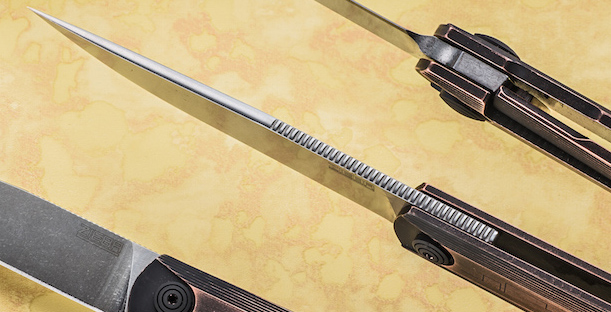
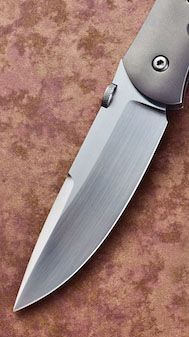
Flipper folders such as the CRKT Acquisition, pocketknives, linerlocks, framelocks and other folding knives remain subject to the definition of switchblade and/or gravity knife as a result of Gov. Andrew Cuomo’s veto of S. 6483-A.
According to Knife Rights, Cuomo vetoed the Gravity Knife and Switchblade Reform Bill, or S. 6483-A. If he had approved it, the bill would have excluded the vast majority of pocketknives, linerlock and framelock folders, flipper folders, assisted openers and other one-hand-opening folding knives from being designated as gravity knives or automatics (aka switchblades) under existing law. As a result of Cuomo’s knife bill veto, those who carry pocketknives, flipper folders, linerlocks and framelocks, and other one-hand-opening folders in New York remain subject to violating the state’s ban on automatics and gravity knives.
Since many minorities in New York City and others throughout the state carry pocketknives and folders and are the ones most likely to be targeted by the law that stays in place as a result of Cuomo’s knife bill veto, they remain subject to a fine and jail time if arrested for carrying said knives. As BLADE® field editor Ed Fowler notes in his story in the upcoming issue of the April BLADE, on newsstands Jan. 24, “The ultimate display of bureaucratic stupidity are the thousands of knife laws that serve no purpose other than to turn law-abiding citizens, usually minorities, into criminals in the name of public safety.”
According to the Knife Rights news release, Knife Rights will return when the New York legislature convenes this year to the job of fixing “the state’s Gravity Knife law to prevent these arrests and prosecutions. This bill passed with such large majorities in both houses of the legislature that an override of a veto is theoretically possible.”
As Knife Rights noted, Cuomo effectively thumbed his nose at a New York legislature that had overwhelmingly passed S. 6483-A, as well as at other New Yorkers, many of whom include his own constituents, who had supported the bill. In so doing, he joined the “Nexus of No” that includes New York City Mayor Bill de Blasio, New York Police Department Commissioner James O’Neill and District Attorney Cyrus Vance, Jr., in being virtually the only ones who oppose S. 6483-A.
The defeated bill would have added wording excluding knives with “a spring, detent or other mechanism designed to create a bias toward closure and that requires exertion applied to the blade by hand, wrist or arm to overcome the bias toward closure and open the knife” from the existing bill’s definition of switchblade. In other words, knives such as pocketknives, linerlocks and framelocks, assisted openers and others could not be defined as switchblades in New York if Cuomo had not vetoed S. 6483-A. Similar wording would have excluded pocketknives, etc., from the definition of gravity knife as well.
Which knifemakers will excel in 2017? What is the mark of knife greatness? When does the magic begin in the making of mosaic damascus, aka canned steel? What were the knife industry’s top stories of 2016? What will not happen in the knife industry in 2017? These and other edge-pressing questions are answered in the latest issue of BLADE®, on newsstands now!
Custom knifemaking is a whirlwind of talented individuals worldwide. Picking the ones on the verge of breakout years is no easy task, but BLADE feature writer Pat Covert tackles the assignment with gusto, interviewing some of the custom industry’s top authorities for their opinions on the subject. Find out which makers will take their work to the edge and beyond in “Will One Steel Your Heart?”

What is the mark of knife greatness? One leading indicator is a knife that, after its debut, serves as a yardstick against which all subsequent knives of a similar type are measured. BLADE field editor Mike Haskew examines these “yardstick knives” in “The Mark of Greatness.”

Mosaic damascus, aka canned steel, provides some of the most beautiful and intricate of blade materials. BLADE feature writer Daniel Jackson visits with some of today’s forgers of the scintillating steel to find out not only why they do it but how in “When The Magic Begins.”
The year past had more than its share of cool happenings in the knife industry, including the first-ever
Read how mosaic damascus is forged, such as on these folders by Mike Tyre, in “When The Magic Begins.” (PointSeven image)Which knifemakers will excel in 2017? One Neil Ostroff highly recommends is Sebastijan Berenji of Borka Blades. (True North Knives image)Find out which knifemakers will excel in 2017 in the latest issue of BLADE®, on newsstands now!
BLADE Show Women’s World Championship Cutting Competition, burgeoning knifemaking stars on social media, pro-knife legislative gains, a world record price for an American knife at auction and much more. Read all about it in “Sharp and Sweet ’16.”
Predicting what will happen in the coming year is a skill far beyond that of yours truly. However, one thing I can do is predict what will not happen in the coming year. Of course, one question remains: Can I even do that? It will take one year to find out. Check out my predictions in “What Will Not Happen in 2017.”
There’s much more in the latest BLADE, including an educational examination of knives and the Second Amendment by Knife Rights’ Doug Ritter (page 6), tests of the latest tantos, flipper folders and factory/custom collaborations, the hottest convenient carry knives and much more, all in the March 2017 BLADE, on newsstands now! For subscription info, click here.
Larry Roberts used the L.T. Wright Knives’ Genesis to survive as a participant on the History channel’s “Alone.”
Larry Roberts, runner-up in the second season of the History channel’s wilderness survival show “Alone,” lasted 64 days in the harsh environs of Vancouver Island with one knife: the Genesis made by L.T. Wright Knives. L.T. Wright knew Roberts as a customer and because he wrote articles for the company’s Self Reliance Illustrated magazine. What he didn’t know, because “Alone” participants are not allowed to discuss the show, was which knife Roberts used on the show. When Roberts was allowed to talk about his experiences, he raved to Wright about how much he appreciated the Genesis. Wright suggested they team up, and a winning partnership was born.
On Dec. 16, LTWK introduced its Larry Roberts Signature Edition Genesis to the public. Fans of the “Alone” star and members of the LTWK Pout House club were eligible for pre-release access for 24 hours prior to the general release.
The premise of the reality show is that a group of outdoorsmen and women are deposited in a remote locale—alone—and whoever can survive the longest, wins—$500,000 to be exact. They are positioned so that natural obstacles prevent them from encountering each other. There is no crew; the participants film themselves and are resupplied with batteries and camera chips. They must build shelters, find enough to eat without expending too many calories, stave off hypothermia and marauding animals, and maintain their sanity.
So, how exactly did Roberts use his knife? The list is extensive. He built small game traps and a fish trap. He used it batonning, feather-sticking, harvesting spruce sap and cedar bark, gutting and filleting fish, processing mice and prying shellfish off of rocks. He used it to make a spoon, a spatula and a fork. He harvested mushrooms with his Genesis, cut cordage and used the sharp 90-degree spine of the knife to strike his ferrocerium rod to start fires. He used the knife to make a spear and tent stakes, and even for first-aid and hygiene tasks, such as removing a splinter or cleaning his fingernails.
The Larry Roberts version of the LTWK Genesis has a broomstick handle and sharpened spine to assist in firebuilding.
The knife measures 9 inches overall. The 4.25-inch blade has a Scandinavian grind, and the chiseled edge is ideal for bushcrafting skills like making kindling, tent stakes and stripping bark, L.T. Wright explained. It used to be, he continued, that outdoor knives were overbuilt to account for hard use in the field, but now that the education and skill level of outdoorsmen has advanced, often through watching and practicing skills learned just on YouTube, thinner-edged knives are sought after by outdoorsmen and survivalists. Roberts, too, praised the knife’s ability to bite deeply into wood.
The Genesis offers a 1/8-inch-thick spear-point blade made of A2 tool steel, following a Kephart design overall. The knives are tested to 57 to 59 HRC on the Rockwell hardness scale, so they are tough but hold an edge, Wright said. The A2 steel, in the opinion of both Wright and Roberts, outperforms O1 and 1095 for edge retention, and corrosion and stain resistance. For his time on the island, Roberts only stropped his knife on his leather belt to remove micro-oxidation from humidity and moisture. He never had to resharpen it at all.
The Roberts version of the Genesis has a broomstick handle because Roberts found the thicker handle easier to hold and control. It also has thumb scallops and a sharpened spine for striking a fire steel against. LTWK made the black Micarta handle with white liners because Roberts likes the black-and-white contrast. The blade is stamped with Roberts’ rendition of his Vancouver Island nemesis: a mouse. “It became an obstacle for me to overcome,” he said of the creature he battled during the show.
The MSRP of the Larry Roberts Signature Edition Genesis is $225 and includes a true 8-ounce black leather sheath with a dangler and 3/8-inch ferro rod loop. Wright prefers to purchase 10-ounce double-died leather from Spen Stelzer, the owner of JRE Industries in Illinois, and have it split to 8 ounces so there are no discrepancies. “We can control consistency better that way,” he explained.
Roberts wanted the largest ferrocerium rod he was allowed to have during the show, so he went with a ½-inch rod and wasn’t able to use the loop that comes with the Genesis sheath. Roberts did use the dangler, however. He explained that it allowed the knife to hang where his hand fell naturally for easy access—just like a gunslinger in a western—and yet carry out of the way of a backpack or any other gear.
Wright grew up playing Tarzan and Rambo in the woods as a boy, and, of course, the tactical use of knives and their implementation in hunting and bushcraft interested him all along. But he wanted to make a living making knives, so he listened to what people told him they wanted. “If you go to a show and come home with all the knives you brought, you’re not going to be in business long,” he said. Like the survivalist industry itself, as the education and skill levels of users advance, so too must the sophistication of the knives. Wright listened.
L.T. Wright (front row, second from left) was surprised and happy to find out his Genesis was the knife Larry Roberts used on the “Alone” series.
At first he made knives as L.T. Wright then as Blind Horse Knives and he’s back as L.T. Wright Knives. Wright learned to make knives from R.W. Wilson, who made the tomahawks for the 1972 movie “Jeremiah Johnson,” a cult favorite among outdoorsmen. “He’s probably sold off all of those,” Wright said, “but I do have a prototype of a tomahawk he made for the Texas Rangers.”
So, it is fitting that Wright should partner up with a man who carried his knife in a reality-based outdoorsman show for the small screen. Roberts grew up in Oregon, spending as much time outside as he could, bait-fishing for steelheads in the Rogue River and bow hunting. His first knife was probably a 3-inch lockback Buck pocketknife, he said. He married his high-school sweetheart, and they had a son and a daughter, now grown and on their own.
Roberts attended the Pathfinder School, LLC Survival Classes offered in Jackson, Ohio, through Self Reliance Outfitters. An instructor at the top-rated school, Dave Canterbury, had been on Discovery Chanel’s “Dual Survival” show, and Roberts had heard about “Alone” from a season one participant named Josh Chavez. Roberts had been looking for a challenge, a real-world way to apply the skills he’d learned. “This was it,” he said, and applied online.
You can be a superb outdoorsman, Roberts pointed out, but if you can’t express yourself in front of a camera, you won’t be selected for the show. Although more shy in real life, Roberts is a natural in front of the camera. He sent along hours of footage of himself conducting survival skills. He made the cut, and a total of 20 finalists attended a boot camp in New York. They were tested on their comfort level in the outdoors in a city park. They underwent both medical and psychological testing, and were trained extensively on how to operate the cameras they would be using to film themselves for the show.
Even though Roberts eventually had to “tap out” because he could not get enough food to compensate for the calories he expended, his life has changed from being on “Alone.” He teaches now for Pathfinder and privately on his own farm. He attended the Primitive Living Skills Conference, Rabbitstick, in September in Idaho and will be attending Winter Count, Feb. 12-18 in Maricopa, Arizona.
Roberts can’t say enough good things about the LTWK Genesis. It’s everything he ever wanted in a knife, in every way. Similarly, he can’t say enough good things about L.T. and his crew at LTWK. It was on the island, at night, when Roberts began designing a tattoo he wanted to get. It incorporated everything that was important to him during the “Alone” challenge. You can read about his experiences on the show and how the tattoo both gave him something to think about and something to look forward to getting in “Star of History Channel’s ‘Alone’ Talks Survival and Tattoos,” an interview by Kirstie Kovats in Inked magazine.
Of course, the mouse figures prominently in the design, as does the knife.
Dave Canterbury, instructor at top-rated wilderness survival Pathfinder School in Ohio, explains the 5 Cs of survivability in his “Bushcraft 101.”
Not sure where to start with your quest to master wilderness survival skills? Dave Canterbury, the primitive arts instructor at Pathfinder School in Ohio mentioned above, has written a book that’ll help you get back to basics, enjoy the outdoors and understand the essentials of wilderness survival.
Custom knife ambassador Phil Lobred joined Gil Hibben in a special audience with Elvis Presley and Kenpo martial artist Ed Parker in 1974. From left: Presley, Parker, Lobred and Hibben. (Conway image)
Custom knife ambassador Philip Carl “Phil” Lobred, the man who commissioned the reproduction of the King Tut Dagger by Buster Warenski and along with Gil Hibben enjoyed a special audience with Elvis Presley, passed away Dec. 14 after a long illness. He was 72.
Hibben and Lobred were especially close. Lobred lived in Alaska in the early 1970s and Hibben moved to Anchorage and made knives out of Lobred’s garage. In 1974, Lobred accompanied Hibben on a private audience with Elvis Presley (see “The Elvis Knife,” July 1997 BLADE®). A member of the Martial Arts Hall Of Fame as well, Hibben knew Ed Parker, the renowned Kenpo martial arts instructor, who also had been one of Presley’s bodyguards. Hibben had made a Kenpo knife in which The King expressed interest, so Parker arranged a meeting for Hibben to present one of the knives to Presley. Lobred was invited along.
“I had the privilege to have Phil Lobred in my life, not only as a friend but as a brother for the past 47 years,” Hibben noted. “He was the closest friend I have ever had and I truly loved him. We shared a
history that few others will ever know and my memories with Phil will live on forever in my heart. His loss is devastating, not only to his family and close friends but to the many, many hearts he touched in the knife community and around the world. ‘Here’s to you P.Q., we had a great time together.'” “P.Q.” is Hibben’s nickname for Lobred and stands for “Pretty Quick.”
One of Lobred’s crowning achievements is the biennial Art Knife Invitational. The AKI assembles 25 of the world’s finest knifemakers in a special show in which high-dollar collectors are invited and enter their names in drawings to buy the knives of their choice. It was the first successful biennial knife show and at least two other shows—the Solvang Custom Knife Show and California Custom Knife Show—are biennial shows today. As of this writing, this year’s AKI is scheduled for Oct. 28 at the Sheraton Hotel San Diego Bayside Tower. Exactly how Phil’s passing will affect the show’s status is unknown at this time.
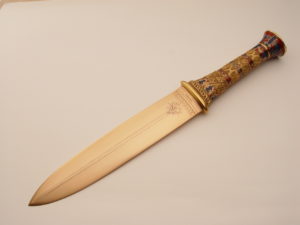
Through it all, the thing Lobred probably will be remembered for most is his commissioning of the reproduction by Warenski of the King Tut dagger in 1982. It took Warenski five years to complete the knife, which included 33 ounces of gold, an ancient technique known as granulation for the handle and much more. When the knife was exhibited at the 1987 Knifemakers’ Guild Show it was a sensation, and served as the cover knife for the February 1988 BLADE. The knife has since been valued at $1 million.
Funeral arrangements are under the direction of El Camino Memorial-Sorrento Valley, San Diego, California. Service information is unavailable at this time.
Official BLADE Show photographer since 2001, PointSeven shot such BLADE Magazine Knives Of The Year® as the 2016 American-Made Knife Of The Year, the SHF by Spartan Blades. (PointSeven image)Eric Eggly is saying goodbye to three decades of knife photography. (PointSeven image)
Eric Eggly is saying goodbye to knife photography. The longtime knife photographer and founder of PointSeven Studios is taking a job in a different though related industry.
A familiar face at knife shows worldwide, Eggly photographed knives for three decades. For about the past two decades he had owned and operated PointSeven Studios in Toledo and then Maumee, Ohio, where he photographed not only knives but products of many kinds for various companies. It was the latter commercial photography that paid the bills, but it was photographing knives that was among his first loves. Along with a number of other photographers that continue to do so, PointSeven not only photographed custom knives but supplied the photos to knife magazines and other media that helped publicize the makers and their knives worldwide.
In addition to photographing knives in his studio, Eggly also took his photography operation on the road, including shooting knives at knife shows in America and abroad. One of those shows is the world’s largest and most important knife event, the BLADE Show in Atlanta, Georgia—this year’s show will be June 2-4, once again at the Cobb Galleria Centre—for which PointSeven had served as official photographer since 2001.
Among the 2016 BLADE Show custom knife judging winners shot by PointSeven was the winner of Best Handle Design by Jean-Louis Regel. (PointSeven image)
Among the BLADE Show duties of Eric and his staff were photographing the BLADE Magazine Knife-Of-The-Year® Awards, the winners of the show’s custom knife judging competition, the American Bladesmith Society’s annual award-winning knives, the BLADE Show World Championship Cutting Competitions, and photos of the overall event inside the show hall in the Cobb Galleria Centre, all for use in the annual BLADE Show recap issue of BLADE® Magazine. In addition to the latter, PointSeven photographed any number of custom and factory knives for a goodly amount of the show’s exhibitors, which number near 1,000. Eggly also conducted BLADE Show seminars on how to photograph knives.
As these words are written, the BLADE Show is in the process of finding a replacement for PointSeven as the show’s official photographer.
Eggly’s new job will be chief product officer for F.J. Westcott, a manufacturer of high-end lighting equipment for professional filmmakers and photographers.
Beware BLADE Show hotel scammers who may contact you concerning hotel reservations for the world’s biggest knife show June 2-4 at the Cobb Galleria Centre in Atlanta. (PointSeven image)
It’s that time of year again, time when Internet, telephone and other scammers misrepresent themselves as so-called “official” agents of the BLADE Show in booking hotel rooms for the world’s biggest and most important knife event. Beware BLADE Show hotel scammers! To find out how to both identify such unauthorized charlatans and protect yourself from them, read on.
Slated for June 2-4 at the Cobb Galleria Centre in Atlanta, the 2017 BLADE Show will attract knife enthusiasts from all over the world, knife enthusiasts unscrupulous scammers will try to exploit. However, if you follow a few easy guidelines, you can foil the scammers and get the best lodging for the show your hard-earned dollars can buy.
The BLADE Show has designated EventSphere as the ONLY housing provider for the 2017 BLADE Show. If it’s anyone but EventSphere, delete. There are fraudulent companies and organizations that will try and present themselves as official partners of the BLADE Show and offer you a potential room that might not be guaranteed or available. When booking with Eventsphere use the online reservation link or call 855-547-8429 and expect to receive an immediate confirmation e-mail.
PLEASE NOTE: EventSphere will NEVER call you directly to book a reservation!!!!!!!
The only reasons EventSphere would call you are:
•You phoned and left a message requesting a returned call;
•There is a problem with an existing reservation;
•Someone from BLADE Show management told EventSphere to contact you.
Should you be contacted by someone other than EventSphere or have any question concerning what you may suspect is a fraudulent booking attempt, please let us know by emailing [email protected].
For more information on the 2017 BLADE Show, the 4th Annual BLADE University and more, stay tuned to this space or visit BLADE Show.
GATCO stopped production over the summer. Bear & Son Cutlery purchased the sharpener division and W.R. Case has officially announced that they bought the Timberline knife brand of GATCO.GATCO, following Spyderco’s lead, was a sharpening company that expanded into knives with its Timberline brand.
W.R. Case & Sons Cutlery Co. in Bradford, Pennsylvania, has purchased the Timberline knife brand from The Great American Tool Company, or GATCO. The plan at Case is to launch a new line of Timberline knives and accessories “into the existing portfolio,” according to a press release issued by Case media contact FJ Feightner. GATCO stopped production over the summer and sold its sharpener division to Bear & Son Cutlery.
“Case is excited to have acquired the Timberline brand assets, and we are developing a comprehensive market strategy around it, which includes future new products and a cohesive integration with the Case brand,” said Mark Paup, president and CEO of Zippo Manufacturing Co. and W.R. Case & Sons.
GATCO acquired Timberline in the early-to-mid 1990s, including knives designed by Timberline’s Vaughn Neeley, such as his folders with the patented NeeleyLock locking system. This transaction followed Spyderco’s lead as a sharpener company that expanded into knives.
Timberline’s specialty was tactical, hunting, utility and kitchen knives, among others. The Timberline Stealth, a tactical folder designed by Neeley, was the BLADE Magazine 1997 American-Made Knife Of The Year®. Here knife designer Swiss Bianco gives a little history of Timberline’s NeeleyLock knives.
Timberline expanded its line to include factory-custom collaborations with knifemakers like Brian Fellhoelter, Tim Herman, Russ Kommer, Greg Lightfoot, Charles Ochs and Butch Vallotton, as well as with designers like Swiss Bianco, George Sessions, Kelly Worden and Dave Young.
Timberline offered a collection of ceramic kitchen knives under the Cape Cod Collection label. In recent years, the company debuted its Javelin and Gas Monkey Garage lines.
Case has been in business since 1889. Its knives have gone from the battlefields of World War II literally to the moon. The company’s expertise is in traditional folding pocketknives, as well as fixed blade sporting knives. In 1981, capitalizing on its unique tang stamp, the company initiated The Case Collectors Club, which now has over 18,000 active members, and is one of the largest known knife collecting associations, according to Feightner.
Steve Shackleford, BLADE editor, contributed to this article.
You Can’t Have Just One Case Knife In Your Collection