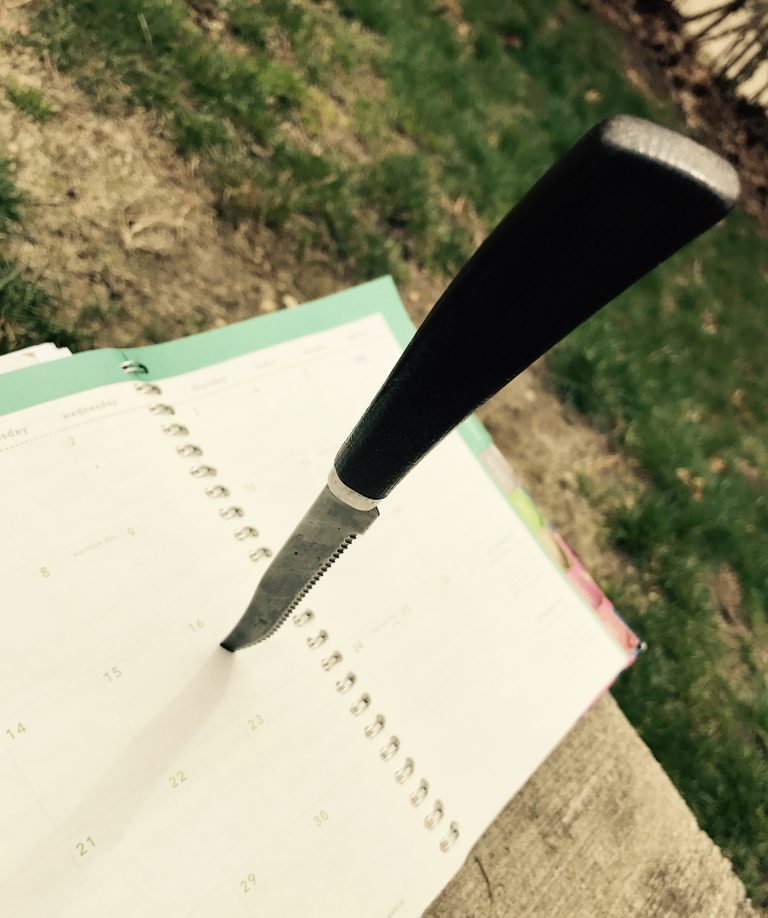
Help us fill in our BLADE calendar. Send us the details and we’ll help spread the word.
We’ve added a calendar to BLADEmag.com. Now, we need your knife events to fill in the BLADE Calendar. We’ll take anything to do with knives: shows, seminars, workshops, hammer-ins, demonstrations, shop tours, classes, throwing competitions, open meetings at your knife club. You supply the details below. We’ll enter it onto the site and send you a link when it goes live so that you can use it on your Facebook Page, Instagram account, forum, blog or other social media outlet.
But wait, we want manufacturer and distributor events too: retail location grand openings, factory tours, celebrations. Anything the public is welcome to attend or sign up for is acceptable.
Be sure to include a photo: It can be of a past occurrence of your event; your company, show or club logo; or an image of the venue. Attach the photo to your email that provides all of the following information:
Complete name of event
Date or dates of event
Start time and end time on each day of the event
Event website or page
Event admission cost
Event organizer’s name
Event organizer’s phone number
Event organizer’s email
Description of event
Complete name of venue
Complete address of venue
Venue phone number
Venue website
Send your email to [email protected]. Be sure to submit your listing a minimum of two weeks prior to the event. We’ll do our best to help you get the word out, and we hope you refer people back to the BLADE Calendar.
Shock and claw karambits help highlight the latest BLADE®, on newsstands NOW!
“Shock and claw” karambits, the damascus knives that changed knife history and the complete lowdown on the 4th Annual BLADE University at the 36th Annual BLADE Show are but a few of the highlights of the latest BLADE®, on newsstands NOW!
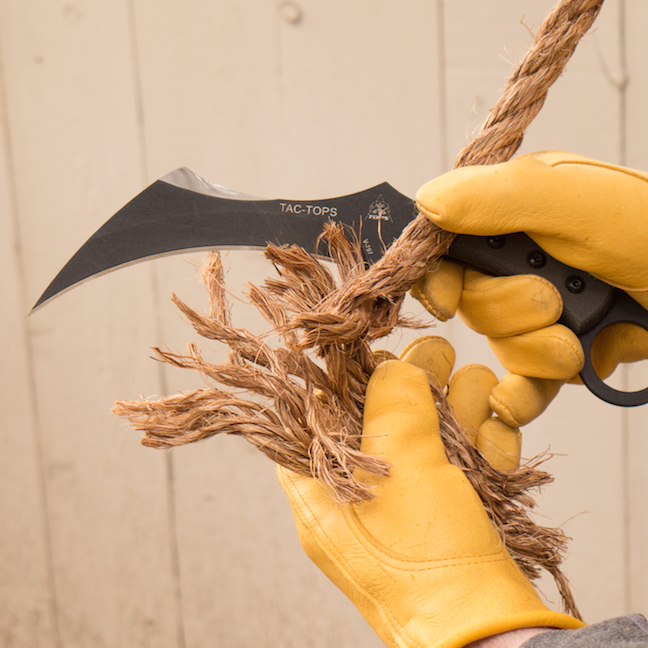
Boasting a blade shaped like a sickle, the karambit has been adapted for martial arts use today. However, it remains an effective cutting tool as well. James Morgan Ayres tests four of the latest editions in his story, “Shock & Claw.”
As the world’s biggest and most important knife event, BLADE Show 2017 attracts the best knifemakers and knife pros in existence. What better talent pool is there to select from as teachers for BLADE University, three days of knifemaking and other cutlery classes on a wide variety of sharp subjects? Check out who will be teaching what and how you can attend in “Back To Sharp School” by this writer.
Also this issue: Pat Covert’s test of four of the latest factory flipper folders; Dexter Ewing’s assessment of some of the newest factory machetes; part two of Frank Trzaska’s salute to the knives used by U.S. soldiers during World War I on the 100th anniversary of the USA’s entry into “the Great War”; the latest paring knives just in time for Mother’s Day, by Daniel Jackson; some of the top drawknives and how to use them, by Abe Elias; a farewell to ABS journeyman smith Larry “The Hammer” Harley; and much more in the latest BLADE—on newsstands now or subscribe here.
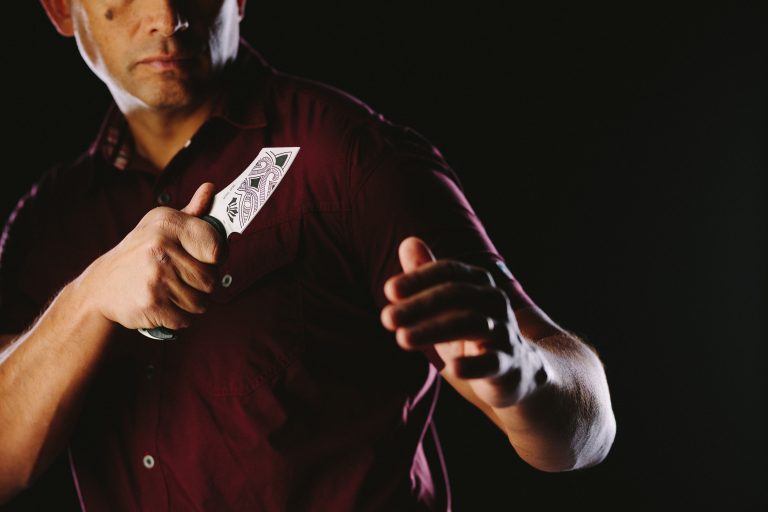
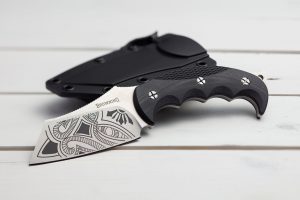
Browning’s line of Jared Wihongi Signature knives is as fierce as its SWAT operator namesake.
Jared Wihongi is a native New Zealander who began training in martial arts at an early age. As a young man he had the chance to live in the Philippines and study an edged-weapon style of fighting called Pekiti Tirsia Kali. Jared has spent 14 years as a law-enforcement special weapons and tactics operator. He also instructs other SWAT team members as well as elite military operatives in edge-weapon skills. He has advised Browning on its Black Label tactical family of knives and now has his own signature line, strikingly designed with Maori-inspired blade etchings. Be sure to subscribe to BLADE magazine to read about the Jared Wihongi Signature line of combat knives in the August issue, on sale May 16, 2017. To learn more about Jared Wihongi’s upbringing and training, read “Browning Launches Wihongi Line of Maori-Inspired Knives.”
The Jared Wihongi Signature Fixed has a canoe-shaped handle that is ergonomically correct in both a forward and overhand grip. The etchings are borrowed from Maori tattoo patterns.
To meet Jared Wihongi and hear him discuss his style and philosophy of knife fighting, here are some well-done videos by Funker Tactical. In the first, Jared discusses how the foot movements used in Filipino knife fighting can aid in an empty-hand or firearm scenario. In the second, Jared addresses how the skills developed through the practice of Pekiti Tirsia Kali are relevant to the reality on today’s street or battlefield. And in the last video, Jared talks about why you should train wearing what you wear in your work or your everyday life. Law enforcement and military especially need to practice wearing their equipment so they understand how their range of motion, breathing and other functions are affected by the added weight.
In “Fighting Folders” Michael D. Janich instructs viewers on the myths surrounding folding knives and how to employ them in a self-defense situation.
Micheal D. Janich covers how to use empty-hand skills, quick one-hand deployment techniques and knife-fighting tactics so you can lean on your folder as part of your self-defense kit. This DVD is well worth the $39.95 when you consider you can watch it repeatedly in the comfort of your home, practicing its demonstrated skills until you’re ready to take your training to the next level.
BLADE® field editor Ed Fowler will hold down table 3N at BLADE Show 2017.
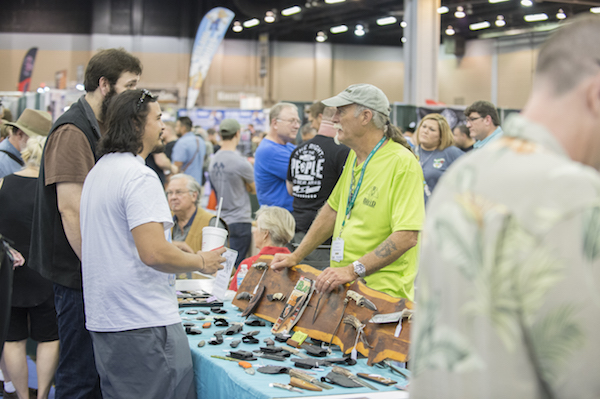
If you are one of thousands of knife enthusiasts worldwide who will attend the 36th Annual BLADE Show June 2-4, it’s time to start making your to-do list for the world’s largest and most important knife event.
There are oh-so-many—almost 1,000 booths and tables in all in the cavernous Cobb Galleria Centre show hall—including the world’s top makers, sellers and displayers of all things sharp. Among them will be three who on a regular basis help make BLADE® Magazine the World’s No. 1 Knife Publication—BLADE Magazine field editors Kim Breed, Joe Szilaski and, health permitting, Ed Fowler.
BLADE® field editor Joe Szilaski will exhibit at Table 3P for BLADE Show 2017.
A retired member of the 5th U.S. Army Special Forces group, Breed’s 20-year military career took him to various world hot spots, including the Gulf War in the early 1990s. It was while there that he wrote a letter to BLADE about his love for knives. One thing led to another and BLADE asked Kim if he would like to write for BLADE on a regular basis testing knives. He took over BLADE’s “Spec Sheet” department and has been testing and writing about knives for the magazine ever since. He also makes custom knives and will be displaying them, along with scrimshaw work by Mrs. Melissa Breed, at table 17G. Stop by and see them—and if you can, do it on June 2. That will be Kim’s birthday. Ask him how old he is—and be sure to duck afterward.
A High-Endurance Performance-Knife (HEPK) master smith, Fowler has been writing for BLADE even longer than Breed—since the late 1980s. BLADE got wind of him after reading a booklet he had written sharing his thoughts on all things knife, including how to use them, how they should be made and much more. Since then in his “Knife Talk” department he has exposed BLADE readers to his distinctive brand of writing and knifemaking, including his preference for 52100 ball-bearing steel, his multiple quenching of his blades, the HEPK courses he teaches at his Willow Bow Ranch in Riverton, Wyoming, and so much more. Visit him and his bladesmithing co-hort, Chris Amos (Chris also has written for BLADE), at table 3N. Also, be sure to attend Ed’s demo, “Choices The Maker And One Who Seeks a Knife Need To Make” show Saturday from 2:15-3:30 p.m. in Room 107. (Note: Ed has been experiencing some health problems of late but both he and we hope it will not prevent him from attending the show.)
Last among three BLADE field editors who will exhibit at BLADE Show 2017 is ABS master smith Joe Szilaski. A native of Hungary who was in-country during the Hungarian Revolution against the Soviet Union in 1956, Joe moved to America and has embraced all things USA, including bladesmithing. He has assumed the mantle of writing the BLADE “Question & Answer” department originally started by Cutlery Hall-Of-Fame member Wayne Goddard, and also teaches knifemaking and tomahawk making in his facility in New York state. In fact, he will teach the BLADE U. class “How To Filework Knives” on show Saturday from 8:30-9:30 a.m. in Room 109. His table is 3P, where he will be ably assisted by Mrs. Lori Szilaski.
BLADE® field editor Kim Breed (in ball cap) will be on duty at Table 17G at BLADE Show 2017.
It’s never too early to start planning your BLADE Show 2017 itinerary, and visiting three of the top BLADE field editors who also happen to be show exhibitors is as good a place as any to start. Meanwhile at least three other BLADE contributors—knifemakers Brian Goode (table 19G), David Lisch (13R) and RJ Martin (11M)—will be exhibiting. Also, other BLADE field editors who should be roaming the show hall will be Abe Elias, Dexter Ewing, Cutlery Hall-Of-Fame member B.R. Hughes and Les Robertson. Elias, in fact, on show Saturday in Room 107 will present the BLADE U. classes “Steel: The Heart Of The Knife” from 10:30 a.m.-12 p.m. and “The Best Edge For The Job” from 2-3:15 p.m.
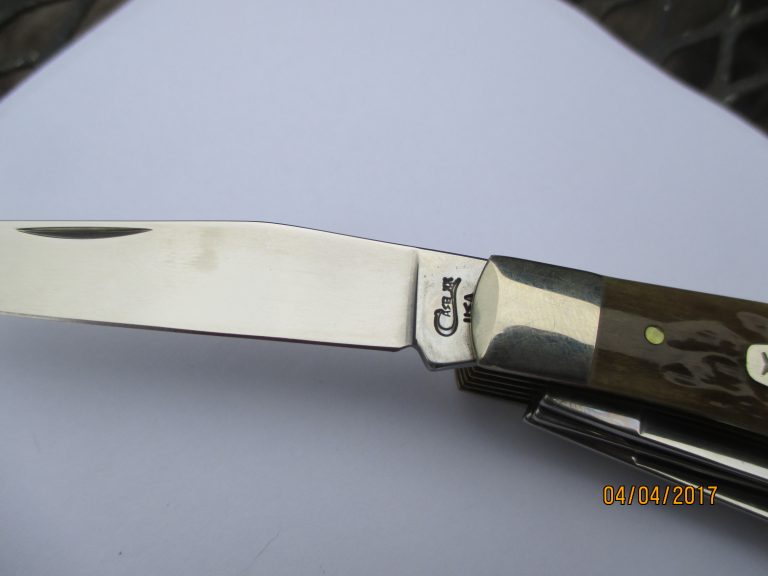
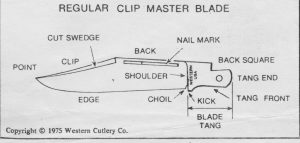
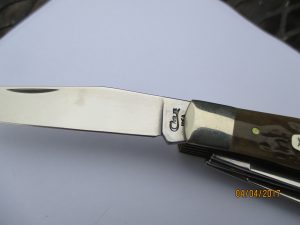
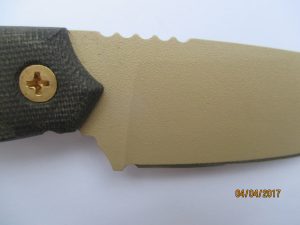
On a pocketknife blade, the knife choil is the notch between the cutting edge and the blade tang and serves to notify you where to stop sharpening the blade.When you think knife choil and pocketknives, Case immediately comes to mind.A classic example of a knife choil on a fixed blade is the notch here between the cutting edge and the ricasso or the blade tang of the Baja 3.0 by TOPS Knives.
Is a knife choil a nick, a notch, a finger groove or something else? And besides, what’s the difference between a nick and a notch?
What it is is one of those knife-specific terms that seems to evade proper definition by many, everyone from knife newbies to knife aficionados.
To expand on the definitions of both A.G. Russell Knives and Mr. Collins, while a knife choil may have enough space to accept a finger for certain types of cutting operations, such a capability is not the choil’s stated purpose. In some instances you may hear the term for such a feature called a finger choil. According to Russell’s definition above, such a reference is “improper.” In fact, sometimes what is incorrectly referred to as a finger choil is really more of a finger groove that spans the undersides of both the handle and the ricasso or the blade tang. Meanwhile, some new factory knives seem to be downplaying the knife choil if not eliminating it entirely.
Be that as it may, the chief purpose of the knife choil, as noted by the definitions of both Russell and Collins, is to allow the full length of the cutting edge to be properly sharpened. In other words, it is simply a small notch between where the cutting edge ends and the ricasso or the blade tang begins that indicates where you should stop when sharpening the blade with a stone, diamond-coated abrasive or what have you.
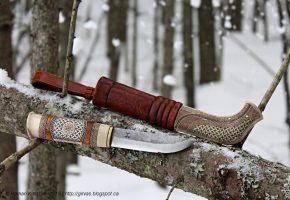
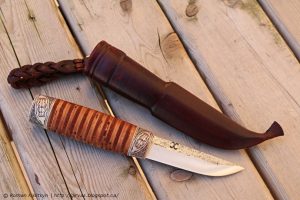
This Roman Kislitsyn sheath is made in North Sami style with a pronounced hook, which interferes less when sitting. The 4-inch blade is made by Pasi Hurttila in 80CrV2 steel. The handle is reindeer antler and birch root burl.
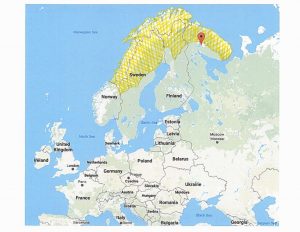
Roman Kislitsyn grew up in Apatity in the Murmansk region of northwestern Russia. Close to Norway, parts of the area also include the lands of the Sami people (in the past referred to as Lapps or Laplanders) which traverse the Kola Peninsula of Russia, and the northern and coastal regions of Finland, Sweden and Norway. Roman and others in his family are geologists so he spent much of his childhood with outdoorsmen, hunters, fishermen and those expert at surviving in the Russian wilderness. Always an admirer of Finnish and Swedish knives, Roman was most drawn to the beauty of the knives made by the Sami, the native reindeer herders of Scandinavia.
Roman Kislitsyn makes Sami-style knives.
Roman’s exposure to knives and survival equipment, combined with a love of crafting things with his hands, led to his first attempt at knifemaking when he was 15 or 16. “It had a blade made of high-speed steel from a piece of mechanical saw, wooden handle made of birch burl, and simple leather sheath, but I was very proud of myself,” Roman related. He made a few more knives, left to attend university and life intervened. A few years ago, he returned to knifemaking and cannot stop.
The traditional Sami lifestyle depends on reindeer herding, hunting and fishing. Roman explained that the design of their knives developed over the course of hundreds of years. They also mastered their own style of decorating things made of reindeer antler. “I like to use Sami-style decoration on my knives too. Even though I’m not Sami, but this makes me feel my connection to the land where I grew up,” Roman stated.
Sami lands, in yellow, historically reached farther south, encompassing Roman’s home region, marked in orange.
Roman makes two types of knives, either Sami style or Finnish puukkos with Sami-style carvings. He does not make his own blades. Some Sami blacksmiths existed, but using blades made by other makers was, and still is, a common practice.
Roman works with high-carbon steel blades made by his friend Alessio Salsi in Belgium. Lately, he’s also being trying laminated and pattern-welded steels. Since Roman makes Scandinavian knives, the grinds are all Scandi. He used to employ blades made by Pasi Hurttila from Finland before Pasi stopped making knives. Roman also used blades made by Randal Graham in Nova Scotia. Randal took a hiatus from knifemaking but has now returned, and Roman hopes to resume collaborating with him.
Roman Kislitsyn put a stacked birch bark handle on this 3.2-inch Pasi-Hurttila-made 80CrV2 blade. Carvings on the antler are in Sami-style. Bark handles are popular for Finnish puukkos; they never get slippery or cold, even below freezing.
Roman is self-taught, learning everything about knifemaking and carving through the Internet, forums and social media. With the exception of light use of a hand-drill and a Dremel, Roman uses only hand tools. “No grinders, sanders, band saws, nothing. Only files and rasps, only hardcore!” he explains. Roman’s goal is to make “functional art,” as one of his customers put it, and not a knife that just sits on a shelf. His favorite handle materials are reindeer antler in combination with birch burl and-or bark, which are all traditional materials in Sami-style knives. Maker’s list price starts at $450 US.
Roman left Russia in 2002 and now lives in Nova Scotia, but you can converse with him through forums like British Blades, Canadianknifemaker.ca and the Russian forum zadi.ru. His website and blog are at Girvas. “Girvas is a name of a lake in same region where I’m from,” Roman added. It is the Russian pronounciation of the Sami word hirvas, meaning “reindeer stag.” You can visit Roman on Facebook at Roman Kislitsyn or on Instagram @roman.kislitsyn. You can e-mail him at [email protected].
The CRKT Homefront is the 2017 BLADE Show knife, and won last year’s Most Innovated Imported Design.
The CRKT Homefront is a Ken Onion-designed knife that won Most Innovative Imported Design at last year’s BLADE Show. The field-strip technology allows for easy cleaning anywhere, without tools. Get yours now for $70 and you’ll save 30% off this true collector’s item.
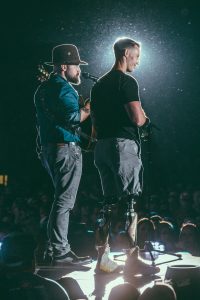
Zac Brown’s Southern Grind deploys formidable spokesman, Johnny Joey Jones, a double amputee Marine staff sergeant.
Johnny Joey Jones, Triple J to his friends and Explosive Ordnance Disposal technician to his Marine Corps brethren, wrote a poem about a particular day, a particular explosion, a particular knife, while on patrol in Afghanistan.
Jones, a double amputee and motivational speaker, is the spokesman and more for Zac Brown’s Southern Ground, which is an umbrella company that represents numerous 100-percent American-made and -sourced products, including the knife company, Southern Grind. Proceeds from the sale of these patriotic items benefit Camp Southern Ground, which strives to give kids of all races and religions, and especially those with neuro-developmental challenges, the positive influence of a camp experience. The camp also helps military families by offering the same experience to children who are dealing with a deployed, injured or deceased parent.
In May 2010, about three months before Staff Sergeant Jones would step on an IED and lose both legs above the knee, he was on patrol with a group of Marines. (In the Corps, EOD units go where they are needed, with whom they are needed.) They came to a small canal. “There is always lots of learning,” Jones said, and in this case, it was that you don’t want to use foot bridges to cross waterways. Such crossings would create bottlenecks, ideal spots for the enemy to booby-trap.
Prior to losing both legs above the knee Johnny Joey Jones was an Explosive Ordnance Disposal technician in Afghanistan.
To get across, first the sweeper, the Marine with the metal detector, went and then the mine-detecting dog and his handler went. “We think the dog stepped on the mine,” Jones said. “The Water So Cold” tells the story.
Joey Jones not only took the lead in combat, he became a mentor to recovering wounded veterans like himself.
The knife was a folder issued to Marines. “I was going to cut off his gear, but guys reached down to pull him out. Days later I realized I still had his knife in my cargo pocket,” Jones said. “I gave it to his first sergeant to give it back to him,” Jones said. That first sergeant is the man in the poem of whom the speaker asks about the Marine’s condition.
Jones has had a poetic streak most of his adult life. Since separating from the service, he has earned his Bachelor’s degree from Georgetown University in public policy. “I don’t go back and edit,” Jones said. He wants the poems to represent him authentically, as he was at the time.
Check back to read more about this inspirational wounded warrior.
To learn more about how Jones and Brown met and the knives made by Southern Grind, be sure to subscribe to BLADE® Magazine.
In “Fighting Folders” Michael D. Janich instructs viewers on the myths surrounding folding knives and how to employ them in a self-defense situation.
You don’t have to have been in combat to know that sometimes Plan B—the knife—can quickly become Plan A when it comes to self-defense. Often our everyday carry is a folder. This DVD can get you started on proper grip, one-handed openings and other tactics using folding knives. The $39.95 price is less expensive that a class and can be watched repeatedly in the comfort of your home.