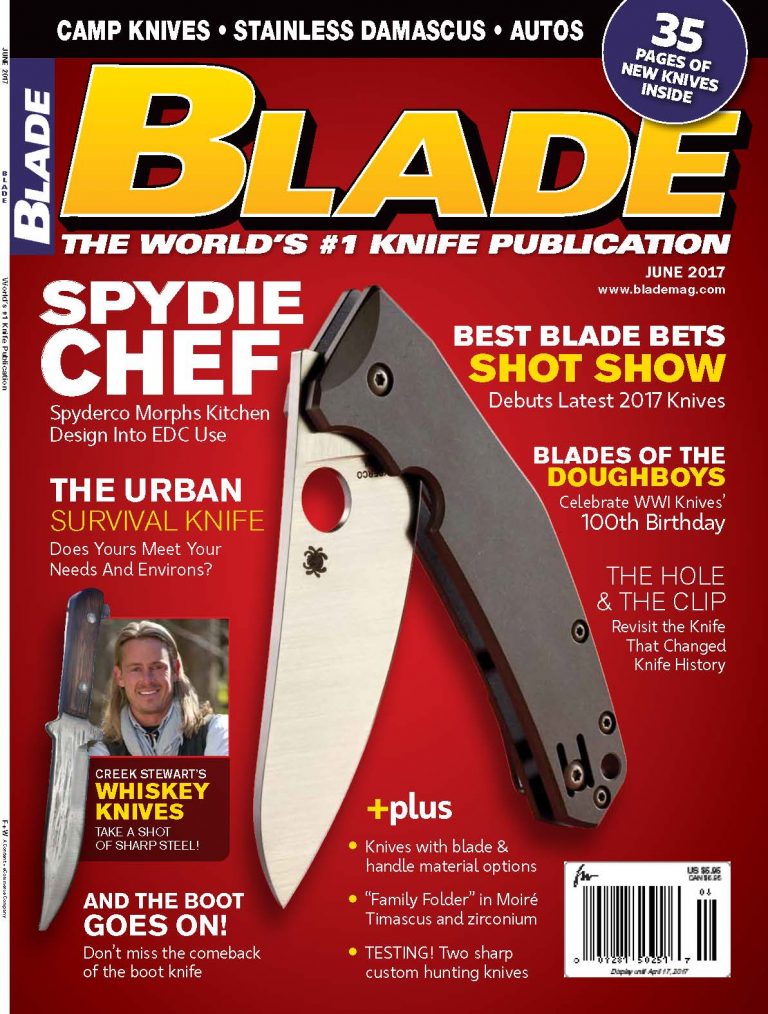
Spyderco’s knife that changed knife history is a headliner in the latest BLADE®, on newsstands now!
Spyderco’s knife that changed knife history, Creek Stewart of Fat Guys In The Woods fame and his knives, the top knives of the SHOT Show and more highlight the latest issue of BLADE®, on newsstands now!
In addition to his TV show on The Weather Channel, Stewart is known for his survival skills—and what’s survival without knives? While Creek gave knives away to the top “survivor” at the end of each episode of his show, he decided he wanted to take things a step further and work with a small American business to produce a line of knives. Whiskey Knives from Hank Gevedon’s Reptile Toolworks are the result and the focus of Erin Healy’s “Samurai Woodsman” on page 12.
Along with the annual BLADE Show—which is set for June 2-4 at the Cobb Galleria Centre in Atlanta—the SHOT Show is the place where many factory knife companies debut their new knives for the year. Check out the hottest knives of SHOT, along with a number of new companies under new flags, in the story on page 26.
There’s much more in the latest issue, including tests of camp knives, custom hunters and the return of an old friend—the newest factory boot knives; the urban survival knife and whether yours meets the demands of your environment; those who forge and sell stainless damascus to knifemakers worldwide; on the 100th anniversary of the USA’s entry into World War I, the first of a two-part story on the knives carried by U.S. Army personnel, aka The Doughboys; and much more, all in the latest issue of BLADE, available in the digital edition and also by subscription.
Goddard considers it all part of paying your dues to go to knife shows, spend countless hours getting ready and perhaps not even selling enough to cover your expenses. But what you will come away with is contacts. You’ll meet people who can help you better your knifemaking skills, get you better materials to work with, photograph your work or help you get it publicized.
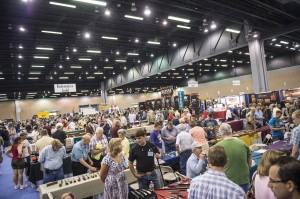
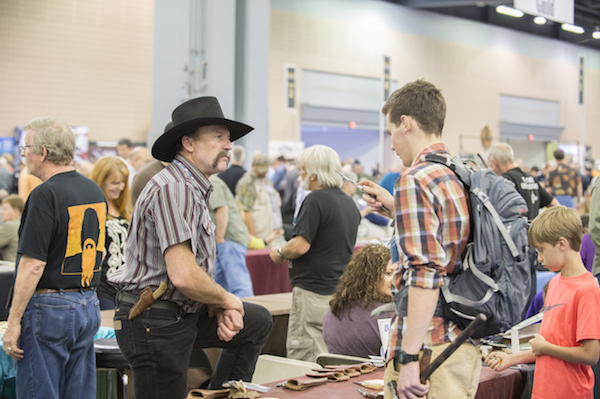
Thousands of knife enthusiasts from all corners of the globe will descend on the Cobb Galleria Centre in Atlanta June2-4 for the BLADE Show. (PointSeven image)
I say, come prepared. Professional business cards are cheap to make up, like less than $10 for 500 at Vista Print, for example. Make sure you triple-proof your phone number and email address because those are the primary ways people get in touch with you. Include how your professional Page is listed on Facebook, and if you’re still mixing business with pleasure, it’s time to start driving folks to a professional page. Include your Instagram handle. You can have one of your photographed knives as a background image one side of your card and a photo of yourself on the other side. A little space on the front or back allows either you or whomever you’re conversing with to jot down something to prompt them to remember how to follow-up with you.
2. Gain Perspective On Your Work
Goddard’s second reason to go to a knife show is somewhat dated. You can clearly see what knives are being made in the industry through magazines like BLADE®, online through visually focused Facebook and Instagram, and through websites. There are books to read and endless hours of You Tube videos to absorb. However, the only thing none of these outlets will provide is touch.
Shows offer you a chance to pick up knives, open them, close them, weigh and balance them in hand. You’ll be able to get ideas on what you can do to improve your work, or in which direction you want your style to head.
3. Establish A Broad Customer Base
You can indeed stay quite busy just through website or Facebook orders, but Goddard brings up a good point about making sure you bring some of everything you offer to a show so there will be something for everyone. A collector may never know about you unless he sees you at a show. He has to hear about you before he can look you up online. Sometimes we only expand our tastes if we are forced to. At a show, buyers will at least glance at knives that normally they’re not drawn to. Every once in a while, they stop and buy something out of character for them, and you’ve just sold a fixed hunter to a guy who thought he only liked tactical folders.
I would add that you might want to consider bringing a few knives to a show that would fit a youth or woman. Sometimes finger placement isn’t comfortable for smaller hands. There could be an extra sale or two for you in a sometimes overlooked segment of the knife-buying population.
4. Show Off Your Art
If you have a wild and crazy, beautiful and bejeweled, historic or psychedelic piece of artwork that people admire but are hesitant to spend money on, the knife show is your outlet. Chances are someone just might buy it, but you’ll also get the accolades such work so richly deserves.
5. See The Country, The World
The Cobb Galleria Centre in Atlanta, Georgia, is the site of this year’s BLADE Show, but there are many other knife shows all over the country. Get to a few.
Not only is a knife show an excuse to travel the country, but it’s a chance to meet people from all over the world. You just never know. You could meet someone from the Netherlands, strike up an online friendship and the next thing you know, you’re ordering a plane ticket to attend your new buddy’s local show.
6. Sell Knives
This is the last thing you should be thinking about if you’re just starting out. Goddard explains that it’ll take a while to figure out what sells for you and what doesn’t. Don’t get discouraged. Keep at it. If there’s a waiting list for the show you want to get into, then put your name on the list and wait.
I would add to practice going to local or regional shows first. Let’s be honest, shows can be exhausting. You’re on your feet all day, always “on” and having similar conversations with many people. It’s hard to take breaks to refresh yourself, but it’s probably one of the best things you can do. Go visit a few booths that have something you’d be interested in buying. Figure out what works for you and what doesn’t so that you stay refreshed and positive for your customers and yet get something for yourself out of the show too.
And although it’s tempting to start packing up early, resist. There’s nothing worse than thinking you can hit the last hour of a show only to find vendors packing up. That last customer may be your best one of the day.
Learn From A Master
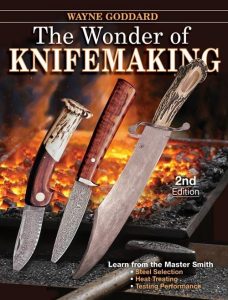
There’s so much to learn, and you can’t learn it all in one day, but Wayne Goddard’s “The Wonder of Knifemaking” is a great place to start.
Wayne Goddard not only shares his suggestions for getting the most out of attending knife shows in “The Wonder of Knifemaking,” but he also shares his experience in setting up workshops, accumulating tools and, of course, making knives. Right now you can save $10.17 off this knifemaking library essential.
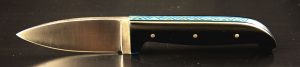
Smyth Knives’ Flat-Grind Utility Knife is made using O1 tool steel, black G10 scales, and blue liners. The blade is 3 inches, and the knife is 7.5 inches overall.
Irishman Paddy Smyth of Smyth Knives in County Roscommon, Ireland, sells 90 percent of his knives through his website to customers in the USA. The other 10 percent are purchased through The Quiet Cailin Studios in Cong, County Mayo, where “The Quiet Man,” starring John Wayne and Maureen O’Hara, was filmed. Some even incorporate ancient bog oak.
Irish Eyes Will Smile Over Smyth Knives
But it was another movie that sparked a love of knives in Paddy growing up. He watched wide-eyed as the work of Gil Hibben’s was deftly wielded in “Rambo III.” It is “my favorite knife of all time, so I have huge respect for [Hibben’s] work,” Paddy commented. He had a week-long visit last year from Jeff Knox, who trained with Hibben in the US. “He has been a great help to me also with advice and sourcing materials as its hugely difficult to get materials in Ireland,” Paddy added.
Paddy Smyth lives in County Roscommon in Ireland and undoubtedly with a name like Smyth has knifemaking in his blood.
He also mentioned that Walter Sorrells’ YouTube channel has been helpful and inspirational.
However, Paddy is a self-taught knifemaker and much of his learning has been by trial and error over the years. “I continue to learn,” he noted. He was trained as a chef and butcher and always had a keen interest in hunting, so he was intrigued by what made a high-quality knife. “So, I basically decided to have a go at knifemaking and caught the knifemaking bug,” he said.
Paddy concentrates on compact pocket and neck knives, bushcrafting and hunting/skinning knives. He makes specialty chef knives to order to client specifications. His favorite steels are O1 an Niolox stainless. He appreciates the consistent finish and heat treat he gets using these steels.
He likes three grinds: Scandi for his bushcrafting blades because it’s easy to maintain an edge; and flat and hollow, according to customer preference, because they both work well for his hunting and skinning blades. For bushcrafters, he chops and batons wood to test for toughness, and then fine-carves paper to verify sharpness. Cutting heavy cardboard with its abrasive quality helps him get a feel for how long his blades will stay sharp. He does ensure his flat- and hollow-ground blades can handle the detailed work of skinning and boning.
The Claw by Smyth Knives, left, is 5.25 inches long, with a 2.2-inch cutting blade. It’s perfect for close skinning/boning/gutting with complete one-finger control.
“My favorite handle material is ancient Irish bog oak, which can be up to 10,000 years old. It finishes really well and has beautiful character and history,” Paddy explained. “It’s very difficult to work with as it’s so hard it’s almost fossilized. And it’s becoming harder to find good pieces. It’s very hard on machinery and tools, but the work is worth the finished product.”
There are no knife shows currently in Ireland, so Paddy sells his work online at www.smythknives.com. Prices range from 90 to 500 Euros plus shipping with discounts for repeat customers. Also, check out the boutique artisan gallery in County Mayo where Smyth Knives are also sold on Facebook. Smyth Knives on Facebook and @smythknives on Instagram are chock full of additional photos and videos. You can call Paddy at 00353 87 6281252.
All Smyth Knives are completely handmade and heat-treated in house. Leatherwork is specific to each knife, so no two creations are the same. Paddy is a retail manager for an oil company based in the west of Ireland. He lives in Roscommontown with his wife, Edel, and their three boys, Shane, Darragh and Cian.
The ornate file work on the spine of this knife by Paddy Smyth in County Roscommon, Ireland, is reminiscent of a Celtic pattern.
“When I started making knives, I realized I had found something incredibly natural to me, as if I was meant to do this or was maybe in my blood, as my family name is Smyth,” Paddy noted. “I’m completely at peace when I’m in the workshop.”
The CRKT Homefront is the 2017 BLADE Show knife. Be sure to get yours now.
CRKT and Ken Onion took home the Most Innovative Imported Design award at the 2016 BLADE Show for the groundbreaking Homefront. Now the Homefront is the official knife of the 2017 BLADE Show. This is a limited run of 300, so hurry! And at $70 you’ll be saving almost 30 percent.
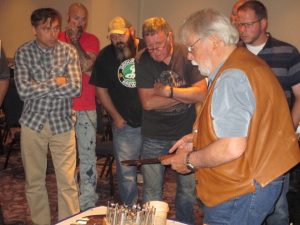
ABS master smith Wally Hayes will show you how to use simple tools to make a throwing knife at the 4th Annual BLADE University. Here he teaches flipper folders at last year’s BLADE U.The 4th Annual BLADE University will feature such classes as how to checker knife handles taught by ABS master smith Timothy Potier.
The 4th Annual BLADE University will offer knife enthusiasts an almost completely overhauled curriculum of classes on the subject of knives and knifemaking June 1-3 in conjunction with the BLADE Show at the Cobb Galleria Centre in Atlanta.
Beginning the day before the BLADE Show and ending BLADE Show Saturday, this year’s BLADE University offers a wide-ranging selection of courses on how to make knives—including blade grinding, handle checkering, embellishment, color-case-hardening knife parts, chatoyance and others—all about blade steels, how to use knives, how to price them and much more.
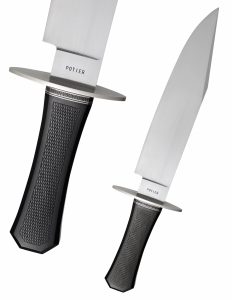
ABS master smith (MS) Timothy Potier will kick off the instruction in Thursday’s “Knives The ABS Way” with his class on how to checker knife handles, followed by fellow MS Jim Rodebaugh‘s “How To Design A Purpose-Built Knife” and “How To Etch and Polish a Damascus Blade.”
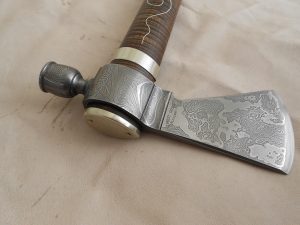
In his fourth appearance for BLADE U., MS Joe Keeslar will show you how to make a brut de forge knife, and ABS journeyman smith (JS) Butch Sheely will end the day’s classes with his tutorial on how to make a pipe tomahawk.
Friday’s instruction will begin with MS Joe Szilaski‘s class on how to filework knives and Tom Krein‘s three-part class entitled “How To Grind a Blade.
ABS master smith Joe Keeslar will teach you how to make a brut de forge knife at the 4th Annual BLADE University.
In the last two parts of his class Tom will demonstrate how it’s done on a Burr King grinder under the Burr-King-sponsored tent in “The Courtyard”—the adjoining parking lot of the BLADE Show host hotel, the Renaissance-Waverly.
Other classes will include two by knifemaker/BLADE® field editor Abe Elias: one on how blade steel is made and blade geometry and how it affects edge retention, and the second on which blade edge and grind is best for which cutting job.
MS/BLADE contributor Wally Hayes will show you how to use simple tools to make a throwing knife, and MS Steve Culver will demonstrate how to design a slip joint with a half stop. Niagara Specialty Metals will wind up the day’s instruction with a class designed for the veteran knifemaker and novice knife enthusiast alike that will include a discussion on the properties of various elements in the steel, proper heat treating, tempering and what it does to the steel, CPM vs. air-melt steels and more.
Saturday’s final sessions will commence with “Knifemaking for Kids” taught by Jason Brous. (Youngsters need not be accompanied by a parent/guardian, though if the youths are so accompanied the parent/guardian will be admitted free of charge.)
Knifemaker Grace Horne of Sheffield, England, will conduct a class on how to make one of her specialties: custom scissors. Knife and sword maker Wally Hostetter will present a two-part class on how to do the Japanese handle wrap, or tsuka maki, and knifemaker/U.S. Marine veteran Les George will show you how to color-case-harden knife parts—that is, the process of adding a multi-colored hard surface to mild steel for use in various knife fittings.
Learn to make a pipe tomahawk in the style of ABS journeyman smith Butch Sheely at the 4th Annual BLADE University.
JS Brian Thie‘s class will cover how to give damascus blades chatoyance—an effect that exhibits an almost mirror-polished look within the damascus pattern itself. MS David Lisch will present a class on how to make the best stag handle, including sharing his “tricks” in working with the material. Knifemaker Johnny Stout‘s class will be on how to price custom knives, including actual costs in building knives, how to price the knives to make a profit (or at least break even) and more. And, finally, knifemaker L.T. Wright of L.T. Wright Handcrafted Knives will present “Draw It, Grind It, Sharpen It: The Beginner’s Guide to Knifemaking,” which will feature knives in various stages of completion to show you how your knife should look all along the way to a finished product, with L.T.’s helpful insights and educational visuals.
Visit BLADE U. for enrollment information, dates, times, classroom locations and more.
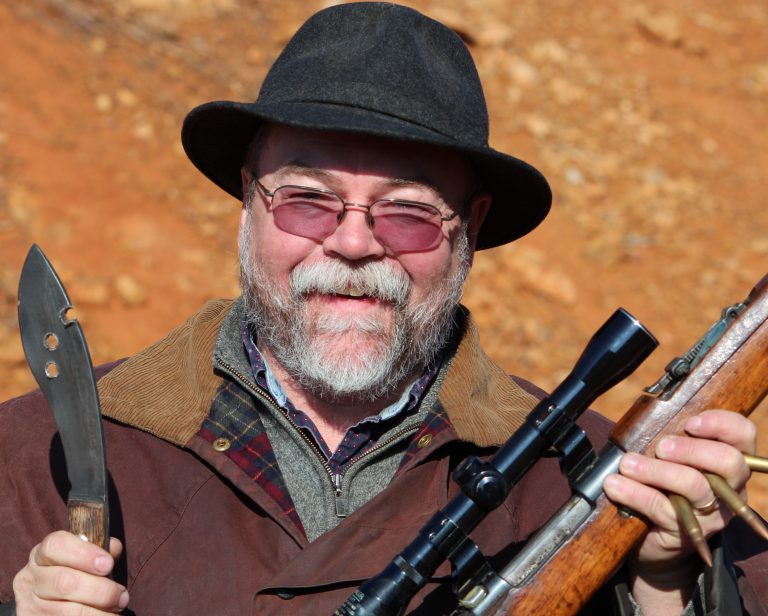
The June issue of BLADE® magazine features a story about wilderness survivalist Creek Stewart and his line of Whiskey Knives, made by Hank Gevedon and crew at Reptile Toolworks in Mt. Vernon, Kentucky. Whiskey Knives are carefully tested, but Hank likes to destroy a few from time to time to spot-check their quality. He starts by bending a Whiskey Corvid model to show that the hard outer layer of the A36 carbon steel will crack when bent in half, but that the knife will stay intact because of the tough inner core. Then he gets to shooting them. Besides, Hank’s just entertaining to listen to.
A Bent Whiskey Corvid Knife Still Chops and Slices
Hank Shoots A Whiskey Corvid with an 8mm Mauser FMJ
So what does all that mean to the knife owner? Well, you won’t want to bend your knife in a vise or shoot it at the range, but the following review of the destructive testing explains how the makuri method of construction can produce a sharp, yet tough knife, ideal for hard-use bushcrafting needs.
What Does Destructive Testing Reveal About Whiskey Knives?
Sure They’re Sharp, But How Sharp?
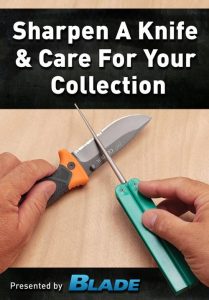
Know How to Sharpen Your Knives
A collection of knives is only as good as it is sharp. Understand how to sharpen all styles of grinds, along with other tips on caring for your collection.
The blades on Whiskey Knives are asymmetrical hollow-ground, meaning that you only need to sharpen one side, the one with the Creek logo on it. The other side just requires a touch-up. Reptile Toolworks puts instructions in the crate with each Whiskey Knife it sends out, but what about your other knives? “Sharpen A Knife, And Care For Your Collection” by BLADE editors covers all aspects of sharpening, demystifying the process and ensuring you have the knowledge to keep your knives sharp at home and in the field.
Knife bill SB 49 would affect this year’s BLADE Show and needs your help by Friday. Bladesmith Butch Deveraux (in cowboy hat) waits on a customer at last year’s BLADE Show. (PointSeven image)
A Georgia knife bill that would reform law and impact the 2017 BLADE Show needs your help by Friday, March 3, or it will die.
According to Knife Rights, SB 49 would increase the legal carry length of a knife blade in the state from 5.5 to 12 inches, but before that can happen the Georgia state Rules Committee must release the bill for a vote.
A recent applicable Knife Rights email stated that “efforts to completely eliminate the carry length limit have been stymied due to the manner in which a knife is defined in Georgia law. [If enacted, SB 49 would] make life much better for knife owners in Georgia without hampering future efforts to completely eliminate the carry length limit at some future opportunity.”
That’s where you come in.
If you plan to attend the BLADE Show June 2-4 at the Cobb Galleria Centre in Atlanta or live, travel or work in Georgia, please call or e-mail the Rules Committee members now. Whether you call or email—if emailing, enter on the subject line “Please Move SB 49″—tell them you respectfully request that they please pass SB 49 out of the Rules Committee so that it may be voted on by the full Senate. Also, be sure to thank them after you make your request. As noted in a recent Knife Rights email on the subject, “Please be polite and respectful and remain on point.” Hey, as with any request, sugar always works better than sulphur, right?
Below is a list of Georgia legislators to contact concerning the matter:
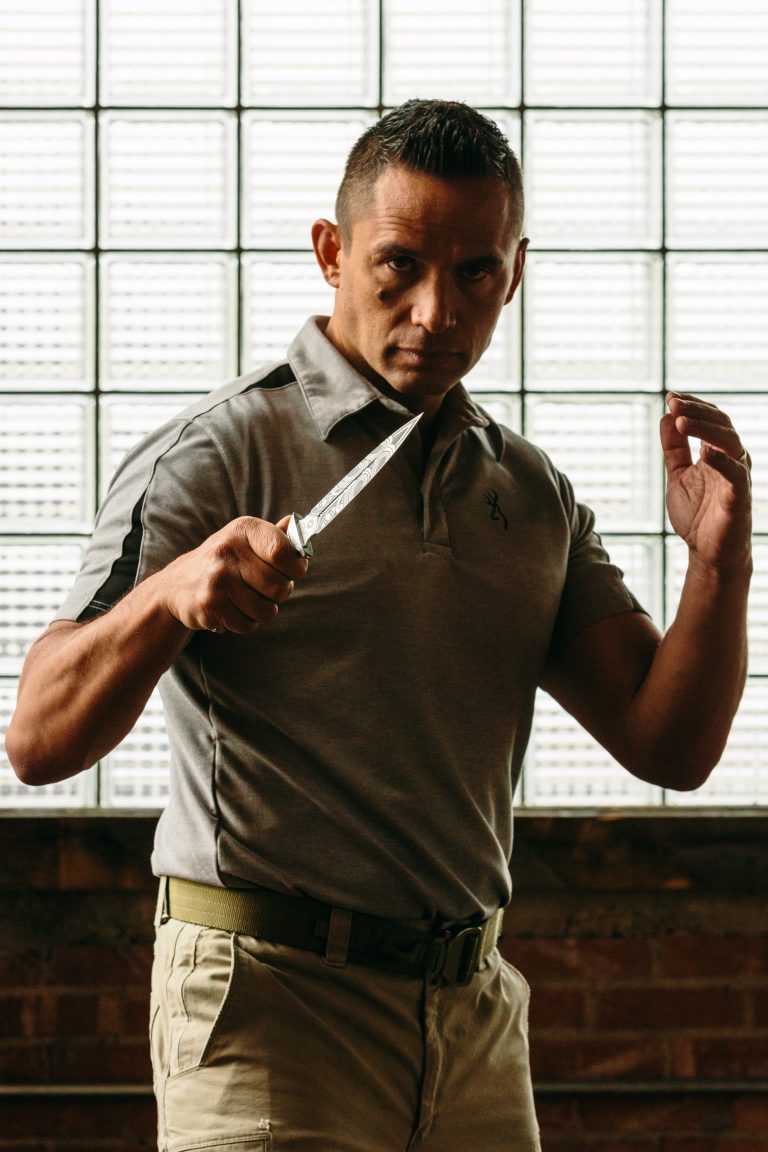
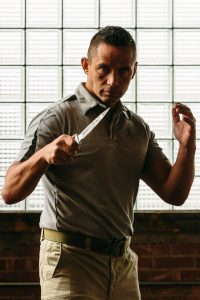
Together with Browning, tactical knife fighting instructor Jared Wihongi has released a signature knife line.
Jared Wihongi’s life and career is built on the warrior spirit of his Maori ancestors. He has practiced martial arts since he was a 10-year-old living in New Zealand, and the Filipino style of knife fighting, since he was 20, some 20-plus years ago. He also has his own signature line of edged weapons through Browning, knives that he hopes inspires “the warrior spirit that lives in each of us.”
Jared has reached the tuhon or master level of Pekiti Tirsia Kali and instructs police officers and elite military operatives in what he calls close quarter force integration tactics, or CQ-FIT. He applies the circular arm movements, the footwork, angling and distance control of Pekiti Tirsia Kali, using empty hands, sticks, knives and even guns, to reality-based training so that police officers are better able to subdue threats, or a special forces member is able to eliminate enemies in close-quarter combat.
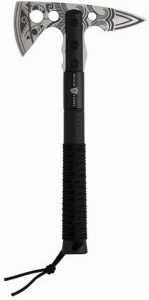
One of Jared’s most interesting-to-watch training sessions involves using a tomahawk in close-quarter fighting. Essentially, the circling motions, overhand and underhand, forward and backhand, are coordinated for attacking your opponent while simultaneously avoiding his advances. The tactical tomahawk in the Wihongi Signature Series is a true straight-handled tomahawk. The blade is made from ¼-inch 420 stainless steel, and the spike end includes a semi-sharpened blade. Three lightening holes are drilled into the blade, maintaining the integrity of the head while removing material to lighten the weapon, making it easier to wield in a fight—or to be fast as lightning.
The Jared Wihongi Signature Series Tomahawk includes acid-etched motifs from the Maori warrior culture.
The forked tang is secured with three flush-mounted screws but is also reinforced by a wide metal ring surrounding the handle. The Wihongi Signature Series Tomahawk carries Browning’s Black Label tactical line logo, along with the familiar Buckmark. The handle is wrapped in paracord, a lighter weight than 550 to eliminating bulkiness, Jared explained.
What is most notable about the weapon is the Maori tribal motif acid-etched into the steel. The warrior culture often carved facial features into woodentaiaha, or fighting staffs. These weapons would include eyes and ornate details that culminated in the familiar out-stuck tongue. Having these designs in a tattoo or engraved on a weapon meant that the warrior was carrying the strength and courage of his ancestors with him into battle.
Jared’s mother hailed from the Lone Star State, but being Mormon she decided to move to Utah. Jared’s father, living in New Zealand, attended a private school run by the Church of Jesus Christ of Latter-Day Saints. He excelled and was granted a scholarship to attend a university, also in Utah. The rest is history. By the time Jared was 1, the couple had returned to New Zealand, raising a brood of six.
Although native New Zealanders only make up 15 percent of the country’s population, the Wihongis lived in a small town that was predominantly Maori. Having grown up the late 1950s when there was little opportunity for Maori youths other than to become farmers, Jared’s father put great importance on education and became a school principal. Two of his sons followed in his footsteps, but Jared and another brother became police officers, with Jared going on to become a SWAT operator for 14 years and counting. He now teaches knife-fighting skills to SWAT teams and elite special forces in the U.S. and allied countries. “I’m an educator too,” Jared said, just in the warrior arts and lifestyle.
Jared Wihongi reviews his tomahawk fighting tactics.
Jared’s father died at a young age and when Jared was 17, the family moved back to the Salt Lake City area. Mormons are expected to go on a two-year mission before attending college. Jared served in the Philippines, which is where he began training in the Filipino knife-fighting arts. He attended college in Hawaii, where he worked as a bouncer, often having to apply his skills in a real-world application. He then returned to the Salt Lake City area and has advanced exponentially in his martial arts practice and his real-world curriculum, which incorporates both the warrior spirit of his Maori ancestors and the premier knife-fighting skills of the Filipinos.
He recommends that anyone who wants to be able to defend themselves against a knife attack seek out a Pekiti Tirsia Kali instructor who offers real-world-scenario training. “Take a sample class,” Jared suggested. “You’ll be able to tell.” Learning to defend yourself against a knife attack is part of learning how to wield a knife in close proximity. Amazingly, this can be done with a tomahawk by choking up on your grip to right under the head. Don’t worry, practice is conducted with training knives. “But you have to make contact to understand knife fighting,” Jared explained
“When I presented this line to the sales force, I asked Jared to lead a haka dance,” said Diane Carver, knife and light product manager at Browning. The feedback she received was intense. Some had never seen the Maori warrior dance that has now been made popular by the New Zealand rugby team and others on social media. Some were inspired to see it live. “I’m so excited about this line,” Diane said.
Jared Wihongi introduces his signature knife line−and leads a haka.
If you’d like to read more about Jared and the four styles of knives in the Jared Wihongi Signature Series by Browning, be sure to pick up the July issue of BLADE® magazine or subscribe.
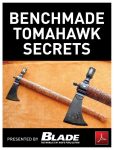
If you’ve ever wanted to try making your own tomahawk, this digital download will provide answers to your questions.
This digital download is an economical way to learn how to select and forge your tomahawk billet, how to drill and fill the eye hole, how to fit the haft to the head and grind it to rough shape. At only $4.99 this volume by BLADE field editor and ABS master smith Joe Szilaski is a fun and needed addition to your weapon-making library.