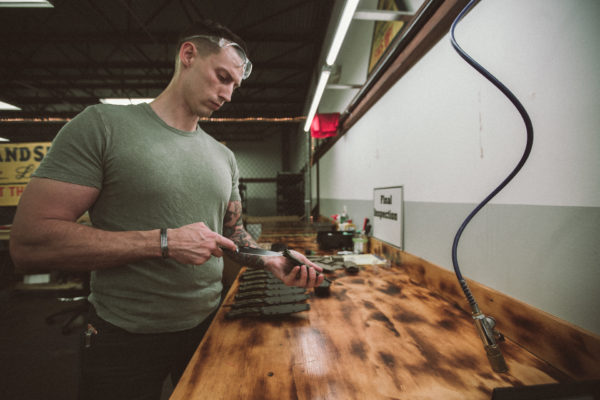
Marine Explosive Ordnance Disposal Technician Staff Sergeant Johnny Joey Jones inspects a knife at Zac Brown’s knife company. The Southern Grind spokesman remembers the fallen, especially the mine sweeper who died in the explosion that took Jones’ legs.
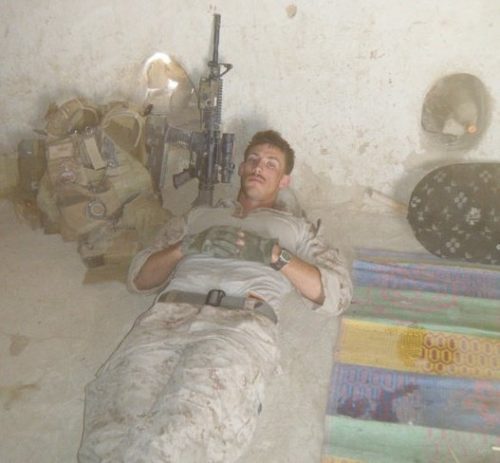
In 2010 ABC Nightline produced a three-part series on Marine Explosive Ordnance Disposal (EOD) Technician Staff Sergeant Johnny Joey Jones. During eight years of service, Jones deployed to both Iraq and Afghanistan. It was while in Helmand, Afghanistan, on August 6, 2010, that Jones stepped on an improvised explosive device, losing both his legs and severely injuring one arm. In the face of inordinate challenges, Jones not only maintained a positive outlook, but became a beacon of hope to his fellow amputees, his fellow veteran collegiates and the public who follow his charity work and appearances on Fox News. Triple J or Joey, as his friends call him, is now spokesman for Zac Brown’s Camp Southern Ground, a 400-acre camp and retreat for children and military families that is funded by the proceeds of numerous artisan shops, including Southern Grind, the musician’s knife company. You can read more about Jones and some of the substantial knives offered through knife-lover Zac Brown’s company in the September issue of BLADE Magazine. (If you can’t find BLADE near you, subscribe.) But no matter how far Jones progresses physically, no matter what business pinnacle he reaches, the Southern Grind spokesman remembers the fallen, one fallen in particular, the man who died in the explosion that took Jones’ limbs: Marine engineer and mine sweeper, Corporeal Daniel Greer.
In the course of eight years of service in the Marine Corps, Staff Sergeant Johnny Joey Jones was deployed to both Iraq and Afghanistan as an Explosive Ordnance Disposal technician. In 2010 he lost both his legs in an explosion. No matter what he does: recovering from his wounds, inspiring fellow veterans as they recover, making motivational presentations, representing charity organizations, appearing on Fox News as a commentator, or as current spokesman for Zac Browns Camp Southern Ground and Southern Grind, the musician’s knife company, Jones is always positive and never fails to remember the Marines, soldiers, sailors and airmen who died in service to our country.
A TV Crew Interviews Jones in Afghanistan, Unaware Of The Fate To Befall Him
Jones’ Recovery Is Motivated By Fellow Wounded Brethren And The Fallen
Jones Remembers The Marine Who Died In The Explosion That Took His Legs
Jones’ Second Chance At Life Is In Honor Of Those Who Died In Combat
No Matter The Obstacle Jones Has Some Marine-Tough Encouragement
Read about the styles of knives most often carried into war and lots more in this two-pack of BLADE’s Military Knives issues for 2010 and 2011.
Boldly designed military knives, stories of knives that saved the lives of men in combat, soldiers who make knives for soldiers, and makers who support the troops, it’s all covered in these two special issues. Normally, $11.90, this download .pdf pack is on sale for $5.99.
Taking great photographs of knives is no easy task—unless you’re a professional, in which case you can stop reading. Essentially, you’re taking a highly detailed shot of something that fills the entire frame, not something small like a bee in the center of a background of blurred petals, but a long, thin item that needs to be in focus from point to butt. But there’s so much more. Every line must be fully revealed and a depth established to convey thickness or thinness. I know close to zero about the mechanics of the art. There are plenty of videos and online courses out there that’ll give you the science of the “study of light.” They can speak to you of aperture, ISO and shutter speed in infinite combinations. All I know is a good photo when I see one, and how I have tried to improve my own photography. Here are the 6 things BLADE looks for in a knife photo. It’ll be up to you to make it happen. Why? Because there are “5 Ways To Get Your Knives Featured In BLADE” and you want to be ready.
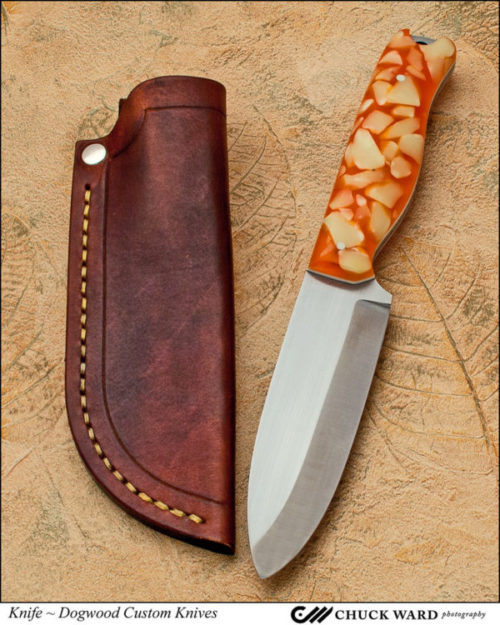
Dan Eastland of Dogwood Custom Knives used professional photographer Chuck Ward to take this exquisite image of his Hawkins knife. Chuck will be the official photographer at the 2017 BLADE Show. Contact www.dogwoodcustomknives.com for more about this outdoorsman’s knife.
Hire A Professional
Knife manufacturers, like good real estate agents, know that great photos will close a sale. They understand that the investment in a professional photographer pays off. When BLADE asks for a photo of their latest release, for example, some even allow high-resolution downloads right from the consumer website without having to go through a media relations person. That can be a time-saver at deadline. I’ve even experienced a large company resubmitting photos with even better ones. There’s nothing that says a one-man-show can’t learn from that level of perfectionism. It’s the same effort you put into crafting your knives.
Hiring a professional photographer will cost you some money, and it’s worth every penny. But like all professionals, some are more versed in what we’re trying to accomplish than others. A portraitist, wedding photographer or photojournalist may or may not be able to give you the results you’re looking for. You want to make sure you chose someone who can show you a portfolio of knives, guns, tools or similar items that looks…well…perfect.
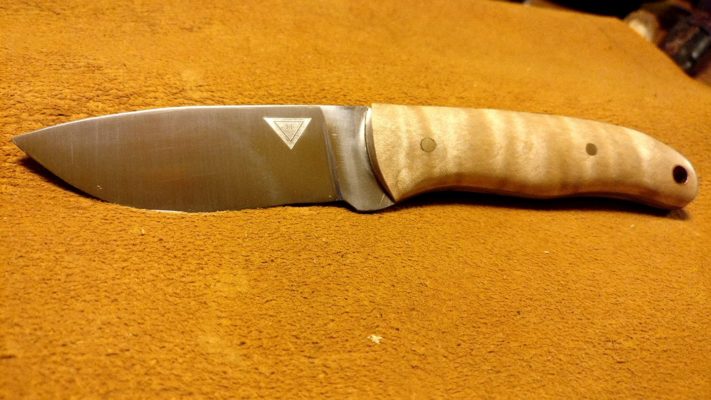
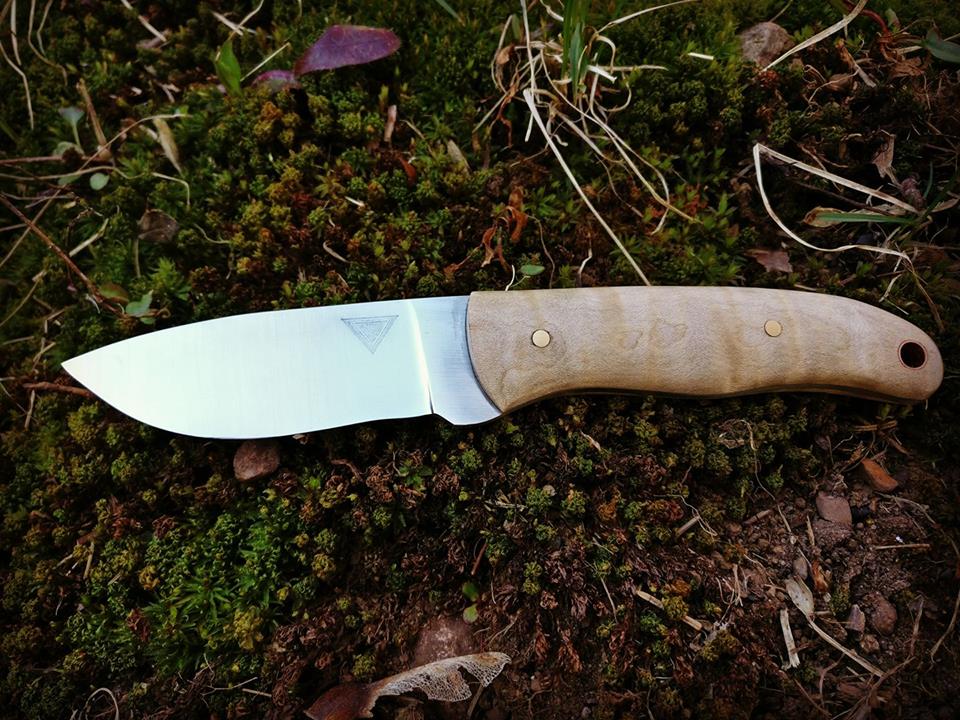
The handle on Tim Tracey’s everyday performer doesn’t stand out as much as it could against the similarly colored background. The caramel color ends up saturating everything in the photo. Also, although the focus on the blade is crisp, the topline on the handle is a touch soft.Tim Tracey took his knife outside and got not only a good image of the blade and handle, but good contrast and a better depiction of the piece’s fullness. The recurved blade is made of 1095 steel and sports exhibition grade curly maple scales. Makers list price: $220. Contact [email protected], Timtraceyknives.com on Facebook or @TimmTracey on Instagram.
You will want two kinds of photos. Photos for your website and social media will create an emotion, an atmosphere. Instagram is full of examples of survival, bushcrafting and hunting knives being photographed outdoors and tactical knives being shot in gritty workshops or light-painted in darkness. Makers create everyday carry still lifes with folders, wallets and watches. Typical? Sure, but each one tells a story that has been told a thousand times before in a slightly different way. Nobody reads just one novel, and nobody looks at just one knife photo. They are all beautiful in their own way. The other kind of photos you will need are those of just the knife itself on a simple background, what is often referred to as glamour or beauty shot.
The question you have to ask yourself is: Are you willing to put as much study and effort into your photography as you are your knifemaking? Answer honestly. There’s no shame in shelling out cash for stunning work. Fill your website with those choice images and have them on hand for BLADE, and then you can practice your own photography skills for social media. Even on social media, though, take the time to post only your best images. Plenty of knife-related Facebook Groups out there are looking for banner photography and have to reject knifes they’d like to showcase because the image is, say, out of focus.
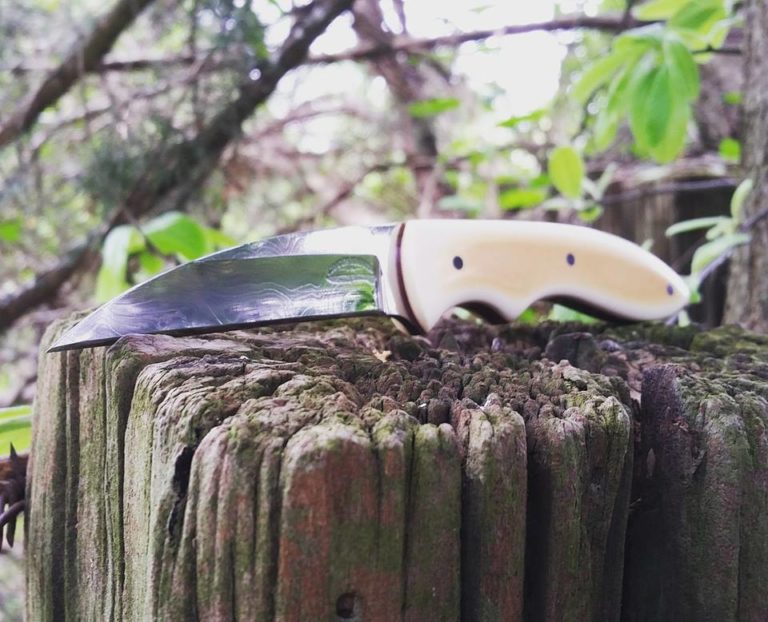
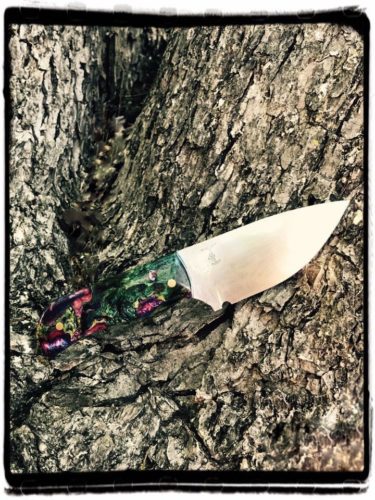
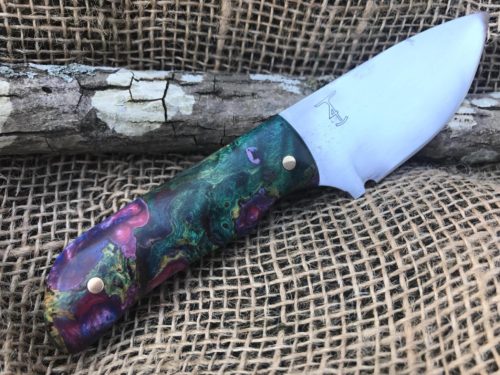
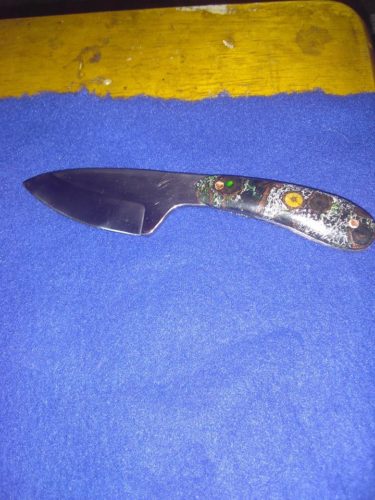
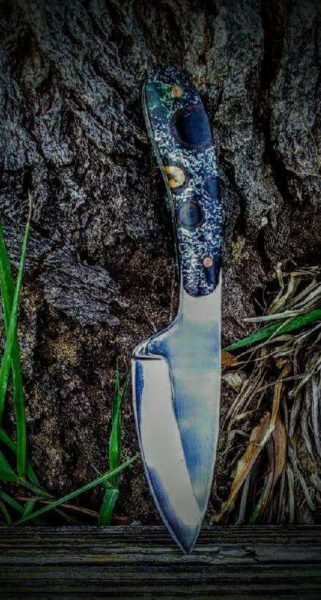
Although this image clearly shows the blade on this skinner by Bobby Toerck, the multicolored handle gets lost in the textured bark.In this image, the handle on Bobby Toerck’s drop-point skinner is nicely contrasted against the still-textured, but now single-colored burlap. And the 80CrV2 blade still looks terrific. The handle is triple-dyed box elder burl by Terry Dunn. Maker’s list price: $175 with Kydex sheath. Contact T4 Custom Knives on Facebook or call 903-812-1173.
Do-It-Yourself
Let’s say you can’t justify the expenditure at this point in your knifemaking journey. Or, more likely, by the very nature of your interest in crafting, you’re determined to take quality photos of your knives yourself. You think, How hard can it be? Very. It can be very challenging to produce the kind of photos needed for a glossy magazine.
“Real” Camera Vs. Camera Phone
You can take the cost of a few sessions with a photographer and buy yourself a decent camera, for starters. Keep in mind, however, that lenses that come with a camera are usually not very good. Be prepared to buy a decent mid-range lens at a minimum.
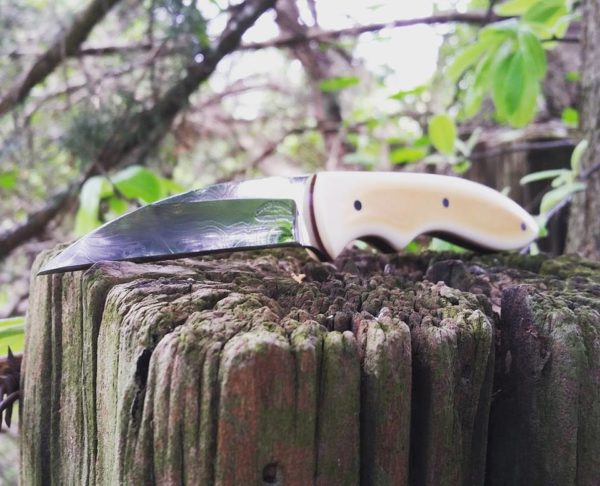
In this vertical image of a horizontal knife, the butt is cut off. There is also glare on the handle and the blade looks dull. Will Thompson decided to get some help for the reshoot.Even though Will Thompson’s handle has to work to stand out against the tree bark, it succeeds. The pattern is now discernible and the blade looks great. This drop-point finger skinner is made of 1095 steel and the Plantstone (stabilized pine branches with aluminum flakes) scales are from Robert Belcher. Maker’s list price: $75. Contact [email protected] or on Facebook at Dusty’s Cutlery.
Then again, there are some excellent photos being taken with newer camera phones. Do NOT attempt this with an older model. You will only frustrate us both because they do not allow for high enough resolution of the images. Be sure if you submit a photo from your phone that you email it at its largest size. If there are settings on your phone that need to be changed to allow for taking photos at higher resolution, then you’ll need to set those accordingly. Those settings will apply only to photos you take going forward; you cannot retroactively apply them to photos already taken. Whether you use your phone or a “real” camera, the same fundamentals of photography apply.
Tip: If you smoke or if you have your phone in your shop, there could be resin or dust on your lens. You’ll want to clean that—gently—before you begin.
Be sure to take great photos of all your work before they are sold, and to back them up, either in the cloud, through an online backup service or on a thumb-drive.
6 Things BLADE Looks For In A Knife Photo
Focus
The entire knife must be in focus, from point to butt. Are there some artsy shots of crystal clear blades and blurred handles or vice versa? Sure, but that’s not what we’re looking for in print. Online, we’re more open to considering some of those shots, provided we have some conventional full-focus shots to accompany the story as well.
If you are taking what we call a “using” shot where you’re photographing the knife in use for an online story or if we are working on a story together for print, be aware of where your camera is focusing. I have seen crystal clear shots of a leaves on the ground while the knife and the hand it’s in are both blurry. Focus is probably the single most important aspect of a good photo.
Contrast
Be aware of the color of your background. A grey knife on gray pavement, a black knife on a blackened tree stump, camouflage your knife. It’s like a silver or gray car against gray pavement on a gray winter day—you can’t see it. No contrast. This applies to multicolored handles against multicolored backgrounds as well.
In this image of Andrew Griggs’ knife, the blade looks dull and the focus on the handle is somewhat soft. Also, if this image were being used for a BLADE Magazine section that required a cutaway, the prop would be in the way of the blade.Andrew Griggs got outside to reshoot his knife. Now you can see the pattern-welded steel! The Southern Comfort gentleman’s fixed blade has a Vintage Paper Micarta handle. Maker’s list price: $300 with leather sheath. Contact Griggs Knives on Facebook.
Composition
For two of BLADE’s sections, “What’s New” and “Knifemaker Showcase,” only cutaway images of the knife are used. (See the “5 Ways To Get Your Knives Featured In BLADE.”) This means that you don’t need to worry about the background at all. In fact, white paper is fine, but watch for any shadows. It’s fine to have a slight shadow, provided the lines of the knife are clearly visible. If the edge or spine of your knife bleeds into the shadow to the point where you can’t tell where the knife starts and the shadow ends, that’ll need to be reshot. Our designers need to able to see those lines.
Mood images are fine for both a feature in print and for online stories. Feel free to get as creative as you want, but ensure that the knife is the main attraction. Photographing knives is one of those times when the rule of thirds really isn’t applicable. The knife is the main attraction and we’re not going for proportional sharing with a background. If the image you’re submitting for consideration is for a section of the magazine that uses cutaways and there’s moss or grass, fabric or fur encroaching on the blade itself, that’ll impede the designers in their work.
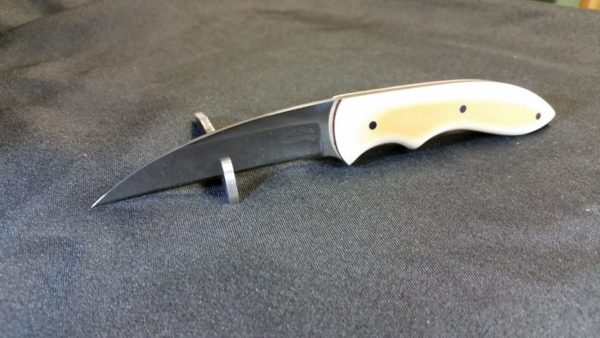
Make sure no part of the knife is cut off, and don’t crowd the point or butt. If you place the knife in a stand and that stand encroaches on the knife, it can’t be used for a cutaway, but it could possibly still be used for an online story or in print.
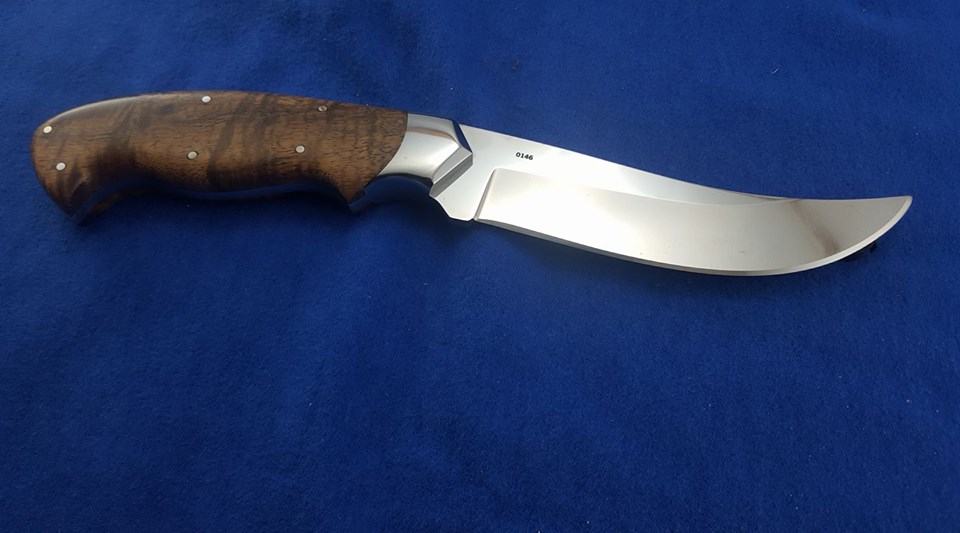
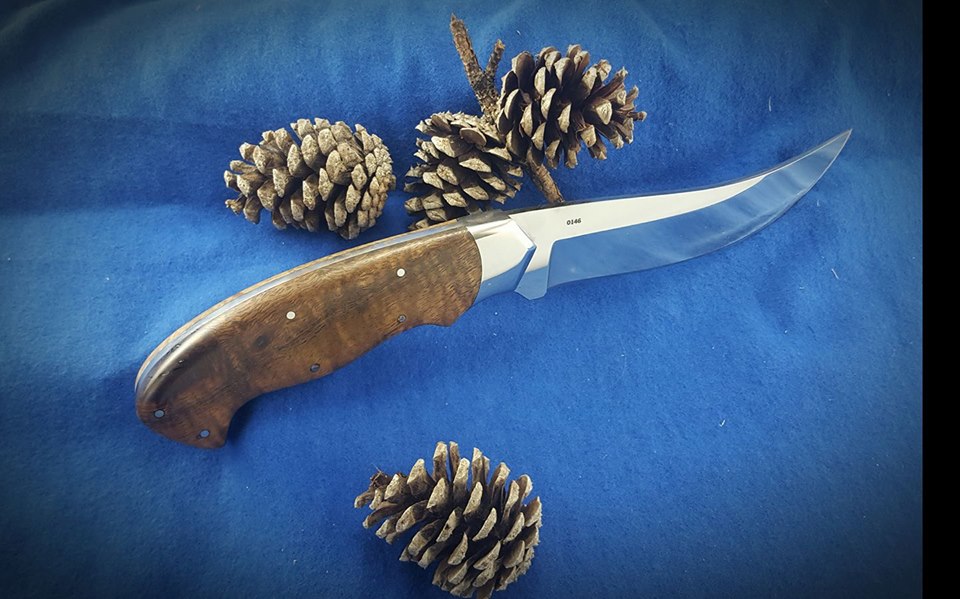
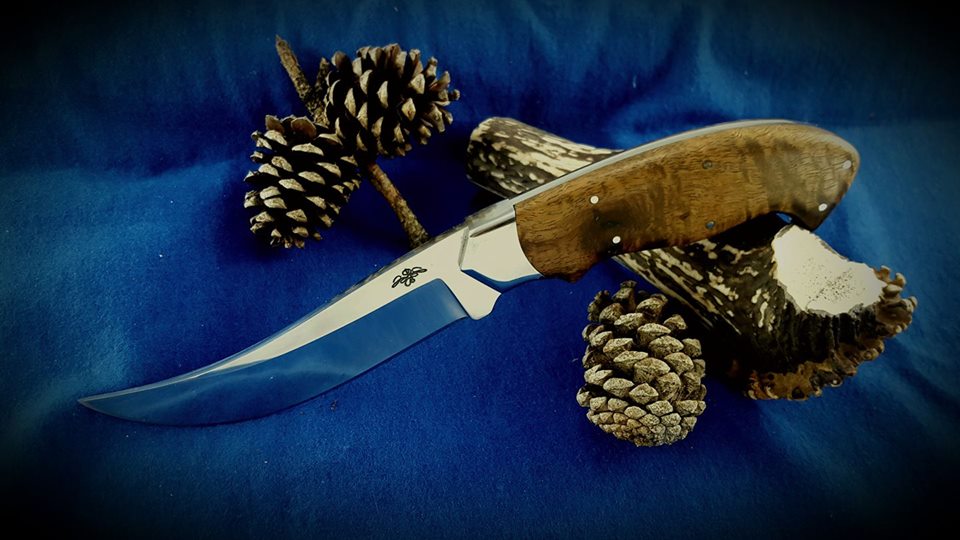
Devin Bliss has taken a very good photograph here. However, there is shadow at the handle, which would make it challenging for the designers to see where to make the cutaway image for inclusion in say, BLADE’s “What’s New” or “Knifemaker Showcase” sections.In Devin Bliss’s second attempt, the handle is more visible, but looks less rich in the harsher lighting. The inclusion of the pinecones makes a nice vignette without encroaching on any line of the knife, so it could still be used for a cutaway or as is. As a side note: Artists will tell you that the eye finds odd numbers more pleasing. I did not tell Devin that. I simply told him the truth: He had surpassed my level of being able to offer suggestions for improvement. He contacted another knifemaker for guidance.At this point, knifemaker Devin Bliss has reached a level of photography that serves his knives well. What did he do? “I changed the direction, propped up the handle onto the antler, moved the lighting around and used a foil reflector to get…a bit more light on the handle and a white reflector to mask off some glare on the blade and bolster.” This modified pronghorn is made of CTS-XHP steel with a curly koa handle. Maker’s list price $300 with stamped leather sheath. Contact [email protected], 903-736-3052 or on Facebook at DB Custom Knives.
Depth and Angles
In layman’s terms, you need to ensure your knives don’t look flat. You’re trying to capture something that’s three-dimensional in a two-dimensional medium. This is where some knives can look disproportionate because you’re focusing on the handle and the blade is in the fuzzy background, so to speak. A shallow depth of field is fine as long as your knife is standing out crisply from point to butt.
Finding the right angle will also help prevent your knife from looking flat. Prop up your knife somehow. Even just leaning it against a pebble allows you to move and capture the thickness or thinness of the piece. Laying it on your hand can work as long as your flesh doesn’t obstruct any of the knife’s lines.
Tip: Take dozens of photos from many different angles and distances and pick the best one of the bunch. If you don’t nail it, don’t compromise, don’t settle, get back there and take dozens more. Pros will take hundreds of impressions to deliver 30. Seriously. Take more shots. No, more. Get a ladder and shoot down, circle your quarry and shoot multiple shots from each hour of the clock, and get down and shoot at eye level. Shoot at morning, noon and night, but mostly late afternoon, to see how different types of sunlight affect your knife images. It’s what the pros did when they were starting out. Now, after years of experience, they can judge the sun’s angle and know how to get what they need.
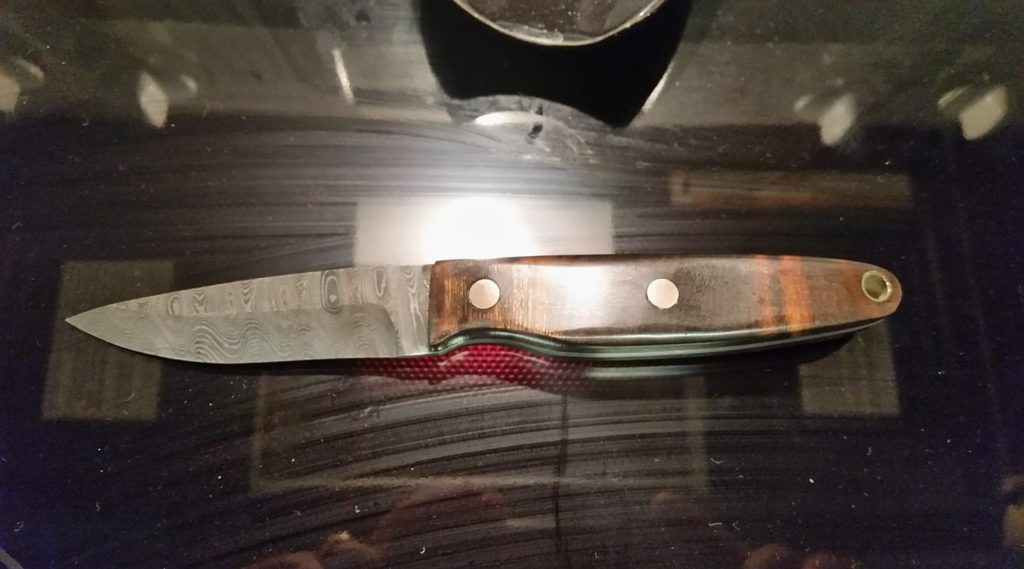
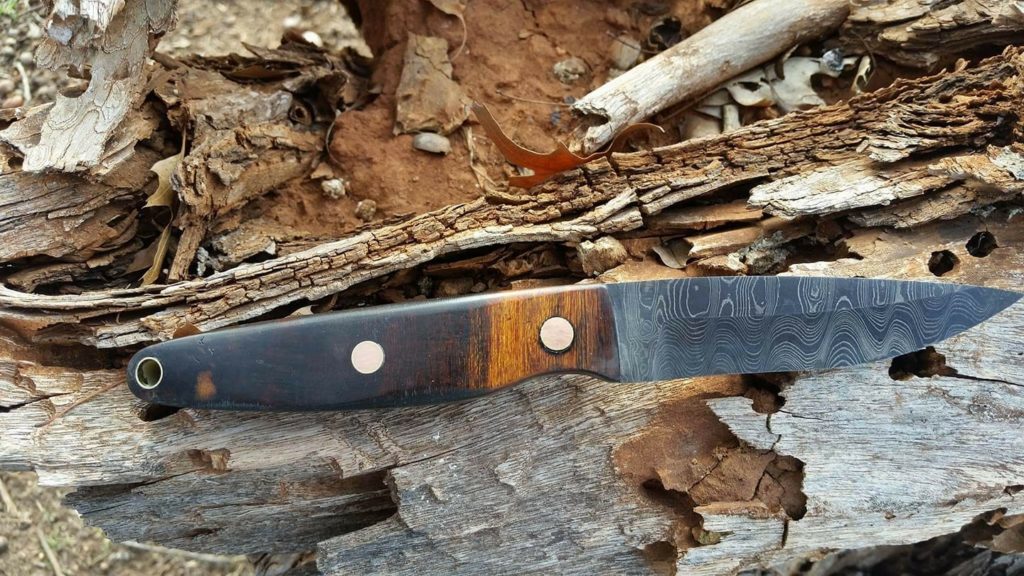
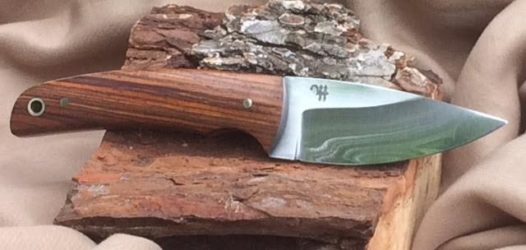
Charles Hawkins has a hard time taking a bad photo, but he pulled out all the stops on this one. That is a stovetop background, complete with streaks and a red glow. The glare on the handle deadens the handle and the pattern in the steel also appears dull. Note the photographer’s hands reflected on the cooktop. Analyze the entire photograph closely.Charles Hawkins took his knife outdoors, and now the focus is as sharp as can be. The background adds interest while still allowing for plenty of contrast. The 3.5-inch blade is made of pattern-welded steel from Alabama Damascus Steel. The handle is ironwood. Maker’s list price: $300. Contact www.hawkcustomknives.com.
Lighting
Natural light is easiest for the amateur to master. A cloudy day is good to reduce blade glare but sometimes it will dull colors. Try a sunny day, but shoot in the shade. Avoid glare on either the handle or the blade whether you’re shooting indoors or out. You also don’t want dappled light coming through the leaves of a tree to interfere with the hamon, for example, so try to find a solid overhang. You also don’t want reflection to make your blade look different than it is in reality.
Indoor lighting is infinitely more challenging. Low light, fluorescent light, light-painting in a dark room—they all have the potential to become “noisy,” grainy, soft. I will leave it to the articles and videos you’re going to pour over to explain why, but trust me, it’s not easy. Sometimes, in light-painting for example, the pins might absorb all the light and they take over the picture. Or the handle’s too dark, or the handle’s visible, but the blade looks dull. Changing the countless variables on this project will help you get the right shot out of your many attempts. It can help to take notes so you know what you’ve tried and whether or not it worked.
Avoid using the flash inside your camera. It will only give you an overlit image that makes your work look flat. An external flash, shot off a wall or ceiling or even a white T-shirt, or an extra light diffused with a white paper bag, may help, but now your knifemaking shop has turned into a spaceship and you’re behind in your orders.
Specs
Images need to be 300 dpi for print with the photo at least 8 inches on the longest side, preferably 10. The image size should be at the very least 600 KB. It’s not that we’ll run it that large, but we need to have the option to do so, especially if we’re doing a cutaway and the knife doesn’t fill the frame.
We prefer .jpg format, and that you attach the image file rather than dragging it into the email. Sometimes that can make a difference in resolution quality, though it admittedly shouldn’t. Also, for similar reasons, submit originals and not versions scraped from Facebook or other social media platform, even for online stories.
Remember, it’s all about the knife here at BLADE. Oh, and makers and manufacturers, too. But without a fantastic photo of a knife as a starting point, how are we ever going to get to know you better?
“101 Knife Designs” is not only filled with great comparisons of blade designs and design theory, but offers terrific examples of exceptional knife photography by Hiro Soga.
Knifemakers of all skill levels will enjoy comparing knife designs in this book by Murray Carter. The photographs by Hiro Soga are exquisite! There is even a discussion on the theory of knife design to help you better understand your craft. Save 35 percent off the cover cost of $29.99 for a total of $19.99.
Here are 5 ways to get your knives featured in BLADE, either in print or online. Our goal is to include as many different types of knives and as many different knifemakers and manufactures as we can in each issue and online. We try not to double up on any individual or company, though sometimes it’s unavoidable. That means that we’re always looking for makers who haven’t been featured before. There are some restrictions, but those will be covered under each category.
Be sure to Like and Follow BLADE Magazine on Facebook. If you’re on Twitter, look for BLADE Magazine. We’re @blade_magazine on Instagram.
First, please Like and Follow BLADE Magazine on Facebook and Follow BLADE Magazine on Twitter and @blade_magazine on Instagram. That way you can see online stories when they’re posted, which may prompt other story ideas.
3 essentials for all 5 publishing options
Our Enthusiasm
We have to like your knife. But wait! We like ALL kinds of knives: cooking, everyday carry, bushcraft, hunting, tactical. We like fixed blades and folders of every deployment and locking mechanism. We like art knives that we’d be proud to put on our shelves. We like all shapes and sizes of knives, of every conceivable blade design and grind. We welcome smiths, stock-removal makers, manufacturers, collectors. Whether you’re just reaching your artistic stride or you’ve been involved in the knife industry for decades, you’re part of the BLADE community. So, don’t be shy. Chances are, we’ll thoroughly appreciate your knife or your perspective on the industry. The only way we’ll be able to see your knife, however, is if you show it to us in a well-done photograph.
Your Enthusiasm
How hard are you willing to work to make your knife look its best in a photo? Or, are you willing and able to hire a professional to take photos so that you can concentrate on knifemaking? The answer to either of those questions will be the measure of your enthusiasm. Other pieces of information will be required, but those details seem easier to acquire than photographs that do justice to your knife.
High-Quality Images
Poor-quality photos will definitely dampen our enthusiasm to publish them, no matter how beautiful your knife is. If the photo is out of focus, low resolution, poorly composed, lacking in contrast, flat or poorly lit, we’ll ask you to get better photos. As challenging as it will seem, it ensures that a poor image doesn’t run side by side with a stellar one, making your knife look lesser than it really is. You can read more about what we expect by reading “6 Things BLADE Looks For In a Knife Photo.”
Let’s say you have terrific photos, then what?
5 ways to get your knives featured in BLADE
‘What’s New’
The “What’s New” section of BLADE magazine features knives from six manufacturers and six custom knifemakers. Occasionally a tomahawk, tool or knife accessory will be included, but the focus, as always, is on knives.
The “What’s New” section of BLADE magazine highlights 12 new knives each issue, six from manufacturers, six from custom knifemakers. And, guess what? If you’ve never been in “What’s New” before, everything you’ve made is “new” in that not all of our readers have seen your work before. If you’ve already been in “What’s New,” perhaps there is something new you’ve been trying out: a different design or grind, or you usually make fixed knives and now you’re moving into folders, or you’re using a different engraver. After being in “What’s New,” you must wait at least 12 months before you can be eligible again, and makers who haven’t been in before will take precedence. Just to reiterate, our goal is to get as many different knives into BLADE as possible. We will occasionally include a tomahawk, sharpener or other knife accessory, but mostly the section features factory and custom knives.
Requirements: High-Resolution Image, Short Description
All that’s needed for “What’s New” is a high-resolution, print-quality image of your knife. Bottom line: 300 dpi or higher, 8-10 inches on the longest side, be that vertical or horizontal, and .jpg format. Now, for “What’s New” we use “cutaways,” or just the knife devoid of its background. This means that you don’t need to worry about creating an artistic vignette or still life with your knife. You do have to worry about getting the best picture you can get. For more on what makes an acceptable photo, read “6 Things BLADE Looks For In A Knife Photo.”
You will also need to supply a list of specs and a few sentences describing the item’s usage. Be sure to note if there’s anything new-to-you about it. They say there are no new stories, just different ways of telling them, and that could also be said of knives. True innovation does happen, and of course, we’re eager to hear about that. However, a maker might be working on new things all the time in his or her shop and that counts!
‘Knifemaker Showcase’
In BLADE magazine’s “Knifemaker Showcase,” six custom knifemakers are featured every month. A well-done knife image, a mugshot and an interview are required for inclusion in this section.
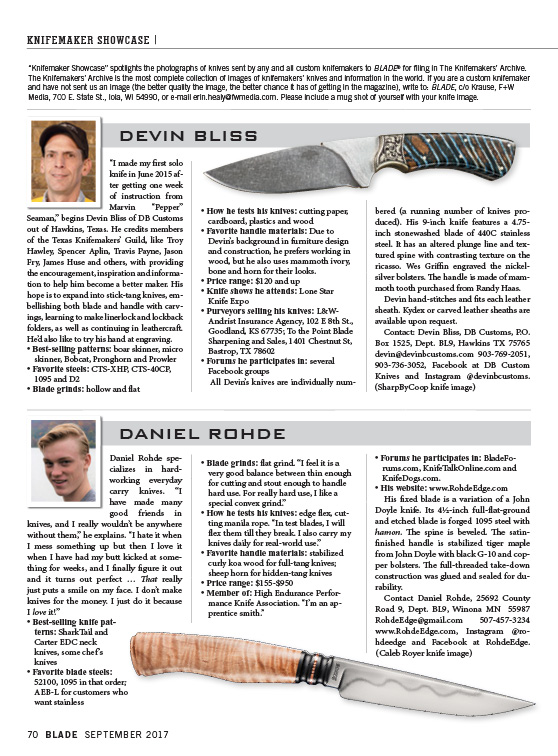
“Knifemaker Showcase” features six custom knifemakers each month all with a half-page layout that includes a mugshot, cutaway knife image and bulleted interview. The goal here is find out more about you, your start in knifemaking, your influences and your preferred materials, designs and ways of connecting with your customers. You’ll need to answer a questionnaire, explaining why you make the choices you do when crafting a knife. You can type out your answers, or if you’re not into typing, we can interview you over the phone once you’ve had a chance to think about your answers. After you’ve been in “Knifemaker Showcase,” you must wait at least 12 months before you’re eligible to be in it again, and makers who’ve never been featured before will take precedence. That way we can shine the spotlight on as many different makers as possible.
Again, our designers use cutaway images of knifes in this section, so a clean backdrop is best. You want to make sure your contrast is good and that nothing, including shadow, fabric, grass, encroaches on the edges of the knife. To learn more about the differences between a good photo and a bad one, read “6 Things BLADE Looks For In A Knife Photo.”
A mugshot is a portrait of you. It can be taken outside or in your shop, but the background will be mostly eliminated since we’ll be cropping in on your face. Don’t wear sunglasses. This is a chance for readers to meet you face-to-face, so to speak. If you’re wearing a hat, just make sure your face is not cast in shadow. Even though it will run small, your photo still needs to be print-quality. Keep in mind that if you submit a family portrait, for example, we will need to crop in on just you, so the size and resolution will need to be higher to account for that.
You’ll need to answer all the questions on the questionnaire unless something doesn’t apply to you. Too much information is better than too little.
BLADEmag.com
“Mightier Than The Sword with Erin Healy” is one BLADEmag.com blog where knifemakers and manufacturers can suggest story ideas of interest to everyone within the industry.
The blogs on our website allow us to take as much or as little space as is required to tell a story. Here is where we have the freedom to explore all kinds of stories related to the industry. BLADEmag.com stories can be about manufacturers, distributors, collectors or knifemakers; they can cover everything from how you made a cast spruce cone handle to how you’ve used knives in your family or on the job, whether it’s skinning deer, cross-chopping herbs in a restaurant kitchen or employing various grips in edged-weapon martial arts. The story can be about one particular knife or a collection. The source can be a multinational corporation with operations on more than one continent or a lone individual in his or her shop. BLADEmag.com strives to be a resource for all things knife, so histories and how-tos are of particular interest.
We welcome guest bloggers, provided the topic you’re writing about is not self-promotional. What this means is that you cannot write about your own knives or services. Pay is non-existent, but bragging rights are impressive. You will need to be able to write well, or be open to guidance and editing. You will need to provide a paragraph-long biography and a mugshot to run with your story, as well as illustrative images.
Requirements: A Good Story, Good Images
The thing about a story, whether it’s a topic you suggest for us to explore or one you’d like to try your hand at writing, is that it needs to have a story—a beginning, middle and end, an angle, a hook. If you as someone in the knife industry find it interesting then, chances are, others will as well. Even though BLADEmag.com will always focus on the knife, we also know that it is the people behind the knife that makes the story compelling to read. The whys are always interesting to include, as well as trying to describe how a material or process contributes to the feel or wow-factor of a knife.
Although knifemaker profiles are reserved for Knifemaker Showcase in print and BLADEmag.com stories online, other ideas for BLADE magazine are always welcome. The final decision for a feature article within the pages of BLADE rests with the editor. Oftentimes in the course of conducting an interview with a manufacturer or knifemaker for “What’s New,” “Knifemaker Showcase” or BLADEmag.com, we find other stories to write about in print.
To get a story into print, images must be top-notch. Focus, contrast, lighting, composition, depth of field all matter. Resolution must be high; size must be large. To fully understand what this means, read “6 Things BLADE Looks For In A Knife Photo.”
Social Media
Make sure to follow us on tag us in your social media photos so we see them and use #BladeMagazine
Requirements: Images, Specifications, Intended Usage, Contact Information
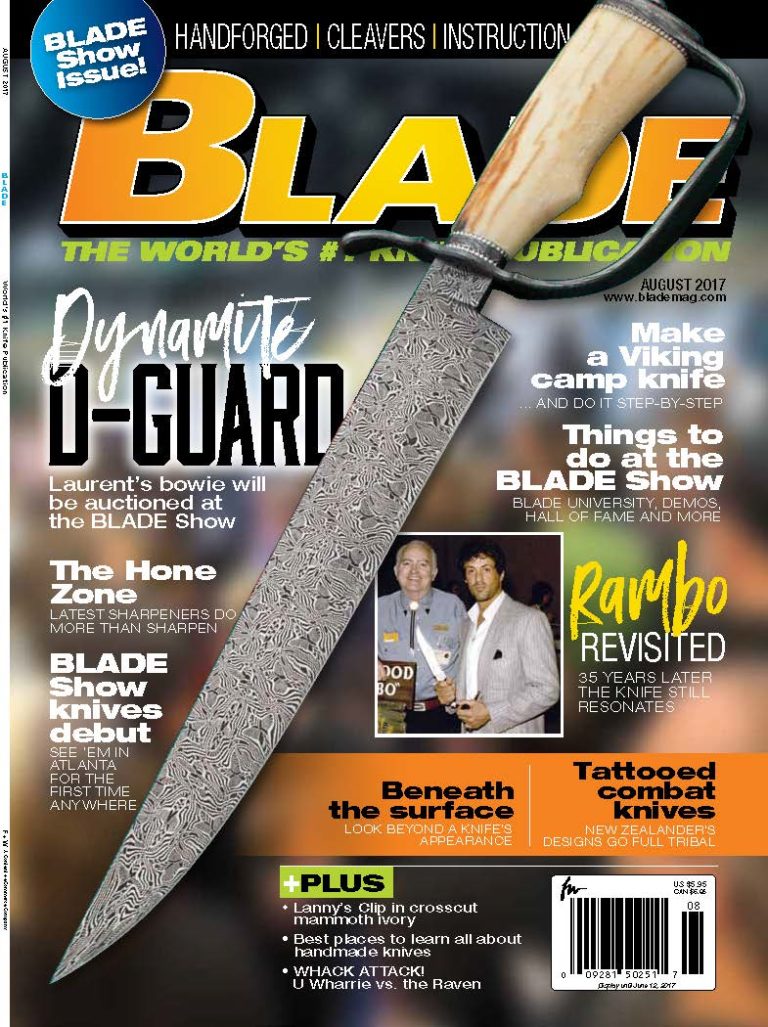
36th Annual BLADE Show preview highlights the latest issue of BLADE®.
Sneak a peak at next week’s 36th Annual BLADE Show in all its sharpened glory in the latest issue of BLADE® Magazine, on newsstands now!
June 2-4 at the Cobb Galleria Centre in Atlanta, the world’s largest and most important knife show will feature over 1,000 domestic and international exhibitors of custom and factory knives and the people and companies who make them, thousands of worldwide knife fans and much more—and it’s all in the latest BLADE.
New features include a balisong-flipping competition conducted by Blade HQ, a survival skills demo by one of the stars of the Alone™ TV series on HISTORY®, Larry Roberts, the BLADE Show 2017 Photo Contest in which patrons enter their favorite BLADE Show 2017 photos with a prize going to the one selected the best of the bunch, how to make a Brut de Forge knife—these and more are among the highlights of the 36th Annual BLADE Show outlined in the latest BLADE.
Also this issue: a retrospective of a knife that changed knife history in “Rambo Revisited”; part one of a three-part series on the latest sharpeners in “The Hone Zone”; how to make a Viking camp knife; New Zealander Jared Wihongi’s new Maori-inspired combat knives for Browning; a review of the handforged knives that will be auctioned—including this issue’s cover knife, a stunning damascus D-guard bowie by Veronique Laurent—by the American Bladesmith Society at the BLADE Show in “John White Will Be Watching”; and much more, all in the latest BLADE.
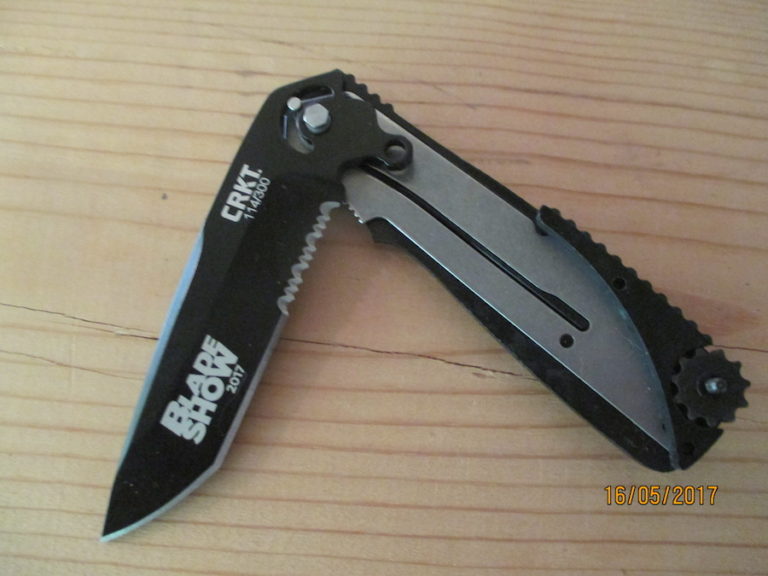
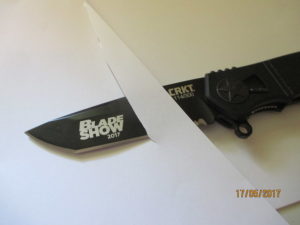
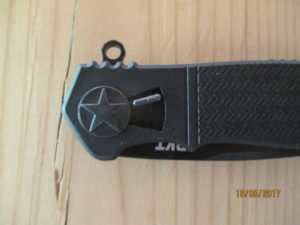
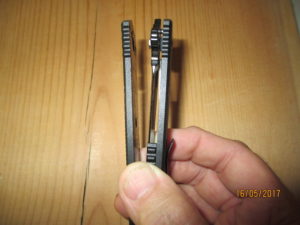
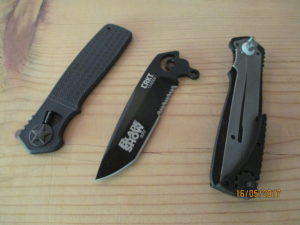
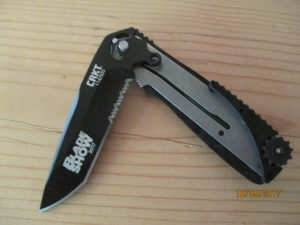
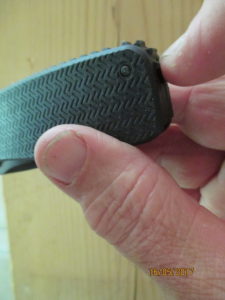
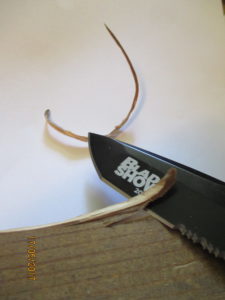
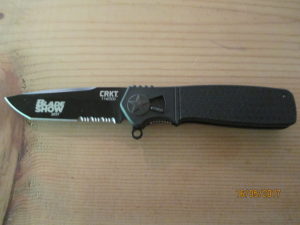
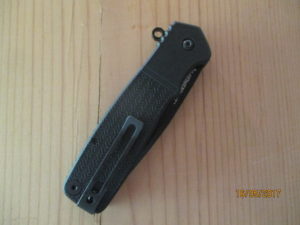
The 2017 BLADE Show Knife and its 1.4116 stainless steel blade cut stationery with ease after whittling curlicues. It was very sharp out of the box.To begin disassembly of the 2017 BLADE Show Knife, push the lever on the bolster up.The sensation of holding a knife that’s coming apart in your hand is kind of cool.The 2017 BLADE Show Knife separates into three parts: two handle halves and the blade. Keep it super simple, you might say.Partially reassembled you can see the liner lock spring and wheel in the handle butt.Rotate the wheel in the handle butt clockwise until the handle separates.
The centerpiece of the 2017 BLADE Show Knife, however, is Onion’s “Field Strip” technology, which enables you to easily disassemble the knife for cleaning and reassemble it in a matter of seconds without the need of a takedown tool of any kind.
Sounds easy but what about people with 10 thumbs like me? I pulled out the 2017 BLADE Show Knife and opened and closed it a few times. The flipper opener works well. I tried whittling some curlicues from a board and cutting stationery, both with good success. The blade was very sharp out of the box.
The directions for the “Field Strip” feature are pretty straightforward. With the knife in the closed position, push the lever on the bolster up. No problem. Rotate the wheel on the handle butt clockwise until the handle separates. The wheel is notched with gears. I found it turned well either with one of my 10 thumbs or my “second thumb” that passes for an index finger. The handle separates into three pieces—two handles and the blade—all simple to clean when the time comes.
To reassemble, put the three pieces back together, press down on and hold the pivot, rotate the wheel counter-clockwise until snug, and push the pivot lever down. It’s pretty easy, even for me.
The CRKT Homefront Tactical is the Official 2017 BLADE Show Knife.
A couple of things: If, after reassembly, the pivot lever balks any when you try and push it down, tweak the screw on the reverse side of the pivot pin until the lever cooperates. Also, be sure the white washers on the pivot pin stay put when you have the knife apart. If they were to come off for any reason during cleaning and/or reassembly, they could be difficult to find. You may even want to remove them during cleaning and apply a small dab of oil to keep them lubricated.
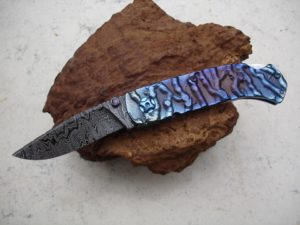
1. This everyday carry folding knife by Tim Lambkin is lightweight at 3.2 ounces. It measures 4 inches closed and is 3/8 inch thick. Tim welded the pattern, did the filework inside and out and flame-anodized the titanium scales to add the wow factor. The screws are the types used in hip replacements, anodized for color! The thumb stud is mother of pearl. Makers List Price: $900-$1000 Contact http://chopsknives.com, [email protected],903-926-7447. (Ericka Lambkin image)
Has a card, flowers and brunch become the routine for Mother’s Day? Maybe you’ve tried getting creative with gift-giving but it wasn’t well received, so you’re sticking with what works. Dull! Where’s your sense of adventure? What about giving the mothers in your life something sharp and pretty? Just like her! Let’s look at 20 custom knives moms want for Mother’s Day, or any day for that matter.
Isn’t that like giving a vacuum cleaner or an iron?
Yes and no. We’re not talking boxed sets of table cutlery or mass-produced blades, regardless of their quality and usefulness. We’re talking 100-percent hand-crafted custom knives. If you decide on a chef knife, for example, it could be construed as encouraging cooking, but the knife will be so beautiful, so smoothly made, so significant in her hand, she’ll overlook the “get cooking” aspect and start searching for things to julienne. You may find her looking for ways to display her knife not only as an easily accessible tool, but as a work of art. It’s not going to be tossed carelessly into a drawer, that’s for sure.
Hmmm. I’m not so sure.
Ok. What about knives for self-defense? Or engraved knives in pearlesence or vivid colors that mom will want to hold, admire and show off? Knives for shaving? The cowgirl in your life could use a custom livestock castration knife.
Excuse me!
Just look. These 20 custom knives will be well received by all types of mothers. Trust me. Now these knives take time to make, so if you see something you like, contact the maker and if he or she doesn’t have one ready, put in an order for a birthday or the holidays. It’ll be worth the wait. I promise.
Neck Knives
Neck knives are compact blades that are drawn in a downward motion from a sheath on a necklace-length lanyard or looped onto a bra like a gun holster. Moms can use this for self-defense or as an everyday carry knife. Various blade styles are frequently offered.
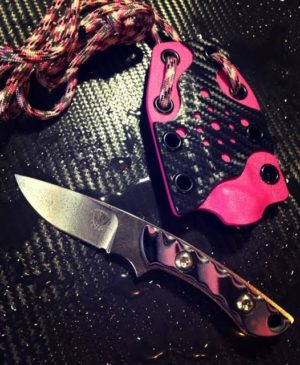
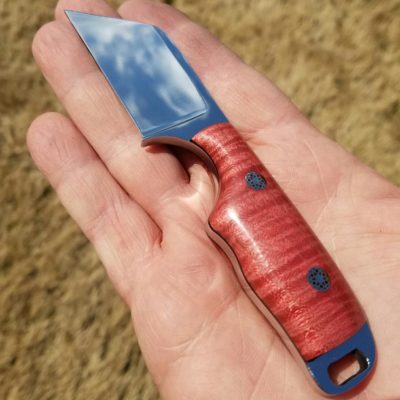
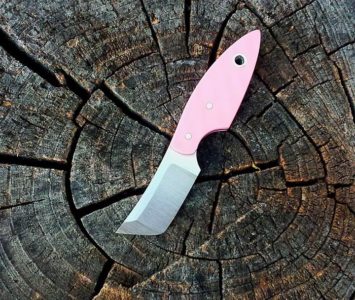
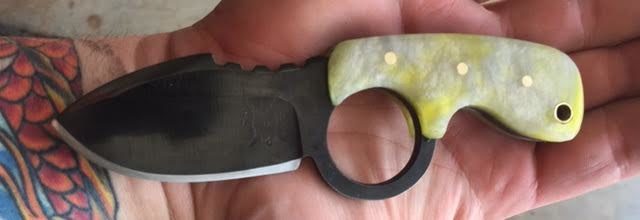
2. This necker by James Huse has a 2 1/8-inch drop-point-style blade made of A2 tool steel. Overall length is 5 1/8 inches. The handle is pink and black G10 with matching Kydex sheath. You release the knife with light thumb pressure and a downward draw. Maker’s List Price: $165. Contact www.huseknives.com, [email protected] or message to Huse Knives on Facebook, @huse_knives on Instagram.3. Pete Sloan’s neck knife is made from 440C stainless steel with a cleaver-Wharncliffe blade design. The handle was crafted using stabilized pink curly maple. Maker’s List Price: $150. Contact www.sloancustomknives.com, [email protected], 731-225-9209 or message on Facebook at Sloan Custom Knives.4. This neck knife by Travis Fleming has a trailing-point tanto blade design made from Nitro-V, an AEBL steel by New Jersey Steel Baron. A pink sheath completes the set. Makers List Price: $160. Contact [email protected] or message at Fleming’s Fabrications on Facebook.5. Denny Furey makes these three-finger Quick Defense Knives with an index finger ring for sure pistol-grip draw from under a top or from between buttons on a blouse. The 2.5-inch blade is made of high carbon 1095 with a blued and polished finish. The handle is made out of Voodoo Resins with brass pins and lanyard tube. Makers List Price: $160, includes sheath. Contact [email protected], 405-642-2198 or message on Facebook at Furey’s Urban Combat Knives.
Pretty Knives
Sometimes it’s all about the eye candy. Holding something pretty, showing it off, is a luxury mom is unlikely to allow herself either in time or cost. But, hey, beautiful knives can also cut a piece of string or open a box, and every time she studies the engraving, the jewel- and pearl-like finishes, the intricate designs in the pattern-welded steel, she’ll be reminded of how much she is treasured.
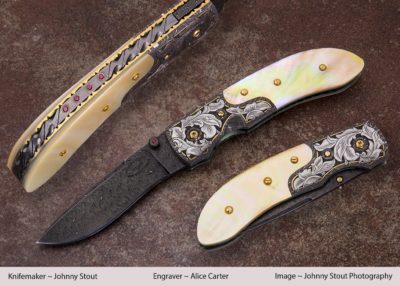
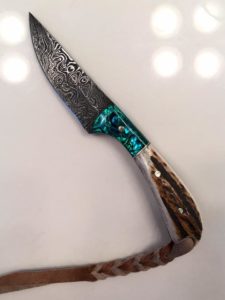
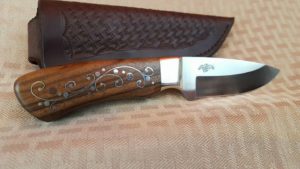
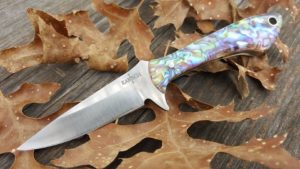
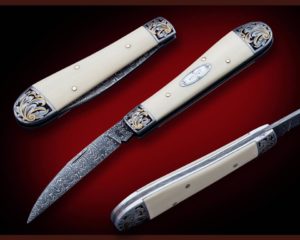
6. This Johnny Stout LeGrande Fine Folder has a 2 1/2-inch pattern-welded blade, gold lip mother of pearl handle scales, engraving by Alice Carter and a precious rubies inset in the backspacer and in the thumb stud. Closed, the knife measures 3 3/8 inches. Makers List Price: $3200. Contact http://stoutknives.com, [email protected] or 830-606-4067.7. Karen Jones made the 3-inch blade on this Work Pony out of raindrop-patterned steel. The bolsters are green abalone, the spacers are brass and the scales are elk antler. The 7-inch knife is “made to be used and abused in real life. Pretty is as pretty does,” Karen added. Makers List Price: $250-$275. Contact [email protected], 682-777-1193 or message at ThunderHorse Blades on Facebook.8. This Devin Bliss Bobcat has a 3.75-inch blade made of 1095 steel, walnut handle with mosaic pins and silver wire inlay and a nickel silver bolster. Its overall length is 8 inches. Makers List Price: $560. Contact [email protected], 903-736-3052 or message at DB Custom Knives on Facebook.9. Ben Kabisch made this for an emergency room nurse who works the night shift. She wanted something “cute, light and concealable.” The blade was made from 1084 carbon steel and the scales are an acrylic abalone. The blade is 3.5 inches and the overall length is 7.5 inches. Makers List Price: $175 Contact 940-733-6404 or message on Facebook at Ben Kabisch.10. This Raymon Earl Hunt Swayback Jack has a 2 3/4-inch Wharncliff-style blade, hand-finished and with a swedge. The handle scales are pre-ban elephant ivory with gold pins and stainless bolster. The inlaid engraving is by Bruce Christiansen. Maker’s list price: $1800 with sheath or purse pouch. Contact 214-507-0896, [email protected], or visit www.3hsknives.com.
Kitchen Knives
Whether the kitchen is in an urban apartment or at a campfire in the woods, chef knives that make food preparation more enjoyable, either by their ergonomics or their beauty, preferably both, are welcome gifts at Mother’s Day or on any holiday. This category also includes skinner/meat processing knives for the huntress in the family.
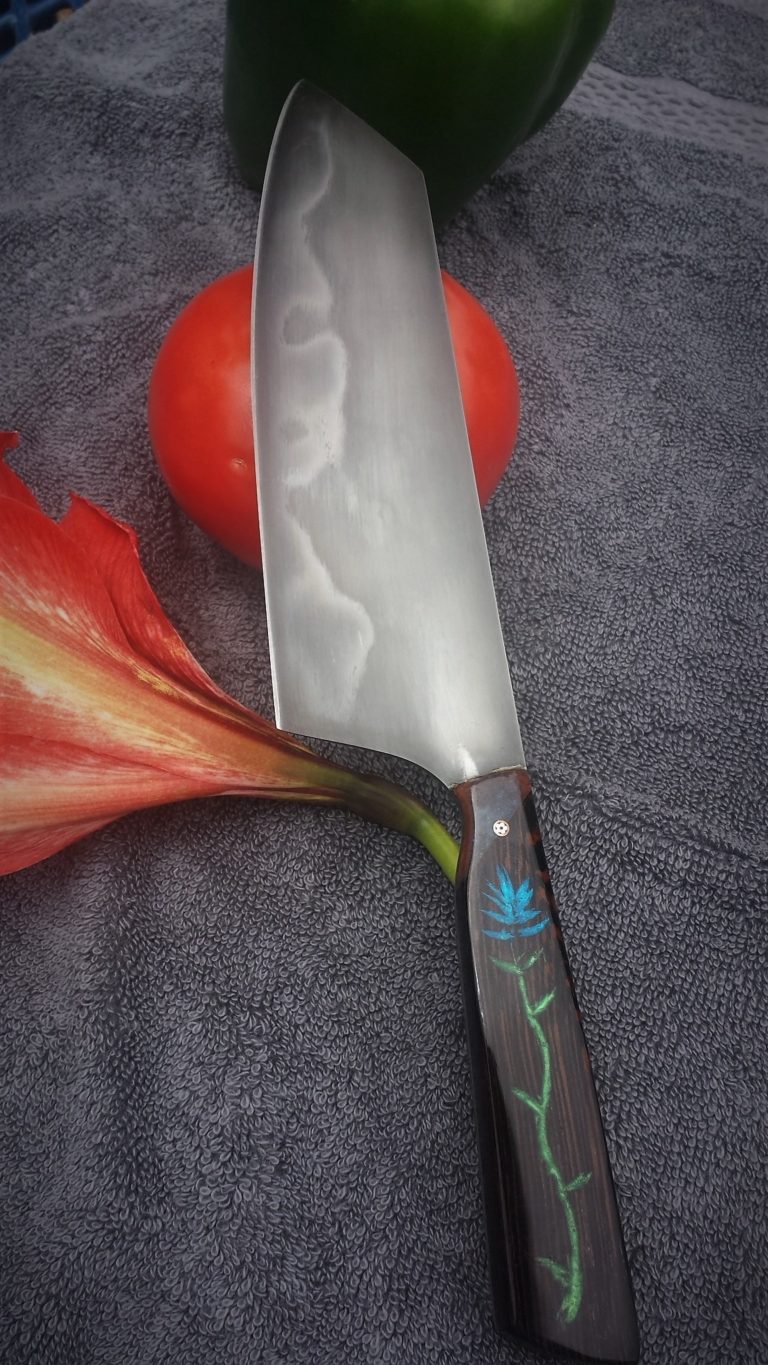
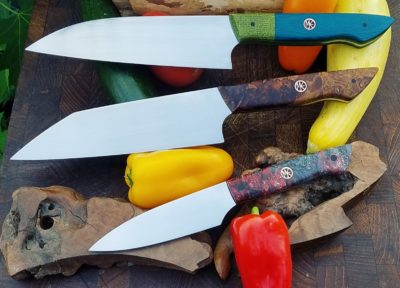
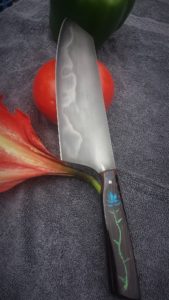
11. Mike Jeffries’ set of chefs knives includes two in AEB-L stainless steel, one in vintage Westinghouse Blue Micarta (rare stuff) with green Shadetree Burlap bolsters and the other in spalted maple burl. The paring knife is made of 52100 high carbon steel with dyed boxelder burl. Makers List Price: $900/set. Contact [email protected], 502-592-4240, on Facebook at 2Birds Metalworks and on Instagram @2birdsmetalworks.12. Nichole Lindstrand’s Modoc model knives are made from 15N20 steel with a drop-point blade, ideal for skinning and processing game. Overall they measure 7.25 inches with a cutting edge of just under 3.5 inches. The handles on these two are made of olivewood and Bone Micarta with blue G10 liners and carbon fiber pins. The makers list price is $165. Contact [email protected], 530-515-6082 or message on Facebook at Lindstrand Custom Knives.13. These 7 1/2-inch kitchen/camp knives by Carson Riley Marquis are made with 1095 steel with a differential heat treatment, acid etched/stonewashed finish and hammered-texture flats with flat grinds. The handles are dyed and stabilized zebra wood bolsters with Ivory Paper Micarta laid atop and divided by Natural Linen Micarta. Pins and lanyard tube are also Natural Linen Micarta. These are right-sized for meat processing and food prep. Makers List Price: $195 each with leather sheath. Contact http://crmarquisknives.bigcartel.com, 903-316-2824 or on Instagram @C.R.Marquis.Knives.14. This Thai-inspired kitchen knife by Todd Stracener is similar to a Japanese bunka. The 6 1/2-inch blade is made of 1095 steel and the handle is made of wenge wood with a resin inlay, The knife is 11 1/2 inches overall. $250. Contact on Instagram @thezeep or message on Facebook at Stracener Knives.
Everyday Carry Knives
Everyday carry, or EDC, knives are ones that you carry on your person or in your purse for both self-defense and general common use. They can be of the fixed-blade variety that you keep in a leather, Kydex or other molded-plastic sheath. Or they can be of the folding type and come with a clip that you can use on your pocket or inside a skirt or pant waistband. EDC makers strive for thin, small and light. They’re often tactical looking, but mom-friendly models come in everything from natural tones to bold and subtle colors.
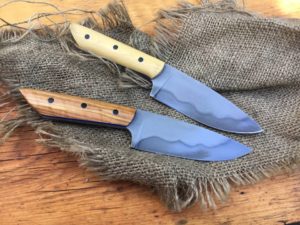
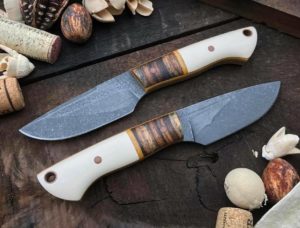
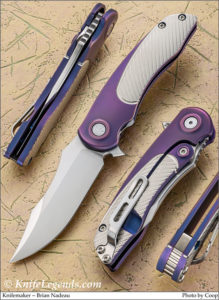
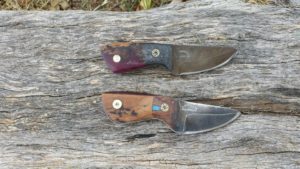
15. Brian Nadeau’s Cyclone Bowie Flipper has a 3.5-inch blade made of CPM S35VN steel. The pivot is constructed with a stainless ball thrust bearing with AEB-L lock. It has a textured, anodized-titanium frame and aggressive gimping for a secure grip in any weather. The pocket clip is 410 stainless steel. Makers list price: $995. Contact www.knifelegends.com, www.sharpbydesign.com or [email protected].16. Shane Hill made this knife for a woman who wanted to have a knife in her car with her. The 3-inch drop-point hollow-ground blade is 1095 steel; the handle is make of cocobolo wood. Overall length of just short of 8 inches. Makers list price: $165. Contact [email protected] or message Hill Knife Works on Facebook.17. These Mini Me knives by Charles Hawkins have 2-inch hollow-ground blades made of pattern-welded steel from Alabama Damascus Steel. The top one has an Alumilite resin and wood handle with carbon fiber bolsters. The bottom one has a terminate wood with box elder handle with Alumilite resin bolsters. Although these knives are technically skinners, at 4 1/2 inches overall and with a clip-on sheath, something tells me they’re more likely to be used as an everyday carry. Maker’s list price: $100-$125 each. Contact www.hawkcustomknives.com, 325-947-7875.
The Right Knife For The Job
To do the job right, you need the right tool. You wouldn’t use a router to mix cake batter, right? (I can tell you’ve thought about it though.) You wouldn’t use a flat brush to curl your bangs, right? OK, maybe. A girl’s gotta do what a girl’s gotta do. Well, it’s the same with knives. Aside from a survival situation, you wouldn’t bushcraft with a paring knife or filet a fish with a tomahawk. Here are just a few of many specialized knives that might be perfect for a mom in your life.
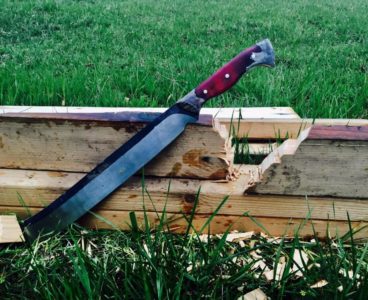
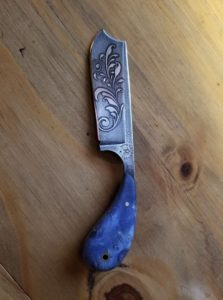
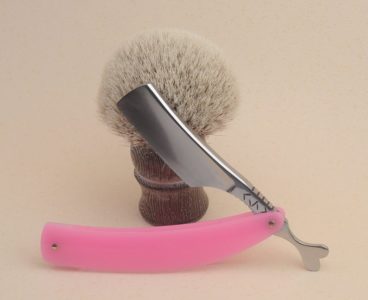
18. Eland Green made this GOLIATH chopper from 5160 tool steel and left the flats black after the heat treatment. The handle is a wood-resin combination. This is a worker for the gardening mom or for chores around a camp, farm or ranch. Makers list price: $600. Call [email protected], 940-736-8333 or message on Facebook at Lost Wood Knives.19. Becky McFall Rodriquez made this teardrop-handled livestock castration knife from a Travis Payne idea. Its 3-inch blade is acid-etched O1 tool steel. The handle is fashioned from blue-dyed box elder burl. The knife is 6-inches overall. When a lady’s doing dirty work, she should have a pretty tool. Makers list price $220-$250. Contact [email protected] or message on Facebook at Rafter M Custom Knives.20. Wet shaving is making a comeback, mainly for men, but also for women. Bruno van Dooren makes a 7/8-plus-inch wide round-point blade from O2 carbon steel with a half hollow grind. The length of the cutting edge is just under 2.5 inches. This shorter edge makes the razor more maneuverable for female shaving. The point is rounded to prevent accidentally poking through the skin. The scales are Kirinite Starlight Pink with Kirinite Glow in the Dark spacers. The pins and washer are brass. Makers list price is $325; pattern-welded or wootz steel versions are higher. Contact [email protected], www.snailforge.be or message on Facebook at Snailforge.
Bonus
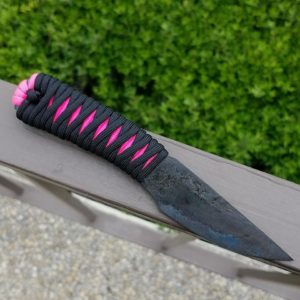
Inside the heart of that special mom there lurks both a queen and a warrior princess, a diplomat and an avenger. She’s a lady with a hard edge and a soft inner core. She may be just the one to wield the Tactigal.
Bonus: Tobin Nieto forged his Tactigal out of 1084 steel to an overall length of 8.75 inches. The blade is a 3.25-inch drop-point style. The pink underlay is 550 paracord while the black cord has had the inner strands removed to allow for a flat Mongolian-style cross wrap. Maker’s list price: $175 with sheath. Contact Stonehaven Knife Works on Facebook or on Instagram @stonehavenknifeworks.
The CRKT Homefront is the Official Knife of the 2017 BLADE Show. This is a highly collectable item and the run is limited to 300. At $70 you can save $29.99 off the $99.99 price, if you order now. The field-strip technology allows you to disassemble without tools. The Ken Onion design won Most Innovative Imported Design award at the 2016 BLADE Show. Here’s where to order your Official 2017 BLADE Show CRKT Homefront Knife.
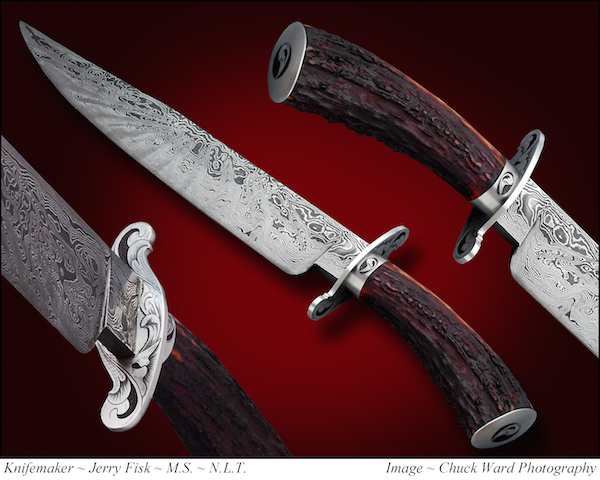
A new pro-knife law expands the blade-length limit for knife carry in Georgia, home of the BLADE Show, to 12 inches. Jerry Fisk’s bowie features a damascus blade and stag handle. (Chuck Ward image)
A new pro-knife law signed into law this week in Georgia comes just in time for the 36th Annual BLADE Show.
Signed May 8 by Georgia Gov. Nathan Deal, the new pro-knife law (HB 292) increases the legal carry length of a knife blade in the state from 5 to 12 inches.
“With the BLADE Show coming up June 2-4, attendees and exhibitors will have more freedom to carry their larger knives without fear of legal entanglements,” Knife Rights reported. It is language from Knife Rights’ Georgia Knife Law Reform bill, SB 49, that is included in the new pro-knife law.
The new 12-inch length limit became effective as soon as Deal signed the bill. Since Georgia passed Knife Rights’ Knife Law Preemption in 2012, any lesser length restrictions in cities and towns are now voided by HB 292. Moreover, neither can local jurisdictions enact prohibitions more restrictive than those in the new pro-knife law.
The BLADE Show and blademag.com express their gratitude to such organizations as Knife Rights, the American Knife & Tool Institute and others that fight for common-sense knife legislation. Both organizations will be among the exhibitors at the BLADE Show and blademag.com encourages you to stop by the booths of each for more information on how to protect your right to own and carry knives.