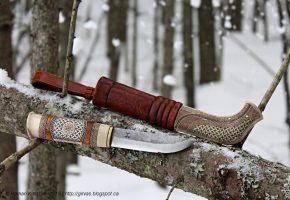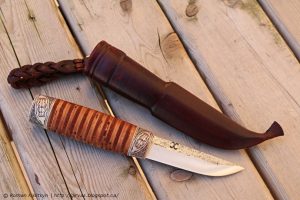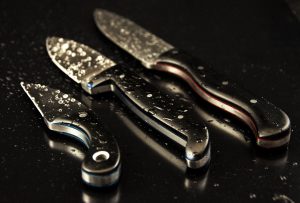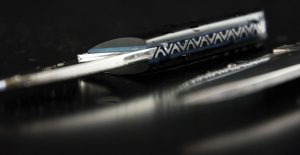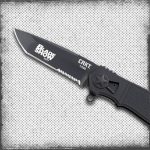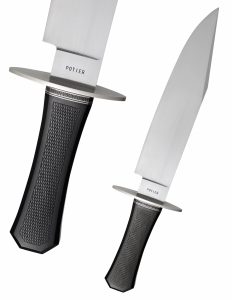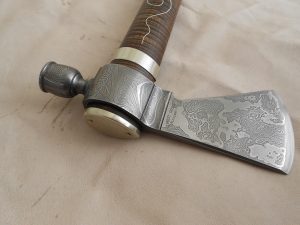
As the creative force behind Oz Custom Knives, Jim Ort made a name for himself with his signature 1095 carbon and 15N20 nickel damascus blades. From tip to pommel, his fixed blade knives offer a classic look that recalls a time when no one left home without a knife. Ort puts his own twist on these timeless favorites by working in modern materials to offer the performance and curb appeal 21st century collectors crave.
Originally hailing from northern Wisconsin, Ort moved into full-time knifemaking in 1996 after retiring to Arizona. In addition to knives, Ort is also an accomplished sheathmaker.
Find more of Ort’s creations at Oz Custom Knives, visit Copper State Cutlery. For direct inquiries, e-mail Ort at ort [at] cox [dot] net.
The Ford of Knife Grinders?

When it comes to the go-to machine for knifemakers, the Burr King 960-272 2×72 may be the Ford of knife grinders.
“The 960-272 has been in production for 40 years. It’s a knifemaker’s grinder. It started with Bob Loveless,” noted Burr King’s James Krier during the grinding classes conducted by Tom Krein and Lucas Burnley in the 3rd Annual BLADE University at the 2016 BLADE Show. “It’s kind of interesting to have a machine over 20 years old that you can still get parts for.” Add the fact that Burr King is celebrating its 65th anniversary this year and you have a source for parts that’s been here for the long haul. “The knifemaker doesn’t have to worry about the company who made it [Burr King in this instance] going out of business,” Krier added.
In sales and marketing for Burr King for 10 years now, Krier said a number of companies that make grinders have passed by the boards in recent years. Not so with Burr King.
“I was talking to a guy about how many grinding companies there had been in the past 20 years and he was saying there were about 25 he could think of that are just out of business, that were up for about two years and then were gone,” Krier said. “That’s why pros who do it for a living will buy something they can actually get parts for 20 years later. It’s gonna be there when they need it.”
The 960-272 is cast aluminum construction. “Every machine is going to be the same. It’s not like it’s a fabricated design or this machine is different from that machine,” Krier continued. “If someone buys a machine and they have one that’s 10 years old and buy another one today, the parts are interchangeable. It’s like having a Ford you can get parts for.” Like old Fords, it’s tough as nails, too. “That’s thing’s bulletproof and ready to go,” Krier assessed.
Burr King makes about 15 different belt grinders, including those for factory knife companies, but the 960-272 remains the bell cow of the lot.
Learn How to Grind Knives
The BLADE staff put together this guide to grinding knives as a way to help new knifemakers jump into these essential skills. Download it now and start reading right away.
BLADE Honored for Stance Against Counterfeit Knives
From the American Knife & Tool Institute (AKTI)
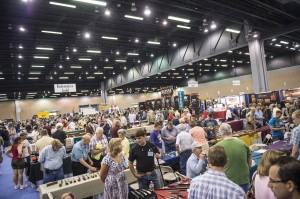
The American Knife & Tool Institute (AKTI) presented its inaugural Integrity Award to BLADE and F+W for contributions to work against counterfeit knives. The presentation took place at the recent BLADE Show awards reception in Atlanta.
The BLADE Show is world’s largest annual knife event; F+W is a media and e-commerce company headquartered in New York City.
Rod Bremer, chair of AKTI’s Anti-Counterfeiting Committee and CEO of CRKT, along with John Sullivan, AKTI Vice President and W.R. Case’s Vice President of Marketing, made the first presentation of the evening to BLADE editor Steve Shackleford.
“AKTI was proud to partner with BLADE to develop a policy to fight the growing number of counterfeit knives damaging our industry,” said Rod Bremer. “The BLADE Show will now be a safer place to display products and for our customers to buy branded knives and tools with confidence they are genuine.”
“BLADE Magazine and F+W are most humbled for being recognized with the first AKTI Integrity Award. The fact that it salutes us for our integrity in fighting the worldwide problem of counterfeit knives and that it’s the inaugural presentation of the honor makes it doubly humbling. On behalf of both BLADE and F+W, I thank you,” said Steve Shackleford.
The BLADE Show policy on counterfeiting, trademark infringement and intellectual property can be seen on their website www.bladeshow.com and is incorporated into the rules for the 2017 show on June 2-4 at the Cobb Galleria Centre in Atlanta, Georgia.
The BLADE Show provides a forum for members of the knife community to gather and focus on knives. Designers, makers and manufacturers can showcase their efforts. Consumers, collectors and users can meet firsthand with those on the supply side and conduct hands-on comparison and evaluation of much of what comprises the knife. The protection of intellectual property, including trademarks and trade dress, is critical to preserving a dynamic and innovative knife industry. The BLADE Show is, accordingly, committed to an anti-piracy policy. Exhibitors who are found to be offering counterfeit or “pirated” knives may be subject to any or all of the following:
- Removal by law enforcement of items proven to be counterfeit or pirated.
- Legal action by the affected parties, including removal from the Show by law enforcement.
- Banned from exhibiting at future BLADE shows.
The BLADE Show will work with law enforcement, private anti-piracy consultants retained by various exhibitors and all involved to arrive at the most equitable solution to issues involving counterfeit and pirated knives. All exhibitors are encouraged to exercise care to avoid counterfeit and pirated knives. Know the source and integrity of the knives you display.
The effects of counterfeits are devastating. In addition to the loss of sales revenue, manufacturers and custom knifemakers incur other costs such as increased customer service issues, legal fees, monitoring counterfeiters, and erosion of their brands.
AKTI works to provide information to the knife community on how to protect their intellectual property, brand and how to fight against counterfeits on the market.
Custom Pocket Clips: Sal’s Pals


Custom knifemakers seem to introduce most knife innovations, which are then emulated by factory knife companies. Not so with custom pocket clips. BLADE Magazine Cutlery Hall-Of-Fame© member Sal Glesser popularized knives with pocket clips in his Spyderco production line, and custom knifemakers took their cue from him. As a result, today’s custom pocket clips might well be called “Sal’s Pals.”

Celebrating its 40th anniversary this year, Spyderco offered its first knife with a pocket clip—and also the company’s trademarked blade opening hole—in 1981 when it introduced the Worker model. Spyderco also popularized serrations on sporting folding knives.
The fact that custom knifemakers adopted the pocket clip, as did factory knife companies everywhere, should come as no surprise. For one thing, the clip’s abilities to attach a closed folding knife to the lip of your pocket rather than having the knife bang around in the bottom of it with car keys, coins, etc., and to make it much easier to retrieve are eminently practical. In addition, Spyderco has offered many factory/custom collaborations—knives designed by custom knifemakers and then reproduced by a company, in this case Spyderco. The first of these was in the early 1990s—the C15 designed by Bob Terzuola, which, of course, also had the blade hole and a pocket clip.
Today’s custom versions of the pocket clip run the gamut, including long ones, short ones, tall ones, round, anodized ones, rose gold ones and more.
For instance, Michael Zieba won Best New Maker at the 2016 BLADE Show for his S2 standard and mini models with serpentine titanium pocket clips finished in rose gold.

On the other end of the scale is Lucas Burnley’s Asian-style folder with a very short skeletonized clip, while Butch Ball offers trailing-point damascus clips on his pearl-handle folders. Craig Camerer presents a long, curved clip in mokuti on his damascus folding knife, while Cutlery Hall-Of-Fame member Ken Onion opts for a short, cross-hatched clip on one style of his folders.
These are but a few of today’s custom knifemakers who took their cue from Sal Glesser and his utilitarian pocket clip. Hey, if you’re going to emulate someone, emulate the best.
Don’t Miss Knives 2017, the World’s Greatest Knife Book
The best knives in the world can only be found in the greatest knife book on the planet. Put your order in for Knives 2017 and look forward to gorgeous full-color photos of custom knives, in-depth articles and profiles of the hottest knives from the best ‘makers.
Order Knives 2017 from ShopBlade.com for the best price anywhere.
Another First for Forged In Fire

When Forged In Fire won the BLADE Magazine 2016 Publisher’s Award during this year’s BLADE Show, it was the first time a television program of any kind was recognized by BLADE® Magazine in such a manner. Selected by the BLADE staff, the Publisher’s Award honors a person or organization that has furthered the knife community in a fashion that bodes well for the future of that community, both inside and out. Forged In Fire on History answers that requirement—and then some.
It’s rare that knifemaking of any type is given the high-profile exposure of television coverage, much less a weekly program of its own. However, Forged in Fire has done just that and much more. Those who watch it are familiar with the group of bladesmiths it gathers each week, each group different from the last, with the bladesmith in each charged with forging a knife—often in a very exotic style—in a stated time limit under the watchful gaze of a panel of judges and millions of TV viewers. Meanwhile, the winner of each episode earns a grand prize of $10,000.
As with most high-profile endeavors, there are those who criticize the program for portraying knives in a so-called negative way and creating an atmosphere that is not conducive to making the best knife possible—but then making the best knife possible is not necessarily the goal. The goals include to demonstrate not only how tough it can be to make a quality knife under a short deadline but also to entertain—and Forged in Fire does that quite well. Meanwhile, bladesmiths, knifemakers and the knife industry in general are getting more exposure before more people than ever before. And that is a great thing.
Now on the cusp of entering its third season, Forged In Fire will have a different look with ABS master smith Jason Knight filling in for ABS master smith J. Neilson. We fully expect the show to enjoy yet another banner season, and for bladesmithing and the knife community in general to continue to benefit from the unprecedented exposure such a TV show brings to knives the world over.
Want to Get Started in Knifemaking?
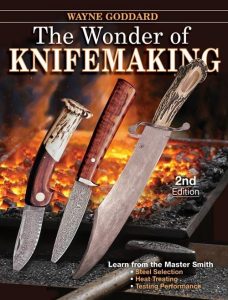
For those new to knifemaking, BLADE put together a special collection just for those starting out. The Complete Knifemaking Collection gathers great knifemaking books and tutorials to get you up to speed in no time. The price is unbeatable, too.
Order the Complete Knifemaking Collection from ShopBlade.com.
Holy Grail Knives in New BLADE

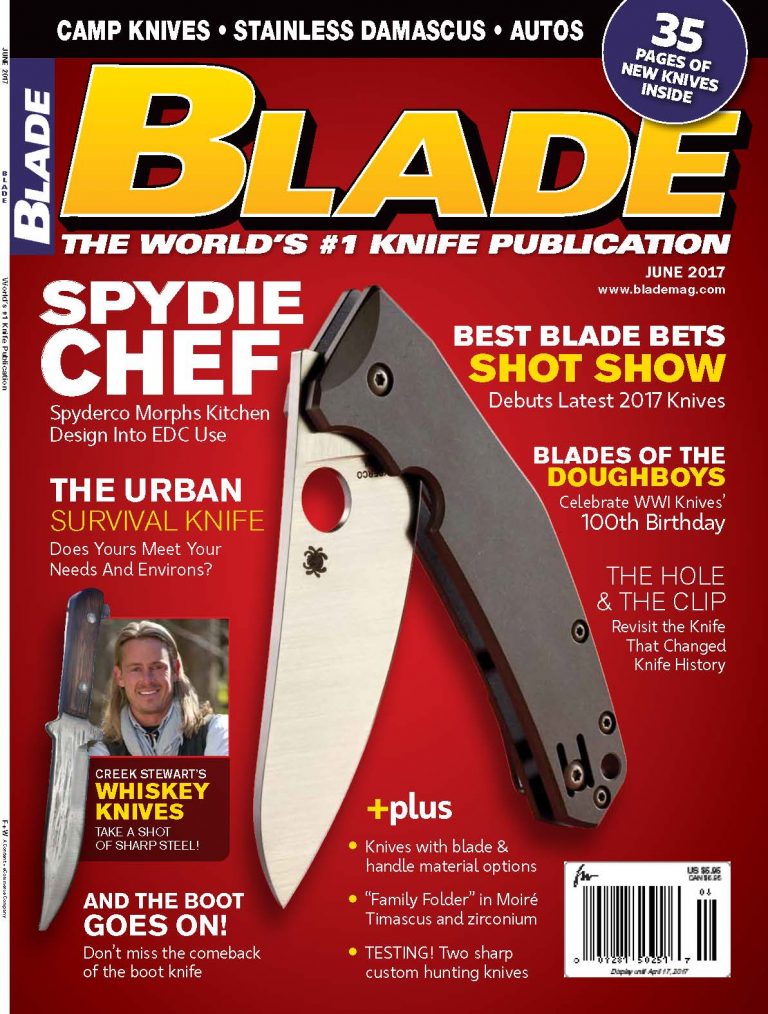
Are you in search of your “Holy Grail” of knives or have you found it? Or did you find it and trade it away? Or do you doubt that such a knife exists? The new issue of BLADE®, on newsstands now, examines the topic of holy grail knives in depth with a special story interviewing those who have found theirs and still have them, and another enthusiast who questions whether there even is such a knife.
Also in the latest issue of the World’s No. 1 Knife Publication is our semi-annual story on the planet’s hottest custom knifemakers’ hottest knives. We polled those who buy and sell the top custom knives for a living—custom knife purveyors—for their opinion on the matter, and they list the knives by maker and price in “Feel The Burn.”
Are you ready to make knives? You may be more prepared than you think. Knifemaker Brian Goode has been making knives for 10 years and has written and talked on the subjects not only of getting started in knifemaking but also how to do it on a budget—including a class on the latter at the 3rd Annual BLADE University during the 2016 BLADE Show. Learn his thoughts on the subject in his special story.
Flipper folders, slip joints and tactical fixed blades remain among the world’s most popular knives. Join Dave Rhea for the latest factory flippers, James Morgan Ayres for a test of today’s sharpest tactical straight knives, and Abe Elias as he gauges the performance of some of contemporary cutlery’s most economical slip joints in the latest BLADE.
The question of whether collectible knives also should be used is one that has been debated by knife enthusiasts for decades. Veteran bladesmith/BLADE field editor Ed Fowler supplies the answers as only he can in “Collectors or Users: Who Comes First?”
There’s much more in this issue, including some of the coolest knives from the 2016 Art of Steel Little Rock Custom Knife Show; factory knife companies that continue to offer new knives in a selection of different old-school high-carbon steels; a test by MSG Kim Breed of two utility fixed blades; visits to the shops of Turkish knifemakers who trace their cutlery lineage back over eight centuries; John Doyle’s modern interpretation of an ancient Eastern design known as the kard; instructor Doug Hepler and a class on cold forging he taught to high school students on a lonely atoll in the South Pacific; the knives carried by three BLADE readers; and more, all in the latest BLADE—on newsstands now!
Mel Pardue Wins Lorenzi Award
A veteran knifemaker exemplary in terms of teaching and mentoring his fellow makers in the fine art of building knives, Mel Pardue is the 2016 BLADE Show winner of the Edda and Aldo Lorenzi Award.
Edda and Aldo Lorenzi, owners of the old G. Lorenzi retail knife store in Milan, Italy, continue to support the custom knife industry through the Aldo and Edda Lorenzi Award, an honor bestowed annually at both the BLADE Show and the International Custom Cutlery Exhibition (this year Sept. 23-25 in Kansas City). Each carries a $1,000 prize graciously provided by the Lorenzis to the honoree.
Pardue made his first knife in 1952. He participated as a voting member of the Knifemakers’ Guild for 39 years, and served on the Guild’s board of directors in various capacities for 14 of those years. He is the first person without membership in the American Bladesmith Society to teach at the Bill Moran School of Bladesmithing, where for five years he conducted classes on how to make folders. He has taught the same subject at the Batson Bladesmithing Symposium for the past half-decade or so, and has held seminars and classes in his shop for almost 40 years. He received the Ron Little Award in 1992 and is a past winner of the Guild’s Red Watson Award.
Pardue has over 15 design and utility patents with Benchmade Knife Co. He has served on Benchmade’s board of directors several years. He taught the Benchmade staff how to refine three production models in the company’s Gold line of knives.

He organized and helped set up the website for the Gulf Coast Custom Knifemakers Association in Florida. His tireless commitment to the knife industry has inspired such makers as ABS master smith Steve Schwarzer, BLADE Magazine Cutlery Hall-Of-Fame© member Ken Onion and many others. He joins last year’s winner, ABS master smith Joe Keeslar, as the epitome of what it means to be a mentor to knifemakers everywhere.