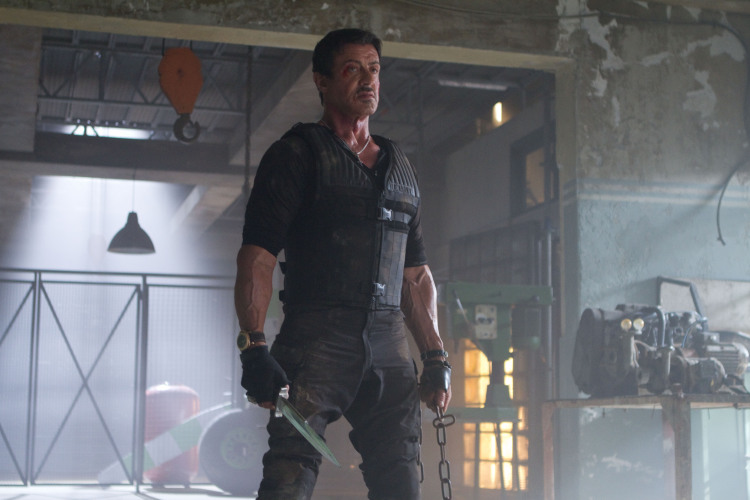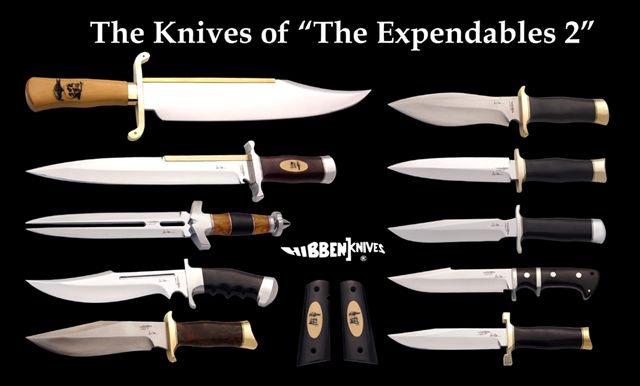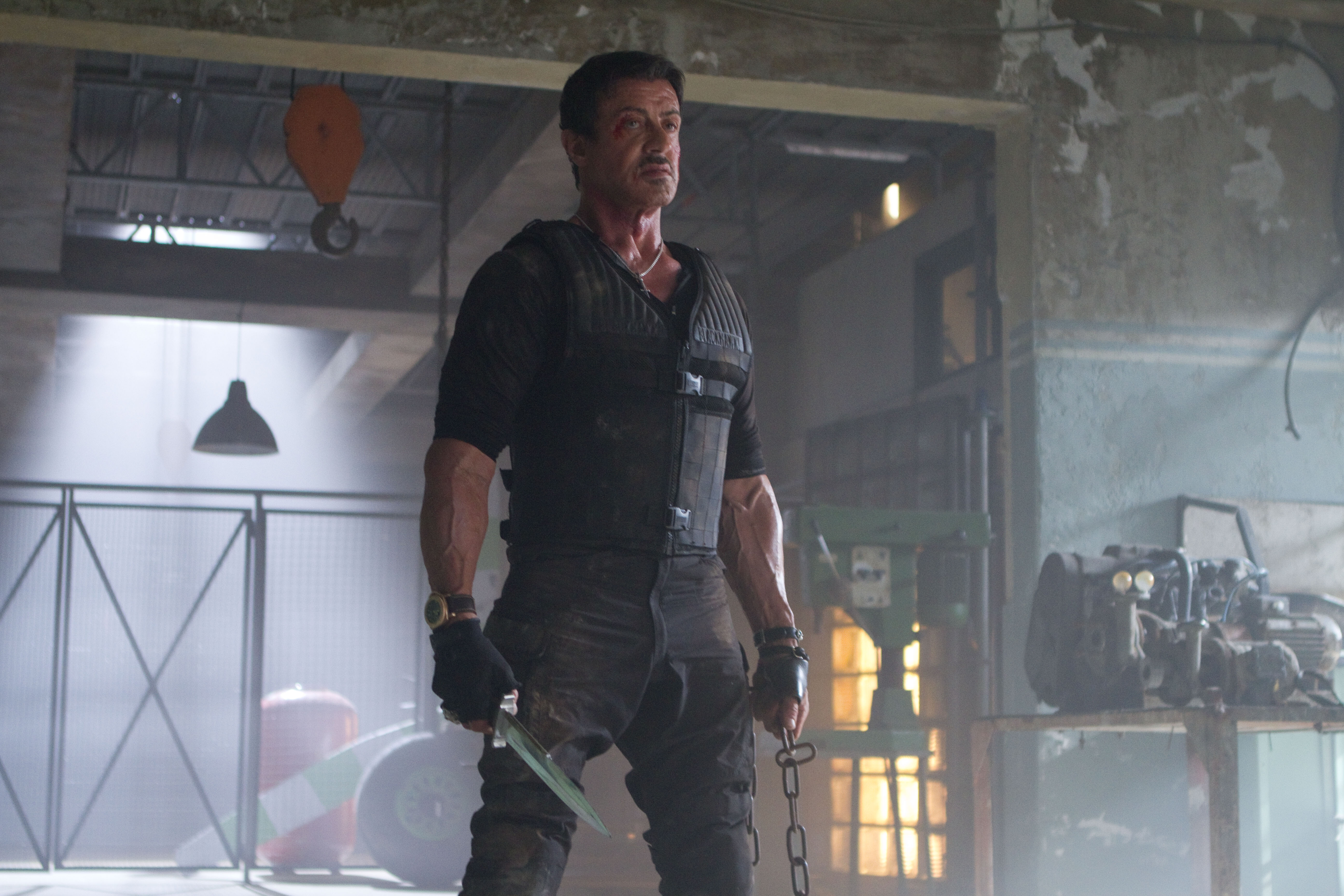
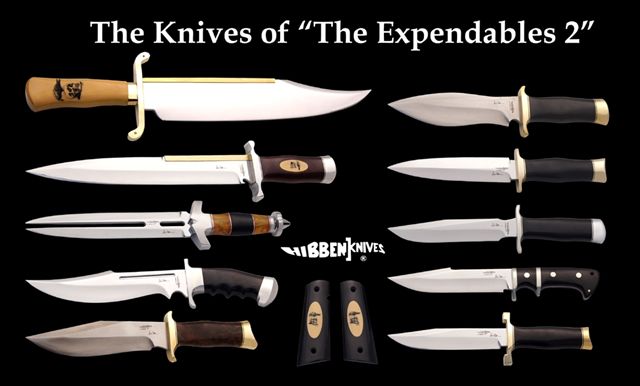
 Sylvester Stallone (top) holds the Gil Hibben Toothpick (second from top left, above) in a scene from The Expendables 2. Along with the modified version of Gil’s Alamo Bowie (top left, above), it is a carryover from the first film in the series, The Expendables. The Legion Fighter (fourth from top left, above) is the knife Hibben made expressly for Stallone for the sequel. (photo from The Expendables 3 by Frank Masi; photo of Hibben knives by Mike Carter)
The longest-running custom knifemaker/movie star connection of all time will have another go soon with the imminent worldwide release of the action blockbuster, The Expendables 2.
Blade Magazine Cutlery Hall-Of-Fame© member Gil Hibben has a rich history with writer, producer and actor Sylvester Stallone. It began at Dan and Pam Delavan’s 1985 California Custom Knife Show when Stallone visited Gil’s table and walked away with several of Gil’s custom knives. That encounter led to Stallone calling on Gil to make the famous survival knife (cover inset, August 1988 BLADE®) that Stallone wielded in Rambo III and later the massive machete (cover, February 2008 BLADE®) in the fourth movie in the series, Rambo.
In 2010, The Expendables, co-written, directed by and starring Stallone, along with an all-star cast of action-film heroes, again employed Gil’s knives. Stallone’s character, team leader Barney Ross, carried a custom Hibben 17.5-inch “Toothpick” model (cover, November 2010 BLADE). Meanwhile, Gunnar Jensen, played by Dolph Lundgren, and Lee Christmas, played by Jason Statham, took turns using a huge, 19-inch custom Hibben bowie.
All of the original Expendables except Mickey Rourke return for The Expendables 2, which at press time was due to open in theaters Aug. 17. The all-star cast has grown with the addition of Chuck Norris and Liam Hemsworth to the Expendables team. Action star Jean-Claude Van Damme joins the cast as the leader of an opposing team of mercenaries, along with his right-hand man, Hector, played by Scott Adkins. Both Bruce Willis and Arnold Schwarzenegger return with more substantial parts in the new film. The $100 million sequel was filmed in Bulgaria in late 2011.
SLY ON LINE 1
Gil received the call from Stallone early last year to discuss the knives Stallone wanted for the sequel. Two of Gil’s knives from The Expendables will return to the big screen in The Expendables 2. His big custom bowie again will be carried by Lundgren, and both Stallone and Van Damme will be seen with the Toothpick. But Stallone said he wanted more—a lot more.
The amazing 76-year-old Gil set to work and delivered at least 10 different models, including multiple copies of some and a few prop knives with half blades to give the appearance of being embedded into something or someone. As before, some of the knives have the Expendables skull-and-raven logo scrimshawed on the handles by scrimshander Richard “HutcH” Hutchings, who does nearly all of Gil’s scrimshaw work. HutcH also scrimmed the logo on several sets of black Micarta Colt .45 pistol grips Gil provided for the film.
Some of the knives Gil made for the movie were based on previous models he has made during his 55-year career, though some are new designs he made especially for the film. Among those expected to be prominently seen is his Legion Fighter, this issue’s cover knife, a recurve fighter with a 9.5-inch blade of quarter-inch 440C stainless steel. The Micarta handle is sandwiched between a hefty stainless steel guard and buttcap.
One of the new, never-before-seen models is a split-blade fighter, somewhat reminiscent of Gil’s “Double Shadow” knife (second photo from top, third knife down from top left), with a stainless steel guard and buttcap and a handle of black Micarta and amber.
Stallone chose the big bowie that appears in both the original movie and the soon-to-be-released sequel after seeing a similar model, Gil’s Alamo Bowie, on the Hibben Knives website (www.hibbenknives.com). The decision was made to modify it with a different handle of ivory Micarta® that could be scrimshawed with the skull-and-raven Expendables logo seen throughout the original film on tattoos, motorcycles, clubhouse doors and the knives. The long, slender Toothpick carried by Stallone in both movies was an entirely new design Gil developed for The Expendables.
I have seen some stills from the sequel and a couple of preview trailers that show some of the knives very prominently displayed, but it remains to be seen what makes the final cut. “We never know what will actually end up in the movie,” Gil notes. “Sometimes scenes are filmed using the knives and then those scenes get cut in editing. I guess we will find out when everyone else does at the theater.” (Editor’s note: From reports at press time, the Legion Fighter cover knife gets its best movie air time when actor Randy Couture, who plays the role of Toll Road, uses it.)
IMPROVISE AND REVISE
As is usually the case when making knives that will be featured in a film, designs are revised and changed along the way to satisfy the producers, directors, prop masters and actors involved. Once the designs are finalized and approved, Gil has to scramble to get several copies made and delivered to remote filming locations such as Burma for The Expendables and Bulgaria for The Expendables 2. The knives he makes for the films are fully functional and sharpened. In some cases the prop department will make dull replicas that can be safely used in close-up fight scenes.
The Expendables featured an impressive lineup of stars that, in addition to Stallone, Lundgren, Statham, Willis, Couture, Schwarzenegger and Rourke, included Jet Li, Steve Austin and Terry Crews as a team of elite mercenaries. Eric Roberts played the bad-guy/corrupt CIA agent.
The Expendables was No. 1 at the box office in its opening weekend in August 2010. The film’s budget was reportedly $70 million. It grossed over $274 million worldwide by the end of the year, and that is not counting DVD sales. That was certainly enough success to entice movie officials to make a sequel.
REEL STEEL BY THE DOZENS
Gil has made knives for dozens of movies and television shows, including designing and making Klingon swords and knives for assorted Star Trek TV shows and movies, throwing knives in Steven Seagal’s Under Siege, and knives in The Perfect Weapon starring Jeff Speakman. He also has enjoyed a following among Hollywood celebrity collectors, among them Elvis Presley, John Wayne, Steve McQueen and Shelley Berman.
Stallone long has been a collector of custom knives and a fan of Gil’s work. In fact, Stallone ordered some large custom lockback folders based on the Rambo III knife design he had personalized as gifts to Willis and Schwarzenegger during the filming of The Expendables.
The Expendables 2 will be the fourth Stallone film for which Gil has made custom knives. There are Hollywood rumors of further Rambo and Expendables sequels, so you may be seeing more of the Stallone-Hibben connection.
The Expendables 2 is produced by Nu Image and Millenium Films, and is distributed by Lionsgate. It is written by Sylvester Stallone and Richard Wenk and directed by Simon West.