Home Blog Page 260

The Iconic Loveless Knife Built For Schrade

The knife Bob Loveless built for Schrade features a stainless steel blade and synthetic molded handle with no guard. The top piece is the Schrade knife, and the bottom is the Loveless semi-skinner prototype from which the Schrade knife was developed. Note the finger-grooved  handle, a feature seldom seen on a Loveless knife. 

The photo is by Hiro Soga and ran across a two-page spread in the book Knifemaking With Bob Loveless.

Vacation Knives: Roadside Stop/Camping Set

So you’re tooling down the highway with a bunch of screaming kids in the back seat on your way to DisneyWorld, and the wife says let’s pull this puppy over at the next rest area and feed the brood. What better way to chow down on those cans of beanie weanies than with the Team Realtree 16-piece flatware set from Kutmaster? Whether vacationing, camping or what have you, this set prepares you for whatever tasty morsels may cross your, the wife’s or the kids’ palates.

For more click on http://www.shopblade.com/kutmaster-team-realtree-16-pc-flatware-set-y7725/?r+ssfb080112

Colorado Dreamin’: Western Cutlery

A rare Twin Set of Western Cutlery knives consists of a red-handle P48A (top) and P28 (bottom). The P28 has a sabre-ground blade instead of the standard flat grind. (Clyncke photo)

Knife collectors are dreamers. They dream of finding a Scagel, a fine bowie or an old Case knife at garage and estate sales. They dream of looking through a box of junk at a flea market, spotting an old green-bone Remington whittler, and buying it for five bucks so they can walk around smiling like a Cheshire cat. Most of the time it is just a dream, though once in a while the dream comes true.

    My dad worked at Western Cutlery in Boulder, Colorado, in the late 1930s, and I did concrete contract work for the company after it moved to the outskirts of Boulder on Western Avenue. Dad was good friends with the Harvey Platts family, and I got to know a number of the workers at the plant. I became a part-time custom knifemaker, scrimshander and jewelry maker over the years, and when Western’s plant in Longmont went out of business, I bought a lot of raw material I could use to make my knives and jewelry.

    I never lost my love of Western knives. I have owned a lot of the Boulder models and always enjoy looking for them, finding a good one, removing the dirt from it and cleaning up the sheath. My family had many Western knives on our ranch and farm, where knives were everyday tools. The many different ways of using them resulted in most being heavily abused, overly sharpened on a grindstone, and tossed in a bucket in the old shop when they wore out. I still have some of the old knives with blades that were sharpened so much they resemble toothpicks.

    I am retired now and go to many estate sales and flea markets, hoping for a good find here and there. I always see my collecting friends looking for “the prize,” too. We have a friendly competition to see who can get that old knife first, then hunt the others up and show what we found.


DREAMIN’-TYPE KNIVES

In 2010, a family friend who was 89 passed away and I bought some nice old knives from his family, including five Westerns, a nice old Case Tested XX and several other brands. A couple of the Westerns and the Case are in very good condition—dreamin’-type knives.

    A week later I was at another sale and asked about any Western knives, as another long-time Boulder family was conducting the sale. I was about to leave when a man said he had heard me ask about Westerns. He had one, I looked at it and we exchanged phone numbers. On the way home I started dreaming again about what the man had, hoping it was a rare one, maybe a World War II stiletto or a big, old one-blade folder.

    A few days later I got anxious and phoned him. He said the knives were packed away and he would call me when he found them. I had heard that many times before, so the dreamin’ abruptly stopped.

    Two days later the phone rang and it was the fellow again, telling me to stop by. I arrived and he got out three boxes and put them on a table. Inside were many cloths of different types rolled up in bundles. I picked up the top one, opened it and saw a Western 48A with red handles in mint condition. I nervously started opening more. Not one or two as I had imagined, but 28 pristine Western Boulder knives with sheaths! I was stunned to say the least. This was without a doubt the finest group of knives I had seen since Western closed its doors.

    There were six folders, including a gorgeous 062 two-blade with redbone handles, two yellow-handle trappers, a 441 with cracked-ice scales, a brownbone 426 stockman, and a 656 with beautiful redbone scales. There was an L77A with a sawtooth back, a 539 with very nice stag handles, a rare dark-yellow-handle P48A, four “Black Beauty” knives of varying sizes, an L28, 628 and a P28. As I kept unwrapping I became more stunned at each knife. These all were brand new, never used or handled at all. Luckily, they were not stored in the sheaths but wrapped separate from the corroding leather.

    As I lifted one of the last four and unwrapped it, I know my jaw dropped to my chest. Here was a wonderful white-handle “Twin Set” containing a P48A and a P28. I was nervous as a cat in a dog pound! As I unwrapped the last three, again I was stunned. Here were three more Twin Sets, one stacked leather, one white handled and another red. I calmly put them all back as the man inquired which one I would like to buy. I asked which ones were for sale and he said, “Why don’t you buy ’em all?” We arrived at a price and I paid him.

    I asked where the knives came from and he said they belonged to his brother, who had worked at Western for a while in the leather department. He did not seem to want to talk about it, so I took the knives and left.


DREAM, DREAM, DREAM …

When I got home, I carefully unwrapped the knives and sheaths again, lined them up and just stared. One of my dreams had come true for sure.

    It was time to give the knives closer inspection. Most of the brass guards and nickel bolsters were discolored with age, so I took a polishing cloth and carefully brought the new shine back. As I began to polish the stacked leather Twin Set, I got another shock.

    Both knives had a Boy Scout stamp just above the Western Boulder stamp. I had seen 48s with the Boy Scout stamp but never the smaller L48B. Also unusual is that three of the four Twin Set larger knives have sabre blades with no blood grooves. The sheaths were somewhat dry, so I applied leather balm to bring them back to life. I noticed some were not stamped the same as Western did most of its sheaths, particularly the four Twin Sets. Since the knives’ original owner had worked in Western’s leather shop, he may have been just doing what he liked, or he may have been trying new styles. I guess I will never know for sure.

    One thing I do know for sure: I will keep dreaming of finding another great knife or two, and now I can dream of finding another great cache such as this one.—by Marvin Clyncke


DREAM KNIFE VALUES*


Twin Set w/scout-stamped knives $400

Twin Set w/red tenite handles   $450

P48A w/yellow handle $375

539 w/stag handle $275

248 w/cracked-ice handle $200

060 Rancher’s two-blade folder $250

L77A w/Finnish-style sheath $250

Twin Set w/white tenite handles $450


*The author’s values are for knives in mint condition.


For more on the latest knives, knife legislation, knifemaking instruction, knife trends, knifemakers, what knives to buy and where and much more, subscribe to BLADE® Magazine, the World’s No. 1 Knife Publication. Click on http://www.shopblade.com/blade-magazine-one-year-subscription-us/?r+ssfb073112 for more information.

A Pearl In the “Greatest Loveless Knife Designs” Rough

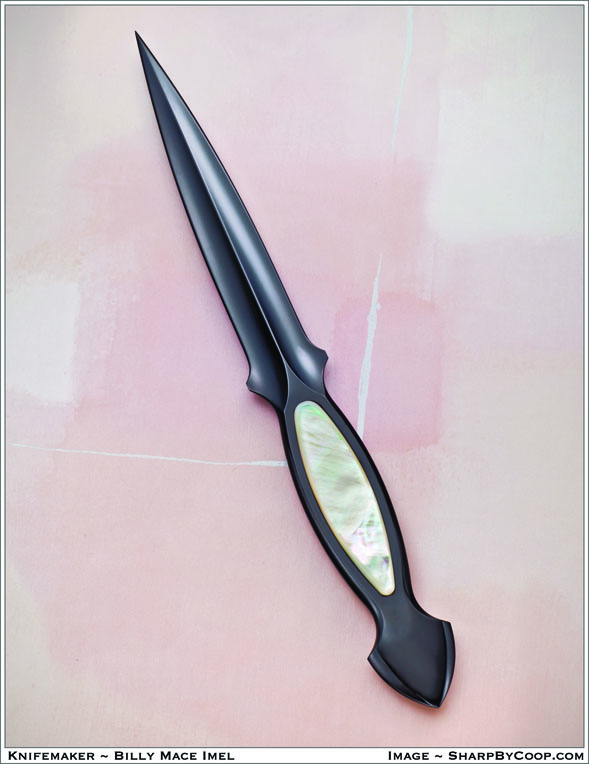
When considering the “Greatest Loveless Knife Designs,” a pearl-handle piece is probably not the first that enthusiasts would think of. In fact, this “gent’s” model is one of the very few knives made in pearl from the Loveless shop. And what a beauty she is! … including the naked lady logo.

Thanks go to Dave Ellis for lending the image and his expertise on the matter. Dave has two websites: http://www.robertloveless.com and http://www.exquisiteknives.com

Salute Conan’s Birthday With “Spirit of the Sword”

Celebrate Arnold Schwarzenegger’s 65th birthday today by reading about his Conan sword and other movie long blades in “Spirit of the Sword.”

    Designed by Jody Samson, the Conan sword Schwarzenegger used in the 1982 blockbuster film captivated American movie audiences and set the stage for such subsequent film swords as those in “Hook,” “Princess Bride,” “Highlander III: The Sorcerer,” “The Mask of Zorro,” “Lord Of The Rings,” “Pirates of the Caribbean” and more, as well as the lucrative sword repro business entered into by United Cutlery, CAS Hanwei, Albion, Tony Swatton and others.

For more click on http://www.shopblade.com/spirit-of-the-sword/?r+ssfb073012

What’s Your Steel I.Q.?

According to BLADE® subscriber surveys, one of the topics subscribers request BLADE cover most is steel—specifically, steel for knife blades. It is not much of a stretch, then, for the latest installment of “BLADE Quiz” to challenge your knowledge of the most popular of blade materials.

    The answers are at the end of the story. Be sharp!

1) Damascus or a damascus type of steel has been traced as far back as: A) the 11th century A.D.; B) second century A.D.; C) 500 B.C.

2) Wootz steel is believed to have originated in: A) Damascus, Syria; B) Indian and/or Sri Lanka; C) Japan.

3) A Swedish steel with 2 percent nickel is known as A) Sandvik 12C27; B) Damasteel damascus; C) 15N20.

4) According to most authorities, for a steel to be stainless, it must contain what percentage range of chromium? A) 11.5 to 12; B) 12.5 to 13; C) 13 to 13.5.

5) The Japanese word for “blade steel” is: A) ha-gane; B) hada; C) ha-machi.

6) The two stainless steels for which Blade Magazine Cutlery Hall-Of-Fame© member Bob Loveless is most famous for introducing to custom knives are: A) BG-42 and 154CM; B) 154CM and ATS-34; C) 440C and Vascowear.

7) A material that is dissolved in another metal in a solid solution or that results when two or more elements combine in a solid solution A) is ductile; B) has been sintered; C) is an alloy.

8) The measure of a steel’s resistance to deformation is its A) wear resistance; B) toughness; C) hardness.

9) Cutlery Hall-Of-Famer Bill Moran introduced damascus steel to modern custom knives at the Knifemakers’ Guild Show held in A) 1972; B) 1973; C) 1974.

10) At the aforementioned Guild Show, Moran’s knives fetched how many dollars per blade inch of damascus? A) $50; B) $100; C) $150.

11) The relative resistance of a steel to breakage, chipping, or cracking under impact or stress is its A) toughness; B) hardness; C) wear resistance.

12) The Crucible Particle Metallurgy steel originally called CPM 440V is now called: A) CPM M4; B) CPM S90V; C) CPM S60V.

13) To harden to the 60 HRC level during heat treating, a steel must have at least what percentage of carbon? A) 0.5; B) 0.75; C) 0.90.

14)  The first CPM steel created exclusively for knife use was: A) CPM S30V; B) CPM 440V; C) CPM 3V.

15) If the first symbol of a steel’s designation is a letter and the second symbol is a number, it is probably a: A) high-carbon steel; B) tool steel; C) high-speed steel.

16) The point at which a steel becomes permanently deformed is its: A) yield strength; B) tensile strength; C) impact strength.

17) Tool steel contains a number of different elements that combine with the steel’s excess carbon to form A) ferrite; B) austenite; C) carbides.

18) In order to cool fast enough, low-alloy steels such as O1 must be quenched in A) oil; B) water; C) a mixture of both A and B.

19) Steel handmade from electrolytic sponge iron and antique wrought iron is called A) tamahagane; B) bulat; C) oroshigane.

20) The carbon steel D.E. Henry claims to have used for knives in the 1940s and that BLADE® field editor Ed Fowler is known best for today is: A) 52100; B) 5160; C) 1084.


Answers: 1) C; 2) B; 3) C; 4) B; 5) A; 6) B; 7) C; 8) C; 9) B; 10) B; 11) A; 12) C; 13) A; 14) A; 15) B; 16) A; 17) C; 18) A; 19) C; and 20) A. Scoring: 0-3—You’re rusty. 4-7—You just went from Man of Steel to Man of La Mancha. 8-12—Come back when you can say molybdenum without chipping a tooth. 13-17—You are starting to become abrasion resistant. 18-19—Wayne Goddard just looked over his shoulder at you. 20—Your initials have officially been changed to HRC (hardness Rockwell C).

For more on the latest knives, knife legislation, knifemaking instruction, knife trends, knifemakers, what knives to buy and where and much more, subscribe to BLADE® Magazine, the World’s No. 1 Knife Publication. Click on http://www.shopblade.com/blade-magazine-one-year-subscription-us/?r+ssfb072712 for more information.

Jerry Ahern Passes Away

(photo of Jerry Ahern courtesy of JerryAhern.com)

Jerry Ahern, novelist, author of nonfiction books and many magazine articles, passed away Tuesday, July 24. He was well known internationally for his extremely popular “Survivalist” series of novels. Mr. Ahern was a fan of the Detonics line of handguns, so much so that he acted as president of the company, then named Detonics USA, from 2004 to 2007, while it was located in Pendergrass, Georgia.

    Mr. Ahern was 66. Survivors include his wife, Sharon, children, grandchildren and a nephew. Arrangements were made through Evans Funeral Home, Jefferson, Georgia. 706-367-5467, http://evansfuneralhomeinc.com.

Advertisement

Must Read Articles

Read this before you make a knife

Knifemaking 101 – Read This Before You Make a Knife

  by Wayne Goddard My experience has taught me that there's nothing like digging in and getting started. I've often said the hardest part of the...
how to forge damascus steel

How to Forge Damascus

Advertisement
Advertisement