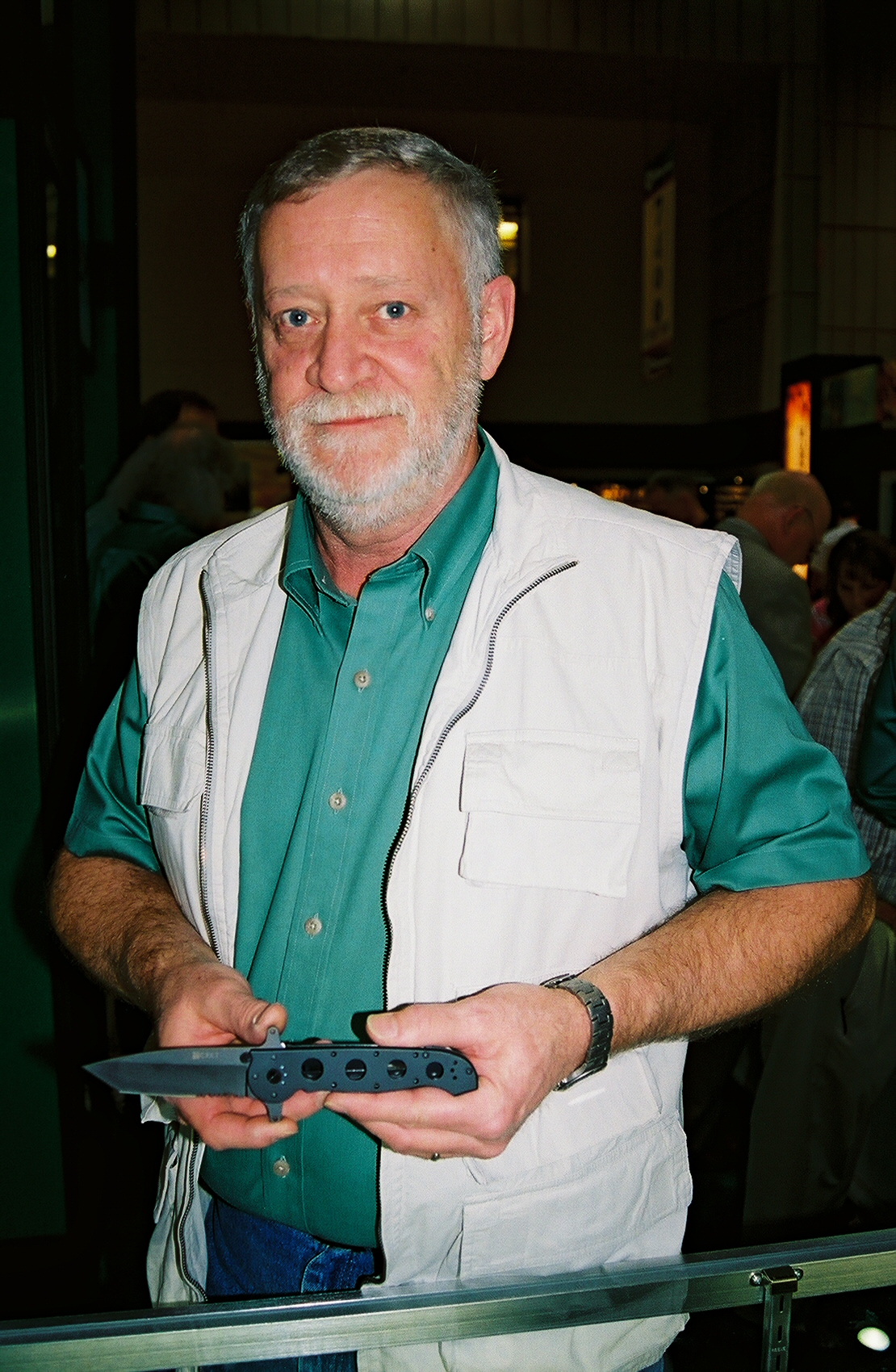
Teacher, mentor, retired Army master sergeant and friend to the knife industry, knifemaker Harold “Kit” Carson became the 49th member inducted into the Blade Magazine Cutlery Hall Of Fame© during the 2012 BLADE Show (www.bladeshow.com) at the Cobb Galleria Centre in Atlanta.
Formally inducted by his friend and fellow Cutlery Hall-Of-Famer Ken Onion during the BLADE® Magazine Awards Banquet on show Saturday night June 9, Kit was unable to attend due to health concerns. Accepting on his behalf was another of his many industry friends, Rod Bremer of Columbia River Knife & Tool.
Kit is probably best known for helping popularize the flipper style of folder and for his M16 folder, and also his M4 and M21. The latter three knives have been reproduced by CRKT in factory/custom collaborations, the M16 in 20 different iterations in the current CRKT catalog alone. He also collaborated with Roy Helton on the CrossLock for Buck in 1996. Kit designed the Intrepid for Buck and also the Magna folder for Outdoor Edge.
However, as much as he is revered for his knives, perhaps his most lasting contribution is his willingness to teach any and all how to make them. Combined with the timing of it—when knives and knifemaking exploded on the Internet circa the late 1990s/early 2000s—his mentoring benefited perhaps as many new and upcoming potential knifemakers as anyone before or since.
TRUE AMBASSADOR
“This isn’t about how wonderful his knives are—though they are impressive—it’s not so much about his 40 years as a custom knifemaker, not about his military service, though he did spend 20 years in the Army, retiring in 1993 as a master sergeant,” Onion began in his induction speech. “It’s not so much his collaborations with factories, though they are impressive. It’s about one of the most beloved custom knifemakers ever, a true ambassador of the handmade knife and this industry, a man who deeply loves his craft, this group of enthusiasts here tonight, and spending the last four decades selflessly teaching and promoting his craft to any and all who wish to learn.
“The list of makers he’s taught, encouraged and promoted is impressive and includes names like A.T. Barr, Jerry Corbin, John Greco, Jim Smyth, Jon Graham, Jerry Hossom, Marty Young and Brian Fellhoelter, to name a few. He’s just one of those guys who loves to help everyone around him, to help new guys refine their techniques, find their footing or learn a few new tricks, to encourage the new or old makers with his ‘C’mon in guys, take your shoes off and sit a spell’ personality, his calm demeanor, and his caring and nurturing nature. It is no wonder he is so admired.
“He took me under his wing when I was just a snot-nosed little punk knifemaker and taught, encouraged and congratulated me for my entire career,” Onion continued. “This guy is also a patriot, an amazing patriot. I’ve known him for as long as I’ve been making knives and he’s been sending a good amount of his custom knives to active-duty servicemen without asking anything in return, just doing the right thing for the right reason. He’s definitely a lead-by-example kind of guy. He also supports many veteran and law enforcement charities every year. I can think of no one more deserving, no one that emphasizes the purpose and meaning of the Hall Of Fame more so than my friend, Mr. Harold ‘Kit’ Carson.”
SOWING THE M16 SEEDS
Accepting on Kit’s behalf, Bremer recalled a special meeting with the inductee.
“The first BLADE Show we attended as CRKT was in 1996. Kit came to our table and he talked to me and I was blown away that he even gave us the time of day,” Bremer said. “He offered up a fixed blade to us that was a killer design and I was mesmerized because that was back in the day when he [helped develop] the CrossLock for Buck. I was thrilled he gave us any attention whatsoever, but that’s the kind of guy Kit is.
“I brought the knife back to my old partner and I said, ‘Kit Carson has given us this opportunity to do one of his designs.’ I was so excited but we didn’t know what to do with it. It was clearly not something we could do a good job for him on, so we didn’t know how to say no thanks because it was Kit Carson. We said, ‘Kit, we can’t do this knife justice.’ We were honest with him and I believe he did it with Buck and it was a big success and they had the right horsepower to do it, and we didn’t at the time. What’s very cool about Kit was he didn’t throw us under the bus for that.
“A couple years later at a Guild Show we looked on the corner of his table and there was his M16 and I thought, ‘Man, that is just too good to not try one more time to see if we couldn’t put something together with him.’ And you know, that’s the bread and butter for CRKT, one of many, and that’s just a little snippet of the kind of guy Kit Carson is,” Bremer concluded.
Noting that Kit was struggling with his health, he added, “But he’s going to be good and his spirit is always good.” Bremer then read the following statement prepared by Kit.
IN KIT’S WORDS
“It’s indeed an honor and privilege to stand before you tonight to fulfill another goal in my life’s journey with a totally unexpected honor—to be inducted into the Blade Magazine Cutlery Hall Of Fame. Understanding that only one individual is selected each year makes this an even more special event for me.
“Having grown up not far from here in North Georgia, I’ve always been interested in anything mechanical. I’ve carried that fascination to find innovative and creative things, to make things work better throughout my life. After high school I served a four-year apprenticeship here in Atlanta, finishing in 1972. That year I started making knives and was also drafted into the Army. I served in numerous positions throughout Europe and the United States.
“It was during my last 10 years in the Army that knifemaking became extremely interesting and a challenging hobby. Those were extremely rough years, long hours as both a soldier and knifemaker while always trying to ensure that our kids had a sandwich and a lunchbox. I was working in small sheds, basements and garages, or wherever I could find space in government housing, apartments and houses, to grind a blade shape or handle, or try to figure out how a locking mechanism worked.
“If it weren’t for the love and patience of my bride, Miss Betty, children Jody and Christy, or equally the friendship of folks like Bob Cargill to be there to answer questions, I would’ve never survived as a maker. It was the friendship of those like Bob, Ken Onion, Gene Baskett, George Young and Les Robertson, as that is what this craft is all about.
“We did not have the Internet, all the books or the specialty tools. Many of us still today do every piece by hand, filing, sanding, honing blades, slowly creating knives, spending hundreds of hours at knife and BLADE shows establishing our names in the industry and, most importantly, making lifelong friends.
“The profession of knifemaking ranks right up there with any profession that requires dedication, devotion, passion, honesty. It’s all about customer service and the pride of stamping your name on a blade which communicates to the world it’s something you’ve created. Regardless if it’s a unique custom, one-of-a-kind or production model that millions of copies were produced from, it’s yours, it’s who you are, it’s where you’ve been, and it’s your creativity and innovation. However, it must stand for quality.”
“I know there are no limits to this profession as to where it can go. Thanks to the Internet, our blog and forum sites, publications like BLADE Magazine that support manufacturers like CRKT, Buck, Spyderco, to name just a few, coupled with the fact that knifemakers come from every background and every walk of life, the continued progressing of this profession is unlimited. Shoot, one could even argue that if you put a group of knifemakers, bladesmiths and collectors together, you could build a spaceship.
“I’ve pretty much dedicated the past 35 years of my life to our country and my family in trying to progress the profession of knifemaking throughout the world. The recognition of my dedication is extremely humbling, much appreciated and will never be forgotten. This is the highlight of my knifemaking life. I pledge to you all that I will continue to progress this profession through continued memberships of both young and old knifemakers—and we’ll see ya’ on the moon.”
 Get a Kit Carson M16 Knife from ShopBlade.com
A high quality Carson knife doesn’t have to cost you an arm and a leg. Click here to order one of his renowned M16 knives from ShopBlade.com for just $47.99.