Paring Knife: 4 Top Kitchen Tools

The Paring knife is there when you need it most, from big tasks to small. Here are options for every type of user.

Paring knives may often get overlooked in the kitchen for their flashy big brothers—chef’s knives—but like EDCs, they’re there when you need them most and there’s one for every type of user.

What Are Some Of The Best Paring Knives:

TOPS Knives Dicer

TOPS Knives embraces the paring knife market in conjunction with its Dicer line of kitchen knives. “We noticed, in the process of wanting to design a kitchen knife, that there were some amazing U.S.-made custom kitchen knives, but there weren’t many high-quality domestically made production kitchen knives,” TOPS spokesperson Jeremiah Heffelfinger observed. “This was a void that we were more than happy to fill, especially with the plan for a full line of kitchen knives in the near future.”

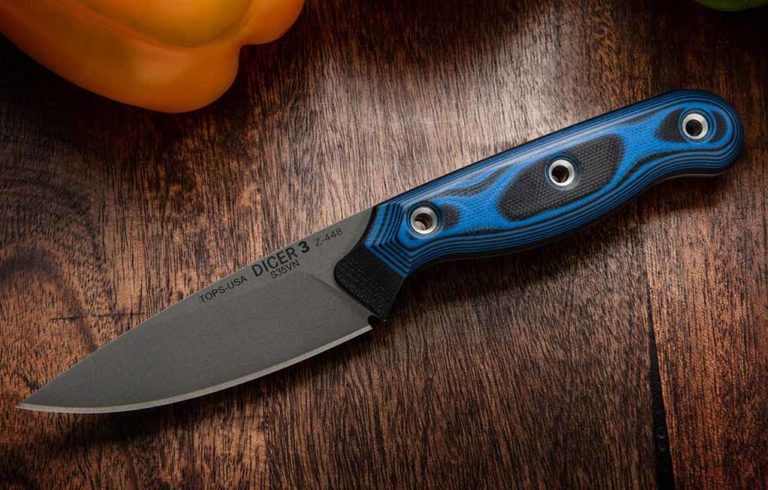
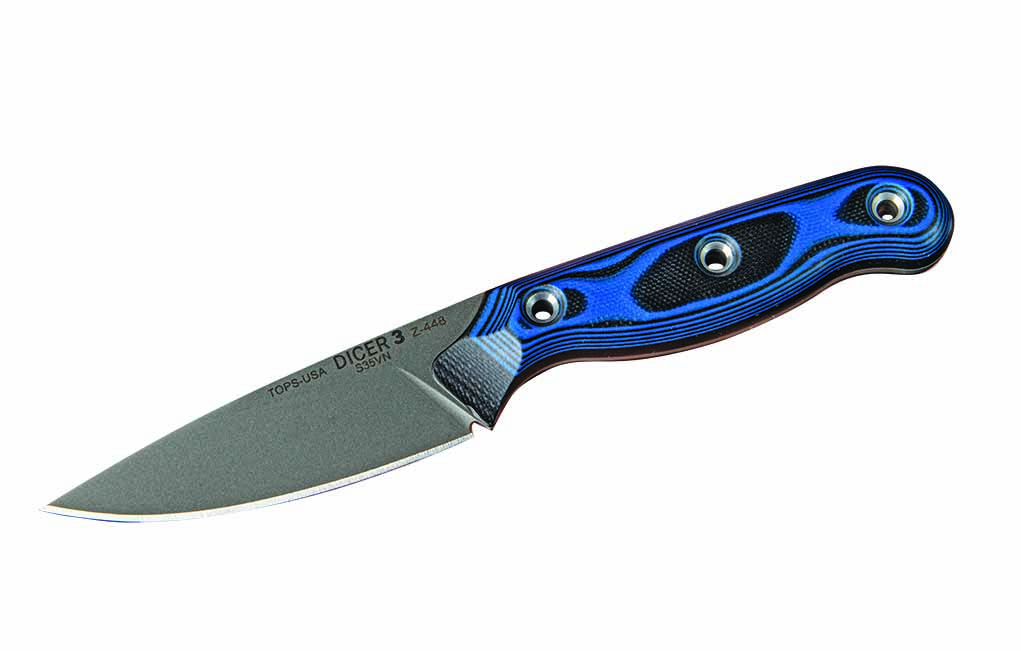
 The Dicer 3 has balance, a great blade steel—CPM S35VN stainless—ergonomics and looks.
The Dicer 3 has balance, a great blade steel—CPM S35VN stainless—ergonomics and looks.

A design contest between the staff of TOPS Knives in 2017 yielded the Dicer, an 8-inch chef’s knife. TOPS President Leo Espinoza designed a companion paring knife. The Dicer 3, released with the chef’s knife in 2019, that sports the same steel and handle material. The paring knife has become a popular offering as the company has filled out its culinary lineup, including bread and steak knives.

“The chef’s knife typically gets the majority of the attention, but for fine and detail tasks the paring knife can’t be beat,” the TOPS spokesperson advised. “It affords more control for tasks like peeling and trimming meat, fruit or vegetables.”

Heffelfinger said the Dicer 3 is a package that sports balance, a great steel, ergonomics and looks. When company officials designed the chef’s knife, they wanted it ground from CPM S35VN stainless steel, a material they carried over to the diminutive blade.

“We hadn’t seen many kitchen knives using S35VN and, having used the steel before on our Camp Creek hunting knife, we knew it would perform very well with great edge retention and durability,” he said. “Being a stainless steel, it is much less prone to corrosion and rust, making user maintenance just a little bit easier.”

The blade is flat ground to reduce friction in cuts, a .09-inch-thick steel that tapers to .032 inch near the tip, and sharpened to about 20 degrees to balance clean slices and durability when chopping, Heffelfinger added. It’s a blade described as a medium-to-heavy weight for a paring knife.

“We have a reputation for overbuilt hard-use tools that are able to hold up under extreme-use scenarios. We brought this philosophy with the full-tang design on every one of our Dicer line of knives,” he explained, “but we also wanted a classic feel and look for them, with a TOPS flair.”

He indicated knife enthusiasts have noticed that overbuilding and some have taken the blade far from the kitchen knife drawer.

“We have had a number of customers purchase the Dicer 3 to use as an EDC knife,” Heffelfinger said. “Due to the size of the blade, the S35VN stainless steel and smooth, contoured handles, they have attached a clip to the sheath and roll with it on their belt every day.”

Dicer 3 Specs
Designer: Leo Espinoza
Blade length: 3.5”
Blade steel: CPM S35VN stainless
Blade grind: Flat
Blade thickness at its thickest: .09”
Handle material: Black canvas Micarta® and Blue-black G-10
Handle thickness range: .1875 to .75”
Weight: 4.7 ozs.
Overall length: 7.88”
Sheath: Black Kydex
Country of origin: USA
MSRP: $200

Case Household Cutlery 3-Inch Clip Point

Sometimes it is best not to change the paring knife beloved by cooks through the decades, designs that have seen food crazes come and go: Jell-O salads, fondue pots, casseroles and avocado toast. Enter Case Knives’ Case Household Cutlery 3-inch clip point paring knife.
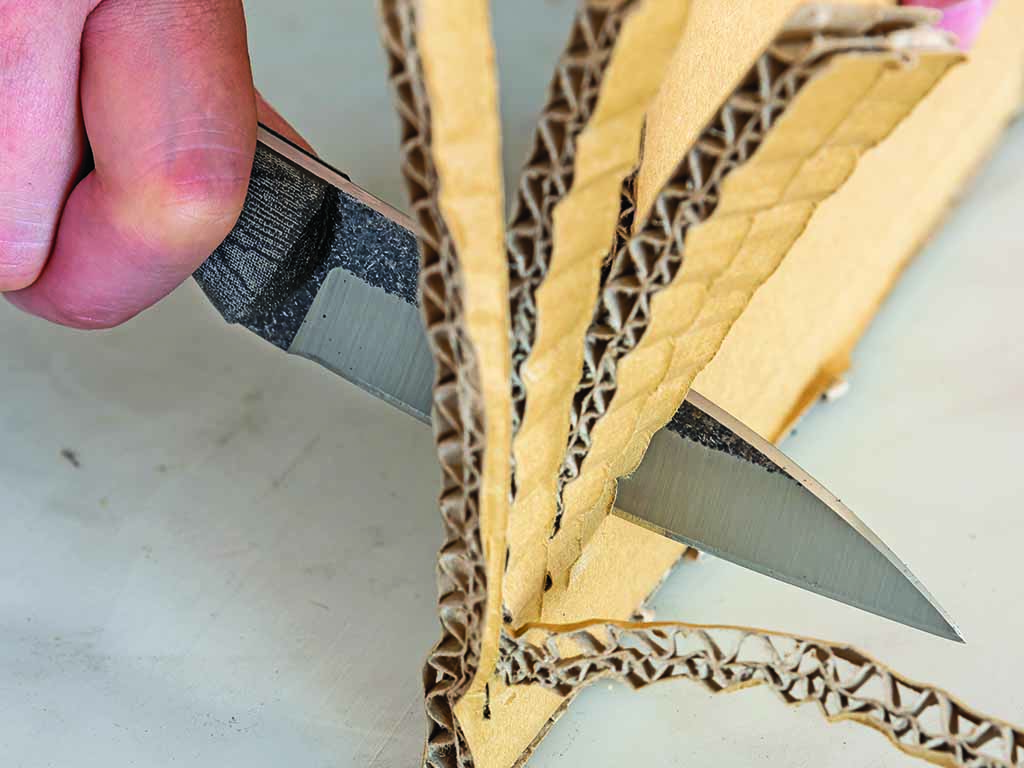
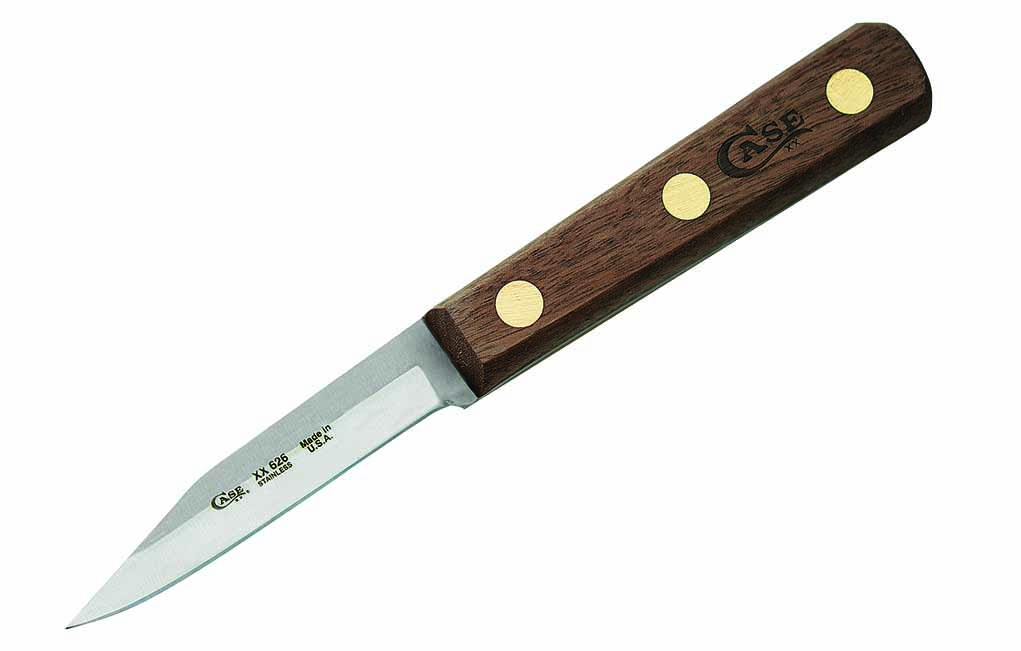
 Case has two paring knife blade styles: a spear and a clip point (shown here). “The clip-point version excels at chopping smaller food items because of its blade design and the blade edge, which mirrors the flat cutting surface when used correctly,” Case spokesperson Fred Feightner noted.
Case has two paring knife blade styles: a spear and a clip point (shown here). “The clip-point version excels at chopping smaller food items because of its blade design and the blade edge, which mirrors the flat cutting surface when used correctly,” Case spokesperson Fred Feightner noted.

“We use classic walnut wooden handles that have been used in millions of kitchens over time,” said Fred Feightner, Case senior marketing communications manager. “We purposely wanted these new kitchen knives to look, feel and perform like the Case household knives of old, and we feel our current offerings do just that very well.”

Case debuted the knife in 2012 while reintroducing its household line—in part by demand from its fans and also as a way to expand its brand and possibly place the knives with retailers who emphasized kitchen supplies.

Consumer advocates insisted on a simple handle design: a straight .5-inch-thick wooden handle, Feightner said. For the blade, the company turned to its Tru-Sharp™ surgical steel—the Case version of 420HC stainless—sabre ground and polished to a satin finish to resist the corrosion that can occur working around food.

The company has two paring knife blade styles. While the spear point slices and dices with ease, Feightner confided, “The clip-point version excels at chopping smaller food items because of its blade design and the blade edge, which mirrors the flat cutting surface when used correctly.”

It’s a knife Feightner says, despite its size, can hold up to kitchen tasks most anywhere. As he noted, “We think our paring knives are perfectly weighted so that intricate work is as easy as tougher jobs around the kitchen and at the barbecue pit.”

Household Cutlery 3-inch Clip Point Paring Knife Specs
Blade length: 3”
Blade steel: Tru-Sharp™ Stainless
Blade grind: Sabre
Handle material: Walnut
Handle thickness at its thickest: .5”
Overall length: 6.75”
Weight: 1.7 ozs.
Country of origin: USA
MSRP: $27.99

V Nives Emerald Paring Knife

Mike Vellekamp, owner and founder of V Nives, indicated his company has recently entered the world of kitchen knives, too. At his house, the 8-inch chef’s knife is most often used to prep food thrown in a wok or barbecued.

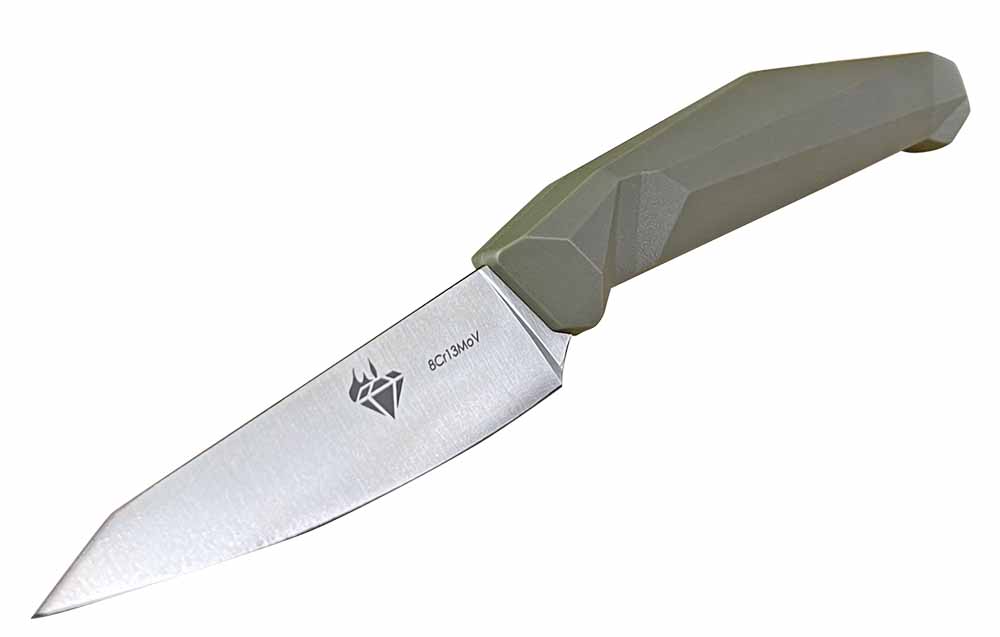
 The green handle—an exclusive color for V Nives—of the Emerald Paring Knife is injection molded around the blade tang.
The green handle—an exclusive color for V Nives—of the Emerald Paring Knife is injection molded around the blade tang.

“However, for day-to-day utility in the kitchen, the paring knife is definitely a must have,” Vellekamp said, adding the genre of blade is “optimal for intricate cutting, mincing, slicing and dicing fruits and veggies, deveining prawns/shrimp, and cutting herbs.”

And what V Nives offers won’t be the type of model found moldering in grandma’s cutlery drawer: the angular and green-hued Emerald Paring Knife. Vellekamp said it’s an example of a modern, innovative kitchen implement.
“DiaFire actually developed the knife,” Vellekamp said. “We have a close relationship with the brand, and we are the exclusive distributor for the Americas. We chose their kitchen products because of their dedication to innovation and quality.”
The Taiwan-made blade is 1/16-inch thick and flat ground from 8Cr13MoV stainless steel. “This is a great blade steel because it holds an edge very well for its intended uses, it’s highly corrosion resistant and it’s very easy to resharpen,” Vellekamp noted.

The green handle—an exclusive color for V Nives—is injection molded around the blade tang, making an ergonomic handle that runs between .417 to .645 inch thick. It’s a grip Vellekamp calls tough and light. And while he and other knife enthusiasts will tell you it’s a terrible way to treat your most important tool in the kitchen, the handle can survive a trip through the dishwasher if the, er, less knife enlightened put it there.

“These knives are a perfect example of high value at an affordable price,” Mike said, “and I believe it is a perfect complement to the modern kitchen.”

Emerald Paring Knife Specs
Blade length: 3.5”
Blade steel: 8Cr13MoV stainless
Blade grind: Flat
Blade thickness at its thickest: .059”
Handle material: Nylon and fiberglass injection molded
Handle thickness range: .417 to .647”
Weight: 4.25 ozs.
Overall length: 8.15”
Country of origin: Taiwan
MSRP: $42

Bradford Knives Blue G-Wood Paring Knife

Brad Larkin of Bradford Knives said a wise knife collector once told him that any good chef’s knife needs a paring knife sidekick. As a result, he’s happy with the Washington state-based shop’s flagship paring knife.

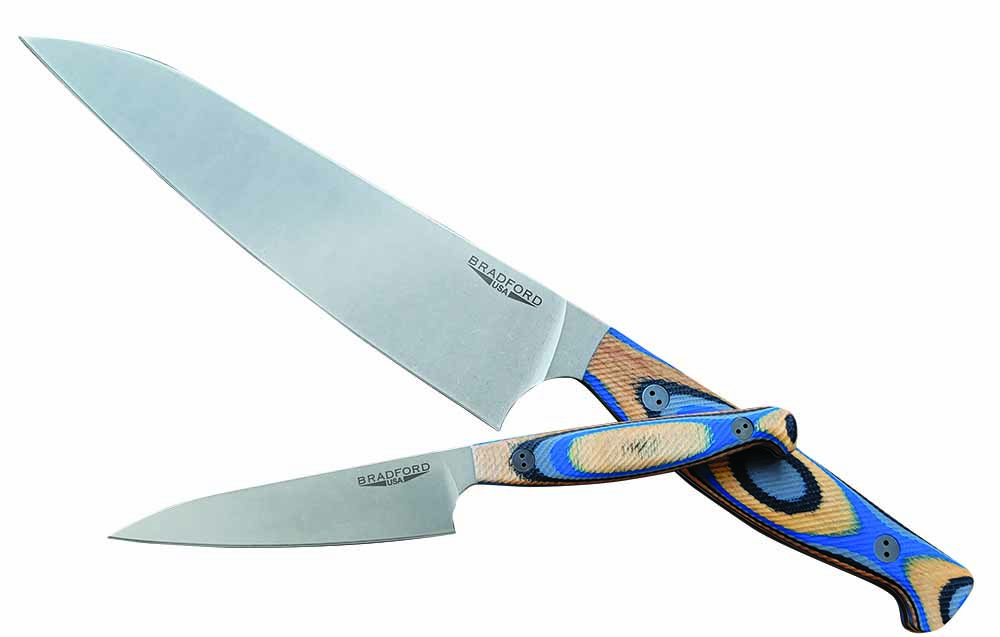
 Brad Larkin of Bradford Knives said the handle of the company’s Blue G-Wood Paring Knife is designed to be held in a surgical-like pinch grip. He indicated the result is a lightweight knife focused on fine cutting.
Brad Larkin of Bradford Knives said the handle of the company’s Blue G-Wood Paring Knife is designed to be held in a surgical-like pinch grip. He indicated the result is a lightweight knife focused on fine cutting.

“It complements our chef’s knife so well and we do find that customers seem to enjoy a ‘set’ of kitchen knives as opposed to our EDC knives, which are very carefully built around specific daily uses,” Larkin explained. “In the kitchen you need to be ready for a quickly changing, dynamic environment, and our hope is that the paring and chef’s knives can accomplish these mission-critical chores.”

Over the years, Bradford has released different versions of its paring knife. Recently, the company issued a limited run of handles made from blue G-wood, a composite of G-10 and wood veneer. Stainless blade steel choices are edge-holding, corrosion-resistant AEB-L or tough M390.

Bradford, which is known more for its tactical and EDC models, returned to its culinary roots with the paring knife. The first edged tool it made was the Gatsby, a steak knife.

The company’s paring knife features thin blade geometry—just the way Bradford Knives prefers it. The .09-inch-thick blade has a distal taper. “Our process allows for a full flat grind. It does produce a very mild hollow-grind effect,” Larkin qualified, “but it is hardly worth mentioning.”

The handle is designed to be held in a surgical-like pinch grip. Larkin said the result is a lightweight knife focused on fine cutting, such as making fruit twists for cocktails, for instance, though it could be considered a medium-weight model compared to most paring knives.

“A paring knife can be the best for overall utility, especially considering our blade size is larger than the typical paring blade and it shares design elements with our chef’s knife,” he opined. “It’s a real slicer!”

Blue G-Wood Paring Knife Specs
Blade length: 3.8”
Blade steel: Choice of M390 or AEB-L stainless
Blade grind: Full-height flat
Blade thickness at its thickest: .09”
Handle material: Blue G-wood
Handle thickness range: .2 to .55”
Weight: 1.8 ozs.
Overall length: 7.5”
Country of origin: USA
MSRP: $129

Blade Show Texas And Texas Gun Experience Team Up

0

Blade Show Texas and Texas Gun Experience have teamed up to provide Blade Show Texas attendees a night of hands-on experience in a safe and managed environment. Blade Show Texas attendees with PROOF of attendance (show receipt or wristband) are invited to a private demo event on Saturday evening March 19, from 7 p.m. to 10 p.m. at 1901 S Main St, Grapevine, TX 76051.

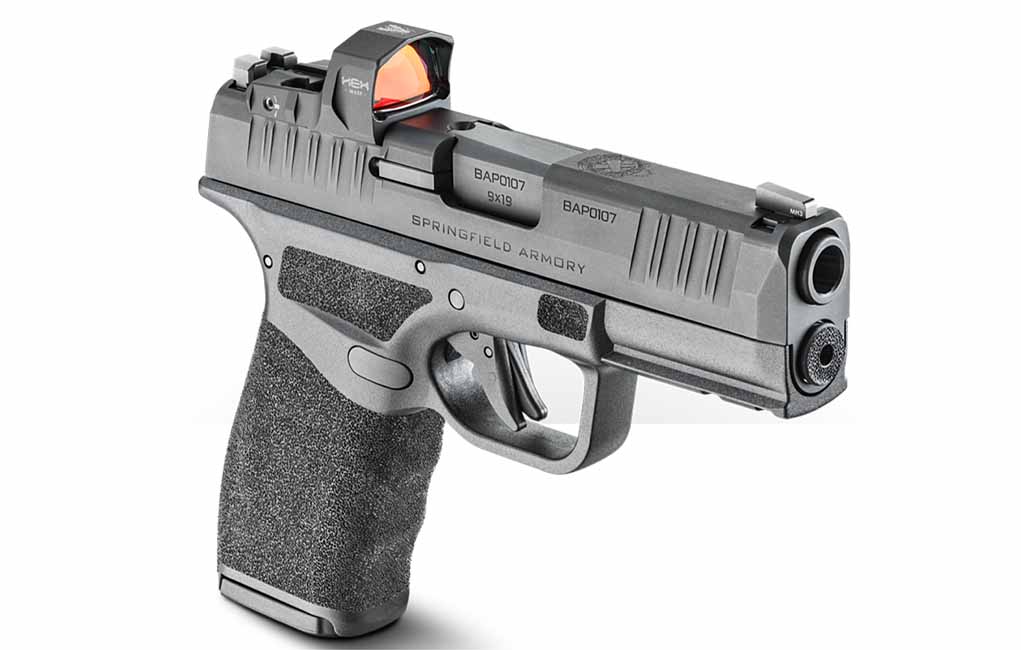
Springfield Hellion
Springfield Hellion

The shooting experience will be limited to the first 200 attendees or until the ammunition runs out. For further details and to secure a guaranteed shooting experience, stop by the Texas Gun Experience booth by the SHOW ENTRANCE and subscribe to one of the following magazines: BLADE, Gun Digest, RECOIL, CONCEALMENT, OFFGRID.

EXPERIENCE THE FOLLOWING:

ATAC 300black
ATAC 300black
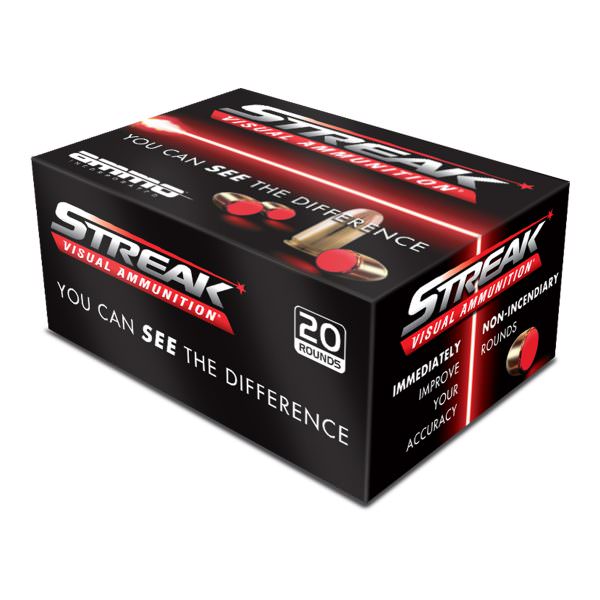
Streak AMMO
Streak AMMO

WIN AWESOME PRIZES:

Hellcat Pro
Springfield Armory Hellcat Pro

Throughout the evening, lucky attendees will win the following prizes:

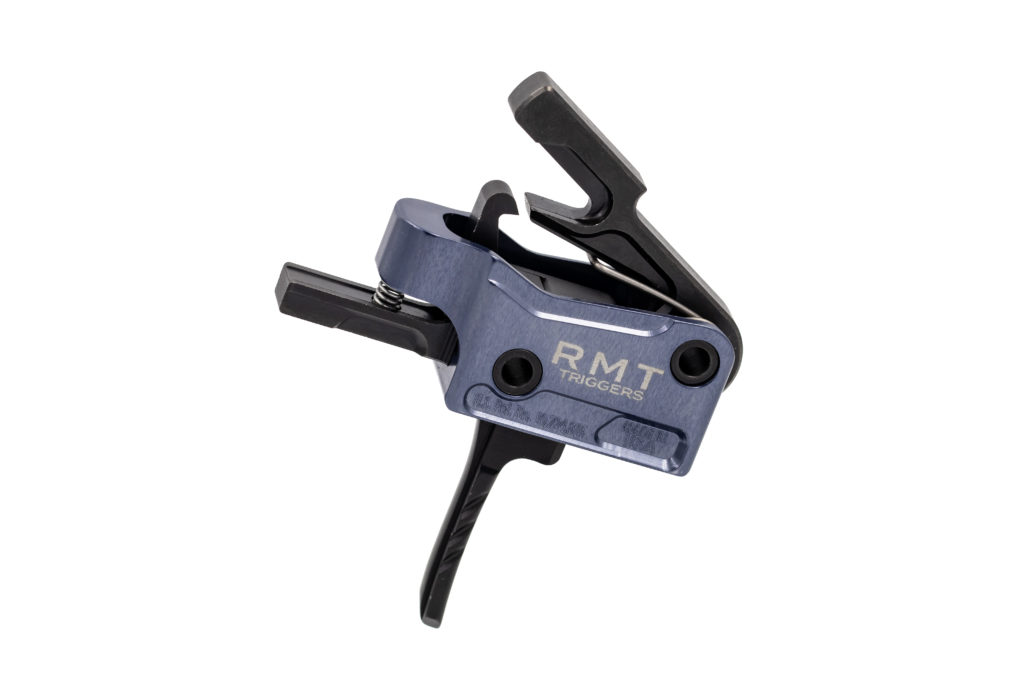
RMT Nomad
RMT Nomad

Best High-Carbon Steel Knife Options

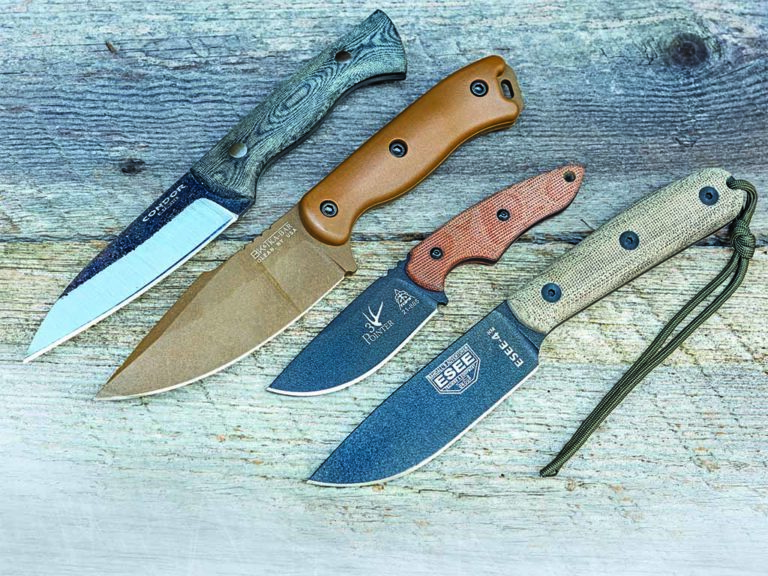
Looking for a tough and ready option for EDC? Here are 4 factory high-carbon steel knife options that wear and use the reliable 1095 steel well.

Knives in tried-and-true carbon blade steels such as 1095 often are left out of the conversation. Do they still have relevance in the modern world of knives? The short answer is yes—and they remain relevant for the same advantages that made them popular in the first place.

“There are a number of reasons why 1095 is popular with consumers and manufacturers,” states Joe Bradley, sales and marketing manager for KA-BAR Knives. “It’s a great steel to work with and maintain, which is the primary reason we have used 1095 Cro-Van for decades.” Says Shane Adams, marketing director for ESEE Knives, “It takes a beating and is field-serviceable. We know it, use it and trust it with our lives.” Adds Jeremiah Heffelfinger of TOPS Knives, “1095 is also easier to sharpen, especially in the field, than some stainless steels.”

You can work 1095 to death, then take your favorite sharpener and put an edge right back on it. Try doing that with CPM S30V stainless! Because of 1095’s tendency to rust, you must maintain it more than stainless. Many 1095 blades sport a coating that protects most of the surface except the edge. If you’re not careful, corrosion can begin at the edge then travel up underneath the coating. Consequently, in a wet environment keep a light coat of oil on the blade. If you wash the knife, towel dry it carefully and let it air dry, too. As for some of today’s top models in 1095, check these out.

Condor Tool & Knife Bush Slicer Sidekick

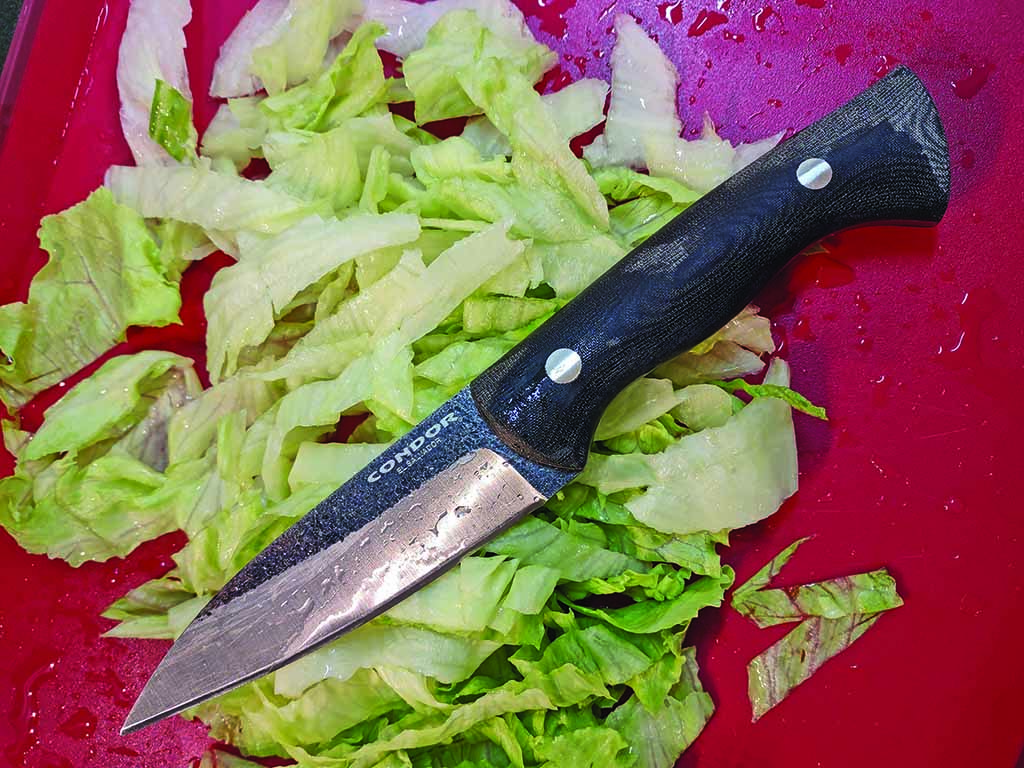
The Bush Slicer Sidekick from Condor Tool & Knife is a small, lightweight fixed blade designed to handle intricate food prep tasks similar to those paring knives address. It also functions as a stand-alone tool for bushcraft, as well as day hikes and such.
The Bush Slicer Sidekick from Condor Tool & Knife is a small, lightweight fixed blade high-carbon steel knife designed to handle intricate food prep tasks similar to those paring knives address. It also functions as a stand-alone tool for bushcraft, as well as day hikes and such.

The Bush Slicer Sidekick from Condor Tool & Knife is a small, lightweight fixed blade designed to handle intricate food prep tasks similar to those paring knives address. It also functions as a stand-alone tool for bushcraft, as well as day hikes and such.

The 6.4-inch modified wharncliffe blade on this high-carbon steel knife has a defined tip for intricate cutting tasks, but also enough sharpened real estate to get work done. Close to 9 inches overall, the knife carries well and is neither too big nor too small for many food prep and camp chores. The black Micarta® handle is ergonomically shaped for maximum user comfort. The sheath is well designed, too. One of the few hybrid-constructed models employing Kydex and leather, it is quite user friendly. You get the rigid protection of Kydex along with the carry versatility a leather loop offers, allowing the sheath to move somewhat while on the belt. The gray Kydex complements the handle’s appearance.

The Bush Slicer Sidekick is built extremely well, with high quality fit and finish. The edge is razor sharp out of the box. The standard Condor blade finish is two tone, with the darkened heat-treat scale finish on the flats and machine satin on the bevels. The cutting edge is tilted up a bit in relation to the handle, giving more hand clearance on a flat surface. The way the blade profile tapers toward the tip is smart as well, giving the knife the ability to tackle finer cutting tasks. Another nice feature is the 90-degree blade spine for use in conjunction with a fire-starting ferrocerium rod.

Condor’s knives are not flashy but work like pack mules. The Bush Slicer Sidekick slices cardboard like a champ. The flat grind tapers the edge to a thickness that is both durable and sharp.
Condor’s knives are not flashy but work like pack mules.  The Bush Slicer Sidekick slices cardboard like a champ. The flat grind tapers the edge to a thickness that is both durable and sharp.

The flat-ground blade thins the edge well so it sails through a variety of materials, yet is thick enough for durability. The tip is controllable for fine and precise cutting. Integral front and rear guards prevent unwanted hand movement in either direction. However, those with larger hands may find the grip a bit small. It also lacks a lanyard hole. At a manufacturer’s suggested retail price (MSRP) of $119, the Bush Slicer Sidekick represents excellent value in an expertly crafted using fixed blade. County of origin: El Salvador.

TOPS Knives 3 Pointer

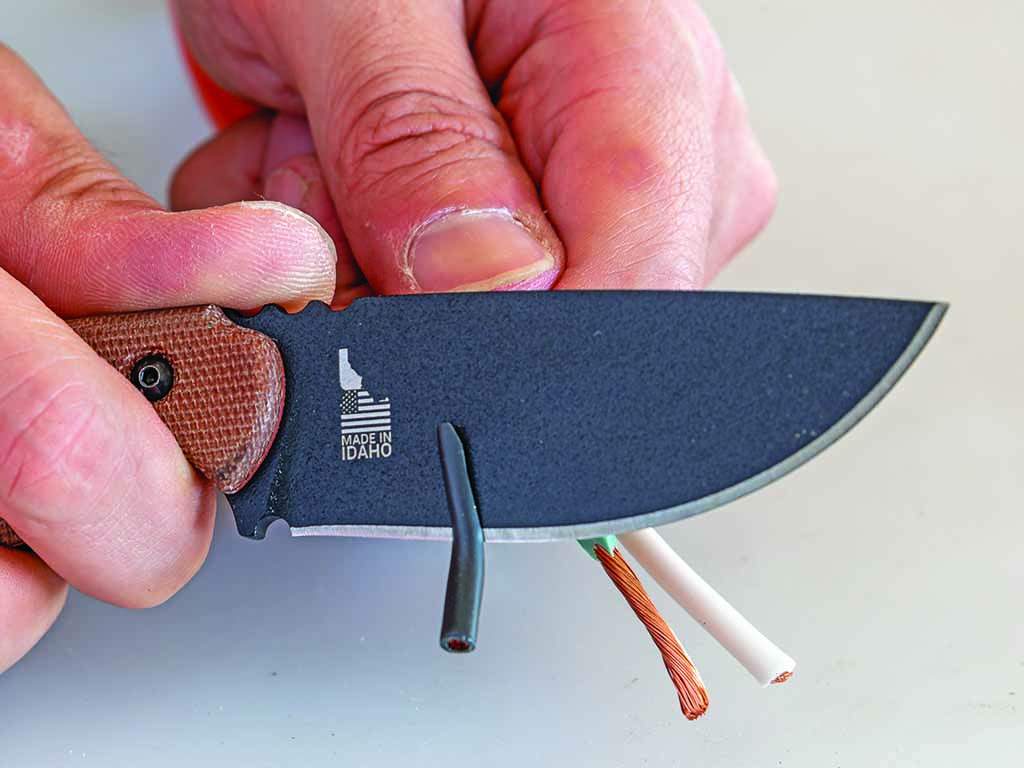
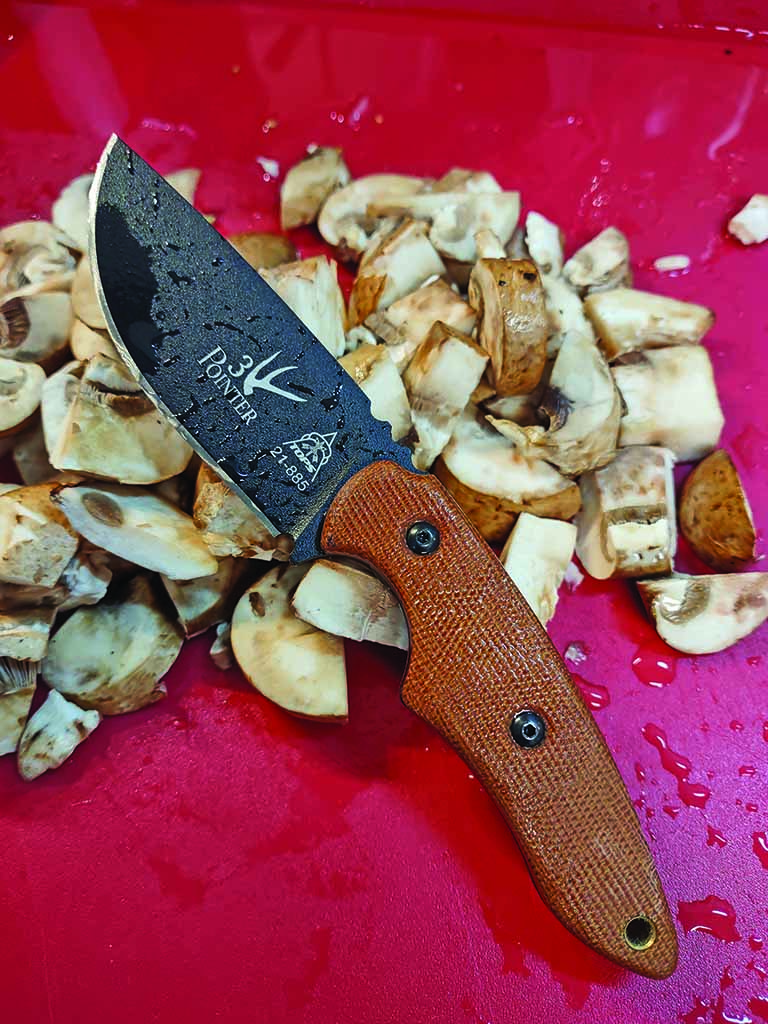
The TOPS Knives 3 Pointer is a great multi-carry fixed blade with the option of being a neck knife.  The drop-point blade is great for cutting food as well as utility tasks that require a sharp blade and precise control, such as wire stripping.
The TOPS Knives 3 Pointer is a great multi-carry high-carbon steel knife, a fixed blade, with the option of being a neck knife.  The drop-point blade is great for cutting food as well as utility tasks that require a sharp blade and precise control, such as wire stripping.

The TOPS Knives 3 Pointer might be the smallest of the test bunch, sporting a 3.1-inch blade and 6.6-inch overall length, but also has the most options. It comes in three handle choices—black Micarta, tan Micarta and skeletonized. In addition, each model comes with two modes of carry. Straps screwed to the sheath permit horizontal belt carry, and a chain provides neck carry (just remove the belt loops). The options might make you consider the 3 Pointer to replace a folder for EDC.

The high-carbon steel knife’s heart and soul lies in its deep-bellied drop-point blade capable of field dressing game, doing chores in camp, etc. Black Traction Coating helps ward off rust. It is a very durable coat that withstands frequent heavy use.

The handle is particularly interesting. The pronounced finger groove can lock into your grip, with the rest of your fingers falling into place on the tapered handle. Unlike other fixed blades of this size, the handle isn’t blocky or bulky, which allows it to be carried as a belt or neck knife.  We tested the tan handle version, which has a nice contrast in appearance to the black blade. Three large traction notches accept a thumb comfortably on the spine to exert control and pressure. The red liners provide a subtle pop of color contrast.

The 3 Pointer’s handle is particularly interesting. The pronounced finger groove can lock into your grip, with the rest of your fingers falling into place on the tapered handle.
The 3 Pointer’s handle is particularly interesting. The pronounced finger groove can lock into your grip, with the rest of your fingers falling into place on the tapered handle.

The Kydex sheath is well made and designed with an integrated thumb rest that lets you grip the knife handle and push out, easily popping it free of the sheath. The feature is very well thought out and not found on many knives.

I carried the 3 Pointer mainly as a neck knife for the evaluation. Neck knives are a love ’em/hate ’em proposition. If you want to carry a smaller fixed blade in a discreet manner this is the most viable option, as neckers conceal easily, even under a plain T-shirt*.  They also work well with polo-style and button-down dress shirts. And when you start layering as the temperatures drop, neck knives carry well under a hoodie and other cold weather wear. The flat handle profile enhances discreet carry without printing underneath the aforementioned T-shirt. I like how the shape and contours help you obtain a very secure grip.

The drop point blade is usually my favorite when it comes to straight knives due to its versatility. The belly allows the blade to tackle sizeable cutting tasks while remaining easy to carry.  If you prefer taking a small fixed blade into a restaurant to substitute for the knives provided, the 3 Pointer is low profile enough to cut food without attracting unwanted attention.  The TOPS 3 Pointer in tan Micarta has an MSRP of $125—an excellent deal for a USA-made sheath knife.

ESEE 4HM

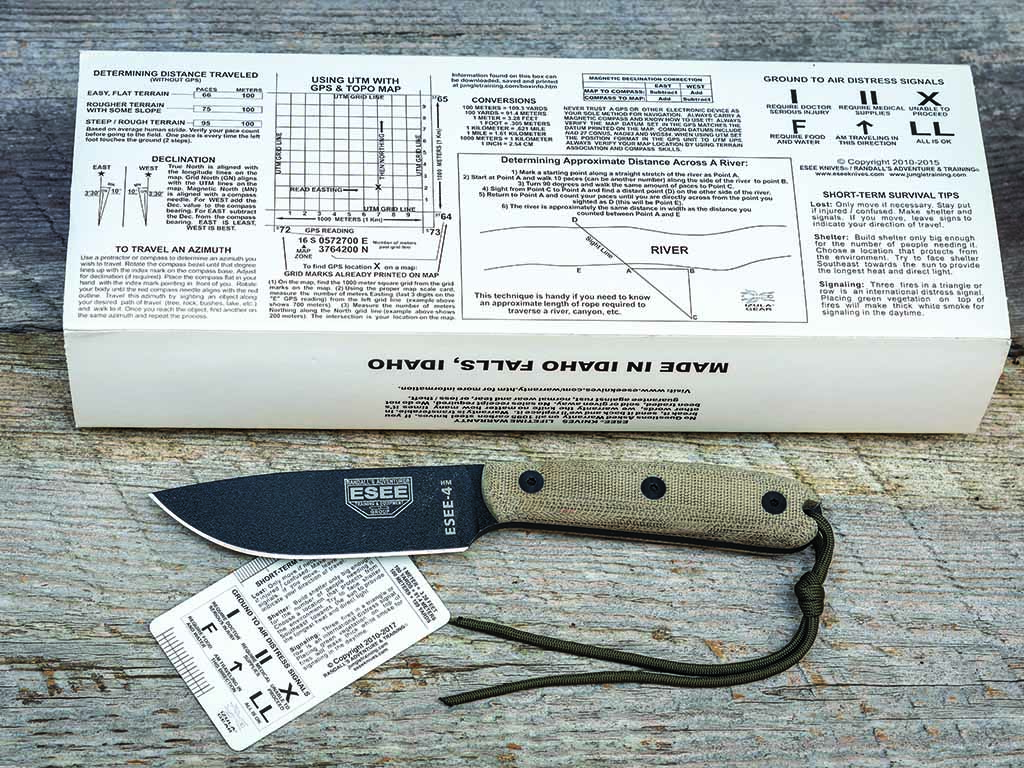
The ESEE 4HM comes in some of the most utilitarian packaging anywhere with information that every outdoor survivalist needs, including how to determine distance traveled, GPS and topographical map tips, and much more.

The ESEE 4HM blends toughness and cutting efficiency in one package that carries easily and is built for extended use. The 4.3-inch blade has a generous belly for field dressing, food prep and some bushcraft. Overall length is just short of 9 inches. Blade thickness is .1875 inch and the flat grind is robust for long-term durability, though thin enough for slicing. The blade has a black powder coat to protect it from the elements.

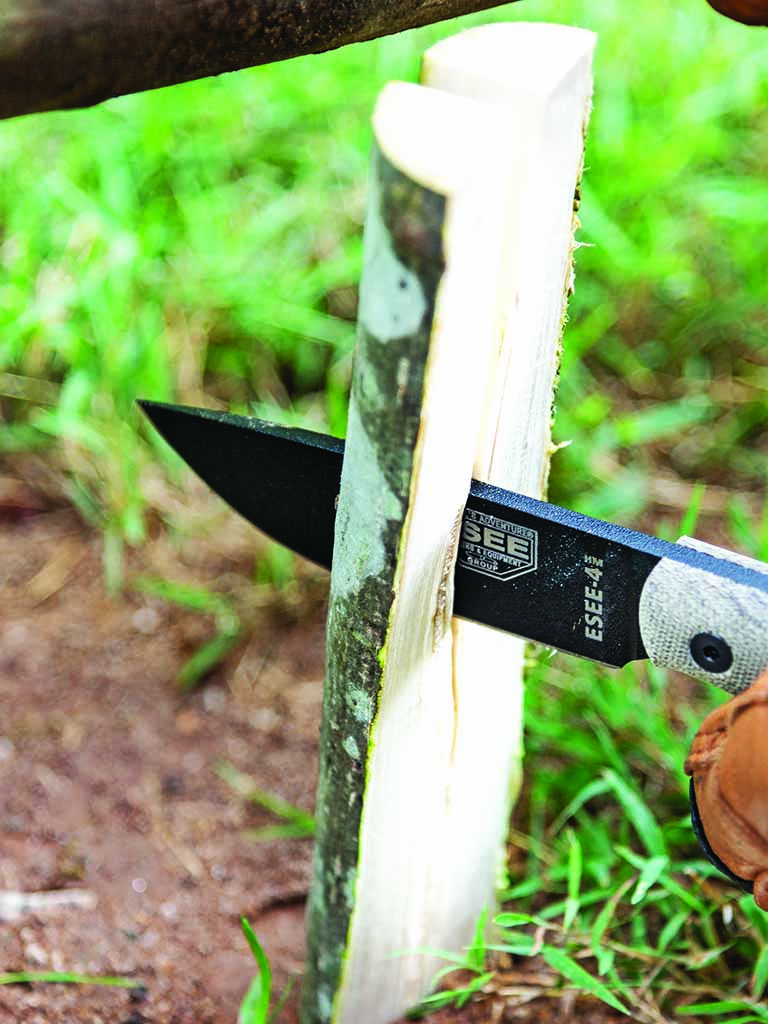
The ESEE Knives 4HM is designed to be a more modern variation of a bushcraft/utility knife. With its straight-forward design, it offers high performance with a more user-friendly blade.
The ESEE Knives 4HM is designed to be a more modern variation of a bushcraft/utility high-carbon steel knife. With its straight-forward design, it offers high performance with a more user-friendly blade.

The Micarta handle is beefy but rounded in the right places, and fills your hand without generating hot spots. The Micarta is fastened to the tang using three sets of flat-head Torx screws. A lanyard hole comes with a length of paracord, making the 4HM easy to extract from the well-made, sewn pouch sheath of brown leather. The knife sits down in it securely but loose enough so it comes free smartly when needed.

It is a great all-around fixed-blade high-carbon steel knife. The blade and handle shapes are universal and work well in most scenarios. The drop point shape is also a great scraper, if needed. The fat handle cross section gives a reassuring grip, as opposed to shapes that might be comfortable but, due to being too thick, are not as secure in the hand. If you enjoy hunting, camping and hiking and use a fixed blade a lot, this is the knife you need. Country of origin: USA. MSRP: $178.

KA-BAR BK18 Harpoon

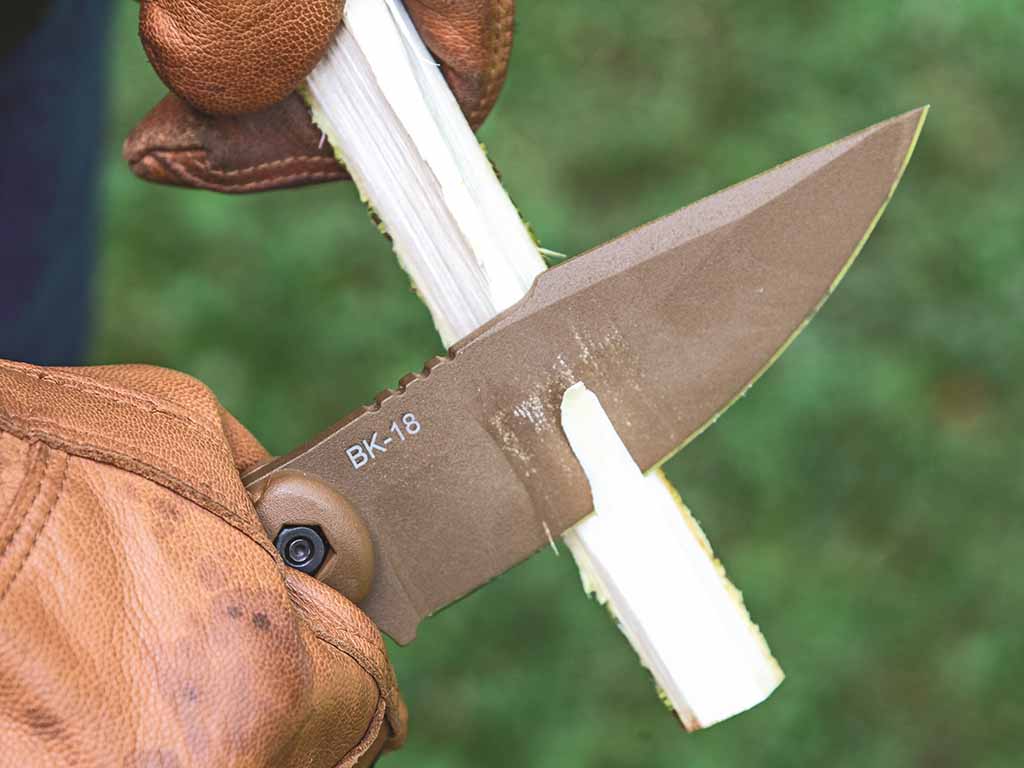
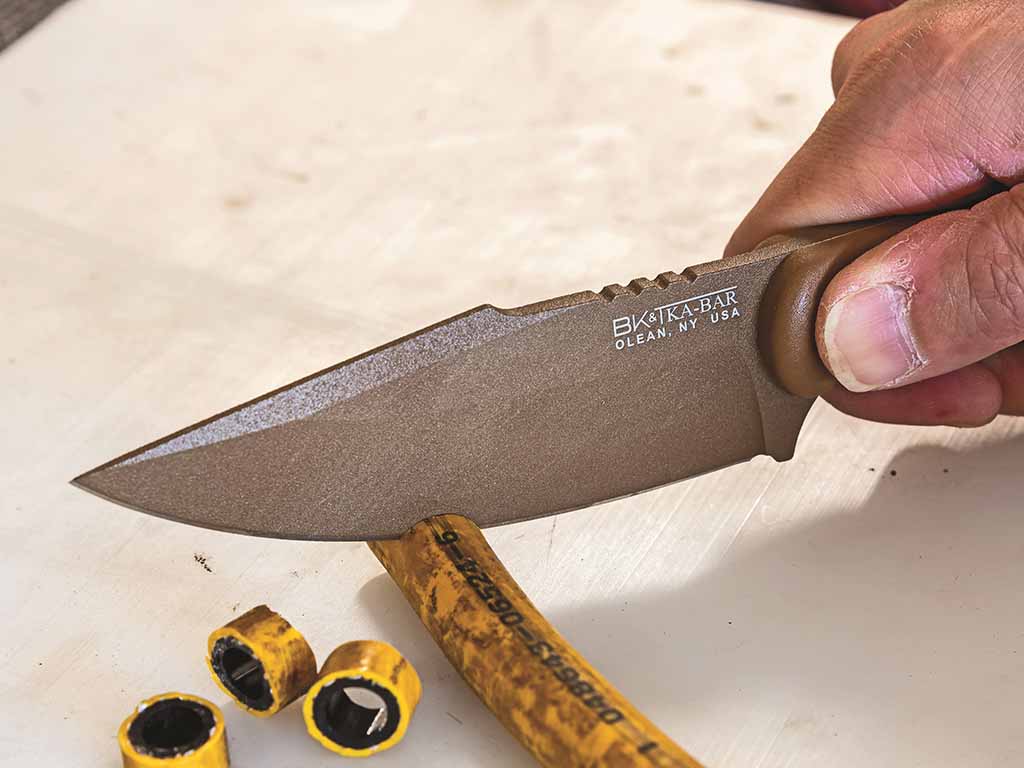
The BK18 Harpoon’s tall, flat grind engages whittling and carving jobs with gusto. The swedge provides a bit of visual attitude, too.
The BK18 Harpoon’s tall, flat grind engages whittling and carving jobs with gusto. The swedge provides a bit of visual attitude, too.

The BK18 Harpoon is Ethan Becker’s latest design for KA-BAR.  The 4.5-inch drop-point blade offers plenty of length for food prep and outdoor tasks. The prominent harpoon-style swedge projects attitude. The ergonomic handle features multiple swells for comfort and a non-slip grip. A palm swell fills your hand and provides excellent stability and control. The harpoon blade forms an integral forward guard, and the slightly dropped handle butt helps capture your hand. There’s an oblong hole for a lanyard.

At 9.3 inches overall, it’s a great mid-sized sheath knife. The blade belly slices easily, while the handle provides the ultimate in control. Traction notches on the spine allow you to choke up. The sheath is a molded Celcon® polymer with a heavy duty nylon webbing belt loop. The knife fits/clicks in to avoid inadvertent loss. A nifty feature is the two molded-in vent channels that reduce moisture by allowing inside air flow. A secondary webbing button snap secures the handle in place, though the way the knife clicks tightly into the sheath, I cannot imagine it popping loose accidentally. The belt loop also can be re-mounted to set the knife up for left-hand carry.

The KA-BAR Becker BK18 Harpoon is equally at home with food prep or work tasks. The blade’s sweeping belly tackles a host of chores inside and out.
The KA-BAR Becker BK18 Harpoon is equally at home with food prep or work tasks. The high-carbon steel knife’s blade’s sweeping belly tackles a host of chores inside and out.

One thing many remember about seeing their first Becker design is the chunky handle design. As awkward as it may look, it works. No matter the model, basically the same handle shape is used, a hallmark of Becker designs. The BK18 Harpoon has the same configuration but it’s slimmed down considerably. It’s comfortable for extended use and helps keep your hand in place with no awkward sliding in either direction. It also helps prevent the handle from rotating in your grip.

Speaking of handles, there is an optional upgrade. The tan Micarta kit, which replaces the stock molded grip, is $35. It’s worth it. The Micarta has a nice grab-you-back feel that holds well even with wet hands—a feature the stock handle somewhat lacks. MSRP is $120, also not bad for a USA-made fixed blade.  

Also Read:

Knife Profile: Shrike Out Hits A Home Run

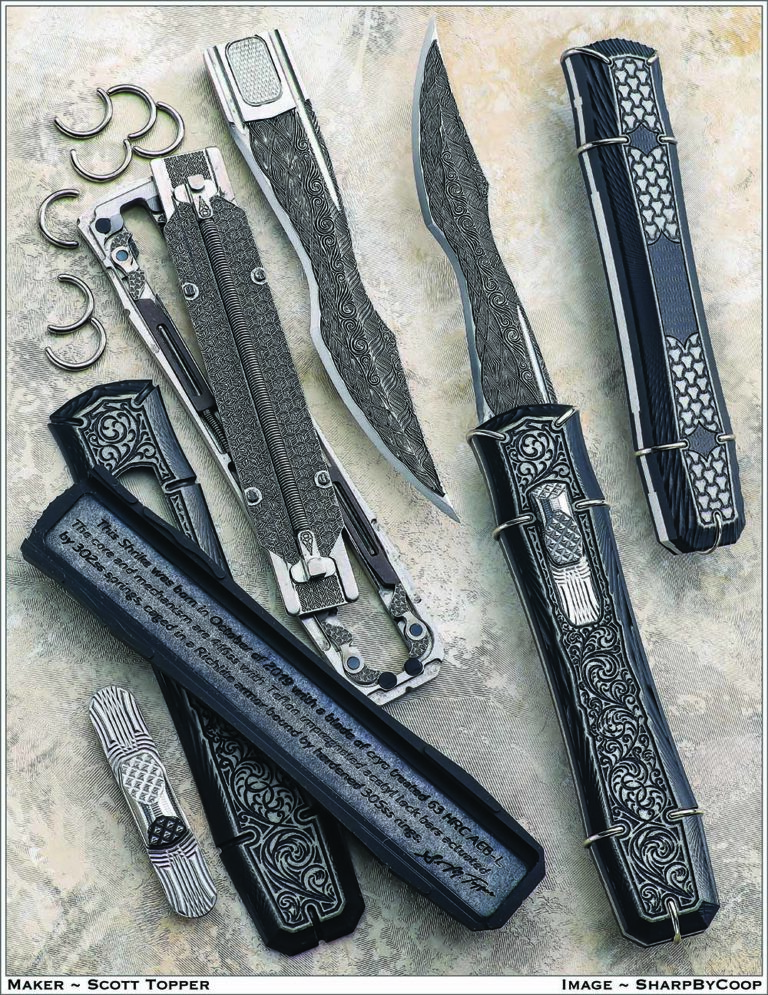
Scott Topper’s off-the-charts out-the-front is a multi-part marvel, the Shrike Out, brings an artistic twist to the automatic.

It’s hard not to like the Shrike, a custom out-the-front dual-action automatic by Scott M. Topper.

The blade is cryogenically treated AEB-L stainless steel. According to Scott, since AEB-L’s micro-structure allowed for a finer edge, it originally was a go-to steel for disposable razors. He indicated the version of the material he uses competes well against crucible steels, and is made through a conventional metallurgy technique.

The six inside springs are hand wound stainless steel. The four locks are independent. The brown lock parts are Teflon-impregnated Delrin for permanent lubricity. The black Richlite scales are inlaid with white to add contrast to the engravings.

The knife comes nested in a velvet-lined walnut box. Plain and all-stainless versions of the Shrike are also available. According to Scott, the various styles of the knife are available through the PVK Showroom (888-878-5643 pvk.com) in Las Vegas.

Shrike Out Specs
Knife: Shrike Out The Front Dual Action Auto
Blade length: 4”
Blade steel: Cryogenically treated AEB-L stainless
Frame material: 416 stainless steel
Handle material: Paper phenolic composite
Closed length: 5”

Also Read:

Japanese War Swords Part II

0

BY LEON KAPP

The great World War II Japanese swordsmiths, war sword souvenirs and more

Kurihara Akihide established the Nippon To Denshujo. Akihide was a member of the Japanese Diet or congress. The Diet asked him to help make swords and train swordsmiths. He set up the Nippon To Denshujo in Tokyo in 1933 and hoped to train about 1,000 swordsmiths. His first student was Yoshihara Kuniie, the grandfather of perhaps the today’s foremost living swordsmith, Yoshindo Yoshihara. Kuniie later became head of a sister forging organization in Yokohama, and the head of the Army Forge in Tokyo. Kuniie’s brother and son (Yoshindo’s uncle and father) also joined the Denshujo and began making swords at this time.


The Denshujo’s students usually took names beginning with the character Aki from the founder Akihide’s name (such as Akifusa, Akimitsu, etc.). Kuniie originally signed with the name Akihiro but soon began to use the name Kuniie, as did Yoshindo’s father (Yoshindo’s father was the second-generation Kuniie). The swords from the Denshujo are of very strong interest to collectors, as well as any Yoshihara sword from this period, and also any swords made by the Denshujo’s chief instructor, Kasama Shigetsugu, and its founder, Kurihara Akihide. A surprisingly large number of Japanese smiths working today can trace their professional lineage to someone who worked at the Denshujo from 1933 to 1945.

Akihisa made this Japanese war sword in 1942. He worked in the Nippon To Denshujo in Tokyo. Overall length: 26 inches. It is a good example of the army swords of the period. It is somewhat stout and heavy, and has a fairly complex hamon composed of small loops, or gunome. (Aram Compeau image)

SEKI CITY

Seki was home to 350 licensed swordsmiths as well as a large number of associated craftsmen. The city had a population of around 30,000 and about half of them probably were involved in sword production, polishing and mounting. In the 1940s, Seki shipped about 18,000 mounted swords a month to the military organizations. Traditional tama hagane swords comprised about 6-to-7 percent of the output. Many others were made from puddled steel, and cheaper swords were made from foundry steel and salvaged structural steel. The leading smiths in Seki commonly signed with names beginning with the character Kane, such as Kanefusa, Kanenobu, etc, and many of the resulting swords are of interest to collectors today.

A Japanese swordsmith named Kanenobu made this sword in the 1940s. It is 24.5 inches long, stout and somewhat heavy, and has a simple, almost straight, hamon. Kanenobu was one of 350 registered smiths working in Seki City in the 1940s. (Aram Compeau image)

The Manchurian Railway Co. in Manchuria made specialty steels and used them for swords. All the swords were signed indicating they were made by the Manchurian Railway Co., and very rarely have an individual swordsmith’s name on them. The swords appear to be made of several types of proprietary steels folded and forged together. They almost always have a simple, straight hamon.

There were many very good smiths scattered around Japan whose work is valuable today. Some of them included Nagamitsu in Okayama, Takeshita Yasukuni in Hokaido, the Horii family in Hokaido, the Gassan family in Osaka, Minimoto Yoshichika, Masakiyo, Takahashi Yoshimune, and many others, as well as swords signed Koa Isshin Mantetsu saku made by Manchurian Railway Co.

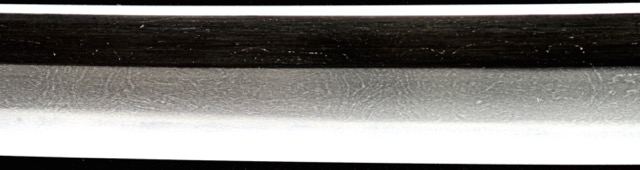
A macro photo shows a recently polished sword made by Nagamitsu. Nagamitsu worked in Okayama and was a very prolific swordsmith. He apparently used only tama hagane for his swords, and this shows the excellent quality of his forging work. There is a very clear and prominent wood grain pattern or itame hada on the blade. Note that the lines forming the pattern are long and continuous. (Aram Compeau image)

All Japanese sword production stopped in 1945 and was illegal until the U.S. occupation ended in 1953. Sword production then resumed slowly and, by 1964 when the Tokyo Olympics was held, there was finally a healthy market in Japan again for newly made swords, or gendaito.


WAR-ERA KOSHIRAE

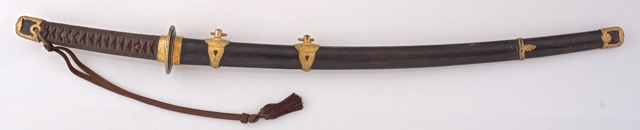
The original Westernized koshirae used by the Japanese military closely resembled 19th-century European-style mountings with slight adaptations to fit Japanese swords. Around 1931 or 1932, new koshirae styles were adopted and are the ones seen with most World War II Japanese swords. The new army mounting was closer in form to the traditional Edo-period-style koshirae. It could properly contain a traditional Japanese sword and allow it to easily be used in the traditional manner.

The navy also adopted a new koshirae at about the same time, and is how surviving Japanese World War II naval swords commonly are mounted. The army scabbards were usually covered with a thin sheet of metal lacquered a shade of khaki. There was a traditional sword guard or tsuba, and all the traditional metal fittings were present. The navy scabbards often were covered with sharkskin or rayskin, with all the traditional metal fittings and tsuba in tow, too. In 1944, a new model army koshirae appeared which seems to be an evolution of the 1932 version. Generally, swords that appear in these types of military koshirae have blades of tama hagane or puddled steel and are generally well made.


JAPANESE WAR SWORD COMPARISONS

In general, Japanese sword blades of the 1930s and 1940s are well constructed. They feature steel that was forged proficiently and a visible jihada if they receive a new, quality traditional polish. However, in comparing World War II-era swords to older swords and to swords made after 1960, there are clear differences.

The differences arose from the lack of traditional tama hagane for the swords, and pressure to produce a large number of swords in as short a period of time as possible. Using tama hagane is very time consuming and requires expensive raw materials and a large amount of forging time. Consequently, when comparing swords from World War II to other periods, they appear to be stout and heavy with a strong amount of tapering in the width of the blade from the hilt to the point (typically about 20 to 30 percent). In addition, the hamon are usually straight, or are straight and have simple projections (ashi) extending to the edge, or are simple gunome or regular small loops or waves. This type of hamon is relatively easy and fast for swordsmiths to make.

Using puddled steel avoided the time necessary to make tama hagane and to fold it 12 times to give the steel the proper qualities. In addition, the puddled steel (and all swords not made from tama hagane) was made of a single piece of steel forged to shape. Traditional tama hagane swords are composite structures with a high-carbon outer jacket and a soft tama hagane inner core. This reduced the costs and time involved in making the swords, which was important because officers had to buy the swords from the various forging groups. Typically, a tama hagane sword was twice the price of a puddled steel sword, and the other types of swords were less expensive. Yasukuni swords were traditional and very expensive, and cost about twice as much as a traditional sword made in Seki.


WAR SOUVENIRS

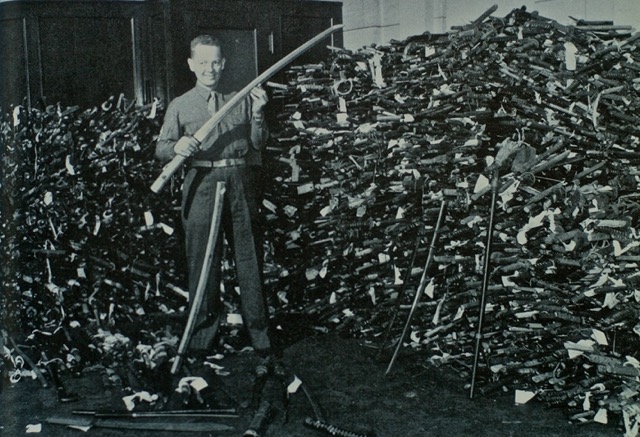
During World War II, many American soldiers simply picked up swords on battlefields. During formal surrenders, the Japanese soldiers surrendered their swords in the field. After the occupation began in 1945, U.S. military authorities went house-to-house to collect all weapons, including swords. In Tokyo, the Akabane Armory was the place where all confiscated swords were taken. At one point, one of the army staff members in charge of the confiscated swords said there was a stack of swords about 6 feet high and 300 feet long. Any U.S. soldier who wanted a souvenir sword simply went to the armory and picked out whatever he desired.

A stack of confiscated approximately 40,000 swords about 6 feet high and 300 feet long languishes in the Akabane Armory in Tokyo circa 1945. A U.S. soldier could simply pick up any of the swords and take it home. This collection is part of the reason so many Japanese swords came to the USA after the war. (image courtesy of Richard Fuller)

According to some collectors, in the early 1950s there were probably more Japanese swords in the USA than in Japan. As Japan recovered and became prosperous after the war, many of the swords here were bought and returned to Japan.

The World War II era was a unique period in Japanese sword history. The variety of swords made, the excellent quality of the fully traditional models, the somewhat distinct style of the swords, and the very large number made all help to define a very specific period in Japanese sword history.


GLOSSARY of JAPANESE SWORD TERMS

Ashi—simple projections from the hamon extending to the edge of the blade
Gendaito—newly made swords
Gunome—loops or waves in the hamon
Gunto—Japanese Army style of sword mounting
Hamon—temper line
Itame hada—a wood-grain pattern on the blade
Jihada—blade surface pattern
Kaigunto—Japanese Navy style of sword mounting
Koshirae—sword mounting
Puddled steel—steel from railroad rails used to make Japanese sword blades
Tama hagane—traditional steel for Japanese sword blades
Tsuba—traditional sword guard


References: Fuller, R. and Gregory, R. Japanese Military Swords and Dirks, Howell Press, Inc., USA. 1997

Kapp, L., Kapp, H., and Yoshihara Yoshindo, Y. Modern Japanese Swords and Swordsmiths, Kodansha International, USA 2002

Dawson, J. Swords of Imperial Japan, Stenger Scott Publishing, USA 2007

A Japanese swordsmith named Kanenobu made this sword in the 1940s. It is 24.5 inches long, stout and somewhat heavy, and has a simple, almost straight, hamon. Kanenobu was one of 350 registered smiths working in Seki City in the 1940s. (Aram Compeau image)

Danes to Dragons: Custom Hawks

Custom hawks and axes combine history, fantasy and imagination

From Danes to dragons, draft horses and drawing smoke, the axe and the hawk have become avenues of artistic expression for some of the most innovative artisans of sharp blades. Long a trusted and dependable companion on the trail, in the bush, around the camp and in the military, axes and hawks are utilitarian and versatile, both in form for their intended purposes and as striking examples of imagination, innovation and aesthetic appreciation.

Utilizing the best in materials and employing their long study of the axe and the hawk, several makers have produced notable works in recent years, among them Peter Pruyn, Tom Ward, Dave Armour and Bill Burke. Each has his own approach to the craft and adds perspective in producing works of incredible beauty.

“My motivation was to try something new,” related Armour, a knifemaker for about 12 years, fashioning hawks and axes for six years and turning his attention to full-time blade work only seven months ago. “In addition, a small, easy-to-carry axe can be a great complement to a hunting or other working knife. I call my style ‘sufficiently evil and deliberately casual.’ I take the function side of things—like heat treating and edge geometry—very seriously, but treat the rest of knifemaking as a chance to play and have some fun.”

With his Clydesdale Set, which includes both a 12.5-inch knife and a 17-inch axe, Dave Armour (inset) lets his ingenuity gallop through. The set is made with a single Clydesdale horseshoe that he obtained through his wife’s employment, involving a tour of Warm Springs Ranch in Missouri, home of the world famous Budweiser Clydesdales. (SharpByCoop axe image)

With his Clydesdale Set, which includes both a 12.5-inch knife and a 17-inch axe, Armour’s ingenuity gallops through. The set is made with a single Clydesdale horseshoe that he obtained through his wife’s employment, involving a tour of Warm Springs Ranch in Missouri, home of the world famous Budweiser Clydesdales.

“I used the sides of the shoe for the outer layers of the knife blade and the bottom for the body of the axe,” Dave said. “I wanted something rustic without looking primitive. So, I made choices like leaving the shoe nail holes unfilled and using a simple hardwood for the handles. I used W2 for the knife core steel and 80CrV2 for the axe bit. Anytime you’re using a unique material, it is stressful. If I messed this up, it wasn’t like I could just scrounge another Clydesdale shoe lying around somewhere.”

Armour, who plies his craft in Auburn, Illinois, uses the term “foundwood” for his handle material. Though he isn’t completely sure, he said he believes it is sassafras, liberated from the bottom of a box of cast-off exotic pieces in a local lumberyard.

The finished Clydesdale Set consists of the beautifully forged san-mai blades, foundwood handles, and a stainless steel bolster/guard. The blade measures 7.5 inches while the edged surface on the axe is 2.25 inches. Dave stated he would produce a similar set for $750 or the axe alone for $300—and he would enjoy the journey “tailoring my technique to the piece.”


MAGIC DRAGON

Forging knives since 1998, Burke received his ABS journeyman smith stamp at the 2003 BLADE Show. “I returned home, quit my job, and have been a full-time maker ever since,” he grinned. His Dragon Tomahawk is nothing short of breathtaking, and he acknowledges that the project was an investment of energy in his Boise, Idaho, shop. “This piece took three months of six- to eight-hour days, seven days a week for me to complete,” he noted. “I have a second piece flying around in my head now.”

The Dragon Tomahawk is 20.5 inches overall, with a 4-inch cutting surface of damascus and a curly maple handle. The head is wrought iron and 1018 mild steel forged into a “W’s” pattern, and the blade steel is 1080, 15N20 and 201 series nickel forged together to create Bill’s Dragon’s Breath pattern. (SharpByCoop image)

The second will be a show-stopper if it compares to the 20.5-inch masterpiece that sports a 4-inch cutting surface of damascus and handle of stout curly maple. “The head is wrought iron and 1018 mild steel forged into the ‘W’s’ pattern,” he commented. “The blade is 1080, 15N20 and 201 series nickel forged together to create my Dragon’s Breath pattern. The handle was first drawn and cut/carved from a piece of red fir, and then, after a few refinements, the pattern was drawn on the piece of maple and the handle made from that.”

Bill Burke lightly fire-etched the head of his Dragon Tomahawk, along with heat coloring the blade in niter salts to achieve a purple/blue-and-red coloration before it was welded to the dragon’s head. The teeth were raised from the steel of the head, and the tongue, inlaid into the blade, gleams in 24k gold. (SharpByCoop image)

Bill has been noted for his quality damascus, and with this piece took inspiration from the work of ABS master smith Joe Szilaski. “All my knives and hawks are forged by me in my shop,” Bill said. “I normally just get an idea of what I want to make and start forging. From almost the first moment that I made the Dragon’s Breath pattern, I knew I wanted to make a dragon-headed tomahawk, breathing fire down the blade of the hawk.”

The dazzling result includes a lightly fire-etched head “because dragons are born in fire and should look that way,” along with heat coloring the blade in niter salts to achieve a purple/blue-and-red coloration before it was welded to the dragon’s head. The teeth were raised from the steel of the head, and the tongue, inlaid into the blade, gleams in 24k gold. Bill indicated he would produce a similar piece for about $17,000, depending on embellishments.


NO PIPE DREAM

One of the most intriguing works by Peter Pruyn is his 15-inch Pipe Axe with ash handle, 4-inch blade and a bowl of hammered twist damascus. He forged the steel from layers of 1070, 15N20 and nickel. (SharpByCoop axe image)

Peter Pruyn was self-taught for quite a while after taking up knifemaking when he lost a valued knife he had carried for years. He later learned the stock removal method from Gene Martin and also attended an ABS bladesmithing class. “That definitely made me a more diverse maker, and it opened me up to forging different types of edged weapons and tools,” he said. From there, he worked with ABS master smith Red St. Cyr, who taught him to forge a tomahawk from a ball-peen hammer.

Through 14 years making knives—12 of those full time—Peter developed an interest in Viking blades, and he has sold a number of pieces on BladeGallery.com. One of his most intriguing works is his 15-inch Pipe Axe with ash handle and 4-inch blade and bowl of hammered twist damascus. He forged the steel from layers of 1070, 15N20 and nickel.

“I was forging an axe for the BLADE Show about seven or eight years ago when I had the idea of making it into a pipe axe, which is similar to a pipe tomahawk,” Peter remembered. “It really only has a larger blade.”

While working on the Pipe Axe, Peter greeted a friend who had come to his shop to work on the electrical setup. “He spotted the head when I removed it from the etchant,” Pruyn recalled, “and immediately claimed it.  I was trying something different on this particular one. I did a very long etching process, and it gave a very deep, rough texture and an antiquated look to the steel. I did the Viking rings on the handle, but I also wanted to put some rings on the pipe bowl to give it a better look.”

The effect was certainly achieved, and Peter successfully tested it using cigar tobacco. “It worked quite well,” he concluded. He said a similar model would run $700.


HALVDAN SWUNG ME

Christened “Halvdan Swung Me,” the Dane Axe by Tom Ward is based on Viking lore and representative of the weapons Viking mercenaries may have wielded in the service of the emperor of Constantinople, today known as Istanbul. His list price for a similar axe: $3,200. (SharpByCoop axe image)

After recently relocating his enterprise, along with his wife’s furniture business, from Carbondale, Illinois, to Istanbul, Turkey, Tom Ward looks forward to future custom orders. Among these may well be a request for a piece similar to his hefty Dane Axe.

When in design school in Boston, Tom took an elective course on forging damascus and bladesmithing taught by ABS master smith J.D. Smith (see May and June issues of BLADE®). “I really fell in love with the process and the idea of making high-quality objects to last someone’s entire life or longer,” he related. “I also loved the history of it and what you could learn through those venues. J.D. was my mentor for about four years before I left school and Boston. My work was fairly independent until 2017, when I started my degree at Southern Illinois University and spent three years researching damascus steel with Richard Smith in Carbondale.”

One of the most significant results of Ward’s career in steel, the Dane Axe, christened “Halvdan Swung Me,” is based on Viking lore and representative of the weapons Viking mercenaries may have wielded in the service of the emperor of Constantinople, today known as Istanbul.

“The phrase ‘Halvdan was here’ is carved into the bannister of the balcony of the Hagia Sophia in Istanbul,” Ward remarked. “So, he was the inspiration for the piece and the name. The shape is not exactly like any Dane axe but serves the same idea with an angled broad blade and beard, and a thin cross section as most war axes had. The angle of the blade is to deliver a deeper chopping or swinging cut, and it is the same cutting concept as the curve of a saber. The forward point is also hypothesized for stabbing, and the beard for hooking legs and shields.”

Damascus legend Daryl Meier sold the wrought iron, salvaged from a bridge that was torn down in Illinois, for inclusion in the Dane Axe steel combination, and encouraged Tom’s pursuit of pattern welding. The Dane Axe haft, fashioned from sturdy hickory and ash laminate, extends beyond 5 feet.

“The pattern welding on the blade is sort of an East meets West thing,” Tom commented, “with traditional wolf’s tooth from northern Europe and the Persian chain patterns, as well as the Byzantine tendency for geometric patterns with the chevrons.”

These exceptional craftsmen are among many who have explored the addition of hawks and axes to their repertoire. They set the bar high and bring additional interest to another creative frontier.

Above: Rudy Dean’s pipe hawk features a 4.5-inch blade of twist damascus and a handle of curly English walnut. The smoke  hole plug is damascus and the mouthpiece and eye cap are ancient walrus ivory. (SharpByCoop image)


Spyderco Yojimbo 2: Fantastic Straightedge Folder

0

Now in its second iterations, the Yojimbo 2 nails exactly what a straightedge folder should be.

It isn’t hard to review a Spyderco knife.

Anyone who has ever used one can tell you the company has an uncanny ability to nail the making of folders as well as fixed blades. What is even more uncanny is how the company can do it so consistently while being so prolific. Hence, if you want to talk about good straight-edge knives and also the features of folding EDCs in comparison to fixed-blade EDCs, you might as well include one of the best folding knifemakers in the business. If you’ve ever talked to BLADE Magazine Cutlery Hall-Of-Fame® member Sal Glesser, you quickly realize the thing that drives Spyderco’s outstanding record of knife offerings is Sal’s passion for the trade.

The wide blade on the Spyderco Yojimbo 2 gives plenty of real estate for your thumb to clear the scale and fi nd its way into the hole so you can open the knife easily.

Yojimbo 2 Rundown

The Yojimbo design has been out for years, but to be truthful I am just getting around to reviewing it now in the Yojimbo 2 iteration. At 7.55 inches open, it’s in the midsized folder range. I prefer a small-to-midsized folder because once I get into the large folders, I start asking myself why I didn’t just choose a fixed blade. The blade has a sharp-angle execution of a wharncliffe style, resulting in a very articulated tip. With a blade width starting at 1.5 inches, the steep angle still provides a sturdy tip. Spyderco uses a hollow grind that results in a thin geometry.

The handle is subtly textured G-10. The texturing for me has that Goldilocks feel to it—just right. Sometimes because of new machining technology companies do things they can do and don’t think about whether they should. One of the things I most often find is over texturing of handles to the point the knife is uncomfortable to use. This isn’t the case with the Yojimbo 2. The texturing is very slight but undoubtedly present.

Straightedge’s Performance

Opening and closing the folder is smooth. It features Spyderco’s compression lock system, which has a crisp lock up. There’s no doubt your blade is locked thanks to a crisp snap as the lock engages. A handle profile with a number of broad finger grooves provides a secure grip. The broad grooves allow the knife to remain nimble in your grasp.

Out of the box, the Yojimbo 2 was razor sharp. It made eff ortless cuts through this packing crate strapping like the medium wasn’t even there.

If I were to mention only one issue I have with the knife it would be something particular to me and people who suffer the same affliction: fat hands. My hands are beefy. On occasion, the compression lock, because it is located on the spine, catches me ever so slightly between the lock and the liner. Would this version of Spyderco’s would be No.
1 every time. The overall profile makes it easy to capture the rim on tight and loose pockets alike. Not every knife I have reviewed over the years comes back around to be a personal carry. I can tell you, though, the Yojimbo 2 will be making it into my EDC rotation.

Spyderco supplies one of its full-metal pocket clips for the Yojimbo 2. I can’t say this enough: If you had to make a list of the top-five-designed pocket clips, this version of Spyderco’s would be No. 1 every time. The overall profile makes it easy to capture the rim on tight and loose pockets alike. Not every knife I have reviewed over the years comes back around to be a personal carry. I can tell you, though, the Yojimbo 2 will be making it into my EDC rotation.

For more information on the Yojimbo 2, please visit spyderco.com.

Also Read:

Advertisement

Must Read Articles

Read this before you make a knife

Knifemaking 101 – Read This Before You Make a Knife

  by Wayne Goddard My experience has taught me that there's nothing like digging in and getting started. I've often said the hardest part of the...
how to forge damascus steel

How to Forge Damascus

Advertisement
Advertisement