Knifemakers From Around North America Came To Auburn, Maine For The 2022 New England Bladesmithing Symposium
The 12th annual New England Bladesmithing Symposium brought nearly 100 knifemakers and enthusiasts together for the first hammer-in since 2019.
The event ran from July 15-17 in Auburn, Maine at the New England School of Metalwork and featured classes and workshops galore. Throughout the weekend there was something to scratch any itch you may have had about knives.
Master Smith Lin Rhea presented a tutorial on how to make his dynamic X-Rhea knife. There were workshops on everything from how to build out your knifemaking business to forging recurves.
It was a brutally hot Saturday in the Pine Tree State, yet it didn’t dampen spirits, particularly for the main event– the Battle of the Bladesmiths. The 2-hour competition to pushed four makers to their limits, and drew the largest crowds and interest.
Learning From The Best
The classroom at the NESM is covered wall to wall with tools and other metalwork made by past students just like this.
During the afternoon I was able to drop into a few of the classes. The one I got the most out of was led by Master Smith Christoph Deringer.
Derringer class about the anatomy of the knife was a joy, particularly the care he gave answering questions. His wry sense of humor even out, like when he called flux a crutch pertaining to forge welds. In that particular case, he suggested simply listening to the metal and letting it guide you when you forge weld, no flux is needed.
He taught everyone a neat trick for adding patina to a blade, as well. The crux, you hang the knife above a piece of heated copper. Heating the copper causes it to emit gasses that rise up and patina the blade to an almost bronze color.
A Successful Weekend
It was a big weekend for the school, gathering makers from the Northeast, Eastern Canada, and even as far west as California. For NESM director Dereck Glaser, it was a successful weekend, particularly given the COVID-related lapse in the symposium the past few years.
“The school, in general, draws from around New England,” Glaser said. “I’m excited to see more Canadians here, to be honest. We can’t forget we have a whole other country on our border. I can’t be pulling students out of the Atlantic Ocean so Canada’s a really good option.”
It’s important for anyone with even a passing interest in knifemaking to visit their local school and learn. Not only can you save yourself toil and trouble, but supporting the broader community of makers helps it survive and thrive even in the lean times.
Journeyman smith Mace Vitale runs a workshop on handle shaping.
“It saves exponentially the number of years,” Glaser said. “Indebting yourself to a week and about $600 could potentially save you 3-5 years of trial and error on your own. The amount of compressed skill and support you get in 4-5 days of a course, answering those questions that’ll take 3-5 years to figure out on your own.”
Glaser said that even with the uncertain economy, he believes the future of the school and knifemaking is bright because the passion is boundless.
“The fiscal issues we’re having is making it rough. It’s 90+ percent an enthusiast kind of hobby and craft for most people,” Glaser said. “Where inflation and cost of living’s gone, everyone’s seeing a toll in the crafts. We’re even seeing it in the welding, which is an employment-based skill. But on a whole, I think the energy is still there. The love for it is greater than ever. A lot of people did a lot of things to better themselves in it through the pandemic, so I think coming out on the other end I think people are kind of stronger.”
The Passion For Knives
A nice bit of camraderie. Two of the battle contestants Leo Potter (in the hat) and Jeremy Yelle share a fun moment ahead of the contest.
As informative and enlightening as the classes were the attendee’s conversations. Everyone was excited, whether it was to learn from a particular smith, show off a piece they made, or for the battle at night, everyone was open and welcoming.
A Previous winner of the Battle of the Bladesmiths, Emiliano Carrillo (owner of Sun and Stars Forge), was particularly poetic in what he said about the process of making his own steel.
“When I started the smelt earlier in the day the sand runs through my fingers, and by the time the day’s done it’s a lump of material that can be turned into something,” the owner of Massachusetts-based Sun and Stars Forge said. “It goes from being this throwaway material to something that’s actually useful. I think that’s crazy. It really is alchemy to me. It’s addictive. You do it and it works and you do it again and again and it breaks your heart, and then you have some successes.”
The day ended with the battle. Four young smiths were tasked with turning a one-foot bar of 1084 into a complete knife in just two hours. You can read all about the contest here.
In total, the symposium was absolutely worth the trip and should be on your checklist if you’re a serious maker in the Northeast U.S. or Eastern Canada.
To learn more about the New England School of Metalwork, click here.
The Correct Sheath Is Pivotal To The Complete Hunting Knife Package. A Good Sheath Can Keep Your Knives Safe And Sharp For Decades.
The Correct Sheath Is Pivotal To The Complete Hunting Knife Package. A Good Sheath Can Keep Your Knives Safe And Sharp For Decades.
For the hunter in the field, a dependable and durable hunting knife is indispensable equipment, and it follows that the sheath that holds the knife must be equally up to the task.
Secure carry, protection for the blade and handle, easy access, and the ability to stand up to the elements and hard use are essential. While there is a variety of sheaths available and each one contributes something to the equation, the sheathmakers themselves have come to eye-opening conclusions as to the making and deployment of the correct sheath for the hunting knife. Personal preference is still a prime mover, but the basics make the difference between cooperation and catastrophe in the field.
“The best style for a hunting knife sheath is whatever the hunter wants,” explained veteran sheathmaker Paul Long. “Personal preference is very important. However, the knife that would best be described as a hunter would be best suited in a deep seat pouch with a loop that would carry relatively high on the belt. In most cases the deep pouch would preclude the need for a retention strap. For a double-guard hunter, a drop-loop belt sheath would probably be best with a snap strap for secure retention.”
Depending on the style of the knife, the guard often dictates the best pouch configuration. “I favor the pouch-type sheath, and the hunting knife generally has a single guard as opposed to a double guard,” related sheathmaker Paul Lebatard, who also has found success with his custom knives through the years. “I make a lot of doubles, too. You would have to make a snap-type sheath with a keeper strap, but on hunting knives with single guards the pouch type is always best.”
Three different styles of pouch sheaths by Kenny Rowe, from left: regular pouch, plain leather; strap pouch, floral hand carved; and full flap pouch, full coverage gator. (Kenny Rowe image)
A sheathmaker for over 50 years, Chris Kravitt zeroes in on the personal preference perspective. “First and foremost, it’s a matter of the configuration of the knife, and then if more than one style will work it becomes a matter of personal preference,” he observed. “My preference is to go with the pouch because it is easier to draw and resheathe the knife without worrying about straps.”
At the same time, Kravitt acknowledges varying hunting knife construction and its influence in sheath form and function. “If a knife has a double guard, it isn’t going to work on a pouch sheath, and if you have a knife with an integral handle, possibly,” he said. “Certain things don’t lend themselves to the traditional style, like when the blade is the widest part of the knife or there is no bolster or ricasso extending beyond the edge.”
Kenny Rowe, owner of Rowe’s Leather in Hope, Arkansas, adds another option on the hunting knife sheath. “Ninety percent of these sheaths would be the pouch type because they cover most of the knife, and with the guard you can make a welt where the knife has some resistance coming in and out,” he noted. “Some sheaths will have a lid that has a snap on it, and that is as secure as you can get with the flap snapping over the front of the sheath.”
The consensus with the pouch sheath makes sense for all the reasons that the hunter encounters in the field. For its toughness and the ability to shape and mold the sheath as desired during the construction process, cowhide reigns supreme among sheath materials. Most sheathmakers use 7-to-9-ounce* vegetable-tanned cowhide.
Style Of Sheaths
The use of exotics such as ostrich, stingray, alligator, crocodile or other hides is a continuing option, though for the most part they are used as accents, often in the form of inlays, rather than adding any performance-related component to the sheath.
“Exotics are very useful in sheathmaking but primarily for aesthetics,” Long explained. “Elephant and shark are two that are tough enough to withstand very hard use and are usually built as an overlay on a vegetable-tanned base sheath. I work with various snakes, lizards, ostrich and many others.”
Ultimately, Chris Kravitt—here working on a sheath in his shop—stands by the individual perspective. “First and foremost,” he begins, “it’s a matter of the configuration of the knife, and then if more than one style will work it becomes a matter of personal preference.” (Chris Kravitt image)
As Kravitt noted, “The basic sheath is going to be cowhide 99 percent of the time, but for overlays and inlays my favorite is stingray, which is near bulletproof but more expensive and harder to work with—but great stuff. Ostrich leg or shin is very nice, and Malaysian horned frog has a very nice texture to it. Snakeskin is not very durable, but it’s fine when the knife and sheath are for show since it won’t hold up with regular use.”
Tooling and carving also provide style points and may be pleasing to the eye. However, neither actually contributes to the performance of the sheath in field use. “I occasionally do some tooling with stamps, but carving is a talent I don’t have,” Lebatard remarked. “Still, on almost every sheath I’ll put something in keeping with the theme of the knife, like a small deer. Someone might place an order and specify that they just want a bare, plain sheath, or they may want just their initials on it. That’s a good thing about leather. When it is wet it can be molded and stamped, and when it dries it will hold that impression.”
Tanning And Steel
Vegetable tanning is essential when the blade meets the sheath leather for an extended period. In contrast to chrome-tanned leather, a vegetable-tanned leather is not known to corrode or stain a blade left in the sheath for any length of time. That old admonition to store the knife itself separately from the sheath will then get a longer look.
“A lot of people say not to store knives in the sheaths, but as long as the sheath is made of good vegetable-tanned leather, I’ve never had a problem,” Lebatard noted. “I made a knife for a friend a few years ago and he didn’t want a sheath. He was going to get someone else to make the sheath for him. Several years later, he brought the knife to me and he had had it in a chrome-tanned leather sheath. It was nearly rusted through. The chrome-tanned leather is very corrosive.”
Kravitt has had similar experiences. “I hear so many people say not to store knives in leather sheaths, but I have kept knives in sheaths for years and never had a problem,” he recalled. “My sheaths are all vegetable tanned as opposed to chrome tanned. Chrome-tanned leather may have salts and other things in it.”
Drainage And Inserts
Waterproofing is another essential element, and in the construction itself there are questions surrounding drainage holes and inserts as well.
Most sheathmakers shy away from inserts since contact with the blade may dull the edge. After all, the welt and/or strap should suffice for a snug fit. Inserts in and of themselves may be judged to provide some measure of redundancy, but contribute little to the overall stability of the lockup or in protecting the knife itself. Long says, “Even the best inserts, being rigid, will do more harm to a blade than top grain leather.”
The different decorations Kenny Rowe offers with his sheaths include, from left: smooth; border tooled; basket weave; acorn and oak leaf hand carving; exotic skin overlay (gator); exotic skin inlay (beaver tail); and exotic skin full coverage (ostrich leg). (Kenny Rowe image)
At first glance it might appear that a drainage hole is a good idea to help maintain cleanliness and prevent the buildup of moisture or debris within the sheath. Not so fast!
“I do not ordinarily put a drain hole in my sheaths,” Long asserted. “Nor do I do any waterproofing of the interior of the sheath. Rather, I depend on the normal intelligence of my client to not go swimming with their sheath, and to at least try to clean the blood and guts off the blade before reinsertion.”
Rowe agrees. “I don’t see any sense in it,” he commented. “I can count on one hand the number of sheaths I’ve made with drain holes in them, and I’ve been making sheaths for 35 years at least. The only time I would expect someone to have their sheath in really wet conditions would be if they accidentally rolled into a deep river or their boat sank. I wouldn’t expect someone to haul off into neck deep water with their hunting gear on. For debris, it’s easy enough to take a wire with a little hook in the end and just rake the sheath out, or blow it out with air, or stand it upside down and shake it or tap it on a table.”
Kravitt, on the other hand, will utilize a drain hole and an insert from time to time. Often, the insert itself is fashioned from leather to avoid additional friction against the knife edge. The employment of the drain hole is in direct response to the future use of the gear in the field.
“If I know the sheath will be used in harsher conditions, I think it should have a drain hole,” he remarked, “not just for draining moisture, but also removing debris—especially when the user has spent a lot of time in the woods.”
Sheathmakers do tend to rely on the owner of the product and of the hunting knife to exercise responsibility in the field. “Explain to the client, if they are a novice, about the ‘care and feeding of a leather sheath,’” Long smiled.
How To Care For A Hunting Sheath
The well-crafted sheath is the constant companion of the hunting knife, either in the field or a collector’s cabinet, and the best measure of the sheath’s contribution is its role in that partnership. For the sheath to function properly, owners must remember the fundamentals of hunting knife care. Keep both the knife and sheath clean. Wipe away moisture and other fluids. Maintain the surfaces as needed. Don’t put the knife away wet and expect the sheath to do more than expected.
Adhering to best practices will ensure long life for both the hunting knife and its all-important sheath.
*According to the Montana Leather Co. website (montanaleather.com), leather thickness is typically measured in ounces. For instance, an ounce of leather is equal to 1/64 inch. As a result, 7-to-9 ounce leather will be in the 1/8 inch range, give or take a few millimeters.
Blending old and new, the modern period knife brings history alive in masterpieces.
Historical perspective is a relevant component in just about any undertaking. In the realm of cut, incorporating an appreciation of the past into the work of today brings another dimension to the custom knifemaker’s statement.
Interest in the knifemaking of a bygone era offers a window into the true artistry required to reproduce the knives of yesteryear, particularly with the absence of modern conveniences in the shop. Along with the interest in the historical knife, several custom makers bring famous designs, styles and patterns to life once again in tribute to those who have gone before.
The idea of the period knife blends old and new. “I’ve been making knives seriously since about 2002 when I took a class with the American Bladesmith Society in Washington, Arkansas,” related ABS master smith Lin Rhea. “Joe Keeslar and Greg Neely lit a fire under me and got me on my way. Since then the town of Washington has been like a second home, and I’ve even added to the personal connection between me and the area by interest in one of the town’s historical residents who was also a knifemaker. His name was James Black.”
A resident of Prattsville, Arkansas, Lin gained an appreciation for Black’s distinctive body of work*, using contrasting materials and techniques to create a bold, attractive look. “I’m grateful to get to know Mr. Black by studying his work,” Lin continued. “This intense study led me to try to recreate one of his knives, the Carrigan Knife. The original knife, a guardless coffin-handled bowie, was made by Mr. Black in the early 1830s in Washington, Arkansas. I chose the Carrigan as my first attempt because of its less intimidating size; however, as is often the case I found it to be just as intimidating once I started into the project.”
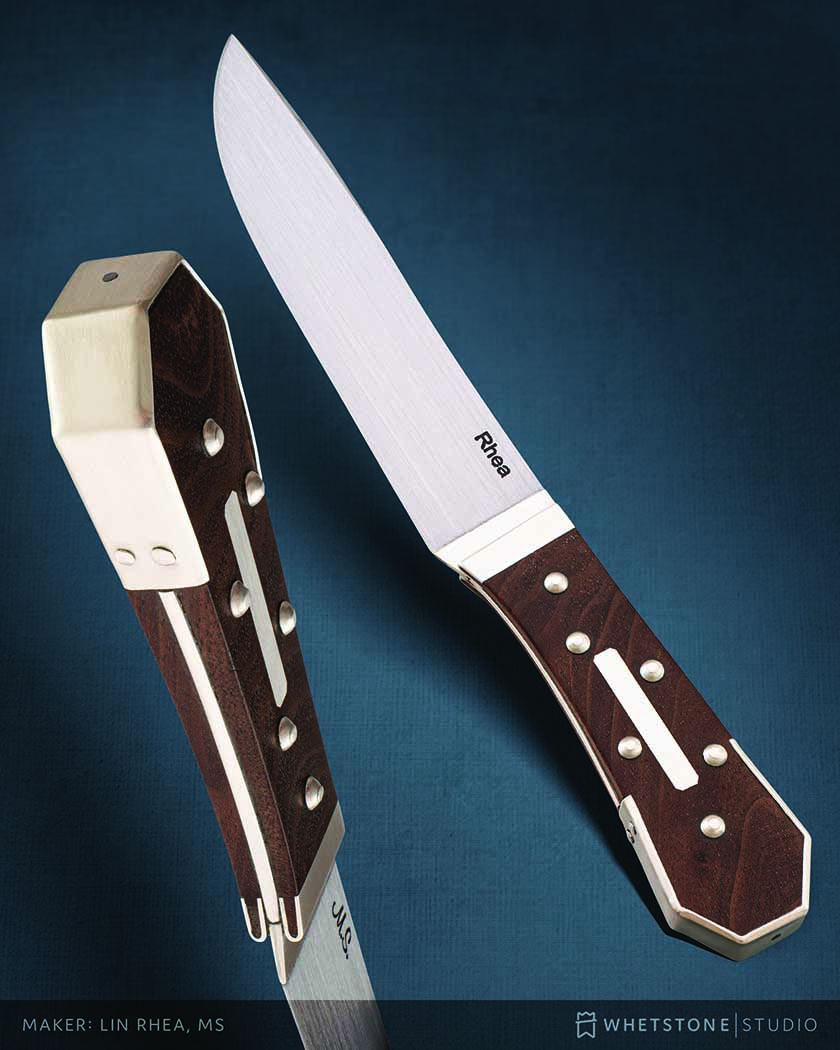
Lin Rhea’s period knife, a reproduction of the Carrigan Knife is based on a dress bowie James Black is thought to have made in the early 1830s in Washington, Arkansas. The original Carrigan includes a black walnut handle with coin silver pins and trim. The blade is about 6 inches long and the overall length is approximately 10.25 inches. (Whetstone Studio image)
The original Carrigan includes a black walnut handle providing a nice contrasting background to the coin silver pins and trim. The blade is about 6 inches long, and the overall length is approximately 10.25 inches. The full tang is virtually covered entirely by the walnut scales and the silver wrap.
When Rhea undertook his homage to Black and the Carrigan, he chose stabilized walnut, which he harvested himself several years ago, and trim in sterling silver. He forged the blade from 80CrV2 carbon steel and included at least 30 separate parts while attempting the same techniques used by Black nearly two centuries ago in fastening and assembling the finished knife.
“There is so much to be said about not only this knife but also Black’s work,” Lin concluded. “He was able to create a knife design utilizing only three materials yet impacting the knife world as few others could. His ability to arrange these materials into a functional, long lasting, beautiful tool is only enhanced by the knowledge that he also built in other qualities like moisture resistance, logical assemblage and ergonomics. All of this was done in a historic setting without modern equipment and epoxies. In my opinion, his design is ingenious.”
The Gold Rush Period Knife
Recently inducted into the BLADE Magazine Cutlery Hall of Fame® (September BLADE®, page 52), knifemaker Jim Sornberger has assimilated his gold and silversmith skill sets into custom knifemaking while helping introduce the modern world to the classic design, luster and embellishment of the Gold Rush era and boomtown San Francisco of the mid-19th century.
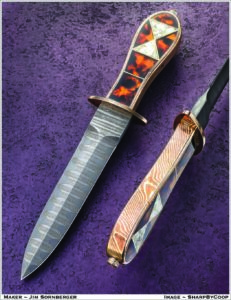
BLADE Magazine Cutlery Hall-Of-Fame® member Jim Sornberger’s interpretations of the Michael Price San Francisco/small dress bowie have won awards at various venues, including Best of Show at the 2019 International Custom Cutlery Exhibition in Fort Worth, Texas. This period knife features a blade in Vegas Forge stainless barstock AEBL and 412 stainless steels and san-mai damascus with a solid core. The guard and wrap handle are in Mike Sakmar mokumé barstock. Jim’s price for a similar knife: $3,500. (SharpByCoop image)
“I’ve been making knives since 1975 with the help of the late Les Berryman, an early Guild member, and with some guidance from Bob Loveless, Herman Schneider and Barry Wood,” Jim recalled. “The last three signed for me to join The Knifemakers’ Guild.”
For Sornberger, the style, embellishment and decoration of the canes, jewelry and knives of the Gold Rush era are most appealing. “San Francisco from 1850 to 1904, the Gold Rush period, was one of the wealthiest cities in the world, attracting some of the greatest artists, jewelers, carvers and engravers to ply their trade to a wealthy clientele. The work done in that period,” he opined, “rivals the best ever done.”
In the knifemaking genre, Michael Price and Will & Finck were among the most successful and prolific of the Gold Rush. Their work remains emblematic of the great migration to settle the American West, and the riches and ruin that were found with the experience.
“Price was Irish, and both cutlery firms hired workers who were English, German and possibly Scottish,” Sornberger explained. “Their dress knives are probably the most embellished American knives made in the 1800s-1900s. The dress knives had two common handles: an interesting, modified coffin shape and a more rounded, subtle taper shape. The blade shapes are spear-point dagger and San Francisco clip spear point.”
Sornberger is recognized as an authority on original San Francisco knives, as well as the magnificent gold quartz that was used so well by Gold Rush artisans. His modern interpretations of the Michael Price San Francisco/small dress bowie have won awards at various venues, including Best of Show at the 2019 International Custom Cutlery Exhibition in Fort Worth, Texas.
Jim’s dress fixed-blade bowie in the accompanying picture was made with Vegas Forge stainless barstock AEBL and 412 stainless steels, and san-mai damascus steel with a solid core. The guard and wrap handle are in Mike Sakmar mokumé barstock. Jim’s made such handles in gold and silver and nickel silver, also. The inlays are tortoise celluloid and California native gold/gold quartz.
According to Sornberger, the biggest challenge in his stunning creation was grinding the blade to show the distinctive pattern of the shell and the hardened core. The san-mai laminated blade was etched with ferric chloride, rinsed and color set with WD-40®.
Frog Knife
“The style of Michael Price’s work is a really good canvas with flowing lines, and there is a lot you can do with it,” observed ABS master smith Jon Christensen, who is in his 22nd year of making knives. “I wouldn’t call my San Francisco-style knives replicas. I do like to keep to the original form and honor the style of the maker, though.”
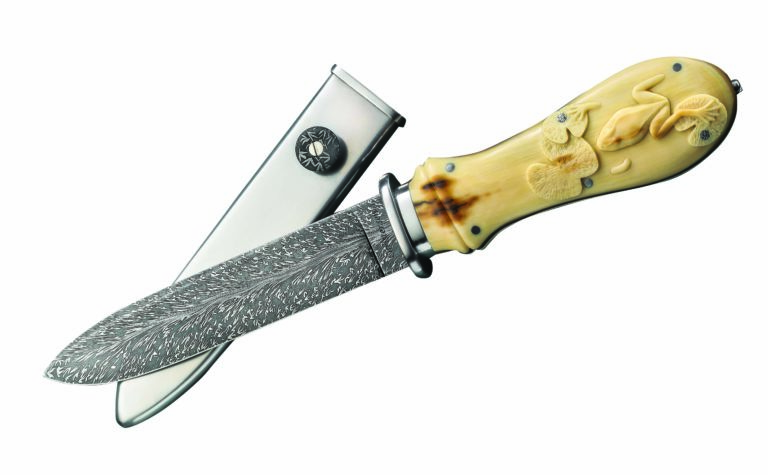
Jon Christensen’s San Francisco-style folder includes a blade of feathered leaf damascus steel and a handle of carved mammoth ivory with inlay of 4,500-year-old bog oak. Quite a period knife. (ChantryLeePhotography.com image)
One of Christensen’s most evocative pieces to date is referred to simply as the Frog Knife. However, the piece is far from simple, and Jon manages to convey the spirit of the Michael Price style while also imprinting some of his own personality.
“I built the feathered damascus for the blade with 1080 and 15N20,” he advised. “It’s a canister damascus. I forged the bamboo leaves and placed them in the can, welded it up, reduced it, and feather cut it so it would produce feather-cutting smears and leaves, and form branches to look like a little grove of bamboo leaves.”
The 10-inch knife has a 5.5-inch blade and a frame and sheath incorporating 410 stainless steel. Christensen utilized the “canvas” of the handle to the fullest, carving the mammoth ivory into a pleasing vignette of frogs and lily pads.
“The handle has something of a back story,” he smiled. “I had seen the Poppy Knife that Michael Price made and thought I would do my version. I took the knife to the BLADE Show and it didn’t find its owner. Then, the handle got ruined, and I just took the opportunity to rehandle it with the frogs and lily pads.”
Christensen got his start making stock removal knives after a career as a horticulturist. He learned to forge while working with ABS master smith Ed Caffrey and visited with knifemaker Rick Eaton and ABS master smiths Shane Taylor and Wade Colter. Jon also makes San Francisco folding knives and enjoys swordmaking. Plans for the future include more period knife examples.
Kimbll Style
ABS master smith Josh Smith owes his little league baseball coach, ABS master smith Rick Dunkerley, credit with getting him started making knives about 30 years ago. From the beginning, Josh has appreciated the thought process and craftsmanship of custom makers from a bygone era.
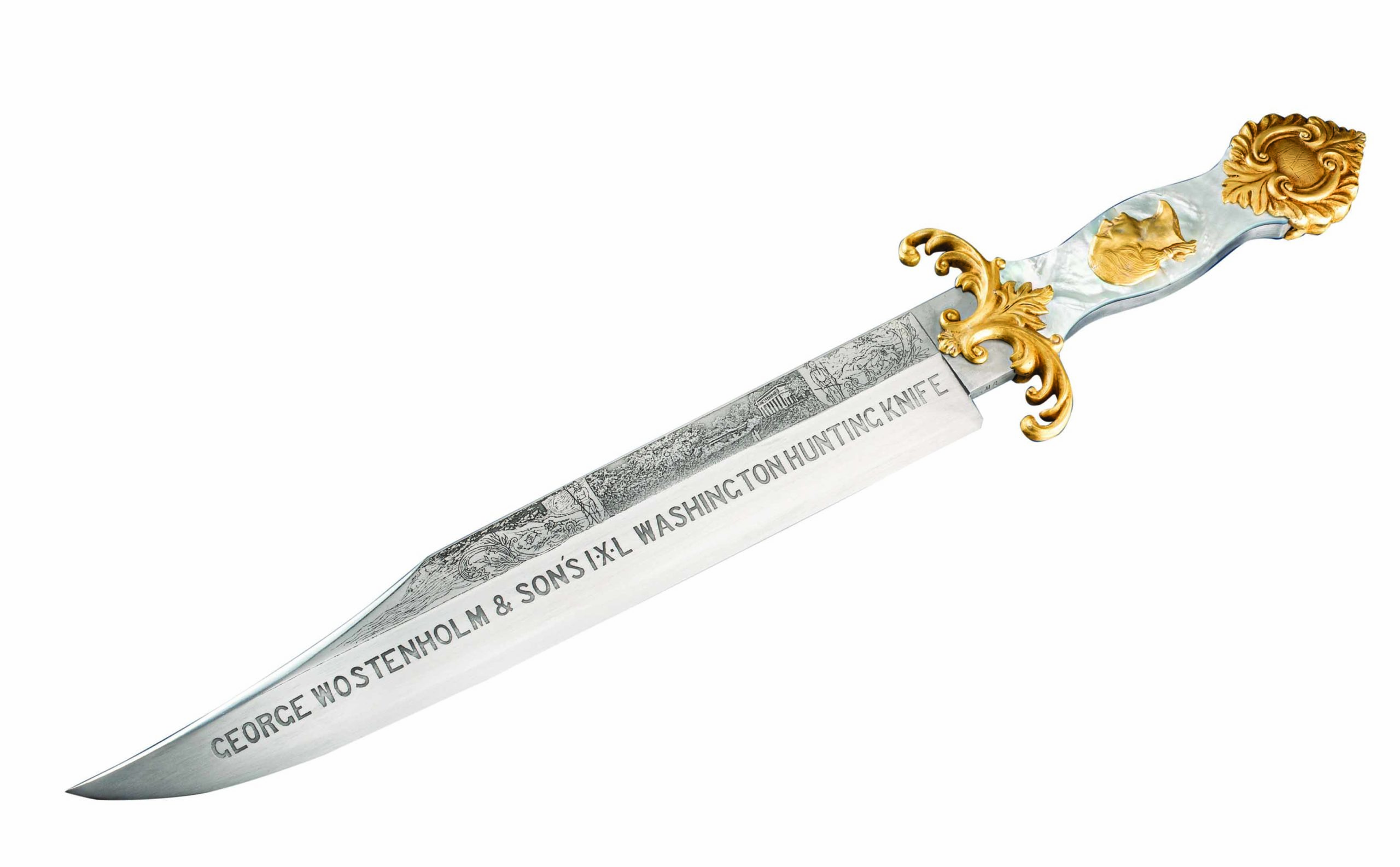
A period knife reproduction of the I*XL George Washington Hunting Knife by Doug Noren gets the full treatment in a 13.5-inch blade of 5160 carbon steel, a mother-of-pearl handle and 18k plated nickel silver. Overall length: 21.5 inches. (Whetstone Studio image)
“There’s something special about reproducing something that was built nearly 200 years ago,” he reasoned. “It’s easy to get lost in your thoughts while working on these knives, wondering what the makers were thinking about at the time. Was the knife going into battle? Was a rich man just wanting something unique? Was the maker just trying to be different and impress people? Were function and effectiveness of use the only factors that mattered? It’s really cool to think about.”
Josh has found the opportunity to consider historical context with a dagger in the distinctive dog-bone handle, recalling the mid-1800s when a gentleman named Loring Kimball of Vicksburg, Mississippi, owned several similar original pieces that were probably made by at least two different knifemakers in the New Orleans area. Knives in what many refer to as the Kimball style have been reproduced by a number of modern makers, mostly bladesmiths.
“The distinctive characteristic of the dog bone is clearly the shape of the handle,” Smith said, “but to me it’s more than that. The large domed pins and the flat facets on the handle provide such a neat look. One of the original Kimball daggers from the 1830s had silver wrapped around the butt of the handle and a small, thin silver guard. I never pretend to exactly reproduce these knives. I always put my own spin on the knife, trying to bring some of my style into it.”
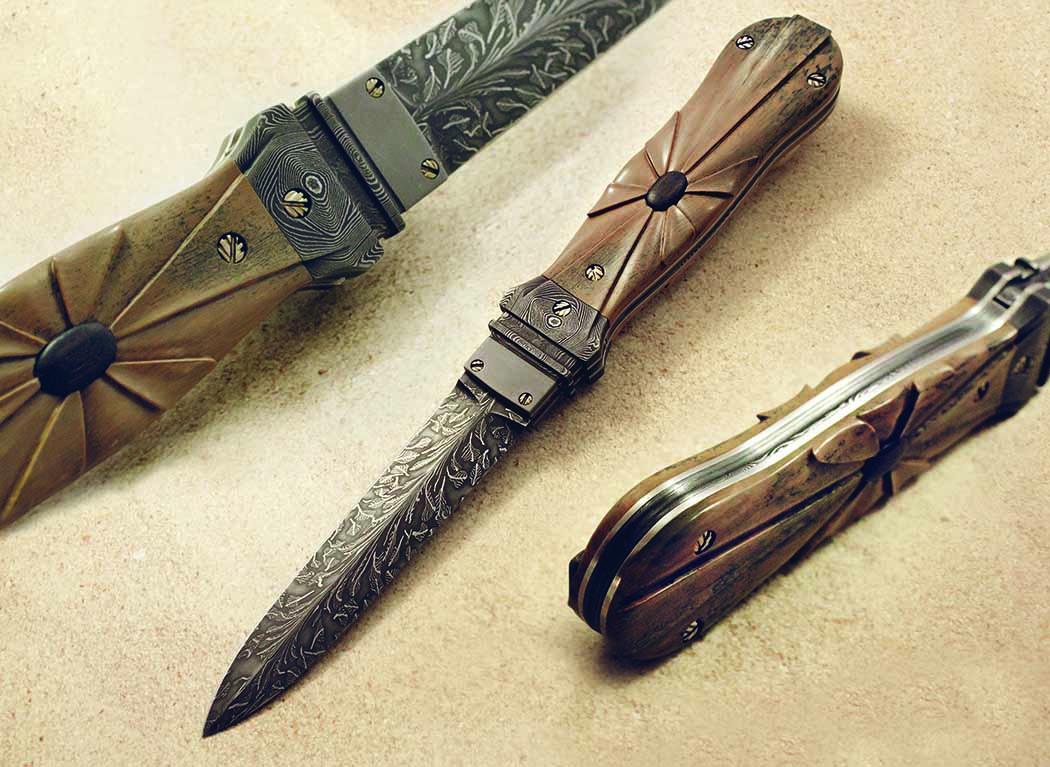
Smith’s dog-bone dagger is fashioned from his own ladder pattern “W’s” damascus blade, African blackwood handle and 18k-gold pins and liners. The 9.5-inch blade is forged from 1080 carbon and 15N20 nickel-alloy steels, while a gold collar stretches over the back of the blade and bears the engraved name of the maker. Overall length: 14.25 inches.
“This particular knife was heavily influenced by Tim Hancock,” Josh said. “I feel Tim, Harvey Dean and James Batson are the three men who led the way in bringing these knives back to prominence, and Tim had the most influence on my construction of these knives. I love period knives and definitely plan on doing more. There are so many incredible weapons from the past that would be fun to recreate.”
*While a number of top industry authorities attribute such original 19th-century pieces as the Carrigan Knife, Bowie No. 1 and others to Black, no knives with Black’s mark are known to exist.
The Paring knife is there when you need it most, from big tasks to small. Here are options for every type of user.
Paring knives may often get overlooked in the kitchen for their flashy big brothers—chef’s knives—but like EDCs, they’re there when you need them most and there’s one for every type of user.
TOPS Knives embraces the paring knife market in conjunction with its Dicer line of kitchen knives. “We noticed, in the process of wanting to design a kitchen knife, that there were some amazing U.S.-made custom kitchen knives, but there weren’t many high-quality domestically made production kitchen knives,” TOPS spokesperson Jeremiah Heffelfinger observed. “This was a void that we were more than happy to fill, especially with the plan for a full line of kitchen knives in the near future.”
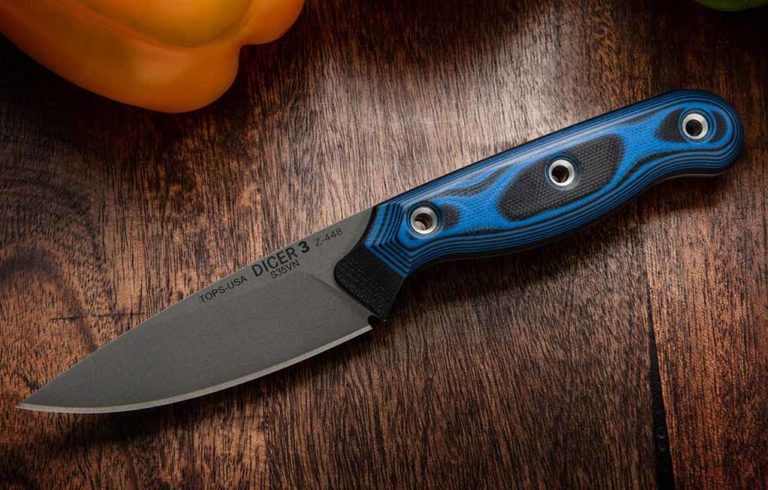
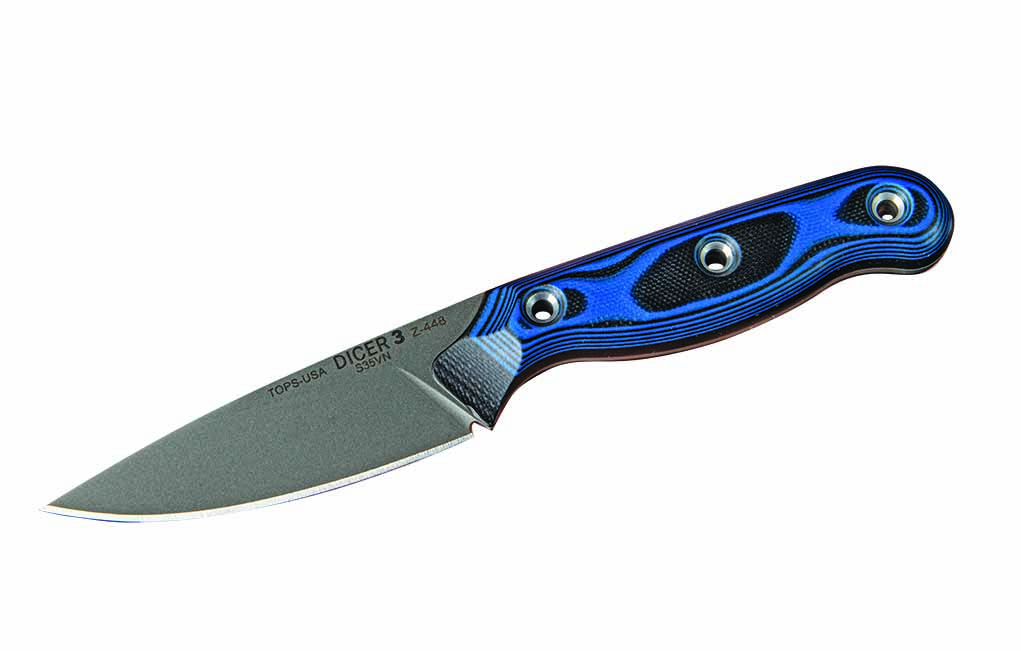
The Dicer 3 has balance, a great blade steel—CPM S35VN stainless—ergonomics and looks.
A design contest between the staff of TOPS Knives in 2017 yielded the Dicer, an 8-inch chef’s knife. TOPS President Leo Espinoza designed a companion paring knife. The Dicer 3, released with the chef’s knife in 2019, that sports the same steel and handle material. The paring knife has become a popular offering as the company has filled out its culinary lineup, including bread and steak knives.
“The chef’s knife typically gets the majority of the attention, but for fine and detail tasks the paring knife can’t be beat,” the TOPS spokesperson advised. “It affords more control for tasks like peeling and trimming meat, fruit or vegetables.”
Heffelfinger said the Dicer 3 is a package that sports balance, a great steel, ergonomics and looks. When company officials designed the chef’s knife, they wanted it ground from CPM S35VN stainless steel, a material they carried over to the diminutive blade.
“We hadn’t seen many kitchen knives using S35VN and, having used the steel before on our Camp Creek hunting knife, we knew it would perform very well with great edge retention and durability,” he said. “Being a stainless steel, it is much less prone to corrosion and rust, making user maintenance just a little bit easier.”
The blade is flat ground to reduce friction in cuts, a .09-inch-thick steel that tapers to .032 inch near the tip, and sharpened to about 20 degrees to balance clean slices and durability when chopping, Heffelfinger added. It’s a blade described as a medium-to-heavy weight for a paring knife.
“We have a reputation for overbuilt hard-use tools that are able to hold up under extreme-use scenarios. We brought this philosophy with the full-tang design on every one of our Dicer line of knives,” he explained, “but we also wanted a classic feel and look for them, with a TOPS flair.”
He indicated knife enthusiasts have noticed that overbuilding and some have taken the blade far from the kitchen knife drawer.
“We have had a number of customers purchase the Dicer 3 to use as an EDC knife,” Heffelfinger said. “Due to the size of the blade, the S35VN stainless steel and smooth, contoured handles, they have attached a clip to the sheath and roll with it on their belt every day.”
Dicer 3 Specs Designer: Leo Espinoza Blade length: 3.5” Blade steel: CPM S35VN stainless Blade grind: Flat Blade thickness at its thickest: .09” Handle material: Black canvas Micarta® and Blue-black G-10 Handle thickness range: .1875 to .75” Weight: 4.7 ozs. Overall length: 7.88” Sheath: Black Kydex Country of origin: USA MSRP: $200
Case Household Cutlery 3-Inch Clip Point
Sometimes it is best not to change the paring knife beloved by cooks through the decades, designs that have seen food crazes come and go: Jell-O salads, fondue pots, casseroles and avocado toast. Enter Case Knives’ Case Household Cutlery 3-inch clip point paring knife.
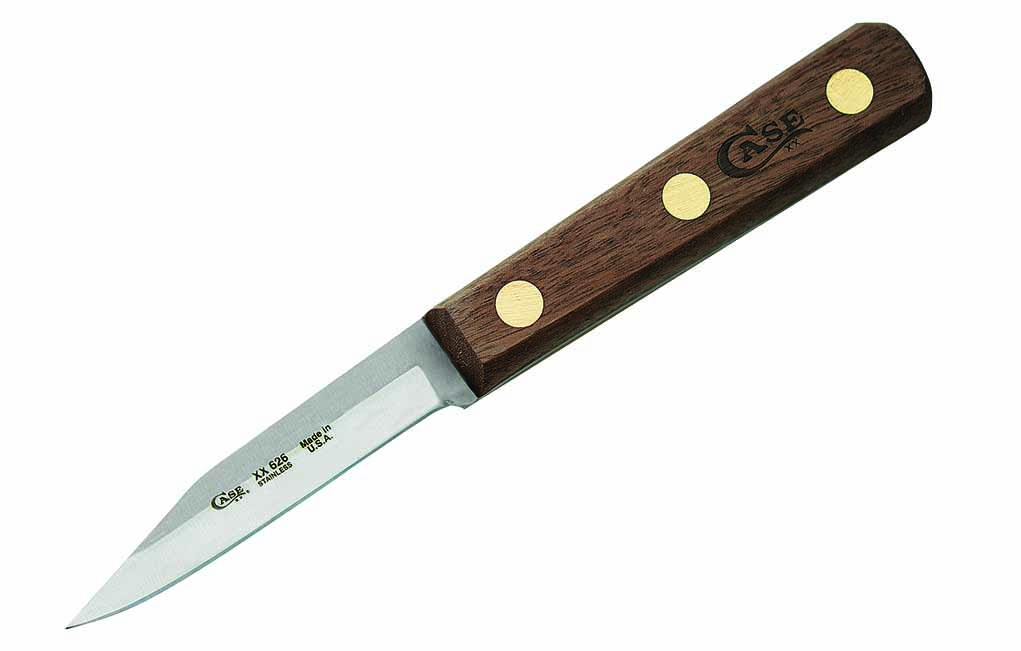
Case has two paring knife blade styles: a spear and a clip point (shown here). “The clip-point version excels at chopping smaller food items because of its blade design and the blade edge, which mirrors the flat cutting surface when used correctly,” Case spokesperson Fred Feightner noted.
“We use classic walnut wooden handles that have been used in millions of kitchens over time,” said Fred Feightner, Case senior marketing communications manager. “We purposely wanted these new kitchen knives to look, feel and perform like the Case household knives of old, and we feel our current offerings do just that very well.”
Case debuted the knife in 2012 while reintroducing its household line—in part by demand from its fans and also as a way to expand its brand and possibly place the knives with retailers who emphasized kitchen supplies.
Consumer advocates insisted on a simple handle design: a straight .5-inch-thick wooden handle, Feightner said. For the blade, the company turned to its Tru-Sharp™ surgical steel—the Case version of 420HC stainless—sabre ground and polished to a satin finish to resist the corrosion that can occur working around food.
The company has two paring knife blade styles. While the spear point slices and dices with ease, Feightner confided, “The clip-point version excels at chopping smaller food items because of its blade design and the blade edge, which mirrors the flat cutting surface when used correctly.”
It’s a knife Feightner says, despite its size, can hold up to kitchen tasks most anywhere. As he noted, “We think our paring knives are perfectly weighted so that intricate work is as easy as tougher jobs around the kitchen and at the barbecue pit.”
Household Cutlery 3-inch Clip Point Paring Knife Specs Blade length: 3” Blade steel: Tru-Sharp™ Stainless Blade grind: Sabre Handle material: Walnut Handle thickness at its thickest: .5” Overall length: 6.75” Weight: 1.7 ozs. Country of origin: USA MSRP: $27.99
V Nives Emerald Paring Knife
Mike Vellekamp, owner and founder of V Nives, indicated his company has recently entered the world of kitchen knives, too. At his house, the 8-inch chef’s knife is most often used to prep food thrown in a wok or barbecued.
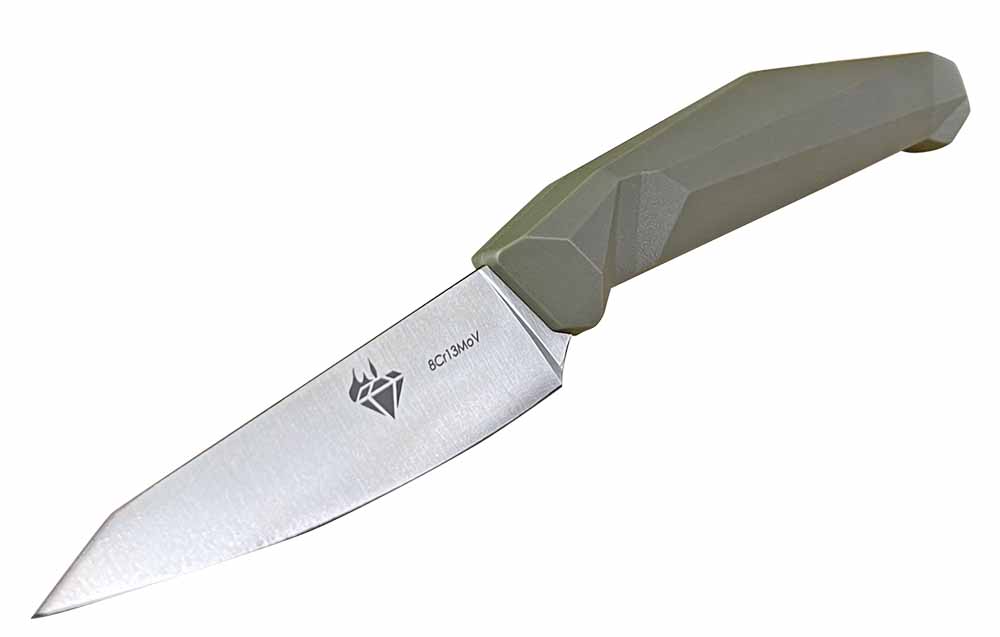
The green handle—an exclusive color for V Nives—of the Emerald Paring Knife is injection molded around the blade tang.
“However, for day-to-day utility in the kitchen, the paring knife is definitely a must have,” Vellekamp said, adding the genre of blade is “optimal for intricate cutting, mincing, slicing and dicing fruits and veggies, deveining prawns/shrimp, and cutting herbs.”
And what V Nives offers won’t be the type of model found moldering in grandma’s cutlery drawer: the angular and green-hued Emerald Paring Knife. Vellekamp said it’s an example of a modern, innovative kitchen implement.
“DiaFire actually developed the knife,” Vellekamp said. “We have a close relationship with the brand, and we are the exclusive distributor for the Americas. We chose their kitchen products because of their dedication to innovation and quality.”
The Taiwan-made blade is 1/16-inch thick and flat ground from 8Cr13MoV stainless steel. “This is a great blade steel because it holds an edge very well for its intended uses, it’s highly corrosion resistant and it’s very easy to resharpen,” Vellekamp noted.
The green handle—an exclusive color for V Nives—is injection molded around the blade tang, making an ergonomic handle that runs between .417 to .645 inch thick. It’s a grip Vellekamp calls tough and light. And while he and other knife enthusiasts will tell you it’s a terrible way to treat your most important tool in the kitchen, the handle can survive a trip through the dishwasher if the, er, less knife enlightened put it there.
“These knives are a perfect example of high value at an affordable price,” Mike said, “and I believe it is a perfect complement to the modern kitchen.”
Emerald Paring Knife Specs Blade length: 3.5” Blade steel: 8Cr13MoV stainless Blade grind: Flat Blade thickness at its thickest: .059” Handle material: Nylon and fiberglass injection molded Handle thickness range: .417 to .647” Weight: 4.25 ozs. Overall length: 8.15” Country of origin: Taiwan MSRP: $42
Bradford Knives Blue G-Wood Paring Knife
Brad Larkin of Bradford Knives said a wise knife collector once told him that any good chef’s knife needs a paring knife sidekick. As a result, he’s happy with the Washington state-based shop’s flagship paring knife.
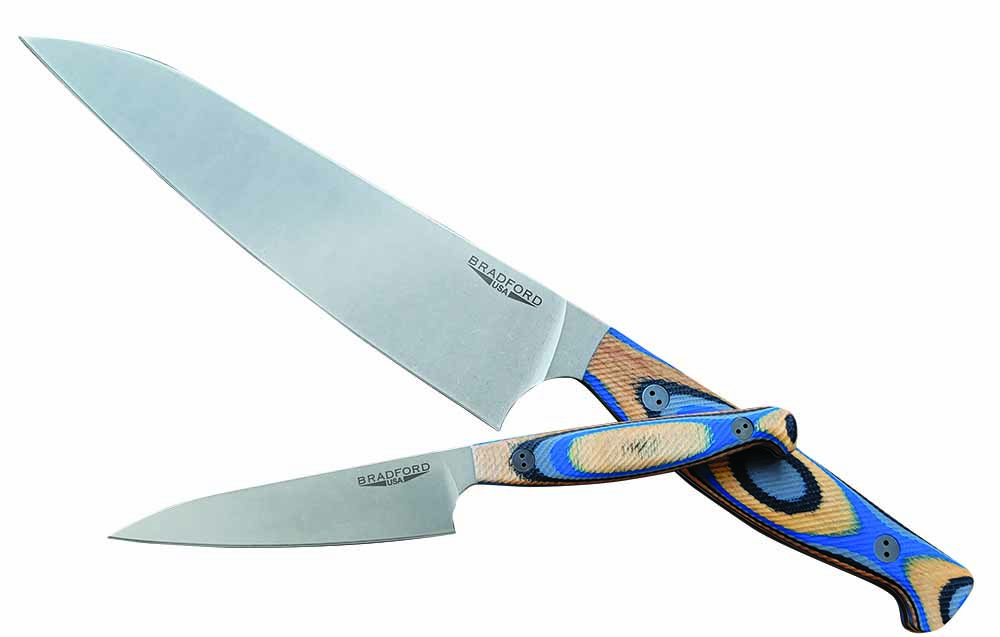
Brad Larkin of Bradford Knives said the handle of the company’s Blue G-Wood Paring Knife is designed to be held in a surgical-like pinch grip. He indicated the result is a lightweight knife focused on fine cutting.
“It complements our chef’s knife so well and we do find that customers seem to enjoy a ‘set’ of kitchen knives as opposed to our EDC knives, which are very carefully built around specific daily uses,” Larkin explained. “In the kitchen you need to be ready for a quickly changing, dynamic environment, and our hope is that the paring and chef’s knives can accomplish these mission-critical chores.”
Over the years, Bradford has released different versions of its paring knife. Recently, the company issued a limited run of handles made from blue G-wood, a composite of G-10 and wood veneer. Stainless blade steel choices are edge-holding, corrosion-resistant AEB-L or tough M390.
Bradford, which is known more for its tactical and EDC models, returned to its culinary roots with the paring knife. The first edged tool it made was the Gatsby, a steak knife.
The company’s paring knife features thin blade geometry—just the way Bradford Knives prefers it. The .09-inch-thick blade has a distal taper. “Our process allows for a full flat grind. It does produce a very mild hollow-grind effect,” Larkin qualified, “but it is hardly worth mentioning.”
The handle is designed to be held in a surgical-like pinch grip. Larkin said the result is a lightweight knife focused on fine cutting, such as making fruit twists for cocktails, for instance, though it could be considered a medium-weight model compared to most paring knives.
“A paring knife can be the best for overall utility, especially considering our blade size is larger than the typical paring blade and it shares design elements with our chef’s knife,” he opined. “It’s a real slicer!”
Blue G-Wood Paring Knife Specs Blade length: 3.8” Blade steel: Choice of M390 or AEB-L stainless Blade grind: Full-height flat Blade thickness at its thickest: .09” Handle material: Blue G-wood Handle thickness range: .2 to .55” Weight: 1.8 ozs. Overall length: 7.5” Country of origin: USA MSRP: $129
Now in its second iterations, the Yojimbo 2 nails exactly what a straightedge folder should be.
It isn’t hard to review a Spyderco knife.
Anyone who has ever used one can tell you the company has an uncanny ability to nail the making of folders as well as fixed blades. What is even more uncanny is how the company can do it so consistently while being so prolific. Hence, if you want to talk about good straight-edge knives and also the features of folding EDCs in comparison to fixed-blade EDCs, you might as well include one of the best folding knifemakers in the business. If you’ve ever talked to BLADE Magazine Cutlery Hall-Of-Fame® member Sal Glesser, you quickly realize the thing that drives Spyderco’s outstanding record of knife offerings is Sal’s passion for the trade.
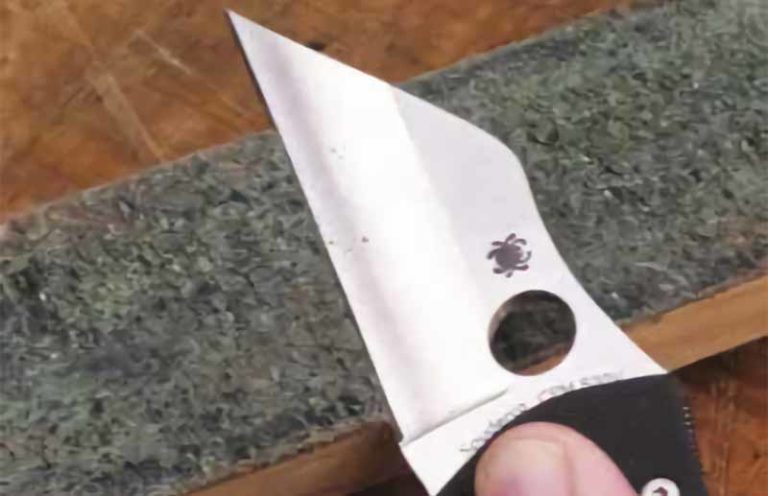
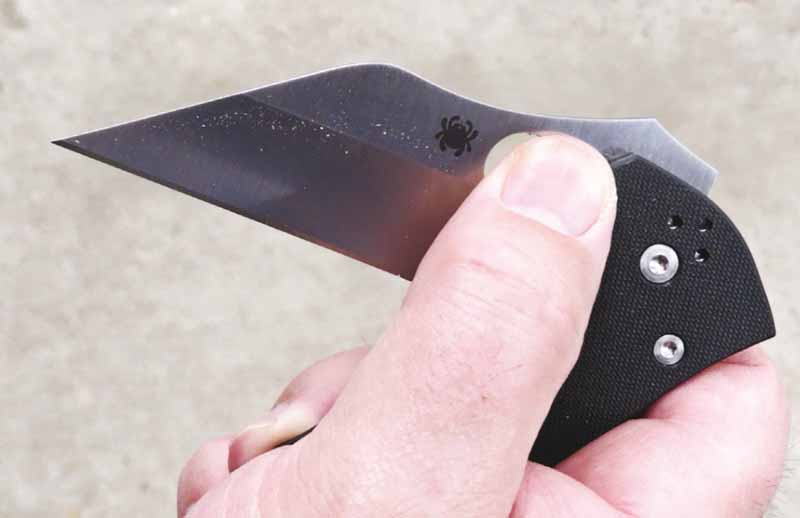
The wide blade on the Spyderco Yojimbo 2 gives plenty of real estate for your thumb to clear the scale and fi nd its way into the hole so you can open the knife easily.
Yojimbo 2 Rundown
The Yojimbo design has been out for years, but to be truthful I am just getting around to reviewing it now in the Yojimbo 2 iteration. At 7.55 inches open, it’s in the midsized folder range. I prefer a small-to-midsized folder because once I get into the large folders, I start asking myself why I didn’t just choose a fixed blade. The blade has a sharp-angle execution of a wharncliffe style, resulting in a very articulated tip. With a blade width starting at 1.5 inches, the steep angle still provides a sturdy tip. Spyderco uses a hollow grind that results in a thin geometry.
The handle is subtly textured G-10. The texturing for me has that Goldilocks feel to it—just right. Sometimes because of new machining technology companies do things they can do and don’t think about whether they should. One of the things I most often find is over texturing of handles to the point the knife is uncomfortable to use. This isn’t the case with the Yojimbo 2. The texturing is very slight but undoubtedly present.
Straightedge’s Performance
Opening and closing the folder is smooth. It features Spyderco’s compression lock system, which has a crisp lock up. There’s no doubt your blade is locked thanks to a crisp snap as the lock engages. A handle profile with a number of broad finger grooves provides a secure grip. The broad grooves allow the knife to remain nimble in your grasp.
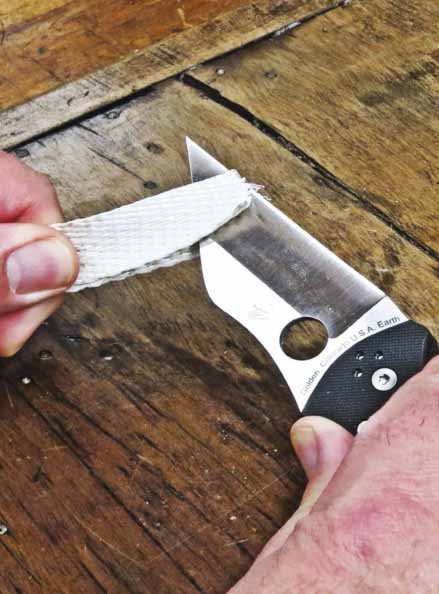
Out of the box, the Yojimbo 2 was razor sharp. It made eff ortless cuts through this packing crate strapping like the medium wasn’t even there.
If I were to mention only one issue I have with the knife it would be something particular to me and people who suffer the same affliction: fat hands. My hands are beefy. On occasion, the compression lock, because it is located on the spine, catches me ever so slightly between the lock and the liner. Would this version of Spyderco’s would be No.
1 every time. The overall profile makes it easy to capture the rim on tight and loose pockets alike. Not every knife I have reviewed over the years comes back around to be a personal carry. I can tell you, though, the Yojimbo 2 will be making it into my EDC rotation.
Spyderco supplies one of its full-metal pocket clips for the Yojimbo 2. I can’t say this enough: If you had to make a list of the top-five-designed pocket clips, this version of Spyderco’s would be No. 1 every time. The overall profile makes it easy to capture the rim on tight and loose pockets alike. Not every knife I have reviewed over the years comes back around to be a personal carry. I can tell you, though, the Yojimbo 2 will be making it into my EDC rotation.
For more information on the Yojimbo 2, please visit spyderco.com.
The proper angle is key to a sharp blade. Here are the angle-guide sharpeners that ensure you’ll always get it right.
A big part of sharpening, aside from proper sharpener selection, is how to select and maintain the proper angle of the blade to the sharpener. In fact, the key to successfully sharpening any blade regardless of the grade of steel is being able to maintain that angle. Ever try sharpening freehand on a bench stone with little experience doing so? The reason folks get frustrated with learning to sharpen is they don’t keep the angles consistent. It’s all about the angles. You must take into account what use your knife will see and sometimes that determines the specific angle to use.
You probably know of the angle guide kits with a metal clamp that affixes to the blade and has uprights on either end with a series of holes that correspond to various degrees of angles. Such kits all help instill confidence and the ability to subtract guesswork at maintaining the desired angle.
SHARPENER TYPES
There are plenty of sharpeners capable of reproducing keen edges. Avoid the pull-through types that require you to drag the blade through. Those are set at one angle and use carbide to get the job done. These will ruin a blade in time, and I don’t recommend them. You need a sharpening kit that’ll help establish and hold a consistent angle. All you need to be concerned with is making the motions to get the edge sharp.
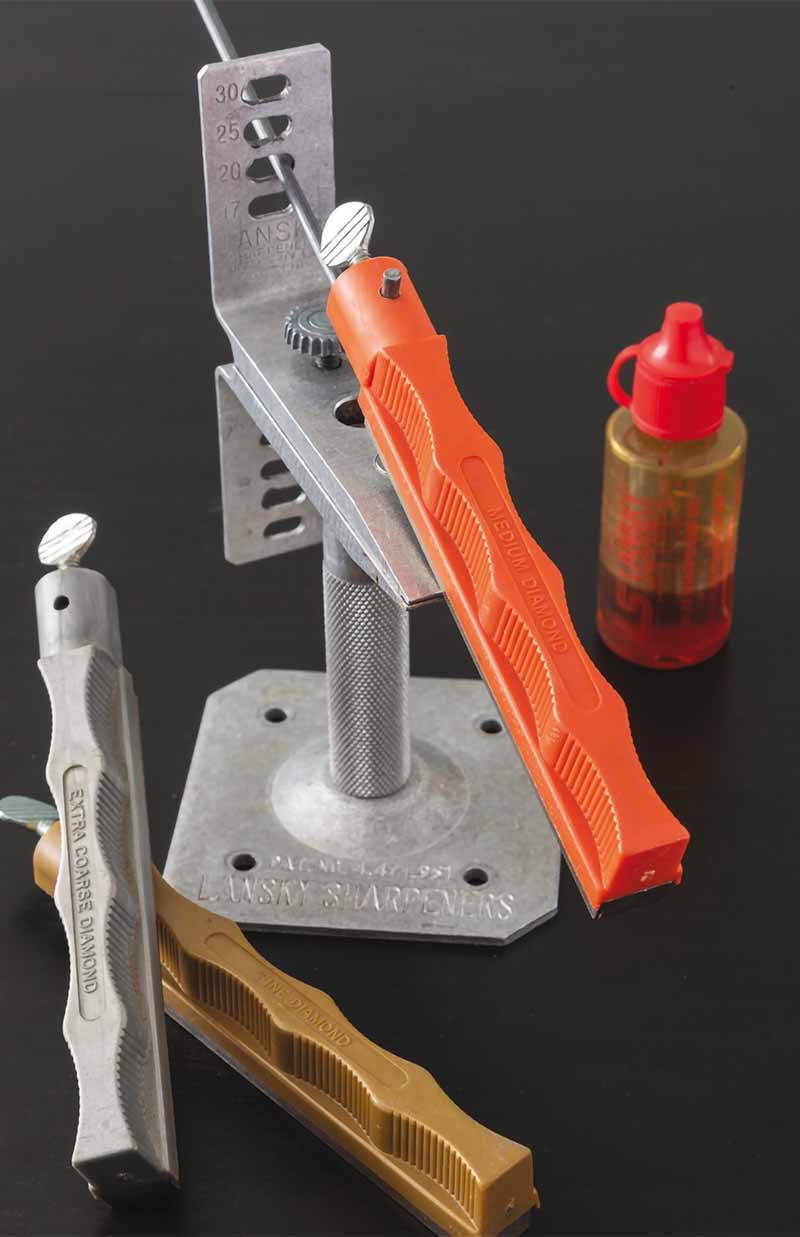
The Lansky Deluxe Diamond Knife Sharpening System is one of the oldest angle guide kits on the market. Four various grits of diamond-coated hones are featured, including extra-coarse for fast work of reviving dull blades. The sturdy aluminum clamp holds the knife securely.
Lansky’s four-stone Deluxe Diamond System Precision Knife Sharpening Kit is the best the company offers in angle guide clamp units. It includes an extra coarse hone great for reprofiling edge angles. It also has coarse-, medium-, and fine-grit diamond-coated hones for fine-tuning the edge once it’s been established. The aluminum clamp is sturdy and offers four edge angles: 17, 20, 25, and 30 degrees. The kit stores in a sturdy plastic storage case. MSRP: $114.99.
GATCO offers the Ultimate Diamond Hone Sharpening System, which is similar to the Lansky. Featuring coarse-, medium-, and fine-grit diamond-coated abrasives, the kit includes Ultimate Finishing and triangular-shaped serration hones, too. It works on plain, serrated, and partially serrated edges. The hones are wider and longer for more effective use and have molded-in integral handguards for safety. There’s also a plastic storage case. MSRP: $119.99.
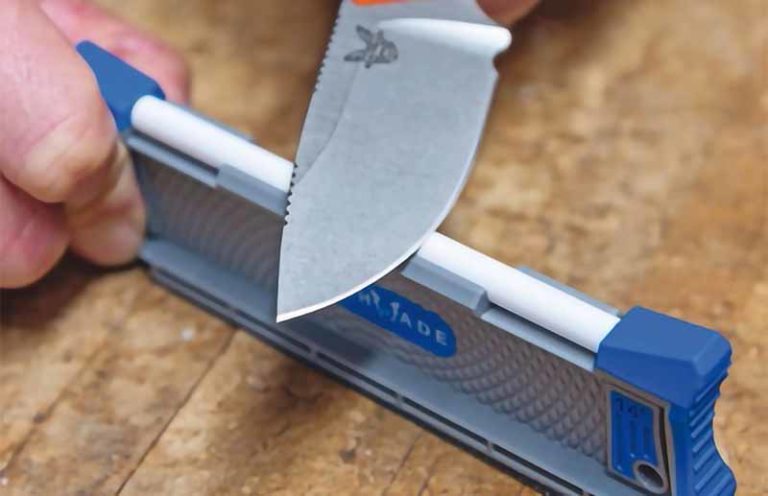
To sharpen the CPM S90V blades with the SelectEdge 14 degree angle of its Hidden Canyon Hunter and Saddle Mountain Skinner, Benchmade offers the model 50082 14 Degree SelectEdge Guided Hone Tool. Designed in conjunction with and manufactured by Work Sharp, this compact sharpener incorporates a fine grit ceramic rod and a leather strap on the backside. Built-in guides set the blade at the correct 14-degree angle. The idea with this one is to apply frequent edge touchups. A premium steel, S90V is notoriously difficult to resharpen, a difficulty negated via frequent edge maintenance sessions with the 50082. MSRP: $25.
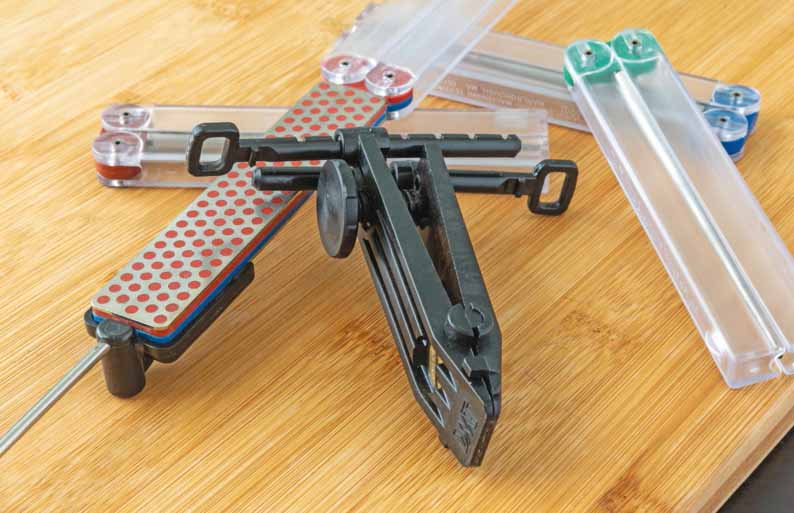
DMT’s Magna-Guide angle kit includes a magnetic guide rod and sturdy blade clamp with adjustable angles. Use any model DMT Double Sided Diafold folding fi le and you have two sharpeners in one—a freehand fi le and an angle guide kit.
For knives without the SelectEdge technology, Benchmade offers the Edge Maintenance Tool, also designed with and manufactured by Work Sharp. It uses a fine-grit ceramic rod and a leather strop but in a more compact folding format with a pocket clip for easy carry. As with the 14 Degree SelectEdge Guided Hone Tool, built-in guides assist in achieving the optimal angle for edge restoration. The Edge Maintenance Tool works well with pocketknives, fixed blades, and tactical folders—pretty much any knife. MSRP: $50.
DOWNSIZED 2X72
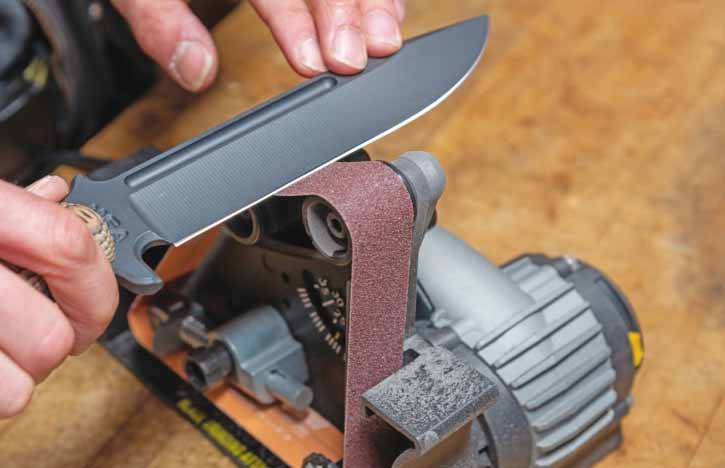
For the more advanced sharpeners among you, Work Sharp offers the Ken Onion Elite Sharpening System, a variable speed motorized unit employing long-lasting flexible abrasive belts made by Norton Abrasives. It’s pretty much a downsized version of a larger and much more expensive 2×72 slack belt grinder used by many knifemakers.
The Work Sharp Ken Onion Elite sharpener is pretty much a downsized version of a larger and much more expensive 2×72 slack belt grinder used by many knifemakers.
Designed by BLADE Magazine Cutlery Hall-Of-Fame® member Ken Onion, the Elite makes quick work of bringing completely dull and/or damaged knife edges back to life and is fully adjustable for applying edges between 10 and 35 degrees. The abrasive belts measure 1 by 18 inches and make quick work of any sharpening task. Once you become comfortable with how the sharpener operates, you can consistently grind an even edge on your blades. (Author’s note: Motorized sharpening is best left to those with sharpening experience.) MSRP: $199.95.
Diamond Machining Technology (DMT) offers the Double Sided Diafold Magna-Guide Sharpening System centered around the company’s Double Sided Diafold folding diamond files. The Magna-Guide System features the Aligner Blade Guide clamp with integrated, adjustable angle guides. A metal guide rod affixes securely to the Double Sided Diafold file via a large rare earth magnet. Attached to an FWCX Extra Coarse/Coarse Double Sided Diafold, the manual system can easily reprofile an edge to any one of seven pre-set angles.
DMT’s Double Sided Diafold diamond files are built well, highly effective, and among the best compact sharpeners on the market. One of the best things about the Magna-Guide is you can use the Double Sided Diafold files as stand-alone sharpeners without the guide rod and angle guide clamp. Consequently, you get a guided sharpening system and a standalone sharpener for the price of one. The Magna-Guide Kit’s MSRP: $27.49 (works with any Double Sided Diafold file).
Wherever folks live close to the earth, they use big knives
Little knives are convenient to carry but, if you have a lot of work to do, big knives are it. I’ve lived and worked with indigenous peoples in Latin America and Southeast Asia and found that wherever folks live close to the earth, they use big knives—machetes, parangs, goloks, bolos and the like. They use them for everything from rough work such as cutting poles and opening coconuts, to dressing out pigs and game, to delicate work such as slicing mangoes.
The advantage of the big blade was illustrated to me one day when I was working alongside a villager who, with his bolo and its 14-inch blade, cut wood for a fire, bamboo poles for a cooking rack, lopped off a banana leaf on which he filleted two large fish and sliced them thin as a sushi chef—all in the time it took me to bring down a few stalks of bamboo with my hair-shaving-sharp Randall Model 1.
We reviewed the test knives with that standard in mind. We chopped and split wood and sliced meat and tomatoes. We also, just because, cut hanging rubber hose and slashed through water-filled plastic bottles.
LONG, TALL & HANDSOME: Boker Arbolito El Gigante
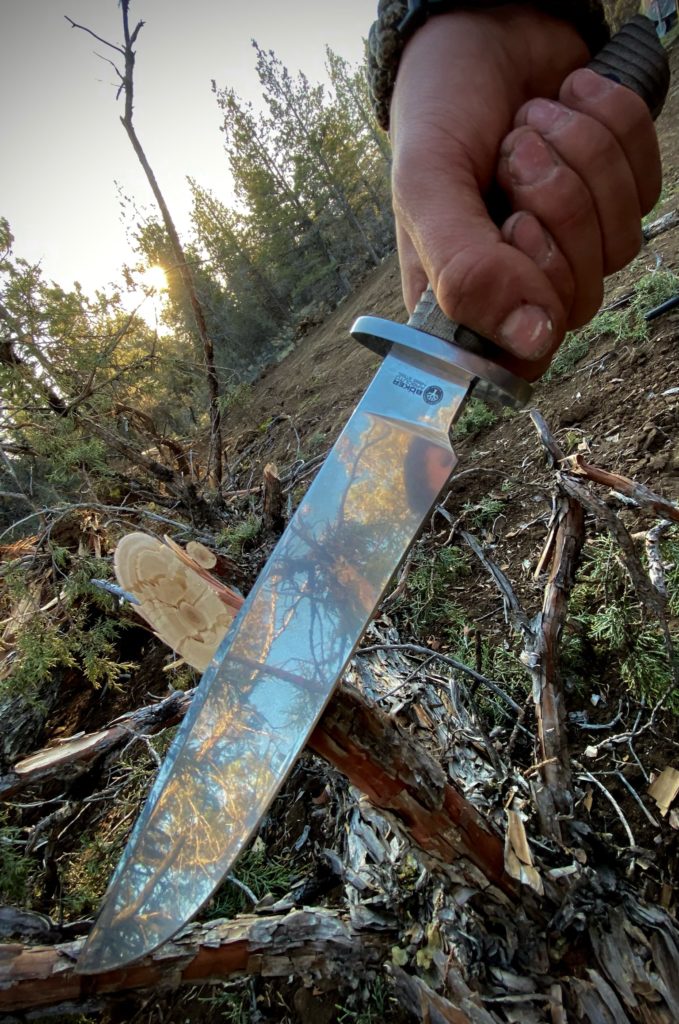
The Boker Arbolito El Gigante is a handsome classic bowie with a stonewashed blade, comfortable handle and nice leather sheath. Balance is excellent, all very much in the bowie tradition. Construction is top quality; so is performance. It cleaved 2-inch pine saplings with one stroke. The quarter-inch-thick spine was brought down to a well-supported edge fine enough to slice tomatoes, and slice meat thin enough to see light through the slices. We slashed rubber hose and the water bottles with ease.
Like all well-designed and crafted bowies, this is a versatile all-around knife.
A tree branch succumbs to the reflective blade of the Boker Arbolito El Gigante. It cleaved 2-inch pine saplings in one stroke.
BOKER ARBOLITO EL GIGANTE
Blade Length: 9.25”
Blade Steel: Bohler N695 stainless
Blade Thickness: .24”
Blade Grind: Flat
Blade Finish: Stonewash
Handle Thickness: .94”
Handle Material: Green Micarta®
Weight: 15.75 ozs.|
Overall Length: 14.75”
Sheath: Leather
Country of Origin: Argentina
MSRP: $229
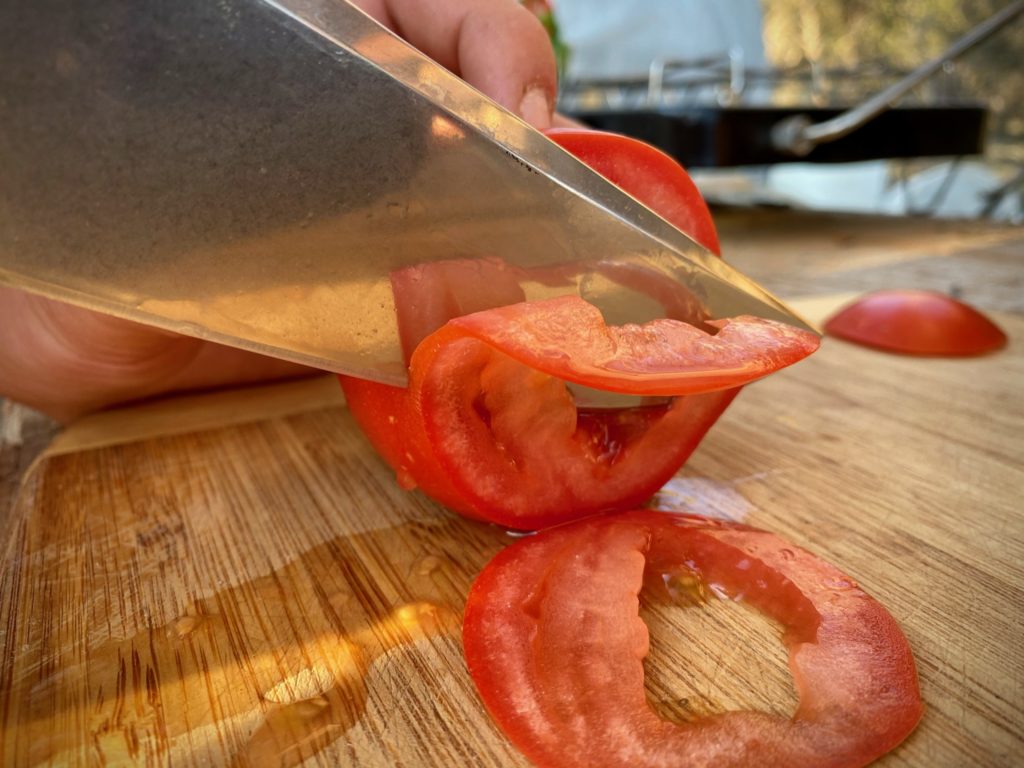
The El Gigante also proved its mettle after chopping wood by slicing a tomato nice and thin.
SEMPER FI! The KA-BAR Gunny
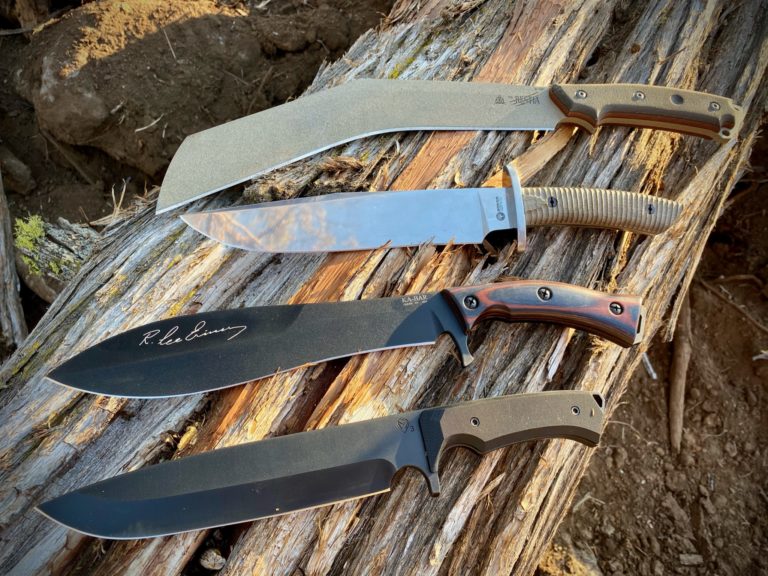
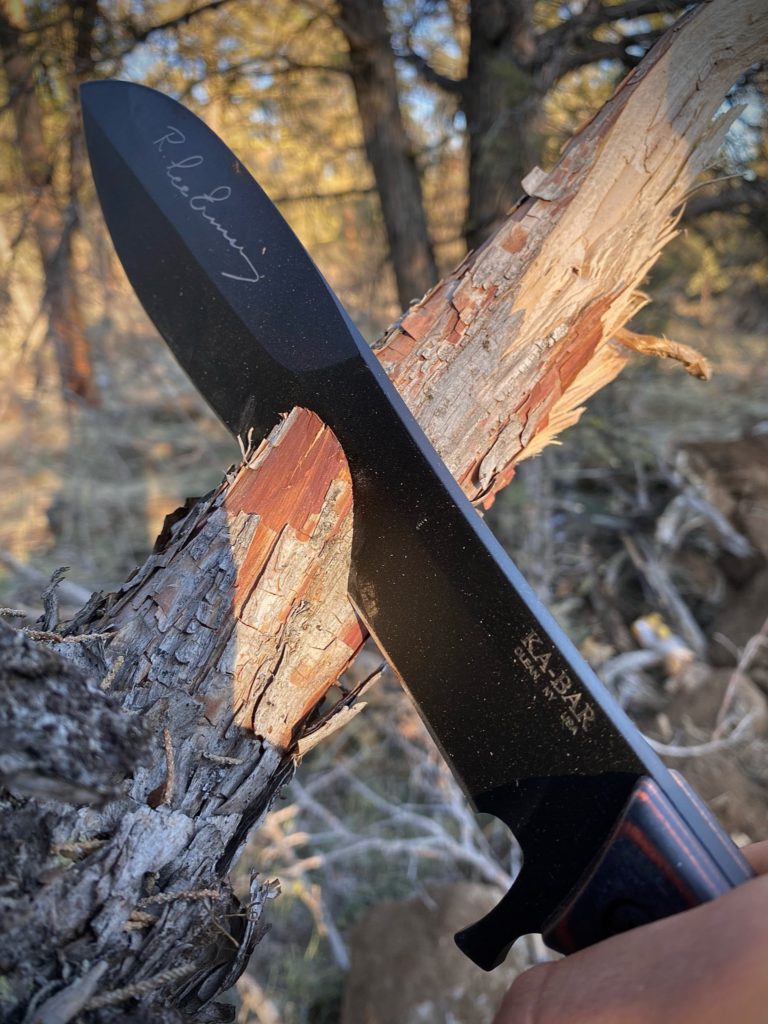
The KA-BAR Gunny is a hybrid design that resembles a bolo. I suspect R. Lee Ermey, the unforgettable Gunny who serves as the knife’s namesake, spent some time in jungles because this combination chopper/slicer’s performance is on par with village-forged bolos I’ve used in Southeast Asia, and that’s a high compliment. Its forward weight and terrific blade design promote efficient chopping.
The KA-BAR Gunny chomps into dry pine. Its forward weight and blade design promote efficient chopping.
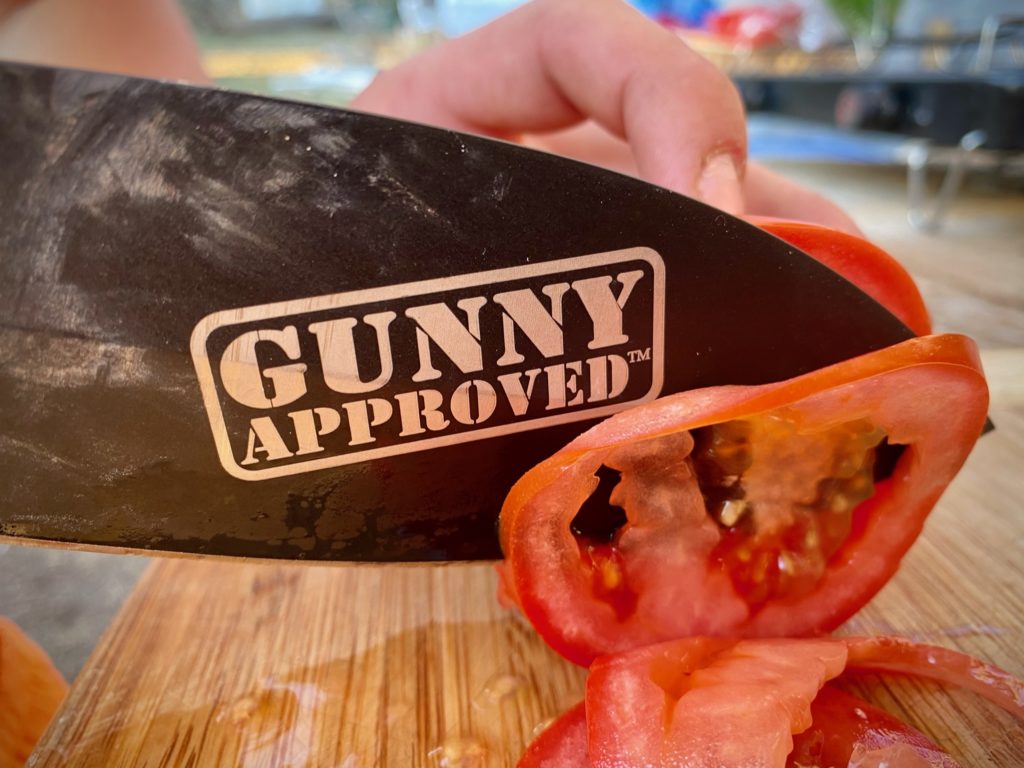
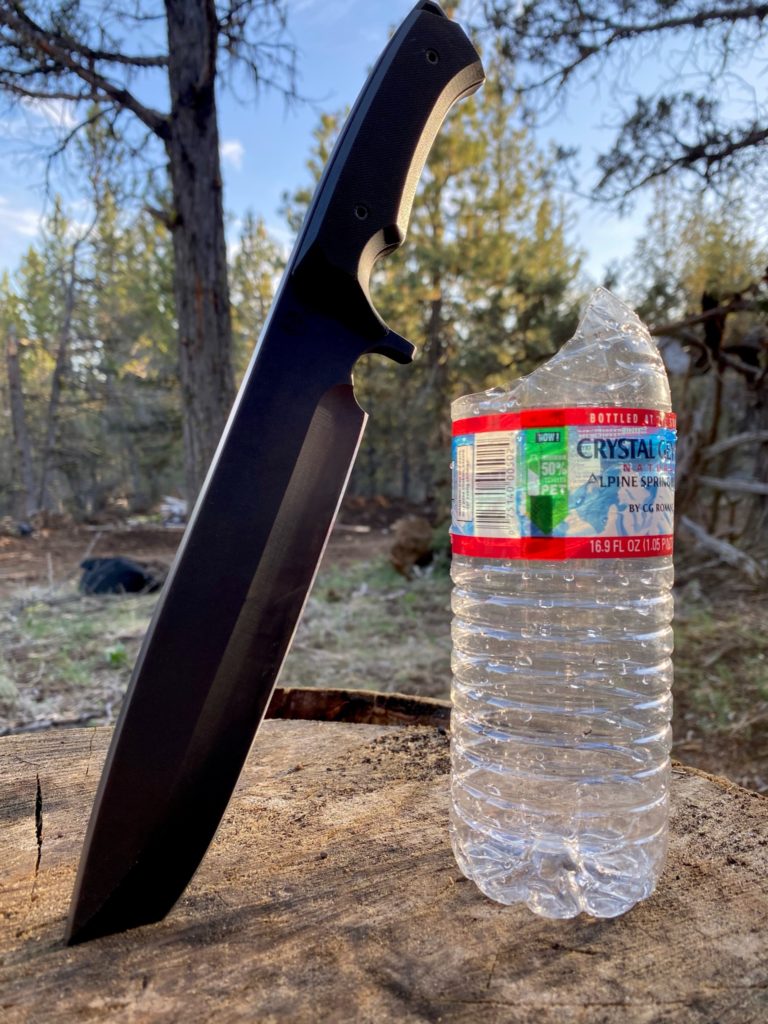
We cut through 3-to-4-inch-thick saplings with two strokes. We took down a tree with a 6-inch-thick truck just because we could. After the chopping the blade was still sharp enough for camp kitchen work. The belly, good balance and fine edge combined to make slicing meat and vegetables a pleasure. Slashing hanging rubber hose and the water bottle were a piece of cake. The comfortable handle lends itself both to heavy chopping and fine meat cutting, which is unusual.
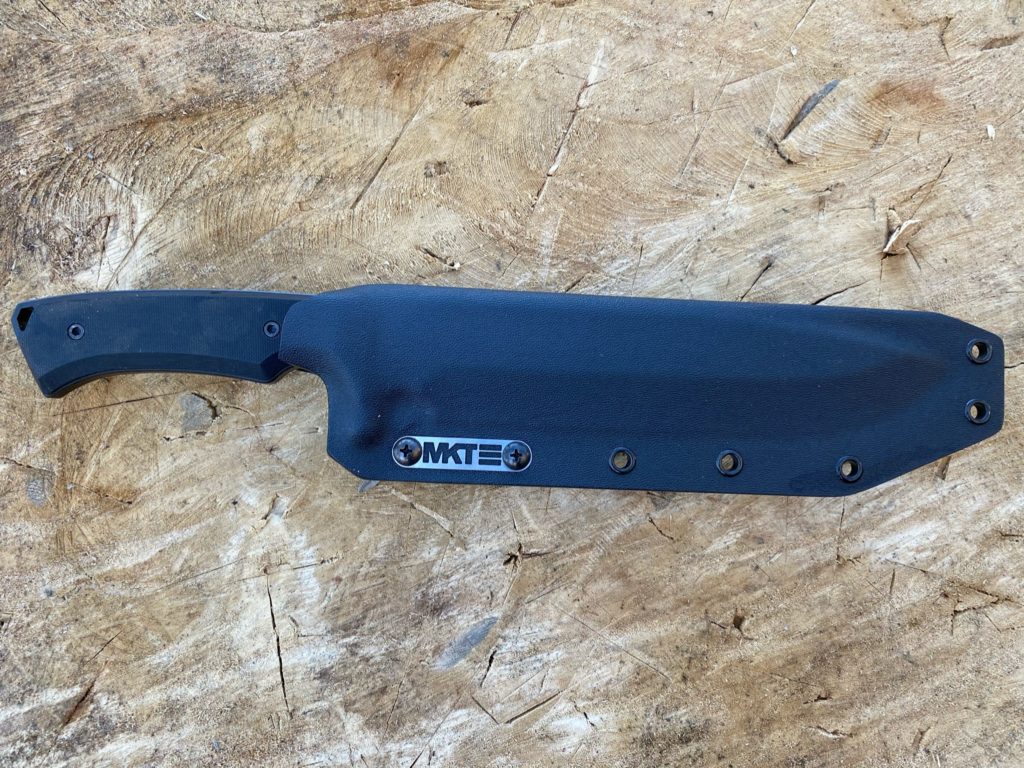
The Gunny is an excellent all-around bush knife. The sheath has a pocket for a sharpening stone, which was not included with the review model.
After chopping wood, the Gunny sliced tomatoes like a chef’s knife.
KA-BAR GUNNY
Designer: R. Lee “Gunny” Ermey
Blade Length: 9.75”
Blade Material: 1095 Cro-Van carbon steel
Blade Width: 2”
Blade Thickness: .2”
Blade Grind: Flat
Handle Width: 1.5”
Handle Thickness: .94”
Handle Material: Wood
Weight: 15.29 ozs.
Overall Length: 15.5”
Sheath: Leather
Country of Origin: USA
MSRP: $292
RAZOR SHARP: Medford Knife & Tool Bonfire
The Medford Knife & Tool Bonfire came from the maker absolutely razor sharp! The blade design is interesting in that we do not often see a contemporary styled drop point and hollow grind on such a big blade. I don’t know the Rockwell, but the steel is hard and tough. It was just as razor sharp after we put it through its paces as when we started.
The Bonfire comes with a well-fitted Kydex sheath.
The fine edge made for a very good slicer and slasher and lopped off thin branches with one cut. The hollow grind tended to bind when chopping wood, though that’s to be expected—hollow grinds aren’t chopping designs. It’s better to think of this knife as a well-designed and crafted big knife rather than a bush tool such as a panga or kukri. It sliced rubber hose with a snap of the wrist and slashed through water bottles with more consistency than the other review blades and cut meat just fine. You probably could dress out a bear with it.
Use it as a big knife on soft materials and you won’t be disappointed. It comes with a well-fitted Kydex sheath.
The Medford Knife & Tool Bonfire slashed through water-filled plastic bottles with more consistency than the other review blades.
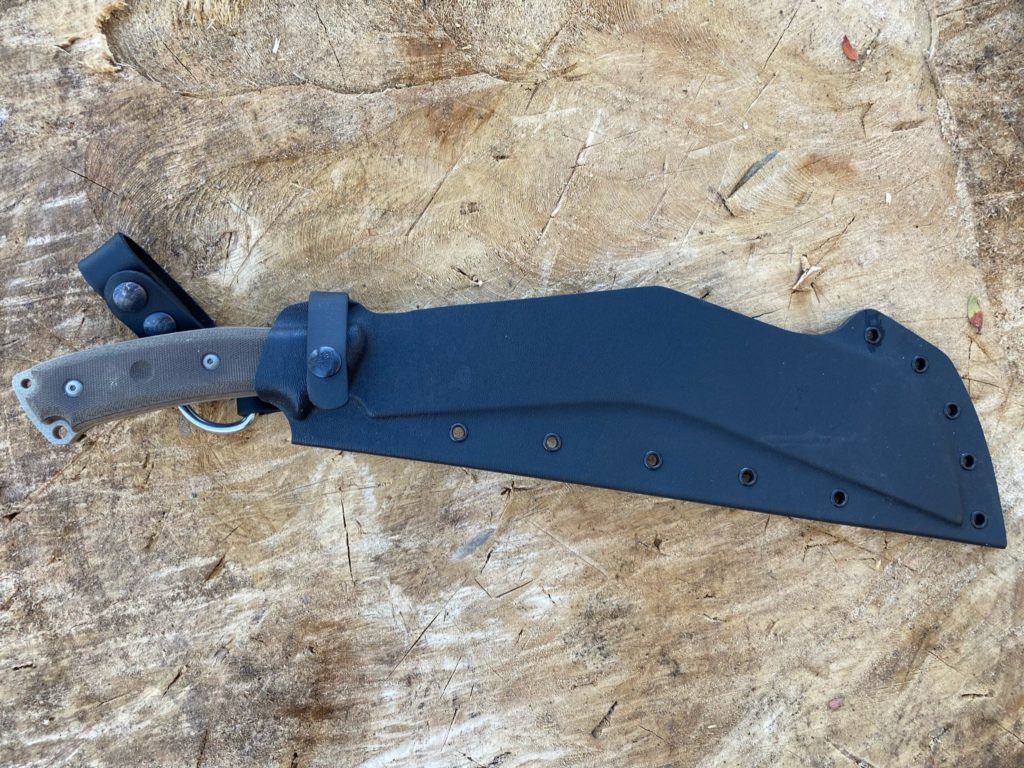
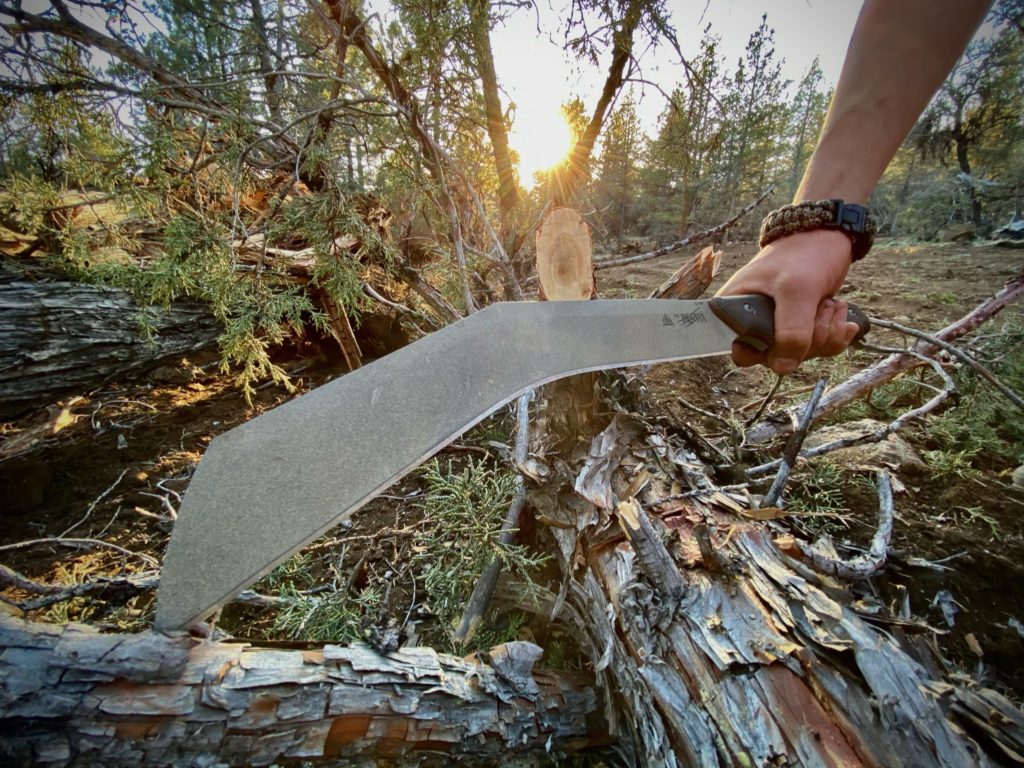
The TOPS Bestia is just a beast. A kukri-styled 13-inch blade and hefty weight make it the blade of choice for serious chopping or zombie cleaving. We hacked though a 3-inch sapling with one stroke, and used it to clear a stand of saplings and brush. The handle remained comfortable during an hour or so of work. Heavy as a small hatchet, it is more versatile and safer in use, especially in thick brush. During many survival classes, I’ve seen more injuries from hatchets than from big blades with their longer cutting edges.
The Kydex sheath is formed to fit the unmistakable kukri-style blade of the Bestia.
Given its heft, blade design and chopping ability, the Bestia is surprisingly usable in the camp kitchen. We found it could slice meat quite well, allowing for adjustments in maneuverability due to its blade length.
The TOPS Knives Bestia’s kukri-styled 13-inch blade and hefty weight made it the blade of choice for serious chopping or, as the author puts it, “zombie cleaving.”
VERSATILE BUSH TOOLS If you haven’t spent much time with a big blade, try one. Work with it for a while. Direct close attention to your work and you’ll find a good big blade to be a terrific, versatile bush tool.