
12th Annual BLADE University Classes

Hone your cutlery acumen at the 12th Annual BLADE University

How to make and design knives, how to determine which steel for which knife, what to look for in proper damascus patterns and how to enhance their appearance and other incisive knife subjects will highlight the class schedule of the 12th Annual BLADE University.
Held in conjunction with the 44th Annual BLADE Show June 6-8 at the Cobb Galleria Centre in Atlanta, BLADE University will be sponsored by Work Sharp. Classes begin the Thursday before the show, June 5, and will run through Friday, June 6, and Saturday, June 7. All courses will be taught in the Cobb Galleria except one—Fundamentals of Grinding—which will convene under the tent in The Courtyard, aka the parking lot of the show’s host hotel, the Renaissance Atlanta Waverly.

BLADE University assembles some of the world’s best knifemakers, bladesmiths and other cutlery and steel professionals to teach a wide range of subjects for the knife user, knifemaker, knife hobbyist, knife entrepreneur, knife designer, and knife aficionado and novice alike. If you love knives or are just beginning to, BLADE University has a topic for you. The complete course schedule, with subjects, teachers, times and venues:

Thursday, June 5
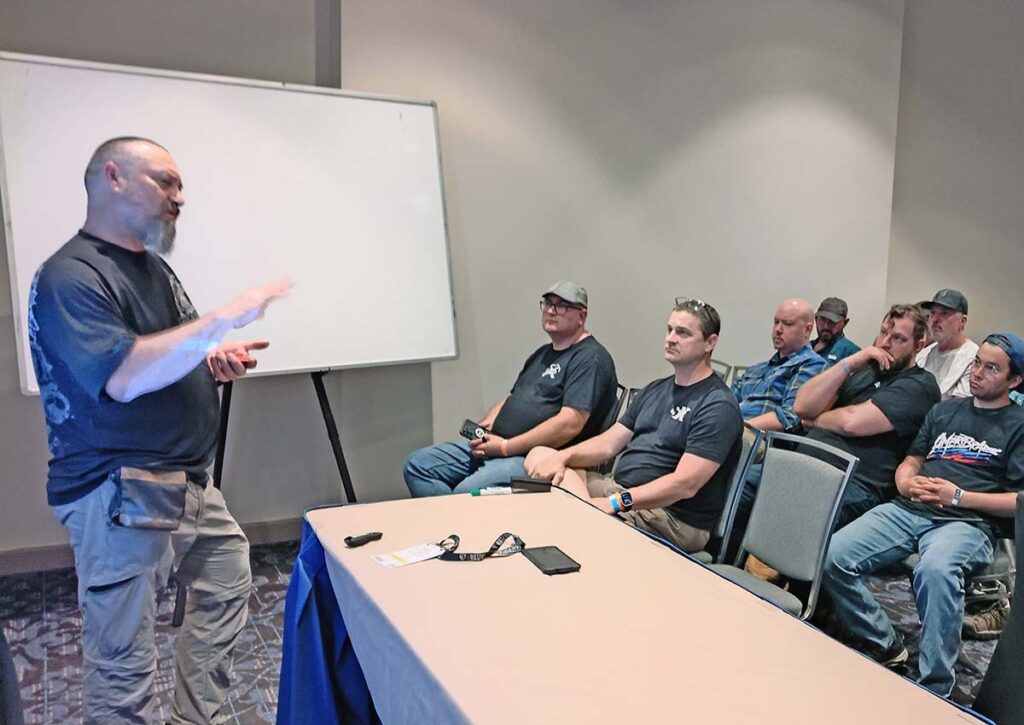
In “Level Up Using Lasers, Ninjas and Other Cool Tools,” ABS master smith Neels van den Berg dives into how tools like laser engravers, digital design, and jigs and process design can streamline your workflow and enhance your work.
  • Material Conservation for the Forging Smith, Mareko Maumasi, 4 to 5 p.m., Room 104—Award-winning bladesmith Mareko Maumasi shares techniques and approaches he uses to reduce guesswork and material waste in the workshop. His approaches not only help the knifemaker’s material go further but also save time and money.

Friday, June 6
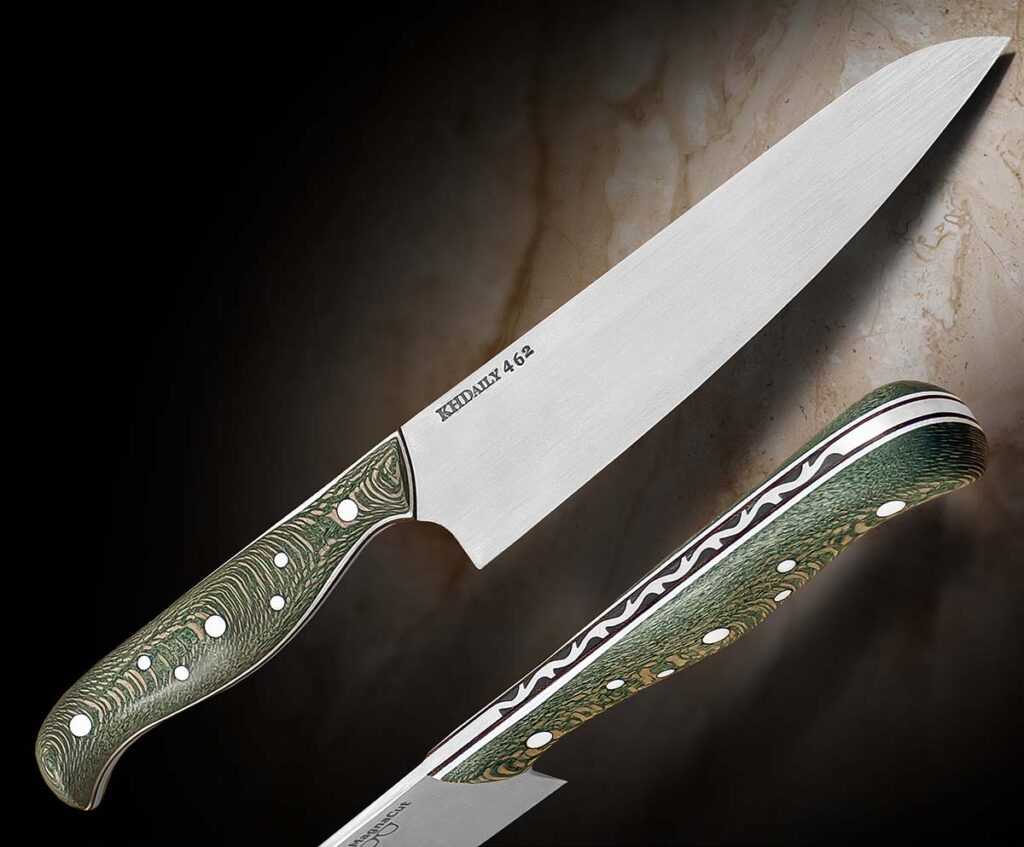
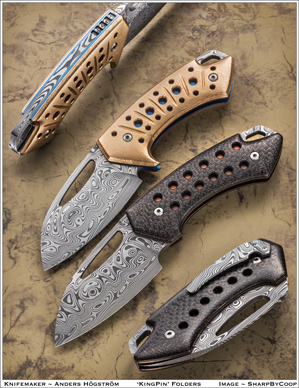
In “Elevating Your Handle Appearance: Spine Filework, Handle Shapes and Pin Placement,” knifemaker Kyle Daily shares his preferred files and specialized equipment for crafting his five most popular filework patterns, ensuring your knife not only looks exceptional but also feels comfortable and functional. (Jocelyn Frasier knife image)
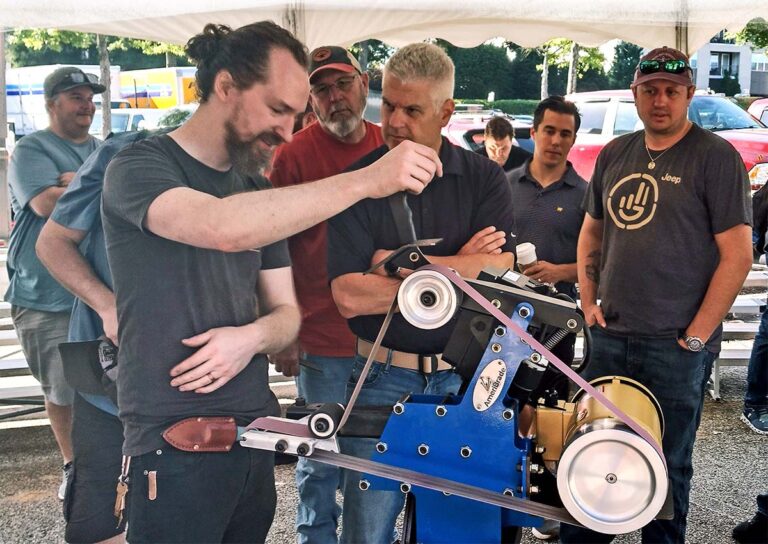
  • Fundamentals of Grinding, AmeriBrade and guest grinders, 8 to 9:30 a.m., The Courtyard—AmeriBrade and guest makers provide a general overview on grinds, techniques and different equipment. The class is interactive and the team answers questions and demonstrates suggestions for common issues.
  • Deep Dive into Culinary Knives, Mareko Maumasi, 10 to 11:30 a.m., Room 103—Mareko Maumasi returns to help collectors and makers better understand the nuances of high-performance culinary knives. The class covers design aspects from blade tip to pommel, aiding collectors in making more informed knife-buying decisions, and makers in creating higher-quality and higher-performing culinary knives.
  • The Tom Brown Tracker Experience, Mathew Williams, 1 to 2 p.m., Room 107—Experienced woodsman and tracker Mathew Williams discusses the iconic Tom Brown Tracker knife, including the blade’s notable features, how the knife’s function can be of benefit to the user and more. Mathew even dispels some Hollywood myths concerning the TBT. This one’s for old-time fans and newcomers alike.
  • Take Damascus Etching to the Next Level, Baker Forge, 1:30 to 2:30 p.m., Room 103—Greyson Weltyk of Grey Blades and Jordon Berthelot of JB Blades teach step-by-step processes on how to enhance intricate patterns in damascus with Gator Piss etchant, including in-person demos with damascus knives. Subjects include proper cleaning prep, temperatures, stacking oxide techniques, sealing oxides and more. Receive in-depth looks at new product offerings from Gator Piss for etching stainless damascus and properly sealing damascus with nano-ceramic technology. Have the opportunity for Q&A with authorities about damascus etching.
  • Hands on Sharpening, Work Sharp, 3:30 to 4:30 p.m., Room 113—What happens when a knife goes dull? How do you know when to sharpen it? Bring your own knife or borrow a demo model and learn the progression of shaping a bevel, sharpening and edge maintenance from the team at Work Sharp. You get hands-on practice and experience sharpening your blade using a variety of sharpeners and abrasives, from whetstones to belts. (See under Saturday’s classes for an encore presentation.)
  • Leather Sheath Making Tips, Tricks & Tools, John Dennehy, 4:30 to 5:30 p.m., Room 107—Classes on sheath making are conducted at knife shows, social media and elsewhere. Unfortunately, some of the online demos are by those giving the wrong advice. John Dennehy shares the sheath-making tips he’s learned after working leather for almost 50 years, including leather selection, the tools he uses and why he uses them. He also covers the construction details he employs that experienced leather workers recognize immediately as the ones needed to produce a professional sheath.

Saturday, June 7
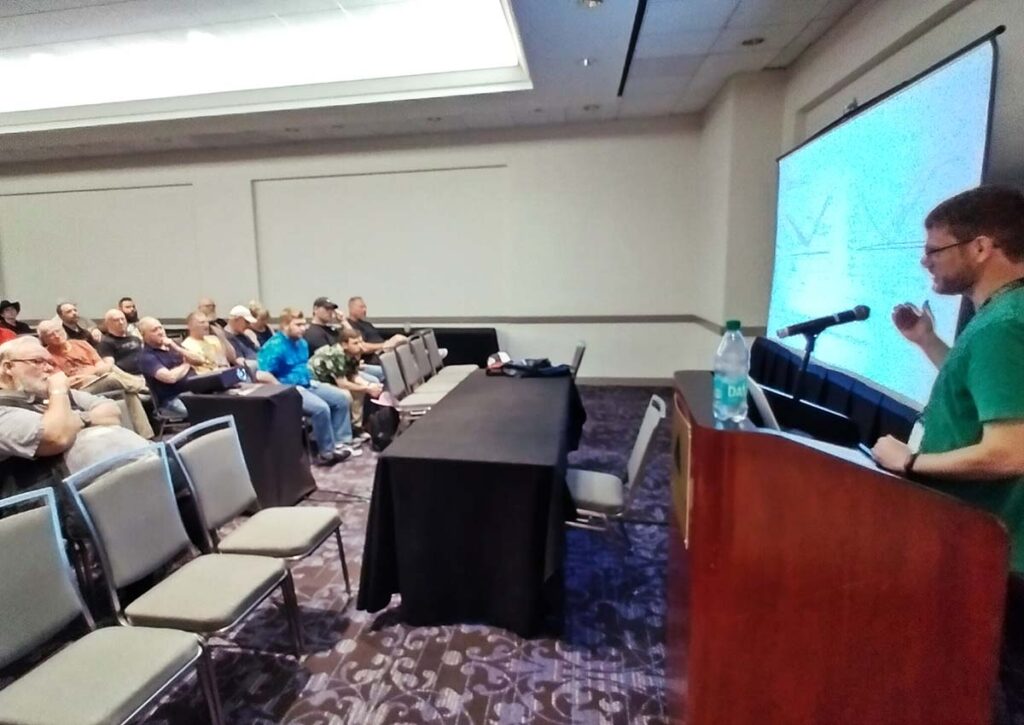
In “How to Select the Best Steel for Every Knife,” steel metallurgist Dr. Larrin Thomas talks about the factors that are important for different types of knives, such as cost, toughness, edge retention, sharpenability and corrosion resistance.
  • Elevating Your Handle Appearance: Spine Filework, Handle Shapes and Pin Placement, Kyle Daily, 8:30 to 9:30 a.m., Room 113—Enhance the appearance of your knife with distinctive features that go far beyond standard production models. Knifemaker Kyle Daily from KHDaily Knives guides you through the intricate art of filework on the spine, while also sharing insights into handle design and pin placement on the handle. Discover Kyle’s preferred files and specialized equipment for crafting his five most popular filework patterns, ensuring your knife not only looks exceptional but also feels comfortable and functional. From laying out your pattern to a step-by-step tutorial, this class provides the essential knowledge to achieve a professional and eye-catching finish. A Q&A session at the end ensures you leave with the skills and knowledge to take your knifemaking to the next level.
  • Demystifying Damascus, Mareko Maumasi, 9:30 to 11 a.m., Room 104—Mareko Maumasi completes his third straight day of teaching BLADE University classes with a most challenging one. He breaks the subject down in a way to help collectors gain a better appreciation for the knowledge and skill required to make unique damascus patterns, and to deepen the makers’ understanding of pattern design and composition.
  • The Cutting Edge, Nick Italiano, 9:45 to 10:45 a.m., Room 107—Nick Italiano, seasoned outdoorsman and host of the Raise The Flag Podcast, discusses the nuances of various blade grinds. From common everyday uses to survival situations, Nick covers several common grinds and their real-world function.
  • Level Up Using Lasers, Ninjas and Other Cool Tools, Neels van den Berg, 12:30 to 1:30 p.m., Room 113—Step up your knifemaking game with cutting-edge technology, unconventional techniques and insider secrets from ABS master smith Neels van den Berg. In this high-energy session dive into how laser engravers, digital design, and jigs and process design can streamline your workflow and improve your work. Plus, explore the mindset and discipline—the “ninja skills”—that separate good makers from great ones. Packed with real-world examples, practical insights and a touch of humor, this is a must-attend for makers looking to work smarter, not harder.
  • Designing Knives: Philosophy, Tools and Inspiration, Jens Anso, 2:15 to 3:15 p.m., Room 104—Award-winning knifemaker Jens Anso shares his approach to knife design, including how he thinks about form and function, the tools he uses and where he finds inspiration. With decades of experience in the industry, he’s developed a clear design philosophy that balances aesthetics, ergonomics and real-world usability. He explains his workflow, from sketching and CAD modeling, to prototyping and refining details. His goal is to provide insight into the design process and share practical takeaways for makers and enthusiasts who want to push their work further.
  • Hands on Sharpening, Work Sharp, 2:15 to 3:15 p.m., Room 113—What happens when a knife goes dull? How do you know when to sharpen it? Bring your own knife or borrow a demo model and learn the progression of shaping a bevel, sharpening and edge maintenance in this encore presentation from the team at Work Sharp. You get hands-on practice and experience sharpening your blade using a variety of sharpeners and abrasives, from whetstones to belts.
  • How to Select the Best Steel for Every Knife, Larrin Thomas, 4 to 5 p.m., Room 104—Both the makers and buyers of knives have many options for steels, but how do they know which ones to choose? Steel metallurgist Dr. Larrin Thomas talks about the factors that are important for different types of knives, such as cost, toughness, edge retention, sharpenability and corrosion resistance. Which steels are more optimal for a large chopper, a kitchen knife or a folder? For makers, the topics of forgeability, grindability, polishability and ease of heat treating are covered to choose steels that perform well and fit the knifemaking setup.

More classes were being determined at press time. For more information on them and on how to enroll in one or more of BLADE University’s classes, see our course offerings. There will be additional information on BLADE University in the June BLADE® and also in the BLADE Show Program, copies of which will be distributed for free at the BLADE Show.

More BLADE Show Information:

Stephens Forge New Hydraulic Press

0

Forging damascus steel with a hydraulic press. Dave Stephens. Anchorage Alaska.

We Test 4 Small Choppers Priced $32-$450

0
 

SMALL HATCHETS, HAWKS AND AXES ARE LIGHTWEIGHT AND VERSATILE

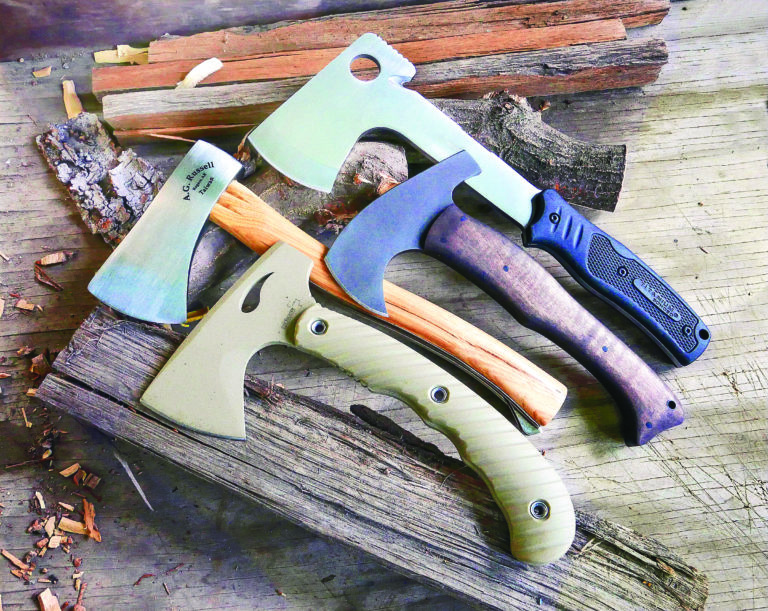
Four small, packable “hack-its” are convenient and can defy their size in terms of performance. Clockwise from top: Camillus/Western Blackriver Long Hatchet, Winkler Hunter Axe LT, Boker Plus Escape Hawk and A.G. Russell Pocket Safety Axe.

By Pat Covert

They’re small choppers that go by the names of hatchets, hawks and axes, so for simplicity’s sake let’s lump them into a group and call them hack-its, because that’s what they do for the most part. They hack.

The small choppers separate themselves from their bigger siblings largely because they are much more portable. Let’s take a look at four of the pint-size hack-its—all under a foot long—and explore their usefulness.

I tested each one on a variety of woods both hard and so, including the dreaded 6-inch privet log I use to gauge a chopper’s ability to bite into tough, seasoned materials. I also used the hack-its to cut 3/8-inch synthetic rope because if they will chop it, they’ll also cut the skin of meat and vegetables.

The weight of the chopper’s head and its placement on the handle makes a difference in its “bite-ability.” A big reason the Russell Pocket Safety Axe (left) bit into the privet log so well is because the hack-it simply has more weight at the point of attack.

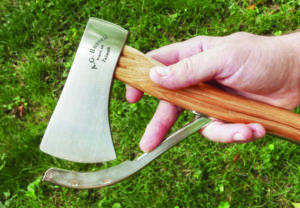
A.G. Russell Pocket Safety Axe

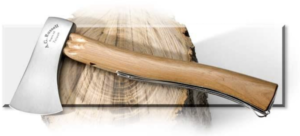
With much of its overall weight in the head, this is a very top-heavy hatchet—which can work to its advantage. Photo from agrussell.com

The A.G. Russell Pocket Safety Axe is a Marble’s design from circa the early 20th century. Marble took a small hatchet, 10.6 inches overall, and designed a fold-out metal shield in the handle to cover the bit in lieu of a sheath. Simply ingenious.  The A.G. Russell version has a 4.5-inch 1070 spring steel head with a 2.4- inch cutting edge, and a typical old-school hammering base at the rear.  The head has a distinctive three-slot mounting system Marble deemed superior to the standard oval style.  The 8.8 inch handle is hickory and the whole kit and caboodle weighs 1 pound. Manufacturer’s suggested retail price: $79.95.

The fold-out blade shield of the Russell Pocket Safety Axe is pure wizardry, especially considering the design is well over 100 years old. You won’t be caught saying “Where did I put the sheath?” with this one.

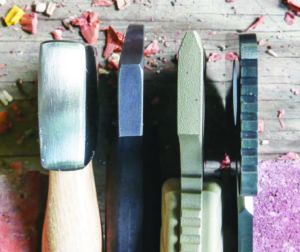
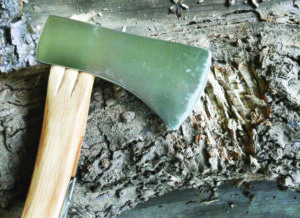
With much of its overall weight in the head, this is a very top-heavy hatchet—which can work to its advantage. In the bite test on the privet log, the Pocket Safety Axe finished first simply because the business end has a lot more weight (see the side-by-side comparison image on head thicknesses). Consequently, it chopped each test material well.

The bite of the A.G. Russell Pocket Safety Axe proved to be exceptional. The traditional, top-heavy hack-it took to the dreaded 6-inch privet log with gusto, sinking its teeth into the seasoned hardwood surprisingly well.

The fold-out bit shield has pluses and minuses. On the upside, it’s very convenient and there’s no sheath to keep up with. On the other hand, you have to pack it since there’s no belt-sheath option. Also, you’ll want to wear gloves for extended use, as the hinge mechanism in the handle can dig into the inner  fingers. All in all, though, the Pocket Safety Axe is a stellar performer.

SPEC CHECK: A.G. RUSSELL POCKET SAFETY AXE
CUTTING EDGE:
2.4”
BLADE MATERIAL: 1070 spring steel
HEAD WIDTH: 4.5”
HEAD THICKNESS: .7” at the thickest
BLADE COATING: None
HANDLE MATERIAL: Hickory
SPECIAL FEATURES: Metal blade cover in handle
CARRY: Pocket or pack
WEIGHT: 16 ozs.
OVERALL LENGTH: 10.6”
COUNTRY OF ORIGIN: Taiwan
MSRP: $79.95

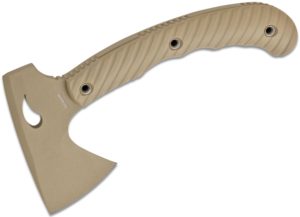
Boker Plus Escape Hawk

The Boker Escape Hawk is a hawk that thinks it’s a hatchet. Photo from knifecenter.com

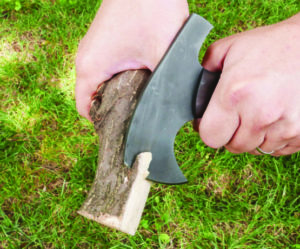
Designed by Australian knifemaker/ designer Peter Fegan, the Boker Plus Escape Hawk is tactical in design. Hawks are primarily used for breaching and combat but can full other chores as well. Only 9 inches overall, the Escape Hawk has a 4.75-inch head of quarter inch-thick SK5 tool steel and a 2.56- inch cutting edge.  The head has enough beard to be used for carving, and the curved 7-inch handle is adorned with nicely sculpted, diagonally grooved FRN ( berglass-reinforced nylon) scales.  The butt can be used for hammering.  The steel is protected throughout with a powder coat. A dual-strap Kydex sheath covers the head. MSRP: $189.95.

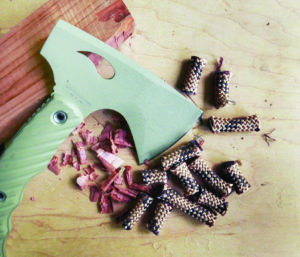
The Boker Plus Escape Hawk is a hatchet in disguise. The small hack-it’s 2.56-inch SK5 tool steel bit chopped rope in nice, clean lops, and hacked off nice-sized cedar tinder chips with ease.

Due to its small size, you won’t be doing much breaching with the Boker Escape Hawk, but the pint-sized hack proved its worth. The SK5 steel had plenty of hack, chopping rope in nice, clean cuts, and knocking out chunks of seasoned cedar for tinder. Though the bearded bit can be used for carving, the inward slant of the handle mounting to the head impedes its effectiveness for the purpose a tad. The handle has full-length scales—a bonus for freedom of grip—and the diagonal grooves afforded it the best purchase of the bunch. The Boker Escape Hawk is a hawk that thinks it’s a hatchet.


SPEC CHECK: BOKER PLUS ESCAPE HAWK
CUTTING EDGE:
2.56”
BLADE MATERIAL: SK5 tool steel
HEAD WIDTH: 4.75”
HEAD THICKNESS: .25”
BLADE FINISH: Powder coating
HANDLE MATERIAL: FRN
SPECIAL FEATURES: Full-length sculpted scales
CARRY: Kydex sheath
WEIGHT: 13.1 ozs.
OVERALL LENGTH: 9”
COUNTRY OF ORIGIN: China
MSRP: $189.95

Camillus Western Blackriver Long Hatchet

The Blackriver will handle many chores around the camp, and the bonus firesteel and pouch on the sheath add value. Photo from Camillus.com

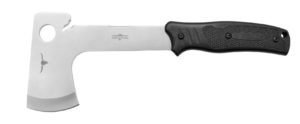
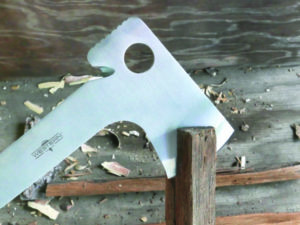
At 11.5 inches, the Western Blackriver Long Hatchet from Camillus is, indeed, the longest of the test hack-its. It sports a 4.5-inch-wide head with a 2.5-inch chopping edge. On the back side of the head is a gimped flat edge for hammering and a sharpened diagonal slot for cutting cord. The 9.5-inch handle has 5.25-inch black checkered rubber scales, and there is a shaving slot midway between the handle and the head. A ballistic nylon sheath with a firesteel pouch—with firesteel—is included. MSRP: $31.98.

The Western Blackriver Long Hatchet from Camillus is the batonner of the bunch. The thin bit cleaved into the tight hardwood grain like a thief in the night. Once the head was in, the final splitting was done by batonning the upper handle.

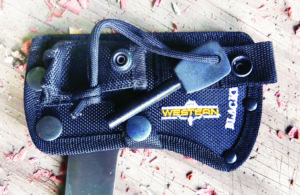
The Blackriver has the lightest head of the test group so it didn’t win the chopping wars, but its length and handle design give it a leg up on the others in some functions. The thin head is ideal for batonning, enhanced by the 4 inches of exposed steel below the bit, which can be used as a striking surface. The grip is very comfortable, the rubber scales aiding in impact absorption. The Blackriver will handle many chores around the camp, and the bonus firesteel and pouch on the sheath add value. It’s also by far the most affordable of the group.

The Camillus/Western Blackriver Long Hatchet has a pouch on its ballistic nylon sheath containing a firesteel. This is a nice added extra on a hack-it that is already able and affordable.

SPEC CHECK: CAMILLUS/WESTERN BLACKRIVER LONG HATCHET
CUTTING EDGE:
2.5”
BLADE STEEL: 420 stainless
HEAD WIDTH: 4.5”
HEAD THICKNESS: .2”
BLADE COATING: Titanium bonded
HANDLE MATERIAL: Rubber
SPECIAL FEATURES: Firesteel included
CARRY: Ballistic nylon belt sheath
WEIGHT: 17 ozs.
OVERALL LENGTH: 11.5”
COUNTRY OF ORIGIN: China
MSRP: $31.98

Winkler Hunter Axe LT

The price is high but the Winkler is as close to a custom as you’ll get—plus, the sheath is a marvel in itself. Photo from WinklerKnives.com. 

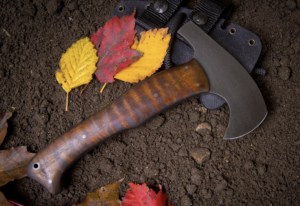
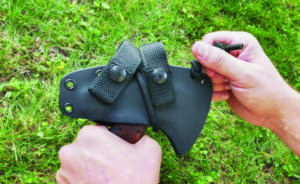
At only 9 inches long, the Winkler Hunter Axe LT is a small hack-it, but packs a full 19 ounces of weight—and that’s with a skeletonized handle tang. The Hunter Axe LT has a 3.5-inch-wide, bearded 80CrV2 carbon steel head with 2 inches of cutting edge, and there’s a hammering base out back. The steel thickness is a healthy .25 inch and is coated head to toe in Caswell black oxide. The scales are full-length, highly attractive curly maple. A padded Kydex sheath with nylon belt loops covers the head, and employs a shock-cord retention system for a quick draw. MSRP: $450.

The Winkler Hunter Axe LT turned out to be the best carver of the bunch due in no small part to the handle’s position in relation to the head and beard. The hand- some curly maple handle is comfortable to boot.

The Hunter Axe LT may be short but at 19 ounces is the heaviest of the test hack-its—a full 2 ounces more than its nearest rival. The LT almost won the bite contest but didn’t due in part to its weight being more equally distributed than the top-heavy Russell Pocket Safety Axe. The 80CrV2 steel chops extremely well and the Caswell finish is very tough. Though not a carving axe per se, the LT was our best candidate for the chore and would have performed even better with a lower grind angle on the lead edge. The price is high but the Winkler is as close to a custom as you’ll get—plus, the sheath is a marvel in itself.

SPEC CHECK: WINKLER HUNTER AXE LT 
CUTTING EDGE:
2”
BLADE MATERIAL: 80CrV2 carbon steel
HEAD WIDTH: 3.5”
HEAD THICKNESS: .28”
BLADE COATING: Caswell black oxide
HANDLE MATERIAL: Curly maple
SPECIAL FEATURES: Skeletonized handle
CARRY: Kydex belt sheath w/tension release
WEIGHT: 19 ozs.
OVERALL LENGTH: 9”
COUNTRY OF ORIGIN: USA
MSRP: $450

The Winkler Hunter Axe LT’s Kydex sheath has a bungee-style tension cord for quickly releasing the axe from its housing. The sheath as a whole is very well made—a Daniel Winkler trademark.

HAPPY HACKING!

Packable hack-its are limited only by their size. They are capable of building small shelters, chopping and splitting small- sized firewood, cutting rope to size, and a myriad of other small chores around the camp. When buying a small, packable chopper like one of these, first define your intended use for it. As you can see by the test bunch, each has its strong suits, and MSRPs vary widely. Choose wisely and happy hacking!

Annual Fall Knife Show in Wisconsin

0

Annual Fall Knife Show in Wisconsin, Northern Lakes Knife Co. Show Division

e-mail: [email protected]

Mastersmith Mike Williams on Blade Grinding

ABS Mastersmith Mike Williams demonstrates the techniques involved in grinding a forged blade from beginning to final grind. Mastersmiths JR Cook and Jerry F…

Mcnees Custom Knives Chopper Proto

0

Created on August 21, 2010 using FlipShare.

Ladies Make Chef’s Knives, Both In Brooklyn

In an article titled “Sisters Of Steel: Vermont Women Forge Success Making Handmade Kitchen Knives,” initially published on BurlingtonFreePress.com, a Gannett Company, and written by Melissa Pasanen, the story is of Moriah Cowles and Chelsea Miller, both incredibly 30 years old, both slender and both with dark hair. They also both grew up in Vermont with fathers who work with their hands, and now they both live in Brooklyn, where each has built a reputation for making kitchen knives. And neither knew about the other, until recently, yet they’ve yet to meet in person.bilde

According to the feature article, Chelsea grinds old horse hoof files into handmade knives at her family’s Peacham workshop, and Moriah took a blacksmithing course in North Carolina before forging her first knife from a railroad spike. See their complete story here.  For more quality household cutlery, click here.

Brooklyn-based knifemaker Chelsea Miller (left) fashions kitchen knives from repurposed materials like metal files in her family’s workshop in Peacham. / EMILY McMANAMY/FREE PRESS PHOTO.

Advertisement

Must Read Articles

Read this before you make a knife

Knifemaking 101 – Read This Before You Make a Knife

  by Wayne Goddard My experience has taught me that there's nothing like digging in and getting started. I've often said the hardest part of the...
how to forge damascus steel

How to Forge Damascus

Advertisement
Advertisement