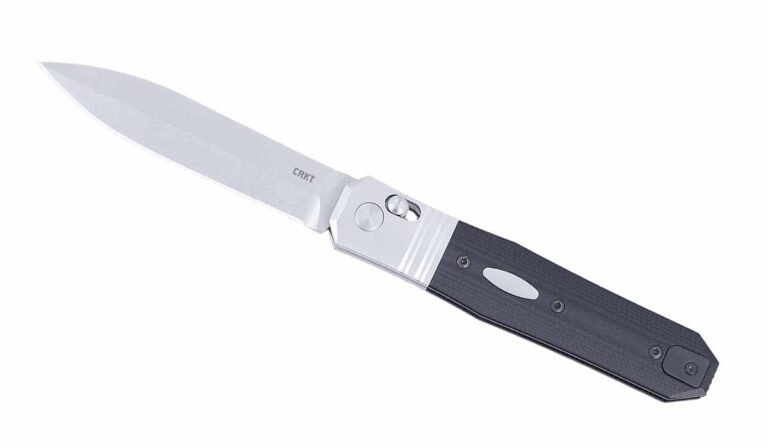
CRKT’s first MagnaCut blade and Ken Onion’s first crossbar lock the maker looks to come up aces.
As always, Columbia River Knife and Tool (CRKT) is innovating—and releasing its innovations—at a mind-boggling clip. The latest up for the Oregon-based company is a USA-made collaboration with another well-known knife concern, made with some top-notch material. It’s also a looker to boot.
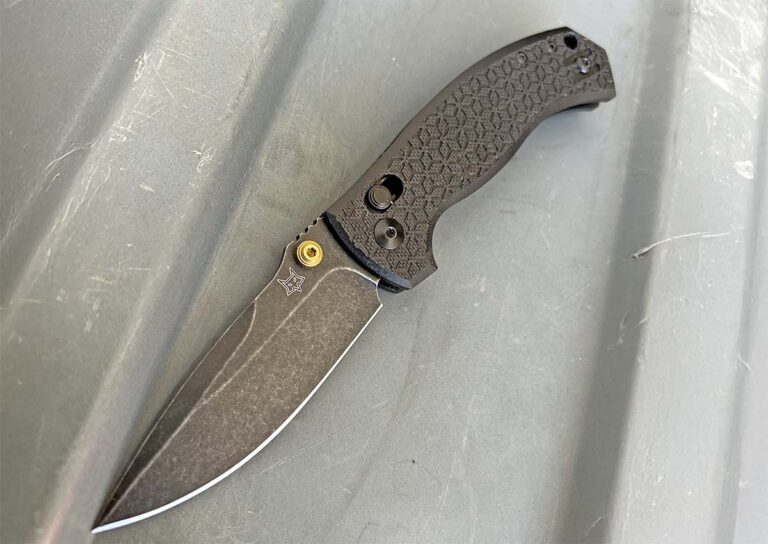
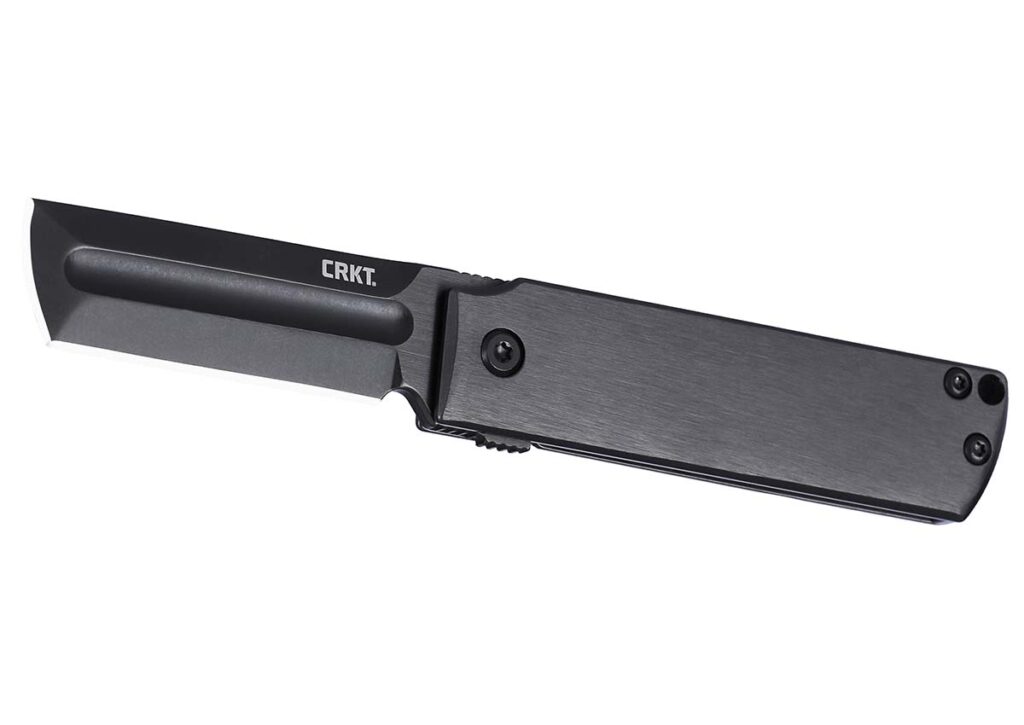
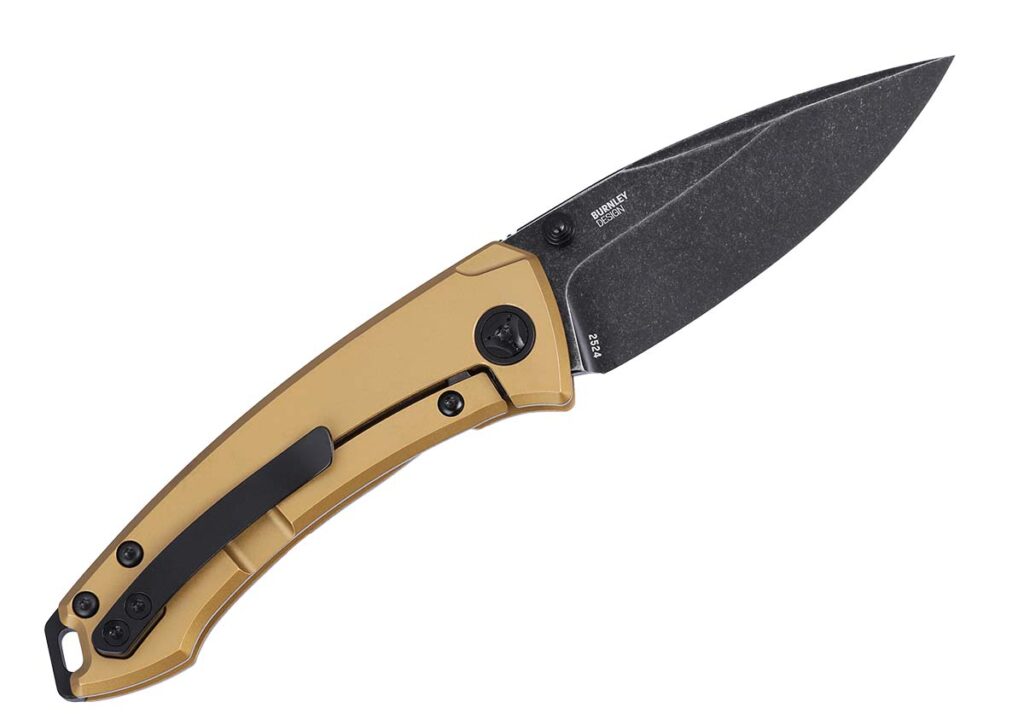
Meet the Redemption, a sleek folder developed in conjunction with Hogue Knives and based on the legendary designer Ken Onion’s Deadman’s Hand custom. As a side note, the Onion’s custom takes its name from the cards Wild Bill Hickock supposedly held when shot—aces and eights. Living up to its inspiration and its own moniker, the Redemption has an Old-West gambler’s feel to its lines and profile.
Yet, made with cutting-edge steel—the first time CRKT has utilized CPM MagnaCut for a blade—it’s up on the times and offers contemporary performance. For those who might not know, MagnaCut is among the hottest blade steels, with exceptional toughness, wear resistance and corrosion resistance. To boot, its microstructure also makes edge management easy.
Redemption Mechanics
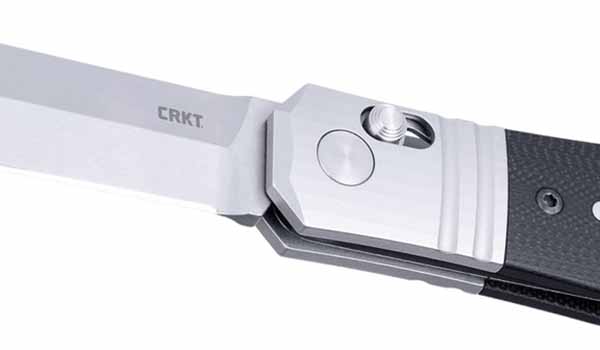
Another inaugural of the Redemption is its locking mechanism—at least for Onion. Hard to believe, but this is the first time the prolific designer has incorporated a crossbar lock into one of his creations. But it does broaden the knife’s appeal, not only offering silky-smooth deployment of the spear-point blade and a strong lockup but also making it ambidextrous. For the nimble and quick of hand, it opens the potential of fast deployment with a flick of the wrist.
Blade Points
In addition to using top-shelf steel, the CRKT Redemption has an interesting blade design. Stiletto-like, the 4.06-inch blade should prove a piercing pro, particularly with its fine tip. Nevertheless, the knife has enough edge for general cutting tasks and at .15-inches thick should have enough backbone to handle semi-rugged jobs, if your opportunities for perforation are limited. Overall, it is very reminiscent of the Deadman’s Hand’s blade, however, the CRKT knife has a stonewashed finish, whereas the custom had a high polish.
Handle Design
Not dead nuts, but the shape of the Redemption’s handle suggests a coffin handle—more so with the stainless-steel bolsters setting off the dark scale. To this end, CRKT has opted for G10 with nice texturing to it, giving the knife a measure of all-weather aptitude. The pocket clip is engineered for deep carry and is reversible, furthering the knife’s appeal to righties and lefties.
Final Cut
Clocking in with a $225 MSRP, the CRKT Redemption teeters on the premium end of the production knife price scale. But given the name behind its design, the materials the company has chosen and the fact it’s domestically made, it is by no means out of bounds. And given the knife is based on an Onion classic and has a wicked throwback look, it’s more than likely to catch the attention of more than one knife aficionado.
What better knife to carry daily than one explicitly designed to save lives?
Why rescue knives as EDC? It’s more like “why not?” Life presents situations you don’t expect—an accident happens and there you are, right in the middle of it. It is therefore very important to be and stay prepared. Having a rescue knife within close reach can help when you need it most.
But who really carries a rescue knife daily? If you are a fireman, EMT or in law enforcement, it’s an easy answer. Remember the be and stay prepared motto. Even if not in a save-and-serve profession, you can have a rescue knife with you for times you need it most.
Victorinox Rescue Tool
It probably is no surprise that Victorinox makes a rescue knife. The company is well known for fashioning super handy pocketknives with all sorts of onboard tools that make work, play and life easier and more convenient—and in this case, safer, too.
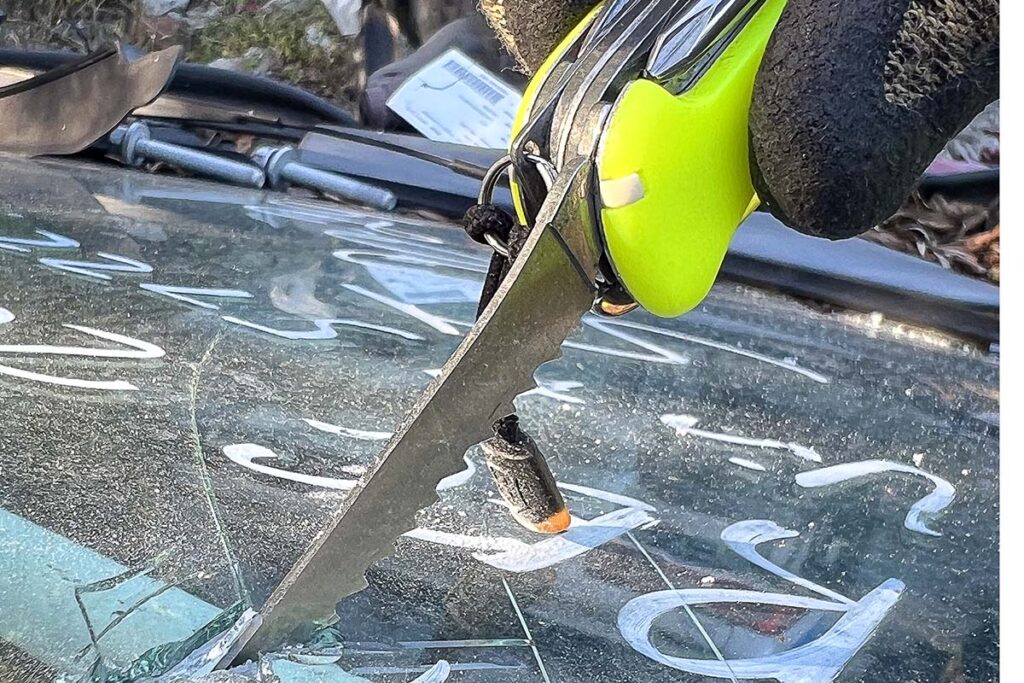
The Victorinox Rescue Tool comes with a special saw that will cut through laminated vehicle glass such as the kind used for windshields. The author said the saw grabbed on the pull stroke. “The saw possibly would have better results if the windshield were shattered first,” he noted, “but I couldn’t locate any shattered windshields on any of the test vehicles.”
At about 4.4 inches closed, the Victorinox Rescue Tool has a frame based on the largest knife the company makes. This is definitely not a pocketknife! It comes with a high quality sewn and riveted nylon sheath (more on it later).
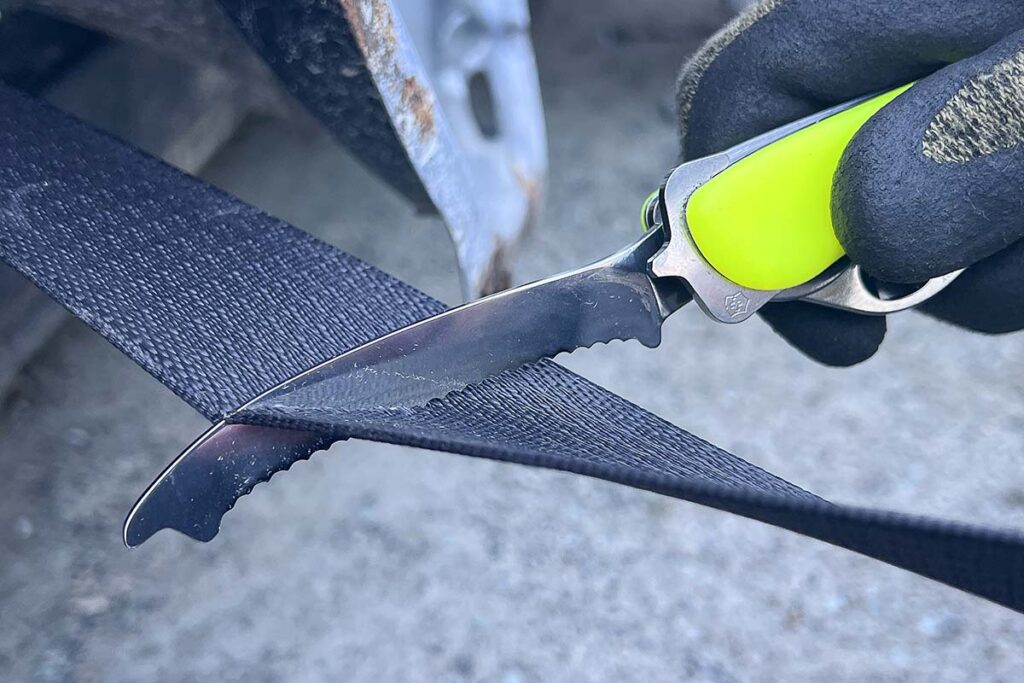
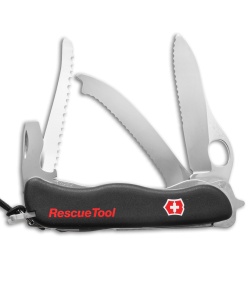
As with most Swiss Army knives, the Rescue Tool sports a variety of on-board tools: a partially serrated 3⅛-inch main blade with hole opener; bottle opener; flathead and Phillips screwdrivers; a combination can opener and small flathead screwdriver; a 3.25-inch semi-curved, fully serrated blade for cutting seatbelts; a specially designed 3.25-inch pull saw for cutting shatterproof glass; and a glass breaker. The latter two are removable. The polyamide scales come in high-visibility yellow for easy location in low light conditions, and the scales glow in the dark after being charged up by sunlight or artificial light. Fit and finish on the Rescue Tool is standard for Victorinox—perfect out of the box. The blades and tools are finished nicely in a full polish except for the saw blade, which is satin finished. Opening and closing action is smooth. The main partially serrated blade locks open via a linerlock as well.
The seatbelt cutter is extremely effective. The rounded, dull blade tip extends slightly beyond the handle butt so you can deploy the blade with or without gloves. Work the blade under the seatbelt and, with one swift motion, pull and the blade slices clean through. The serration pattern is similar to one you might see on a steak knife, with evenly spaced teeth—simple yet very effective and extremely sharp out of the box.
The fully serrated blunt tipped seatbelt cutter blade of the Victorinox works exceptionally well. It has plenty of aggressive bite to cleave through seatbelts in a hurry.
The partially serrated main blade is easy to deploy via the hole opener. The blade is unlike most if not all other partially serrated non-Victorinox patterns. The front 70 percent of the edge is serrated and the balance closest to the tang is plain for finer cutting. The serrations are more rounded at the tips than on the seatbelt cutter, presumably to allow the blade to cut evenly like a plain edge. I tested it on food, cardboard and manila rope, and it cut smoothly and aggressively.
Now for the disappointing part—the glass breaker. It was not effective at all. I could not get a side car window to shatter no matter how hard I hit it. I presume the failure is due to the breaker point being too big. In my experience, the most effective glass breakers are the ones that come to a point and are made of carbide, as with the balance of the review knives. The glass saw is effective, though it grabs a bit too much on the pull stroke. However, when I adjusted the pressure it worked. Country of origin: Switzerland. MSRP: $115.
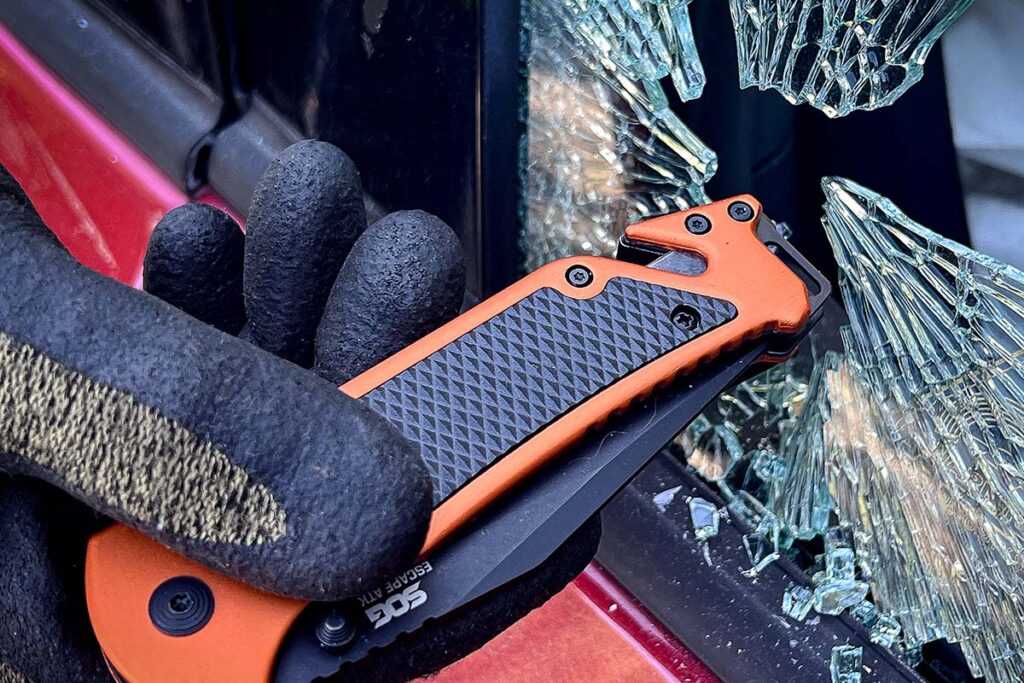
The SOG Escape 2.0 ATK is the updated version of the original SOG Escape, a multipurpose rescue folder targeted at the serve and save pros. It features a 3.4-inch blade of AUS-8 stainless steel PVD coated black, a partially serrated edge, anodized aluminum handle, integrated/replaceable seatbelt/line cutter, and glass breaker. The blade sports ambidextrous thumb studs and a flipper for one-hand opening. The edge is serrated to tackle a plethora of cutting chores. The clip point shape is adaptable to a wide range of tasks and the defined point is great for scoring. The serrations provide extra slicing power when the going gets tough.
The author uses the SOG Escape 2.0 ATK to shatter a car window, both prior to (inset) and after the fact. Inset into the handle spacer, the glass breaker quickly shattered the side glass with a concentrated pop to the window’s lower corner.
The handle is cast aluminum with stainless steel liners. It comes in two colors: high visibility orange and OD green. The integrated slot at the butt houses a blade for cutting seatbelts, line and string without opening the knife. A glass breaker in the handle spacer quickly shatters side car windows. The breaker works very well. It quickly shattered the side glass with a concentrated pop to the lower corner of the window. The pocket clip is a fold-over, deep carry model. A spare seatbelt/line cutter blade stows safely beneath the textured panel handle inlay. Back out the two small Phillips screws securing the cover and you will see the blade underneath—it is simple to swap out. Country of origin: China. MSRP: $54.95.
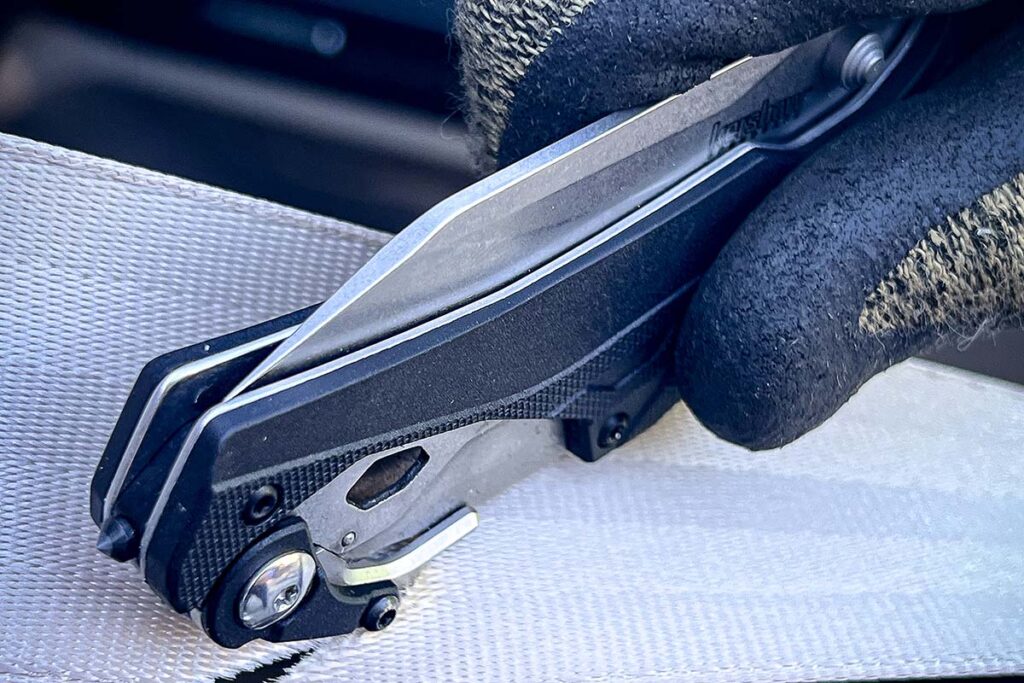
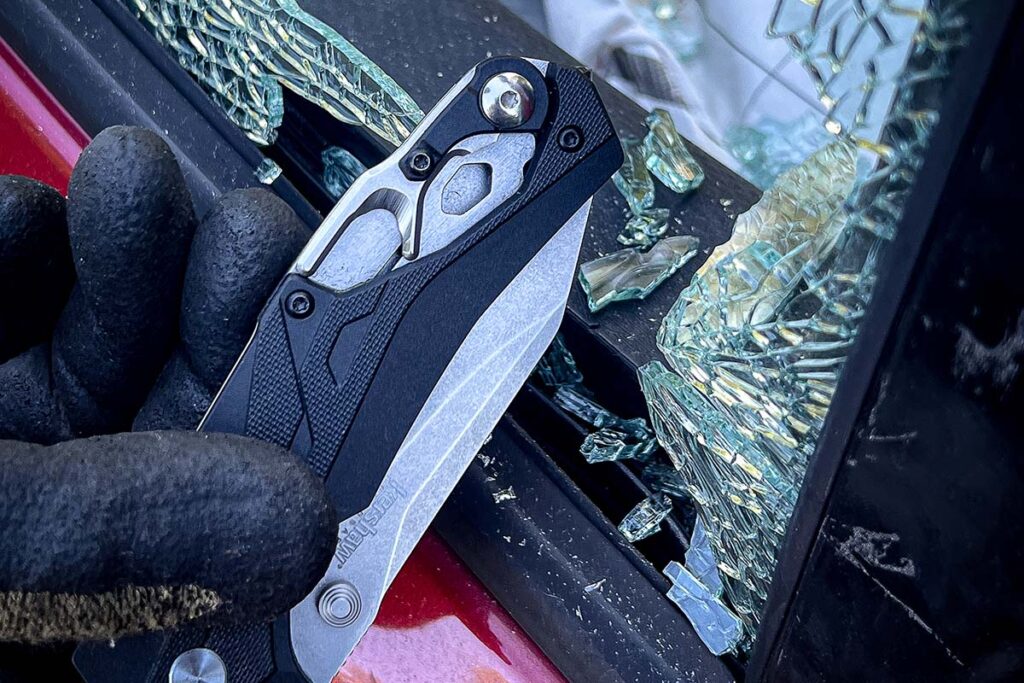
Kershaw’s Drivetrain rescue knife looks like any standard EDC linerlock folder. It has a stylish handle coupled with a very utility friendly blade—but that’s where the similarity ends. The presentation side of the handle butt boasts an integrated seatbelt cutter that folds out. A glass breaker is inserted into the end of the handle spacer. The 3.2-inch clip point blade has ambidextrous thumb studs and a flipper for one-hand opening enhanced by the company’s SpeedSafe assist mechanism. The blade is D2 tool steel for augmented edge holding and wear resistance, especially for the price point. The stonewash finish is attractive and hides scratches.
The author indicated the fold-out locking seatbelt cutter of the Kershaw Drivetrain is the best of the test bunch. It’s a wide hook with a blunt tip leading edge for safety. Rest the handle spine on the seatbelt and pull. The handle guides the cutter to the belt and it cleaves very easily.
The handle is molded glass reinforced nylon with double stainless steel liners. The scales are textured and contoured for a nonslip, comfortable grip with no hot spots. The seatbelt cutter easily deploys with one hand and a separate linerlock holds it in place. When closed, the cutter is concealed within the lines of the handle profile and doesn’t get in the way. A steel pocket clip carries the closed knife blade tip up.
The blade is very utility friendly, from opening boxes and mail to cutting cardboard and plastic sheeting. Once locked open, it is extremely secure with no play.
The Kershaw glass breaker works very well. Situated at the end of the handle, a quick strike with it to the lower corner of the vehicle side window did the job.
The seatbelt cutter works well. The hook tip is dull and rounded so you can work it under the seatbelt without inadvertently cutting yourself or the accident victim. The blade is ground on both sides to enhance sharpness. For best results, make your pull cut at an angle in relation to the seatbelt. Also, resting the handle spine on the seatbelt is a great way to “aim” the cutter. It bites in better that way and, when you feel it engage, give the handle a quick tug and it cleaves through effortlessly. It is a surprisingly effective seatbelt cutter! The glass breaker works very well, too. Country of origin: U.S. design, prototype and quality control, Chinese manufacture. MSRP: $69.59.
Utica’s Honor Rescue Knife
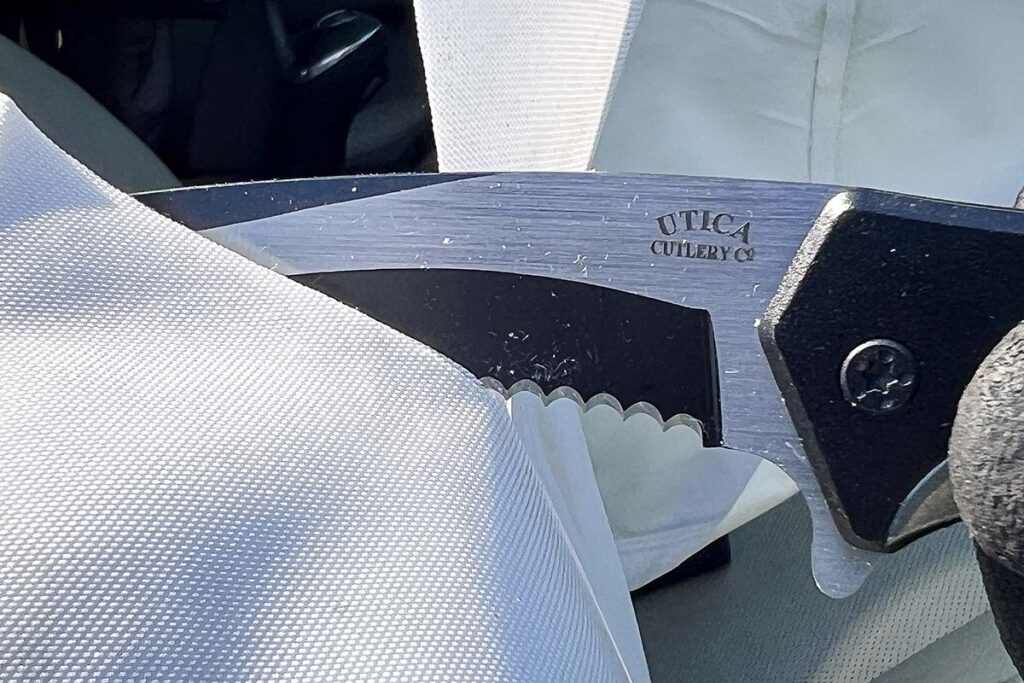
Utica’s Honor Rescue Knife is the least expensive of the test group. It packs a few features normally found on rescue knives, such as the integrated seatbelt cutter, glass breaker and a partially serrated, modified tanto blade. The 3-inch stainless steel blade’s partial serrations help rip through thicker materials. A two-tone finish adds character, with the bevels and spine black oxide coated and the flats satin finished. A flipper tab provides ambidextrous opening, and the blade rides effortlessly on bearings for ultra smooth action. The handle is aluminum with double stainless steel liners providing the backbone. A linerlock holds the blade open securely. A seatbelt cutter slot in the handle butt has two sharpened blades held in the scissor position to cleave seatbelts with a firm pull. The steel back spacer has an extended portion that tapers to a point, which serves as the glass breaker.
The Utica tanto blade’s partial serrations help rip through thicker materials.
Like with the Victorinox Rescue Tool, the glass breaker on the Utica test model was ineffective. The point rounded off due to multiple hits to a side window and did not shatter it. The breaker needs a carbide point. A deep carry clip positions the closed knife blade tip down. Cost and feature wise, the Honor Rescue Knife is a great option without breaking the bank. Country of origin: China. MSRP: $32.97.
Final Cut
A final thought: Some prefer having a rescue knife for emergencies only as opposed to having one for both work and emergencies. You can get away with a relatively inexpensive rescue knife if you preserve it for emergency use exclusively. (Some high-end rescue knives cost as much as regular tactical folders, that is, several hundred dollars.) There’s nothing wrong with an inexpensive rescue knife as long as the manufacturing quality is there, the blade lock holds and the blade is sharp. If you are adept at doing so, sharpen the blade first before stowing it away; this way you know the blade is very sharp. And since you won’t be using it as an EDC, the sharp edge will be preserved. This works well if you have multiple vehicles in your family that you wish to outfit with rescue knives.
Where To Keep Your Rescue Knife
Keeping a rescue knife in your vehicle is a great idea as it can help free you and others should you have an accident or happen upon one. However, give careful thought to where you stow the knife.
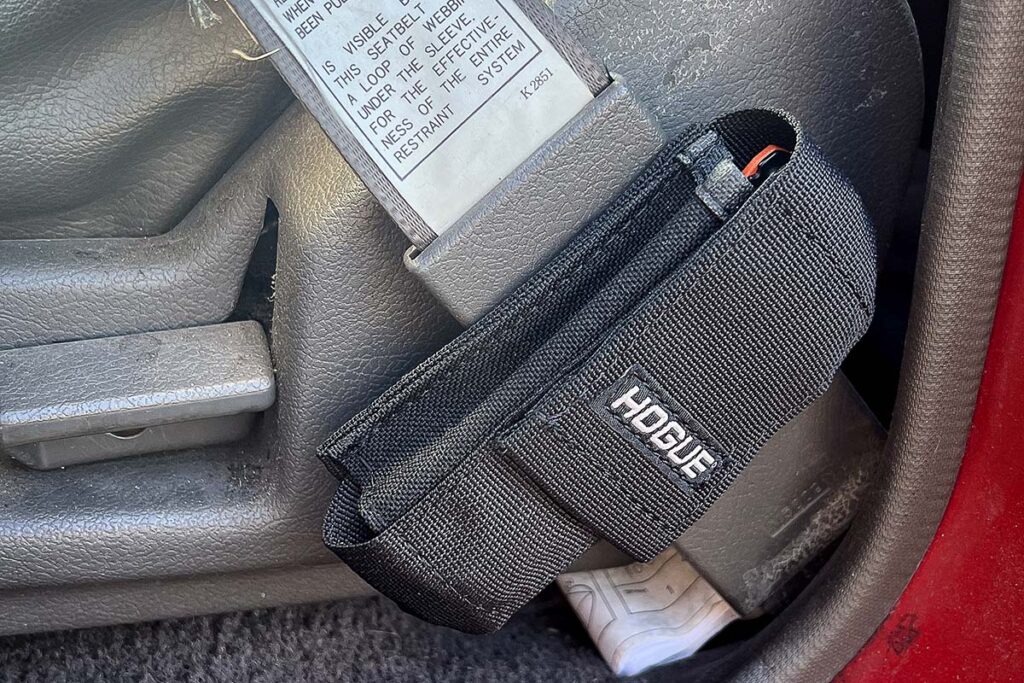
The author keeps his Hogue Trauma rescue folder in the sheath wrapped around the lower portion of the seatbelt anchor in between the seat and door of his truck.
Most assume a glovebox is a safe place and while not a wrong choice, it is a poor one. Why? For one, in an accident your seatbelt may not release because of the tension; in essence, you’re strapped to the driver’s seat and cannot lean over to access the glovebox. Worse, the vehicle could be upside down or on its side. In other words, have the knife placed securely within arm’s length.
I keep a Benchmade Auto Triage inside the sunglass holder in the roof of my car, just above the inside rearview mirror. It is secured shut with a latch so it won’t pop open on impact. I can easily reach it and remove it from the holder with my right hand. In my truck I keep a Hogue Trauma rescue folder in the sheath wrapped around the lower portion of the seatbelt anchor in between the seat and the door. It’s just enough room for me to access the knife with the door shut, and the knife is secured in that position and won’t move.
The worst place to keep the knife is in the center console cupholder. While it’s convenient to access, if you get rear ended or t-boned, the knife will go airborne and land way out of reach. Some vehicles may have a center console storage/armrest in the middle. Yeah, mine in each vehicle is a clutter catchall for receipts and other junk, but it’s another ideal location because the armrest lid latches shut and is within arm’s reach.
We give you an overview of the Crawford Knives Survival Staff. This is a hiking staff that is a very high quality survival system. This staff can be used f…
Top makers explain how they collaborate with knife companies.
The old cliché of the win-win holds a real grain of truth. Any successful partnership must be mutually beneficial, and in the knife industry the phenomenon of the collaboration has come to exemplify the upside of working together.
Years ago, a veteran custom knifemaker described his relationship with a major manufacturer as serving as the company’s research and development department. Such a description is accurate in that the manufacturer often relies on the custom maker for new design inspiration, from good looks to materials and mechanics. The collaboration has emerged in the last 35 years or so as an outstanding means of bringing innovation to the public and putting first-rate knives in the hands of the mass market.
The ins and outs, nuts and bolts, and give and take of the collaboration process raise questions for makers interested in striking deals of their own. A few comments from makers who have achieved great success on the collaboration frontier offer helpful insights.
“It goes both ways,” observed BLADE Magazine Cutlery Hall-of-Fame® member Bob Terzuola, who indicated he completed his firstfactory collaboration with fellow Cutlery Hall-of-Famer Sal Glesser and the design team at Spyderco in 1989. “You can go to the company or the company can come to you depending on your notoriety. If you are just starting out, you probably have to go to the company.”
On the business side of the ledger, Suzi Terzuola takes the lead and has demonstrated proficiency in making the deal work for everyone involved. Her flair for negotiation and finding the right blend of maker-manufacturer cooperation has been demonstrated through the years as Bob has worked not only with Spyderco but also the old Camillus, Boker, Fox, Pro-Tech, Tactile Knife Co. and others.
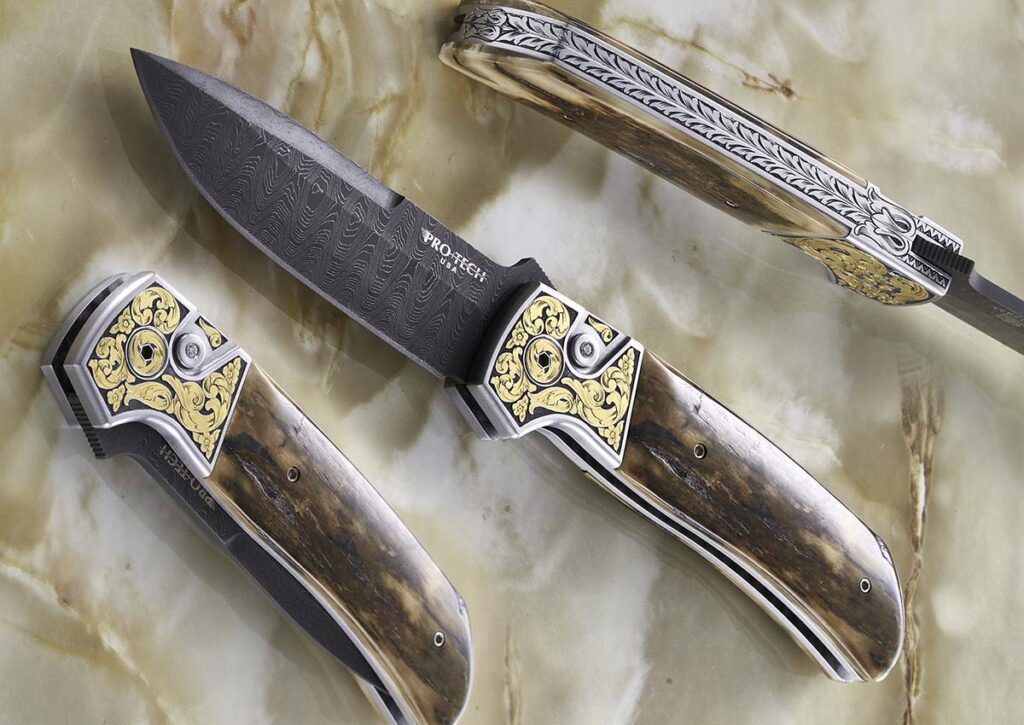
BLADE Magazine Cutlery Hall-of-Fame® member Bob Terzuola has done collaborations with many companies, including the Bob Terzuola ATCF Auto Ultimate from Pro-Tech, the BLADE Magazine 2022 Investor/Collector Knife Of The Year®. (Eric Eggly/PointSeven knife image)
“I was raised by parents with their own successful businesses,” Suzi observed, “and I saw Bob receiving passive income from Spyderco and Camillus, and of course passive income is how you survive after having only so many years to make knives. I began looking at the knife designs Bob had and tried to match the design to the company. Bob has patents lining the walls, and when he lends his name to a knife he should receive a signing bonus and a bonus against the royalties.”
In return for his design skill and the use of his name in promotions, Bob has certainly established himself as a leader among successful custom collaborators. His contribution to a company’s success has enhanced his reputation of excellence across the industry, while Suzi has forged a business posture that results in security for the future.
Knife Collaboration Contracts
The contract is the key component of a collaborative deal, and depending on the circumstances everything is negotiable. Although early agreements made among friends were sometimes done on a handshake, it has become a “best practice” to hammer out the terms of the collaboration on paper, invest in an attorney’s review, and formally memorialize the discussions. Standard royalties run roughly 5 percent of the price at which the company sells the knife.
The Terzuolas include a period of time in which the company is allowed to produce the knife; the period may be extended at maturity with the agreement of both parties. Further, there may be a requirement that the company produces a certain number of knives in a given time period, also renewable. Restrictions on wholesale pricing or discounts that affect royalties may also be negotiated.
For those considering a foray into collaborations, Bob and Suzi offer some advice: “If you’re a new maker, you shouldn’t just walk up to [the company’s] booth at a show. Make an appointment to see them because they are at the show to deal with customers. Approach a company with one or more finished designs. They want a package presented to them, a prototype or existing model, something they can hold in their hands, and in the case of a prototype it’s good to have as many innovations and design creations as you can—anything that will set the knife apart from other potential deals out there.”
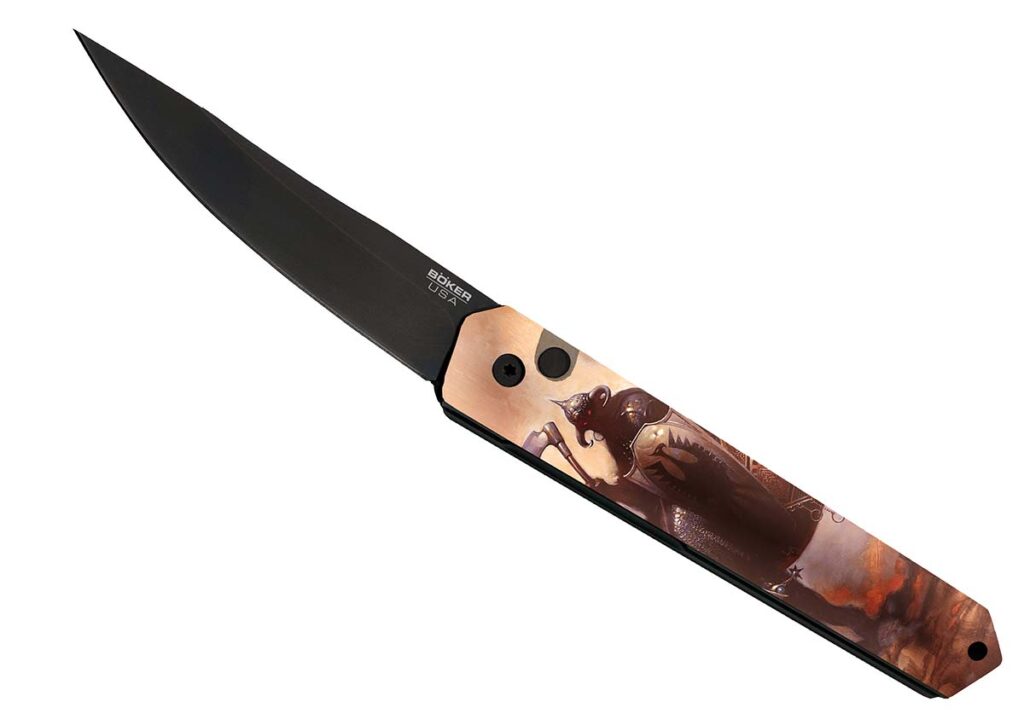
Lucas Burnley has designed several iterations of his Kwaiken for Boker, including the Kwaiken Auto Frazetta.
Suzi added that a higher profile in the industry can drive success.
“We are the R&D for a knife company,” she noted, “and when you approach them for a collaboration your social media resumé is very important.”
Making custom knives since 1994, Darriel Caston has concluded collaborations with numerous companies, including CRKT, Spyderco, Boker, V Nives, Kansept Knives and more.
“I’m prolific when it comes to designs,” he affirmed. “There are probably about 300 that I will never get to making. I’m an engineer by trade and my 3D drawings are almost ready for production, and that helps with the deals. They ask for STEP files [standardized 3D model data files for CAD and 3D printing] that can go right into machining. Sometimes we work with a prototype, and sometimes we work with a knife that I have been doing for quite a while.”
According to Darriel, one significant element of the collaboration is the retention of the rights to the design.
“Anybody who wants to do a collaboration must put footprints in the sand, get their work out there and show a story,” custom knifemaker Darriel Caston observed. One of his latest designs for CRKT is the blacked-out MinimalX framelock folder, an evolution of a knife originally made for SpaceX to commemorate a rocket launch.
“You never want to give up your design,” he warned. “I would license the design to the company usually up to four or five years, and the average is three years. After that, you can discuss if you want to continue if the relationship has been good for both parties. License the design and never sell it. If a company buys the design, then they own it forever. If it became their best seller, I could never make the knife again, and I would have to stay away from anything that looks like it.”
For Caston, every deal starts with a friendly conversation. As progress is made, attorneys draw up the contract. He sees the process as straightforward, whether dealing with an American manufacturer or a company headquartered in a foreign country.
“I find the knife community for the most part to be very honorable,” he commented. “I haven’t run into any bad juju. When you want to do a collaboration, I tell people they need to have a name and a track record of good designs with people following them on social media and stuff.”
Since his first collaboration—with Spyderco in 2015—Darriel can speak with confidence regarding the potential for success.
“It would be rare for someone to take a design to a company without a history or a footprint there. They look for your story,” he noted. “Anybody who wants to do a collaboration must put footprints in the sand, get their work out there and show a story. Then it becomes easier.”
Getting A Collab Off The Ground
Darriel Caston has concluded collaborations with several companies. “I’m prolific when it comes to designs,” he affirmed. “There are probably about 300 that I will never get to making.” Now discontinued, the Squarehead was one of his early collaborations with Spyderco.
Custom maker/U.S. Marine Corps veteran Les George found early collaboration success at the SHOT Show some years back. He approached Pro-Tech a decade ago, and the association has continued since then.
“I had just finished my first batch of VECP [Value Engineering Change Proposal] mid-tech knives,” he remembered, “and I thought it would be cool to see Pro-Tech make the knife in an automatic. So, I did the CAD work to change the knife to an automatic and walked up to their booth at the SHOT Show. I asked to speak to the owner, and Dave Wattenberg came over and shook my hand. I drew a big breath and told him, ‘My name is Les George and I am a knifemaker and I have a design I think would be a great knife for you to make as an auto and I already have the CAD done would you like to see it?’ I said that all as one sentence in one breath!”
Still, a pragmatic view of the collaboration landscape demands preparation and planning. A so-called “cold call” may not meet with success.
“It depends on the company whether a direct approach will work or not,” George conceded. “Don’t walk up to a company at the BLADE Show and tell them you’re a hot maker and they should pay you to make one of your designs. Instead, walk up, introduce yourself, and show them with CAD pictures, a 3D printed model, or a real knife, and tell them why you think it would be awesome to work with them on a production project.”
When it comes to her husband Bob’s collaborations, Suzi Terzuola takes the lead and has demonstrated proficiency in making the deal work for everyone involved. An example of several overseas Terzuola collaborations is the Clap from Italy’s Maniago Knife Makers.
Les sees the components of a particular collaboration deal varying. Of course, some of the structure depends on the negotiating skills of the parties. Commonly, the compensation may revolve around a percentage of dealer or distributor pricing on each unit, and particular deals may extend as long as each party is pleased with the progress.
“Collaborations should run as long as they are profitable,” Les remarked. “Companies don’t generally kill a successful project unless there is a capacity constraint issue or something else outside hindering it. Both parties can end the deal at any time with some allowances for production to finish with the things they have in progress already. Every contract I have ever seen gives one company the rights to exclusively make a particular model. My contracts have a provision that I can make as many customs of my models as I want. In the end, it would be counterproductive to license the same model to multiple companies. The maker would be competing with himself at that point, and it’s not helping the companies.”
Priming The Pump
Award-winning maker Lucas Burnley appreciates the help of friends in establishing a firm footing for collaboration.
“In general, I’m a big fan of pulling on my network,” he said. “If you have someone you can reach out to for an introduction, that’s always a strong move. If you don’t have someone to make an introduction, you might be able to ask around and at least figure out who you need to talk to. Regardless of how you get your foot in the door, I highly recommend going to a knife show and trying to set up a meeting in person.
“A design is only one part of a collaboration,” he continued, “so bring your ‘A’ game and think about what other value you can provide for the company. I was introduced to Boker by Jens Anso and Jesper Voxnaes, and Ken Onion put in a good word for me with Columbia River Knife & Tool. I’ll be forever grateful for those introductions and the relationships behind them. I’ve been able to pay it forward a few times, and hopefully I’ll be able to do it many more times in the years to come.”
Les George’s V14 dagger design for Spartan Blades was the BLADE Magazine 2014 Investor/Collector Knife Of The Year®.
In Burnley’s experience, contracts provide compensation most often in the form of monthly or quarterly royalties based on a percentage of sales. One-time lump sum payments are also seen; however, the income generated depends on the goals of the two parties involved.
“I want my designs to run until my grandkids are old enough to thank me for my good decisions,” he laughed. “If a model is selling, I want it to keep selling. On the flip side, I will routinely ask what models we can kill if they aren’t pulling their weight.
“One caveat here is that if a design is still in production, I want to get paid for it,” he concluded. “Some companies will offer a contract for a set period of time but have the option of continuing to produce the model. I view this as somewhat akin to a one-time payout. If it works for you great; just make sure you are paying attention.”
George specifically limits the number of companies he works with in order to give the relationships the priority he believes they deserve. Consistency, he says, is huge. Real, solid collaborations are not “get-rich-quick schemes.” He remembers getting his first collaboration check in 2014 totaling a whopping $6.
“A design is only one part of a collaboration,” Lucas Burnley observed, “so bring your ‘A’ game and think about what other value you can provide for the company.” His Tuna Compact framelock design for CRKT is one of his latest collaborations. “A design is only one part of a collaboration,” Lucas Burnley observed, “so bring your ‘A’ game and think about what other value you can provide for the company.” His Tuna Compact framelock design for CRKT is one of his latest collaborations.
Times change—and checks change with good business practices, commitment, follow through, and most of all a process from contract to design and product that proves profitable for everyone.
Katz three-blade Stockman Executive Drop Point stacks up against the knives of old school.
Most in my age group were raised with a slip joint knife. It’s the knife Dad always carried in his pocket. Being raised with a dad who was a commercial fisherman, I used knives as tools every day—everything from cleaning fish to making fishing nets.
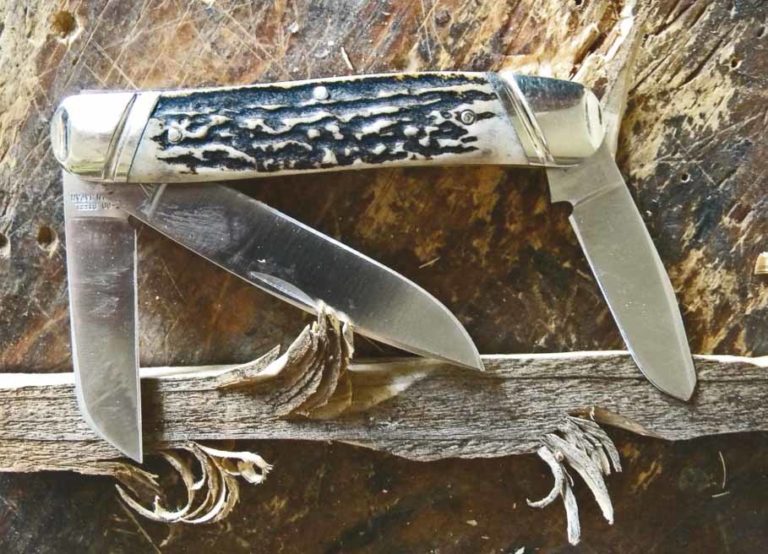
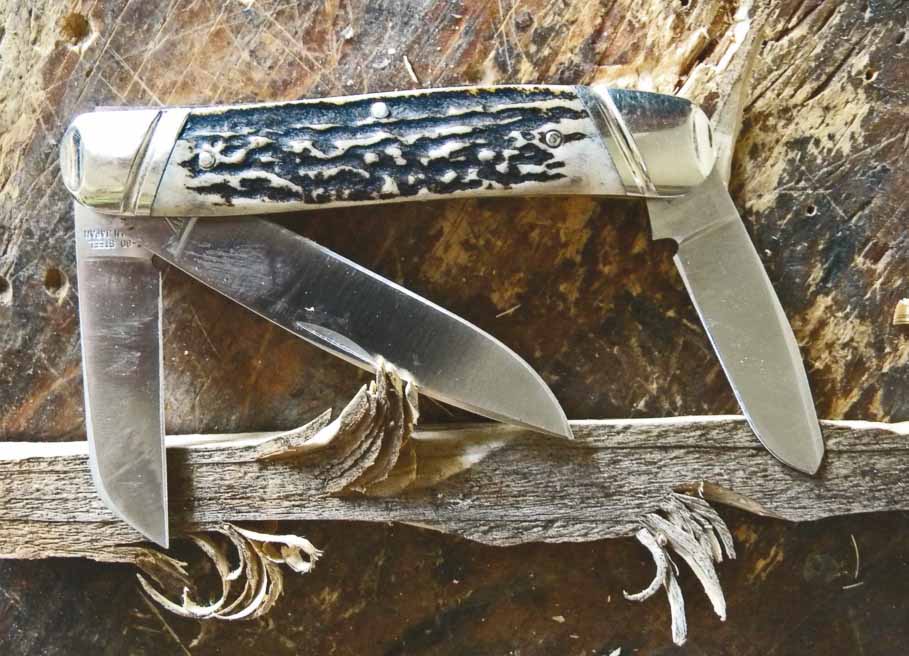
The main blade carved nice curly-cues with great control. The sheepsfoot had a tendency to dig deeper into the pine for thicker curly-cues. The spey was about midway on the curly-cues and depth of cut.
My father, Jacob, always used a three-bladed stockman for working with twine while making or repairing 90-foot trawl nets. It would take him 30 days or more to hand-tie every square in the massive nets. He would always work with the knife’s smallest blade. When it was sharpened down to a nub, he would go to the next blade. The knife would last him five years of heavy work. Then he would put it in his junk drawer and start using a new one. Only carbon steel blades knives were allowed—stainless steel had not evolved to the performance levels of today.
Katz Knives has taken old-school looks and added blades of high-performance XT-80 stainless steel on its Stockman Executive Drop Point. Let’s see if Dad would have approved.
TEST ’EM UP
In a quick sharpness test on 20-pound bond copy paper, all three blades sliced cleanly and smoothly. The shorter blades can be a bit challenging till you get used to them. The sharpening notch/choil caught on the paper during testing.
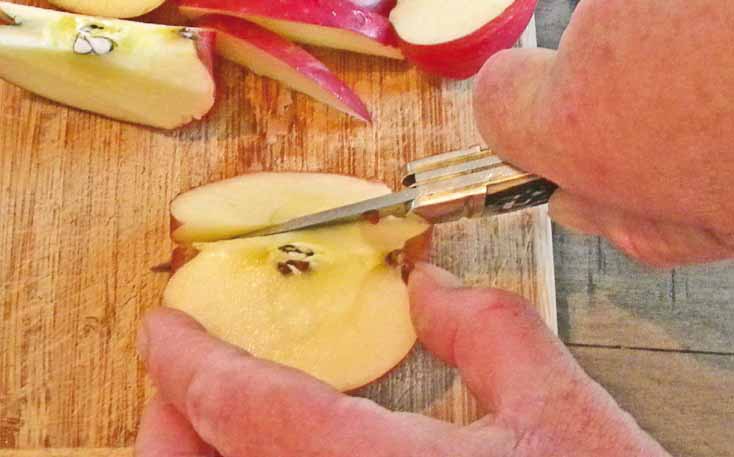
My wife, Melissa, wanted to play with the knife so I got an apple from the fridge for her to slice. The drop-point main/master blade worked great for sectioning the apple into wedges. Next was the sheepsfoot blade for seed removal and skinning the wedges. (The wedges were yummy.)
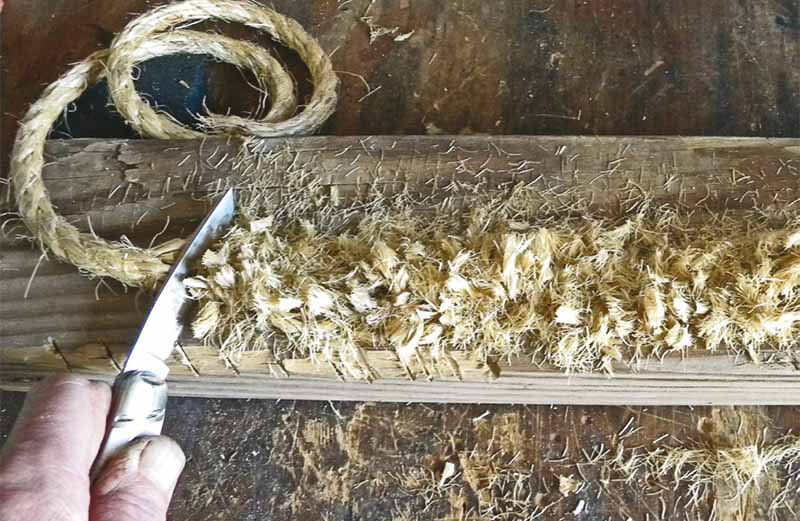
The main blade crunched to 74 clean cuts on the half-inch sisal rope before the edge started to slide.
Single-walled cardboard was next. All blades bit into it aggressively. The cardboard got hung up on the sharpening notches of the two smaller blades while slicing. As a result, I had to slow down the slicing and control the edge placement. The master blade made short work of the cardboard.
It was time to make some firesticks as camping season was in full swing and I needed a fire to roast marshmallows. The master blade gave me nice curly-cues with great control. The sheepsfoot blade had a tendency to dig deeper into the pine for thicker curly-cues. The spey blade was about midway on the curly-cues and depth of cut. SAFETY NOTE: Care must be taken while doing heavy cutting with a slip joint. It does not take much pressure to accidentally close a blade on a finger.
To make kindling from end cuts of a fence, I softly batonned the main blade into the slabs. This worked very well and smoothly with no damage to the blade. Again, care was taken to avoid a blade closing on a finger.
The final test was cutting half-inch sisal rope. Only the main blade was consistent during cutting due to its ample enough length giving me the stand-off needed to make crunching cuts. The XT-80 stainless crunched to 74 clean cuts before the edge started to slide.
Melissa uses the drop-point main blade to cut the apple into nice bite-sized sections.
This knife is well-executed in design and manufacture.
REPORT
Using the stockman was a very nice experience and provided good memories. You have three blades to work with, so you should always have a sharp edge on hand. The Katz is a very welcome addition to your pocket.
CHANGES
I love the straight edge of a sheepsfoot blade. I would add a midsize wharncliffe blade instead of the smaller spey.
Stockman Executive Drop Point Specs Company: Katz Knives Blade Lengths/Patterns: 23∕4” drop point, 23∕16” sheepsfoot & 2” spey Blade Steel: XT-80 stainless Handel: Stag bone Bolsters: Nickel silver Liners: Brass Weight: 2 ozs. Closed Length: 3.75” Country Of Origin: Japan MSRP: $181.90
To learn more about the Stockman Executive, please visit katzknives.com




![Best Rescue Knives [Field Tested]](https://blademag.com/wp-content/uploads/Rescue-Knife-9-768x512.jpg "Best Rescue Knives [Field Tested]")