Home Authors Posts by BLADE Staff

BLADE Staff

Slip Joint Knife: Best Modern Takes On The Classic Design

The slip joint knife endures as a time-tested design, perfect as an everyday pocket companion. Here we look at some of the best modern takes on the classic style of knife.

The slip joint is perhaps the most recognized form of folding knife. Chances are you started your knife collecting journey by buying some sort of slip joint, such as a Swiss Army knife or other multi-blade.

Slip joints have been on the comeback trail for some time now, with an increasing number of factory knife companies offering new examples of the tried-and-true design. This is good for the entire slip-joint genre, as novice collectors discover, and veteran ones rediscover, their love for the classic traditional folders.

CRKT Venandi

CRKT and custom knifemaker Richard Rogers have a few factory collaborations under their belts. Richard’s distinct style lends to knives with both a signature-refined appearance and a high level of usability. He mainly makes higher-end custom knives, and his work is sought by discerning collectors.

CRKT’s newest Rogers collaboration is the Venandi, a single-blade trapper featuring a 3-inch 

blade in a modified clip-point pattern and 8Cr13MoV stainless steel. The handle is a brown-and-black G-10, and the contour brings out the woodgrain-style layers for an exciting visual pop. The triangular-shaped bolts and pivot bolt provide a distinctive touch of class, and the bomb shield is a nice touch.

Despite being a larger slip joint, at 1.8 ounces the knife is lightweight and rides comfortably inside a pocket or next to your wallet. The blade’s pull is a bit stiff and that’s on purpose. There is a half-stop, in which the blade pauses midway through opening and closing cycles. A large nail nick assists in opening. A hollow grind and a bit of a swedge dress up the blade’s appearance.

The Venandi is stylish and functional. It’s a knife you can carry when dressed up for church or the office, tackling home improvement projects, or doing yardwork. Out of the box, the blade is centered and the action is crisp. 

My only complaint is the lack of a hole to attach a lanyard for grabbing at the top of the pocket for easier knife access. With an MSRP of $49.99 and made in China, the Venandi is a highly functional custom-designed folder that won’t break the budget—and it’s really good looking to boot.

Spyderco Lil Native Slipit

With optimized ergonomics for enhanced cutting performance, the Spyderco Lil Native Slipit is a compact folder that feels larger in the hand than you might think. Of course, this is no surprise as Spyderco is the master of ergonomics for smaller knives, the result being an extremely comfortable user experience. 

The Slipit line of slip joints offers traditional Spyderco performance for jurisdictions—most of which are overseas—that ban lockblade folders. The company’s Native locking folders have been great sellers, and it makes sense to offer the design in a Slipit version, too.

The Lil Native Slipit’s 2.4-inch blade is CPM S30V stainless steel, well known for its edge-holding power, and features Spyderco’s signature leaf shape. A full flat grind thins the cutting edge out nicely, enabling the knife to sail through a variety of materials quickly and efficiently. 

The handle is peel-ply G-10 in a texture that provides enough traction without being overly aggressive. In an open length just shy of six inches, the folder is big enough to complete most daily cutting chores.

The action is extremely smooth thanks to bronze washers and a full polished tang, allowing the blade’s spring to glide effortlessly over the surface while opening and closing. Since the Lil Native isn’t a traditional slip joint, Spyderco uses a notched joint in the tang to allow the backsprings to firmly seat to hold the blade open. 

To close, applying pressure to the blade spine generates enough force to overcome the notched joint and thus allows the blade to rotate closed. The action is akin to a lockback folder—firm yet smooth. The blade hole allows you to open and close the folder easily with one hand as you would with any of the company’s lockblade models—a rarity for a slip joint. A steel pocket clip mounts in one of four configurations for carrying the Lil Native Slipit most any way you desire. 

Made in the USA, the MSRP is $198.

Boker Barlow Prime EDC

The barlow is a classic pocketknife pattern many workingmen know. It’s a simple design that holds up well to a variety of slicing chores. Through the years many companies have offered their own versions of the pattern, and the Boker Barlow Prime EDC is one of the latest iterations.

Featuring an old-school design executed with modern materials, the knife has a 2.4-inch spear-point blade ground from N690 stainless steel and a satin finish. Action is smooth opening and closing. There’s also a nice half-stop.

The handle is black canvas Micarta® with a smooth polished finish that is a touchy-feely delight. Even the pins are flush with the grip surface. The handle is linerless, which helps save weight and reduce thickness. The contoured handle allows the Barlow Prime EDC to both feel terrific and ride comfortably in a pocket. Speaking of which, the knife almost disappears in the bottom of one.

Weighing in at 1.23 ounces, the Boker makes a great EDC knife. It is perfect for those who do not like bulk when carrying a pocketknife. It takes on small, mundane daily cutting tasks with ease—opening mail and boxes, packs of crackers, pesky clamshell packages, etc. It’s small enough to not attract unwanted attention. For those who like single-blade slip joints for daily carry, add this one to your list. 

Made in Germany, the Boker Barlow Prime EDC has an MSRP of $185.95.

LionSteel JKCF Jack

And now, for something a bit different—the LionSteel JK3CF Jack.  LionSteel’s slip joints are a departure from the norm since they have nothing but high-end materials in their construction. The JK3CF is a perfect example. Taking the traditional jackknife and putting its spin on it, LionSteel offers the knife in three configurations.

The JK3CF has all the boxes checked. It has a main blade, a screwdriver/bottle opener combo tool, and a corkscrew. The handle is carbon fiber with titanium bolsters and liners. The 3-inch main blade is a traditional clip point with a swedge. Premium M390 stainless steel provides the ultimate in edge holding. Normally M390 is reserved for tactical knives, and this might be a rare occasion that it’s used on a slip joint. 

The ambidextrous long blade pulls allow quick and easy deployment. The screwdriver/bottle opener also has matching long pulls. Everything fits up on the JK3CF, including excellent craftsmanship and smooth action of the blades. The spring tension is firm and does a great job holding the blades open.

A couple of things on this one I particularly like are not commonly found on slip joints. First is the use of Torx fasteners throughout. The scales are secured by the fasteners, as well as the pivot. 

Second is the crowning (rounding) of the exposed edges of the liners, backsprings, and blade spines. The extra touch provides a lot of visual pop. Not every manufacturer takes the time and effort to crown the edges, so when you see a knife that has it done, it stands out even more—and I really dig it. You can tell LionSteel took extra measures for the knife’s aesthetics.

The flat grind allows the blade to sever various materials easily, and the M390 won’t give up when other steels do. It is in it for the long haul. The handle width is perfect for use as a thumb rest to apply pressure to the blade. There’s something about using a high-end production knife made with premium materials. 

The JK3CF is meant to be used, so go ahead and use it with confidence. M390 is one of my favorite go-to steels when I need the ultimate in edge holding. The blade shape is conducive to work. The flat grind cuts a variety of tough materials easily and the defined tip is a good scoring tool. 

Made in Italy, the JK3CF has an MSRP of $225, which arguably is fairly steep for a production slip joint. But remember, it uses titanium and a premium blade steel.

SOG Terminus SJ

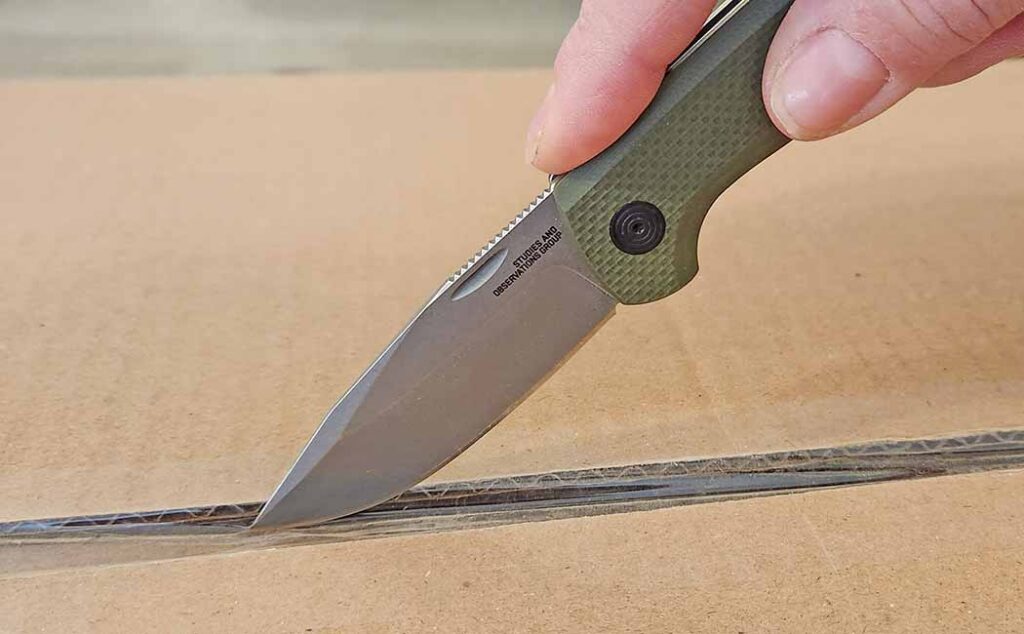
SOG Terminus slip joint
The overall looks of the SOG Terminus might easily fool you into thinking it’s a modern linerlock.

I’ve had a hit-and-miss relationship with SOG’s folders over the years. Some I’ve liked the looks of and others not so much. Some were dead-solid users, some not so much. In the Terminus, SOG provides both a solid user and an attractive knife—you know, like that girlfriend you get along with and are OK being seen with in public.

The folder has a very modern appearance. It sports a set of textured G-10 scales in OD green. The blade is saber-ground CRYO D2 tool steel and has a false edge. For those who prefer a more contemporary look you have it in the Terminus, and you don’t sacrifice utility for aesthetics.

Right off the bat the edge cut well, but just for the heck of it I gave it a good stropping and took it up a level or two. Though not heavily contoured, the grip is comfortable and provides nimble control. SOG offers a nice, genuine user in the Terminus and at a reasonable price so you can put it to work without making it a safe queen.

Hinderer XM-18 Slippy

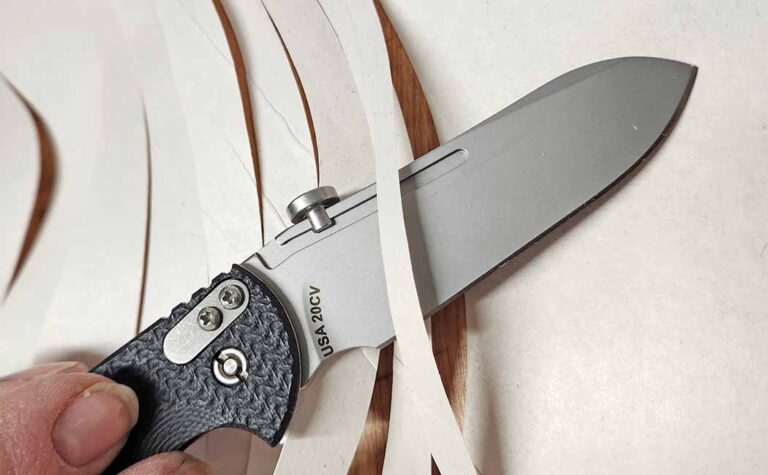
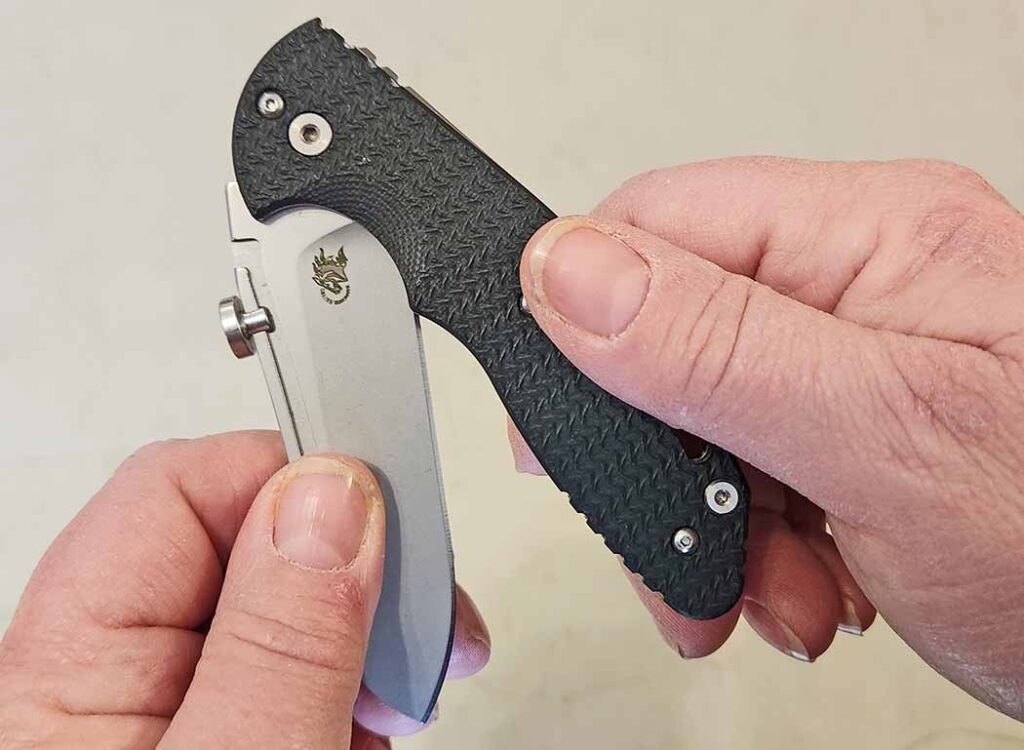
XM-18 Slippy Slip Joint Opening
Though you can use the movable/sliding thumb disc of the XM-18 Slippy from Rick Hinderer Knives for one-hand opening, the author preferred simply using the long notch to open the blade.

Nothing quite says modern like a knife name that sounds like a football play. With the XM-18 Slippy slip joint, Rick Hinderer Knives executes a pocketknife design but adds Rick’s own special spin to it. At first glance you would think it is a contemporary linerlock folder. The spring system is tight to help prevent accidental blade closure. A heavy spring also makes it a bit challenging to open for me—so much so I prefer opening it with two hands rather than using the innovative thumb disc design. I just can’t seem to get an angle to easily allow me to overcome the spring tension. Hinderer has devised a design that allows you to move the thumb disc along the groove so you can find the best leverage point for your needs. My thumb is so large I can’t quite get it between the knife body and the disc.

The blade is a saber-ground sheepsfoot pattern of CPM 20V stainless steel. With a tip below center, it makes utility-style cuts simple. A pocket clip with a raised tip has no difficulty locking on a pocket rim. I had no issues while testing the XM-18 Slippy. It did everything you might ask it to do in daily life. It’s also a sturdy enough build that you can lean on it for tougher jobs.

Kershaw Zero Tolerance 0235

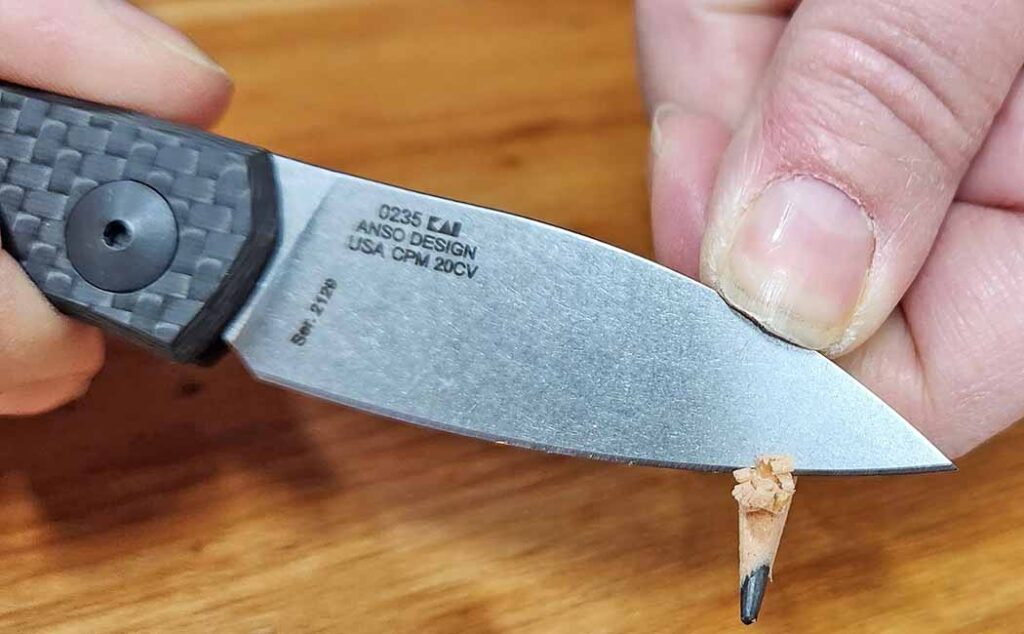
ZT sharpening pencil
There is nothing like a thin ground blade like that of the ZT 0235 to get a wicked edge on a knife. Such a blade can make shavings so thin you can almost see through them.

Carbon-fiber scales give the 0235 by Zero Tolerance (ZT) an up-to-date look as well as the appearance of a trim, lightweight package. An open-frame body structure eases the job of keeping the Jens Anso design free of pocket lint. The spear-point blade of CPM 20CV boasts a full flat grind. A reversible saber-style pocket clip provides deep pocket carry. The clip is one of my disappointments as it’s rather small and doesn’t trap most pant pocket rims well. It’s a tight fit once on a pocket, which tends to make a smooth withdrawal with my bear-paw hands difficult.

The lanyard loop on the back of the handle tends to be a European thing in my eyes, and I wouldn’t necessarily use it given its location on the knife. You can’t put it at the back because of the clip position, but nothing is stopping you from running a cord or a chain through the clip.

Thanks to a detent ball system, the blade holds open both fully and also in the half-stop position. Once the detents disengage, the blade is freewheeling. On a backspring system the tension on the blade is constant and restricts the blade from moving freely. If enough pressure is applied to break the detents free, you’ll have a blade with no resistance to it, which worries me a bit.

The knife is on the small side and works well but the lightweight feel can be a bit deceiving—especially if you equate heft with durability. Handling is no problem but, due to the lack of mass, you can feel the strain of heavier cuts through the handle. I would classify the 0235 as a gentleman’s knife given the crisp presentation with the carbon fiber—well suited for small everyday chores while acting as a showpiece.

Editor’s Note: Abe Elias and Dexter Ewing contributed to this post.

Check Out More Buyer’s Guides:

Cool Customs: Kurt Swearingen’s Buffalo Hunter Set

From One-Day Course To One-Of-A-Kind Knives, Kurt Swearingen’s Buffalo Hunter Set Shows How Quickly The Knifemaker Has Honed His Craft

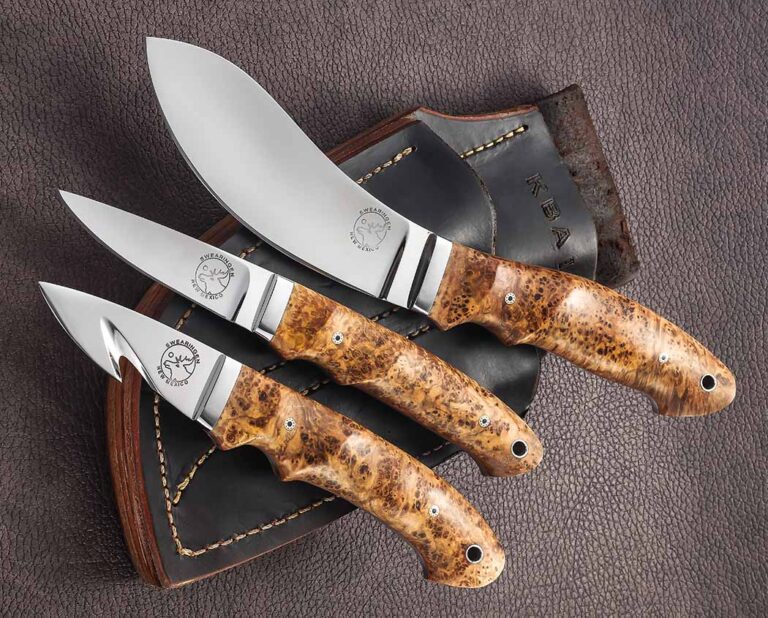
ABS Journeyman Smith/Knifemakers’ Guild member Kurt Swearingen went with tradition and what works in his three-piece buffalo hunter set.

Made for North American big game, the set includes a Green River-type skinner, caper, and gut hook in CPM 154 stainless steel blades and black ash burl grips. Kurt based the design on a similar set he’d seen from the 1800s. He chose CPM 154 because that’s what he uses on his fixed-blade hunting knives and the ash because it’s a wood native to the Great Plains, home of the American bison. 

He made the sheath from three layers of stacked 9-ounce leather with two layers of welts. The sheathed set weighs 2-3 pounds so he hollow ground the blades and outfitted them with bolsters instead of guards to save on weight and size. The set wears on a belt, though Kurt modified it so you can string it on a pack or a saddle.

Who Is Kurt Swearingen?

Kurt Swearingen

Swearingen’s knifemaking journey began back in 2007 after taking a one-day class. From there he learned from one of the all-time greats, Lin Rhea, who helped him to perfect forging and heat treating techniques that have helped make his knives stand out from the pack.

Just seven years after that course that started it all, Swearingen earned the rank of journeyman smith. Today he specializes in hunting and camp knives of all types.

Buffalo Hunter Set Specs

Model: Buffalo Hunter Set
Maker: Kurt Swearingen
Patterns: Green River skinner, caper and gut hook
Blade lengths: 4.75 inches, 3 inches, and 2.75 inches
Blade steel: CPM 154 stainless
Handle material: Black ash burl
Sheath: Three layers of 9-ounce stacked leather
Maker’s price for a similar set: $1,850

Read More

Cool Customs: Isaiah Schroeder’s Gyuto

Isaiah Schroeder’s Gyuto Comes In A Spectacular Damascus Pattern And Showcases The Maker’s Skill.

Isaiah Schroeder considers his gyuto the best knife he’s made, and the blade’s electrifying stainless damascus pattern and the ergonomic handle make it hard to argue the point.

Of the blade Isaiah said, “It’s a pretty simple pattern, one I’ve done in carbon steel quite a bit. A low-layer lazy twist is what I call it.” It consists of only 11 or so alternating layers that he twists three or four times. “That’s pretty much all it is,” he observed. “I love the way it turns out with the bold layer lines and everything. It looks kind of topographical and I always like that.” The darker steel is AEB-L stainless and the lighter parts are 154CM stainless.

He said the convex blade grind works great for food release. He is especially proud of the look and feel of his thin handle design that includes silver fittings done in the lost-wax-casting method. Combined with the 1/8-inch-thick blade, he said it’s, “Thin to win for a kitchen knife.”

A full-time knifemaker based in Madison, Wisconsin, Schroeder makes kitchen knives of all types in the Japanese style including a sujihiki, a long knife made for fine slicing of meats, fish, and precisely cutting through sinew. He also makes a petty knife as well in damascus. 

Gyuto Knife Specs
Pattern: Gyuto Japanese chef’s knife
Blade length: 9.44 inches
Blade material: Low-layer lazy twist damascus of AEB-L and 154CM stainless steels
Blade grind: Convex
Handle material: African blackwood
Fittings: Fine silver (2 ozs. worth)
Overall length: 14.44 inches
Maker’s price for a similar knife: $2,000
Knife to know: Isaiah is a full-time knifemaker

Read More

Cool Customs: Joe Mangiafico’s Trout Knives

Inspired By His Time Fly Fishing In The Pacific Northwest, Joe Mangiafico’s Trout Knives Are Durable, Eye-Catching Tools.

Joe Mangiafico’s trout knives not only are built to use but are cool and colorful to boot.

The 28-year-old Massachusetts maker acid etched the flat areas of the blades for a damascus look, yet it’s the handles and sheaths that really stand out. 

The grips are structural mosaics of G-10, brass, and copper. For instance, the blue haloed red center pins of the model with the green handle are inlaid plugs, and the brass pins are press fit and epoxied all the way through. He designed the Kydex sheaths with centered pocket clips to attach to your pocket or waders while fishing. The red-banded model is inspired by the redband trout Joe fly fishes for in the Deschutes River Valley of central Oregon.

Who Is Joe Mangiafico

Joe Mangiafico

Mangiafico began making knives while still a college student several years ago. Joe makes his knives in his shop in Cotuit, on the southern coast of Cape Cod. While the majority of his work is custom knives, he does have a factory collaboration with the German company Boker Knives. His Brook fixed blade is made from VG-10 steel and, like his trout knives, showcases his deft ability to craft an eye-popping handle. It retails for $156.95 and can be found on Boker’s website.

Trout Knife Specs
Model names: Brook Trout, Brown Trout and Rainbow Trout
Knife type: Trout knife
Blade lengths: 3 inches
Blade steel: Nitro V stainless
Blade grinds: Flat
Handle materials: G-10, copper and brass
Bolster materials: Brass, Micarta® and mokume gané
Overall lengths: 6.5 inches
Sheaths: Kydex
Maker’s price for similar knives: $375 each

Read More

Cool Customs: John Thunert’s Capemaster

0

Utilizing Steel From An Iraqi Tank, John Thunert’s Capemaster Is A Skinner Built On The Foundation Of A Caping Knife.

When John Thunert learned an acquaintance had some spare steel from an Iraqi tank, he jumped at the chance to buy some of it and forge it in the damascus of his Capemaster skinner.

Strips of steel 3×3 inches and 4×4 inches, each 3/16-inch thick, were torch cut from the armored vehicle, which was stored in a “tank graveyard” in Iraq. John cleaned the steel up, including removing some paint. He also got a copy of the form his friend had to fill out on the steel as a “war trophy,” which is how he was able to legally ship the steel stateside. “It kinda gives me some bona fides,” John noted.

Capemaster Knife

He said an analysis of the material identified it as a very pure form of mild steel containing 99 percent iron and few impurities. Though the knife started out as a caper, it kept “growing” until it became a skinner, but John kept the caper name. The handle is quilted poplar with pins of a subdued coyote brown G-10 to match the liners.

Who Is John Thunert?

John has been making knives since 2017 and has competed on The History Channel’s Forged In Fire show. He sells more than a dozen varieties of his Capemaster knife on his website, with the majority made from exclusively 80CrV2 steel. The majority of his Capemasters retail for $245.He has also made Bowie knives as well as multiple types of kitchen knives.

Capemaster Knife Specs
Blade Length: 4.75 inches
Blade Grind: Flat
Blade Steel: 80CrV2/1095/15N20/Iraqi tank steels
Overall Length: 9.25 inches
Handle Material: Quilted Poplar with Coyote Brown G-10
Price Of A Similar Knife: $625

Read More

Best Bushcraft Knife: When Steel Meets The Woods (2023)

Be it chopping wood or prepping a meal, a solid bushcraft knife is an essential piece of backwoods kit.

Bushcraft is a specialized skill set that ensures survival in the wilderness using foraging, hunting, fishing, shelter construction, and firecraft, all accomplished with minimal tools. The primary bushcraft implement is a fixed blade employed not only for food prep but the other mentioned skills, too. 

As a result, such a fixed blade must be a tough tool capable of more than just standard cutting tasks, including whittling, carving, splitting wood or, in conjunction with a ferrocerium rod, starting a campfire.

What Defines A Bushcraft Knife?

Five basic chores of outdoor survival can be performed with a bushcraft knife. The tasks are elemental and a must-learn if you want to use a bushcraft knife to maximum effect.

  • Chopping
  • Batoning
  • Carving
  • Fire Starting
  • Food Prep

Chopping

Whereas a small hatchet, ax, or even a machete are better suited for the task, a bushcraft knife can turn the trick. Grip the handle as far back and as securely as you can, and chop as you would with a larger knife, ax, hatchet or machete.

Batoning

Basically, to baton a piece of kindling is to split it. Take a rather large/thick piece of wood to act as a baton/hammer in one hand, lay the blade edge on the end of the secured piece of kindling with the other, and, using firm, deliberate blows, pound the blade lengthwise through the kindling, effectively splitting it.

Again, an ax, hatchet or even a folding saw would be better, but if you lack any of these, your bushcraft knife is capable of handling such a task.

Carving

One of the most important bushcraft skills is to carve bowls, spoons, or even whittling sticks to roast hot dogs. Chopping and batoning are tasks using brute force; carving is more finesse and control.

This can be accomplished by using the knife and a ferrocerium (aka ferro) rod. The job is best done by using a knife that has a blade with a 90-degree spine as opposed to a chamfered or radiused one.

Grasp the knife firmly, cutting edge up. Lay the corner of the blade spine on the ferro rod and with one swift, downward motion, as if you are whittling o a piece of the rod, move the blade down it. Doing so will result in a white hot shower of sparks. The sparks can ignite tinder to start a fire.

The key to fire starting is always select a bushcraft knife with a 90-degree spine. If it lacks such a spine, you can always use the edge but this will dull the one spot on the edge faster than standard cutting will.

Food Prep

And, obviously, a bushcraft blade can also adeptly handle any cutting task related to food or campsite prep. Bushcraft knives prove a knife need not have sheer size and weight to be effective. It’s all in smart design of the blade and handle.

Our Picks For Best Bushcraft Knife

Boker Magnum Life Knife

Boker-A1-knive
Boker Magnum Life Knife

The most affordable bushcraft model of the test bunch, the Boker Magnum Life Knife has a 3.9-inch blade of 440A stainless steel in a modified clip-point pattern. Built rugged for the outdoors, the knife comes with a sturdy Kydex sheath for safe carry.

At 7.87 inches overall, the Life Knife sports a handle of machined black G-10 in a coarse crosshatched checkering pattern for enhanced hand traction regardless of conditions. The grooves in the crosshatching work are similar to those of a radial car tire by displacing moisture. Red fiber liners under the G-10 add a nice pop of color to an otherwise dark knife. 

The handle includes integral forward and rear guards to prevent your hand from sliding in either direction. The three large traction notches in the thumb rest area of the blade spine also help improve grip. The handle felt a bit skinny in my hand, so I would prefer a slightly wider one. 

Conversely, the Life Knife might be a great choice for those with smaller paws. The 3.9-inch blade is a great size for belt carry. The rather compact nature allows it to carry comfortably, with the length neither too long nor too short. The short blade tip accomplishes precise cutting chores easily.

The sheath is a simple fold-over design of Kydex with a Boker Plus clip for belt carry. The sheath features quality construction, retains the knife well, and is simple yet effective. 

MSRP: $59.95

Condor Tool & Knife Bushcraft Bliss

Condor Tool & Knife Bushcraft Bliss

Composed of high-quality materials, the Bushcraft Bliss from Condor Tool & Knife boasts a 5-inch blade with a flat grind. The 1075 carbon steel can be rather easy to sharpen in the field and still retains an edge well. The modified clip point shape offers a generous belly for slicing and a defined point. A swedge gives the blade a bit of attitude, and bead-blasted flats and satin-finished bevels provide a two-tone finish that’s very eye-catching.

The ergonomic handle of red linen Micarta® is an excellent choice thanks to its being largely impervious to temperature and humidity changes. Three thong tubes fasten the scales to the full tang. Three large notches at the spine permit non-slip thumb placement so you can bear down on the blade. With its rounded edges, choil, and scale contouring, the handle felt as if it were molded to my hand.

The sheath is Condor’s hybrid molded Kydex and leather rig, an unusual material combo. The belt loop and securement strap are leather. The leather belt loop allows the sheath to move somewhat, unlike the more rigid molded clamshell fastener—which doesn’t—and makes it easier to sit down while wearing it. A thumb break molded into the top of the sheath assists in extracting the blade, which is a nice extra touch.

I found the handle to be very comfortable. A distinctive trait is the prominently elevated traction notches. They almost look like part of a gear. The feature ensures your thumb isn’t going anywhere. 

The 5-inch blade makes baton work easy, as well as food prep tasks. Out of the box, the 1075 carbon steel was plenty sharp and ready for use. The Bushcraft Bliss is a consistent performer. 

MSRP: $118

TOPS Knives Brakimo

TOPS Knives Brakimo Bushcraft Knife
TOPS Knives Brakimo

Joe Flowers runs Bushcraft Global, where he instructs students on basic and advanced survival skills while in the Amazon jungle. A notable authority in the field, he also designs knives, including the Brakimo from TOPS Knives, a tool that can carve, cut, split, and perform just about any task involving outdoor survival.  

The 5.25-inch blade of 1095 carbon steel is a drop-point pattern with a Scandi grind. It has a generous belly for easy slicing and a defined point for delicate work.

The green Micarta handle is ideal for bushcraft given its stability and minimal weight. It is matte-finished for a nice grip quality without being overly aggressive. The integral front and rear guards provide a measure of safety that locks the knife in the hand. The divot in the handle is for use with a bow drill for making fire. 

If there is a solid all-around performer of the test bunch, it’s the Brakimo. I like how it easily handles heavy work like chopping and baton work, as well as such lighter work as whittling and food prep. You can choke up on the handle for tasks requiring more control where a slicing or rocking motion is used. Grip the handle more toward the rear and feel how the balance point shifts to a blade-heavy profile for easy, effective chopping. 

The Scandi grind acts as a wedge and splits the wood in a snap, almost as if no effort were invested—very impressive performance! For one knife that does it all, the Brakimo is it. In-hand it feels substantial and capable of taking on serious work. 

MSRP: $225

Spyderco FB42G Zoomer

Spyderco FB42G Zoomer

Designed by Tony Zoomer, an outdoor enthusiast and survival skills instructor from the Netherlands comes the Spyderco FB42G Zoomer. Made of high-end materials, the knife is expertly configured and has a list of features that quite possibly makes it the most comfortable bushcraft knife you’ll use.

The 5-inch blade in a drop-point pattern is premium CPM 20CV stainless steel for enhanced edge retention. The blade has an ample belly for slicing and whittling/carving tasks and a defined point for close-up detail work. The full flat grind transitions to a convex edge, which is durable and extremely sharp.

The black G-10 scales are machined where they join the tang, so the handle is completely rounded in profile. This translates into a super comfortable grip that eliminates hot spots. An integrated rest at the blade spine permits placement of your thumb for additional pressure on cuts and for added control. The full tang extends a little beyond the end of the handle for use as a light-duty hammer.

The sheath is a custom-designed, well made leather drop-leg-style rig with a free-floating belt loop. It has an exterior storage pouch with a snap closure. The pouch can carry your choice of survival supplies, a large folding knife, a multi-tool, etc. 

The free-floating belt loop allows the knife to swing freely as you move or pivot out of the way when you are seated. It also can temporarily break away in the event the sheath gets snagged by brush in the woods. 

The Zoomer is a solid performer. The heavily contoured G-10 handle feels mighty good in the hand. The full flat grind allows the blade to sail through whatever you cut.

While the handle is comfortable, it felt big in my hand. Those with smaller hands might not take to it easily. While using high-performance CPM 20CV stainless steel is not typically a bushcraft thing, with some regular stropping and honing, you can prolong the edge and skip sharpening during your trip.

MSRP: $600

Fallkniven S1 Pro Forest Knife

Fallkniven survival knife review
The Fallkniven S1 Pro Forest did fine work—as on this fish spear—with full control. (All images by Ash Ayres and Mary Lou Ayres)

Fallkniven’s S1 Pro Forest Knife is the evolutionary descendant of the company’s S1, which has been in production for over 20 years. The Pro version is made with better steel than the original S1, is more sophisticated and a better performer.

The S1 Pro simply does everything well and with no fuss. Its convex grind does not bind in deep cuts, goes through tough, knotty wood with little effort, peels bark, makes feather sticks, does fine work as on fish spear points with full control, and slices duck through skin, meat and bone like Luke Skywalker’s lightsaber. It cut through 2-inch-thick saplings in about a minute with little effort. The non-slip grip is comfortable and does not, in fact, slip.

Compact enough to always have on—or with a custom sheath, inside—your belt, the S1 Pro is as close as I’ve seen to the mythical “one knife to do it all.”

MSRP: $466

Ontario Bushcraft Woodsman

Woodsman Bushcraft Knife
Bushcrafting chopping The geometry of the Bushcraft Woodsman’s blade, combined with the overall design, good steel and heat treat, make for an exceptional big knife.

Veteran bladesmith Dan Maragni designed this issue’s cover knife, the Ontario Bushcraft Woodsman. The big blade shows his expertise and lineage as an accomplished smith, and is far more sophisticated than a first glance might suggest.

The distal taper gives it excellent balance, and, combined with the taper from spine to edge, great chopping ability.

We slashed through 2-inch-thick saplings with a single swipe, an important point in the calories-expended-vs.-results-achieved equation, and when night is falling and you need to get a fire going.

The blade’s geometry, combined with the overall design, good steel and heat treat, make for an exceptional big knife. Again referencing Tolkien, Ash called it the “Goblin Cleaver.”

Not as handy for fine work as the smaller knives, Dan’s design is a reassuring blade to have by your side in deep woods when the jackals are howling—or the Orcs.

MSRP: $137

Larry Roberts Signature Edition Gen6 Scandi (L.T. Wright Handcrafted Knife Co.)

Scandi grind bushcraft knife
Due to its scandi grind, which tends to hang up in deep cuts, an average of three minutes was required to get through 2-inch-thick saplings with the Gen6 Scandi.

The Larry Roberts Signature Edition Gen6 Scandi from L.T. Wright Handcrafted Knife Co. performs like a “Mora on steroids,” according to Ash. I agree.

If you’re familiar with the scandi grind, the only surprise with the LRSEG6S is that it takes scandi-ground blades to a higher level of performance. It excels at controlled shallow cuts, holds an edge well, and is strong enough that when batonning you can twist the blade with no worries and quickly pop the batonned material apart.

I like the longer 6-inch blade much better than the popular 4-inch pattern because you can get more stuff done faster and at no penalty to doing fine work. Due to the scandi grind, which tends to hang up in deep cuts, an average of three minutes was required to get through 2-inch-thick saplings.

Comfortable in the hand, it is also beautifully made and finished. A good all-around performer, it is a classic belt knife for the woods.

MSRP: $253

Editor’s Note: Dexter Ewing and James Ayres contributed to this post.

Read More

Cool Customs: Matt Williams’ BBQ Chef’s Knife

A Woodworker By Trade, Matt Williams Crafts Knives Meant For Rugged Use, Including His BBQ Chef’s Knife.

A woodworker by profession that includes making cutting boards, Matt Williams got into knifemaking too and is glad he did because of the feedback he gets from customers. His BBQ Chef’s Knife is a case in point.

His clients told him his chef’s knives were too thin, especially the local Texas barbecue chefs who need thick, tough blades for separating ribs and joints in competitive barbecue events. As a result, he built the BBQ Chef’s Knife on a santoku cutting base with a thicker blade and a “really aggressive feel” built to take abuse.

Matt Williams

Matt lives on an old pecan orchard by the Colorado River and stabilizes and spalts the pecan for his turned-wood handles. The handle for his BBQ model is done in a wa style split down the middle with round dowels of white oak left proud to contrast with the darker pecan. He also forged the steel and made pretty much everything but the coffee for the blade etch. 

The combination of his new-style chef’s knives and cutting boards is just the ticket for the highly competitive local Texas barbecue chefs. Along with his custom knife work, Williams also makes one-of-a-kind cutting boards as well that he sells through his website.

BBQ Chef’s Knife Specs
Blade Length: 9 inches
Blade Material: 400-layer damascus of 15N20 nickel alloy and 1084 carbon steels
Hande Material: Spalted pecan, cedar elm and white oak
Handle Style: Wa
Overall Length: 15 inches
Knife To Know: The blade tapers from .169 of an inch at the thickest point to .05 of an inch at the thinnest point
Maker’s Price For A Similar Piece: $750

Read More

Advertisement

Must Read Articles

Read this before you make a knife

Knifemaking 101 – Read This Before You Make a Knife

  by Wayne Goddard My experience has taught me that there's nothing like digging in and getting started. I've often said the hardest part of the...
how to forge damascus steel

How to Forge Damascus

Advertisement
Advertisement