Home Authors Posts by BLADE Staff

BLADE Staff

Featured Knife: Tom Kreger Carolina Field Knife

SK-934

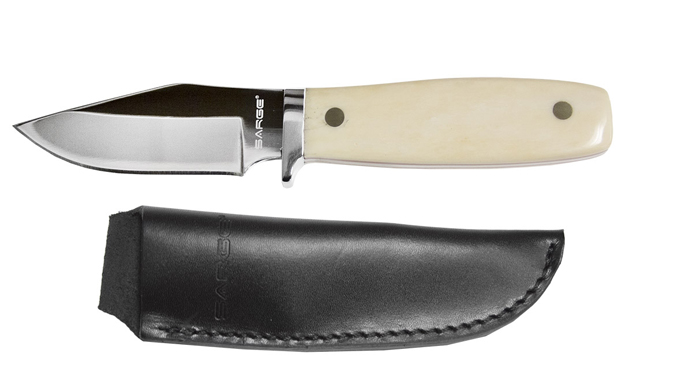
New from Sarge Knives is the SK-934, also known as the Tom Kreger Carolina Field Knife. Among the crowded field of fixed blade knives for outdoor duty, this one stands out for the little extras that come with it, along with an outstanding price point. That’s why it’s a BLADE featured knife.

That’s a bone handle for starters, polished off with red liner and brass fasteners. It adds up to a handsome look and feel.

The steel on the 3.5-inch, mirror polish blade is 440C stainless. The drop point offers plenty of room for the thumb along the spine. This increased control is important when the job gets demanding.

When paired with the handle, the overall length of the Tom Kreger Carolina Field Knife is 7.5 inches.

As a finishing touch, Sarge Knives is offering a black leather sheath with each Tom Kreger Carolina Field Knife. That’s real leather, not the plastic stuff that sometimes gets passed off as such.

Here’s the best part. The price point clocks in at only $59.95. That’s one heck of a deal.

To recap, here are the specs again:

  • SK-934, Tom Kreger Carolina Field Knife
  • Handle: White Bone with Red Liner and Brass Fasteners
  • Blade: 3 ½”
  • Overall: 7 ½”
  • Finish: Mirror Polish
  • Steel: 440C Stainless
  • Includes: Black Leather Sheath

You’ll have to go right to Sarge Knives to get this super deal. Click here to get a Tom Kreger Carolina Field Knife for just $59.95 from Sarge Knives.

Video: Jenn Coffey Keynote Address

0

Best knife book
Knives 2014 is available for pre-order now. Click the cover to order.

The Hon. Jenn Coffey offered this keynote address at the 2013 BLADE Show. Although a good deal of her speech talked about knife rights, she also mentioned counterfeiting.

“We have all seen the hard work, dedication and imagination of our friends and family stolen, and knock-offs made and sold as if they were the real thing,” Coffey said.

Another idea she addressed was pairing knife manufacturers with car dealers. Seat belt cutters are an important tool. Could it be time for the two sides to meet and offer seat belt cutters in new vehicles?

What are your thoughts on these important issues? Leave a comment below.


Photos: Highlights from Day 1, 2013 BLADE Show

0

BLADE Show 2013 Day 1

Image 1 of 19

Doug Noren talks knives at his 2013 BLADE Show booth, which takes place May 31 to June 2 at the Cobb Galleria in Atlanta.

101 Knife Designs Murray Carter
One of the knife books not available at the BLADE Show as “101 Knife Designs,” by Murray Carter. Click the cover to order it now.

Here’s a look at what captured BLADE’s camera flash during the first day of the 2013 BLADE Show, on May 31 at the Cobb Galleria in Atlanta.

By all accounts, the show was another big success for the world of knives. Did you attend? Leave a comment below with your BLADE Show stories.

Video: Salt Bath Heat Treating

0

This video from the American Bladesmith Society (ABS) explains how to perform salt bath heat treating. It’s part of the Phoenix knife project ABS members created. You can see video about the incredible ABS Phoenix knife here.

Here’s a bit of background from the ABS about the Phoenix knife:

The Phoenix Knife was originally created by several members of the ABS Board, then disaster struck and it was damaged in a house fire. On its second life, several ABS Board Members contributed in the efforts to bring it back to life including Master Smith Kevin Cashen shown in this video heat treating the blade and bringing the knife back to life. Stay tuned for the third video about “Rockwell Testing” the blade.

To follow the Phoenix knife through its stages, be sure to subscribe to the ABS YouTube channel. There are plenty of knife videos online, but the expert insights from ABS are a cut above.

How to make a knifeAlso recommended is BLADE’s Guide to Making Knives, 3rd Edition. It covers heat treating and many other steps in the knifemaking process.

10 Tips for Proper Knife Show Etiquette

Ask Permission

Always ask an exhibitor’s permission before picking up a knife from his table. Nothing’s worse than some ya-hoo barging up, grabbing a knife and launching into a spiel on how much he knows about knives. Treat the exhibitor like you would any decent human being and ask permission to pick up the knife first.

Considerations for Folders

If it’s a folding knife, after asking the exhibitor if you can pick it up, if it’s closed and you want to open it, ask if you can do so (though most every folder maker will expect you to open it, check the action, etc). And if it’s a multi-blade, NEVER open more than one blade at a time. It puts too much pressure on the backsprings and can cause undue wear and tear. If you’ve bought the knife, then open all the blades you want (though it will still cause undue wear on the backsprings). And if you open the blade(s), close it/them before handing the knife back to the maker.

Hand Someone a Knife Safely

how to give someone a knife

Mind Your Edges & Tips

Your blades are your responsibility! Mind those edges and tips. Nothing is ruder than gouging someone on your 6 because you’re strolling around with a sword under your armpit like some 18th-century field marshal.

Say It, Don’t Spray It

Be careful when you are examining an exhibitor’s knife not to spray spittle on the knife. Some people tend to “spray it instead of say it,” and spittle, if not wiped off, can cause “spit pits,” or tiny rust spots.

Wait Your Turn

Never interrupt an ongoing conversation at an exhibitor’s table. The exhibitor might be in the process of selling a knife and if you barge in and start blabbing away, it may chase the buying customer off. Besides that, it’s rude.

Make Way for Business

If you’re talking to an exhibitor and have no intention of buying a knife and see someone next to you who obviously is intent on buying a knife from the exhibitor, politely bow out and give way to the potential buyer.

Leave “I’ll Be Back” to Arnold

Before leaving his/her table, unless you are really going to do it, never tell the exhibitor, “I’ll be back.” Don’t be labeled an “I’ll Be Backer”! 😉

Haggling

Don’t haggle over price with custom knifemakers. They know how much time, effort and materials they put into a knife. If you don’t like the price, move on.

Getting in Close

Using a loupe to examine an antique knife is one thing but don’t use one to examine the custom maker’s knife at the maker’s table. It’s just not very good form. Now, if it’s a custom knife sold by a purveyor, that’s different. After all, if you have a question about the knife’s authenticity, it is possible that the purveyor made a mistake in buying the knife. We all err at times, right?

These are a few of the rules of knife show etiquette. There are others. Practice proper knife show etiquette and your entire show experience will benefit as a result.

Video: The Kevin Cashen Phoenix Knife

Kevin Cashen
The stories behind the blades are part of what makes collecting knives so much fun. The provenance might be happy or sad, but it’s the storytelling itself that is so valuable. Knives can be keys to unlock those stories. Instead of calling up a house fire, the Kevin Cashen Phoenix Knife tells the story of getting through tough times.

Part of the appeal to knife collecting are the stories behind the blades. The so-called “Phoenix Knife” from master smith Kevin Cashen is one such knife.

Judging from the name, you’d be correct in guessing Kevin Cashen’s piece figuratively rose from the ashes. In a tragic turn of events, it literally earned the title, too.

According to the American Bladesmith Society (ABS), which posted the video above, the Phoenix Knife started life as a group project. Several ABS board members got together to make a Bowie, including Kevin Cashen.

However, a house fire destroyed much of the knife’s progress. Undeterred, the board members regrouped and gave it another shot.

The result, as the video shows, is the Phoenix Knife. “It’s alive!”

Have a great knife story? Post it in the comments below.


The Stories Behind the Designs

Knife Patterns BookCertain knife designs are repeated again and again for good reason: They work. Murray Carter explores the stories behind many designs in his new book, 101 Knife Designs. You know the designs that stand the test of time. Now read why.

Click here to order 101 Knife Designs.

Illustrated Guide to Types of Blades

2

Types of Blades 1Types of Blades 2

Learn about the different types of blades out there with these handy illustrated guides. They’re perfect for anyone curious about blade shapes, terminology or what to look for before buying a knife for a particular use. Just click on either image for a larger view. Types of blades covered include:

California Clip
Can Opener
Citrus Peeler
Clip
Clip-Saber
Coping
Cotton Sampler
Cuticle
Dog Grooming
Drop Point
File
Fish Scakler/Cap Lifter
Letter Opener
Long Pull
Muskrat
Pen
Pruner
Punch
Razor
Regular Pull
Saw
Screwdriver/Wire Stripper
Serrated Spay
Sheep Foot
Skate Wrench
Skinner
Spay
Spear
Typesetter
Wharncliffe

Types of bladesThis illustrated guide to types of blades is excerpted from the American Premium Guide to Knives & Razors CD. Jim Sargent’s book is ideal for anyone who collects Case knives or has an interest in knife history.

Advertisement

Must Read Articles

Read this before you make a knife

Knifemaking 101 – Read This Before You Make a Knife

  by Wayne Goddard My experience has taught me that there's nothing like digging in and getting started. I've often said the hardest part of the...
how to forge damascus steel

How to Forge Damascus

Advertisement
Advertisement