New Gut Hook From Templar Knife Is Built To Be Used In The Field And Commercial Settings.
The new Reagan gut hook from Templar Knife is a new, exciting edition to the hunting knife market. From a maker known for auto and OTF knives comes this fixed blade that uses a unique construction to create the best possible knife.
The blade thickness decreases as it goes from heel to tip. This allows the knife to segment a sternum as well as skin a kill. Add in the gut hook and the Reagan allows for a smooth full-cavity evisceration.
The handle’s ergonomic design and finger grooves, combined with guards on the top and bottom give you a better, more comfortable grip. You’ll have more leverage with each cut thanks to the better thumb and hand placement on the handle.
The Reagan is 8.3 ounces with a 4.6-inch blade and will be launched to the general public in September.
When Brown Is Down You Need A Trustworthy Blade. These Skinning Knives Have The Chops To Make Quick Work Of A Dirty Job.
You can have the fanciest camo and the best rifle money can buy, but if your skinning knife is dull and beat up it’s not going to amount to much after the moment of truth.
A good skinning knife is a key component of any hunter’s kit and unlike its name suggests, most are used for more than simply caping your kill. Generally speaking, the best skinners are typically do-all hunters–as quick through a deer’s pelvic bone as it is removing hide.
True enough, there are some specialty blades out there (we hit a few of those) and if they fit into your system then they’re the perfect addition. But no matter what style knife you choose, all skinners will share the same basic asset–the ability to maintain an edge, for obvious reasons.
Why Sharpness Matters
Picture this, you put an elk down right as the sun dips below the horizon. Your breath is visible as you set to dress it and already thick flakes are falling from the sky. Do you want a knife you’ll sharpen every third cut?
In these circumstances, expediency demands a sharp blade. But so does safety. As most likely know–but always bears repeating–there’s a greater chance of cutting yourself with a dull knife than with a sharp one. Given you’ll make awkward cuts a challenging angles when dressing game, main times under the dim glow of a headlamp, it’s a good idea to have a tool that won’t endanger you. Unless you like the trill of working on your tourniquet skills miles from a medical facility.
Styles Of Skinning Knives
Given it has its own moniker, there are dedicated skinning knives in this world. Generally speaking, most makers outfit them with an accentuated belly and a fine edge, allowing the blade to work naturally with the user’s cutting motion. Additionally, the tip is positioned out of the way or is less prominent, ensuring you don’t end up with a nasty mistake, such as a gut puncture.
All that said, any knife is potentially a skinner if it’s sharp and you know how to use it. However, in most cases, hunters will find a few general aspects most good skinning knives share in common:
Highly Controllable: Cleaning and skinning require controlled cuts, lest you butcher the meat or perforate the cape. Controllable can mean different things to different people, but in many cases, it equates to a smaller blade with a skinner.
Fine Blade: Yeah, a serrate blade might aid in getting through bone, but it will make a mess of meat and connective tissue.
Easy Maintenance: Cleaning and skinning is a dirty, wet and sticky job–it’s not for a knife that must be handled with kid gloves.
Stays Sharp: As pointed out previously this is a safety and time aspect because you want to get back to camp ASAP with all your digits and all your blood.
Bear & Son Cutlery 7.25-Inch Stag Delrin Upswept Skinner
Bear & Son Cutlery 7.25-Inch Stag Delrin Upswept Skinner
Our list starts with an offset fixed blade from Bear & Son Cutlery. The Stag Delrin is a tough, sweeping steel that is wider near the bolster before tapering toward the tip. This allows for the bulk of the skinning to happen by the ample belly, and the offset Stag Delrin handle provides an easy way to nimbly move the knife.
The 3.13-inch blade is made from 440 stainless with a hollow grind. The leather sheath keeps the knife protected. And the whole outfit is just 3.3 ounces, making it a lightweight option. The only downside for some, it’s a bit longer than many might require.
MSRP: $50.99
Gerber Gator Clip Point
Gerber Gator Clip Point
The Gerber Gator looks mean, feels tough, and is strong enough to help you process your hunt with ease. The 420 HC stainless steel blade features a deep clip point that is excellent for doing fine knifework to get the last bit of skin off of the carcass.
The blade is connected to a glass-filled nylon handle with a Gator Grip overmold that provides excellent grip even when bloody or wet. The lockback mechanism will keep the blade secure when in use, and the ballistic nylon sheath is just as tough and rugged as the knife itself.
When it comes to skinning knives the Gator is among the best and will serve you well for years.
MSRP: $62
Havalon Piranta-Z
Havalon Piranta-Z
The Piranta-Z from Havalon stands out from the rest of our list because of its changeable blades. It comes with a dozen 60A steel blades that easily clip into the sleek black polymer handle. The knife opens thanks to ambidextrous thumb stubs, handy for those times you only have one free hand.
All of the additional blades are a huge advantage compared to some other knives. Accidentally clip a blade? Replace it with a new one in seconds. A blade goes dull midway through dressing? Remove it and change it in a snap.
Maintenance is a breeze too. The back of the knife opens for easy cleaning, and the removable holster clip allows you to keep the knife secure while on a hunt. The one issue here is that if you have to cut any bone you’ll need another tool.
MSRP: $54.99
Argali Serac
Argali Serac
Argali thought of almost everything with the Serac. At just 2.1 ounces it is insanely light, and the skeletonized handle allows for easy movement and adjustments when butchering a kill. The blade is made from S35VN stainless steel that holds an excellent edge and is durable enough to get into the guts and bones of a carcass.
This American-made blade is an excellent skinner but is just as good as an all-around hunting knife that can process an entire animal. The G10 scales provide an excellent grip that’s easy to maintain even when wet. The included Kydex sheath is just as robust as the knife itself.
MSRP: $209.99
Ka-Bar Becker Companion
Ka-Bar Becker Companion
Our list rounds out with a knife designed by legendary maker Ethan Becker. The Ka-Bar Becker Companion is a heavyweight in the world of skinning knives. It’s so tough it can handle splitting kindling for the fire as well as skinning a 10-point.
The fixed blade is made from 1095 Cro-Van steel married to an Ultramid handle. Unlike many of the other knives on our list that come in weighing just a few ounces, the Becker Companion is 10.5 inches long and weighs one pound. The trade-off is that it’s beefier than the other knives and is able to cut through sturdier material, but it may not be the best for finite skinning and knife work.
Regardless, this all-around hunting knife is more than capable of skinning your next kill and even butchering it so you can sear it over the campfire before the sun goes down.
This New Release From CRKT Is Timed In Conjunction With National Knife Day. The Newest Entrant In the Squid Line Has New Features And High-Quality Steel
It’s National Knife Day, and CRKT has released a limited-edition knife to celebrate the day. The all new Squid II OD Green, which was made in Italy, debuts today and combines everything knife fans love about CRKT with the craftsmanship of a custom knife. Only 500 units of this model are being sold.
The blade is made from stonewashed Böhler M390 steel which merges excellent edge retention and wear resistance. Ground to a plain edge, the blade is 2.68 inches in length and has a 58-61 HRC.
In a first for the Squid line, the knife features a liner lock to secure the blade in place, and the IKBS ball bearing pivot system allows for fast, smooth deployment. The handle is made from green Micarta for a rugged look, and a lanyard hole allows you to take the knife anywhere you are.
“The Squid™ II is far and away one of the finest knives we’ve ever produced,” said Doug Flagg, VP of Marketing & Innovation for CRKT. “This knife combines decades of design experience with the aspirations of what we’re trying to achieve as a brand and we’re confident it’s a knife that will stand the test of time.”
The knife goes on sale today and has an MSRP of $185
This New EDC Folder From Buck Is Quality On A Budget. It Takes Everything You Love About Buck Knives And Gets It In Your Hand For Under $50.
Not all cleavers need to be monsters that can cut through full racks of ribs. Some are perfect for your pocket.
The new 263 HiLine from Buck is just that. It’s an economical folder featuring a D2 steel cleaver blade. Ball bearings make opening a breeze, and everything is held securely with a frame lock. The handle is anodized aluminum with G10 scales and bronze-finished, titanium-coasted fasteners.
This knife excels at being a great EDC and a great camping knife. The cleaver blade does wonders preparing food on an unusual surface while you’re on a hike or getting ready to turn in while camping. The strong D2 blade can handle the day-to-day tasks needed of a good EDC with ease.
At less than four ounces in weight, the 263 HiLine is as light as it is strong, and the pocket clip allows you to easily keep the knife with you morning, noon, or night. For the asking price, you won’t find many better EDC folding cleavers.
This New Folder From Kizer Is Described As A Folding Santoku Knife. It’s A Bold Claim For A Bold Knife From The Chinese Maker.
The new Kizer Towser X blurs the line between kitchen knife and robust EDC folder. When open it really does look like a Santoku minus the Granton edge. The cleaver-like blade is 3.39 inches long and made from a stain-finished 154CM steel. While it is described as a sheepsfoot, the blade is more akin to a smaller version of the kitchen knife.
This makes for an exciting piece that is as comfortable slicing rope in the garage as it is butterflying a chicken breast in the kitchen. The dual thumb stud openers and liner lock make the knife easy to open and secure to use. The red micarta scales provide excellent grip and a classic look.
The frame and liner are both made from stainless, and the tip-up pocket clip make this blade easy to carry. If there is to be a future for folding kitchen knives, this might be the blueprint for many to come.
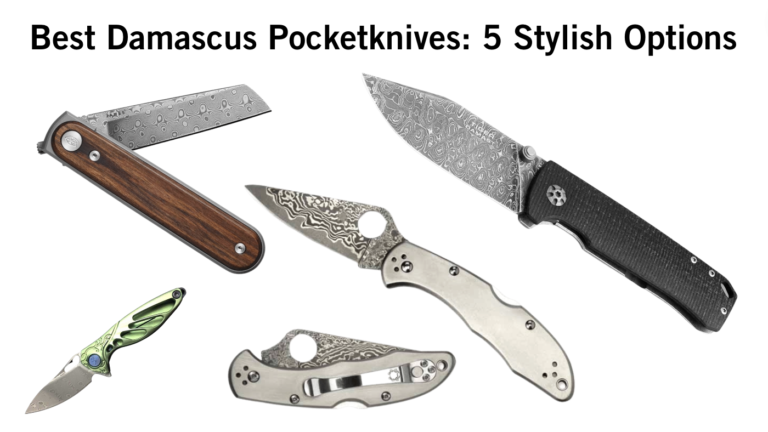
Damascus Pocketknives That Wow From Around The World.
Yes, some steels are of higher quality than others, but nothing is as eye-catching as a well-made damascus knife. And now, thanks to contemporary forging techniques, there are just as many high-quality damascus pocketknives as there are kitchen knives, daggers, and swords.
What Is Damascus Steel
Also called pattern-welded steel, damascus steel is made from forging multiple types of steel together. This can create different kinds of patterns in the finished product once the construction is complete.
Traditionally, damascus steel was created to imbue a sword with a desired blend of toughness and hardness. While cutlery is still forged this way for that purpose, today many damascus blades are made for the cosmetic look that comes from the acid etching or polishing done when the blade is complete.
You’ll see many damascus knives today constructed from the core of one type of steel and multiple layers of different steels on either side of it.
While the actual origin of the term “damascus steel” is unknown, many have connected it to the Syrian capital of Damascus and swords made or sold in the city in ancient times. Another theory is that the term is derived from the Arabic word “damas” which means watered, which describes the wave-like pattern that many blades can have.
Best Damascus Pocketknives
Boker Tiger-Damast
You know what you’re getting when you purchase a knife from Boker. Its legendary maker for a reason, and the Tiger lives up to its lofty standard. An elite collector’s knife, the Tiger is made from German tank parts from a tank destroyed in a battle in Latvia in 1944.
The non-stainless blade is made in the intrepid pattern by maker Chad Nichols. The handle scales are a burlap micarta design to echo the look of German armored vehicles of the era. This is the dream of any knife lover interested in military history.
MSRP: $719
Spyderco Delica 4
A damascus version of one of Spyderco’s most famous blades, the Delica 4 is a beauty. The damascus blade/titanium handle combo gives the piece a futuristic look and feel.
The blade itself is made from a VG-10 stainless core with 15 layers of forged-welded damascus on either side. The machined titanium handle gives the whole piece a ridiculous amount of strength and durability. Spyderco is a beloved brand for a reason, and this version of the Delica 4 keeps the good times rolling.
MSRP: $304.50
The James Brand Duval
The Duval is the first front-flipped knife from The James Brand, an Oregon-based company founded in 2012. The frame lock makes for easy opening and sturdy use of the Damasteel Rose DS93X blade.
The material is made of 100 total layers of a pair of different types of steel. It becomes stainless once heat treated and has excellent corrosion resistance and edge retention.
This modified sheepsfoot blade is married to a handle made from Rosewood, and the whole thing weighs just 2 ounces. The hardware is all stainless and the ball bearings are ceramic. This piece is built to last and last a long time.
For a company’s first foray into front-flipping knives, James Brand has knocked it out of the park.
MSRP: $399
Kansept Knives Convict
This knife from Kansept Knives, a Chinese maker, stands out in numerous ways. For starters, it features a sheepsfoot blade, a less common blade types. Designed by Chris Conaway and Sheepdog Knives, the Convict is a light, nimble knife that can easily handle the job of an EDC.
The titanium handle is as light and strong as you would expect, and the stonewashed finish lets the damascus pattern shine through. While it may not be sexy, the ceramic ball bearings not only let the knife flip open smoothly and will never rust so it’ll open smoothly for decades.
MSRP: $203
Rike Knife Humminging Mini Flipper
The smallest knife on our list is from Rike, but it packs a wallop of a punch.
The Hummingbird Mini is just 3.75 inches in total length and has a 1.5-inch blade. The Damasteel drop point flips open easily, and the titanium handle helps keep the whole construction to just .6 ounces.
This is an excellent keychain or neck knife. It even comes with a Kydex sheath designed to be worn on a lanyard for this purpose. Sure, it’s the smallest and least-expensive knife on our list, but it does everything you would want from an EDC. The fact that it won’t break the bank is another feather in the cap for this knife from the Chinese maker.
Folders. OTF knives. Switchblades. Fixed Blades. There are so many different types of pocketknives. Each of them opens and closes differently so knowing how to close a pocketknife is important aspect to consider before buying one.
While it might be basic, we take a look at how to close the most common types of pocketknives on the market today. No matter the blade, it’s important to know how to close them safely, so you keep all your digits.
Frame Lock
A frame lock works by using the pressure of the frame itself to hold the blade in place once it’s open. To close it, you’ll need to gently push that part of the frame outward and away from the bottom of the blade. This will free the steel and allow you to fold it back into the housing.
Liner Lock
The liner lock is one of the most common types of locking mechanisms. While simple and straightforward, doing it too quickly can put your fingers in danger so be careful. As you’ll see in the video below, taking your time makes this one of the easiest things you can do.
You free the blade by pushing the liner out of the way, but it’s imperative that you move slowly when you start to push the blade down. Too much weight and it’s going right into your thumb.
Slip Joint
The slip joint has no internal locking mechanism. You just open and close the blade by pulling or pushing the blade. Famous slip joint knives include the Swiss Army knife and the Opinel #8. Since there is no locking mechanism, you push the blade down into the handle to close it.
Some knives, like the #8, have a lock to hold the blade in place while it is open or closed, but it isn’t used during the process of opening or closing the blade.
Lockback Knife
Lockback knives have a small notch toward the back of the spine of the knife. Pressing down on it will release the blade from the locked position. From there, it’s similar to a slip joint in that you’ll need to guide the steel back into the closed position.
Other Types Of Knives
The world of knives stretches far beyond folders. These knives are all closed differently.
Fixed-Blade
It’s not a closing, per se, but many fixed-blade knives come with a sheath or a sheath can be purchased for them. It’s important to keep these blades sheathed for both your safety and the safety and longevity of the knife itself.
Automatic Knives
Automatic knives, or switchblades, are spring-loaded and open via a push button. To close an out the side opener, it operates similarly to a liner lock. You push the tab on the bolster to one side to take the blade out of tension and then fold it back into the housing.
Butterfly Knife/Balisong
The most dramatic knife of them all, closing a butterfly knife is a form of theater. There are many tricks you can do with a balisong but the first two to learn are how to safely open and close it. The flowing movements of the handle and blade are always an entertaining sight, but be careful and remember to never catch it if it falls.