Ka-Bar Makes One Of The Most Legendary American Combat/Utility Knives. First Issued In 1942, The Knife Continues To Impress And Inspire Today.
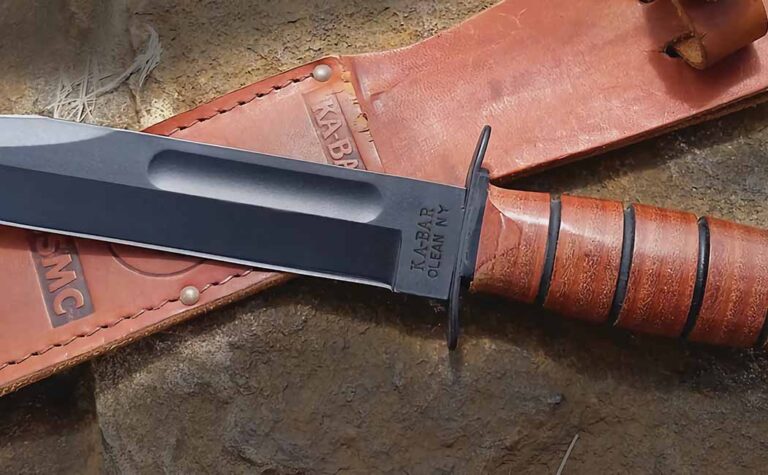
Few knives are as beloved and inspire more contemporary blades, than the Ka-Bar USMC fighting/utility knife. Ka-Bar Knives’ designation for it is the 1219C2, aka “the Ka-Bar,” and the knife was, and still is, a high-quality combat/utility tool. Ka-Bar Knives makes the contemporary version in its factory in upstate New York.
The History Of The Ka-Bar
As America entered World War 2, the Army and Marines took issue with the old World War 1-era trench knives that were being issued to them. The handles were too bulky, the blades were too brittle, and they were expensive to make.
After trying a few stopgaps, the Army asked arms suppliers to design a new combat/utility knife. Marine officers John Davis and Howard E. America worked with the Union Cutlery Company (now Ka-Bar Knives) to design a model that took elements from an old Navy knife and civilian hunting knives to create the 1219C2. In addition to Ka-Bar, Camillus, PAL, Robeson Shuredge, Case and Ontario were among those who made a USMC fighting/utility knife or a reasonable facsimile.
The knife was first issued to elite Marine units in November, 1942 and became standard issue for all Marines by 1944. Today, the knife is manufactured for military use and marketed to civilians as a utility/hunting knife.
Modern Ka-Bar Knives
Along with the original USMC fighting/utility knife, Ka-Bar makes many different combat/utility knives. This trio is a prime example of what the company produces today.
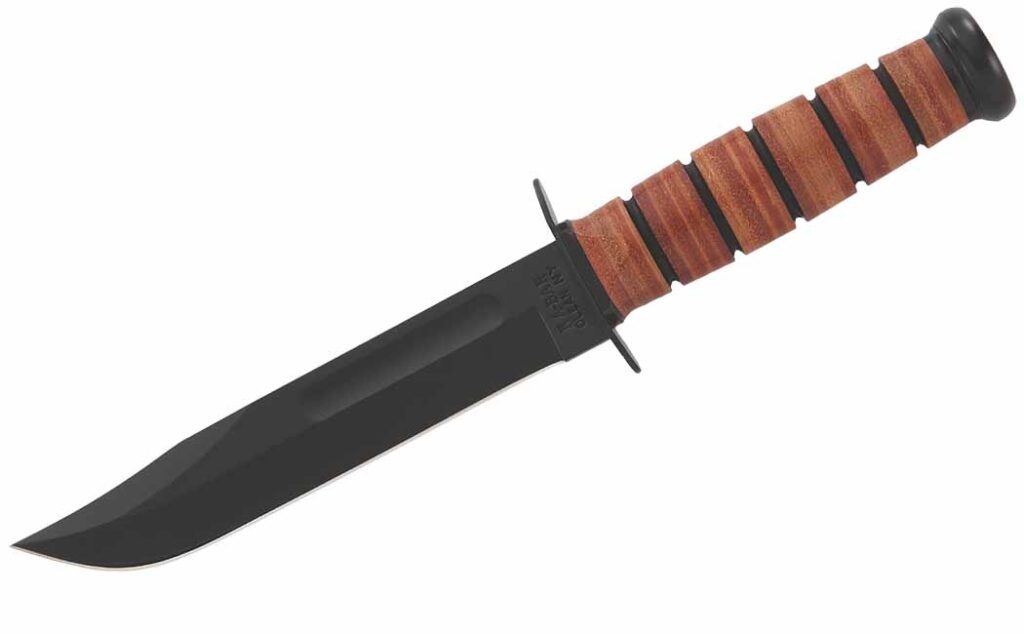
USMC Ka-Bar Plain Edge
The knife that made the Ka-Bar name famous is as popular as ever. There’s also a serrated version, but the plain edge is the original and is a hefty, economical knife.
The 7-inch clip point blade is made from 1095 Cro-Van steel with a 20-degree flat grind and a Rockwell hardness of 56-58 HRC. At just 11.2 ounces, it’s lighter than you might expect from a knife that size, which lets it flow smoothly when slicing, and the leather handle provides a secure grip. The rigid plastic sheath is MOLLE-compatible and can be carried vertically or horizontally.
Classics are classic for a reason, and the USMC fighting/utility knife is everything you could ask from a combat/using piece.
MSRP: $128.53
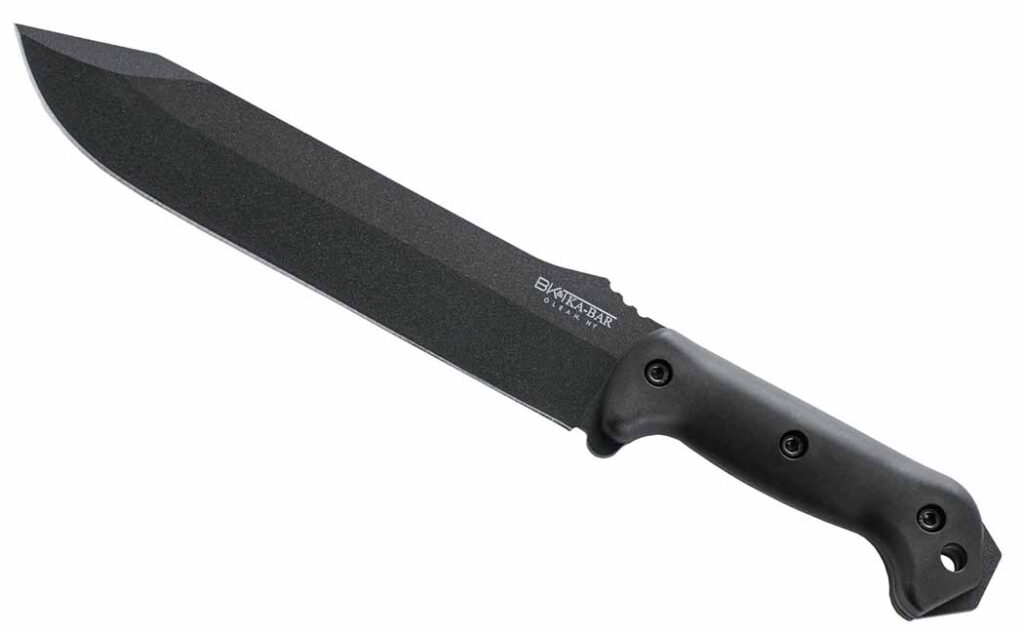
Becker Combat Bowie
Melding an American bowie-style blade with Becker’s trademark ergonomic handle design and you get this sleek, all-black combat knife. It is designed for bushcraft or camping too.
The 9.25-inch blade is married to an Ultramid handle that provides a strong grip. At 17.12 ounces, it’s a bit heftier than the USMC fighting/utility, making it excellent for more heavy-duty work like trimming thicker branches and vines or cutting through medium brush. Similar to the USMC fighting/utility, the Combat Bowie is made from 1095 Cro-Van and has a Rockwell hardness of 56-58 HRC.
A heavy-duty polyester sheath is included and is MOLLE-compatible as well.
MSRP: $178.61
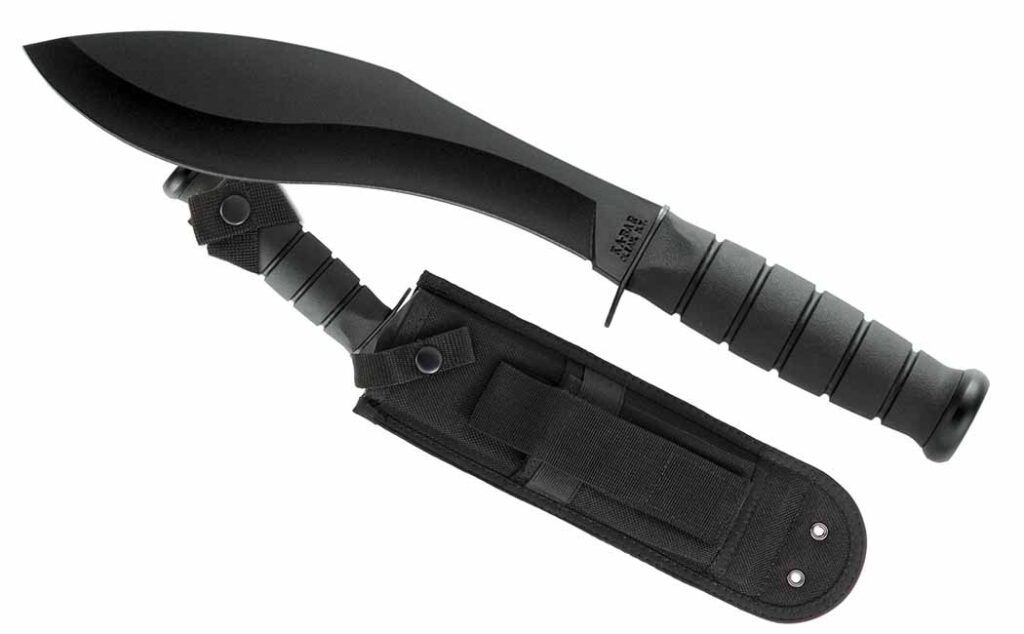
Combat Kukri
This knife may have “combat” in the name, but its bread and butter is decimating small trees and vines. The kukri is smaller than a standard machete and is more finite in its cutting. That doesn’t mean that this blade can’t flex its muscle and chew through almost any brush you put in front of it.
This knife may have “combat” in the name, but its bread and butter is decimating small trees and vines. The kukri is smaller than a standard machete and is more finite in its cutting. That doesn’t mean that this blade can’t flex its muscle and chew through almost any brush you put in front of it.
At just under 16 ounces, it’s relatively lightweight yet robust.
If you’re buying it you’re most likely looking for a high-quality outdoors knife, and this kukri is it. The 1095 Cro-Van will need to be maintained to get the best out of it over time, but that comes with the territory of owning good knives. This knife will make a great companion working through the bush while camping or while cutting through bushes in the backyard.
The Stake Out Is Yet Another Fun And Exciting Multi-Tool From Gerber. Designed For Camping, The Stake Out Checks All The Boxes
When you’re out camping there is no worse feeling than reaching into your pack and realizing you forgot to bring the one tool you really needed. The new Stake Out form Gerber will have you covered from pitching the tent to the time you pack up and head home.
There are 11 tools packed into a 4.5-ounce, compact 3.32-inch little tool that will shave countless pounds off your pack. There are four types of cutting tools to go along with six all-rounder tools that can be used multiple ways.
The most notable cutting tool is the 2.2-inch Scandi grind blade. Secured via a framelock, this blade is what you want while out camping: a small blade that can handle quick, precise cuts. The blade is unique when it comes to the Stake Out in that all the other tools are secured via a linerlock.
Along with the blade, there’s a wood saw, an awl, and a pair of scissors to round out the roster of cutters.
Where the Stake Out gets really funky is in its other tools and their placement. There is a ruler right on the frame of the knife. The tweezers are easy to find thanks to an orange handle. You have a ferro rod striker, a bottle opener, and a file all within the confines of the Stake Out. And the most exciting element: the tent stake puller.
Pulling stakes out can be a drag. The tent stake puller gives you that extra leverage to make packing up and heading home a breeze.
Overall, this is a lovely multi-tool. It easily clicks onto your pack thanks to a carabiner, and the assortment of tools helps it stand out in a crowded field. Some type of plier would have made this a 10/10, but even without them this is still a quality bit of utilitarian cut at a great price.
The New Kizer Drop Bear Is An Excellent EDC, And The Clutch Lock Is A Worthy New Addition To The World Of Axis Lock Knives
In the ever-growing world of EDC knives, finding ways to stand out is difficult. So many brands, so many steels, so much of everything. And even in that crowded field, the new Drop Bear from Kizer finds ways to catch the eye.
Boasting a high-quality blade, simple handle, and innovative lock, the Drop Bear is the kind of knife you’ll want to use every day … more so, it’s the type of blade you’ll go out of your way to use.
Getting The Drop On The Drop Bear
The Drop Bear in both of its colorways: Gunsteel on top and Black, with the bright purple thumb stud, below.
First that name. For those wondering it originates from a beast of Australian folklore that–as the legend goes–drops from trees to attack humans. Pleasant.
However, Kizer’s Drop Bear (MSRP $158) allure isn’t its reference to free-falling arboreal bruins. Instead, it’s Kizer’s twist to Benchmade’s Axis™ lock configuration.
Called a Clutch Lock by the China-based company, the mechanism provides a dead-tight lockup. I put this through the wringer, but we’ll get to that in a moment. And while few locking mechanisms have ever sold a knife, this adds enough of a spin to the traditional drop point to make it stand out.
So, let’s talk a little bit about the Drop Bear’s Clutch Lock.
Clutch Player
The clutch lock seen after removing one of the scales. The lock can be adjusted, and scales replaced, in less than two minutes.
As the fidgety type, I have to confess up front I love this knife. Right off that should give some indication of what the Clutch Lock brings to the table.
Where Kizer gets it correct is by not improving an already proven system, with the blade unlocking similar to most other Axis-type locks. For those unfamiliar, a pair of buttons situated on either side of the knife–in this case behind the pivot–are retracted, thus releasing the blade. As mentioned, it’s an ideal lock for those of us who fidget.
However, Kizer has improved the system by tinkering with the pair of Gemini springs hidden beneath the scales. The rub here, their tension is adjustable. This is a big deal.
This concept is not entirely foreign to those bold enough to have skunk worked spring tension for years. Many times the results were less than optimal, which is why Kizer’s setup is desirable. Basically, you won’t make the Drop Bear a victim of shoddy kitchen-table knifesmithing.
The tension adjustment itself is simple, even for the mechanically challenged. The frame has five holes on each side in which the spring is loosened or tightened. If you want a faster open and tighter lockup, crank it up to the holes closest to the blade. Desire a looser action, dial it down.
Interestingly, and probably grasped by the mathematically inclined in the audience, the five holes on each side don’t add up to five settings. Instead, it’s 5X5 settings for a total of 25. Boy, if you can’t find what you’re looking for in that range, then nearly any knife is likely to leave you cold.
Bear Necessities
The Drop Bear is a sleek, nimble knife as seen from above.
Novel as the Drop Bear’s Clutch Lock is, it wouldn’t add up to a pile of scrap if Kizer didn’t finish the job with all the parts to make a solid knife. Overall, they make it worth the price of admission.
With a quality EDC knife in mind, Kiser outfitted the Drop Bear with a blade a shade under 3-inches long–legal in most jurisdictions. The 154CM stainless steel, again becoming popular in this role, offers a Rockwell hardness of 58-61 HRC.
Topping off this end of the knife, Kizer applies a flat grind to help create the edge. Good choice, because it comes out of the box frighteningly sharp. Outfitted with moderately sized thumb studs with plenty of clearance, this attribute is quickly deployed.
In the hand, the knife feels light–listed as 3.7 ounces–but not light as air. This is a good middle ground for this class of knife, where it feels substantial in your hand yet won’t tear the rivets out of your jean’s hip pockets.
Much of the weight savings come from an attractive skeletonized frame, under the aluminum handle scale. With an ergonomic swell toward the middle of the handle, the Drop Bear offers purchase and plenty of control.
As for aesthetics, the knife comes in two colorways. The first style is a gun steel blade with a satin finish and black thumb stud. The second has a black blade with an eye-catching purple thumb stud.
Finally, a tip-up clip keeps the knife at hand and riding deep in the pocket.
Testing The Drop Bear
The Drop Bear was a joy to test and cuts most types of material with ease.
It’s an EDC so I wasn’t going to try and chop through the vines slowly overtaking the corner of my backyard fence. I used it around the house for a few days.
It cut through plastic and tape like there was nothing there at all. It’s a perfect letter opener. The Drop Bear easily handles the daily tasks you’ll see every day. Taking it a step further, I used it as my only knife when prepping dinner for my wife and I.
First was the romaine lettuce, which the knife handled with ease. Whether holding the Drop Bear in the pinch grip like a chef’s knife or by using the jimping and pressing down with my thumb from the top down, the knife dispatched the lettuce easily.
Up next was the tomatoes, and it was the best experience I’ve had with a flat-edge knife cutting tomatoes. They were Campari tomatoes, so smaller and more delicate than beefsteak or Roma tomatoes, and the Drop Bear went through the flesh easily. This was best done in a pinch grip and got incredibly thin slices of tomato for the salad.
Celery is stiff and crunchy, and it was no problem for the Drop Bear. The chicken breast was easy too. I preferred cutting the chicken by utilizing the jimping, and the knife bit down easily and sliced through the meat without a hiccup.
My single favorite cutting task was the bell pepper. I chose to cut the pepper through the skin side as that is traditionally more difficult than cutting through the interior flesh. I have never cut through a bell pepper easier than I did with the Drop Bear. It left me thinking that this could reasonably replace a paring knife.
However, the Drop Bear did meet its match against a large carrot. The knife did not enjoy fighting through the harder, denser flesh, forcing me to switch to a kitchen knife to finish the job.
Beyond the kitchen, the Drop Bear shined. It gets through cardboard boxes like nothing. The corrugated cardboard can be the test upon which many knives fail, but the Drop Bear didn’t even blink.
Additionally, I tested it on some brand new ⅜-inch polypropylene cord. I figured that the cord would provide some sort of fight for the Drop Bear. Instead, it was a first-round knockout as the blade smoothly sliced through the rope, leaving a clean cut with little in terms of frayed strands.
As for the action, I preferred the knife a little looser and set it at the second position. And the lock, I put the strength of the lock through the ringer. I did everything I could to break it. I bent it backward, sideways, every which way I could to flex the knife. The lock held firm and never budged.
Final Cut
Overall, the Drop Bear makes the cut for me.
The knife has enough mechanical allure to make it intriguing while remaining practical. For tinkers and fidgeters, this is a big plus. For those less inclined to get wowed by engineering wizardry, Kizer’s creation still shows sharp.
The Drop Bear is more than ready to tackle most EDC jobs, though you might not want to push it too far out of its comfort zone. What knife isn’t that true for? But for the price, it seems Kizer has hit the mythological sweet spot for this class of knife.
The Gerber Mark II Is One Of The Most Famous Combat Knives Ever Issued To The American Military. First Introduced In 1966, It Still Endures Today.
When it comes to military knives, few are as universally beloved as the Gerber Mark II. First issued for use by U.S. service personnel in the Vietnam War in 1966, the knife has stayed in production since with the exception of 2000-2008.
The Mark II was successful due largely to its well-designed blade and lightweight. The blade is 6.5 inches long, and contemporary versions of it are made from 420 HC stainless steel. The handle is made from die-cast aluminum which helps keep the weight to just eight ounces.
What Makes The Gerber Mark II Special?
The Mark II stands out thanks to its blade design. There are many combat knives and bayonets, such as the M7 and M9, that are modeled after the classic dagger or spear point. The Mark II also has a double-edged spear point blade but with one massive exception: the wasp waist.
The wasp-waisted blade has a narrower section of steel, akin to how a wasp’s body narrows at its waist. On the Mark II, this narrower section comes toward the guard, and the edge on both sides has small serrations. Not the deepest you’ll find on a knife, the serrations are still there to cut.
Very few modern combat knives have the wasp waist (other famous American models like the M7, USMC fighting utility knife, and M9 don’t have it), and it is the visual signature of the Mark II.
Can I Buy A Gerber Mark II Today?
Yes, you can, but it’s not so straightforward. Gerber is, of course, still in business and thriving, but go to its website and you won’t find a Mark II for sale. There are other serrated tactical knives but no Mark II.
To purchase a Mark II today you’ll have to either go to sites like ebay or retailers such as Knifecenter, Smoky Mountain Knife Works, etc. Other makers offer knives similar to the Mark II, but if you want the real deal you’ll have to dig a little bit to purchase one yourself.
However, the ones of recent make that are available are reasonably priced at right around $100-$115.
Tactical Pens Allow You To Have A Self-Defense Multi-Tool On You Even In Places Where A Knife Isn’t Allowed. These Are Five Pens That Will Keep You On Top Of Your Work And Can Keep You Safe.
The tactical pen is the perfect protection tool to have when you’re going somewhere where knives simply aren’t allowed. A tactical pen is great to take to the airport, to the big game, or to have in your pocket every day simply: it is a pen, after all.
Beyond just writing, tactical pens usually come with a glass-breaking tip, but many have additional features that make them far more than just a rugged pen.
Why Should I Buy A Tactical Pen?
For starters, they are high-quality pens that can write in adverse conditions. Beyond that, they are excellent safety tools that can go with you anywhere. Sure, you could look at a tactical pen and think “this is really excessive for a pen,” but that would miss the point of why they are so useful.
A tactical pen is an excellent way to keep yourself prepared for whatever life can throw at you. Sure, you may never need to use the pen for much more than signing checks, but it is a lot better to have the tools at hand and not need them than to need them and not have them.
5 Tactical Pens That Will Make Your Life Easier
These five pens feature a bevy of different tools and features that make them all incredibly useful as an EDC. No, none of them have built-in blades, but they do all have something that will make life much easier, and you safer when needed.
Atomic Bear SWAT Pen
Don’t let the low price of this pen fool you: it is the real deal. The SWAT pen is a beast. Made from 6061-T6 aircraft-grade aluminum, the SWAT pen is light and can take a beating. The tungsten carbide tip at the end is perfect for shattering glass when necessary and can provide an added bit of malice if you need to protect yourself.
The writing implement is smooth and easy. The inkwell takes Parker G2 ink, which is easy to find and easy to replace. All in all, this is a high-quality tactical pen at a bargain of a price.
MSRP: $15.99
Boker Plus Quest Commando Pen
Boker makes great knives and that craftsmanship carries over to their tactical pens. The Quest Commando was designed by Kevin Passon & David Cyr, and the duo left no stone unturned. The six-inch, black aluminum pen can be used like a kubaton in self-defense situations. The writing implement uses Lamy M-22 ink and is smooth as butter.
This is a durable, quality pen that you can travel the world with and feel confident when it’s in your hands.
MSRP: $44.96
Smith & Wesson Stylus Tactical Pen
It’s not a firearm but it’s made with the same care as Smith & Wesson’s famous guns. The Stylus Tactical Pen is a self-defense tool for the modern age. Yes, it is a good pen and uses Schmidt P900M parker ink cartridges, but this pen shines by what it does away from the page.
Most notable is the stylus tip atop the screw cap. This rubberized tip allows you to use the pen on all touchscreens, which is easier on your hands, especially on a phone screen, and allows you to still use your tech even in wet or cold conditions.
The window breaker at the opposite end of the pen tip works as advertised and is ridiculously strong.
MSRP: $39.99
Nitecore NTP10 Titanium Tactical Pen
The priciest pen on our list is from Nitecore. It’s the only knife on our list made from titanium instead of aluminum. Milled to a thickness of 1.8 mm, the NTP10 is almost unbreakable, and the tungsten steel tip at the end does what you expect. It is insanely light at just .64 of an ounce and takes German Schneider gel ink.
The main thing to think about with this pen is the price. Yes, the titanium is robust in a way that aluminum isn’t, but is it worth it? That’s for you to decide.
MSRP: $119.95
Schrade SCPEN4BK
Is it the most expensive? No. Is it the beefiest tactical pen? No. But boy, did Schrade pack a boatload of features into this pen at an incredibly fair price.
Of course, there’s a tungsten steel glassbreaker at one end, and the pen uses Black Starminen Fine Point D1 Pen Cartridges. But beyond that, the pen elevates to a proper survival tool. When removed from the body, the pen cap doubles as an ear-piercing survival whistle. It’ll get the attention of anyone in the vicinity and even a bit further than that.
Also embedded in the pen is a ferro rod that can be accessed by unscrewing the back half of the pen. There is a striker plate underneath the tungsten steel breaker and is reverse threaded into the pen body so you can’t accidentally unscrew it and lose it, as it is very small.
So many features in such a small space, and at a great price too. Schrade hit a home run with the SCPEN4BK.
The Wharncliffe Is An Interesting Blade Design With A Captivating History. Over The Years It’s Grown Into A Desirable EDC Blade. These Five Wharncliffes Stand Out From The Pack.
There aren’t many blade styles like the wharncliffe. The wharncliffe stands out from many other blade designs thanks to its long, straight cutting edge and spine that tapers to the point. This allows for a variety of shapes of wharncliffe blades, with some being more squared off with a sharp taper and others being more rounded with a more gentle taper.
Regardless of the taper or size of the blade, the wharncliffe has grown into a beloved blade that has evolved to meet the needs of knife lovers over the last 200 years.
Where Does The Name Wharncliffe Come From?
If you guessed that it was named for a person you’d be correct, or at least almost correct. The name for the blade dates back to the 1820s and British Colonel James Archibald Stuart-Wortley-Mackenzie, the first Lord of Wharncliffe.
One night, while having dinner with his cousin, Archdeacon Corbett, Wharncliffe was lamenting how staid and tired the cutlery industry in Britain had become. The two then worked on a new type of knife to present to the Joseph Rodgers & Sons cutlery company in Sheffield, the epicenter of the cutlery trade in the UK.
Rodgers liked the blade so much that the company put it into production and named it the wharncliffe in the Lord’s honor.
What Is The Wharncliffe Used For?
The wharncliffe initially was used mainly as a whittling knife. The long, straight edge made it perfect for long strokes on a piece of wood. Over time, the blade has evolved with the rest of the knife industry and is now a quality all-rounder EDC. The straight edge is excellent at transferring energy from the hand into the material being cut. Not great at puncturing, it’s very good at most other cutting tasks.
5 Wharncliffes You Should Look Into Buying
Today, the wharncliffe has become a standard blade design by makers around the world. These are five that you should take a look at.
Spyderco Salt 2
Few companies have dived deeper into wharncliffes than Spyderco. The Salt 2 is a prime example of how the company has smartly developed the blade style, although there are many knives on the company’s roster that utilize it as well.
The ergonomic green FRN handle makes this knife easy to use, especially considering how it was designed to be used near water. The H-1 steel is highly corrosion resistant, which makes this knife the perfect choice to use near water. You can choose between a plain edge and a serrated edge, and the lockback keeps everything secure even when drenched.
Spyderco is beloved because of the quality of its knives, and the Salt 2 shows many things the company can do.
MSRP: $124.25
CRKT Inara
A simple, elegant design from Richard Rogers, the CRKT Inara is a perfect example of a quality, affordable wharncliffe EDC.
The framelock is strong. The deployment is smooth. The G-10 stands firm even in extreme conditions. This little flipper really does it all and looks good while doing it. The stonewashed 8Cr14MoV stainless blade is 2.78 inches long and the whole construction weighs just 1.8 ounces.
A small, nimble knife, the Inara showcases why the wharncliffe has become a regular EDC blade.
MSRP: $56
Emerson Knives P-Sark
If the last knife was for day-to-day use, the Emerson Knives P-Sark is for the most extreme situations. This is the standard issue knife for U.S. Navy Rescue Teams, according to Emerson Knives. It’s a thick, beefy blade designed to extract people in severe situations.
The 3.5-inch blade is made from 154CM stainless steel with a chisel grind. The G-10 handle is waterproof and perfect for the type of intense moments this knife was built for. The blade comes in both black and stonewashed varieties.
Sure, this could be used as an EDC, but this knife is designed for much more than just opening boxes and stripping wires, and is priced accordingly. If you want a strong, physical knife, then this is the one for you, but you’ll be able to find good EDC wharncliffes at more affordable prices.
MSRP: $226.95
Kershaw Leek
Kershaw has them all, and it’s no surprise that it offers a solid EDC wharncliffe. The Leek line of knives runs 16 deep, but we are concentrating on the original.
The whole construction is stainless steel with a 3-inch blade made from 14C28N stainless steel. The Ken Onion-designed knife is a sleek, sturdy flipper held in place with a framelock. At 3 ounces it’s a bit heavier than some of the other knives on this list, which is good because it helps the piece feel better in the hand and more secure in use.
The assisted-opening flipper, the tip lock to keep it secure when closed, and the reversible pocket clip are all features on the knife that elevate it from just a good knife to a high-quality EDC.
MSRP: $79.99
Cold Steel Tuff Lite
Small. Tough. Durable. Three ways to describe the Tuff Lite from Cold Steel. This little wharncliffe is a rugged little beast. Made from Japanese AUS-8A stainless steel, the Tuff Lite’s blade is just 2.5 inches long with a relatively squared-off tip that makes it perfect for deep cutting tasks.
The handle is made from Griv-Ex which, when paired with Cold Steel’s Tri-Ad lock, provides a rock-hard construction when deployed. This is the most affordable knife on our list, but it may be the highest value thanks to how the knife was put together.
MSRP: $40.99
Read More
Bowie Beauties: Three Quality Factory Bowie Knives
Five Different Factory Makers Picked Up Awards At Salt Lake City With WE Knife Stealing The Show
Factory makers brought out their best for the BLADE Show West knife competition, and they did not disappoint. Five factories took home wins with the big winner being WE Knife, which won two categories and the Best Of Show award.