Home Authors Posts by Steve Shackleford

Steve Shackleford

Georgia Knife Preemption Becomes Law July 1

Georgia Governor Nathan Deal has signed a most important bill for knife owners and the knife industry. With his signature, Knife Rights reported, SB432 establishes knife law preemption in Georgia beginning July 1, effectively repealing draconian restrictions on knife ownership, sales and manufacturing in cities like Atlanta, home of the BLADE Show, the world’s largest knife show.

    One word of caution! Please note that the new knife preemption law does not go into effect until July 1, so BLADE Show attendees should remain cautious this year, as the old laws remain in effect until the beginning of July. The BLADE Show is June 8-10.

    Thanks to the members and supporters of Knife Rights who made their support known to the legislature and governor and to the bill sponsors, Georgia Senator Bill Heath and Georgia Representative David Knight.

    Knife Rights’ Director of Legislative Affairs Todd Rathner worked very hard from well before this year’s legislative session started in order to pass the bill and get it signed.

    For more information, click on www.KnifeRights.org.

For more on the latest knives, knife legislation, knifemaking instruction, knife trends, knifemakers, what knives to buy and where and much more, subscribe to BLADE Magazine, the World’s No. 1 Knife Publication. For subscription information click on http://www.shopblade.com/product/blade-magazine-one-year-subscripti…?r+ssfb050712#BL1SU.

Take the BLADE® Quiz and Get Sharp!

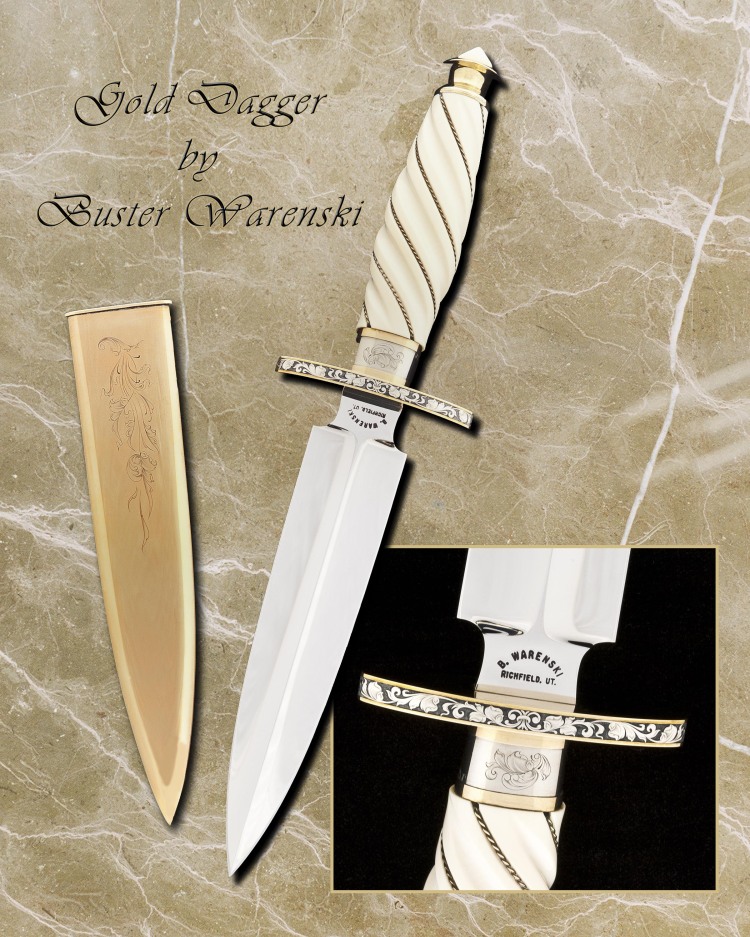
When knife enthusiasts think Knifemakers’ Guild, thoughts of Blade Magazine Cutlery Hall-Of-Fame© member Buster Warenski cannot be far behind. His gold dagger includes a gold separator band between the guard and also a gold pommel. The handle is carved antique ivory with twisted gold wire. The engraving is by Julie Warenski-Erickson. (from the Dave Nittinger collection; photo by Dave Siegel)

From One Cutlery Cradle To Another


The first BLADE Quiz focuses on Sheffield and the early days of the Knifemakers’ Guild


ARE YOU UP ON YOUR KNIFE HISTORY, especially the golden age of Sheffield and the beginnings of the Knifemakers’ Guild? Our first installment of a new BLADE® department, the “BLADE Quiz,” should let you know how schooled you are in short order. The answers appear below.

    1) The very early Sheffield knives carried the stamp “GR.” To what/whom did the initials refer and what were the knives better known as? A) Green River and Green River Knives; B) King George and Green River Knives; C) Great Britain and Green River Knives

    2) Knifemaker Ted Dowell served as a gunnery officer on which U.S. Navy ship during the Korean War? A) U.S.S. Minneapolis; B) U.S.S. Missouri; C) U.S.S. Intrepid

    3) How many cutlery factories were in Sheffield in 1910? A) 400; B) 1,400; C) 4,000

    4) Which Guild knifemaker was known early on by the moniker of “El Lobo Solo” (Spanish for “lone wolf”)? A) Chubby Hueske; B) Ruffin Johnson; C) Clay Gault

    5) Upon completion of 50 years of service, each Joseph Rodgers & Sons Ltd., employee was presented with: A) A 5-inch-tall silver statue of Vulcan holding the Rodgers trademark of a six-pointed star and a Maltese cross; B) a replica of the world-famous Rodgers “Year Knife”; C) a gold watch

    6) The obverse side of the blade is: A) the front or display side bearing the maker’s mark; B) the side without the maker’s mark; C) the blade spine

    7) Knifemaker Red Watson’s first name was A) Red; B) Herbert; C) Quinton

    8) In 19th-century Sheffield, the men who worked knife grinders feared: A) grinder’s asthma or grinder’s consumption; B) shattering grindstones, which could kill a worker; C) A and B

    9) Who stated, “Is knifemaking an art? I feel that anything done well is an art, be it a Rembrandt, a custom knife, or the Golden Gate Bridge. In short, what is art? More important, what isn’t?” A) Bud Cronk; B) Buster Warenski; C) Harvey McBurnette

    10) A cross guard has: A) Two quillons; B) one quillon; C) no quillons.

    11) According to The Knifemakers Guild Directory of the Membership, Bob Dozier is the son of: A) a blacksmith; B) an ironworker; C) a farrier

    12) The tool used by many Sheffield cutlers to put inlay holes in mother-of-pearl scales or to drill holes in scales is known as the: A) stidder or stiddy; B) parser or parsey; C) doller or dollie

    13) The first female knifemaker to apply for membership in the Knifemakers’ Guild was Carolyn Tinker, at the 1974 Guild Show. However, there was also another female maker who applied for membership at the ’74 show. Her name? A) Mary Jean; B) Ethel Waters; C) Rita Winter

    14) The term pocketknife originally referred to: A) a knife with blades opening at one end only; B) any knife that could be carried in a pocket; C) a knife that was always handy and could be used for any number of cutting chores

    15) Which of the following is not a founding member of The Knifemakers’ Guild? A) Jon Kirk; B) John Applebaugh; C) John T. Smith

    16) In old Sheffield, a bolster was cast or forged from nickel, iron or brass and had a projection used to tommy it to the liner. In this instance, to tommy means: A) to pin; B) to rivet; C) to solder

    17) Xylonite was the first of many types of imitation: A) bone; B) ivory; C) pearl

    18) Knives with handles made by burning an imitation tortoiseshell pattern into clear horn with lye were known as: A) spotted penknives; B) shell knives; C) turtle blades

    19) The Deguello, the tune Santa Anna adopted to signify no quarter would be given to the defenders of the Alamo, was originally used by: A) the Moorish invaders of Spain; B) Christopher Columbus; C) the Spanish conquistadores


Answers: 1) B; 2) B; 3) C; 4) B; 5) A; 6) A; 7) C; 8) C; 9) C; 10) A; 11) A; 12) B; 13) A; 14) A; 15) C; 16) B; 17) B; 18) A; 19) A. Scoring: 0-3—Your tongs just got gonged. 4-7—Have you considered foregoing knives and taking up Farmville? 8-12—You’re spending too much time playing mumbley-peg. 13-16—Your knife neurons are starting to fire. 17-18—You are qualified to run for mayor of The Pit at the BLADE Show. 19—You must be Pete Cohan, curator of the National Knife Museum.

For more on the latest knives, knife legislation, knifemaking instruction, knife trends, knifemakers, what knives to buy and where and much more, subscribe to BLADE Magazine, the World’s No. 1 Knife Publication. For subscription information click on http://www.shopblade.com/product/blade-magazine-one-year-subscripti…?r+ssfb050512#BL1SU.

 

Knife Of The Day XXIII: Abalone Case Peanut for Mother’s Day

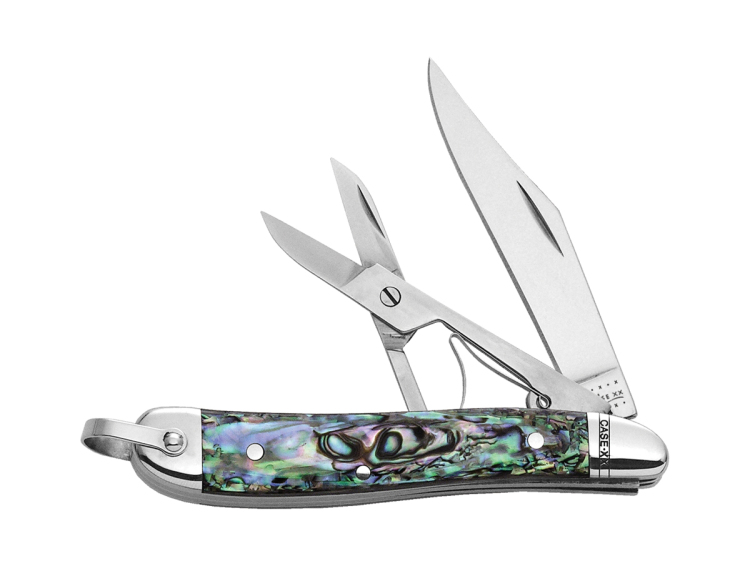
NOBODY APPRECIATES A SHARP UTILITY TOOL LIKE MOM—and all the better if it’s pretty. The Case abalone peanut is just the ticket for Mom on Mother’s Day.

The swirling abalone scales are very attractive and the clip blade and scissors—all in a 2 7/8 inches-closed package that weighs in at a scant 1.2 ounces—will give Mom all the cutting and snipping power she needs on her special day.

For more information click on www.wrcase.com.

For more on the latest knives, knife legislation, knifemaking instruction, knife trends, knifemakers, what knives to buy and where and much more, subscribe to BLADE Magazine, the World’s No. 1 Knife Publication. Click here for a subscribe to BLADE Magazine.

Strange Blade Brews

Darrel Ralph outfits his assisted-opening DDR Gun Hammer 3-D Alpha in a 3.95-inch blade of stainless damascus with a Stellite 6K core by Chad Nichols. The frame is Nichols 3-D-carved Moku-Ti titanium damascus. Ralph’s list price: $3,500. (knife photo courtesy of Darrel Ralph)

Some of today’s alternative blade materials may change the way you look at knives

By Pat Covert

TO MOST KNIFE ENTHUSIASTS, THE WORD STEELis so closely associated with blades it would be hard to describe a knife without it. After all, since its earliest known production about 4,000 years ago, in one form or another steel has ruled the roost not only in cutlery but so many other things that pervade our lives.

Simply put, steel is everywhere. Unfortunately, most versions of it rust.

Progressive thinking in the knife arena has led to a boom in the technological aspects of blades, which includes those of materials that do not rust or rust very little in comparison to stainless steel. (Stainless steel resists corrosion but is not impervious to it.) In the process, cobalt-based alloys such as Stellite®, Talonite and Cobalt Dendritic have received attention. Other materials such as laminates using titanium and carbon fiber, as well as ceramics, also have been used to good effect.

Frost on a Windowpane

Not a common metal, most of the world’s cobalt is mined in the Republic of the Congo. Today, most cobalt is used in corrosion-resistant “super alloys,” which are particularly suited for gas turbine and jet aircraft engines.

David Boye has been making knives for over 40 years. He offers fixed blades and folders for use around saltwater and other rust-inducing environments. He has used dendritic material exclusively since 1980 because he says he prefers its strength, cutting performance, ease of sharpening, and ability to cast roughly to shape.

(Editor’s Note: For a better understanding of forging various metals into blades, check out The Complete Bladesmith: Forging Your Way to Perfection, pictured at left.)

“Dendritic is the kind of pattern [damask] which naturally forms when a carbon alloy cools after smeltering,” Boye explains. “It looks like frost on a windowpane.”

According to many knifemakers, the finer the blade’s grain structure, the better it cuts. Boye supports the opposite view.

“These relatively large, rooted and fully bonded carbides produce microscopic teeth along the cutting edge, and this is what actually does the cutting,” he notes. The combined attributes of extreme cutting performance, no rusting in seawater and being non-magnetic so it does not affect a compass or electronics make the material ideal for the ocean environment. “We have used dendritic cobalt for over 15 years and have received virtually zero chips, broken blades or complaints,” Boye says, “and many customers have raved to me about the blade performance.”

He states that the material’s downside is each knife design requires a set of porcelain molds which are challenging and/or expensive to make, the mold created for each individual blade has to be discarded after only one use, the casting alloy is costly, and the waiting time for blades from the foundry can be lengthy.

Damascus Hybrid

Chad Nichols is a large supplier of damascus to the cutlery industry and has pioneered a new blend of patterned steel using cobalt 6K, commonly known as Stellite, and stainless steel—particularly AEB-L and 304. “The interesting thing about the 6K cored steel is that the cobalt alloy itself does not have to be heat treated to retain edge-hold abilities,” he observes. “The only reason the material needs to be heat treated is for corrosion resistance [for the stainless steels in the damascus] and for etching purposes.”

Nichols outlined several attributes of the hybrid damascus, “The addition of the cobalt-based alloy increases its durability and oxidation resistance,” he states. “The cutting performance of the 6K damascus is great. It’s a workhorse of a steel for cutting and can retain a razor edge even under the most vigorous conditions.” As for the disadvantages of the material, there are two. “The blade material is expensive. You already have a relatively high cost for the damascus and then you add the 6K which, pound for pound, costs more than the handmade damascus,” Nichols says, adding, “It’s not a lot of fun to make, either!”

“Won’t Crack Under Flex”

The book on modern laminate blades using metal bonded to synthetics was co-authored by knifemaker Warren Thomas (also, see page 114, August 2011 BLADE®). He indicates he began making laminate blades in 1991 using stainless steel and carbon fiber. Shortly thereafter he substituted titanium for steel, creating a lightweight, zero-magnetic knife. Thomas says he uses a “trade-secret” chemical bond that positively adheres the two materials.

“My laminates have half the weight of a steel blade, absolute zero corrosion, won’t crack under flex, and don’t micro-fracture under heavy stress along the cutting edge like steel blades do,” he explains. “To improve the performance of the blade, I weld tungsten carbide along the cutting surface to enhance the edge retention. This gives it a toothy edge that improves the cutting performance.

“There is no chance of corrosion using carbon fiber and titanium. Both materials are impervious to common destructive forces like sea salts, body sweat, and other elements that wreak havoc on steel,” he notes. “Steel knives have a very hard time cutting some synthetics, such as Kevlar™. My knives actually cut these materials quite well due to their ability to saw through them.”

Laminated blades do have their disadvantages. “In very rare circumstances, the blade can delaminate. I’ve had this happen approximately a dozen times in 20 years and have always corrected the problem for the customer,” he says. “Due to the direct cost of the state-of-the-art materials involved and the time spent fabricating the laminates, there is a higher cost for my blade over steel. However, you get what you pay for.”

That’s Edge Retention!

Ceramic blades are made by taking zirconium oxide—also known as zirconia—powder, compacting it under intense pressure, and heating it in blanks at high temperatures in the 1,400° Celsius range. The blades are much more common among kitchen knives, and for good reason. For straightforward slicing and dicing they are extremely effective, but for lateral blade movement with torque, such as for prying, they tend to snap or shatter.

Boker Knives has never shied away from thinking outside the box, and its ceramic knife line not only includes kitchen knives but tactical and everyday carries as well. “If used as intended, ceramic blades will outperform steel,” Boker USA CEO Dan Weidner says. “In an independent lab test performed comparing ceramic to steel, technicians measured the amount of pressure required to cut through a standard piece of cardboard. After 1200 cuts the pressure required to cut using the ceramic blade was the same as the first cut, while the identical task using a steel blade showed decline after 400 cuts.” Now that’sedge retention!

Ceramic blades also have other benefits over stainless steel, including corrosion resistance. “This is one of the prime advantages of ceramic,” Weidner opines. “It cannot rust, which is why it’s used so often in maritime and military saltwater environments.”

There is also good news on the economic front. “Initially the cost of ceramics was on the high side, but now there are sufficient manufacturers producing the material to put the price point in the same range as good, quality steel,” Weidner says. Moreover, ceramic blades are non-magnetic.

Is One For You?

The strange brews in blade technology are not for everyone, but they offer a wide range of features, including either no rust or a huge reduction of same, zero magnetism, weight reduction and enhanced edge holding. Granted, there are downsides in some instances, though apparently not enough to discourage enough buyers of the blade brews outlined herein.

Is there an alternative blade in your future?

For more on alternative blade materials such as Spyderco’s H1, Strider Knives’ Nitinol, and Bohler-Uddeholm’s Vanax 35 and 75, see page 68 of the April 2011 BLADE®.


Also be sure to check out BLADE’s Guide to Making Knives.


For more on the latest knives, knife legislation, knifemaking instruction, knife trends, knifemakers, what knives to buy and where and much more, subscribe to BLADE Magazine, the World’s No. 1 Knife Publication. Subscribe to BLADE magazine.

Top 11 Self Knife Promoters


The Spyderco Caly 3 (above) features a blade of ZDP-189 stainless and a carbon fiber handle. For info on how to buy one, click here.


THE CUTLERY INDUSTRY OFFERS MANY GREAT FACTORY KNIVES, but not all the companies who sell them promote them effectively. On the other hand are those who do. My top 11 list* of those who do it best follows.


No. 1: Spyderco. Spyderco’s catalog excels in content and looks. The company has a comprehensive website with high-resolution, easily downloadable images for media use, runs colorful, creative ads, and even has a professional calendar illustrated with a Spyderco knife for each month. The company exhibits at most high-profile knife shows, has a solid Internet knife discussion forum presence, and curries an outstanding stable of collaborative makers who are Spyderco ambassadors by proxy.


No. 2: SOG Specialty Knives. Any company that gets R. Lee “The Gunny” Ermey to plug its knives through ads, appearances at knife shows and elsewhere gets my vote. SOG exhibits at many high-profile knife shows, has a professional catalog and supplies the media with high-resolution images of its knives.


No. 3: A.G. Russell Knives. Blade Magazine Cutlery Hall-Of-Fame© member A.G. Russell is nothing if not a master self-promoter, and his company has it all in terms of great catalogs updated and mailed on a semi-annual basis, an informative website, professional ads, a healthy Internet knife discussion forum presence—and its own annual knife show to boot.


No. 4: Cold Steel. Cold Steel’s catalog is very well done and mailed to customers on a regular basis, with seasonal updates. The company is a master of “promotion in motion”—that is, it offers a number of CDs that show Cold Steel knives being used. The company’s website is outstanding, with high-resolution, easily downloadable images for media use.


No. 5: Buck. Buck recently signed Haley Heath of the “Family Traditions with Haley Heath” program on the Sportsman Channel to have her own line of Buck hunting knives. Buck has a comprehensive catalog and offers high-resolution images for media use. It excels at sending e-mails on the latest in its knives and other company initiatives. It exhibits at most high-profile knife shows and benefits from the goodwill and publicity generated by the Buck Collectors Club.


No. 6: Benchmade. A top-notch catalog, a complete media supply of outstanding high-resolution images, a steady stream of e-mail updates on company doings, an impressive array of collaborative makers who promote the company line by osmosis, a presence at most major knife shows, and effective use of such celebrities as Michael Waddell and the Bone Collector line make Benchmade a prime-time self-promotion player.


No. 7: Case. A great catalog, intuitive use of such American icons as John Wayne, Johnny Cash and celebrities that have included Blake Shelton and others on company knife lines, providing high-resolution images of its knives to the media, an “American heartland” approach to ad content and design, exhibiting at most high-profile knife shows and more all guarantee Case a top spot in the self-promotion sweepstakes. Plus, the Case Collectors Club adds its 19,000 members to the mix.


No. 8: Columbia River Knife & Tool. CRKT’s catalog is right up there with Cold Steel’s and Spyderco’s. CRKT offers high-resolution images, including great close-ups of specific knife features, for media use. It exhibits at most high-profile knife shows, and its vast stable of collaborating knifemakers serves as a P.R. agency in and of itself.


No. 9: Boker. Another of the companies with a great catalog, Boker supplies a comprehensive array of high-resolution images of its complete knife line to the media. Like CRKT, Boker has a vast fleet of collaborating makers who no doubt spread the good word of their designs for Boker as well. It exhibits at most major knife shows.


No. 10: William Henry Studio. William Henry recognizes the value of celebrities to promote its knives (i.e., actor Joe “Pants” Pantoliano’s appearance at the 2009 BLADE Show). It offered a William Henry knife valued at $10,000 to celebrate the 30th Annual BLADE Show and gave it away at last year’s show, creating mini-membership drives for Knife Rights, the American Knife & Tool Institute and the Custom Knife Collectors Association in the process. In other words, William Henry’s good P.R. for others was also good P.R. for William Henry. The company offers elegant ads, too.


No. 11: Gerber. Two words: Bear Grylls. Gerber has a nice catalog and supplies high-resolution images of its knives to the media, but it is the Bear Man that puts it on this list.


*The list rates the companies’ promotional ability only, not the quality of the knives. However, “perception is reality,” and effective self-promotion influences many people’s opinions of knife quality, whether it is an accurate barometer of quality or not.


For more on the latest knives, knife legislation, knifemaking instruction, knife trends, knifemakers, what knives to buy and where and much more, subscribe to BLADE Magazine, the World’s No. 1 Knife Publication. For subscription information click on http://www.shopblade.com/product/blade-magazine-one-year-subscripti…?r+ssfb043012#BL1SU.


Knives, Knifemakers, Tips On Knife Collecting Today and Tomorrow

Great knives, knifemakers, tips on knife collecting and much more are in the offing at venues across the country and abroad today and tomorrow, April 28-29.

    The Solvang Custom Knife Show is in Solvang, California, today ONLY. Some of the world’s finest custom knives and knifemakers are there. For more info click on www.nordicknives.com.

    The 30th Annual NCCA Extravaganza Knife Show is at the Hilton Hotel in Mystic, Connecticut, today and tomorrow.

    The Wolverine Knife Collectors Show is in Novi, Michigan, today and tomorrow at the Suburban Collection Showcase.

    The ABS Spring Piney Woods Hammer-In is today and tomorrow at the Texarkana College/Bill Moran School of Bladesmithing in Washington, Arkansas. For more info click on www.americanbladesmith.com.

    The 13th Annual Knifemakers Show is at the German Blade Museum (Deutsches Klingenmuseum) in Solingen, Germany, today and tomorrow. For more info click on www.messer-macher-messe.de.

    And finally, today is the final day of the Mason Dixon Knife Club Annual Show at the Best Western/Grand Venice Hotel in Hagerstown, Maryland.

For more on the latest knives, knife legislation, knifemaking instruction, knife trends, knifemakers, what knives to buy and where and much more, subscribe to BLADE Magazine, the World’s No. 1 Knife Publication. For subscription information click on http://www.shopblade.com/product/blade-magazine-one-year-subscripti…?r+ssfb042812#BL1SU.

Former TSA Official Says Don’t Ban Knives!

According to an ABC News report, a former Transportation Security Administration official says knives and other items should be removed from the prohibited items list for airline passengers.

Former TSA administrator Kip Hawley, who ran the TSA from 2005 to 2009, advocates that the TSA no longer look for weapons that cannot penetrate the cockpit door.

“Blades, sharp objects, tools, all those things should be removed from the prohibited items list,” Hawley told ABC News. “Carry a big knife, carry five knives. What are you going to do with a knife or five knives? You are not going to take over the plane. … The focus should be explosives and toxins — things that can kill a lot of people very fast before security measures can stop someone from making that attack.”

He argues since 9/11, objects that cannot kill a lot of people in a short period of time are no longer a significant threat. He says allowing screeners to concentrate on detonators and bomb parts instead of small weapons would make flying safer, and the screening process more convenient.

“The captain is not going to open up the door. The captain is not going to surrender the cockpit and the passengers are not going to sit by and let the guy stand there with a knife,” Hawley said. “I mean, you have to think of it as risk management. What is the risk that somebody is going stand up there with a knife to somebody — a child, a flight attendant — the risk that they’re going to do that and then take over the plane? And do we put people through these long security lines, fishing through their bags, two million people a day, just to prevent the eventuality that somebody might get killed? That’s a tradeoff.”

For more on the latest knives, knife legislation, knifemaking instruction, knife trends, knifemakers, what knives to buy and where and much more, subscribe to BLADE Magazine, the World’s No. 1 Knife Publication. For subscription information click here.

Advertisement

Must Read Articles

Read this before you make a knife

Knifemaking 101 – Read This Before You Make a Knife

  by Wayne Goddard My experience has taught me that there's nothing like digging in and getting started. I've often said the hardest part of the...
how to forge damascus steel

How to Forge Damascus

Advertisement
Advertisement