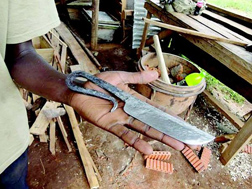
The following is excerpted from a feature article by James Morgan Ayres that ran in the April 2013 issue of BLADE® Magazine.
Over 90 percent of wilderness deaths by mischance are caused by hypothermia. Knowing how to build an emergency shelter quickly can mean the difference between freezing to death and surviving. You can build a survival shelter that offers protection from cold and snow or rain in no more than 30 minutes, and with only the tools at hand—which is where knives can make the difference in getting the shelter up before it is too late.
5 Keys to An Emergency Shelter
1) Evaluate your situation and decide if you need to spend the night out before it gets so dark you cannot see to build a shelter; 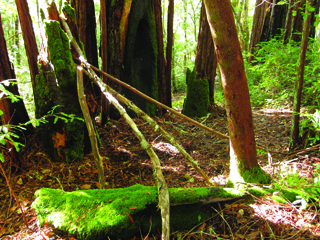 2) If available, select a level spot that provides natural shelter—a large tree or boulder, for example. Barring that, choose a place that has building materials such as saplings or brush nearby; 3) Build a framework using the natural shelter as a base; 4) Cover the framework with branches, leaves, brush and whatever materials are available. If possible make the covering 6 inches to a foot thick; the thicker the covering, the better the insulation. If you are in an area where there are limited building materials, having a reflective blanket in your pocket could be a lifesaver. It weighs only about 3 ounces, is no larger than a handkerchief and can make a difference of up to 20°F, and; 5) Cover the floor with six-to-12 inches of leaves, pine needles, duff (decaying leaves and branches), or whatever is available for insulation. Leave the area near the entrance clear of debris. After making the cleared area safe for burning small pieces of kindling, build a small fire in it. The fire should be no larger than a soup bowl.
If you are properly dressed for the climate, you can spend the night in such a shelter with a tiny fire not only safely but also comfortably. Having the know-how to build the shelter is critical. Having a good knife can make building the shelter quick and easy.—by James Morgan Ayres
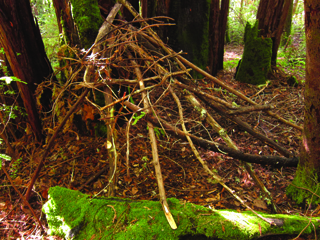 Author’s note: The shelter in the photos using pine boughs was built in a national park, not a true wilderness area. We were required to “leave no trace” and return everything as it was. Therefore, we did not thatch the roof nor build up the floor with boughs and leaves as described in the text, as you would in a survival situation.
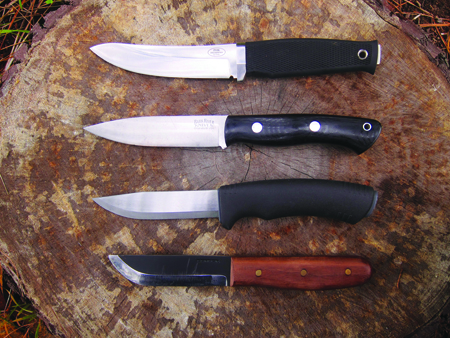
My associate and I used and evaluated four very different knives to construct two survival shelters. The review knives fall into two categories. The Mora and Condor both have ‘Scandi’ grinds and are economical. The Bark River and Fallkniven have convex grinds and are priced like the premium knives they are. 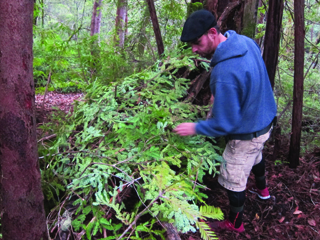
CONDOR BUSHCRAFT
The Condor Tool & Knife Bushcraft Basic Camp Knife has a comfy wood handle, a 4-inch blade of 1075 carbon steel with a lot of belly, and a full tang. When driven into a tree it was strong enough for a 200-pound guy to do a pull-up on; we tried it, no problem. The belly of the black-epoxy-powder-coated blade proved its worth in general use, but a little more tip would have been welcome. In knife design everything is a compromise and this is a good one. The welted leather sheath holds the El Salvador-made knife securely and is unusually nice for a package in this price range ($34.98 MSRP). 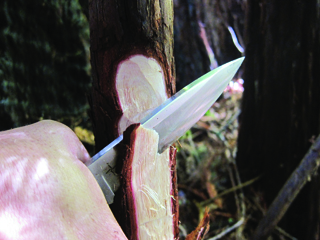
 BARK RIVER AURORA
The Bark River Aurora ($239 MSRP) is Bark River honcho Mike Stewart’s personal design for an all-around bushcraft knife. The American-made fixed blade displays excellence in design and use. The convex blade of A2 tool steel provides easy, controllable push cuts, supports the edge for batoning, gets into a cut aggressively, and has a centerline point for precise control. The handle is ergonomically contoured, does not slip and is comfortable in hard use. The balance is so good and the 9.5-inch knife feels so lightweight and quick that it seems to weigh less than the specs (6 ounces) would indicate. The pouch-type leather sheath is handsome, secures the knife well, carries comfortably and has a loop for a firesteel.
I suspect the Aurora has a reserve of strength that we did not come close to tapping in our review. Though not billed as one, I think the Aurora is an excellent choice for a wilderness survival knife. 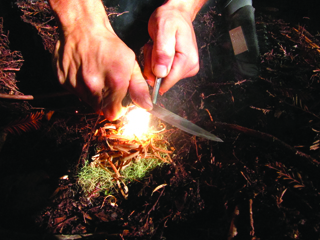
MORA BUSHCRAFT
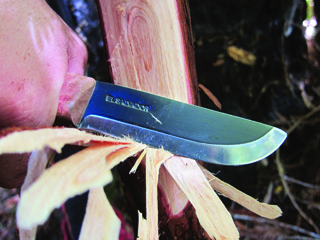
Made in Sweden, the Mora Bushcraft Survival Knife ($57.95 MSRP) comes with a firesteel and diamond sharpener—both valuable tools—in a composition sheath. The thick, 4.25-inch blade sacrifices nothing in slicing and wood-shaving ability. It has a good, usable point and is strong enough for batoning. The handle is very comfortable. The knife popped out of the sheath, which was worn on a belt, while we were jumping over a log. A cut or the loss of the knife could have resulted.
FALLKNIVEN PHK
Fallkniven markets its Professional Hunter (PHK) as “one of the best hunting knives in the world.” It is also a very good all-purpose bushcraft and survival knife. The convex grind and long, curved edge combine to make a strong 5-inch blade of 3G steel that just wants to cut. It batons well, makes good push cuts and snap cuts efficiently on small branches. It would even do a little light chopping, though no knife this size (9.4 inches overall) can be an efficient chopper. The PHK’s nonslip Thermorun™ thermoplastic handle is comfortable in any grip, even during hard use.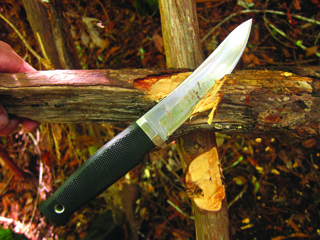
Made in Japan, the knife offers a choice of a leather or Zytel® sheath. I much prefer the leather one since the Zytel sheath must be snapped to secure the knife, as we learned when the knife fell from the unsnapped sheath while we were running. MSRP: $470.
HOW THEY FARED
In general, we found the knives with the Scandi grinds to be somewhat better for fine woodwork, such as making fuzz sticks, while the convex-ground blades cut more efficiently and with less drag in deep cuts. All the knives’ handles were comfortable and did the job. On the other hand, each knife had its own character and pros and cons.
The Bark River was everyone’s all-around favorite, and if there had been a prize for most handsome, it would have won. The Fallkniven displayed the high level of function for which the brand is known, and clearly had enough reserve strength to serve as an urban destruction tool. The standard Mora is a good all-around bushcraft blade at a very low price. It is a bit stronger than other Mora models we have seen, and the inclusion of a firesteel and diamond sharpener produces a very nice package. However, the sheath needs work—otherwise you had better use duct tape to secure the knife, as we did. The Condor brings a welcome alternative to the bargain-priced market and stands on its own merits as a strong, efficient choice for the bush.
The premium-priced Bark River and Fallkniven exhibit higher-quality construction and did almost everything better than the less expensive Mora and Condor. Nonetheless, the difference was a matter of degree. All would serve to build a shelter and produce firewood, and maybe save your life.




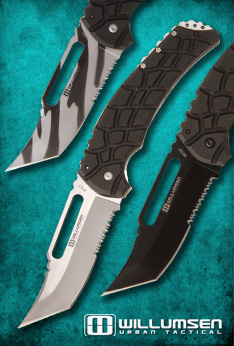 opening. The modified tanto blade offers strength and versatility. The Blondie is available in a black-coated, urban camouflage or satin-finished blade with a partially serrated or straight edge totaling six versions in all.