Great knives have face. I’m not talking about a face like on a Halloween mask, but a knife with a design or style that’s recognizable by a large number of knife enthusiasts as having been made first by one knifemaker and one knifemaker only.
The face, in this instance, is the unmistakable knife design or style of the maker in question.
There are at least two provisos: 1. To fully qualify as a knife with face the knife must be recognizable by a large number of knife enthusiasts. Now, there no doubt are great knives made by makers that one or a few enthusiasts may recognize as being the knives of specific makers, but the ones that really fill the bill are the ones many enthusiasts can look at and say, “Yep, that’s so-and-so’s knife.” It’s effective in terms of a conversation starter among knife enthusiasts who are friends, or as a conversation icebreaker among those who have just met. They don’t know each other but they do know great knives with face.
2. Some of the makers of knives with face have had their designs with face emulated by many others. Even so, if the knife has face those who recognize it will say that it’s in the style of the maker who originated it.
Following is a selection of great knives with face and why they qualify. Enjoy!
The Bob Loveless dropped or drop-point hunter. The Loveless drop-point hunter is one of the great knives with face on this list that meets Proviso 2 above. While it may not appear to be all that unusual, the drop-point style of the blade—where the blade tip falls below the plane of the spine—is something Loveless popularized in the 1970s and ’80s, and it remains his signature style to this day.
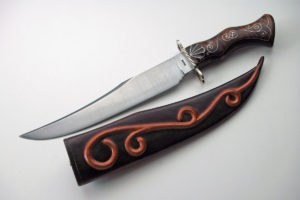
The Bill Moran style. Actually, as with Loveless, any number of Moran knives have face, though I’ve chosen one of my favorites: the ST-24. The flowing blade with a long clip point and ergonomically contoured dropped handle with silver wire inlay is unmistakably a Moran.
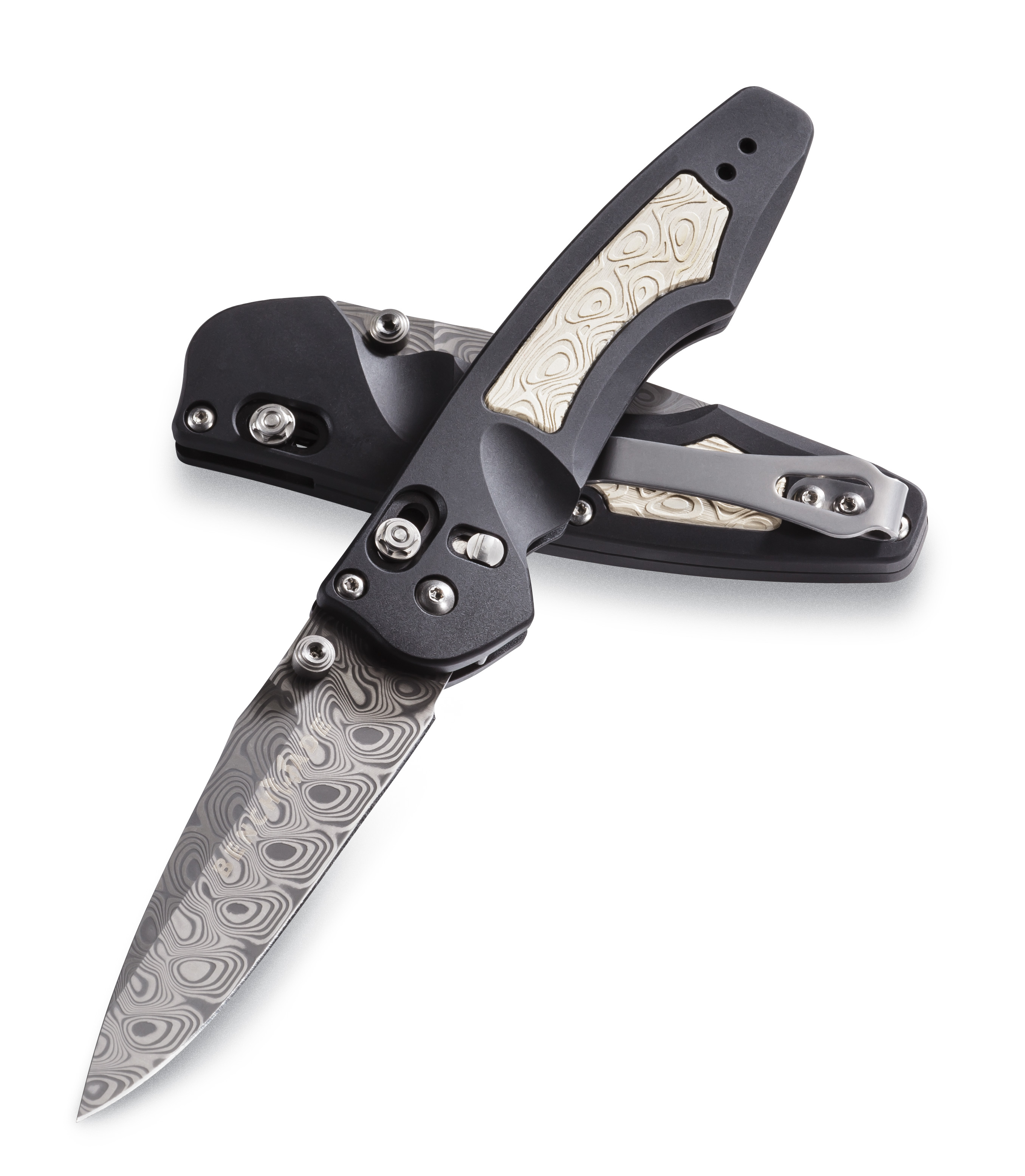
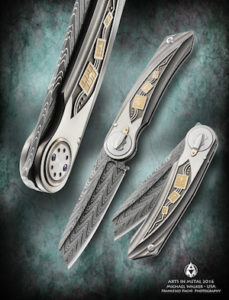
The Michael Walker style. Walker’s linerlock folder changed knives forever but he also makes models unlike anyone else. Outfitted with any number of his clever and innovative locks, each of which gives the handle a notably different look at the pivot, Walker’s knives use the latest and most exotic materials, are embellished in any number of creative and ornate ways, and usually have some of the most interesting blade shapes you’ll ever see.
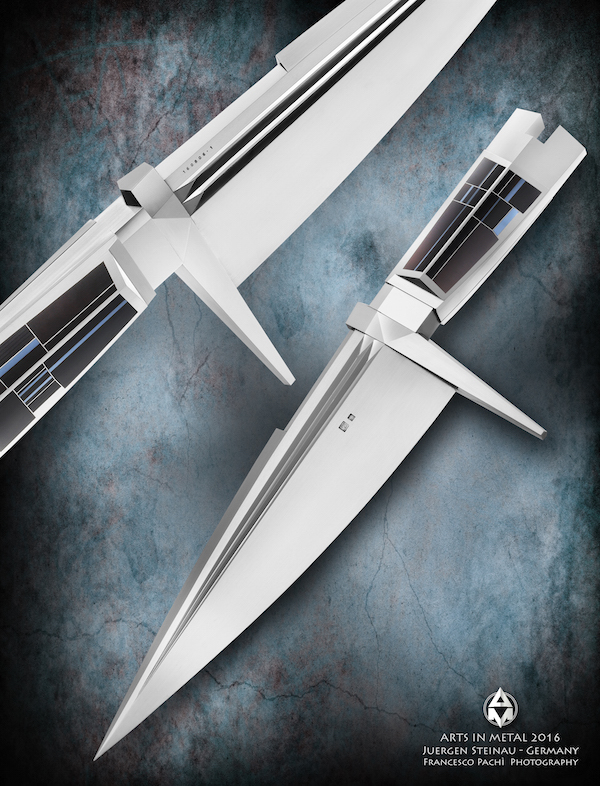
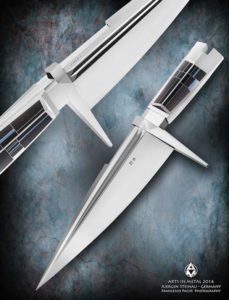
The Jurgen Steinau style. When I first saw one of Jurgen Steinau’s knives, at first I wasn’t even sure I was looking at a knife. The designs, angles and materials of his knives are like something from a book on intergalactic architecture. Suffice it to say, Steinau’s great knives have face—and then some!
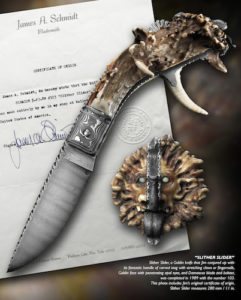
Jim Schmidt’s Goblin Folder. Schmidt’s Goblin Folders have face in more ways than one. Not only do they have the face of a goblin on the handle’s stag butt, but that face makes the knife unmistakable as the style originally made by Mr. Schmidt. A number of his other models have face as well.
There are others who make great knives with face. Which ones make your list?
1 The Loveless dropped or drop-point hunter has face in large part because of the drop-point blade with the tip that drops below the plane of the spine. An original is shown at bottom here, with a Schrade repro at top.4 Jurgen Steinau’s great knives have face for their design, angles and materials that look like something straight out of a book on intergalactic architecture.3 Michael Walker’s spectacular folders have face for any number of reasons, from their distinctive pivots to their exotic materials, creative embellishments and standout blade shapes.2 Bill Moran’s ST-24 has face thanks to the long, flowing blade and ergonomic dropped handle with silver wire inlay—not to mention his distinctive sheaths. Those who know great knives recognize the Moran style immediately.
5 Jim Schmidt’s Goblin Folder has face in more ways than one—it actually has the face of a goblin on the handle butt!
Summer means camping and camping requires lots of chopping jobs for such handy pieces as the Alaskan Bush Pilot Hatchet from Timberline.
Designed by custom knifemaker Russ Kommer, the hatchet features a 440 stainless steel blade in a satin finish and a finger-grooved haft covered with Zytel slabs. Overall length: 9 inches. Weight: 3 pounds. It comes with a bridle leather sheath and a non-slip belt loop.
For more on the latest knives, knife legislation, knifemaking instruction, knife trends, knifemakers, what knives to buy and where and much more, subscribe to BLADE® Magazine, the World’s No. 1 Knife Publication. Click on http://www.shopblade.com/blade-magazine-one-year-subscription-us/?r+ssfb062712 for more information.
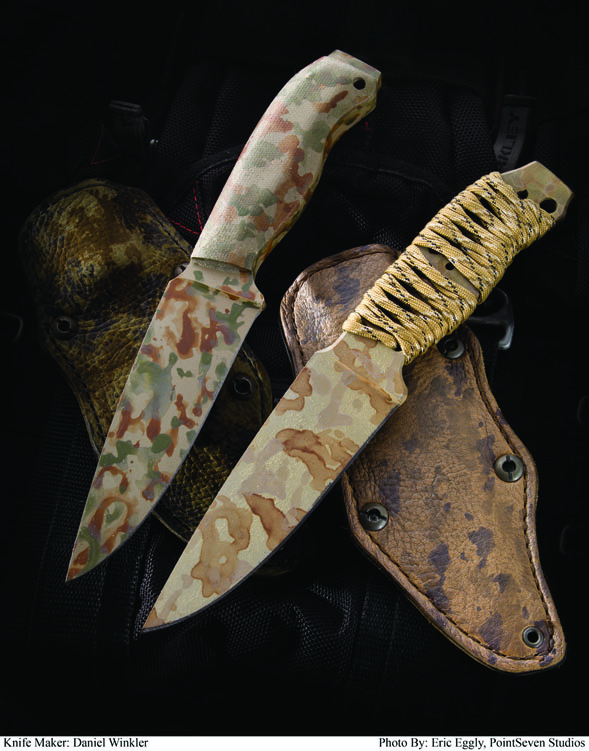
Paraded in the Knives 2013 book like dress soldiers at a welcome-home party is a pair of Daniel Winkler fixed blades in camouflage finishes, and cord-wrapped and otherwise synthetic handles. They each measure 9.75 inches overall and feature extended “striker pommels.”
Soldiers will no doubt take as much of a liking to the twosome as the Editor of Knives 2013, further catapulting them to the top of the “Editor’s Favorites from Knives 2013 Book” list. (Eric Eggly, PointSeven Studios photo)
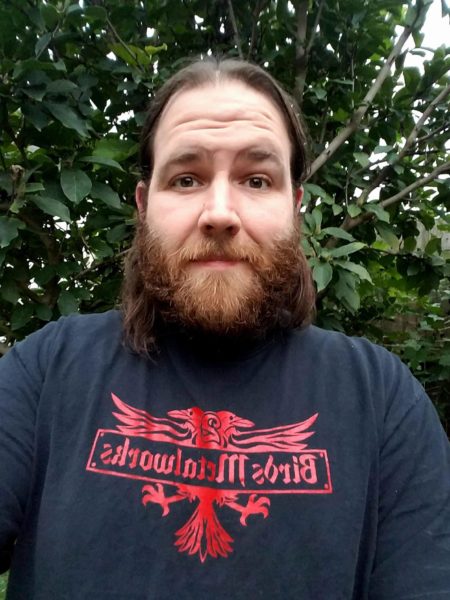
In a recent Facebook post, Mike Jeffries of 2 Birds Metal Works asked fellow knifemakers if they had a website, if it was worth the time and money to set up and maintain and how they approached it. He often throws out marketing-related topics for discussion. If you’ve followed any of those threads, you’ve already picked up some digital marketing tips from fellow makers. So, with Mike’s permission, our first in a series of Marketing For Knifemakers articles will delve into some of the feedback he received, assess some statistics and provide examples of custom knifemaker websites. Obviously, if you are an uber-successful full-time knifemaker, you can stop reading, unless you want to reach a still wider audience. This article, though, is aimed at those on the cusp of going larger or full-time with their craft. So, knifemakers: Do you need a website?
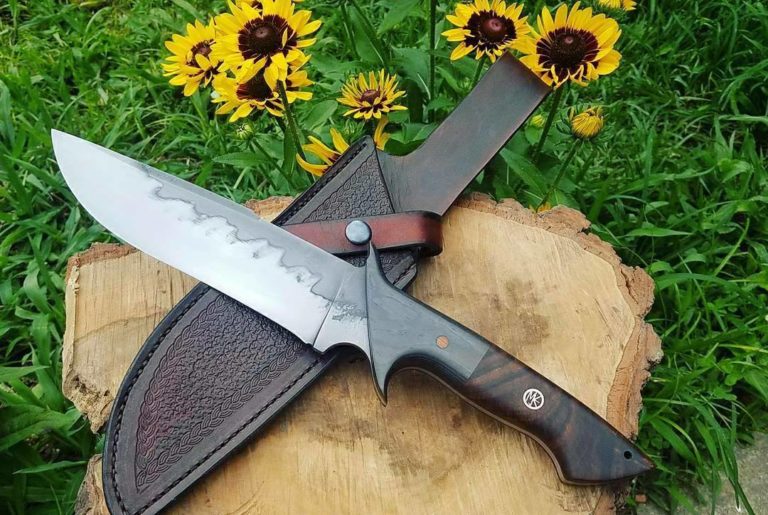
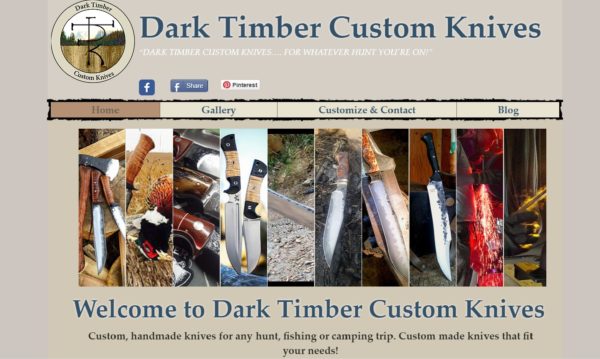
Experiment. Do a search for “custom knifemaker.” The first one to come up is Dark Timber Custom Knives, run by Peter Kohler. Why? A blog, and most of the photos are labeled. There needs to be content that bots can search through.
We’ll save whether you should go the do-it-yourself route or hire a pro for another time. We simply want to determine if a website is worth your time, money and effort at this point in your knifemaking career.
What Are Your Knifemaking Goals?
Are You A Hobbyist Or Part-Timer?
There is no shame in continuing to improve your craftsmanship, loving the journey and decidedly not going forward with a website. Continue to learn with each knife, sell a few to keep yourself in supplies and follow along with the community to stay up on industry news. Facebook (FB) and Instagram (IG) are all you really need.
Is Knifemaking Your Calling?
If you’re “arrived,” you already have a website and you can stop reading, unless you want a few tips on maximizing your customer base. If you’re striving to reach higher rungs on the artisan ladder, focus on bettering each knife, learning from mentors and obtaining your journeyman smith rating if you forge. You can either start a website or wait. Once you think, and your peers confirm, that you’ve hit your knifemaking stride, though, you will definitely need a website. You will also need to tailor that site to reach the public you set out to attract.
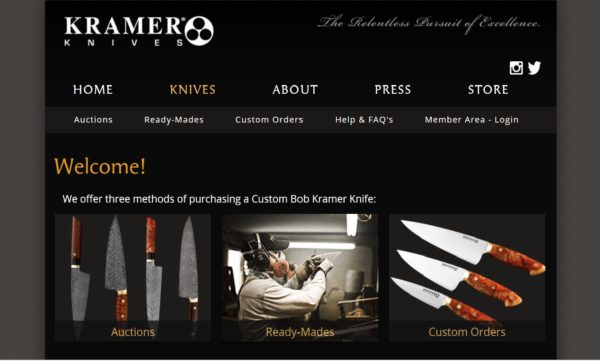
Bob Kramer of Kramer Knives maintains a website that reflects his appreciation of metallurgy and how it contribute to his “effortless art.” A website is an “experience” that should reflect the maker’s philosophy, style, story. Kramer’s does all that, which is why he come up third in a search for “custom knifemaker,” right after Arizona Custom Knives.
Are You Actively Growing Your Business?
You’re comfortable with your style and level of craft. You’re 100 percent committed to knifemaking as a full-time trade. You’re making money at it. You may be maxed out, or you may go through times of feast and famine. You, perhaps more urgently than other custom knifemakers, could benefit from a website sooner rather than later.
Whom Do You Want To Reach?
Honestly assess your style of knives and ask yourself who would be interested in your work? That can be a distasteful question when you solely want to focus on your art, but it’s not just about selling knives. It’s about tapping into the community that will be assessing and judging your pieces.
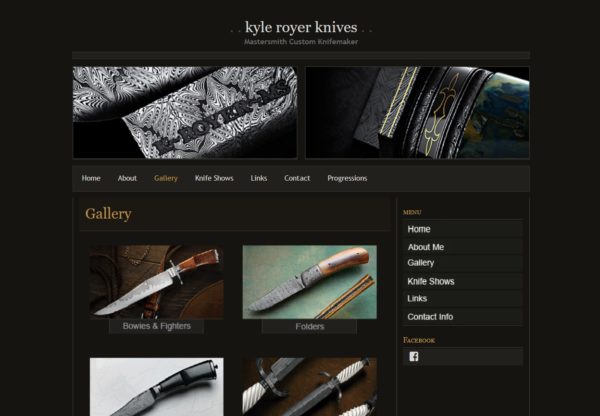
Kyle Royer Knives‘ website is full of professional photos by Caleb Royer and every single one of them includes full specs. Kyle is an American Bladesmith Society master smith. He was 23 when he wrote his About page. He’s 27 now. Is it perfectly grammatically correct? No. Is it genuine and true to him and his knifemaking journey? You bet. Your knives need to be perfect, not your writing. Write as you would speak.
The Collector
If your folders are carried in a velvet pouch or arranged on a display shelf, a website, of course, is essential. You already know this. You’re spending the majority of your time in your shop or socializing with your clientele in the normal course of living your life. However, “owning” your name may not be enough in a waning high-end knife market. Is your site attracting the gentleman who wants something to go with his watch, the art collector who may be looking for a new-to-him art to explore, or neither. We’ll be exploring more about best practices for your site in an upcoming Marketing For Knifemaker’s article.
The Brotherhood
If you’re making tactical knives for the military, for law enforcement or for civilian self-defense, then you need a website, period. This category also includes trainers and balisongs for combatives instructors and practitioners.
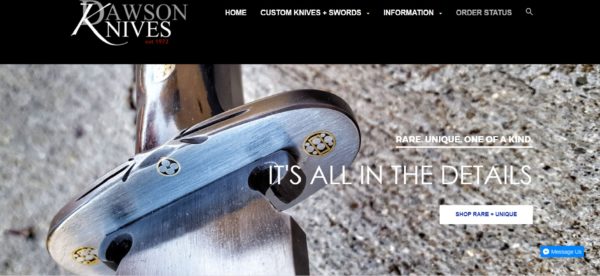
Dawson Knives comes up fifth in a “custom knifemaker” online search. This site is both exquisite art and an homage to the military. However, it’s high ranking is due in no small part to its depth. Check out its active blog, The Daily Grind.
The Outdoorsman
If you’re making knives and tools for bushcrafting, camping, hunting, fishing or survival, you, too, need a website. Obviously, there is crossover in these categories. Your Rambo-esk survival knife may be totally tacticool, so you’ll want to appeal to The Brotherhood as well as The Outdoorsman.
The Everyman
The everyman carries a knife for everyday chores, or keeps one in her purse, or has a few in a kitchen “junk” drawer. You absolutely need a website to reach this person.
The Cook
How can you convince people who cook that you can make a knife that will perform as well as an expensive classic, but in a color other than black? Answer: a website.
How Do People Find You?
Word Of Mouth
There’s still 30 percent of the adult US population (250 million) that is not online. That’s where you stake your name on the quality of your product and never let it out your door if you’re not 100 percent sure of it.
You also learn to ask. You ask your happy customers to write reviews for you. You ask your less-than-happy customer to honestly share his disappointment and how you went above and beyond to not only make it right, but make it better than all right. You ask fans to tell their friends about you. You ask them to share your posts.
Article Appearance
Print publishing is indeed on the decline, but digital publishing is coming into its own. Articles in which your work is included can give you a boost in search engine optimization because it’s packaged with over 300 words and includes links, images and video—all things that help rank that article, and thereby your knife images, higher.
Social Media
If you’re on the cusp of growing larger, you undoubtedly have social media well underway. We’ll be doing articles on each platform and how you can best maximize it to get your type of knives in front of a broader audience.
Online Search
This is where we want to focus. In order to meet new customers where they are, you must put yourself in their shoes. Sit down at the computer and think like a non-knifemaker. That can be a challenge. By focusing on Facebook and Instagram, knifemakers are talking to each other and customers who already know them. There is so much overlap that the circle of influence has shrunk to solely each other and fans. Fellow knifemakers are the best source of cheerleading, constructive guidance and fellowship, but they can’t help you reach those outside the knife industry.
Mike Jeffries of 2 Birds Metal Works in Louisville, Kentucky, will often throw out marketing questions for knifemakers on Facebook. Some of the feedback he receives is invaluable, though you should always verify current marketing practices because things change quickly in the digital marketplace.
Make a list of the things that people might type into a search engine to find you. Enlist a non-knifemaker’s input if necessary. Let’s use 2 Birds Metal Works as an example. Mike makes knives to handle your cutting needs “from kitchen to camp.” So, his aim will be to attract the The Outdoorsman and The Cook. Except for current customers and fellow makers, people know neither “Mike Jeffries” nor “2 Birds Metal Works,” so what might they enter to stumble upon Mike’s work.
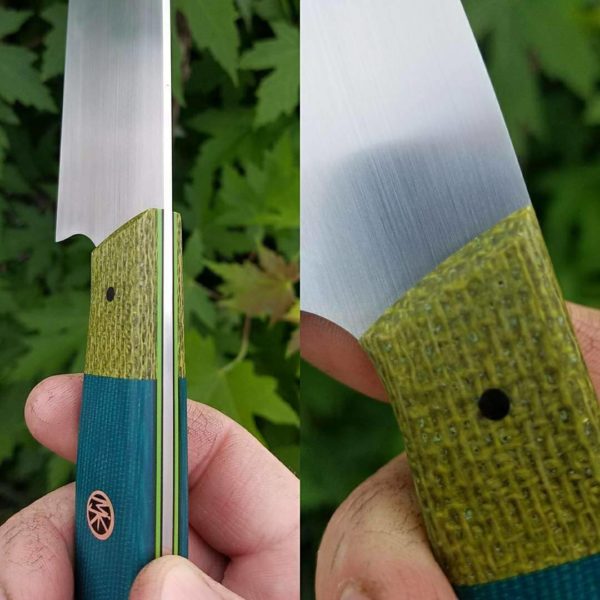
Mike Jeffries’ chef knife has a 7-inch AEB-L stainless blade with a Vintage Blue Westinghouse Micarta handle with Shadetree Emerald Burlap bolsters. The signature pins are made of copper. The overall length is just under 12 inches. Maker’s list price: $300-$380. Contact Mike Jeffries, 2 Birds Metal Works, [email protected], 502-592-4240, on Facebook at 2 Birds Metal Works & Mike Jeffries Knives.
As clumsy as that sounds, that’s what you want to have happen. Mike offers a chef knife with a teal blue and lime green handle. Let’s say a woman is searching for a housewarming gift for her sister, whose favorite color combination is teal and lime. She types in “teal and lime gift.” That’s it. Nothing about knives in the equation. If Mike has written a full caption to go with an image of his knife on his website along with the suggestion that it makes a nice gift, he has just increased the chances of his site coming up in a search. If he also describes in a blog post how he made this knife and covers his reasoning behind his color choices as well as all his other creative decisions, he’s gone even farther to ensure his site has a chance of coming up on a vague search like in our example.
Is it foolproof? Of course not, but you’re honestly playing the search engine optimization game with images and descriptions and blog posts. If you do that for each type of knife you make, over time, it will pay off in higher rankings for a variety of searches.
Isn’t Social Media All A Maker Truly Needs?
In A Word, NO!
Digital marketers had predicted that websites would give way to social media and email would die at the hand of Messenger. That’s not how it’s turned out.
The only way your Facebook profile will come up in a online search is if someone actually searches for your name or company name. You’re trying to reach people who have never heard of you and don’t even think of knives as an option for, say, gift-giving. You could argue that you would never want your art falling into the hands of someone who can’t appreciate what a custom knifemaker does. OK, but what if by getting a knife into their hands by whatever means, you create an impassioned fan, who then tells her friends how brilliant the colors were, how perfectly the knife worked, how great it felt…
Content Is Still King
Words still matter in this hashtag world. “Content” refers to anything used to fill an article, social media page or website. It can be writings, visuals in still or video form, and links, but in order for visuals and links to have weight, they must have words associated with them. And you need a place to park your content where it’s forever accessible, and not lost on some never-ending feed. (Saving posts helps you, but not your potential customer.)
How can this be? Isn’t Facebook pushing video? You bet. It’s trying to be You Tube, which is owned by Google, and although FB has a more engaged audience, more people visit You Tube in a month than visit FB. Efforts are probably underway to extract video content so transcriptions can be combed by search engine robots. But even that won’t help if a maker is just silently showing all sides of a knife. We’ll talk more about video and how best to harness it in another Marketing For Knifemakers article.
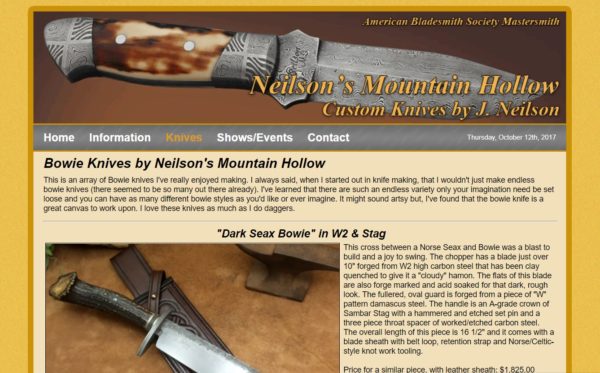
J. Neilson, American Bladesmith Society master smith and “Forged In Fire” judge, has a website that makes exceptional use of photo description. Knives on the Neilson’s Mountain Hollow site not only get a list of specs, but a full description of inspiration, construction or something else memorable about the build.
So back to words. Every day the Google bots do their thing, combing articles, photo titles and captions, video titles and descriptions, links and meta data fields, to rank websites according to relevancy. Ever wonder why video is embedded in an article, or why slide shows come with accompanying written commentary? Words, dude, words. The term “blog” may be passe, but blogs still matter—greatly. You are reading one. We call it an “article,” but it’s still an article under my name and the Mightier Than The Sword banner. Every single example of a website that comes up high under a search for “custom knifemaker” includes either a blog or highly descriptive photos captions. J. Neilson’s blog ranks high in a search for “custom knifemaker” not because it’s filled with “Forge In Fire” references, but because of his depth of description on each of many, many knives.
Battling Anti-Knife Bias
As many of you are fully aware, there is definitely bias at Facebook and it’s against weaponry. Selling of guns and knives is not allowed, so don’t put prices on your marketplace items. Even though they encourage you to boost your post, if you ever try to, you’ll be informed that what you’re selling goes against FB policy. So, what’s a custom knifemaker to do? Play the game, organically and on your own terms—with a website. Your post to Facebook lasts about 5 hours; your blog post/article has a 2-year lifespan.
What does “organic” mean, anyway? It refers to building content naturally and not paying for ads to boost results. It’s about “articles” or “blog posts” on your website, photos, video and links that all work together to speak on a specific subject. The words are compiled naturally, and not “stacked” repeatedly in an unnatural cadence.
Normally, Mike Jeffries focuses on “kitchen to camp” knives, but he decided to try an old-school American Bladesmith Society-style knife, but with a full tang. The Cowboy Fighter even caught the eye of Jason Knight and Murray Carter when they stopped at the 2 Birds Metal Works table at BLADE Show 2017. A blog post would be the perfect place to tell this knife’s story and what it meant to Mike on his knifemaking journey. The 7 3/4-inch blade is made of W2 steel with hamon. The handle is walnut burl with unidirectional carbon fiber bolsters. Overall length is 13.5 inches. Maker’s list price: $750 with leather sheath by Two Drunken Celts Custom Leather. Contact Mike Jeffries, 2 Birds Metal Works, [email protected], 502-592-4240, on Facebook at 2 Birds Metal Works & Mike Jeffries Knives.
Let’s say you have a blog on your WordPress website. You should aim for a minimum of 300 words per post to optimize search engine optimization (SEO). You explain what you’re working on that week. You mention blade lengths, because people use blade lengths as part of their search criteria if they’re in a state that limits them. You mention steel, your process, the handle material, including color, price, what comes with it, how it is shipped, and how people can put in an order for one. You give shouts out to your suppliers and mentors or supporters on the project then share it to Facebook.
You will still be speaking to your established audience while increasing your chances of being picked up in a generic search. Pretend you are talking to people who know nothing of custom knifemaking, because you are. Take the opportunity to educate as you go, minimizing abbreviations and lingo. You’re broadening and educating your clientele with each post. You write, “Everyday (one-word adjective) carry, abbreviated as EDC, refers to something you carry every day (two-word noun).” See how I did that? (Laugh here.) At the end of the week, you write another post sharing how you did. You include pictures of your works-in-progress, rather than “WIPs,” and a finished example. You share your successes and challenges.
Instead of saying “click here” for a link, link to the applicable words. Never forget the “web” part of the worldwide web. Link to others when appropriate, but do not link to everything. You don’t want to pull your potential customer away too frequently. Pick and choose wisely, and be sure to set the link so it opens in another window so they can easily return to your site. All of this helps to rank you higher in searches. It’s more time-consuming than FB or IG, but can be done less frequently, and over time, garners stronger returns on time spent.
5. Who Controls Your Website Experience?
Guess what? You don’t get put in a time-out on your own website. You control your content and exactly how it looks and reads. You can build a photo gallery of finished work that includes a written description with all specs and includes the prices—imagine, no Facebook jail! You can have an About page that gives your journey as a person and as a knifemaker. It doesn’t have to be long, but it should be at least 300 words and include images from benchmarks in your life. People are buying a part of something you’ve poured your heart and soul into; they want to know who you are.
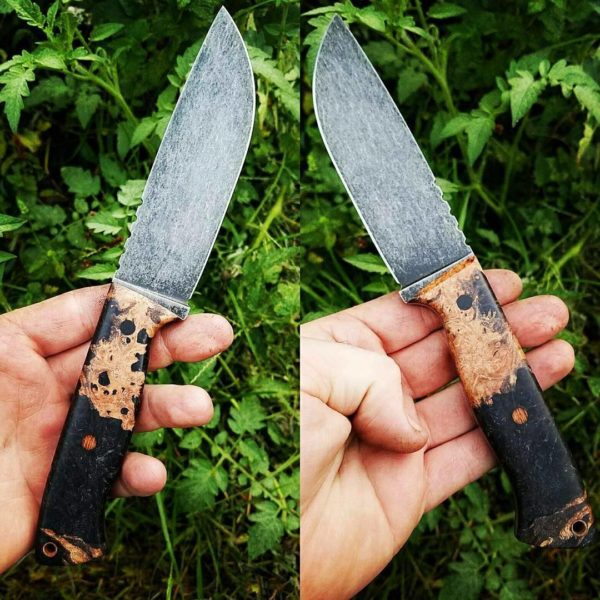
This is a good time to mention that you can’t take too many great photos of your finished work, but bad photos hamstring your marketing, period. Mike Jeffries takes some nice photos, but not enough of them to have samples of everything he’s made. His Campcrafter model is his flagship camping knife. It has a 5-inch blade of 80CrV2 high-carbon steel. Overall length is just over 10 inches. This one has a black and burl handle. Maker’s list price: $250-$325. Contact Mike Jeffries, 2 Birds Metal Works, [email protected], 502-592-4240, on Facebook at 2 Birds Metal Works & Mike Jeffries Knives.
You can include platforms to sell directly from your website. You can and should drive traffic to your social media sites and include your website on your social media profiles, but you are in charge of your website content, for better or worse. Best of all, you can include at the very least, a newsfeed, but hopefully you’re seeing the benefit of a blog, so you can share industry new that your customers might benefit from, including your own promotions, giveaways and waffles (sorry, a website won’t change state laws). A blog within your site gives you a platform from which to explain thing about your craft, offer your opinion, talk about your life as a knifemaker, projects you have in mind, specials you’re running, shop tours you’re hosting, hammer-ins you’re organizing. It’s a place where you can put in words what you normally say in a video.
“But I hate writing. That’s too much of a time-suck.” Agreed. Perhaps you know someone who likes it. You can offer them short money to do weekly posts for you. “Arrgh, a money-suck.” Try to look at it as an investment in growing your business. I see plenty of knifemakers who can’t even Share a post. Their buddies do in 2 seconds what they couldn’t figure out in two weeks—that’s an actual quote from one of them. Trade your buddy a knife for an equal value of his digital expertise.
What Does Your Knifemaking Destination Look Like?
Ranking higher in online searches is a long-term endeavor. It takes consistently delivered content over the course of an extended period of time. Google is no more friendly to weapons than Facebook, but all knifemakers are playing under the same set of rules and the ones with websites and blogs are being rewarded.
Make a list of all the terms you want to “own.” Start building content around those terms, and your website will populate itself into relevancy. Remember, it sometimes happens in life that the most gifted are not always the ones who obtain success with their given talent. It is the ones who can take their art and persistently and accurately market it, who will garner both recognition and thereby profitability.
At the same time, if you’re constantly sucked into the money and time trap of marketing, there will be no knives to market. Use your time at the forge and the grinder to think. Start a notebook of both your big vision and the baby steps necessary to get there. Then enlist the help of people who truly get who you are and what your knives are about, so that you are free to make more knives.
A Digital Subscription To BLADE Is The Answer
You can read your digital issues of BLADE Magazine anywhere you have your phone, tablet or computer, and there’s no need to find storage for all your old issues.
If piling-up issues of magazines seems like a waste to you… If you feel like you don’t have time to read a magazine… If you like the stories we offer in BLADE, but want a more economical option, then a digital subscription is the answer. An annual subscription to BLADE is $17.98, $4 off the print price.
Is a U.S. Army Ranger made or is he born? Is it the training he receives that makes him a Ranger, or is there some innate quality in him that draws him to Ranger training in the first place? If you tell former U.S. Army Ranger Sergeant Kyle Gahagan (pronounced guh-HAY-gan) that he doesn’t have the proper credentials for full-time employment with your company, he’ll proceed to acquire three doctorates. If you were to suggest that he not go to work at the auto-body shop if the pain in his right arm is so bad that he cannot hold a toothbrush, he’ll go anyway and tape a hammer to his forearm. If you crush his 10-year-old spirit by telling him that the knife he spent hours making is no good and throwing it on the ground, he will one day use that craft to not only heal himself from the emotional ravages of war, but to help heal other veterans as well. Never tell an Army Ranger he cannot make a knife.
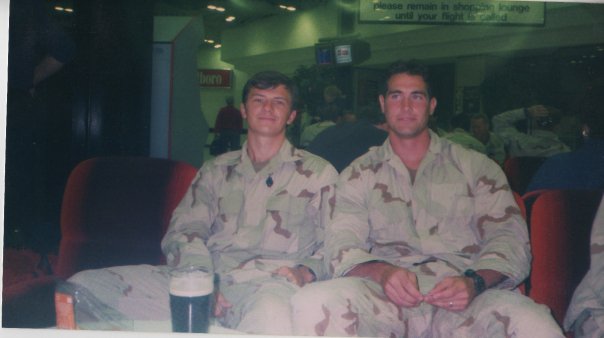
U.S. Army Ranger Sergeant Kyle Gahagan, right, pauses for a drink with Chris Hickox after his first tour in Afghanistan. Kyle is using blacksmithing to help counsel veterans as they find new missions in life.
Kyle doesn’t remember a time when he didn’t want to be a soldier. As a boy, he would dress the part and play army for hours. He came from a military family with a grandfather who served in the U.S. Navy during World War II and a father who retired as a full Colonel after a near-three-decade career in the Army’s Armor branch. Kyle was born in Colorado and lived in Kentucky and Germany, but from ages 8 to 11 the family lived in Savannah, Georgia. He would see the then-black-bereted Rangers of the 1st Ranger Battalion, who were stationed at Hunter Army Airfield in Savannah, and he knew that’s what he wanted to be. “I thought they were the coolest guys on the whole planet,” he said.
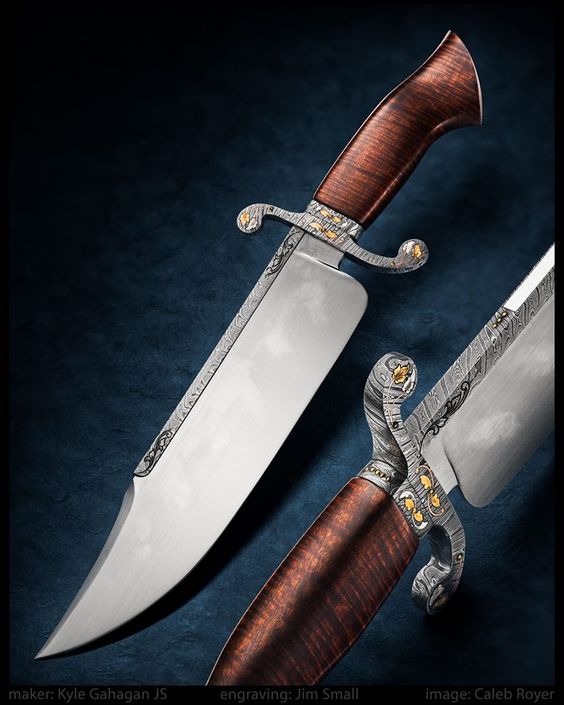
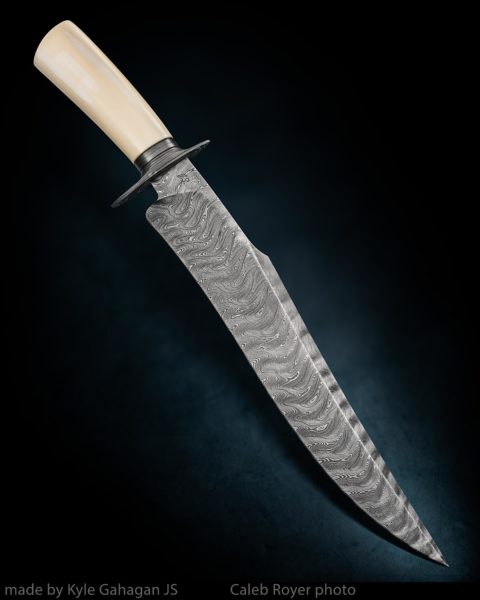
Growing up Kyle remembers a giant-to-him W. R. Case & Sons bowie on display above the mantle. He was not allowed to touch it, but he spent many hours studying it. When he became a knifemaker the only thing he wanted to make was big bowies. Only now he was bigger and so his bowies kept getting larger to recapture the proportion of his boyhood fascination with the big bowie. “I had to scale that back a bit,” he says with a laugh. This one has a 12.5-inch blade of forge-welded 1075 annd 15N20 steels with a fossil walrus ivory handle. Maker’s list price: $3200. Contacts for Gahagan Knives are listed at the bottom of this article.
Kyle got his first knife from his maternal grandfather when he was 5. It was a little Old Timer pocketknife to go with the shotgun he got for deer hunting. “I hunted with my grandfather until he couldn’t hunt anymore,” he said. His father transferred back to German, so Kyle saw him infrequently. It was his grandfather who spent time with the hyperactive boy, teaching him how to hunt and build things, how to work with his hands. At 10 his grandfather handed him a piece of aluminum and told him to go make something with it. It was his first attempt at making a knife. Although not an easy material to be cutting and grinding on, he crafted something resembling a knife. There was no heat treating involved, he said with a rare chuckle.
As Kyle learned more, he once spent a long time forging a knife. He hammered painstakingly to forge-weld steel for the blade. He made a wooden sheath, carefully lining up the wood grain. “I was so proud of that knife,” he said. He took it to an area knifemaker. That maker couldn’t stop telling him how bad it was. He threw it on the ground. “It crushed me,” Kyle said. “I didn’t make another knife for about 20 years.” He didn’t even tell his grandfather what had happened. “I think he thought I just grew out of my interest in it.”
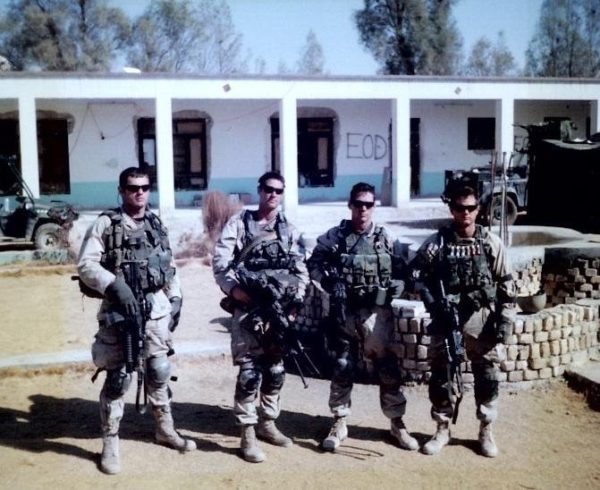
U.S. Army Ranger Kyle Gahagan, second from left, was deployed twice to Afghanistan. This was taken in Kandahar before a mission on his first tour.
In 1999 at the age of 19, Kyle enlisted in the Army with a Ranger contract. He was engaged when he went in and was married in between basic training and Airborne school. He went into the Ranger Indoctrination Program and Ranger school and was assigned to his boyhood heroes’ unit, 1st Battalion, 75th Ranger Regiment. But then 9/11 hit and he was being deployed back to back. He did two deployments in Afghanistan and two in Iraq, but because they blend into what amounted to nearly three years of being gone, he can’t quite recall the order. He was a SAW gunner in Afghanistan, he led a team for a while, and in Iraq, he was an S3, which organized training operations in the rear and coordinated missions during combat.
During one training session, Kyle was giving a private a block of instruction on the M203 grenade launcher. It hit a buried mortar not 15 meters away. They were able to determine that the grenade had not had sufficient time to arm itself, so the mine had caused most of the damage. Kyle received shrapnel wounds to his face, chin, neck and right leg. In a parachute training jump Kyle got his right arm entangled in his rigging, which led to a torn tendon and debilitating tendinitis. His unit was involved in the Jessica Lynch rescue, but the mission that had the most impact on Kyle was the Ranger rescue of a Navy SEAL team on the third day of Operation Anaconda, a sweep of al Qaeda and Taliban forces in the Shahikot Valley of Eastern Afghanistan.
Although not on the mission, Kyle lost three friends on the firefight atop Takur Ghar Mountain: Rangers Marc Anderson, Bradley Crose (with whom Kyle attended paramedic school) and Mathew Commons. You can read about the harrowing battle for Roberts Ridge in Sean Naylor’s “Not A Good Day to Die, The Untold Story of Operation Anaconda” and in Malcolm MacPherson’s “Roberts Ridge, A Story Of Courage And Sacrifice On Takur Ghar Mountain, Afghanistan.” Kyle can go for days without thinking about his brother Rangers, but then something in life will remind him that they’re not here to live their lives.
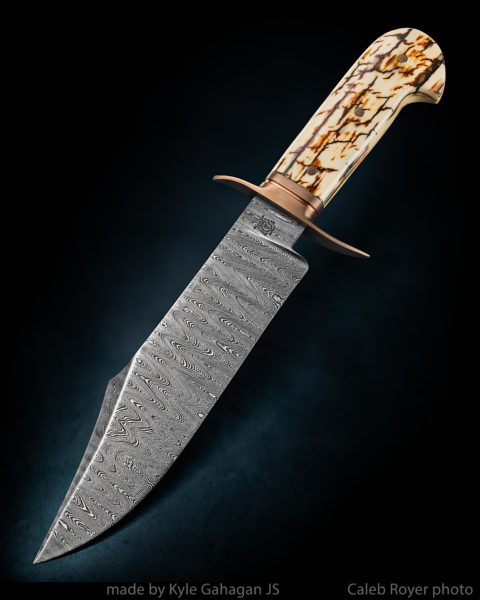
This Gahagan Knives bowie has a 10.5-inch blade made of forge-welded 1075 and 15N20 steels. The handle is mammoth ivory with a bronze guard. Maker’s list price: $3000. Contacts are listed at the bottom of this article.
Kyle would have stayed in the Army, but after seeing his parents divorce and his father remarry two more times, he knew he didn’t want to lose his wife over his career choice. He felt it wasn’t fair to Dana, so he transitioned out in 2004. Their daughter, Zoe, was born right after Kyle got out, and their son, David, was born in 2011. At first Kyle wasn’t sure what he wanted to do. He worked in an autobody shop, but when the pain in his right arm, exacerbated by a bone spur on his clavicle, got so bad he could barely function, he knew he had to find other work. “On my last day, the pain was so bad I couldn’t hold a hammer—I couldn’t hold a toothbrush.” He taped the hammer to his forearm and at the end of the day told his boss that he just couldn’t do the work anymore.
He was at the right place at the right time to land a job as an IT (information technology) contractor for Lowe’s, developing three data centers, one in Texas and two in North Carolina. When Kyle applied for full-time employment, the company told him it could not hire him because he lacked a degree. So, he went back to school. His mother was a teacher, so education has always been important to him. In the end, “100 percent and then some” in keeping with the Ranger creed, he came away with three doctorates, two in education and one in psychology.
Kyle Gahagan made this 10.5-inch blade with forge-welded 1075 and 15N20 steels. The guard uses the same steel, and the handle is ringed gidgee wood. Maker’s list price: $3500. Some Gahagan Knives pieces are available through https://exquisiteknives.com or you can contact Kyle via the methods listed at the bottom of this article.
During this time Kyle was an administrator to a local college, a school principal and eventually an acting superintendent. His frustration grew as he continually tried to hold students and parents to high standards. Kyle ensured that the children had what they needed to succeed, but if they didn’t follow the rules, they faced the consequences. He felt undermined, however, by a politically-correct environment in which his decisions were often overturned. Eventually, he just quit.
When Kyle was a school administrator, his chief financial officer asked him to make a knife he could give to his future brother-in-law as a wedding gift. Kyle was reconnected with that kid who had became engrossed in making the best knife he could make. “I enjoyed the process,” Kyle said. He began making knives “as a hobby.” Although he may not have recognized it at the time, that sounds like too casual an approach for a craft that would end up tying his love of knifemaking, education, psychology and his warrior brethren together, giving him a new mission in life.
In 2013 Nate Bocker began Resilience Forge in Virginia. Nate served in the Army with the 249th Engineer Battalion. The active-duty sergeant sought a way to help the wounded warrior community. He thought by teaching veterans the skill of bladesmithing they could hammer out some of the issues associated with post-traumatic stress disorder, receive appropriate physical therapy for some injuries and have the foundation of a new skill they could expand into a trade if they so chose. Nate’s first student christened the program Blade Therapy. Kyle then launched Resilience Forge North Carolina and began implementing standard operating procedures so that the non-profit could expand nationally. No matter where a veteran attended, they’d know that the program would be the same.
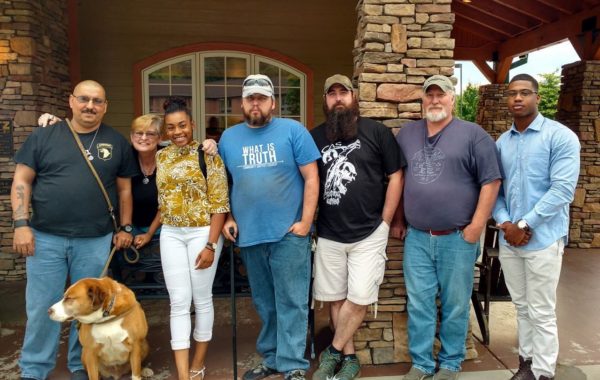
The Department of Defense made a video of ABS journeyman smith and former Army Ranger Kyle Gahagan, third from right, to celebrate the work he’s done in helping veterans. You can watch it below.
The irony is that there is no structure to the program. Veterans when they’re transitioning from active duty or medical care into civilian life don’t have a schedule. “My door is always open,” Kyle said. All a veteran has to do is call ahead and he is there to provide counselling in the active environment of the forge. “Sitting on a couch and talking doesn’t work with the military mindset. They want to be producing something,” he said. Lots can unfold in the course of making a knife in one of Kyle’s classes. Take the 96-year-old veteran who was on Omaha Beach on the D-Day Invasion of Normandy. “He couldn’t do much,” Kyle said, but it was only a couple of weeks after visiting Resilience Forge that the veteran’s wife called. “She said, ‘I don’t know what you did, but my husband is happier.’ He had opened up to her,” Kyle said. And now Kyle is happy too. He’s found his new mission.
He knows what it’s like to reach that point where it’s darkest. Where the trudging goes on incessantly, you feel miserable physically and mentally, you’re exhausted and there’s no clear purpose to your life. Irrespective of his constant advancements career-wise, Kyle knows the heartbreak of remembering lost buddies. Anderson had been a school teacher. “We all face it,” Kyle said. At one point the emotional and physical pain was so bad that he walked away from the one thing that could have ever compelled him to leave the Army: his marriage. That lasted six months. There is a point, even in knifemaking, when the challenges seem to go on for too long, when things don’t fall naturally into place, when braking the blade seems nobler than letting it crack under stress.
Kyle taps into each veteran’s ability to adapt and overcome. Even though he’s teaching a physical skill, he’s giving veterans back their confidence, their ability to overcome and adapt. He helps them find their flexibility, their resiliency, their ability to fight back and achieve self-sustainability again. He can’t tell the veteran what his new mission is, but he can guide and support him while he figures it out. And that knife that they thought they couldn’t finish becomes a token of what they’re capable of accomplishing.
DoD News In Focus: Taking the Edge Off
Kyle’s plans, not surprisingly, are big. He currently puts veterans up in area hotels. He’d like to get a camper that he could use to haul a mobile forge to VA hospitals. He could use it for sleeping on those trips and to accommodate veterans when they’re at Resilience Forge. The VA is now sending patients to him. He sees the program expanding across the country, and eventually, Dana leaving her insurance agent job and working with him. He hints at perhaps another doctorate, and in 2018 he’ll be testing for his American Bladesmith Society master smith rating in Kansas. He uses a power hammer when he’s forging his own knives, but he teaches by hand. He’s hoping to stave off another tendinitis surgery, but he can feel his tendinitis getting worse. Like many veterans, his battle for coverage continues. Even so, his mission is crystal clear, and he is happier than he’s ever been.
Donations and Inquiries
To make a donation to Resilience Forge North Carolina, you can access gahaganknives.com through Paypal, or you can mail a check made out to Joy To The World Foundation to Kyle at the address below. The Joy To The World Foundation provides administrative services, such as tax preparation, to non-profits.
You can read your digital issues of BLADE Magazine anywhere you have your phone, tablet or computer, and there’s no need to find storage for all your old issues.
If piling-up issues of magazines seems like a waste to you… If you feel like you don’t have time to read a magazine… If you like the stories we offer in BLADE, but want a more economical option, then a digital subscription is the answer. An annual subscription to BLADE is $17.98, $4 off the print price.
Award-winning knifemaker Brian Fellhoelter drew on his experience as a whitewater guide to design the Timberline ECS. Frustrated by emergency knives that fell out of their sheaths during rafting and kayaking trips, Brian developed a reliable mechanism to hold the knife securely in the sheath until deployment is required. The result is the ECS.