
The BLADE Blogs

The blogs of the BLADE editors, Steve Shackleford and Erin Healy.

Never Tell An Army Ranger He Can’t Make A Knife

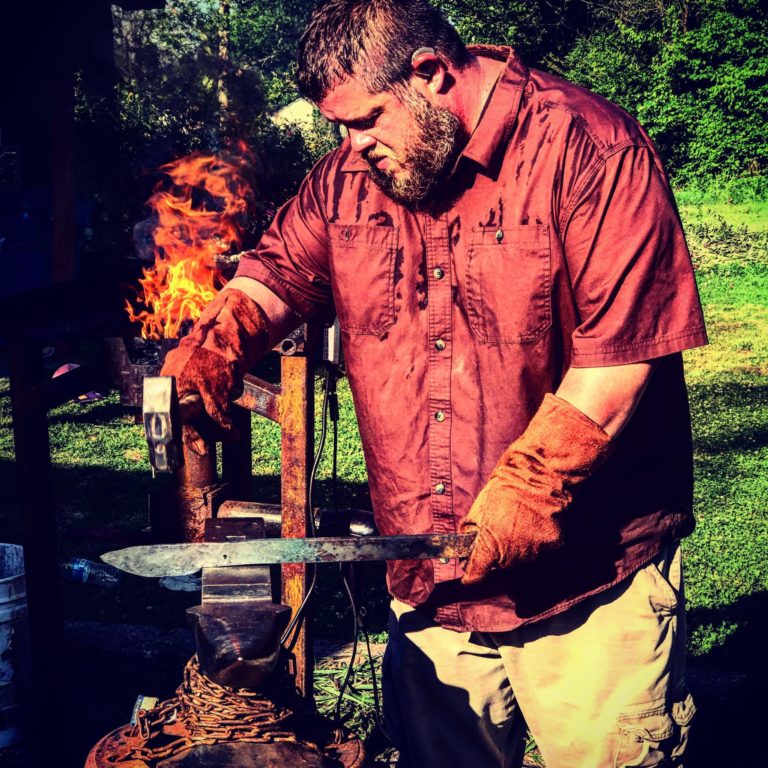
Is a U.S. Army Ranger made or is he born? Is it the training he receives that makes him a Ranger, or is there some innate quality in him that draws him to Ranger training in the first place? If you tell former U.S. Army Ranger Sergeant Kyle Gahagan (pronounced guh-HAY-gan) that he doesn’t have the proper credentials for full-time employment with your company, he’ll proceed to acquire three doctorates. If you were to suggest that he not go to work at the auto-body shop if the pain in his right arm is so bad that he cannot hold a toothbrush, he’ll go anyway and tape a hammer to his forearm. If you crush his 10-year-old spirit by telling him that the knife he spent hours making is no good and throwing it on the ground, he will one day use that craft to not only heal himself from the emotional ravages of war, but to help heal other veterans as well. Never tell an Army Ranger he cannot make a knife.
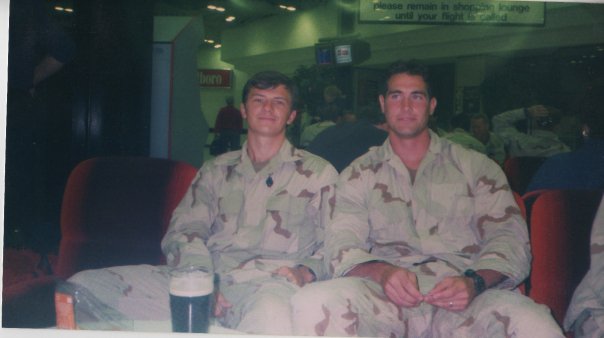
U.S. Army Ranger Kyle Gahagan deployed twice to Afghanistan and twice to Iraq.
U.S. Army Ranger Sergeant Kyle Gahagan, right, pauses for a drink with Chris Hickox after his first tour in Afghanistan. Kyle is using blacksmithing to help counsel veterans as they find new missions in life.

Kyle doesn’t remember a time when he didn’t want to be a soldier. As a boy, he would dress the part and play army for hours. He came from a military family with a grandfather who served in the U.S. Navy during World War II and a father who retired as a full Colonel after a near-three-decade career in the Army’s Armor branch. Kyle was born in Colorado and lived in Kentucky and Germany, but from ages 8 to 11 the family lived in Savannah, Georgia. He would see the then-black-bereted Rangers of the 1st Ranger Battalion, who were stationed at Hunter Army Airfield in Savannah, and he knew that’s what he wanted to be. “I thought they were the coolest guys on the whole planet,” he said.
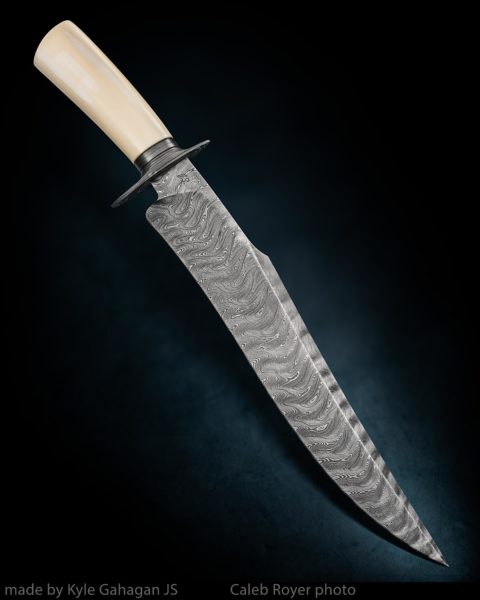
American Bladesmith Society journeyman smith Kyle Gahagan loves to craft large bowies.
Growing up Kyle remembers a giant-to-him W. R. Case & Sons bowie on display above the mantle. He was not allowed to touch it, but he spent many hours studying it. When he became a knifemaker the only thing he wanted to make was big bowies. Only now he was bigger and so his bowies kept getting larger to recapture the proportion of his boyhood fascination with the big bowie. “I had to scale that back a bit,” he says with a laugh. This one has a 12.5-inch blade of forge-welded 1075 annd 15N20 steels with a fossil walrus ivory handle. Maker’s list price: $3200. Contacts for Gahagan Knives are listed at the bottom of this article.

Kyle got his first knife from his maternal grandfather when he was 5. It was a little Old Timer pocketknife to go with the shotgun he got for deer hunting. “I hunted with my grandfather until he couldn’t hunt anymore,” he said. His father transferred back to German, so Kyle saw him infrequently. It was his grandfather who spent time with the hyperactive boy, teaching him how to hunt and build things, how to work with his hands. At 10 his grandfather handed him a piece of aluminum and told him to go make something with it. It was his first attempt at making a knife. Although not an easy material to be cutting and grinding on, he crafted something resembling a knife. There was no heat treating involved, he said with a rare chuckle.

As Kyle learned more, he once spent a long time forging a knife. He hammered painstakingly to forge-weld steel for the blade. He made a wooden sheath, carefully lining up the wood grain. “I was so proud of that knife,” he said. He took it to an area knifemaker. That maker couldn’t stop telling him how bad it was. He threw it on the ground. “It crushed me,” Kyle said. “I didn’t make another knife for about 20 years.” He didn’t even tell his grandfather what had happened. “I think he thought I just grew out of my interest in it.”
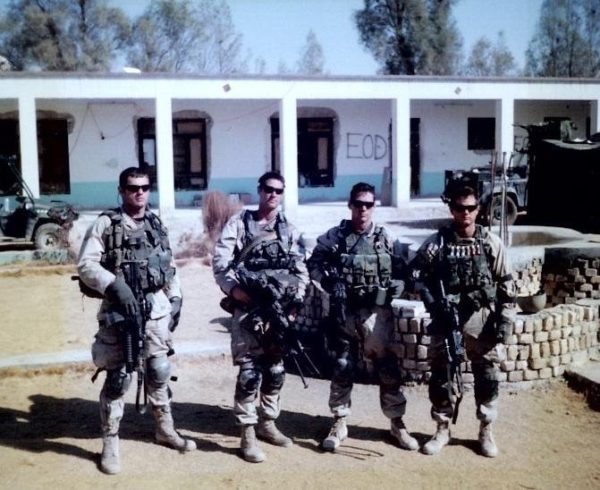
U.S. Army Ranger and knifemaker Kyle Gahagan was deployed to Afghanistan and Iraq two times each.
U.S. Army Ranger Kyle Gahagan, second from left, was deployed twice to Afghanistan. This was taken in Kandahar before a mission on his first tour.

In 1999 at the age of 19, Kyle enlisted in the Army with a Ranger contract. He was engaged when he went in and was married in between basic training and Airborne school. He went into the Ranger Indoctrination Program and Ranger school and was assigned to his boyhood heroes’ unit, 1st Battalion, 75th Ranger Regiment. But then 9/11 hit and he was being deployed back to back. He did two deployments in Afghanistan and two in Iraq, but because they blend into what amounted to nearly three years of being gone, he can’t quite recall the order. He was a SAW gunner in Afghanistan, he led a team for a while, and in Iraq, he was an S3, which organized training operations in the rear and coordinated missions during combat.

During one training session, Kyle was giving a private a block of instruction on the M203 grenade launcher. It hit a buried mortar not 15 meters away. They were able to determine that the grenade had not had sufficient time to arm itself, so the mine had caused most of the damage. Kyle received shrapnel wounds to his face, chin, neck and right leg. In a parachute training jump Kyle got his right arm entangled in his rigging, which led to a torn tendon and debilitating tendinitis. His unit was involved in the Jessica Lynch rescue, but the mission that had the most impact on Kyle was the Ranger rescue of a Navy SEAL team on the third day of Operation Anaconda, a sweep of al Qaeda and Taliban forces in the Shahikot Valley of Eastern Afghanistan.

Although not on the mission, Kyle lost three friends on the firefight atop Takur Ghar Mountain: Rangers Marc Anderson, Bradley Crose (with whom Kyle attended paramedic school) and Mathew Commons. You can read about the harrowing battle for Roberts Ridge in Sean Naylor’s “Not A Good Day to Die, The Untold Story of Operation Anaconda” and in Malcolm MacPherson’s “Roberts Ridge, A Story Of Courage And Sacrifice On Takur Ghar Mountain, Afghanistan.” Kyle can go for days without thinking about his brother Rangers, but then something in life will remind him that they’re not here to live their lives.
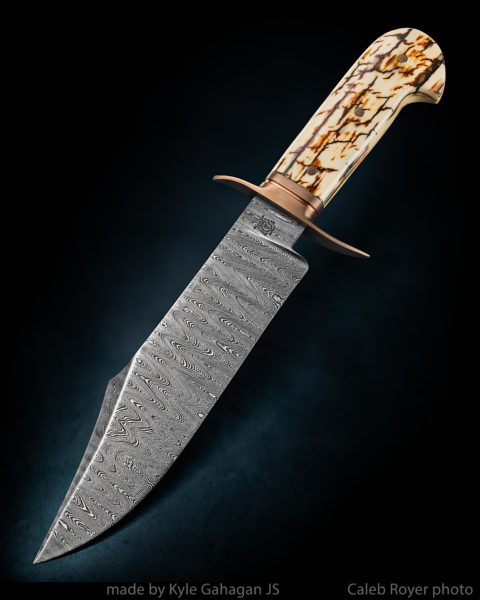
Kyle Gahagan of Gahagan Knives loves to make high-end bowie knives.
This Gahagan Knives bowie has a 10.5-inch blade made of forge-welded 1075 and 15N20 steels. The handle is mammoth ivory with a bronze guard. Maker’s list price: $3000. Contacts are listed at the bottom of this article.

Kyle would have stayed in the Army, but after seeing his parents divorce and his father remarry two more times, he knew he didn’t want to lose his wife over his career choice. He felt it wasn’t fair to Dana, so he transitioned out in 2004. Their daughter, Zoe, was born right after Kyle got out, and their son, David, was born in 2011. At first Kyle wasn’t sure what he wanted to do. He worked in an autobody shop, but when the pain in his right arm, exacerbated by a bone spur on his clavicle, got so bad he could barely function, he knew he had to find other work. “On my last day, the pain was so bad I couldn’t hold a hammer—I couldn’t hold a toothbrush.” He taped the hammer to his forearm and at the end of the day told his boss that he just couldn’t do the work anymore.

He was at the right place at the right time to land a job as an IT (information technology) contractor for Lowe’s, developing three data centers, one in Texas and two in North Carolina. When Kyle applied for full-time employment, the company told him it could not hire him because he lacked a degree. So, he went back to school. His mother was a teacher, so education has always been important to him. In the end, “100 percent and then some” in keeping with the Ranger creed, he came away with three doctorates, two in education and one in psychology.
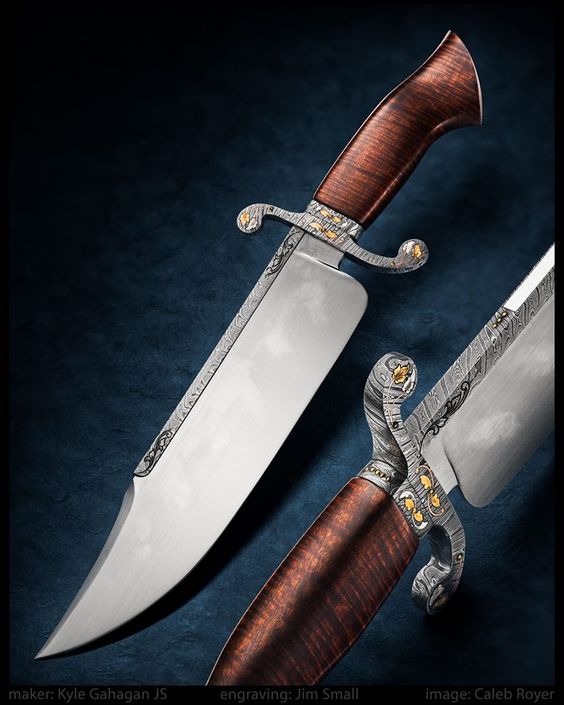
Kyle Gahagan knives are sometimes offered for sale through ExquisiteKnives.com.
Kyle Gahagan made this 10.5-inch blade with forge-welded 1075 and 15N20 steels. The guard uses the same steel, and the handle is ringed gidgee wood. Maker’s list price: $3500. Some Gahagan Knives pieces are available through https://exquisiteknives.com or you can contact Kyle via the methods listed at the bottom of this article.

During this time Kyle was an administrator to a local college, a school principal and eventually an acting superintendent. His frustration grew as he continually tried to hold students and parents to high standards. Kyle ensured that the children had what they needed to succeed, but if they didn’t follow the rules, they faced the consequences. He felt undermined, however, by a politically-correct environment in which his decisions were often overturned. Eventually, he just quit.

When Kyle was a school administrator, his chief financial officer asked him to make a knife he could give to his future brother-in-law as a wedding gift. Kyle was reconnected with that kid who had became engrossed in making the best knife he could make. “I enjoyed the process,” Kyle said. He began making knives “as a hobby.” Although he may not have recognized it at the time, that sounds like too casual an approach for a craft that would end up tying his love of knifemaking, education, psychology and his warrior brethren together, giving him a new mission in life.

In 2013 Nate Bocker began Resilience Forge in Virginia. Nate served in the Army with the 249th Engineer Battalion. The active-duty sergeant sought a way to help the wounded warrior community. He thought by teaching veterans the skill of bladesmithing they could hammer out some of the issues associated with post-traumatic stress disorder, receive appropriate physical therapy for some injuries and have the foundation of a new skill they could expand into a trade if they so chose. Nate’s first student christened the program Blade Therapy. Kyle then launched Resilience Forge North Carolina and began implementing standard operating procedures so that the non-profit could expand nationally. No matter where a veteran attended, they’d know that the program would be the same.
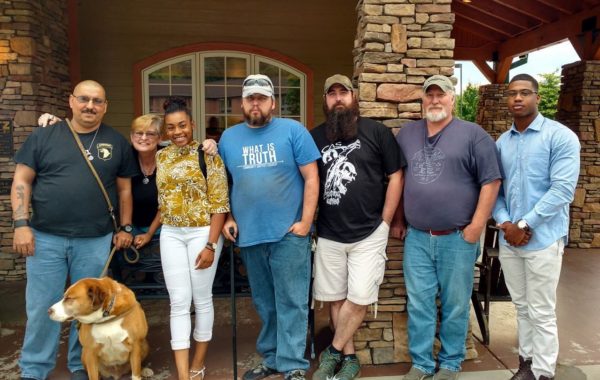
A DOD video entitled "Taking the Edge Off" showcases U.S. Army Ranger Kyle Gahagan's story.
The Department of Defense made a video of ABS journeyman smith and former Army Ranger Kyle Gahagan, third from right, to celebrate the work he’s done in helping veterans. You can watch it below.

The irony is that there is no structure to the program. Veterans when they’re transitioning from active duty or medical care into civilian life don’t have a schedule. “My door is always open,” Kyle said. All a veteran has to do is call ahead and he is there to provide counselling in the active environment of the forge. “Sitting on a couch and talking doesn’t work with the military mindset. They want to be producing something,” he said. Lots can unfold in the course of making a knife in one of Kyle’s classes. Take the 96-year-old veteran who was on Omaha Beach on the D-Day Invasion of Normandy. “He couldn’t do much,” Kyle said, but it was only a couple of weeks after visiting Resilience Forge that the veteran’s wife called. “She said, ‘I don’t know what you did, but my husband is happier.’ He had opened up to her,” Kyle said. And now Kyle is happy too. He’s found his new mission.

He knows what it’s like to reach that point where it’s darkest. Where the trudging goes on incessantly, you feel miserable physically and mentally, you’re exhausted and there’s no clear purpose to your life. Irrespective of his constant advancements career-wise, Kyle knows the heartbreak of remembering lost buddies. Anderson had been a school teacher. “We all face it,” Kyle said. At one point the emotional and physical pain was so bad that he walked away from the one thing that could have ever compelled him to leave the Army: his marriage. That lasted six months. There is a point, even in knifemaking, when the challenges seem to go on for too long, when things don’t fall naturally into place, when braking the blade seems nobler than letting it crack under stress.

Kyle taps into each veteran’s ability to adapt and overcome. Even though he’s teaching a physical skill, he’s giving veterans back their confidence, their ability to overcome and adapt. He helps them find their flexibility, their resiliency, their ability to fight back and achieve self-sustainability again. He can’t tell the veteran what his new mission is, but he can guide and support him while he figures it out. And that knife that they thought they couldn’t finish becomes a token of what they’re capable of accomplishing.

DoD News In Focus: Taking the Edge Off

Kyle’s plans, not surprisingly, are big. He currently puts veterans up in area hotels. He’d like to get a camper that he could use to haul a mobile forge to VA hospitals. He could use it for sleeping on those trips and to accommodate veterans when they’re at Resilience Forge. The VA is now sending patients to him. He sees the program expanding across the country, and eventually, Dana leaving her insurance agent job and working with him. He hints at perhaps another doctorate, and in 2018 he’ll be testing for his American Bladesmith Society master smith rating in Kansas. He uses a power hammer when he’s forging his own knives, but he teaches by hand. He’s hoping to stave off another tendinitis surgery, but he can feel his tendinitis getting worse. Like many veterans, his battle for coverage continues. Even so, his mission is crystal clear, and he is happier than he’s ever been.

Donations and Inquiries

To make a donation to Resilience Forge North Carolina, you can access gahaganknives.com through Paypal, or you can mail a check made out to Joy To The World Foundation to Kyle at the address below. The Joy To The World Foundation provides administrative services, such as tax preparation, to non-profits.

Kyle Gahagan, Ed.D Ph.D
Gahagan Knives
200 Preachers Bottom Drive
Moravian Falls, NC 28654
336-467-1244
[email protected]
www.gahaganknives.com
Facebook: Gahagan Arms

A Digital Subscription To BLADE Is The Answer
Save $4 off the print price of a annual subscription to BLADE Magazine with a digital subscription.
You can read your digital issues of BLADE Magazine anywhere you have your phone, tablet or computer, and there’s no need to find storage for all your old issues.

If piling-up issues of magazines seems like a waste to you… If you feel like you don’t have time to read a magazine… If you like the stories we offer in BLADE, but want a more economical option, then a digital subscription is the answer. An annual subscription to BLADE is $17.98, $4 off the print price.
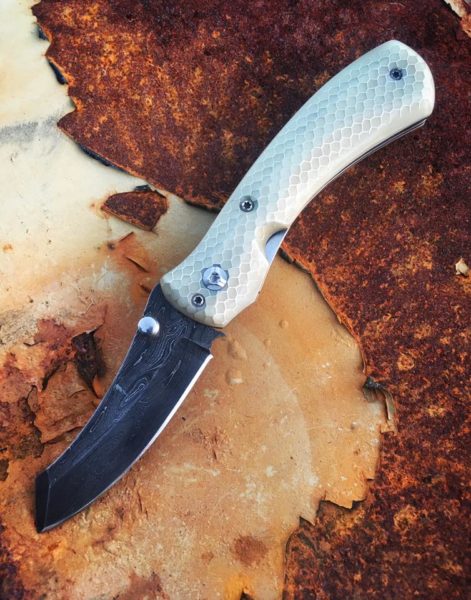
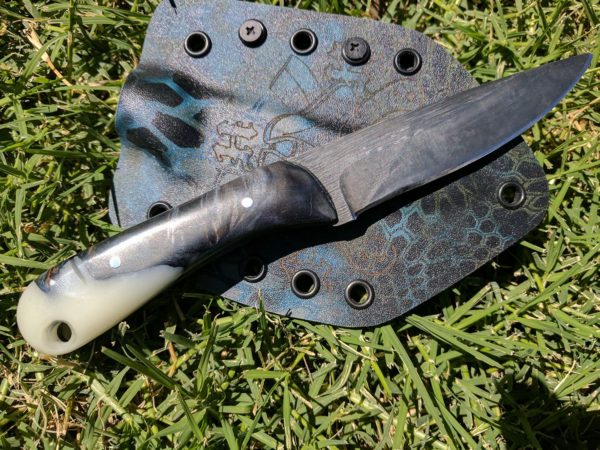
6 Knife Handles That Glow In The Dark

There are four categories of “glow.” Bioluminescence is, say, a firefly. There’s chemiluminescence, caused by a chemical reaction—think glow stick. Radioluminescence is most frequently used in clock or watch paints and on instrument panels. Then there’s phosphorescence, frequently used in toys, or toys for grown-ups: knives, or more specifically knife handles. The old-school invisible type of glow-in-the-dark scales show white-ish in daylight. The handle might have tinges of color, but it’s essentially white. If it has been exposed to enough sunlight, it will glow in blues, purples or greens in the dark. New-school daylight glow is visible day or night and comes in variety of colors. Here are six knife handles that glow in the dark, three of each variety, perfect options for Halloween or the everyday kid in all of us.

1. A son makes glow-in-the-dark-handled knife for his dad

Randy Madan of Patriot Horde Knives made this Pig Poker for his dad, Randy, who uses it on his farm in Kentucky. This type of old-school glow will appear creamy or pasty by day and either blue-violet or green by night, provided it has absorbed some UV light, explained scalemaker, Rob Carper of Rob Carper Innovations (RCI).

This glow-in-the-dark knife handle is a hybrid by RC Innovations.
Randy Madan of Patriot Horde Knives made this 4.5-inch flat-ground blade out of 1095 steel from Aldo Bruno at New Jersey Steel Baron. The Pig Poker has an acid-washed finish and a hybrid glow-in-the-dark handle by Rob Carper of RC Innovations. The knife is 9 inches overall. Maker’s list price: $200. Contact Patriot Horde Knives, 760-885-9370, [email protected], on Facebook at Patriot Horde Knives or Jr Madan and on Instagram @the_patriot_horde.
Randy Madan made this glow-in-the-dark-handled knife for this father.
In low light this Pig Poker from The Patriot Horde Knives glows blue, provided it has absorbed enough light.

2. This GITD friction folder is pinned by a grenade pull

A rescue knife has a blunt point for two reasons, explained Denny Furey of Furey’s Urban Combat Knives – Unlimited. One, it can be used to pry with, and two, if you needed to cut someone’s seatbelt, for example, you don’t want to run the risk of sticking them with a sharp point.

The grenade pull locks the blade in the open position for secure cutting. The pin can then be stored in the attached slot on the sheath, similar to how a ferro rod might be stowed.

Denny Furey of Furey's Combat Knives - Unlimited made this blunt-tip rescue knife with grenade pull pin.
The “Resukyū” (Rescue) Friction Folder is a one-off by Denny Furey of Furey’s Urban Combat Knives – Unlimited. The 3-inch blunt-tip rescue blade is made out of O1 tool steel, as are the breacher/bottle opener and spacers. The blade and back spacer have an acid stonewashed finish. The knife measures 6.75 inches closed and 8 inches overall. The handle scales are Glow In The Dark by Voodoo Resins. The hardware, including the grenade pin lock, is stainless steel. Maker’s list price: $300 with Kydex/Holstex sheath. Contact Denny Furey, Furey’s Urban Combat Knives – Unlimited, 405-642-2198, [email protected], on Facebook at Furey’s Urban Combat Knives – Unlimited.
Furey Urban Combat Knives - Unlimited made this rescue friction folder as a one-off.
This Denny Furey friction folder handle was made by Voodoo Resins and appears green in the dark.

3. New-school daytime glow is visible day or night

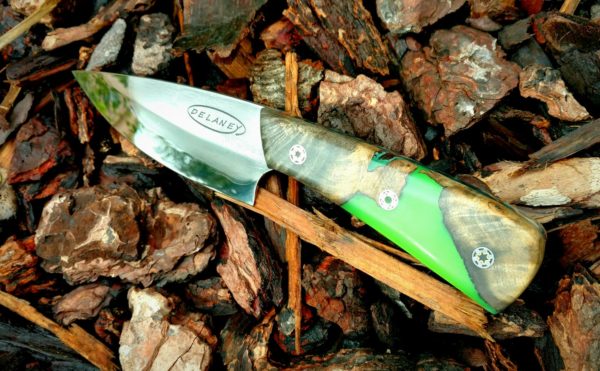
Jason Batdorf of Delaney Knives makes his own glow mix, using raw materials, but one would need to be a chemist with a laboratory to actually make the glow powder.

Jason Batdorf makes his own glow mix for his wood-glow hybrid knife scales.
Jason Batdorf made this 4-inch flat-ground Delaney drop-point blade out of 1095 steel with hamon. The handle is a buckeye burl and glow hybrid made by the maker with his own glow mix. Overall length is 8 inches. Maker’s list price: $250. Contact Jason Batdorf, at Delaney Knives on Facebook or call 419-583-8238.

4. Knife named for a customer’s departed sister

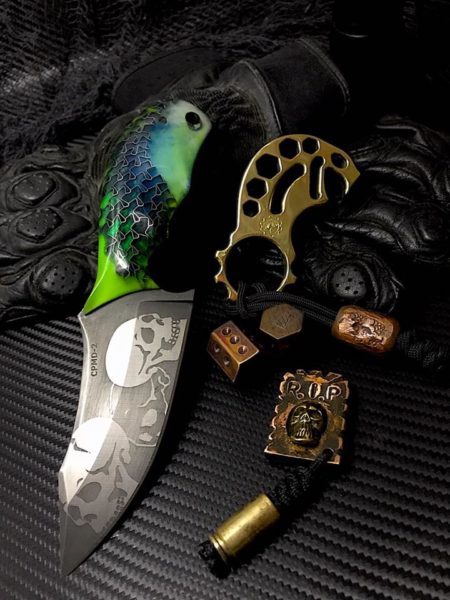
Brent Vacarro of Black Widow Knifeworks & Tactical Gear designed this blade for a customer as a custom order. When Brent began receiving interest in the knife, he wanted to introduce it into his lineup. But there were two problems. “First, I had to get permission from the customer, and second, I needed a name for it,” Brent explained. He contacted the customer and asked if it would be OK if he made more of this knife model. The customer was fine with that. “Then I asked him to name the blade,” Brent continued. “This is where it becomes very special very fast. He had told me about his sister passing away when they were younger, so he had asked if we can name the blade after her. My immediate response was ‘Of course!’ So that’s where H.E.R.L comes from, her initials.”

Brent Vacarro of Black Widow Knifeworks & Tactical Gear got permission from a customer to recreate his custom order. Brent let the customer name it after his deceased sister.
Brent Vaccaro’s H.E.R.L has a 4.5-inch flat-ground blade of CPM D2, acid-washed with etched skulls. The handle is Voodoo Resins’ Dr. Strangelove (green/blue glow) with green G-10 liners. Overall length is 7 inches. Maker’s list price: $280-$350. Contact Brent Vacarro at [email protected], 908-328-2049, on Facebook at Black Widow Knifeworks & Tactical Gear and on Instagram @blackwidowknifeworks.
Dr. Strangelove is a Voodoo Resins with blue and green glow in the dark.
Dr. Strangelove scales are made by Matt Peterson at Voodoo Resins. Dimensions are 5.9 inches long by 1.85 inches wide by .300-inch thick. Makers list price: $40/set.

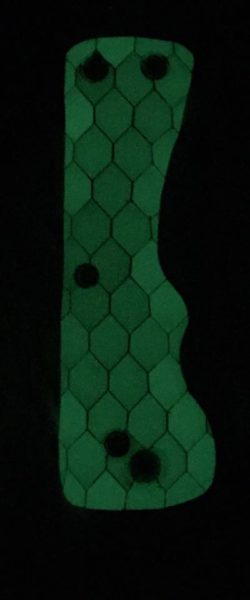
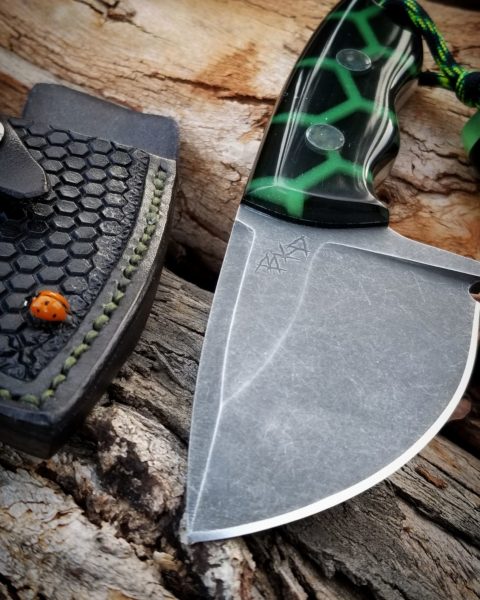
5. Glow-in-the-dark honeycomb pattern is echoed in leather sheath

Namen Borras echoed the honeycomb glow-in-the-dark pattern in his accompanying leather sheath for the BKD Skinner.
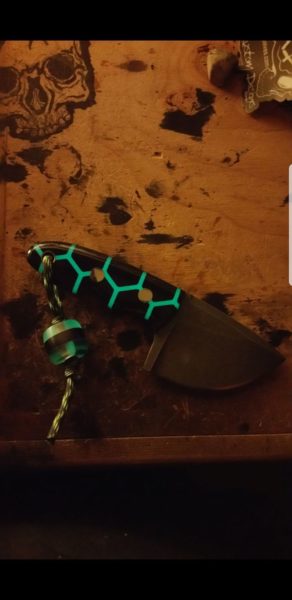
Namen Borras’ BKD Skinner has a flat-ground 2.5-inch blade with swedge made out of CPM S35VN with acid and stonewashed finish. The knife is 6 inches overall. The handle scales are glow-in-the-dark honeycomb with clear resin by DerangedDonkey with black G10 liners. Maker’s list price: $350 with black leather sheath with matching honeycomb pattern. Contact Namen Borras on Instagram @borraskustomdesigns, www.bkdknives.com or at [email protected].
A knife handle can be a little or lot glow-in-the-dark, in random or purposeful design.
This is how the honeycomb pattern on the above knife appears in the dark.

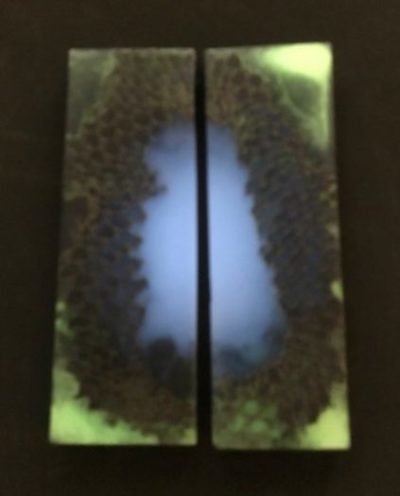
6. Old-school Glow Hex emits violet shade in the dark

Tyler Freund's custom folder glows violet in the dark.
Tyler Freund made this one-off custom folder with a 1.3-inch flat-ground blade of pattern-welded steel from Alabama Damascus Steel. The Glow Hex scales are by Beyond Wood Products, and are paired with titanium liners. Screws, pivot pin, pivot screw, backspacers and clip are also titanium. Overall length is 9.7 inches. Maker’s list price: $400. Contact Tyler Freund, Freund Custom Knives, 1755 Madison 541, Ironton, MO 63650; 573-366-3906, [email protected] and on Instagram @freunds_customs.
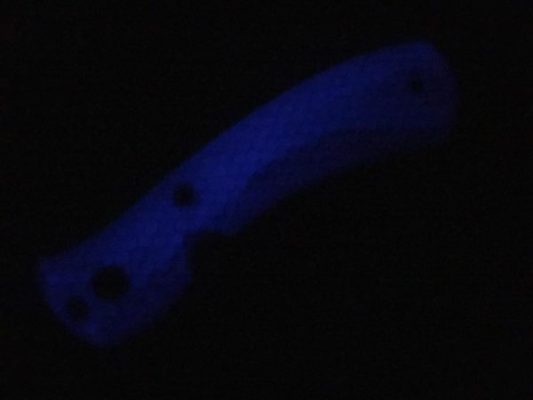
Old-school invisible scale material can glow blue, violet or green in the dark.
Tyler Freund’s one-off custom folder glows a blue-purple in the dark when it has absorbed sufficient UV light.

A Digital Subscription to BLADE Is The Answer

Save $4 off the print price of a annual subscription to BLADE Magazine with a digital subscription.
You can read your digital issues of BLADE Magazine anywhere you have your phone, tablet or computer, and there’s no need to find storage for all your old issues.

If piling-up issues of magazines seems like a waste to you… If you feel like you don’t have time to read a magazine… If you like the stories we offer in BLADE, but want a more economical option, then a digital subscription is the answer. An annual subscription to BLADE is $17.98, $4 off the print price.
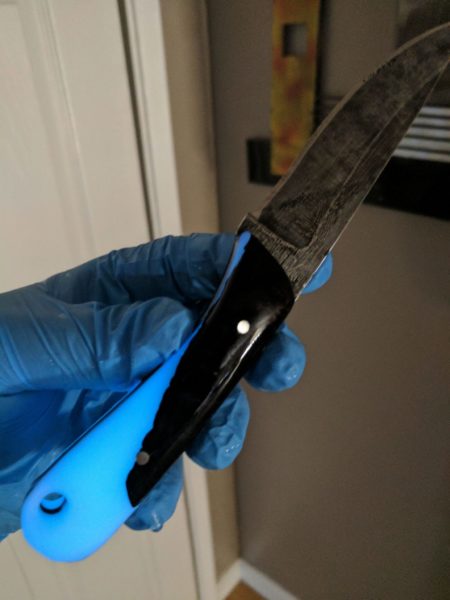
 

Is Knife Found In River The Original Bowie?

In what could be the most important discovery in knife history, what is alleged to be Blade Magazine Cutlery Hall-Of-Fame© member Jim Bowie’s original knife has been pulled from a river in Louisiana.


“Fantastic!” exclaimed Bowie historian Daniel Reese Schively when told of the discovery. “If it really is Bowie’s knife, it will change everything in terms not only of the knife itself, but also will help validate the legend and legacy of James Bowie the man.”


Others were not quite so enthusiastic, including Henry Searles, a long-time maker of bowie reproductions.


“I’ll believe it when I see it,” he scoffed. “A knife pulled from a river after almost two centuries? It’s got to be just one big chunk of rust!”


However, according to the man who found it, Arlan Thibodeaux of Marion, Louisiana, the knife is in remarkably good condition. “We were dredging the Maravich River for the Parish of Alexandria Public Works Department when we spotted a shiny object encrusted in black, slimy mud,” Thibodeaux said. “When we pulled it out, we could see it was a knife, but we had no idea exactly how important the knife might be.”


It is believed the dark Louisiana river mud may have preserved the knife remarkably well despite the long period of time.


At 9.25 inches, the straight-backed blade matches the length Jim Bowie’s brother, Rezin, described in writing about the original bowie knife: “The length of the blade was nine and one quarter inches, its width one and a half inches, singled edged and blade not curved.” In addition, the pinned handle appears to be made of ebony and is in a coffin shape, a style that was very popular circa the 1830s.


Whether the knife really is Bowie’s remains to be seen. However, the war of words apparently has only just begun. Stay tuned for further developments.


Oh, and in case you haven’t figured it out by now, this story is a total and complete hoax. Happy April Fool’s Day!

Knifemaker: A New Role for Johnny Strong

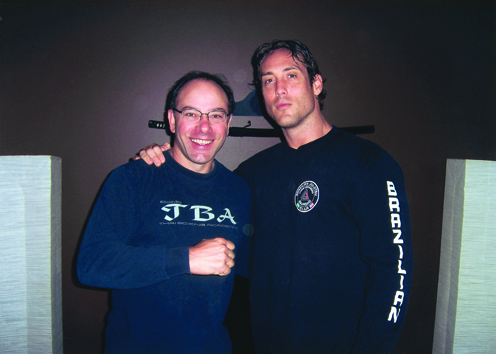
As with all Johnny Strong knives, the Urban Assassins (top photo) are flat ground from CPM-S35V stainless and heat treated by Paul Bos Heat Treating. Overall lengths: 11.5 inches. (Katie Summers photo) Johnny Strong’s latest movie Sinners and Saints (second photo from top) debuted in January. (Photo: Mark Rutledge; Poster: Dave Burton) The author [left] and Strong [right] (third photo from top) at the author’s house.

Star of Sinners and Saints also makes knives

By Wally Hayes


Through knives I have met some of the most amazing people, one of whom is actor Johnny Strong. Last summer I received an e-mail from Johnny. He was interested in my Dragon Waki he had found on Bladeart.com’s website. We exchanged e-mails about his new waki, music and his interest in knifemaking. I learned Johnny is an actor, musician, martial artist and artist. He has been collecting knives since he was 8.

“It was when I was on tour with my band, Operator, that I got serious about collecting custom knives. I would be on the tour bus searching the web for knife dealers,” he said.

After talking with Johnny and learning a little about him, I suggested he visit my shop and hang out for a weekend. He did—and he jumped in with both feet.

We started out forging two blades to shape. Then I taught him grinding and heat treating. The crash course was three long, fun-filled days. As Johnny told BLADE®, “It was a great experience coming to Wally’s and having him share all his knowledge with me. I learned how to manipulate steel and apply these skills to my edged art.”

As soon as Johnny returned home, he ordered a belt grinder, drill press and some steel. In the past year he has created some very original designs. His computer-drawing skills enabled him to develop a practical and aggressive-looking knife style. As he noted, “With my knives, I like to paint in tactical colors.” His blades are flat ground from CPM-S35V stainless steel and heat treated by Paul Bos Heat Treating.

Johnny has created some unusual blade finishes with a combination of bead blasting and etching. The blades are ground with a wide secondary bevel that makes his knives razor sharp, similar to those by Shiva Ki. Johnny hand carved a mold to make his handles. He casts them one at a time. The handle material is an impact/chemical-resistant resin. The cutouts in the handle butts are multi-purpose prying/shaping tools. He also designed and ordered custom-made black titanium handle fasteners.

Three of Johnny’s models are the Urban Assassin, Canine Assassin and Combat Assassin (this issue’s cover knife; see page 7). Respective blade lengths are 6.5, 8.5 and 11 inches. The blade of the Canine Assassin has a tiger-stripe finish, while the Combat Assassin blade features a sawback. Each blade has what Johnny calls his three-edge design, which was inspired by the knife-combat training he has received. All his knives come with custom leather sheaths.


Sinners and Saints

Johnny has starred in Black Hawk Down, The Fast and The Furious, Get Carter, The Glimmerman and his new action movie, Sinners and Saints. Johnny plays the lead role of Sean Riley, a New Orleans detective.

To prepare for one of the movie’s knife fight scenes, Johnny trained with Ron Balicki for three months. Balicki is well known as a practitioner and teacher of the martial arts, and is a student and son-in-law of Dan Inosanto, a legendary martial arts instructor who studied under Bruce Lee. Balicki is also a top Hollywood stuntman and plays the role of Rucker in Sinners and Saints.

Johnny learned both one-handed and two-handed combative drills. In a knife-fighting scene in the movie, Johnny uses an Allen Elishewitz “Phalanx” folder and a Cold Steel Tai Pan dagger. Balicki plays Rucker, a bad guy Johnny’s character must kill. The knife-fighting scene took two days to shoot. Balicki uses a Cold Steel Voyager folder in the scene.

“Ron has a ton of experience and was great to work with,” Johnny noted. “We wanted to make the knife fighting scene as realistic as possible.” Johnny has a strong background in martial arts with a black belt in Brazilian Ju-Jitsu and is training hard to get in shape for his next movie.


Movies, Music and Knives

This past fall I flew down to Johnny’s to help with his knifemaking and have some fun playing music as well. Music is a big part of Johnny’s life. When not acting, he works on music either for film scenes or his own CDs.

His new album is The War of Art on iTunes. It features two of his Urban Assassin models silhouetted on the cover. I was asked to bring my guitar so I could play lead on a couple of songs in his studio. What a blast—mixing knifemaking with recording music. We worked on edge geometry, sheaths and a new folder design coming out in 2012. Stay tuned for more movies, music and knives from a very talented guy.

For more on the latest knives, knife legislation, knifemaking instruction, knife trends, knifemakers, what knives to buy and where and much more, subscribe to BLADE Magazine, the World’s No. 1 Knife Publication. For subscription information click on http://www.shopblade.com/product/blade-magazine-one-year-subscripti…?r+ssfb030312#BL1SU

The Hammer That Took A Bladesmith’s Hearing Gave Him His Craft

Once upon a time, two little boys were smashing their toy cars with hammers. An errant swing caused a brain injury that left one of them without his hearing. Thirty-four years later the deaf boy grew up to be a man who swings a hammer in the forge. He holds no grudges. They were just boys playing, neither knew any better. “I’m a forgiving person,” wrote Norman “Buddy” Thomas of Quapaw, Oklahoma, in a Messager note. Today Buddy is a graphic artist and runs a screen printing shop by day, making knives part-time by stock removal and forge. He also strives to set a positive example in the deaf community. So, in essence, the hammer that took a bladesmith’s hearing gave him his craft. Another loss would wound Buddy further, but he is grateful, always grateful, for the love of his family and the means to create beautiful knives.

A hammer took Buddy Thomas hearing, but gave him back the craft to express himself.
Norman “Buddy” Thomas of Tree of Liberty Bladecraft and Forge lost his hearing when he was accidentally hit in the head with a hammer. Today he’s the one wielding the hammer as he forges knives that run from frontier-style to post-apocalyptic.

Buddy was born in 1980. He and a neighbor boy were beating on their Hot Wheels with a hammer. Buddy was 3, the other boy, 5. The other boy’s swing went wild, hitting Buddy in the head. But a baby’s crown is not as forgiving as a die-cast model car. He irreparably lost his hearing. At first his parents tried the speech therapy route. Buddy began displaying social issues. It doesn’t seem like a bad idea to teach a non-hearing child to speak, but it confuses people who can hear and who do not realize the person is deaf. “No matter how well you can hone the speaking skills of a deaf individual, one thing is concrete certain, you can’t fix deaf,” Buddy explained.* He has one ear that is slightly better than the other and a hearing aid can maximize what remains, but it can’t cure the problem.

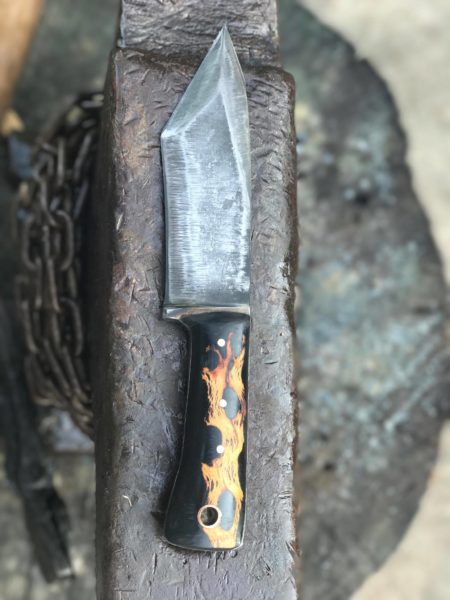
Buddy Thomas utilizes both frontier and post-apocalyptic styles in his knifemaking.
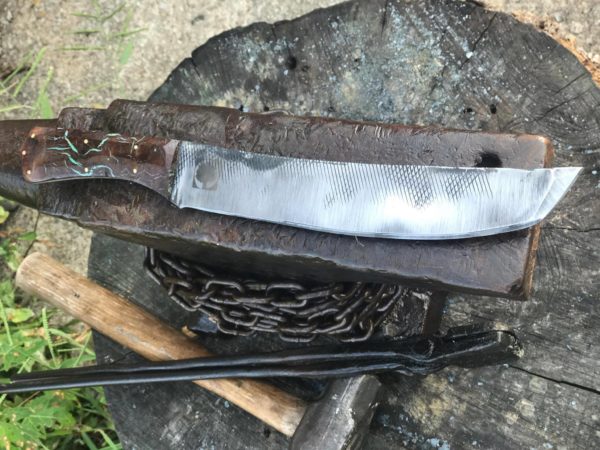
Buddy Thomas’ tanto chopper is made from a farrier rasp drawn out to 15 inches overall with a 9.75-inch blade length. The frontier-style coffin-shaped handle is stabilized maple burl with turquoise casting. Maker’s list price: $375. Contacts for Tree of Liberty Bladecrafting and Forge are listed at the end of this article.

Pre-kindergarten began for Buddy in an all-deaf environment. Throughout elementary and middle school Buddy was educated through a public-school system that focused on teaching deaf students to speak. His parents saw that he needed a change and enrolled him in Oklahoma School for the Deaf in Sulphur, which, funny enough, is one town over from where Jantz Supply is located in Davis. Jantz has been offering knifemaking supplies to craftsmen worldwide for 50 years. It was at OSD where Buddy flourished and his interest in metalwork began.

Buddy Thomas' American tanto hybrid sports a cholla cactus handle cast in black epoxy.
The American tanto hybrid from Tree of Liberty Bladecraft and Forge is made with 5160 spring steel. The blade length is 5.75 inches; overall length is 9.75 inches. The handle material is stabilized cholla cactus cast in black epoxy. Maker’s list price: $350. Contacts for Tree of Liberty are listed at the bottom of this article.

Meanwhile, at this time there were not a lot of American Sign Language courses for Buddy’s parents, but he taught them what he learned. His sister, Kalley, picked up on it quickly. Today, hearing parents are teaching sign language to their pre-verbal hearing children. Science is showing, in all mammals not just human babies, that possessing a non-verbal means of communication minimizes frustration and thereby aggression. Later these babies and, say, puppies who are taught means of communicating as early as three to four weeks of age, are more confident and better able to cope with the inevitable challenges of life. There are also positive physiological benefits. Buddy said that it was easiest to conduct a non-sign conversation with his parents, but even now he uses ASL frequently with his father. His mother passed away after an illness in 2014. Both of his parents encouraged Buddy tremendously, and his father, along with his fiance, June, remains one of his biggest supporters.

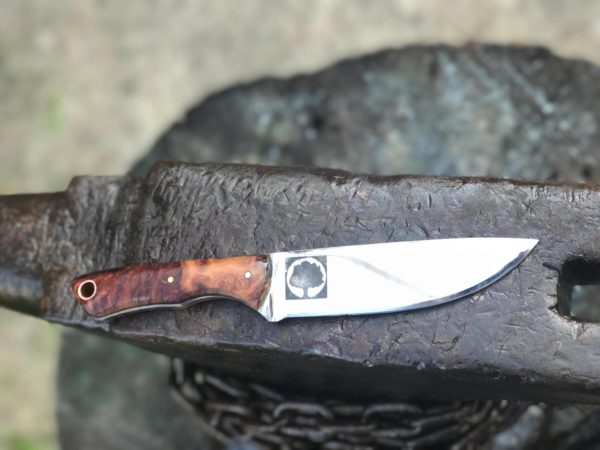
Deaf forger Buddy Thomas' small hunter is made from 1095 steel.
This small hunter has a 5.75-inch blade of 1095 high carbon steel. The overall length is 8.75 inches. The handle material is stabilized Australian red mallee burl cast in blur Alumilite by Lucas Free. Maker’s list price: $350. Contacts for Buddy Thomas at Tree of Liberty Bladecraft and Forge are listed at the bottom of this article.

Buddy didn’t realize how much his machine shop/metal working class would impact his life. He was focused on going to college. He graduated from OSD as a Salutatorian with a 4.0 grade point average, serving as president in the local National Honor Society. “The only mismatched puzzle was my machine shop/metal working class, which I loved because when I tried the first semester out in that class I got hooked to the welding and metal fabrication,” Buddy wrote. His instructor Dwayne Bryant spent hours of one-on-one time with him, helping him develop his welding skills. Each advancement in his metal fabrication skill fueled his creativity. “In fact, my very first nonfunctional knife was made in that class in 1997 when I was just 17 years old,” he recalled. “A piece of mild steel plating, ground into the shape of a knife roughly 8 inches overall. A DeWalt angle grinder was used to taper a bevel and create an edge. The handle was from a can of spray-on rubber. I wish I still had it. Well, after that it would be years before I attempted another knife build again.” Buddy sprinkled laughing emoticons throughout that description.

“It was pretty much just a plain little skinner, probably only an inch wide but at least a quarter-inch thick,” he noted with tears of laughter.

Buddy was also the co-editor of the school newspaper along with his good friend James Mitchell, who in his own right has had an impact on the deaf community supporting various organizations. Then it was off to major in visual communications art at the University of Oklahoma (UO) in Norman. “I was one of only three deaf students on campus: a football player recruited from Lee’s Summit, Missouri, a French major and myself, an art major,” Buddy wrote, revealing how isolating it can sometimes be for a deaf person in a hearing world.

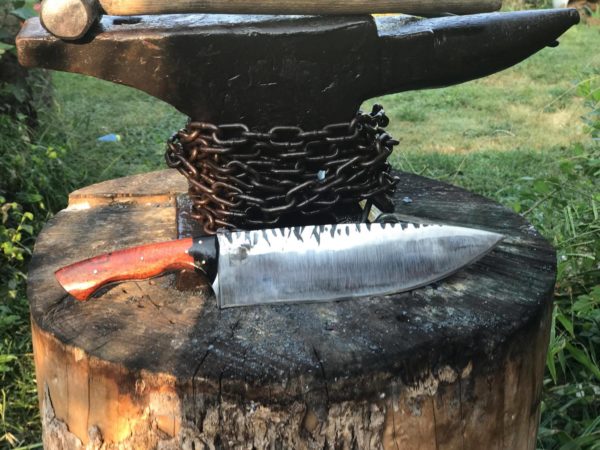
This large chopper was forged by deaf bladesmith Buddy Thomas of Tree of Liberty Bladecraft and Forge.
Buddy Thomas’ large bushcraft chopper is made from reclaimed early-1900s saw mill high-carbon steel. It is 16 inches overall with a 10.25-inch blade. It is 2.75 inches wide at its widest point. The handle material is figured cedarwood with a black epoxy bolster guard. Maker’s list price: $425. Contacts for Tree of Liberty Bladecraft and Forge are listed at the bottom of this article.

But Buddy got to work, putting his art and journalism experiences into play as a cartoonist and copy editor for The Oklahoma Daily, the school newspaper. “My childhood dream was to be a comic book artist. Of course, dreams change as we go through life,” Buddy noted. He grew up around several talented comic artists, including Steve Erwin, the original penciler for DC Comics’ Deathstroke the Terminator, a character portrayed on the television show “Arrow.” “I had originally wanted to attend the Joe Kubert School of Cartoon and Graphic Art in Dover, New Jersey, but I was persuaded to apply to UO and was accepted, so I went that route.” It was nice to have UO on his resume, but by the end of his first semester all the visual communications art slots were filled and he was assigned to a painting major. That was definitely not where he wanted to take his art, so he did not return, despite his good grade standing.

Buddy now manages a screen print shop and does graphic designs and color separations. “Part of my time I’m out running the automatic press and printing T-shirts, and the other part of my time I’m cooking up some wicked graphics, either for the storefront or a customer order,” he wrote. “At night and on weekends I work my forge and knife shop.” Care to guess what the name of the print shop is? Metal Fab Trophy and Screen Printing. You don’t have to hit Buddy over the head for him to get that he may be exactly where he was meant to be all along. The name he chose for his business: Tree of Liberty Bladecraft and Forge, invoking the freedom that he experiences through his creativity.

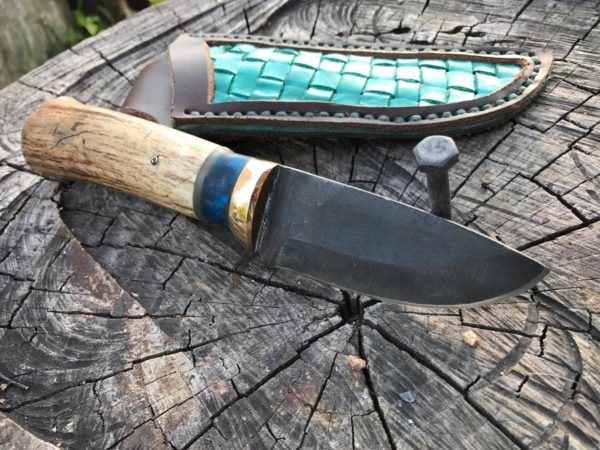
Deaf knifemaker Buddy Thomas sold this knife for $575.
This Buddy Thomas creation comes with a turquoise leather weave sheath. It is made from CPM S90V steel, 9.5 inches overall with a 4.75-inch blade. The handle is elk antler with a rustic coffee stain and a blue Alumilite spacer and solid brass guard. Maker’s list price: $575. Contacts for Tree of Liberty Bladecraft and Forge are listed at the bottom of this article.

Buddy’s design skills do help him when he’s working up a pattern for a stock-removal knife on card stock, “but when forging, it’s all in the eye,” he wrote. Buddy started in stock removal and worked his way into forging by trial and error with lots of research and time spent learning from other forge artists. “A guy I ran into in a forum a few years back—his name was Ethan Paul Dobbins—he sent me tons of material to read up on. Another was a lifelong friend who did some blacksmith work as a tool maker, James Moore. I have actually learned most of my blacksmithing skills at the anvil from James, who was there to help me correct my hammering form and help guide me through and recognize heat requirements and steel reactions,” Buddy explained.

Buddy can read lips and his hearing aid, although not the best, helps him hear a little. “James is as hearing as they come! Maybe selectively deaf at times,” Buddy joked with a laughing emoticon. “I can read him pretty well, but sometimes have to have him repeat himself.”

The Thomas are a deaf-hearing couple; they have two daughters.
Deaf bladesmith Buddy Thomas and his hearing wife, Sundae, have two daughters, Anna, 12, and Kaity, 9.

Buddy’s wife, Sundae, is also hearing. They met at a football game in Picher, Oklahoma, and were married in 2001. She did not know sign language at the time, but she has learned from Buddy. They have two daughters, Annaleigh, 12, and Kaitlynne, 9, who also know sign language. Their first child, also a girl, Daisy Elizabeth, would be 15 now, but the couple lost her two weeks after she was born, to infection. “She passed in my arms,” Buddy wrote.

Deaf knife forger Buddy Thomas lost his hearing at the age of 3 and his infant daughter when she was 2 weeks old.
Buddy and Sundae Thomas lost their first child, a daughter, at 2 weeks of age, due to infection. Buddy lost his hearing at the age of 3; his wife is hearing.

“She was beautiful. I always wonder what she might have been like as their older sister. I’m so grateful and thankful for those two.”

If you converse with Buddy for any length of time, you will sense the sad undercurrent of the tragedies in his life, but you simultaneously get the feeling of a silent, gentle but unwavering determination to not just live, but thrive. He doesn’t minimize the impact of his losses—his hearing, his daughter, even his childhood aspiration to become a comic strip artist though he admits to outgrowing that aspiration—but the Tree of Liberty gives him more than solace; it restores his life-battered spirit.

He enjoys the stock-removal method of knifemaking, but whenever possible, he prefers to forge. He started on a coal forge and still loves it, but he often goes to the propane forge because it’s quicker and cleaner. “Most CPM steels are difficult to forge,” he observed. “Stock-removal methods work much easier for such jobs. Most of my stainless and powder steels I apply the stock-removal method to, but my high carbons benefit me better at the forge. Ultimately, they all go in the forge for heat treating.”

This knife is one of Buddy Thomas' all-time favorites. The bolster is copper and the scales were provided by RC Innovations.
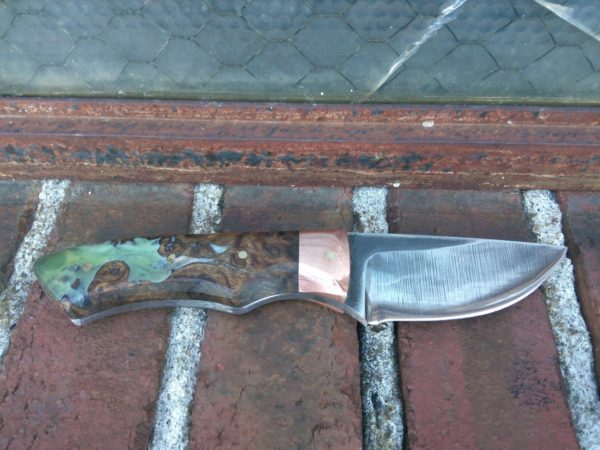
This Tree of Liberty Bladecraft and Forge creation has a 4-inch Elmax steel blade and an overall length of 8.75 inches. The handle material is rare black nargusta cast in a jade green Aluminite by Rob Carper of RC Innovations. The bolster is copper. Maker’s list price: $475. Contacts for Buddy Thomas listed at the bottom of this article.

Buddy’s knifemaking style swings from old frontier to post-apocalyptic utilizing reclaimed steel. He also makes everyday carry knives and has a preference for using copper bolstering. “One of my biggest goals as a maker is to get a prop knife made for ‘The Walking Dead’ show,” Buddy notes. His forging buddies, Aric Davis, Ryan Edwards and Louis Stark, often get together for Sunday forge-ins. In other words, the forge is the hearth of Buddy’s heart.

“I would not be where I am in this world if I did not have the deaf community behind me, specifically my best friend who has always had great words of encouragement,” Buddy said of a deaf woman who is like a sister to him. He recommends that deaf people who are interested in learning about knifemaking and forging do so through a deaf school or access vocational rehabilitation departments in their state for guidance and research. The next step is to seek out experienced bladesmiths who offer classes in their shops. “A deaf individual would acquire an interpreter to accompany them to the classes. It is actually my goal to establish a stronger bridge in that direction,” Buddy added. His plan is to work toward his American Bladesmith Society journeyman smith rating and eventually his master smith rating so he can offer classes to other deaf people. He knows they would be more comfortable learning from a deaf instructor. Three-way conversations with an interpreter can lead to a loss in focus.

Buddy lives out his favorite quote, attributed to Helen Keller: “Optimism is the faith that leads to achievement. Nothing can be done without hope or confidence.”

Contact Norman “Buddy” Thomas, Tree of Liberty Bladecraft and Forge, 304 W. 2nd St., Quapaw, OK 74363; 918-320-9349 (cell), email: [email protected]; on Instagram @tree_of_liberty_bladecraft and on Facebook at Tree of Liberty Bladecraft and Forge.

*Editor’s note: For this interview Buddy and I Messaged about using Facetime, but we felt it would be easier for him if we Messaged. It forced me to slow down and try to pick up on all of those nuanced things that happen even in phone conversations, like tone. In the end, Buddy and I both felt that he had told his story and I had heard his story in all its bittersweet humanness.

Buddy’s Links for Deaf-Related Services And Assistance

September is National Deaf Awareness month. Here are a few organizations that deaf bladesmith Buddy Thomas of Tree of Liberty Bladecraft and Forge in Quapaw, Oklahoma, recommends.

Oklahoma Association of the Deaf

Promotes, protects and preserves the civil rights and quality of life of deaf and hard of hearing individuals in Oklahoma.

National Association of the Deaf

Carries out the same mission but on a national scale. Closed captioning and civil liberties issues are often addressed by NAD.

Oklahoma Department of Rehabilitation Services

Empowers Oklahomans with disabilities to live healthy, active, smoking-free lives.

A Digital Subscription To BLADE Is The Answer

Save $4 off the print price of a annual subscription to BLADE Magazine with a digital subscription.
You can read your digital issues of BLADE Magazine anywhere you have your phone, tablet or computer, and there’s no need to find storage for all your old issues.

If piling up issues of magazine seems like a waste for you… If you feel like you don’t have time to read a magazine… If you like the stories we offer in BLADE, but want a more economical option, then a digital subscription is the answer. An annual subscription to BLADE is $17.98, $4 off the print price.
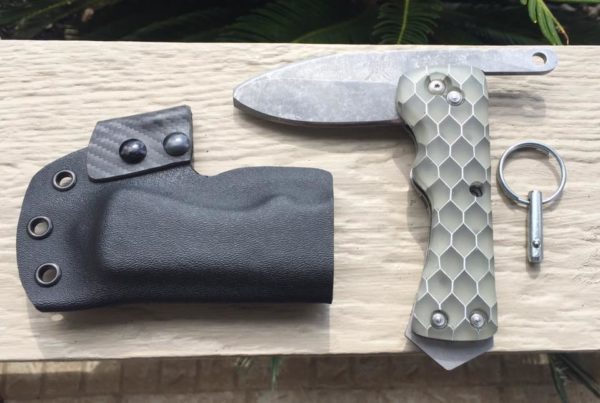


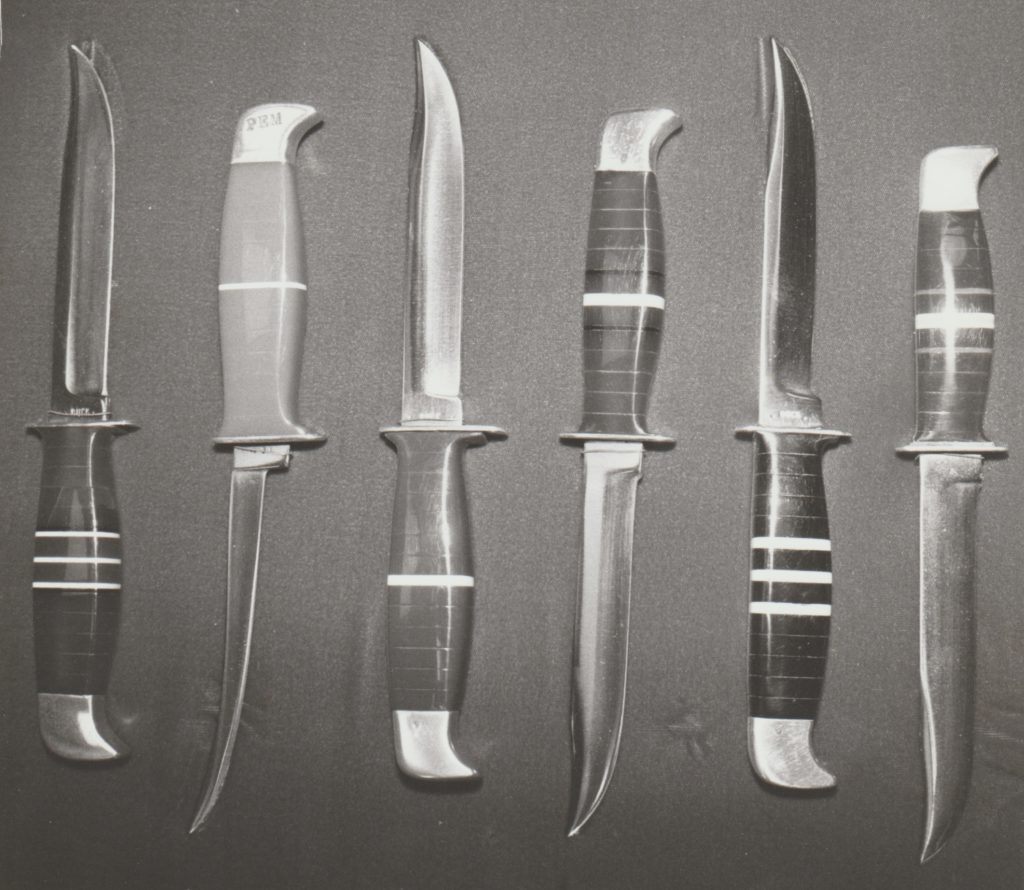
First Family of Knives?

Hoyt Buck knives
These pre-1950 Buck knives handmade by Buck patriarch Hoyt Buck are classic examples of the Buck legacy.
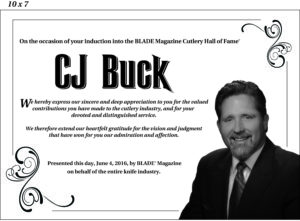
CJ First Family of Knives
CJ Buck was the most recent member of the First Family of Knives to be inducted into the BLADE Magazine Cutlery Hall Of Fame, entering the hall in 2016.
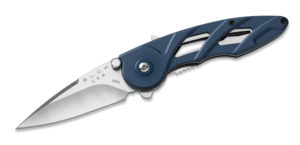
Buck Knives Rush
One of several of Buck’s assisted-opening folding knives is the Rush.
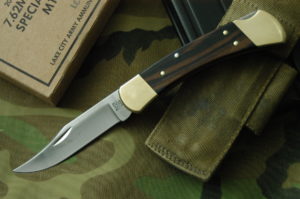
Buck 110
First produced in 1964, the Buck 110 remains one of the most famous modern production knives ever.

If there’s such a thing as the First Family of Knives, the Buck family is it.

Buck Knives has been run by a member of the Buck family—Hoyt, Al, Chuck or CJ—since “H.H. Buck and Son” set up shop in 1945. Since that time, the name Buck has become synonymous with fine hunting, sporting and other knives, and Al, Chuck and CJ help comprise the only family with three members to be inducted into the BLADE Magazine Cutlery Hall Of Fame*.

According to The Story of Buck Knives … A Family Business by Tom Ables, in 1946 “Buck’s knives were all created from used metal files that had been discarded by Consolidated Vultee, the huge aircraft manufacturing plant that later became Convair. These worn-out files, with their heavy carbon content, were perfect for the toughness and edge-holding qualities that Hoyt Buck required in his knives.”

Al joined his father full time in 1947. “[Al] learned how to laminate the thin strips of Lucite plastic used on the handles,” The Story of Buck Knives noted. “He learned how to separate and drill the handles themselves. Later, he learned how to temper the blades so painstakingly sharpened by his dad.”

Sadly, Hoyt learned he had cancer in 1948 and the dreaded disease claimed his life a short year later. He was only 59. Al assumed the company reins and guided it successfully through the 1950s and into the “modern age” of the 1960s. Buck incorporated in 1961, with a young Chuck Buck on the board of directors. The company began making the iconic Buck 110 Folding Hunter on a full production basis in September 1964. The knife’s sales jumped in 1965, increased 63 percent in 1966 and vaulted another 60 percent in 1967.

The knife industry would never be the same again.

Buck flourished under the direction of Al in the 1970s and ’80s, offering the latest in knife designs, materials and more. Along with the legendary Jimmy Lile, Howard Cole and William R. Williamson, Al was inducted into the Cutlery Hall Of Fame at the 1984 BLADE Show.

First Family of Knives Al
In 1984, Al Buck became the initial member of the First Family of Knives to join the Cutlery Hall Of Fame.

As the September/October 1984 issue of BLADE® noted in reference to Al and the 110. “Buck didn’t invent the lockback, but he certainly popularized it, and despite a flood of other lockbacks, the Buck knife still leads the way. If you are carrying a lockback today, you can thank Al Buck for his enduring promotional efforts. You have a safer knife for it.”

Chuck was next in line to be inducted into the Cutlery Hall Of Fame, being inducted along with Blackie Collins in 1996. Chuck was a part of the Buck family business from childhood. By 1970 he was corporate vice president for manufacturing, involved in all aspects of the process, from purchasing to personnel to packaging. In 1979 he became company president. Through Chuck’s leadership, the company completed a modern new plant and corporate headquarters in 1980 with 4.5 acres under one roof.

Under his direction the company grew and prospered, winning several BLADE Magazine Knife-Of-The-Year® Awards. By 2004 he was Buck Knives chairman and helped oversee the company’s historic move to Post Falls, Idaho, from El Cajon, California, in 2005.

First Family of Knives Chuck
Chuck Buck was the second Cutlery Hall Of Fame inductee from the First Family of Knives in 1996.

CJ was inducted into the Hall in 2016 following a career that saw him begin by working on the Buck production line in 1978. For 21 years he handled numerous company promotions and responsibilities. In 1999 he was named president of Buck Knives and, in 2001, CEO. In 2015 he was named Buck chairman of the board. He is a co-founder of the American Knife & Tool Institute (AKTI), serving multiple terms as AKTI president, and is the AKTI’s current CEO. He played a pivotal role in the AKTI’s historic defeat of an attempt by U.S. Customs to classify all one-hand-opening knives as switchblades in 2009. Ironically, today, thanks to the efforts of such organizations as AKTI and Knife Rights, switchblades—better known now as automatics—are being legalized in more and more states, and there’s even an effort under way to repeal the archaic Federal Switchblade Act of 1958. In addition, under CJ’s leadership, Buck has an entire line of automatics, including one of its latest—a version of the iconic 110 in full auto mode, no less.

The only family with three members in the Cutlery Hall Of Fame, the Bucks can legitimately lay claim to being the First Family of Knives. Their contributions speak for themselves.

•Uncle Henry and Al Baer of the original Imperial Schrade and A.G. and Goldie Russell are the only brothers and husband and wife, respectively, to be inducted into the Cutlery Hall Of Fame.


Distinguishing Elephant from Ancient Ivory

Elephant vs. ancient ivories
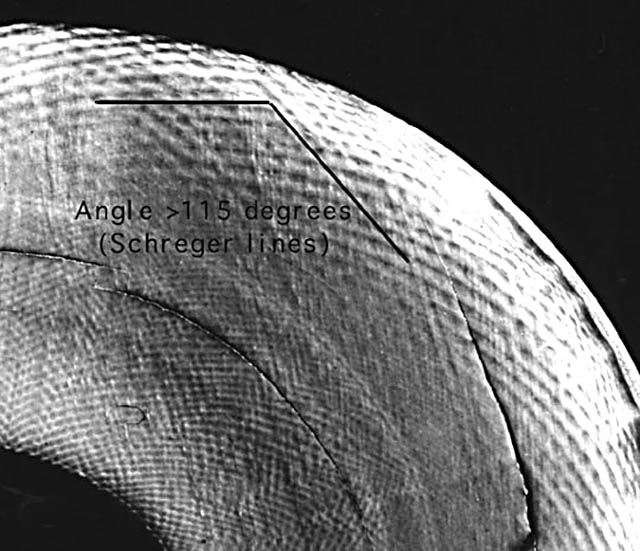
Distinguishing elephant from ancient ivory can be done by the correct reading of the Schreger lines on the surface of the ivory.

Distinguishing elephant from ancient ivory is challenging and becoming more and more important for the owners of knives with handles of ancient ivory. However, there are two reliable keys to make the determination easier.

Polished cross sections of elephant and mastodon/mammoth ivories display stacked chevrons of cross-hatched lines called Schreger lines or Lines of Retzius—incremental lines of rhythmic deposition of successive layers of enamel/dentine matrix during development. The Schreger lines closest to the outer bark of the tusks are the most visible—and the ones to measure—though there are also inner Schreger lines that are less discernible around the nerve cavity. The intersection of Schreger lines form angles, and this is the key—if the average angle is greater than 115 degrees, then it’s elephant ivory; if the average angle is less than 90 degrees, it’s mastodon or mammoth. Variations in the angles can occur in individual tusks, particularly as the patterns tighten more toward the center. Plus, the visible cross section must be cut square to the axis of the tusk—otherwise the chevrons’ angles will be distorted.

Specimens from both extinct and existing animals can show angles between 90 and 115 degrees in the outer Schreger lines, so the differentiation should never be based solely on a single angle measurement when the angles fall in this range. When averages are used, a clear separation between the ivory of existing elephants and extinct mammoths/mastodons exists. Elephant ivory averages above 100 degrees and mammoth/mastodon ivory averages below 100 degrees.

Another I.D. key, though more involved, can also distinguish mammoth or mastodon ivory from elephant. These ancient ivories can often have blue-green or brownish blemishes on the surface produced by an oxidized iron phosphate called vivianite. Even if the discoloration is barely visible, ultra-violet light will make it stand out with a dramatic velvety-purple appearance. Even if elephant ivory were similarly discolored—though in its natural state, elephant ivory will not display the same discoloration—it would not exhibit the characteristic fluoresence of vivianite.


With recent ivory laws handed down by Fish and Wildlife greying the lines between elephant and ancient ivories, it is possible the laws may give federal agents the right to seize knives and materials that cannot be proven as outright ivory but simply have the ivory look. As a result, if you own knives with ancient ivory handles, having an at least a general knowledge of how to differentiate elephant from ancient ivory could save you from having your knives confiscated, from being fined or both.

Hot Knife Deals at ShopBlade.com

Black Friday knife deals

Advertisement

Must Read Articles

Read this before you make a knife

Knifemaking 101 – Read This Before You Make a Knife

  by Wayne Goddard My experience has taught me that there's nothing like digging in and getting started. I've often said the hardest part of the...
how to forge damascus steel

How to Forge Damascus

Advertisement
Advertisement