
The following was excerpted from examiner.com, and written by Mike Searson, Knife and Sword Examiner:
Emerson Knives Opens New Factory by Mike Searson
The following was excerpted from examiner.com, and written by Mike Searson, Knife and Sword Examiner:
Spartan Blades Sets Up New Knife Shop
An article posted Tuesday, April 1, 2014, on www.thepilot.com, an online news site serving Moore County, North Carolina, detailed Spartan Blades’ knife manufacturing facility move to a historic restaurant, now closed of course—the LobSteer on U.S. 1 in Southern Pines, North Carolina.
Ted M. Natt Jr., of www.thepilot.com, details:
The sign outside the former LobSteer restaurant on U.S. 1 in Southern Pines proclaims that Spartan Blades is coming soon.
“We’ve had people coming in and asking about being short-order cooks and waitresses,” Spartan Blades co-owner Curtis Iovito said with a laugh last week, “so we’re telling people it’s going to be a Greek-Japanese fusion restaurant.”
The confusion is understandable, given that the LobSteer operated on the site for 44 years until closing last year.
But Spartan Blades manufactures finely crafted tactical and field knives for the military, law enforcement, outdoor enthusiasts and collectors. The knives are sold in gun shops, cutlery shops and specialty stores in 30 states and 20 countries through a network of 120 authorized dealers.
“We’ve gained quite a bit of notoriety in the past few years,” Iovito said. “We had over $1 million in sales for the first time last year.”
Iovito and business partner Mark Carey, who met while serving in the U.S. Army Special Forces, currently produce 2,500 knives a year in less than 1,000 square feet of space in what used to be the mule barn at Malcolm Blue Farm in Aberdeen.
Click here to read the rest of the article. For more military and tactical knife models, click here, and enjoy!
Buck Hits Million Mark for Knives Made in 2010

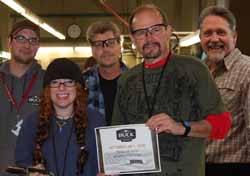
POST FALLS, IDAHO– When a 110 Folding Hunter rolled off the production line at Buck Knives on Friday, Oct. 29, it was the millionth knife made this year.
“We’re breaking records,” said Phil Duckett, Buck’s chief operating officer. “It’s awesome, and we still have two months to go.”
Another positive sign of growth has been the addition of 40 new employees this year, bringing Buck’s total workforce to 250 in their Post Falls, Idaho, plant.
“This is a testament to our commitment to making our products in America,” Duckett said. “The troops on the floor worked hard to get us to these impressive numbers.”
Pictured: Buck employees with the millionth knife produced in 2010.
What’s Your Steel I.Q.?
According to BLADE® subscriber surveys, one of the topics subscribers request BLADE cover most is steel—specifically, steel for knife blades. It is not much of a stretch, then, for the latest installment of “BLADE Quiz” to challenge your knowledge of the most popular of blade materials.
The answers are at the end of the story. Be sharp!
1) Damascus or a damascus type of steel has been traced as far back as: A) the 11th century A.D.; B) second century A.D.; C) 500 B.C.
2) Wootz steel is believed to have originated in: A) Damascus, Syria; B) Indian and/or Sri Lanka; C) Japan.
3) A Swedish steel with 2 percent nickel is known as A) Sandvik 12C27; B) Damasteel damascus; C) 15N20.
4) According to most authorities, for a steel to be stainless, it must contain what percentage range of chromium? A) 11.5 to 12; B) 12.5 to 13; C) 13 to 13.5.
5) The Japanese word for “blade steel” is: A) ha-gane; B) hada; C) ha-machi.
6) The two stainless steels for which Blade Magazine Cutlery Hall-Of-Fame© member Bob Loveless is most famous for introducing to custom knives are: A) BG-42 and 154CM; B) 154CM and ATS-34; C) 440C and Vascowear.
7) A material that is dissolved in another metal in a solid solution or that results when two or more elements combine in a solid solution A) is ductile; B) has been sintered; C) is an alloy.
8) The measure of a steel’s resistance to deformation is its A) wear resistance; B) toughness; C) hardness.
9) Cutlery Hall-Of-Famer Bill Moran introduced damascus steel to modern custom knives at the Knifemakers’ Guild Show held in A) 1972; B) 1973; C) 1974.
10) At the aforementioned Guild Show, Moran’s knives fetched how many dollars per blade inch of damascus? A) $50; B) $100; C) $150.
11) The relative resistance of a steel to breakage, chipping, or cracking under impact or stress is its A) toughness; B) hardness; C) wear resistance.
12) The Crucible Particle Metallurgy steel originally called CPM 440V is now called: A) CPM M4; B) CPM S90V; C) CPM S60V.
13) To harden to the 60 HRC level during heat treating, a steel must have at least what percentage of carbon? A) 0.5; B) 0.75; C) 0.90.
14) The first CPM steel created exclusively for knife use was: A) CPM S30V; B) CPM 440V; C) CPM 3V.
15) If the first symbol of a steel’s designation is a letter and the second symbol is a number, it is probably a: A) high-carbon steel; B) tool steel; C) high-speed steel.
16) The point at which a steel becomes permanently deformed is its: A) yield strength; B) tensile strength; C) impact strength.
17) Tool steel contains a number of different elements that combine with the steel’s excess carbon to form A) ferrite; B) austenite; C) carbides.
18) In order to cool fast enough, low-alloy steels such as O1 must be quenched in A) oil; B) water; C) a mixture of both A and B.
19) Steel handmade from electrolytic sponge iron and antique wrought iron is called A) tamahagane; B) bulat; C) oroshigane.
20) The carbon steel D.E. Henry claims to have used for knives in the 1940s and that BLADE® field editor Ed Fowler is known best for today is: A) 52100; B) 5160; C) 1084.
Answers: 1) C; 2) B; 3) C; 4) B; 5) A; 6) B; 7) C; 8) C; 9) B; 10) B; 11) A; 12) C; 13) A; 14) A; 15) B; 16) A; 17) C; 18) A; 19) C; and 20) A. Scoring: 0-3—You’re rusty. 4-7—You just went from Man of Steel to Man of La Mancha. 8-12—Come back when you can say molybdenum without chipping a tooth. 13-17—You are starting to become abrasion resistant. 18-19—Wayne Goddard just looked over his shoulder at you. 20—Your initials have officially been changed to HRC (hardness Rockwell C).
For more on the latest knives, knife legislation, knifemaking instruction, knife trends, knifemakers, what knives to buy and where and much more, subscribe to BLADE® Magazine, the World’s No. 1 Knife Publication. Click on http://www.shopblade.com/blade-magazine-one-year-subscription-us/?r+ssfb072712 for more information.
Knife Purveyor Of The Day I
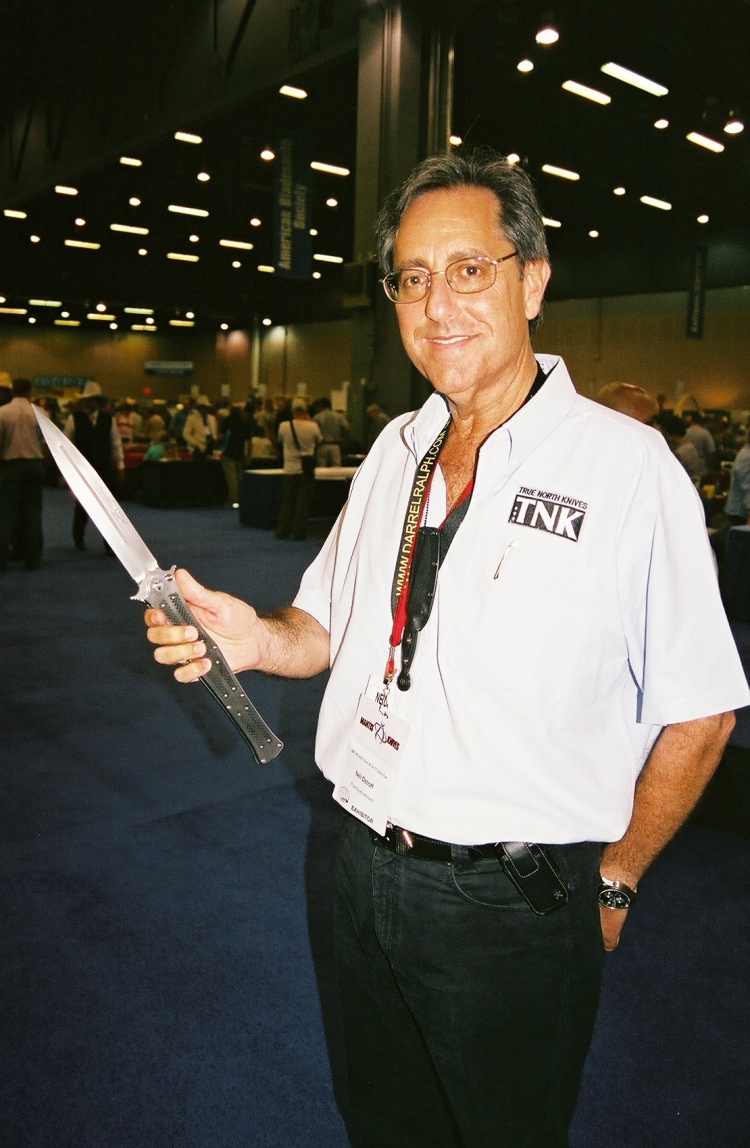
The first in our Knife Purveyors Of The Day series is Neil Ostroff (shown above with a Darrel Ralph Madd Maxx folder at a past BLADE Show) of True North Knives in Williston, Vermont. Formerly based in Canada, TNK is now U.S.-based and brings you some of the finest in tactical and utility custom knives, a number of which are exclusives, from such makers as Kirby Lambert, Strider Knives, Darrel Ralph and others.
For more information, click on www.truenorthknives.com.
For more on the latest knives, knife trends, knifemakers, what knives to buy and where and much more, subscribe to BLADE® Magazine, the World’s No. 1 Knife Publication. For subscription information click on http://www.shopblade.com/product/blade-magazine-one-year-subscription-us/?r+ssfb301211#BL1SU
Ernest Emerson Plugs BLADE Show on Armed American Radio
Ernest Emerson talked about his knives, his seminar and more for the upcoming BLADE Show on Armed American Radio over the weekend.
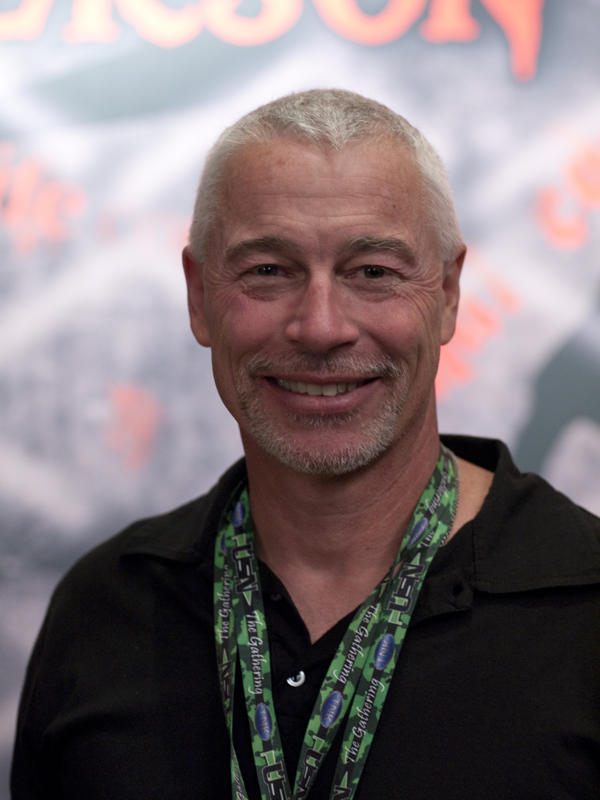
Emerson (pictured), who also will display his factory knives at his show booth, extolled the virtues of the BLADE Show and his seminar, “Countering Terrorism: Get Your Mind Right,” which will be BLADE Show Saturday at 1 p.m. Originally slated for Room 110 in the host Cobb Galleria Centre, the seminar will be held at the same day and time in Room 104 instead.
According to Emerson, Armed American Radio has 166 radio affiliates and recently picked up a new one in Phoenix, Arizona, the country’s fifth largest market.
The BLADE Show will be June 10-12 at the Cobb Galleria in Atlanta. For more information, click “BLADE SHOW” on the bar at the top of this page.
Grab Ya’ Some Ontario/Ranger RD Tanto!
The American-made Ranger RD Tanto by Ontario Knife Co. (OKC) is designed by retired U.S. Army Ranger Justin Gingrich to be a tough tool that, in addition to cutting or slashing, can be used to dig, pry and penetrate better than a standard drop or spear point.
“I don’t traditionally do a lot of tanto blades,” Gingrich said. “I had been getting more and more requests from guys who needed or wanted one that is usable and ‘bomb proof.’” He added that he tested the RD Tanto and it soon became a hit with users.
The thickness is the key to the effectiveness of the robust full-tang knife.
“The Ranger line has always been built on two traits that make it stand out: [that the knives are] affordable and overbuilt,” Gingrich added. “I want to make sure the blade is a tool and that it can be used as such without worry of failure.
“OKC reproduced it very well. They held to my specs without any issues. Price is always a concern, but with OKC already doing the rest of the Ranger Line in quarter-inch-thick 5160 and the same handle material, they can buy in bulk and help keep the costs in check.”
For more on the Ranger RD Tanto, visit www.ontarioknife.com.
To read similar stories and the latest knife news and much more, subscribe to BLADE by clicking on http://www.shopblade.com/product/blade-magazine-one-year-subscription-us/?r+ssfb291111#BL1SU
PHOTO CAPTION
Quarter-inch-thickness runs the length of the black-powder-coated, 5160 carbon steel blade all the way to the chisel tip, designed to make the Ontario Ranger RD Tanto sturdy under intense lateral pressure. Overall length: 12.186 inches. Blade length: 7.187 inches. The Micarta® handle comes in black or olive drab. MSRP: $175.64 (includes MOLLE-compatible black nylon sheath with hard plastic insert and utility pouch). (Ontario photo)