The BLADE Blogs

The blogs of the BLADE editors, Steve Shackleford and Erin Healy.

House Moves To Protect Legal Ivory Owners

The U.S. House Appropriations Interior Subcommittee approved a bill July 9 that would protect legal ivory owners.

“This action is a significant step towards protecting all lawful ivory owners,” observed Rob Mitchell of the Elephant Protection Association. “As this bill progresses , we will continue to provide updates as developments occur.”

Called the FY15 Interior and Environment Appropriations bill, the measure will be considered for approval by the U.S. House Appropriations Committee next week.

“This is great news!” exclaimed Sandra Brady, scrimshander and a member of the Elephant Protection Association. “Our efforts are paying off. As a direct result of the Oversight Committee Hearing held June 24, this bill, if approved, would not allow any funds to be used for changes in the ivory laws.

“However, this law is not passed yet and has to be voted on by the Senate, but the verbiage we had hoped for is there. We still have a fight on our hands, and we’ll keep you posted as to how and when and what to do to help this along.”

The bill is in response to the ban on the domestic sale and trade of legally owned ivory by the Obama Administration and U.S. Fish and Wildlife Service (FWS). It includes wording that would prohibit FWS from using any funds to restrict the domestic sale and trade of legally acquired ivory, as well as any further restrictions on its import and export.

The language does NOT prohibit the administration from trying to end poaching and illicit trade, but does protect legal ivory owners and their ivory.

For more information on how you can help fight the government’s attempt to ban the domestic sale and trade of legally acquired ivory, contact the Elephant Protection Association, 1035 W. Bristol Rd., Warminster, PA 18974.

Legal ivory owners may get relief.
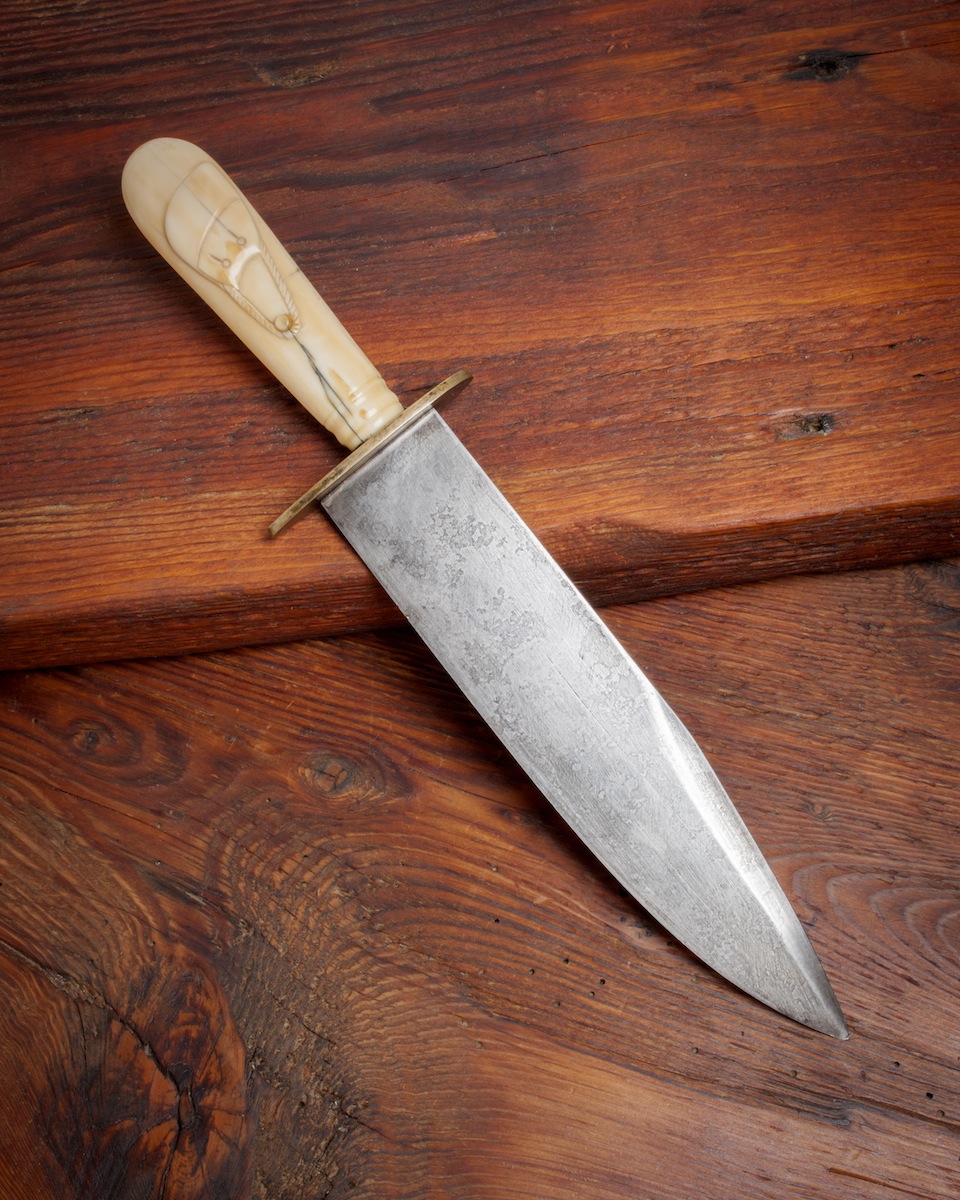
U.S. House takes first steps to protect the rights of legal ivory owners. This ivory-handle 19th-century bowie is from the collection of Bill Simmermacher. (Simmermacher photo)

Indiana Senate Committee Votes To Repeal Switchblade Ban

Indiana Senate’s Committee on Corrections, Criminal and Civil Matters unanimously passed Senate Bill SB06, a Knife Rights requested bill sponsored by Senators Jim Tomes and Johnny Nugent, which would overturn the state’s antiquated and irrational ban on the possession of switchblade/automatic knives. Senate Bill SB06

This is just the first step in this effort, but the unanimous bipartisan vote bodes well for the bill’s future. If you live, work or travel in Indiana, please contact your Senator and ask them to support SB06 when it comes to the floor for a vote in the coming days. Locate your Senator, or the Senator who represents where you work or travel here: http://district.iga.in.gov/DistrictLookup/.

Knife Rights Director of Legislative Affairs, Todd Rathner, testified at the hearing that these antiquated bans were implemented in the 1950’s in response to hysteria induced by movies like Rebel Without A Cause. They were not based on any type of public threat, increase in crime or other public policy decision. He also explained to the committee that “modern technology has created knives that open just as fast or faster than switchblades or automatics, so the bans on these knives are obsolete.”

SB06 removes a provision that makes it a Class B misdemeanor for a person to manufacture, possess, display, offer, sell, lend, give away, or purchase any knife with a blade that opens automatically by hand pressure applied to a button, device containing gas, spring, or other device in the handle of the knife. Read the bill here: http://1.usa.gov/sffRrU.


3rd New England Hammer In sponsored by the American Bladesmith Society


July 15 through 17, 2011

Offered by the American Bladesmith Society, Inc.

Hosted by the New England School of Metalwork

Location:
New England School of Metalwork
9 Albiston Way
Auburn, Maine 04210

For more Information:
Dr. Jim Batson at 256-971-6860 or [email protected]

Registration Fee: $55

Pre-Register and pay the $55 Registration fee online in the Store

or Cindy Sheely, ABS Store Manager at [email protected] or (419) 832-0400

Event Flyer: TBA

Demonstrators:

Lin Rhea, MS – Forging, grinding, heat treating a camp knife to pass the JS Performance Test

Christoph Deringer, MS – Damascus steel

Dan Farr, JS – Handles and Guards, Blade Finishing

Mace Vitale, JS – Preparing for the Journeyman Smith Test, Auctioneer

Butch Sheely, JS – Forging Tomahawks

Schedule: TBA

Accommodations:

The Fireside Inn, 207-777-1777, 2 double beds, $60 plus tax, Washington St, Auburn, ME.
Ramada Inn, 207-784-2331. 2 double beds, $85.50, 490 Pleasant St., Lewiston, ME

Cutting Demonstrations:

Participate in the Cutting Demonstrations. Bring a sharp knife, 15” or less in length
with a blade no longer than 10”. The handle should be pinned & with a safety lanyard.

Please Pre-Register:

Get your $55 Pre-Registration Fee in early and plan to attend Demonstrators Dinner on Thursday night.
Please mail registration form & check to the ABS Store
or register through the ABS Store on the website.

DMT Garners Presidential Award for Exports

Diamond Machining Technology, an internationally known manufacturer of knife sharpeners, was presented the President’s “E” Award for exports at a ceremony in Washington, D.C. on May 28, 2014. U.S. Secretary of Commerce Penny Pritzker presented the E Award, which is the highest recognition any U.S. entity can receive for making a significant contribution to the expansion of U.S. exports. DMT is the only Massachusetts company to receive an E Award this year.

DMT_New Magna-Guide Kit“We are honored to receive the ‘E’ Award in recognition of our global sales and marketing efforts,” said Mark Brandon, President of DMT. “Over the past five years—in addition to strong U.S. sales growth—DMT has expanded its export sales by an average of 18 percent per year and added 13 new ‘shipped-to’ countries. It is a credit to our vibrant, international distribution network, as well as the quality of our Made in America products.”

In her congratulatory letter, Secretary Pritzker wrote, “DMT has demonstrated a sustained commitment to export expansion. The “E” Awards Committee was very impressed with DMT’s exporting to 37 countries. The company’s co-branded marketing program was also particularly impressive. DMT’s achievements have undoubtedly contributed to national export expansion efforts that support the U.S. economy and create American jobs.”

First established under President John F. Kennedy in 1961, companies nominated for the “E” Award must demonstrate four years of successive export growth in addition to an innovative international marketing plan. This year, a total of 66 U.S. companies received the President’s “E” Award. The “E” represents a World War II symbol of excellence.

In 2013, U.S. exports of goods and services hit an all-time record of $2.3 trillion. Nationally, jobs supported by exports reached more than 11 million, an increase of 1.6 million since 2009. See more knife sharpers here!

Jerry Ahern Passes Away

(photo of Jerry Ahern courtesy of JerryAhern.com)

Jerry Ahern, novelist, author of nonfiction books and many magazine articles, passed away Tuesday, July 24. He was well known internationally for his extremely popular “Survivalist” series of novels. Mr. Ahern was a fan of the Detonics line of handguns, so much so that he acted as president of the company, then named Detonics USA, from 2004 to 2007, while it was located in Pendergrass, Georgia.

    Mr. Ahern was 66. Survivors include his wife, Sharon, children, grandchildren and a nephew. Arrangements were made through Evans Funeral Home, Jefferson, Georgia. 706-367-5467, http://evansfuneralhomeinc.com.

First Family of Swedish Steel

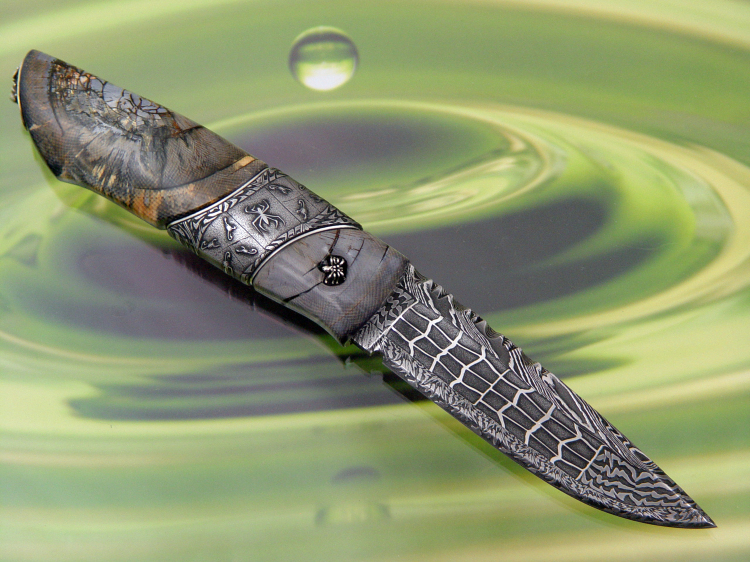
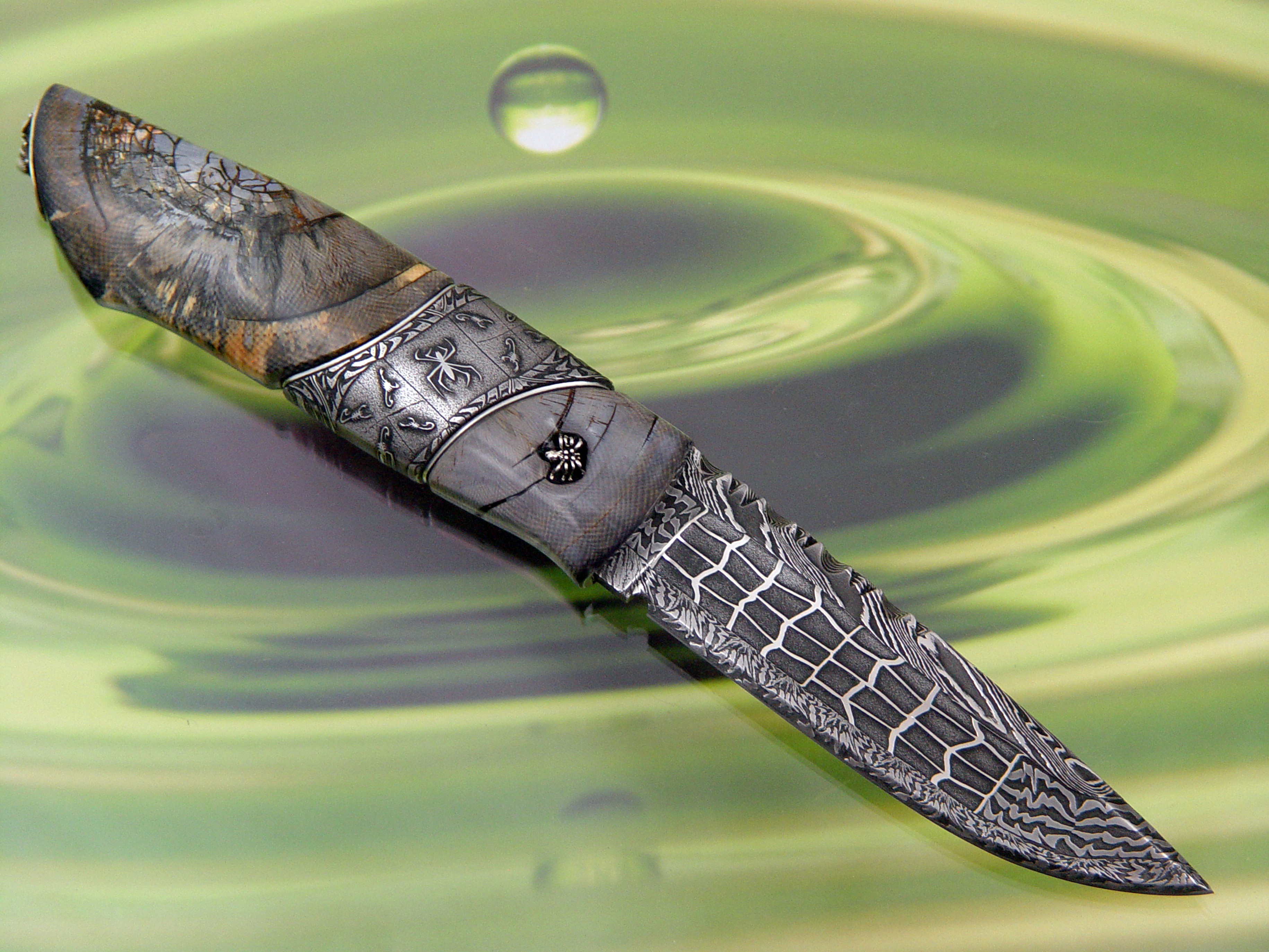
“Mammoth Spider” by Thomas Lofgren features a blade of a net-pattern mosaic damascus forged by Mattias Styrefors, a mammoth ivory and mosaic damascus handle, and sterling silver detail. (Lofgren photo)


Thomas and Claes Lofgren


Among the noteworthy Swedish knifemakers who have burst on the international cutlery scene in recent years, one of the names that stands out is Lofgren—father Thomas and son Claes.

    It is the family’s favorite sport, fishing, which brought Thomas to handmade cutlery. An annual family rite is to spend 10 days fishing—and fishing only—in the Lofoten Islands of Northern Norway. The waters are fish rich and it is not uncommon to pull out one in the 18-to-24 pound range. When you catch them you have to fillet them, which calls for a pretty good knife. Hence, Thomas began making such knives about 20 years ago. The first one cut reasonably well but was so ugly he felt obligated to make another one, and he has not quit making them since. He learned a few things from a book on knifemaking but the real trigger for improvement was an encounter with Roland Stromberg, an experienced maker. Roland taught him how to sew a nice sheath and from there showed him how to improve the general quality of his work.

    Having a technical background, Claes started getting interested in the craft in 2000, which made knifemaking just that much more important to Thomas. Since then there have been many elements of progress, emulation and sharing between father and son in the knife field. Now they are both part-time makers. Claes also works for an industrial company, and Thomas was instrumental in coordinating the 2005 and 2008 Sävsjö International Knife Expo. Thomas also found time recently to write the book, Making a Sheath for a Nordic Style Knife. It includes 150 of his own photos and sold 2,600 copies in its Swedish version, was translated into French and is now being published in German and Russian. Meanwhile, He exhibits at many shows in Sweden, other European cities (Paris, Helsinki, Solingen, Nontron), and in the USA. 

    His knife motto is “What stops growing will soon be dead.” Consequently, Thomas is always trying to improve, learning new techniques—Claes’s contributions are important in this regard—looking for new materials, and experimenting with fresh combinations of shapes and colors. “I like challenges, to walk on thin ice, even if I am not a very good swimmer,” he quipped.

    All his knives are distinctive. Even on models of similar design, he introduces many different decorations of handle and sheath, and combinations of colors and materials. In the past few years he turned toward even more high-quality materials. He is using less wood and more mammoth and walrus ivory, hippopotamus or warthog tooth, giraffe bone, etc. If he uses wood, it is often stabilized and colored. Once in a while he will embellish his knives with gold and silver, or a small precious or semi-precious stone. He prefers mosaic damascus for his blades, especially that of Conny Persson or Johan Gustafsson, or sophisticated damascus by Mattias Styrefors and André Andersson. His knives have won a number of awards in judging competitions at Swedish and American knife shows.


LIKE FATHER …

Claes’s background includes welding, most notably operating a robotic welding machine for three years. As the company he worked for expanded, a part-time position for supervising the planning of materials supply was created. Claes applied for the post and got it.

    For years he knew his father made knives, but Claes was not interested. However, in 2001 he watched his father and Johan Gustafsson board an airliner for the Knife Expo near Los Angeles (Pasadena), and “felt envious when Dad took off.” Wanting to experience the USA and California—and, of course, “California girls”—Claes saw making knives as one way to pay for the trip. His knowledge of metalworking and materials, plus the teaching of the basics by his father, resulted in very quick progress. Five months after making his first knife alone, he entered it in a judging competition at the Ludvika Show in Sweden and won in his chosen category. It was an enormous boost. By February 2002, he already had enough pieces ready to accompany his father to the Knife Expo. Since then it has become a sort of tradition for father and son to attend the Knife Expo and Ludvika Knife Week, as well as several other European shows.

    Claes’s knives share several points of similarity with his father’s. Both makers prefer mammoth bark ivory (the “bark” is the outside crust of the tusk), the same steel suppliers, quality sheaths in the Nordic style, and the same way of naming knife models. Nonetheless, not all the similarities are the result of Thomas’s influence. It is often Claes’s ideas and imagination that inspire his father.

    There are also some differences between the two. “Thomas’s knives are well made and imaginative, but with a more traditional approach. He has a feel for elegant and functional knives,” Samuel Karlsson stated. “Claes’s knives are more daring; his designs are more adventurous and extreme.”

    Being younger and with more of a technical background, Claes probably experiments more than Thomas. “The worst thing that can happen is that it goes wrong and I have to start all over again,” the younger Lofgren observed. “It can cost some material but I think it’s worth a try. I find it exciting to cross the line to find new approaches.”

    I would be remiss if I did not mention that Anna, Claes’s younger sister, also is a very good maker and has won prizes in judging competitions at Swedish knife shows. For the moment her knifemaking career is on hold as she works with her partner on restoring a farm they bought and caring for a 2-year-old boy. Meanwhile, Claes’s partner, Monika Bengtsson, also is making her first knives. “I think that I can retire now, before they all become too good for me!” Thomas laughed. “The only person not making knives in the family is my wife, Ann-Charlotte. But I can tell you that she bought two small blades …”

    Father and son makers are not uncommon, and father and daughter are less frequent. But if you add son, daughter, partner of the son and maybe one of these days the mother, a real first family of Swedish steel is in the making.—by Francis Anglade

Thomas and Claes Lofgren

+4670 834 9229 (Claes)

+46381 135 73 and +4670 69 77 405 (Thomas)

[email protected]

www.lofgrenknives.com

Specialties: Both make one-of-a-kind knives in similar styles and materials

Blade Steels: Mosaic damascus forged by Conny Persson, Johan Gustafsson, Joe Olson and Henry Hilden, and damascus forged by Mattias Styrefors and André Andersson

Handle Materials: Mammoth (including bark) and walrus ivory, hippo and warthog tusk, giraffe bone and woods (the latter often stabilized and colored)

Embellishment: Occasionally gold and silver, and precious and semi-precious stone inlays; some engraving by Jonny Walker Nilsson

Sheaths: Nordic style

Author! Author!: Thomas wrote the book, Making a Sheath for a Nordic Style Knife, which sold 2,600 copies in the Swedish version and has been translated into French, German and Russian

If you’re looking to make your own mosiac damascus, look no further than the Forging Mosaic Damascus Knives download from BLADE. You’ll learn the foundation of this fascinating process to be able to build your own great designs.


Click here to get the download for just $4.99.

Returning Soldiers: Did Customs Give You a Hard Time About Your Knife?

BLADE is receiving reports about U.S. Customs and Border Protection confiscating or prohibiting returning soldiers’ knives from entering the United States. Did this happen to you? BLADE wants to hear from you ASAP.


Send an e-mail to [email protected] or call 715-445-4612 x13648 right away. Time is of the essence.

Advertisement

Must Read Articles

Read this before you make a knife

Knifemaking 101 – Read This Before You Make a Knife

  by Wayne Goddard My experience has taught me that there's nothing like digging in and getting started. I've often said the hardest part of the...
how to forge damascus steel

How to Forge Damascus

Advertisement
Advertisement