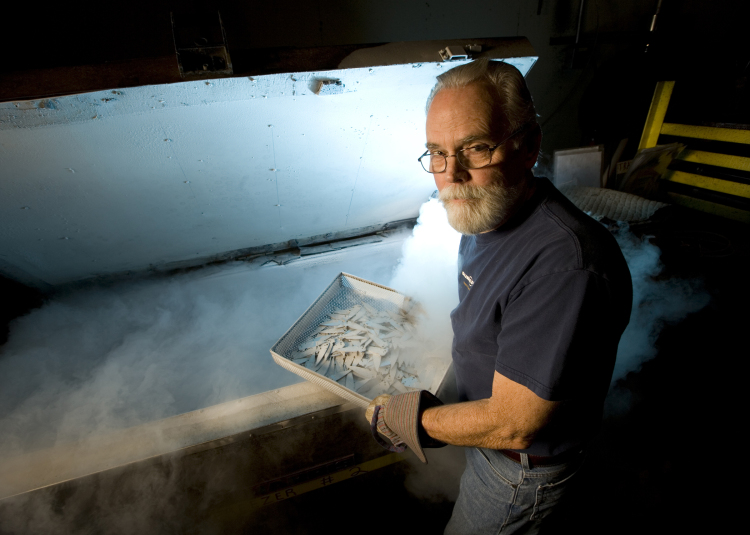
Although formally retired from his full-time role as head of heat treat for Buck Knives, Paul Bos continues to pursue the passion that captivated him as a 9th grader, many years ago.
“After all these years of friendship and working relationships, it’s satisfying to know that we can continue to provide the same specialized heat-treat service custom knifemakers have come to expect,” Bos said. “I’ve heard that my ‘retirement’ misled some, but Paul Bos Heat Treating is very much alive and well.”
For a brochure and price list, call or e-mail Paul Farner: (208) 262-0500, ext. 21; [email protected].
# # #
Photo Attached: Paul Bos
Paul Bos Heat Treating–Paul Farner, e-mail[email protected]Phone 208-262-0500 Ext.21
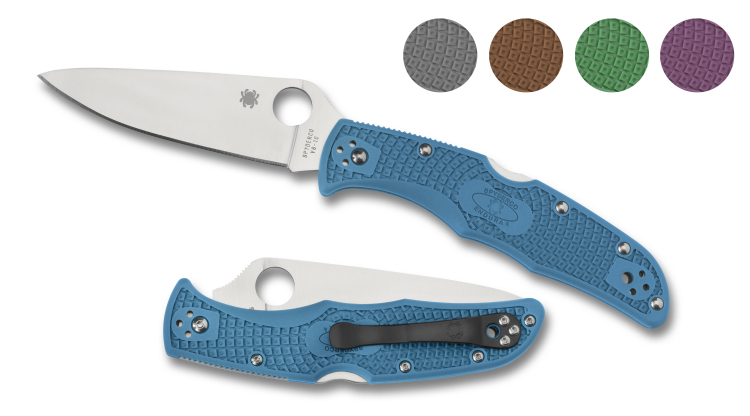
A representative example of a mid-lockback is the Spyderco C10 Endura, here in a plain edge and reversible pocket clip. (Spyderco photo)
Dating back half a millennium, the lockback is special and timeless
By Mike Haskew, BLADE® field editor
One of the most popular of folder locking mechanisms, the lockback is proof positive that everything old is new again. Most knife enthusiasts are aware of the influence the lockback has had for what is going on 60 years now, even though its origin goes back much further. Its ease of carry, safety and durability make for a winning knife, and in both the factory and custom segments of the industry, the lockback continues as a staple of production, craftsmanship and sales.
Glesser cites a couple of additional reasons for the rise and popularity of the lockback. The lockback spring can be easily positioned so it will not close inadvertently on the user, while the mechanism itself is easy to operate.
“The lockback has evolved over time,” Glesser explained. “The configuration of the locking bar changed in the mid-’70s after Harvey McBurnette showed Al Mar how to do that. Now, there are front, mid and rear lockbacks, and the advantage of the lockback produced by Al Mar is that the kicker of the blade is located where the lock pivot is, so the edge of the blade did not hit the spring. We asked Al for permission to use his lock on our early knives and still use a lock that is essentially the same to this day.”
One concern for the lockback has been the level of engineering required in its construction. “The lockback is an engineering challenge,” Sal concluded, “and shortening the [lock bar for the front- and mid-lockback models] makes it even harder to do. Because it is difficult to make, we have worked as recently as the last two years on refining the lock to virtually eliminate play in the blade.”
Lockback Lineage
Despite or perhaps because of its requirement for tight tolerances, the lockback has a substantial lineage. According to Bill Claussen, co-author of Sheffield Exhibition Knives, the lockback has been around in various forms since 15th-century Spain. Other European cutlers—including the French, Italians and English—have produced lockback variants during the past 500 years or so.
In the modern era, Claussen cites the Buck 110 folding hunter, which hit the market in 1964, as an industry icon. “It changed the face of modern pocketknives,” he commented. “Although lockbacks had been introduced to the U.S. for more than 200 years, they were not made affordable and convenient in mass production until Al Buck introduced his knife. This knife was quickly adopted by sportsmen, tradesmen, truckers and other workmen as an ideal, all-around, heavy-duty work knife. Vintage 110s are hard to find today, and one in mint condition will cost a small fortune if you can find one.”
Chairman of the board at Buck Knives, Cutlery Hall-Of-Famer Chuck Buck recognizes the pivotal role the 110 has played in modern lockback development, and acknowledges the challenges that surrounded the original premise of a practical production lockback. “The lockback actually is a bar that goes across the back of the blade with the spring under it, and when you push down on the bar it rocks on a stainless rivet,” he said. “So, that was always hard to get exact because you did not want it to be loose and it needed to fit perfectly.
“You need to do fine blanking of the blades to achieve that and for years components had been machined, but with fine blanking you can get that done. We worked with the design for quite a few months, and it was all new to us. That was in 1963. The first knives on the market totaled about 250 in 1964, and then in 1965 we ended up making about 10,000 of them. It just grew from there. The 110 continues to be one of our most popular knives, and we are producing them now at a rate of over 1,000 per day. We have a whole crew that just makes the 110 folding hunter. To Buck, it has been something that has sold every year, and it just keeps getting better.”
Over the years, there have been a few tweaks to the lockback design of the Buck 110. For example, during the 1970s it was discovered users were placing a great deal of pressure on the blade and the brass rivet in the mechanism itself was shearing. The brass rivet was replaced with a stainless steel component, and the 110 continues to sell well around the world. From large retailers to mom-and-pop hardware stores, from Main Street to Moscow, the Buck 110 is a knife user’s mainstay.
No Excess Motion
From a custom perspective, knifemaker Steve Hoel has wrestled with the lockback in his shop. “They’ve been making lockbacks for years, and everybody is making them now,” he remarked. “If the lockbacks are engineered right and the angles are right, then you have no excess motion. It’s simple to operate and strong, and can be done without a lot of expensive equipment. The lockback can be made with nothing more than a file if you know what you’re doing. They’re tough but, if they’re made right, you can eliminate all the slop and rattle.
“I don’t think there are a lot of big weaknesses in the lockback. They’re more complicated to make right than a LinerLock™, and you’ve got to understand some engineering principles. It isn’t rocket science, but there’s some science involved, and Ron Lake [helped write] a book [How To Make Folding Knives] that you can read to help make a good knife. You can come up with some mechanisms that will work well and are reasonably simple, but you can’t scale them down to a small knife without running into problems. A lot of the strength of the lockback depends on the width of the lock bar and the position in front, back or above the blade. If you don’t pay attention, you can get down to some weak points.”
The lockback mechanism itself, particularly among custom makers, has seen some streamlining and refinement over the years. While the principles are constant, improvements relate to the availability of better materials and higher-quality fit and finish. Some older lockbacks could not stand up to a lot of hard work and were clunky or overbuilt.
“I started out taking old knives apart and fixing them and modifying things in them,” Hoel recalled. “If you back up 60 or 70 years ago, the old pocketknives had 90/1000ths holes with 84/1000ths pins in those holes a lot of times, so it was not like using a taper pin or bushing that holds things solid. The ones we make now are more solid, primarily through better craftsmanship and materials that have evolved.”
The Human Element
Claussen asserts another aspect of the popularity of folding knives and of lockbacks in particular has to do with human nature. “It’s their mystique,” he related. “People seem to have a fascination for complicated things, plain and simple. This is generally true in life and very specifically in the collecting field. Watches, clocks and other collectibles are favored because of their complication. The general rule, with all things being equal, is that the more complications, the more desirability, hence greater value. To have a locking feature with a knife definitely adds mystique, aura and increased value.”
Perhaps therein lies the secret to the success of the Buck 110 and other production or custom lockback folders that have reached such prominence. Practical, strong lockup increases safety and security in operation. Folding knives carry more easily than fixed blades, and it can be argued that their deployment is somewhat easier than that of a fixed blade in certain situations. Modern materials and knifemaker experience have enhanced the quality of the lockback on all fronts, and the mechanism has become accessible to the general public like never before.
Still, there is something about that tight, solid lock, the feel in the hand of the user, which makes the lockback so special and so timeless.
For more on the latest knives, knife legislation, knifemaking instruction, knife trends, knifemakers, what knives to buy and where and much more, subscribe to BLADE® Magazine, the World’s No. 1 Knife Publication. For subscription information click on http://www.shopblade.com/product/blade-magazine-one-year-subscripti…?r+ssfb021712#BL1SU
Every day is Memorial Day for the family of Master Sergeant Robert Mark Horrigan. The weeks leading up to the holiday and through June 17, though, mark an intensified period of mourning for Robert’s identical twin brother and American Bladesmith Society master smith John Horrigan of Elite Knives. Robert was a member of C Squadron, 1st Special Forces Operational Detachment, Delta Force, JSOC and June 17, 2005, was the date he was killed in action in Al Qa’im, Iraq. Gentlemanly, soft-spoken, John says, “Excuse my language, but I’m an asshole for about two weeks” leading up to Memorial Day. And with that, you know that no matter how courteous, no matter how elite the warrior pedigree of either man, John knows exactly how hard it is for Gold Star* families and fellow veterans, and he’s willing to get in the dirt and help.
John Horrigan owns Elite Knives and works out of his home shop in Burnet, Texas. His knifemaking began in earnest after returning from his service as a U.S. Army Ranger in 3rd Battalion, 75th Regiment.
The Horrigan twins learned to hunt and fish growing up on a farm in Limestone, Maine, which is in Aroostook County, so far north it might as well be in New Brunswick, Canada. When the boys were 10, knowing jobs would be scarce, the family moved to Florida. The humidity exacerbated their father’s emphysema and tuberculosis, however, so two years later thy moved to Austin, Texas. John and Robert enlisted together and advanced to become U.S. Army Rangers, serving in 3rd Battalion, 75 Ranger Regiment. After three years, John left the military—for love. He had met Donna when he was 17 and she was almost 15. He has now been married to his high school sweetheart for 29 years. They have a daughter and a son, with one grandchild and another on the way. “I just knew the military life was not for her,” John said.
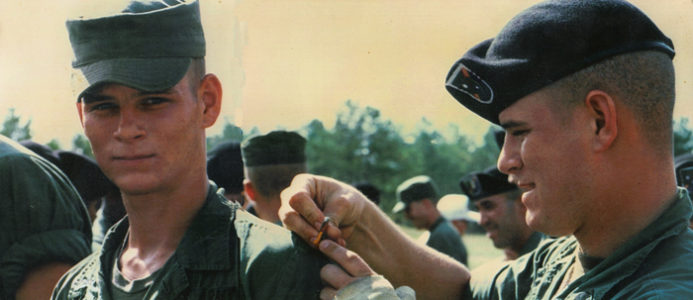
Then-U.S. Army Ranger Robert Horrigan pins the Ranger Tab on his twin brother John Horrigan’s shoulder at a graduation ceremony on Fort Benning, Georgia.
John performed security for the U.S. Department of the Treasury for a short while and then became a deputy with the Travis County Sheriffs Office as well as a fireman. In 1983 John made his first knife. After his brother’s death, he made a commemorative knife for Bob’s unit and another for President George W. Bush. He makes everything from swords, daggers and the occasional tomahawk to camp knives, hunters and bowies. John also continues to make his brother’s design, the Bob Horrigan Military Fighter. You can read more about the brothers and their knives in an article by Kevin Jones that ran in the December 2010 issue of BLADE Magazine entitled, “Twin Brothers, Makers and Heroes.”
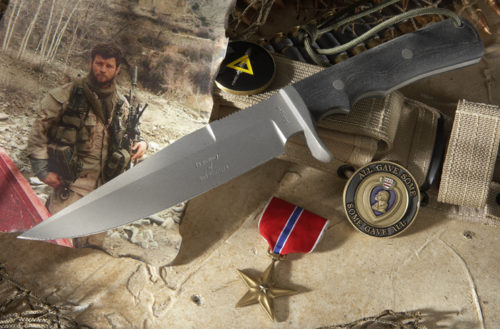
The Bob Horrigan Military Fighter has a 6 1/2-inch blade made out of 440C stainless. The guard and handle bolts are made of 303 stainless. The handle is fashioned with Black Linen Micarta. Overall length: 11 1/4 inches. Maker’s list price: $550. This design is also available with a double guard at 13 inches overall at the same price, or in pattern-welded steel with ironwood handles at a maker’s list price of $720.
While love and love of knives determined the course of one brother’s life, the warrior spirit could not be quenched in the other. Over the course of his 19 ½-year career, which culminated in Special Forces, Robert, who his brothers-in arms called Bob, deployed five times to Iraq and three times to Afghanistan. “Badass” and “real deal” can be overused, but not with Bob Horrigan. Delta operator George E. Hand IV wrote two eulogies of Bob for SOFREP News that get to the heart of the quintennial gentleman warrior: “Delta’s Robert Horrigan: A Better Man Than I” and “Delta Forces’ Own Robert Horrigan: Dwarfed By The Presence of Giants.”
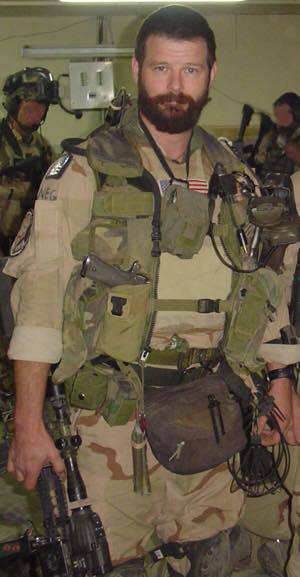
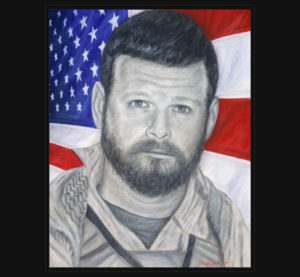
Robert M. Horrigan left the service when his twin brother, John, did but reenlisted, moving into Special Forces after his time in Ranger Regiment. He was killed in action in Iraq, June 17, 2005, in Al Qa’im, Iraq.This portrait of MSG Robert M. Horrigan was done by Phil Taylor for the non-profit The American Fallen Soldiers Project. It was present to the Horrigan family in accordance with the 501(c)(3)’s mission of bringing comfort and healing to Gold Star* families. You can watch the video about this particular portrait at the bottom of this post.
Bob did not have to go on his last mission. He was closing in on retirement. He had plans. He was going home to his wife and daughter and he was going to make knives with his brother. Five years before, John had introduced Bob to knifemaking, and he liked it. While living in base housing on Fort Bragg Bob would run an extension cord outside to work on his creations. “I’m not sure they would have been happy about if they knew,” John says, a warmth in his voice. Like John, Bob loved the artistry of knifemaking, but he only had time for making combat knives.
In addition to medals depicted here by ribbons, Robert Horrigan was posthumously promoted to Master Sergeant and awarded the Legion of Merit Medal, the Bronze Star Medal with Valor Device and the Purple Heart. In addition to his mother, Mary; twin brother, John; and sister Lisa Shine, he is survived by his wife, Denise; his daughter, Courtney; and another brother, Daniel. He is buried in Section 60, Site 9131 at Arlington National Cemetery.
John continues to live out this dichotomy. “I could make a lot more money making fighters,” he said. After banging out 40 of them, though, he longs to delve into the art of the craft. Then, when he’s deep into a showpiece and it seems like it will never be finished, he begins to long for the refreshing simplicity of hammering away on combat knives. “I flip flop,” he says. “I used to have six or seven pieces, 80 percent done” for BLADE Show. He laughs about what he refers to as his attention deficit hyperactivity disorder. Now he works on two at a time and finishes them before he moves on to the next one. After the show he enjoys being able to relax and resume his own pace.
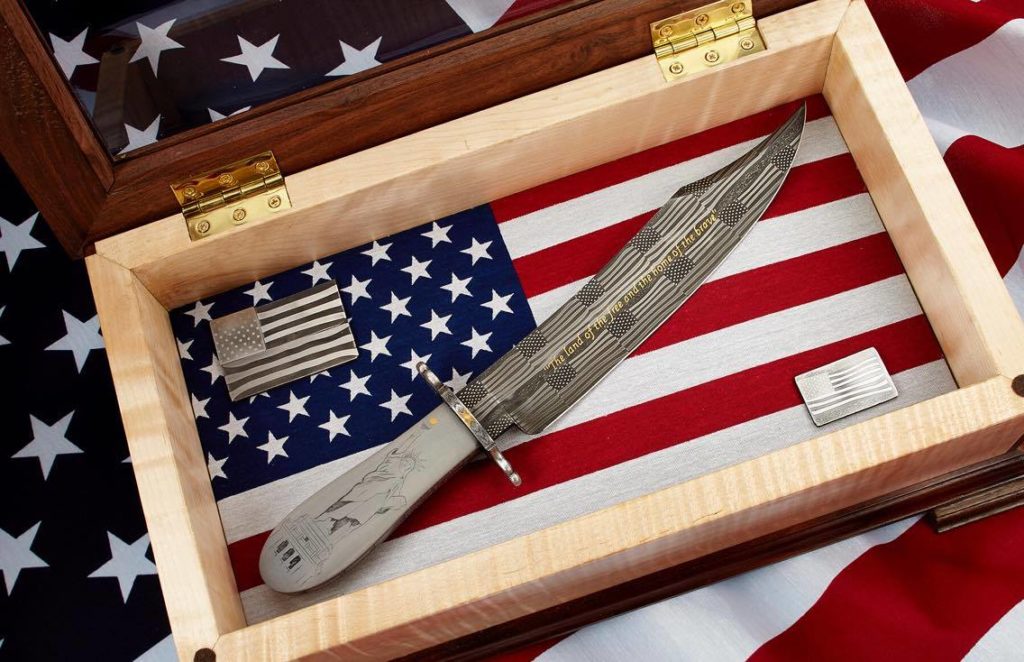
When he needs a break from combat knives, maker John Horrigan switches to crafting high-end pieces of art. This bowie is made in American flag mosaic-pattern steel. Although you can’t see it, “In God We Trust” is engraved along the spine. The handle scales are 416 stainless steel engraves with the Statue of Liberty. The quote on the blade is done in 24-carat gold. Contact: Elite Knives
So although Robert didn’t have to go on that last mission, he wanted to be with his unit. And with that decision, the dream the twins shared of living out their days together with their families and making knifes ended—hard, on the other side of a breached door. The objective was to sneak in, target Abu al-Zarqawi, the al-Qaida leader in Iraq, and get out. The problem was that by the time the mission was underway, the enemy knew the Americans were coming. Bob Horrigan was the number-one man. He got inside the room and was immediately engaged in an intense firefight. The number-two man, Master Sergeant Michael L. McNulty—also a twin—was shot down on the threshold. While teammates extracted Mike from the doorway, Bob took hits to his femoral artery and head. Both men held on while their brethren simultaneously continued the battle, plugged their wounds and extracted them to a secondary airfield approximately 1000 meters away because a closer one was under attack. Both men were alive when they were put on the aircraft and when they landed at the medical facility. Heart massage was performed on Bob. But, as John explained, when you’ve been hit that many times, when you’ve lost that much blood, no matter how much they hold on, it’s only a matter of time before they succumb.
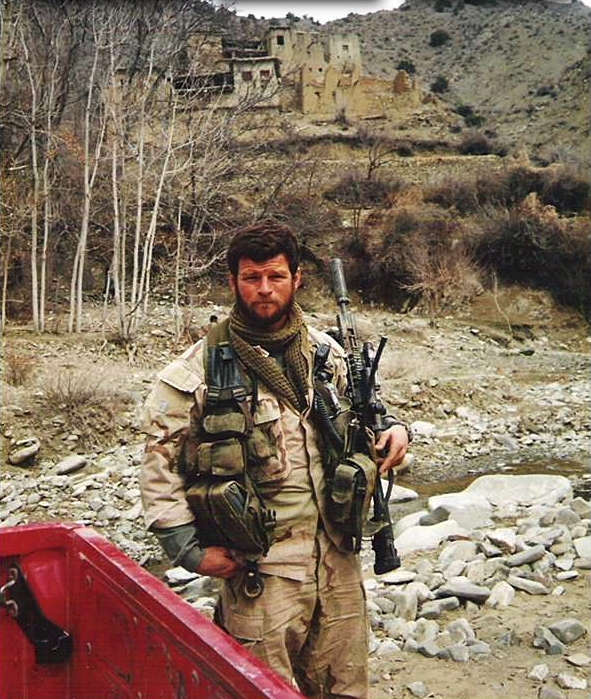
John 15:13 reads this way in the New King James version of the Bible: “Greater love has no one than this, than to lay down one’s life for his friends.” John Horrigan will tell you that his twin brother, Robert, did just that for his brothers-in-arms. Jesus did the same for us. This photo of Robert was taken taken March 19, 2002, east of the Shahi-Kot Valley on the route to Khost during the post-Operation Anaconda chase.
The part about both men being twins, was only the first of endless seeming coincidences. Robert’s wife kept his remains in an urn at home for a few years before he was interred, but John also wanted to visit the grave of the man who had died with his brother. He made the trip to Arlington National Cemetery, and when asked who he was looking for, gave McNulty’s name. There were three men also standing at the information desk. “Who did you say you were looking for?” one of them asked John. John repeated the name. He tried to introduce himself. Being an identical twin, the men already knew who John was. They were from his brother’s unit, and they too had come to visit McNulty’s grave.
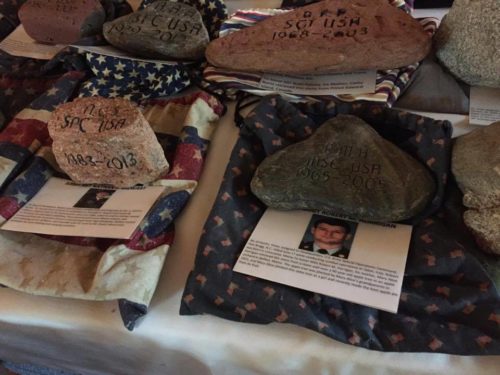
Another time the Horrigans had planned a family trip back to Maine. Many people were involved and Donna was looking at a particular house to rent. It was expensive so John suggested checking Craigslist. She found the same house listed for less. As the process continued, the twin’s sister, Lisa, began to suspect a scam. John wasn’t sure at first, especially since he was so used to dealing with wire transfers through the course of selling his knives internationally. He was busy in Boston and directed his sister to handle it. On the way to Maine, John thought, ‘Maybe it is a scam,’ and called the Ellsworth Police Department. A detective, Dotty Small, confirmed that it was indeed a scam. John called Lisa who was standing on the porch of the house, which already had tenants living in it. John told her what he had learned. In an event to commemorate Maine’s heroes called The Summit Project, Detective Dotty Small had hiked Baxter Mountain carrying a stone with the initials of a fallen warrior on it: M.R.H.
“Maine is good to its veterans,” John Horrigan said. According to The Summit Project nearly 1 in 7 Mainers are veterans or approximately 15 percent of the state’s population, one of the highest rates of any state in the nation. The Summit Project honors fallen heroes and brings awareness to the challenges of grieving families. The Bangor Daily News covered the event in 2014. The article was entitled “Feeling the weight: Hikers carry tribute stones for Maine heroes to Baxter mountaintop.”
One night at the firehouse, John had a dream. In it, Robert came to him and told him to look up Al Qa’im. “I’m thinking, ‘I’ll never remember that,’” John said. Al Qa’im was a center for insurgency near the Syrian border, and the town in which Bob was killed. It means ‘I have risen.’” John pauses. “Another translation is ‘I have ascended.’”
It is like this all the time, Bob seemingly orchestrating serendipitous exchanges for his family and especially his twin. “I lost half of me,” John said. It took me a year and a half to get beyond wanting to blow my head off,” he admitted. “God really had to hit me with a sledge hammer…It’s not about you anymore. It’s about Me.”
John and Robert’s mother was a novice nun. After five years in the convent, she knew she wanted to have children so she left. The Horrigan children were given a Catholic upbringing. “In the Army, you drift away,” John said. About two years before he died, Robert told John that he was coming back to God. John accepted the news in his easygoing manner, but perhaps didn’t think as much of it as he does now in hindsight.
“All this macho ‘I can handle it.’ Well, obviously, you can’t. You have to talk to someone,” John said. “There has to be a support network, and having God can help.” John is quiet for a moment. “Bob was a sniper,” he reveals. Bob told John that he’d killed 50 to 60 enemy combatants. “He did not have PTSD, that I know of,” he emphasized. Bob told John that he was OK, because he was “alright with God.” The Old Testament is filled with killing, John said. “Evil exists in this world and you have to exterminate it. It’s like when you have an infestation of bugs. You have to kill every one or they’ll come back. When you’re fighting an ideology where (the enemy is) hiding behind women and children, it’s like a cancer of the highest magnitude” that must be eradicated.
“Memorial Day is not a happy time,” John said. He acknowledges the day by telling people about his brother and the tragedy of leaving a hurting wife, 12-year-old daughter, mother, siblings and especially a twin with whom he did everything. But perhaps because of the leadership ingrained in him as a Ranger, John understands that he cannot be consumed by the grief of his own loss. God channels his pain in a way that reaches people just like him, veterans and family members who are wracked with unbearable grief. John recently lost a firefighting co-worker to suicide. It left him shocked because the man was always so cheerful “Everyone has demons. Call me. We’ll fight them together.”
Knifemaker John Horrigan Remembers Fallen Twin Brother Robert Horrigan
*Gold Star families are those that have lost a service member in combat. You will see the vertical red-rimmed banners most commonly on vehicles. Each blue star represents a family member serving in the military, while a gold star represents a fallen service member.
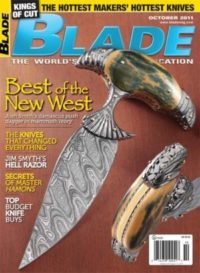
In addition to a review of Robert Horrigan’s Military Fighter from Elite Knives, you’ll also get a rundown on Old West-style push daggers in the October 2011 issue of BLADE.
So what does fellow Special Forces member Kim Breed think of Elite Knives’ Bob Horrigan’s Military Fighter? Read his review right away in this downloadable version of the October 2011 issue of BLADE for $5.95.
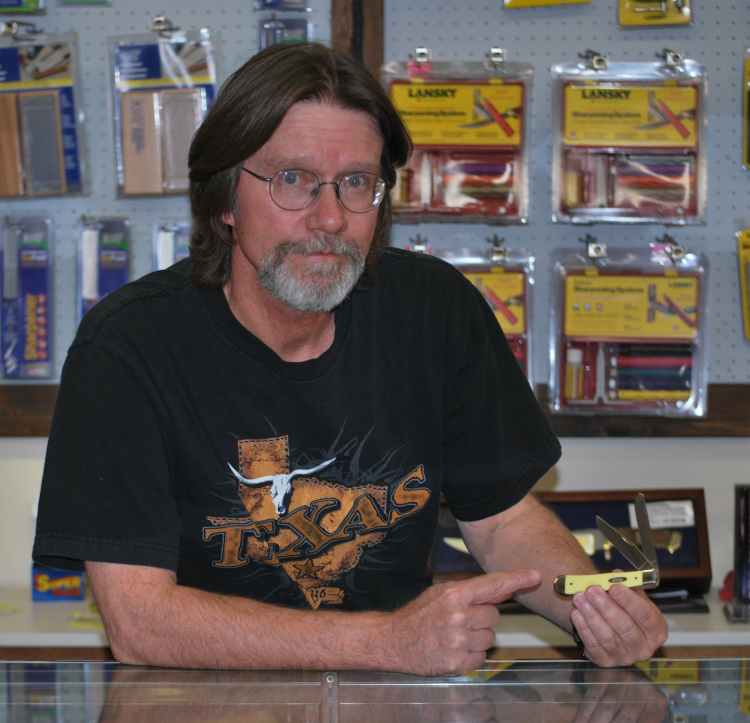
Troney Toler of Knives Plus in Amarillo, Texas, says his biggest seller by far is the Case model 161 yellow-handle trapper with blades of Case’s “chrome vanadium carbon steel”—which, according to a Case official, is 1095 carbon steel with added chromium and vanadium. (photo courtesy of Troney Toler)
There is snow on the roof but fire in the furnace of the most popular factory carbon steel knives
By James Morgan Ayres
With all the new, exotic alloys populating the knife industry in recent years, what about the sales of factory knives with blades of the “old faithful” carbon steels? To find out, I spoke with a selection of cutlery retailers from Texas to Canada and asked if carbon steel blades are still selling in the face of competition from the new alloys, and, if so, which of the non-stainless knives are hottest in terms of sales.
North of the border, Pauline Favreau of the Canadian Knife Zone says she sells carloads of carbon-steel knives. In the springtime her customers load up on Cold Steel kukris and machetes to clear weeds, vines and saplings from around their summer cabins. Given the riotous early season growth in the north, this is a big job and a tough one. According to Favreau, her experienced customers rely on Cold Steel blades of 1055 carbon steel for their ability to take a keen edge and be easy to sharpen. She sells them for around a modest 30 Canadian dollars ($29.50 American) each and says customers prefer them to expensive alloy blades and their reputation for being hard to sharpen. Moreover, when the blades get the inevitable nick or two, it is easy enough to repair the edge with a stone.
Favreau says 45 percent of her clientele generally are female, some of whom are members of the Royal Canadian Mounted Police, military and other professions. She adds that KA-BAR’s Becker Knife & Tool line in 1095 carbon steel is far and away the most popular with the Mounties, who buy models from the Becker Necker at 56 Canadian dollars ($55) to the Campanion at 106 Canadian dollars ($104.20).
The owner of Canadian Knife Zone indicates many northern outdoor enthusiasts favor the traditional Grohmann hunter and the venerable D.H. Russell Canadian belt knife, at about 75 Canadian dollars ($73.73) each, both in C-70 carbon steel. The classic Opinel with its XC70 carbon steel blade and beechwood handle priced at 11 Canadian dollars ($10.80) is a perennial favorite of backpackers and others looking for a lightweight folder, Favreau adds.
Though the carbon-steel knives mentioned are affordable, she says price is a minor factor in the choices of Knife Zone’s customers. They are looking for proven performance and usually opt for non-coated blades.
Fans of 1095
Tom Melago of Chestnut Ridge Knives in Latrobe, Pennsylvania, says he sells many Ontario kukris and machetes in 1095 coated carbon steel, with the basic Model C 1-18 being the most popular machete. According to Melago, “Ontario’s Spec-Plus 2502 kukri is one of the most popular knives of any kind in my store. It’s favored 10-to-1 by my customers over other brands of kukri.” He adds this is due to the Ontario kukris’ reputation for quality and because they are made in America, which is a strong selling point. At his list prices of $29.99 for the machete and $53.99 for the kukri, these big boys appear to be a bargain.
Melago says though the choppers see considerable use as utility tools, most of his customers who buy big blades do so for survival packs and bug-out bags (BOBs). With Chestnut’s list prices in parentheses, Ontario’s RTAK II ($94.99) and RAT 7 ($87.99) in 1095 carbon steel also are finding their way into many Pennsylvania BOBs, as is ESEE’s entire line in 1095. From the Junglas ($155.99) to the ESEE 3 ($89.99) and ESEE 6 at ($116.99) to the tiny Izula ($49.95), Melago says all sell as fast as they can be ordered, and all have proven to be tough and easy to sharpen. (Again, all parenthetical list prices are Chestnut’s).
Like Favreau, Melago states price is not a factor in his customers’ choices. He says all of them express a willingness to pay more for models made in America, and most opt for non-coated blades.
Tougher Steel
At J.T. Knives in Port Jervis, New York, Joe Tarbell says the entire Ontario Spec Plus line of 1095 carbon steel knives continues to sell as well as always, which is very well indeed. Like his retail counterparts, Tarbell indicates even though the Spec Plus line is priced affordably from about $45 to $100, price has little to do with his customers’ knife-buying decisions. He says customers who request carbon-steel knives seem convinced carbon steel is tougher than any stainless. Some are older customers who have used carbon steel for years and are not interested in changing. Ease of sharpening and toughness are the deciding factors.
Tarbell says many of his customers are outdoorsmen and into survival skills. They prefer carbon steel for its traditional qualities and because “they get a better spark with a flint fire starter” on it. While they are concerned with rust, they also understand the simple steps they can take to avoid it (keeping the steel clean, a little oil, storing the knife in a dry place, etc.).
The J.T. headman states he has seen an increased demand for the Dustar Israeli combat knives, which use D2 tool steel. At a list price of $225, it is a relatively expensive factory knife, but he says buyers seem to appreciate the qualities of D2 and its solid construction. Tarbell adds his store also does well with anything from the Benchmade Bone Collector series, all in D2 blade steel as well.
Have Blades, Will Rust
The story on carbon-steel knives is very different at Troney Toler’s Knives Plus in Amarillo, Texas. Toler says he sells many traditional carbon-steel pocketknives and few fixed blades. His biggest seller by far is the Case model 161 yellow-handle trapper with blades of Case’s “chrome vanadium carbon steel”—which, according to a Case official, is 1095 carbon steel with added chromium and vanadium. According to Toler, he orders the knives 50 at a time and, at a list price of about $50 each, he often runs out of them.
In general, Knives Plus has two classes of customers. “The first,” Toler said, “is the grizzled old farmer or rancher who won’t have anything but a blade that ‘will rust.’” Such a customer has been using the knives for a half century and figures “if the blade won’t rust, the steel is no good.” Of course, the customer knows how to care for carbon steel, so maintenance is not an issue.
The other kind of customer will return a knife if a spot of rust shows up. “Those folks are better off with a Spyderco,” Toler notes. “Occasionally, I’ll see one of the old guys come in and buy a Spyderco, but that’s unusual.”
Boker, Queen and Eye Brand pocketknives in carbon steel are also good sellers for Toler, with such Queen models as the mini trapper with D2 blade steel a special favorite. He says D2 is “almost stainless” but not quite. About the only fixed blades Knives Plus does much business with is the ESEE 3-P in “well-tempered 1095.”
Even in today’s world of hi-tech alloys, the age-old carbon steel still earns its keep. Maybe it will continue to do so for another thousand years or so. Who’s to say it won’t?
For more on the latest knives, knife legislation, knifemaking instruction, knife trends, knifemakers, what knives to buy and where and much more, subscribe to BLADE® Magazine, the World’s No. 1 Knife Publication. For subscription information click on http://www.shopblade.com/product/blade-magazine-one-year-subscripti…?r+ssfb020412#BL1SU
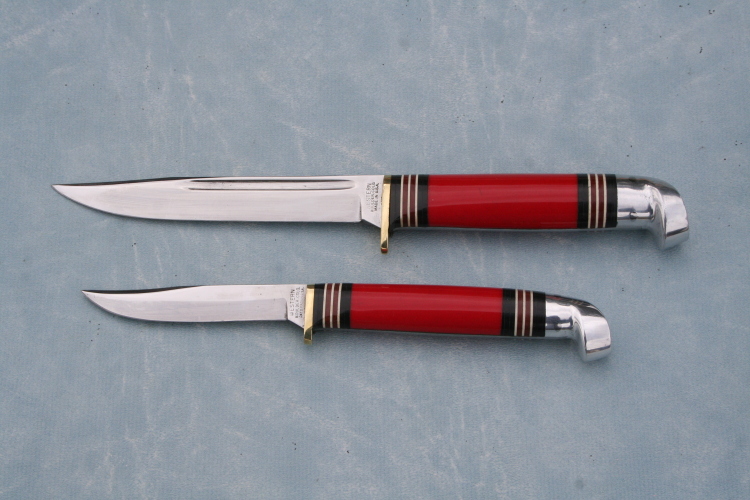
A rare Twin Set of Western Cutlery knives consists of a red-handle P48A (top) and P28 (bottom). The P28 has a sabre-ground blade instead of the standard flat grind. (Clyncke photo)
Knife collectors are dreamers. They dream of finding a Scagel, a fine bowie or an old Case knife at garage and estate sales. They dream of looking through a box of junk at a flea market, spotting an old green-bone Remington whittler, and buying it for five bucks so they can walk around smiling like a Cheshire cat. Most of the time it is just a dream, though once in a while the dream comes true.
My dad worked at Western Cutlery in Boulder, Colorado, in the late 1930s, and I did concrete contract work for the company after it moved to the outskirts of Boulder on Western Avenue. Dad was good friends with the Harvey Platts family, and I got to know a number of the workers at the plant. I became a part-time custom knifemaker, scrimshander and jewelry maker over the years, and when Western’s plant in Longmont went out of business, I bought a lot of raw material I could use to make my knives and jewelry.
I never lost my love of Western knives. I have owned a lot of the Boulder models and always enjoy looking for them, finding a good one, removing the dirt from it and cleaning up the sheath. My family had many Western knives on our ranch and farm, where knives were everyday tools. The many different ways of using them resulted in most being heavily abused, overly sharpened on a grindstone, and tossed in a bucket in the old shop when they wore out. I still have some of the old knives with blades that were sharpened so much they resemble toothpicks.
I am retired now and go to many estate sales and flea markets, hoping for a good find here and there. I always see my collecting friends looking for “the prize,” too. We have a friendly competition to see who can get that old knife first, then hunt the others up and show what we found.
DREAMIN’-TYPE KNIVES
In 2010, a family friend who was 89 passed away and I bought some nice old knives from his family, including five Westerns, a nice old Case Tested XX and several other brands. A couple of the Westerns and the Case are in very good condition—dreamin’-type knives.
A week later I was at another sale and asked about any Western knives, as another long-time Boulder family was conducting the sale. I was about to leave when a man said he had heard me ask about Westerns. He had one, I looked at it and we exchanged phone numbers. On the way home I started dreaming again about what the man had, hoping it was a rare one, maybe a World War II stiletto or a big, old one-blade folder.
A few days later I got anxious and phoned him. He said the knives were packed away and he would call me when he found them. I had heard that many times before, so the dreamin’ abruptly stopped.
Two days later the phone rang and it was the fellow again, telling me to stop by. I arrived and he got out three boxes and put them on a table. Inside were many cloths of different types rolled up in bundles. I picked up the top one, opened it and saw a Western 48A with red handles in mint condition. I nervously started opening more. Not one or two as I had imagined, but 28 pristine Western Boulder knives with sheaths! I was stunned to say the least. This was without a doubt the finest group of knives I had seen since Western closed its doors.
There were six folders, including a gorgeous 062 two-blade with redbone handles, two yellow-handle trappers, a 441 with cracked-ice scales, a brownbone 426 stockman, and a 656 with beautiful redbone scales. There was an L77A with a sawtooth back, a 539 with very nice stag handles, a rare dark-yellow-handle P48A, four “Black Beauty” knives of varying sizes, an L28, 628 and a P28. As I kept unwrapping I became more stunned at each knife. These all were brand new, never used or handled at all. Luckily, they were not stored in the sheaths but wrapped separate from the corroding leather.
As I lifted one of the last four and unwrapped it, I know my jaw dropped to my chest. Here was a wonderful white-handle “Twin Set” containing a P48A and a P28. I was nervous as a cat in a dog pound! As I unwrapped the last three, again I was stunned. Here were three more Twin Sets, one stacked leather, one white handled and another red. I calmly put them all back as the man inquired which one I would like to buy. I asked which ones were for sale and he said, “Why don’t you buy ’em all?” We arrived at a price and I paid him.
I asked where the knives came from and he said they belonged to his brother, who had worked at Western for a while in the leather department. He did not seem to want to talk about it, so I took the knives and left.
DREAM, DREAM, DREAM …
When I got home, I carefully unwrapped the knives and sheaths again, lined them up and just stared. One of my dreams had come true for sure.
It was time to give the knives closer inspection. Most of the brass guards and nickel bolsters were discolored with age, so I took a polishing cloth and carefully brought the new shine back. As I began to polish the stacked leather Twin Set, I got another shock.
Both knives had a Boy Scout stamp just above the Western Boulder stamp. I had seen 48s with the Boy Scout stamp but never the smaller L48B. Also unusual is that three of the four Twin Set larger knives have sabre blades with no blood grooves. The sheaths were somewhat dry, so I applied leather balm to bring them back to life. I noticed some were not stamped the same as Western did most of its sheaths, particularly the four Twin Sets. Since the knives’ original owner had worked in Western’s leather shop, he may have been just doing what he liked, or he may have been trying new styles. I guess I will never know for sure.
One thing I do know for sure: I will keep dreaming of finding another great knife or two, and now I can dream of finding another great cache such as this one.—by Marvin Clyncke
DREAM KNIFE VALUES*
Twin Set w/scout-stamped knives $400
Twin Set w/red tenite handles $450
P48A w/yellow handle $375
539 w/stag handle $275
248 w/cracked-ice handle $200
060 Rancher’s two-blade folder $250
L77A w/Finnish-style sheath $250
Twin Set w/white tenite handles $450
*The author’s values are for knives in mint condition.
For more on the latest knives, knife legislation, knifemaking instruction, knife trends, knifemakers, what knives to buy and where and much more, subscribe to BLADE® Magazine, the World’s No. 1 Knife Publication. Click on http://www.shopblade.com/blade-magazine-one-year-subscription-us/?r+ssfb073112 for more information.
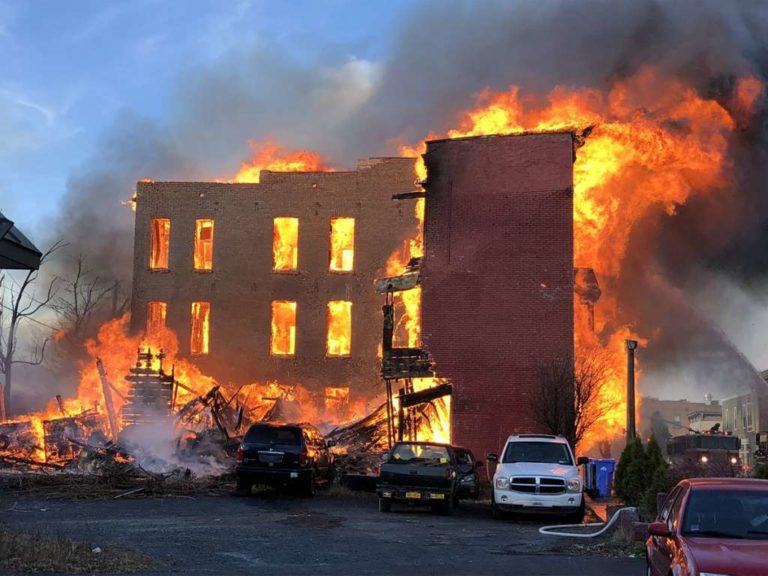
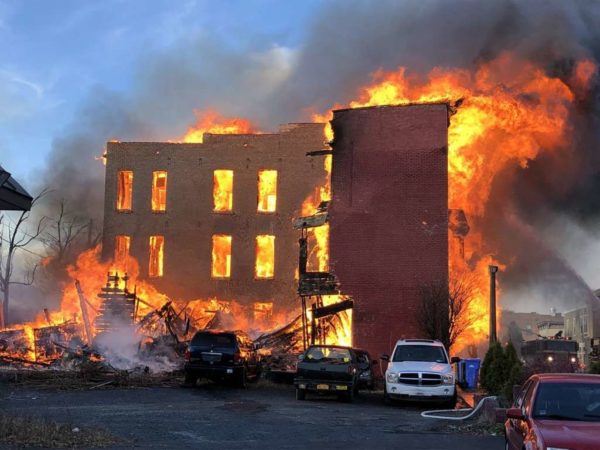
John Gomes, the 51-year-old Cohoes, New York, resident and alleged “amateur knifemaker” who started a fire that damaged 32 buildings and displaced approximately 20 people, will not appear in court today as scheduled. He was charged with felony reckless endangerment and misdemeanor arson on Friday, Dec. 1 while the 200 block of Remsen Street smoldered, threatening to reignite. Gomes’ case has been waived to Albany County Court to be presented to a grand jury. In a report by the Times Union of Albany, New York—which has followed the story closely—Gomes lawyer has stated that his client is a hard-working plumber, the father of two children and this was a tragic accident, not a crime. Reaction from knifemakers on social media was swift and nearly unanimous: Gomes’ did not do his research, about forges or metal working, and his claim of trying to replicate something he saw on “Forged In Fire” was a deflection from his own lack of forethought. One maker from Upstate New York theorized that it could have been simply a trash fire to avoid disposal charges, but that claiming to be working steel was a better story than a flagrant violation of the law. Was Forged In Fire a scapegoat for the Cohoes fire?
John Gomes, a resident of Cohoes, New York, started a fire in an open barrel in his back yard. Reports say he was attempting to bend a knife, as he had seen done on “Forged In Fire.” But was “Forged In Fire” a scapegoat? (Times Union photo)
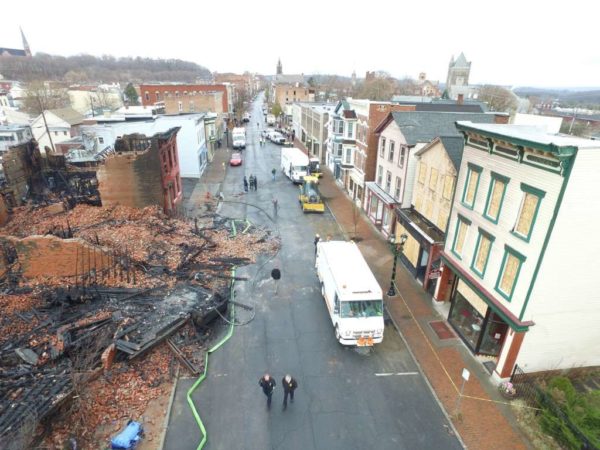
On Friday, December 1, knifemakers awoke to the cringeworthy news that Gomes had started an open barrel fire in his back yard to “bend” metal as he had seen done on “Forged In Fire.” It was a relief that nobody was killed in the fire. One fireman was treated for dehydration and heat-related issues and the fire chief received a burn from a flying ember, but other than that nobody was injured. By last count, 32 buildings were damaged by fire, smoke or water, resulting in millions of dollars’ worth of property damage. Approximately 20 to 25 people were displaced, but Red Cross representatives were on sight to meet the immediate needs of both emergency response personnel and to provide shelter, food and clothing to those whose houses had burned. Cohoes is a quiet commuter city about 18 miles north of Albany. The houses in the affected area are wooden and within inches of each other. The 30-mile-an-hour winds on November 30, made it challenging for the firefighters to stay ahead of the blaze.
Cohoes is an old mill town that is no stranger to fires. In 1978 a man and his seven children were killed in a fire suspected of being set by the sole survivor, the wife and mother. After new evidence surfaced in 2010 Virginia Grotto did sign a confession, but then claimed she was badgered to do so. Another Cohoes fire in 1988, destroyed nine buildings, including three businesses. That fire also affected Remsen Street. The cause remains a mystery with some neighbors claiming at the time it was a Hells Angels motorcycle gang act of revenge against someone living in the apartment building where the fire started and others claiming to have seen two boys playing with matches. All other causes were ruled out. In both cases, Cohoes rebuilt. One added note to the most recent fire was that this area of Cohoes was enjoying a resurgence. Both the current mayor and interviewed business owners commented on the city’s resilience and they would rebuild. A florist was able to resume work the next day despite building damage, and a pharmacy owner lost a storage garage that contained chair lifts that had been ordered for Christmas, backup inventory and old medical records, but his store was open for business.
The 30-mph winds made getting ahead of the fire a challenge. In the end 32 buildings were damaged and approximately 20 people displaced. (Times Union photo)
John Gomes’ son defended his father on social media, claiming that he never meant to burn down his own house or anyone else’s. Commenters offered words of encouragement for the boy and prayers for his family. On knifemaker Groups on Facebook like Forged In Fire TV Show Discussion Group!!!! and my own Erin at BLADE, it was unanimous that “Forged In Fire” was not to blame. There were jokes about the blade not making the cut, or the reverse, it being able to wipe out a city block. There was mention that “Forged In Fire” now does include a warning that forging is dangerous and not to be attempted without careful consideration of safety measures. Of course, one popular comment on Facebook was simply a picture of a fire extinguisher.
John Gomes, according to statements made by his lawyer to the media, never intended for his open barrel fire to cause damage to his own house or anyone else’s. He’s been charged with felony reckless endangerment and misdemeanor arson. (Times Union photo)
Concern was expressed, though, by more than one commenter on more than one thread that “Forged In Fire” seems to play up the fireball created during quenching. It is a television show and the quenching drama makes for good entertainment. However, the “Forged In Fire” set is actually fireproof. It is vented to prevent asphyxiation, but not in the way a home forger might vent his forge. This is why it is often unbearably hot on the set, causing heat exhaustion in some participants. And, of course, there are crewmembers standing by with extinguishers, ready to cut the electricity or provide medical attention as needed. There have been instances in the final round when participants are at their home forges of fireballs being too close to propane tanks and the like. Although show representatives expressed sadness over the fire in Cohoes, they reserved comment, according to Times Union reports.
One of the most intriguing comments was posted by a resident bladesmith of Upstate New York. “I think he was burning trash, which is illegal in most municipalities in New York State, so he would not have to pay for disposal,” theorized F. Page Steinhardt, of Sunshadow Design and “Forged In Fire” winner. He added, “In an open burn barrel, which is illegal in most municipalities in New York State in a 30-mile-per-hour wind, which is a dumb idea, and ‘Forged In Fire’ was a convenient scapegoat.” Page reiterated that he didn’t know for sure the exact motivation for the fire, and perhaps we will never know exactly what happened. “But that is just my opinion from reading the stories and living in Upstate New York,” he concluded.
Matthew Parkinson of Dragon’s Breath Forge in Connecticut and another “Forged In Fire” winner brought up another good point. “FIF isn’t responsible for someone who can’t think ahead. I mean, they show giant fireballs all the time, so it isn’t like you could even claim they make it look safe.” Matt also offered guidance to those just starting out. “As far as new smiths, take a class. Find a good school and take a class. It will be the best money you ever spend.”
A Digital Subscription To BLADE Is The Answer
You can read your digital issues of BLADE Magazine anywhere you have your phone, tablet or computer, and there’s no need to find storage for all your old issues.
If piling-up issues of magazines seems like a waste to you… If you feel like you don’t have time to read a magazine… If you like the stories we offer in BLADE, but want a more economical option, then a digital subscription is the answer. An annual subscription to BLADE is $17.98, $4 off the print price
Meet Brent Harp, one of the very few Bob Loveless protégés to be trained in Loveless’s shop alongside Jim Merritt. A detective in the Redlands, California, Police Department, Harp first met Loveless in 1986, when he was trying to learn how to heat-treat steel to make his knife blades harder and hold a better edge.
Last month, Harp was featured in Southern California’s The Press-Enterprise newspaper regarding his knifemaking and keeping the Loveless legacy alive.





 treat service custom knifemakers have come to expect,” Bos said. “I’ve heard that my ‘retirement’ misled some, but Paul Bos Heat Treating is very much alive and well.”