The BLADE Blog w/Steve Shackleford

Knives, knife people, knife news, knife use, knife collecting, knifemakers, knife events, the BLADE Show, BLADE Magazine, and more.

Salute America’s Family of Veterans

Many American families have their share of veterans. In fact, you could say America is one big family of veterans. With that in mind, today is Veterans Day, the day to thank all the veterans you know—those in your family and those everywhere—for keeping America safe.

My Grandfather Frank was in the Army and drove an ambulance in Europe during World War I. My dad was in the Navy during World War II and served as a radar man on the USS Cimarron, an oiler that serviced many of its sister ships in the Pacific Theater. He never talked much about the war but I know he enjoyed his time and the friends he made while in the service. He and Mom were married in 1942 and she supported him throughout the conflict. She gets a lot of credit, too.

Dad’s brother, my Uncle Jack, also served in the Navy during the war, as did my great Uncle Grady. He was in the Army Air Corps. My Uncle Joe served on the USS Hancock, an aircraft carrier, in the 1950s. I served in the Navy during the Vietnam War era and was stationed at Roosevelt Roads, Puerto Rico, and Little Creek, Virginia. My service helped me grow from a peach-fuzz-faced kid into a young man, and also provided me with the money from the G.I. Bill to get my college degree.

I am but one of many to come from such families. How about you? Did you serve, or did anyone in your family? Tell us about your experiences or those of your family members who served—where they served, the years, etc.

Meanwhile, of course, let’s not forget all those brave souls who paid the ultimate sacrifice for our country. Without them, none of us would be living in this great nation and enjoying the freedoms we do. Maybe there are better countries to live in, but not for me. I’ll take this one.

For the latest knives, knife trends, tips, news and much more, stay sharp at www.blademag.com.

Thanks the veterans you know on Veterans Day.
Celebrate your family’s veterans—and all veterans—on Veterans Day. The author’s dad served on the USS Cimarron during World War II. The author’s mom is at left.

Use A Hunting Knife Designed by Russ Kommer

A hunting knife is great—and when you use a hunting knife designed by an Alaskan hunting guide who also happens to be a knifemaker, that’s even better.

The Alaskan Skinner designed by Russ Kommer for Timberline.
A hot hunting knife is just what the doctor ordered—the Alaskan Skinner designed by Russ Kommer for Timberline.

The Alaskan Skinner from Timberline is a hunting knife designed by knifemaker Russ Kommer, who also is a long-time Alaskan hunting guide. Kommer spent most of his youth in the Minnesota north woods hunting, trapping and fishing. Idaho is where he got his start as a big-game guide in the Selway-Bitterroot Mountains. He took his passion for hunting to Alaska in 1984—which is where he also discovered his love of knives, particularly the hunting knife design, after dressing big game. He learned to design the most functional and comfortable hunting knife he could and started making versions of them in 1997.

Kommer’s custom knives include the hunting knife/skinner, camp knives, folders, “unique” fillet knives, fighters, boot knives, bowies, hatchets and tactical knives. In addition to Timberline, Kommer also has designed knives for CRKT, including the Signature line of hunting knife, and the Escalade and Extreme Mountain hunting knife models for Browning

The Alaskan Skinner features what is called an upswept blade with a hollow grind—great for high-performance field dressing, skinning and other chores associated with big game. Besides that, it will also help you prepare your meals in camp and do the other cutting chores that need doing outdoors.

The blade steel is a 440 stainless that fights corrosion and is relatively easy to sharpen compared to steels such as CPM S30V and others. The handle is a soft Zytel rubber with a palm swell to fill your hand, and finger grooves and a bird’s beak pommel to lock your hand in for any number of cutting tasks, from light slicing to heavy-duty cutting. Overall length: 9.625 inches. A black ballistic nylon sheath with belt loop is both handsome, durable and secure. Weight (including the sheath): 13.5 ounces.

Click here for more about this Russ Kommer hunting knife.

Buck Knives, Inc. Announces Partnership with Haley Heath

Buck Knives Inc. is pleased to announce the signing of Haley Heath and “Family Traditions with Haley Heath” to a multi-year license agreement which includes a signature line of hunting knives designed for female hunters. 

This unprecedented partnership in the cutlery industry will enable Buck Knives and Haley Heath the opportunity to fulfill a long overdue need in the cutlery marketplace.  “I am incredibly excited to be the first female featured with her own line of hunting knives from the number one brand in hunting, Buck Knives,” stated Heath.  “We have a great opportunity to create a new line of female specific products.  From my travels and interactions with people around the country, I know this is a need and I am happy to work with Buck Knives to provide knives to all the other ladies who enjoy the outdoors as much as I do. Buck Knives has been producing quality USA made knives since 1902 and to work with them is awesome.”

 Chuck Buck, Chairman of Buck Knives stated, “We are all so pleased to be able to work with Haley, G.O., and the entire Heath family.  They represent everything we believe in when it comes to family, outdoors and hunter safety.  I have no doubt that Haley and G.O. will be great ambassadors for Buck Knives.” 

“Family Traditions with Haley Heath” is a popular program on the Sportsman Channel that epitomizes today’s generation of hunters and shows first-hand how family traditions can be passed down in powerful ways. Haley, a 5th-generation hunter, “Ultimate Outdoorsman Finalist” and the first woman to receive The Sportsman Channel’s “Viewer-Favorite” award, hosts the show.  She hosts the show with her husband G.O. and their son Gunner and daughter Dakota for the true “Family Traditions” experience. 

Hones for the Sharpening Challenged

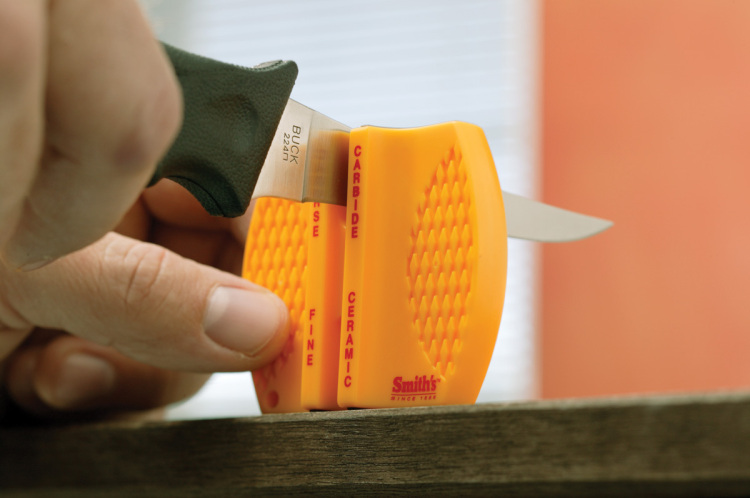
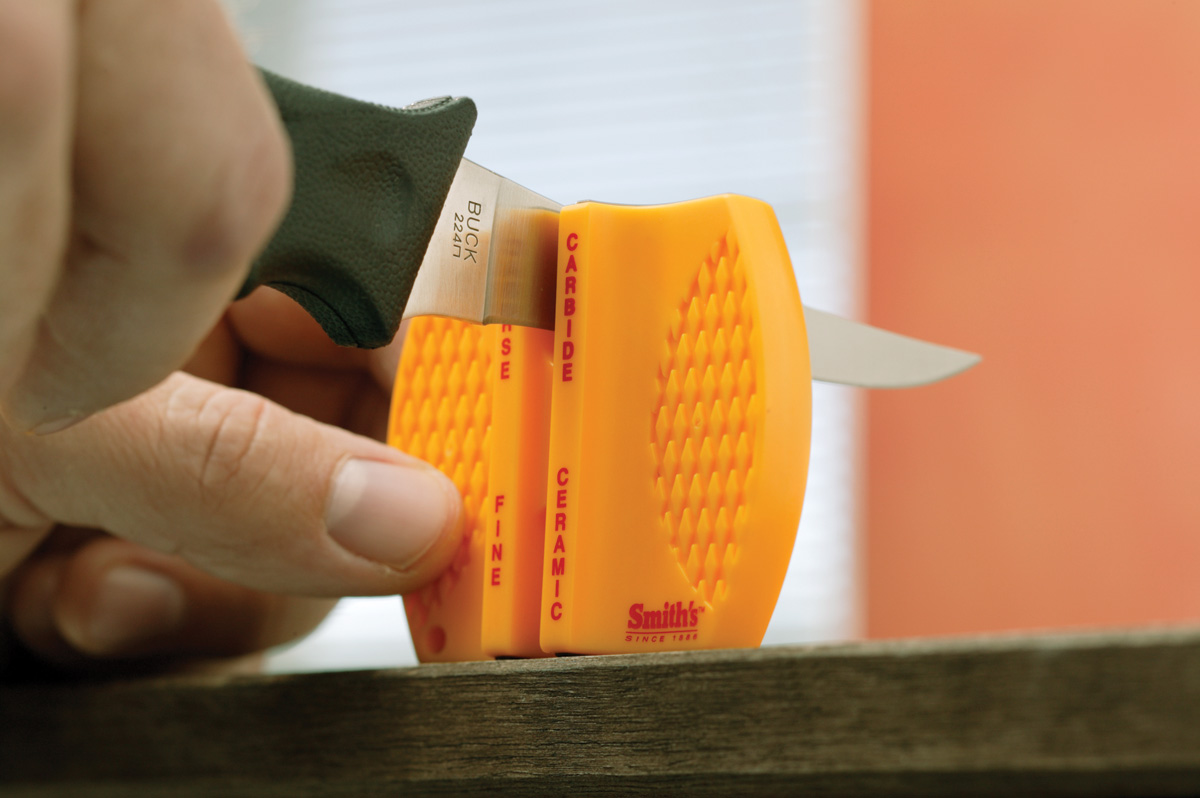
The CCKS 2-Step Knife Sharpener from Smith’s offers coarse tungsten carbide rods on top and extra-fine (1,000 grit) ceramic rods on bottom—both at pre-set angles for easy pull-through use—for sharpening and edge touch-ups/refinement, respectively. MSRP: $3.99. (Smith’s photo)

If sharpening stumps you, try one or more of these simple yet effective sharpeners

By Dave Rhea

A good working edge on a blade is one of the knife owner’s most important considerations, but sharpening is not always as easy as it seems. How do you hold the knife to the sharpener/which angle should you use? Do you use ceramic, stone or diamonds? How much sharpening is too much? How much is too little?

    Here is a better question: Since even thinking about sharpening can get complicated, why not idiot proof the subject?

Quick and Easy

Chris Fire is a sharpening expert. As the marketing manager for Lansky Sharpeners, Fire lives and breathes by the sharpening industry. His suggestion for the quickest and easiest sharpener is Lansky’s Quick Fix Pocket Sharpener.

    The Quick Fix has all the elements of an easy sharpener: Low price (MSRP: $5.99), small—about the size of a money clip—and fast results. A half-dozen or less strokes through one of the two slots clears up a problem blade edge in a hurry. One side holds a slight segment of tungsten carbide rod to return the edge to a proper geometry, and the other side holds a like-sized span of ceramic rod to deburr it.

    Fire drew a distinction between the quick-and-easy and something less expedient but perhaps wiser.

    “Tungsten-carbide sharpeners sharpen by tearing steel off the blade rather than slowly honing,” he warned. “They remove a lot of metal. Use them in a pinch, but for everyday edge maintenance you probably want to use something less aggressive like Lansky’s Turn Box Ceramic Sharpener.”

    The 4 Rod Ceramic Turn Box (MSRP: $21.99) offers a higher-grade sharpening experience but is also uncomplicated. It uses two pair of 5-inch alumina ceramic rods that are set at pre-determined angles: 20 and 25 degrees. Holding the knife upright vertically, you draw the blade down along the rods of the V-shaped sharpener. With internal rod storage, it also breaks down into a compact kit for stowing in a drawer or tool/tackle box.

    Fire added that perhaps as important as having a good sharpener is the knowledge that different tasks call for different knives. In other words, a chopping knife is not going to make a great slicing knife no matter what kind of edge it has.

    “Chopping knives have a more durable edge, but they’re not as sharp,” he professed. “Chopping potatoes with such knives is great. Achieving paper-thin tomatoes slices? Not so much. So keep a knife for slicing, a knife for chopping, a multi-purpose knife and maybe a fillet knife, and use each to its strengths.”

Hassle Free

Marketing manager for Smith’s, Russ Cowen adds that a seemingly insurmountable task is convincing the consumer on-going edge maintenance is the key to keeping a perpetually useful edged tool.

    “The best way to keep a knife sharp is to never let it get dull,” he explained. “If the consumer would just take a few minutes either before or after using a knife, and especially during use if doing lots of cuts for a longer time period, to touch up or freshen the cutting edge, he or she would see that not only would the knife cut better, but it would also take them half the time to accomplish the task.”

    For such hassle-free edge maintenance, he recommends Smith’s 2-Step Knife Sharpener, a small plastic-framed sharpener with an insanely low MSRP of $3.99. The two sharpening slots—in carbide and ceramic—offer two stages of edge work: 1) coarse “for re-setting the edge on very dull or damaged blades,” and 2) fine for finishing work that will bring a blade closer to the hair-popping sharpness so many knife users crave.

    “The 2-Step Knife Sharpener will sharpen any blade style with a flat grind on both sides of the blade as long as the blade will fit inside the sharpening slots. It works well on Euro/American style kitchen knives, everyday pocketknives, folding or fixed-blade hunting knives, fillet knives, outdoor sport knives, custom knives, and tactical/LE knives with little to no maintenance,” he said. “At most, the user may have to rinse it off or clean the ceramic rods after extended use.”

    For knives that suffer from the usual treatment—letting them go pretty much dull—Cowen offers this advice: “The best way to put a new, sharp cutting edge on a very dull or damaged knife blade is to use an abrasive surface that is aggressive enough to remove large amounts of metal from the blade quickly.”

    He suggests a sharpener with carbide blades or a low-grit diamond-coated surface. Such abrasive components are quite aggressive and remove metal from the blade very quickly—sometimes so fast you can see the metal shavings falling off the blade, he added.

Simplest Is Best

Pre-set angles and guides are all designed to make the obligatory task of sharpening a knife easier. However, according to Mark Brandon, president of Diamond Machining Technology (DMT), it does not get any simpler than the old-fashioned bench stone.

    “There’s a myth out there that sharpening is difficult,” Brandon began. “I don’t think the sharpening industry has done itself any favors—we’ve done our part to help convince people that it’s difficult by coming out with all these ‘we’ll-hold-your-edge-for-you’ kind of products.”

    He said the reality is that via its training videos available at www.dmtsharp.com, DMT has taught scores of folks to sharpen on a stone in less than five minutes.

    “We think it’s kind of idiot proof to begin with,” he stated. “Sometimes the simplest approach can be the best, and there is really nothing simpler than a 6-inch-by-2-inch stone.”

    Brandon’s two bench-stone suggestions start with the DMT Diamond Whetstone, which comes in 6- and 8-inch models. They have MSRPs of between $47.16 and $95.26, depending on the length and choice of either plastic or hardwood case. A diamond abrasive is the best and simplest material to put a great edge on a blade, he said.

    His other suggestion is the DuoSharp 8-inch model, another diamond stone that is double sided in fine and extra-fine grits to address both sharpening and refining the edge. The 8-inch DuoSharp has an MSRP of $105.03 for the stone alone and $114.58 with the stabilizing base accessory.

    “It’s all a matter of how much time are you willing to spend on it,” Brandon said. “If you have a fine stone, depending on how much time you want to take, you can get a dull knife sharp. But if you don’t have that much time, you may want to have a coarse stone available to get it to a certain level and a fine stone to get a good working edge, and if you really want to make it hair-popping sharp, go to an extra fine.”

Rule Of Thumb

No matter your preference, there are plenty of choices available. The key is to find your comfort zone and touch up the edge at least once for every three or four times you use a knife. The basic rule of thumb is do not let your knife go dull and it will be easier to keep a crisp, high-performing edge.

For more on the latest knives, knife legislation, knifemaking instruction, knife trends, knifemakers, what knives to buy and where and much more, subscribe to BLADE Magazine, the World’s No. 1 Knife Publication.


DMT Wins Global Trade Award

The Associated Industries of Massachusetts International Business Council (AIM-IBC) announced recipients of its 17th annual Global Trade Awards yesterday, and among the honorees is Diamond Machining Technology (DMT) of Marlborough, Massachusetts.

    The awards recognize Massachusetts firms, institutions and public agencies of all sizes that have demonstrated excellence in international trade. “In addition to making advancements overseas in each of their respective fields, our 2012 Global Trade Award winners are giving back to the Massachusetts economy through job growth, trade enhancement and global partnerships,” said Kristen Rupert, AIM-IBC executive director.

    DMT will be among those honored at AIM’s 97th Annual Meeting on Friday, May 11.

    Founded in 1976, DMT designs and manufactures all of its diamond-coated sharpening tools at its Marlborough facility. The company distributes its products through resellers in all 50 states and 30 countries. DMT’s business has multiple market segments including hardware, woodworking, gardening, culinary, outdoor sports (hunting, fishing and camping) and speedskating. The Dutch and Chinese Olympic speedskating teams use DMT sharpening stones on their skates to maintain a competitive “edge.” The company has built a strong international distribution network, and its U.S. and foreign patents have been critical in helping the company secure new market positions overseas. DMT’s export sales have increased 65 percent over the past two years, largely because of the introduction of new products and entry into new markets in Russia and Eastern Europe.

    DMT has earned seven Blade Magazine Knife Accessory of the Year® Awards, a HANDY Innovation Award, the National Home Gardening Club’s Seal of Approval, the Handyman Club of America’s Seal of Approval, and an international award for innovation at Germany’s International Hardware Fair.

    Visit www.dmtsharp.com for more information and purchasing, or call Customer Service at 800-666-4368.

For more on the latest knives, knife legislation, knifemaking instruction, knife trends, knifemakers, what knives to buy and where and much more, subscribe to BLADE Magazine, the World’s No. 1 Knife Publication. For subscription information click on http://www.shopblade.com/product/blade-magazine-one-year-subscripti…?r+ssfb042512#BL1SU.

Help Fight 1 Percenters’ Ban-All-Ivory Law

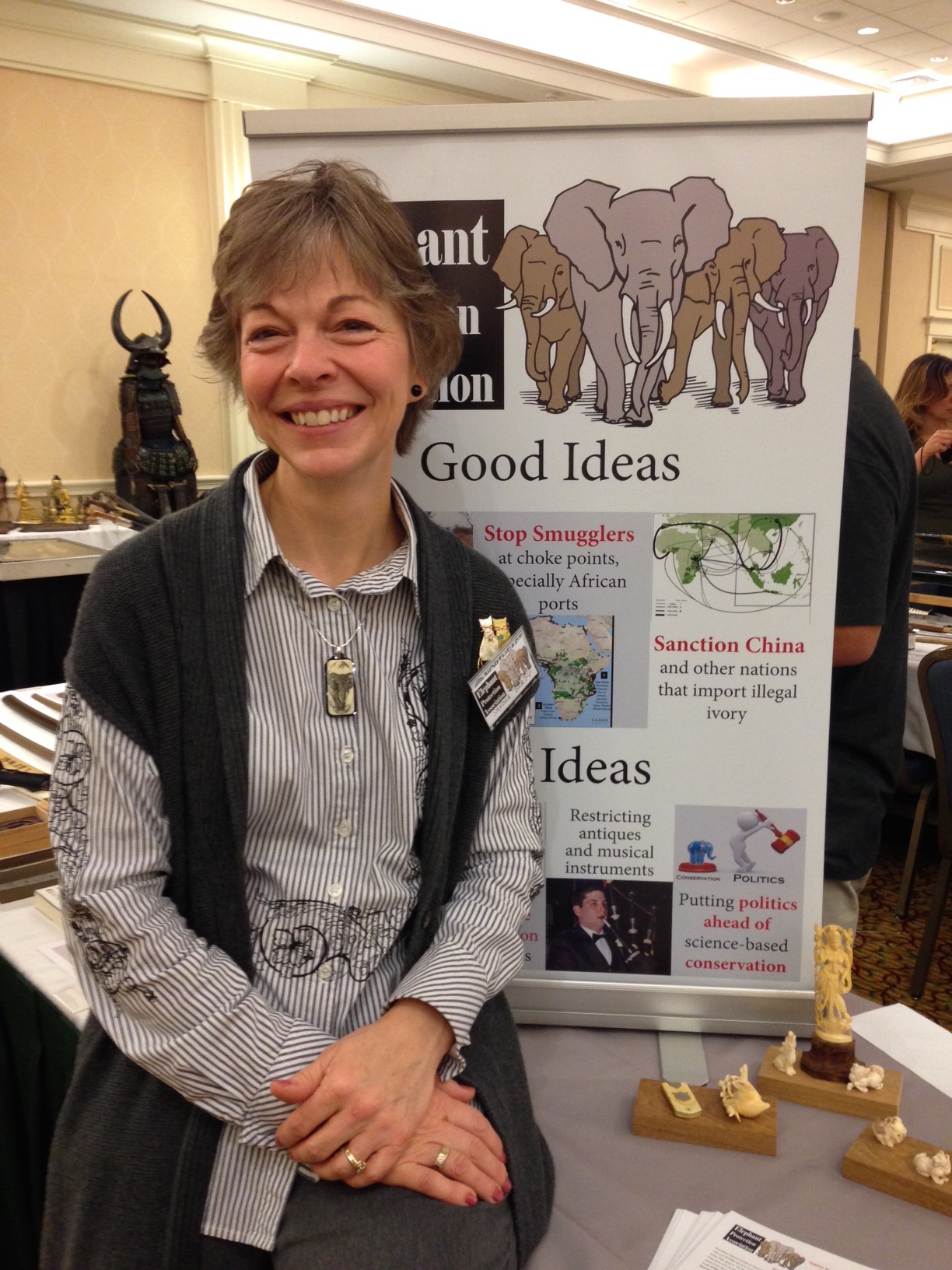
Brady and ivory.
Sandra Brady of the Elephant Protection Association urges citizens of Washington state to fight against a new anti-ivory initiative.

A ban-all-ivory law supported by billionaire Microsoft co-founder Paul Allen and other 1 percenters is on the ballot in Washington state and will succeed unless you help stop it NOW!

The measure, I-1401, would ban not only elephant ivory but also the ivory of mastodon, mammoth and other extinct species.

Sandra Brady of the Elephant Protection Association said help is needed at the grassroots level to defeat the measure supported by rich billionaires such as Allen and other non-governmental organizations, which have raised more than $2.7 million—including $1.7 million from Allen—in an effort to pass it in the state legislature.

“It really is a David versus Goliath situation,” she observed of the fight against the 1 percenters who are supporting I-1401. She urged those who oppose the bill to write their local newspapers and use social media to voice their opposition. “On the upside we are having an impact,” she said of the grassroots effort. “On the down side, the more states that pass such ridiculous measures, the more likely other states will follow suit. This is why your help to defeat this in Washington state is so important.

“Write letters to the editors of the state’s newspapers, use your voice on Facebook and other social media. Help us get the word out that I-1401 is a bad law and should be voted down.”

A small organization, the Legal Ivory Rights Coalition Committee (LIRCC), is fighting against Allen and the other fat cats who are supporting I-1401. However, the LIRCC has no budget and relies on people contacting newspapers and working social media to spread the word. The good news is that editorial pages across Washington state are calling I-1401 misguided. While acknowledging the noble goal of preserving elephants, many editorial pages recognize the futility of a state law designed to stop crime in Africa and Asia. It would punish the state’s citizenry without stopping poachers. They also recognize the redundancy with existing federal laws that prohibit import of ivory and other endangered species, together with the unnecessary burden it would place on the state’s fish and wildlife officers.


The latest issue of BLADE is on newsstands now!Recommended:

Stay abreast of the latest developments on this and many more knife rights issues with a subscription to BLADE.

Ivory Ban Proponents Feel The Heat

Stop heinous ivory bans!
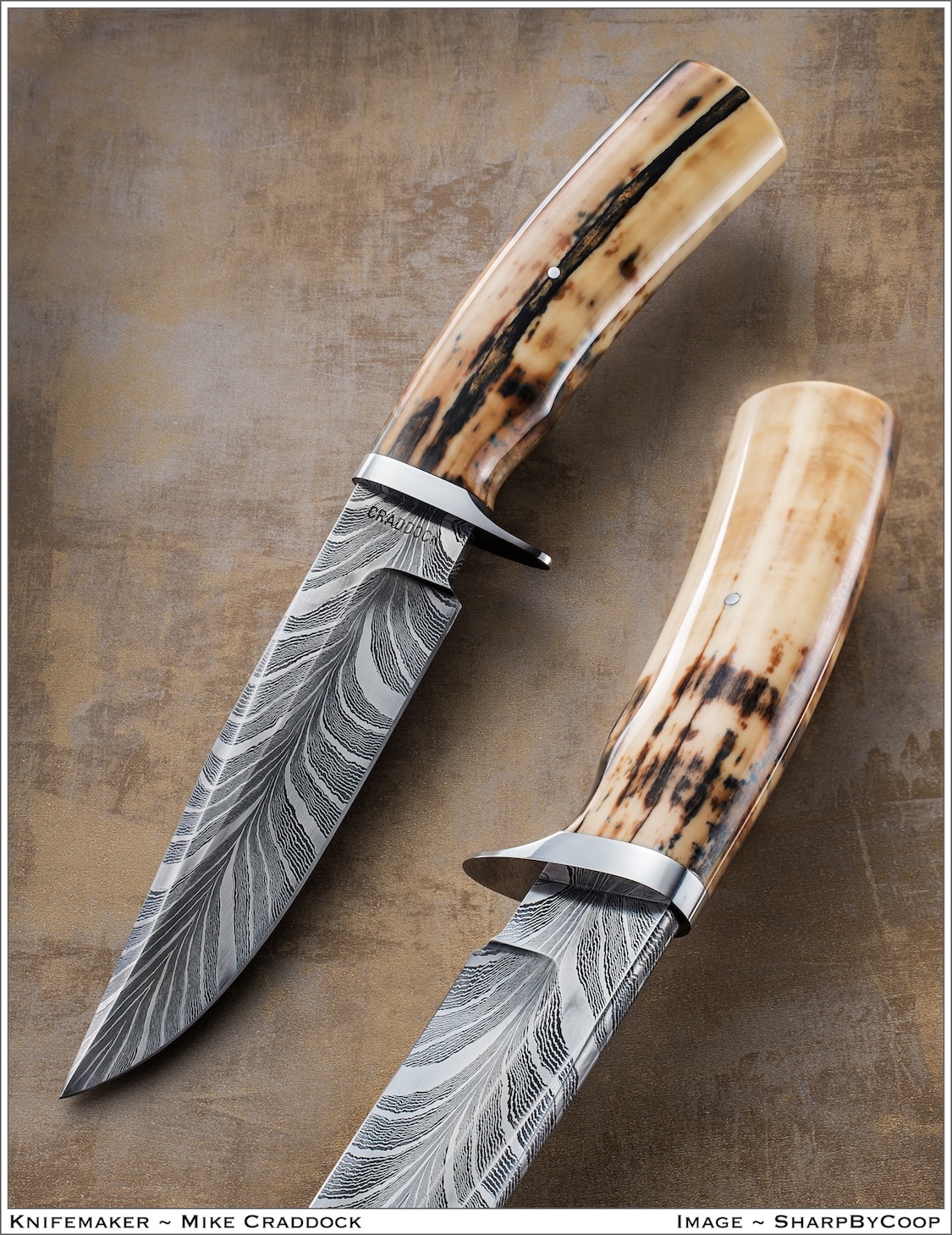
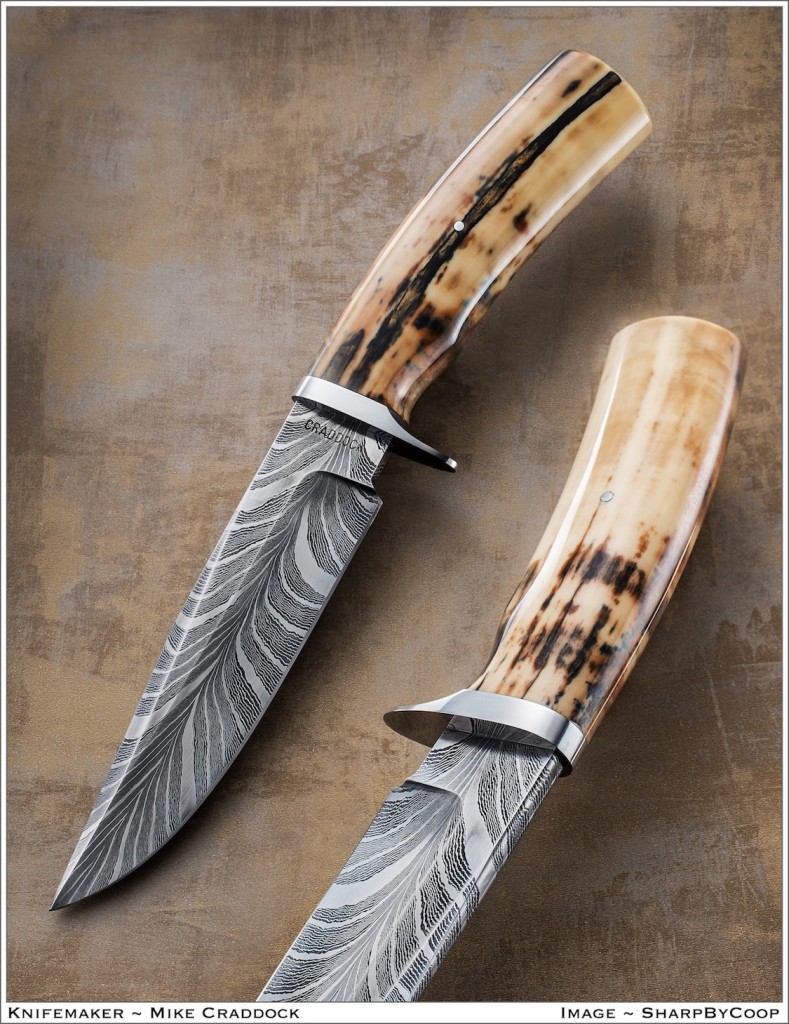
Help stop such heinous ivory bans as the one in New Jersey that forbids fossil ivory, too. Mike Craddock employs fossil walrus ivory on his damascus beauty. (SharpByCoop image)

Ivory ban proponents are feeling the heat from those who would protect their right to own and sell legal ivory on both the federal and state levels.

If recent developments are indicative, the actions of those fighting to protect their right to sell their legal ivory are having the desired effect.

However, much work remains to be done.

According to Rob Mitchell of the Elephant Protection Association, ivory ban proponents have been scrambling to torpedo pending Congressional bills that would stop a nationwide ivory ban. “In the past few weeks, the Wildlife Conservation Society [WCS] has e-mailed its members praising the the New Jersey ivory ban while soliciting contributions to fight back the bills pending in Congress to stop a federal domestic ivory ban,” Mitchell writes.

New Jersey’s ban is especially heinous as it bans not only elephant ivory but fossil ivories as well. Like New Jersey, New York has instituted a state ivory ban that exceeds the restrictions recommended by U.S. Fish and Wildlife.

According to Mitchell, John Calvelli of the WCS said, “I can’t overstate what a threat this is. These bills could be attached to any larger piece of legislation and swiftly passed at any time.” Meanwhile, the WCS is calling on its members to urge their lawmakers to halt any and all efforts to stop ivory bans on both the federal and state levels.

Mitchell indicated the WCS is disseminating false stories to trigger public hysteria about the possibility of elephant extinction in attempts to snuff out rational discourse on how to both protect elephants and Americans’ right to sell their legal ivory. He added that the WCS is “an organization with over $210 million in annual revenue and over $750 million in assets” that “continues to lead the publicity campaign drawing misleading relationships between legal ivory in the United States and poaching in Africa.”

For information on how you can help protect both the elephant and the rights of Americans to sell their legal ivory, visit elephantprotection.org.


The latest issue of BLADE is on newsstands now!
The BLADE Magazine 2014 Knives Of The Year® highlight the new BLADE®, on newsstands now!

Stay abreast of the latest developments on this and many more knife rights issues with a subscription to BLADE.

Advertisement

Must Read Articles

Read this before you make a knife

Knifemaking 101 – Read This Before You Make a Knife

  by Wayne Goddard My experience has taught me that there's nothing like digging in and getting started. I've often said the hardest part of the...
how to forge damascus steel

How to Forge Damascus

Advertisement
Advertisement