Featured Knives

Here are BLADE Magazine’s Featured Knives of the Week. Browse through these articles to find the best knives available from both custom knifemakers and factory knives.

Click here to browse through our list of Featured Knifemakers.

Knifemaking – – Knife Collecting – – Tactical Knives – – Survival Knives

What’s New: The Latest Kitchen Knives, Sporting Cutlery and More
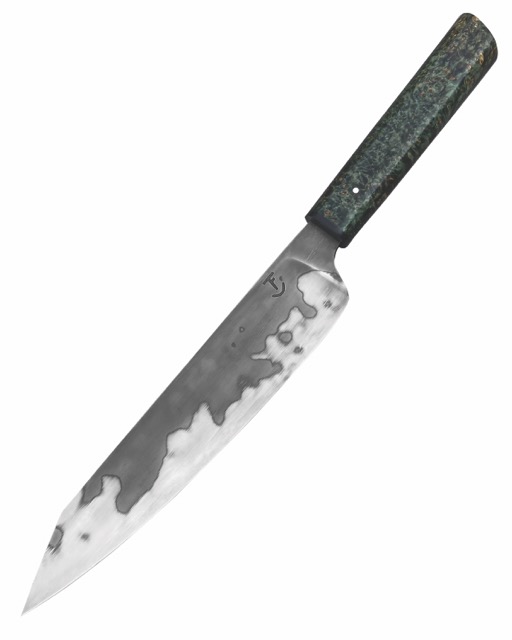
What’s New: The Latest Kitchen Knives, Sporting Cutlery and More

PATTERN: Gyuto chef’s knife
BLADE LENGTH: 10″
BLADE MATERIAL: 1095 spring steel
ROCKWELL HARDNESS: 62 HRC
BLADE THICKNESS AT ITS THICKEST: .09″
BLÀDE WIDTH AT ITS WIDEST:17/8″
HANDLE MATERIAL: Dyed maple burl
SPACER: Black paper Micarta
KNIFE TO KNOW: Blade hamon achieved
w/help of a clay coating: the maker is an apprentice smith in the American Bladesmith Society
MAKER: Travis Fleming, Flemingsfabricationsagmáil.com, flemingsfabrications.com (Jocelyn Frasier image)

TSPROF Sharpener
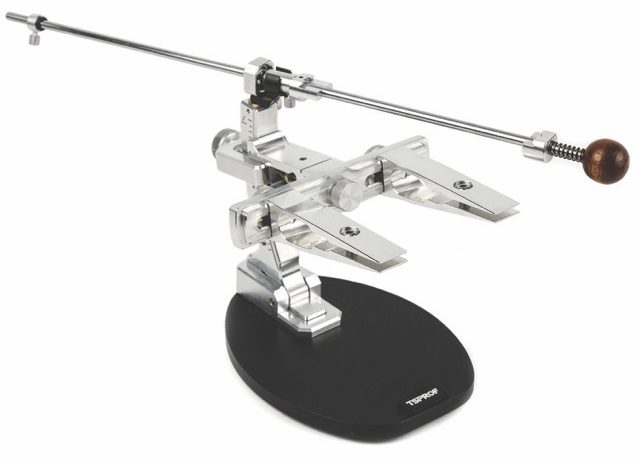

SHARPENER NAME: Kadet Expert
KNIFE TO KNOW: Universal clamps and rotary mechanism provides double-sided sharpening without resetting, editing and fine-tuning of edges; sharpens blades up to ll.8″ long. 1.57″ wide and .275″ thick; disassembles easily and folds for storage or transport; built for ambidextrous use
UNIT MATERIALS: Body and clamps are D16T aluminum
ANGLE RANGE: 8.5 to 28.5 degrees
ABRASIVES: Compatible w/ abrasives up to 6.3″ long and .118 to .59″ thick
WEIGHT: 4 Ibs.
MSRP: $290
COMPANY: TSPROF, attn: Victor, dyachkovvatsprof.ru, https:/en.kadet.tsprof.com
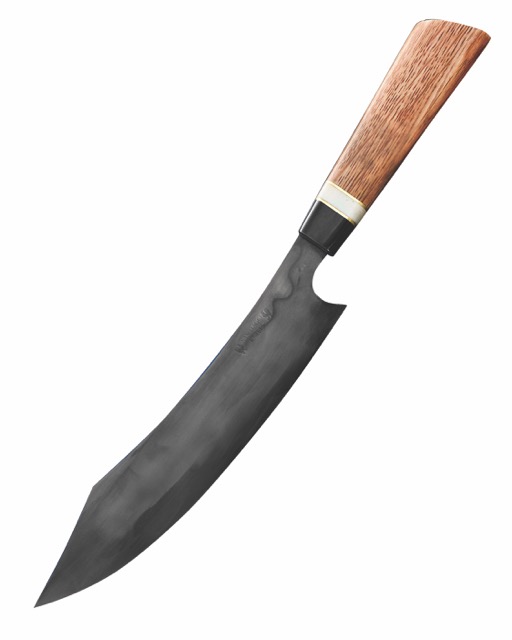


MODEL NAME: BBQ Knife
BLADE LENGTH: 8″
BLADE MATERIAL: W2 tool steel
BLADE THICKNESS: ll0″ at base,
.025″ at .197″ from the tip
BLADE WIDTH: 1.5″
HANDLE: Buffalo horn, brass spacers,
bone and reclaimed barn oak
OVERALL LENGTH: 13″
MAKER’S PRICE FOR A SIMILAR
KNIFE: $425
MAKER: Jose Santiago-Cummings, [email protected], 253-777-8732
(Caleb Royer image)


Scoot Fox Chef Knife
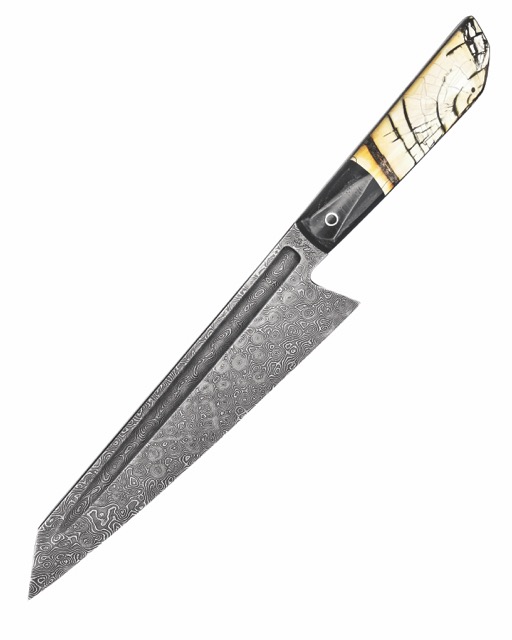
MODEL NAME: Chef’s knife
BLADE LENGTH: 9”
BLADE MATERIAL: Damascus w/fuller
HANDLE: Cross-cut mammoth ivory
LINERS: Black G-10 PINS: Custom Micarta®/steel and carbon fiber
BOLSTERS: Bog oak
OVERALL LENGTH: 15” KER’S
PRICE FOR A SIMILAR KNIFE:
$1,800
MAKER: Scott Fox, [email protected] 479-264-0303 (Caleb Royer image)


Tyler Hall Chef Knife
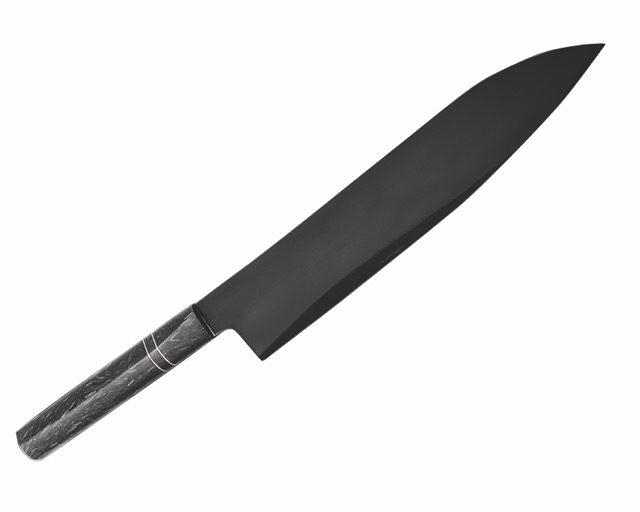
MODEL NAME: Chefs knife
BLADE LENGTH: 10″
BLADE MATERIAL: 52100 ball
bearing carbon steel
BLADE GRIND: Compound flat/
Convex
BLADE FINISH: Maker’s proprietary
“food-safe” obsidian mirror polish
KNIFE To KNOW: The knife follows traditional Japanese shape but shares little else with the traditional gyuto, the blade has a rounded spine and choil
HANDLE: Shredded carbon-fiber cast in black resin; black G-10 w/silicon bronze spacers and pin
OVERALL LENGTH: 15″
MAKER’s PRICE FOR A SIMILAR KNIFE (EXCLUDES A SHEATH): $1,000
MAKER: Tyler Hall, [email protected] 512-665-6597
(Caleb Royer image)


Julian Cunningham Chef Knife
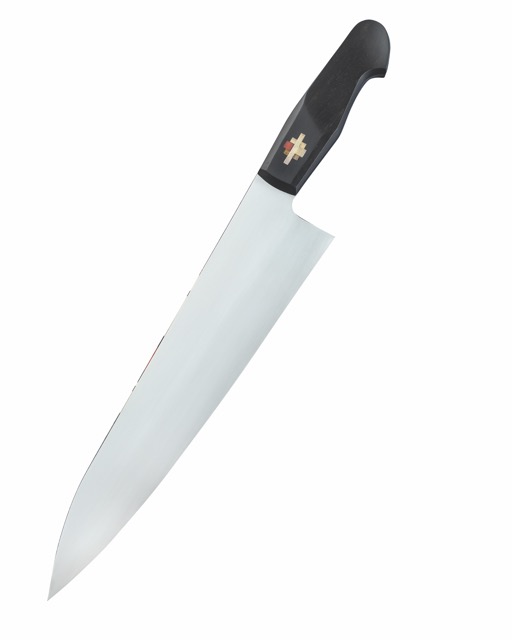
MODEL NAME: Mondrian Rose
PATTERN: Chef’s knife
BLADE LENGTH: 9.5”
BLADE MATERIAL: 52100 ball-bearing carbon steel
HANDLE: Ebony w/wood mosaic inlay of redheart, yellowheart, holly and blue mahoe SHEATH (not shown): By JCC Cutlery; same materials as handle inlay
KNIFE TO KNOW: The maker is 18; this is one of the last knives he made be- fore heading to college to study industrial design.
MAKER’S REMARK: “My goal for this knife was to take my first step towards making pieces that can be considered ‘art knives’ while still maintaining a highly usable design. This is what I want the future of JCC Cutlery to look like.”
OVERALL LENGTH: 14.5”
MAKER’S PRICE FOR A SIMILAR KNIFE: $2,000
MAKER: Julian Cunningham, JCC Cutlery, Dept. BL12, 3524 Quebec St. NW, Washington, D.C. 20016 202- 802-5338 [email protected]
(SharpByCoop image)


Bill Kennedy Jr. Trapper
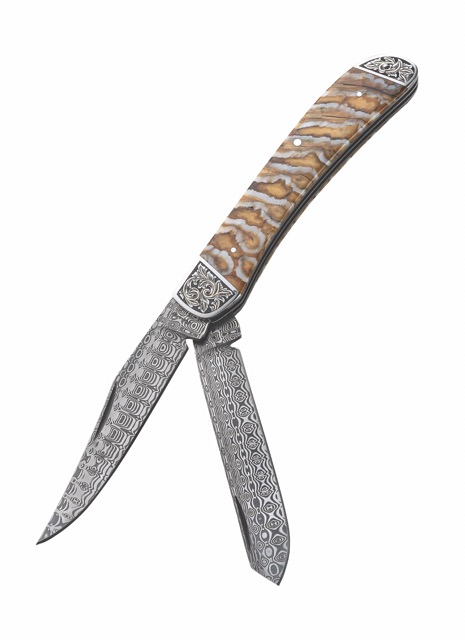
MODEL: Full-size two-blade trapper
BLADE LENGTHS: 3”
BLADE MATERIAL: Damasteel damascus in a Munin pattern
HANDLE: Mammoth tooth ivory
HANDLE FRAME: 410 stainless in an integral construction
BOLSTERS: Same material and construction as frame
ENGRAVING: By Alice Carter CLOSED LENGTH: 4.25”
KNIFE TO KNOW: The maker has been a voting member of The Knifemakers’ Guild since 1985
MAKER: Bill Kennedy Jr., Dept. BL12, POB 850431, Yukon, OK 73085 405-760-5296
bkfish1@gmail. com, billkennedyjrknives.com (SharpByCoop image)

Chad Nell Dress Locking Folder
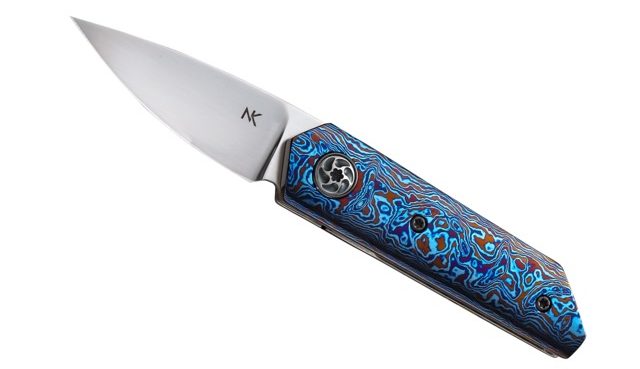
MODEL NAME: Trico Lava Lamp
PATTERN: Dress locking folder
BLADE LENGTH: 2 3/8”
BLADE STEEL: Uddeholm AEB-L stainless
HANDLE MATERIAL: Alpha Knife Supply White Timascus TM Lava Lamp
HANDLE FRAME: 6Al4V titanium
CLOSED LENGTH: 3 3/8”
MAKER’S PRICE FOR A SIMI- LAR KNIFE: $2,100
MAKER: Chad Nell, Dept. BL12, 2424 E. 2070 S. St., St. George, UT 84790 [email protected], nellknives.com (SharpByCoop image)

Manuele Messori Art Folder
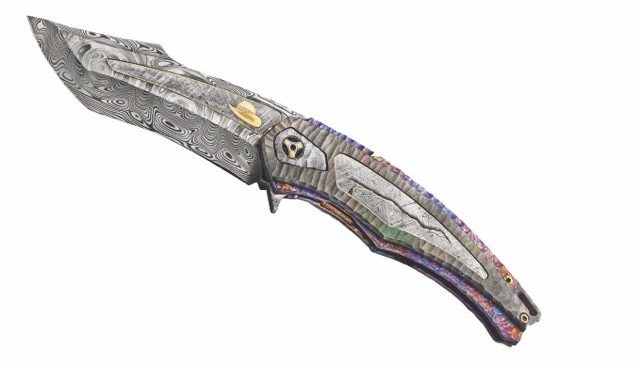
KNIFE TYPE: Fancy art folder
CUTTING EDGE LENGTH: 4.7″
BLADE MATERIAL: Damasteel damascus in a Grossrosen pattern inlaid w/Gibeon meteorite
BLADE THICKNESS AT ITS THICKEST: 157″
HANDLE MATERIAL: Timascus” and zirconium inlaid w/Gibeon meteorite
SPACER MATERIAL: Zirconium
ENGRAVING: 24k gold
CLOSED LENGTH: 4.9″
MAKER’S PRICE FOR A SIMILAR KNIFE: $7,000
MAKER: Manuele Messori, [email protected] (Francesco Pachi image)

SOG OTF-Blackout
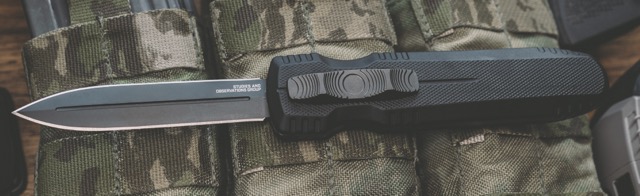
MODEL NAME: Pentagon 0TF-Blackout
KNIFE TYPE: Auto
BLADE LENGTH: 3.79″
BLADE STEEL: Cryo CPM S35VN stainless
BLADE THICKNESS AT ITS THICKEST: 11″
BLADE FINISH: Black titanium nitride
BLADE PATTERN: Spear point
HANDLE: Hard-anodized aluminum
WEIGHT: 6.07 ozs.
CLOSED LENGTH: 4.06″
KNIFE TO KNOW: First-ever-out-the- front auto by S0G; secure blade lock-up w/no “battle rattle” I
COUNTRY OF ORIGIN: USA
MSRP: $349.95
COMPANY: S0G, attn: Matt Crawford, Dept. BL12,6521 2l2th St. SW, Lynnwood, WA 98036-7411 425-771-6230 [email protected], www.sogknives,com

A.G. Russel Knives Mosquito Hawk
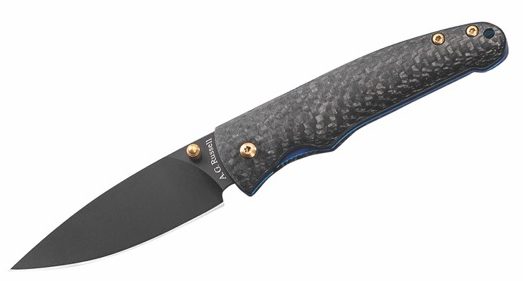
MODEL NAME: Mosquito Hawk
PATTERN: Gent’s knife
BLADE LENGTH: 2.75”
BLADE MATERIAL: 8Cr13MoV
ROCKWELL HARDNESS: 57-59 HRC
KNIFE TO KNOW: Blade pivots on bronze washers for smooth action; “liner- less” construction for light weight (the single liner forms the linerlock)
HANDLE: Carbon fiber
POCKET CLIP AND SINGLE LINER: Titanium anodized blue; clip is righthand carry, tip down
FITTINGS: Titanium anodized gold LOCK: Linerlock
WEIGHT: 1.2 ozs.
CLOSED LENGTH: 35⁄8”
COUNTRY OF ORIGIN: China MSRP: $85
COMPANY: A.G. Russell Knives, attn: J. Broce, Dept. BL12, 2900 S. 26th St., Rogers, AR 72758 479-631-0055 jakeb@agrussell. com, www.agrussell.com

Zero Tolerance 0990

KNIFE NAME: 0990
KNIFE TYPE: Flipper folder
BLADE LENGTH: 3.25″
BLADE STEEL: CPM 20CV stainless
ROCKWELL HARDNESS: 60-62 HRC
BLADE GRIND: Flat
HANDLE MATERIAL: Carbon fiber w/steel overlay w/bead-blasted finish
POCKET CLIP: Reversible; deep carry
ACTION: Flipper on KVT ball-bearings
LOCK: Inset linerlock
CLOSED LENGTH: 44″
SPECIAL FEATURES: Skeletonized structure and “floating bridge”
COUNTRY OF ORIGIN: USA
MSRP: $275
COMPANY: Zero Tolerance, daielloakai-usa.com, www.ztknives.com
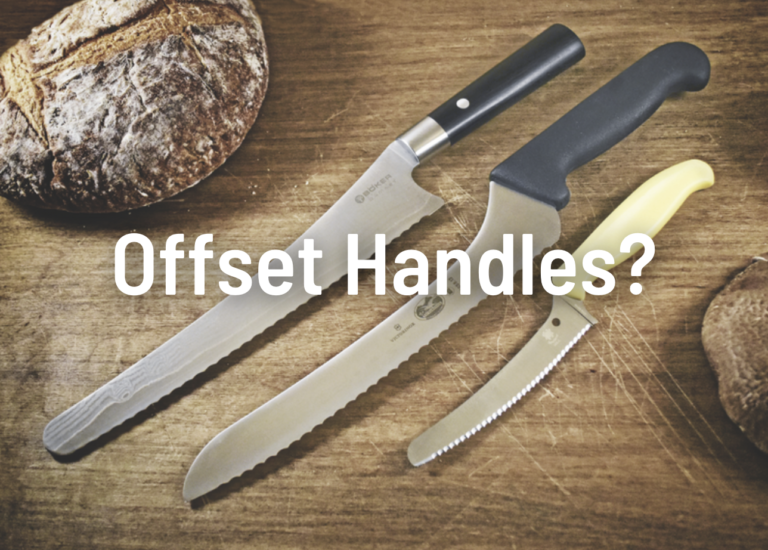
Offset Kitchen Knife Handles? We Test 3 of Them.

0

The offset handle may just save your skin during meal prep

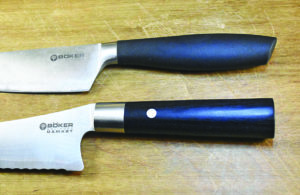
Most will agree that offset handles on kitchen knives look just a bit funky, but have you ever pondered why the unusual “stepped design” is what it is? Actually, there’s a method to the madness and it’s really quite simple. It’s to save your knuckles from getting banged up while slicing. Little has been written about this unusual handle, so we thought it would be both fun and informative to give a handful of o set-handle kitchen knives a spin around the cutting board.

It should be noted that such cutters often are referred to as bread* or sandwich knives which, when you think about it, makes sense, since loaves of bread typically have largish,  at bottoms that require getting the digits down low when cutting. Plus, like the majority of bread knives, most are serrated.

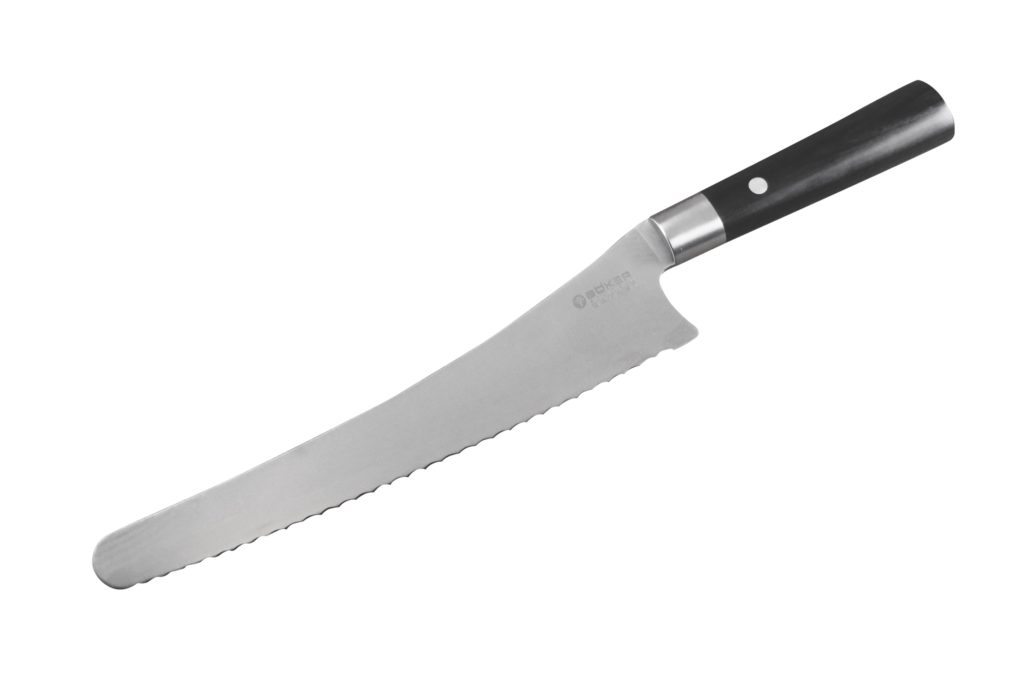
What’s an offset worth? In this case a half inch. At top is a Boker chef’s knife the author has used for years. The drop from handle to blade edge is .75 inch. On the Boker Black Damascus Bread Knife at bottom, the drop is 1.25 inches.

The test knives have full serrations and, interestingly, there is a slight bow to the blades as well.  The slight curve enables you to rock the blade back and forth on all cutting to make sure the cut is complete, a trait common to most cleavers as well. Serrations are a double-edged sword, so to speak, in that they make it easy to saw through most media.  The other edge of the sword is that they can be a nightmare to sharpen, a feat some prefer to job out to the factory or professionals. However, serrations work particularly well at food prep for many breads, meats and vegetables, which is why so many kitchen knives of all types have them. Note that the featured models are hidden-tang knives—all the better to keep unwanted fluids out of the nooks and crannies found on their full-tang counterparts.

KITCHEN CUTTERS 

The Boker blade is all business as there is no effort to etch the damascus, though the pattern is faintly visible.

The Boker Black Damascus Bread Knife is the high-priced spread, pun intended. It is a large bread knife but is extremely lightweight due to its very thin blade.  The blunt-tipped pattern has full serrations, each approximately .25 inch long. According to a Boker spokesperson, the blade’s core is VG-10 stainless.  The damascus pattern is forged of various stainless steels by Japan’s Takefu Special Steel, Ltd.  The blade is all business as there is no effort to etch the damascus, though the pattern is faintly visible.  The ovate handle is topped with a stainless steel bolster.


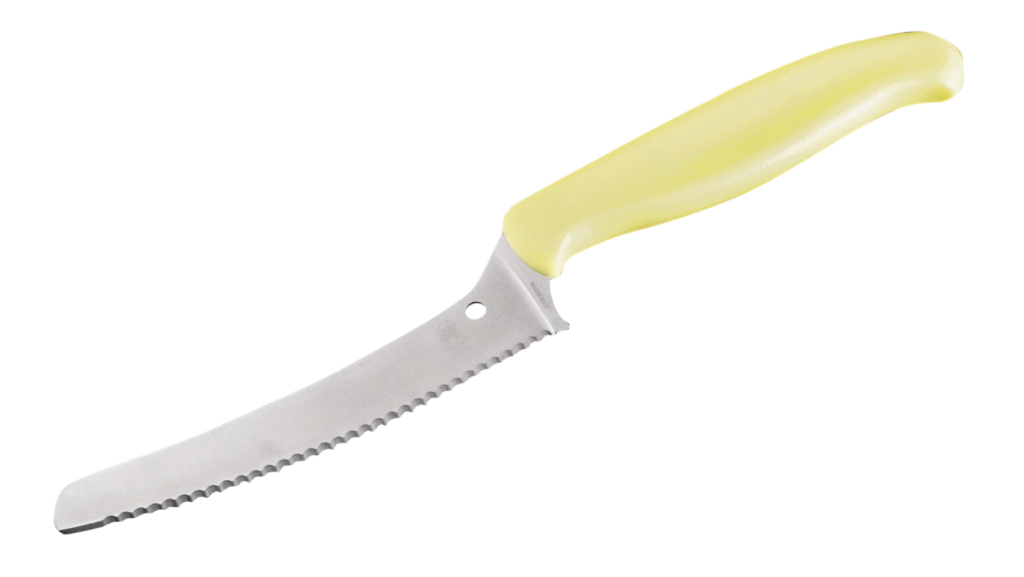
 The Spyderco Blunt-Tip Z-Cut is the smallest of the test slicers. Billed as a “go-to knife for all food preparation chores,” its blade has fine .125-inch serrations along the edge.  The CTS BD1N stainless blade steel is made by Carpenter Technology, a leader in the industry, and is considered much better than common culinary alloys.  The handle is yellow polypropylene, a common synthetic found on many kitchen knives because it is dense and repels water.  The Blunt-Tip Z-Cut is super lightweight.

The Blunt-Tip Z Cut is a smaller, handier version of the other two test knives.
 

The Victorinox 9-inch Offset Sandwich Knife is the largest and heaviest of the test bunch, edging out its Boker counterpart by a half inch and a half ounce. Victorinox has always been hush-hush about its proprietary steels but does indicate that the blade is stainless steel with a carbon content of .5 percent^.  e blade has .25-inch serrations and the ample handle is a black synthetic. After its acclaimed Swiss Army knives, Victorinox is well known for the Forschner brand kitchen knives, which it has owned controlling stock in since 1981.

The Victorinox 9-inch O set Sandwich Knife is the largest and heaviest of the test bunch, edging out its Boker counterpart by a half inch and a half ounce.

TASTY TESTING

I tested the two large o set knives sideby-side as their specs were so similar, starting with a 4×7-inch loaf of Publix Tuscan Boule bread. Unlike run-of-the-mill white bread, Tuscan Boule has a very tough rind. Using the knives in sawing strokes, I took off quarter- to half-inch slices. Both knives performed admirably, giving me any grief only on the  at base of the loaf due to its full 7-inch rind. Once I got used to rocking the blade on the final cut, this, too, made for quick business. My biggest takeaway, however, was that offset handles do indeed work! In fact, I didn’t come anywhere close to busting a knuckle. My knuckles tapped the cutting board top a few times, but nowhere near as badly had I been using a handle without the offset. Both the Boker and Victorinox were comfortable in the hand, with the latter having an edge due to its fat, curvaceous—not to mention slightly longer—handle, though you’d be  fine with either knife.

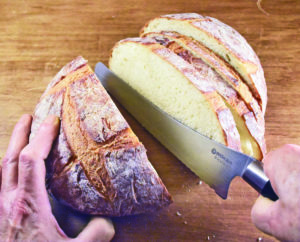
The Boker Black Damascus Bread Knife takes off nice, clean slices of Tuscan Boule bread. The bread has a tough rind but the serrated blade made quick work of it.

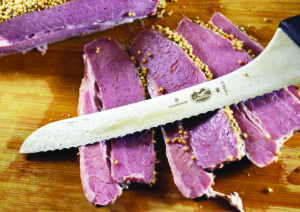
Next I took the knives outside the Bread Zone, testing them on other foodstuffs such as corned beef and Cajun sausage. Both knives sliced extremely well. Indeed, you could make an entire sandwich using these knives—but would you want to? By doing so you’d dull your serrations faster, even if minutely. It may be better to stick to bread and let your other kitchen knives share the cutting chores.

The author took the Victorinox 9-inch Sandwich Knife out of the “Bread Zone” and used it to cut neat slices of corned beef. You may or may not wish to use your bread knife in this manner, but the option is there.

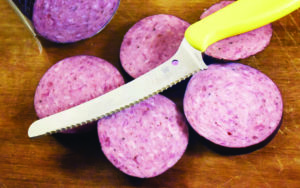
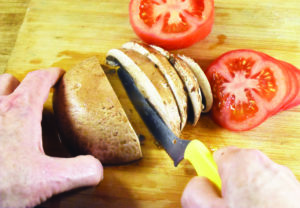
 The Spyderco Blunt-Tip Z-Cut is a smaller, handier version of the two bigger models, mainly because you need not drag out a large cutting board to use it. It’s not going to slice its way through a large loaf like the Tuscan Boule, but it will whip its way through a smaller sub-style sandwich or your standard white bread lunch quickie. I also gave it a spin slicing tomatoes, portobello mushrooms and a 3-inch chub of summer sausage.  The knife performed very well and is limited only by its size.  The Blunt-Tip Z-Cut’s blade is scary sharp—not surprising since serrations have been in Spyderco’s wheelhouse for quite a while.  Where’s also a plain-edge version of the knife available—the Pointed Z-Cut.  These two make for good companion knives and the plain-edge version will cut down your use of the serrated one.

The Z-Cut proved to be a little powerhouse, taking slices off a chub of summer sausage with aplomb. The CTS BD1N stainless steel takes a sharp serrated factory edge—a Spyderco specialty.
The Spyderco Blunt-Tip Z-Cut is billed as a versatile knife for all sorts of food prep. The author sliced up some tomato and worked on a portobello mushroom cap. Note the precise slices.

CHOICES ABOUND

All of the test knives were wicked sharp. You might ask yourself, if the two large bread knives cut equally well, why pay such a higher price for the Boker? For the same reason some carry affordable Kershaw folders as their EDC and others spend much more on a Chris Reeve: choices abound in the culinary world, just as they do in the EDC realm.

*Editor’s note: Standard bread knives have conventional, straight handles.

^Medium carbon steel has a carbon content of approximately .3 to .59 percent. High carbon steel has a carbon content of approximately .6 to .99 percent. 

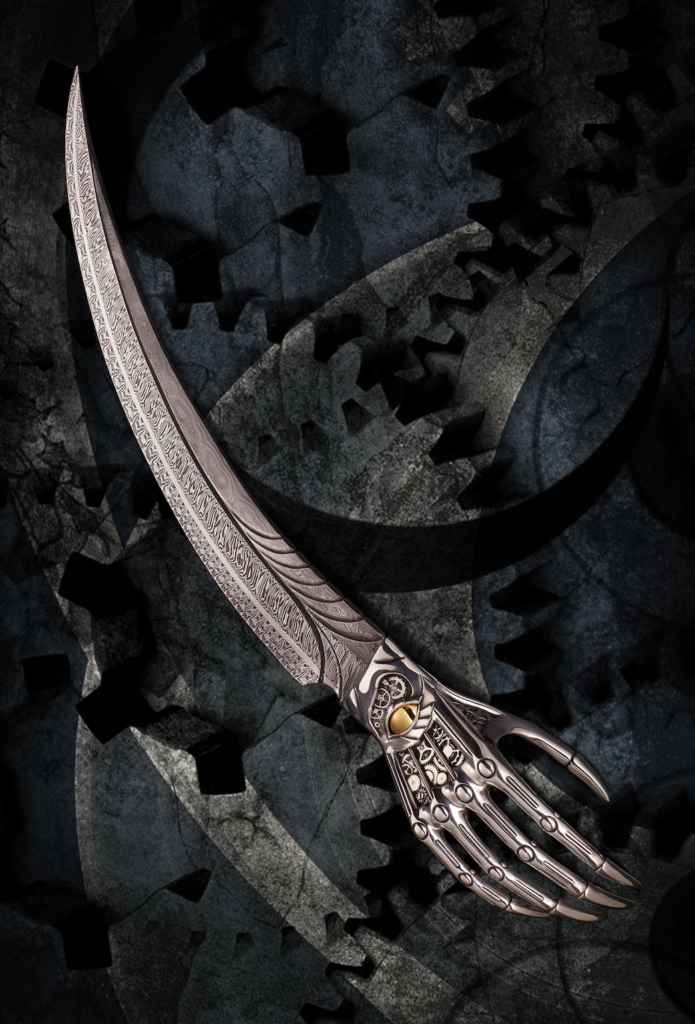
IT’S ALIVE! The Living Knife by Jean-Marc Laroche will grab you—literally

“A knife capable of movement and gifted with intelligence …”
—Jean-Marc Laroche

“On fitting your hand into that of the knife, you already feel a strange clasping in response when, suddenly, the mechanical fingers close! You can’t get free! With the same movement, an eye opens and stares at you intensely. It’s awake! Now you are under its control, and the knife is master of you who dared to take it in your grasp.”

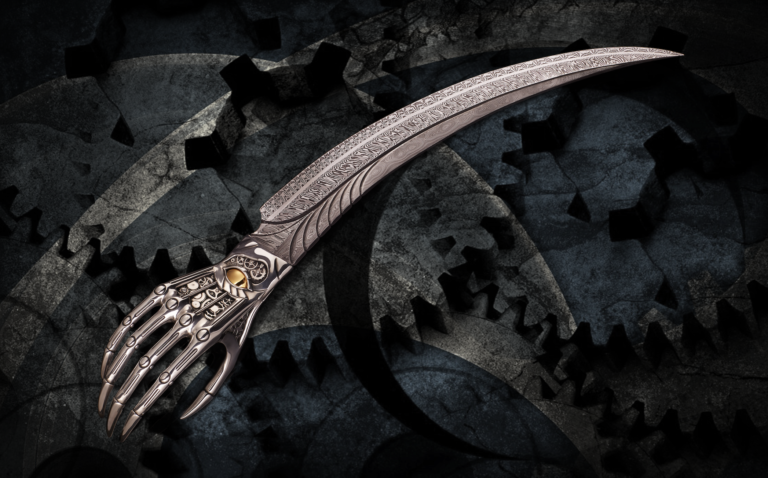
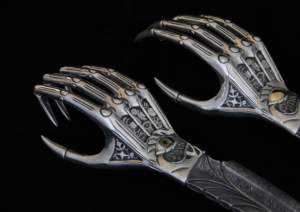
Above: The Living Knife by Jean-Marc Laroche features a mechanical hand for a handle that, as you grab it, literally grabs you back. The damascus blade is a composite of 15N20, 15LM and UHB11 high-alloy nickel and carbon steels in explosion, twist and random patterns forged by Swedish maker Roger Bergh. Overall length: 25 inches. (images courtesy of Jean-Marc Laroche)

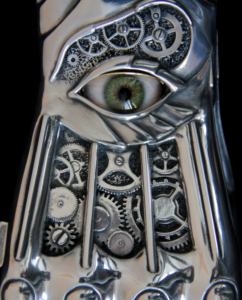
In addition to the above, French knifemaker/artist Jean-Marc Laroche refers to his latest creation—this issue’s cover piece—as “The Living Knife.” Since it has a “hand” for a handle with “fingers” that close, an “eye” and an overall lifelike appearance, who are we to argue? As you grab the handle, the “fingers” actually grab back so that it’s hard to tell who’s holding whom. And, as the fingers grab your hand, the “eye” opens. The hand also is embellished with gears in the Steampunk style.

A close-up of the silver-plated bronze hand shows the detail of the gears in a Steampunk motif. (image courtesy of Jean-Marc Laroche)
The opening eye.

The Living Knife is indeed a most unusual creation—but then Laroche has been making otherworldly pieces for over two decades. Even by his standards, though, this one takes his knife art into uncharted territory.

“It was from the cinema of fantasy films that I drew my inspiration,” he notes. “It took me 12 years to implement my idea, six months to carry it out and a fair number of technical difficulties had to be overcome.

“Yet here it is, like a cunning thing from another time that a mad inventor out of the 19th century would have dreamed up. This biomechanical being activates its workings to move its fingers; it seizes control of the situation with its eye’s intelligence.”

The Living Knife is an assembly of mechanical parts, the prototype having been made in resin. A few rare versions in bronze, gold and silver are in the process of being forged.

“Swedish knifemaker Roger Bergh participated in this project. Indeed, I have been talking to Roger about it for 10 years and he has always been enthusiastic,” Laroche observes. “Roger first forges damascus steel to obtain various types of structures; he then assembles them into magnificent combinations. A world-renowned knifemaker, he has remained down-to-earth and open. Working with him is a real pleasure.”


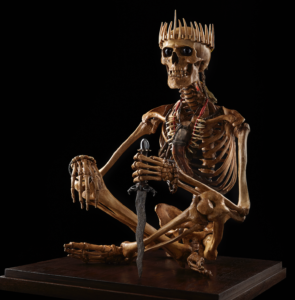
In addition to knives, Jean-Marc Laroche sculpts skeletons on a lifelike scale. An example is his “Warlord,” a kind of Javanese king holding a kris.
The skeleton is resin on a steel structure. The crown is assorted animal bones, the eyes are natural quartz crystal, and the necklaces and bracelets are from “different ethnic tribes.” The knife is made from an old Indonesian kris blade, some teeth and hematite.

KNIFE SPECTACULAR

BLADE® first learned of Laroche at the 1992 East Coast Custom Knife Show, where his knives with “alien-head” handles were a show hit. The alien heads were those of animals he customized and coated with a special resin.

In 1997 Laroche’s “Mother Ship with Fighters”—a set of four knives including one large one and three smaller ones with dagger blades and curved, claw-like guards—was a winner of the annual BLADEhandmade Best In Show Award. His “Byakhee,” a spectacular knife with a handle resembling a large, bat-like bird inspired by the science-fiction stories of H.P. Lovecraft, won Best Fantasy Knife at the 1998 BLADE Show West.

Laroche introduced The Living Knife to an appreciative audience this past June at the FICX, an invitation-only knife show in Paris that also featured a few U.S. makers, including Kevin Casey. It was Jean-Marc’s first knife show since 2002. Since then he had been involved in other forms of sculpture and exhibiting them worldwide.

Actually, The Living Knife is not Laroche’s first attempt at such a piece, his “Devil Hand” predating it. However, the Devil Hand did not have the mechanical grasping capability, the same materials or other select features of Laroche’s newest rendition. Laroche said he also has made two knives similar to The Living Knife, the first being sold to the Instituto Ricardo Brennand (http://www.institutoricardobrennand.org.br/index2.html), a museum in Recife, Brazil.                   

For a video on how The Living Knife operates, watch the video below:

3 Backup Knives That Are Sharp As Ever

1

Small-to-medium military-style blades that make the perfect backup knives, ready to tackle the toughest duty.

What Are The Best Backup Knives:

Soldiers have carried blades to war throughout recorded history, but the kinds of blades they carried have changed since Herodotus. Swords have long since fallen into disuse. Even large fixed blades are not as commonly used as they were in World War II and Vietnam.

Like others, I carried a Randall Model 1 with a 7-inch blade when I was in uniform, which was shortly after the invention of repeating firearms. And recently we saw a photo of Billy Waugh, a legend in the Special Ops community, on horseback in Afghanistan with a 12-inch bowie on his belt.

Marines have their KA-BARs and some soldiers still carry large fixed blades, but small handy pieces, often folders, are the most common knives carried by today’s soldiers. These knives are often used as tools. Less often, though on critically important occasions, they serve as backup weapons.

We reviewed three knives that fit into today’s parameters: two fixed blades and one folder. We cut nylon webbing and cord, rubber tubing, wall paneling and tough saddle leather. We also stabbed layered saddle leather, a plastic barrel and two zombies. I’m kidding about the zombies—just making sure you’re awake. In fact, no zombies were injured during this review.

Cold Steel Mini Leatherneck Double Edge

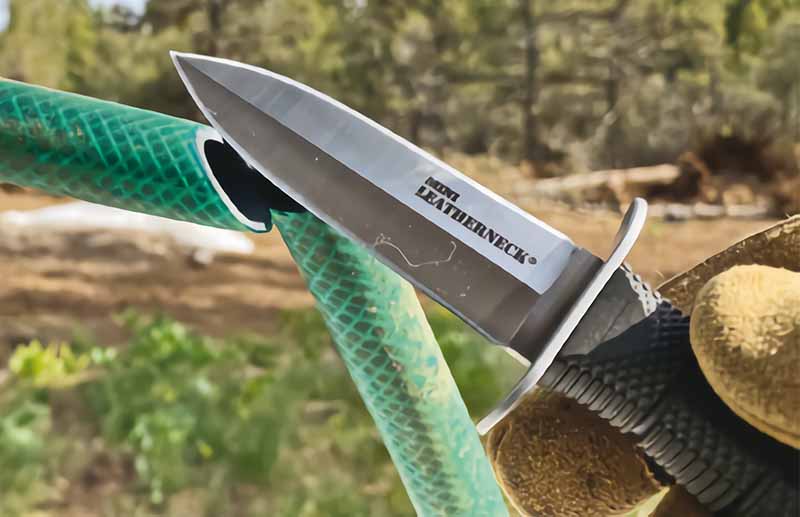
The Mini Leatherneck slices garden hose. Some daggers, due to steep blade geometries, do not cut very well. Not so this little puppy.

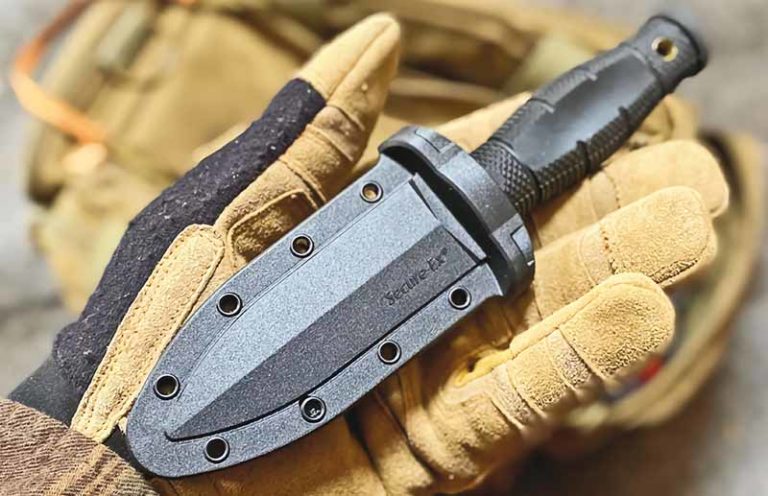
The Cold Steel Mini Leatherneck Double Edge is a diminutive dagger terrific at what daggers are designed to do: stab things. The Mini Leatherneck penetrated deeper and with less effort than the other review knives in five layers of saddle leather, and went deeper into the thick plastic barrel than the others. Some daggers, due to steep blade geometries, do not cut very well. Not so this little puppy. We were surprised at just how well the fairly thick-bladed little dagger did cut, well enough to make it useful as an all-around tool as well as a weapon of last resort. The blade needed sharpening after hard use but we expected that. Comfortable handle, solid guard, secure sheath, what more do you need? And all for 29 bucks, please. Try to find a better bargain.

Puma SGB Stonewashed Tactical Folder

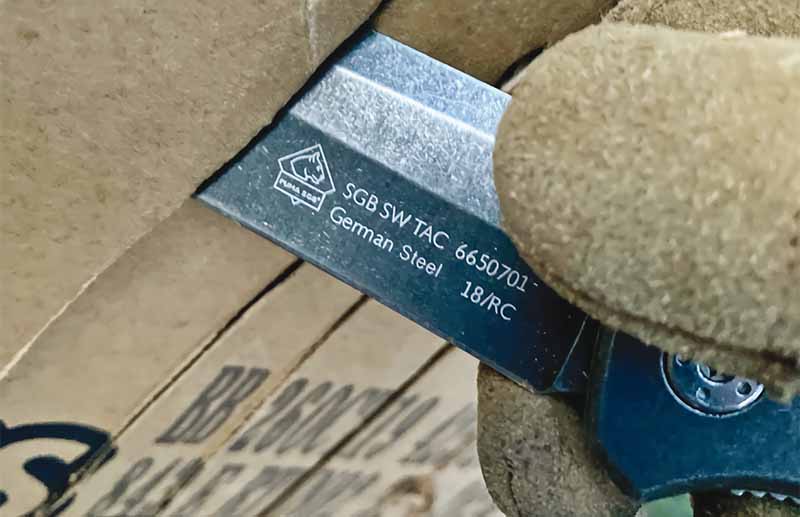
The Puma tanto blade created some resistance while pushing into simple things like cardboard, but the edge  and steel more than made up for it.
The Puma tanto blade created some resistance while pushing into simple things like cardboard, but the edge
and steel more than made up for it.

Today’s troops, except for some Special Forces units, carry folders by a ratio of at least five-to-one over fixed blades, and with good reason. Modern tactical folders with clips are convenient to carry, quick to the hand with various opening devices,
and, though not as strong as fixed blades, can serve as formidable backup weapons of last resort. The Puma SGB Stonewashed Tactical Folder with Seat Belt Cutter and Glass Breaker—Puma SGB TAC for short—fulfills these functions and adds a glass breaker that works and a seat-belt cutter that’s safer to deploy than an ordinary blade. The tanto point penetrates reasonably well, though not with the ease of the Cold Steel dagger. It is, nonetheless, very strong. When we punched it into the tough plastic drum, there was no doubt the point would withstand twisting and ripping. The straight edge cut well and didn’t need sharpening. Secure clip, easy opening with thumb stud, locks open solidly—all in all, a good tool and backup knife for soldiers.

RMJ Tactical UCAP (Up Close and Personal)

The RMJ UCAP stabs through five layers of  saddle leather.
The RMJ UCAP stabs through five layers of
saddle leather.

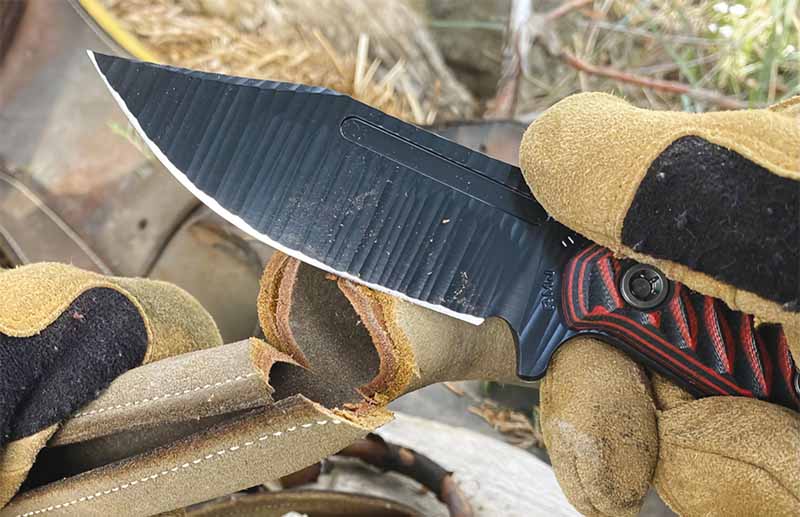
Sharp, tough and handy, the RMJ Tactical UCAP (Up Close and Personal) fixed blade reflects its name and fits into the current mode of small fixed blades. The curved edge was the best slasher and cutter of the group, and indeed was a stand-out. The reinforced point penetrates almost as well as the Cold Steel and gives up nothing in strength to the tanto-pointed Puma. The blade has a small fuller, which contributes to good overall balance. The grooved handle is secure and comfortable. The single integral guard adds to grip security during a full power stab. This is a well-designed, well made, handy-sized fixed blade that would serve a soldier well and be equally good as a bushcraft knife. The Kydex sheath is versatile, secures the knife in three positions and can be attached to a MOLLE system. This one is a winner.

Also Read:

Friedly/Rudolph Collaboration is an Homage to American Indian culture

0

The End of The Trail

Friedly/Rudolph collaboration is an homage to American Indian culture

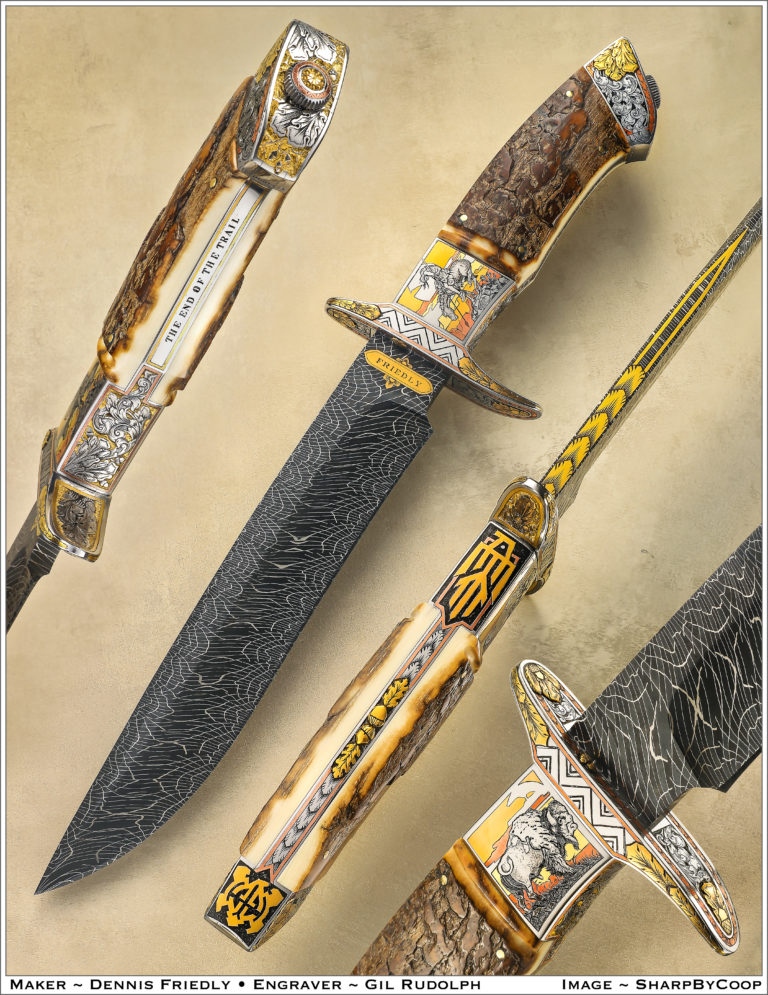
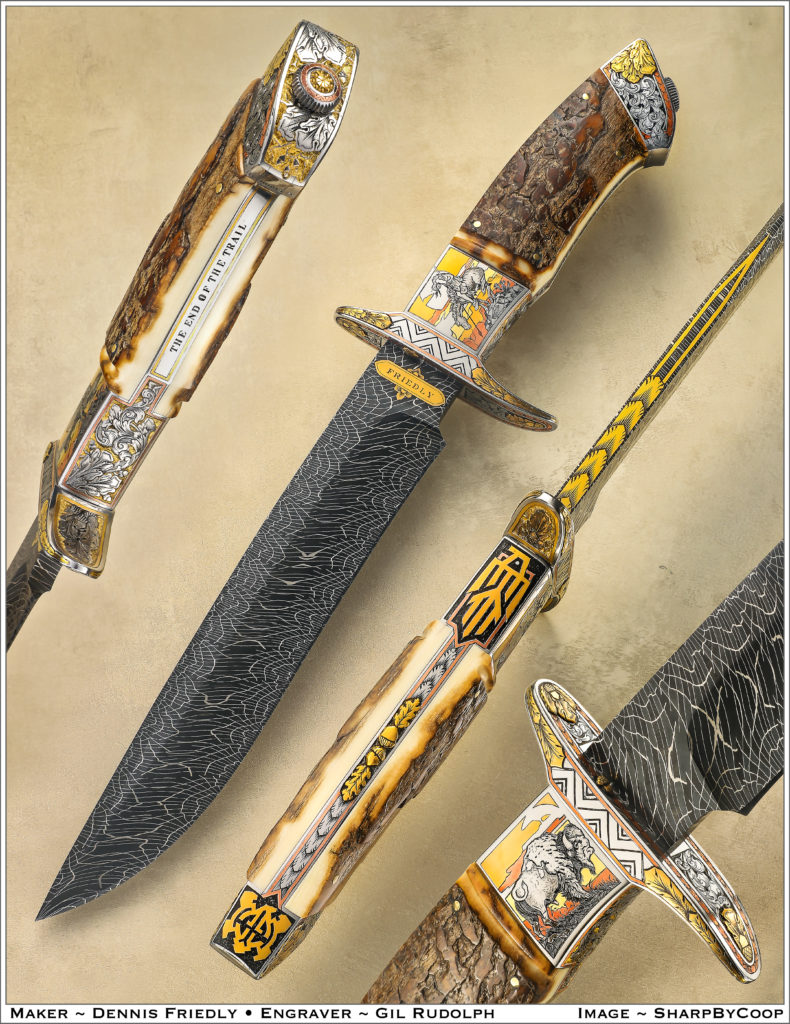
Based on the famous sculpture by James Earle Fraser, The End of The Trail by Dennis Friedly memorializes the struggles for survival of the American Indian and the Plains bison. Gil Rudolph did the copious amount of 24k-gold inlay and raised gold engraving in assorted American Indian motifs. (SharpByCoop knife image)

The End of The Trail by Dennis Friedly is a theme piece dealing with the separate battles that American Indians and the Plains bison fought for survival in 19th-century America.

The famous sculpture of the same name by James Earle Fraser is reproduced in 24k gold inlay engraving by Gil Rudolph on one bolster and an American bison on the other. The look and even of the texture of the distinctive ancient bark ivory slabs resemble that of a bison. Meanwhile, Rudolph’s spectacular 24k-gold and raised gold work engravings are configured to represent various symbols of American Indian culture, including all over the guard, pommel and spines of the handle and blade.

SPEC CHECK

Knife: The End of The Trail
Maker: Dennis Friedly
Blade length: 8.5”
Blade steel: Robert Eggerling damascus
Handle material: Ancient bark ivory
Engraving: 24k gold in inlay and raised gold work, all by Gil Rudolph
Construction: Take down
Maker’s price for a similar knife: $14,500

For more information contact Dennis Friedly, Dept. BL9, 12 Cottontail Ln. E, Cody, WY 82414 307-527-6811 [email protected], friedlyknives.com.


Danes to Dragons: Custom Hawks

Custom hawks and axes combine history, fantasy and imagination

From Danes to dragons, draft horses and drawing smoke, the axe and the hawk have become avenues of artistic expression for some of the most innovative artisans of sharp blades. Long a trusted and dependable companion on the trail, in the bush, around the camp and in the military, axes and hawks are utilitarian and versatile, both in form for their intended purposes and as striking examples of imagination, innovation and aesthetic appreciation.

Utilizing the best in materials and employing their long study of the axe and the hawk, several makers have produced notable works in recent years, among them Peter Pruyn, Tom Ward, Dave Armour and Bill Burke. Each has his own approach to the craft and adds perspective in producing works of incredible beauty.

“My motivation was to try something new,” related Armour, a knifemaker for about 12 years, fashioning hawks and axes for six years and turning his attention to full-time blade work only seven months ago. “In addition, a small, easy-to-carry axe can be a great complement to a hunting or other working knife. I call my style ‘sufficiently evil and deliberately casual.’ I take the function side of things—like heat treating and edge geometry—very seriously, but treat the rest of knifemaking as a chance to play and have some fun.”

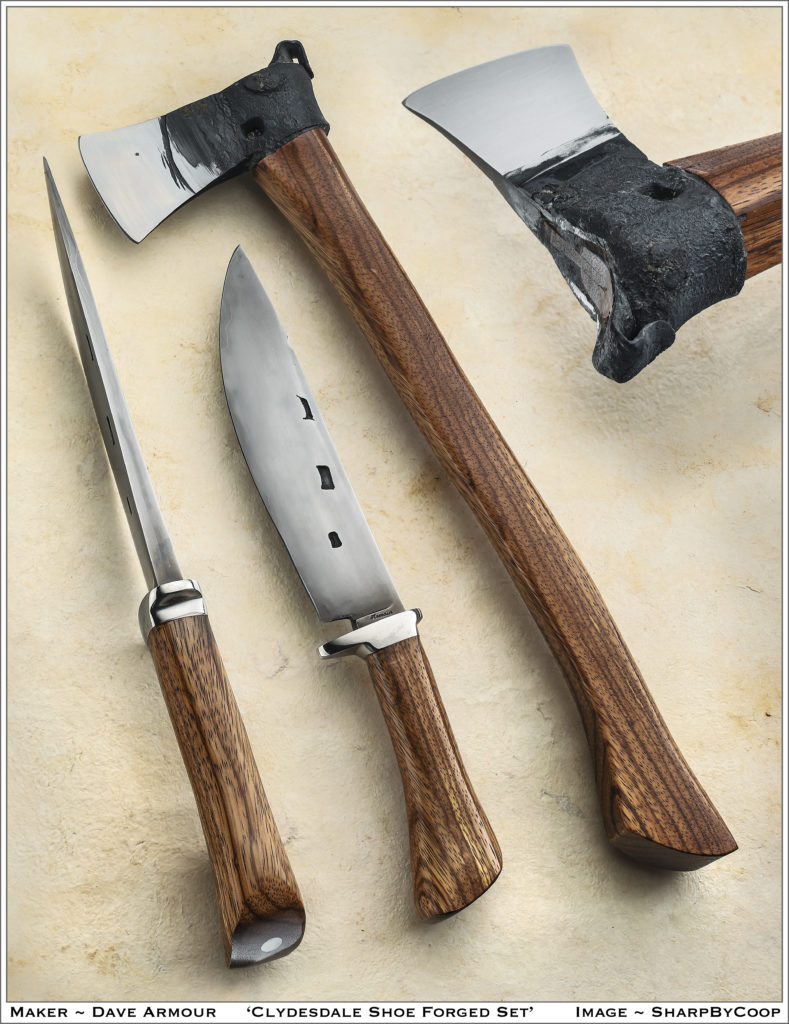
With his Clydesdale Set, which includes both a 12.5-inch knife and a 17-inch axe, Dave Armour (inset) lets his ingenuity gallop through. The set is made with a single Clydesdale horseshoe that he obtained through his wife’s employment, involving a tour of Warm Springs Ranch in Missouri, home of the world famous Budweiser Clydesdales. (SharpByCoop axe image)

With his Clydesdale Set, which includes both a 12.5-inch knife and a 17-inch axe, Armour’s ingenuity gallops through. The set is made with a single Clydesdale horseshoe that he obtained through his wife’s employment, involving a tour of Warm Springs Ranch in Missouri, home of the world famous Budweiser Clydesdales.

“I used the sides of the shoe for the outer layers of the knife blade and the bottom for the body of the axe,” Dave said. “I wanted something rustic without looking primitive. So, I made choices like leaving the shoe nail holes unfilled and using a simple hardwood for the handles. I used W2 for the knife core steel and 80CrV2 for the axe bit. Anytime you’re using a unique material, it is stressful. If I messed this up, it wasn’t like I could just scrounge another Clydesdale shoe lying around somewhere.”

Armour, who plies his craft in Auburn, Illinois, uses the term “foundwood” for his handle material. Though he isn’t completely sure, he said he believes it is sassafras, liberated from the bottom of a box of cast-off exotic pieces in a local lumberyard.

The finished Clydesdale Set consists of the beautifully forged san-mai blades, foundwood handles, and a stainless steel bolster/guard. The blade measures 7.5 inches while the edged surface on the axe is 2.25 inches. Dave stated he would produce a similar set for $750 or the axe alone for $300—and he would enjoy the journey “tailoring my technique to the piece.”


MAGIC DRAGON

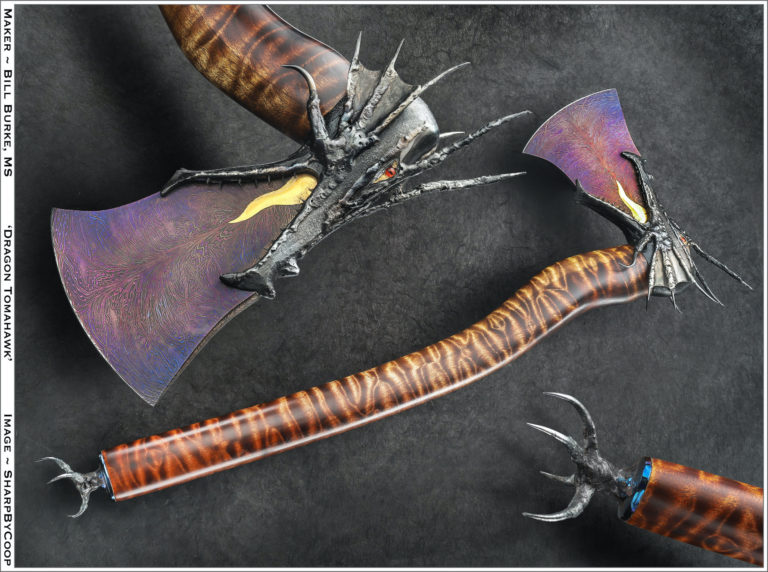
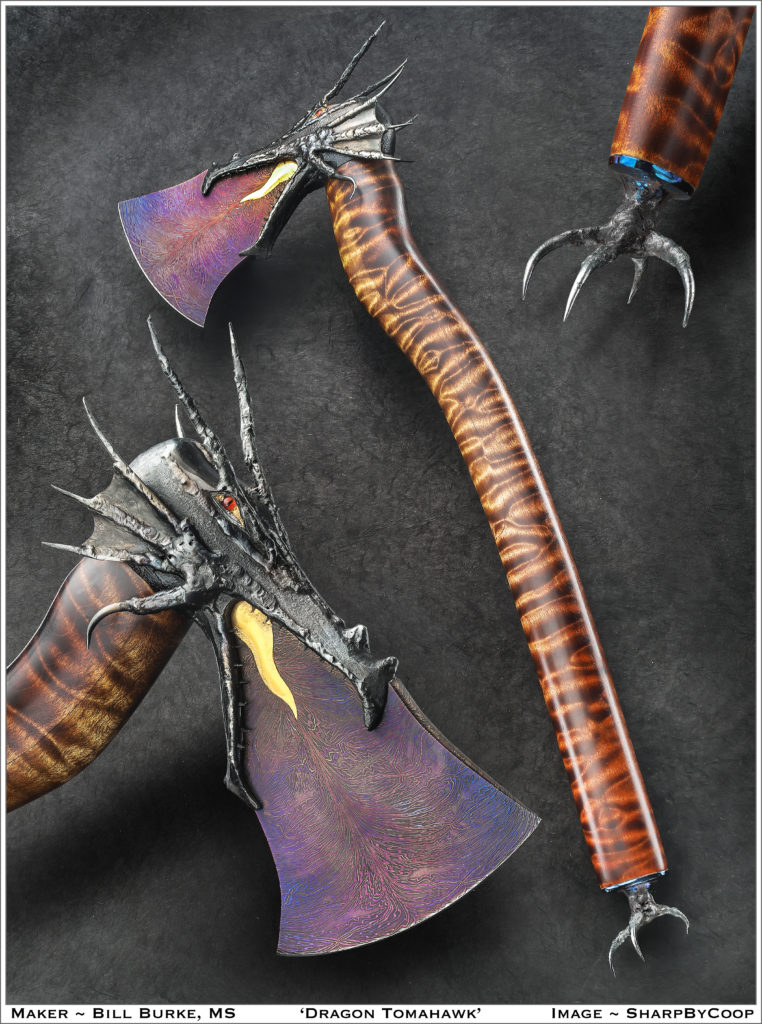
Forging knives since 1998, Burke received his ABS journeyman smith stamp at the 2003 BLADE Show. “I returned home, quit my job, and have been a full-time maker ever since,” he grinned. His Dragon Tomahawk is nothing short of breathtaking, and he acknowledges that the project was an investment of energy in his Boise, Idaho, shop. “This piece took three months of six- to eight-hour days, seven days a week for me to complete,” he noted. “I have a second piece flying around in my head now.”

The Dragon Tomahawk is 20.5 inches overall, with a 4-inch cutting surface of damascus and a curly maple handle. The head is wrought iron and 1018 mild steel forged into a “W’s” pattern, and the blade steel is 1080, 15N20 and 201 series nickel forged together to create Bill’s Dragon’s Breath pattern. (SharpByCoop image)

The second will be a show-stopper if it compares to the 20.5-inch masterpiece that sports a 4-inch cutting surface of damascus and handle of stout curly maple. “The head is wrought iron and 1018 mild steel forged into the ‘W’s’ pattern,” he commented. “The blade is 1080, 15N20 and 201 series nickel forged together to create my Dragon’s Breath pattern. The handle was first drawn and cut/carved from a piece of red fir, and then, after a few refinements, the pattern was drawn on the piece of maple and the handle made from that.”

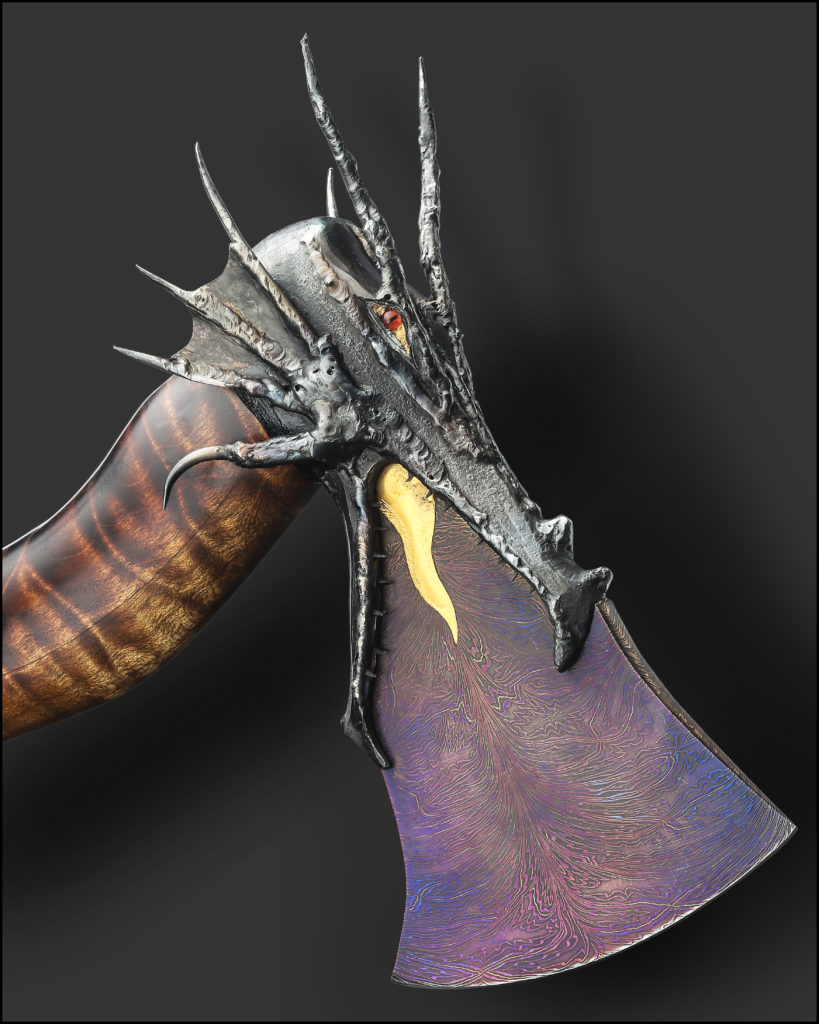
Bill Burke lightly fire-etched the head of his Dragon Tomahawk, along with heat coloring the blade in niter salts to achieve a purple/blue-and-red coloration before it was welded to the dragon’s head. The teeth were raised from the steel of the head, and the tongue, inlaid into the blade, gleams in 24k gold. (SharpByCoop image)

Bill has been noted for his quality damascus, and with this piece took inspiration from the work of ABS master smith Joe Szilaski. “All my knives and hawks are forged by me in my shop,” Bill said. “I normally just get an idea of what I want to make and start forging. From almost the first moment that I made the Dragon’s Breath pattern, I knew I wanted to make a dragon-headed tomahawk, breathing fire down the blade of the hawk.”

The dazzling result includes a lightly fire-etched head “because dragons are born in fire and should look that way,” along with heat coloring the blade in niter salts to achieve a purple/blue-and-red coloration before it was welded to the dragon’s head. The teeth were raised from the steel of the head, and the tongue, inlaid into the blade, gleams in 24k gold. Bill indicated he would produce a similar piece for about $17,000, depending on embellishments.


NO PIPE DREAM

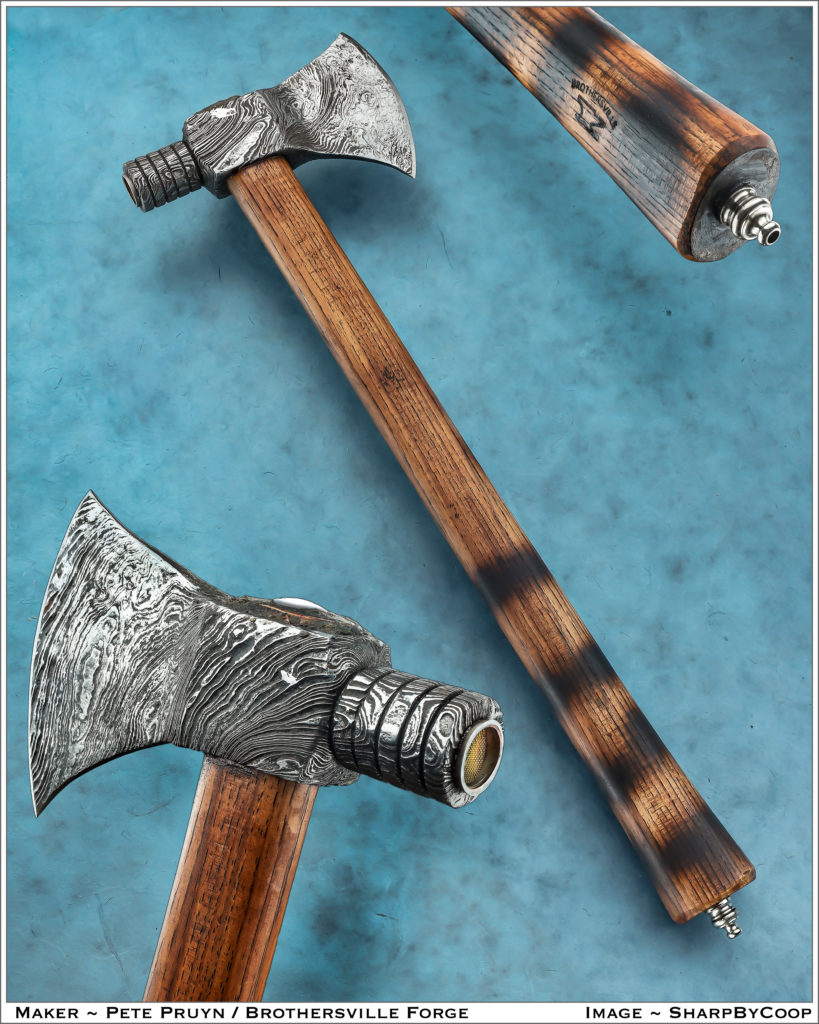
One of the most intriguing works by Peter Pruyn is his 15-inch Pipe Axe with ash handle, 4-inch blade and a bowl of hammered twist damascus. He forged the steel from layers of 1070, 15N20 and nickel. (SharpByCoop axe image)

Peter Pruyn was self-taught for quite a while after taking up knifemaking when he lost a valued knife he had carried for years. He later learned the stock removal method from Gene Martin and also attended an ABS bladesmithing class. “That definitely made me a more diverse maker, and it opened me up to forging different types of edged weapons and tools,” he said. From there, he worked with ABS master smith Red St. Cyr, who taught him to forge a tomahawk from a ball-peen hammer.

Through 14 years making knives—12 of those full time—Peter developed an interest in Viking blades, and he has sold a number of pieces on BladeGallery.com. One of his most intriguing works is his 15-inch Pipe Axe with ash handle and 4-inch blade and bowl of hammered twist damascus. He forged the steel from layers of 1070, 15N20 and nickel.

“I was forging an axe for the BLADE Show about seven or eight years ago when I had the idea of making it into a pipe axe, which is similar to a pipe tomahawk,” Peter remembered. “It really only has a larger blade.”

While working on the Pipe Axe, Peter greeted a friend who had come to his shop to work on the electrical setup. “He spotted the head when I removed it from the etchant,” Pruyn recalled, “and immediately claimed it.  I was trying something different on this particular one. I did a very long etching process, and it gave a very deep, rough texture and an antiquated look to the steel. I did the Viking rings on the handle, but I also wanted to put some rings on the pipe bowl to give it a better look.”

The effect was certainly achieved, and Peter successfully tested it using cigar tobacco. “It worked quite well,” he concluded. He said a similar model would run $700.


HALVDAN SWUNG ME

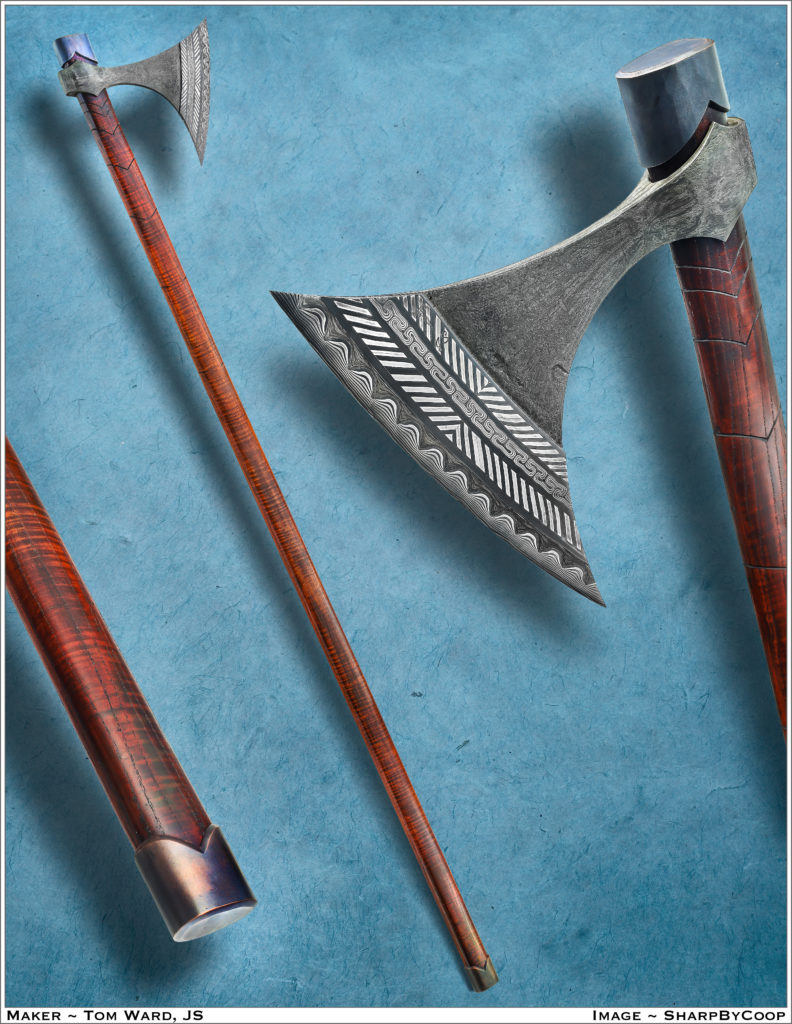
Christened “Halvdan Swung Me,” the Dane Axe by Tom Ward is based on Viking lore and representative of the weapons Viking mercenaries may have wielded in the service of the emperor of Constantinople, today known as Istanbul. His list price for a similar axe: $3,200. (SharpByCoop axe image)

After recently relocating his enterprise, along with his wife’s furniture business, from Carbondale, Illinois, to Istanbul, Turkey, Tom Ward looks forward to future custom orders. Among these may well be a request for a piece similar to his hefty Dane Axe.

When in design school in Boston, Tom took an elective course on forging damascus and bladesmithing taught by ABS master smith J.D. Smith (see May and June issues of BLADE®). “I really fell in love with the process and the idea of making high-quality objects to last someone’s entire life or longer,” he related. “I also loved the history of it and what you could learn through those venues. J.D. was my mentor for about four years before I left school and Boston. My work was fairly independent until 2017, when I started my degree at Southern Illinois University and spent three years researching damascus steel with Richard Smith in Carbondale.”

One of the most significant results of Ward’s career in steel, the Dane Axe, christened “Halvdan Swung Me,” is based on Viking lore and representative of the weapons Viking mercenaries may have wielded in the service of the emperor of Constantinople, today known as Istanbul.

“The phrase ‘Halvdan was here’ is carved into the bannister of the balcony of the Hagia Sophia in Istanbul,” Ward remarked. “So, he was the inspiration for the piece and the name. The shape is not exactly like any Dane axe but serves the same idea with an angled broad blade and beard, and a thin cross section as most war axes had. The angle of the blade is to deliver a deeper chopping or swinging cut, and it is the same cutting concept as the curve of a saber. The forward point is also hypothesized for stabbing, and the beard for hooking legs and shields.”

Damascus legend Daryl Meier sold the wrought iron, salvaged from a bridge that was torn down in Illinois, for inclusion in the Dane Axe steel combination, and encouraged Tom’s pursuit of pattern welding. The Dane Axe haft, fashioned from sturdy hickory and ash laminate, extends beyond 5 feet.

“The pattern welding on the blade is sort of an East meets West thing,” Tom commented, “with traditional wolf’s tooth from northern Europe and the Persian chain patterns, as well as the Byzantine tendency for geometric patterns with the chevrons.”

These exceptional craftsmen are among many who have explored the addition of hawks and axes to their repertoire. They set the bar high and bring additional interest to another creative frontier.

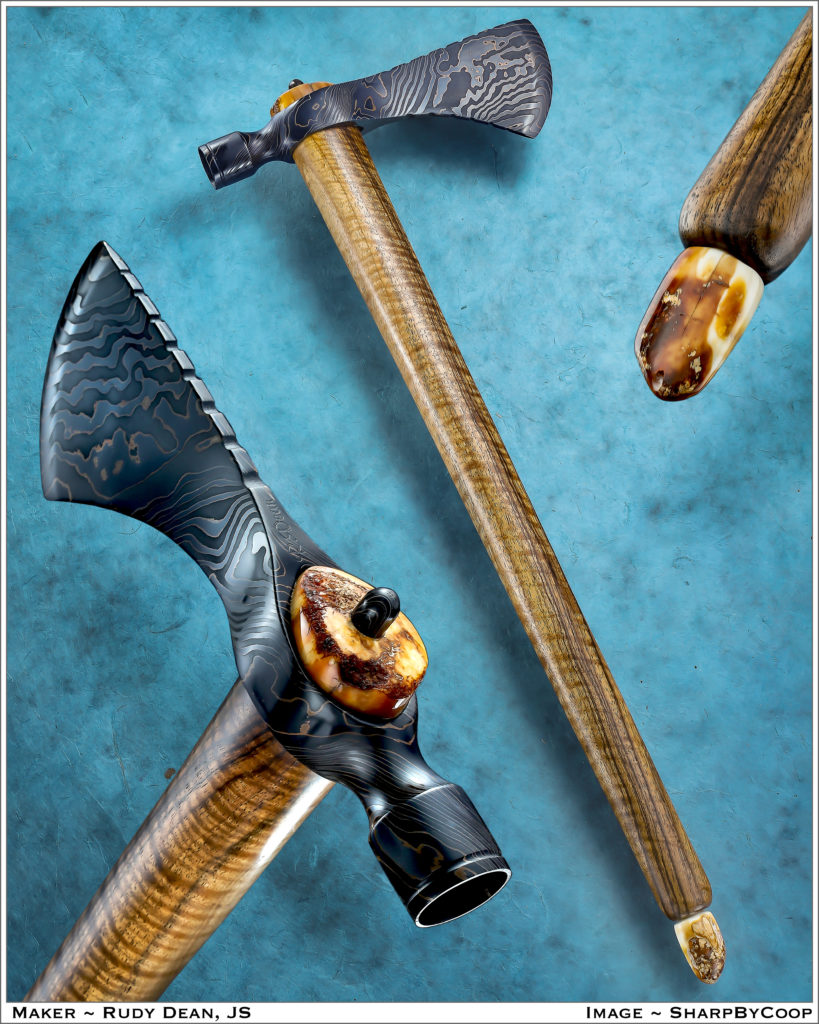
Above: Rudy Dean’s pipe hawk features a 4.5-inch blade of twist damascus and a handle of curly English walnut. The smoke  hole plug is damascus and the mouthpiece and eye cap are ancient walrus ivory. (SharpByCoop image)


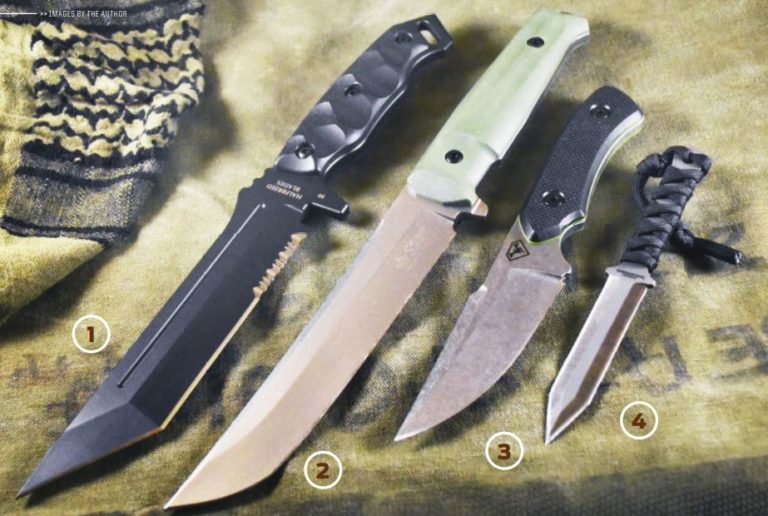
Four Battle Tough Military-Style Fixed Blade Knives

Today’s military-style fixed blades are ready for duty. These four are certainly ready to earn their stripes.

What Are The Top Military-Style Fixed Blade Knives:

The history of cutlery has many different facets but none any more glorified than the fixed-blade knives that have seen battle for centuries. Fixed blades are still a major part of our fighting forces’ need for strong steel and they’ve become more diverse since the modern tactical age began in the early-to-mid 1990s.

Condor Tool & Knife’s Neck Gladius

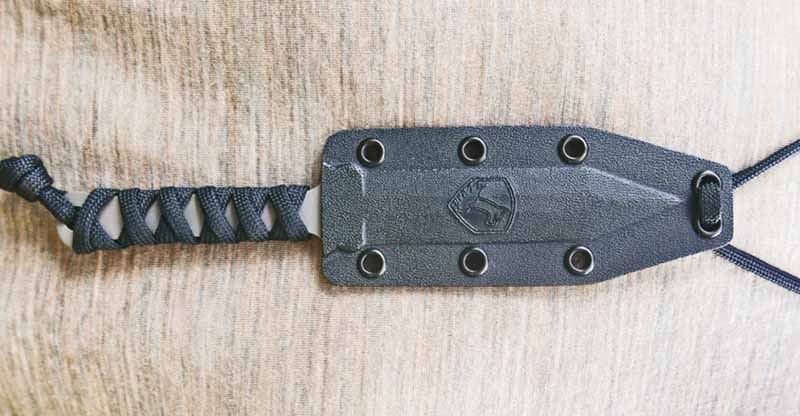
One thing hasn’t changed: such knives must perform duties outside of combat. An example is Condor Tool & Knife’s Neck Gladius, a diminutive version of the classic Roman combat sword. Designed by writer/outdoorsman and BLADE University instructor Joe Flowers, its double-edged blade is handsomely ground in Condor’s favorite blade material: 1075 high carbon steel. The black-paracord-wrapped handle has a tail at the base. A black Kydex neck sheath includes a nice length of paracord for neckwear.

The black Kydex sheath of the Neck Gladius includes a suitable length of paracord for neck wear.

One of the best uses I’ve found for small neck knives is preparing tinder as a firestarter. The neck knife makes for an excellent companion to a larger knife for doing detail work, so I put the Neck Gladius to work doing just that.

Hitting my sweet spot, a pine forest north of town, I used the small blade to dig out some nice chunks of pine resin, which burns nice and long as tinder. I complimented the pine resin with some fine pine shavings to complete the kit. The little Condor will handle other small tasks as well, such as cutting paracord to length. “Handy” is its middle name!

Condor Tool & Knife Neck Gladius
Designer: Joe Flowers
Blade Length: 3.14″
Blade Material: 1075 high-carbon steel
Handle Material: Baracord wrap
Weight: 2.12 ozs.
Overall Length: 6.06″
Sheath: Kydex with paracord lanyard
Country Of Origin: El Salvador
MSRP: $54.98

DoubleStar Blades Chico Diablo X

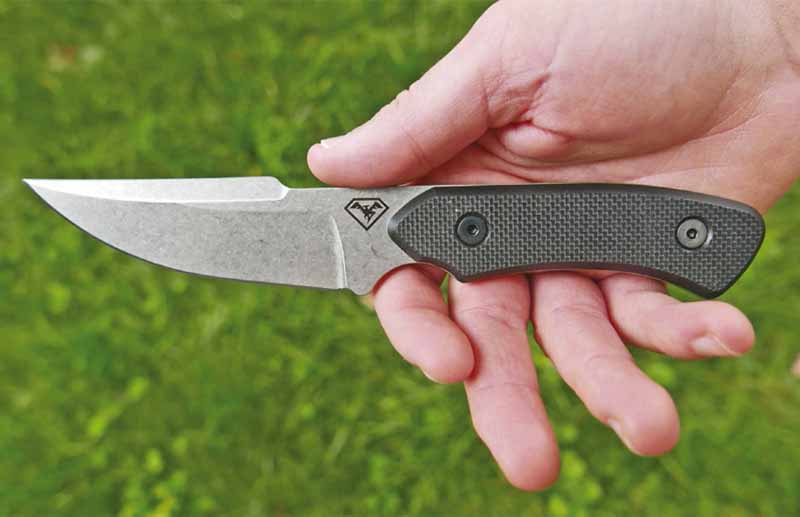
Designed by BLADE® field editor Kim Breed, the Chico Diablo X from DoubleStar Blades is, as you might expect, tough as nails. It is a medium-sized sheath knife with a harpoon-pattern blade. A deep index finger groove extending from the bottom/front of the checkered scales into the tang adds grip when getting down to business. The black Boltaron sheath has a real-deal Tek-Lok for carry options. Weight is a manageable
6.24 ounces.

A deep index finger groove extending from the bottom/front of the checkered scales into the tang of the DoubleStar Chico Diablo X adds grip when getting down to business.

The knife’s size is perfect for medium-duty field tasks such as dressing game, prepping meals, cutting rope and working wood. It’s not heavy enough for chopping but is a serious slicer. I tested the blade across the grain on a 4.5×2.25-inch slab of cold corned beef brisket. Despite the blade being shorter than the chunk of beef, the Nitro-V stainless steel glided through the brisket, taking off one clean quarter-inch slice after another. The Chico Diablo X is a well-built multi-tasker worth every penny of its surprisingly affordable price tag.

Doublestar Blades Chico Diablo X
Designer: Kim Breed
Blade Length: 3.75″
Blade Material: Nitro-V Stainless
Handle Material: Black G-10 with green G-10 liners
Weight: 6.24 ozs.
Overall Length: 8″
Sheath: Black Boltaron with Tek-Lok attachment
Country Of Origin: USA
MSRP: $149.99

Kizlyar Supreme Senpai

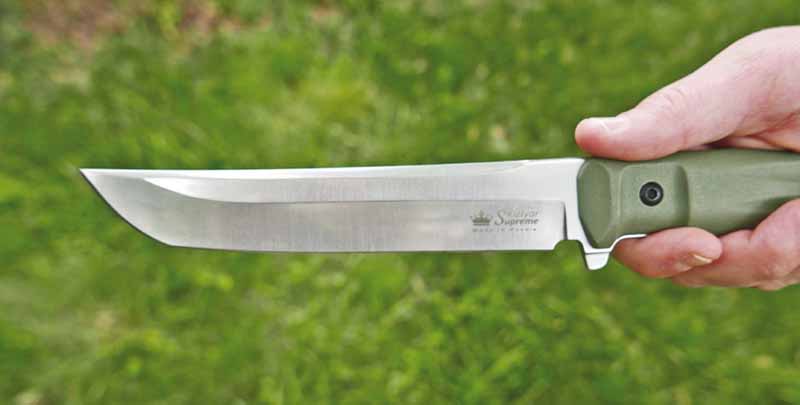
The Kizlyar Supreme Senpai is the longest knife of the test group, including a tanto blade in more of a traditional Japanese curved-tip style. The handle is spare of curves save for a slight finger groove and short guard. The scales are nicely rounded and Kizlyar provides a sandwiched matching green synthetic belt sheath for carry.

The Senpai includes a traditional Japanese tanto blade. The handle has nicely rounded scales spare of curves save for a slight finger groove and a short guard. The knife comes with a matching green synthetic belt sheath.
The Senpai includes a traditional Japanese tanto blade. The handle has nicely rounded scales spare of curves save for a slight fi nger groove and a short guard. The knife comes with a matching green synthetic belt sheath.

Given its weight and slim blade profile, I liked the Supreme Senpai for slicing and shaving from a utility standpoint. I roughed out a seasoned hardwood tent peg using a small hatchet, and tested the blade at finetuning the pointed tip and shaving the sides. The long blade came in handy as I could pull it through while slicing and shaving rather than simply pushing it downward against the tough hardwood—my reasoning being, if it could handle stout wood, simpler chores like meal prep and cutting rope would be a snap. The Supreme Senpai blade performed well shaping the challenging wood, leaving no doubt it could be handy around camp.

Kizlyar Supreme Senpai
Blade Length: 6.75″
Blade Material: AUS-8 stainless
Handle Material: OD green Kraton/ABS plastic
Weight: 10.3″
Overall Length: 12″
Sheath: Polyamide Nylon
Country Of Origin: Russia
MSRP: $150

Halfbreed Blades Medium Infantry Knife

How brutish is the Aussie-made Halfbreed Blades Medium Infantry Knife? Consider this—it’s around just one ounce shy of the other three test knives combined in weight! The blade is a whopping .23-inch thick at its thickest, features 1.5 inches of serrations from the tang forward, and has a black, rust-resistant Tefl on coating. The ample handle scales are “chunked” black G-10 and there’s a wicked skull crusher. The sheath has rear attachments for MOLLE (Modular Lightweight Load-carrying
Equipment) or belt carry.

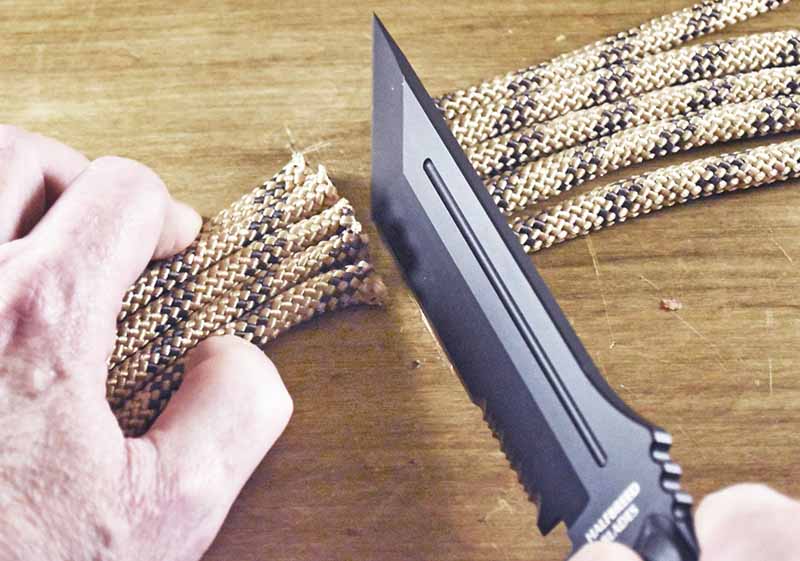
The Halfbreed Medium Infantry Knife incorporates brutish .23-inch blade steel. The author pulled it through five lengths of 3/8-inch rappelling rope in one clean slice using the forward plain edge portion of the blade.

This overbuilt brute is a handful capable of chopping, slicing and shaving. Given its near three-quarter-pound weight it will no doubt chop, but the serrations somewhat limit the chopping ability of the blade’s plain edge portion. (Serrated edges will chop but it’s hard on them, and resharpening the teeth is a royal pain.)

I tested the knife at slicing and started with lengths of ⅜ -inch synthetic rappelling rope. Working my way up, I was able to slice cleanly through five lengths of the rope side-by-side before I ran out of rope. The handle offered superb grip throughout the testing process. The Halfbreed entry has the ability to perform heavy-duty camp chores like
shelter building, chopping branches for firewood and shaving wood.

Halfbreed Blades Medium Infantry Knife
Blade Length: 6.69″
Blade Material: Bohler K110 D2
Handle Material: Black G-10
Weight: 17.08 ozs.
Overall Length: 11.77″
Sheath: Black Kydex
Country Of Origin: Australia
MSRP: $335


Also Read:

Advertisement

Must Read Articles

Read this before you make a knife

Knifemaking 101 – Read This Before You Make a Knife

  by Wayne Goddard My experience has taught me that there's nothing like digging in and getting started. I've often said the hardest part of the...
how to forge damascus steel

How to Forge Damascus

Advertisement
Advertisement