Featured Knives

Here are BLADE Magazine’s Featured Knives of the Week. Browse through these articles to find the best knives available from both custom knifemakers and factory knives.

Click here to browse through our list of Featured Knifemakers.

Knifemaking – – Knife Collecting – – Tactical Knives – – Survival Knives

4 Very Different Versions of the EDC Folder

Once upon a time a long time ago, my idea of the perfect everyday carry knife was a Randall Model 1. Most of the guys I worked with back then carried 16- to 18-inch pangas every day.

Times change. People change. I no longer carry a Randall in an inside waistband clip sheath every day, or at all, really. No doubt there are many folks today who strap on a 10-inch bowie or a USMC fighting/utility knife every morning before breakfast. To that you can add the legions who EDC a tactical folder.

There are, however, many folks who prefer to carry simple pocketknives. Almost every cowboy I know carries an old school Schrade or Case stockman in the watchpocket of his Wranglers. Many other folks, some constrained by knife laws, EDC more contemporary versions of the traditional pocketknife, the knife that at one time was in every schoolboy’s and every man’s pocket—for some, a gentleman’s folder.

My team and I recently did a field review of four very different contemporary versions of the EDC folder. If we were cowboys I reckon we could have trimmed hoofs, done minor surgery on cows and other cowboy things. But we’re not cowboys. So, we used them for the stuff we tend to do. We opened boxes and cut up cardboard. We did cut rope, which felt kind of cowboyish. We went for a hike and picked and sliced fresh rose hips for tea, peeled and sliced oranges for a trailside picnic, cut pine limbs and whittled fuzz sticks to start a lunchtime fire. Not exactly gentleman stuff either, but hey, everyone has his own EDC needs.
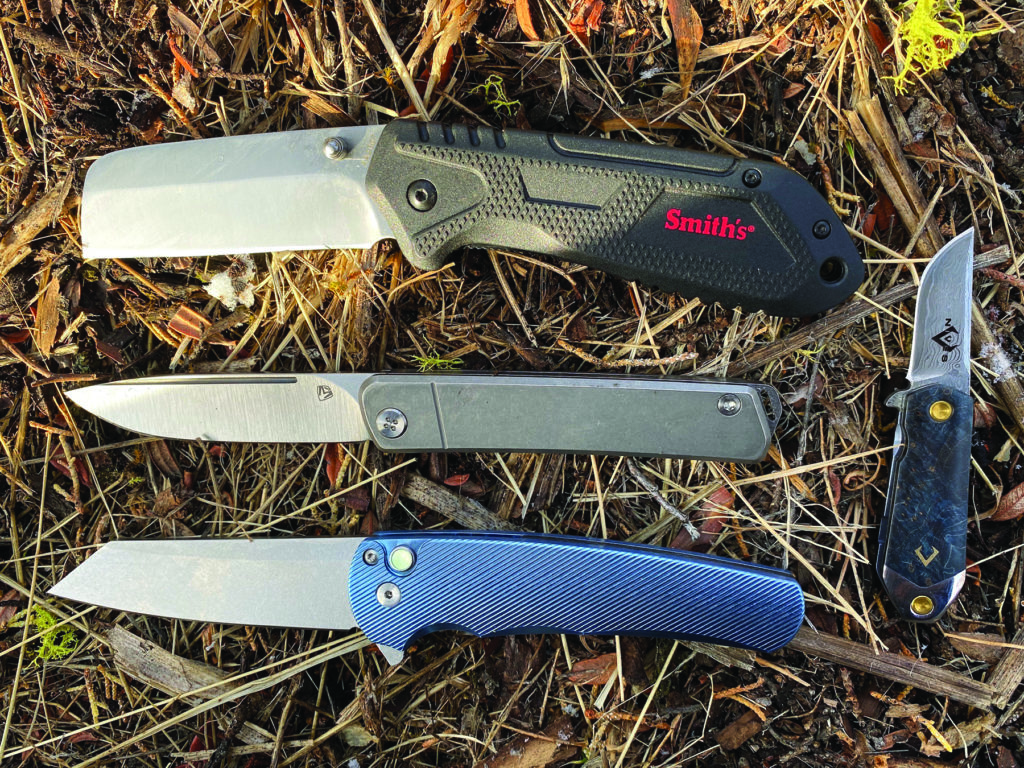
Four of the latest in EDC knives, counterclockwise from right: V Nives Killabite, Pro-Tech Knives Malibu Wharncliffe, Medford Knife & Tool Gentleman Jack and Smith’s Edgework-Site Wharncliffe Knife.

SLIM JACK: Medford Knife & Tool Gentleman Jack

Sleek, slim and lightweight, with a blade long enough to slice a watermelon without getting your hand wet, the Medford Knife & Tool Gentleman Jack is a gentleman’s folder in appearance, in feel and in fact. With little effort, its slim blade excelled at cutting nylon kernmantle rope, and at food preparation and slicing thin peels of bark for tinder. The slender handle looks as if it would be uncomfortable, but the edge was so sharp and the grind so slim that little force was required to cut stuff. Hence, the thin handle was not uncomfortable. The slenderness made it easy to carry—we all hardly knew we had a knife in our pocket when carrying it.
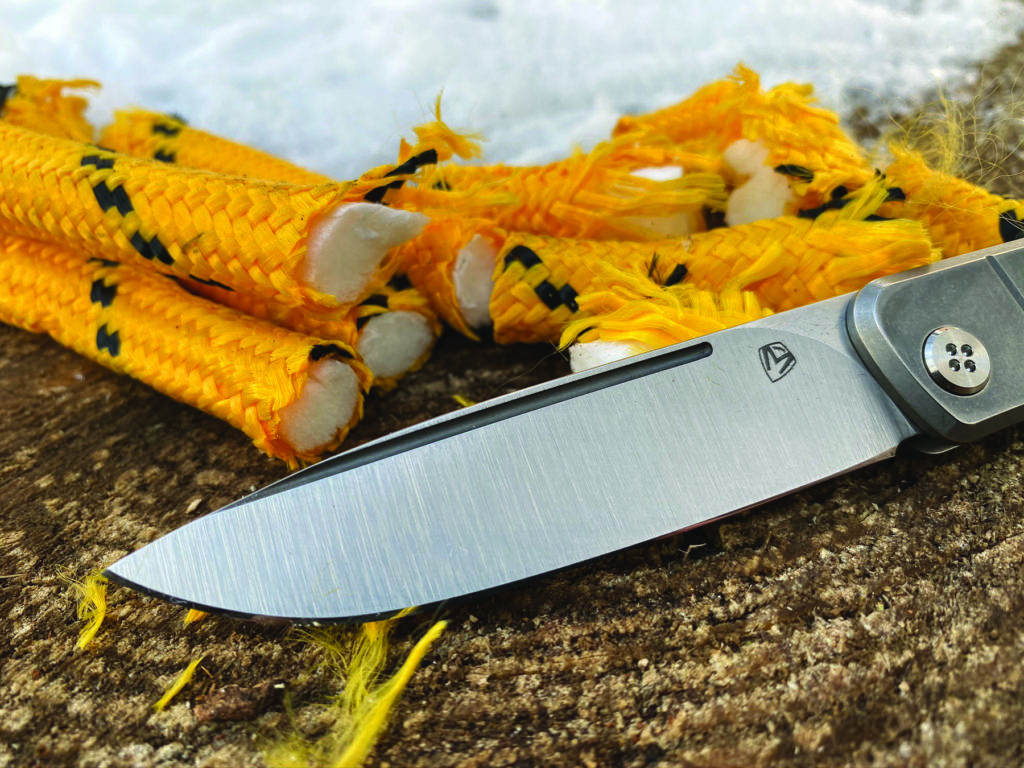
With little effort, the slim blade of the Medford Knife & Tool Gentleman Jack excelled at cutting nylon kernmantle rope.

Most folders in this size range tend to be tactical, with black blades and other features the uninformed consider fearsome. This folder, however, is so nice looking, so polished a piece of pocket jewelry, that it’s unlikely to alarm the clueless, which means you could use it in mixed company without getting weird looks.

SPECS: Medford Knife & Tool Gentleman Jack
Blade Length: 3.1”
Blade Steel: CPM S35V stainless
Blade Width: ¾”
Blade Thickness: .125”
Handle Material: Anodized titanium
Action: Slip joint
Closed Length: 4”
Country of Origin: USA
MSRP: $375


WORKADAY FOLDER: Smith’s Edgework-Site Wharncliffe Knife

The Smith’s Edgework-Site Wharncliffe Knife is a workaday folder that equals many high-priced limited-production knives in durability and function. Robust, with a very comfortable handle and a good edge grind, it was our preferred blade for getting up some wood for a fire. Press cuts with modest effort cut deep into, and through, wrist-thick pine branches. In fact, it was the most effective of all the review knives at cutting wood for the fire. Shaving bark and curls for tinder was a piece of cake.
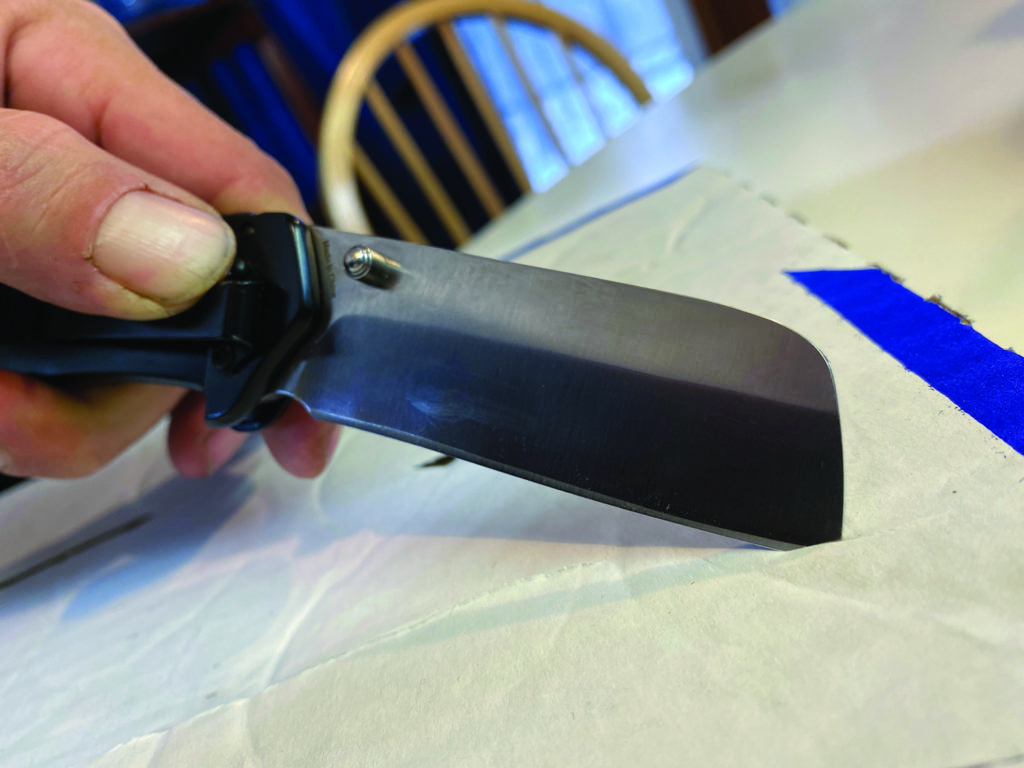
According to the author, the Smith’s Wharncliffe is a workaday folder that equals many high-priced limited production knives in durability and function.
 

I am not a fan of wharncliffe blades, but the long straight edge and overall cutting efficiency might make me a convert. The edge was very welcome when cutting nylon rope laid across a tree stump, and cutting cardboard boxes into strips. Did I mention the handle? Clearly it is designed by someone who understands hard work, and for someone who must do a day’s work. This is a very good tool and, for the price, a great value.
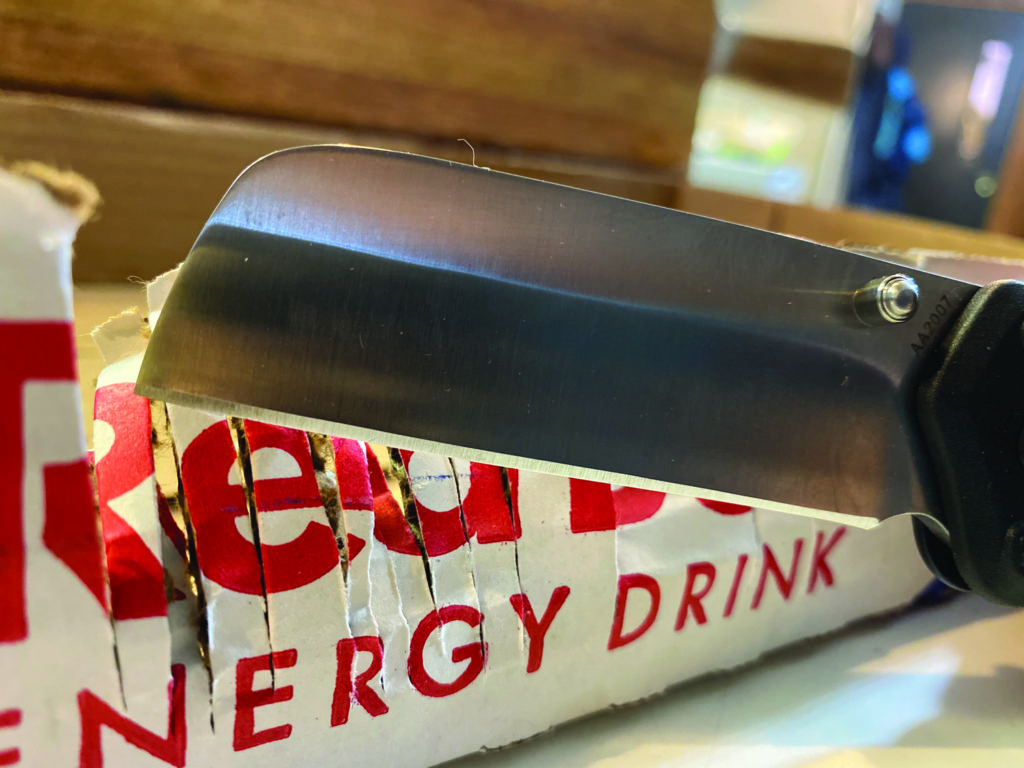
The edge of the Smith’s Wharncliffe was very welcome when cutting nylon rope laid across a tree stump, and cutting cardboard boxes into strips.


SPECS: Smith’s Edgework-Site Wharncliffe Knife
Blade Length: 2.95”
Blade Steel: 400 series stainless
Blade Pattern: Wharncliffe
BLADE OPENER: Thumb stud
Handle: Glass-filled textured synthetic w/pocket clip
Lock: Framelock
Closed length: 4”
MSRP: $24.99


ROCKETKNIFE: Pro-Tech Malibu Wharncliffe

The Pro-Tech Knives Malibu Wharncliffe is handsome, modern in appearance and detail, and resembles a 21st-century knife designed to be carried by an astronaut. In fact, the knife looks a little like a rocket—and has a high-tech lock to boot.
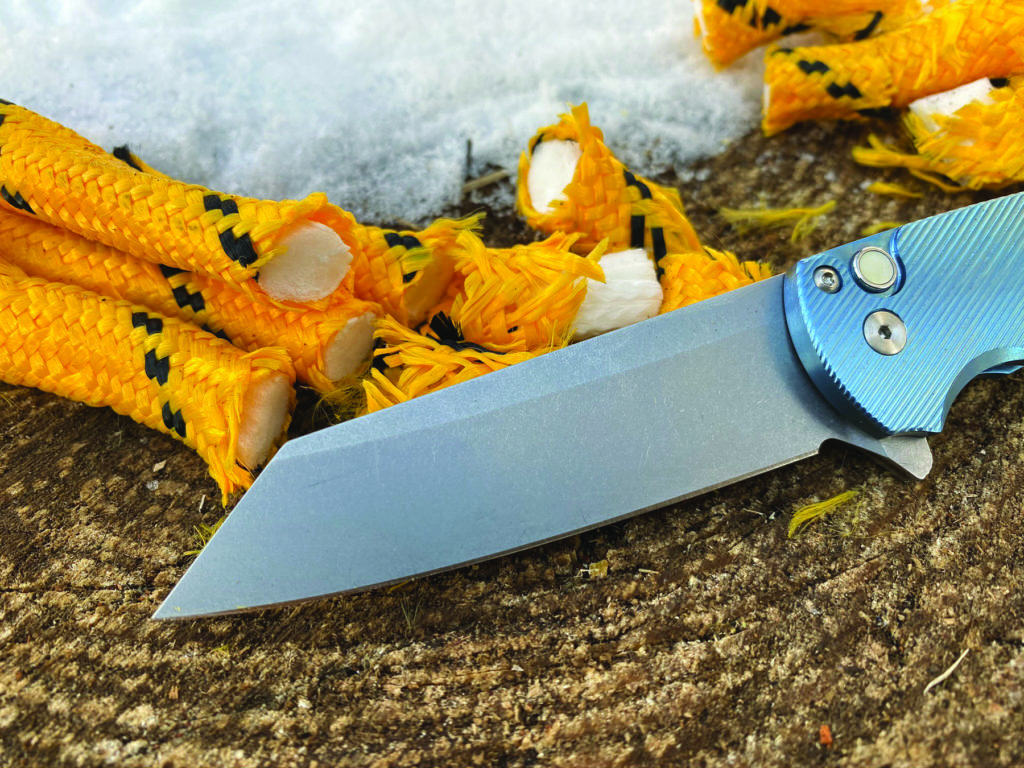
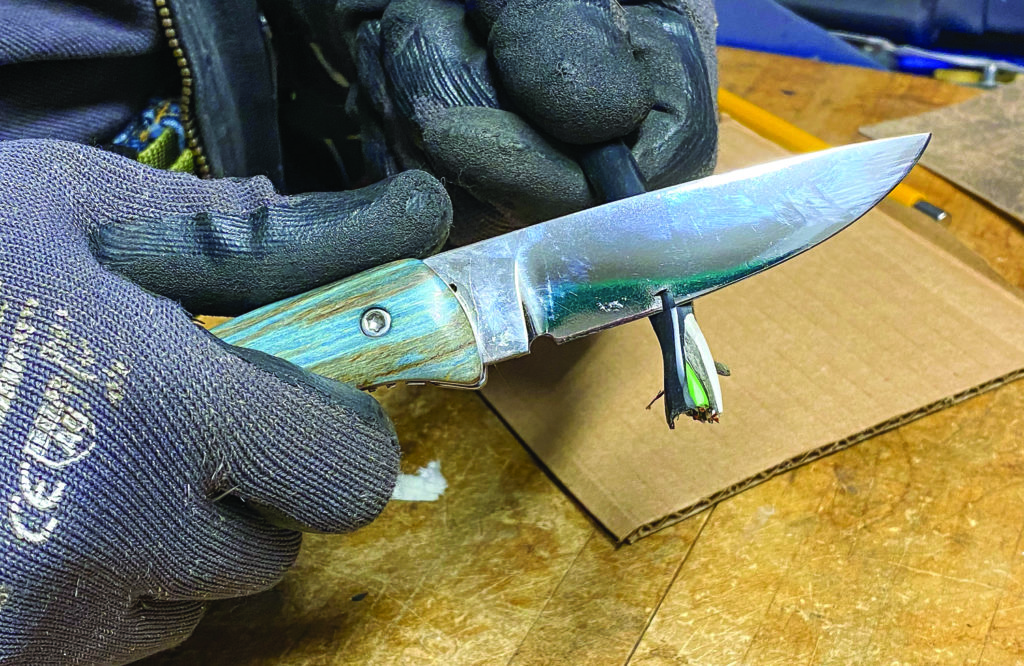
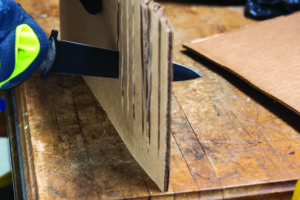
The Pro-Tech Malibu Wharncliffe easily and cleanly crunched through nylon rope and kept its edge cutting cardboard.

It also performs well. The overall blade design with its flat grind, fine edge and up-tipped point was terrifically efficient at all slicing tasks. At first glance I thought the point design might inhibit penetration, and it did. But something in the geometry that eludes me made it very efficient at all cutting and slicing tasks. It easily and cleanly crunched through nylon rope, kept its edge cutting cardboard, and was just the thing for slicing rose hips for tea. It did very delicate cuts cleanly and with precision. With its modestly sized blade, brilliant blue handle and overall polished appearance, it qualifies as a large gentleman’s folder, albeit one with more function than the usual run of that type of knife.
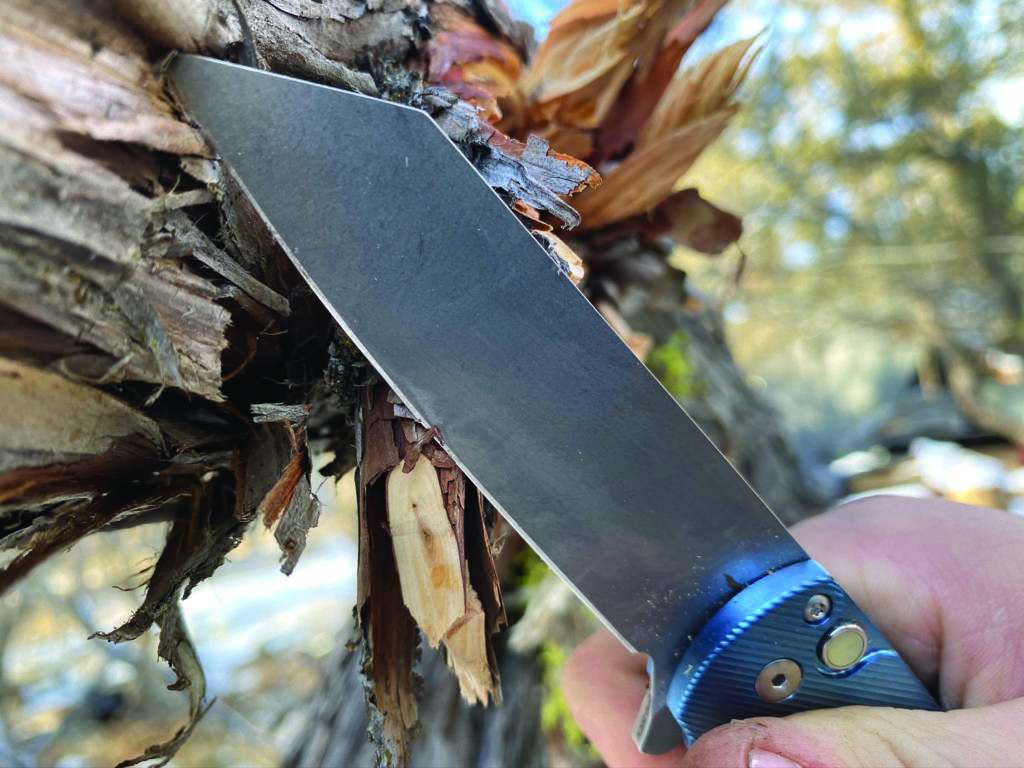
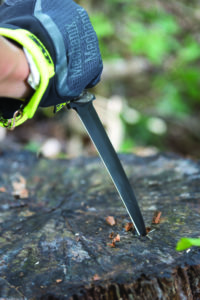
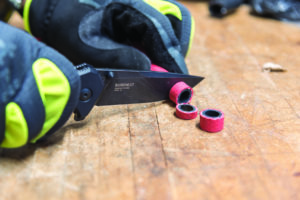
Something in the geometry that eluded the author made the Pro-Tech Malibu Wharncliffe very efficient at all cutting and slicing tasks. He uses it here to collect pine sap to help start a fire.

SPECS: Pro-Tech Knives Malibu Wharncliffe
Blade Length: 3.25”
Blade Steel: CPM 20CV stainless
Blade Thickness: .125”
Blade Style: Modified wharncliffe
Blade Finish: Stonewash
Blade Grind: Flat
Blade Opener: Flipper
Lock: Plunge lock
Closed length: 4.25”
Country of Origin: USA
MSRP: $270


MUST-WORK MINI: V Knives Killabite

Can we say the V Nives Killabite is cute?

I don’t usually use that word when discussing knives, but, truth be told, this little puppy is cute. High-tech, too. The damascus blade, carbon fiber handle and framelock all say dress tactical folder. Miniature, yeah, but still pretty tactical.

Don’t let little knives fool you, though—they are useful. I’ve been beating the drum for tiny blades for years ever since I learned a little bit about flintknapping and worked with some experimental archaeologists. (One of the latter was the lithic expert who consulted on Otzi the Iceman, the 5,000-year-old mummy discovered in the Alps who had a complete tool kit with him, including his flint knife with a 1.5-inch blade.) I’ve taught survival classes during which I use a folder with a 2-inch blade to make a tool kit consisting of a spear, bow and arrows, haft for a stone axe, and more. I wouldn’t hesitate to do the same with the Killabite.
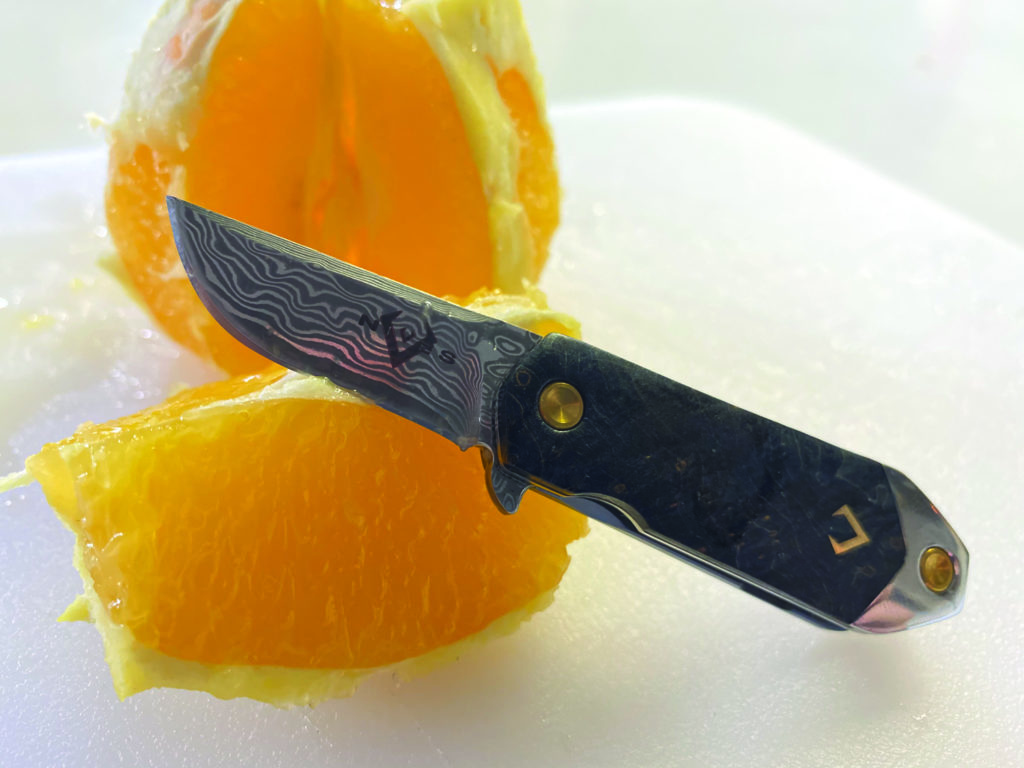
The V Nives Killabite peeled and sectioned an orange with aplomb. The handle has a nice curved profile and is comfortable as such a small handle can be, comfortable enough for the kind of work that you would do with the knife.

The trailing point design and smooth edge with no ricasso or other fripperies makes the most of the short blade. The edge is just a tad thicker than I prefer, which makes it strong at the cost of a little slicing ability, but allowed it to bite deep into wrist-thick pine with no trouble. For long term use I might reprofile the edge—or maybe not. I like the notion of such a small blade being so strong.
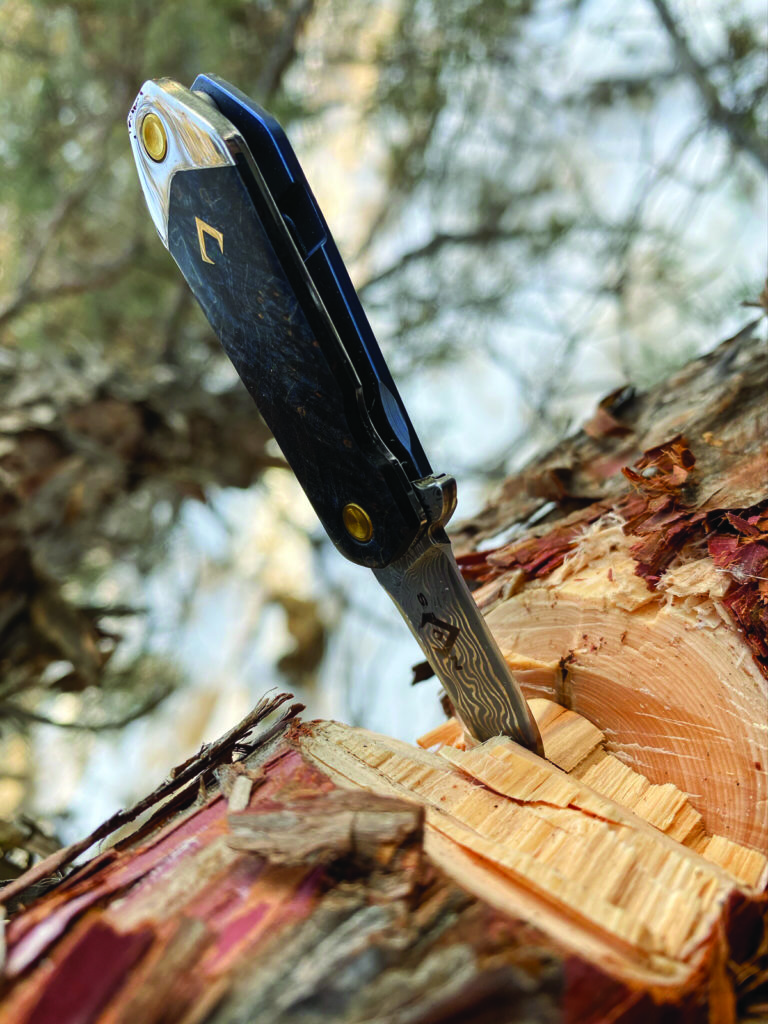
The V Nives Killabite vanquished pine pieces for firewood. It bit deep into wrist-thick pine with no trouble.

The handle has a nice curved profile and is comfortable as such a small handle can be, comfortable enough for the kind of work that you would do with the knife. Keep in mind, too, a surgeon’s scalpel is only 1.5 inches long. Must work gets done with small blades. A keeper this one is.
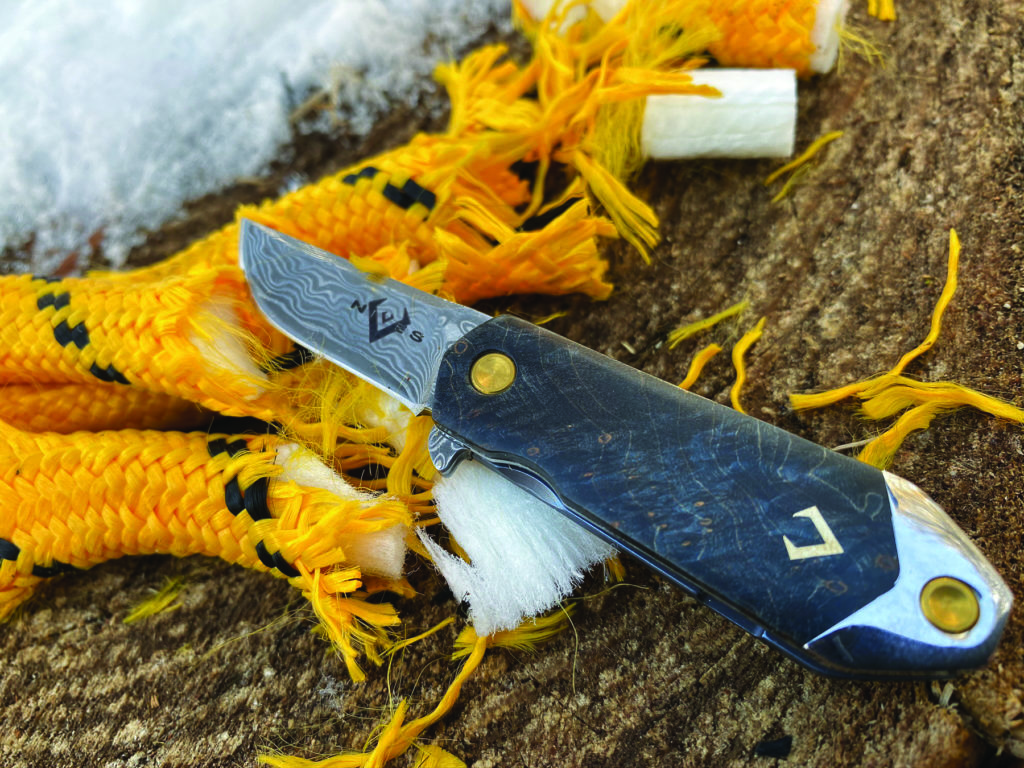
The trailing point design and smooth edge with no ricasso or other fripperies makes the most of the Killabite’s short blade.

SPECS: V Nives Killabite
Blade Length: 1.4”
Blade Steel: Stainless damascus
Blade Thickness: .097”
Blade Style: Trailing Point
Blade Opener: Flipper
Blade Grind: Flat
Handle Material: Carbon fiber
Handle Thickness: .35”
Pocket Clip: Tip-up
Lock: Framelock
Weight: 1 oz.
Closed Length: 2.25”
Countries of Origin: USA and offshore
MSRP: $95.95

ONLY YOU KNOW

Which would be the best EDC? There’s no such thing, really. The right question is, which is the best EDC for you?

Only you will know the answer.
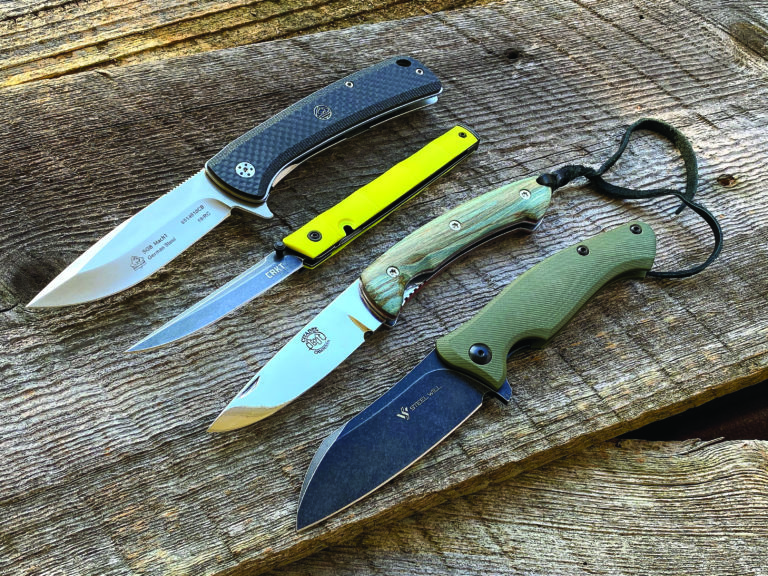
 

4 AWESOME LINERLOCK EDC KNIVES

When it comes to EDC folder locks, the linerlock is hard to beat

Few folding knife locks perform as well for everyday carry (EDC) as the linerlock. Constructed properly, the linerlock is easy to open and, especially on a knife that includes a blade opener and a pocket clip, is a snap to carry, deploy, open and close, all with one hand—an EDC hallmark.

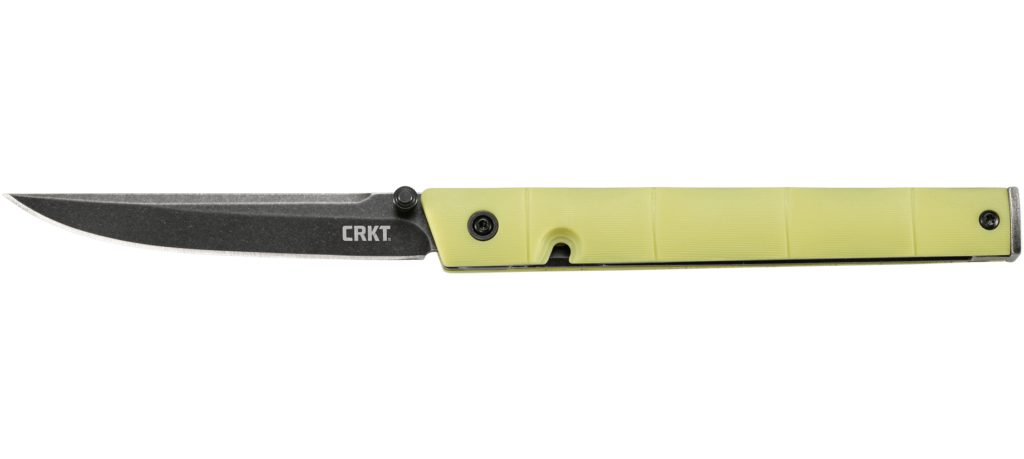
CRKT Knives CEO

Designed by award-winning knifemaker Richard Rogers, the CEO Bamboo linerlock folder is one of the more slender knives from CRKT. It’s an unobtrusive folder that won’t weigh you down and is ideal for dress suit carry. In fact, it can carry attached to a shirt pocket a la a ballpoint pen. It blends well with the office crowd, as it is a low profile design that will not raise eyebrows.

Just over 3 inches long, the blade is 8Cr13MoV stainless steel for a good balance of edge holding and resharpening ease. The trailing-point blade opens quickly and efficiently via a thumb stud. The pivot’s Ikoma Korth Bearing System (IKBS) enhances smooth blade action. A saber-style primary grind combined with a full-length swedge grind gives the blade a bit of attitude.

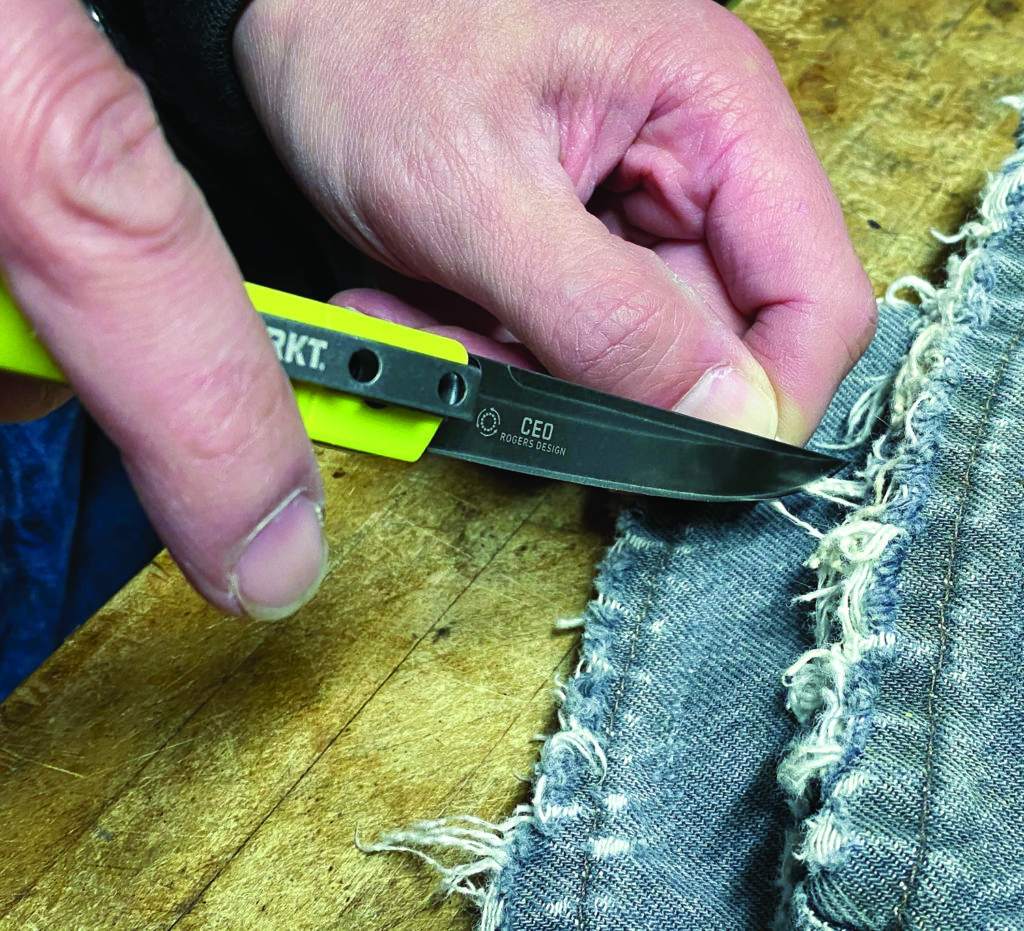
Award-winning knifemaker Richard Rogers designed the CEO Bamboo from CRKT to be the quintessential office carry folder. It is tailored for such daily uses as trimming stray threads from clothing.

The handle consists of two stainless steel liners and glass-reinforced nylon scales. The scales are molded in a color and shape/texture to mimic bamboo. The handle’s squared off butt resembles the classic doctor’s knife/pillbuster pocketknife pattern. A deep carry, fold-over clip allows the knife to ride low in a pants or shirt pocket, or inside a sport coat breast pocket.

The linerlock engages firmly and secures the blade open with no play. Simply hit the thumb stud and the blade pops open fast to the locked position thanks to the IKBS. Firmly push the edge of the exposed portion of the lock spring, and the blade unlocks and rotates closed as easily as it opens. I like how simple it is to open and close the blade, especially for such a slender folder. Many such folders do not manipulate easily due to their size.

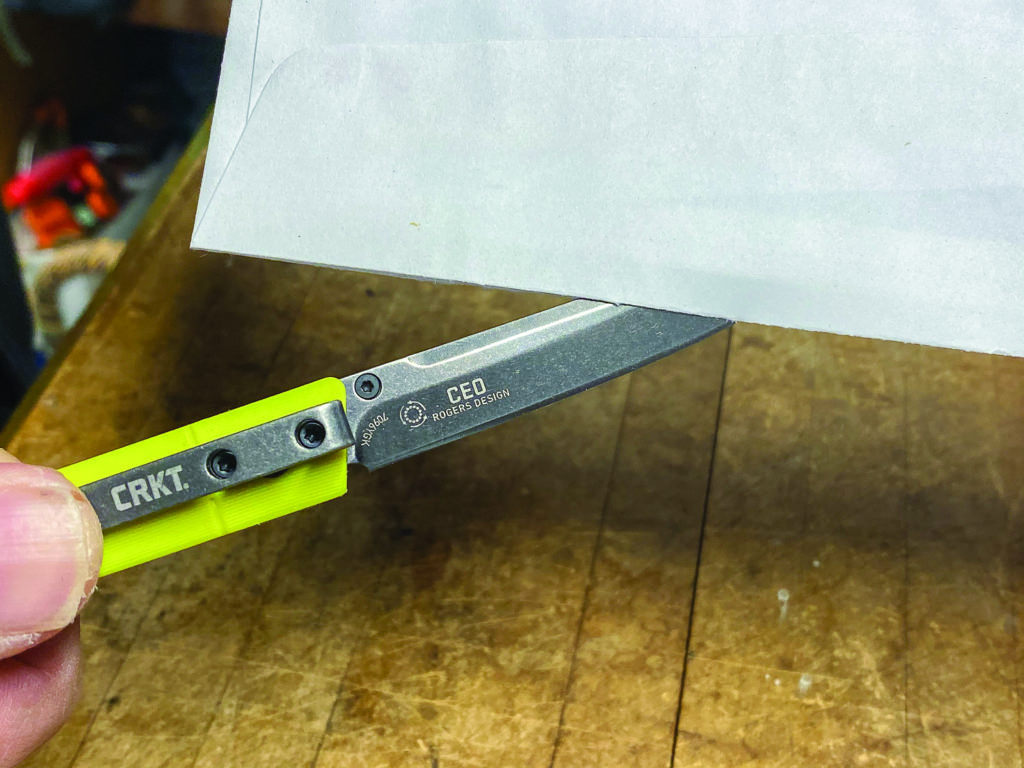
Opening mail is one of the many tasks the slender blade of the CRKT CEO Bamboo does well.

And for a slender folder, the CEO has plenty of bite. The slim blade slits open envelopes and packages effortlessly. I like how it blends in and does its thing with no unnecessary fanfare. The only negative about the CEO is also a positive—the deep carry clip. The fold-over design creates a hot spot when you grip the handle but carries the closed folder deep in the pocket, which is nice. Given that the knife isn’t made for prolonged, heavy duty use, I find the clip to be a good thing. Made in China, the CEO has a manufacturer’s suggested retail price (MSRP) of $54.99. It is a great value.

EXCELLENT SLICER: Citadel Kampot

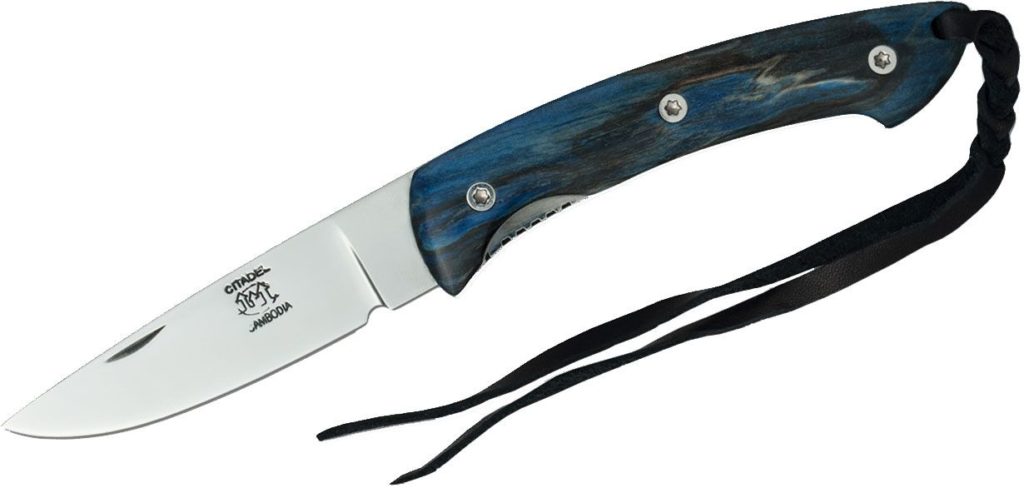
The Citadel Kampot linerlock folder sports a 3-inch drop point blade of Bohler N690 stainless steel. N690 is a mid-grade stainless with great edge holding properties but also is rather easy to resharpen. It is a fine alternative to today’s “super steels.” The ergonomic handle has double stainless steel liners and stabilized blue beech scales. Red liners add a subtle pop of color. The scales are nicely rounded and contoured so the folder rests in your grip comfortably with no hot spots. An integrated guard prevents your hand from sliding onto the blade edge and, together with a bird’s beak butt, keeps your hand on the handle.

The linerlock secures tightly with zero blade play. Five large notches in the end of the liner aid thumb traction in unlocking the blade. The Kampot has a nail nick opener instead of a thumb stud, hole, disc or flipper, so it is the only knife of the test bunch that requires two hands to open, though it does close with one hand like the others. Neither does it have a clip.

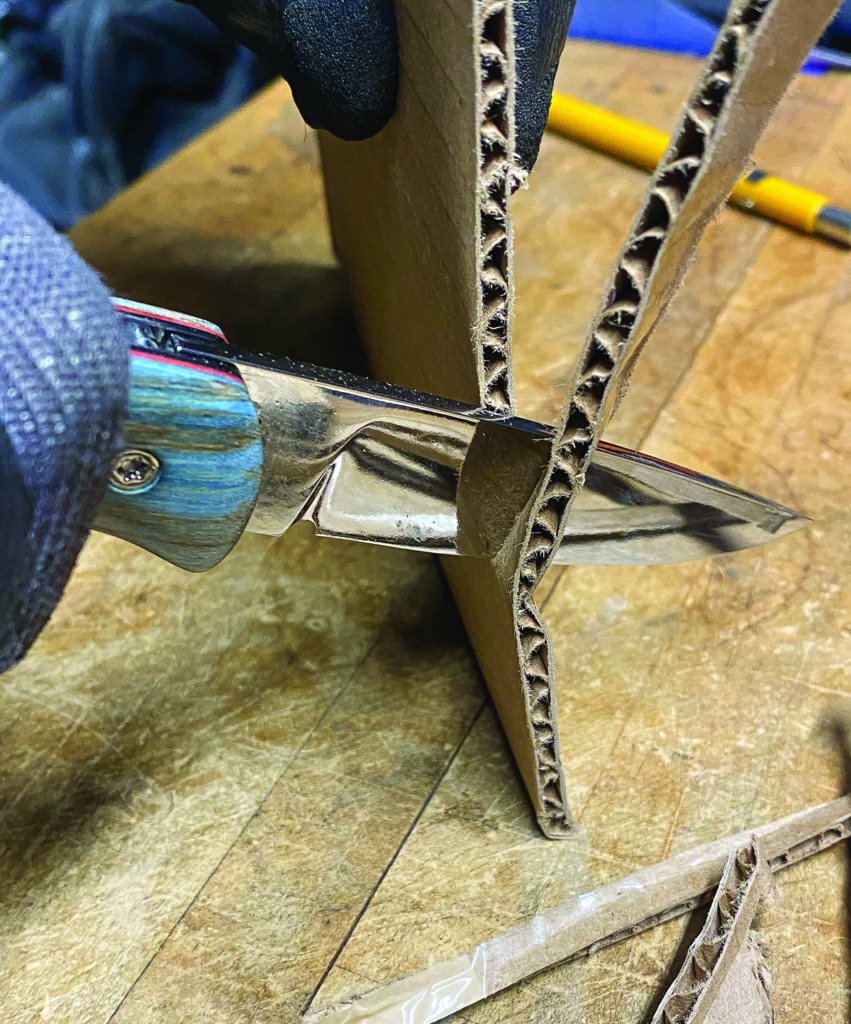
The Citadel Kampot (left) easily rivals most any working folder with its drop point blade. The high polish of the steel makes it easy to clean as well.

At 4.5 inches closed the Kampot is rather large, which might make it a bit uncomfortable for pocket carry. A braided leather lanyard attached to the handle permits you to fish the folder easily from a pocket. The knife is good looking, with the blade, liners and handle screws exhibiting a high polish.

The flat-ground blade is an excellent slicer. However, out of the box it was not as sharp as I prefer. I gave it a few light strokes on a ceramic rod followed by stropping and that enhanced its bite. The grip is very comfortable and a great alternative to folders with flat handle profiles. It is really nice looking. The beech scales differ slightly in color. The test model has streaks of tan and blue-green as well. It reminds me of how brass and copper patina when exposed to the elements over time and get a blueish green hue. The Kampot is a great alternative if you’re not into the all black and edgy tactical folder look. The blade pivot is not exposed, so the pivot tension is not adjustable. This cleans up the look, though I know some knife guys like to adjust the pivot tension to their own liking.

Citadel’s Kampot folder is a bit rough around the edges but remains a very efficient cutting tool. The flat-ground blade slices through a variety of materials with gusto.

A negative is the knife’s size, though for some that is a good thing. The lack of a clip is compounded by the lack of a belt sheath. The Kampot needs one. For me, the knife is too big to carry in the pocket, so belt carry would be the best option. On the other hand, ready-made belt sheaths are rather easy to find (a good source is Smoky Mountain Knife Works at smkw.com/knife-accessories/sheaths). Made in Cambodia, the Kampot has an MSRP of $205. 

CHECKS ’EM ALL: Puma SGB

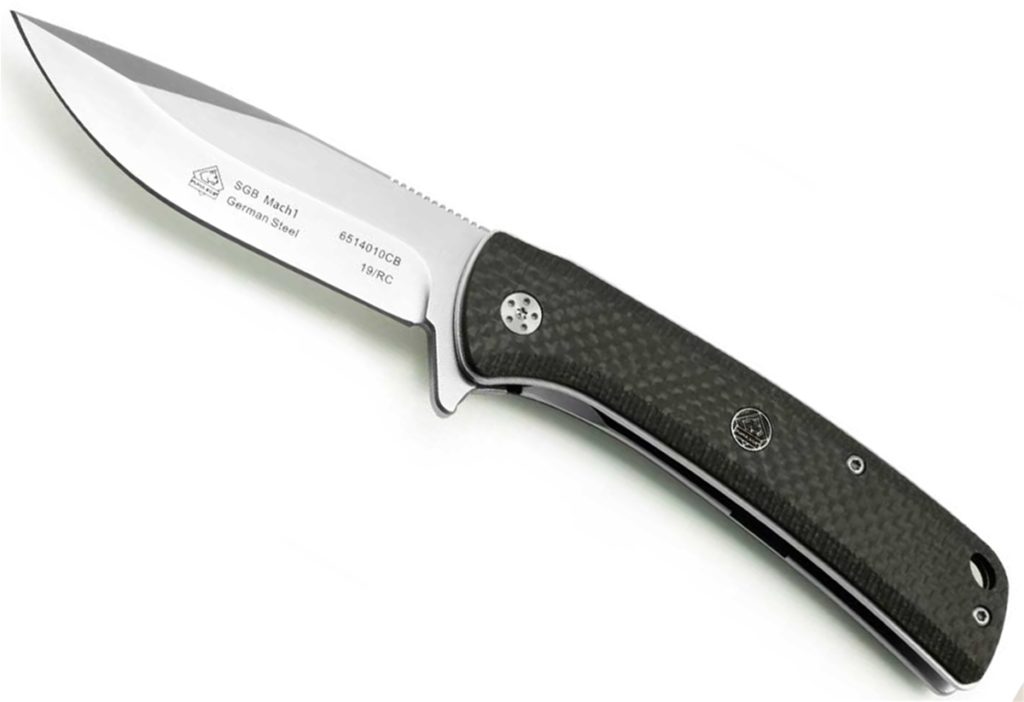
The Mach 1, along with the Sonic, are linerlock flipper folders Puma SGB introduced in 2020. They are identical, sharing the same handle materials/design and blade material. The only difference is the Sonic features a clip point blade and the Mach 1 has a modified drop point. With its hollow ground main bevel and generous, sweeping belly, the 3.6-inch blade in the latter pattern accomplishes a wide variety of cutting tasks. It is a large folder ideal for the ample knife jobs you have, indoors or out.

The German 1.4116 stainless steel holds an edge well and is fairly easy to resharpen. It is a steel found mainly in kitchen knives and is highly stain resistant. It isn’t commonly used in the knife industry, and expect performance to be equivalent to 440A or even 420HC stainless. Its lower overall production costs are passed on to you in the form of a great value.

A flipper tab offers quick and effortless one-hand deployment. The swift, smooth action is aided by a pair of ceramic caged ball bearings in the pivot. The handle features nice carbon fiber scales, giving the Mach 1 a modern, futuristic appearance—it is eye catching the way the light reflects off the strands in the weave pattern. The chamfered edges of the carbon fiber are textured to aid grip retention. A deep carry, fold-over pocket clip totes the closed folder blade tip down in the pocket, deep enough to conceal the knife yet hold it within easy reach.

The Puma SGB Mach 1 matches 1.4116 stainless steel with a sturdy handle sporting carbon fiber scales and stainless steel liners. The blade rides on ceramic bearings for smooth opening and closing.

The Mach 1 checks all the boxes: great fit and finish, silky smooth blade action, and super sharp and ready to work right out of the box. The drop point blade adapts to most any task. The edge has a nice bite and easily sinks into the material being cut. As wide as the handle is, you can get a really good grip that instills confidence. The open-frame handle promotes ease of cleaning. Country of  origin: China. MSRP: $149.99. For the money, it’s a solid value in features and performance.

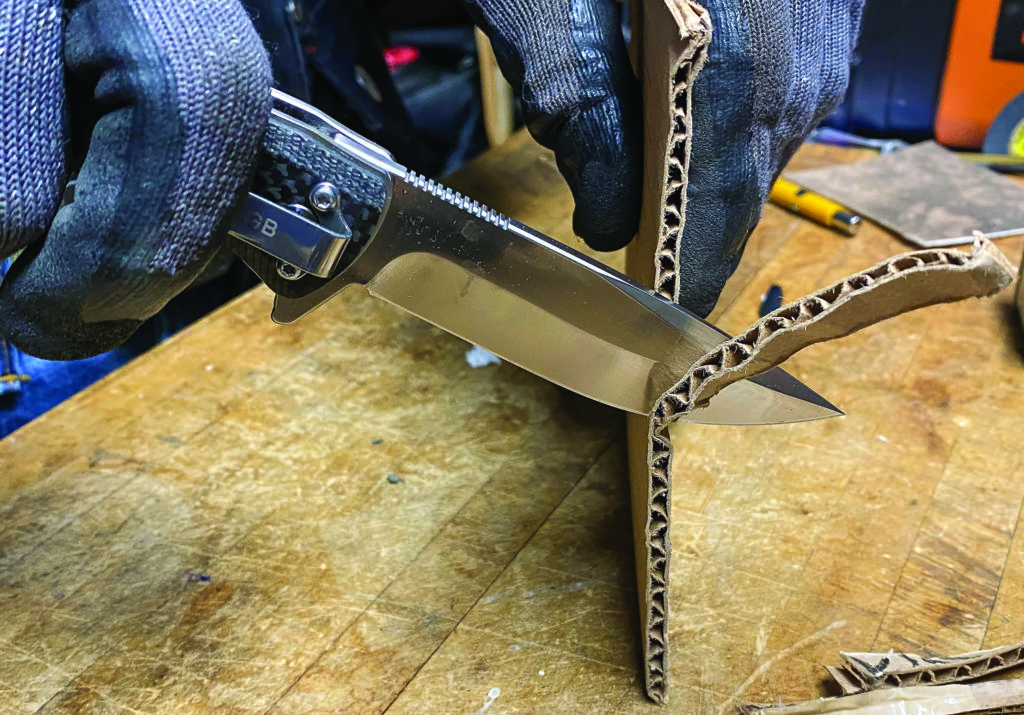
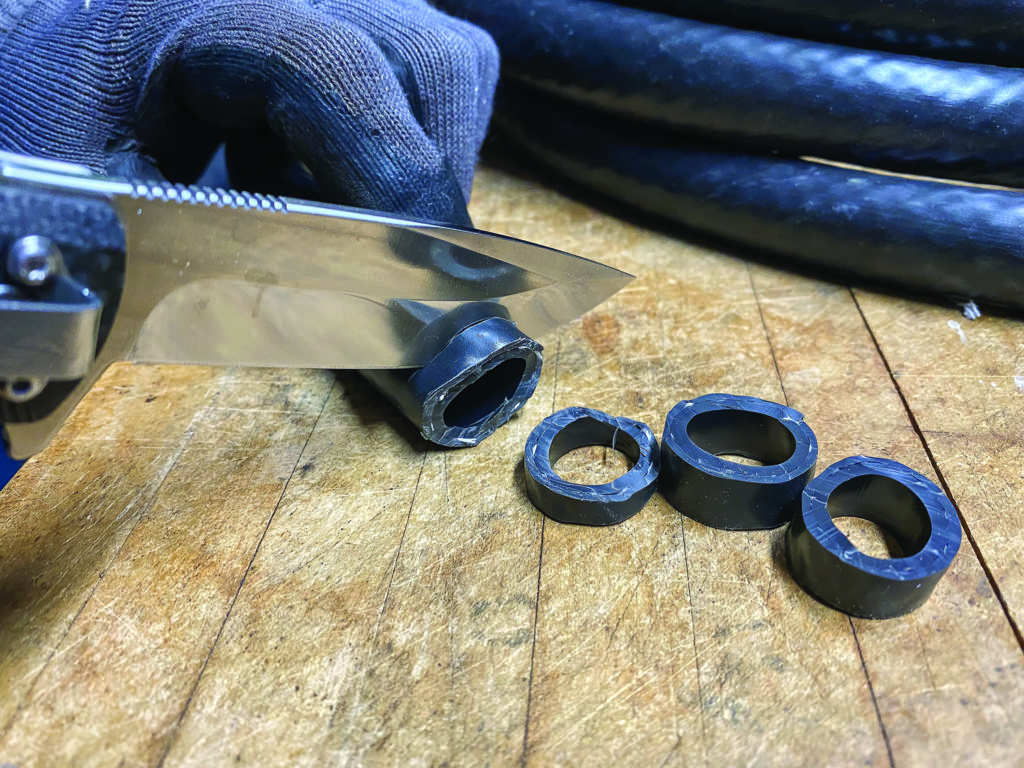
The hollow grind of the Puma SGB Mach 1’s drop point blade (middle left) helps provide plenty of bite for tough tasks such as cutting thick rubber hose.

NEW LEVEL of CHIC: F24 Nutcracker from Steel Will Knives

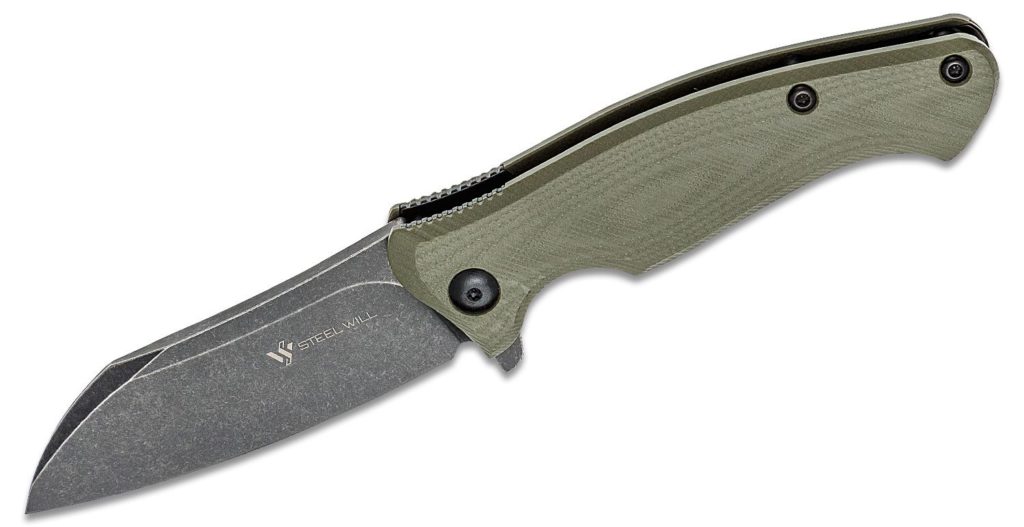
Taking EDC folders to a new level of chic, the F24 Nutcracker from Steel Will Knives features bold styling with a sheepsfoot blade and an ergonomic handle. The 3.4-inch blade is Bohler N690 stainless steel. The flat grind is tailored for both stout utility applications and lateral strength. A flipper is integrated for fast opening and is assisted by ceramic bearings, which promote super-smooth action and rapid deployment.

A large finger recess at the pivot allows you to index the G-10 grip, while the “bird’s beak” butt captures your hand. The G-10 has a light 3-D machining pattern that aids purchase. Traction notches at the thumb rest on the spine supply grip to bear down for power cuts. Dual nested stainless steel liners provide a rigid backbone and the nesting feature reduces overall handle thickness. Two large standoffs add style. A smaller standoff at the rear acts as a tie-off point for a lanyard (not included).

Even the pocket clip is nicely done. It’s sculpted, styled titanium that carries the closed folder blade tip up and is secured via one large screw. The clip’s shape mimics the handle’s curvature, and the overlay adds to aesthetics. It’s great to see a company put extra effort and thought into the clip, which looks better than standard stamped clips. It definitely holds the knife securely in the pocket.

The F24-33 Nutcracker has a black stonewashed blade, black liners, standoffs and clip, and a green G-10 handle. At 4.5 inches closed, the  knife is sized just right to handle just about any cutting task. The linerlock secures quite tightly at the lower third of the tang with no blade play. A series of traction notches at the exposed portion of the liner permits the thumb to easily seat and secure itself to unlock the blade. 


HOW LINERLOCKS SHOULD LOCK

Many knife nuts in-the-know have certain preferences to where a brand new linerlock knife’s lock spring should hit on the tang when the blade is locked open. Some prefer it to hit in the lower third of the tang, from the linerlock side. Some prefer it to hit in the middle.

One thing to remember about linerlocks is there is a break-in period for the lock. In other words, as the metal on the end of the lock spring wears to conform with the tang, it is likely that the spring will travel more toward the center of the tang—not a whole lot, just a little. Hence, it is probably best to select a linerlock knife where the spring hits on the lower third so it can compensate some following the break-in period.

— by Dexter Ewing

Above: The test linerlocks exhibit how they wedge the blades open at the tangs, from left: Steel Will Nutcracker, Puma SGB Mach I, Citadel Kampot and CRT CEO Bamboo. On the tang of the blade where the linerlock spring directly hits, the face is machined at an angle so that when the spring moves into place, there is a wedging effect that stops the spring from moving any farther. Titanium is an ideal material for the spring as titanium tends to gall, or stick, to steel, and, of course, the tang is steel.

4 Carbon Cutters: Steel With An Old School Feel

Carbon steel knives continue to be among the top factory performers.

High-performance stainless steels—CPM S30V, S35VN, S90V and 20CV, along with CPM 154, M390 and CTS 204P, to name some— rule in many corners of today’s knife market. While such steels exhibit astonishing edge-holding power and the ability to go the distance without much maintenance, the tradeoff is they can be difficult to sharpen. With the ascendance of such “super steels” you might think carbon steels would be gone for good.

Nothing could be further from the truth. While carbon steels may not attract the attention they once did, that doesn’t mean they’re no less a viable option for hunting, camping and even tactical knives. Many still prefer carbon steels over the high-performance stainless ones, and the primary reason is ease of sharpening, especially in the field. While carbon steels require a bit more maintenance, such as a light coat of oil to prevent corrosion and staining, they can give premium stainless steels a run for the money. Another factor is the all-important lower cost of carbon steels.


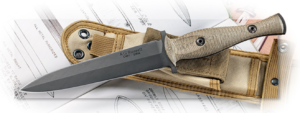
SANDBOX STEEL: A.G. Russell Knives Sandbox Dagger

Photo from agrussell.com

The inspiration for the Sandbox Dagger from A.G. Russell Knives comes straight from the old Camillus Marine Raider Stiletto and legendary Fairbairn-Sykes dagger, both of World War II fame. BLADE Magazine Cutlery Hall-Of-Fame® member A.G. Russell’s intent was to recreate the effectiveness of the venerable dagger designs while boosting the durability of the blade, as the tapered, relatively thin blades were prone to break. Carefully studying the old combat knives, A.G. devised the Sandbox Dagger.

Most daggers fail with broken tips. The A.G. Russell Sandbox Dagger in DM1 carbon steel is redesigned to allow for more blade tip thickness. The knife survived this sideways snap-out treatment with no damage whatsoever.

Beginning with a wider blade that takes longer to taper, thus giving it more body, he discovered new ways of grinding that allowed more stock thickness to remain, enhancing lateral strength. Traditionally a weak spot for daggers, the point thickness is more considerable as well. Another A.G. idea was to offer a “varied edge angle.” Most of the blade would be sharpened at A.G.’s preferred angle of 15 degrees, but toward the tip it changes to a more obtuse angle to bolster point strength. Phil Gibbs, company design engineer, was in charge of torture testing prototypes.  One of the tests he successfully performed was driving the dagger through an AK-47 magazine, with absolutely no damage to the tip, and the edge remaining very sharp.

The Sandbox Dagger from A.G. Russell is a highly functional cutting tool. It sliced up cardboard just as well as any single-edge knife would. It is razor sharp out of the box.

The 6-inch blade is DM1 steel, named in honor of bladesmith/metallurgist Dan Maragni, who assisted in its development and heat treatment for A.G. Russell Knives. It is a modified version of the 0170-6C carbon steel the old Camillus used when it made the Becker Knife & Tool line. (Today, KA-BAR makes all BK&T knives.) DM1 can sustain hard use without edge deformation or chipping, yet remains easy to resharpen.

The ergonomic handle is green, rib-textured Rucarta. The rounded handle expands toward the tang to better fit your hand. Indentations on either side give your thumb a non-slip resting place for grip retention, as well as a reference point for blade indexing. The blade is razor sharp out of the box.  Manufacturer’s suggested retail price (MSRP): $375. 


A-R-RMY, SIR! Case Hambone

Photo source: knifecenter.com

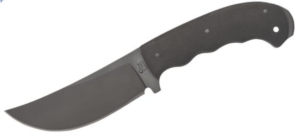
Knifemaker Daniel Winkler and U.S. Army veteran Clint Romesha (page ??) designed the Case Hambone to be a “do-all” field knife for field dressing, batonning wood, preparing food and more. Hambone was the nickname of the legendary U.S. Army pack mule Hamilton T. Bone. Hambone was based at Fort Carson, Colorado, as part of the pack mule program and served from 1943-56, including two combat missions during World War II—the same base Romesha operated from during his military career. 

Is it tactical or outdoor? How about both? The Case Hambone is a heavy-duty fixed blade of 80CrV2 carbon steel that will serve either function very well. The flat-ground blade slices easily.

Hambone the knife embodies the hardworking spirit of Hambone the pack mule. The 80CrV2 carbon steel is tough and holds an edge. The trailing point/skinner blade is 4.75 inches with a full flat grind and generous belly that facilitate chores like slicing and chopping/batonning. Handle material options are black canvas Micarta®, curly maple and black textured rubber. The finger-grooved handle with a bird’s-beak butt and integral guard ensures a secure grip in most conditions.

The eight stars engraved on the handle spine memorialize Romesha’s eight teammates who gave their lives during the Battle of Kamdesh in Afghanistan (page ??). The exposed blade tang can be employed as a hammer or glass breaker. The felt-lined Kydex sheath promotes sure knife retention and easy deployment equally well. Rather than having a typical fold-over or sandwich construction, the sheath uses a Micarta spacer to separate its Kydex halves. The OD green Kydex features black overlay with a star laser cut into it to symbolize the Army’s colors and logo.

The eight stars on the blade spine of the Case/Winkler Hambone memorialize the eight men who were part ofArmy Staff Sgt. Clint Romesha’s Cavalry unit who perished during a 2009 battle with Afghan rebels. Along with Daniel Winkler, Romesha designed the Hambone.

The Hambone’s deep blade belly is great for cutting meats and vegetables. The blade is fairly thick up to the tip, which makes it strong for heavy use and abuse. The handle is quite comfortable, providing ample blade control at all times, even with wet hands. The Micarta material is an excellent choice for an all-around user.

The only downside might be the weight. Some may find the knife too heavy on a belt, but, then again, the weight is one of the contributing factors to its cutting power. MSRPs: $325.99 (black canvas Micarta), $333.99 (curly maple) and $342.99 (textured rubber).   
 

TACTICAL CLASSIC: Steel Will Barghest

The Steel Will Barghest has all the hallmarks of a great tactical folder. The test model’s modified clip-point blade of 3.5 inches is full-flat ground from D2 tool steel, a favorite among production companies and custom makers for its toughness and ease of sharpening.  The blade opens via a flipper or ambidextrous thumb studs, and the swedge grind adds a bit of attitude. The action is quick, smooth and precise, with the blade riding on a pair of phosphor bronze washers.
The Barghest and its D2 tool steel blade is the latest tactical folder from Steel Will. It comes in two sizes and two blade finishes, and features flipper opening as well as dual thumb studs. It’s a rugged EDC folder at a great MSRP ($84.99 and $89.99)

The handle is a study in the perfect tactical folder design well suited for prolonged use regardless of the elements. The  integral guard prevents your hand from slipping forward, and the handle gracefully curves and expands slightly at the midsection to fill your palm nicely without feeling too unwieldy.  The blade secures via a linerlock, and dual steel liners provide rigidity. Black G-10 scales feature a series of machined grooves that enhance your grip with or without gloves. A pronounced chamfer on the edges of the scales makes the Barghest feel very comfortable, eliminating any hot spots. A fold-over steel pocket clip carries the knife deep in a pocket. Steel Will also offers a second clip for lefties—just switch clips. The G-10 handle spacer sports large  traction notches, and is slightly oversized to make the notches stand out.

The Steel Will Barghest and its D2 blade packs the punch to get tough cutting jobs accomplished and still hold an edge very well.

The Barghest offers what I like in a tactical folder. The blade shape and size is ideal for many cutting tasks, not too small nor too large, and has plenty of bite to power through a variety of tough materials. D2 is a time-proven steel that withstands abuse yet is easy to maintain.
The only negative I see is the pocket clip.  Yes, it is a positive as well, but not everyone likes the deep-carry feature, as no part of the handle sticks above the pocket to grab onto. Hence, you must fish around a bit to grab the knife. Hey, you can’t please everyone! MSRPs: $84.99 (3.5-inch blade) and $89.99 (4-inch blade).


STOUT as it is SOLID: Condor Tool & Knife Blue Havoc

condortk.com

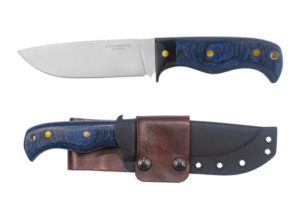
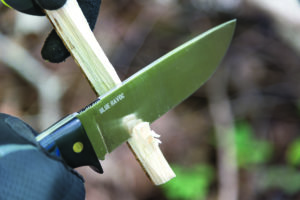
The Condor Tool & Knife Blue Havoc features a 5.5-inch drop-point blade of 1075 carbon steel mated to two-tone black-and-blue paper Micarta scales and a black phenolic bolster. The knife is a handful, a beast that can tackle any cutting task at camp or, in a pinch, use for combat. It is stout as it is solid. The satin-finished blade’s full flat grind is aces in cutting efficiency. A series of traction notches filed into the blade spine provide optimal positioning for applying downward pressure for tougher cutting tasks.

The Condor Tool & Knife Blue Havoc and its beastly blade of 1075 carbon steel can tackle most any camp cutting task.

The handle sports a generous palm swell that fills your grip comfortably, is non-slip and offers precise blade control. Micarta is an excellent choice for using knives because it is strong yet lightweight. It is impervious to most fluids and isn’t affected by weather changes, humidity, heat or most any external factor that would cause integrity issues. Plus, it comes in a myriad of hues to please the pickiest knife enthusiast. The dual-color Micarta® layers show through, adding an exciting visual texture, more so than any solid color Micarta can offer. Integral front and rear guards prevent unwanted hand movement in either direction, and the front guard enables you to choke up to exercise control for precise cutting. As big as the knife is, it’s important that it be able to tackle finer cutting as well, especially in a camp or survival scenario.

The Condor Tool & Knife Havoc is an edged tool to take on your next camping trip. Its droppoint blade and ergonomic handle are ideal for a variety of cutting tasks.

The Blue Havoc’s sheath materials are an unusual mix: molded Kydex and a leather belt loop. Most Kydex sheaths usually have either a Kydex belt loop or some sort of quick-release attachment, such as a Blade-Tech Tek-Lok. The reason Condor went with the leather belt loop on a Kydex sheath is to allow you to remount the belt loop in the event the sheath orientation must be reversed to accommodate left-hand/side-body carry. Simply remove/replace two screws to dismount/remount the loop. Also, the leather allows the entire sheath to move on your belt to a degree to prevent the knife from being caught up in bushes, branches, etc.

Condor’s catalog states the Blue Havoc can be used in either a tactical or outdoor setting, though due to its appearance, the knife is probably better suited for outdoor use. Moreover, the drop-point blade shape makes it a great camp utility knife for food prep or field dressing/skinning tasks. The 1075 carbon steel resharpens very well, which helps at the campsite. MSRP: $134.98.  

STILL RELEVANT

Carbon steel is alive and well at a time when super steels are all the rage. It remains the steel of choice of many hardcore knife users, not only for the lower cost but primarily for the ease of sharpening. It may require a bit more maintenance than stainless, but carbon steel is still relevant and here to stay.


Three Blades with an East Asian Design Flair

Three blades with an Eastern design flair are zesty cutters

For many decades Asian knives, tools and swords languished in the cutlery industry, remembered most for blades brought back by U.S. service personnel who fought in the Pacific during World War II. Times have certainly changed, thanks in no small part to a highly accomplished custom knifemaker named Bob Lum.

Of Asian descent, Lum introduced the custom knife world to his “American” version of the Japanese tanto and leaf-shaped blades circa 1980. Through the balance of the ’80s, and later in the ’90s, Lum’s tanto design was rabidly embraced by a budding modern tactical knife crowd. The tanto has been a mainstay ever since. Other Asian blade styles, such as the bolo and kukri, have been embraced as well. My team and I look at three modern takes on the “Asian Equation” here and put these intriguing cutters through the paces.

CHAMP CHOPPER: Spyderco Lum Darn Dao

source: knifecenter.com

Designed by Lum before he passed away way too early in 2007, the Spyderco Lum Darn Dao is a full-tang Chinese dao-style knife. Overall length: 16.27 inches. The 10.63-inch blade is CPM 154 stainless steel with a flared tip and a swedge grind terminating at the clip on the spine. The 5.64-inch handle has a flared base and the black G-10 scales are ample, fully sculpted and highly polished. A handcrafted dark brown leather sheath with a thumb-break retention loop comes standard. Weight (minus the sheath): 17.89 ounces. MSRP: $649.95. This is a limited edition of one production run only.

The first thing we noticed about the Lum Darn Dao is that it’s not as cumbersome as it initially looks, and then we realized it’s just shy of 18 ounces, which is not that unwieldy as large knives go. The handle is an exercise in comfort—well sculpted all the way around.

The Lum Darn Dao has a deep V-grind, making it an excellent slicer. Sisal rope was a piece of cake. Full grinds like that of the Darn Dao slice and chop well, as the edge doesn’t encounter the hump of a ricasso when it goes about its work.

One inch seemed to be the Darn Dao’s magic number. Employing a basic hammer grip, we used the blade to cut through 1-inch sisal rope like it was butter. When we challenged it on an old phone book (remember those?) with diagonal full-force chops, it repeatedly sunk in an inch deep. For long-term use we’d opt for a rougher finish or texture on the G-10 grip, but all in all the Darn Dao chopped like a champ. 

Specs: SPYDERCO LUM DARN DAO
Blade length: 10.63 inches
Blade steel: CPM 154 stainless
Handle length: 5.64 inches
Handle material: Sculpted G-10
Sheath: Leather belt carry
Weight: 17.89 ounces
Overall length: 16.27 inches
Country of origin: Taiwan
MSRP: $649.95

SHORT, WIDE HYBRID: SOG’s Kiku XR Blackout

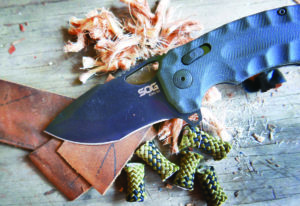
SOG’s Kiku XR Blackout is a mid-size folder 7.375 inches open and 4.3 inches closed. Designed by custom knifemaker Kiku Matsuda of Japan, the 3-inch black-coated blade of CTS-XHP stainless steel is a hybrid of the tanto style with some interesting twists. The main grind is recurved and there is a swedge grind on the spine that ends in a harpoon dip. The blade opens via a kidney-shaped hole in the blade or by an optional gimped flipper. The black handle has sculpted G-10 scales over black stainless steel liners, and SOG’s XR pull-down slide release unlocks the blade. On the rear is a blade-tip-up pocket clip. Weight: 5.19 ounces. MSRP: $189.95.


SOG’s Kiku XR Blackout has a hybrid version of the American tanto blade. The recurved portion of the main grind does a great job trapping leather and rope, and the tip finishes the job as it is pulled through.

The Kiku XR Blackout’s blade is shorter and wider than the traditional tanto pattern. We tested it first on 1.5-inch-wide harness leather, executing straight cuts and pull-throughs. The modified edge cut very well, though we almost ran out of blade while pulling upward through the leather strip.

Rope was much easier. The recurve of the blade trapped the rope, and the secondary grind from the dividing line—or yokoke—to the tip finished the job. It should be noted not all tantos have a yokoke; some simply sweep through upward to the tip. The cuts on 3/8-inch rappelling rope were clean as a whistle, while the edge tended to shred thicker 1-inch sisal. The handle was plenty comfortable and added to our cutting pleasure.

SPECS: SOG KIKU XR BLACKOUT
Blade length: 3 inches
Blade steel: CTS XHP stainless
Blade type: Hybrid American tanto
Handle material: Sculpted G-10
Special features: Multiple blade grinds
Carry: Pocket clip, blade tip upWeight: 5.19 ounces
Closed length: 4.375 inches
Country of origin: Taiwan
MSRP: $210.95

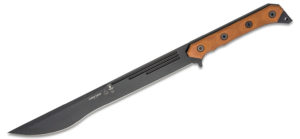
2-HAND HOSS: The TOPS CUMA Kage

photo source: knifecenter.com

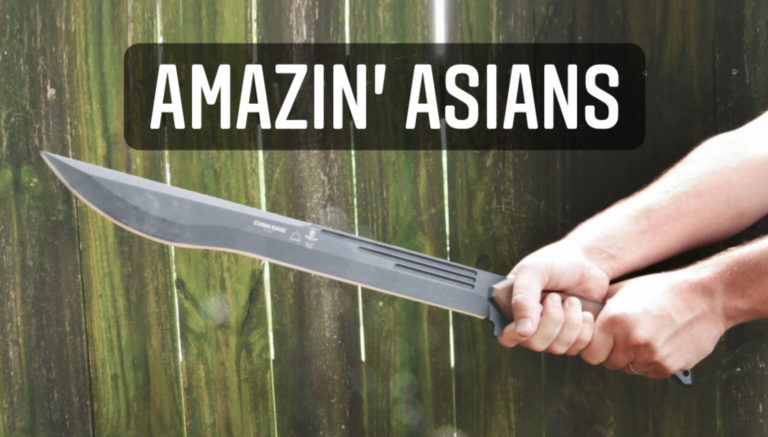
The TOPS CUMA Kage is a tour de force by martial arts guru Sijo Wayson Johnny Tsai. Overall length: 23.75 inches. The 15.5-inch blade of 1095 high carbon steel sports TOPS’ Black Traction Coating. The lengthy handle is 8.25 inches with Micarta scales sized for two-handed delivery. The blade is a hybrid straight sword pattern blended with 7 inches of kukri bulge at the tip to give it a bit of utility to go with its, ahem, badassery. It includes a full-length black Kydex sheath with a dangler/attachment ring. Weight: 31.5 ounces. MSRP: $360.

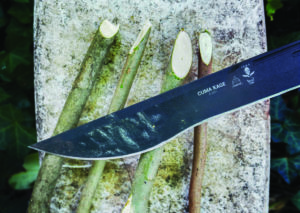
Using one hand or two, the author found the CUMA Kage cut brush equally well. However, as you might expect, you can take on much heavier tasks with it by using both hands.

To test the CUMA Kage for its utility billing, we took it outside for brush-clearing duty. We’ve always admired the kukri and have cleared an acre or two over the years with one, so this long send-up of the chopper intrigued me. We found out quickly we could use the CUMA Kage with one hand or two, which gives it a big leg up on its smaller cousin. The Micarta handle is well filled out and plenty grippy. One-handed we were able to easily whack through half-inch-thick green hardwood stalks and branches. Two-handed we sliced through stalks three-quarter of an inch with ease, and 1 inch as long as we had clearance to pull back for a full stroke. Though not the CUMA Kage’s original intent, it does have formidable utility.


Specs: TOPS CUMA KAGE
Blade length: 15.5 inches
Blade material: 1095 carbon steel
Blade finish: Black Traction Coating
Handle length: 8.25 inches
Handle material: Micarta
Special features: Kukri blade tip 
Sheath: Kydex w/leather dangler
Weight: 31.5 ounces
Overall length: 23.75 inches
Country of origin: USA
MSRP: $360

MELONIOUS ASSAULT

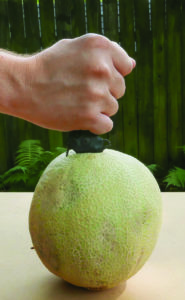
After testing the blades on a variety of fare, just for fun we took to the backyard to let them each have a go at a cantaloupe. Leading off with a reverse grip on the SOG Kiku XR, we stabbed the forlorn melon to the hilt. As stubby a version of the tanto as the Kiku XR’s blade may be, the cantaloupe’s pithy skin gave into the knife’s wishes quite easily.

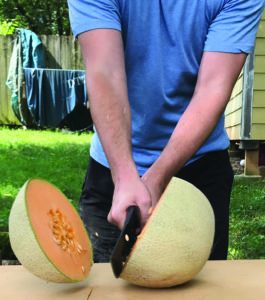
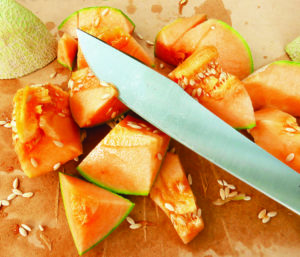
Next up the TOPS CUMA Kage tried the task of halving the cantaloupe in one fell swoop, which we captured in burst mode on my neighbor’s IPhone. Mission accomplished. Finally, we used the Lum Darn Dao to “prepare the meal” by using the blade in quick, rapid-fire chops. The sword’s deep V-grind—not unlike that of a chef’s knife—performed admirably.

Like an oversized chef’s knife, the Lum Darn Dao deftly whacked the cantaloupe into chunks with speed and style.

BEASTS of the EAST

While we often think of knives and swords of an Asian design in the context of combat and martial arts, it’s easy to forget that many Eastern blades were used for everyday utility as well. The tanto was an everyday carry by the Samurai class in Japan, and men and women alike carried a smaller version, the kaiken, aka kwaiken. The chisel grind was not typical on tantos as we see on some of them today, but on knives for culinary purposes. The Japanese kiridashi, which is rapidly gaining a toehold in the cutlery world, was also chisel ground and used for wood carving and marking.

The wicked Indian/Nepalese Kukri was employed in combat, but is primarily a tool for clearing land and is used widely for bush whacking today. Even the Indonesian karambit was considered a working knife by its users. If nothing else, the distinctiveness of Asian cutlery design has added richly to our knowledge base of cutlery and given us a plethora of modern-day knives to explore.

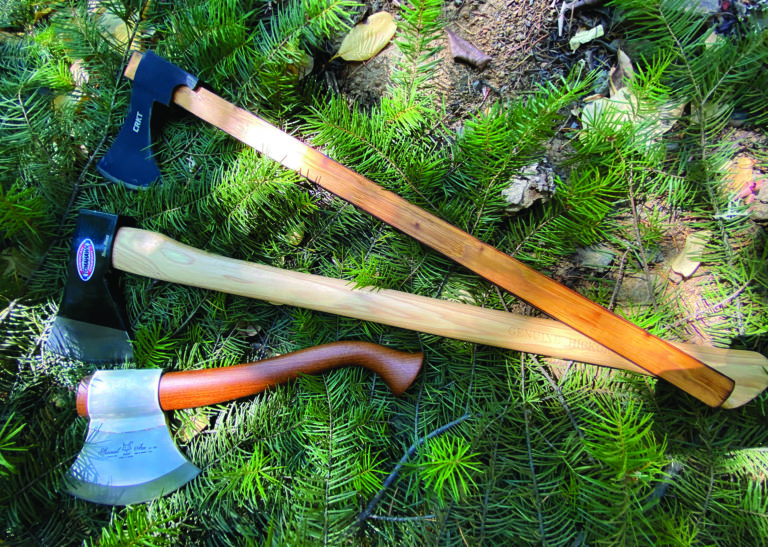
3 Awesome Axes for Chopping Wood Like a True Lumberjack

THREE FACTORY AXES TAKE THE CHOP, LIMB, TRIM, SHAVE AND STRIP TEST

BY JAMES MORGAN AYRES

We got snowed in one New Year’s in a rented cabin in the mountains. When I expressed concern about relying on electric heat in a remote cabin, the rental agent assured me that the electricity never went out. In any event, she said, “There was plenty of firewood for the fireplace and an axe. You’re an experienced outdoorsman. I’m sure you can cope.”

Of course, the electricity went out. I found about a cord of unsplit logs, each log 6-to-8 inches in diameter and 3 feet long. No split wood. No kindling. No axe. I batonned my ever-present Randall Model 1 around the edges of the logs to make kindling, and split enough wood to keep the fire going until the electricity came back on. Three days. I coped but every time I went to the wood pile, I wished I had an axe. Any of the axes in this field review would have been welcome.

Almost anything will chop softwood such as pine. For a proper challenge, we spent a day clearing madrone and oak at a friend’s property. Oak is a hardwood. Madrone is more fibrous and even tougher. We also split seasoned oak logs for our friend’s fireplace.

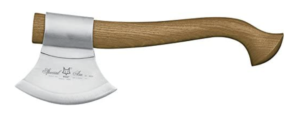
HIKING HACKER: The Fox Trekking Axe

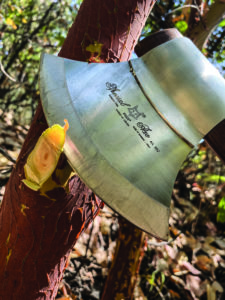
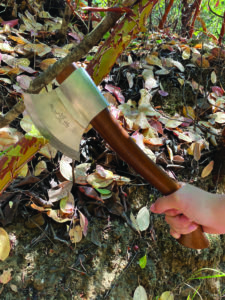
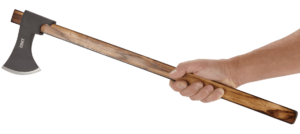
The Fox Trekking Axe is a terrific chopper for the backpacker, hunter or woods wanderer. Reminiscent of a medieval design, it’s light enough to keep in a rucksack and very well made.

The thin blade came sharp enough to cut paper and kept its edge during a day’s work. Its good edge geometry and balance, comfortable and ergonomic handle—well, really, its overall efficient configuration, which I suspect was inspired by an old, well-proven design—enabled painless hours of chopping, limbing and trimming. The long edge worked well for stripping and shaving bark to make bare poles. I have no doubt that the Trekking Axe would serve to quickly erect a shelter against an incoming mountain snowstorm, or dress out and break down an elk carcass. With its long, almost knife-like edge, it could also skin out the elk.

The thin blade, so efficient at taking down saplings and other work, tended to bind when chopped into the center of the seasoned oak logs. That’s a matter of geometry—the blade is not wedge shaped and won’t serve as a splitting maul, which is outside of its design envelope. A change in method overcame that limitation. By working around the edges and splitting off sections an inch or 3 thick, we were able to reduce logs to kindling.

Overall it’s a well-designed, well-made tool that I wouldn’t hesitate to take to the deep woods.

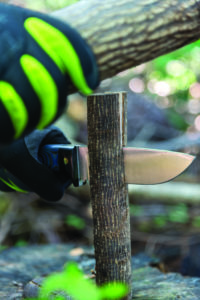
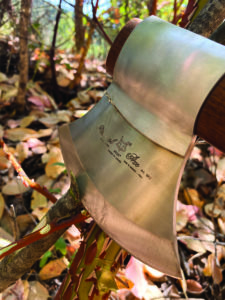
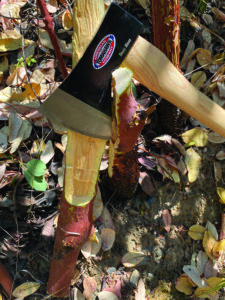
Good edge geometry and balance and a comfortable, ergonomic handle enabled painless hours of chopping, limbing and trimming with the Fox Trekking Axe. Here it chops the Ma- drone sapling with aplomb.

SPECS: FOX TREKKING AXE
CUTTING EDGE:
5.625”
BLADE STEEL: 12C27 Swedish stainless
HEAD WIDTH: 4.7”
HEAD THICKNESS: .22”
HEAD FINISH: Satin
HANDLE MATERIAL: Sassafras (wood)
WEIGHT: 13.8 ozs.
OVERALL LENGTH: 13.8”
COUNTRY OF ORIGIN: Italy
MSRP: $104.95

THAT’S AN AXE: Cold Steel Trail Boss

Photo from KnifeCenter.com

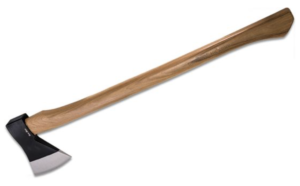
I hefted the Cold Steel Trail Boss, chopped through a 3-inch madrone sapling with one swing and paraphrased Crocodile Dundee’s line: “That’s an axe.”

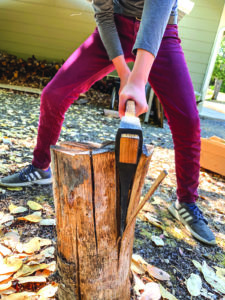
About the size of a traditional cruiser axe, the Trail Boss has a smooth, comfortable haft/handle in-between axe and tomahawk length. The long edge came sharp and stayed sharp. The head has good wedge-shaped geometry that made splitting the seasoned oak logs a breeze. Unlike a splitting axe, it was not too thick for general work. One whack to the center of the log and there were two split sections on the ground. It’s not a splitting maul or splitting axe but almost as efficient. While it has enough heft to split oak, it’s also light enough and balanced so that downing saplings could be done with full control and no danger of cutting through and swinging too far.

When limbing, it was easy to control for precise cuts, even when limbing with one hand. The haft is not as long as that of a full-sized axe, nor is the head as heavy. However, the head’s well-designed geometry, the smooth, comfortable handle and overall good balance enabled it to perform almost as well as one.

This is a good, all-around chopping tool—actually, an excellent all-around chopping tool.

SPECS: COLD STEEL TRAIL BOSS
CUTTING EDGE:
4.5”
BLADE MATERIAL: 1055 spring steel
HEAD WIDTH: 6.5”
FINISH: Black
HANDLE MATERIAL: Hickory
WEIGHT: 2 lbs., 9.5 ozs.
OVERALL LENGTH: 27”
SHEATH: Not Included
COUNTRY OF ORIGIN: Taiwan
MSRP: $49.99

FRANKISHLY SPEAKING: CRKT Cimbri

Photo from CRKTknives.com

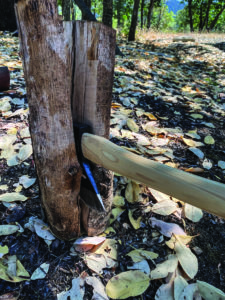
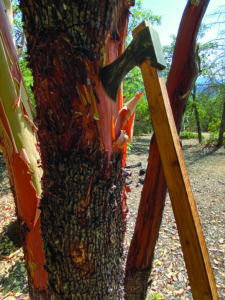
The CRKT Cimbri is an interesting design that, in my opinion, needs a bit of work to fulfill its potential. Modeled on a classic Frankish axe, with a nicely shaped head and a long handle, it is well balanced.

With a nicely shaped head and a long handle, the CRKT Cimbri is well balanced for such tasks as splitting oak logs.

Unfortunately, the edge wasn’t sharp out of the box and we test all knives, axes, tomahawks, swords, etc., as they come, so there’s a level playing field for all. The lack of a truly sharp edge required more force to chop through the saplings and impeded its penetration when splitting. Also, the thick coating on the carbon steel head caused it to drag in a cut. Even more unfortunate, and for some reason I do not understand, the haft is squared rather than oval or round. The acute edges of the haft/ handle not only were uncomfortable, they dug into our hands, producing blisters—in one instance breaking the skin of one of our testers’ palms.

The author stated he would round off the edges of the CRKT Cimbri’s squared-off haft.

Tuning up the edge would be a simple job, a matter of 20 or 30 minutes with a good stone. Reprofiling the haft wouldn’t be difficult, but I cannot understand why anyone would put a squared handle on an axe. Historical authenticity, perhaps?

SPECS: CRKT CIMBRI
BLADE LENGTH:
4.09”
BLADE MATERIAL: 1055 spring steel
HEAD THICKNESS: 1.26”
FINISH: Manganese phosphate coating
HANDLE MATERIAL: Tennessee hickory
WEIGHT: 2 lbs., .8 oz.
OVERALL LENGTH: 25.75”
DESIGNER: Elmer Roush
COUNTRY OF ORIGIN: Taiwan
MSRP: $69.99

AUTHOR’S CHOICES

Which of the three would I choose if I were again snowed in and had only a stack of logs to burn? If I hiked in, the Trekking Axe would be my choice, no question. I’m too old to hump anything heavier in a rucksack filled with camping gear, food and ammunition. If I arrived by car or truck, the Trail Boss would be it. If I had only the Cimbri, I would use my belt knife as a draw knife to take off the corners of the handle and smooth it. That done, 20 minutes with a sharpening stone and I’d head for the wood pile.


We Review 4 Drop Point Knives Priced $74-$450

VERY FEW BLADE PATTERNS SHARE THE STYLE AND GRACE OF THE DROP POINT.

Ever since BLADE Magazine Cutlery Hall-Of-Fame® member Bob Loveless popularized the drop-point hunter, there’s been a love affair with the eloquent blade style. Hunters have embraced it—not only for its good looks, but also because of its ability to process game cleanly and efficiently. The drop-point blade also has found a presence on modern tactical knives, attesting to its abilities as an overall effective design.

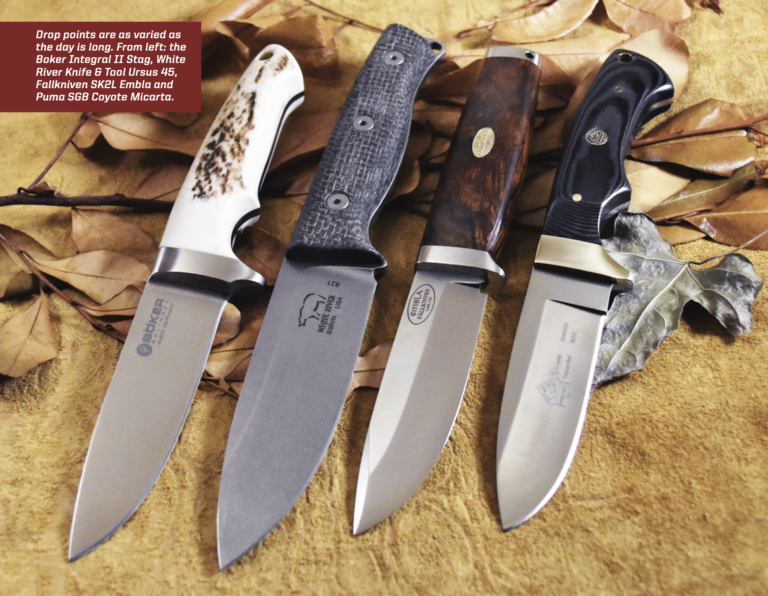
We’ll stick to hunting/sporting versions and examine a diverse group of drop points from manufacturers around the world. I tested the knives for a variety of chores, including carving and slicing wood, rope and leather, as well as functions particular to a given knife.

1.) SLICING FINE: The Puma SGB Coyote

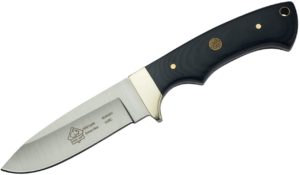
The Puma SGB Coyote Micarta is the budget entry in our quartet. SGB blades are made in Germany, and knife assembly is done in China for cost savings. The Coyote’s 3.75-inch, 440A stainless blade has a deep hollow grind, and its 8.25-inch overall length makes it a medium-sized hunter. Handle construction is full-tang stainless steel with an upper bolster and polished black Micarta® scales that sport a Puma medallion. Weight: 6.14 ounces. A ballistic nylon belt sheath is included. MSRP: $74.99.

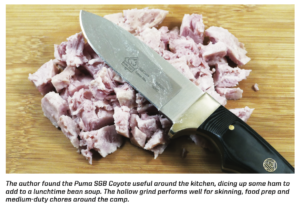
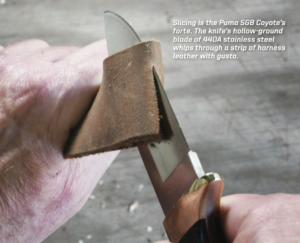
The only knife in the group with a hollow grind, the Coyote is geared toward fine slicing. Testing the blade on leather and rope revealed the 440A stainless steel to be more than adequate, slicing upward in pull-through strokes on harness leather and doubled-up, 3/8- inch synthetic rope in single strokes, both with ease. The blade performed equally well on flat push and pull slices on a wood table top. The handle is comfortable thanks to its nicely finished Micarta scales. I also used it to slice and dice ham to fortify some bean soup, and it handled the prep admirably.

The blade is not going to hold an edge as long as the more expensive steels and those with flat grinds—that’s just the nature of the beast. However, for its price point, it’s an outstanding value that will serve you well for skinning, food prep and medium-duty chores around the camp.

PUMA SGB COYOTE MICARTA SPECS
BLADE LENGTH: 3.75”
BLADE STEEL: 440A stainless
BLADE GRIND: Hollow
HANDLE MATERIAL: Black canvas Micarta®
SPECIAL FEATURES: German-made steel
SHEATH: Ballistic nylon; belt carry
WEIGHT: 6.14 ozs.
OVERALL LENGTH: 8.25”
COUNTRY OF ORIGIN: Germany (blade); China (assembly)
MSRP: $74.99

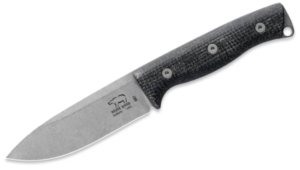
2.) BUSHCRAFT BEAR: The White River Knife & Tool Ursus 45

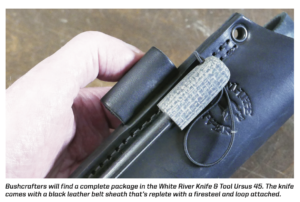
At 9.5 inches overall, the White River Knife & Tool Ursus 45 is a large hunter and the only USA-made drop point in the test bunch. Ursus is Latin for bear, and the “45” is short for the knife’s 4.5- inch blade. The upscale CPM S35VN stainless steel blade has a deep, flat grind topped with a stonewash finish. The 5-inch black burlap Micarta® handle has screw construction, and there’s a lanyard hole in the butt. A brown leather sheath, replete with both a firesteel and loop, is included. MSRP: $250.

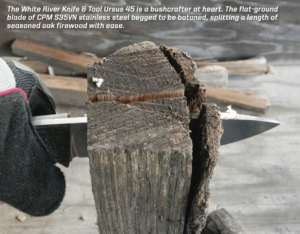
The 45 is a bushcraft knife and makes no bones about it. It screamed to be batoned, and I obliged by battering it through some well-seasoned oak firewood across a roughly 3.5-inch span. The edge of the premium S35VN blade was hardly fazed—this is darned tough steel!—and it also performed well debarking, slicing and digging into some dense boxwood. The blade spine threw sparks off the firesteel surprisingly well. (I find that most prefer tool steel for this function.) It had plenty of firepower. The scales were plenty grippy, and the finger guard and palm swell in the handle made for a strong, secure grip.

It would be hard to find any criticisms about the 45 because it does what it’s supposed to do without complaint. In addition, its price point is well in line with a bushcraft fixed blade with premium steel and above-average fit and finish.

WHITE RIVER KNIFE & TOOL URSUS 45 SPECS
BLADE LENGTH: 4.5”
BLADE STEEL: CPM S35VN stainless
BLADE GRIND: Flat
HANDLE MATERIAL: Black burlap Micarta®
SPECIAL FEATURES: Stonewash finish; firesteel
SHEATH: Brown leather belt sheath w/ firesteel loop
WEIGHT: 8.19 ozs.
OVERALL LENGTH: 9.5”
COUNTRY OF ORIGIN: USA
MSRP: $250

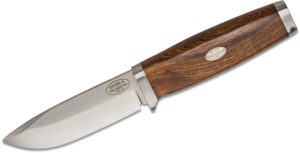
3.) HIGH-END CONVEX: The Fallkniven SK2L Embla

The Fallkniven SK2L Embla is the first of our two higher-end factory drop points.

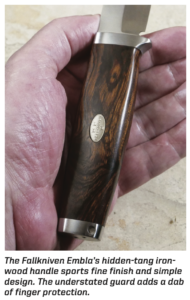
Made in Sweden, the 8.31-inch Embla derives its ovate, barrel-handled styling from the Scandinavian puukko. It also has a short, stainless steel guard. The 3.94-inch blade is Fallkniven’s laminated CoS stainless steel and is more indicative of the common drop-point style— with the exception of having a convex blade grind. The 4.38-inch handle has a hidden tang and desert ironwood scales sandwiched between a stainless guard and buttcap. A logo emblem rides at center. Manufactured in Japan, the Embla weighs 6.3 ounces and comes with a black leather dangler-style belt sheath. MSRP: $449.95.

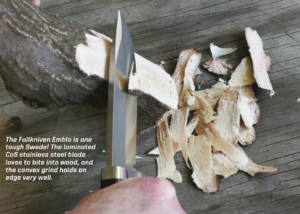
The Embla is the only knife in the group with a convex grind. I’ve mentioned how impressive the company’s laminated CoS stainless steel is in these pages before, and the Embla’s blade didn’t disappoint. I tested it by debarking and slicing into some tough, green, 3-inch-diameter boxwood. It dug in as if it wanted to be there. It also bit into some seasoned oak with equal gusto. The desert ironwood handle is attractive and comfortable, and the sheath is top-shelf.

Many bushcrafters prefer this traditional handle design and use it to great effect. The stainless steel guard, though not deep, is a welcome addition to the handle. The Embla ain’t cheap but it’s first-class from stem to stern. Fallkniven has filled the high-end niche by backing the knife with superb quality.

FALLKNIVEN SK2L EMBLA SPECS
BLADE LENGTH: 3.94”
BLADE STEEL: Laminated CoS stainless
BLADE GRIND: Convex
HANDLE MATERIAL: Desert ironwood
SPECIAL FEATURES: Puukko handle design; convex edge
SHEATH: Black leather belt model w/ dangler
WEIGHT: 6.3 ozs.
OVERALL LENGTH: 8.31”
COUNTRY OF ORIGIN: Japan
MSRP: $449.95

4.) SAVORY STEEL: The Boker Integral II Stag

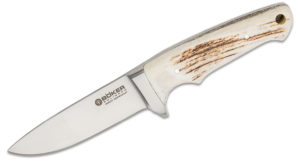
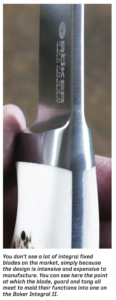
As the name implies, the Boker Integral II Stag features a one-piece design and a handle of an attractive, deep stag. The steel is 440C stainless steel—not unusual in Europe, where its manufacture is a high art. The blade is 4.65 inches long, with a flat grind from edge to spine. The handle design has a deep index finger detent below the solo front bolster. The knife comes with a black leather belt sheath. Weight: 8.47 ounces. Overall length: 9.45 inches. MSRP: $449.

The knife is 100 percent Solingen made, and its overall fit and finish reflect this fact. Real or imagined, integrals have a special feel about them. There’s a “oneness” in the tactile feel between hand and knife.

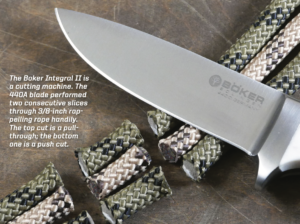
Any preconceived notions I might have had about the blade’s 440C steel were dispelled when I tested it cutting and carving wood, as well as slicing 3/8-inch rappelling rope. In one test, I laid down three lengths of the rope side by side on a flat wood surface and did a pull-through slice immediately followed by a push- through stroke. Only moderate pressure was needed, and the slices were clean as a whistle. The stag handle is comfortable and finely finished—as it should be at this knife’s upper-end price tag.

Will the Integral II’s steel hold an edge as long as a high-end powdered steel? Probably not. It is more a knife to savor than a knife to beat the hell out of, and it does “savoring” in spades. For those who prefer—and can afford—a beautifully crafted knife, this is one you’ll enjoy using.

BOKER INTEGRAL II STAG SPECS
BLADE LENGTH: 4.65”
BLADE STEEL: 440C stainless
BLADE GRIND: Flat
HANDLE MATERIAL: Deer stag
SPECIAL FEATURES: Integral design
SHEATH: Black leather belt model WEIGHT: 8.47 ozs.
OVERALL LENGTH: 9.45”
COUNTRY OF ORIGIN: Germany MSRP: $449

Editor’s note: Loveless always referred to the knife as a dropped hunter because the point of the blade dropped below the plane of the blade’s spine. Somewhere along the way, knife writers and those in the knife community started calling it a drop-point hunter or simply a drop point, and the name stuck. 


5 Out-The-Side Automatic Knives that are Stylish & Functional

By Dexter Ewing

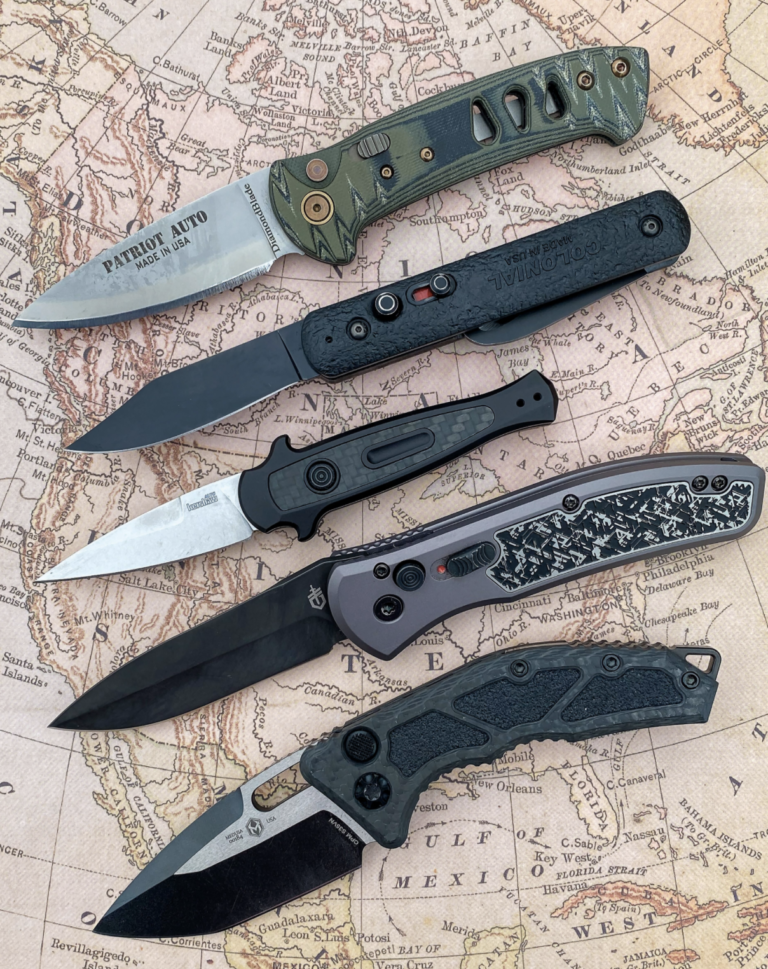
Because the blade opens swiftly by the press of a button, the automatic has a special aura knife enthusiasts dig. There’s something satisfying about the crisp snap! sound the blade makes when it opens and locks. Add the fact that all five of our out-the-side (OTS) test autos are American made and their aura takes on a winsome red-white-and-blue tint.

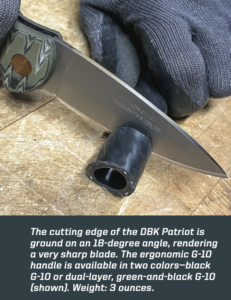
What better way to start off a story on all-American-mades than with the Patriot Auto from Diamondblade Knives (DBK)? Among its notable safety features are an integrated forward hand guard and a handle butt that drops down to help discourage rearward sliding of your hand. Plus, the handle is contoured for comfort over prolonged use.

Another interesting Patriot feature is it is the only auto this writer is aware of that incorporates not one but two springs to fire the blade. There is a traditional coil spring plus a kicker leaf spring of 17-4 stainless steel integrated into the handle spine that, after the blade is released, “throws” the blade out. The coil spring takes over from there, propelling the blade to the open and locked position. In this writer’s experience, the Patriot has the most recoil of any OTS.

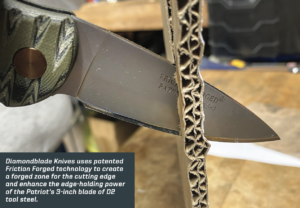
The blade is DBK’s patented Friction Forged D2 tool steel. You can clearly see the forged zone, which is demarcated similarly to a blade with a hamon. Due to the acute cutting edge angle, the blade has plenty of bite. Cutting meat, the Patriot is like a scalpel. Tougher materials such as cardboard and reinforced rubber hose are no match either.

Pros: The opening action is very responsive due to the twin spring setup. The lack of steel liners makes the knife thin, lightweight and easy to carry. The heavy-duty pocket clip totes the knife securely. Friction Forged technology enables the cutting edge to stay sharper for longer periods of time. There is a secondary sliding switch safety for additional carry security.

Cons: Because they are not steel, the Patriot’s liners widen the handle a bit, making it more comfortable for some users. This is not as stylish, appearance- wise, as other autos but the design works—and that’s what matters. There is a lack of gimping at the thumb rest on the handle spine. MSRP: $269.

UNOBTRUSIVE & STURDY

The Colonial Knife Model 556 automatic is tailored for law enforcement use. Though all black, it is an unassuming knife and doesn’t look aggressive.

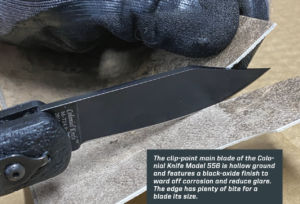
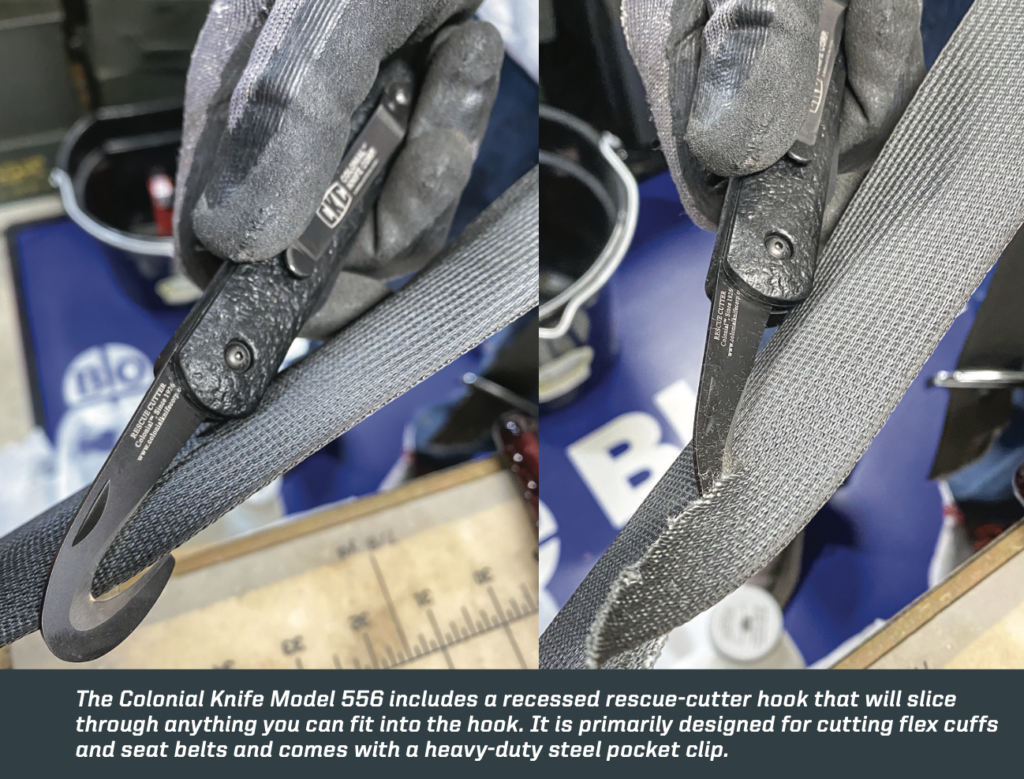
The slender-profiled handle with a rounded contour rests in your hand comfortably. The main blade is a hollow- ground clip point of 440A stainless steel. A secondary blade operates via a slip joint from the handle butt—a specially designed, recessed rescue-cutter hook. Originally designed to sever flex-cuff restraints used in law enforcement, the hook also can be used to cut jammed seat belts or to remove accident victim clothing for emergency medical treatment.

The handle is a highly durable, impact- resistant thermoplastic called Isoplast. It has high-tensile strength to withstand rough service. There is a molded-in, earthy-type texture that provides a nonslip grip without being aggressive and rough on pants material.

The main blade fires automatically. It works off a button with a sliding switch safety to prevent both accidental activation and locking. The blade opens quickly with no recoil.

Due to the handle’s slender cross section, combined with its 1-ounce weight, the knife is a pleasure to carry. It lacks bulk and weight, and because it doesn’t take up much room, you can easily slide your hand into a pocket to fish out keys or change.

Pros: The 556 is easy to carry and comfortable to hold. The clip holds the knife securely in a pocket. It is lightweight and the main blade cuts like a scalpel.

Cons: The thin blade tip could be susceptible to breakage if used roughly, and the slender profile might be a disadvantage for those with bigger hands. MSRP: $120.

LOOKER that PERFORMS

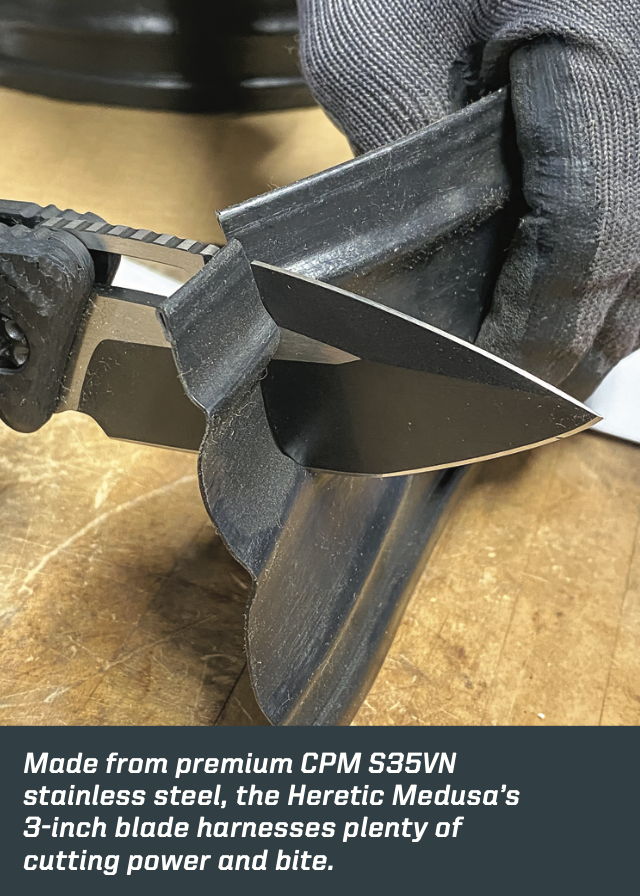
The Heretic Medusa OTS pairs a wide blade with a curved, slender-ish, ergonomic handle. When the knife is open, it almost looks as if the blade will not fit into the handle when closed. It is an interesting visual effect this writer finds whimsically appealing in folding knives.

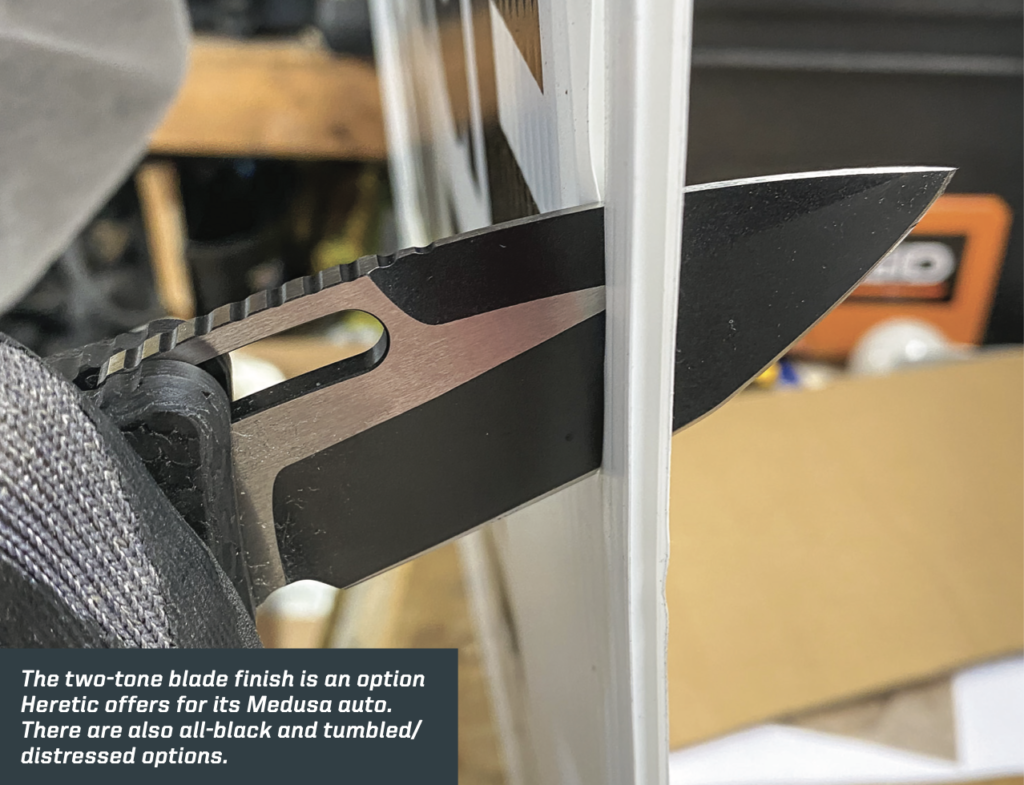
The blade finish is two-tone. The blade bevels have a KG Gunkote, and the flats are satin. The bit of bright silver popping through an otherwise all-black knife creates an interesting visual contrast.

The caged bearing system inside the coil spring assists with the ultra-smooth blade action. The handle is ergonomically shaped to fit the hand like a glove, with an integrated forward guard that tapers and curves to bring the rest of the handle into proper shape. Grip-tape inlays enhance hand traction. The tape is sufficiently recessed so it will not chafe pants fabric but not so deep that your fingers cannot touch it.

The handle comes in carbon fiber or anodized titanium and color options of black, green, blue, purple and orange. On the reverse side is a milled steel pocket clip with a large imbedded ball bearing on the end for ease of secure attachment/ detachment. The clip is unusual looking and not simply stamped steel. Some thought has obviously been invested into its appearance and function—very cool!

The handle has a steel spacer and a lanyard hole. The firing button is large, offers a checkered surface for a sure grip and sits flush to the handle surface. Firing the blade involves a deliberate push of the button. While there is no secondary safety, there is little to no danger of the Medusa’s blade firing accidentally.

Pros: The carbon-fiber version is extremely lightweight and a pleasure to carry. Since it’s recessed, the grip tape won’t damage your pocket. The flat- ground blade cuts very well and the tanto tip has excellent piercing capabilities.

Cons: The price is on the high side. In addition, some users do not like grip tape because it is too harsh on the fingers.

MSRPs: $322 to $350 for the aluminum- handle version and $434 to $462 for the carbon-fiber-handle one.

TACTICAL/STYLISH FUSION

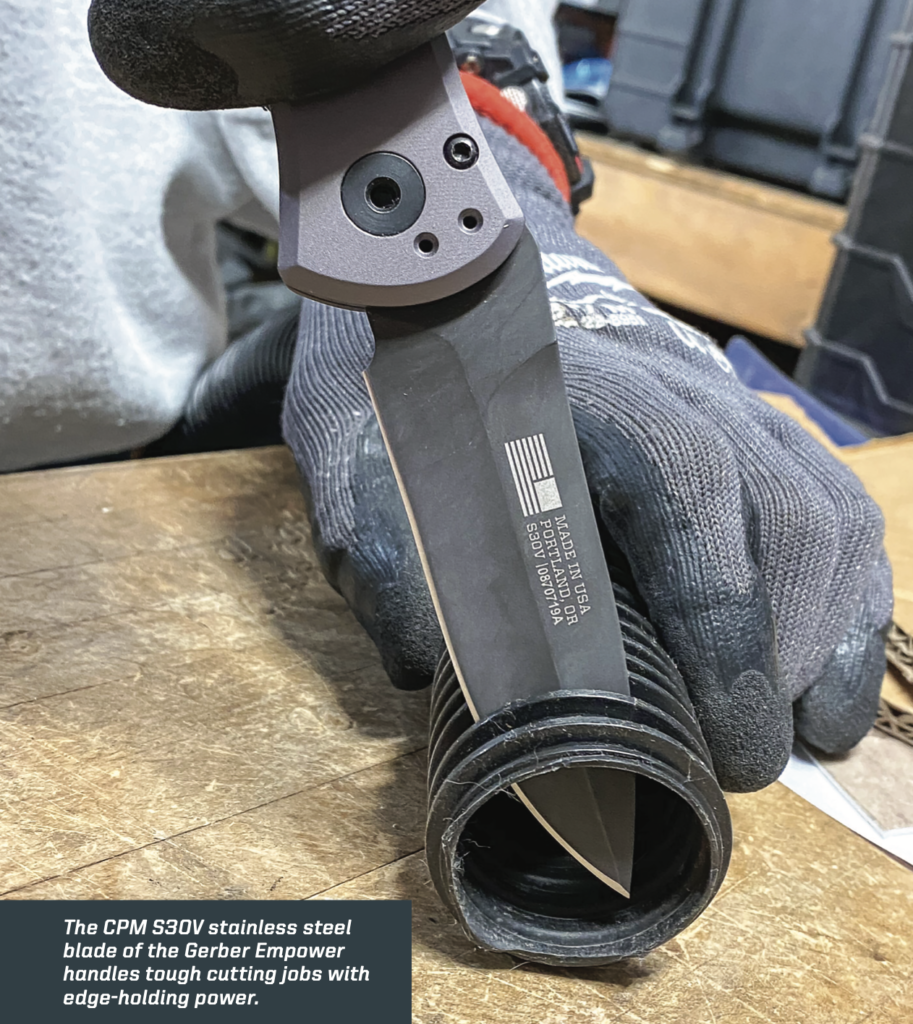
The Gerber Empower features a utilitarian-friendly, spear-point blade mated to an aluminum handle. The OTS infuses a bit of “sporty” with “heavy duty” resulting in a huge amount of practicality. The Empower employs CPM S30V stainless blade steel and a machined aluminum handle with Type III hard- anodized coating for scratch protection. The 3.25-inch blade can tackle some of the biggest daily cutting tasks. The nearly full-length swedge gives it a sleek appearance, and a black-oxide coating boosts corrosion resistance and non- glare properties.


An expanded area around the pivot acts as an integral guard, and gimping in several handle locations enhances purchase. For style and further hand traction, Gerber includes an inlay called the “Armored Grip”—a plate of stainless steel with an electroformed, random- textured pattern.

Because the button isn’t recessed into the handle, the secondary safety is a necessity. Why doesn’t Gerber recess the firing button? Some argue it creates issues when the user is wearing gloves: It’s hard to deploy the blade quickly if you cannot feel the button. The ramped sliding switch safety is easy to operate, even with gloves. When you see the red dot, the knife is ready to go!

The handle comes in black, gray, urban blue and multicam arid camo. All have black, plain-edged blades except for the black handle version, which is also available in a stonewashed finish as well as black coated and partly serrated. The steel pocket clip carries tip up or down.

Pros: Due to its Armored Grip inlay, the Empower is an interesting fusion of tactical and style. The spear-point blade is adaptable to many cutting tasks. There is a pronounced firing button and sliding switch safety that are easily accessible, even with gloves.

Cons: The pocket clip is not ambidextrous and the handle gimping isn’t aggressive enough. The recessed lanyard holes are small, so standard 550 cord will not work as a lanyard.

MSRPs: $130 (black-bladed models); $125 (stonewash); and $150 (Multicam Arid).

ITALIAN STALLION

The “little brother” to Kershaw’s bigger Launch 8 Italian-style, stiletto automatic, the Launch 12 offers the same design in a more compact and easier-to-carry/ use package. Custom knifemaker Matt Diskin configured the Launch 8 and 12 to be modern versions of the classic Italian stiletto switchblades with the iconic symmetrical blades and handle profiles, along with integral curved guards.

The blade releases via an inlaid firing button but lacks a secondary safety. Kershaw obviates this by designing the release to be an intentional action: You must depress the button deliberately in order to get the blade to fire.

The Launch 12 may seem to be merely a curio but is far from it. The smaller size allows it to ride in the pocket nicely. The handle width makes it comfortable to grip and provides a secure hold. The blade action is very crisp and ultra-quick (no doubt, the blade’s small size and light weight help in these regards).

Pros: The Launch 12 is a good pocket-carry size. The clip is ambidextrous and positions the knife as low as possible in a pocket. The knife offers great action. It’s small but there is enough handle width to make it comfortable in the hand, and it doesn’t feel as if it might slip from your grip. The carbon-fiber inlay adds a nice touch of class.

Cons: The size might be too small for some with larger hands, and the blade tip might be fragile for rough use. MSRP: $149.99.

Editor’s note: Be sure to check all laws that pertain to both you and the area in which you carry your automatic knives.

For the contact information for the pictured knives, see “Where To Get ’Em” on page 71.

For the latest knives, knife news, trends and more visit blademag.com, BLADE®’s popular Instagram page @blade_ magazine, and on Facebook and Twitter.

Advertisement

Must Read Articles

Read this before you make a knife

Knifemaking 101 – Read This Before You Make a Knife

  by Wayne Goddard My experience has taught me that there's nothing like digging in and getting started. I've often said the hardest part of the...
how to forge damascus steel

How to Forge Damascus

Advertisement
Advertisement