

Four custom makers push the boundaries of the tried-and-true cleaver.
An inclination toward the kitchen and a desire to design and deliver cutlery used on a regular basis has spurred a number of custom knifemakers to try their skill with the cleaver. It’s a staple in most kitchens and its uses are as varied as the food prepared there.
Robert Wayman of Middleburgh, New York, sees his cleavers as complementing years of food preparation. “I’ve done a lot of my own food processing, and I spent several years in commercial kitchens when I was younger,” he commented. “So, I’ve always had an affinity for culinary knives and especially cleavers. The cleaver is such an iconic blade. I love to make everything from heavy-duty butcher cleavers to medium-duty kitchen cleavers, Chinese cleavers and lighter-duty veggie cleavers for the kitchen.”
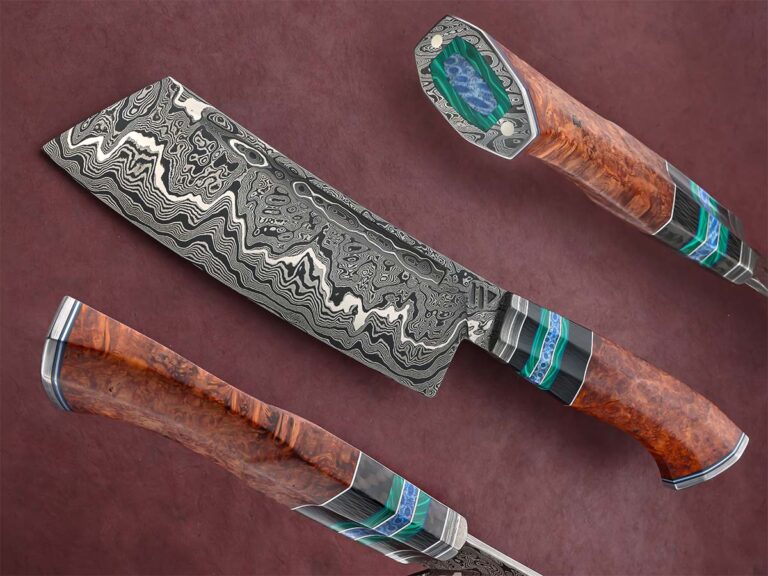
Robert’s featured cleaver is 14 inches in overall length with an 8-inch blade of pattern damascus go-mai five-layer steel. The core is a 100-layer random pattern damascus made of 1084 and 15N20 high-carbon steel and a layer of nickel and matching damascus cladding. The handle includes a damascus collar, stainless steel and G-10 spacers, crosscut carbon fiber, green malachite and blue coral accents, stabilized amboyna burl and a damascus butt cap with stainless mounting pins inset with blue coral framed with green malachite.
“I packed a lot into that one,” Wayman smiled. “As a maker, I’m all about sole authorship. I make all of my own high-carbon damascus steel in-house, and a cleaver provides a great opportunity to showcase that steel. One of my favorite things to forge is a large cleaver with an integral bolster.”
Wayman sees large blades, such as those associated with cleavers, as inherently challenging, while making a task-specific blade, such as a cleaver, adds another layer of complexity. Although they are labor-intensive and involve a lot of time in the shop, performance remains the key.
“Overall weight needs to be taken into consideration, as well as how that weight is distributed for the style cleaver you are making,” Robert advised. “Ergonomics is an important consideration for any knife or tool, but especially for kitchen cutlery. Whether it’s in a professional or home kitchen, you’re making a handle that a chef or cook could use for hours of food prep on any given day. So, it must be comfortable.”
Edgy Ebony
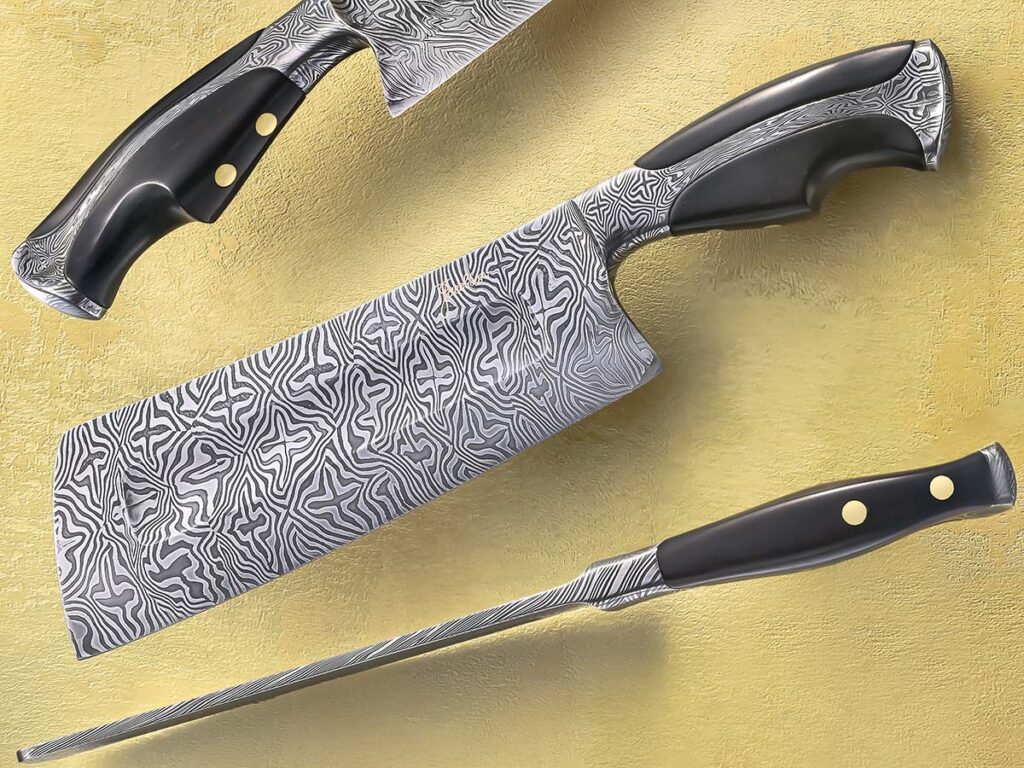
David Jacobson’s integral 13-inch cleaver with ebony handle scales sports an 8¼-inch mosaic damascus blade of 1085 and 15N20 steels and a gold inlay signature—his first such accent. He used brass bolt pins to finish the ebony scale attachment.
“I love cooking and making cool chef’s knives and kitchen tools,” Jacobson related from his Felton, California, shop. “Edge geometry for chopping and balance are challenges, and fullers are nice when slicing vegetables for food release. Cleavers are not only for the kitchen. They are great for large fish processing at the dock, chopping through bone and restaurant back-alley butchering. The wide blade shows off the many designs in the damascus steel, and I chose a traditional profile for this particular cleaver. I’ve always liked a black handle with big brass pins—old school.”
Cutting Mustard
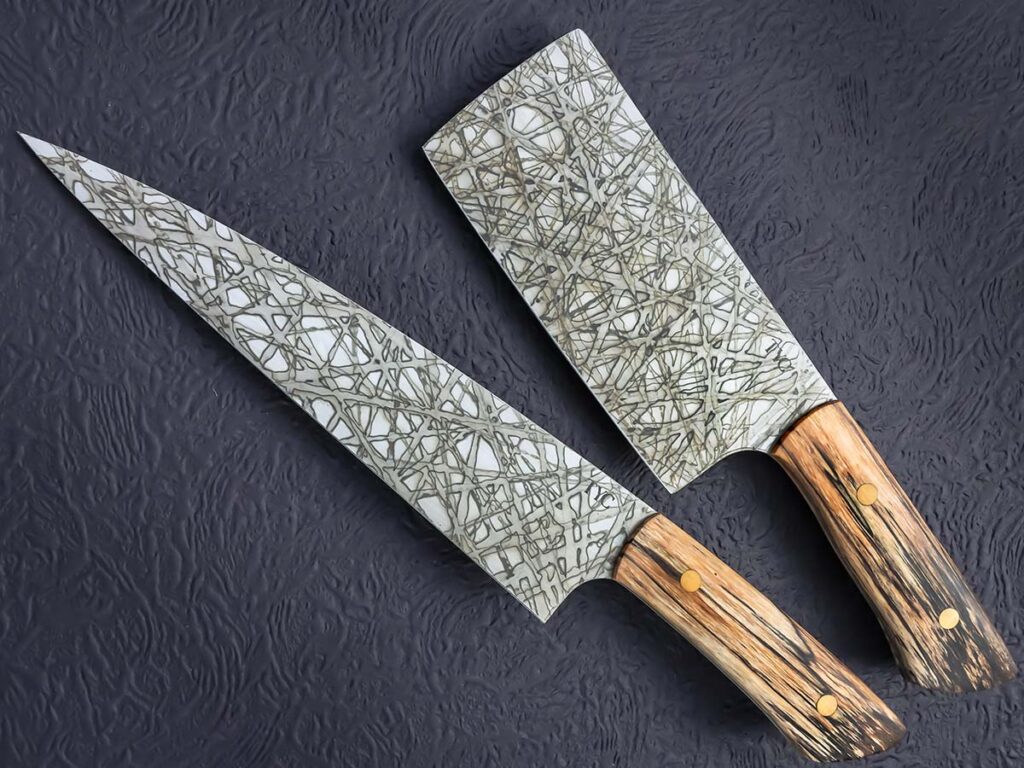
The pairing in Bill Tyc’s featured ensemble is stunning in its presentation. “The cleaver as well as the chef’s knife are made of 52100 high carbon steel from the NJ Steel Baron,” he remarked. “The handles are stabilized spalted tamarind from Wood Dynamics fastened with brass Corby bolts. The pattern on the steel is a mustard patina done with a ruler edge, hence the name “Lines of Insanity” pattern. The cleaver is 11½ inches overall with a 6¼-inch blade. It’s 3 inches tall and ¾ inches at the heel. I felt the spalted lines of the tamarind wood would look perfect with the mustard patina.”
Tyc, who resides in Waterbury, Connecticut, remembers making kitchen knives that did something no other creations had generated. He got immediate feedback from users.
“In fact, the first ‘kitchen’ knife I sold was a cleaver at the Mystic Knife Show in Connecticut,” Bill remembered. “A gentleman circled the floor three times, every time touching a cleaver I had on the table. Last pass, he picks it up and just says, ‘I’ll take it.’ My wife and I look at each other with a thumbs up, and off he goes. Well, the following year, the gentleman comes into the show, right up to my table, and says, ‘Last year I bought a cleaver from you.’ The wife and I again look at each other because we most certainly remembered. He says, ‘I have so much fun using that cleaver every day!’ I reached across the table, shook his hand and said, ‘I’ve been waiting 20 years to hear that! I could pack up and go home, I feel so good.’”
According to Tyc, many custom knifemakers shy away from cleavers because they require a lot of work. At just about any knife show, only a relative few are seen for sale. But he adds cleavers’ utility far exceeds their supposed kitchen niche, pointing out they are handy for camping, survival exercise, yard work and bushcraft as well.
“The most important things are balance and weight,” Bill observed. “A knife used as often as a kitchen knife or cleaver has to feel good in the hand, not just initially, but long term. You may find yourself using your kitchen knives for many hours through the week. You want it to be comfortable, not a labor.”
Veggies Beware
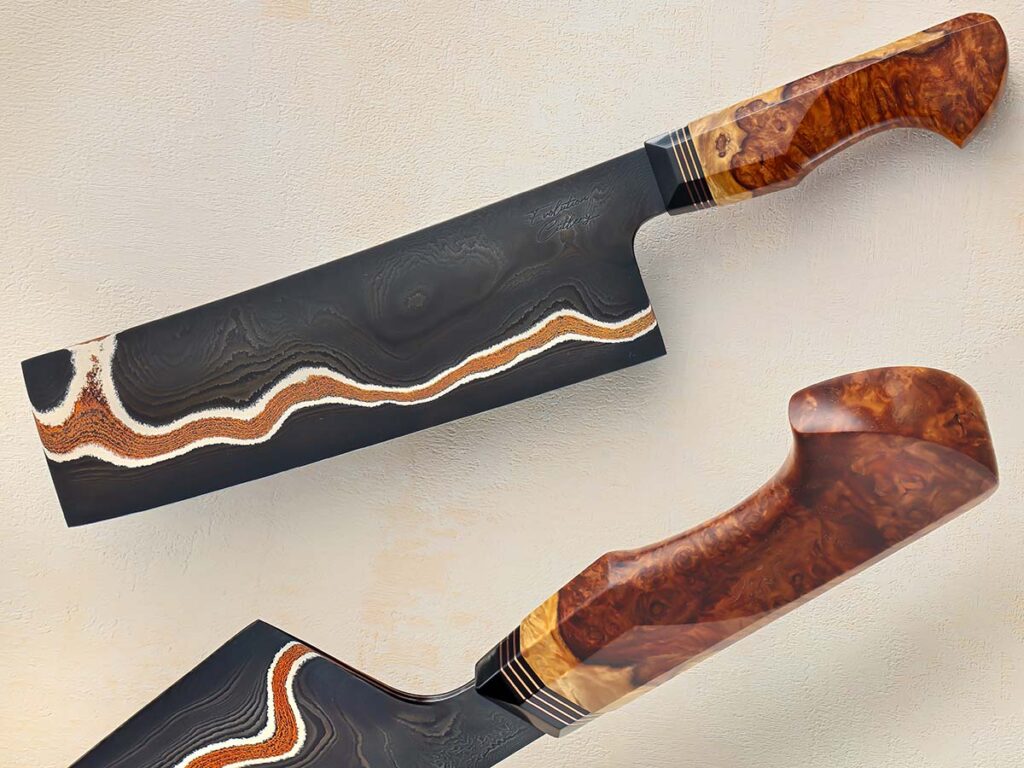
In 2016, Dan Tompkins began making knives, and three years later, he started Evolution Cutlery in Highland, New York. His kitchen knife work began simply because he wanted to make cutlery used on a daily basis, and his cleaver immediately attracts attention.
“The big square profile is a great canvas to show forging skills, especially if using mosaic damascus. It allows a lot of room to see the details in the patterning,” said Dan. The subject steel is Baker Forge copper mai with a blacked-out finish and layers of patina’d copper in the nakiri, or veggie cleaver, design. The handle is Tompkins’ hybrid octagonal/western style made from amboyna burl, heirloom fit to a copper and G-10 bolster. The cleaver blade measures 8½ inches, and the overall length is 13 inches.
“One challenge in making cleavers is getting the edge geometry perfect for the intended purpose,” explained Dan. “There are many different types of cleavers, so the proper geometry is an important consideration. Heavy-duty blades require a heavy convex edge, while veggie cleavers are best with a laser-thin edge. When it comes to kitchen knife ergonomics, not only do you have to have a good feel in the handle’s shape and contour, but you also have to have proper balance to make the knife comfortable to use all day. While cleavers will almost always be slightly blade heavy in balance, they should still be balanced not far in front of the handle … Balance can make a light knife feel heavy or a heavy knife feel light. In my opinion, even a heavy knife with proper balance is far more comfortable to use than a light knife with improper balance.”
Tompkins sees the cleaver in action in varied settings, not just the kitchen. Camp chores like chopping wood or preparing food outdoors can be handled easily with a cleaver made for such adventures, and he makes the cleaver to fit the anticipated tasks.
Versatility is readily apparent in these custom cleavers, and their functionality is in lockstep with good looks driven by their makers’ creativity.
Check Out More Cool Customs:
- Cool Custom: Jesse Hu’s Thorfinn Daggers
- Cool Custom: Stuart Kerr’s Cu Mai Dragon Is Built To Slay Beards
- Cool Custom: Robert Logan’s Tiny Fighter
- Cool Customs: Rocco Nawrocki’s Knife For Sergeant Bunker
 NEXT STEP: Download Your Free KNIFE GUIDE Issue of BLADE Magazine
BLADE’s annual Knife Guide Issue features the newest knives and sharpeners, plus knife and axe reviews, knife sheaths, kit knives and a Knife Industry Directory.Get your FREE digital PDF instant download of the annual Knife Guide. No, really! We will email it to you right now when you subscribe to the BLADE email newsletter.





