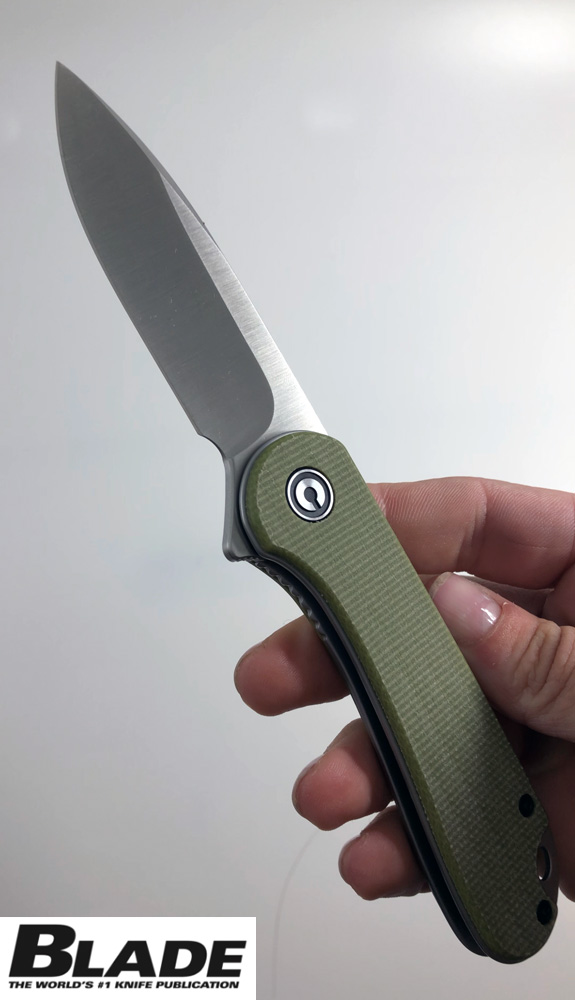
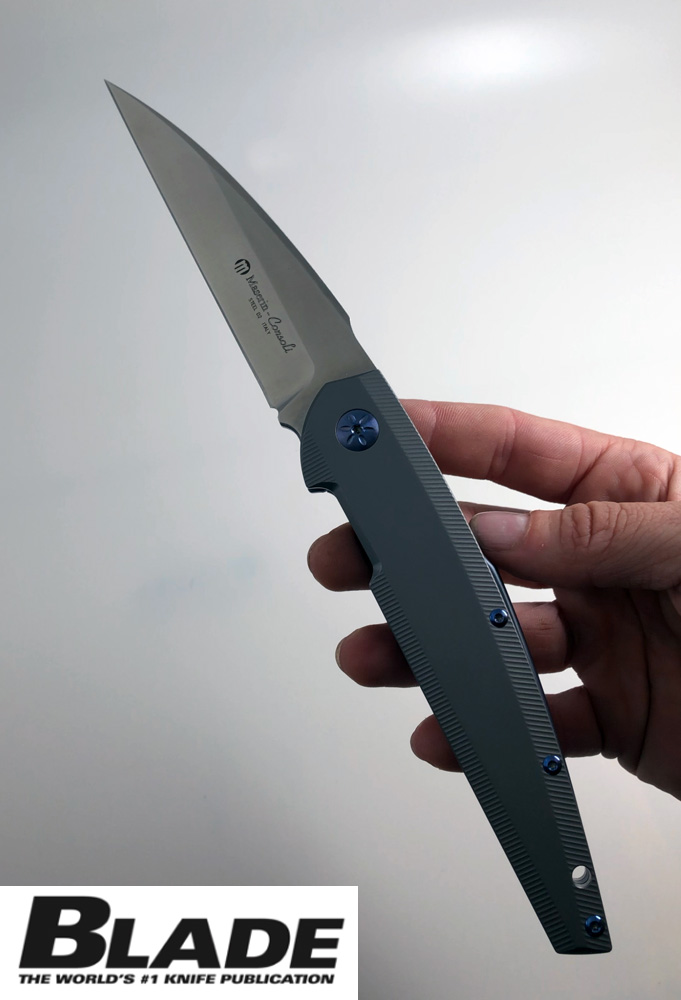
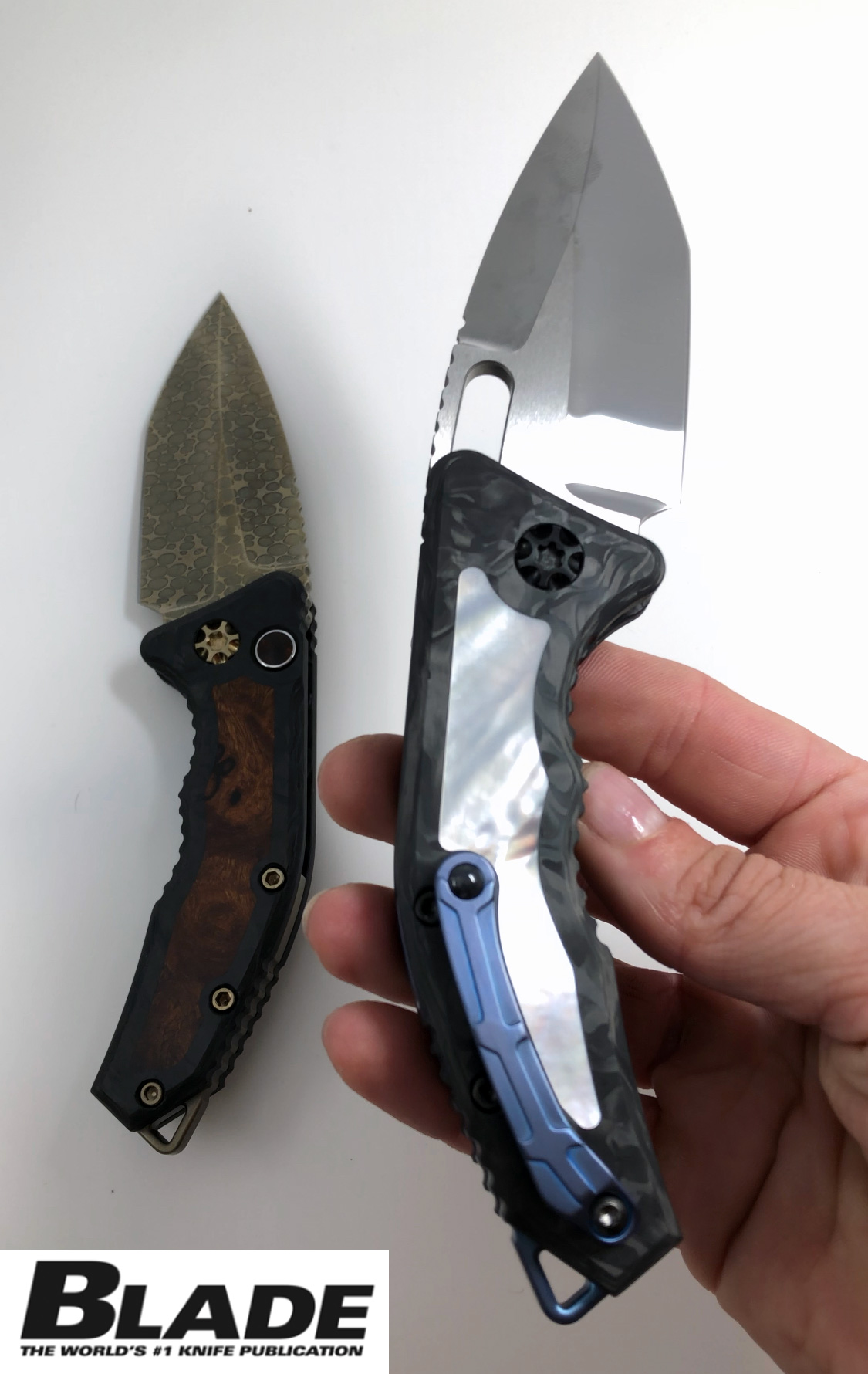
Hawaii has petitioned the Ninth Circut Court to overturn a recent decision making butterfly knives legal.
Knife Rights reported on September 22 that Hawaii had petitioned the Ninth Circuit Court for a rehearing en banc in an attempt to overturn a recent 3-0 panel decision that ruled the state’s balisong ban unconstitutional under the Second Amendment.
The panel decision in favor of the appellants in Teter v. Lopez was a big win for Second Amendment (2A) supporters. However, the decision would be rendered moot if the Ninth Circuit grants Hawaii’s petition for the en banc rehearing and then the state is somehow able to have the decision overturned.
Among other unconstitutional assertions, Hawaii’s petition claims that only weapons “commonly used for self-defense” are 2A protected. As Knife Rights (KR) points out, such a claim was refuted by the U.S. Supreme Court decision in New York State Rifle & Pistol Association, Inc. v. Bruen, which established that arms usable for “any lawful purpose” are 2A protected and not just those used “commonly for self-defense.”
Hawaii’s petition includes the dishonest claim, “If left undisturbed, the panel’s analysis will govern challenges involving many highly dangerous weapons that States quite reasonably seek to regulate or ban: assault weapons, high-capacity magazines, and more.”
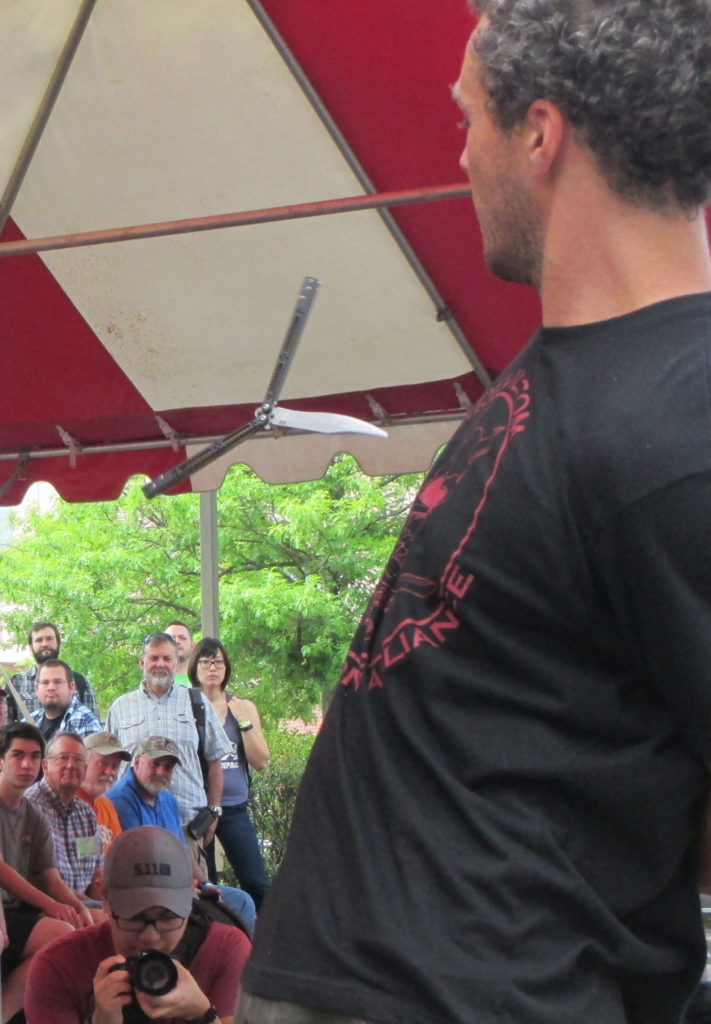
The state’s insinuation that a balisong is “a highly dangerous weapon” is ludicrous and unsupported by the facts. Where are all the instances and facts and figures of balisongs being highly dangerous? I’ve watched 13-year-olds-and-up flip balisongs for the past seven years at Blade HQ’s Battle for Bali-Champion at the BLADE Show, not to mention the West Coast Flipping Championships conducted by Squid Industries at BLADE Show West, and I’ve yet to see any “highly dangerous weapon” activity in any of them. Besides, if such contests were full of activity involving “highly dangerous weapons”—especially when youngsters are actively involved—not only would show officials cancel them but the venues hosting the shows would forbid them as well, something none of them have done.
BLADE Show 2017 hosted its first-ever balling competition coordinated by Blade HQ.
Adding to the absurdity of the state’s petition is its not-so-veiled attempt to include balisongs in the ambiguous world of “assault weapons.” “Assault weapon” is one of those anti-2A boogeyman catchall terms that has never been adequately defined for legal or legislative purposes by anyone or anything at any time—in large part because millions of items, from human fists to automobiles, are used as assault weapons. As a result, any law-abiding judge should reject any petition containing the term “assault weapon” as legally null and void due to its use of indefinable, overly inclusive language.
At press time, KR indicated the next step was for the petition to be circulated to all active Ninth Circuit judges and any senior judge who chose to participate. As KR noted, it was likely that the appellants would be required to respond to the petition about why the court should not rehear the case, though the judges could just vote on it instead. “Odds are that sooner or later the court will vote to rehear the case,” KR noted on its website, kniferights.org, “but we’ll see.”
If you live in Hawaii, contact your state officials and tell them to pull all the strings they can to uphold the panel’s decision asserting that the bali ban is unconstitutional. Meanwhile, stay tuned to KR’s website for updates. Considering the left-leaning history of the Ninth Circuit Court, this decision has huge precedent-setting implications.
You have NO need to read this article because it could never happen to you. Right? This article must have been written for knife-wielding thugs or street gang members. Right? Why would law enforcement authorities ever come after you? Right?
WRONG! Merely because you possess or carry a knife, knife law enforcers may try to justify their existence by turning you into an accused “law-abiding” criminal. Even though you are a careful, honest knife owner, with no intent to do any harm, and would never knowingly break the law, this can easily happen to you. I have plenty of criminal case files of examples of innocent, unsuspecting, law-abiding folks having to fight their way through the justice system to “prove their innocence.”
#1: Remain Silent
The Fifth Amendment protection against self-incrimination, also known as the “Right to Remain Silent,” is one of the most important Constitutional protections Americans have, that many other countries do not grant.
Yet, naive people in the United States routinely ignore Fifth Amendment protections and bury themselves with “explanations.” When it comes to a criminal violation, most law-abiding citizens are ignorant about the details of the law and its many loopholes and defenses. By opening their mouths, they remove all doubt about their ignorance and usually give the state something not just to use against them, but to twist against them.
#2: Ask for your Attorney
The Sixth Amendment guarantees an individual’s right to an attorney. By asking for your/an attorney and remaining silent, honest knife owners provide themselves with a fundamental foundation for a strong legal defense. Defense attorneys smile when they learn their clients stood firm on their rights.
Say, “I want my attorney.” If you do not already have an attorney, say, “I want an attorney.” Requesting an attorney does much more than simply getting legal counsel. Simply requesting an attorney causes a wall of Constitutional protection to spring up around you.
#3: Do Not Consent to Waiving Any Rights
A right given up is a right lost. Do not consent to a search without a warrant. Do not sign any documents or statements without an attorney’s advice. All citizens have a Fourth Amendment right to a warrant being issued before their person or premises are searched.
There are exceptions to the necessity for a warrant, and there is a large body of law that exists as to when law enforcement officers have justification or probable cause for a warrantless search. However, whether an exception for the warrantless search exists or not, you should never consent to a warrantless search.
Sometime in the early 1990s, a journalist—to the chagrin of the handful of other knifemakers also still working in Sheffield, England—described Stan Shaw as “The Last Little Mester,” and the title stuck until Stan’s passing in February. Stan made many fancy pocketknives but “Little Mester” was never simply a title that denoted mastership of a craft skill.
Historically, workers in the Sheffield cutlery industry were notoriously independent. As the industry moved from craft-based to industrialization, nearly all cutlers were on piece-work and would rent space in the workshop—a yard of bench or a “trough” for grinding. Work came from other workers, and each worker did a very specific task on the knife before it was passed to the next worker. The process was efficient because of the hyper-specialization of all of the workers in the chain. There was a complicated, ever-changing network of subcontracting, renting, supplying and rivalries, but no one learned all the processes to make a knife—there was no concept of sole-authorship.
In her thesis, Sally-Ann Taylor* states that the “differing opinions regarding the status of the little mester reflected the actual diversity in his possible position and role. Some felt that the title implied that his enterprise should involve him in a certain number of commercial risks and liabilities. Sometimes he was an actual workman himself, obtaining orders from larger factors, merchant or manufacturers, and then employing a few men to help him … sometimes even these workers would employ others beneath them, but usually only members of their own family—particularly women and children.” Hence, little mesters were small-scale flexible employers, recruiting workers to supplement their own labor as required.
In 1844, a commentator on the cutlery trades stated that “there are several modes of conducting the manufacture, but the factory system is not one of them … there is no large building, under a central authority, in which a piece of steel goes in one door and comes out at another converted into knives, scissors and razors. Nearly all the items of cutlery made at Sheffield travel about the town several times before they are finished.”**
HE KNEW at 14
Stan didn’t come from a cutlery background. He was born in 1926 in a small village outside Sheffield, and, after seeing a market stall of knives, decided at 14 that that was what he wanted to do. By chance, he walked into the prestigious company, Ibberson, and spoke to the owner, Billy Ibberson.
Pointing to a showcase displaying the firm’s best pocketknives, Stan said he’d like to learn how to make such knives. As Stan recalled, “Billy then fetched up one of the cutlers, Ted Osbourne—a little bloke about 5 feet or so tall—and asked, ‘Will you have him?” He said, ‘Yes.’ And I started on the Monday at an apprentice’s wage of 10 shillings a week.”
When Stan joined the firm, the old patterns of working had long gone; “little mesters” and “factors” had morphed into the more familiar patterns of factory working, with all the workers employed by the company and paid a wage. He was one of the last apprentices to be taken on and his curiosity about the entire process of making folding pocketknives was insatiable. As he moved through Ibberson and other companies over the years, he actively approached other workers to learn their processes as well as his own. It was this breadth of training that made him unique and was vital to him in later life.
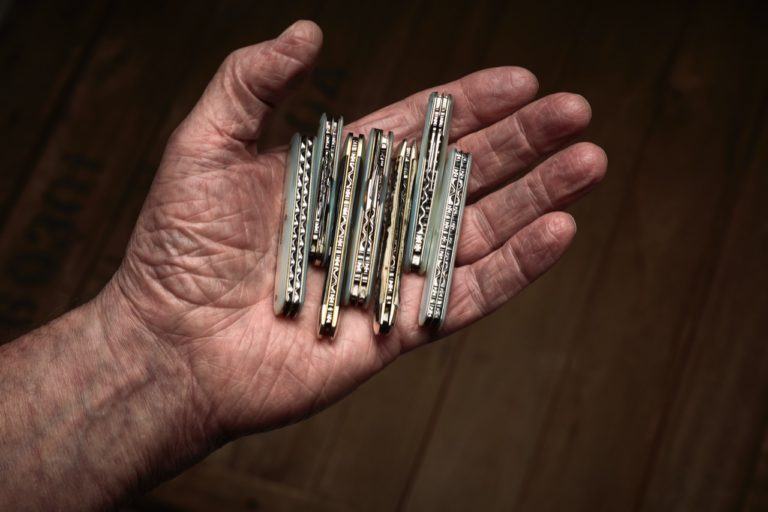
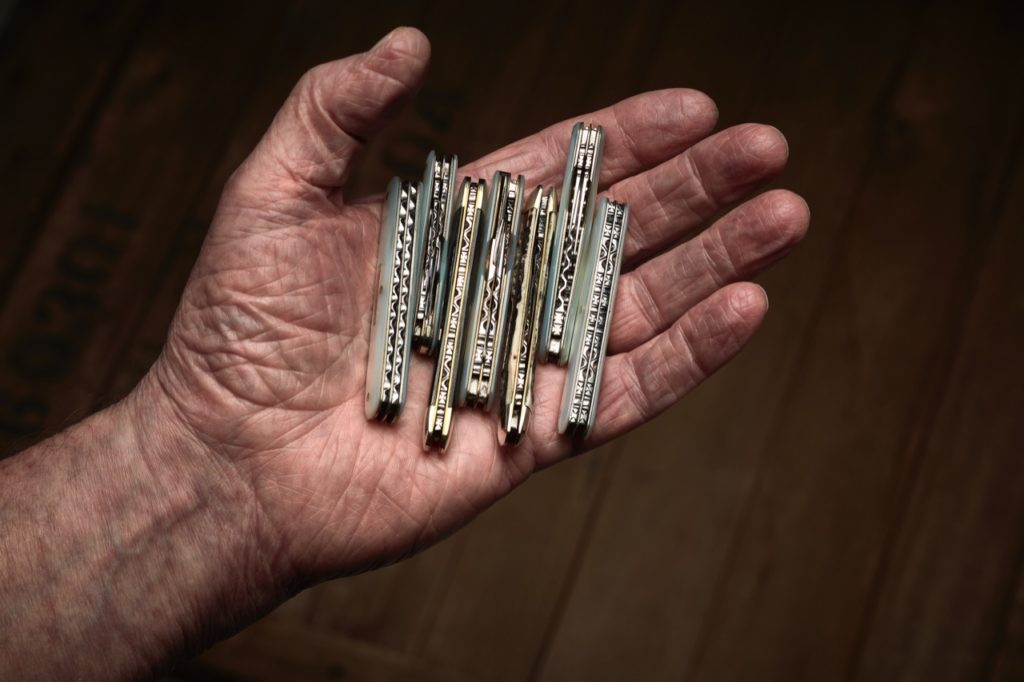
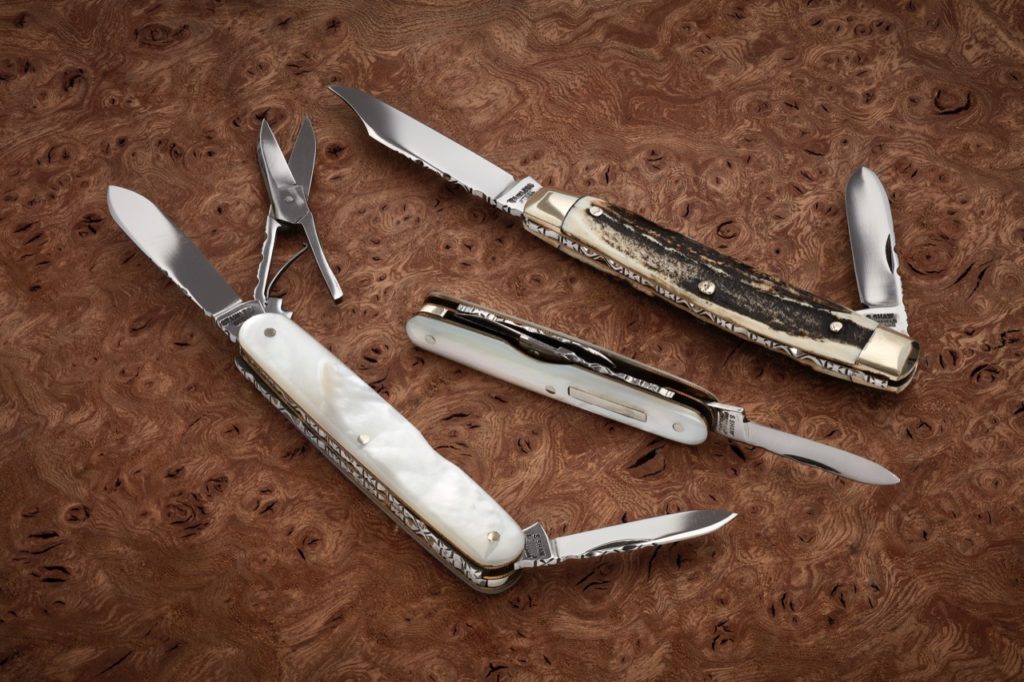
A sampling of Stan Shaw’s pocketknives with richly fileworked blade spines and backsprings. Look close and you can see the Maltese crosses for which Stan was so well known. (image by Carl Whitham, Sheffield)
THEIR PATHS CROSS
By the beginning of the 1980s, the contraction of the Sheffield cutlery industry was such that there were no more companies left to employ him, so he set-up his own workshop in Garden Street. It was there, 10 years later, that our paths crossed.
I had made a set of three folding knives for a college project and hadn’t been able to find anyone still making traditional Sheffield slip joints to ask for advice. A couple of years later, I heard Stan being interviewed on the radio and realized that I still desperately wanted to learn to make knives. I packed up my workshop in London and moved to Sheffield to persuade him, in person, to take me on as his apprentice. He welcomed me into his workshop but said that he was nearly 70 and too old for an apprentice. Instead, he offered me his bucket of old, handforged blades and springs, told me to select a handful and “go and figure it out yourself because it’s not that hard.” He would always be there to help if I got stuck.
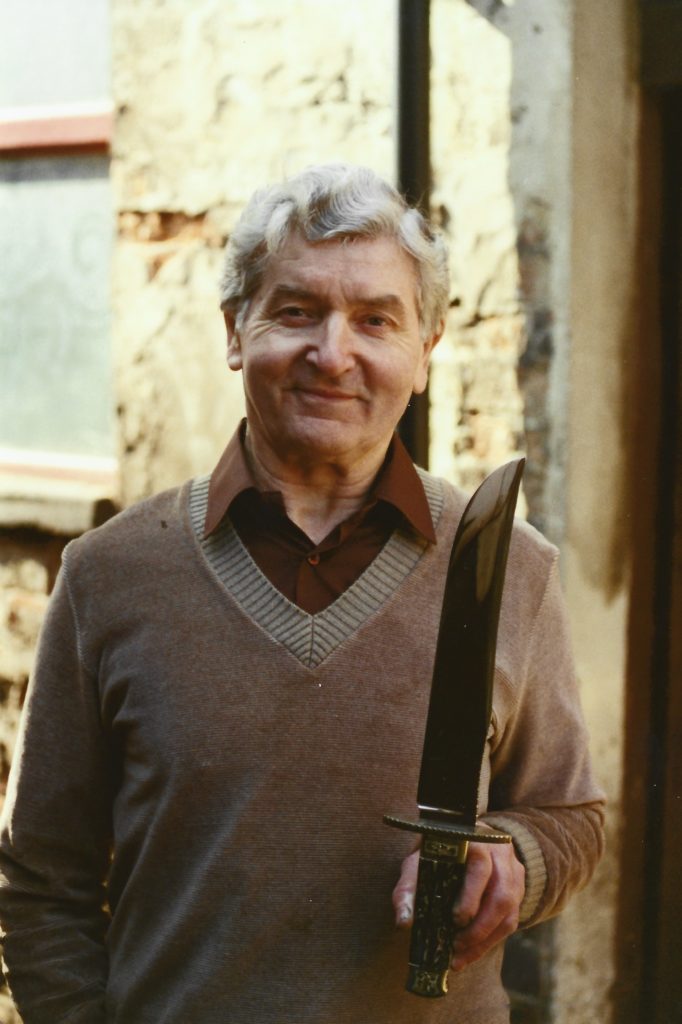
Stan Shaw as he appeared in the early 1990s. (Geoffrey Tweedale image)
A few years ago, when I was gently teasing him about still having a 10-year waiting list for his knives, he said, “I should have taken you on then, lass, you’d just about be useful to me now!” So, for all the times our paths crossed, for all the gentle encouragement and for completely changing my life’s path when I was 23 years old, thank you, Stan.
Stan was not a “little mester.” He was a master and was proud that he could make his knives from start to finish, a concept that would be completely alien to Sheffield knifemakers a hundred years ago.
Stan Shaw, whose career of making classic pocketknives spanned almost 80 years, passed in late February at the age of 94.
He started work for W.G. Ibberson in Sheffield, the old knifemaking capital of England, in 1941. Apprenticed to Fred and Ted Osborne, men Stan described as the two best cutlers in Sheffield, he eventually succeeded them in 1954 as the company’s top maker of pocketknives. Though the Sheffield knife industry was in rapid decline, he continued making knives, renting an old workshop in 1983 and becoming an independent cutler.
As Stan moved through Ibberson and other companies over the years, he actively approached other workers to learn their processes as well as his own. It was this breadth of training that made him unique and was vital to him in later life. (image by Carl Whitham, Sheffield)
As an independent he did it all in the making of his pocketknives, and he did it all quite well. As he said in “Stan Shaw: Little Mester of Sheffield” in the May 1994 BLADE: “I have to do everything now because there are no forgers, grinders, scissor-makers and so on left. My earlier experience with Ibberson’s has proved invaluable in that respect. All my knives are hafted, ground and assembled by me. It’s harder work but the satisfaction is greater. Scissors, files, punches, shields, shackles, handles, scales, bolsters—the list is endless—but each part is made by me on these wheels and dollies with only hacksaws, files and a few other traditional tools, such as my parser. The only job I don’t do is the occasional engraving I have done on the bolsters.”
His knives are testaments to the classic exhibition pieces, many with a host of blades and other tools and implements. In 2003 he became an honorary freeman of the Company Cutlers and in 2017 was awarded the British Empire Medal. As late as 2019, into his 90s, he continued to clock in bright and early in the mornings to make pocketknives at Kelham Island Museum. In the interim he served as a mentor to many makers, including award-winner Grace Horne, among others.—by BLADE® staff
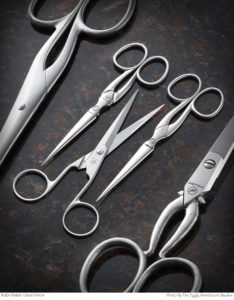
In addition to pocketknives, the author is also well known for her award-winning custom scissors made in the original knifemaking center of the United Kingdom—Sheffield, England. (Eric Eggly/PointSeven image)
The Author, Grace Horne
Editor’s note: An award-winning knifemaker from Sheffield, England, the author currently makes traditional folders. For more information contact her at Dept. BL9, The Old Public Convenience, 469 Fulwood Rd., Sheffield, United Kingdom, S10 30A [email protected], gracehorn.co.uk. Also: Steven and Kylie Cocker, Instagram @steven_cocker_sheffield; Michael May www.michaelmayknives.com; and/or Michael and Ashley Harrison plus apprentice at A Wrights & Sons www.penknives-and-scissors.co.uk.
*Tradition and Change: The Sheffield Cutlery Trades 1870-1914; Sally-Ann Taylor
**The Penny Magazine Supplement, April 1844, p.168; Thomas Allen
EDITOR’S NOTE: Regular BLADE® readers will remember the story about the author, Edmund Davidson, on page 10 of the February 2021 issue detailing how he narrowly hung on to beat the COVID virus. It was several months before that he had learned of the heroics of Virginia police officer Corey Wood in rescuing two young girls from a most harrowing accident, an accident that could have cost them their lives if not for Officer Wood’s sound thinking and quick action.
To salute Wood for his performance above and beyond the call of duty, on behalf of the National Society of the Sons of the American Revolution, the author presented him the SAR Life Saving Medal and certificate on Aug. 6, 2020.
After the author told us of the presentation, we suggested he make a special knife for the officer, too, which the author did and which appears herein.
Following is the story of how Officer Wood saved the day for the two youngsters, and preserved for them what we all can only hope will be most rewarding futures.
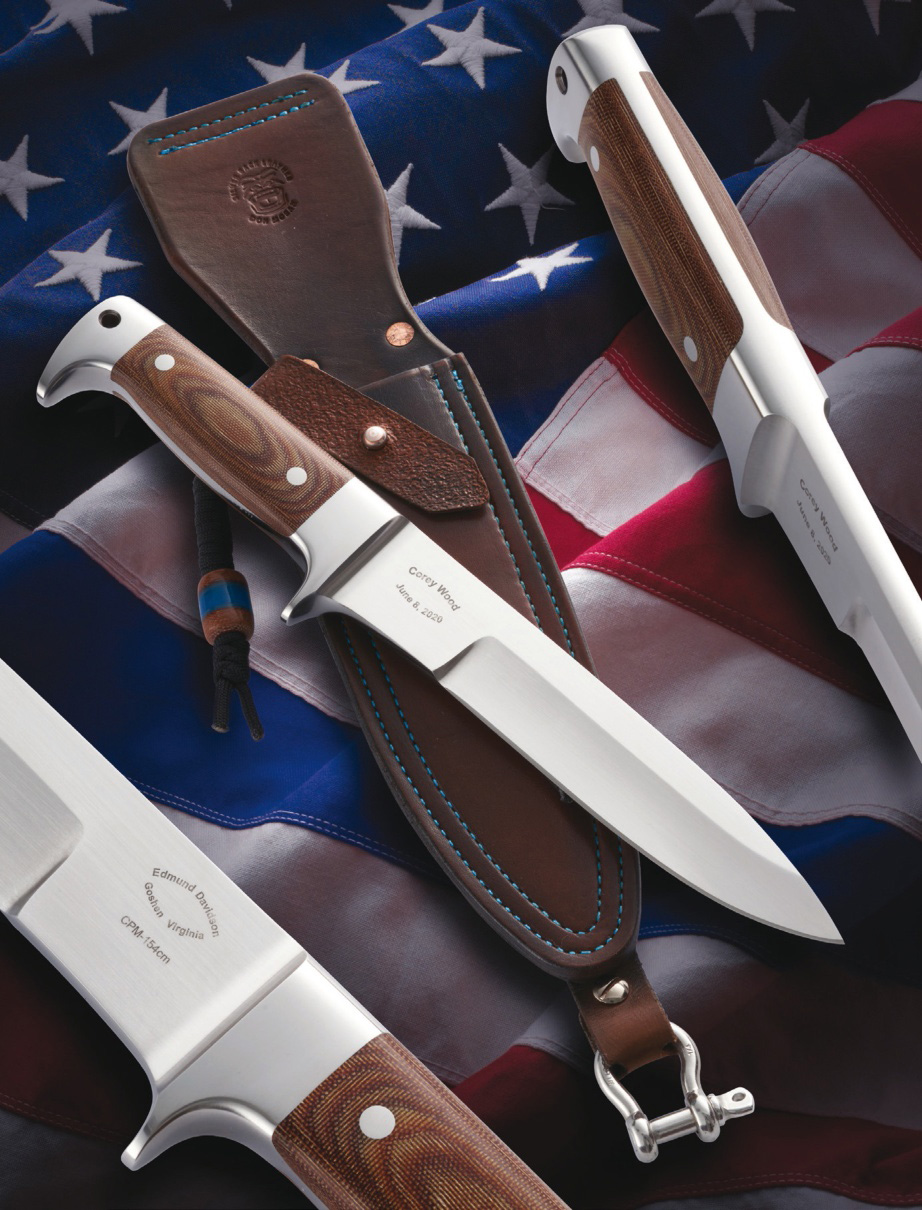
The author made one of his signature integral fixed blades and presented it to Officer Wood for his heroic actions. On the right-hand side of the ricasso are the words “Corey Wood” over “June 8, 2020,” the latter the date of the officer’s actions. The sheath is by Don Moran. (Eric Eggly/PointSeven image)
This is the story of 1½-year-old Violet and 5½-year-old Gracie. In what seemed like a routine car ride with their mom, returning home late at night was no big deal—until the ride took an unexpected turn.
It was 12:06 a.m. June 8, 2020, when their mom’s cell phone last pinged the Craigsville, Virginia, tower a mere nine miles from their destination. However, they did not arrive.
At about 4:30 that afternoon, Officer Corey Wood was returning home from an administrative day and turned on his television. The news reported that a Craigsville family was missing. At the time Corey did not know of the family, so he called the Augusta County Sheriff’s Office for more information.
When he was told the family’s last name, he said he knew the grandmother and that family members were good people and not prone to unusual acts. After Corey learned of the last cell phone tower ping south of North Mountain on Route 42, he took it upon himself to look for them.
The Search
He drove his police car a few miles past the last ping and started his search. He parked the car and walked a quarter mile up one side of the road looking for anything unusual, then walked back on the other side doing the same thing. Corey did this quite a few times where there was no good visibility off the road.
When he got to Augusta Springs, he parked his car and, while talking to his mother via cellphone, walked to look at an area of heavy brush.
At 7:34 p.m. he told his mom he had to go, that the sun was reflecting off something deep in heavy underbrush 20 feet below the road’s surface. He noticed bark knocked off a locust tree and grass mashed down.
Without hesitation, he carefully descended into the heavy vegetation and undergrowth and discovered the missing family in their wrecked car.
Luckily the rear window had been blown out as a result of the impact, fully to pry open the damaged door, he finally had to use his issued ASP baton as a pry bar to gain access.
He found her anxious to exit the scene—but her safety latch was jammed. He worked hard to loosen it and with a great deal of effort finally got the latch to release. Corey checked Violet for physical injuries and, finding none, cradled her in his arm and proceeded to climb the steep bank to the road. That’s when tragedy nearly struck.
Fatigue was sapping his strength. He slipped and fell backward in a twisting motion, landing on his back so as to protect Violet from the fall, knocking his wind out.
Taking about a minute to compose himself, he resumed his climb, this time making it to safety with the baby, where first responders awaited her arrival.
Corey said he made the descent and ascent about 15 times while assisting in the recovery of the vehicle. Tragically, the mother of the two beautiful children was not wearing her seat belt and did not survive the crash.
Life-Saving Efforts
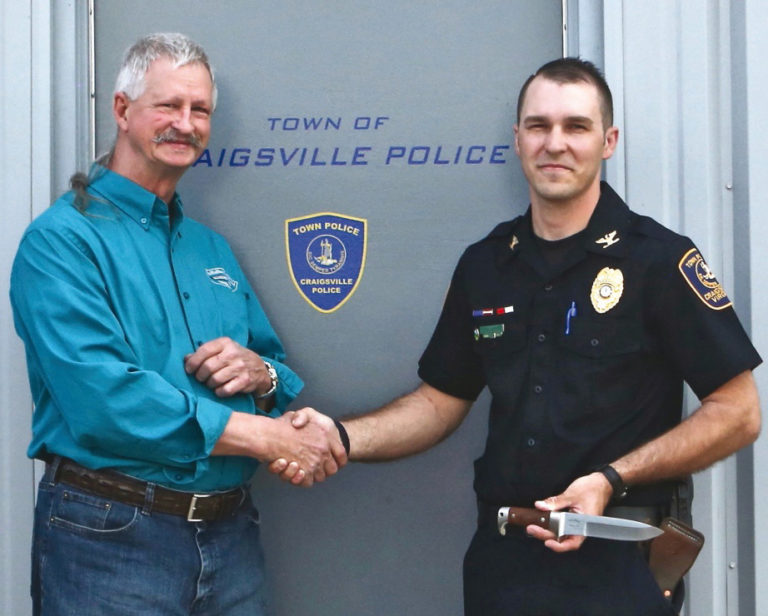
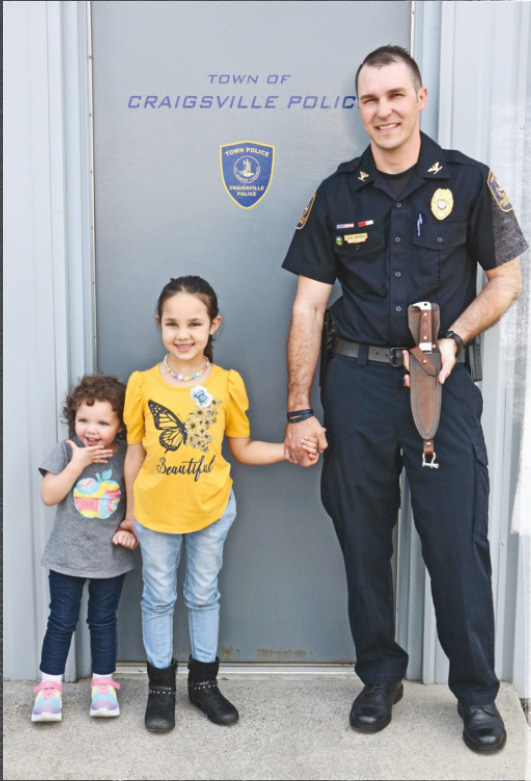
This is a more recent image of the girls and Officer Wood. Corey holds the author’s sheathed knife.
Gracie and Violet were taken to the hospital, where they were cared for and found to have suffered no physical injuries, a testament to the importance of child safety seats. Both girls had been trapped inside the car for over 18 hours, with temperatures near 90° F.
If not for Corey’s instincts and dedication to preserving life, plus taking on a one-man search-and-rescue mission with no one else around, Gracie and Violet might not have survived.
It is with great pride that we, the members of the General Daniel Morgan Chapter, the National Society of the Sons of the American Revolution, presented Officer Corey Wood with the SAR Life Saving Medal, along with the Life Saving Certificate.
Ron Popeil, best known as a TV infomercial pitchman, passed away on July 28, 2021, at the age of 86, according to multiple news media outlets.
The company Popeil founded, Ronco, is synonymous with as-seen-on-TV products, and the “set it and forget it” and “but wait, there’s more” catchphrases. While he wasn’t the first to apply salesmanship to the screen, Popeil did popularize the personality behind the product.
Popeil’s Showtime knife set is a perfect example. Well into his career as a “name” on TV, Popeil brought on his family to pitch his blades:
While Popeil’s contributions to all things sharp didn’t bring him to BLADE Show, there’s no doubt that his ubiquitous media presence influenced the consumer knife market and countless imitators.
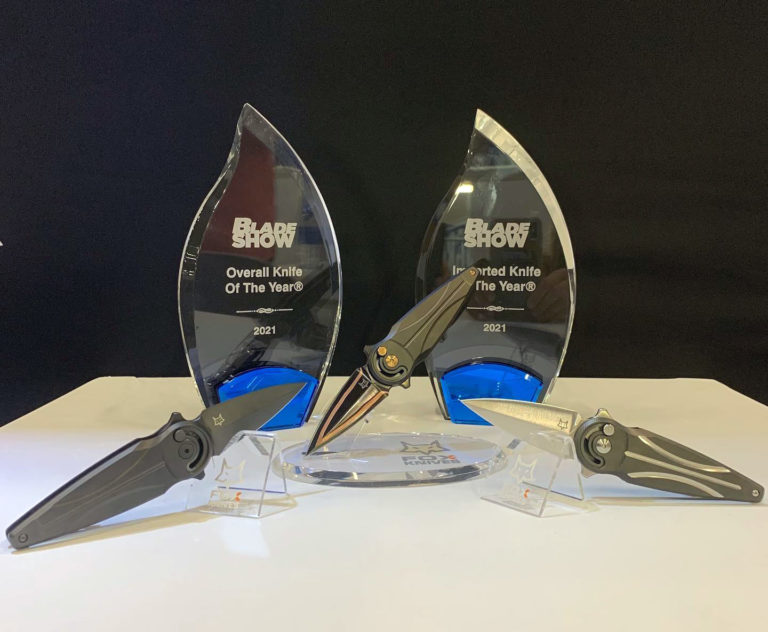
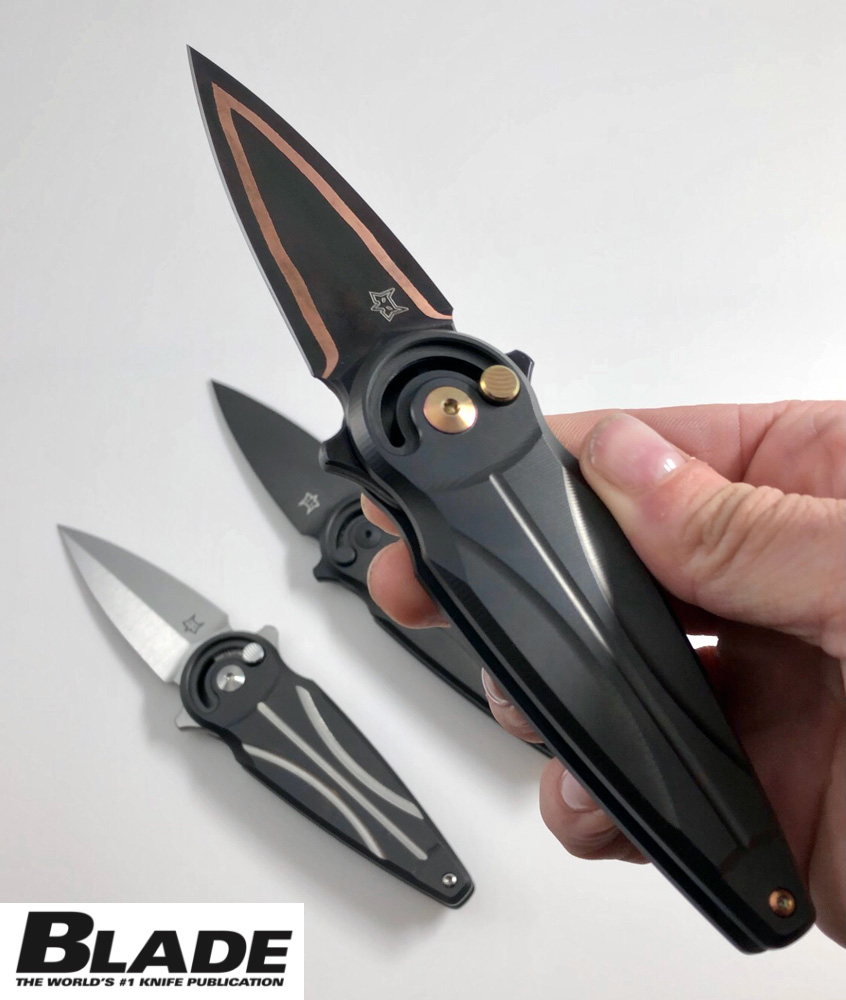
The 2021 Overall Knife of the Year® is the Fox Saturn. The 40th BLADE Show took place June 4-6, 2021, at the Cobb Galleria in Atlanta, Georgia. The event is the largest knife show on Earth, with attendees and exhibitors from around the world.
This prestige is what makes the awards at BLADE Show so vital to the knife industry. Below are the factory and custom award winners.
2021 BLADE Show Knife-Of-The-Year® Award Winners
Representatives from BLADE (www.blademag.com) distributedBLADEMagazine Knife of the Year® awards in 11 categories, plus awards for individuals’ career achievements. All entrants in the Knife of the Year® competition were evaluated by a super panel of undisclosed judges on a number of factors, including utility, design, creativity, materials, aesthetics, feel and other traits.
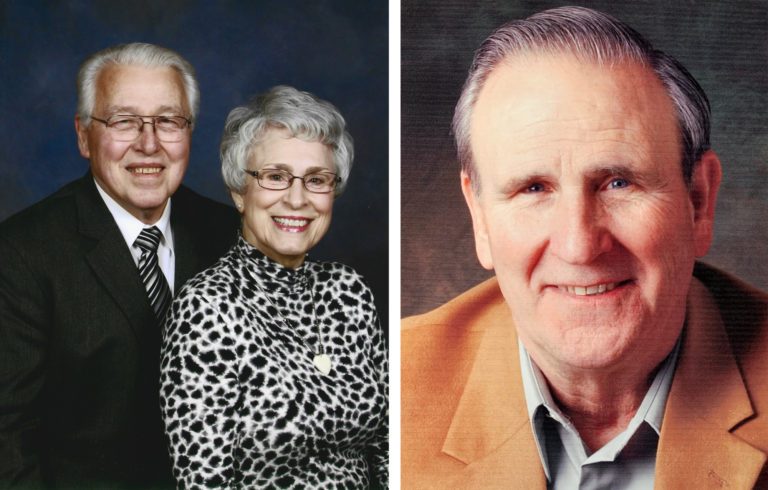
Jay Hendrickson and the husband-and-wife team of Billy and Beverly Mace Imel are the 2021 inductees into the BLADE Magazine Cutlery Hall Of Fame®.
Nominated by, and then elected in a vote of, sitting members of the Cutlery Hall Of Fame, the three comprise the 63rd, 64th and 65th members of the world’s only shrine recognizing all segments of the knife industry.
The Imels are the first-ever husband-and-wife team—or any pair, for that matter—to join the Hall simultaneously. A.G. and Goldie Russell are Hall-Of-Fame members but were inducted in separate years.
Along with the 2020 inductees, Joe Keeslar and Jim Sornberger, the 2021 inductees will be formally enshrined the Saturday of the BLADE Show, June 5, in Atlanta. Joe and Jim could not be formally enshrined last year because the BLADE Show was canceled due to the pandemic.
Jay Hendrickson
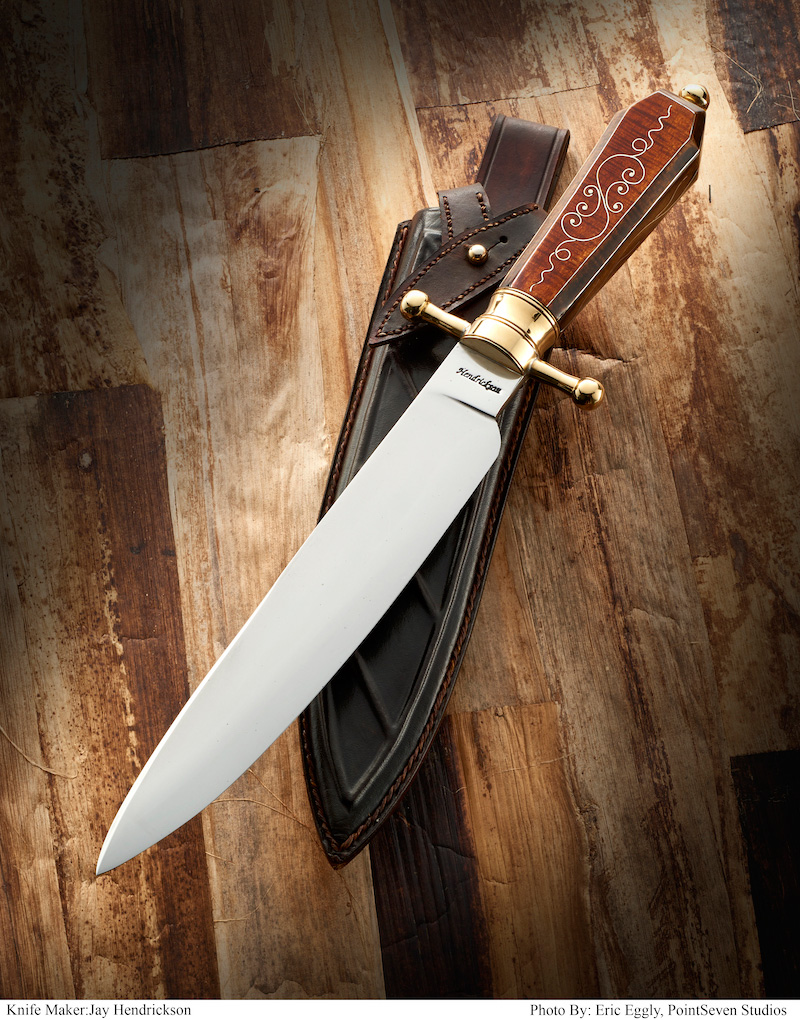
Impeccable fixed blades in the Moran style with matching sheaths are a Jay Hendrickson staple. (Eric Eggly/PointSeven image)
Jay Hendrickson
Jay is an American Bladesmith Society (ABS) master smith who succeeded Cutlery Hall-Of-Fame member Bill Moran as ABS president in 1991—as a nominator noted, “a trying task to be sure, and Jay succeeded Bill very well.” The nominator went on to write Jay is a good bladesmithing teacher who has taught at many venues in the USA and France, and also served as director of the Moran Foundation for 10 years, helping to preserve Bill’s legacy.
Early on, Jay and Bill conducted a forging demonstration that was one of the longest running of all BLADE Show demos. The first installment was in 1987 on the sidewalk outside the show’s former Holiday Inn & Convention Center site in Knoxville, Tennessee, and continued at each succeeding BLADE Show in Knoxville and then at the Cobb Galleria in Atlanta until Bill passed away in 2006. Not only was it one of the BLADE Show’s longest running demos, it was also one of the most popular.
In 1995, Jay was presented with the ABS’s highest honor, the Don Hastings Award. The annual honor goes to an individual “who has performed outstanding service on behalf of the forged blade in the tradition of Don Hastings,” one of the founders of the ABS. In 2004, Jay won the William Wales Scagel Award, presented by the ABS to a bladesmith “for longtime service to promote the forged blade.” Another Cutlery Hall Of Famer, Scagel is considered the grandfather of custom knifemaking.
Jay was voted into the ABS Hall Of Fame in 2006 and a year later wrote the how-to guide, Introduction to Bladesmithing, with tips on how to forge various blade styles “exhibiting balance and aesthetic appeal,” how to understand the basic metallurgy of popular blade steels and more. Concluded the nominator, “Jay is a fine bladesmith, a fine teacher helping to preserve the art of bladesmithing, and a splendid ambassador of knives and knifemakers.”
Last but certainly not least, Jay forges magnificent fixed blades in the classic Moran style, including expertly ground bowies, camp knives, fighters, hunters and more, often in curly maple handles with intricate silver wire inlay, all accompanied by superb leather sheaths.
Beverly and Billy Mace Imel
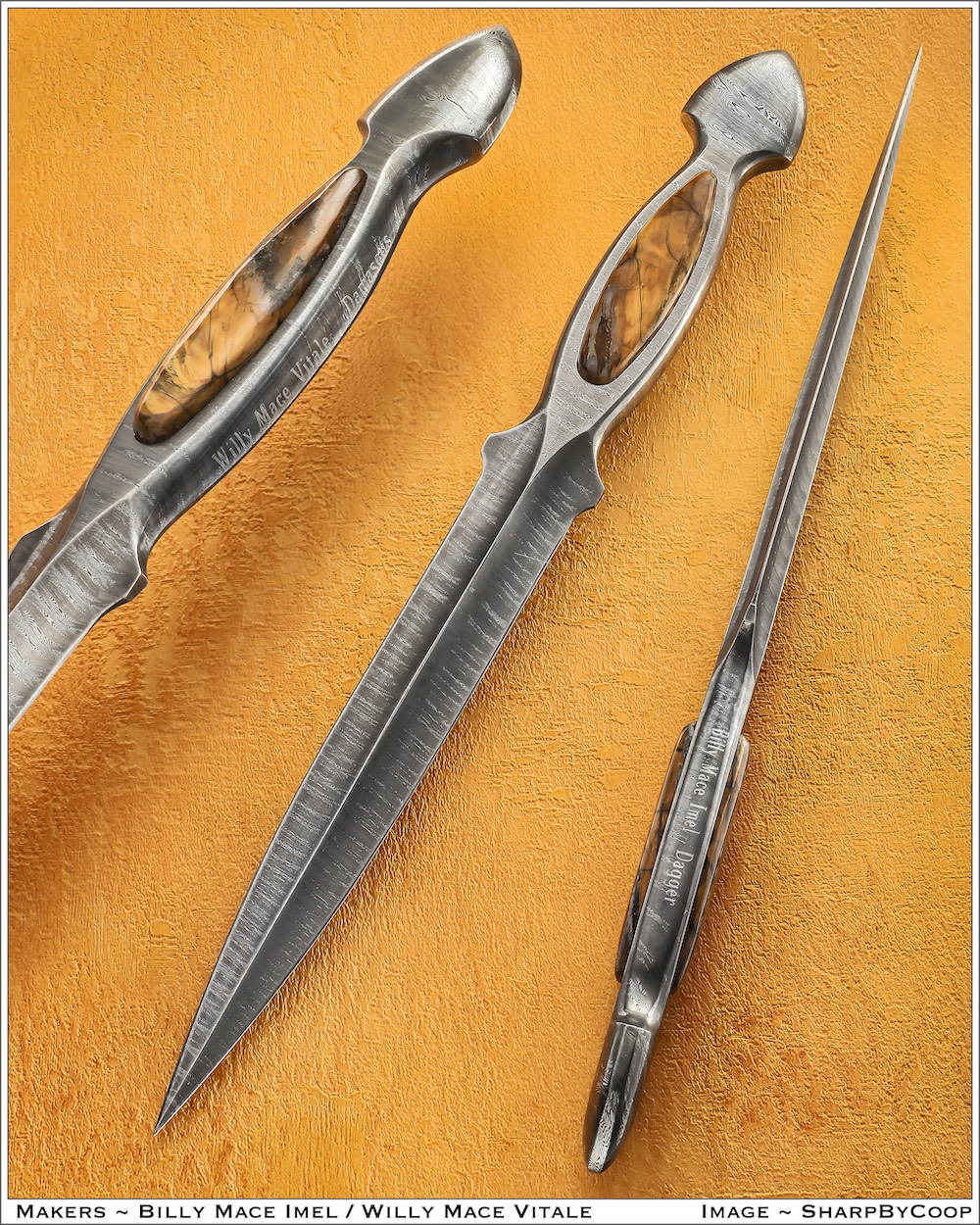
An example of Billy’s premier dagger work is this collaboration with Mace Vitale. (SharpByCoop image)
Beverly and Billy Mace Imel
Beverly and Billy Mace are the first pair of Cutlery Hall-Of-Famers ever to be inducted simultaneously. They also join A.G. and Goldie Russell as the only husband-and-wife team in the Hall.
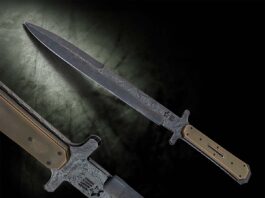
Billy makes fantastic fixed blades yet is perhaps best known for his sleek daggers with stainless steel blades in clean, crisp grinds and slender handles in a variety of gorgeous materials. To augment that knifemaking talent is his many hours of service to The Knifemakers’ Guild.
“What can you say about those who have worked so many hours and years to help so many?” wrote a nominator. “Billy was the secretary of the Guild during a huge building phase of the longtime maker association. Every year many new applicants had to be processed. Those of us who sat on the Guild’s board of directors during many of those years can testify to the energy and effort Billy put forth. The heavy load of accounting, stopping his own work to help discuss an issue—and those issues were many—and still be able to arrive at the Guild Show venues two days early with his own knives and to help set up each show’s exhibition room was a remarkable achievement. I think Billy is a gold standard for the Cutlery Hall Of Fame in terms of working hard for others.”
Beverly, meanwhile, served with distinction for many years on the Guild board as the organization’s secretary-treasurer.
“You can’t mention Billy’s name without mentioning Beverly’s,” the nominator continued. “The Guild board of directors was a large wheel, with every director a spoke in that wheel, but it was Beverly who kept the wheel’s hub lubricated and in motion. She maintained the Guild’s records in perfect order, and if there was a question about something from the past, she either looked it up or could recall it from memory—often smack dab in the middle of a Guild business meeting.”
Beverly’s familiarity with and recollection of Guild bylaws was legendary. Indeed, anytime a Guild president was asked a question he didn’t know the answer to during a Guild business meeting, he would often turn from the microphone and say, “Beverly, do you know?” Invariably she did and more than a few members in attendance would smile and wink at each other as a result.
The nominator went on to state that he wanted the Cutlery Hall of Fame to step out of the mold and do something different in considering Billy and Beverly for enshrinement. “It would be honorable for us to induct both of the Imels as one,” he wrote. Enough sitting Hall Of Famers agreed and the Imels are now members of their august group.