Mike MacInnes of Holland, Michigan, remembers his first two knives, both given to him by his dad. The first was a Buck 110 clone and the second was a Solingen hunting knife. Mike has been involved with black powder rifle hunting and gunsmithing all his life.
Mike MacInnes is a part-time bladesmith. He only makes, and therefore sells, the kinds of knives he likes to make, one of the joys of keeping making as a hobby while he holds on to his day job as a vending route supervisor in Michigan.
In 2012 he wanted to donate a knife for an auction to benefit the Michigan State Muzzle Loading Association. He called his friend Al Englsman and asked if he would help him make a Scagel-style knife. He enjoyed making the first one so much it lead to others. He advanced quickly, probably because his work on rifles aided his craftsmanship.
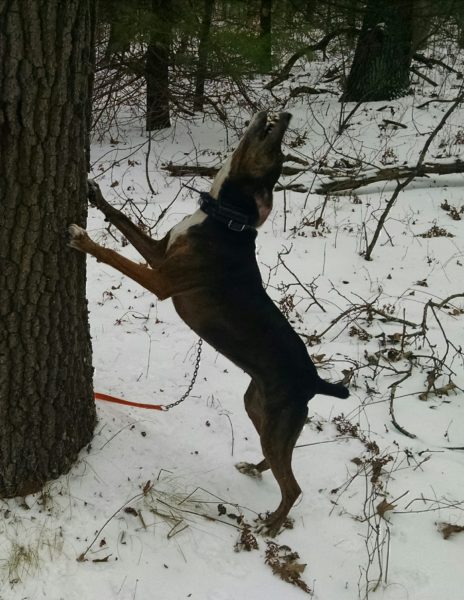
Betty is a mountain cur, dogs specifically bred to trail and tree small game or hunt and bay larger quarry.
Mike had met Al, who is a breeder of Mountain Cur, when he went to buy his squirrel-hunting dog, Betty.
Mike MacInnes and his wife, Erin, sometimes get out to Holland State Park in Holland, Michigan. The lighthouse in the background is called Big Red.
Mike is a route supervisor for a vending machine company by day, but loves his hobby. He only sells what he likes to make. He’s grateful for the influences of Bill Binky growing up, Marv Palmer and Joe Valentin. He lives near Lake Michigan with his wife, Erin, and their two children.
Best-selling knife patterns: full-tang hunter with 3- to 4-inch blade; hidden-tang drop-point hunter with 4- to 5-inch blade
Favorite blade steels: 1080; 5160
Blade grind: full flat
How he tests his knives: slice paper, shave hair, cut phone books, chop wood
Knife shows he attends: Badger Knife Club Knife Show
Facebook Groups he participates in: The Real Knife Makers of America, Knife Gods, Blade Smithing World
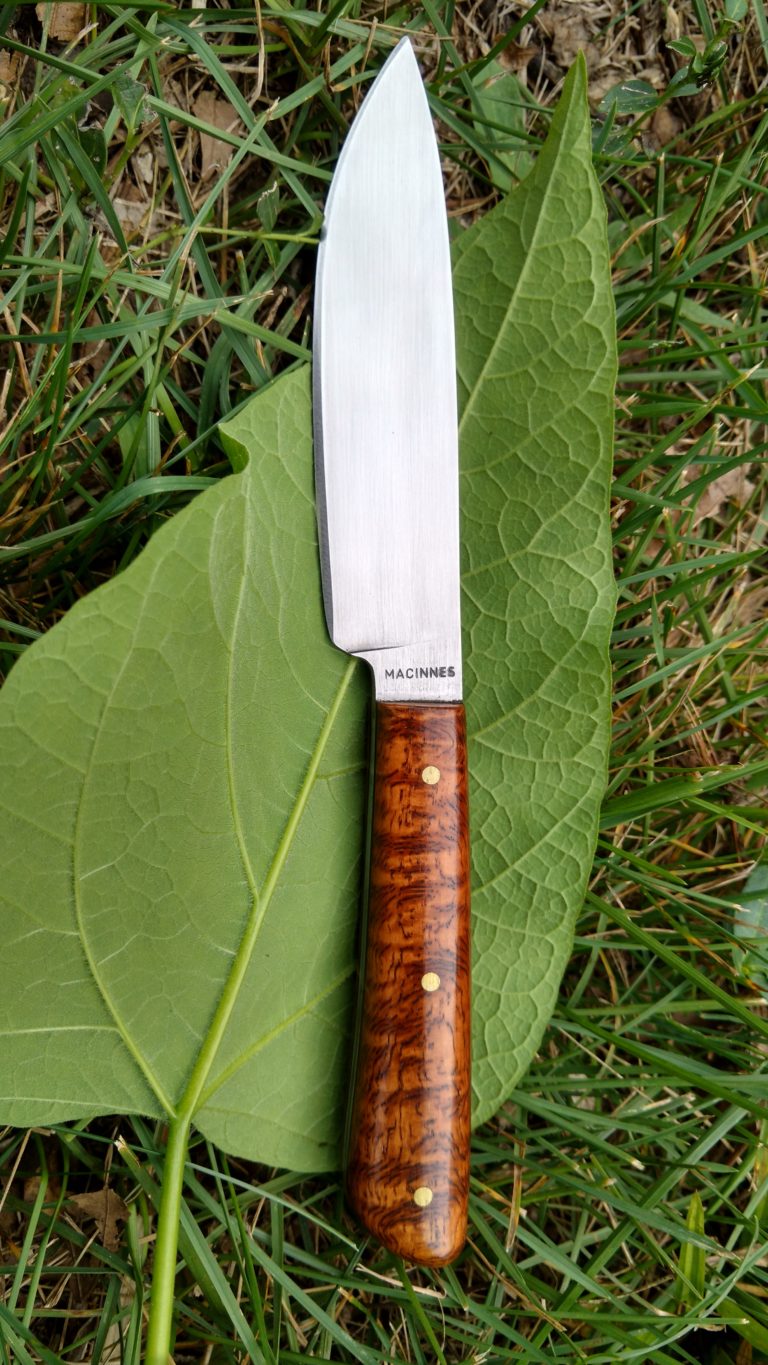
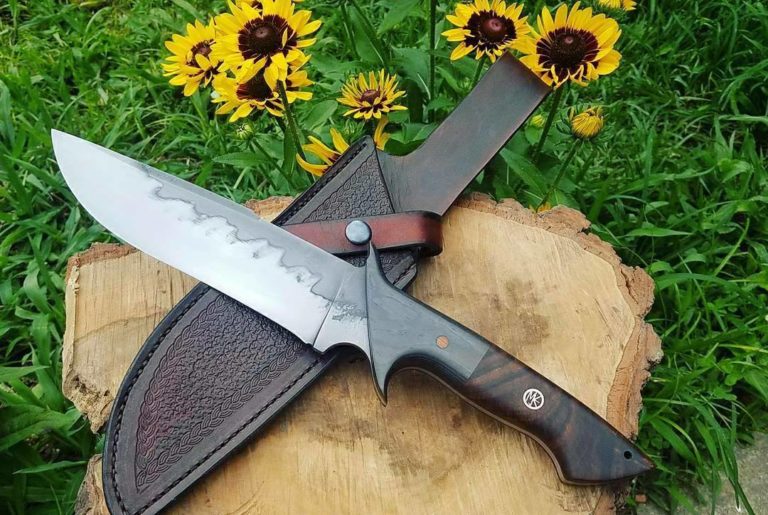
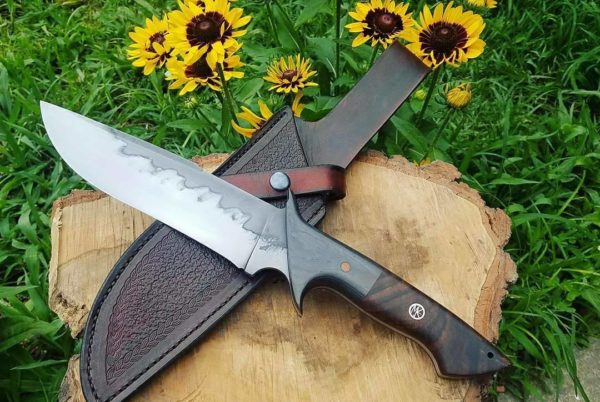
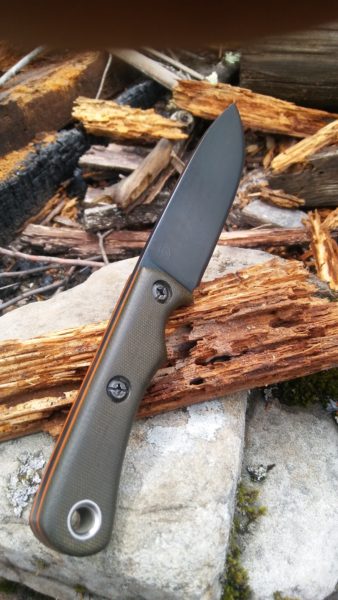
This 4 ¾-inch drop-point hunter was forged from 1080 steel. Handle is made of oak burl with black fiberboard liners. Overall length is 8 ½ inches. Pins are brass. Price is $175-$450.
Mike’s isn’t taking any more orders until he catches up on the orders he’s taken and finishes knives for upcoming shows. Follow him on Facebook though for updates on peeks at works-in-progress and finished pieces.
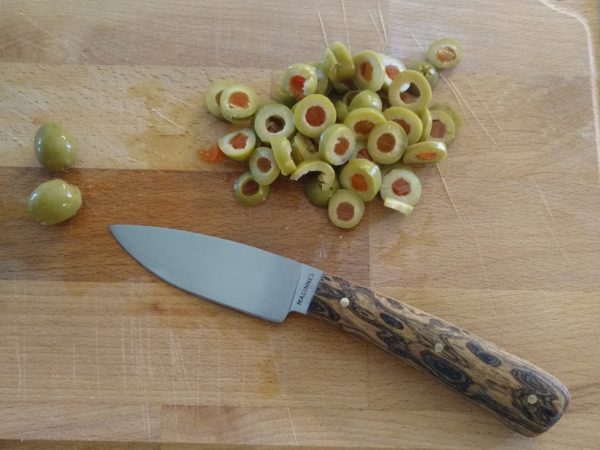
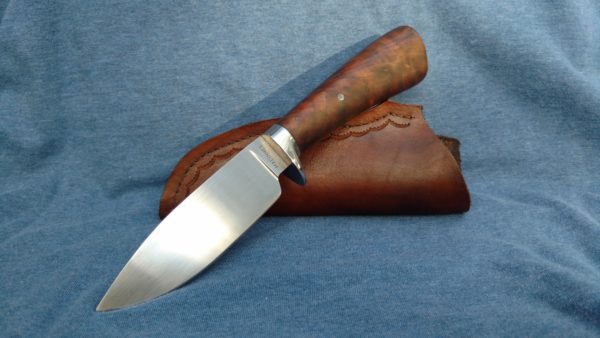
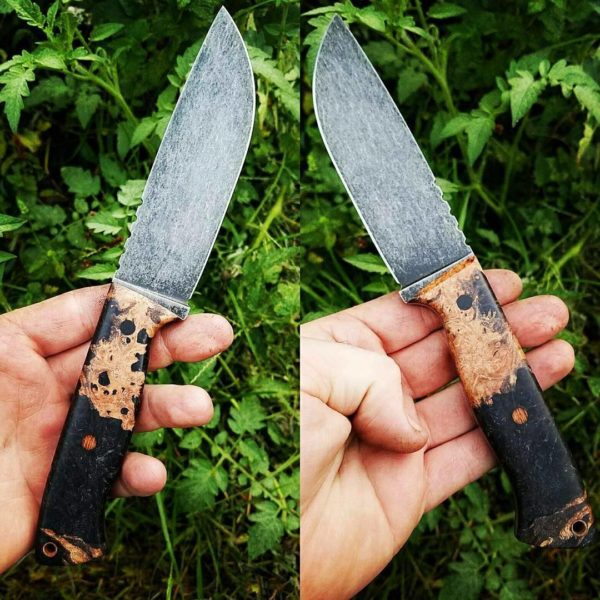
This hunter has a 3.25-inch blade forged from 1080 carbon steel. Its handle scales are made from bocote wood. The pins are brass. Maker’s list price: $185. Contacts listed at the bottom of this article.This Mike MacInnes piece was forged from 1080 carbon steel. The blade is 4 inches long with an overall length of 8.25 inches. “The handle is made of some of the nicest walnut that was even harvested here in Michigan,” Mike declared. The shape of the handle is a little thicker in the butt than he normally makes, but it felt so good he will probably do more in that style. The guard was forged from 416 stainless steel with a matching pin. The sheath was hand-stitched and -tooled by Mike. Maker’s list price: $350. Contacts listed at the bottom of this article.
You can read your digital issues of BLADE Magazine anywhere you have your phone, tablet or computer, and there’s no need to find storage for all your old issues.
If piling-up issues of magazines seems like a waste to you… If you feel like you don’t have time to read a magazine… If you like the stories we offer in BLADE, but want a more economical option, then a digital subscription is the answer. An annual subscription to BLADE is $17.98, $4 off the print price.
In a recent Facebook post, Mike Jeffries of 2 Birds Metal Works asked fellow knifemakers if they had a website, if it was worth the time and money to set up and maintain and how they approached it. He often throws out marketing-related topics for discussion. If you’ve followed any of those threads, you’ve already picked up some digital marketing tips from fellow makers. So, with Mike’s permission, our first in a series of Marketing For Knifemakers articles will delve into some of the feedback he received, assess some statistics and provide examples of custom knifemaker websites. Obviously, if you are an uber-successful full-time knifemaker, you can stop reading, unless you want to reach a still wider audience. This article, though, is aimed at those on the cusp of going larger or full-time with their craft. So, knifemakers: Do you need a website?
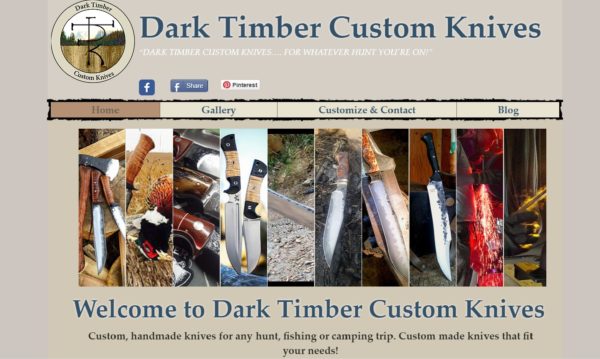
Experiment. Do a search for “custom knifemaker.” The first one to come up is Dark Timber Custom Knives, run by Peter Kohler. Why? A blog, and most of the photos are labeled. There needs to be content that bots can search through.
We’ll save whether you should go the do-it-yourself route or hire a pro for another time. We simply want to determine if a website is worth your time, money and effort at this point in your knifemaking career.
What Are Your Knifemaking Goals?
Are You A Hobbyist Or Part-Timer?
There is no shame in continuing to improve your craftsmanship, loving the journey and decidedly not going forward with a website. Continue to learn with each knife, sell a few to keep yourself in supplies and follow along with the community to stay up on industry news. Facebook (FB) and Instagram (IG) are all you really need.
Is Knifemaking Your Calling?
If you’re “arrived,” you already have a website and you can stop reading, unless you want a few tips on maximizing your customer base. If you’re striving to reach higher rungs on the artisan ladder, focus on bettering each knife, learning from mentors and obtaining your journeyman smith rating if you forge. You can either start a website or wait. Once you think, and your peers confirm, that you’ve hit your knifemaking stride, though, you will definitely need a website. You will also need to tailor that site to reach the public you set out to attract.
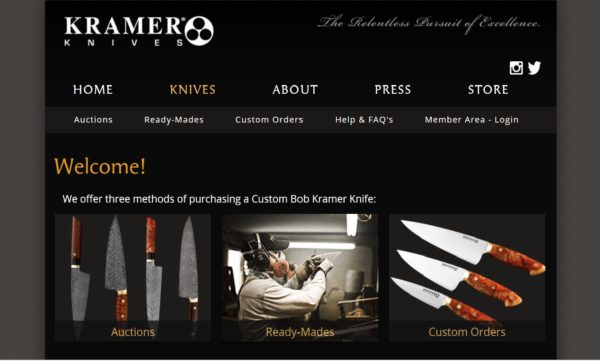
Bob Kramer of Kramer Knives maintains a website that reflects his appreciation of metallurgy and how it contribute to his “effortless art.” A website is an “experience” that should reflect the maker’s philosophy, style, story. Kramer’s does all that, which is why he come up third in a search for “custom knifemaker,” right after Arizona Custom Knives.
Are You Actively Growing Your Business?
You’re comfortable with your style and level of craft. You’re 100 percent committed to knifemaking as a full-time trade. You’re making money at it. You may be maxed out, or you may go through times of feast and famine. You, perhaps more urgently than other custom knifemakers, could benefit from a website sooner rather than later.
Whom Do You Want To Reach?
Honestly assess your style of knives and ask yourself who would be interested in your work? That can be a distasteful question when you solely want to focus on your art, but it’s not just about selling knives. It’s about tapping into the community that will be assessing and judging your pieces.
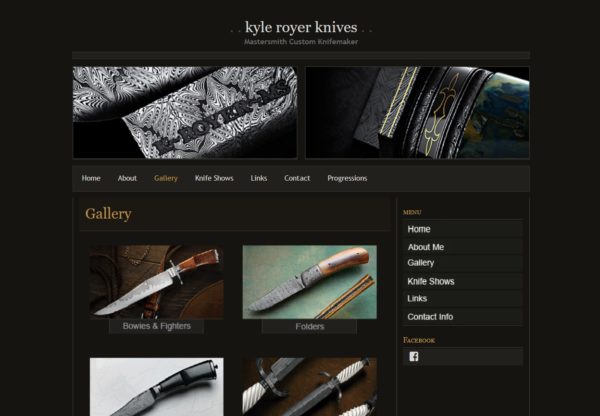
Kyle Royer Knives‘ website is full of professional photos by Caleb Royer and every single one of them includes full specs. Kyle is an American Bladesmith Society master smith. He was 23 when he wrote his About page. He’s 27 now. Is it perfectly grammatically correct? No. Is it genuine and true to him and his knifemaking journey? You bet. Your knives need to be perfect, not your writing. Write as you would speak.
The Collector
If your folders are carried in a velvet pouch or arranged on a display shelf, a website, of course, is essential. You already know this. You’re spending the majority of your time in your shop or socializing with your clientele in the normal course of living your life. However, “owning” your name may not be enough in a waning high-end knife market. Is your site attracting the gentleman who wants something to go with his watch, the art collector who may be looking for a new-to-him art to explore, or neither. We’ll be exploring more about best practices for your site in an upcoming Marketing For Knifemaker’s article.
The Brotherhood
If you’re making tactical knives for the military, for law enforcement or for civilian self-defense, then you need a website, period. This category also includes trainers and balisongs for combatives instructors and practitioners.
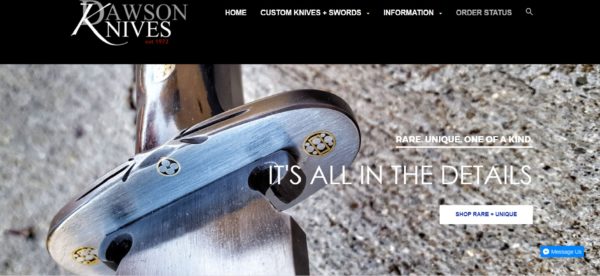
Dawson Knives comes up fifth in a “custom knifemaker” online search. This site is both exquisite art and an homage to the military. However, it’s high ranking is due in no small part to its depth. Check out its active blog, The Daily Grind.
The Outdoorsman
If you’re making knives and tools for bushcrafting, camping, hunting, fishing or survival, you, too, need a website. Obviously, there is crossover in these categories. Your Rambo-esk survival knife may be totally tacticool, so you’ll want to appeal to The Brotherhood as well as The Outdoorsman.
The Everyman
The everyman carries a knife for everyday chores, or keeps one in her purse, or has a few in a kitchen “junk” drawer. You absolutely need a website to reach this person.
The Cook
How can you convince people who cook that you can make a knife that will perform as well as an expensive classic, but in a color other than black? Answer: a website.
How Do People Find You?
Word Of Mouth
There’s still 30 percent of the adult US population (250 million) that is not online. That’s where you stake your name on the quality of your product and never let it out your door if you’re not 100 percent sure of it.
You also learn to ask. You ask your happy customers to write reviews for you. You ask your less-than-happy customer to honestly share his disappointment and how you went above and beyond to not only make it right, but make it better than all right. You ask fans to tell their friends about you. You ask them to share your posts.
Article Appearance
Print publishing is indeed on the decline, but digital publishing is coming into its own. Articles in which your work is included can give you a boost in search engine optimization because it’s packaged with over 300 words and includes links, images and video—all things that help rank that article, and thereby your knife images, higher.
Social Media
If you’re on the cusp of growing larger, you undoubtedly have social media well underway. We’ll be doing articles on each platform and how you can best maximize it to get your type of knives in front of a broader audience.
Online Search
This is where we want to focus. In order to meet new customers where they are, you must put yourself in their shoes. Sit down at the computer and think like a non-knifemaker. That can be a challenge. By focusing on Facebook and Instagram, knifemakers are talking to each other and customers who already know them. There is so much overlap that the circle of influence has shrunk to solely each other and fans. Fellow knifemakers are the best source of cheerleading, constructive guidance and fellowship, but they can’t help you reach those outside the knife industry.
Mike Jeffries of 2 Birds Metal Works in Louisville, Kentucky, will often throw out marketing questions for knifemakers on Facebook. Some of the feedback he receives is invaluable, though you should always verify current marketing practices because things change quickly in the digital marketplace.
Make a list of the things that people might type into a search engine to find you. Enlist a non-knifemaker’s input if necessary. Let’s use 2 Birds Metal Works as an example. Mike makes knives to handle your cutting needs “from kitchen to camp.” So, his aim will be to attract the The Outdoorsman and The Cook. Except for current customers and fellow makers, people know neither “Mike Jeffries” nor “2 Birds Metal Works,” so what might they enter to stumble upon Mike’s work.
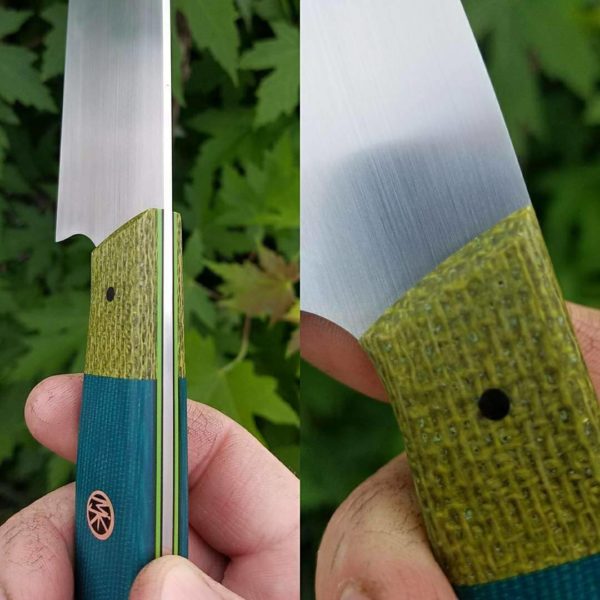
Mike Jeffries’ chef knife has a 7-inch AEB-L stainless blade with a Vintage Blue Westinghouse Micarta handle with Shadetree Emerald Burlap bolsters. The signature pins are made of copper. The overall length is just under 12 inches. Maker’s list price: $300-$380. Contact Mike Jeffries, 2 Birds Metal Works, [email protected], 502-592-4240, on Facebook at 2 Birds Metal Works & Mike Jeffries Knives.
As clumsy as that sounds, that’s what you want to have happen. Mike offers a chef knife with a teal blue and lime green handle. Let’s say a woman is searching for a housewarming gift for her sister, whose favorite color combination is teal and lime. She types in “teal and lime gift.” That’s it. Nothing about knives in the equation. If Mike has written a full caption to go with an image of his knife on his website along with the suggestion that it makes a nice gift, he has just increased the chances of his site coming up in a search. If he also describes in a blog post how he made this knife and covers his reasoning behind his color choices as well as all his other creative decisions, he’s gone even farther to ensure his site has a chance of coming up on a vague search like in our example.
Is it foolproof? Of course not, but you’re honestly playing the search engine optimization game with images and descriptions and blog posts. If you do that for each type of knife you make, over time, it will pay off in higher rankings for a variety of searches.
Isn’t Social Media All A Maker Truly Needs?
In A Word, NO!
Digital marketers had predicted that websites would give way to social media and email would die at the hand of Messenger. That’s not how it’s turned out.
The only way your Facebook profile will come up in a online search is if someone actually searches for your name or company name. You’re trying to reach people who have never heard of you and don’t even think of knives as an option for, say, gift-giving. You could argue that you would never want your art falling into the hands of someone who can’t appreciate what a custom knifemaker does. OK, but what if by getting a knife into their hands by whatever means, you create an impassioned fan, who then tells her friends how brilliant the colors were, how perfectly the knife worked, how great it felt…
Content Is Still King
Words still matter in this hashtag world. “Content” refers to anything used to fill an article, social media page or website. It can be writings, visuals in still or video form, and links, but in order for visuals and links to have weight, they must have words associated with them. And you need a place to park your content where it’s forever accessible, and not lost on some never-ending feed. (Saving posts helps you, but not your potential customer.)
How can this be? Isn’t Facebook pushing video? You bet. It’s trying to be You Tube, which is owned by Google, and although FB has a more engaged audience, more people visit You Tube in a month than visit FB. Efforts are probably underway to extract video content so transcriptions can be combed by search engine robots. But even that won’t help if a maker is just silently showing all sides of a knife. We’ll talk more about video and how best to harness it in another Marketing For Knifemakers article.
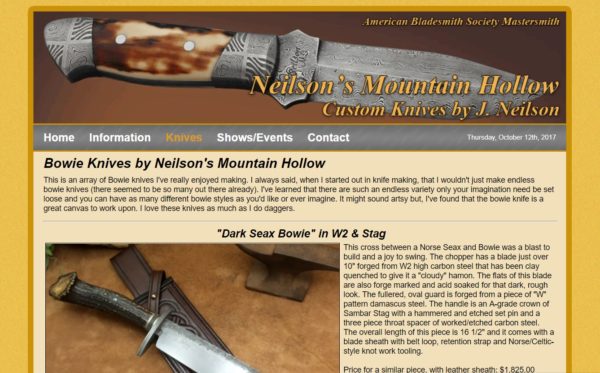
J. Neilson, American Bladesmith Society master smith and “Forged In Fire” judge, has a website that makes exceptional use of photo description. Knives on the Neilson’s Mountain Hollow site not only get a list of specs, but a full description of inspiration, construction or something else memorable about the build.
So back to words. Every day the Google bots do their thing, combing articles, photo titles and captions, video titles and descriptions, links and meta data fields, to rank websites according to relevancy. Ever wonder why video is embedded in an article, or why slide shows come with accompanying written commentary? Words, dude, words. The term “blog” may be passe, but blogs still matter—greatly. You are reading one. We call it an “article,” but it’s still an article under my name and the Mightier Than The Sword banner. Every single example of a website that comes up high under a search for “custom knifemaker” includes either a blog or highly descriptive photos captions. J. Neilson’s blog ranks high in a search for “custom knifemaker” not because it’s filled with “Forge In Fire” references, but because of his depth of description on each of many, many knives.
Battling Anti-Knife Bias
As many of you are fully aware, there is definitely bias at Facebook and it’s against weaponry. Selling of guns and knives is not allowed, so don’t put prices on your marketplace items. Even though they encourage you to boost your post, if you ever try to, you’ll be informed that what you’re selling goes against FB policy. So, what’s a custom knifemaker to do? Play the game, organically and on your own terms—with a website. Your post to Facebook lasts about 5 hours; your blog post/article has a 2-year lifespan.
What does “organic” mean, anyway? It refers to building content naturally and not paying for ads to boost results. It’s about “articles” or “blog posts” on your website, photos, video and links that all work together to speak on a specific subject. The words are compiled naturally, and not “stacked” repeatedly in an unnatural cadence.
Normally, Mike Jeffries focuses on “kitchen to camp” knives, but he decided to try an old-school American Bladesmith Society-style knife, but with a full tang. The Cowboy Fighter even caught the eye of Jason Knight and Murray Carter when they stopped at the 2 Birds Metal Works table at BLADE Show 2017. A blog post would be the perfect place to tell this knife’s story and what it meant to Mike on his knifemaking journey. The 7 3/4-inch blade is made of W2 steel with hamon. The handle is walnut burl with unidirectional carbon fiber bolsters. Overall length is 13.5 inches. Maker’s list price: $750 with leather sheath by Two Drunken Celts Custom Leather. Contact Mike Jeffries, 2 Birds Metal Works, [email protected], 502-592-4240, on Facebook at 2 Birds Metal Works & Mike Jeffries Knives.
Let’s say you have a blog on your WordPress website. You should aim for a minimum of 300 words per post to optimize search engine optimization (SEO). You explain what you’re working on that week. You mention blade lengths, because people use blade lengths as part of their search criteria if they’re in a state that limits them. You mention steel, your process, the handle material, including color, price, what comes with it, how it is shipped, and how people can put in an order for one. You give shouts out to your suppliers and mentors or supporters on the project then share it to Facebook.
You will still be speaking to your established audience while increasing your chances of being picked up in a generic search. Pretend you are talking to people who know nothing of custom knifemaking, because you are. Take the opportunity to educate as you go, minimizing abbreviations and lingo. You’re broadening and educating your clientele with each post. You write, “Everyday (one-word adjective) carry, abbreviated as EDC, refers to something you carry every day (two-word noun).” See how I did that? (Laugh here.) At the end of the week, you write another post sharing how you did. You include pictures of your works-in-progress, rather than “WIPs,” and a finished example. You share your successes and challenges.
Instead of saying “click here” for a link, link to the applicable words. Never forget the “web” part of the worldwide web. Link to others when appropriate, but do not link to everything. You don’t want to pull your potential customer away too frequently. Pick and choose wisely, and be sure to set the link so it opens in another window so they can easily return to your site. All of this helps to rank you higher in searches. It’s more time-consuming than FB or IG, but can be done less frequently, and over time, garners stronger returns on time spent.
5. Who Controls Your Website Experience?
Guess what? You don’t get put in a time-out on your own website. You control your content and exactly how it looks and reads. You can build a photo gallery of finished work that includes a written description with all specs and includes the prices—imagine, no Facebook jail! You can have an About page that gives your journey as a person and as a knifemaker. It doesn’t have to be long, but it should be at least 300 words and include images from benchmarks in your life. People are buying a part of something you’ve poured your heart and soul into; they want to know who you are.
This is a good time to mention that you can’t take too many great photos of your finished work, but bad photos hamstring your marketing, period. Mike Jeffries takes some nice photos, but not enough of them to have samples of everything he’s made. His Campcrafter model is his flagship camping knife. It has a 5-inch blade of 80CrV2 high-carbon steel. Overall length is just over 10 inches. This one has a black and burl handle. Maker’s list price: $250-$325. Contact Mike Jeffries, 2 Birds Metal Works, [email protected], 502-592-4240, on Facebook at 2 Birds Metal Works & Mike Jeffries Knives.
You can include platforms to sell directly from your website. You can and should drive traffic to your social media sites and include your website on your social media profiles, but you are in charge of your website content, for better or worse. Best of all, you can include at the very least, a newsfeed, but hopefully you’re seeing the benefit of a blog, so you can share industry new that your customers might benefit from, including your own promotions, giveaways and waffles (sorry, a website won’t change state laws). A blog within your site gives you a platform from which to explain thing about your craft, offer your opinion, talk about your life as a knifemaker, projects you have in mind, specials you’re running, shop tours you’re hosting, hammer-ins you’re organizing. It’s a place where you can put in words what you normally say in a video.
“But I hate writing. That’s too much of a time-suck.” Agreed. Perhaps you know someone who likes it. You can offer them short money to do weekly posts for you. “Arrgh, a money-suck.” Try to look at it as an investment in growing your business. I see plenty of knifemakers who can’t even Share a post. Their buddies do in 2 seconds what they couldn’t figure out in two weeks—that’s an actual quote from one of them. Trade your buddy a knife for an equal value of his digital expertise.
What Does Your Knifemaking Destination Look Like?
Ranking higher in online searches is a long-term endeavor. It takes consistently delivered content over the course of an extended period of time. Google is no more friendly to weapons than Facebook, but all knifemakers are playing under the same set of rules and the ones with websites and blogs are being rewarded.
Make a list of all the terms you want to “own.” Start building content around those terms, and your website will populate itself into relevancy. Remember, it sometimes happens in life that the most gifted are not always the ones who obtain success with their given talent. It is the ones who can take their art and persistently and accurately market it, who will garner both recognition and thereby profitability.
At the same time, if you’re constantly sucked into the money and time trap of marketing, there will be no knives to market. Use your time at the forge and the grinder to think. Start a notebook of both your big vision and the baby steps necessary to get there. Then enlist the help of people who truly get who you are and what your knives are about, so that you are free to make more knives.
A Digital Subscription To BLADE Is The Answer
You can read your digital issues of BLADE Magazine anywhere you have your phone, tablet or computer, and there’s no need to find storage for all your old issues.
If piling-up issues of magazines seems like a waste to you… If you feel like you don’t have time to read a magazine… If you like the stories we offer in BLADE, but want a more economical option, then a digital subscription is the answer. An annual subscription to BLADE is $17.98, $4 off the print price.
Halloween knives conjure visions of human steak and Bela Lugosi, high tops and Frankenstein, and decapitations and zombies. Warming to the genre yet?
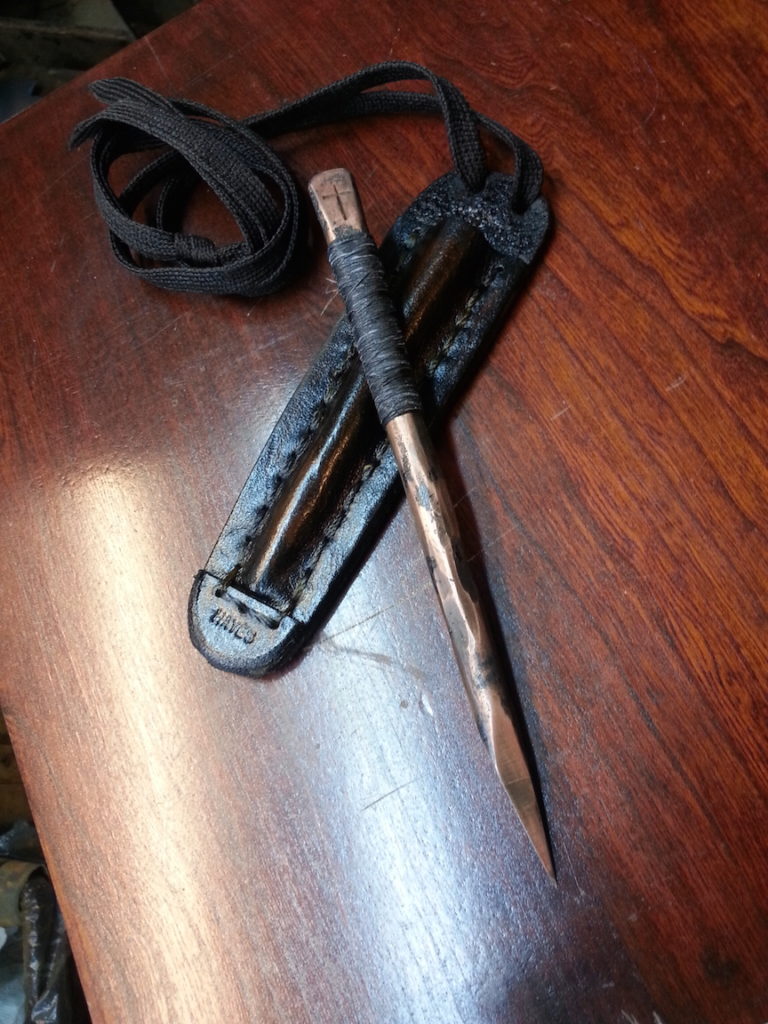
ABS master smith Wally Hayes makes a couple of Halloween knives that fit the mold like a stake in Frank Langella’s heart: the Vampire Stake and the Zombie Spike. Formed like, well, a stake to drive into the chest of one of the spooky set’s most famous blood-sucking ghouls, the Vampire Stake has a distinctive cross forged into the handle butt to intimidate the worst of the slimy night crawlers, antique coloration and a leather sheath. The Zombie Spike, on the other hand, is 6 inches long and fashioned from O1 tool steel ground and heat treated for high performance. Hayes says it’s popular among his law enforcement customers, though he didn’t mention if it was the officers in the CSI: Walking Dead unit or not. It comes with a Kydex sheath.
Creatures of the night cringe at the sight of the Vampire Stake by Wally Hayes.Wally Hayes‘ Zombie Spike will keep the Walking Dead on their toes.
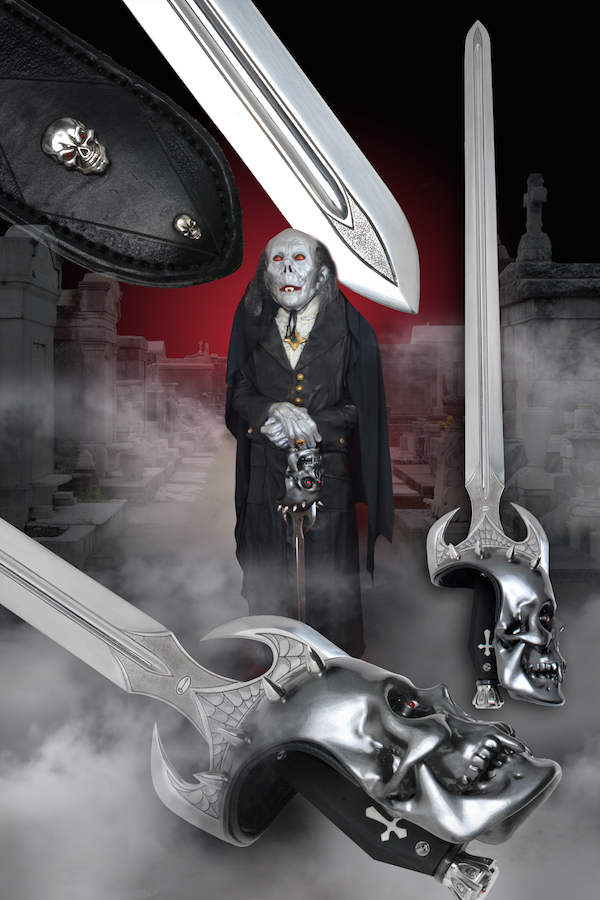
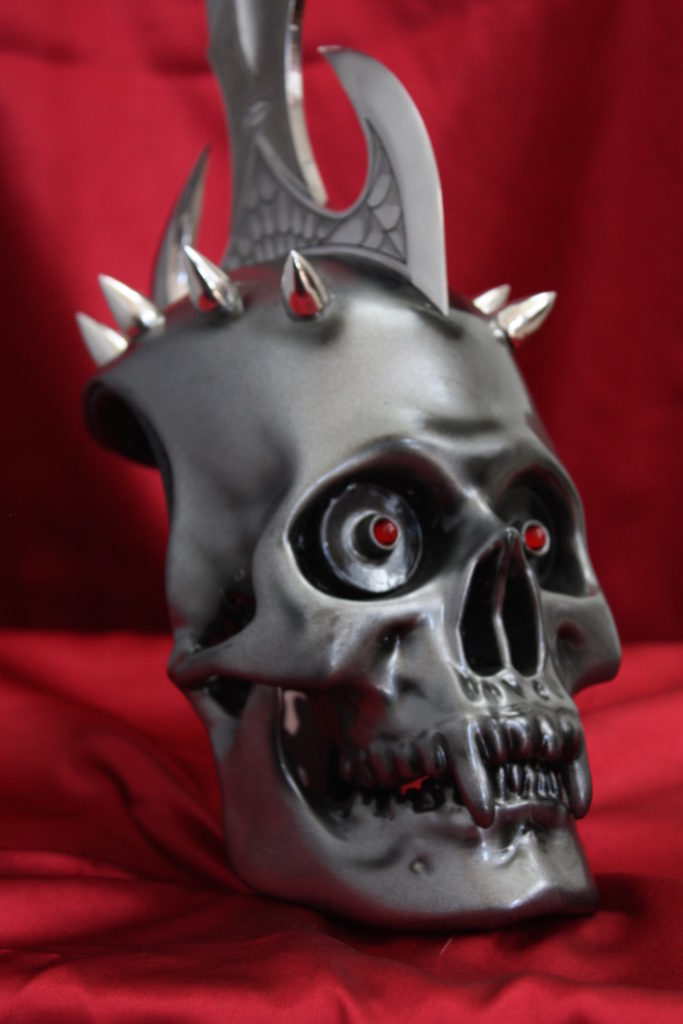
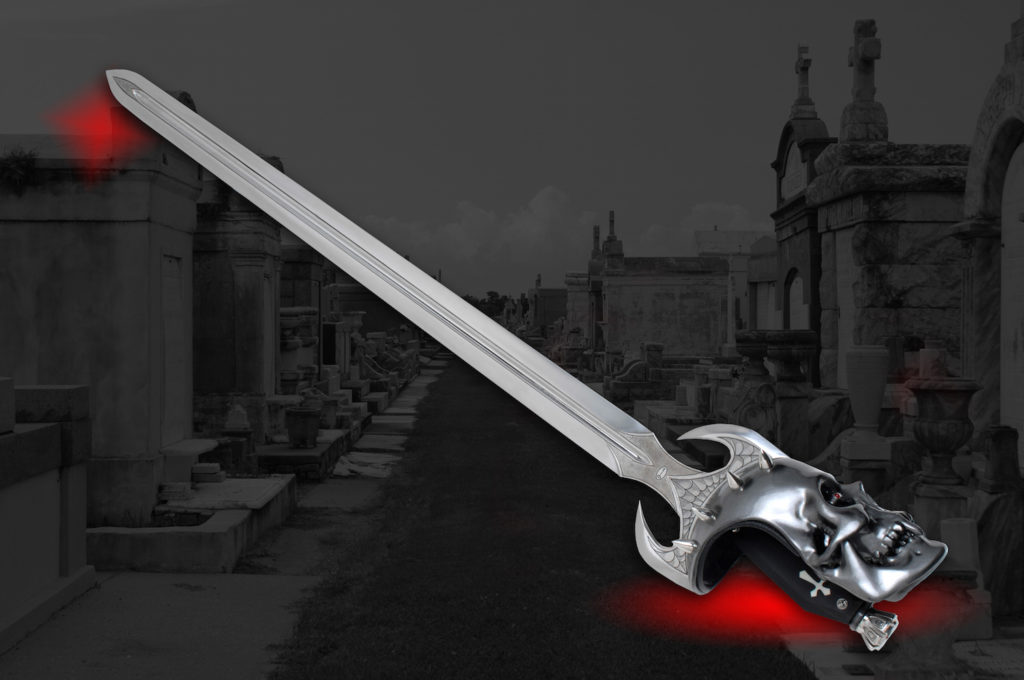
Dan Keyes‘ “The Count” features a coffin handle with inlaid ivory crosses, a fullered, 30-inch blade of double-drawn 440C stainless steel and LED bulbs that light The Count’s red eyes. The skull is powder-coated “anthracite gray” with highlighted airbrushing. Weight: Just short of five pounds. Overall length: 38.5 inches.
The Count by Dan Keyes is just what Dr. Death ordered.The red eyes of The Count’s skull light up with the flip of a switch in the handle next to the black-leather-lined skull.The Count boasts a 30-inch blade, weighs just short of 5 pounds and is 38.5 inches long overall.
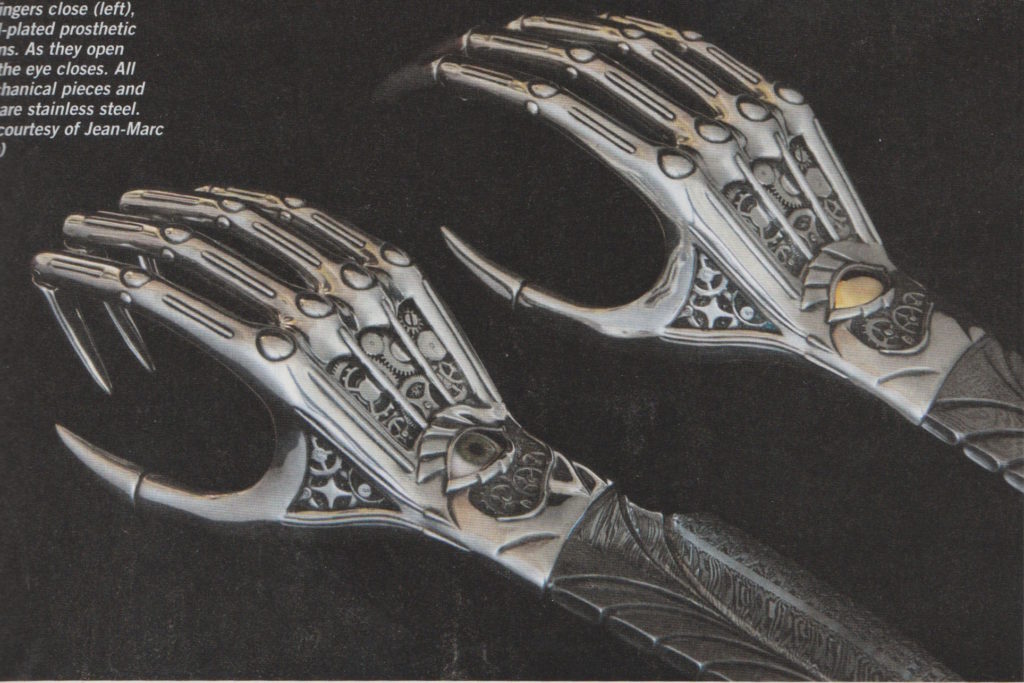
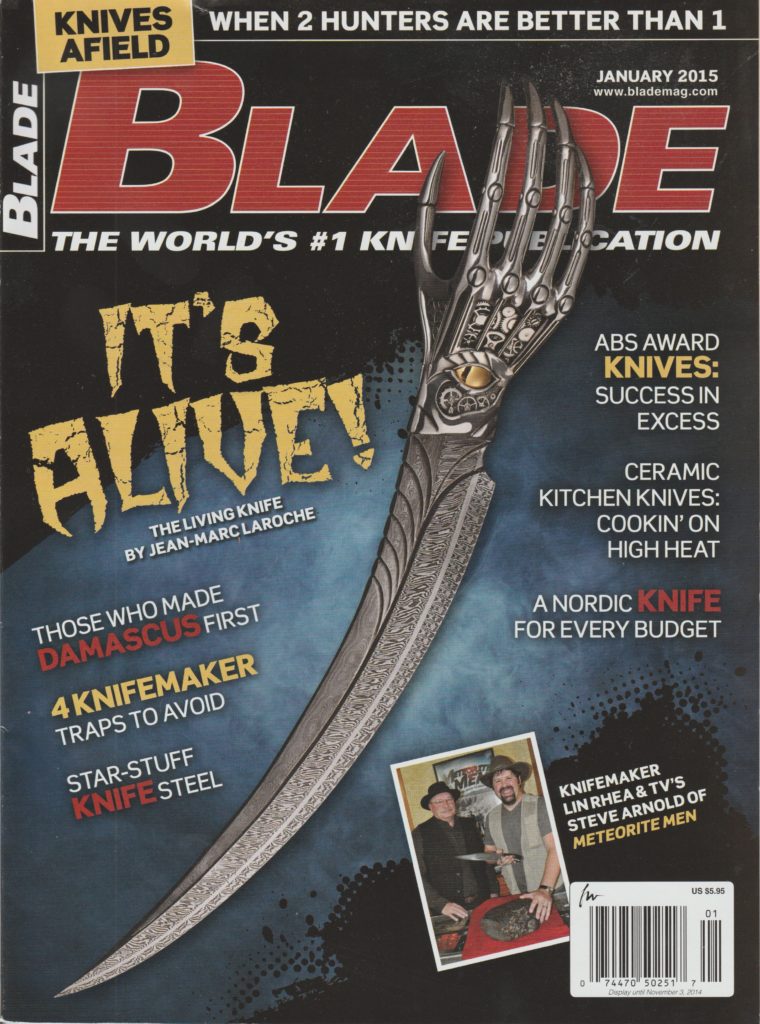
The creation of French knifemaker/artist Jean-Marc Laroche, The Living Knife has a “hand” for a handle with “fingers” that close, an “eye” and an overall lifelike appearance that will literally, er, grab you. As you grab the handle, the “fingers” actually grab back so that it’s hard to tell who’s holding whom. And, as the fingers grab your hand, the “eye” opens. The hand also is embellished with gears in the Steampunk style. The blade is a composite of 15N20, 15LM and UHB11 high-alloy nickel and carbon steels in explosion, twist and random patterns forged by Swedish maker Roger Bergh. Overall length: 25 inches.
When you grab the “fingers” of the “hands” of Jean-Marc Laroche‘s The Living Knife, they literally grab you back!
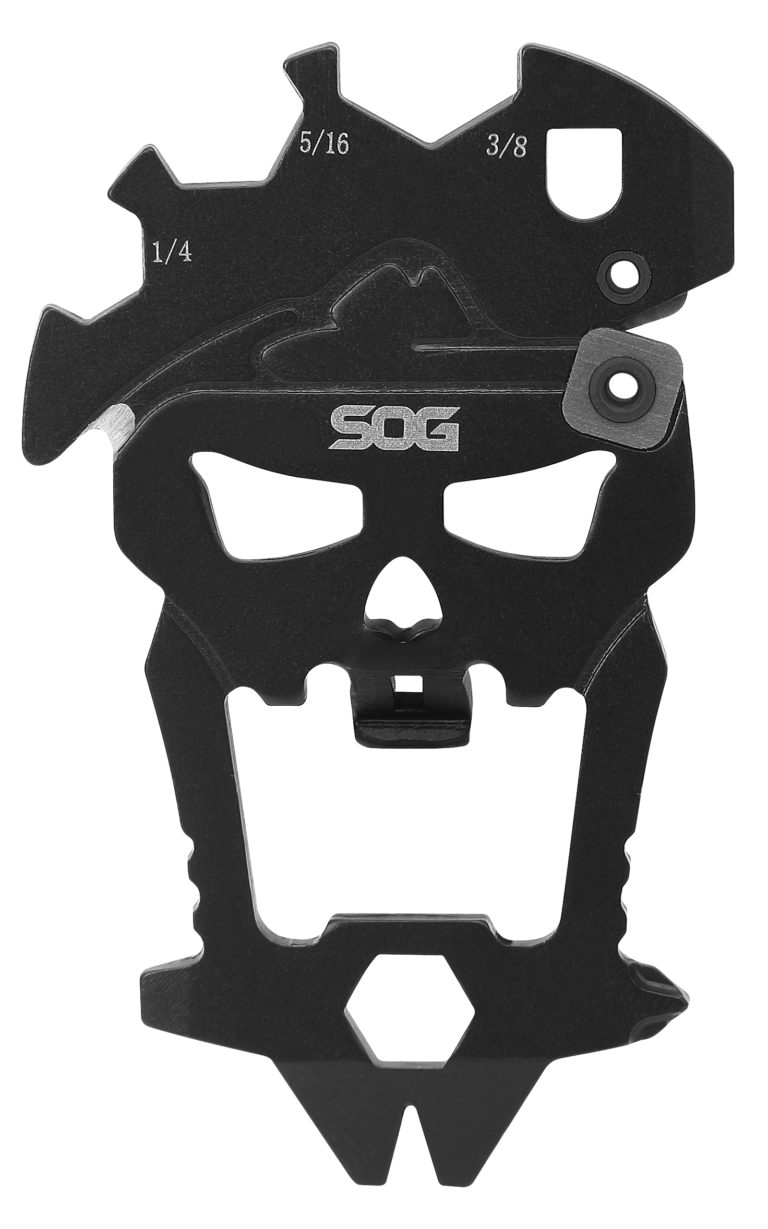
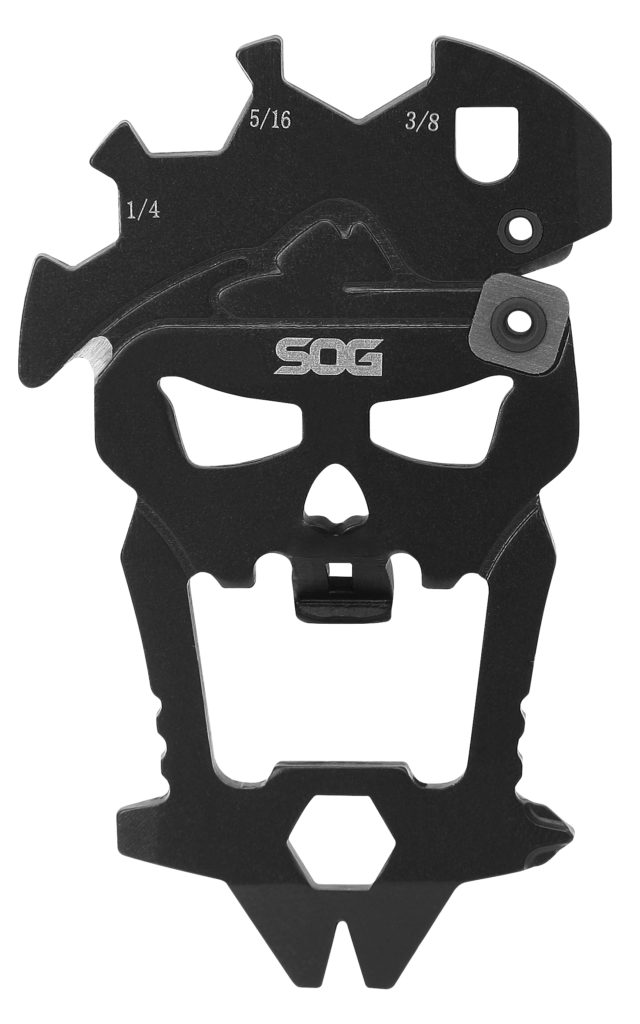
The MacV Tool from SOG Specialty Knives & Tools is shaped like a skull and is 12 tools in one, including 1/4-, 5/16 and 3/8-inch wrenches, blade sharpener, strap/cord cutter, small and large flathead screwdrivers and more. Designed to resemble the original skull from the MACV-SOG group of Vietnam War fame the company is named after, it measures 2.5 by 1.5 inches and weighs .6 ounce.
Shaped to resemble the skull logo of the original MACV-SOG group of Vietnam War fame, the MacV Tool from SOG Specialty Knives & Tools is 12 tools in one.
A toxic green handle and big, bad modified-cleaver blade in a black finish complete the KA-BAR Zomstro Chopper.
As you might imagine, knives with a zombie theme are undead and well, including the Reaver Cleaver from Zombie Tools and the Zomstro Chopper from KA-BAR. Based on the Chinese war sword, the Reaver Cleaver features an 18-inch blade of 5160 carbon steel, weighs 3 pounds, 10 ounces, and is 31 inches overall. The Zomstro Chopper, meanwhile, features a big, bad modified cleaver blade in a black finish and KA-BAR’s toxic green Zombie handle.
If The Count and the rest of our Halloween knives don’t keep you down for the count, you might be among the living dead. If so, stay clammy and watch out for sunrise!
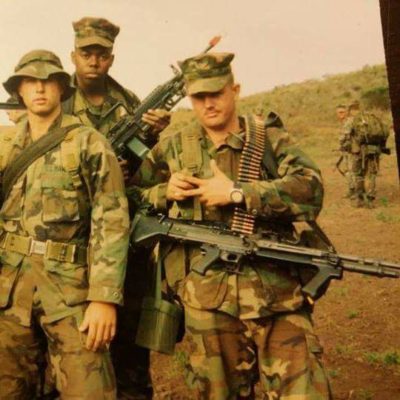
Randy Madan, known as JR on social media, served in the U.S. Marine Corps from 1992 to 1996 as a combat engineer. “I blew things up,” he said, laughing. Now, at 43, he has been a federal correctional worker for 20 years.
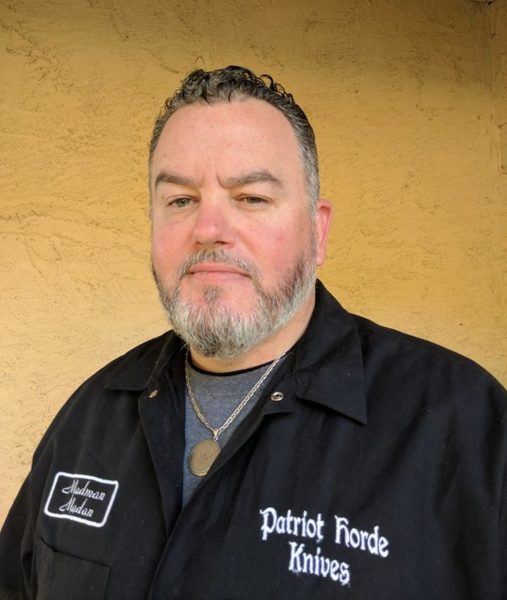
Randy Madan of Patriot Horde Knives hopes to be able to keep making knives when he retires from his job in the federal correctional system. Randy is supportive and encouraging of other veteran makers.
He always loved and carried knives, but he got his start in knifemaking in October 2016. “The knifemaker that I idolize, Michael Cleveland from Half Lives Knives, afforded me the opportunity to join a knife build-off for a veteran charity. Me being a vet myself, I jumped at the opportunity,” he explained. He has continued to make knives and to encourage other veteran makers.
Randy Madan of Patriot Horde Knives served in the U.S. Marine Corps from 1992 to 1996 as a combat engineer.
“I am just a small-time maker, wanting to perfect my knives so that when I retire in a couple of years I can make more,” he said. Other makers who have helped along the way include John Savage, Ryan Schreiber, Denny Furey and Mark Wagoner.
Favorite blade steels: 1095 with plans to start using O1 and 80CrV2
Blade grinds: flat with plans to add hollow
How he tests his knives: shave hair, skive 7- to 9-ounce leather, cut ¼-inch bolts, chop 2-by-4s
Favorite handle materials: Voodoo Resins, Rob Carper Innovations, 8th Dimension Concepts and J Hue Customs. “I am a big fan of the hybrid materials,” Randy noted.
Price range: $250 and up
Forums he participate in: The Real Knife Makers of America, Global EDC and other Groups on Facebook
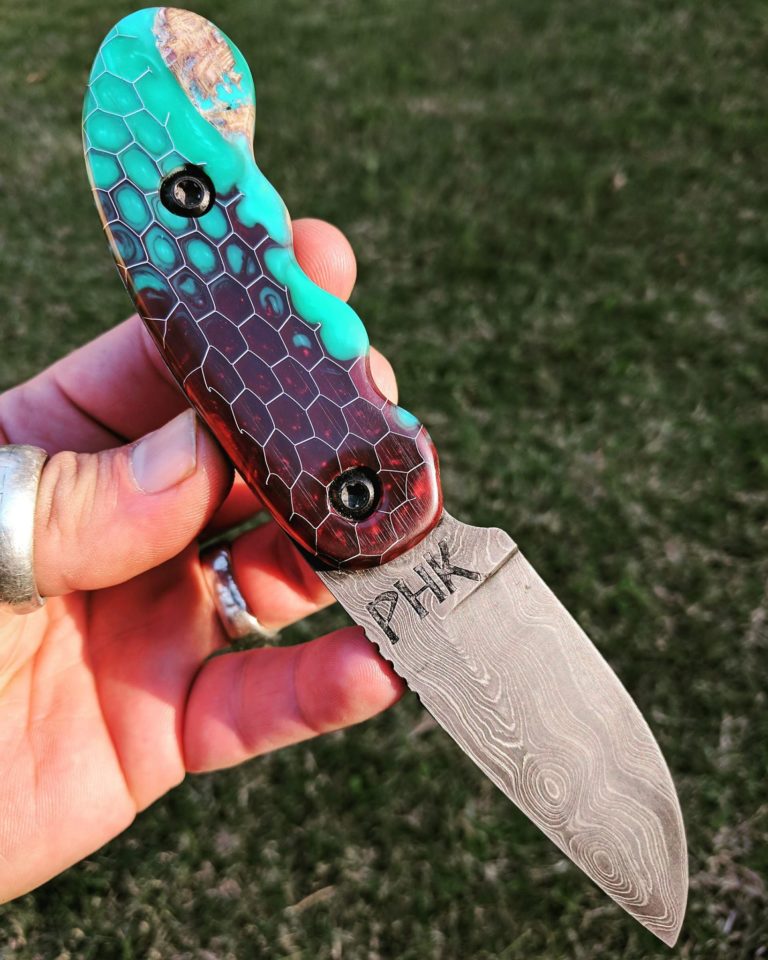
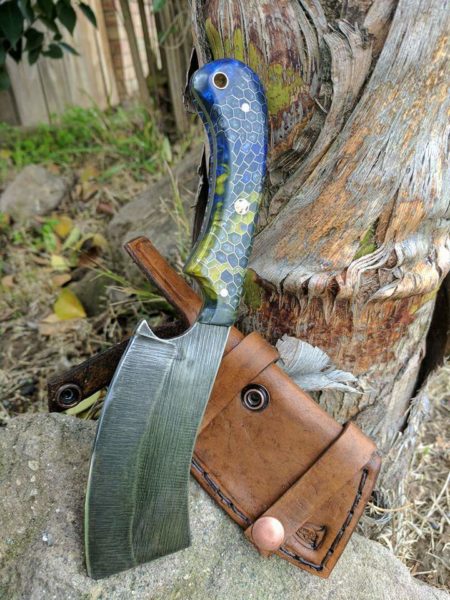
DaCleva has a 4-inch flat-ground blade made of 1095 steel with an acid-washed finish for a battle-worn look. Overall length is 9 inches. Scales are by Norman Robbins at 8th Dimension Concepts. Maker’s list price: $250 with Kydex sheath; $325 with leather.The Lil Chubby drop-point is 8 inches overall, with a 3.5-inch flat-ground blade made with random pattern Alabama Damascus Steel from Lacy Smith. The handle scales are from Norm Robbins from 8th Dimension Concepts. Maker’s list price: $300 with sheath. In 1095 steel at $200. Contacts listed at the bottom of this article.
Randy uses All Star Abrasives in Lawrenceburg, Tennessee, for his abrasive supplies, which is what he puts to his hybrid scales to bring out their color.
Contact Randy Madan at [email protected], 760-885-9370 on Facebook at Patriot Horde Knives and on Instagram @the_patriot_horde.
A Digital Subscription to BLADE Is The Anwswer
You can read your digital issues of BLADE Magazine anywhere you have your phone, tablet or computer, and there’s no need to find storage for all your old issues.
If piling-up issues of magazines seems like a waste to you… If you feel like you don’t have time to read a magazine… If you like the stories we offer in BLADE, but want a more economical option, then a digital subscription is the answer. An annual subscription to BLADE is $17.98, $4 off the print price.
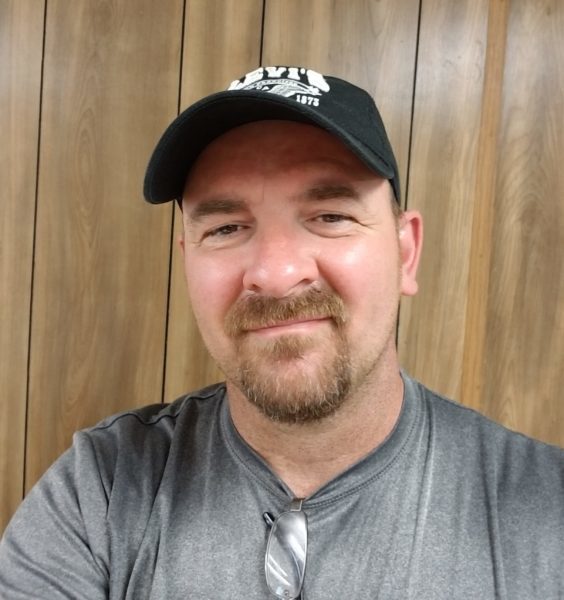
When Jerry Davis was a baby he was scooting across the floor and his grandmother dubbed him Scooter. He is a third-generation welder and fabricator. His dad made knives as a hobby, and by the time Scooter was a teenager, he, too, was making knives.
Schooter Davis, a Desert Storm US Marine Corps veteran, specializes in small everyday carry knives, skinners and survival knives.
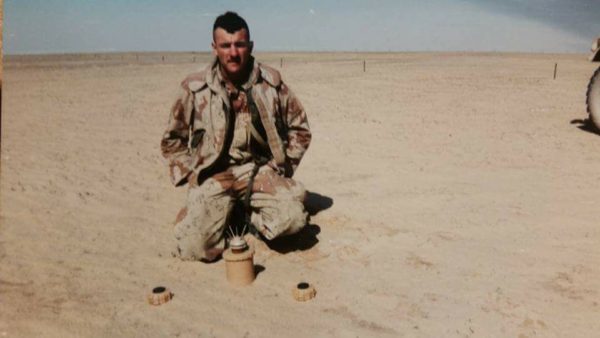
At 19 he entered the U.S. Marine Corps and served as a heavy equipment engineer during Desert Storm. The Gulf War veteran served four years then returned to West Virginia.
Scooter Davis served in the U.S. Marine Corps during Desert Storm. The Gulf War vet then returned to his native West Virginia.
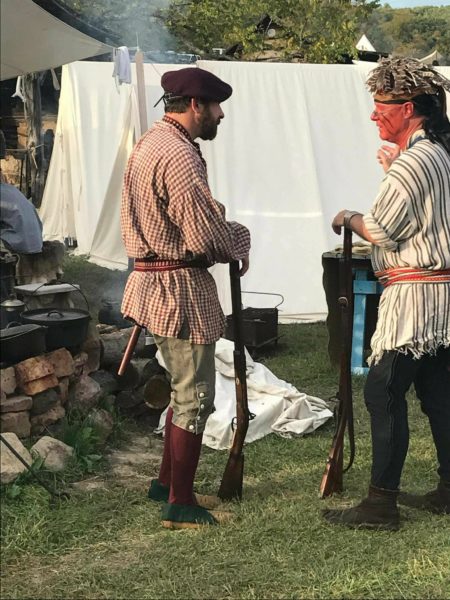
When he isn’t making knives, he’s attending rendezvous, living history gatherings that bring early American frontier days to life. He makes many items in his kit and, of course, period-appropriate knives.
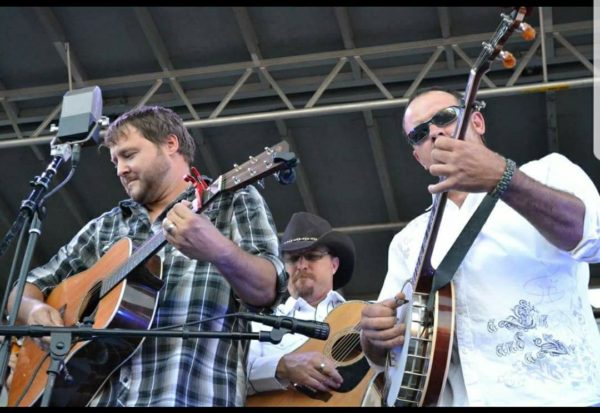
“A primitive rendezvous is a living history event,” Scooter Davis explained. “I have enjoyed them since I was a child. It’s like taking several steps back in time and I enjoy crafting knives and other items that represent that time period [early American frontier].”He’s also a singer and musician, playing weddings, parties and other events, equally comfortable with Sinatra or Stevie Ray Vaughan.
The quintessential Renaissance man, Scooter Davis of Rough Run Forge, can also perform anything from smooth jazz to country.
“I’ve always been an artistic feller, always making things. I can make just about anything,” Scooter said. But what really inspired him was the quality of the work he saw coming out of other knifemakers. John Savage has been a good friend along the way. “My goal is to create blades worthy of being used in the outdoors.”
Best-selling knife patterns: small everyday carry, skinning, survival
Favorite blade steels: 1095 for ease of forging, toughness; 52100 for toughness, edge retention
Blade grinds: flat for deep cutting and skinning, convex Scandi for durability in hard use
How he tests his knives: field use, chopping mountain laurel, slicing paper, cutting small bolts, shaving
Favorite handle materials: Micarta for toughness and durability; wood and bone for beauty and value. “I am partial to rare and hard-to-find materials,” Scooter noted.
Price range: $150 and up
Online purveyors: Pendleton County Outdoors, www.pendletoncountyoutdoors.com
Knife shows he attends: Greater Shenandoah Valley Knife Show, Harrisonburg, Virginia
Member of: American Bladesmith Society
Forums he participate in: Facebook Groups, Knife Dogs, BladeForums.com
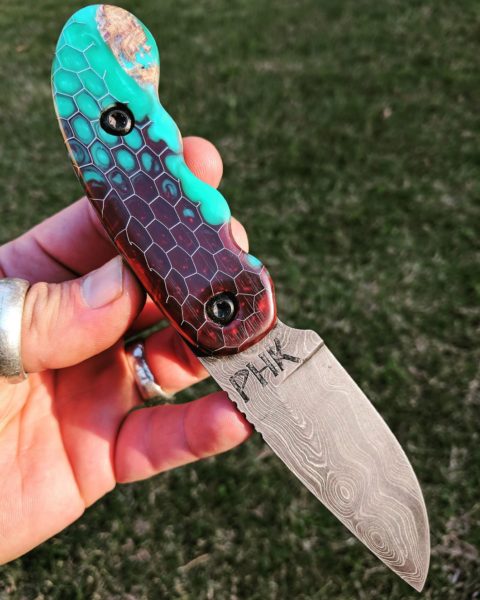
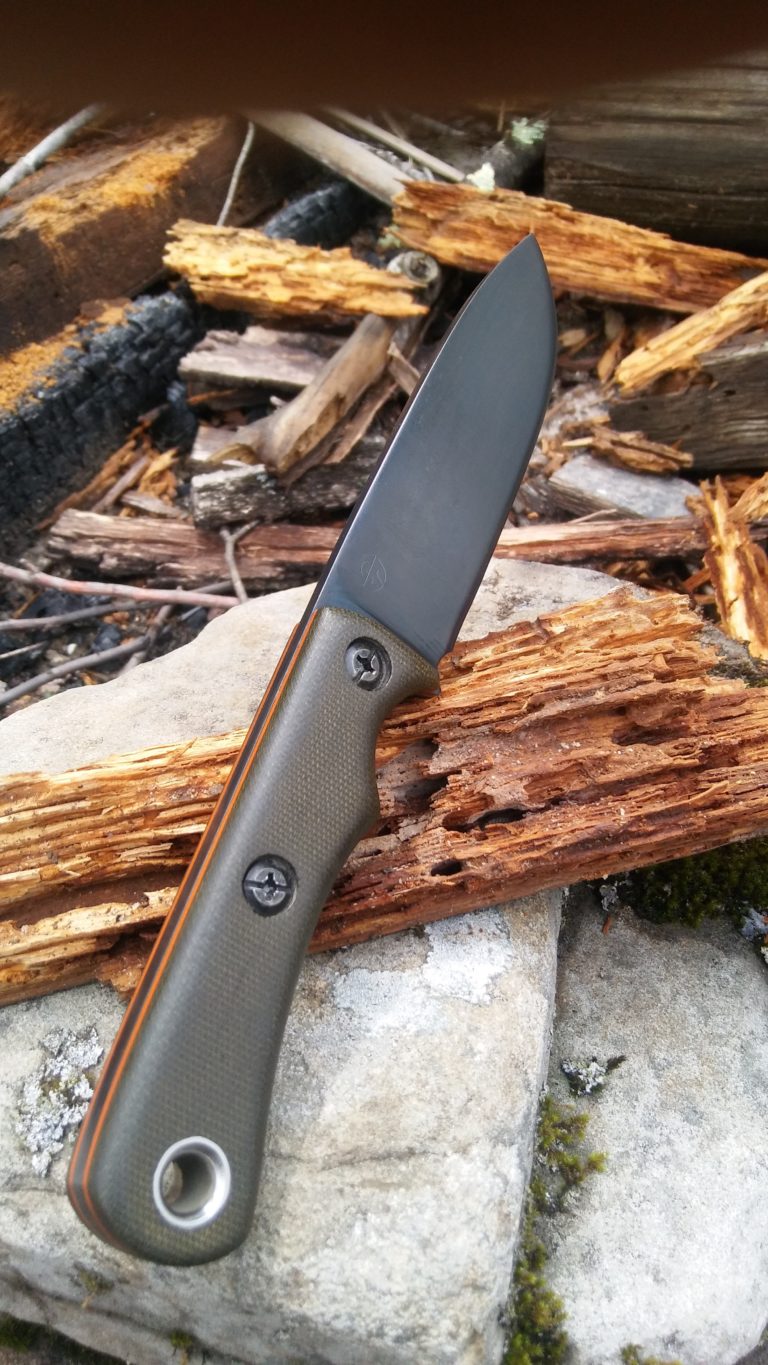
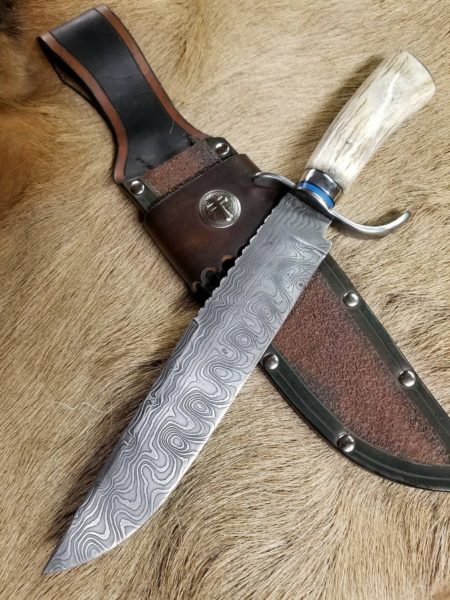
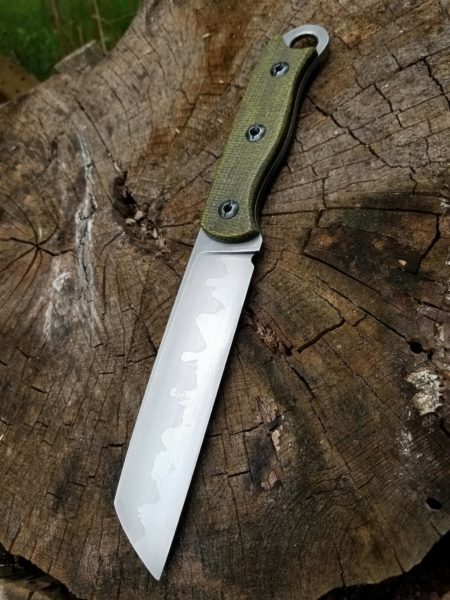
This bowie has a 13 1/2-inch blade made of pattern-welded steel by Zoe Crist Knives. The handle is comprised of elk antler, stainless steel and G-10 spacers. The maker’s own pattern-welded steel was used on the guard. Maker’s list price: $800. Contacts listed at the bottom of this article.Scooter Davis’ seax is 10 1/2 inches long with a 5 1/2-inch blade made from W2 steel with hamon. Avocado Micarta scales were used for the handle. Maker’s list price: $250. Contacts listed at the bottom of this article.The W.A.C.K.-1 (Wilderness Area Camp Knife) has a 5-inch blade forced from 1095 high-carbon steel. The scales are fashioned from OD green canvas Micarta with hunter orange G10 liners and a ½-inch stainless steel lanyard tube. Contacts listed at the bottom of this article.
Contact Scooter Davis at 540-560-1672, [email protected], on Facebook at Rough Run Forge and Instagram @roughrunforge.
A Digital Subscription To BLADE is the Answer
You can read your digital issues of BLADE Magazine anywhere you have your phone, tablet or computer, and there’s no need to find storage for all your old issues.
If piling-up issues of magazines seems like a waste to you… If you feel like you don’t have time to read a magazine… If you like the stories we offer in BLADE, but want a more economical option, then a digital subscription is the answer. An annual subscription to BLADE is $17.98, $4 off the print price.
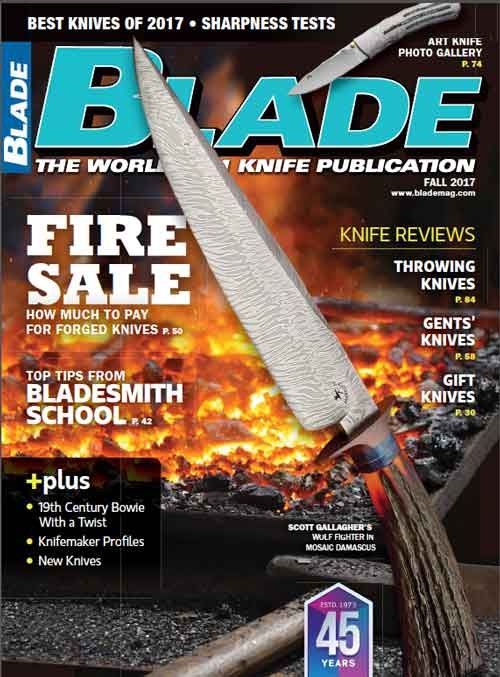
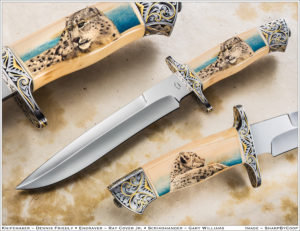
Forged knives are the focus of the latest BLADE®, on newsstands now!The Ikoma Korth Bearing System developed by Flavio Ikoma and Ricardo and Paulo Lala—here on a Korth Carved Reptile—helped revolutionize flipper folders.J.T. Oldham shares his views on whether you should reboot your knife collection in this issue.Find out where art knives such as this model by Dennis Friedly are headed in this issue of BLADE®.
Hot knives don’t get any hotter than those hammered to shape in the forge, and the latest BLADE® focuses on forged knives in all their radiant glory.
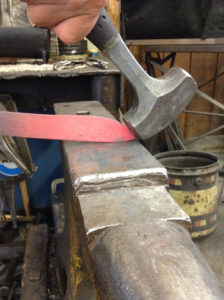
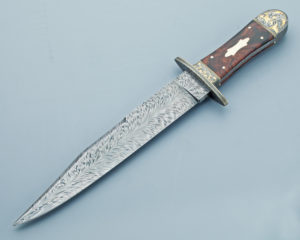
Chris Amos provides tips for novices on how to forge knives in this issue of BLADE®.Harvey Dean‘s damascus beauty won the Antique Bowie Knife Association Award for best period bowie by an ABS master smith. (Chuck Ward image)
How do you get started forging knives? High Endurance Performance Knife master bladesmith Chris Amos covers the basics every newbie bladesmith should know in “Top Tips for Novice Bladesmiths.” Attending hammer-ins is another must for those serious about forging knives, and BLADE Managing Editor Erin Healy tells you about one of the top centers of bladesmithing instruction, the New England School of Metalwork, in “Hammah-Time!”
Sometimes you need to start all over again, including with the knives you collect. Pat Covert interviews some top collectors for their views on the subject in our lead story, “Is It Time To Reboot Your Collection?” Throwing knives have been enjoying a resurgence lately, and James Morgan Ayres tries his hand at flinging some of the latest ones in “Bull’s-Eye!”
Art knives were among the hottest custom knives anywhere in the 1980s and ’90s but in recent years have been overshadowed by tactical and other knives. Dave Rhea examines the current state of the genre and where it’s headed in “Where To Now, Art Knives?” Gent’s knives have an across-the-board appeal for their looks, style and utility. Abe Elias tests four of the latest in “Steel-ish & Stylish.”
There’s much more in this issue, including how the flipper folder changed knife history, tests of two hunting knives, sharp holiday season gift ideas and much more in the latest edition of BLADE, on newsstands now or available in the digital edition. Or, you can subscribe to the domestic print, digital, Canadian print or international print editions.
“I was born a tinkerer,” Dwayne Horvath of Aku-Strike Knives of Pittstown, New Jersey, related. He was always taking things apart, from his father’s reel-to-reel video recorder to his car. By his own admission he was not great at school, but it was during those moments looking out the window, daydreaming, when ideas came to him—lots of ideas. It carried over into his car-racing days, his career as a successful fix-it man and now in retirement as a full-time inventor who daydreamed a trainer knife.
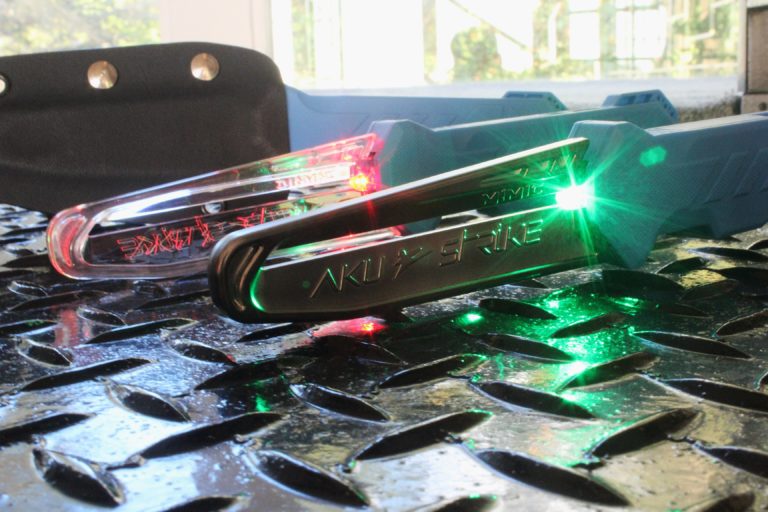
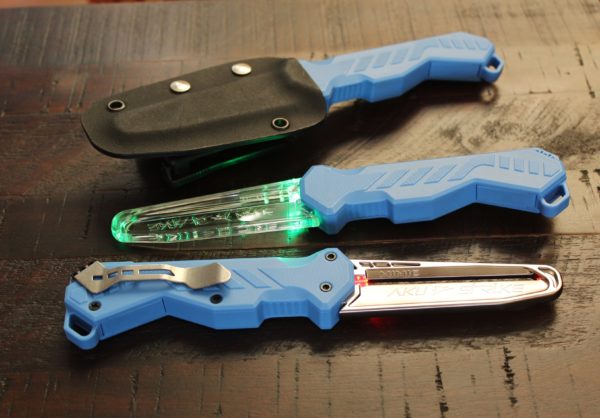
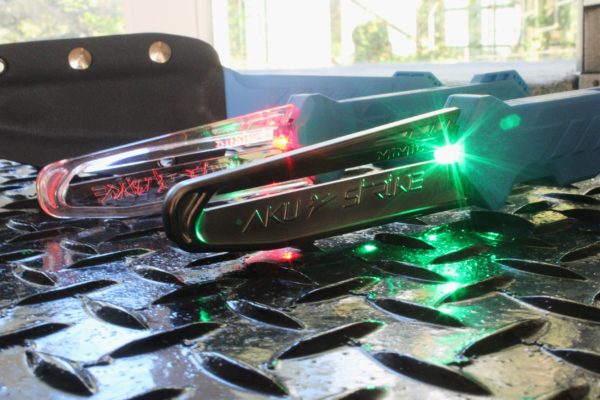
The Aku-Strike Mimic T-16 confirms contact with a red or green LED light and different tones for daytime use when lights are not as visible. Available in nickel or clear. MSRP: $41.95-$43.95. Contacts for Aku-Strike Knives appear at the bottom of this article.
The Aku-Strike Mimic T-16 came to Dwayne in a vision driving home one night from a training session at Alex Wilkie’s Martial Arts Academy in Bridgewater, New Jersey. “It was not a thought before it was a vision. The vision was possibly stirred by an emotion or feeling from training that night,” Dwayne explained.
Dwayne knew about the Shocknife, which is indeed useful for inducing fear in combatives training, but it’s is not something you want to learn on or use every day. Chalking the edges of training knives indeed leaves a mark to inform you and your training partner of a strike, but it’s messy and may not fully wash out of some shirts. There was a real need for another alternative.
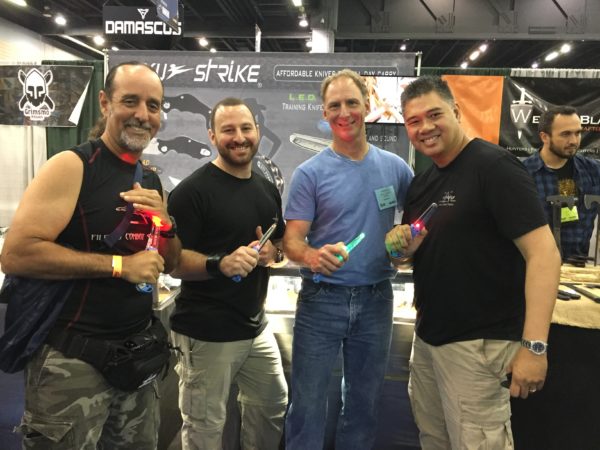
Carlos Pipo Lopez and Samuel Yaron Brill, on the left, and Ray Dionaldo, on the right, all of FCS (Filippino Combat Systems) Kali, give Dwayne Horvath’s (second from right) Aku-Strike Mimic 16-T, an LED training knife with tones, resounding thumbs-up.
“I noticed some students going through the motions of training with the knife and wondered if they realize how deadly a knife can be. I then asked myself, ‘How could I be more aware of being cut and the danger of the blade and also convey to my partner that he is in danger or is being cut? We need something to alert us when contact is made, or what I coin, ‘confirmation of contact,’ while training,” Dwayne explained.
When you take away shock and chalk, you have light or sound left. “Now how do I make this work?” Dwayne asked himself. He had some knowledge of patents. He knew that if he designed something simple, he could get a broad patent. That would in turn mean he would need to minimize parts and keep the construction of the training knife simple. That is a challenge with all the patents out there. He knew he needed at least one switch to turn it on. Any more and he might be infringing on someone else’s design.
Then Dwayne asked himself, “What would be the best way to make the blade send a signal to the electronics? I started drawing and one hour later I figured out the basics. Of course, there were many thoughts and designs in between,” he added.
With the Aku-Strike in the sheath, the battery tray angle also serves to register your fingers to hook the handle for a quick draw. This is one feature that attracted Ray Dionaldo, of FCS Kali, as the feel was similar to his quick-draw knife. The knife also has a secure feel when your hands sweat. Contacts for Aku-Strike Knives are listed at the bottom of this article.
Dwayne was on his last chance with the U.S. Patent and Trademark Office. After reading many patents and going through a few attorneys, he got the patent worded appropriately. He then contacted an attorney who secured a patent. Two months later, Dwayne received the kind of broad patent he had hoped for. Then he got an additional patent.
The Aku-Strike Mimic T-16 has received endorsements from law enforcement agencies whose members must be thoroughly trained for whatever they might find on their beats, including an aggressor with a knife. Martial artists like Ray Dionaldo of FCS (Filipino Combat Systems) Kali, Doug Marcaida of “Forged in Fire” fame and Funker Tactical, the home of all kinds of fighting videos, have all given the Aku-Strike their nod of approval. Even, Setcan, the company that invented the Shocknife, has endorsed the Aku-Strike. The two training knives are not really competitors since one can be used on a more regular basis, while the other can be used periodically to maximize the intensity of a particular training session.
Dwayne had originally envisioned an aluminum blade. “I took it to an Airsoft range. Kids were swinging for the fences. OK, not safe with aluminum for teens, plus you know it hurts—that’s a given,” Dwayne commented. He moved on to polycarbonite. “The polycarbonite had limitations with flex and strength, but overall it was a win, and much more forgiving,” he emphasized. “As a matter of fact, it hurt much less than many rubber trainers and, of course, aluminum.”
Dwayne’s goal was to appeal to a wider, younger demographic that was just starting out with their combatives training to hardcore adult players of Airsoft and paintball. He also wanted to reach law enforcement and martial arts professionals. He finds the inventing to be easier than the marketing. But without that creativity, there would be nothing to market. Dwayne received the kind of encouragement and validation he needed throughout his life, later when his business was a success, but also earlier around the race tracks of New Jersey.
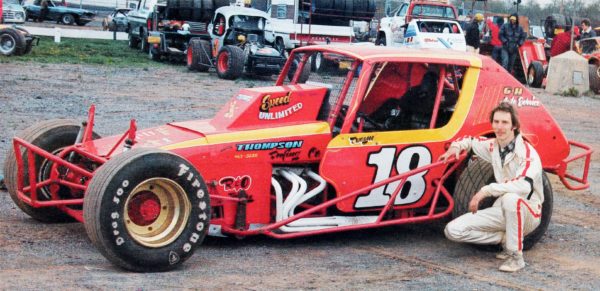
Dwayne Horvath of Aku-Strike Knives spent his formative years on the dirt-track speedways of New Jersey. He was given the encouragement and leeway to tinker, to daydream and now in his retirement he has invented a training knife that gives instantaneous pressure-based feedback through LED light and tone during combatives training. (Photo by Bob Snyder)
“At an early age, I loved racing and would go to Flemington Speedway, a local dirt track…It was a family event every weekend, consisting of fast cars sliding around the dirt track and a bucket of fried chicken,” Dwayne recalled.
“One night my favorite driver crashed real bad, destroying the starter’s stand,” Dwayne felt terrible and wanted to help. He got his father’s permission, and Howie Cronce took Dwayne to his house and let him help. “After school I would ride my bike about 10 miles to his shop, work to the wee hours.” Dwayne would eventually fall asleep and Howie would wake him, put his bike in the back of his pickup and take him home.
“In high school I wasn’t the sharpest tool in the shed. I usually wanted to look out the window and daydream, but I did rebuild a teacher’s engine on his Studebaker and built go-carts from scratch.
“In my racing days, I had what some would call some crazy ideas (probably from daydreaming) about the workings of a car suspension,” he explained. He needed to learn more, but from where? In those days, access to the Internet wasn’t readily available. He decided to sneak into the library at a technical college and hit the books and microfiche to research the effects of tire-slip angles and G-force on race cars.
“I then saved money to buy a G-meter to put in our dirt car, which had never been done before. When uploaded to a laptop, this would show all the forces of breaking, acceleration and cornering in real time so we could see what and when things were happening.” Then adjustments could be made to the shocks, springs and geometry on the car. “I was invited to the Penski shop to study the new shocks we used and got to know Ray Evernham before he teamed up with Jeff Gordon and Hendrick Motorsports.”
And it’s been like that ever since. If grades were given out in daydreaming, Wayne would score an A-plus.
You can read your digital issues of BLADE Magazine anywhere you have your phone, tablet or computer, and there’s no need to find storage for all your old issues.
If piling-up issues of magazines seems like a waste to you… If you feel like you don’t have time to read a magazine… If you like the stories we offer in BLADE, but want a more economical option, then a digital subscription is the answer. An annual subscription to BLADE is $17.98, $4 off the print price.