Home Blog Page 222

Radio Show Addressed Ivory Ban

The federal ban on elephant ivory was one of the topics on the DIane Rehm radio talk show March 4.

Ivory highlights Rehm talk show.
The Diane Rehm radio talk show had ivory as a topic on March 4. Steve Nolte’s fixed blade sports an ivory grip. (Chuck Ward photo)

Craig Hoover of the U.S. Fish and Wildlife Service was among the show’s guests. Hoover is one of the federal officials several in the knife industry have been contacting for information on the federal ivory ban.

Much of the program seemed geared toward the poaching of elephants and how awful that is—which everyone agrees is pretty much the case. What everyone can’t agree on is the best way to address it, and most in the knife industry agree a ban is not it.

Meanwhile, the Obama Administration’s ivory ban drags on.

In a related development, it appears the anti-ivory edict will be updated with new wording due to come out sometime in April. You can make a difference by contacting your Congressional representative and voicing your views. To find out the name of your representative and how to contact him or her, visit http://www.house.gov/representatives/find/

In addition, make your views known to Sally Jewell, Secretary of the Department of the Interior, and Daniel M. Ashe, Director of Fish and Wildlife. Both can be reached at their respective departments at 1849 C St., NW, Washington, DC 20240. For the former call 202-208-3100 or email [email protected] for more information.

Stay tuned to www.blademag.com for the latest knives, knife news and more.

7 Keys To Top Knife Handles

Know the keys to the best handle design to enhance your knife’s performance and safe use. Following are seven:

1) According to ABS journeyman smith Dan Farr, the size of your hand is a key to arriving at the best handle for you. Longer hands require a larger handle diameter and thicker hands a smaller diameter. Wearing gloves works best with a longer and thinner handle. Remember that an eighth-inch difference in handle diameter means approximately a 3/8-inch difference in circumference.

Do you know the keys to top handle design? The knife is the Kershaw Mini Skinner. (Kershaw photo)
Know seven keys to top handle design. The knife is the Kershaw Mini Skinner. (Kershaw photo)

2) As for handle material, most synthetics tend to be stable, durable and often require no protective finish. Wood is strong for its weight, finishes well and adds beauty. Stag is somewhat limited in shape and size, but has good texture and adds traditional looks.

3) Contoured and formed grips are great if they fit your hand, but the more form fit the handle, the fewer people it fits. Finger grooves are an example. They are nice if they fit your fingers, horrible if they do not. Handles with a single finger groove for the index finger will generally be versatile enough to fit many hand sizes.

4) Round handles have no natural indexing for the blade edge (natural indexing refers to the ability to know where the edge is by how the handle feels in your hand rather than having to look at the edge to know where it is). Oval handles are much more useful. They index the edge to the handle and add the ability to use twisting force.

5) Curving the butt of the handle down—also known as the dropped handle—will improve purchase.

6) A palm swell allows a relaxed, comfortable handhold. It keeps your hand in the same place on the handle, provides a natural pivot point and helps with retention.

7) Guards are important safety features. A guard should blend with the contours of the grip and be strong, though in proportion to the rest of the knife.


A Knife Handle That Really Sticks With You

best drop point deer hunting knifeThis Deer & Deer Hunting Drop Point Knife is a great example of a knife that gets its handle right. This hard-working hunting knife was made exclusively by the American Knife Company for BLADE‘s sister brand, Deer & Deer Hunting, and is a great pick for hunters and collectors alike.

Order the Deer & Deer Hunting Drop Point Knife only at ShopBlade.com.

BLADE University: A Fresh Approach to Knife Education

Learn knives as only the legends and masters can teach them at the new BLADE University at the Cobb Galleria Centre in Atlanta. BLADE U. will begin a day before the June 6-8 BLADE Show and end June 7.

Learn wire inlay from ABS master smith Joe Keeslar at BLADE University
ABS master smith Joe Keeslar will teach wire inlay at BLADE University.

A whole new approach to the knife show seminar concept, BLADE University consists of a series of classes under separate headings that are guaranteed to entertain, enlighten and educate you on your favorite subject.

Let industry knifemaking gurus Chris Reeve, Jerry Fisk, Jerry Busse, Tony Bose and Bill Harsey show you how they approach the knife design process in five separate classes under the heading of “Knife Designs of The Masters.” Learn how to inlay wire in knife handles and sheaths from ABS master smith Joe Keeslar in a two-part segment of “Knives The ABS Way” that also will include classes on the design concept of “Line and Flow,” and a demonstration of how applicants test for ABS journeyman and master smith—and how they are judged in the process.

Are you into collecting the knives of such legends as Bob Loveless, Bill Moran, Bo Randall and Jim Schmidt but don’t know what to look for or how? Purveyors Gary Clinton, Dave Ellis and Maj. Louis Chow will show you the way in three separate classes under the heading of “Collecting the Knives of The Legends.”

Engraving is a technique more and more knifemakers are learning to embellish their work and enable them to offer a sole-authorship product. It’s also a great way to embellish your knives in your spare time at home. Learn how the pros do it in “GRS Engraving Instruction,” a complete classroom experience that covers design, art work elements, scribing lines, using engraving tools and understanding how they work, and more.

Finally learn how to do the Japanese handle wrap, all about sword fittings and temper lines, what to look for when buying a Japanese sword and proper sword care/maintenance from two of the world’s leading Japanese sword makers, Wally Hayes and Wally Hostetter, in three separate classes all under the heading of “All About Japanese Swords.”

For  more information visit http://www.bladeshow.com/ehome/bladeshow.com/bladeuniversity/?&&

Antique Ivory Exceptions Rule Too Stringent

Russ Andrews uses fossil ivory on his dagger. (SharpByCoop photo)
One potential problem with the ban is that some fossil ivories resemble elephant ivory, such as the mammoth ivory on the handle of this dagger by Russ Andrews. (SharpByCoop photo)

The recently announced federal ban on ivory not only seems to outlaw all import, export, interstate and intrastate sales of elephant ivory, it also appears to make all potential exceptions to the rule such as antiques virtually impossible to meet.

Initially announced on Feb. 11, the ban received more coverage Feb. 26 when the federal website http://www.fws.gov posted a story outlining the ban in more detail, including Director’s Order No. 210 from the U.S. Department of the Interior, Fish and Wildlife Service.

The story indicated that while virtually all elephant ivory is now illegal, a few exceptions exist, such as antique elephant ivory. However, to qualify as antique, elephant ivory must adhere to a hodge-podge of requirements that not only are virtually impossible to meet but present prohibitive costs in the process.

For instance, to qualify as an antique, the ivory must be 100 years old or older. However, the person claiming the ivory is that old must “definitively prove” the identity of the species. Such proof “can be in the form of bonafide DNA analysis,” a qualified appraisal or “other documentation,” such as “family photos, ethnographic fieldwork or other information.” If such analysis is required on each and every piece of elephant ivory, it would be cost-prohibitive for individual knifemakers. What’s more, the appraiser and the appraisal must meet strict guidelines in terms of the appraiser’s credentials, the scientific method used to determine the age or species must be described in detail, a detailed history of the article including proof of authenticity must be presented, etc.

Not only are the requirements draconian in nature, they don’t even take into account the fact that no one kept such records of their ivory when they bought it months or years ago, and to obtain such information now is virtually impossible.

Further, there must be proof that the ivory was imported through one of 13 specific ports of entry—12 in the USA and the other in San Juan, Puerto Rico. Notarized statements or affidavits by the exporter or seller are not adequate proof.

The maximum penalty for violations—which would qualify as violations of the Endangered Species Act—is one year in prison and a $100,000 fine for the individual, and $200,000 for an organization. Those who submit false records or identification of ivory face a maximum penalty of five years in prison and a $250,000 fine.

For the latest knives, knife news, trends and more, stay tuned to www.blademag.com.


New BLADE Hits Newsstands TODAY!

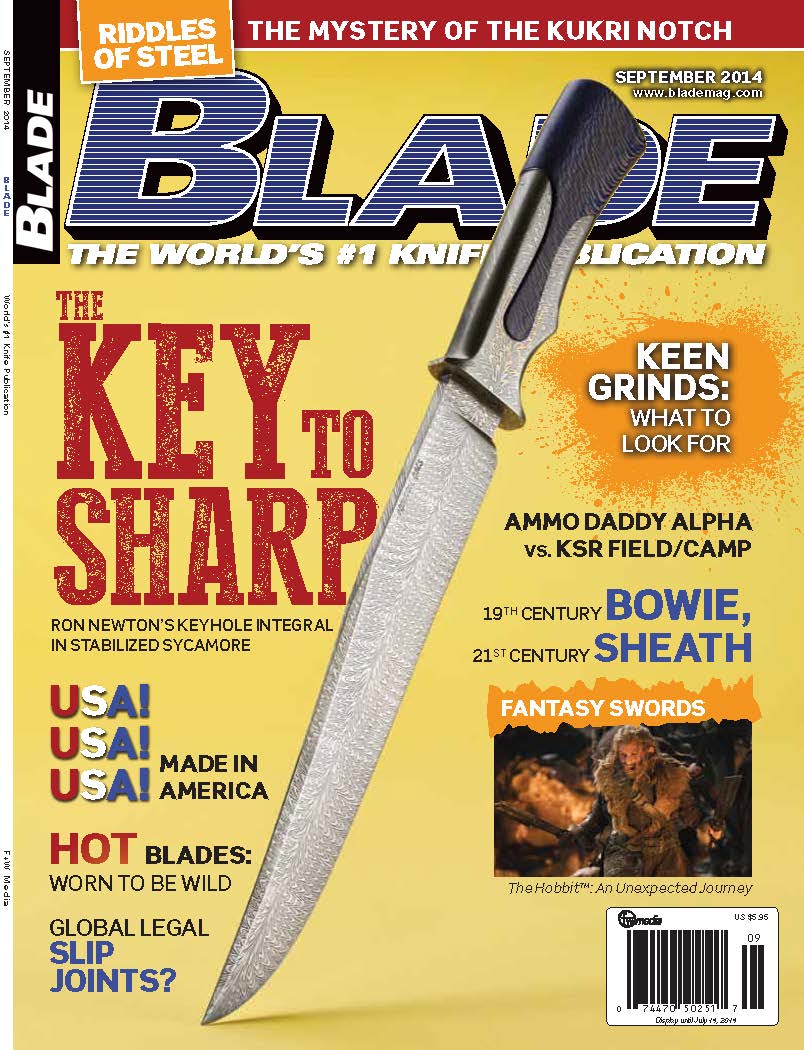
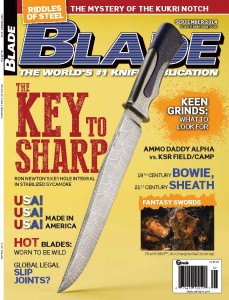
What does it take to be a full-time knifemaker? Was BLADE Magazine Cutlery Hall-Of-Fame© member Michael Walker’s LinerLockâ„¢ an innovation or a redo? Do you know how to make a damascus plug weld? These questions and more are answered in the latest issue of BLADE®, debuting on newsstands TODAY!

Get the new BLADE, on newsstands now!
The new BLADE is on newsstands now!

Custom knives have a mystique and following all their own, and the hottest makers of same enjoy a cult-like status with their most ardent fans. However, what’s it really like to be a full-time custom knifemaker? Read part one of veteran maker Shane Sibert’s story “26 Hurdles To Making Knives” and you will get a healthy dose of reality. In other words, if you’re thinking of becoming a knifemaker, Shane’s article is must reading.

Michael Walker invented the LinerLock in 1981, but it wasn’t until 1987 that other makers started producing folders with the ingenious locking mechanism. Since then the mechanism has exploded in popularity, and today is probably the most popular lock on contemporary folders. Along the way, Walker had to fight to maintain his claim of being the inventor of the LinerLock. He tells you all about it and other things in “LinerLock: Innovation or Redo?”

Also: Check out the first-ever knives offered by Maxpedition, including this issue’s cover knife, the Ferox. Learn all about some of the best knives you may not know of and also what is behind the re-emergence of blade fullers, also known incorrectly as blood grooves, on today’s knives.

Knifemaker Stanley Fujisaka passed away on the last day of 2013 but not before he left an indelible impression on scores of knifemakers, knife enthusiasts and, of course, his loving family and friends. Dan Delavan shares his memories of the endearing Hawaiian maker and person in “Fujisaka: A Great Mentor Remembered.”

Stay tuned to www.blademag.com for the latest in knives, knife trends and much more.

2014 BLADE Show Website Now Available

0

The completely updated 2014 BLADE Show website is up, running and conveniently ready to take your booth or table order as an exhibitor at the show; for you to purchase your three-day or one-day ticket to the show, and thus beat the crowds, or add on the Friday Early-Bird option;image-1.php make hotel reservations at the Renaissance Waverly Hotel or one of the BLADE Show partner hotels; to see sharp seminars and view a seminar schedule; or see updated lists of exhibitors who will be displaying their wares at the World’s Greatest Knife Show.

The BLADE Show is June 6-8, 2014, at the Cobb Galleria Center in Atlanta, Georgia. Don’t miss out. Get your ticket to the World’s Greatest  Knife Show now! See you there!

KA-BAR Issues WWII Theater Knife

0

KA-BAR announces an exciting project to manufacture and release a limited edition of 350 iconic E.W. Stone WW II theater knives. E.W. Stone, Jr., Stone’s son, has collaborated with KA-BAR to use his father’s original handle casts of what has now become legendary to WW II knife collectors—skull and cobra grips. The grips will anchor 350 KA-BAR USMC Fighting/Utility knives with blued blades.EWStoneKnifeStoneKnife

The climate and the nature of combat in the South Pacific led to the creation of the Stone Knife.  The leather handle of the KA-BAR USMC Fighting/Utility knife often fell prey to the humidity, rainfall and combat conditions of the Pacific campaign. Though the blade remained intact, the handles occasionally suffered from jungle rot. In a display of resourcefulness, E.W. Stone, Sr., who worked in the foundry of the USS Holland, cast new handles onto the KA-BAR blades. Stone salvaged material from downed Japanese aircraft to make his signature handle. Approximately 250-300 E.W. Stone theater knives were made during World War II, and according to his son in a video (see video at end of story), about 95 percent of the cast handles were on KA-BAR knife blades.

The modern KA-BAR E.W. Stone Knife features a JRE semi-custom sheath, a golden oak Gerstner display case, an informational booklet and DVD, and a certificate of authenticity signed by KA-BAR President John Stitt and E.W. Stone, Jr.

The KA-BAR E.W. Stone Knife can be purchased only at KA-BAR.com, or by calling KA-BAR at 800-282-0130. The cost of the E.W. Stone is $1,000.  The E.W. Stone Knife is sold on a first come first serve basis and is limited to five per customer.

Make sure to watch this fascinating video interview with E.W. Stone, Jr.:

KA-BAR E.W. Stone Knife Limited Edition from KA-BAR Knives on Vimeo.

For more on military knives, click here.

Advertisement

Must Read Articles

Read this before you make a knife

Knifemaking 101 – Read This Before You Make a Knife

  by Wayne Goddard My experience has taught me that there's nothing like digging in and getting started. I've often said the hardest part of the...
how to forge damascus steel

How to Forge Damascus

Advertisement
Advertisement