An interview with Spyderco Marketing Manager Joyce Laituri for an article posted online by the Denver Post  on January 21st, 2014, proved revealing, even to those who have been in the knife industry for a long time. For instance, did you know that, in addition to knives, Spyderco also manufactures carbon fiber sailboats?
A short question-and-answer type of article, it’s the kind of piece that reflects positively on knives, and that, after all, is what the industry needs most. It starts out:
How did you get involved in this business? Spyderco is a family-owned and operated business run by Sal, Gail and Eric Glesser. The company was started in the late 1970s, selling knife sharpeners from the back of a converted bread truck at state fairs (the family also lived in the bread truck).
An article on the lost art of knife sharpening in Spain rang true to this knife enthusiast, and I’m sure it will for you, too. In an article posted on BBC News Business and written by Tom Burridge of BBC News, Madrid, Burridge reports on two men, Rafael Antonio and Rafael Romero del Campo, who use motorbikes to take their knife-sharpening services to businesses in Madrid.Â
The whirl of the petro-powered stone wheels can be heard in the early-morning hours. As Burridge writes, “A shrill, but tuneful whistle reverberated around the narrow streets of my neighbourhood in central Madrid. I peered from my balcony, and, in the distance, there he was. His name is Antonio, an elderly man, dressed in simple clothes, who grew up in a Spain that is far removed from the country we both live in today. And he is practicing a Spanish tradition that is slowly disappearing. Antonio is an afilador, which translates into English as a sharpener. He thinks he is one of only five left in the whole of Madrid.
Brandishing two of my best kitchen knives, which probably hadn’t been sharpened for going on 10 years, I ran down on to a silent, sleepy, Sunday morning street.”
The knife Gil Hibben made for Elvis Presley in 1974 lives on today in the “Hibben Karate Master” reproduction (shown at bottom above) from United Cutlery. (United photo)
Today is Presley’s birthday and a reminder of when Hibben and Phil Lobred, coordinator of the Art Knife Invitational, visited Presley 40 years ago.
It was also when Hibben presented Presley with a handmade Hibben knife.
Both Hibben and Presley were practitioners of Kenpo karate. In 1974, Gil and Phil attended a Kenpo tournament in Los Angeles. While there, they stayed with Ed Parker, founder of the Kenpo system. Parker had one of the early custom Hibben Kenpo knives which, at the time, Gil called the Ed Parker Knife. It occurred to Parker that Elvis, who had a second home in L.A. and was a karate student of Parker’s, might be interested in the Hibben knife. Plus, presenting the knife to Elvis could be a way to get Gil and Phil in to see the King.
Parker made the arrangements and Gil and Phil were at Presley’s L.A. home. When the knife was presented to Elvis, the King was extremely pleased. “He was like a kid with a new toy,” Lobred recalled. Presley went upstairs and returned with a gold Omega watch and presented it to Hibben in return. In all, Gil and Phil got to hang out with the King and Co. for about six hours.
As for whatever happened to the knife presented to Presley, Hibben said no one knows for sure. “It’s not at Graceland,” Gil noted. Maybe one day it will turn up. If it does, Hibben said he will know it on sight.
For the latest knives, knife news, trends, tips and more, stay honed at www.blademag.com.
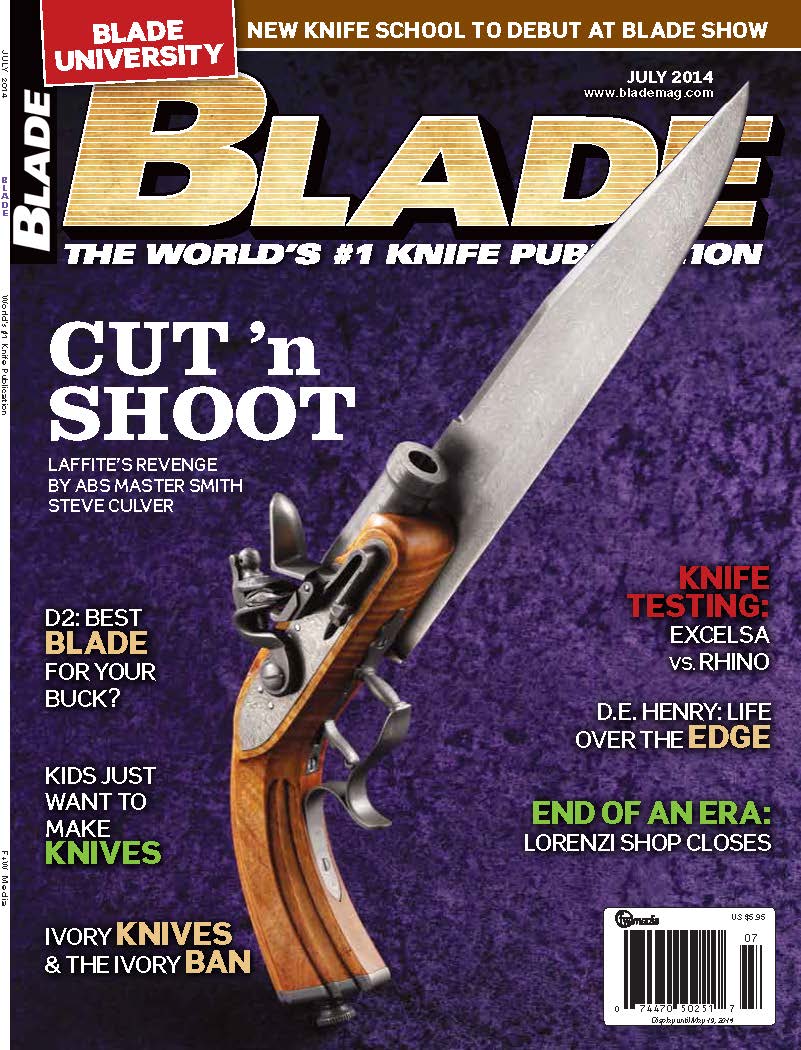
Get the lowdown on the latest knife hotbed of Russia in the new BLADE®—on newsstands NOW!
The Shirogorov brothers’ Hati is the cover knife for the new BLADE, which debuts on newsstands today.
Sporting the Hati flipper folder by Russia’s hot knifemaking brother team of Sergei and Igor Shirogorov on the cover, the March BLADE features the headline story on the explosion of all things knife in Mother Russia. From the custom knives of the Shirogorovs and others, the factory knives of Olamic Cutlery and Kizlyar, and the explosion in the buying of American-made custom and factory knives by Russians, today’s knife market is warming up nicely in the Land of the Bear.
If you’re into making knives, the new issue has two stories that should fit your sheath. In fact, one is part two of Ed Fowler’s pouch sheath how-to. The other is Pat Covert’s pictorial on how Bob Dozier makes a frame-lock folder.
Like bushcraft knives? If so, join Mike Haskew as he taps the expertise of some leading makers and users of same in discussing “5 Keys To Top Bushcraft Knives.”
From the early days of Bill Moran to some of today’s leading custom knives, wood knife handles with the tiger-stripe look seem to have a mesmerizing effect on knife enthusiasts. Discover which woods have it and what all the hubbub is about in “Tiger Woods.”
The year past was a momentous one in the world of knives, and BLADE was there to cover all the head-turning events. Relive the year that was in “Dancing On The Edge.”
And, winding up BLADE’s 40th anniversary series on the top knives and makers of the past 40 years is part three of the installment on the top custom makers over a segment of that stretch—this time the top 16 from 2001-2012.
There’s much more—and it’s all in the new March BLADE.
For the latest knives, knife news, trends and more, stay honed at www.blademag.com.
An all-inclusive ivory ban that would target ancient ivory such as mammoth and mastodon in addition to elephant ivory likely will pass without your help by the end of day today, Dec. 27.
A proposed ivory ban would include ancient ivory. Kevin Casey uses ancient walrus ivory on his bowie. (SharpByCoop photo)
A Presidential Advisory Committee that met on Dec. 16 recommends a total ban of ivory within the USA to the task force on Wildlife Trafficking. The ban would apply to the sale of all ivory in any form and include pre-ban and antique ivory in knives, guns, musical instruments, pianos with ivory keys, etc. The ban would affect collectors, makers and anyone who sells within or to the USA. The committee will file its report on Dec. 28, so any entreaties opposing the proposed ban must be e-mailed by no later than today in order to be registered and considered before the report is filed.
The address to send your email to is [email protected]. Copy and paste the following letter—though feel free to tailor it as you see fit—to an email, and email it to the above address:
Dear Advisory Committee,
I stand against a total ban of all ivory sales in the USA.
As called for in the Presidential Executive Order, I ask that the recommendations continue to allow for “legal and legitimate commerce.”
The ivory market in the USA is stable and/or declining, and seizure records indicate that a high proportion of the seizures were personal effects lacking the correct paperwork, not the so-called blood tusks reported on by the media. The Elephant Trade Information System (ETIS) analysis indicates that the amount of ivory by weight seized annually has not increased in recent years. We are not the consumers of the poached ivory. Therefore, banning ivory sales within the USA will do nothing to save the remaining world population of elephants.
The CITES MIKE (Monitoring the Illegal Killing of Elephants) September 2013 report analysis, page 64, states, “Africa’s elephant populations are managed sustainably,” and that in 2013 the quote for permits for legal elephants was 1,350 animals. There is legal trade that can be monitored with DNA testing and permitting. Enforcing and policing a ban would require funds that should be used to support the ban on imports already in effect.
I fully support CITES rules, closing international borders to elephant ivory trade, a law already in effect that should be fully supported and enforced. I stand against a total ban of all ivory commerce within U.S. borders, a decision that would be an enforcement nightmare. Like Prohibition of the 1920s, it would cause a new wave of illicit commerce where a legitimate one now exists. Museums, antique dealers, collectors, artisans and individual citizens have invested in a legal and valuable material. Sanctioned trade in ivory that is legal (culled and pre-ban) and comes from unthreatened sources (mammoth, boar, warthog, antique and recycled products) can pose no possible threat to elephant herds in the wild.
I believe our mutual goals are the same and a solution can be reached. Please keep the focus where it belongs. To increase the elephant population, the killing must be stopped in Africa and at its borders.
An article posted by Bee Wilson on The Guardian website’s Life & Style blog is titled “Bring Your Own Cutlery: Why We Should All Carry Our Own Knives and Forks.” Following is a short excerpt from the interesting and informative article about the practice—and suggestion that the tradition continue—of bringing your own knives, forks and necessary cutlery to restaurants.
In China and Japan, a “bring-your-own-chopsticks” movement has sprung up. Could a similar trend take off here, or are we too wedded to disposable plastic cutlery?Â
In medieval Europe, people used to carry their own personal knife – a sharp one – for every eating occasion. There was no expectation that cutlery would be provided, except perhaps for spoons. When the meal was done, the knife was wiped clean on a napkin and carefully returned to your person. The knife was worn so habitually that – as with a watch – you might start to regard it as a part of yourself and forget it was there. A 6th-century text reminded monks to detach their knives from their belts before they went to bed, so they didn’t cut themselves. Like many aspects of medieval life, this knife carrying now seems pretty weird.
Just in time for the holidays comes THE EX Kitchen Knife Set—2nd Edition by Raffaele Iannello, available on eBay for $89.97. Color choices are blue, red, white, yellow, orange, black and silver, to match the decor, of course, of your ex’s kitchen, or your own kitchen as a reminder of why it’s yours and yours only now.
It’s the perfect gift for the voodoo princess or not-so-charming prince on your Christmas list.