Home Blog Page 253

Tips for Grinding a Blade

1

Editor’s Note: This is an excerpt from Murray Carter’s new book, Bladesmithing with Murray Carter. Click here to learn more from this renowned knifemaker.

The shape of the blade, or profile, must be precisely ground. Grinding is the operation of using files or other abrasives to mechanically shape the steel into a functional blade.

Grinding can be divided into two categories: grinding the blade profile and grinding the blade’s edges (secondary and primary).

Let’s talk about the profile. Grinding a forged blade’s profile can be done with a variety of tools. Heating the blade via friction is not a big concern because this grinding is done prior to heat treating (annealing, quenching and tempering). As you may know, the blade needs to be shaped after a pattern or template. At this stage that template is scribed onto the billet of steel that is to become your knife.

Place the pattern so that it most appropriately covers the billet in relation to the thickness and tang. Be careful on full-tang knife billets to orient the template the correct way. I once made the mistake of switching the tang end of the billet for the blade end and wound up with a blade with way too much taper.

Once the template is in place, secure it with a pair of locking pliers or strong clamps. Any sharp-pointed tool that is harder than the annealed steel will scribe (scratch) lines onto the billet. Trace around the template completely. Examine it before you remove the clamp(s) to make sure you can see the scribe lines clearly. Examine it again, checking it against this list:

* Are the lines clear and not making little “train tracks?”

* Is the blade/tang junction exactly where it should be?

* Is the blade where it should be?

* If you have made a mistake scribing the lines, you can lightly grind the surface and scribe again, but you will now be committed to grinding and polishing the flats of your finished blade.

Also remember that, on a laminated billet, if you grind steel from one side you really ought to grind the same amount from the other side as well, or the steel core will no longer line up in the middle. For blades
that are meant to have a forge finish or a hammer-forged finish, these options will no longer be possible, so take great care when scribing lines on a billet.

There are several methods for removing the excess steel from the billet to produce the perfect profile.

* Steel shears

* Cut-off wheel

* Band saw

* Drill press and hack saw

* Belt sander

* Bench grinder

* Kaiten toishi

As the smith is cutting out or grinding the blade profile, the scribed lines, which should be clearly visible, are the guide. As soon as you are so close to the lines that you are actually touching them in places, it is necessary to employ another “micro observation” technique to be in full control of the profile.

In a good source of natural light, hold the blade at eye height with the flats of the blade horizontal. Instead of focusing your attention on the flats, look closely at the outer edges of the blade. If you hold the blade with the point towards your eye, the spine of the blade should look compressed into a few millimeters.

Compressed like this, every high or low spot on your scribed line will be evident. Similarly, every line on the outer profile of the blade should be examined this way. In the pattern or template you used, every line should be well defined and with a purpose. Ask yourself if the lines you are now looking at were meant to be perfectly straight, curved or pointed. Pinpoint trouble areas, then attempt to grind in a way to affect only those areas and re-examine.

At this stage, the blade should be at 97 percent of its final profile. The other 3 percent will be removed in the final polishing stages.

Click here to get 40% off Bladesmithing with Murray Carter and take the next step in the knifemaking journey.

How to Select a Steel for Forging

0

Editor’s Note: This is an excerpt from Murray Carter’s new book, Bladesmithing with Murray Carter. Click here to learn more from this renowned knifemaker.

The first and most logical approach is to select steel by doing some research on cutlery grade steel. Topics to especially pay attention to are the chemical composition of different steels and the effects of each chemical; isothermal transformation graphs for different steels; the effects and importance of thermal cycles, including annealing, quenching and tempering; the availability and cost of the steels and, perhaps most importantly, how easy the steels are to work by hand.

The above paragraph only took a few lines to write and a few minutes to compose, and yet many metallurgists will spend their whole lives researching those points. Pursue it to your heart’s content, and to that end I have included a thorough bibliography at the back of this book. However, to get you focused back on the task at hand, suffice it to say that there are some specifi cs you will need to concentrate on when selecting steel. These are:

• The amount of carbon in the steel

• Forging temperature range

• Annealing temperature, quenching temperature and tempering temperature

• Availability

• Overall workability

Let’s examine each of these in a little more detail.

Carbon is added to iron (Fe) to make steel. Carbon is the element that enables steel to harden when it is quenched at the proper temperature. Steel is unique in this aspect; all other metals soften when subjected to the same thermal cycle. The amount of carbon is very important. Too little carbon will fail to make steel harden when quenched, and too much carbon turns cutlery steel into cast steel. Generally speaking, less than 0.5 percent carbon is considered low carbon steel, and not suitable for blades. More than 1.6 percent carbon is considered extremely high carbon steel, and is very tricky to make into a blade. More than two percent usually equates to cast steel. Hence, most blades in the world have a carbon content between 0.5 percent and 1.5 percent.

In this range, all other factors being equal, the more carbon, the harder the blade gets when quenched. The harder the blade, the finer an edge and the longer it will stay sharp.

Forging temperature range is the temperature at which you can “work” or manipulate the steel. Most steel can be worked between a bright red heat and orange/yellow heat (approx .700~900 degrees Celsius, 1290-1650 Fahrenheit) and it will yield under the blow of the hammer, bend or twist etc.

Below this range the steel will cease to yield to manipulation and can be damaged by subjecting it to stress. Likewise, steel can be irreversibly damaged from working it at too high a temperature.

Annealing, quenching and tempering are the three phases of heat treating steel. These temperatures are very critical figures to commit to memory for the steel you are working. The heart and soul of a blade is the heat treat, as the final quality of the blade will be determined by how successfully these three operations are accomplished. Knowing the proper temperatures, and knowing what they look and feel like, is a critical skill for the bladesmith.

Availability determines whether or not you will be able to try forging that ‘super-steel’ you have been reading about. If you cannot locate or buy the steel in question, the pursuit becomes meaningless. Cost is another factor. Even if you locate the steel of your dreams, it may cost too much to have it shipped to your location. You want to know if you can acquire the steel for a reasonable cost and if it will be available in the foreseeable future.

Overall workability considers how the steel in question compares to other steels. Is it easy to manipulate under the hammer when you are forging it? How does it heat treat? Is it prone to warping, bending or cracking? Is it easy to straighten after heat treating? How does it take a final polish?

These questions are easier to answer once you have experience with a few of the common steels.


Click here to get 40% off Bladesmithing with Murray Carter and take the next step in the knifemaking journey.

4 Steps to Perfect Freehand Sharpening


1) Select a Sharpener

Invest in a good bench stone. You have the natural ones like the Arkansas stones and the manmade ones such as the Norton India stone. There are also the diamond-bonded stones that many companies produce.

2) Color the Edge

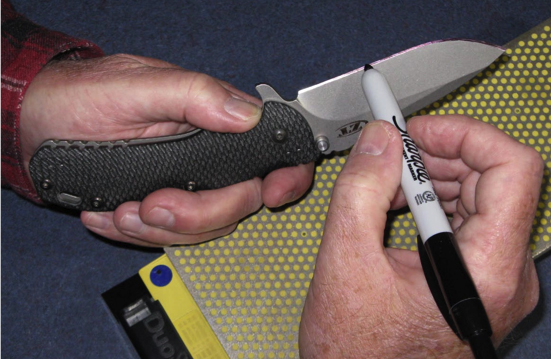
With a black ink permanent marker, color the entire cutting edge or primary bevel on both sides of the blade. The objective is to sharpen off the black ink. After you remove the ink from both sides of the blade, it will be sharp.

3) Adjust Accordingly

Take a few strokes on the stone and then examine the edge bevel. If you see ink toward the top of the bevel, decrease the angle of the blade to the stone. Conversely, if you see ink toward the bottom of the bevel, increase the angle to capture that part.

4) Remove the Ink

After you sharpen the ink from the cutting edge, you will have to remove any stray marker ink. A liquid-based adhesive and paint remover is ideal for the job. Place a few drops on a paper towel and very carefully wipe the cutting edge.

Going Forward

After you get the hang of it, skip the permanent marker step. Congratulations, you’re now a freehand sharpening pro!


Vacation Knives: Multi-Tool For Emergency Repairs


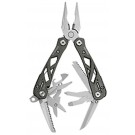
A hot multi-tool with a selection of sharp blades in plain and serrated edges, assorted tools such as a spring-loaded pliers, flat-head and Phillips screwdrivers, a saw, scissors, can-opener and more—what else would you need to fend off an emergency repair job while on the road? The Gerber Suspension Multi-Tool has it all, plus one-hand opening and the company’s Saf.T.Plus locking system—all for our nifty price of $34.99.


For more info click on http://www.shopblade.com/gerber-suspension-multi-tool-y6989/?lid=blss081512

Navy SEAL’s Super Bolo!

Nearly 20 years later and with my original bolo in disrepair, I thought it time to replace it with an updated and more technologically sophisticated design. My goal was to find a knifemaker from my home state of Kentucky who would be capable and willing to collaborate on the project. It was not long before several members of the Knifemakers’ Guild recommended Gene Baskett. A Guild member since 1981, Gene has proved to be one of Kentucky’s finest custom knifemakers and has earned the respect of his peers for the quality work he produces.

He and I based the knife’s design on the old bolo I had used when I served in the SEALs. Our decision was to go with CPM-154 stainless steel, and Gene made several blade adjustments. We experimented with a rubber handle made from extremely durable horse matting material—a perfect Bluegrass State touch, and a substance also favored by a number of makers and contestants in the cutting competitions. The resulting grip is firm yet shock absorbing. The handle can also be securely grasped when wet. My concerns were simple: durability and performance. I wanted a knife that would withstand a heavy amount of punishment and still perform well.

Both Gene and I agree that the knife has exceeded our expectations. Its cutting ability is just plain scary. Without honing the original edge applied by Gene, I put the knife to the test. He already had whacked through 1-inch saplings, and still the blade was gliding through blades of grass and straw. My test consisted of saplings, 1-inch tree branches and wild grape vines. All were easily severed with one clean hit.

After 20-to-30 strikes on branches and vines, I moved on to a grass mat wrap 4 inches in diameter. The grass mat was wrapped tightly around a 1-inch piece of dried bamboo. One diagonal strike went completely through. I finished the test with a piece of quarter-inch tanned cowhide. With only slight pressure, the bolo sank through the hide from tip to handle. Drawing the blade out and away left a clean, effortless cut through 8 inches of hide. The blade was still quite sharp afterward.—BY STEVE WATKINS, retired Navy SEAL

For the complete story on the author’s super bolo, you can get the digital version of the December BLADE® by clicking on http://www.shopblade.com/blade-dec-2012-digital-issue?lid=SSfbbl101612

PICTURE CAPTIONS, FROM TOP

TOP: At top is the author’s old bolo and leather sheath and below it is Gene Baskett’s Super Bolo and Kydex® sheath. (photo courtesy of Steve Watkins)

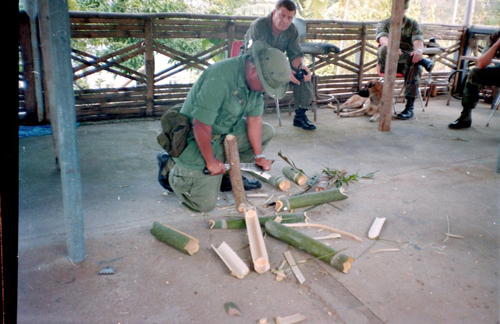
MIDDLE: One of the instructors near the author’s duty station in the Philippines circa 1990 splits wood with the author’s old bolo. (photo courtesy of Steve Watkins)

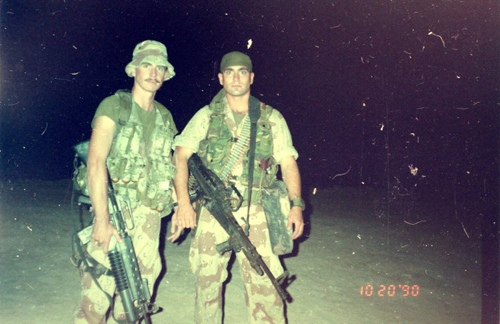
BOTTOM: The author (right) and his friend, Brad O’Neill, on patrol circa 1990. The author is shown holding an M-60 (7.62mm) and his friend an M-16 with an M-203 (a 40mm grenade launcher). (photo courtesy of Steve Watkins)

Now That’s one Far-Out Flipper Folder!

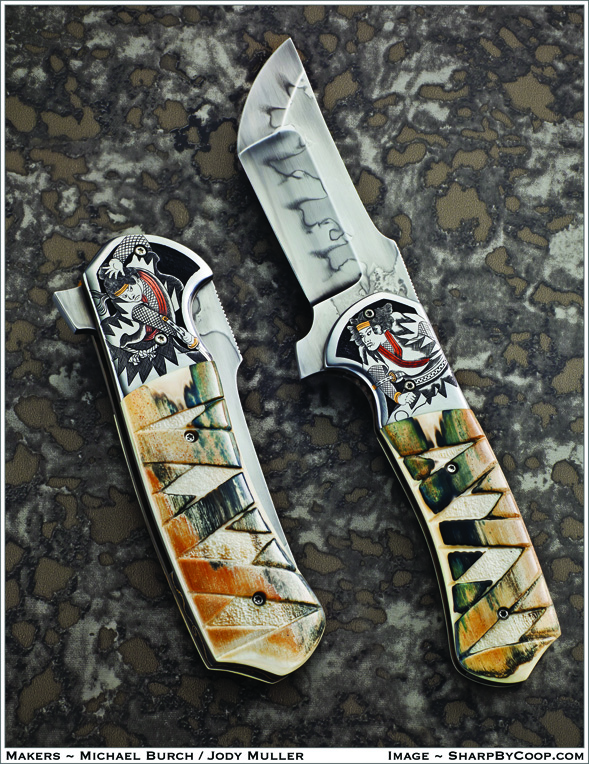
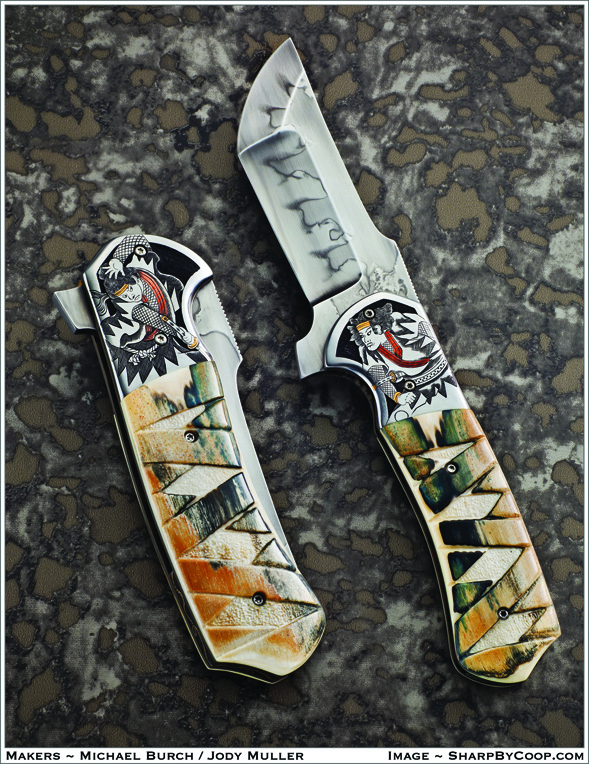
The temper line alone on Michael Burch’s flipper folder is enough to catch the old knife enthusiast eye, not to mention a Samurai warrior, that, thanks to Jody Muller color engraving, emerges from the gold, copper and stainless steel bolsters of the 1095 folding tanto.

The Samurai remains partially concealed by a crosshatching of mammoth ivory, as well as that smoky temper line. The handle treatment gives it an exotic, bamboo-like look that fits the engraved subject matter, as well as the blade style, and all taken together propels the knife to the status of an “Editor’s Favorite from the Knives 2013 book.” (SharpByCoop.com is responsible for the photography.

SGT. DAKOTA MEYER’S KNIFE

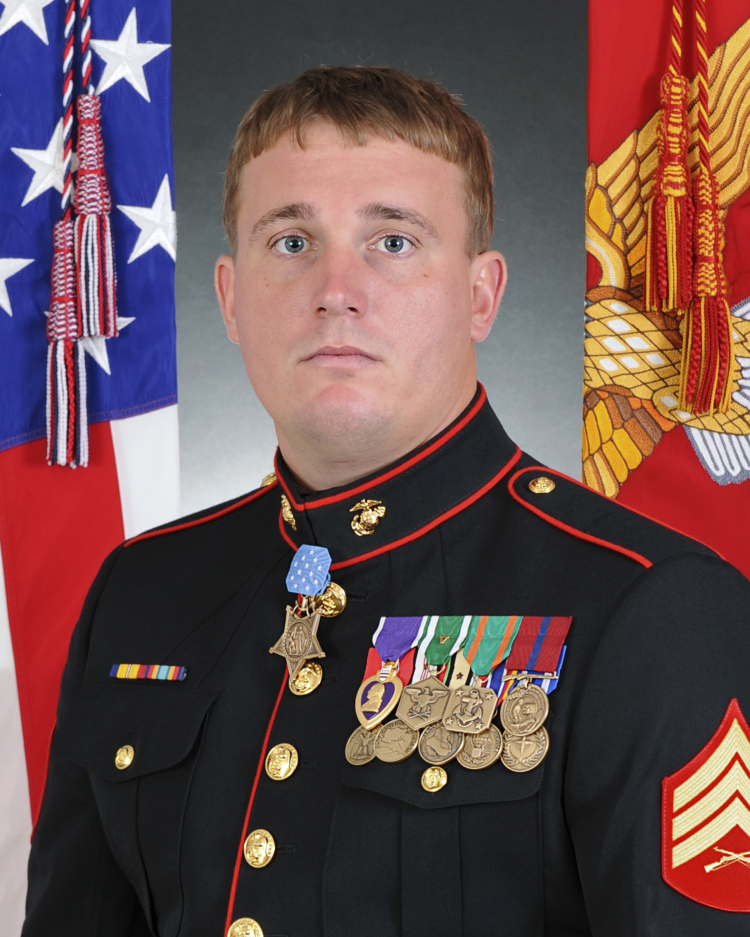
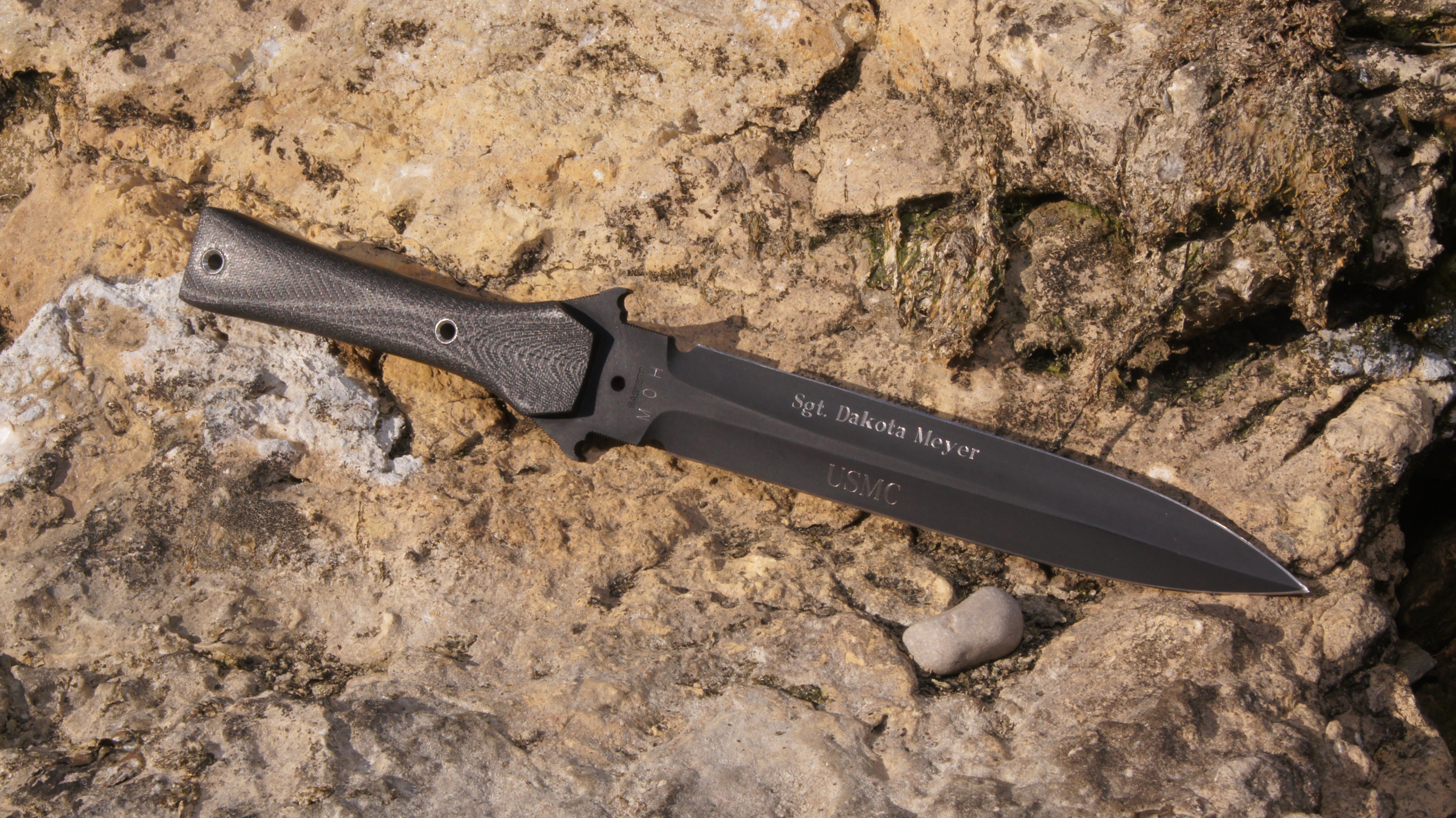
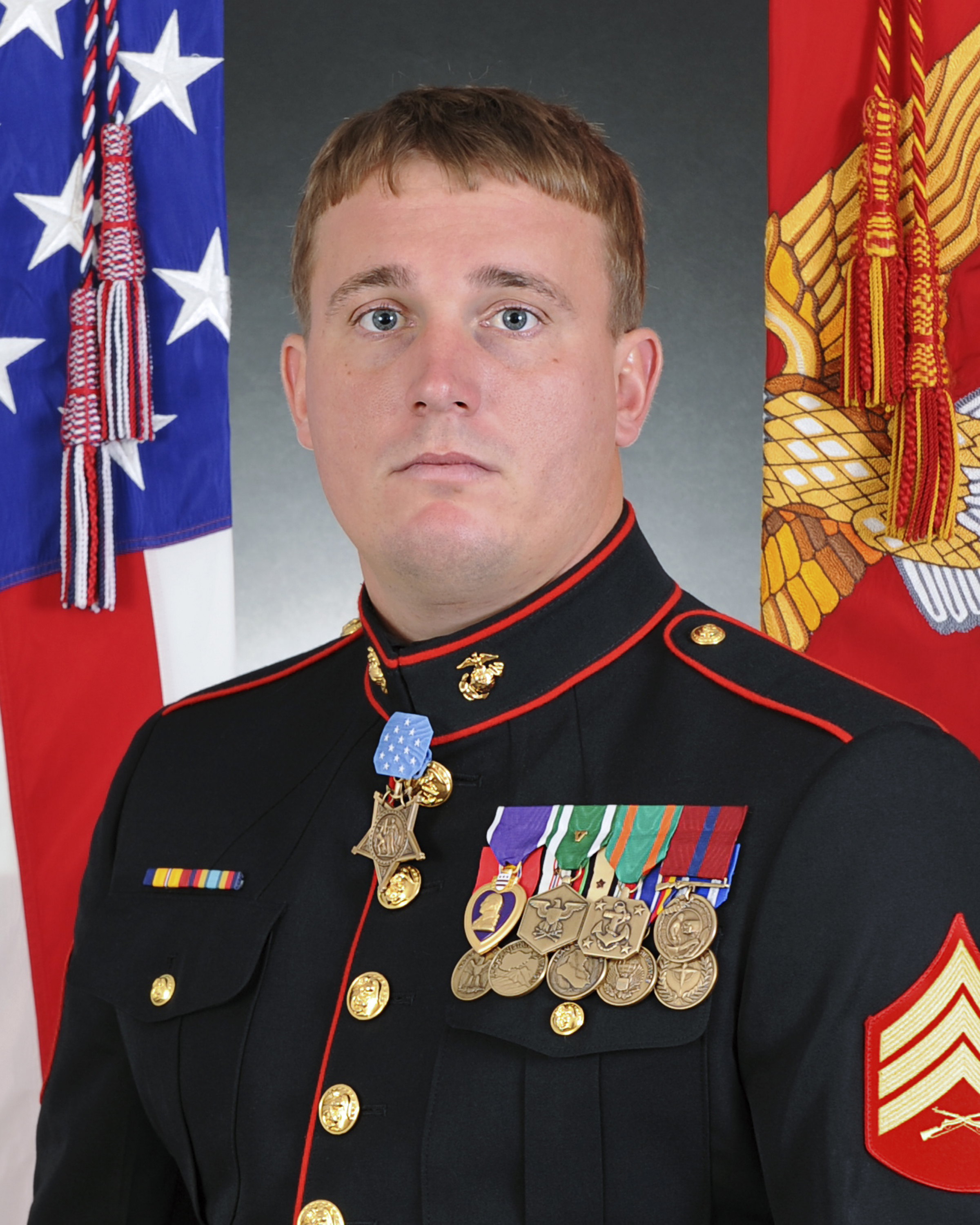
In recognition of his military actions in Afghanistan on behalf of his fellow servicemen and his country that resulted in his receiving the Congressional Medal of Honor, U.S. Army Sgt. Dakota Meyer was presented with a custom knife made by Gene Baskett, a custom AR-15 rifle, and honorary membership in the Knifemakers’ Guild.

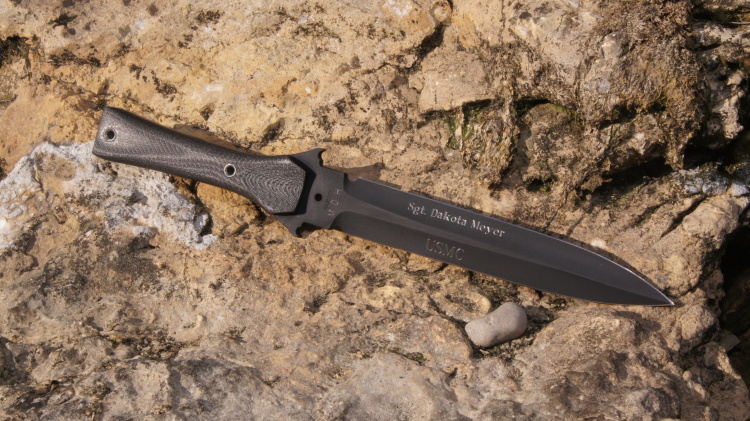
    During a special ceremony this past December in Elizabethtown, Kentucky, Baskett, formerly of Elizabethtown and now of Eastview, Kentucky, presented Sgt. Meyer with a Baskett handmade knife, a custom fighter with a black Moly-Coated CPM-154 stainless blade and a black linen Micarta® handle. The knife is engraved “MOH, Sgt. Dakota Meyer, USMC” on the mark side and “8 September 2009, Kunar Province Afghanistan” on the flip side. The engraving is by Patrick Clark of Clark Jewelers, also of Elizabethtown. Richardson Gunsmithing did the Moly Coating.

    In all, Baskett said he got to spend about three hours with Sgt. Meyer the day of the presentations. “He really loved the knife,” Baskett observed. “He was really appreciative and seemed very humbled by it all.”

    J.J. Akins and Steve Sprowls of Elizabethtown’s Sporter Express gun shop presented Sgt. Meyer with the custom-engraved rifle. The gun is engraved “Rifle presented by the citizens of Hardin County, KY. Sergeant Dakota Meyer, USMC. 8 September 2009. Kunar Province Afghanistan. Congressional Medal of Honor,” and was donated by Sporter Express.

    A member of the Guild’s board of directors, Baskett also presented Sgt. Meyer with a custom Guild honorary membership badge that includes the worlds “Medal of Honor Recipient” and the Marine Corps emblem.

ACTS OF HEROISM

Sgt. Meyer was born and raised in Columbia, Kentucky. He entered the Marine Corps after high school in 2006. On Sept. 8, 2009, Sgt. Meyer, then a corporal, was credited with numerous acts of heroism and saving the lives of several Marines in a battle near the village of Ganjgal in Afghanistan (see sidebar, page ???). As a result, Meyer was awarded the Medal of Honor in a ceremony at the White House on Sept. 15, 2011.

    Sgt. Meyer spoke to a small crowd and the media during the ceremony in Elizabethtown, saying he does not consider himself a hero and that the Medal of Honor and what it represents is much bigger than him. His actions on “the worst day of my life” may have saved several fellow Marines, though he said he could not save four of his close friends in his unit. He wears a bracelet bearing their names.

    The Americans who died in the ambush were: 1st Lt. Michael Johnson, 25, Virginia Beach, Virginia; Staff Sgt. Aaron Kenefick, 30, Roswell, Georgia; Hospital Corpsman Third Class James R. Layton, 22, Riverbank, California; and Gunnery Sergeant Edwin Wayne Johnson Jr., 31, Columbus, Georgia. A fifth soldier, Army Sgt. 1st Class Kenneth W. Westbrook, 41, Shiprock, New Mexico, later died from his wounds.

    Sgt. Meyer received the Medal of Honor in a ceremony at the White House on Sept. 15, 2011. When a White House staffer contacted him to arrange the ceremony, Sgt. Meyer famously asked to “have a beer with the President.” Sgt. Meyer received an invitation to the White House the afternoon before the ceremony (see sidebar, page ???). He also requested that when he was honored, simultaneous services should be held at other applicable locations to honor the memory of his fellow service members who died or were mortally wounded during the ambush and his rescue attempts.

    Sgt. Meyer is the third living recipient of the Medal of Honor since the Vietnam War, and the first living Marine in 38 years to be so honored. In addition to the Medal of Honor, he also received the Purple Heart, Navy Commendation Medal w/Combat V, the Navy Achievement Medal and the Combat Action Ribbon during his years of service from 2006-2010.

MILLION DOLLAR CHALLENGE

Sgt. Meyer uses his fame to raise money to provide college scholarships to the childen of those soldiers who did not survive the war. His goal is to raise $1 million for his “Million Dollar Challenge” (see sidebar, page ???). During the presentation ceremony, Sporter Express presented a check for $750 toward that goal.—BY MIKE CARTER

For more information on the Million Dollar Challenge, visit www.dakotameyer.com. For more on Gene Baskett knives, contact Gene Baskett, Dept. BL12, 427 Sutzer Ck. Rd., Eastview, KY 42732 270-862-5019 www.baskettknives.com.

To stay abreast of the latest in knives and knife information, subscribe to BLADE® at http://www.shopblade.com/blade-magazine-one-year-subscription-us?lid=SSfbbl101212

Keeping Up With Dakota Meyer

It is not often a living U.S. Marine receives the Congressional Medal of Honor, and Sgt. Dakota Meyer is the first one to do so in 38 years. Neither is he one to rest on his laurels.

    For instance, he has partnered with the Marine Corps Scholarship Foundation (MCSF) to raise money so the children of Marines can attend college. Sgt. Meyer said he realizes the importance of education and believes in the MCSF motto, “Honoring Marines by Educating Their Children.” The Dakota Meyer Scholarship Initiative was established and Sgt. Meyer committed to personally raising a million dollars to fund the effort. In fact, during the MCSF’s 50th anniversary celebration this past spring, it was announced that he had successfully reached his goal of raising a million dollars. The Challenge to America to match the million dollars Sgt. Meyer raised is ongoing. To learn more about it and to make a donation visit www.dakotameyer.com

    He indicated he was honored President Obama accepted his invitation to have a beer the afternoon before the Medal of Honor ceremony. (As a side note, Sgt. Meyer said the White House brews its own beer, a honey ale, which he said both he and the president enjoyed.) He added he appreciated the opportunity to speak with and ask advice from the president. The president emphasized the importance of education, a priority Sgt. Meyer shares. In fact, Sgt. Meyer said he hopes to continue his education when his travel schedule slows down.

    Meanwhile, he spends much of his time on the road, traveling all over America to share the story of his fallen brothers. He also advocates for veterans and has recently partnered with the U.S. Chamber of Commerce and Toyota on the Hiring Our Heroes campaign, which provides jobs fairs for veterans nationwide, as well as training veterans to successfully make the transition from military to civilian employment. At press time, Sgt. Meyer’s book Into the Fire was slated to be published this September.

Above and Beyond The Call

 According to Dakota Meyer’s citation for the Medal of Honor, he was recognized, “For conspicuous gallantry and intrepidity at the repeated risk of his life above and beyond the call of duty as a member of Marine Embedded Training Team 2-8, Regional Corps Advisory Command 3-7, in Kunar Province, Afghanistan, on 8 September 2009.

    “When the forward element of his combat team began to be hit by intense fire from roughly 50 Taliban insurgents dug in and concealed on the slopes above Ganjgal village, [then] Corporal Meyer mounted a gun-truck, enlisted a fellow Marine to drive, and raced to attack the ambushers and aid the trapped Marines and Afghan soldiers. During a six-hour firefight, Corporal Meyer single-handedly turned the tide of the battle, saved 36 Marines and soldiers and recovered the bodies of his fallen brothers.

    “Four separate times he fought the kilometer up into the heart of a deadly U-shaped ambush. During the fight he killed at least eight Taliban, personally evacuated 12 friendly wounded, and provided cover for another 24 Marines and soldiers to escape likely death at the hands of a numerically superior and determined foe.

    “On his first foray his lone vehicle drew machine gun, mortar, rocket grenade and small arms fire while he rescued five wounded soldiers. His second attack disrupted the enemy’s ambush and he evacuated four more wounded Marines. Switching to another gun-truck because his was too damaged, they again sped in for a third time, and as turret gunner he killed several Taliban attackers at point blank range and suppressed enemy fire so 24 Marines and soldiers could break out.

    “Despite being wounded, he made a fourth attack with three others to search for missing team members. Nearly surrounded and under heavy fire, he dismounted the vehicle and searched house-to-house to recover the bodies of his fallen team members. By his extraordinary heroism, presence of mind amidst chaos and death, and unselfish devotion to his comrades in the face of great danger, Corporal Meyer reflected great credit upon himself and upheld the highest traditions of the Marine Corps and the United States Naval Service.”


TOP PHOTO AND SECOND PHOTO FROM TOP

Congressional Medal-of-Honor recipient Sgt. Dakota L. Meyer recently was presented with a Gene Baskett handmade knife. The custom fighter has a black Moly-Coated CPM-154 stainless blade and a black linen Micarta® handle. The knife is engraved “MOH, Sgt. Dakota Meyer, USMC” on the mark side. The engraving is by Patrick Clark. Richardson Gunsmithing did the Moly Coat. (photo of Sgt. Meyer courtesy of the United States Marine Corps; knife photo by Mike Carter)


 

Advertisement

Must Read Articles

Read this before you make a knife

Knifemaking 101 – Read This Before You Make a Knife

  by Wayne Goddard My experience has taught me that there's nothing like digging in and getting started. I've often said the hardest part of the...
how to forge damascus steel

How to Forge Damascus

Advertisement
Advertisement