Home Blog Page 265

DPx Gear: Hot Knives From A Hot New Company

Robert Pelton Young (above), adventurer, filmmaker and author of Licensed To Kill*, The World’s Most Dangerous Places, and Come Back Alive, has spent a good bit of his life in places most people would not visit with a free, round-trip, first-class ticket and an 82nd Airborne Division fire team as bodyguards. War zones, low-intensity conflict areas, failed states, third world dictatorships, pestilent swamps, parched deserts and places where guys with AKs and bad attitudes hang out are home to RYP, as he prefers to be addressed. His first knife design, the HEST—Hostile Environment Survival Tool—reflects that experience, as do his later models, all now offered through DPx Gear.

    His entry into knife design was sparked by talks with Jeff Randall of ESEE Knives—then known as R.A.T. Cutlery—when both were in Peru, where RYP was doing a story on drug labs and Jeff was running one of his survival courses. The original HEST grew from those conversations and was initially manufactured by R.A.T. (page 74, October 2009 BLADE®).

    RYP has expanded his product range and manufacturing base. Ontario Knife Co. manufactures the original HEST, made to the same specs. Lion Steel of Maniago, Italy, makes another version, the HEST II, using Uddeholm Sleipner tool steel. Lion also manufactures the HEST/F, a folder with a D2 tool steel blade designed for the same hostile environments, and two models of the HEFT—Hostile Environment Field Tool—one with a 4-inch blade, the other 6 inches, both of Uddeholm Sleipner. All versions of the HEST and HEFT have a storage compartment under the scales.

    My cohort and I used the original HEST extensively over a period of a year in the California Sierras and the Mojave Desert. It also was one of the few knives I brought with me during my six months of travel in various countries around the Mediterranean. At 7 5/8 inches overall and with a 3 1/8-inch blade of 3/16-inch 1095 carbon steel in a Rockwell hardness of 56-57 HRC, the HEST and its Kydex® sheath are small enough to disappear in a pocket, tuck inside a belt, or carry as a neck knife. It is an excellent example of what I call a “traveler’s knife”—a fixed blade small enough to have with you at all times, sturdy enough to pry open a locked door, rip through a stone wall, serve as an arresting device, and with the ability to take and hold a hair-popping edge.

    We did all those things with the HEST and used it for everyday tasks: opening boxes, whittling fire boards and preparing food, including slicing potatoes, ribs, steaks and ripe tomatoes, the latter which requires a very sharp edge to avoid squishing them. If a knife is not useful on a daily basis, sooner or later it will be left behind. The HEST is effective as a daily tool and serves as a reliable emergency implement.

    It sports a wire breaker, a tiny pry bar at the butt and a bottle opener. Where he travels, RYP said good beer has caps requiring a lifter, whereas bad beer has screw tops. However, I had reservations about the bottle-opening notch and was concerned it weakened the blade. In actual practice the blade did flex at that juncture with the weight of a 200-pound person hanging from it, but it did not break and sprang back to true when the pressure was released.
     At first I thought the pry bar would poke and catch on clothing, but after a while I forgot it was there until it was needed. We used it to grind away mortar between stone blocks and to scrape out the mortar around a steel door set into concrete before ripping the door from the wall. I carry a fire starter and paper money rolled tightly in the hollow space under the green canvas Micarta® handle slabs. The HEST balances well, feels good in the hand, is small, sharp, tough, and, at 4.9 ounces, performs above its weight class.

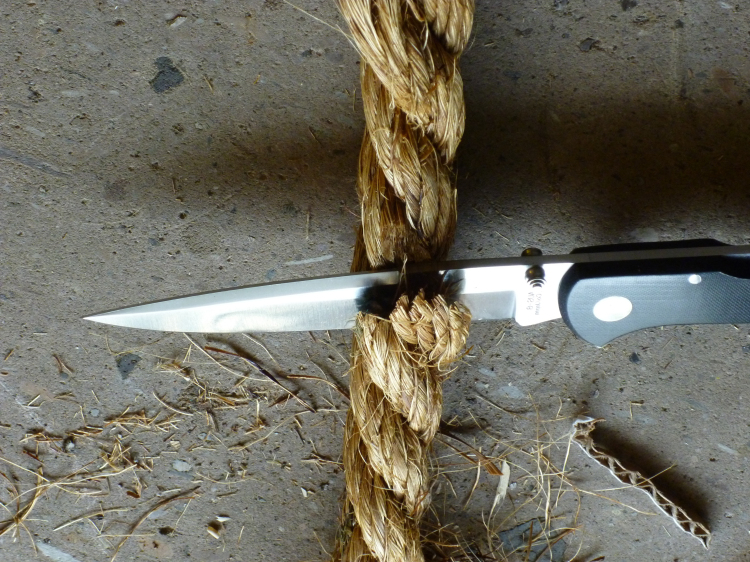
    The HEFT 6 (pictured at top splitting wood) has a 5.75 inch blade of Uddeholm Sleipner, is 10.4 inches overall and weighs 10.2 ounces. It has a combination striker and pry bar at the butt. We gave the knife a heavy month-long workout during which we used it to split a stack of 2x4s, chop through a stand of saplings, cut sheet metal, and pry open a locked steel gate. After that, and with only a quick edge touch up, I loaned it to a professional butcher, Shawn Carlson. Shawn used it for a week, during which he broke down a beef carcass, dressed out a couple dozen slabs of ribs, a stack of pork roasts, bacon and assorted other meat products. He also sliced up 20 rib slabs and split 15 chickens.

    “This is a well-designed knife with a comfortable handle,” he assessed. “It’s easy to work with and doesn’t fatigue your hand during a full day’s work. Unlike some sharpened pry bars, this knife has a fine point that allowed me to easily get into muscle and separate it from connective tissue. I didn’t need to touch it to a sharpening steel even after chopping through joints and cartilage.”—by James Morgan Ayres


*Editor’s note: Licensed To Kill is an insightful and entertaining look into the lives of military contractors, especially during the height of the Iraq War. It may not change your opinion of such contractors but it definitely will enlighten you as to what it was/is like to be one.


DPx Specs


DPx Gear

attn: Robert Young Pelton

Dept. BL7, 2321 Kettner Blvd.

San Diego, CA 92101

888-233-3924

619-780-2600

www.dpxgear.com

Specialties: Utility fixed blades and folders

Blade Materials: Uddeholm Sleipner and D2 tool steels, German Lohmann Niolox 1.4153.03 stainless steel, and 1095 carbon steel

Blade Finishes: Black texture powder coat, milspec black, stonewashed, and black satin TiCN PVD

Handle Materials: Green canvas Micarta®, olive drab G10/titanium, black G10 and Brazilian Santos wood

Geared Up: Features on some models include a wire breaker, a tiny pry bar at the butt, glass breaker and a bottle opener; all versions of the HEST and HEFT have a storage compartment under the scales

DPx FYI: Specific models are designed by Robert Young Pelton and/or Pelton in conjunction with Tom Novak and Tommaso Rumici, and made by Ontario Knife Co. and Lion Steel

Sheaths: Leather and DeSantis Kydex® models

MSRP Range: $123.75 to $275


For more on the latest knives, knife legislation, knifemaking instruction, knife trends, knifemakers, what knives to buy and where and much more, subscribe to BLADE® Magazine, the World’s No. 1 Knife Publication. Click on http://www.shopblade.com/blade-magazine-one-year-subscription-us/?r+ssfb062612 for more information.


Video: Interview with Jim Behring of Treeman Knives

0

Fun Gun Gear Presents: “Treeman Knives”. Jim Behring Started out making Hand forged knives, but after a number a SEAL Team 4 members had him make their personal knives, he’s now making a complete line of High quality Combat knives for real world hostile enviorments. Interview at the 2012 Blade Show, Atlanta, GA.


Get started in knifemaking with the new book, BLADE’s Guide to Making Knives, Volume 2. Click here to check out this information-rich resource.

Video: Knife Rights Awards Breakfast 2012

0

The Knife Rights Awards Breakfast took place during the 2012 BLADE Show in Atlanta. Georgia State Senator William “Bill” Heath received the 2012 Freedom’s
Edge™ Award, and FOX News host SE Cupp spoke about knife rights.


Get the latest knife rights news by signing up for a subscription to BLADE magazine.

SOG Collaborates on Video Game Tomahawk


SOG (www.sogknives.com) has partnered with Electronic Arts, a global leader in digital interactive entertainment, to develop the Voodoo Hawk, a tomahawk weapon designed specifically for the video game Medal of Honor™ Warfighter.
 
     The Voodoo Hawk (http://sogknives.com/store/F18-N.html), a combination of SOG’s Tactical Tomahawk and FastHawk weapons, was designed by SOG, game designers and U.S. Tier 1 Operators, the creators of the Medal of Honor series, to provide game players with an authentic warfare experience.
 
     A limited-edition version of the Voodoo Hawk, which includes custom engraving, SOG patch, and special sheath (http://sogknives.com/store/F18LTD.html), will go on sale this October, in conjunction with the launch of Medal of Honor Warfighter. The Voodoo Hawk is made with a 420 stainless steel head, weighs 24 ounces and has a glass-reinforced nylon handle. Overall length is 12.56” and has a cutting edge of 3.5”.
 
     Proceeds from sales of the Limited Edition Voodoo Hawk will be donated to Project HONOR (http://www.medalofhonor.com/project-honor), an initiative launched by Electronic Arts to benefit the NAVY SEAL Foundation, the Special Operations Warriors Foundation, and other charities.  The Voodoo Hawk and the Limited Edition Voodoo Hawk will retail for $75.00 and $100.00, respectively.  Only 500 Limited Edition Voodoo Hawks will be sold.    
 

    “We were honored to be asked by the Medal of Honor producers to work with them in creating a unique weapon specifically for this game,” says Nando Zucchi, VP of Marketing for SOG.  “The Medal of Honor series dedication to accuracy in portrayal of the equipment and weaponry used in their game is incredible. The producers of the game felt that SOG had to be included in Warfighter in order to meet their standard of authenticity. We are delighted to be a part of this franchise and to work with Electronic Arts to benefit the Project HONOR foundation.”
 
     Medal of Honor WarFighter, which is the latest video game from the Medal of Honor series, was written by U.S. Tier 1 Operators and will be released for PC, Xbox 360, and PlayStation 3 on Oct. 23.  In addition to the Voodoo Hawk, the SOG Ops Black TiNi belt knife and SOG PowerLock EOD Black Oxide Multi-Tool are also featured in the game.  

    SOG Specialty Knives and Tools are sold nationwide.  To find a dealer in your area or to learn more about SOG visit www.sogknives.com.   

For more on the latest knives, knife legislation, knifemaking instruction, knife trends, knifemakers, what knives to buy and where and much more, subscribe to BLADE® Magazine, the World’s No. 1 Knife Publication. Click on http://www.shopblade.com/blade-magazine-one-year-subscription-us/?r+ssfb062612 for more information.

Get In On The Knives of Summer!

Summer’s here and so are all the hot things there are to do during it—many of which call for one of the sharp knives in our “Knives Of Summer” feature.

     Among the things that make summer so much fun is fishing, not to mention eating a nice grilled or fried fillet afterward. Before you cook your catch you have to fillet it, and the Big Eddy from CRKT is ideal for the job. The 420J2 stainless blade features Russ Kommer’s high hollow grind, which creates an air pocket to lift and “float” fillets off, while the flat taper ground side glides smoothly across the skin. Triple-Point Serrations help you cut through gristle, bones and fins. A Kraton grip offers a firm, safe hold on the knife.

     For more on how to get your Big Eddy, click on http://www.shopblade.com/big-eddy-3008?r+ssfb062512

For more on the latest knives, knife legislation, knifemaking instruction, knife trends, knifemakers, what knives to buy and where and much more, subscribe to BLADE® Magazine, the World’s No. 1 Knife Publication. Click on http://www.shopblade.com/blade-magazine-one-year-subscription-us/?r+ssfb062512 for more information.

High In The Necking Order

An Alan Folts design, the Columbia River Knife & Tool Minimalist Tanto features a 2.125-inch blade of 5Cr15MoV stainless with a Rockwell hardness of 55-57 HRC. Weight: 1.6 ounces. Overall length: 5.13 inches. MSRP: $34.99 (includes A glass-filled nylon sheath, neck paracord and braided fob). (CRKT photo)

The latest factory neck knives are a smorgasbord of designs and carry options

“When neck knives are designed and made properly, they will be minimal in size, yet easy and comfortable to use. They will be light enough around the neck to not be bothersome or noticeable [and] will be held safely and securely upside down in their sheath, but can be drawn and put into action with a minimum of effort.”

    The preceding words by ABS master smith Murray Carter accurately and succinctly capture the finer qualities of neck knives, a subject Carter knows a thing or two about since he forges nearly 40 varieties. Along with the growing popularity of knives specifically designed for this carry system, the offerings by knife manufacturers are also expanding to meet the demand, and like many factory-produced blades today, the quality of the finished product is increasingly excellent.

    If you happen to be in the market for a small, multi-use utility neck knife, then the Boker Plus Gnome fits the bill. The full-tang design is 4 inches overall, which is somewhat smaller than most neck knives, and the 2 1/8-inch blade of 12C27 stainless steel is relatively thin to enhance cutting ability. The Micarta® handle is equipped with a hole for a lanyard.

    “On a knife this small, weight is generally not an issue, and the lanyard hole does help the knife’s balance,” noted Terry Trahan, Boker USA product specialist. “The Micarta with the unique handle design’s deep choil-like area and lanyard all work together to provide a good grip.”

    The design is a collaboration between Boker Plus and Danish maker Jesper Voxnaes. The knife also is available in a stag handle, and comes with a leather belt sheath.

Female LEO Feedback

5.11 Tactical (see April 2011 BLADE®*) has introduced a new necker to its growing family of knives. Consistent with the company’s approach to knife designs, this one also grew out of feedback from customers.

    “We had a meeting of all female law enforcement officers, which was the first time we had women only at one of these meetings,” said Mike McCourt, business leader for 5.11’s knife program.  “The female officers requested a personal defense, last-ditch knife that could be worn around the neck or behind a belt.”

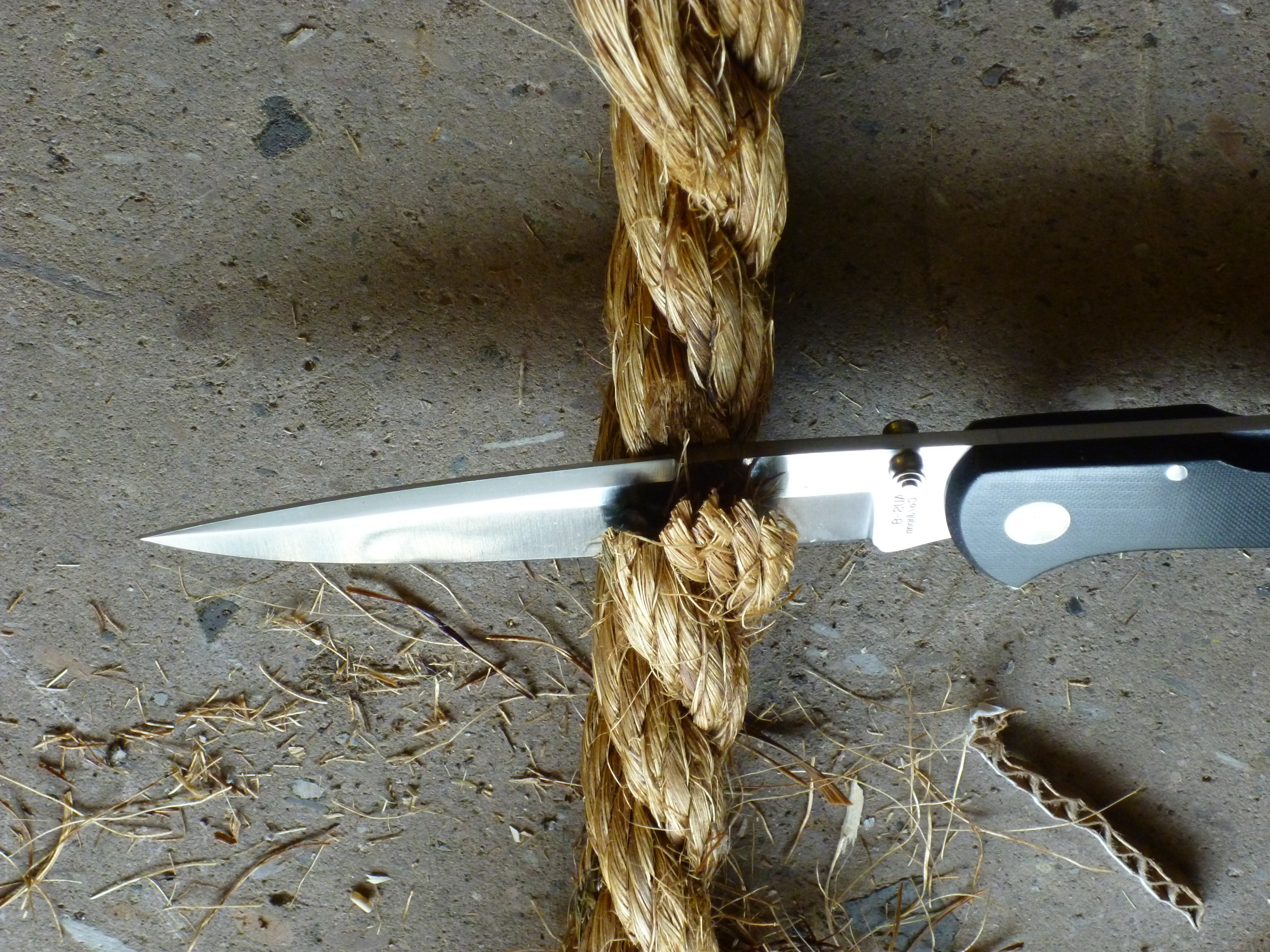
    The resulting effort is the “SidePick Spearpoint,” which has a 2-inch blade of AUS-8 stainless steel and choices of a plain or 50-50 plain/serrated edge. The textured FRN scales are removable. The back edge can be sharpened (though be sure to check the laws in your area for double-edged knives). MSRP: $59.99.

    “The composite sheath comes with an adjustable boot/belt clip and adapter that allow for a total of 12 carry angles,” McCourt noted. “There’s also an ankle strap for extra security during boot carry, and for neck carry it has a black beaded breakaway chain.” A breakaway chain prevents injury and even strangulation should it be grasped in a struggle or catch on something.

“A Pure Necker”

Nemesis Knives offers four different neck knives, including the new “Afterburner.”

    “The Afterburner’s 2.25-inch blade fills a gap between our 1 5/8- and 2-inch models and, unlike our other neck knives which can be carried numerous ways, the Afterburner is a pure necker in the sense that there are no other carry options,” noted Nemesis headman and the knife’s designer, Jeff Hall. “I’ve been thinking about the design for a long time, so it has been two or three years in the making.”

    The knife is 5.25 inches overall with a blade of 9Cr13 stainless in a satin or black finish. A bead chain and Kydex® sheath are included.

    “Our customers wanted a beefier small fixed blade, so unlike many other neck knives, which are only 1/8 inch thick, the Afterburner is 3/16 inch thick,” Hall said. “It’s also full machined inside and out, and all the holes and corners are CNC-machine countersunk and chamfered.” The knife features skeleton construction to reduce weight, and thumb ramp ridges for added traction in various grips. Tentative MSRP: $49.95. 

Church-Key Design

To hear Mike Manrose of Meyerco tell it, the company’s “Besh Wedge Bottle Rocket” designed by Brent Beshara seems to be a multi-collaboration of sorts.

    “It started off as Dirk Pinkerton’s Variable Broadhead neck knife and Brent added the BESH Wedge geometry, while also lengthening the knife out,” Manrose said. (Author’s note: The BESH Wedge is two diagonally opposed bevels converging to create a third edge [see October 2010 BLADE*]). In other words, what you have is a bottle opener and a handy box cutter. “The knife is a great utility piece as well as a very usable backup weapon,” Manrose said. “It is based on an age-old church key design.”

    The origin of church key is unknown to me, but the term brings to mind various bottle/can openers worn around the neck on youthful trips to the beach with a hoard of guys toting coolers full of beer. Apparently that memory is not far off the mark, as I discovered when I asked Beshara what the knife is designed to do.

    “It is a beer-drinking tool which opens bottles and cans,” he grinned. “The handle is the bottle opener, and the front has a BESH Wedge, which is unsharpened due to the nature of the tool, and the reinforced tip easily opens can tabs.”

    The Bottle Rocket’s 2.5-inch blade is 7Cr17 stainless (according to Manrose, an equivalent of 440A). Overall length: 5 inches. It comes with a sheath and neck chain. “The sheath is glass-filled nylon, which is tough as nails,” Manrose said. “We put a detent ball in it so you can spin it on a smooth surface for who buys the next round. It will serve you well for a long time as a utility piece, bottle opener, backup—and it’s just cool!”

    While nodding my head in mute admiration, I asked Manrose to expand on the “spin” feature.

    “Another age-old tool from the Roman era,” he chuckled.  “An old sailor’s game I picked up along the way,” added Beshara. The MSRP is $29.99 and the piece comes with the words “Cheers! Besh” aptly engraved on the reverse side.

Added Considerations

Given today’s available neck knife choices, opting to wear one involves making decisions that include purpose, size, materials, design, or just about anything else you would consider when choosing a fixed blade, with the provision that the overall length will be naturally limited.

    I have worn a necker regularly for some time in perhaps the most common form—handle down in a Kydex sheath. It is easy enough to access under a shirt with the button closest to the handle open, though I exercise great care returning the blade to the sheath for reasons equally divided between my intense dislike of pain and a deep fear of embarrassment were I to stab myself in the chest.  Along with using caution in re-sheathing, it is also important to remember a general rule of thumb: Any fixed blade may be considered “concealed” for legal purposes, so it is good to be familiar with pertinent state and local regulations.—by Stephen Garger

For information on how to get a wharncliffe-blade version of CRKT’s Alan Folts Minimalist, click on http://www.shopblade.com/folts-minimalist-2385?r+ssfb062112


For a profile of 5.11 Tactical, the BESH Wedge story and other articles, nearly 300 past issues of BLADE® are available in two separate DVDs. Visit http://www.shopblade.com/category/cds-dvds-videos?r+ssfb062112 or call 855-278-0406 and mention the First 25 Years Of BLADE DVD collection (1973-1997), or the BLADE 1997-2007 DVD.


For more on the latest knives, knife legislation, knifemaking instruction, knife trends, knifemakers, what knives to buy and where and much more, subscribe to BLADE® Magazine, the World’s No. 1 Knife Publication. Click on http://www.shopblade.com/blade-magazine-one-year-subscription-us/?r+ssfb062112 for more information.

Silver Wire Inlays: The Keeslar Method

0

by Joe Keeslar

Silver wire inlay is one of several forms of embellishment—along with scrimshaw, decorative filework, metal engraving and carving—used on knife handles. For me, none of these decorative enhancements should replace what the basic knife should be: a well-designed, functional, well-made tool using the best materials and workmanship possible. Take a knife with these criteria and add some form of embellishment and you have a piece that a collector, user or aficionado of fine cutlery would drool over and want to own.

Simply put, silver wire inlay serves no functional purpose, but it sure makes a knife look pretty if it is done well—with a good, artistic design and well-executed technical application.

My introduction to wire inlay was some years ago while building Golden Age flintlock rifles. Many rifles of the period were relief carved with silver wire accents. The transition from wirework on rifles to knives was a short step.

In this two-part series on wire inlay you will be introduced to the tools used in the process, pattern/design development, the procedure for inlaying silver wire and final finishing of the handle.

So often in undertaking a new aspect of knifemaking, a large financial outlay is required up front to get started. This is not so with silver wire inlay. You can make nearly all the basic tools you need on a modest budget.

Advertisement

Must Read Articles

Read this before you make a knife

Knifemaking 101 – Read This Before You Make a Knife

  by Wayne Goddard My experience has taught me that there's nothing like digging in and getting started. I've often said the hardest part of the...
how to forge damascus steel

How to Forge Damascus

Advertisement
Advertisement