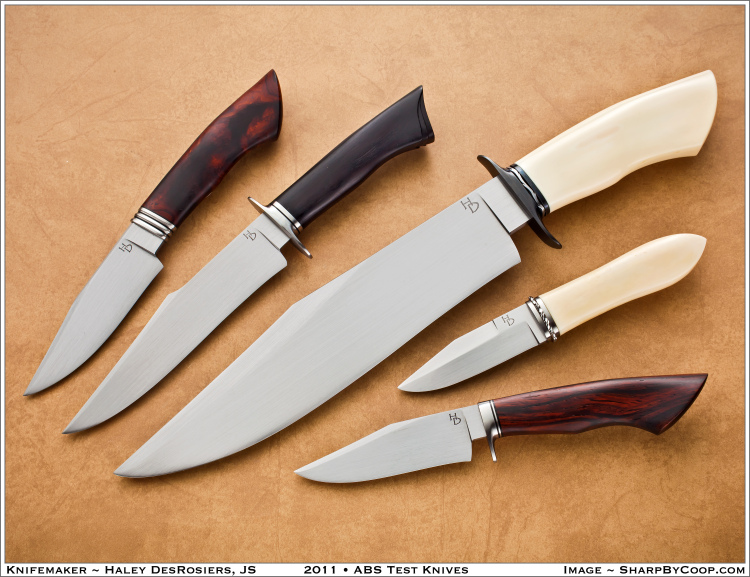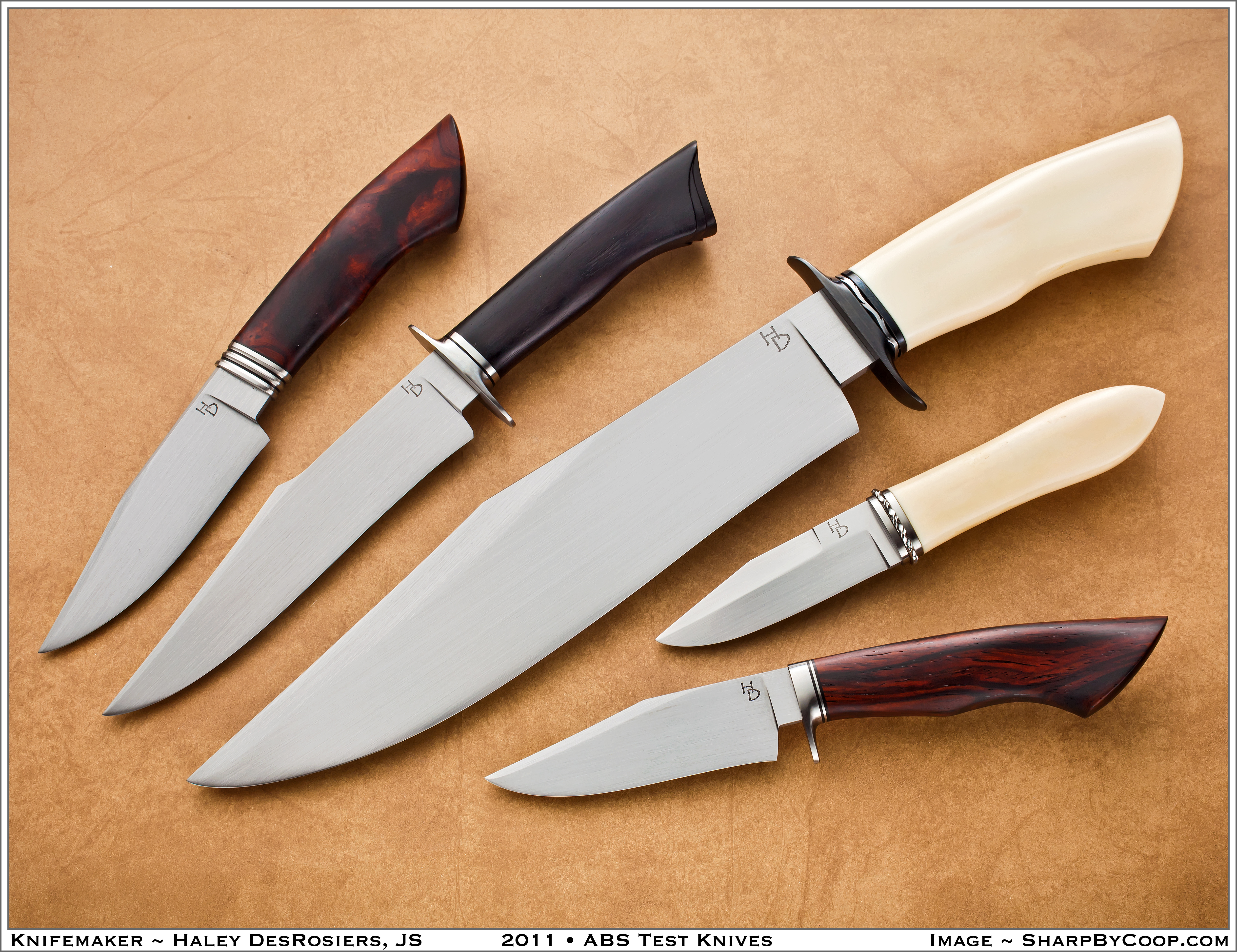
Haley DesRosiers’ five applicant knives for the rating of ABS journeyman smith include the one (center) judged best of all those submitted by JS applicants, thereby winning the 2011 George Peck Award. (SharpByCoop.com photo)
By B.R. Hughes, a founding member of the American Bladesmith Society, a member of the Blade Magazine Cutlery© and ABS Halls Of Fame, and BLADE® field editor
If you are old enough, you may recall a 1954 hit song written by Johnny Richards and Carolyn Leigh that went something like this:
Fairy tales can come true, it can happen to you,
If you’re young at heart …
Don’t believe in fairy tales? After reading the storybook saga of Adam and Haley DesRosiers and the adventures they experienced at the 2011 BLADE Show, you just might alter your thinking.
Let’s begin with Haley, a winsome lass born in Stika, Alaska, the daughter of a commercial fisherman and a mother who assisted in the family business. The future Mrs. DesRosiers spent many days on her dad’s fishing vessels working as a deckhand, and there were occasions when her boat was at sea for as long as several weeks.
At 17 she developed an interest in knives, and, inspired by a video, decided to be a bladesmith. Her first forge was a hole in the ground, the air power supplied by an electric hair dryer via a pipe.
As her skills improved, so did her smithy. One day she decided her beat-up anvil needed repairing. On an Internet knife discussion forum she learned her anvil could indeed be fixed, and ABS master smith Jason Knight e-mailed her about Adam DesRosiers, an Alaskan ABS journeyman smith who might be willing to help. In turn, Jason told Adam of the young Alaskan lady interested in bladesmithing. Adam promptly e-mailed Haley and offered his assistance.
Setting up the initial meeting between the future husband and wife was not so simple. Both lived in remote areas, approachable only by air or sea, so they agreed to rendezvous at a folk festival in Juneau on April 8, 2008. While there, Adam took Haley’s anvil to the shop of ABS journeyman smith David Mirabile, where it was refurbished. Haley gave Adam some caribou antler and he presented her with a handmade gas forge. At the time, Haley was still using a hairdryer as a blower. Many communications between the two followed. A bit later, Haley’s father offered Adam a job as a deckhand for the balance of the season. He accepted and so, in reality, Adam and Haley’s first date consisted of six weeks of offshore fishing, both working as deckhands.
Born in Anchorage in 1976, Adam is the son of a commercial fisherman and a nurse. After Adam was graduated from high school, he attended the University of Alaska, studying marine technology. While there he worked at a local boatyard and, after college, joined the Merchant Marine, serving as a deckhand for three years.
As for his first memory of making knives, at the ripe old age of 5 he took his mother’s butter knife and “improved it” in his father’s workshop, using the cement floor as a grinder. It must be noted that his mother was not impressed with the “improvements.”
Adam’s first forge was a galvanized washtub, also featuring an electric hairdryer. In 2001 he attended the William F. Moran School of Bladesmithing in Washington, Arkansas, for the introduction to bladesmithing class, where his instructors were Kevin Cashen and Dickie Robinson. The same year he took a damascus class taught by John Fitch at the school. Adam returned the following year to take another damascus class, one taught by Steve Dunn. In 2006, Adam received his ABS journeyman smith rating. I was the head judge of the review panel that year, and Adam received not one negative vote from the panel.
As Adam and Haley’s romance flourished, Haley took the introduction to bladesmithing class at Haywood College in Clyde, North Carolina. Adam joined her, deciding it would not hurt to take a refresher course. The instructors were Burt Foster and Jason Knight, the latter the man who initially introduced Adam and Haley. It was on the bank of Jason’s pond in South Carolina that Haley and Adam became engaged on April 12, 2009.
They were married Sept. 13, 2009. Haley was borne by a raft down an Alaskan creek to the ceremony. Using the anvil that had brought the bridge and groom together for the first time as an altar, the service was performed by Pastor Berry Byrd. ABS master smiths Knight and James Rodebaugh were among the groomsmen. Adam wore a sword for the ceremony, as did the groomsmen, and their swords provided the arch under which the happy couple departed. (For more, see Haley’s story “A Match Made in Handforged Heaven” in the October 2010 BLADE®.)
Haley set up bladesmithing in Adam’s shop. There they made their first knife together, featuring a blade of 5160 carbon steel. Adam prefers to make camp knives and Haley likes hunters, which is certainly natural enough since she is a devoted outdoors enthusiast. When I inquired what type of game she most enjoyed hunting, she quickly replied, “Deer, duck, caribou, black bear and brown bear.”
“Ever been charged by a bruin?” I asked.
“Once.”
“What happened?”
“I dropped him with my .30-06.”
Verily, a modern-day Diana!
As the 2011 BLADE Show neared, the DesRosiers were extremely busy. Adam was preparing to test for ABS master smith, while Haley was getting ready for her quest for a JS stamp.
“Did Adam do anything to help you get ready?” I asked. “Yes,” Haley smiled, “Among other things, he told me to quit playing with damascus!” For the ABS JS review, no damascus is permitted on any of the five applicant knives. Hence, she concentrated on knives featuring blades of 1084 and W2, her two favorite carbon steels.
During the BLADE Show, each took his/her five review knives to two separate rooms in Atlanta’s Cobb Galleria Center, where judging panels awaited. In addition to passing or failing the applicants, the panels were also required to select the winners of the George Peck Award and the B.R. Hughes Award. The former is for the best knife submitted by a JS applicant, the latter for the single finest knife made by an MS applicant.
A happy ending for this tale would have both Haley and Adam earning their respective ratings. They did—but there’s more. An incredible conclusion would have Haley winning the Peck Award and Adam receiving the Hughes Award—and they did! (See page 48, January BLADE.)
If that is not a fairy tale come true, it will do until one comes along.
THE DESROSIERS’ FILE
Adam and Haley DesRosiers
POB EXI
Juneau, AK 99850
907-321-7258
www.alaskablades.com
Adam’s Specialties: Forged fixed blades, especially camp knives
Haley’s Specialties: Forged fixed blades, especially hunters
Adam’s Steels: W2, damascus in 1084 and 15n20
Haley’s Steels: W2 and 1084; damascus
Handles of Both: Natural materials, including the ancient ivories, assorted woods and others
Adam’s Honors: ABS master smith, winner of 2011 B.R. Hughes Award
Haley’s Honors: ABS journeyman smith, winner of 2011 George Peck Award
For more on the latest knives, knife legislation, knifemaking instruction, knife trends, knifemakers, what knives to buy and where and much more, subscribe to BLADE® Magazine, the World’s No. 1 Knife Publication. For subscription information click on http://www.shopblade.com/product/blade-magazine-one-year-subscripti…?r+ssfb040912#BL1SU.