

Knifemaker and panelist Michael O’Machearley lost his son in Iraq in 2003. Along the lines of an earlier question that Romney was asked, he questioned the candidate on whet…
Knifemaker and panelist Michael O’Machearley lost his son in Iraq in 2003. Along the lines of an earlier question that Romney was asked, he questioned the candidate on whet…
The Alaska House of Representatives has unanimously passed HB 55 “Definitions of Gravity Knives and Switchblades,” referred to by sponsor Rep. Mark Neuman as the “Knife Rights Act.” HB 55 would clarify state law on the subject of assisted-opening and one-hand opening knives to ensure they are not considered gravity knives or switchblades, currently banned under Alaska statute.
According to Knife Rights, it requested that the bill be amended to include Knife Law Preemption, which would make knife laws consistent across Alaska.
HB55 is now in the Alaska Senate, where it has been referred to the Judiciary Committee.
If you live, work or travel in Alaska, please contact the Senate Judiciary Committee members and ask them to vote in support of HB55. Contacts for Judiciary Committee members can be found at: http://www.legis.state.ak.us/basis/get_com_info.asp?comm=SJUD&session=27.
Knife Rights Director of Legislative Affairs, Todd Rathner, testified in support of HB55 before the House Judiciary Committee, answering questions regarding both Knife Law Preemption and about the clarifying language of the bill.
Knife Law Preemption protects honest citizens from a patchwork of local ordinances and rules that can entrap those traveling within or through a state in possession of knives that meet state law or wherever they live in the state. Without preemption, a person can be charged with a violation of law when they have no intention of violating the law.
As explained by Rep. Neuman, “Spring-loaded [assisted-opening] knives and other one-handed knives that have a bias towards closure are an important tool for Alaska hunters, anglers and many craftsman. Many of us carry and use knives every day, and some mechanisms, such as being spring-loaded, don’t make our knives switchblades. We shouldn’t be punished nor have our tools, which can be just as expensive as other implements, subject to seizure or forfeiture.”
For more info click on www.KnifeRights.org
For more on the latest knives, knife legislation, knifemaking instruction, knife trends, knifemakers, what knives to buy and where and much more, subscribe to BLADE Magazine, the World’s No. 1 Knife Publication. For subscription information click on http://www.shopblade.com/product/blade-magazine-one-year-subscripti…?r+ssfb030812#BL1SU
Congratulations! With the help of the many knife enthusiasts who emailed and called Georgia senators, the Georgia Senate passed SB432 by a vote of 41-12. SB432 is the Knife Law Preemption bill that would repeal all local knife ordinances more restrictive than state law.
Now the bill moves to the Georgia House for consideration.
Without the outpouring of emails and calls from knife enthusiasts around the country who let Georgia Senators know that this bill was important to them, it would not have passed. Thanks for your help!
Much credit goes to Senator Bill Heath’s diligent efforts in getting this bill through the Senate under extreme time constraints. The knife community and BLADE Show (for more on the show click on http://bladeshow.com/ehome/index.php?eventid=31379&😉 attendees are lucky to have a Georgia senator who appreciates our rights and our tools and is will to work so hard to protect them.
Knife Rights officials said they will now focus on the House and will update you shortly.
As home to BLADE Show, successful passage of SB432 would not only ensure Georgia residents carrying a knife are treated fairly wherever they travel in Georgia, but all those traveling to the BLADE Show through towns and cities with knife laws more restrictive that Georgia’s otherwise decent knife laws would be safe from violation.
Knife Law Preemption protects honest citizens from a patchwork of local ordinances and rules that can entrap those traveling within or through a state in possession of knives that meet state law or wherever they live in the state. A person can be charged with a violation of law when they have no intention of violating the law.
The BLADE Show, held annually in Atlanta, Georgia—this year June 8-10, once again at the spacious Cobb Galleria Centre—is the world’s largest knife show and pumps millions of dollars into the local and state economy. SB432 would protect the thousands of exhibitors and visitors who travel to and from BLADE Show to buy, sell or simply enjoy the thousands of knives on display and the many knife-related events associated with the show.
For more info on the pro-knife bill, click on www.KnifeRights.org.
For more on the latest knives, knife legislation, knifemaking instruction, knife trends, knifemakers, what knives to buy and where and much more, subscribe to BLADE Magazine, the World’s No. 1 Knife Publication. For subscription information click on http://www.shopblade.com/product/blade-magazine-one-year-subscripti…?r+ssfb030812#BL1SU
Reuters of Warsaw, Poland, reports that champion kite surfer Jan Lisewski, 42, used a knife to fight off 11 sharks and repeated shark attacks during a two-day battle of survival after becoming stranded in the Red Sea.
Lisewski, who became the first person to kite surf across the Baltic Sea last year, was two-thirds of the way across the Red Sea from Egypt to Saudi Arabia when he became stranded. His kite suddenly deflated after the wind stopped during the 124-mile crossing from the Egyptian town of El Gouna to Duba in Saudi Arabia.
As nightfall approached the Gdansk-born champ and instructor sent an SOS message from an emergency transmitter – but it took nearly 40 hours for Saudi coast guard officials to locate him.
During the first night, Lisewski fired a rescue flare towards a Red Sea fishing vessel but it did not alter course towards him, so he wrapped up his kite to make a raft on his board so he could catch some sleep.
His only sustenance was a small supply of water, energy drinks and two energy bars.
On the second night he said the surfboard drifted towards a reef where he was attacked by up to 11 sharks. He said he fought off the sharks, some apparently up to 18 feet long, using a knife during an all-night battle.
“I was stabbing them in the eyes, the nose and gills,” Lisewski told Reuters.
Lisewski, who only suffered exhaustion and dehydration during the ordeal, said he usually does not carry a knife but his brother Piotr urged him to take one.
“Maybe he had some kind of premonition,” he said.
BLADE® was unable to discern what kind of knife Lisewski carried during his ordeal.
You still have time to support Georgia’s SB432, a Knife Law Preemption bill that would protect law-abiding citizens traveling through the state from a patchwork of conflicting knife laws that make citizens in accordance with the law in one jurisdiction and lawbreakers in the next.
As Atlanta is home to the BLADE Show, successful passage of SB432 would not only ensure Georgia residents carrying a knife are treated fairly wherever they travel in Georgia, but all those traveling to the BLADE Show though towns and cities with knife laws more restrictive than Georgia’s otherwise decent knife laws would be safe from violation. (Author’s note: An Atlanta city ordinance makes it illegal to carry any automatic or any knife with a blade longer than 3 inches “readily available for use.”)
According to Knife Rights, the Georgia Senate Judiciary Committee has passed SB432 but your help is needed urgently to get the bill through the state’s Senate Rules Committee and a Senate floor vote. Knife enthusiasts have only until close of business tomorrow, Wednesday, to get the bill through the Senate Rules Committee and a Senate floor vote.
If you live, work or travel in Georgia, and this includes every BLADE Show exhibitor and attendee, please POLITELY contact the Chairman and Co-Chairman of the Senate Rules Committee and simply ask them to bring SB432 to a vote on the floor:
Chairman: Senator Don Balfour [email protected] (404) 656-0095
Co-Chairman: Senator Bill Hamrick [email protected] (404) 656-0036
SB432 is sponsored by Senator Bill Heath, who has worked hard getting it through to this point. Now it is important for ALL of US to help him get it through the Senate (and then on through the House).
E-MAIL Senators Balfour and Hamrick TODAY and/or call them.
For more information click on www.KnifeRights.org
For more on the latest knives, knife legislation, knifemaking instruction, knife trends, knifemakers, what knives to buy and where and much more, subscribe to BLADE Magazine, the World’s No. 1 Knife Publication. For subscription information click on http://www.shopblade.com/product/blade-magazine-one-year-subscripti…?r+ssfb030612#BL1SU
According to Knife Rights, the Georgia Senate Judiciary Committee has passed SB432, the Knife Law Preemption bill that would repeal all local knife ordinances more restrictive than state law—but your help is needed urgently to get the bill through the state’s Senate Rules Committee and a Senate floor vote.
Knife enthusiasts have only until close of business on Wednesday to get this bill through the Senate Rules Committee and a Senate floor vote. As Atlanta is home to the BLADE Show, successful passage of SB432 would not only ensure Georgia residents carrying a knife are treated fairly wherever they travel in Georgia, but all those traveling to the BLADE Show though towns and cities with knife laws more restrictive than Georgia’s otherwise decent knife laws would be safe from violation. (Author’s note: An Atlanta city ordinance makes it illegal to carry any automatic or any knife with a blade longer than 3 inches “readily available for use.”)
If you live, work or travel in Georgia, and this includes every BLADE Show exhibitor and attendee, please POLITELY contact the Chairman and Co-Chairman of the Senate Rules Committee and simply ask them to bring SB432 to a vote on the floor:
Chairman: Senator Don Balfour [email protected] (404) 656-0095
Co-Chairman: Senator Bill Hamrick [email protected] (404) 656-0036
SB432 is sponsored by Senator Bill Heath, who has worked hard getting it through to this point. Now it is important for ALL of US to help him get it through the Senate (and then on through the House).
Knife Law Preemption protects honest citizens from a patchwork of local ordinances and rules that can entrap those traveling within or through a state in possession of knives that conform to state law or wherever they live in the state. Without Knife Law Preemption, a person can be charged with a violation of law when they have no intention of violating the law.
The BLADE Show, held June 8-10 at the Cobb Galleria in Marietta, Georgia—which is basically a suburb of Atlanta—is the world’s largest knife show and pumps millions of dollars into the local and state economy. SB432 will protect the thousands of exhibitors and visitors who travel through Georgia to and from the BLADE Show to buy, sell or simply enjoy the thousands of knives on display and the many knife-related events associated with the BLADE Show.
E-MAIL Senators Balfour and Hamrick TODAY and/or call them.
For more information click on www.KnifeRights.org
For more on the latest knives, knife legislation, knifemaking instruction, knife trends, knifemakers, what knives to buy and where and much more, subscribe to BLADE Magazine, the World’s No. 1 Knife Publication. For subscription information click on http://www.shopblade.com/product/blade-magazine-one-year-subscripti…?r+ssfb030512#BL1SU
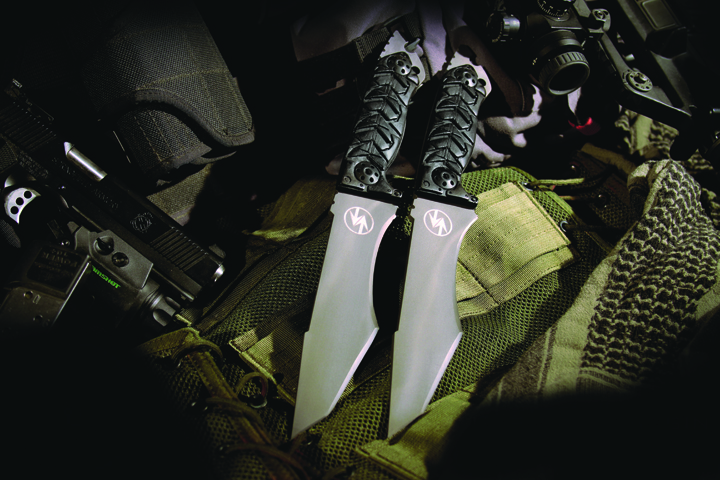

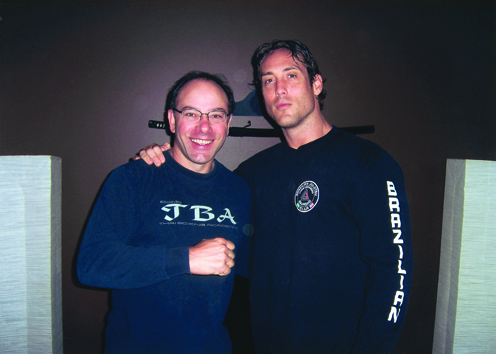
As with all Johnny Strong knives, the Urban Assassins (top photo) are flat ground from CPM-S35V stainless and heat treated by Paul Bos Heat Treating. Overall lengths: 11.5 inches. (Katie Summers photo) Johnny Strong’s latest movie Sinners and Saints (second photo from top) debuted in January. (Photo: Mark Rutledge; Poster: Dave Burton) The author [left] and Strong [right] (third photo from top) at the author’s house.
Star of Sinners and Saints also makes knives
By Wally Hayes
Through knives I have met some of the most amazing people, one of whom is actor Johnny Strong. Last summer I received an e-mail from Johnny. He was interested in my Dragon Waki he had found on Bladeart.com’s website. We exchanged e-mails about his new waki, music and his interest in knifemaking. I learned Johnny is an actor, musician, martial artist and artist. He has been collecting knives since he was 8.
“It was when I was on tour with my band, Operator, that I got serious about collecting custom knives. I would be on the tour bus searching the web for knife dealers,” he said.
After talking with Johnny and learning a little about him, I suggested he visit my shop and hang out for a weekend. He did—and he jumped in with both feet.
We started out forging two blades to shape. Then I taught him grinding and heat treating. The crash course was three long, fun-filled days. As Johnny told BLADE®, “It was a great experience coming to Wally’s and having him share all his knowledge with me. I learned how to manipulate steel and apply these skills to my edged art.”
As soon as Johnny returned home, he ordered a belt grinder, drill press and some steel. In the past year he has created some very original designs. His computer-drawing skills enabled him to develop a practical and aggressive-looking knife style. As he noted, “With my knives, I like to paint in tactical colors.” His blades are flat ground from CPM-S35V stainless steel and heat treated by Paul Bos Heat Treating.
Johnny has created some unusual blade finishes with a combination of bead blasting and etching. The blades are ground with a wide secondary bevel that makes his knives razor sharp, similar to those by Shiva Ki. Johnny hand carved a mold to make his handles. He casts them one at a time. The handle material is an impact/chemical-resistant resin. The cutouts in the handle butts are multi-purpose prying/shaping tools. He also designed and ordered custom-made black titanium handle fasteners.
Three of Johnny’s models are the Urban Assassin, Canine Assassin and Combat Assassin (this issue’s cover knife; see page 7). Respective blade lengths are 6.5, 8.5 and 11 inches. The blade of the Canine Assassin has a tiger-stripe finish, while the Combat Assassin blade features a sawback. Each blade has what Johnny calls his three-edge design, which was inspired by the knife-combat training he has received. All his knives come with custom leather sheaths.
Sinners and Saints
Johnny has starred in Black Hawk Down, The Fast and The Furious, Get Carter, The Glimmerman and his new action movie, Sinners and Saints. Johnny plays the lead role of Sean Riley, a New Orleans detective.
To prepare for one of the movie’s knife fight scenes, Johnny trained with Ron Balicki for three months. Balicki is well known as a practitioner and teacher of the martial arts, and is a student and son-in-law of Dan Inosanto, a legendary martial arts instructor who studied under Bruce Lee. Balicki is also a top Hollywood stuntman and plays the role of Rucker in Sinners and Saints.
Johnny learned both one-handed and two-handed combative drills. In a knife-fighting scene in the movie, Johnny uses an Allen Elishewitz “Phalanx” folder and a Cold Steel Tai Pan dagger. Balicki plays Rucker, a bad guy Johnny’s character must kill. The knife-fighting scene took two days to shoot. Balicki uses a Cold Steel Voyager folder in the scene.
“Ron has a ton of experience and was great to work with,” Johnny noted. “We wanted to make the knife fighting scene as realistic as possible.” Johnny has a strong background in martial arts with a black belt in Brazilian Ju-Jitsu and is training hard to get in shape for his next movie.
Movies, Music and Knives
This past fall I flew down to Johnny’s to help with his knifemaking and have some fun playing music as well. Music is a big part of Johnny’s life. When not acting, he works on music either for film scenes or his own CDs.
His new album is The War of Art on iTunes. It features two of his Urban Assassin models silhouetted on the cover. I was asked to bring my guitar so I could play lead on a couple of songs in his studio. What a blast—mixing knifemaking with recording music. We worked on edge geometry, sheaths and a new folder design coming out in 2012. Stay tuned for more movies, music and knives from a very talented guy.
For more on the latest knives, knife legislation, knifemaking instruction, knife trends, knifemakers, what knives to buy and where and much more, subscribe to BLADE Magazine, the World’s No. 1 Knife Publication. For subscription information click on http://www.shopblade.com/product/blade-magazine-one-year-subscripti…?r+ssfb030312#BL1SU





