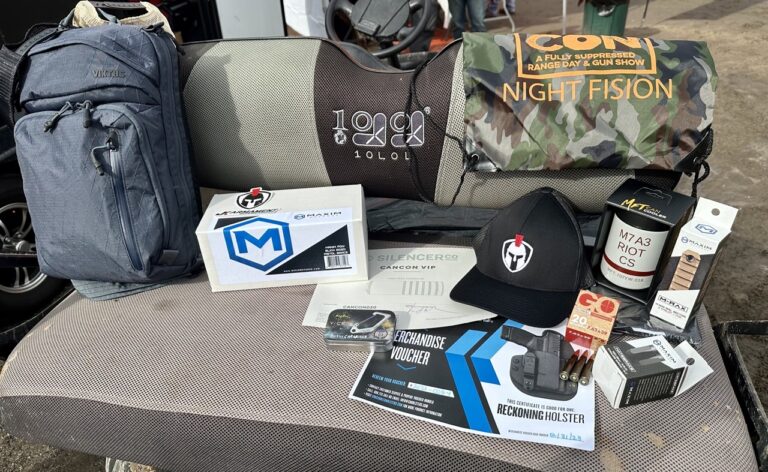
We’re not trying to rub it in that you missed out on the 2022 VIP bags at CANCON in Georgia, but you might feel pretty disappointed that you missed out once you read what was in them.
The good news is that we’re holding TWO CANCON events in 2023! The first one is April 29-30 (VIP access on the 28th also!) in Phoenix, Arizona.
And we’re coming back to Richmond Hill in Georgia, November 10-11 (VIPs get in a day early as well!), so there is really no excuse for you to miss out on some VIP bag goodness this year.
WHAT’S IN THE BAG
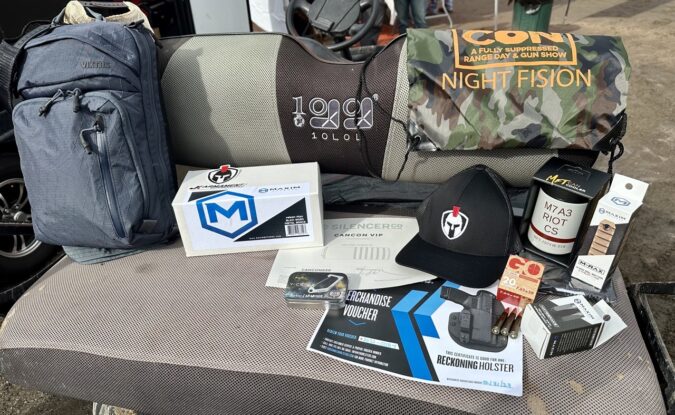
You’ll have to come down to Arizona to find out what is in that VIP bag, but we can take a tour through the 2022 CANCON VIP bag to give you an idea of the kind of high-end swag we put together.
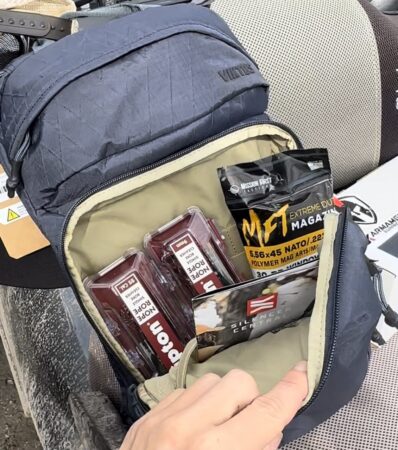
Viktos XL Slingbag
Blue Force Gear Sling
Otis Ripcord Cleaning Cord
Caldwell DeadShot Shooting Bags
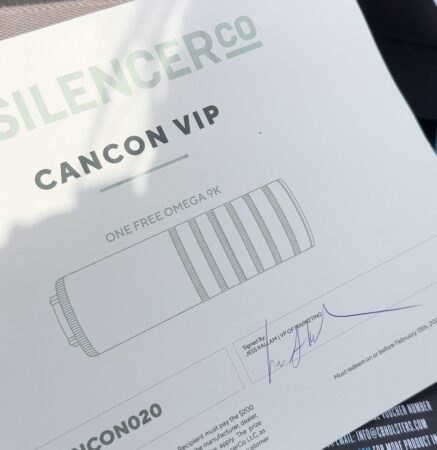
SilencerCo Silencer (Ya, a FREE silencer)
Subscription to Recoil and Offgrid magazines
Mission First Tactical Extreme Duty Magazines 556
Mission First Tactical Coozie
Maxim Defense Hate Brake
Maxim Defense Arm Brace Stock
Primary Weapon Systems Gift Certificate
JK Armamant Stickers and Hats
And that’s not all! We also snuck in a box of Global Ordnance Ammo and a Key Bar Carabiner.
Total VIP Bag Value? Over $1,600.
Will 2023’s VIP bags be better than last year’s? I think they are, but you’ll have to stop by CANCON to find out!
Coming to CANCON but not a VIP? Take a chance at winning a VIP bag! All CANCON attendees can enter to win a VIP Bag, all you have to do is:
CANCON comes to the West! Join RECOIL at the Ben Avery Shooting Center in Phoenix, Arizona April 29th and 30th, with VIP access starting on the 28th!
CANCON presented by Silencer Central, is a fully suppressed range day event with dozens of vendors, hundreds of guns and suppressors, and tons of fun.
Check out the CANCON 2022 Recap to see what you missed last year, and don’t miss out this year!
CANCON West will feature an even BIGGER range day with MORE suppressors, more guns, more vendors, and an even bigger night shoot. Over 100 firearms from over 25 manufacturers!
$50 single-day tickets get you in for ALL DAY plus ammo is provided!
Want the VIP experience? VIP tickets are $700 and allow access for Saturday and Sunday, plus early access on Friday, plus a catered dinner & the Night Vision Network’s Night Shoot on Friday night.
PLUS, VIPs get a VIP bag worth A Lot! Filled with awesome gear that you’ll actually use. We can’t spoil the surprise of what is in 2023’s VIP bag, but here is a look at what was in CANCON’s 2022 VIP bag!
CANCON 2022 VIP Bag Valued At Over $1475
Viktos XL Slingbag
Blue Force Gear Sling
Otis Ripcord Cleaning Cord
Caldwell DeadShot Shooting Bags
SilencerCo Silencer
Subscription to Recoil/Offgrid
Mission First Tactical Extreme Duty Magazines 556
Mission First Tactical Coozie
Maxim Defense Hate Brake
Maxim Defense Arm Brace Stock
Primary Weapon Systems Gift Certificate
JK Armamant Stickers and Hats
Coming to CANCON but not a VIP? Take a chance at winning a VIP bag! All CANCON attendees can enter to win a VIP Bag, all you have to do is:
Post a video or photo from the event tagging @CanconEvent and using the #CanconGiveaway.
BRING THE FAMILY!
CANCON is a family-friendly event with eye and ear protection for everyone.
All ammo is provided, you just bring the trigger finger!
Food and drink will be available for purchase on-site.
Expect to see DAILY giveaways at CANCON, walk with industry experts, shop for your favorite accessories and gear, and check out some special demonstrations and seminars!
Carrying A Concealed Yet Capable And Easy-To-Access Knife, These Neck Knife Options Won’t Leave You Dangling.
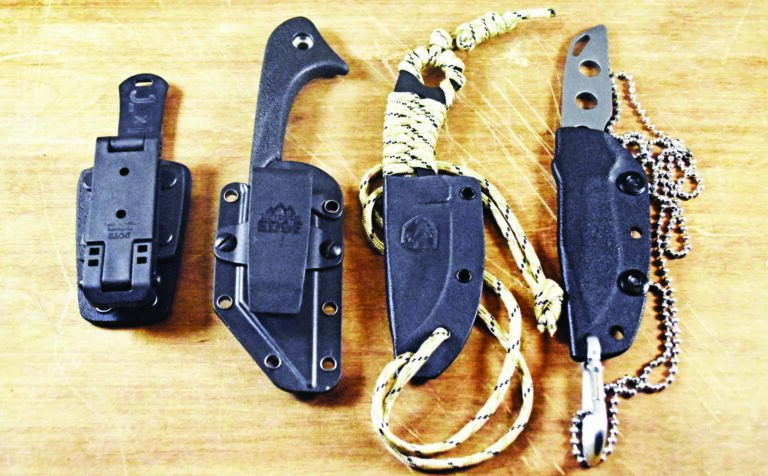
Neck knives are often overlooked as a form of everyday carry, which is surprising since they offer so many advantages. Neckers, as they’re slang-fully called, excel at concealment* as they are easily covered by a shirt or jacket, and, because they’re uncommon EDCs, offer an element of surprise.
While neck knives frequently may be thought of as tools of self-defense, they also offer utility aplenty. In addition, with a fixed-blade neck knife—like all fixers—you simply snatch it from its sheath and you’re ready to go.
Condor Tool & Knife Carlitos Neck Knife
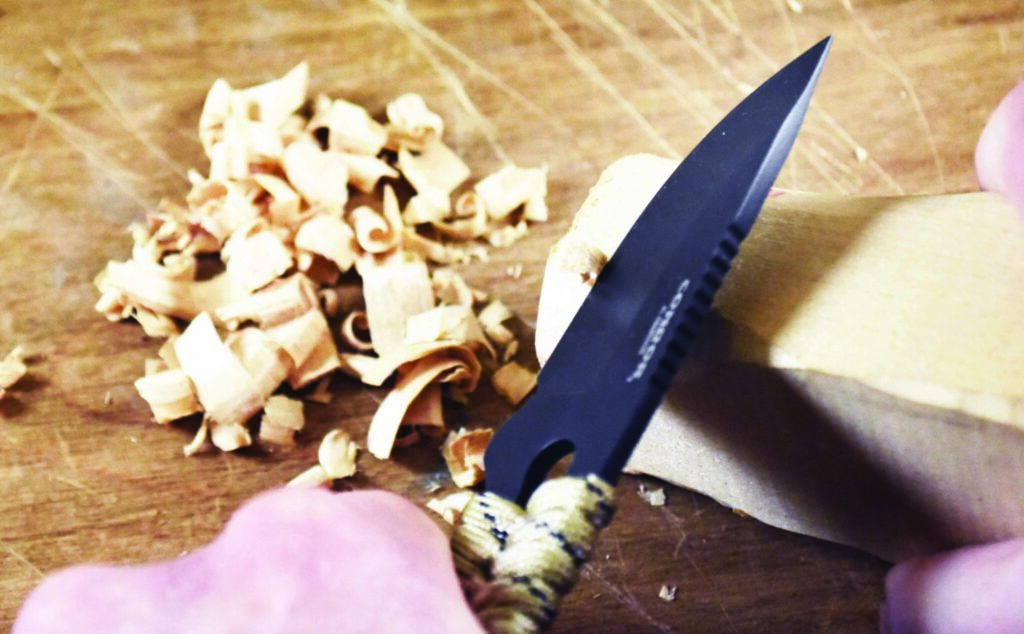
The Condor Tool & Knife Carlitos is pure necker and smacks a bit more of a field knife than a tactical. It shaves wood for fire starter very well and, in fact, could serve as a skinner. In addition, the paracord could come in handy in an emergency.
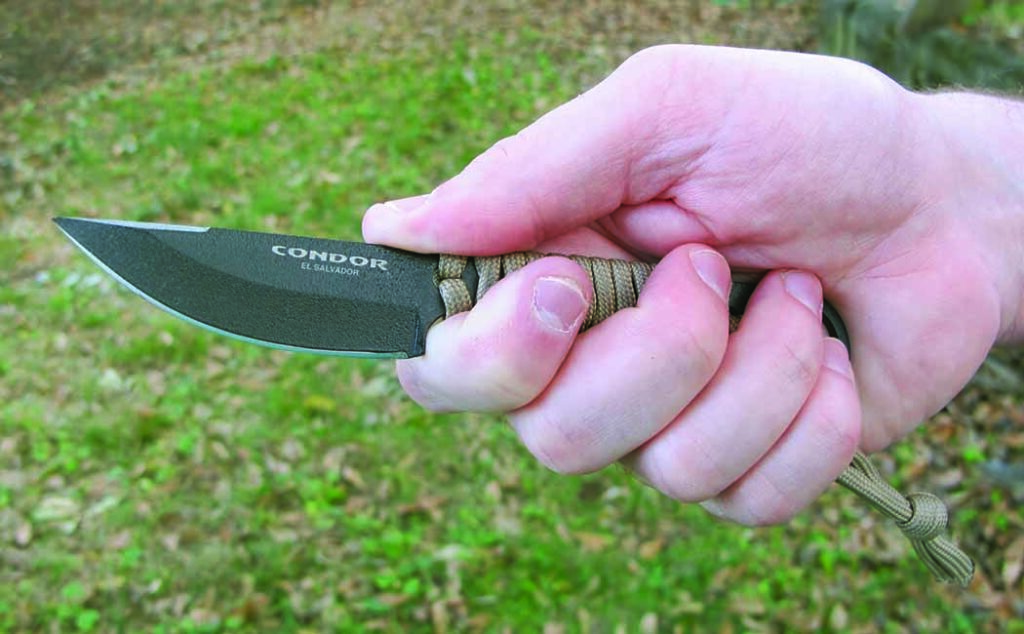
Condor Tool & Knife’s Carlitos Neck Knife is small and lightweight, its weight primarily reduced by its skeletonized design, with only a paracord wrap to add load to its black carbon steel mass.
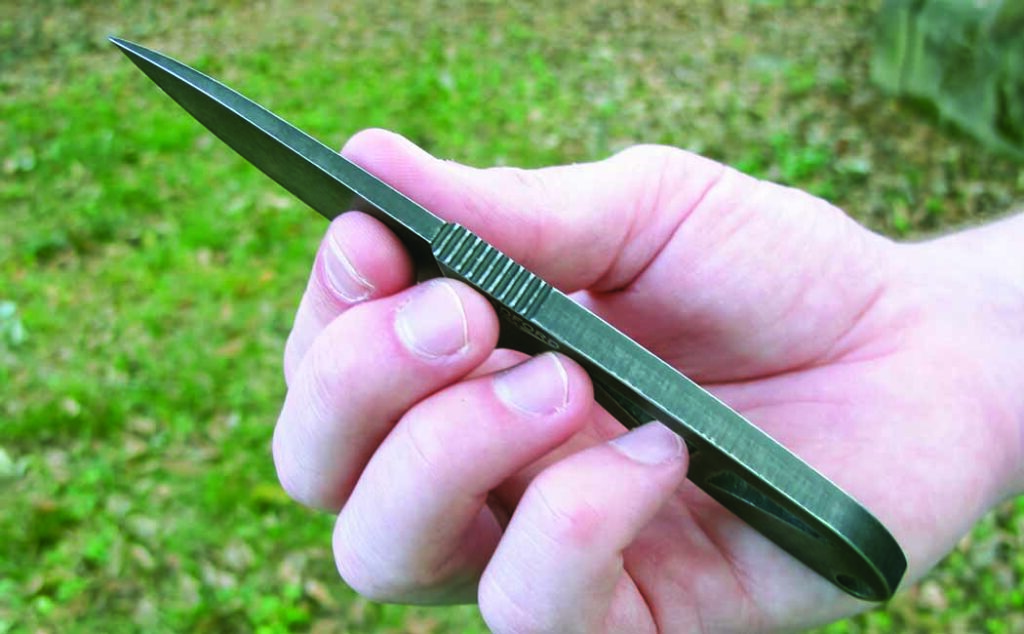
The blade is gimped on the lower spine for added grip. The handle is cord-wrapped with a braided lanyard at the base, handy for releasing the knife from the sheath. The grommets at the sheath’s base can take paracord or ball chain for neckwear.
MSRP: $43
Outdoor Edge LeHawk
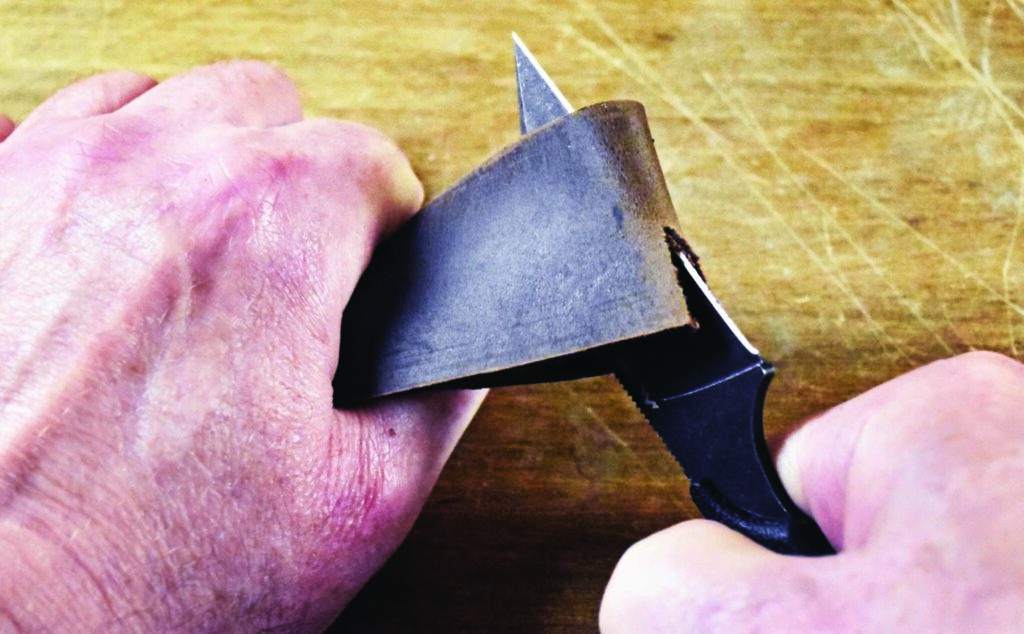
The Outdoor Edge LeHawk is the largest of the test neckers and its 2.9-inch reverse tanto blade came to work. The blade was long enough to sever beefy harness leather with an upward pull-through in a single stroke.
The Outdoor Edge LeHawk, designed by knifemaker Jerry Hossom, is the largest of the test knives. The blade has a swedge grind and fine gimping along the spine.
The 3.3-inch handle is grippy with a kicked-up bird’s-beak butt to prevent slippage. The sheath wears around a neck via a length of provided cord or carries on a belt.
MSRP: $35
TOPS Knives Sneaky Pete Mini
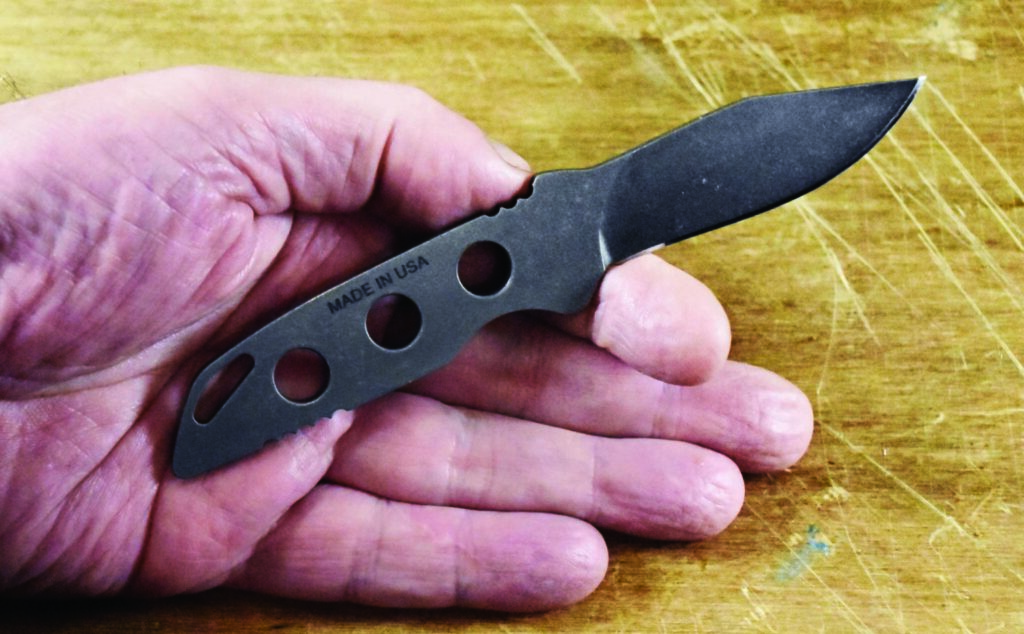
You can see how much hand you have to work with on a mid-size neck knife. The TOPS Sneaky Pete Mini is six inches overall with a 3.5-inch handle. A knife this size won’t fill the palm but there’s enough to get some chores done.
The TOPS Knives Sneaky Pete Mini resembles a scaled-down tactical knife. In fact, it is a miniaturized version of the company’s larger Sneaky Pete introduced in 2018.
The blade’s recurved edge flows into a 3.5-inch skeletonized handle. The entire knife is carbon steel. Delivered with a sheath and ball chain necklace, the Mini also has a carabiner clip for dangler carry. The skeletonized construction makes for a very slim package.
MSRP: $115
WE Knives OSS Dagger
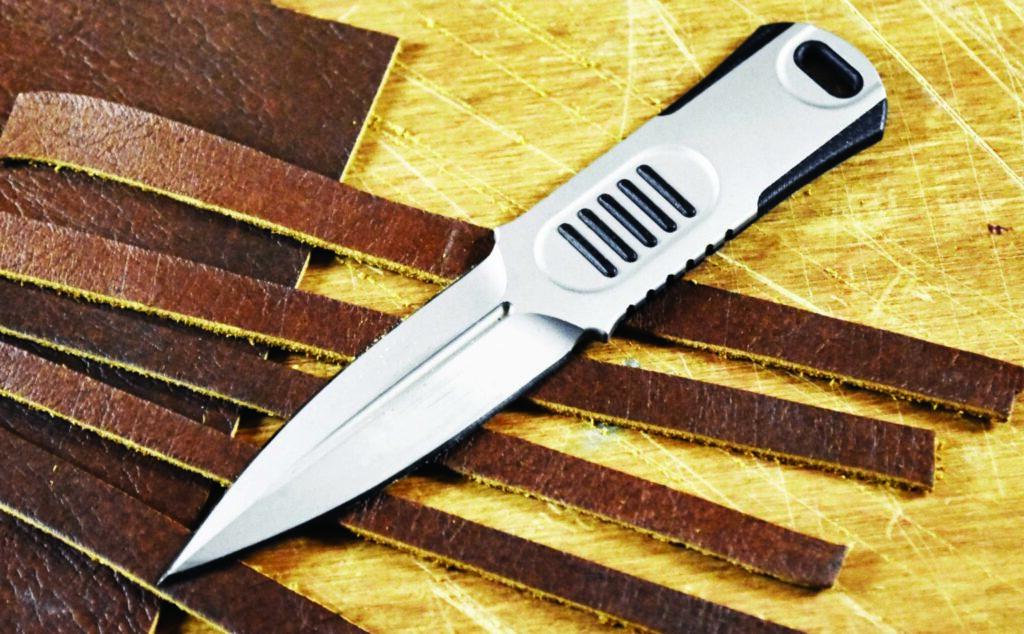
The little WE Knives OSS Dagger, 4.25 inches overall with a two-inch blade, is more of a hideaway knife than a utility hog, but it was not without its merits. The sharp blade of upscale CPM 20CV stainless steel took off nice, clean slices of leather scrap.
The WE Knives OSS Dagger is derived from the famed Fairbairn-Sykes/OSS daggers of World War II, though did you know there were variants this small? They were made for concealment for clandestine operations and called lapel, sleeve and thumb daggers, and it is from these that the WE version is derived. (And, of course, “WE” does not stand for the W.E. of William Ewart Fairbairn.)
The double-ground blade has one edge sharpened and a tapered fuller. The back side of the blade is flat. Essentially an integral design of stainless steel, the handle has inlays for improved grip. The knife is delivered with a black sheath and ball-chain necklace.
MSRP: $105
Boker Plus Rescue Kiridashi
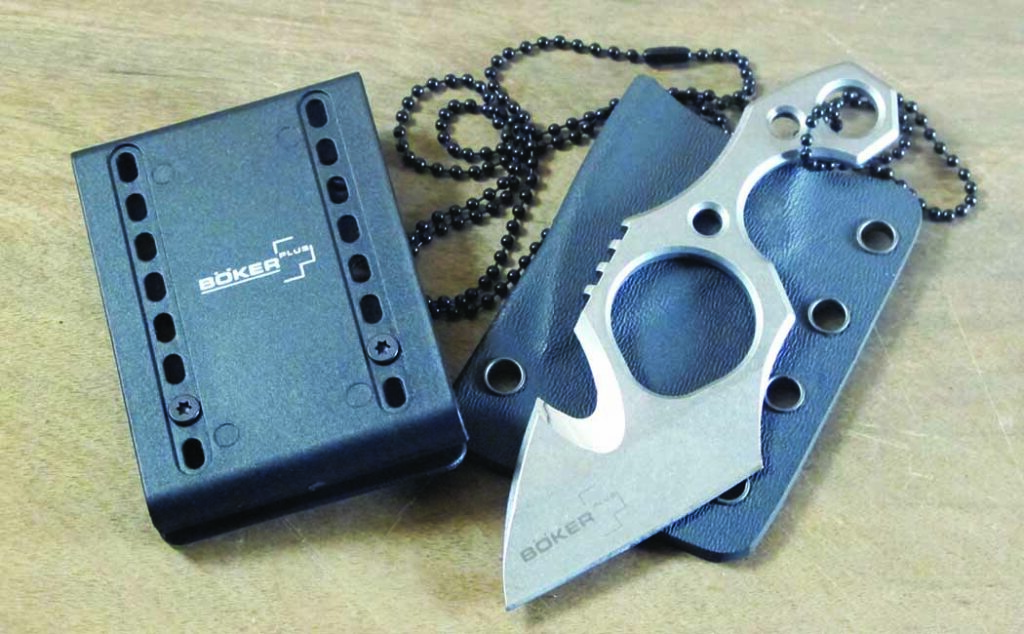
The Boker Plus Rescue Kiridashi is the total package. In addition to the neck knife and black Kydex sheath, Boker includes a ball chain necklace and optional bolt-on Kydex belt loop.
The Boker Plus Rescue Kiridashi gets the “rescue” label by offering a large gut-hook-style web cutter. (For more on the latest rescue knives, see page 44). The blade has the flat edge of a kiridashi but is hollow ground on both sides to enhance slicing capabilities. The handle—the blade and handle length overlap—has a large index finger hole for a sure grip. A black Kydex sheath, black ball chain and bolt-on Kydex belt loop are included.
With its large wharncliffe blade, the knife proved to be a beast. I tested it on leather and 3/8-inch synthetic rappelling rope and it whipped through both with ease. The ring in the short handle enhances grip, making the index finger your main purchase point. Watch out for that gut hook webbing cutter, however, as it’s awfully close to the thumb rest. I tried the hook on seat belt webbing as well. In my experience, though gut-hook-style webbing cutters don’t perform as well as serrated blades, the Rescue Kiridashi will do the job in the heat of the moment.
MSRP: $45
Bradford Knives’ G-Necker
The G-Necker’s thick quarter-inch-plus steel is unusual on a neck knife but Bradford puts it to good use. Note how the blade tapers while the handle retains the full thickness for a comfortable grip.
Bradford Knives’ G-Necker eschews radical curves for more classic lines that give it the look of a standard small fixed blade. It departs from the norm, however, by flexing its muscle with top-shelf Elmax stainless steel in a graceful, flat ground drop point blade. The handle, thick enough to forgo a cord wrap or scales, has two triangulate holes to lighten the load. We tested the blackwash version—other finishes are available. Bradford provides a black Kydex sheath and ball chain necklace.
The quarter-inch-plus-thick handle is unusual among neck knives. However, if you think it might be a bit clumsy, that’s not the case. Bradford has struck a balance by keeping the steel’s thickness on the handle but tapering it on the blade for better slicing.
The Elmax steel cut like a house afire, taking off super crisp cuts on harness leather and whipping through 3/8-inch rope with ease. The handle rests in the palm nicely and the notched gimping on the thumb rest enhances grip. Handles with no scales or padding don’t bode well for long term use as those that have them, but if you’re using the Bradford G-Necker for quick chores, you’ll have no worries.
MSRP: $99
Condor Tool & Knife Kickback
The Condor Tool & Knife Kickback provides a hint of tactical with its swedge-ground spine, while the blade offers a deep belly for outdoor chores such as skinning.
Condor Tool & Knife designed the Kickback for both urban and field duty. The straight-back blade has a swedge grind for enhanced penetration, giving it a tactical feel, while its deep belly makes it at home in the field. The steel has a black traction coat stem to stern and there’s a large finger hole in the base. A nicely done tan paracord wrap with a knotted pull completes the handle. Condor provides a black Kydex sheath with ball chain for neck carry.
The blade did an excellent job of slicing through harness leather, which bodes well for the knife’s potential use as a skinner. I also found the swedge ground point adept at penetrating and boring into leather. Due to its light weight and short blade, the Kickback wasn’t quite as good at cutting 3/8-inch rope as at least one other of the test knives, but it gets the job done. The cord-wrapped handle is very comfortable. I found the ring at the base a bit tight for my pinkie finger but it works well for hanging the knife on a lanyard.
MSRP: $35
TOPS Knives Mini Tanimboca Puukko
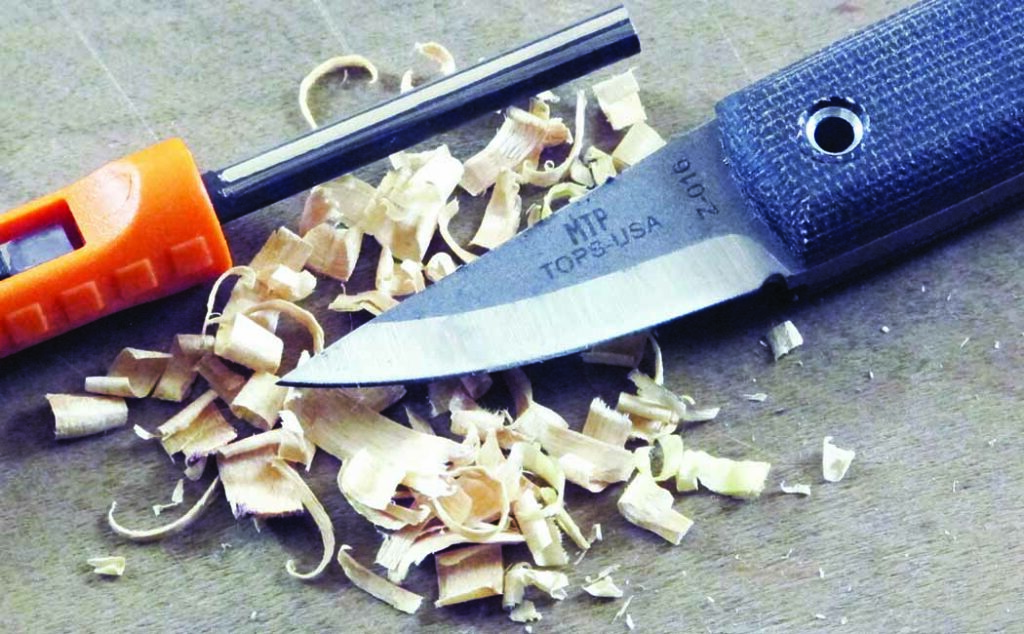
The TOPS Mini Tanimboca Puukko is an excellent little necker for fire prep. It cut fine wood slivers and curlicues for tinder, and the blade spine threw righteous sparks off a ferro rod.
The Mini Tanimboca Puukko by TOPS Knives makes no bones about its mission: It’s basically a small bushcraft knife. It is a full-tang design with a flat-back Scandi-ground blade. The little necker’s handle features comfortably plump black linen Micarta® scales with a large tube lanyard hole in the butt. At 1.28 ounces it’s the lightest of the test group and deviates from the rest in its uncommon top-loading brown leather neck sheath, which wears on a belt, too. The knife is also the smallest of the review neckers and, indeed, the most distinctive.
As noted, the Mini Tanimboca is a field knife. While it will cut leather strips and can saw its way through 3/8-inch rope, it really excels at fire prep. I tested it for taking fine shavings from a boxwood block and stick of pine, and it dug in with gusto and precision. I then tested the blade spine on a small ferro rod and it threw sparks like a champ. The blade tip bores holes in leather with accuracy. The tiny knife makes an excellent companion to its larger sibling, the TOPS Tanimboca Puukko.
MSRP: $110
Securing Your Lanyard
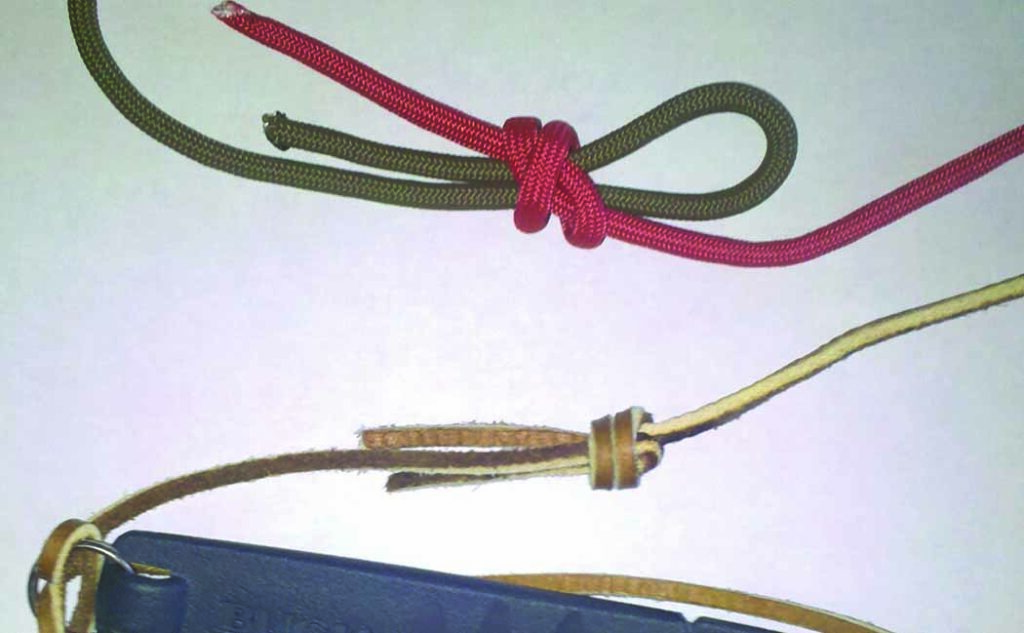
Two friction knots for neck knife “necklaces”: one tied loosely with two different colors of cord for clarity, and below it the same knot tightened up more neatly on a leather lanyard. (Bob Seymour image)
An area of concern with neck knives is the mode of carry around your neck; in other words, if the necklace does not give way if it catches on somethings, it can wring your neck—or worse.
Ball chains are designed to break easily in such instances and thus are considered safe. They’re also cheap and easy to replace. A nylon, leather or other cord, on the other hand, won’t snap in two easily. The solution? A friction or other knot that will release from around your neck with sufficient tension.
“Almost any knot around a loop will do the trick, though some knots may work better than others,” noted BLADE® reader Bob Seymour. In the accompanying image are two friction knots: one tied loosely with two different colors of cord for clarity, and below it the same knot tightened up more neatly on a leather lanyard. Note that the loop prevents the knobby end of the cord from catching during release.
Experiment with different materials and knots and test them to see if they will release with sufficient tension. The key is to arrive at a knot that does not release too easily and one that won’t release at all. If in doubt, trash the cord and use a ball chain.
*Be sure to check the laws concerning concealed knife carry in your area.
Les George Leans On His Decade Of Service In The Marines To Guide His Knifemaking Philosophy
A veteran of the United States Marine Corps and the Iraq War, knifemaker Les George loves vintage military fixed blades and collects, designs, and reproduces them on a regular basis.
About four years ago, Kershaw asked him to design a folding version of one of his military favorites.
“It’s hard to translate from fixed blades to folders,” he noted but he went ahead and designed one based on the M3 trench knife. Kershaw made a prototype from the design—sold today as the XCOM—and sent the knife to Les. Today, the XCOM sells for $53.99 and is well reviewed on the Kershaw site.
He carried it for a while and was cutting with the folder one day when he laid it down and began admiring it. “I saw the prototype lying there and it was way cooler and much more utilitarian than I thought it would be because of the military vibe,” he said.
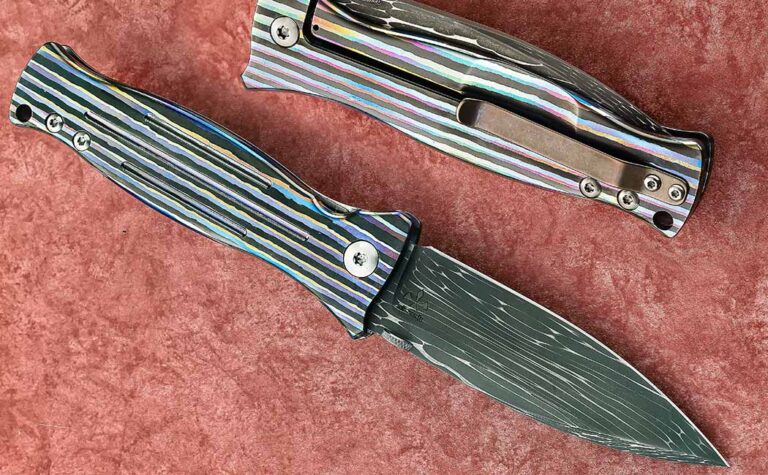
He dropped everything he was doing and made the custom M3 Folder with a blade of a stainless damascus forged especially for the knife by Chad Nichols, and a handle of Zircuti, a laminate of titanium and zirconium. The result is one stunning folding dagger.
Who Is Les George
Les George first started making knives in 1992. Many of his pieces are inspired by his 10 years of service in the Marines where he, among other jobs, worked as an explosive ordnance disposal technician. Overseeing hundreds of EOD missions has given up a unique view of how tools should be made that carries over into his knifemaking. George makes both fixed blades and folders.
M3 Folder Knife Specs
Maker: Les George Blade Length: 3.9 inches Blade Material: Chad Nichols stainless damascus Handle: Zircuti Pocket Clip: Titanium Lock: Framelock Closed Length: 4-⅝ inches Maker’s Price For A Similar Knife: $2,400
Repealing the prohibition on concealed carry switchblades marks the second major knife rights win in Virginia in as many years.
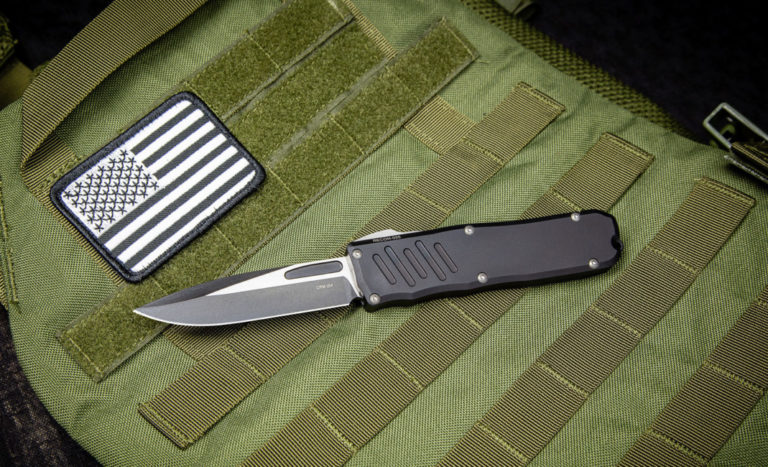
Chalk up another win for knife and Second Amendment rights in Old Dominion. On the heels of last year’s repeal of Virginia’s ban on switchblades or automatic knives, the state has now removed them from the list of weapons that cannot be carried concealed.
Cavaliers shouldn’t go throwing their OTF blades into their hip pockets just yet. While Governor Glen Youngkin (R) may have inked the repeal (HB 2298) on March 27, the law doesn’t go into effect until July 1. Until then, the knives remain illegal to carry in the state.
The latest legislation marks a sea-change in Virginia knife right under Youngkin, who broke what was a frustrating stalemate between the state’s legislative and executive branches. Despite legislators’ efforts to temper the state’s longstanding ban on switchblades, the Governor’s two predecessors vetoed the bills leading in that direction—Terry McAuliffe and Ralph Northam, both Democrats. The 2022 repeal not only saw the executive’s support but passed with overwhelming support from a politically divided General Assembly.
The removal of switchblades from the list of prohibited concealed carry items also proved extremely popular, passing unanimously in the Virginia Senate and with close to ¾’s of the House’s support. In addition to further safeguarding valuable civil liberties, the legislation also shows changing attitudes concerning switchblades.
Why Switchblades Are Illegal
A witch-trial panic swept mid-century America concerning switchblades, sparked by an article by an article titled The Toy that Kills and backed up by movies such as Rebel Without A Cause and Blackboard Jungle.
Aside from stigmatizing paten-leather jackets, politicians and social crusaders squarely set their sights on switchblades as a tool of the country’s wild youth. Despite essentially being a silver-screen fantasy, draconian laws that pushed switchblades to the margins of society were passed and in many corners of the country the tools became so rare as to be considered oddities. Though, before this era, auto knives were quite common.
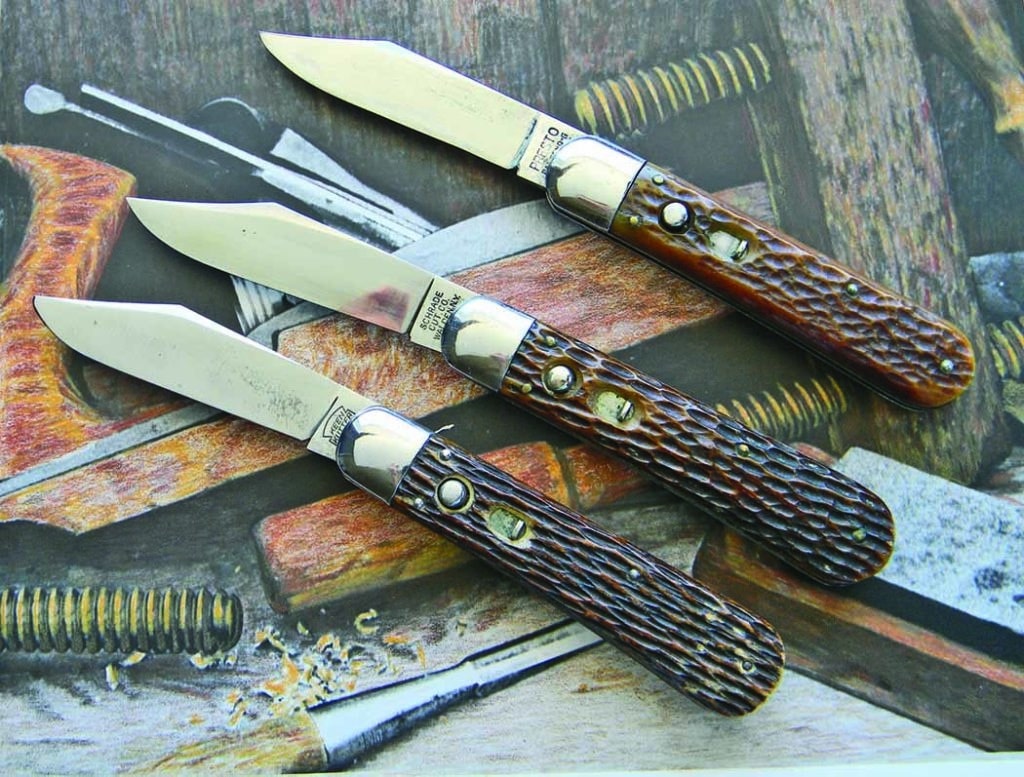
Before the mid-century switchblade panic, the knives were quite common, such as the World War II-vintage Schrade Cutlery Co. examples above.
“I grew up in Washington D.C. in the 40s and 50s and almost every school kid had a switchblade knife. And you played mumblety-peg, throw it to stick in trees. I don’t ever remember anybody being stabbed by a pocket switchblade knife,” Senate Majority Leader Dick Saslaw (D) said in a 2022 interview with Virginia Mercury.
Prohibition On Other Edged Weapons
The concealed carry repeal is a step in the right direction, but the law still maintains the prohibition on several other edged weapons for carry. Bowie knives, dirks, throwing stars and “oriental darts” remain verboten for everyday carry and continue to carry stiff penalties if the law is enforced. A first offense is a Class 1 misdemeanor which is punishable by up to 12 months in jail and a fine of up to $2,500. A second offense could earn a Class 6 felony, which carries a 1-5 prison stretch and a $2,500 fine. And a third offense could net a Class 5 felony, with a 1-10 prison stretch and a $2,500 fine.
While there is scant evidence the prior concealed carry switchblade ban was ever exercised to the full extent of the law, its repeal is likely a load off knife owners’ minds. For a tool that’s used more by first responders than in gangland rumbles, it’s also a big victory.
A Disciple Of Bill Ruple, Burt Flanagan Has Been Making Knives For Nearly A Decade And Crafts Some Of The Finest Slip Joints In The Lone Star State.
Burt Flanagan has been making knives part-time since 2015 and also is a member of the South Texas Slipjoint Cartel of understudies of Cutlery Hall-of-Famer Bill Ruple. Burt’s father was a knifemaker before him but due to extenuating circumstances—he lost his equipment in a robbery—he never achieved the heights he could have.
Flanagan’s mother passed away in 2014 and shortly thereafter a Fedex package from Burt’s father arrived at the door. Inside Burt was shocked to find a 2×72 grinder and called his dad to find out about the gift. His father told him his mother had always supported his interest in wanting to make knives, and through the proceeds from her life insurance policy he knew she’d want to help Burt get started.
In no time Flanagan was grinding away at becoming a highly respected knifemaker. He had a chance to meet Ruple at a Johnny Stout hammer-in in South Texas and—long story short—the legend invited him down to learn how to make slip joints. He did so with his dad in tow and the three have all been great friends since.
Burt also credits The Knifemakers’ Guild for its guidance and is now a member of the organization’s board of directors. When not making knives he works full time for Paragon Industries, makers of fine heat-treating ovens, as the company’s knife industry manager.
Inside Burt Flanagan’s Shop
Burt Flanagan caled down Tony Bose’s Back Pocket model, giving it a 3.25-inch blade of CPM 154 stainless steel and antique Westinghouse Micarta® scales with an abalone shield. (Mitchell Cohen knife image)
The shop tour begins with a piece of equipment Burt knows quite well.
“I am a very blessed man to have a career in the knife industry with Paragon Industries. I would never endorse something that I did not believe in,” Burt states. “My Paragon Pro will reach 1,000 degrees Fahrenheit in six minutes. You may think that’s not possible but it’s true. I will tell you that this is most likely the most important single piece of equipment in my shop because this is where it all starts. The heart of the blade is in the hardness, and my Paragon Pro is the ultimate. When I first got my Paragon oven it immediately cut my heat-treating time by two-thirds over a conventional brick-type oven that took over an hour to reach 1,925 degrees. This is to heat treat CPM 154 stainless steel, which I use pretty much exclusively for my blades, along with carbon steel damascus.
“An absolute must for a slip-joint maker is a surface grinder and I use a DoAll D-8. I was taught that two of the most important things in slip-joint making at a high level are for your parts to be flat and perpendicular. The D-8 takes care of the flat part of the equation. I surface grind my blades and springs to within one-half-of-one-thousandth of an inch with this machine. There are many different quality brands of surface grinders available from old to new. Mine happens to be an older model that has been restored and is in great condition. It weighs close to 5,000 pounds and is a hydraulic two-axis automatic beast that can get the job done.”
Big Tools For Big Jobs
Burt indicates the Moen Turbo Platen eliminates the belt-bump factor during grinding while also blowing a tremendous amount of air over the work, cutting down the heat on the blade big-time.
Next up Burt extols the virtues of his Oliver of Adrian drill point thinner machine.
“I’ve found it to be true that the first thing a dealer, collector or purveyor—as well as many knowledgeable customers—look at in a custom pocketknife is the nail nick. A proper nail nick, no matter what the method used, should have needle sharp points and be thin and consistent throughout. This machine is the beans as we say here in Texas,” Burt explains, “and allows the maker to properly place the nail nick just before assembly. It is equipped with a built-in diamond dresser with a lever that keeps the 5-inch stone sharp all the time. Although there are many ways to cut a nail nick, most makers say this machine arguably does the best job.
“As with a nail nick there are numerous ways to inlay a shield on a pocketknife. I believe the most versatile way is the pantograph. Mine is a Gorton P1-2 model, which has been restored to almost new condition by the pantograph guru, Tim Robertson. There are many different makes and models that work great. These machines are the predecessor to the CNC machines of today. Gorton machines were made from the mid-’60s up to the early ’90s. My machine was made in the mid-’80s. These machines are capable of doing so much more than just shields; it enables the maker to create just about anything your mind can imagine. I believe we are only beginning to explore what is possible with these machines in the knife world.”
Lastly, Burt highlights his Moen Turbo Platen.
“Jerry Moen continues to change knifemaking for the better,” Flanagan praises. “This great tool virtually takes away the belt-bump factor while blowing a tremendous amount of air over your work, cutting down the heat on your blade big-time. It also greatly reduces the amount of belts necessary to achieve the same finish. I actually use three-to-four grits to accomplish a mirror finish. An LED light kit makes it even better.”
Inspired By The Keen Kutter Pen Knife, Tim Britton’s Badger Is A Refined, Modern Version Of The Classic Knife.
When ABS master smith Bruce Bump showed an old Keen Kutter penknife pattern to veteran knifemaker Tim Britton, Tim fell in love with it and immediately set to making his own iteration.
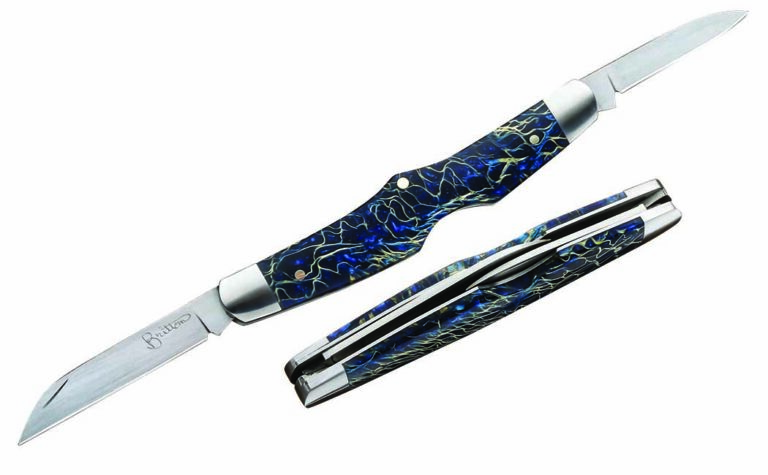
The blades of his version are BG-42 stainless steel that, as Tim noted, has high ductility and holds an edge forever. He flat ground them on his “ancient” 18-inch, 200-pound Porter Cable disc sander. However, it’s the handle that really stands out.
Consisting of stabilized diseased ash burl from Whistle in the Woods, the material looks synthetic but isn’t. “The light stuff in it looks like explosions,” Tim said. “I’ve never seen anything like it.” The projection on the spine fits right in between the user’s index and middle fingers and the groove on the underside cradles the latter for a comfortable, secure grip.
Calling it the Badger, Tim made 10 of them and showed them off to the world at BLADE Show 2022 in Atlanta.
Who Is Tim Britton
Britton has been making knives since 1971 and has spent much of his time recently creating slip joints, of which the Badger is one of his latest. While his knifemaking career started by making hunting knives for dressing game to crafting tactical knives and small folders and slip joints from his shop in Winston-Salem, North Carolina.
With more than a half century of experience, Britton has carved a place, pun intended, for himself among the top knifemakers in the country.
Badger Knife Specs Maker: Tim Britton Blade Steel: BG-42 stainless Blade Grind: Flat Handle Material: Stabilized diseased ash burl from Whistle in the Woods Closed Length: 3.5 inches Maker’s Price For A Similar Knife: $375