Home Blog Page 84

Unconditionally Traditional: The Beauty Of Custom Pocketknives

0

Custom Pocketknives Always Seem To Make Us Feel Nostalgic. These Models From Talented Custom Makers Are All Gems.

There’s something about classic custom pocketknives that tugs at the heartstrings. Once you get bitten by the bug it’s an itch you can never quite finish scratching. It becomes indelibly etched in the DNA. 

Fortunately, custom knifemakers never tire of building them and every year provide new offerings and fresh looks. Meet four of those makers, each highly skilled at the craft who build exquisite knives with personalities all their own.

With its beefy bolster and no-nonsense stout handle, the barlow slip-joint pocketknife is designed for hard use. Adam Rogers gave his two-blade iteration all the right stuff for a million-dollar look.

“I see the barlow as the perfect example of a gentleman’s folder, very universal and great as an everyday carry,” the Aussie maker observes. His upscale workhorse is 3.35 inches closed with a 2.2-inch spear-point main blade and a 1.57-inch secondary pen pattern. He chose CPM 154 stainless steel to do the cutting chores and the fluted bolsters are 416 stainless. “The long pull works well with the shape of the spear blade, whilst giving easy access to open,” Adam notes. 

The upscale liners are jeweled and the backsprings are CPM 154.

Why did he choose giraffe bone for the scales? “Giraffe bone is a great product to work with, easy to use with a large variety of colors available,” Adam assesses. “Paired with the fluted 416 stainless steel bolsters it gives the folder a clean, sophisticated look.” Other traditional pocketknife patterns Adam offers include the sowbelly, saddlehorn trapper—both single and twin blades—small and medium trappers, wharncliffe trapper, Lanny’s Clip and the muskrat.

Trapper By Bubba Crouch

 Bubba Crouch goes the unusual materials route for his dress slip-joint trapper, including a 4-inch blade forged from old Schrade trapper blades and handle wood from the pole that held up the original telephone lines from the house to the office of famed Texas cattle baron Charles Goodnight. (SharpByCoop image)
Bubba Crouch goes the unusual materials route for his dress slip-joint trapper, including a 4-inch blade forged from old Schrade trapper blades and handle wood from the pole that held up the original telephone lines from the house to the office of famed Texas cattle baron Charles Goodnight. (SharpByCoop image)

You might say custom knifemaker Bubba Crouch doesn’t walk the straight and narrow. Instead, he infuses interesting stories and twists in his slip-joint pocketknives that make them truly remarkable. Take, for instance, his dress trapper.

“A customer gave me the wood for the handle he bought at a fundraiser auction from the estate of Mr. Charles Goodnight,” Bubba says. “The historical wood was holding up the original telephone lines from Goodnight’s house to his office.” Just so you know, Goodnight was a living legend among cattle barons in the latter half of the 1800s.

If that isn’t enough to set Crouch’s trapper apart, the 4-inch clip-point blade with the deep belly is forged by Jason Fry from old Schrade trapper blades. The integral bolsters are made to resemble the beaten copper pots Bubba’s mom acquired in New Mexico when Bubba was a child. “I’m always hunting for something unique with a historical past,” he states. “It’s really challenging trying to find these items.”

Like Tom Ploppert (read on for more on him) and many other slip-joint makers, Bubba gets no small part of his inspiration from BLADE Magazine Cutlery Hall-Of-Fame® member Tony Bose. 

“I build mostly trappers in three sizes but I have also built Saddlehorn trappers from the Tony Bose design,” he says. “I’ve built a few lockbacks too but my market is mainly the trapper.”

The Lincoln Folder

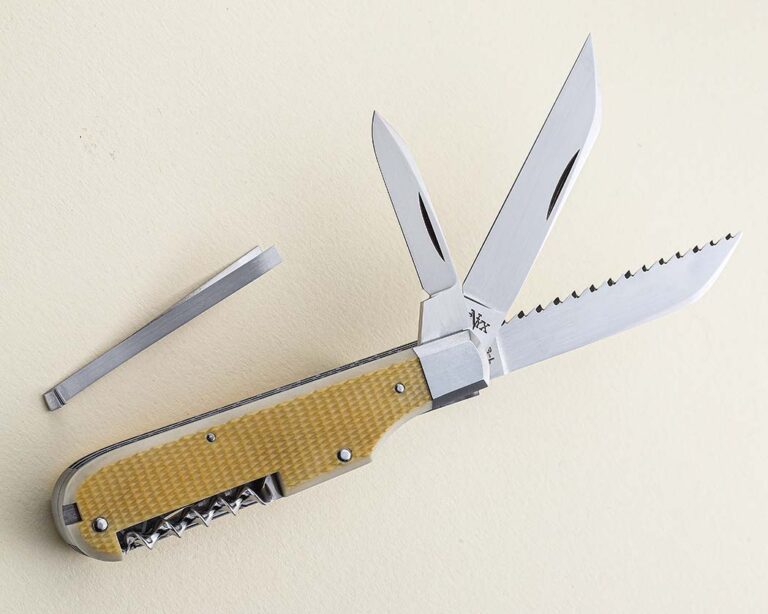
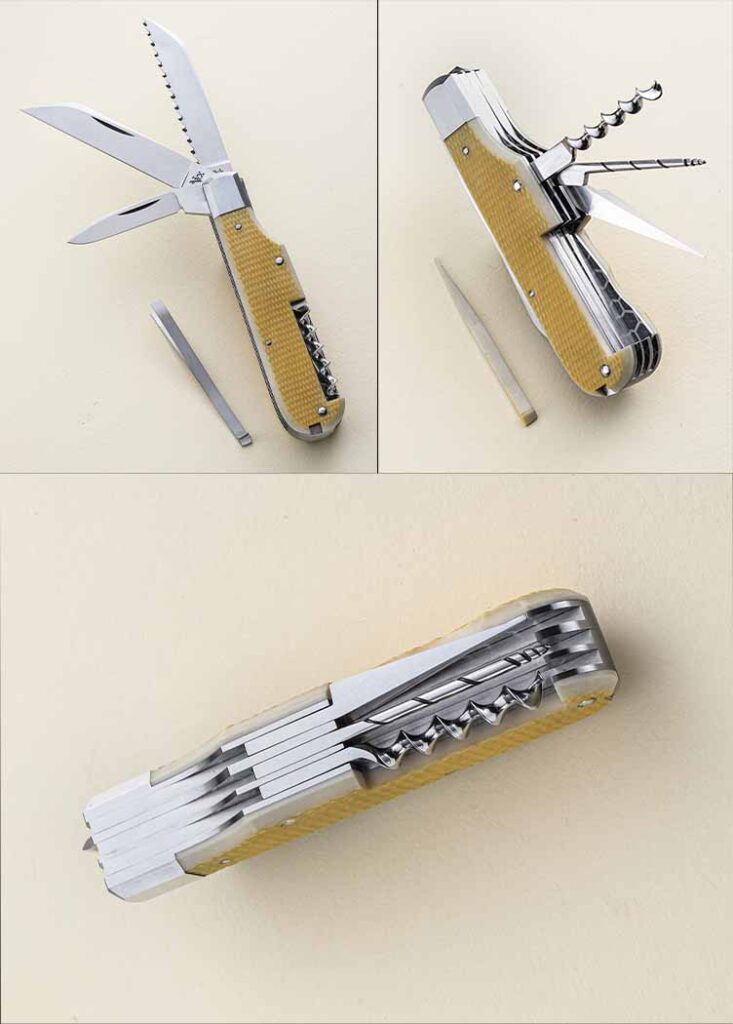
 Eugene Shadley’s Lincoln Folder is a reproduction of the six-blade congress pocketknife that was on President Abraham Lincoln’s person when he was assassinated. The blades are CPM 154 stainless steel and the handle is smooth white bone. Maker’s price for a similar knife: $5,000.
Eugene Shadley’s Lincoln Folder is a reproduction of the six-blade congress pocketknife that was on President Abraham Lincoln’s person when he was assassinated. The blades are CPM 154 stainless steel and the handle is smooth white bone. Maker’s price for a similar knife: $5,000.

Custom knifemaker Eugene Shadley is royalty among slip joint aficionados, so it’s only fitting we feature his reproduction of a pocketknife owned by one of our most famous presidents.

“The Lincoln Folder is my rendition of the congress pocketknife Abraham Lincoln had in his pocket the night he was assassinated,” Shadley notes. “A customer asked me to make a copy.”

The Lincoln Folder is only 3.5 inches closed yet features six blades inside its compact frame. The liners and bolsters are 416 stainless steel with smooth white bone scales topped with a gently curved round bar shield. The blades include a large spear, large sheepsfoot, a cutoff pen, two pen blades, and a manicure blade with a nail cleaner and a file on either side.

Just how tough is it to make multi-blades, especially one with six blades? “Anytime you make a knife where blades pass each other, everything really does need to be in its place,” the award-winning maker and a past president of The Knifemakers’ Guild explains. “A lot of factory knives had a little longer and thinner blades that passed each other. Those knives tended to be more utilitarian and rubbing was the norm. We custom makers are expected to make sure blades do not rub each other.”

Wilbert Saddlehorn Trapper

The Wilbert Saddlehorn Trapper by Tom Ploppert is a lockback with a rich factory history. BLADE Magazine Cutlery Hall-Of-Fame® member Tony Bose introduced Tom to the knife many years ago. Tom’s price for a similar reproduction: $2,100. (Mitchell D. Cohen photography)

Tom Ploppert’s Wilbert Saddlehorn Trapper is a reproduction of a lockback with a rich factory history. 

“Wilbert Cutlery Co. was located in Chicago and was a retail brand sold by Sears Roebuck & Co. through a contract with Napanoch Knife Co. and Empire Knife Co.,” he explains. “They were made from approximately 1908 to 1921. Tony Bose introduced me to this knife and its history many years ago and shared the pattern with me as well.”

The scales are a gnarly premium stag and the integral bolsters are 416 stainless steel. Closed length: 4.5 inches. The Wilbert’s 3.75-inch clip-point blade of CPM 154 stainless steel features a classic nail nick. “There is a lot of blade to fit into a narrow handle and bolster area,” Tom states. “It requires a lot of adjustments along the building process.”

Another notable feature is the blade’s well-defined grind. “I hollow grind all my blades with a 20-inch Burr King grinder using a 1-inch-wide wheel,” Tom notes. “I get crisp grind lines using fresh new belts. Bill Ruple [page 12] taught me early on that nothing cuts like a fresh new belt—along with years of practice.”

Bruce Barnett’s Peanut Pocketknife

Australian ABS journeyman smith Bruce Barnett likes serpentine pocketknife patterns. His peanut with its curvy handle is an example. (Rod Hoare knife image)

Australian knifemaker Bruce Barnett found the peanut pocketknife pattern to his liking and fashioned a striking example of it. 

“I really like the subtle and serpentine-shaped knives, and took it upon myself to stretch it to 3.5 inches and reshape the pivot end,” he related. “Shaping up a nice, long wharncliffe for the second blade was challenging in itself, and I think this one looks pretty cool.”

Barnett’s peanut features a blade of his damascus forged from 1080 carbon and 15N20 nickel-alloy steels in a ladder pattern, mammoth ivory scales, and a 410 stainless frame and bolster. He wanted to make a working knife true to the classic peanut style and succeeded, commenting, “I realize it was generally a small two-blade that fit in your money pocket, but so does this one in today’s working man’s jeans.”

This particular knife is available for $1,350 from Bruce, and a similar piece would run roughly the same price. He uses his forged damascus in about half the knives he produces, both in traditional work and for specific custom orders. His 410 or 416 stainless frame and 154CM stainless spring materials are common, and he appreciates the understated surprises sometimes present in mammoth ivory. 

“I find these materials easy to use and can trust them not to fail,” he commented, “and with mammoth ivory, it’s very stable and durable, and you never know what colors are hiding under the bark.”

After 12 years as a part-time knifemaker and working as a mining maintenance manager, Bruce began making knives full-time in 2017. His farming and mining background had always involved knives, but the catalyst for a move into making his own came from another passion.

“I was introduced to custom-made knives by Max Harvey, who donated a large bowie for me to raffle to help fund my drag racing habit running a nitro-methane-powered Harley-Davidson, which I went on to win the Australian championship on,” he remembered. “After a pretty serious accident, I gave up racing and was instantly looking for something else to do. I had never forgotten that knife. I decided I would try and make one—and here we are.”

Harvey Dean’s Texas Tornado

ABS master smith Harvey Deanmarries 24k-gold engraving and escutcheons, antique shell and Dellana Dots on the blade of Texas Tornado pattern damascus to cap off his ornate Coke bottle pattern. (SharpByCoop knife image)

The famed Case Coke bottle pocketknife took on a new twist when Harvey Dean paired the well-known handle shape with a sleek dagger blade in his Texas Tornado damascus of 1075 carbon and 15N20 nickel-alloy steels. 

This beauty sports a blade of 4-3/8 inches, closed length of 5.5 inches, and lustrous scales of antique shell. Distinctive Dellana Dots accent the blade to assist in opening, while Harvey did his own engraving in 24k-gold overlay with 24k-gold escutcheons. The bolster and guard on each side are integral 416 stainless steel pinned together.

The dagger blade and Coke bottle handle are traditional, but Harvey’s variation marries them in a stunning display that literally makes the “old” something new and exciting in this custom pocketknife. 

“I just thought it looked good,” Harvey commented. “I kind of modified the Coke bottle shape from the Case pattern as their bolsters are straight. Dellana is the first person I know of that instead of using a nail nick or thumb stud, put gold-raised pins in the blade so you could open it with them. I liked that when she started with it.”

Harvey made his distinctive Coke bottle dagger for the Art Knife Invitational (AKI) and said it sold for $9,600. So, with the pricing benchmarked, another similar knife would sell for around the same. In addition, however, the owner receives not only the knife made by one of the premier makers in the world today, but also a fine example of Harvey’s engraving skills.

“I don’t remember how many years ago I started engraving,” Dean mused, “but it’s been close to 10 since I went to the GRS Engraving School [grs.com]. This engraving is overlaid gold instead of inlaid, and the background is also engraved. I called [engraver and AKI coordinator] Barry Lee Hands when I was doing it and told him the pucker factor was very high. This is the first knife I’ve ever done with that much stuff on it, and one of the most ornate knives I’ve ever done. If you look closely, the leaves are actually shaded with round cuts instead of regular cuts like most shading is done to catch the light and get a lot of glittering in the look.”

Tobin Hill’s Custom Cheetah

Tobin Hill said the tough part about reproducing the old Case folding-guard Cheetah pattern is getting the guard to lock tight in the open and closed positions with no rattle or play. (SharpByCoop knife image)

Another tribute to the Case brand comes in the form of Tobin Hill’s version of the venerated Cheetah folder. His take on the Cheetah features the folding guard that made the pattern famous. Both the 3.5-inch blade and guard are CPM 154 stainless steel, while the handle is a superb amber red stag. Closed length: 4.3 inches. The spring and lock guard are also CPM 154, while the liners are 410 stainless and the bolsters are 416 stainless. 

Tobin said this particular Cheetah sold at BLADE Show 2022 for $1,100, while its twin, handled in mammoth ivory, sold at $1,200. Pricing would be similar for another such piece.

“I chose to build the swing-guard Cheetah because of the uniqueness of the mechanism,” Tobin said. “I haven’t seen many other custom makers try it and I like the challenge. The tough part is getting the guards to lock up tight in the open and closed positions with no rattle or play. I’ve seen several production models over the years that did rattle.

“Case has produced several versions of the swing guard. The pattern has always been called the 11½ series. They started making them between 1896-1915. I’ve seen models stamped ‘Case Brothers,’ ‘Case Tested,’ and ‘Case XX.’ The Cheetah pattern I copied was first made in 1973. They also produced the Cheetah Cub, a three-quarter version. The blades were mainly flat ground but I’ve also seen dagger grinds, some with crescent nail nicks and some with long pulls. I hollow ground my knife and thought it would be cool to put both a crescent and long pull in.”

Tobin has made knives for about seven years now and completed his first work on April 16, 2016. While he is still a part-time knifemaker, he hopes to devote more hours to it after possibly retiring soon from his own insurance agency following 42 years in that industry. Prior to making knives, his hobby was no less challenging—restoring violins to their original condition.

Tyler Turner’s Custom Pocketknife

“I was wanting to make a slip joint that was not made by custom makers often and that had some sex appeal to it,” Tyler Turner smiled. “And the graceful curves of the toothpick fit that bill perfectly.” (SharpByCoop knife image)

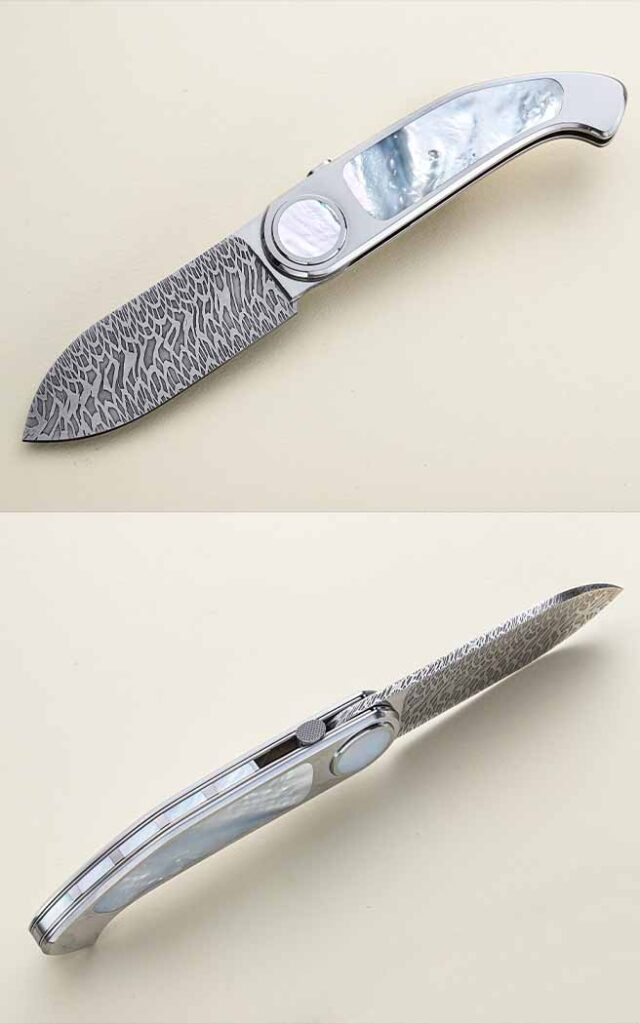
When Tyler Turner took on a toothpick project, he was looking for a certain flair that he knew was otherwise hidden. 

“I was wanting to make a slip joint that was not made by custom makers often and that had some sex appeal to it,” he smiled. “And the graceful curves of the toothpick fit that bill perfectly.”

His long, smooth toothpick features a 3.25-inch blade of damascus forged by Damasteel in the Fafnir pattern, with integral bolstered liners in 416 stainless steel, a CPM 154 spring, top-grade mother-of-pearl scales, and 24k-gold engraving and inlay by Jody Muller. Tyler said the handsome toothpick sold for $2,200, and another in a similar composition would command about the same price.

“The materials were chosen to accentuate one another,” he explained. “The most challenging aspect to the build was grinding the blade. My design led to a very acute angle at the tip. I always grind post-heat treatment, so a lot of care went into grinding it slow and cool so the tip did not turn color and ruin the temper.”

Tyler indicated the toothpick pattern, custom versions of which are less often seen than other patterns nowadays, originated in the early 1900s. It became popular with its easy carry and useful clip blade. And the blend of an older, traditional pattern fit in nicely with the maker’s perspective on his art.

“I would say I have a very eclectic style,” he remarked. “I invite the challenges of making a wide variety of knives so that it always pushes me to be better. Plus, it keeps people guessing!”

A resident of Hopkins, Missouri, Tyler is a part-time custom knifemaker and fourth-generation farmer. He grows amylose corn and soybeans with his father and has been making knives for about nine years now, primarily in the summer and winter. For Tyler, the family farming tradition goes hand in hand with another vocation, a foray into traditional knife patterns with the imprint of his own style.

Editor’s Note: Mike Haskew contributed to this piece.

Read More

Best EDC Fixed Blade Knife: A Cut Above The Rest

These EDC Fixed Blade Knife Options All Have Their Positives As Everyday Companions.

Fixed blades are common in the woods though far less so on the streets—politics has largely seen to that. Folders are in the pockets of many these days and are somehow considered “less dangerous” than fixed blades.

I cannot for the life of me understand this as there is little if any practical difference in terms of capability, with the exception of fixed blades in theory allowing for a longer blade.

There is this idea that a fixed blade is more lethal. Sure, a longer blade allows for greater reach and penetration, but it’s also harder to use in close confines—and substantially more difficult to deploy.

EDC Fixed Blade Knife Pros And Cons

The argument against the carry of larger fixed blades is certainly political, not practical. It could be considered in the same vein as the political arguments surrounding guns, most of which are dedicated to regulating what amounts to cosmetic features. If it looks scary, the thinking goes, you can convince people it is more dangerous.

The interesting part is that the small EDC fixed blade knife options in this article are, for the most part, around the same size as box cutters. The thing is, when we see EDC, we often think about how the item is meant to be on your person, at the ready for utility jobs and even self-protection if need be. The latter is more the case with guns, where there are no power settings, only a fully lethal one. 

In my stories on guns, I have often talked about how accessory-laden modern self-defense arms can be, but at the end of the day you’re not going to open your FedEx deliveries with a gun. Self-defense is a major purpose of firearms, whereas your EDC knife should be a jack-of-all-trades and capable of handling all your daily cutting tasks.

In the process of preparing this article, I had the pleasure of moving into a new house. As such I got to put the test blades through their paces, cutting everything from tape and cardboard to zip ties—and even dinner when I couldn’t find my silverware. In place of my carving knife I used the White River M1 Caper to serve chicken dinner.

The point is, these are supposed to be knives that benefit from fixed-blade construction, able to handle tasks that might damage a folder.

Best EDC Fixed Blade Knife Options

Fixed EDC Fixed Blade Knife Specs Comparision

ModelOverall LengthBlade LengthBlade ThicknessWeightBlade MaterialHandle MaterialMSRP
Boker Pocket Knife6.93 inches3.39 inches0.15 inches3.74 ounces440CG10$105
White River Knife & Tool’s Model 1 Caper7 inches3 inches.130 inch3.2 ouncesCPM S35VN or CPM MagnacutMicarta$120
Citadel Vannak V5.75 inches2.38 inches.72 inch2.9 ouncesDNH7Palisander Wood$175
Gerber Dibs5.96 inches2.5 inches.12 inch2.22 ounces440A440A$36
Kizlyar Supreme Hammy6 inches2.13 inches.13 inch3.6 ouncesAUS-8, Niolox, Sleipner, K340, PGKwalnut, G10 or carbon$117
Boker BFF6.92 inches2.76 inches.10 inch2.29 ouncesABE-LWalnut$259
Spartan Blades Field Grade Enyo6.25 inches2.69 inches.19 inch2.816 ouncesAUS-8AAUS-8A$88

Boker Pocket Knife

boeker-plus-pocket-knife

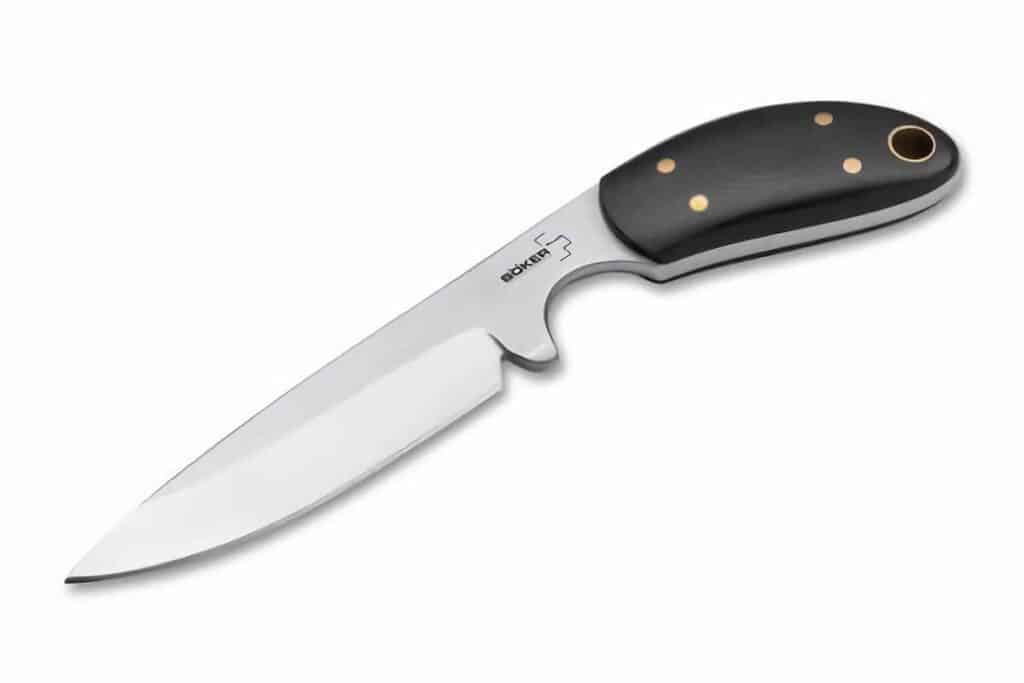
Boker has quite the little devil with the Pocket Knife. The name, of course, implies that it is to be carried in the pocket, and it comes with a sheath that works very well in this role. It’s the longest blade in the group but has the smallest handle. 

The handle size is deceptive; it is very minimalist in the pocket and the sheath sits low, thus making the knife appear to have a much smaller blade. It carries well and is lightweight—two things I like. However, in use, it becomes a bit more of a challenge.

I do get that the Pocket Knife, designed by veteran knifemaker and police officer Mickey Yurco, has a self-defense vibe. The EDC fixed blade knife’s long, narrow tip is an obvious thruster, though the overall texture of the full piece is very slick. The handle shape forces the hand into a slightly uncomfortable angle. Sheathing the knife is also difficult if clipped deep in a pocket.

As a regular-use knife, I have seen better. That said, in a self-defense role, this would be the best of the bunch. If the blade is in your hand in the reverse grip, it feels solid and firm. The tang cutout between the choil and the handle is perfect for pinky finger placement in the reverse grip, and the knife is an effective stabber and slasher in tight spaces. 

This is an excellent blade to pair with grappling techniques and for dealing with heavy clothing. All said, I like what Boker did here. It is a knife that goes in your pocket, but I don’t think it is well suited for the role of a traditional pocketknife.

Pocket Knife Specs
Overall Length: 6.93 inches
Blade Length: 3.39 inches
Blade Thickness: 0.15 inches
Weight
: 3.74 ounces
Blade Material: 440C
Handle Material: G10
MSRP: $105

White River Knife & Tool’s Model 1 Caper

White River Caper

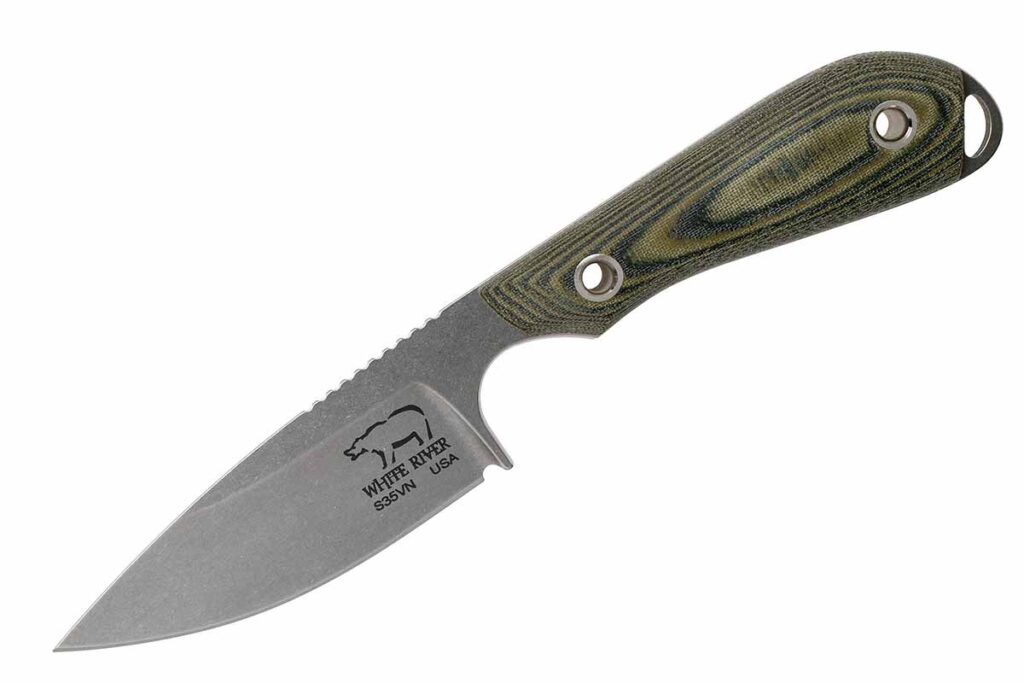
White River Knife & Tool’s Model 1 Caper was the best performer of the reviewed EDC fixed blade knife bunch. I have come to expect great knives from White River, not just ergonomically but also in terms of the quality of steel the company uses. The blades are heat treated very well, are not brittle, and stay extremely sharp even in heavy use.

The first thing I noticed about this knife is the grip, which is not only minimal but very comfortable. I can tell White River spends a great deal of time on the small things, such as the tang cutout having a very nice rounded interior edge that feels great on the finger and never digs into it. The grip material and shape feel terrific in the hand. The only downside is the Micarta® handle gets dirty fast and can stain.

The sheath is very well constructed and allows for positive sheathing with an audible click when the knife is seated. The sheath is meant for belt carry and is not a clip style like the others in the test, and fits most standard belts. The sheath surprised me a bit; it was the easiest to use of the bunch.

As far as utility for a carry knife, this one is probably the most versatile of the group. It is extremely sharp and has an aggressive, fine tip. It is so sharp it can pass through just about any normal material easily. I used it to cut heavy packaging straps and minutes later to prepare dinner. This is the definition of an all-purpose knife.

Model 1 Caper Specs
Overall Length: 7 inches
Blade Length: 3 inches
Blade Thickness: .130 inch
Weight: 3.2 ounces
Blade Material: CPM S35VN or CPM Magnacut
Handle Material: Micarta
MSRP: $120

Citadel Vannak V

Vannick

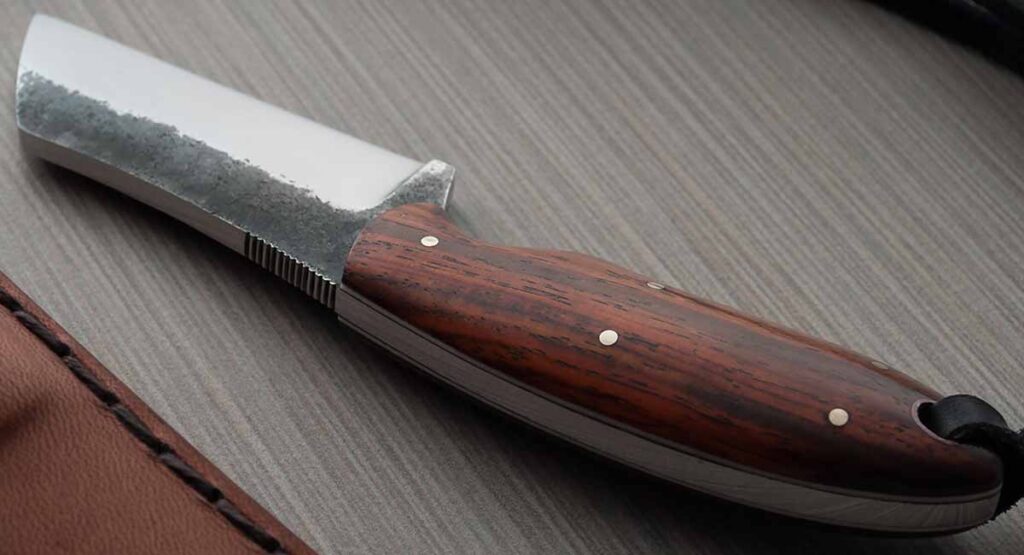
Made in Cambodia by Citadel, the Vannak V is an excellent EDC fixed blade knife. Overall, I really like this little guy. It doesn’t claim to be anything other than a daily use, small-task cutter. It’s great for opening mail and packages, light food prep, and small craft work. It is very pleasant to use and has an exceptional appearance.

Despite it being a great performer, I don’t have a tremendous amount to say about the Vannak V. It is devoid of gimmicks and is just a very tiny knife that does no more than its size allows. I like the wood grip and that the knife is made by hand by people who obviously care about what they’re doing. 

The fit and finish are great. I have no complaints about grip texture or the depth of the tang cutout as the knife can’t really be used in the reverse grip—it’s just too small. The sheath is leather, minimalist, and completely functional.

Vannak V Specs
Overall Length: 5.75 inches
Blade Length: 2.38 inches
Blade Thickness: .72 inch
Weight: 2.9 ounces
Blade Material: DNH7
Handle Material: Palisander Wood
MSRP: $175

Gerber Dibs

Gerber Dibs

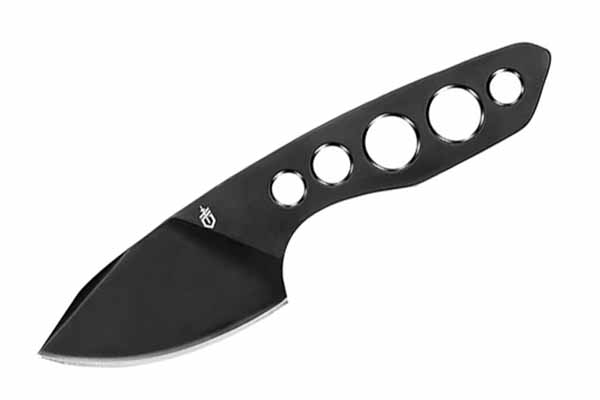
The Gerber Dibs is a one-piece, skeletonized-handle knife common among small examples of the genre. The 440A stainless steel blade is 2.5 inches and has a modified clip point. A flat grind gives the edge plenty of bite for tough cutting chores. 

The ergonomic handle has a large finger recess that doubles as an integral guard. When you grab the handle, it expands a bit to fill your grip. In addition to reducing overall weight, the skeletonized holes accommodate a paracord wrap to further augment purchase. 

An all-encompassing black PVD coating provides a low-profile appearance and enhanced corrosion resistance. Overall length is just shy of 6 inches, making the Dibs a great compact knife for general use or food prep.

Out of the box the edge was excellent, ready to work and featuring plenty of bite. It dispatched cardboard with minimal fuss. The edge quality along with the dropped blade design help promote overall knife security, using either a choke grip for precise maneuvers or resting a thumb on the blade spine to add more control or pressure for the cut. 

With skeletonized fixed blades, it is important to have a more complex handle design with varying features to help you retain your grip in the absence of scales. Despite having no scales, the Dibs is quite comfortable to grip. Skeletonized fixed blades are not meant for long periods of continuous use and are for convenience of carry instead. Bottom line, the knife is a pleasure to use.

The sheath is sewn-and-riveted leather dyed yellow. At first it appears too big—which it probably is—for such a small knife, but sheathed the Dibs is advertised as totable inside the pocket as well, which explains the large design. 

If you have cargo pants with larger front pockets, it carries very well there. A button-snap strap secures the knife and a large loop accommodates most belt sizes. The sheath’s edges are rough and not finished too well. Then again, Gerber targets affordability and as much bang for the buck as possible with the Dibs, so corners apparently were cut. 

Gerber Dips Specs
Overall Length: 5.96 inches
Blade Length: 2.5 inches
Blade Thickness: .12 inch
Weight: 2.22 ounces
Blade Material: 440A
Handle Material: 440A
MSRP: $36

Kizlyar Supreme Hammy

Kizlyar Supreme Hammy

The Kizlyar Supreme Hammy is an incredibly ergonomic knife. The leaf-shaped blade is 2.1 inches long  and sports a full flat grind for slicing power. Blade steel is Niolox stainless. The highly ergonomic handle is loaded with curves that feel molded for your hand. Orange G-10 scales provide a pop of color and a solid grip. The handle is expertly chamfered and contoured in the right places, further enhancing user comfort.

At first glance the Hammy appears cute—but don’t let looks fool you, as it’s designed and built for work. It’s a fixed blade the size of a small open folder. The blade is .11 inches thick at its thickest point and sports a distal taper to the tip. Jimping on the blade spine and thumb rest offer non-slip purchase for your thumb or index finger.

When you grip the handle and your thumb rests naturally on the blade spine, you feel how comfortable the Hammy is. You can also sense the knife is highly controllable, instilling user confidence. The jimping could be a little better. It could be more defined/aggressive to offer a better bite into your thumb.

The leather sheath has a button-snap retention strap. There are also two smaller belt loops attached to the main belt loop. These are provided to carry the Hammy horizontally, as it is set up for traditional vertical carry like most straight knives. 

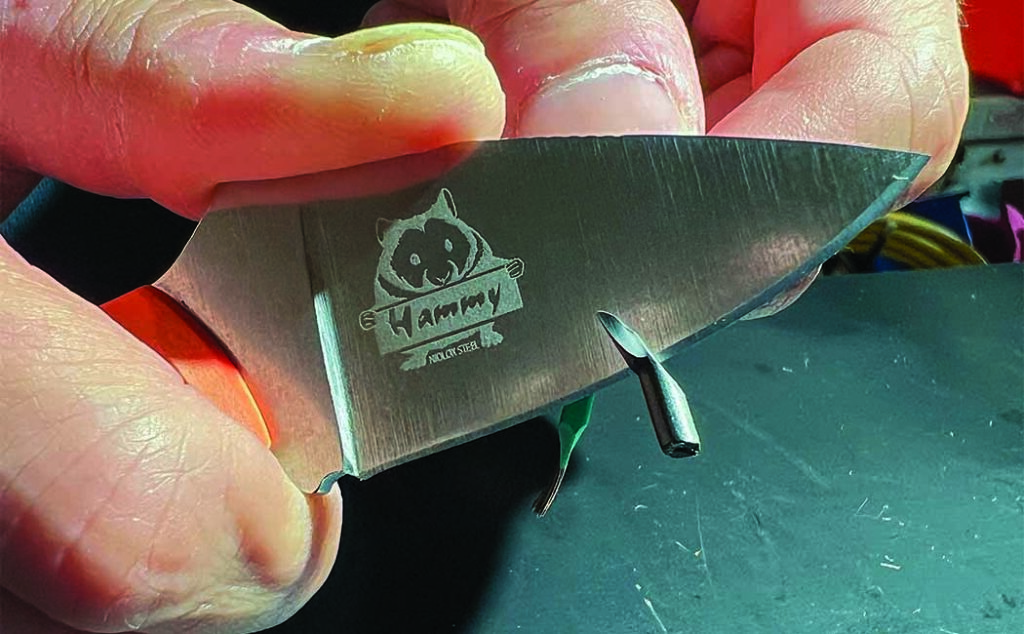
While the sheath itself is well made and includes a whimsical artwork stamping of a hamster (the same illustration appears as an etching on the blade’s right-hand side), it doesn’t have the snuggest fit around the knife. Even with the retention strap buttoned it is possible to still wiggle the Hammy out. This is not so critical if you carry the Hammy vertically, but it is a concern if you carry it horizontally. A properly fitted sheath at this price point is a must. 

Supreme Hammy Specs
Overall Length: 6 inches
Blade Length: 2.13 inches
Blade Thickness: .13 inch
Weight: 3.6 ounces
Blade Material: AUS-8, Niolox, Sleipner, K340, PGK
Handle Material: walnut, G10 or carbon
MSRP: $117

Boker BFF

Boker BFF

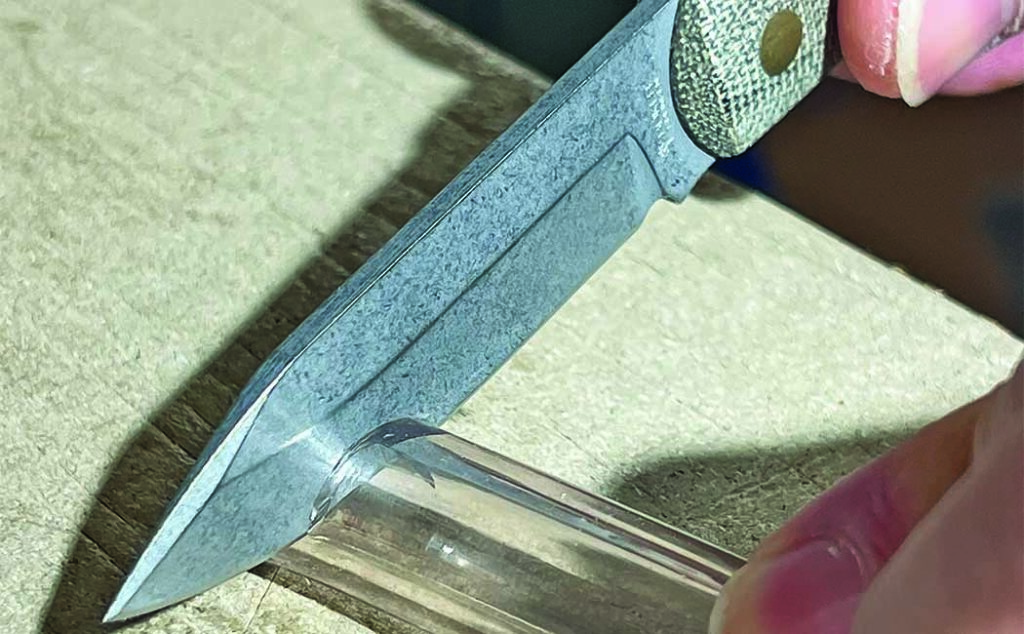
The Boker BFF fixed blade designed by Lucas Burnley is ultra-compact for discreet, comfortable carry. Its design cues are taken from the barlow pocketknife, a general go-to cutting tool for centuries. The 2.7-inch blade is AEB-L stainless steel in a clip-point shape that is very utility friendly. The blade has an acid-wash finish to hide scratches. 

At 6 inches overall, the compact fixed blade almost disappears on your side. The handle comes in a choice of walnut or a more practical green canvas Micarta®. The Micarta is contoured nicely, making the handle rest in your hand snugly. The brass rivets and thong tube provide a nice visual contrast. The knife’s beauty lies in its simplicity of design and execution. It proves that no bells and whistles are needed for a cutter to be highly functional.

The sheath is a nicely made leather pouch style with a slight symmetrical taper toward the bottom. The iconic Boker tree logo is stamped into the leather. A sturdy steel pocket clip enables the BFF sheath to attach to or be removed from your belt quickly—no muss, no fuss. 

With such a lightweight knife, a big belt loop would be overkill. The knife fits the sheath like a glove, with no rattling or wiggling. The sheath compresses down on the handle to hold it securely inside. When the knife is sheathed, the handle sticks up about an inch, plenty for you to grab onto. It also has a hole for a lanyard.

BFF Specs
Overall Length: 6.92 inches
Blade Length: 2.76 inches
Blade Thickness: .10 inch
Weight
: 2.29 ounces
Blade Material: ABE-L
Handle Material: Walnut
MSRP: $259

Spartan Blades Field Grade Enyo

Spartan Enyo

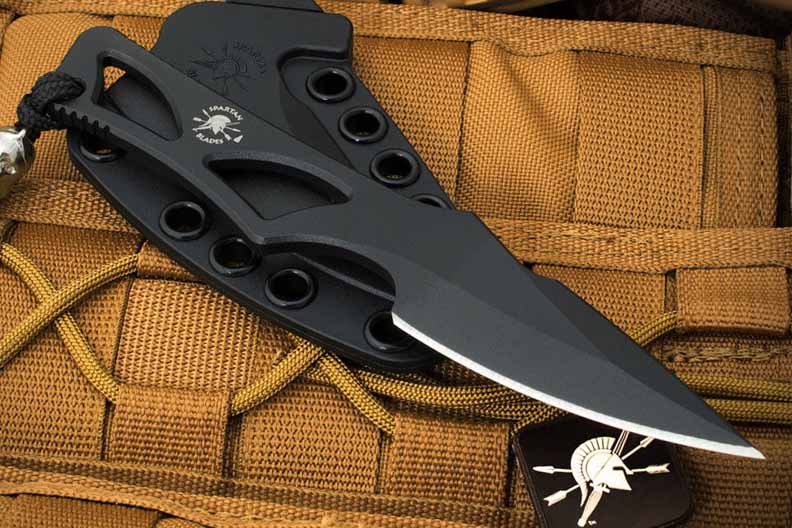
The Field Grade Enyo is a staple of the Spartan Blades line. It boasts an easily concealed blade designed for either utility or backup personal protection. It shares the same dimensions as its higher-priced sibling in CPM S45VN stainless steel, the Enyo, with the exception that the blade steel is AUS-8 stainless.

The modified clip point blade is 2.68 inches and the knife is 6.25 inches overall. The skeletonized one-piece design simplifies the knife and makes it easy to carry. The handle accommodates two different hand holds, which aids in increasing the knife’s versatility. 

Several areas of jimping assist in getting a good non-slip grip. A black epoxy coating throughout provides a low-profile appearance. A paracord lanyard includes a polished Spartan helmet bead, which is pretty neat.

In action the Field Grade Enyo is all business. Don’t mistake it for a small, cute knife. It has attitude and packs a punch! The blade tip is reinforced a bit due to the false edge and penetrates fairly well. Thanks to the way the blade profile tapers, the tip cuts easily. The flat grind and superb edge quality out of the box enable the knife to handle business immediately.

The handle’s various curves seat your hand snug and solidly. The two-thumb rest provides the option of choking up further on the blade for a more reliable grip and improved control. It’s amazing such a small, compact fixed blade can feel so trustworthy in the hand.

When you tackle larger cutting chores, you can choke up on the handle to stabilize the knife and feel in charge at all times. The lack of handle scales means the knife is the bare minimum in bulk.

Those who say they do not like skeletonized knives might want to reconsider with the Field Grade Enyo. You’ll find yourself using it more and more. AUS-8 is well known in the industry for being a good, mid-grade steel, balancing edge holding and economy. It certainly doesn’t disappoint here. It is an excellent choice of steel for a knife of its price point.

The sheath is form-fitting molded plastic riveted for strength. One of the best things about the sheath is how well it locks the knife inside. There is a ramped, notched thumb button on the opening end that when pushed up releases a lock so the knife can exit the sheath. When sheathing the knife you will hear a tiny click indicating the lock has engaged. No amount of tugging on the handle or violent shaking of the sheath upside down can cause the knife to fall out. 

This is very well done and a feature not commonly seen, not only on knives of this price class but more expensive ones, too. Included is a belt loop for IWB (inside waistband) carry, as well as a length of paracord for neck carry. The two carry choices promote both discreteness and ease of access.

Field Grade Enyo Specs
Overall Length: 6.25 inches
Blade Length: 2.69 inches
Blade Thickness: .19 inch
Weight: 2.816 ounces
Blade Material: AUS-8A
Handle Material: AUS-8A
MSRP: $88

Editor’s Note: Dexter Ewing contributed to this piece.

Read More

Cool Customs: Damascus Gentleman’s Hunter

Brandon Hyner’s First Knife Is One Of His Most Current Knives As His New Work Takes Inspiration From His First Blade

Sometimes things take their own sweet time before coming to fruition. Such is the case with Brandon Hyner’s damascus gentleman’s hunter.

Hyner is an accomplished maker. He is a champion of History Channel’s Forged in Fire and has built a business of knifemaking and blacksmithing in his shop in Groton, on the Connecticut coast of Long Island Sound. He has built a following of just over 9,000 followers on Instagram where he showcases his work and produces behind the scenes videos in his shop of him doing everything from welding to forging by hand. 

The damascus gentleman’s hunter is the second of a design Brandon made when he first started blacksmithing and knifemaking. With the help of a Texas bladesmith, he forged a damascus billet for the first knife, and “was forever grateful” for the opportunity. Four years later Brandon decided to finish the knife and was very pleased with how it turned out. As he noted, “I decided to keep the blade as is, as it was a big milestone knife for me.”

It has a six-inch blade with a desert ironwood handle. The brass spacer and carbon fiber bolster complete the look. 

He posted the knife online and someone asked to buy it. However, rather than sell it, Brandon made a similar knife instead. “The second knife came out much better than the first one,” he noted, “but I’m extremely happy with them both.”

It’s a matched pair he can always point to as proof of his maturation as a maker and a beginning of possibly greater things to come. It was a four-year odyssey well worth the wait.

Damascus Gentleman’s Hunter Knife Specs

Knife name: Damascus gentleman’s hunter

Blade length: 6 inches

Blade material: Low-layer twist damascus

Handle: Desert ironwood w/brass spacer

Bolster: Carbon fiber

Overall length: 10 inches

For more information contact Brandon Hyner, Dept. BL4, 852 Bank St., New London, CT 06320 631-742-7227 [email protected].

Read More

2023 BLADE Show Texas Factory And Custom Award Winners

0

See who took top honors in the BLADE Show Texas Factory and Custom Knife Awards.

As expected in Texas, everything is bigger and that includes knife competitions. BLADE Show Texas’ second year in the Forth Convention Center March 17-18, 2022 certainly drew a Lone-Star-State-sized field of some of the world’s most accomplished knifemakers. Between factor and custom competitions, there were some 150 entrants vying for top honors in a total of 14 categories (4 in factory, 10 in custom). Each segment was judged by a panel of top knifemakers from across the industry, who evaluated each for superior utility, design, creativity, materials, aesthetics, and feel, among other traits.

BLADE Show Texas Custom Knife Awards

Best Custom Slip Joint and Best In Show: Evan S Nicolaides

Blade Show Texas Best Slipjoint and Best in Show
Photo: SharpByCoop 

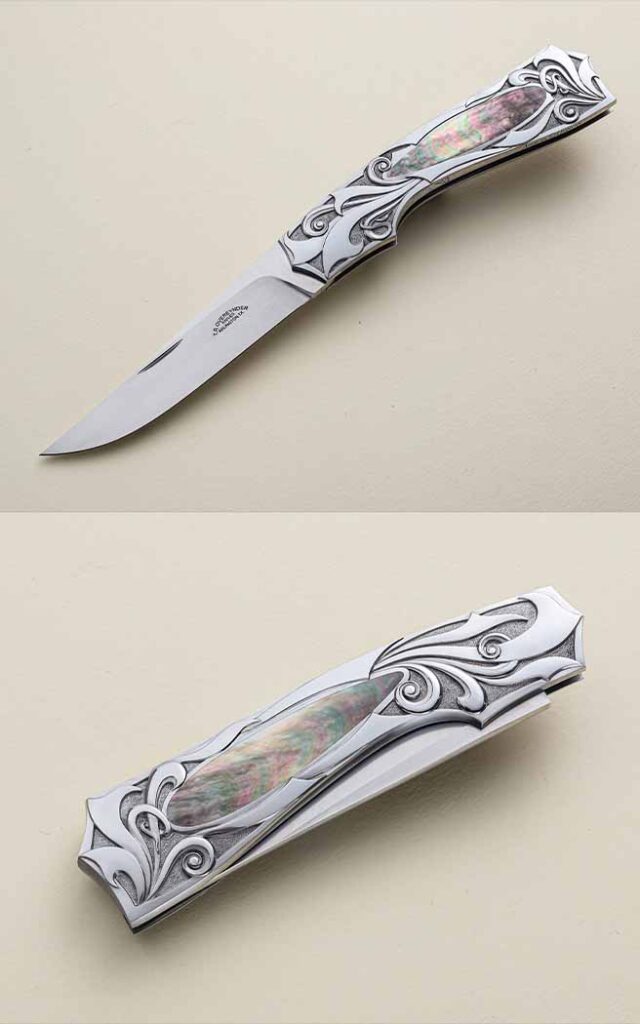
Best Custom Art Knife: T.R. Overeynder

Blade Show Texas Best Art
Photo: SharpByCoop

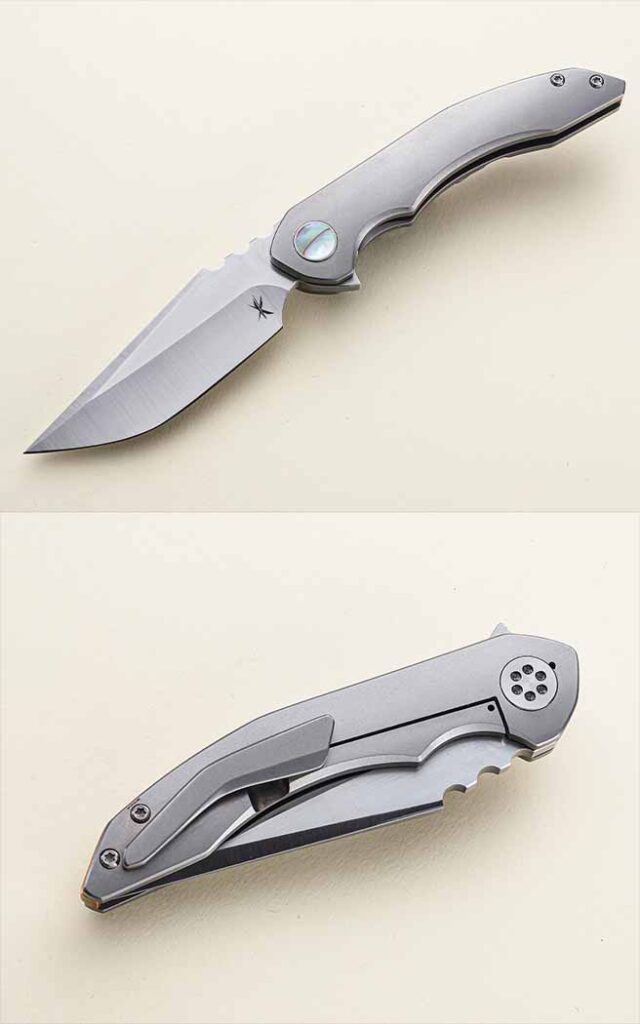
Best Custom Folder: David Longworth

Blade Show Texas Best Custom Folder
Photo: SharpByCoop

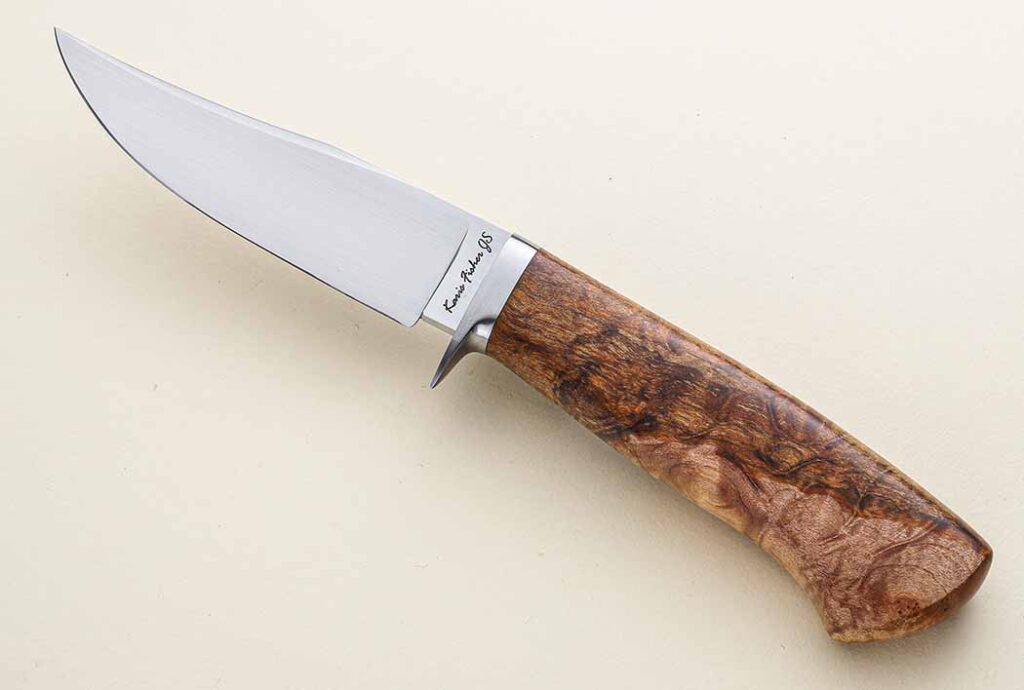
Best Custom Hunter: Karis Fisher

Blade Show Texas Best Custom Hunter
Photo: SharpByCoop

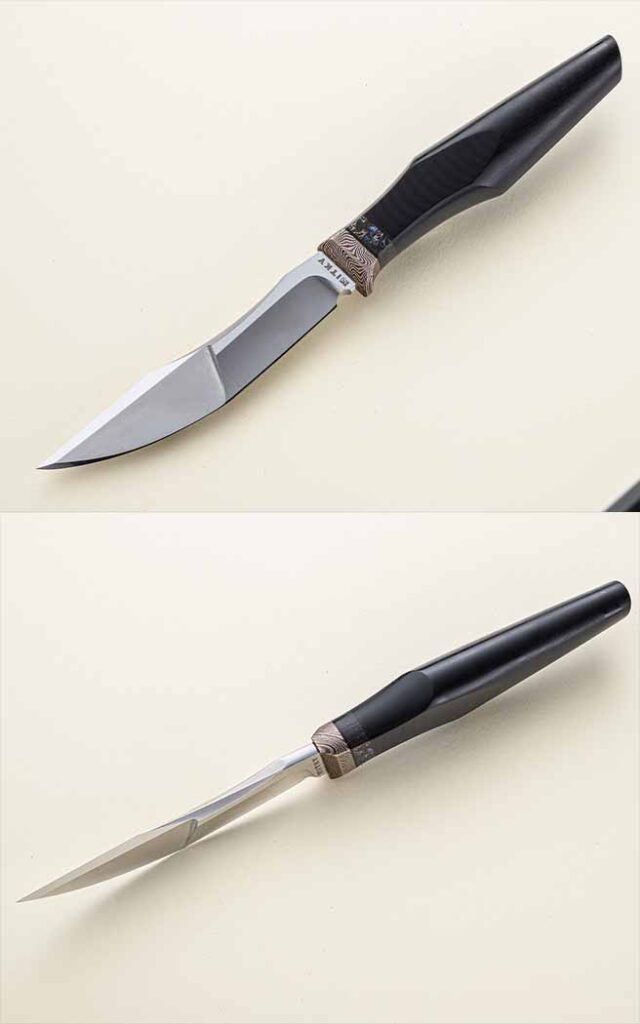
Best Custom EDC: Dmitry Streltsov

Blade Show Texas Best Custom EDC
Photo: SharpByCoop

Best M.A.C.K (Machine Assisted Custom Knife): Keanison Knives

Blade Show Texas Best MACK
Photo: SharpByCoop

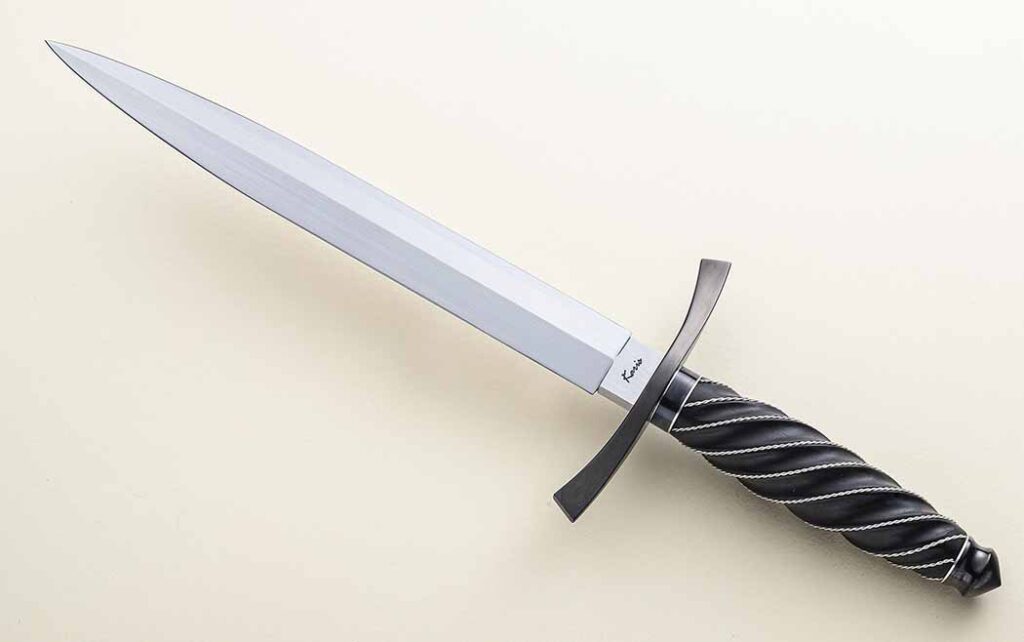
Best Custom Fighter: Karis Fisher

Blade Show Texas Best Custom Fighter
Photo: SharpByCoop

Best Custom Kitchen: Erik McCright

Blade Show Texas Best Kitchen
Photo: SharpByCoop

Best Custom Bowie: Josh Fisher

Blade Show Texas Best Custom Bowie
Photo: SharpByCoop

Best Custom Damascus: John Horrigan

Blade Show Texas Best Custom Damascus
Photo: SharpByCoop

BLADE Show Texas Factory Knife Winners

Best Folder and Best in Show factory: WE KNIFE Ziffius

Blade Show Texas Best Factory Folder
Photo: SharpByCoop

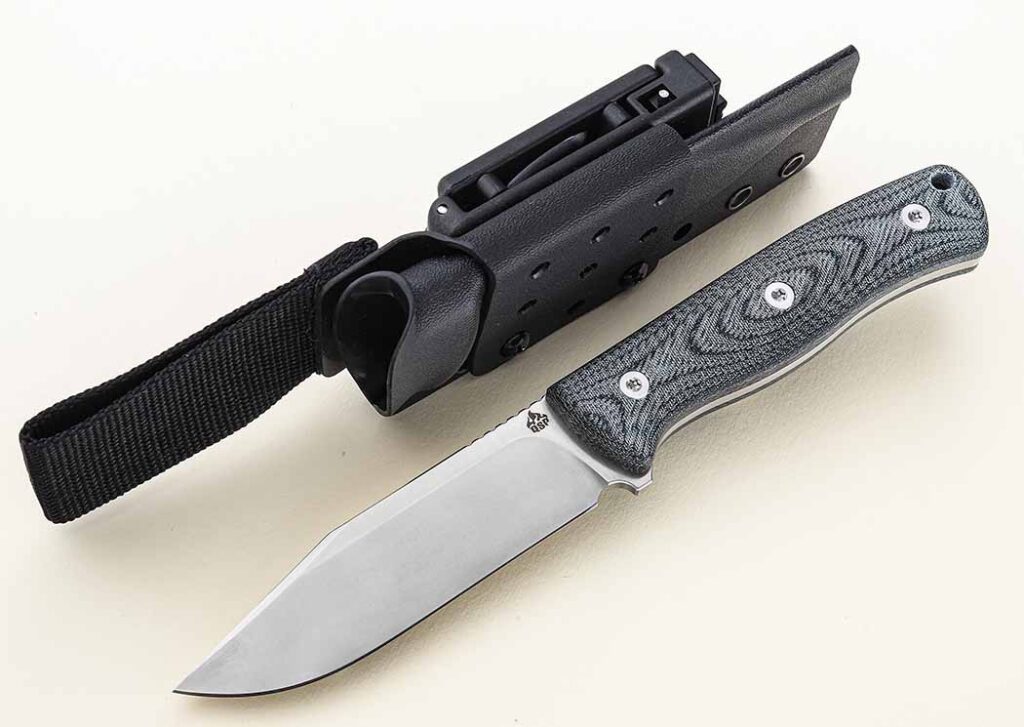
Best Factory Fixed Blade: QSP Bison V2

Blade Show Texas Best Factory Fixed
Photo: SharpByCoop

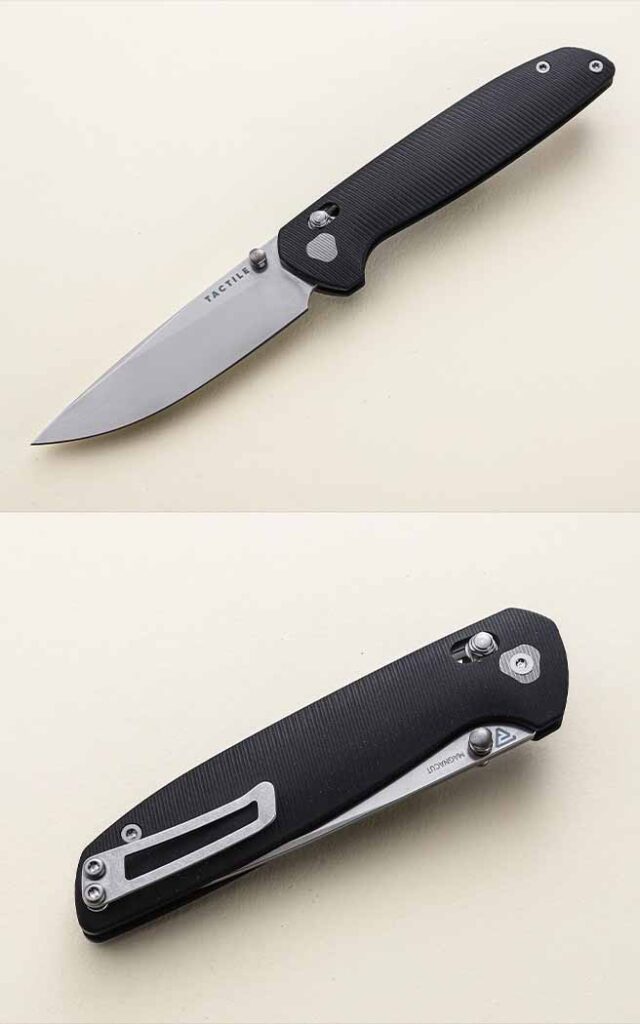
Best EDC: Tactile Knife Co. “Maverick”

Blade Show Texas Best Factory EDC
Photo: SharpByCoop

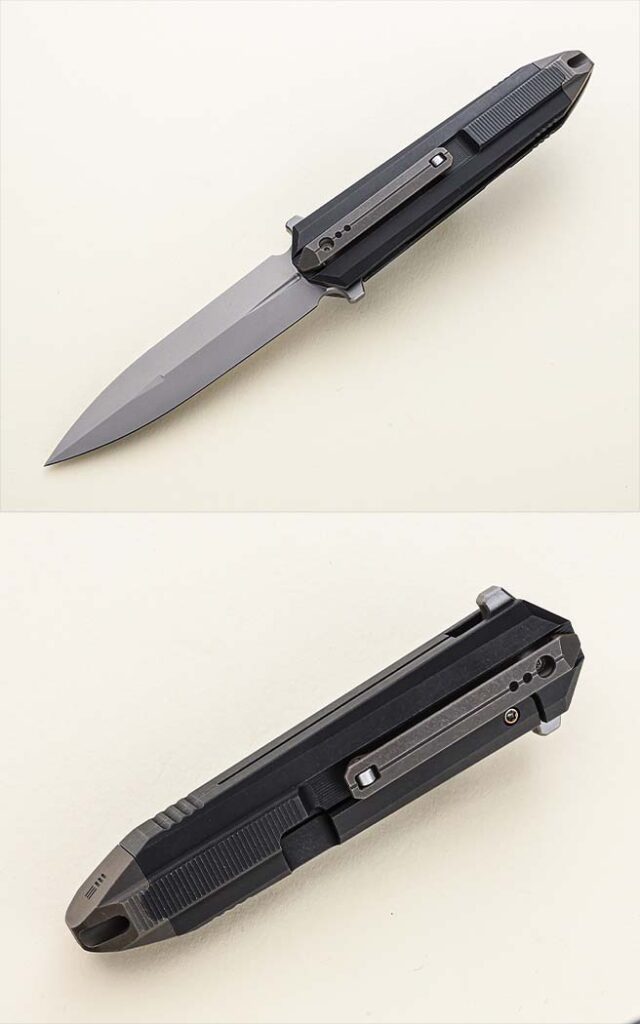
Best Tactical Factory: We Knife “Diatomic 470”

Photo: SharpByCoop

Get More Information On BLADE Show Texas

See More BLADE Show Posts:

MILF-02 Review: A Beefy, Heavy-Duty Folder

The Hardcore Hardware MILF-02 Is A Heavy-Duty Folder That’s Designed For Any Challenge Users Can Throw At It.

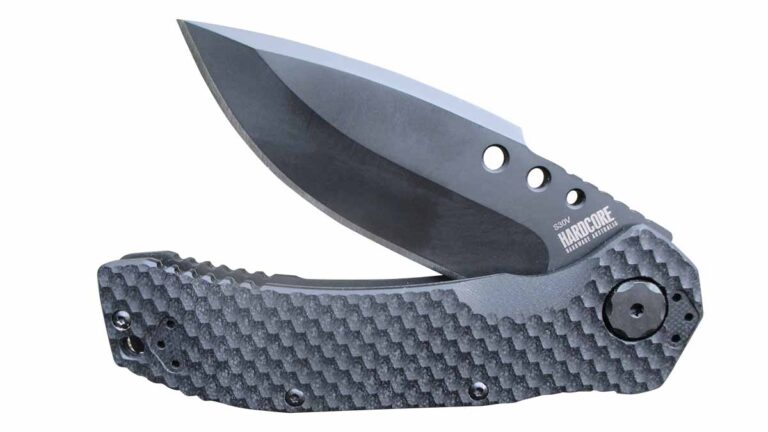
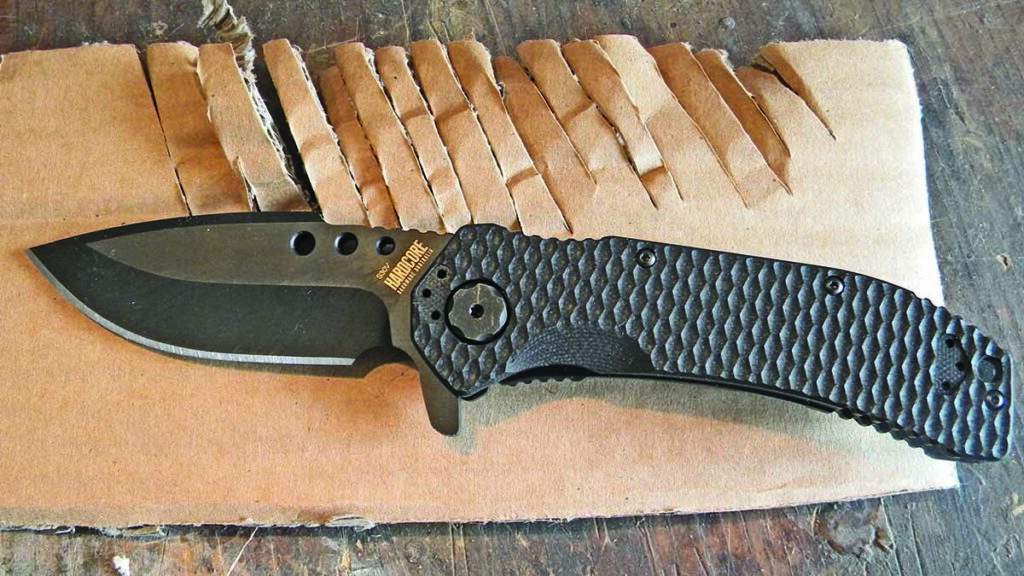
The MILF-02 folder from Hardcore Hardware is made for hardcore users. It’s big and beefy all the way around, has a dimple-textured handle and frame for an excellent non-slip grip, and a classic drop-point-blade shape. 

The hollow grind extends halfway up the blade. Blade steel is CPM S30V stainless with a PVD (Physical Vapor Deposition) coating. It offers a classic black color on a framelock design with a flipper tab on the blade. It’s built heavy duty but it still has to cut.

Testing The MILF-02

MILF cutting cardboard
The first inch of the cuts of the double-walled cardboard went well until the author had to use more pressure to push the cardboard over the thickness of the blade where the hollow grind stops. Once he got used to that, it was easy to overcome the twisting.

Right off the bat, the MILF sliced 20-pound-bond copy paper smoothly. The knife’s weight made the push cuts very easy. There were no snags or hang ups and it was simple to control the width of the slices.

Next: double-walled cardboard. The first inch of the cuts went well, then I had to use more pressure to push the cardboard over the thickness of the blade where the hollow grind stops. Once I got used to hitting this spot, it was easy to overcome the twisting. There were no edge hang ups at all.

I grabbed some 8-ounce leather for some skiving. The MILF was aggressive on every cut and emitted a crunching sound each time. Control was excellent in making fine slices and the handle filled my hand.

Cutting The Hard Stuff

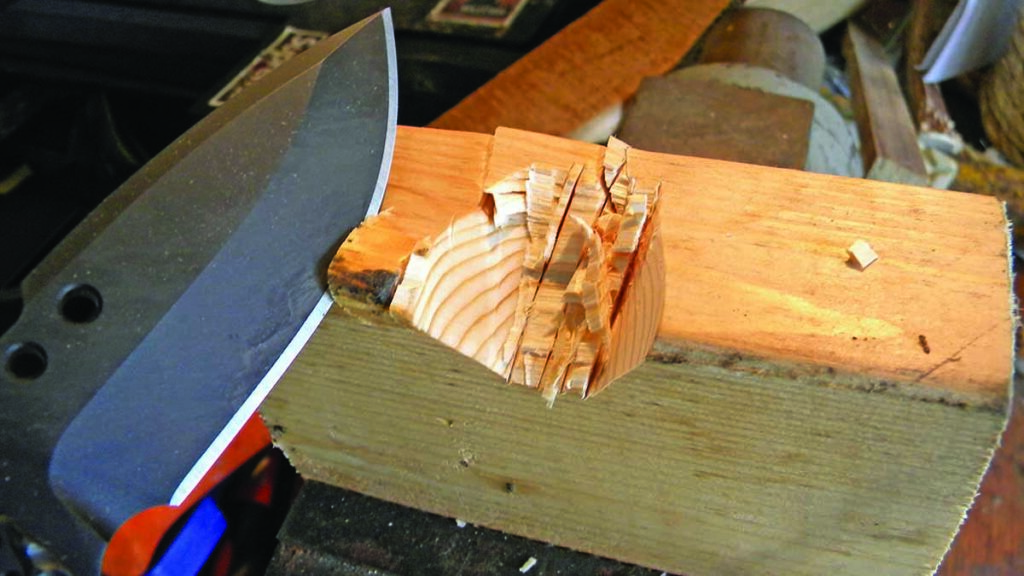
MILF cutting a 2x4
The author gave the 2×4 chunk 20 hard chops and the MILF bit deep on every whack. The edges of each chop were smooth.

It was time for some whittling. The folder seemed to want to bite deep into the wood. I started off with a fine curly-cue and by the end of the cut the edge was well into the wood. The MILF didn’t hesitate at all on the deeper cuts; it just kept curling the wood. It is a heavy cutter for sure.

I put a 2×4 chunk in my vise and gave the wood 20 hard chops. The MILF bit deep on every whack. The edges of each chop were smooth. Lockup was still at 100 percent. The knife is a great chopper with the bigger handle and all, but the inside edges of the handle need softening. They’re a tad on the sharp side

I took the same 2×4 and used the folder to split it into smaller pieces. All it took was a light tap from a dead blow hammer and the wood split with a pop. The thicker blade worked great for this phase of the testing.  Lockup was still at 100 percent.

Half-inch sisal rope was next on the slicing block. The MILF crunched through 200 clean cuts very quickly, showing no signs of slowing down. I stopped cutting to save on rope. Edge holding was excellent and the heat treatment was great.

To take the testing further, I grabbed a deer antler for some more whacking. I gave the antler 20 hard wallops and the blade edge suffered no rolling or chipping. I did manage to remove a very thin wire edge on the blade. However, the main edge was still very sharp.

I returned to the paper slice to recheck the edge. I noticed a few hang ups and found more of the wire edge still intact. Two strops on some leather and the edge was back to original sharpness. Excellent job on the heat treat!

Final Thoughts

I would soften the inside edges of the handle for a smoother grip. Beyond that, the MILF is a heavy-duty using folder that holds a great edge. It’s too big for my tastes but a cutter it is.

MILF-02 Knife Specs

Blade Length: 3.54 inches
Blade Steel: CPM S30V stainless
Rockwell Hardness: 59-60 HRC
Blade Grind: Hollow
Blade Thickness: .59 inches
Blade Width: 1.18 inches
Blade Finish: PVD coated
Blade Pattern: Harpoon/drop point
Blade Opener: Flipper
Handle Frame: 420J stainless steel and G-10
Lock: Framelock
Weight: 7.34 ounces
Closed Length: 4.72 inches
Country of origin: Taiwan
MSRP: $178.73 (rate of exchange at press time)

Read More

Copper Damascus: An Exciting New Way To Make Knives

0

Whether You Call It Copper San-Mai, Cu-Mai, Or Anything Else, Copper Damascus Is One The Trendiest Ways To Forge Knives Today.

By now most knife enthusiasts are familiar with pattern-welded steel, commonly called damascus, whose re-invention for use in knife blades is attributed to BLADE Magazine Cutlery Hall-Of-Fame® member Bill Moran. 

The damascus world has since exploded with complicated mosaics, exotic-tiled canister billets, and, more recently, even some interaction between pattern welding and 3-D printing. These new techniques are mind-blowing for sure.

Copper San-Mai

A 2.75-inch go-mai blade with a wrought-iron cladding over an Aogami2 core and a copper shim layer highlights Joe Edson’s frameback straight razor. The frame is copper with a forced patina. The scales are crosscut mammoth ivory on a G-10 backer with a forged-patina-copper-wedge spacer. Closed length: 3.25 inches. (SharpByCoop image)

One of the hottest new trends in damascus is the inclusion of copper into pattern-welded billets. Commonly called copper-mai, copper san-mai or cu-mai, the technique has been brought to near perfection by Coy Baker at Baker Forge & Tool. 

In 2019 at the request of a customer, Baker created his first copper damascus billet. Starting with Baker as a one-at-a-time weekend garage craftsman, the business exploded. Baker Forge & Tool now has a 3,000-square-foot shop and 10 employees, and they can’t keep up with demand.

Baker says the welding of copper in stacked configurations has been around for centuries in the form of mokumé gané, aka mokumé. While he’s the first to blow up Instagram with welded copper damascus, he is certainly not the first to attempt the cu-mai technique.

He primarily uses 80CrV2 carbon steel for the cores of his billets, and also various patterns of a damascus of 1080 carbon and 15N20 nickel-alloy steels. ABS master smiths Steve Schwarzer and Jason Knight helped him along in his early damascus-making journey. 

How To Forge Copper Damascus

To forge a copper damascus billet, Baker typically uses a core of 80CrV2, a layer of 20-gauge pure copper shim stock, and a cladding of 1080/15N20 damascus. 

“It’s important that the core and cladding stay in a 1-to-1-to-1 thickness ratio,” he said. “The copper doesn’t harden, and it’s critical to keep the core centered so that the cutting edge of the knife will be hardenable steel.” 

He hasn’t experimented with copper alloys other than pure copper, though he has used some bronze and nickel with good results.

It’s no surprise that there are trade secrets that Baker didn’t volunteer, and I was polite enough not to ask. Copper stacked in a billet oxidizes quickly, similar to stainless, and so the welding must be done very precisely. For the welds to stick, the surfaces being welded also must be exquisitely clean, with not even a trace of oils or fingerprints.

The Different Types Of Copper Damascus

Baker did reveal that there are two basic versions of the process. In one, the layers are welded around the perimeter as in canister or stainless welding, and then the entire billet is welded at once. In this method, the temperatures are enough to liquefy the copper, and the perimeter welding keeps the liquid in. 

In the other version, the billet components of core, copper and clad are stacked together and held at brazing temperature. This is Baker’s preferred method, as the copper doesn’t liquefy and so performs more consistently when it comes to thickness. Such exact brazing requires precise temperature control, as a 10-degree variation in either direction from the proper brazing temperature can produce failure. 

While there are no doubt smiths who have attempted and maybe even successfully welded copper damascus by hand, Baker acknowledges that the aspiring smith is much more likely to be successful using a press or power hammer to set the weld. Precision temperature control also gives increased chances of success.

Dion Damascus

A 10.25-inch blade of NBC san-mai, black ash burl handle with an ebony bolster and a white G-10 spacer help complete Andrew Mochado’s kitchen model. Overall length: 16 inches. (Eric Eggly/PointSeven image)

While Baker is the best known and most common source for copper damascus, another variation is available from Dion Damascus. Florida knifemaker Andrew Mochado recently made a knife from a bar of Dion Damascus that included brass, copper, and nickel clad over a core of 52100 carbon steel. 

“It is my take on a gyuto-style chef’s knife,” he said. It has a box elder burl handle with an ebony bolster. Mochado heat treated the blade in a gas forge. “The outside layer of the billet was nickel, so it was very difficult to get it all up to temperature,” he explained. “The nickel buckled up a bit and I thought I had a failure. I was able to successfully grind off all the buckling, and the blade was still perfectly forged together.”

Baker pointed out that the melting points of copper and nickel are above the heat-treating temperature of carbon steel. However, in a forge, the outside layers come in contact with a forge atmosphere that’s well above the desired hardening temperature, thus causing problems with the non-ferrous layers.

How The Copper Affects Knifemaking

Jordon Berthelot is a Texas maker known for kitchen knives and intricate carved and sculpted blade plunges. He’s also made dozens of blades with Baker’s cu-mai. He has been Coy’s “guinea pig” for testing new patterns for months. When Baker develops a new pattern, Jordon builds the prototype.

“I’m pleased with how the cu-mai grinds. You might expect the copper to be gummy or soft or to grind differently when you sculpt it, but it pretty much grinds the same as steel,” Berthelot observed. “You always have to pay attention to get the carving right, but the copper poses no problems.” 

Makers will notice the copper being softer if they hand-sand it aggressively, but overall the copper layers are no more difficult to finish than regular steel.

When it comes to finish work, Berthelot recommends sanding to at least a clean 600 grit prior to etching. “Regular” ferric chloride doesn’t perform well, and etching copper in it will leave a copper tint on standard damascus steel blades later. Instead, Berthelot prefers a 20/20/60 mix of ferric chloride, muriatic acid and distilled water. The addition of the muriatic acid keeps the copper from looking blurry, and keeps the material out of the solution for future etching. After the etch, Berthelot buffs with “black magic” rouge so the copper will “pop” nicely. 

Forged in Fire season 1 episode 2 “OG” winner Chris Farrell of Fearghal Forge in Austin, Texas, took advantage of the bold copper line in his piece of Baker Forge damascus. The copper makes a dramatic, bold statement, and so do the curves and lines of Farrell’s fancy faceted fighter. 

“People see my faceted handles and think they’re kinda funny until they pick one up and realize how well it fits their hands,” Farrell said. He is fascinated by innovations in the knife industry and is always looking for his own ways to innovate. He’s experimented with forging Baker’s copper damascus bar stock: “It can be done, but you really have to be careful. It’s real easy to mess up!”

Copper Damascus Around The World

Australian maker Adam Fromholtz crafted a cake knife of copper damascus from the Japanese steel company Takefu. Takefu steel can be hard to find in the USA, but there is a reliable Australian distributor. Adam’s knife is copper, nickel and brass clad over a V-Toku-2 carbon core. Handle: Tiger myrtle. Blade and overall lengths: 9.25 and 14 inches. His list price for a similar knife: $1,800. (SharpByCoop image)

The cu-mai trend is not limited to the United States. Australian knifemaker Adam Fromholtz of Canberra crafted a cake knife of copper damascus from the Japanese steel company Takefu. Takefu steel can be a challenge to find in the USA, but there is a reliable Australian distributor. 

Adam’s blade is copper, nickel and brass clad over a V-Toku-2 carbon core. Regarding the steel, Fromholtz noted that it was near impossible to forge due to the differences in ductility between the materials. Because of the softer cladding, he noted that the blade tends to gall a bit, so makers should take note of this when fitting a slotted guard on a blade of such a material. Overall, the steel is simple to finish but shows handling marks easily.

How Do Copper Damascus Knives Perform?

Is copper damascus all flash and bling or does it perform? Copper does not harden the way steel does, which makes you wonder how it impacts knife performance. First of all, copper damascus is used with a monosteel—that is, one layer of steel—or a regular carbon damascus core. 

Using a steel core makes it where the copper has absolutely no impact on the blade’s cutting performance, edge stability or toughness. Baker said he knows of two makers who have used his cu-mai material to complete American Bladesmith Society-style performance tests of rope cut, 2×4 chop and 90-degree bend.

When it comes down to it, the copper layers are very thin. Considering that the final weld-up of clad/copper/core/copper/clad may be as much as 2 inches thick, and that the copper starts out roughly .03-inch thick, the overall final billet has very thin layers of copper. It’s enough for a dramatic pattern but not enough to impact knife performance in a negative way. “I made a knife with it then beat the hell out of it,” Farrell said. “So long as it’s heat treated properly, it’s good stuff.”

Availability Of Copper Damascus

The 9-inch blade of Jordon Berthelot’s chef’s knife is Baker Forge & Tool auro-mai damascus with a core of 80CrV2 carbon steel. “It has my carved ridge that adds great weight reduction and a nice ergonomic flow, and decreases the drag coefficient,” Berthelot wrote. “It also allows me to alter the pattern.” Overall length: 14 inches. Maker’s price for a similar knife: $1,700. (image courtesy of Jordon Berthelot)

If you’re a maker looking to capitalize on the copper damascus trend, get in line. Baker Forge releases approximately 70 billets a week to the public, in addition to what it produces for commercial use. The billets “drop” Saturdays on Instagram and are usually gone by the end of the day. 

Most billets are 2-2.5 inches wide and come in thicknesses from ⅜ inch all the way down to 3/32 inch. Pricing currently runs up to $25 per linear inch, but as in all things post-pandemic manufacturing, the supply costs for raw materials keep increasing. 

As for consumers, check knife shows, magazine stories such as this one, and Instagram and elsewhere on the Internet. Cu-mai knives are out there—you just might have to do some digging to find them.

Read More

Allure Of The Subhilt

1

The Subhilt Provides An Additional Element To Make A Knife One Of A Kind. These Makers Show What A Subhilt Can Be.

The subhilt adds a little extra. Its form is expressive and its function is useful. It takes its share of the spotlight and provides another avenue of artistic approach for custom knifemakers who choose to build it.

A few of the makers who accept the challenge of the subhilt put their finest work forward. They use bold, sleek lines, and high-quality materials to bring the best of the subhilt to the market, and the combination of aesthetic and utility blends in a delightful presentation.

Subhilts In Italy

Daniele Ibba was already a goldsmith and “transferred” his skills in that pursuit to making knives. He describes himself as an “autodidact,” a self-taught subhilt maker.

Residing in a small town near Milan, Italy, Daniele Ibba has been making knives since 2004. He finds the subhilt a perfect approach to both usefulness and beauty as evidenced by his integral Medusa Gorgona. 

“Although the knife has a clear artistic connotation, it was developed as a not-artistic knife,” he explained, “and the purpose of this subhilt is to have a stable grip, especially in the lunge, and consequently the possibility to hit the target/threat harder.”

Grip options are plentiful, and Daniele calls his subhilt pleasant to handle in any position, with the best control in the standard or reverse grips. The subhilt allows the user to always know where the blade and edge are located, and offers more protection to the hand.

In the Medusa Gorgona, Ibba collaborated with Lana Gorska and took home best in show from the September 2021 SICAC Knife Show in Paris. 

“We are very proud of this,” he smiled, “because in every international show the competition is always very high and winning such a prize is never easy.”

The Medusa Gorgona is made from a single piece of 440C stainless steel hardened to a Rockwell hardness of 58-59 HRC, and is embellished with 13 mother-of-pearl inlays—four on the front of the handle, eight in the spine and one in the pommel. It also has 20 green diamonds, eight yellow diamonds, two blue diamonds, and three rubies—one round cut and two marquis cut. The fine engraving was done by Italian master Roberto Bruci.

“Lana and I had done many models in Plastiline® [a high-precision modeling clay] searching for the best ergonomic shape,” Daniele related. “Being a subhilt, it was not simple to reconcile design and easy handling. I do not have a [pantograph] or automated machinery, so it was very difficult to realize the handle and the slots for the mother-of-pearl inlays, but with time and patience I was able to achieve a beautiful result. Before designing the knife, Lana and I decided to engrave the mother-of-pearl with the mythological theme of Medusa.

“The story tells that she was one of the three sisters called the ‘Gorgoni,’ daughters of the Gods Forco and Ceto, and they had the power to petrify anyone with their gaze. So, we decided to make the name of the knife with the theme of the engraving, and Gorgona is like a nickname.”


An exquisite award-winning showpiece, the Medusa Gorgona stands out. Ibba’s price for a similar integral presentation without diamonds and extensive engraving would be roughly $13,000.

Marc Aldrich 

Marc Aldrich mirror polished the undersides of the 416 stainless steel quillons of the subhilt on his bowie in a blade of 80CrV2 carbon steel and a handle of artificial ivory. Blade and overall lengths: 10 7/8 and 16 1 /8 inches. (Photo: SharpByCoop)

ABS apprentice smith Marc Aldrich has been making knives since 2013 after taking a couple of courses from ABS master smith/BLADE® field editor Joe Szilaski. Marc admires the work of Dave Loukides, Sam Lurquin, and Jan Hafinec which gave life to his ideas for a subhilt bowie with dazzling results. 

His featured piece includes a blade of 80CrV2 carbon steel finished to a grit of 1500, a stainless subhilt with copper spacers, and a handle of artificial ivory accented with a copper pin. Marc made the sheath of hand-stitched leather with a quilted and copper-studded front panel, copper-studded frog and pigskin lining. A trace of a hamon is visible on the blade, and he explained that he chose not to etch the line but appreciates the discerning eye that catches sight of such detail.

“Of course, a subhilt adds retention and looks cool,” he offered, “but it helps if it is placed and shaped well. If we think of a knife as a sculptural object, the subhilt is another compositional, visual and tactile element we can use to add interest and function. I think my subhilt bowie is a mix between a bowie and fighter. Although not having a sharp swedge, the slender blade profile, added retention of the subhilt and excellent balance would make it formidable. The blade finish is actually bright and nearly mirror.”

Marc says his goal with every knife is to distill the lines down to their “pure essence.” His formula is “lines, flow, proportion and a tasteful balance of detail backed up with quality workmanship.”

The subhilt, he added, is an interesting subset of the bowie genre that is also seen in other knife styles. However, in all cases it must be properly spaced and integrated to avoid a clunky look and awkward handling. His price for a similar piece would run about $2,200.

Japanese Influence

Robert Appleby based his subhilt on a Tom Maringer-styled-and-designed fighter. Exhibiting a strong Japanese influence, the takedown model is comprised of 17 parts as a reflection of the 17 syllables in a Japanese haiku poem.

When Robert Appleby started making knives 27 years ago, he did so as a self-taught craftsman. He studied the work of other makers in similar styles prior to launching a piece of his own, and contacted other makers in person or by telephone to exchange information and gain understanding.

Appleby’s featured subhilt is a Tom Maringer-styled-and-designed Haiku fighter. Exhibiting a strong Japanese influence, the takedown model is composed of 17 parts as a reflection of the 17 syllables in a Japanese haiku poem.

A customer approached Robert a few years ago asking to make a 6-inch version of the original Maringer knife. After gaining permission, Robert borrowed an earlier version from a gracious customer and studied it closely. Robert has since made two knives in this fashion. The featured one sports a 9-inch blade of 154CM stainless steel mirror polished and double hollow ground. 

Robert Appleby’s fighter (Photo: SharpByCoop)

The habaki is forged 416 stainless, while the tsuba (guard) consists of four layers of 410 stainless, and the handle sports 416 stainless fittings. The subhilt is formed of approximately 60 feet of twisted 304 stainless steel wire. 

The handle and blade are joined by a toggle or link, and a pin attaches the tang to the threaded toggle. A 10-24 socket head cap screw is fed through the pommel and threaded into the toggle. For pricing on a similar piece, contact Robert directly.

“In my opinion, a subhilt provides increased retention, a more secure grip and increased control,” Appleby commented. “I don’t see the subhilt as impeding any grip style, as the blade is also double edged, and the subhilt also provides more positive extraction from the sheath. Each spacer is marked by a series of dots, one, two, three, etc., to hold the upper right of the tang hole. As I fit them, only the top and bottom of the tang hole contact the tang so they are self-aligning, as well as the front endcap of the handle. Indexing pins are set into the handle and align the last spacer, handle and pommel.”

Subhilts For Rugged Use

Knifemakers’ Guild voting member Gary Langley said his reproduction of a Bob Loveless Big Bear subhilt fighter is the only Big Bear he’s seen with a rear bolster. Blade and overall lengths: 8 3/8 and 15 inches.

Gary Langley built his reproduction of a Bob Loveless Big Bear subhilt for action. 

“This was designed to be a fighter,” he said. “I have sold one that was going to be used to hunt wild hogs, though this particular piece resides in a collection in Florida. It’s pretty much a straight grip, but I suppose you could hold it however you’re comfortable with it.”

After building a new house, Gary started making custom knives in 1977. His new neighbor was Don Dollar, and it was Don who revealed fit and finish to Gary for the first time. 

“Don showed me a few books and The American Blade Magazine [today’s BLADE®], and I was off,” Gary smiled. “I haven’t built a lot of knives compared to some, and this one is number 603. I’m 68 now and hope to get to 1,000 before I’m done.”

His Big Bear has a CPM 154 stainless blade and 416 stainless guard and subhilt with a mammoth ivory handle. Alice Carter did the engraving. Langley said this is the only Big Bear with a rear bolster he’s seen.

“I’m basically self-taught,” he commented, “and I’ve had a lot of inspiration, but have never taken a class or worked with anyone. [Steve] Johnson’s DVD on building a fighter was a big help—lots of trial and error! It’s not a simple knife to grind, and the things I learned trying to grind it have reshaped my process and equipment.

“The challenge on this blade with a rear bolster is to fit eight edges without a gap,” Langley concluded. “You just have to slow down. I would use my flat disc and rather than turn the motor on, I would turn it by hand so I didn’t go too far too fast.”

Depending on the engraving requested, Gary said his price for a similar knife would be around $3,000.

Read More

Advertisement

Must Read Articles

Read this before you make a knife

Knifemaking 101 – Read This Before You Make a Knife

  by Wayne Goddard My experience has taught me that there's nothing like digging in and getting started. I've often said the hardest part of the...
how to forge damascus steel

How to Forge Damascus

Advertisement
Advertisement