

Master Smith Steve Culver gave an outstanding presentaion on how to build a frame handle at the ABS Heartland Hammer-In in Meridan, Kansas.

Master Smith Steve Culver gave an outstanding presentaion on how to build a frame handle at the ABS Heartland Hammer-In in Meridan, Kansas.
Recorded on March 11, 2010 using a Flip Video camcorder.
Benchmade is proud to announce the release of “Shepherds of Helmand,” a documentary about 17 Oregon National Guard soldiers deployed to Afghanistan to train a battalion of the Afghan National Army in 2008.
The film depicts their mission to conduct counter narcotics patrols in the deadly Helmand Province, a region notorious not only for its opium production but as a Taliban stronghold. “Shepherds of Helmand” is the true story of one of the most decorated units in Oregon National Guard history.
“I am very passionate about preserving our veteran’s legacies and supporting programs that help support our wounded veterans,” says Gary Mortensen, Director of Shepherds of Helmand. “This film couldn’t have been possible without the support of Benchmade.”
Filmmaker Gary Mortensen worked on the project for over two years and utilized photos and video clips provided by the soldiers.
Shepherds of Helmand is narrated by Don Trump Jr. and features music by Zac Brown Band. Both were thrilled to be involved and support this powerful documentary about the soldiers who served in Afghanistan.
“We’re extremely proud to support the making of this film,” says Rob Morrison, Benchmade’s Director of Marketing and Strategic Planning. “These stories help us understand what the soldiers go through on a daily basis when at war, bringing us closer to their personal sacrifices.”
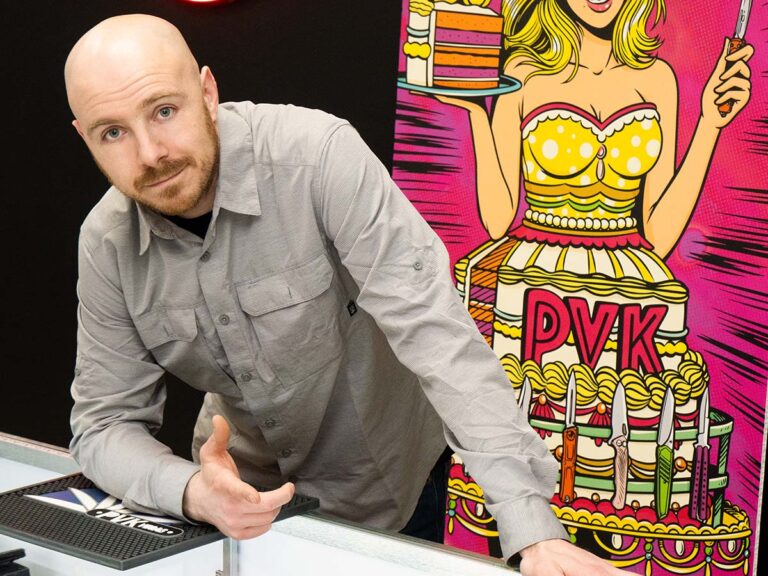
From a New England gentleman’s gift shop to a legendary—if not notorious—knife outlet on the Las Vegas Strip and online edge tool maven, PVK and PVK.com has carved a unique path in the knife world. We caught up with Jeremiah Burbank, the man behind the radical retail brand, and got a behind-the-scenes look at the company’s growth, cross-country moves and PVK starting a new chapter in its story. Buckle up as he surveys the ever-changing knife landscape, shares online sales insights and his enduring passion for knives.
BLADE: Give PVK’s origin story—how did the store come together and how did it end up in Vegas?
Jeremiah: My brother, Joshua, started with a storefront in 1994 in Amherst, Mass., with Pioneer Valley Knife & Tool. It focused on gentleman’s gifts—Maglites, Leatherman, a real eclectic mix. Over that first year, he shifted to pocketknives because he sold a ton of them. He eventually dropped “Tool” from the name and exclusively focused on knives.
By 1999, he had two storefronts in Amherst, and by 2000, he moved completely online with PVK. I came on in 2001 and joined the team, helping Josh with videos of knives, doing over-the-shoulder videos while Josh talked about the knives.
A lot changed in 2013, when some friends of ours went to the USN Gathering in Las Vegas and said we had to check it out. My brother went the next year and said that it was the future of knife sales. By the next year, we had a store by McCarran International Airport, and by 2017, we moved to the Strip—Las Vegas Boulevard—and became PVKVegas. We got to sell knives to the world.
All good things come to an end. Josh passed away unexpectedly in 2021, and shortly after, our landlord informed us they were tearing down our building for the Formula One race. Now PVK is back in New Hampshire—Hudson—and we just opened our showroom last year.
There’s never been a pause with the store.
BLADE: PVK started as a gentleman’s store but ended up a knife retailer—were you and your brother knife guys to begin with?
Jeremiah: Josh was a knife guy through and through—our mother would definitely tell you he had a knife on him throughout his life and took it where he probably shouldn’t have. Josh was into balisongs and read The Advanced Balisong Manual by Jeff Imada. And PVK carried knives we all know today—Benchmade, ProTech, Microtech (we were their second or third dealer)—way before it was cool.
I was always into knives, too. There was some age difference between Josh and me, so one of my earliest memories was hanging out at the store when I wasn’t in school. Also, I think I might have brought a Master of Defense Lady Hawk to school once—I was really into that knife.
BLADE: For those who never had the chance to visit, tell us about the Vegas store—how was it set up?
Jeremiah: Excellent question because it was notorious on the Strip.
Honestly, the frontage was very small—we had 10 cases, maybe 4 1/2 feet long each… call it a 60-square-foot showroom. We had a red carpet, so it really fit into Vegas. We replaced it each month; it got so dirty. Above the cases, we had TVs showing all kinds of knife videos.
As for what we had to sell, we sold everything from $5 knives to $5,000 knives—we couldn’t just cater to knife people. And we had a 10-watt laser to engrave a knife on the spot if someone wanted to put their name or their spouse’s name on the knife.
There was a center section to the store—the VIP room—you accessed from behind the register. We actually had to move the register to get back there. It was differently lit, had a beautiful coffee table and Eames lounge chairs and ottomans. It was a very private and nice experience.
Back there, everything in the cases were customs, short-run knives and one-offs. There was an exclusivity to it. If a guy showed up in a robe and slippers but had a Rolex on his wrist or he said the right things, we’d invite him back to the VIP room. It was a thing of legend.
In the very back was inventory; it was pretty tight because we had 25 safes.
Out front of the store, I’d hang out with the guys and flip knives to get people in the store. You’d see the world in tourists walk by.
BLADE: Vegas is crazy. I imagine you had everybody from celebrities to guys who hit big at roulette come through your doors. What’s your most memorable stories from your time there?
Jeremiah: First and foremost, since I get asked about this a lot, my favorite thing about selling knives is the people—it doesn’t matter if it’s a celebrity or Joe Schmo. Either way, I love to talk about knives.
But we had a number of well-known people who came to our store. Aerosmith had a residency in Las Vegas, and they’d come in. And Post Malone came in unexpectedly with his security detail, hung out in the VIP room and bought a bunch of knives. Tim Burton, Johnny Depp, a whole range of people.
The thing is celebrities are like anyone else when they came into PVKVegas—they’re just a bunch of kids in a knife store. Steven Tyler devolved when he came in, wanting to see each knife and just having a great time.
We were Post’s first stop in the knife world—he’s big into them now. When he came in, you know what the first knife he headed for? The Swiss Champ—the Swiss Army Knife with some 70 functions. He said, “Ah man, you’ve got this?” and had us box it up.
Celebrities are cool, but it’s cooler seeing them geek out on knives. We’re all collectors.
BLADE: You guys were legendary in Vegas, beyond the knife community—was it tough to say goodbye?
Jeremiah: It was heartbreaking, and it was a hard time for me as a person, knife dealer and brother. I had high stree through it all, especially having to break ties with people around the Vegas community who were close with me—with PVK. Honestly, it really didn’t hit me until USN ‘22. Everyone from USN had something to say about the shop. Being back was a strange ripple in reality. Did that all really happen [with the shop in Vegas]? Or did I just dream it?
Closing the shop on the Strip was a flashback for me—in reverse—of when we came out West. Then it was packing up a Penske truck and driving across the country, and I was doing the same but heading for New Hampshire. Life can be very strange, very cyclical.
BLADE: PVK is now back where it started or close to it, does it feel like coming home?
Jeremiah: I love being back. I’m from New England, and the region has always been near to my heart. I love the cold weather and the passing seasons. Plus, my family is an hour away. Plus, I’m offering something not offered anywhere else around here. I’ll also say, it’s great to sell to people face to face again.
BLADE: New Hampshire is a good place to set up shop, compared with some of the other New England states.
Jeremiah: It is the “Live Free or Die” state. New Hampshire was the first state to repeal its ban on switchblades back in 2010, and now we’re seeing it nationwide.
BLADE: You mentioned selling face to face again; that just came about recently. What’s your new shop like in Hudson?
Jeremiah: It’s very different than Vegas, but in a good way. There is no pressure, very calm atmosphere and no VIP room… yet. We’re a 10 a.m.-5 p.m., Monday through Friday operation, which is very different than Vegas, where we were open to 2 a.m.
We opened on Black Friday last year, and it was great to see the excitement it generated. We had folks drive up from Massachusetts when we opened our doors.
Part of what I did when I moved back was contact Nick Chuprin of NCC Knives, who was based in Brooklyn, N.Y., and offered him space. He moved his operation up here, and he has an entire machining cell in the back of the house.
It’s not a standard store; it’s multifaceted. It’s like a knife clubhouse. What other store can you come and get your knife sharpened by a custom knifemaker? And if you want to make, maintain or modify a knife, you bet your daisies I can get it done.
BLADE: Even with the new storefront, online knife sales remain PVK’s lifeblood. But it’s always been that way, correct?
Jeremiah: My brother was an early tech adopter; he had PVKnife.com online in 1997. Even before that, he was on list servers—Wreck.Knife—talking to people about knives. At first, online sales were a trickle, then in three or four years from going online, it became overwhelming. Josh went from having our parents help us ship to outgrowing their house.
He was clever. He used print media—we still do today with BLADE Magazine—to get the word out. And he mailed fliers letting customers know they could order online and have a knife delivered right to their door.
BLADE: Going from the 1990s, when there were a handful of online knife dealers, to today, when there seems to be a new store going online each week, how much more competitive is it now?
Jeremiah: I’ve been doing this a while and will say all competition is good competition. I am good with the free market; it makes us better.
The knife market has seen incredible growth and so have we. Around 2009 is when PVK saw the online market take off, and from then to 2015, our business doubled. By 2018, it tripled, and in 2019, it quadrupled. Then the pandemic hit, and everybody cared about knives.
The bad part about this is it brought a lot of part-time guys into the market who didn’t take it seriously. For better or worse, there aren’t a ton of regulations in the knife world, so there are some who take advantage of the community. That’s not good for anyone.
One of the things I always tell buyers is to make sure whoever they deal with online has a phone number on the website. If they don’t, don’t buy from them. We’ve always accepted all calls from customers and engaged with them.
BLADE: It seems, from your brother’s days on list servers and videos to your work on social media and your Bladeology podcast, PVK has also found it important to engage and build a community online. What motivates your focus on engaging with and building an online community?
Jeremiah: We’re in a disconnected world, and this is a way to make a connection with people. That’s why I find the online community so crucial. With the podcast, it’s friends talking about knives—me, Nick and Chuck Gedraitis—answering knife questions.
I also love recording history, especially with the knives we bring through the shop. You take the Marfione Dragon Slayer 1, it’s gone, it’s in someone’s collection, never to be seen again. So, I find it important to record knives so someday when someone wants to see them, there’s a video or a picture of the knife.
Same goes for the podcast but with the people in the industry. I had Mike Crenshaw of Knife Rights on six months ago, and he passed recently. But a little piece of him gets to live on.
BLADE: Let’s wrap up with something lighter. You have the choice of some pretty cherry knives to carry or fidget with. Do you have a go-to EDC choice?
Jeremy: That might be my biggest problem—my EDC tray overfloweth. But there are two knives that I go to usually. My first is a Microtech Scarab Executive. I was a huge early carrier of the Executive; there’s just something about it. The second, an exclusive Pro-Tech 3V Malibu. Love that button lock, and Dave Wattenberg makes it in an exclusive 3V. I’ve laughed with him about it before; he has been making autos for 25 years, and his best seller is a flipper. But those are my EDCs for real.
BLADE: Thank you for taking the time to speak with us.
Jeremiah: Thank you.
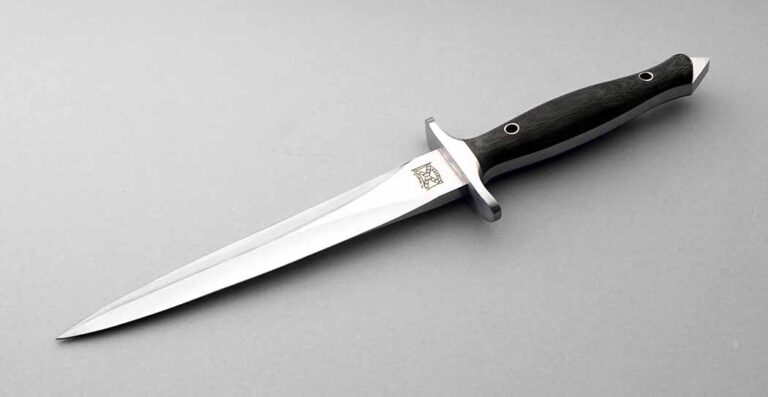
Early in history, warriors concluded they needed a stabbing weapon they could carry because using a sword, club or spear was not always convenient or practical. Daggers were developed to fill that role.
The exact origin of the word dagger has yet to be discovered. It is believed to come from the old French daque or old Italian daga. Dagger gained acceptance during the 14th century when knives with blades that come to a very sharp point became consistently distinguishable from swords.
In peacetime, daggers were often made from expensive materials and worn in ornate sheaths as part of formal dress. Doing so indicated status and wealth. However, daggers weren’t always for the wealthy.
Since daggers are stabbing weapons, they could also be made from bone or antler. This gave those who could not afford items made from metal an effective self-defense tool.
Out of necessity, those who wore a knife in America in the 1800s would usually choose what today we call a bowie. Not only was this knife imposing when worn, it was also large enough to perform the day’s chores while the West was settled. As America became more civilized and cities became more commonplace, the days of wearing such a large knife in public became less acceptable. Self-defense was still at a premium, and small firearms and daggers replaced the large knife. A dagger had to be used at very close range to be effective. No wonder revolvers grew in popularity as the defensive weapon of choice.
During World War I, close-quarters combat was a significant part of trench warfare, where enemy soldiers would fight in tight and narrow quarters in attempts to capture trenches. The best-known dagger of World War I is the 1918 knuckle knife. American weapons inventor Maj. Eugene McNary of the Air Expeditionary Force designed the knuckle knife. He incorporated the same spear-point blade design as the French M1916 Trench Dagger. In addition, McNary added the knuckles and skull crusher point on the handle butt to increase the knife’s lethality. The Landers, Frary & Clark Co. of New Britain, Connecticut, manufactured the knuckle knife. The handle is marked “U.S. 1918” and is maker-marked “L.F.&C.”
The push dagger is designed primarily as a last-resort weapon for close-quarters defense. While not generally utilized as a primary weapon, it does allow the user to carry it concealed and employ it one-handed, giving him the ability to manipulate the push dagger with one hand while using his off hand to help defend himself. The blade of a push dagger is shorter and broader than that of a standard dagger. In addition, the handle is longer horizontally/wider and thicker to give the user more leverage for pushing.
No dagger developed during World War II carries more lore or recognition than the one designed and developed by William Fairbairn and Eric Sykes. The Fairbairn-Sykes dagger can be used for slashing cuts. However, its acutely tapered and sharply pointed blade led the knife to be described as a stiletto, a weapon primarily designed for thrusting. In addition, the knife was configured for surprise attacks, with its slender blade quickly penetrating the ribcage. From 1940 to 1943, Fairbairn and Sykes developed three different patterns of the dagger.
In September 1983, I started taking the U.S. Army Infantry Officers Basic Course at Ft. Benning, Georgia. Traveling with me was the dagger I received as a present from my wife for being commissioned a second lieutenant.
Because of the knife’s reputation during the Vietnam War, it was a factory dagger I had wanted. I was excited to go on the first training exercise so I could finally put my knife through its paces. After cutting some 550 cord, I stuck my dagger in a tree while I tied the knot. I pulled the knife from the tree to find I had only a handle in my hand. I felt shocked, disappointed and angry all at the same time, as this legendary dagger was anything but. Upon closer inspection, I saw that the knife’s tang was 1 inch long and secured by glue in the handle.
The lessons I learned that day were a) don’t believe the hype and b) only use daggers with full tangs. Please note that the custom knives featured in this article all have full tangs. The plus side to the catastrophic failure of my factory dagger is it made me realize I must research my future knife purchases more carefully.
In April 1984, I bought my first custom knife. I never purchased or used a factory knife again. When it comes to an infantryman and his knife, compromise elsewhere!
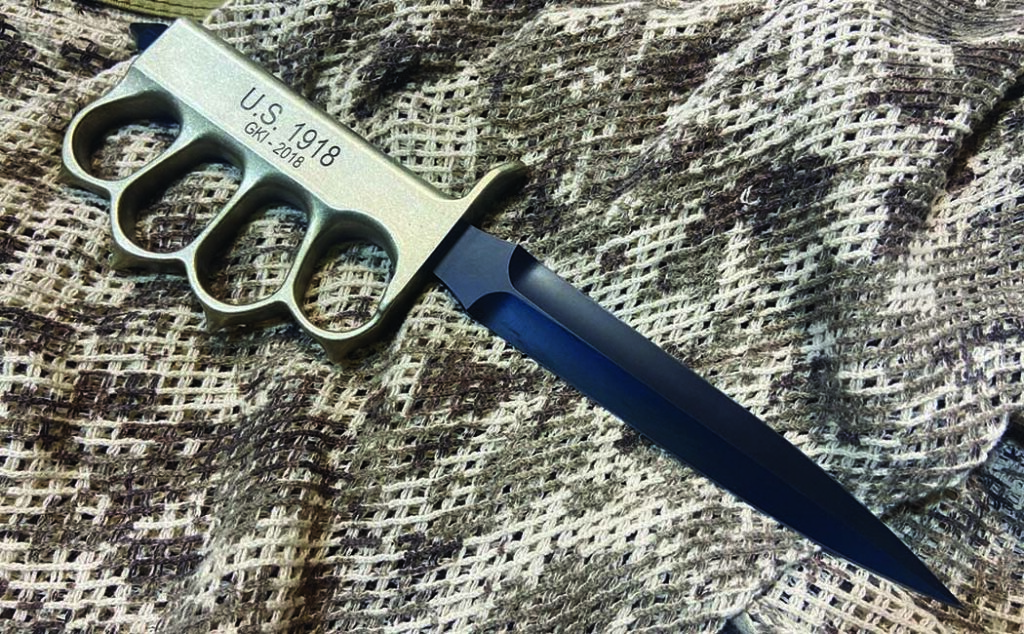
U.S. Marine Corps veteran/custom knifemaker Les George has a fondness for classic U.S. military knives. In 2018, he created his version of the 1918 trench knife. Except for the cast brass handle, Les updated the materials, including a 6.75-inch blade of CPM S35VN stainless steel and a titanium tang nut, both of which have a black Cerakote® finish. As of this writing, he planned to do another limited run of the knife.
Model 1918 Trench Knife Specs
Maker: Les George
Blade Length: 6.75”
Blade Steel: CPM S35VN stainless
Blade Finish: Black Cerakote®
Handle Material: Cast brass w/titanium tang nut
Overall Length: 11.5”
Sheath: Made by George of leather
Maker’s Price: $425 (SharpByCoop knife image; image of Les George by Ronald S. Smith)
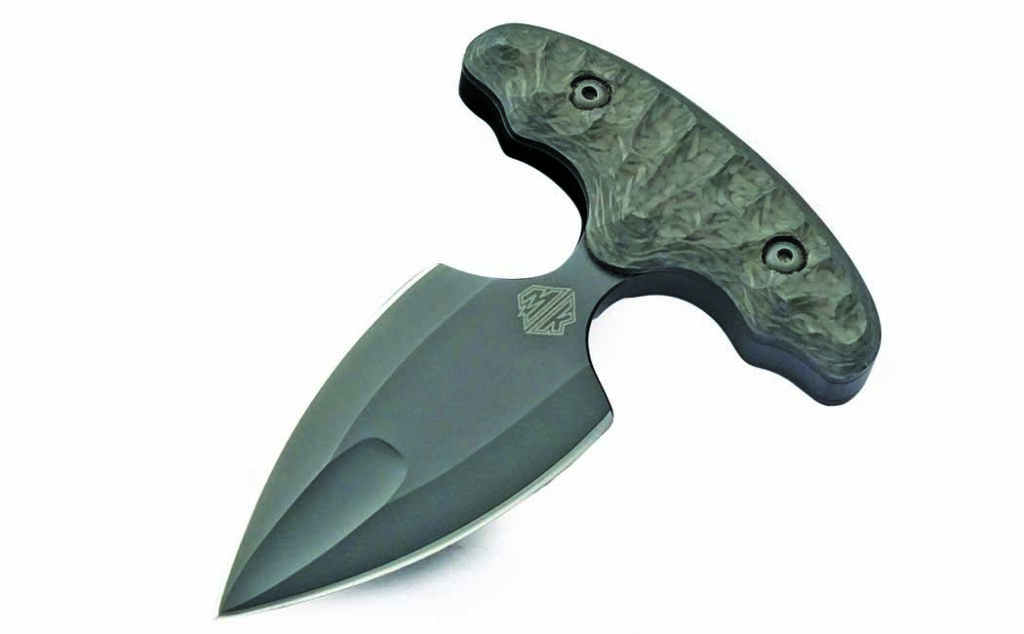
Custom knifemaker Paul McDaniel incorporates all the above-mentioned traits of the push dager in his Mako Push Dagger. The 3-inch double-edge blade is 80CrV2 carbon steel and has a fuller. The 3.75-inch handle is black, textured G-10. The accompanying custom-made Kydex sheath features multiple attachment points.
Mako Push Dagger Specs
Maker: Paul McDaniel
Blade Length: 3” w/full double edge
Blade Material: 80CrV2 carbon steel
Blade Finish: Black Cerakote®
Handle Material: Textured black G-10
Handle Width: 3.75”
Overall Length: 5.25”
Sheath: Made by McDaniel of Kydex w/leather straps
Maker’s Price: $365 (Robertson’s Custom Cutlery image)
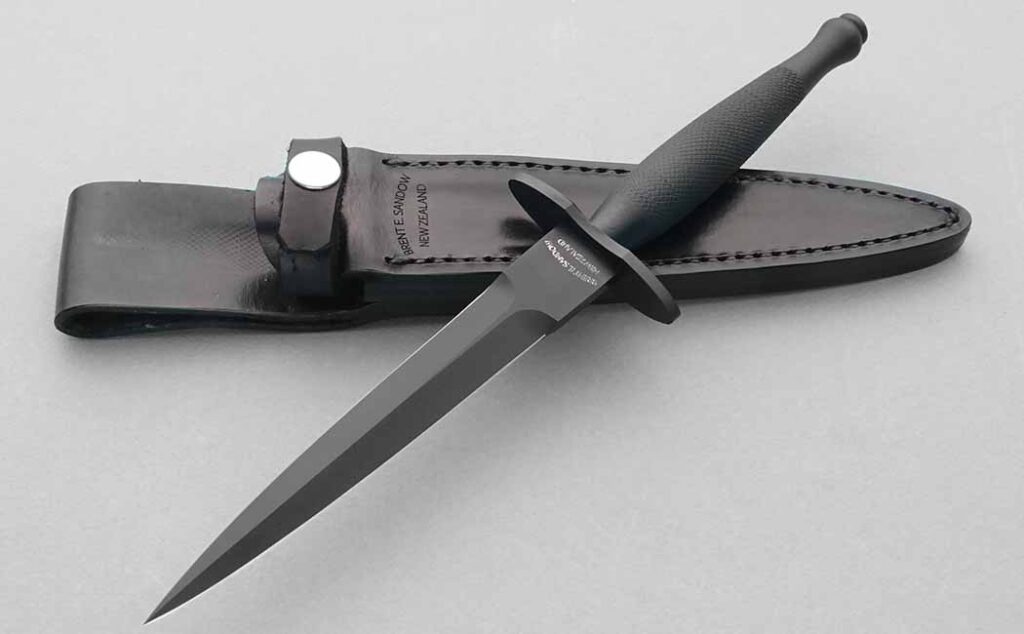
Maker Brent Sandow of New Zealand builds all three F-S dagger variants. The featured one has a 6.75-inch blade of D2 tool steel, a stainless steel guard, and a checkered handle. All the metal parts feature a flat-black Gun-Kote™ finish. In addition, Brent has slightly modified the knife by adding scalloping to the guard. The scalloping allows the user to index the knife. Indexing helps the user by providing a locating mark to help control the blade while maneuvering it*.
A version of the F-S dagger by maker Piotr Gosciniak of Poland sports a slightly shorter blade with a fuller down the center. Contrary to popular belief, a fuller is not a “blood groove.” Instead, it is a feature that reduces the knife’s weight and stiffens the blade. At the same time, it can help the maker provide a knife with enhanced balance. Piotr’s dagger features a 6.3-inch blade of 80CrV2 in black Cerakote. The black G-10 handle is laser-cut to enhance grip. For additional control, the knife has a scalloped guard.
Mako Push Dagger Specs
Maker: Paul McDaniel
Blade Length: 3” w/full double edge
Blade Material: 80CrV2 carbon steel
Blade Finish: Black Cerakote®
Handle Material: Textured black G-10
Handle Width: 3.75”
Overall Length: 5.25”
Sheath: Made by McDaniel of Kydex w/leather straps
Maker’s Price: $365 (Robertson’s Custom Cutlery image)
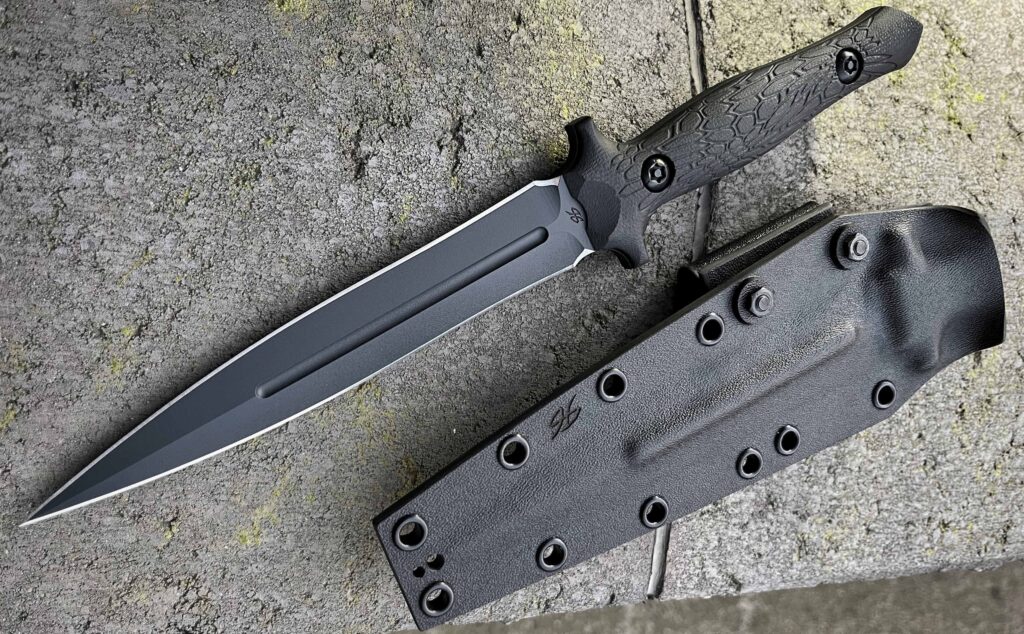
The texture of the black Micarta® handle enhances grip, particularly in a wet environment. The fuller reduces the blade’s weight while at the same time improves its strength. The thumb cutout provides extra stability during use.
Dagger Specs
Maker: Piotr Gosciniak
Blade Length: 6.3”
Blade Material: 80CrV2 carbon steel
Blade Finish: Black Cerakote®
Handle Material: Laser-cut-textured black G-10
Overall Length: 11.5”
Sheath: Made by Gosciniak of Kydex
Maker’s Price: $425 (Piotr Gosciniak images)
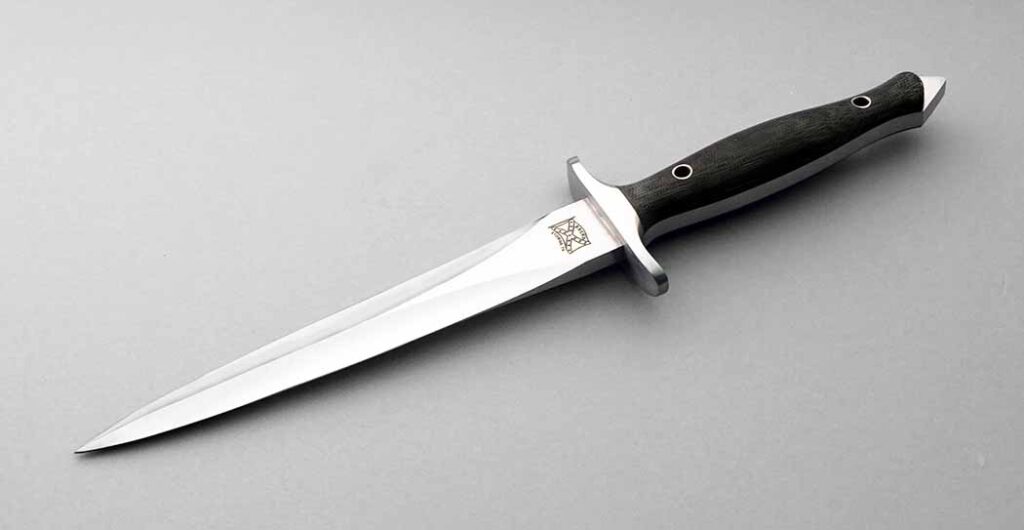
The SF Dagger by Walter Brend features an 8-inch blade of D2 tool steel with a satin finish and Walter’s impeccable grind lines. Handle: black Micarta®. Guard: stainless steel. Special features: Full-tang construction, double edge, thong hole and a skullcrusher pommel. Overall length: 12.75 inches.
SF Dagger Specs
Maker: Walter Brend
Blade Length: 7”
Blade Steel: CTS XHP stainless
Blade Finish: Satin
Handle Material: Black Micarta®
Guard Material: Stainless steel
Overall Length: 12”
Sheath: Custom-made of leather
Maker’s Price: $2,800 (Robertson’s Custom Cutlery image)

This tactical dagger from Winkler was designed for the military by people in the military. It isn’t a show knife for people looking to cosplay as their favorite action star. This is the real deal.
The 5.5-inch blade is 3/16-inch-thick 80CrV2 carbon steel with a black oxide Caswell finish and has a Rockwell hardness of 59-60 HRC. The blade is made for combat and will handle the abuse you throw at it. Both edges are ground to a razor edge.
A tapered tang runs through the entirety of the wasp sculpted canvas laminate handle to give you a strong, sturdy grip. The piece comes with a custom-lined Kydex sheath for secure carry. Made in the USA, the knife is an absolute winner.
WK Defense Dagger Specs
Maker: Winkler
Blade Length: 4.25″
Blade Steel: 80CrV2
Blade Finish: Black oxide no-glare finish
Handle Material: Black Canvas Laminate, Camo G10, Maple, Walnut, WASP
Overall Length: 8
Sheath: Lined Boltaron® Sheath
Maker’s Price: $325
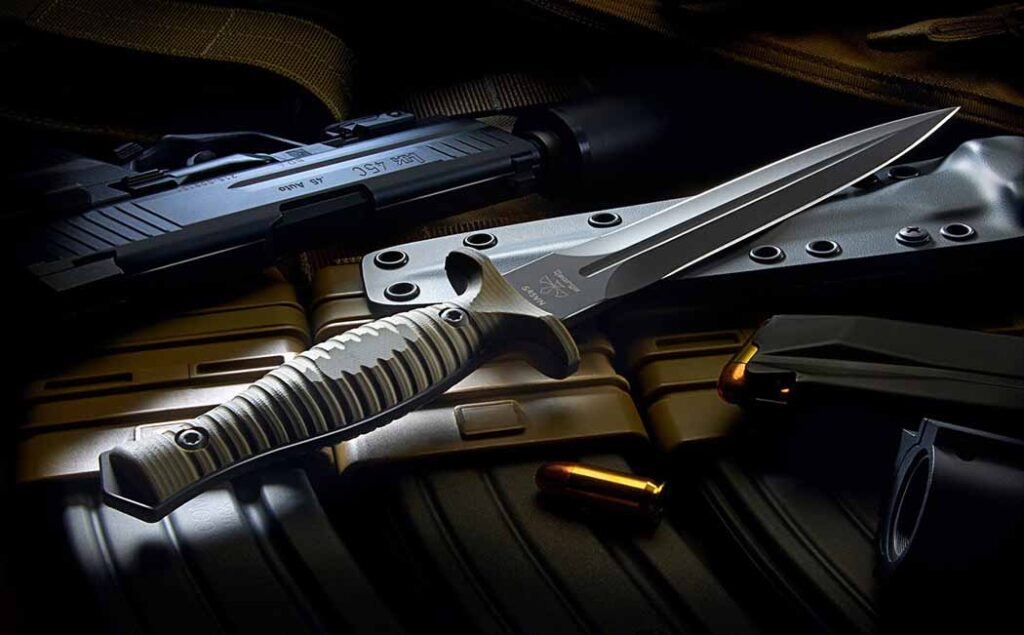
Designed by award-winning knifemaker Les George, the V14 from Spartan Blades is about as high quality as it gets. A Marine veteran, Les knows what is needed from a dagger and puts it all into this one.
The V14 has a beefy 6.75-inch blade of symmetrically ground CPM S35VN stainless steel heat-treated to a Rockwell hardness of 58-60 HRC that provides great edge retention and durability. The handle is 3D-contoured black G-10 that wraps a full tang to provide a strong grip. This knife isn’t going anywhere in your hand, and the blade’s not going to snap in two when deployed. The Kydex sheath is MOLLE compatible.
George V1-14 Dagger
Maker: Spartan Blades
Blade Length: 6 3/4″
Blade Steel: CPM S45VN
Blade Finish: SpartaCoat – PVD – Tungsten DLC (Black) or ZrN (Flat Dark Earth)
Handle Material: 3D Contoured G10, Black or Green
Overall Length: 11 1/2″
Sheath: Kydex Sheath
Maker’s Price: $495
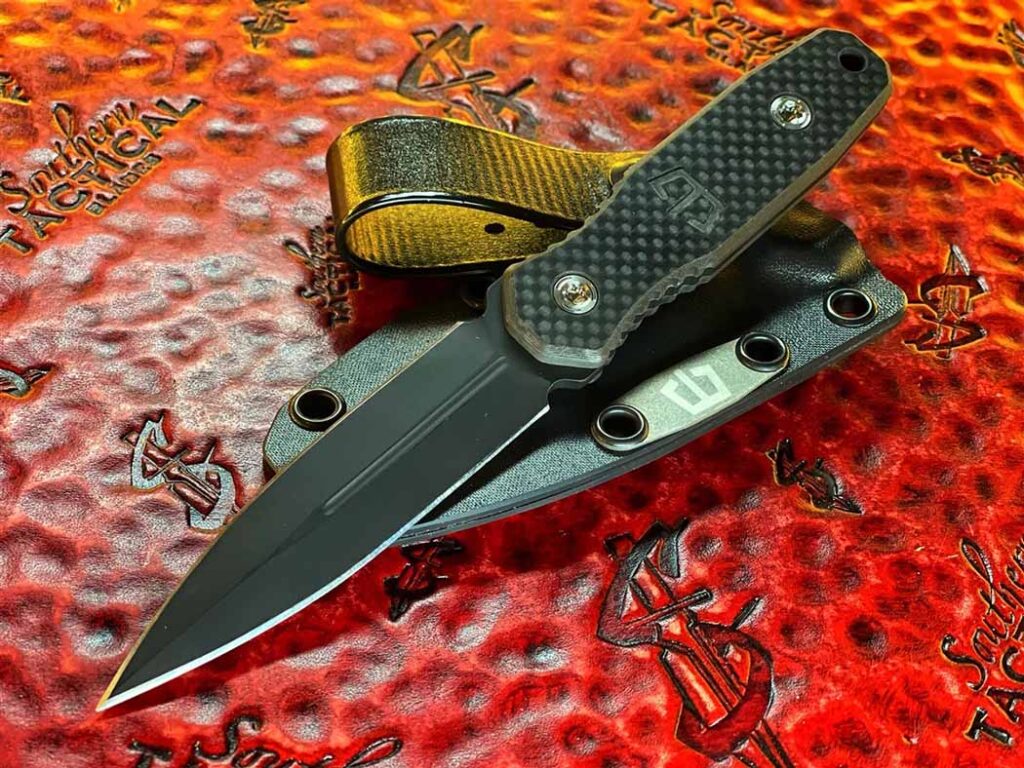
This piece from Blackside Customs is the smallest of the three knives on our list but no less functional.
The 3.5-inch blade is CTS-XHP stainless steel with an OD green Cerakote® finish. The smaller size makes the P7 more feasible as an EDC if you prefer your standard carry to be a fixed blade. The G-10 grips are double-riveted to the tang for a comfortable grip when deployed.
The Kydex sheath lets you carry the knife easily and discreetly. The smaller blade means a lower weight. At just 3.5 ounces, almost three times lighter than the heaviest knife on this list, the P7 is a sleek piece that moves with grace and ease.
Phase 7 Dagger Specs
Maker: Blackside Customs
Blade Length: 3.5″
Blade Steel: CTS-XHP
Blade Finish: Black Cerakote®
Handle Material: Black G10
Overall Length: 7.35″
Sheath: Kydex Sheath w/ BSC Titanium Tag
Maker’s Price: $290
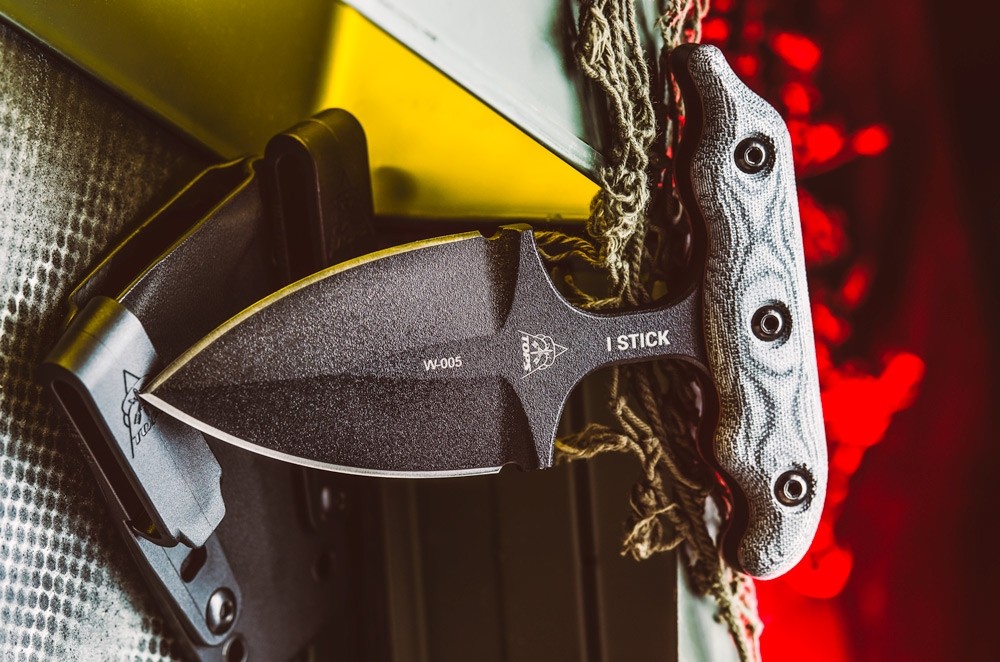
The commendable quality of the TOPS Knives I Stick lies in its ability to live up to its advertised purpose. It excels in the task of sticking objects securely, and credit is due to the TOPS team for their rare commitment to truthful advertising.
The I Stick embodies the original intent behind the push dagger’s design, which is to protect the wielder by swiftly striking those who pose a threat. Possessing a generous blade length and an impressive thickness that instills a sensation of being able to puncture a shipping container, it undeniably proves its efficacy in defensive scenarios.
Featuring sharp edges on both sides, it surpasses the 3.5-inch blade measurement that could attract the attention of law enforcement officers seeking to find fault. Consequently, it may not be the ideal choice for individuals residing in states with stringent knife regulations. However, if you find yourself in a state with fewer restrictions or if you possess a weapons carry permit, the TOPS Knives I Stick presents itself as a formidable contender.
*Editor’s note: Though meant to be inferred from the author’s description, we might add that indexing enables the user to know by feel how the blade is oriented during use, an invaluable feature in situations where the user cannot see the blade for whatever reason.
I Stick
Maker: TOPS Knives
Blade Length: 3.50″
Blade Steel: 1075 RC 56-58
Blade Finish: Black Traction Coating
Handle Material: Black Canvas Micarta
Overall Length: 5.63″
Sheath: Black Kydex
Maker’s Price: $210
Editor’s Note: Michael Ableson contributed to this post.
Read More





