
Custom Knives: Reproductions Of Ancient Knife Designs

The great ancient knife designs aren’t history as they top-notch reproductions prove.

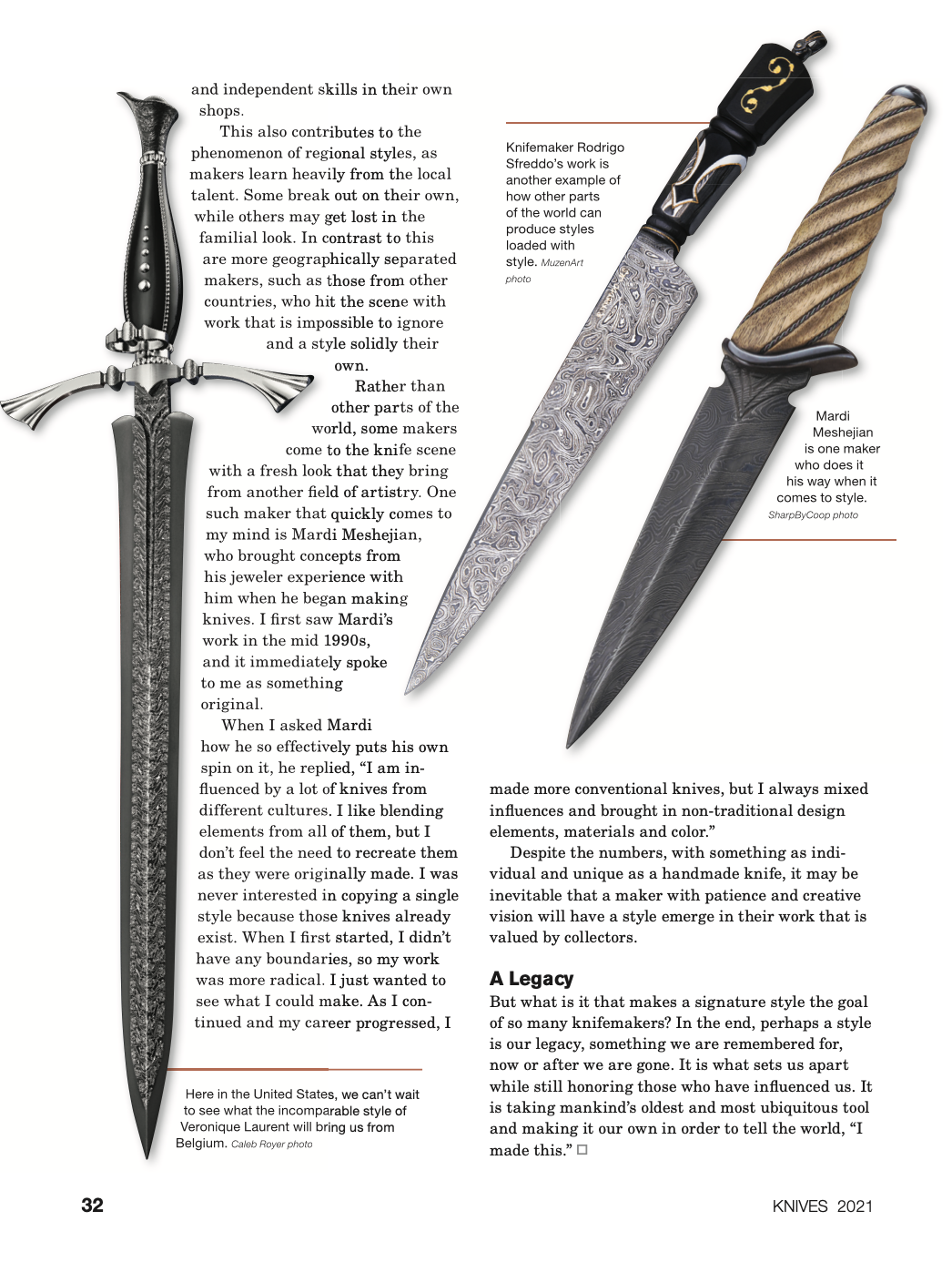
The ancient history of knife design is long, storied and colorful. From Bronze Age daggers to 19th-century dress bowies alone, vintage configurations capture the imagination like a gladiator’s net from the early days of the Roman Coliseum. Tour the classics with these remarkable reproductions.


Colton Arias Scylla
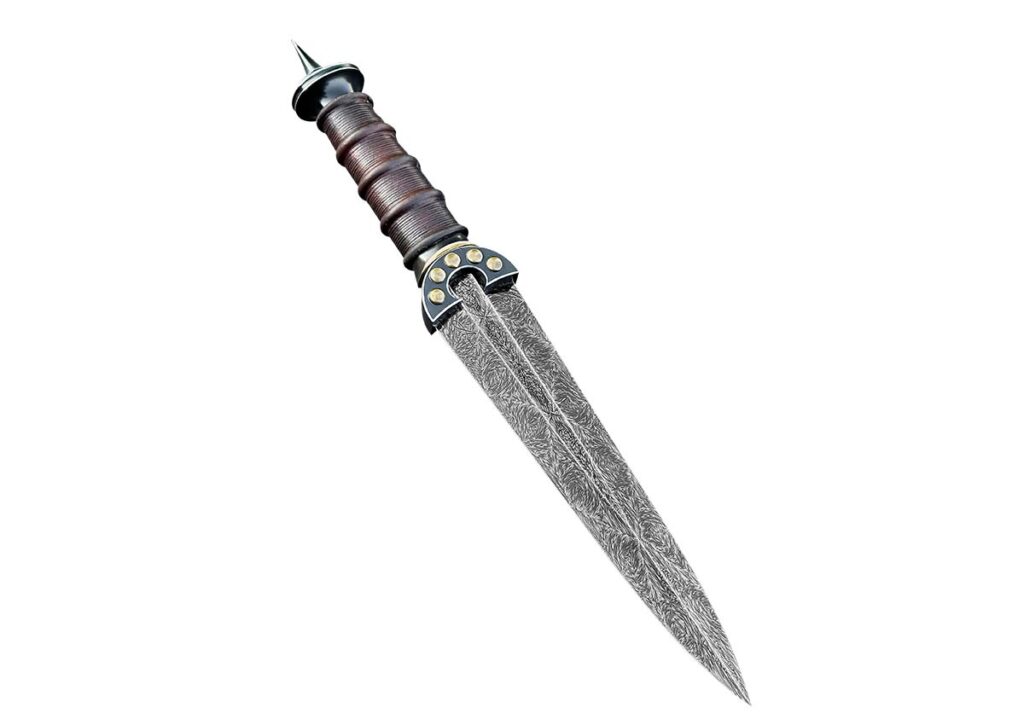
Colton Arias Scylla

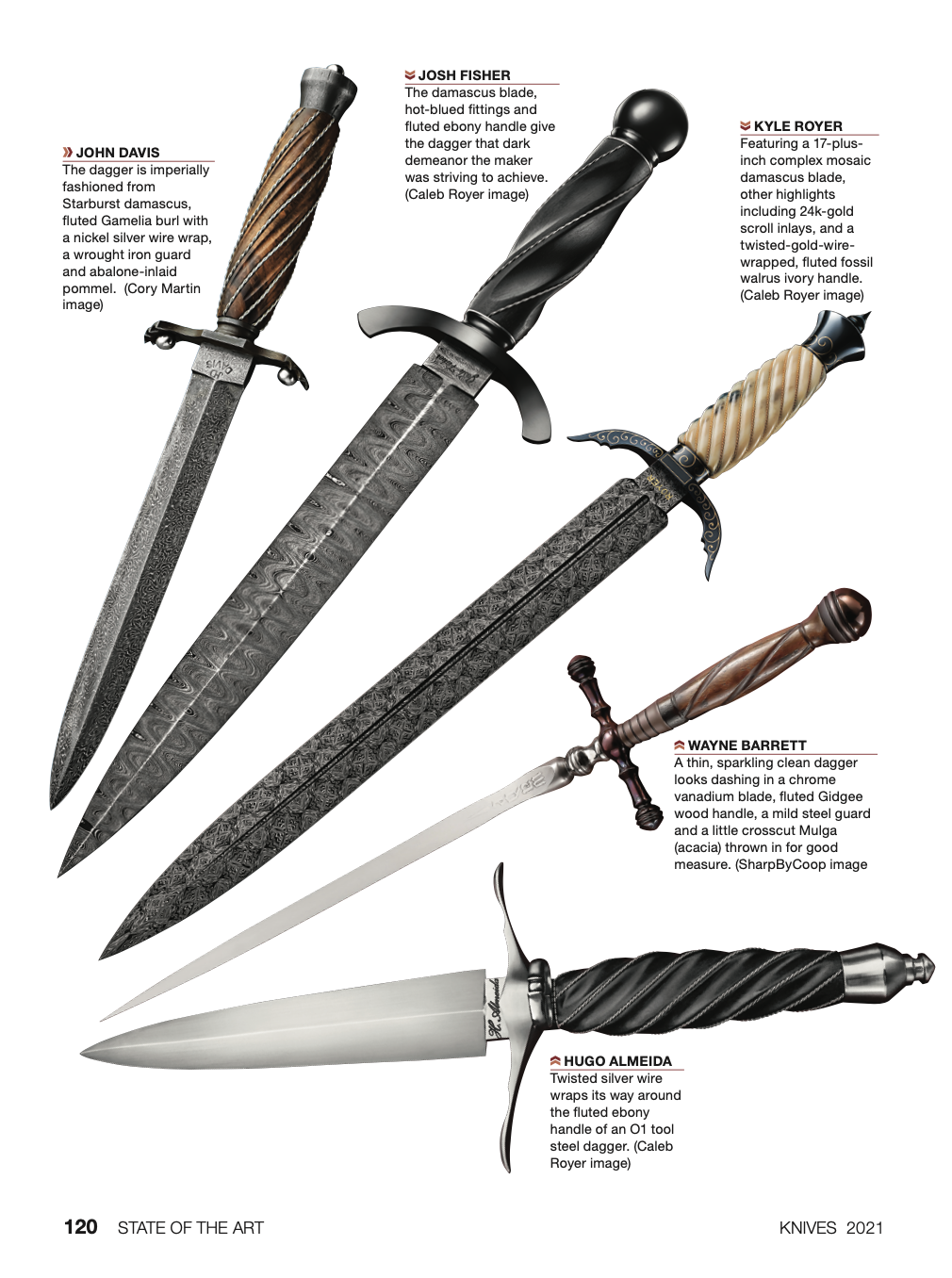
Named after an Etruscan-era mythological monster, Scylla is a repro of an Etruscan Bronze Age dagger by Colton Arias. The 7-inch blade with tapering fuller is a triple feather mosaic damascus of 1084 carbon and 15N20 nickel alloy steels. The spiked-pommel handle is a goat leather wrap and the bolster is mild steel with brass accents. Overall length: 12 inches. (Jocelyn Frasier image)


Dane Standen Cinquedea
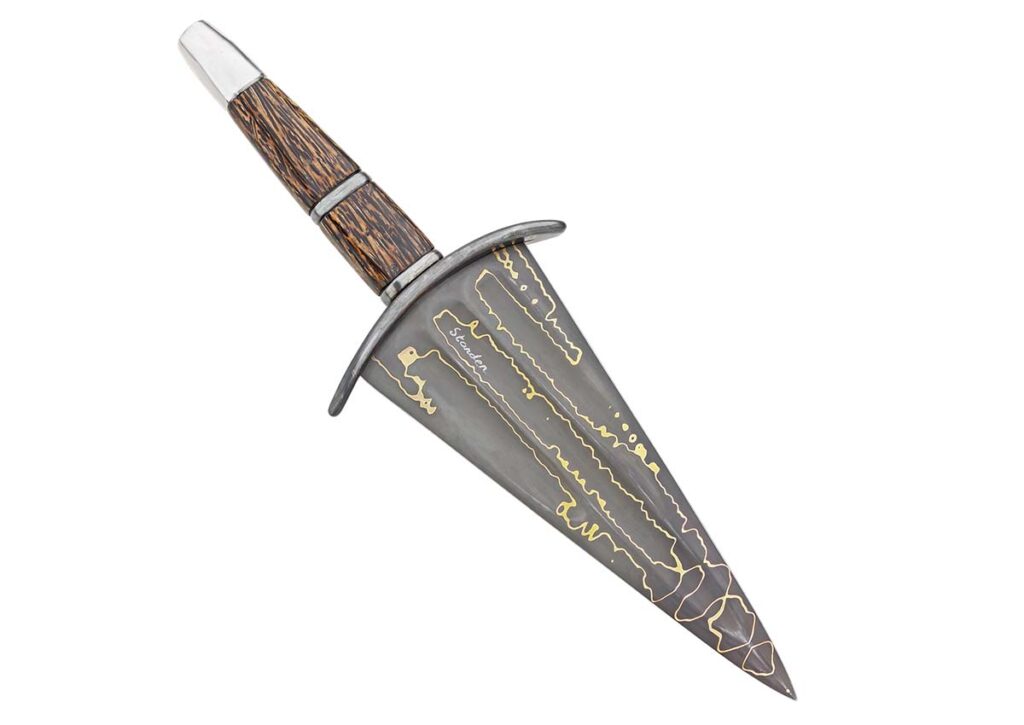
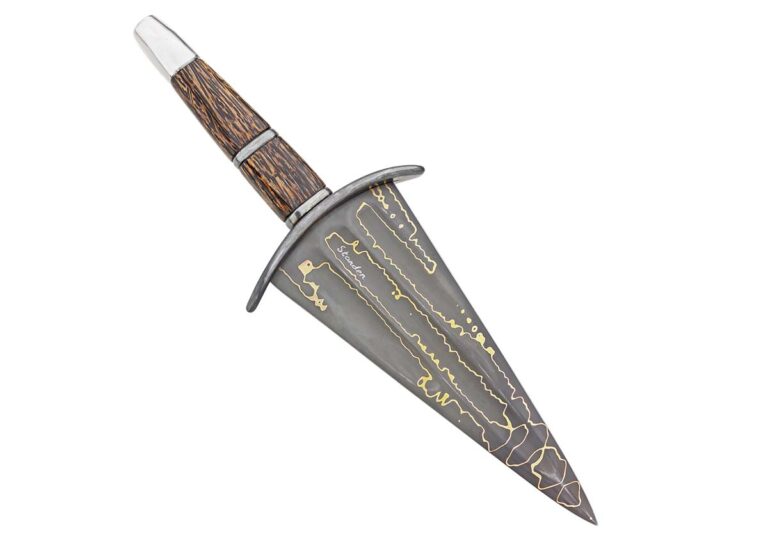
Dane Standen Cinquedea

Dane Standen outfits his modified cinquedea with a three-fullered blade in multiple welds of 1084, cu-mai, 1084, cu-mai and 1084 carbon steels. Blade length: 8.27 inches. The handle of a takedown construction is stabilized black palm and the fittings are mild steel, copper and nickel damascus. Overall length of the centuries-old Italian design: 14 inches. (Rod Hoare image)


Nick Bachtel Dress Bowie
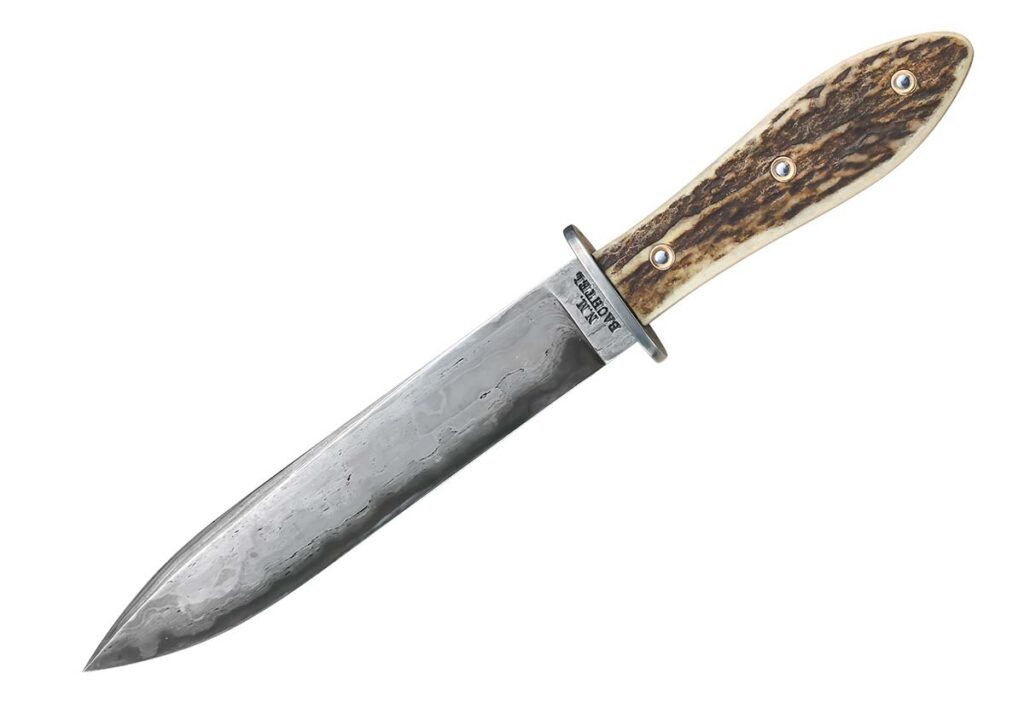
Nick Bachtel Dress Bowie

A 7-inch blade of wrought-iron in a san-mai construction and a handle of elk antler and curly ash highlight a repro of a 19th-century dress bowie by Nick Bachtel. Overall length: 12 inches. The guard is steel and bronze and the knife comes with a traditional bronze sheath (not shown). (SharpByCoop image)


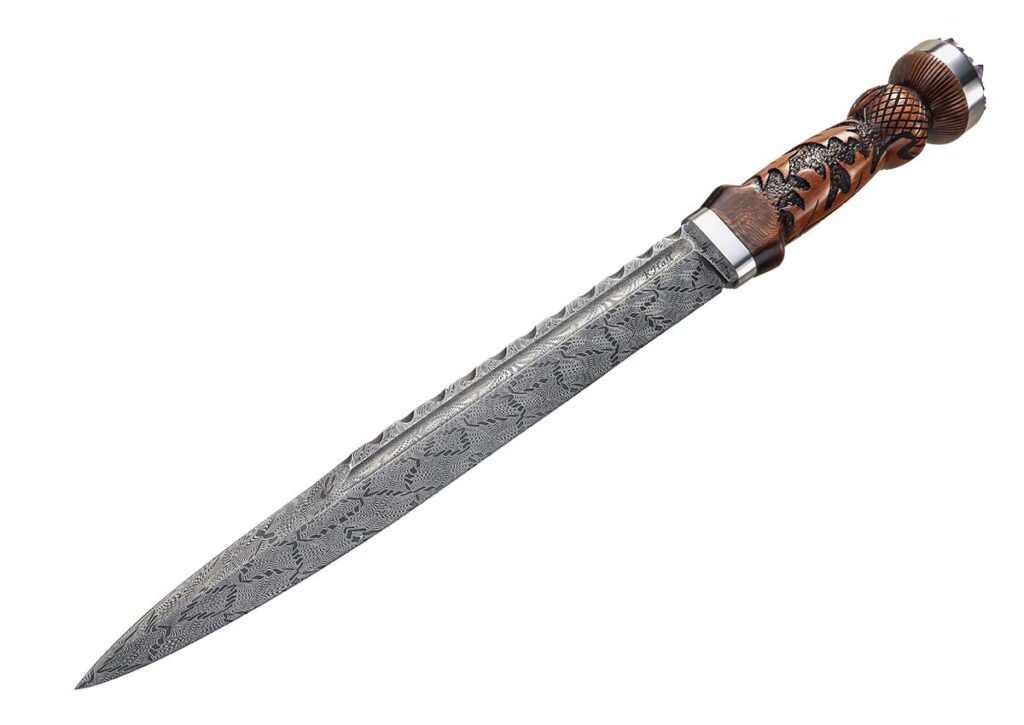
Ken Hall Scottish Dirk
Ken Hall Scottish Dirk

A 12-inch fullered/fileworked blade of an absorbing mosaic damascus and a handle of stained stabilized cherry carved to symbolize a thistle distinguish a stunning Scottish dirk by ABS journeyman smith Ken Hall. Pommel stone: amethyst crystals. Overall length: 17.5 inches. Sheath (not shown): tooled leather. (SharpByCoop image)


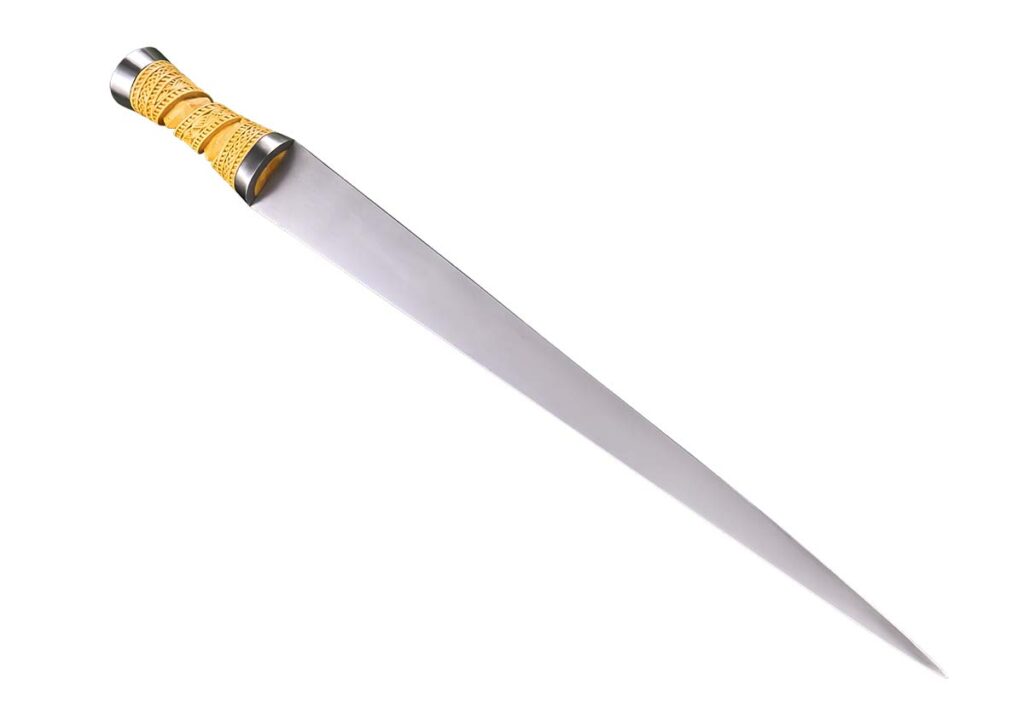
Matthew Berry Edinburgh Skean
Matthew Berry Edinburgh Skean

The Edinburgh Skean by Matthew Berry is a reproduction of a knife by the same name from 1677. The originals were combat knives of Ireland. The blade is 1075 carbon steel and the intricately carved handle is boxwood. Blade and overall lengths: 15.25 and 19 inches. The form-fitting sheath (not shown) is highly detailed leather with a wrap strap. (SharpByCoop image)


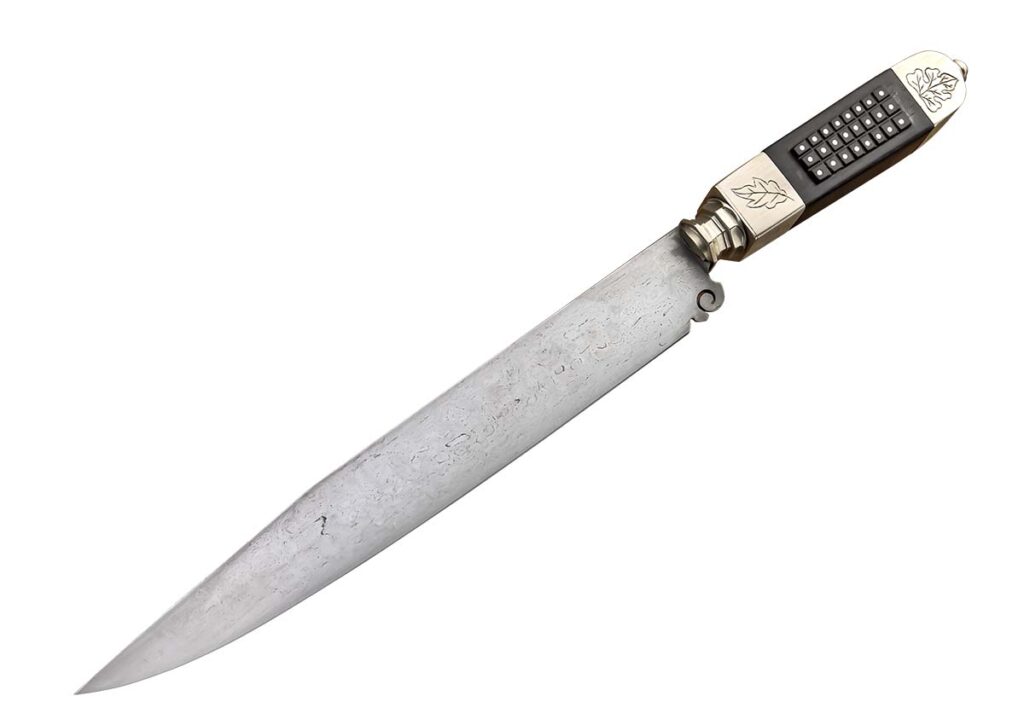
J.J. Simon Samuel Bell Dirk
J.J. Simon Samuel Bell Dirk

ABS journeyman smith J.J. Simon forged the 12-inch flat-ground blade with Spanish notch for his repro of a 19th-century Samuel Bell dirk from bloomery steel. The handle is blackwood with silver pins and the fittings are nickel silver. Overall length: 17 inches. (SharpByCoop image)


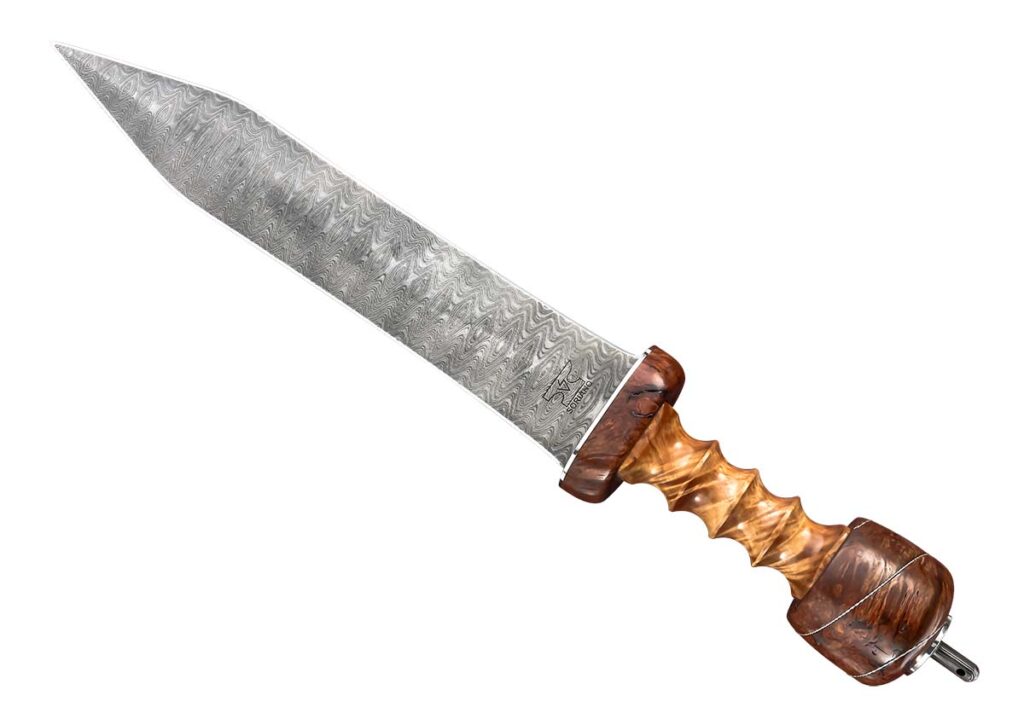
Vincent Soriano Mainz-Pattern Gladius
Vincent Soriano Mainz-Pattern Gladius

ABS apprentice smith Vincent Soriano goes full Roman with his Mainz-pattern gladius. Called the Proeliator, it boasts a 14-inch damascus blade of 1075 carbon and 15N20 nickel alloy steels and pure nickel. The handle is curly maple and the guard and pommel are eucalyptus. Overall length: 22.5 inches. Sheath (not shown): leather. (SharpByCoop image)

More On Knife Collecting:

Irishman uses fossilized bog oak for knife handles

Paddy Smyth of Symth Knives uses a flat grind on this utility knife.
Smyth Knives’ Flat-Grind Utility Knife is made using O1 tool steel, black G10 scales, and blue liners. The blade is 3 inches, and the knife is 7.5 inches overall.

Irishman Paddy Smyth of Smyth Knives in County Roscommon, Ireland, sells 90 percent of his knives through his website to customers in the USA. The other 10 percent are purchased through The Quiet Cailin Studios in Cong, County Mayo, where “The Quiet Man,” starring John Wayne and Maureen O’Hara, was filmed. Some even incorporate ancient bog oak.

Irish Eyes Will Smile Over Smyth Knives

But it was another movie that sparked a love of knives in Paddy growing up. He watched wide-eyed as the work of Gil Hibben’s was deftly wielded in “Rambo III.” It is “my favorite knife of all time, so I have huge respect for [Hibben’s] work,” Paddy commented. He had a week-long visit last year from Jeff Knox,  who trained with Hibben in the US. “He has been a great help to me also with advice and sourcing materials as its hugely difficult to get materials in Ireland,” Paddy added.

Paddy Smyth of Smyth Knives feels at peace when working in his knifemaking workshop.
Paddy Smyth lives in County Roscommon in Ireland and undoubtedly with a name like Smyth has knifemaking in his blood.

He also mentioned that Walter Sorrells’ YouTube channel has been helpful and inspirational.

However, Paddy is a self-taught knifemaker and much of his learning has been by trial and error over the years. “I continue to learn,” he noted. He was trained as a chef and butcher and always had a keen interest in hunting, so he was intrigued by what made a high-quality knife. “So, I basically decided to have a go at knifemaking and caught the knifemaking bug,” he said.

Paddy concentrates on compact pocket and neck knives, bushcrafting and hunting/skinning knives. He makes specialty chef knives to order to client specifications. His favorite steels are O1 an Niolox stainless. He appreciates the consistent finish and heat treat he gets using these steels.

He likes three grinds: Scandi for his bushcrafting blades because it’s easy to maintain an edge; and flat and hollow, according to customer preference, because they both work well for his hunting and skinning blades. For bushcrafters, he chops and batons wood to test for toughness, and then fine-carves paper to verify sharpness. Cutting heavy cardboard with its abrasive quality helps him get a feel for how long his blades will stay sharp. He does ensure his flat- and hollow-ground blades can handle the detailed work of skinning and boning.

Everyone's Irish on St. Patrick's Day, so feast your eyes on these blades from Paddy Smyth on the Emerald Isle.
The Claw by Smyth Knives, left, is 5.25 inches long, with a 2.2-inch cutting blade. It’s perfect for close skinning/boning/gutting with complete one-finger control.

“My favorite handle material is ancient Irish bog oak, which can be up to 10,000 years old. It finishes really well and has beautiful character and history,” Paddy explained. “It’s very difficult to work with as it’s so hard it’s almost fossilized. And it’s becoming harder to find good pieces. It’s very hard on machinery and tools, but the work is worth the finished product.”

There are no knife shows currently in Ireland, so Paddy sells his work online at www.smythknives.com. Prices range from 90 to 500 Euros plus shipping with discounts for repeat customers. Also, check out the boutique artisan gallery in County Mayo where Smyth Knives are also sold on Facebook. Smyth Knives on Facebook and @smythknives on Instagram are chock full of additional photos and videos. You can call Paddy at 00353 87 6281252.

All Smyth Knives are completely handmade and heat-treated in house. Leatherwork is specific to each knife, so no two creations are the same. Paddy is a retail manager for an oil company based in the west of Ireland. He lives in Roscommontown with his wife, Edel, and their three boys, Shane, Darragh and Cian.

Patty Smyth uses detailed file work on the spine of some of his knives.
The ornate file work on the spine of this knife by Paddy Smyth in County Roscommon, Ireland, is reminiscent of a Celtic pattern.

“When I started making knives, I realized I had found something incredibly natural to me, as if I was meant to do this or was maybe in my blood, as my family name is Smyth,” Paddy noted. “I’m completely at peace when I’m in the workshop.”


Get Your 2017 BLADE® Show Knife Now!

Ken Onion and CRKT collaborated on the innovative Homefront knife.
The CRKT Homefront is the 2017 BLADE Show knife. Be sure to get yours now.

CRKT and Ken Onion took home the Most Innovative Imported Design award at the 2016 BLADE Show for the groundbreaking Homefront. Now the Homefront is the official knife of the 2017 BLADE Show. This is a limited run of 300, so hurry! And at $70 you’ll be saving almost 30 percent.

Interview with Knifemaker Sal Manaro

0

Today we meet Sal Manaro of Manaro Custom Knives. He is a knifemaker extraordinare!

http://www.manaroknives.com/default.html

Enjoy!

Cool Custom Combat Knives

0

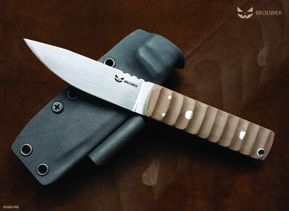
(Jerry Brouwer battle blade)

I was thinking the other day that, in a perfect world, those who put their lives at risk to defend our country would be provided with the newest, most high-tech, quality weapons and equipment in order to their duties.

In some ways, the American forces are the most well-equipped in the world, but in others, they are not. Knives, for example—wouldn’t it be great if all soldiers could carry a hand-fashioned, quality, custom knife with them everyday?

The expense of a handmade combat knife is high, but what’s the cost for a soldier not to carry one? What prompted my thoughts on the subject was the “Battle Honed” section of the KNIVES 2015 book. Between pages 84 and 86 of the KNIVES book are 15 of the most spectacular, clean, handsome, utilitarian, well-built combat knives, hatchets and tomahawks I’ve ever laid my eyes upon. Three examples are shown herein.

What would your ideal combat knife be? And who would make it? For more tactical/combat knives, click here. To see the other 12 combat knives in the KNIVES 2015 book, click here.

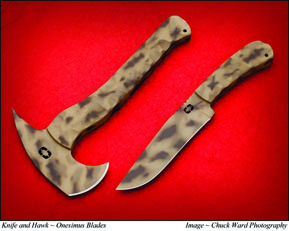
(Levi Graham belt knife and tactical tomahawk. Chuck Ward image)


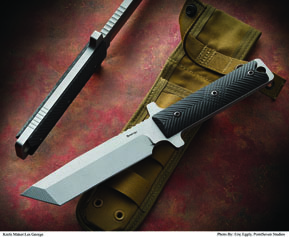
(Les George Marine Corps EOD technician's kit knife. PointSeven image)
(Les George Marine Corps EOD technician’s kit knife. PointSeven image)

Mcnees Custom Knives Chopper Proto

0

Created on August 21, 2010 using FlipShare.

A Day At The New England Bladesmithing Symposium

Knifemakers From Around North America Came To Auburn, Maine For The 2022 New England Bladesmithing Symposium

The 12th annual New England Bladesmithing Symposium brought nearly 100 knifemakers and enthusiasts together for the first hammer-in since 2019.

The event ran from July 15-17 in Auburn, Maine at the New England School of Metalwork and featured classes and workshops galore. Throughout the weekend there was something to scratch any itch you may have had about knives.

Master Smith Lin Rhea presented a tutorial on how to make his dynamic X-Rhea knife. There were workshops on everything from how to build out your knifemaking business to forging recurves. 

It was a brutally hot Saturday in the Pine Tree State, yet it didn’t dampen spirits, particularly for the main event– the Battle of the Bladesmiths. The 2-hour competition to pushed four makers to their limits, and drew the largest crowds and interest.

Learning From The Best

The classroom at the NESM is covered wall to wall with tools and other metalwork made by past students just like this.

During the afternoon I was able to drop into a few of the classes. The one I got the most out of was led by Master Smith Christoph Deringer. 

Derringer class about the anatomy of the knife was a joy, particularly the care he gave answering questions. His wry sense of humor even out, like when he called flux a crutch pertaining to forge welds. In that particular case, he suggested simply listening to the metal and letting it guide you when you forge weld, no flux is needed.

He taught everyone a neat trick for adding patina to a blade, as well. The crux, you hang the knife above a piece of heated copper. Heating the copper causes it to emit gasses that rise up and patina the blade to an almost bronze color.

A Successful Weekend

It was a big weekend for the school, gathering makers from the Northeast, Eastern Canada, and even as far west as California. For NESM director Dereck Glaser, it was a successful weekend, particularly given the COVID-related lapse in the symposium the past few years.

“The school, in general, draws from around New England,” Glaser said. “I’m excited to see more Canadians here, to be honest. We can’t forget we have a whole other country on our border. I can’t be pulling students out of the Atlantic Ocean so Canada’s a really good option.”

It’s important for anyone with even a passing interest in knifemaking to visit their local school and learn. Not only can you save yourself toil and trouble, but supporting the broader community of makers helps it survive and thrive even in the lean times.

Journeyman smith Mace Vitale runs a workshop on handle shaping.

“It saves exponentially the number of years,” Glaser said. “Indebting yourself to a week and about $600 could potentially save you 3-5 years of trial and error on your own. The amount of compressed skill and support you get in 4-5 days of a course, answering those questions that’ll take 3-5 years to figure out on your own.”

Glaser said that even with the uncertain economy, he believes the future of the school and knifemaking is bright because the passion is boundless.

“The fiscal issues we’re having is making it rough. It’s 90+ percent an enthusiast kind of hobby and craft for most people,” Glaser said. “Where inflation and cost of living’s gone, everyone’s seeing a toll in the crafts. We’re even seeing it in the welding, which is an employment-based skill. But on a whole, I  think the energy is still there. The love for it is greater than ever. A lot of people did a lot of things to better themselves in it through the pandemic, so I think coming out on the other end I think people are kind of stronger.”

The Passion For Knives

A nice bit of camraderie. Two of the battle contestants Leo Potter (in the hat) and Jeremy Yelle share a fun moment ahead of the contest.

As informative and enlightening as the classes were the attendee’s conversations. Everyone was excited, whether it was to learn from a particular smith, show off a piece they made, or for the battle at night, everyone was open and welcoming.

A Previous winner of the Battle of the Bladesmiths, Emiliano Carrillo (owner of Sun and Stars Forge), was particularly poetic in what he said about the process of making his own steel.

“When I started the smelt earlier in the day the sand runs through my fingers, and by the time the day’s done it’s a lump of material that can be turned into something,” the owner of Massachusetts-based Sun and Stars Forge said. “It goes from being this throwaway material to something that’s actually useful. I think that’s crazy. It really is alchemy to me. It’s addictive. You do it and it works and you do it again and again and it breaks your heart, and then you have some successes.”

The day ended with the battle. Four young smiths were tasked with turning a one-foot bar of 1084 into a complete knife in just two hours. You can read all about the contest here.

In total, the symposium was absolutely worth the trip and should be on your checklist if you’re a serious maker in the Northeast U.S. or Eastern Canada.

To learn more about the New England School of Metalwork, click here.

Read More

The World’s Greatest Knife Book is Here

0

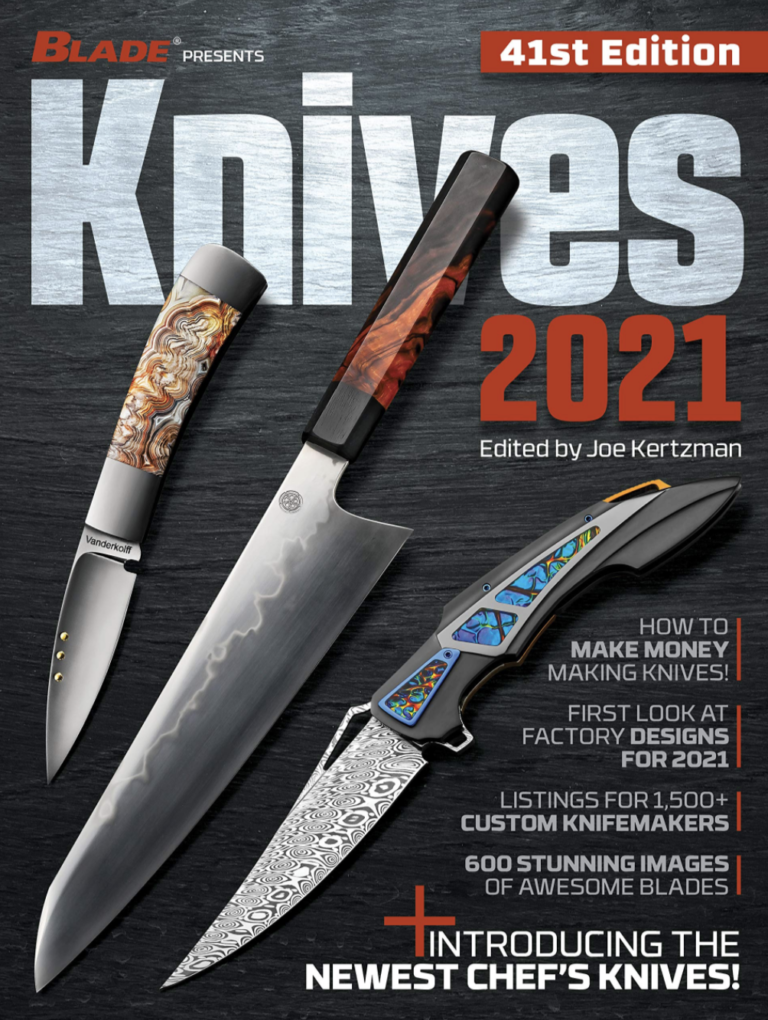
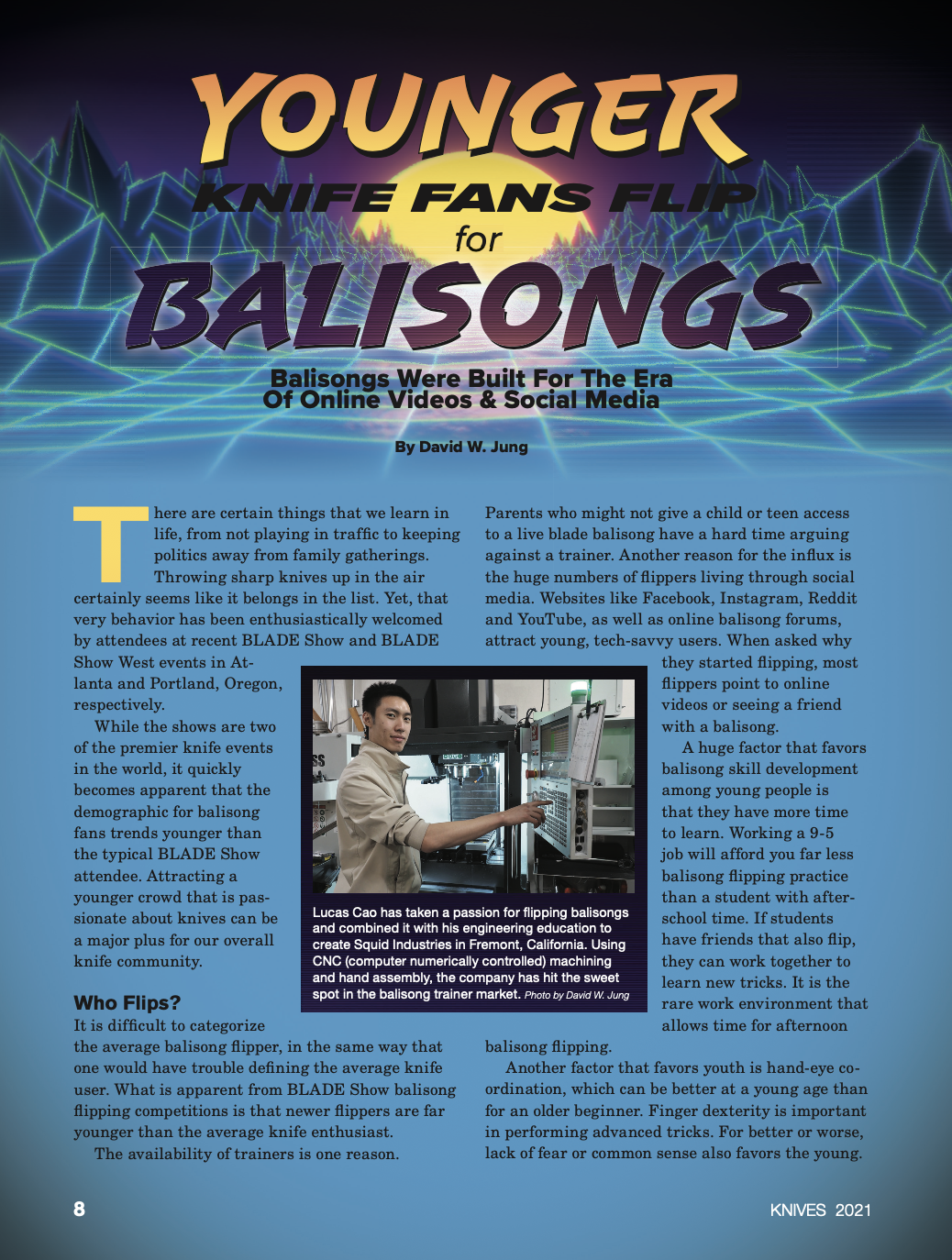
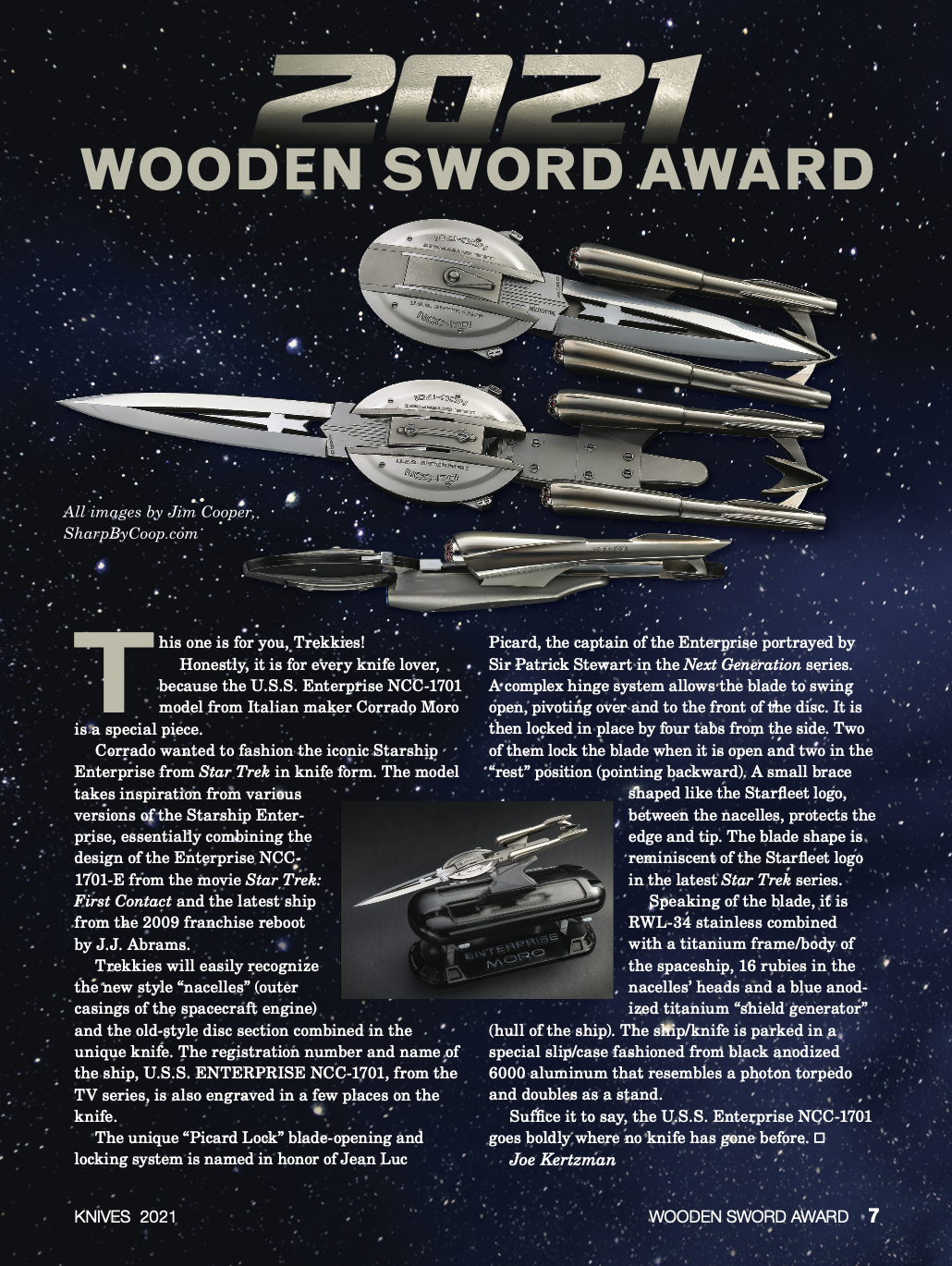
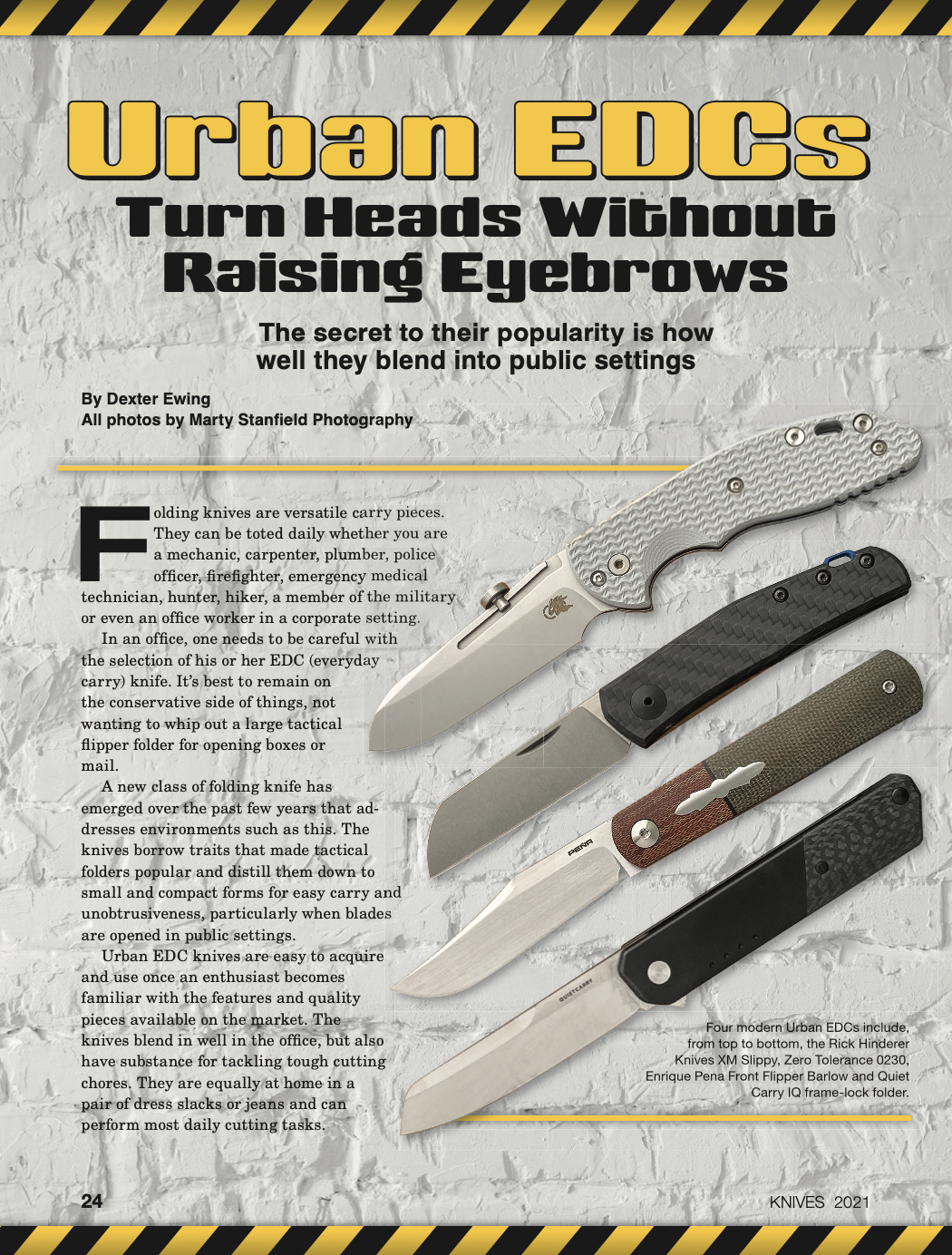
KNIVES 2021, presented by BLADE Magazine showcases blades of every class and style with more than 600 spectacular full-color images, from customs to factory knives.
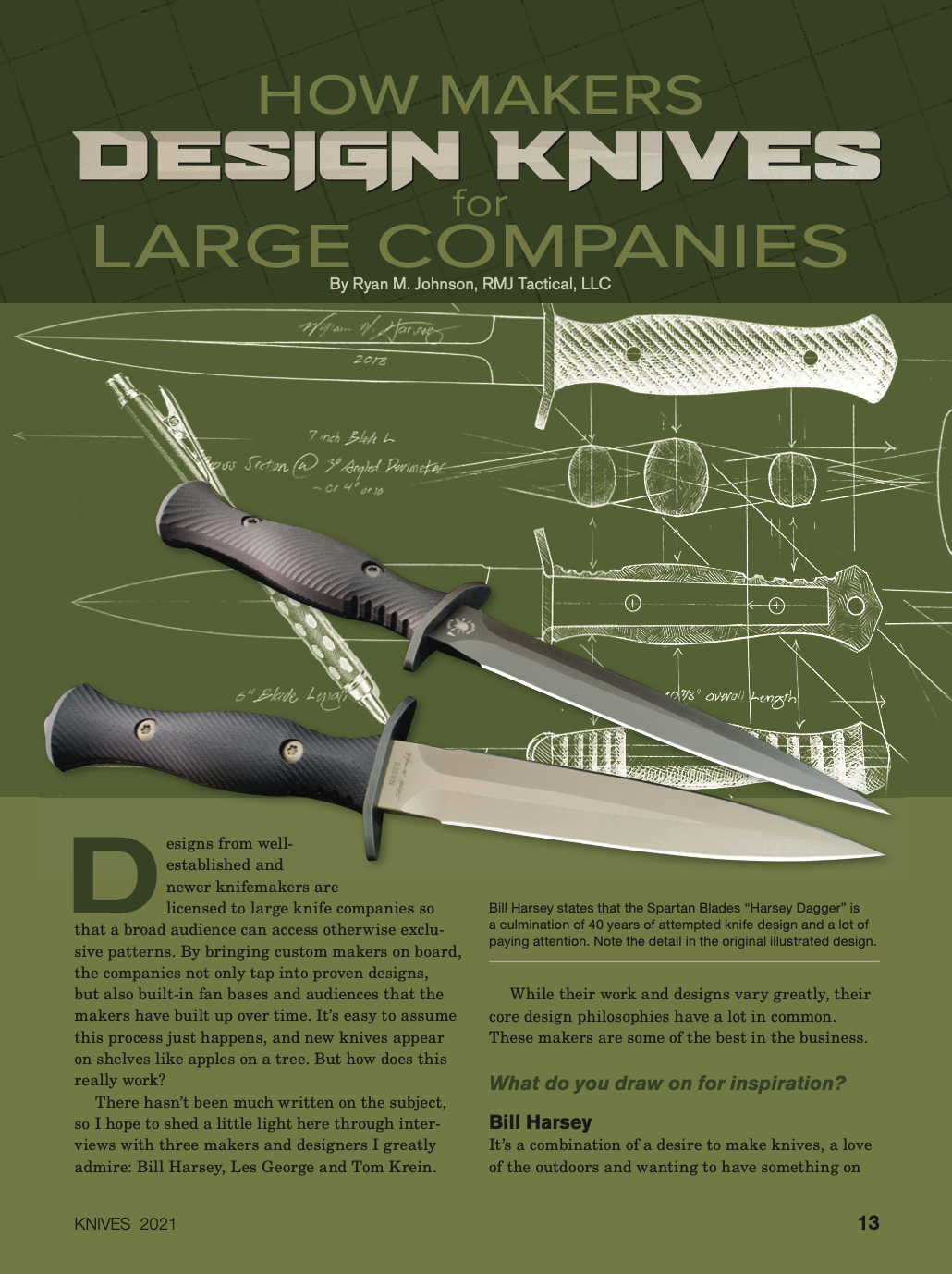
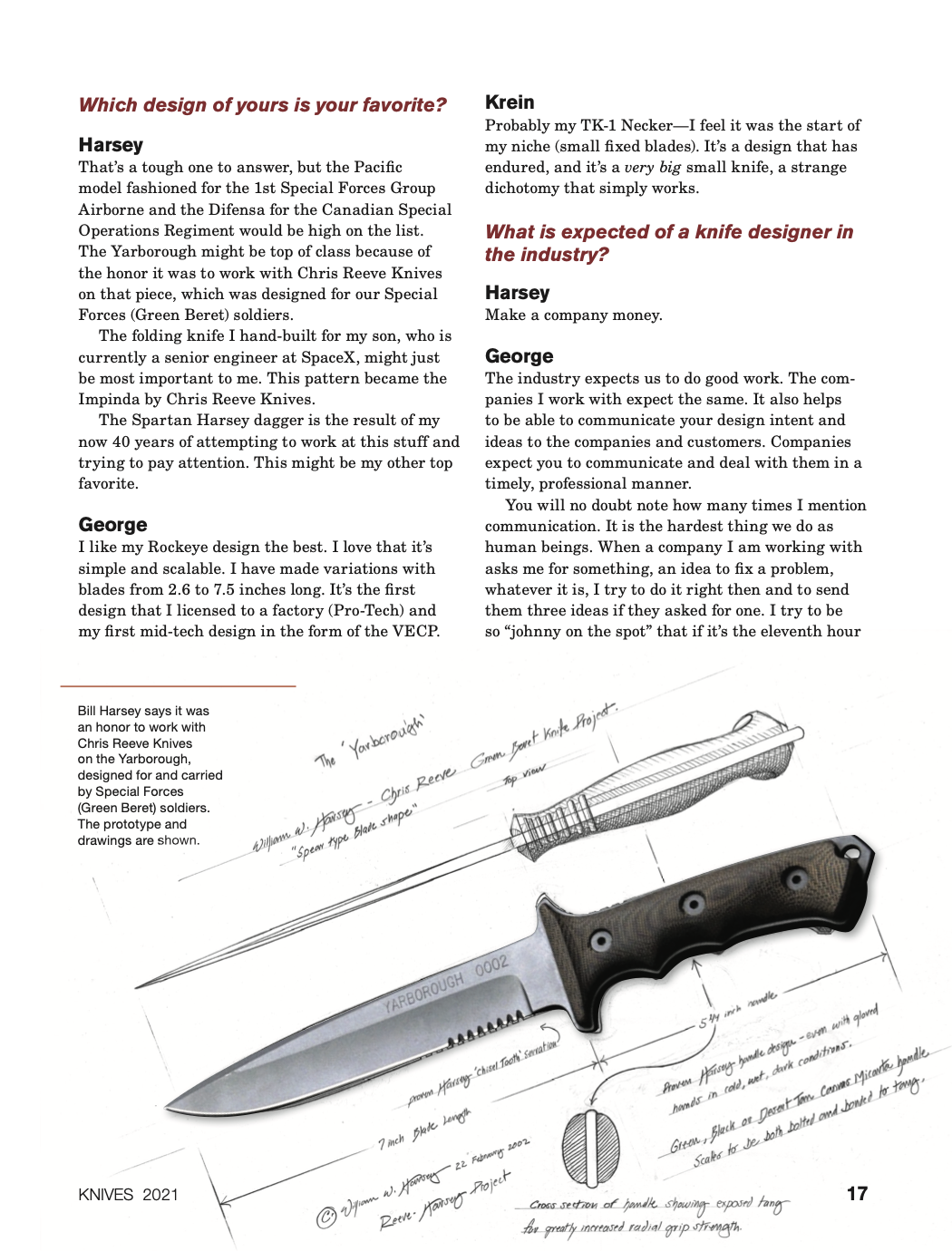
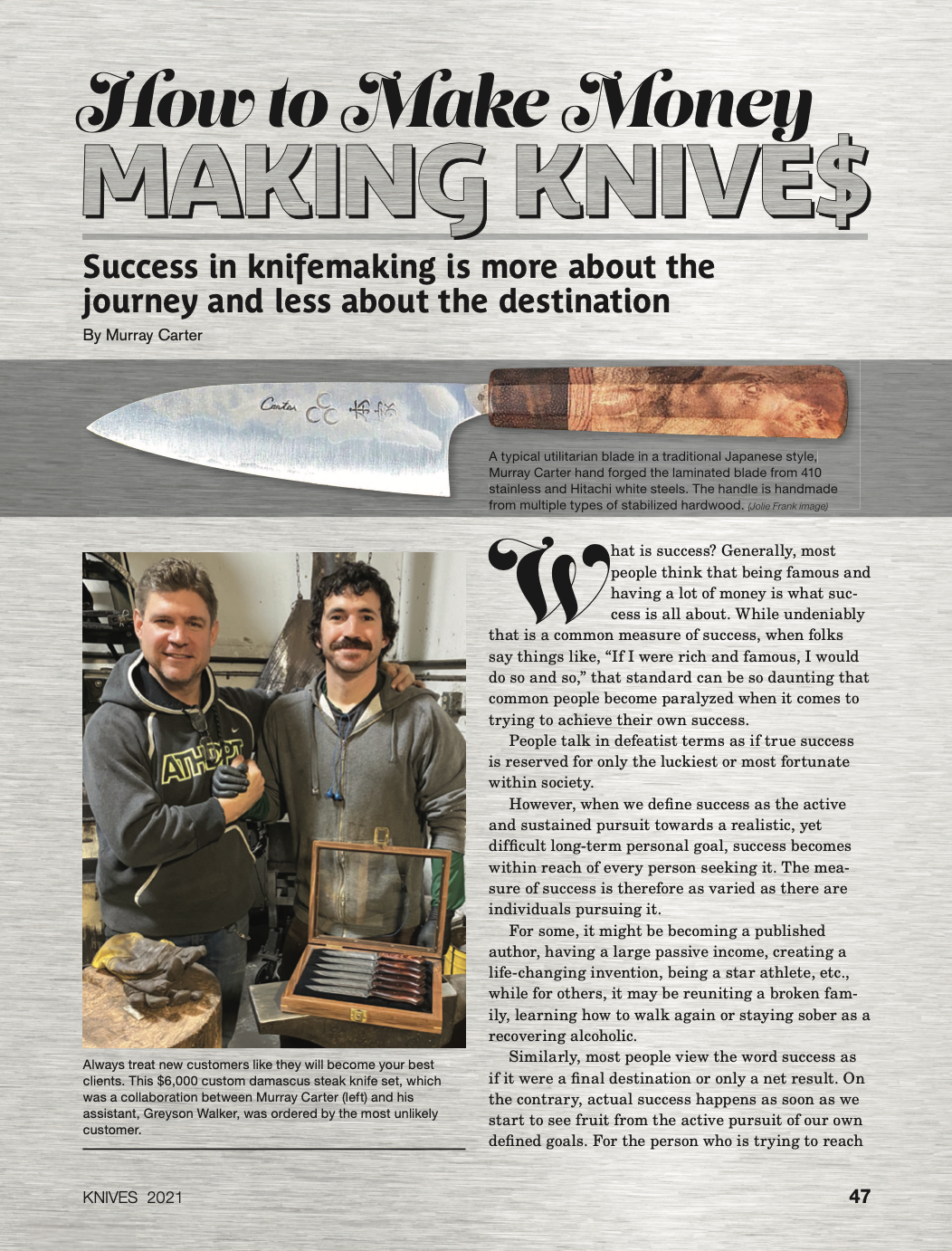
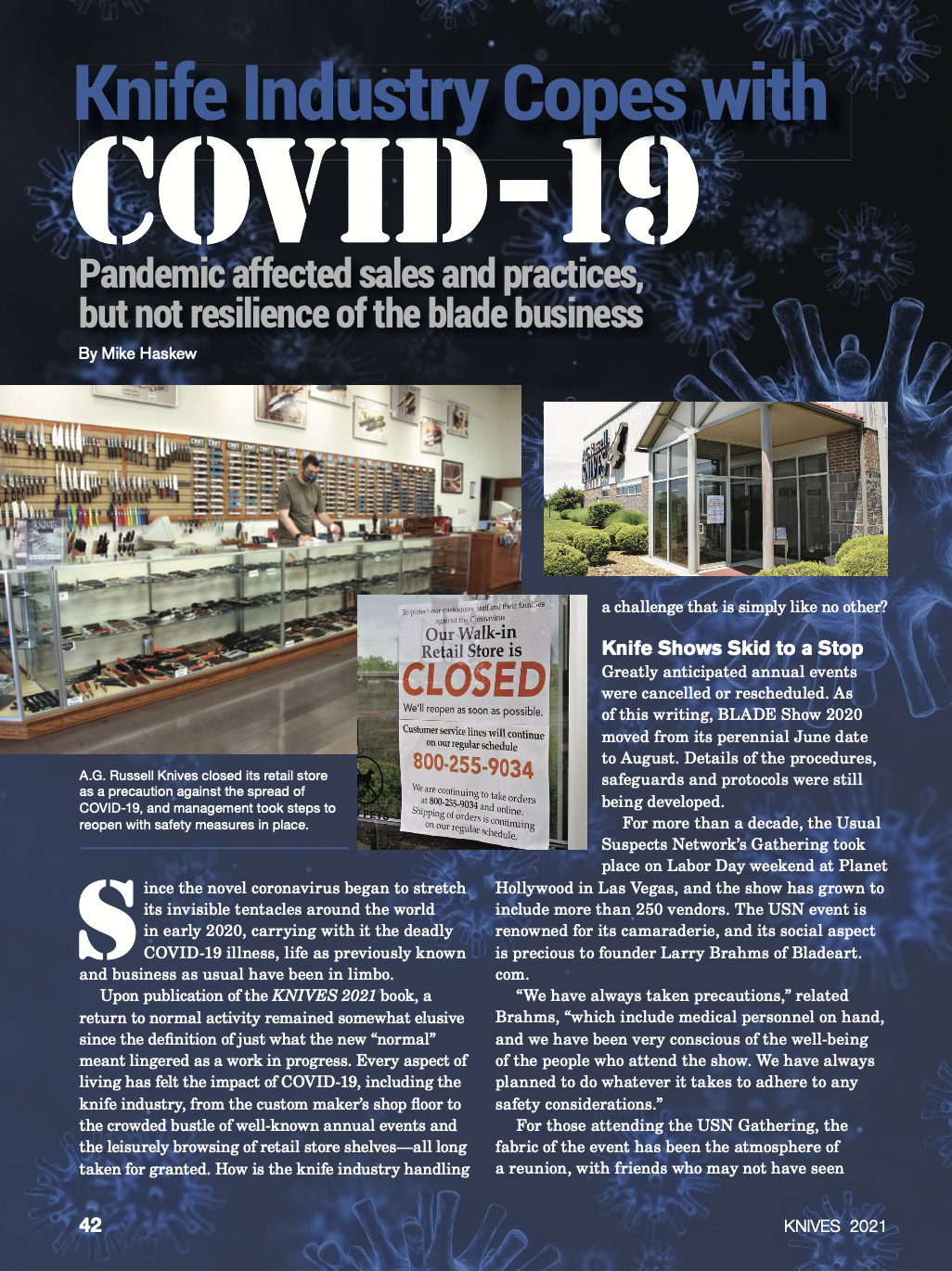
  • Enthralling articles about balisongs, making money making knives, urban EDCs, tactical knives, knife designers and more.
  • The latest trends of flippers, daggers, chef knives, fighters and more.
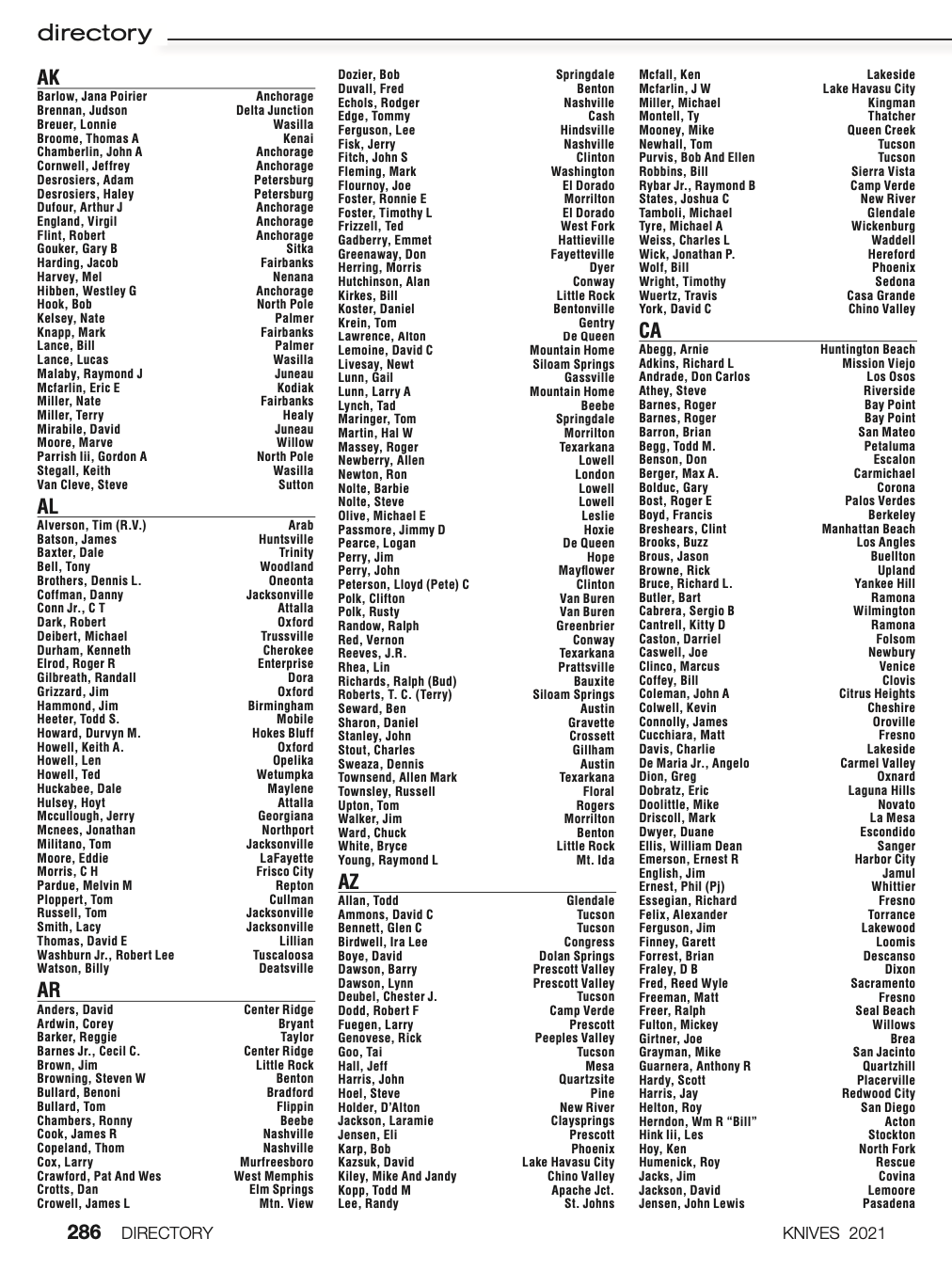
  • A comprehensive Custom Knifemaker Directory includes contact information, websites, specialties, materials, price ranges, tools, tang stamps and comments. 
  • Learn More + Shop Here

KNIVES 2021 Sneak Peak:

Advertisement

Must Read Articles

Read this before you make a knife

Knifemaking 101 – Read This Before You Make a Knife

  by Wayne Goddard My experience has taught me that there's nothing like digging in and getting started. I've often said the hardest part of the...
how to forge damascus steel

How to Forge Damascus

Advertisement
Advertisement