Location: William F. “Bill” Moran, Jr School of Bladesmithing Texarkana College Washington, Arkansas
Information: Contact B.R. Hughes at (903) 824-6588 or Email [email protected]
Registration: Pre-Register and pay the $55 Registration fee online in the Store or contact Cindy Sheely, ABS Office Manager at [email protected]or (419) 832-0400 Demonstrators: Ron Newton, MS………………..Advanced Damascus and Folding Knives Mike Williams, MS………………Handles and Guards and ABS Judging Standards J.R. Cook, MS……………………..Basic Forging and Sound Hunter Design BR Hughes, Founder……………ABS Judging Standards and Auction Dr. Jim Batson, MS………………Bowie Basics and Basic Heat Treating Schedule: on ABS Website www.americanbladesmith.com
Accomodations: Holiday Inn Express, 2600 North Hervey Street, Hope, AR 71801, (870) 722-6262 Best Western, 1800 Holiday Drive, Hope, Arkansas 71801-2510, (870) 777-9222 Super 8 Motel, I-30 and Hwy 278, Hope, AR (870) 777-8601 Relax Inn, 2504 N. Hazel, Hope, AR (870) 777-0777 Days Inn, 16600 N. Hervey, Hope, AR (870) 777-0777
Sandy Froman, past president of the National Rifle Association and one of the nation’s foremost Second Amendment activists, was the keynote speaker at Knife Rights’ Second Annual Sharper Future™ Awards Breakfast held June 11th during BLADE Show in Atlanta, Georgia.
Froman spoke on “How To Win a Knife Fight–Lessons Learned in the Crucible of the Second Amendment”
Sandy Froman was President of the National Rifle Association of America (“NRA”) from 2005-2007. She has been a member of the NRA Board of Directors since 1992 and was elected as vice president in 1998 under President Charlton Heston, serving as an officer of NRA for nine years. She has chaired six NRA committees, including the Legislative Policy, Grassroots Development and Ways and Means Committees. Upon finishing her second term as NRA President in 2007, Froman was unanimously elected for life to the NRA Executive Council by the NRA Board of Directors
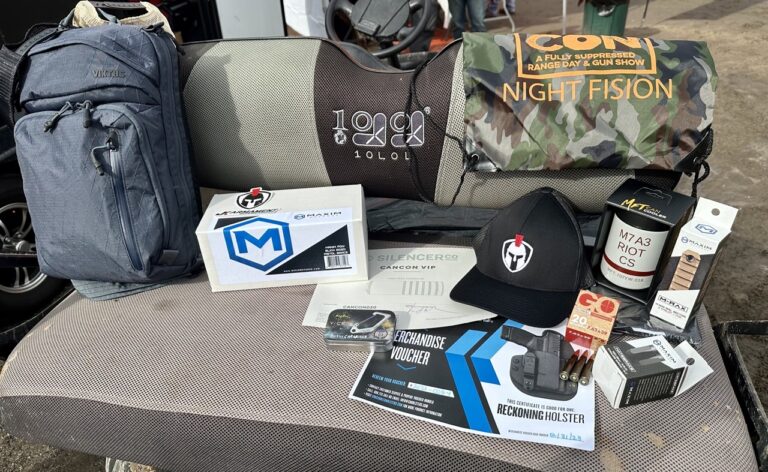
We’re not trying to rub it in that you missed out on the 2022 VIP bags at CANCON in Georgia, but you might feel pretty disappointed that you missed out once you read what was in them.
The good news is that we’re holding TWO CANCON events in 2023! The first one is April 29-30 (VIP access on the 28th also!) in Phoenix, Arizona.
And we’re coming back to Richmond Hill in Georgia, November 10-11 (VIPs get in a day early as well!), so there is really no excuse for you to miss out on some VIP bag goodness this year.
WHAT’S IN THE BAG
You’ll have to come down to Arizona to find out what is in that VIP bag, but we can take a tour through the 2022 CANCON VIP bag to give you an idea of the kind of high-end swag we put together.
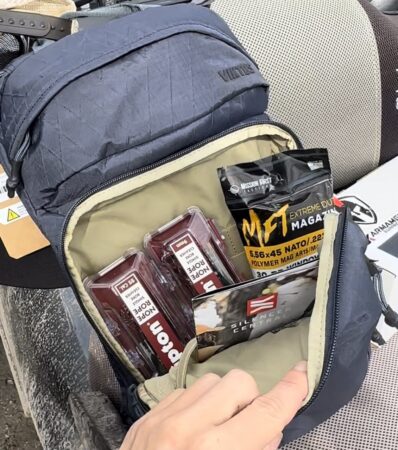
Viktos XL Slingbag
Blue Force Gear Sling
Otis Ripcord Cleaning Cord
Caldwell DeadShot Shooting Bags
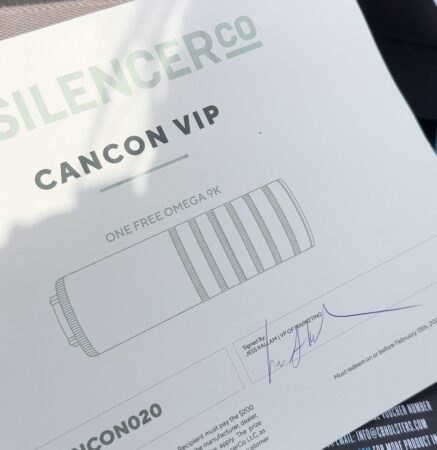
SilencerCo Silencer (Ya, a FREE silencer)
Subscription to Recoil and Offgrid magazines
Mission First Tactical Extreme Duty Magazines 556
Mission First Tactical Coozie
Maxim Defense Hate Brake
Maxim Defense Arm Brace Stock
Primary Weapon Systems Gift Certificate
JK Armamant Stickers and Hats
And that’s not all! We also snuck in a box of Global Ordnance Ammo and a Key Bar Carabiner.
Total VIP Bag Value? Over $1,600.
Will 2023’s VIP bags be better than last year’s? I think they are, but you’ll have to stop by CANCON to find out!
Coming to CANCON but not a VIP? Take a chance at winning a VIP bag! All CANCON attendees can enter to win a VIP Bag, all you have to do is:
From tactical rings to signature openers: analyzing the practical advantages of negative space in blade engineering.
The hole in the handle or blade, or anywhere in knife construction, has something to tell the user. But what is it trying to say or do?
It is eye-catching but the hole and/or ring and the science that goes along with it complement the visual and the practical in knife use. Aesthetics, mechanics and utility are factors. After all, the essence of the knife is in its use as a tool, and who wouldn’t mind a prettier profile at the same time?
Original Hole
The story of the hole in the blade cannot be told without including Spyderco and its legendary leader, BLADE Magazine Cutlery Hall-of-Fame® member Sal Glesser. In the decades since Spyderco introduced its iconic hole in the blade, the company has produced countless folders that characterize the ease of opening inherent in the hole itself.
The story of the hole in the blade cannot be told without Spyderco and its legendary leader, Sal Glesser. The BLADE Magazine 1990 Overall Knife of the Year®, the blade-hole-opening Endura is one of the company’s longest-running models.
Sal said he well remembers the inspiration to step out with his company’s blades.
“The Buck 110 and Gerber Folding Hunter were the watershed change to locking knives, in my opinion,” he recalled. “I purchased a Buck 110 when they first came out. As a young man I learned to open the Buck and Gerber lockers with one hand using my thumb, pushing on the side of the blade. I was working late in the shop one night, payables, payroll, etc., and I thought to try to figure out a way to modify a folding knife so that anyone could learn to open [it] with one hand more easily and more safely than the way I was doing it.”
From that single thought, Glesser went to work. He experimented with adding to the blade for leverage—studs, discs, hoods and other things—but found they got in the way when cutting or sharpening and could “wave” the knife open unintentionally when deploying.
“So I started taking things away from the blade to create purchase for the thumb,” Sal continued. “I first roughed up the side of the blade, which worked, but not very well. Then I drilled a dent into the blade. A dent on both sides became a hole.”
Eureka!
Sal plowed ahead, making a rough prototype using a Japanese folder and welding a piece of drilling rod to the spine of the blade to add height. He ground it down to the thickness of the blade and then drilled the hole to test his ease-of-opening theory.
“We applied for a patent claiming a ‘ledge’ created by the edge of the hole that could be used by the fleshy part of the thumb to urge the blade open with one hand,” Sal recalled. “I chose to use a round hole because it was easier to make and was easily identifiable.”
The rest, as they say, is history.
From the first blade-hole model in 1981, the Spyderco Worker, the distance from the center of the pivot to the hole was analyzed while the optimal size of the hole for the average thumb was measured. Enhanced trademark work was successful in securing the round shape since copies were notable with different shapes to get around the word “hole” in the original Spyderco patent language. Hence, the company introduced the hole into its fixed blades as an identifier “large enough to be cleaned and small enough to be noticed.”
Perfecting the hole for its primary purpose of easy opening meant leaving a certain amount of steel above the hole to compensate for the space. “Some steels that are more brittle could be broken through the hole if pried with hard enough,” Sal concluded. “But the truth be told, there are millions of Spyderco knives in the marketplace over the past almost 50 years and there have been very few that were broken.”
Where & Why Of Holes
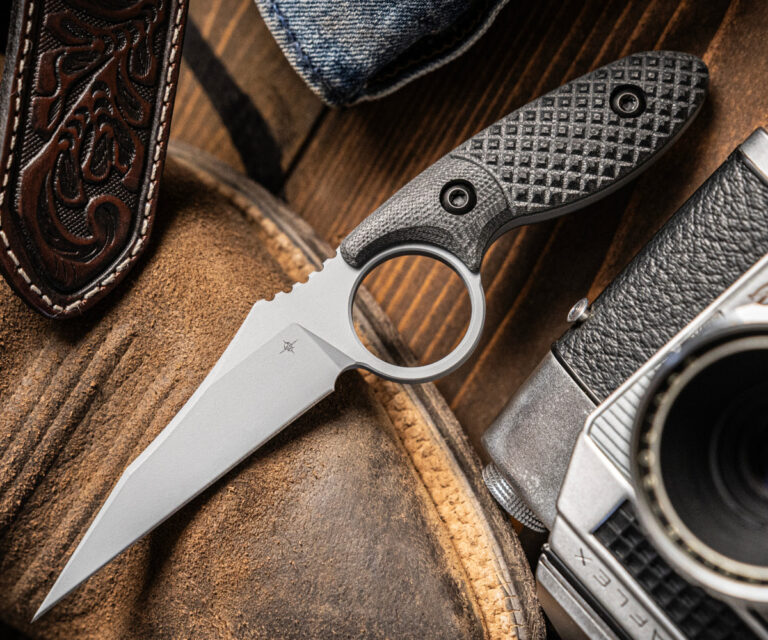
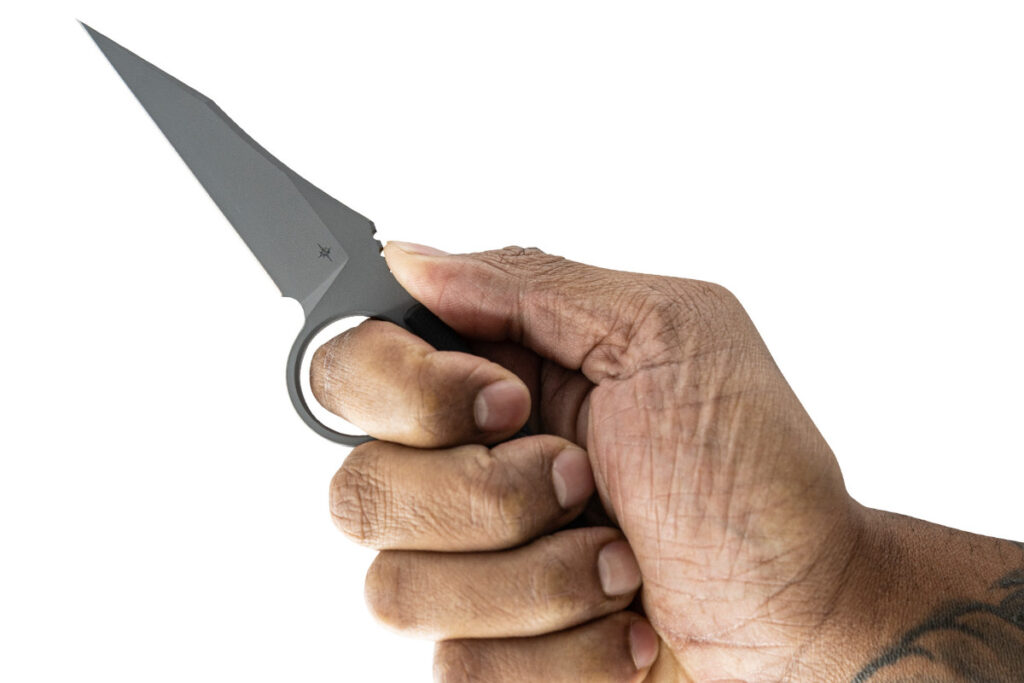
Toor Knives CEO Connor Toor says the hole/ring of the Cortano is between the handle and blade for several reasons, including deployment and retention, a tactile index for consistent hand placement, a lanyard attachment point, and an unmistakable visual signature. Another is the ability to choke up for precise cuts without losing control.
In overall perspective, the hole has its place in the fixed blade as well. The Toor Corporation Cortano sports the hole/ring for a simple reason according to CEO Connor Toor.
“A hole allows fast, ambidextrous one-handed deployment without extra hardware,” he explained, “and it keeps the blade profile clean and snag resistant. It also slightly reduces weight and manufacturing complexity compared with an added stud or thumb disc.”
The hole in the Cortano is located between handle and blade for several reasons, including deployment and retention, a tactile index for consistent hand placement, a lanyard attachment point, and an unmistakable visual signature that differentiates the knife. An added bonus, says Connor, is the ability of the user to choke up for precise cuts without losing positive control.
“We typically call it an ‘index/retention ring’ or simply the ‘deployment hole,’” Toor commented. “The concept is rooted in historic ring knife forms and modern karambit/utility designs more broadly, so while makers like Steve Likarich are part of that lineage, our design pulls from both traditional ring knives and contemporary tactical needs rather than a single source.
“Any aperture introduces stress concentration,” Connor continued, “but proper blade geometry, material selection and heat treatment mitigate that risk. We designed the Cortano so overall material thickness preserves strength around the hole. Real world testing and appropriate use show no practical durability issues when those engineering details are respected.”
Holes For Balance
The Formido fixed blade from Spartan Blades comes with a series of grip holes, that, explains company president Curtis Iovito (inset), “primarily tune balance by reducing handle weight.”
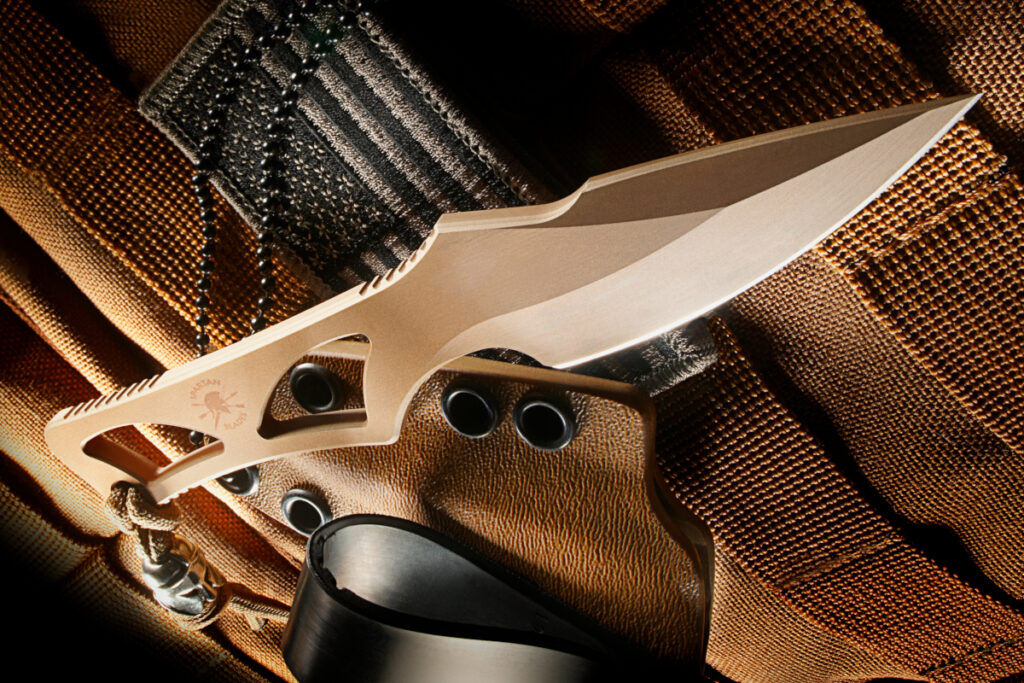
The Formido fixed blade from Spartan Blades comes with a series of holes in the handle, and company president Curtis Iovito readily points to the advantages of the design.
“It’s primarily to tune balance by reducing handle weight,” he advised, “often to place the balance over the index finger. We’ll enlarge or shrink hidden holes under the scales to shift weight where it best serves the knife’s purpose. Looks can be a secondary benefit. Along with weight reduction, there are options for lashing or paracord wraps, and added indexing/traction without introducing weak corners. In some cases, they also enable spear mounting or other field attachments.”
Curtis adds that the parameters for the introduction of holes in the blade or body of the knife vary as to the designer’s objectives.
“There is no universal formula,” he related. Holes, however, must measure up to certain standards to “maintain strong ‘webs’ of material around fasteners and stress points, and scales must be clamped well to prevent lifting and contamination. Round holes are favored because they machine easily and avoid sharp internal corners that become stress risers during heat treat. Arched/rounded cutouts can add torsional strength as seen on our Enyo and Formido.”
Holes In Karambit
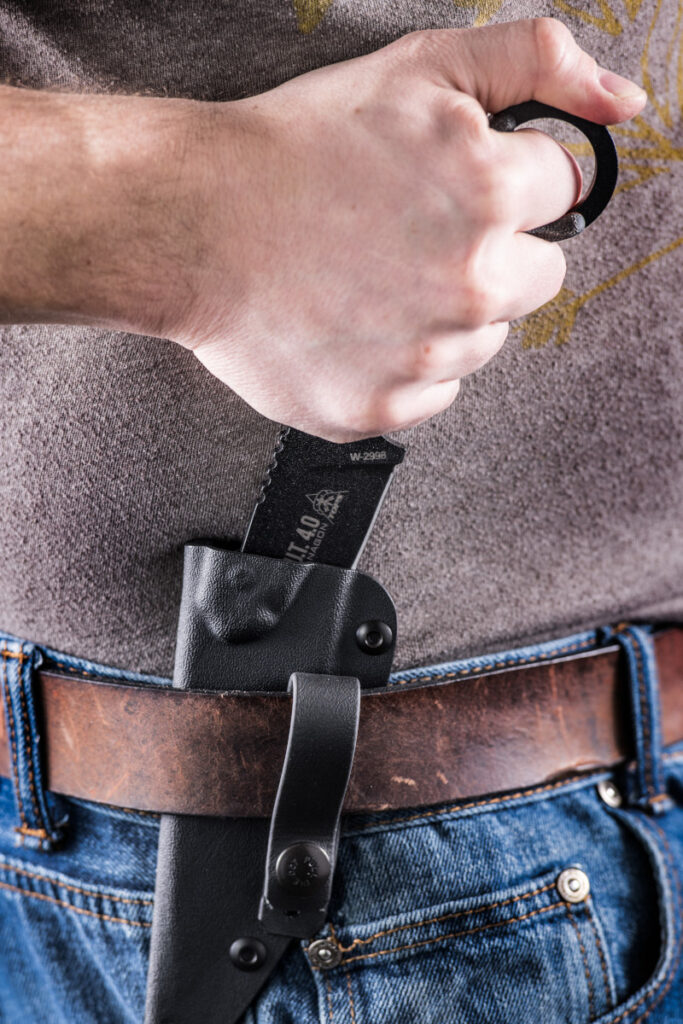
Designed by Joshua Swanagon, the TOPS Knives C.U.T. 4.0 is a hybrid karambit that combines the practicality of a utility knife with the defensive and combat features of a standard karambit. Its ringed handle is common to the pattern’s lineage while the utility drop-point blade is more of a traditional design element.
At TOPS Knives, the C.U.T. 4.0 is a hybrid karambit that combines the practicality of the utility knife with the defensive and combat features of the karambit. Its ringed handle is common to the karambit lineage while the utility drop-point blade is more of a traditional design element. The karambit hole itself is probably a derivative of agricultural use.
“It does seem to be the case that many karambits used in Asia were used as a tool first, cutting cane or other crops” said Craig Powell, TOPS general manager. “As a tool, the pinky is usually in the hole so that the knife can hang down from the hand while the user is picking up the harvest, and then it is swung back into the hand to use the cutting edge.
“I wouldn’t say there is a set rule on the size of the hole,” he added, “but too small makes it easy for fingers to get stuck, which can equal broken fingers or de-gloved fingers in situations where the knife can’t be dropped when needed. Too large makes the knife clunky to use and manipulate properly and too easy to drop. Definitely, there is a balance to be struck. The hole size we use for our karambits does vary somewhat with the overall size of the knife. Typically, the smaller the overall size, the less likely someone is going to use the knife while wearing gloves, so you can use a smaller hole to keep the overall profile of the knife smaller.”
The characteristic ring in the butt of the karambit adds versatility, and Iovito sees advantages in several areas.
“The ring allows rapid grip changes, secure retention of a short blade under stress, and manipulation without dropping the tool. On our CQB Tool, for example, the ring lets a user transition to a pistol grip in a pinch without discarding the blade. We use PEO Soldier [U.S. Army Program Executive Office] data on the average-gloved-finger size for reliable use with gloves. Our research points to about a 1 1/8-inch internal diameter as optimal—big enough for manipulation and glove use without binding, yet not so large that control gets sloppy or the blade flops on the finger. Too small risks pinching, circulation issues, and snagging; too large compromises indexing and retention.”
Michael Janich, special projects coordinator at Spyderco, agrees that the karambit has an agricultural lineage but adds that the island archipelagos of the Pacific, where the design developed, will often provide different cultural backgrounds to its story.
“After harvesting a bundle of vegetables, the handle was released, allowing the knife to hang from the pinky, freeing both hands to tie the bundle,” Janich reasoned. “In contrast, sheathing the knife every time was inefficient and would require the blade to be cleaned to prevent soiling the inside of the sheath. Logically and practically, this makes sense. Some stories of the origin of the karambit, though, suggest that it was developed primarily as a weapon.”
Arched/rounded handle cutouts can add torsional strength as seen on the Enyo by Spartan Blades.
As for the dimensions of the karambit and its characteristic hole, Janich points out that some tools defined as karambits of Southeast Asian origin do not even sport the hole. Nonetheless, the hole defines the karambit today.
“The karambit is not the only historical knife to have a ring,” Michael added. “The Japanese kunai was a trowel-like tool that had a ring at the end of the handle. The ring could be used to enhance grip retention. It also allowed the tool to be hung from a cord for easy transport or for the attachment of a lanyard. The Chinese martial arts also had daggers with butt-mounted rings. In some systems of kung fu, the rings had no specific purpose and only served as pommels. The bird and trout knife, first introduced by Marble’s, also had a pommel ring. Of integral construction, the handle portion of the knife was very narrow, so the ring provided both retention and grip stability.”
Attraction Of The Design
Universally in the world of knives, the hole or ring has its place, its moment, its degree of usefulness. Ultimately, the user chooses the tool that suits the task at hand, and the presence of the hole, for easy opening, control or enhanced utility, is always a candidate for deployment.
Master Smiths Harvey Dean, Tim Hancock, and Steve Dunn describe the American Bladesmith Society – ABS Expo which is set for January 27 – 29, 2012 in San Anto…
From Forging And Picking The Right Materials To Putting Together The Fairest Return Policy And How To Run Your Business, There Are Many Questions Fledgling Knifemakers Should Ask Veterans.
This is the first of a multi-part series about knifemaking
When you consider buying a custom knife, certain questions come to mind. Some are easier asked and certainly more easily answered than others. However, anytime money is forked over in exchange for a handmade, well-built knife, an exchange of information takes place. Still, there may be a fine line between the ordinary, the somewhat sensitive and the downright invasive.
BLADE® asked some well-established custom knifemakers and purveyors what they thought about playing 20 questions with a prospective buyer. In this round of discussion, we’ll tackle those questions that should be asked and answered.
Testing And Heat Treating
I like the questions about testing and heat treating,” commented American Bladesmith Society (ABS) master smith Mike Quesenberry. “As for heat treating, it’s good to know what the maker does. Do they do the work themselves, and what type of heat treating do they do? Is it in a forge, heat-treating oven, do they use a salt pot? Then, on the performance aspect of the knife, is the maker doing any testing, taking it out and beating it or something else depending on the intended use of the knife?”
Veteran ABS master smith and mosaic damascus pioneer Steve Schwarzer agrees. The heat-treating query is near the top of his list. If the makers did the heat treating, did they do it themselves?
“If so, have each maker explain the method. It is perfectly acceptable to ask this question because it is the heart of the blade,” Steve reasoned. “If the maker did not heat treat the blade, ask who did and check the reliability of the heat treater.”
When buying a hunting knife, it’s fair to ask if the makers are hunters themselves or use their own knives in the field. J.C. Provost’s hunter features a 4-inch blade of CPM 154 stainless and scrim by Joanna Provost. (SharpByCoop image)
Authorship
The origin of the steel itself, the aspect of sole authorship, and even asking a bit about the maker’s background is perfectly reasonable, according to longtime purveyor Les Robertson.
“Did the maker do all of the work on the knife? If not, which part of the process is outsourced and why?” Les offered. “If certain aspects of the maker’s knife are being outsourced, this may not be a true custom knife. There can be a fine line between a custom knife and a mid-tech knife. Often, makers grind knives in batches. Consequently, it is more efficient time-wise and more economical to send the blades to a reputable heat treater.
“If the knife features a forged type of blade, especially when it comes to damascus, ask the maker if he forged the steel,” Robertson added. “This question is more germane to those makers not in the American Bladesmith Society. Several people specialize in making damascus for makers to use in their work. Most do an excellent job and offer patterns that will give your knife a unique look. Asking the makers if they belong to a particular knifemakers’ organization is a fair question. But you, as the buyer, should understand what requirements have to be met to belong to the organization and attain certain ratings in each.”
How They Do It
Methods, maker preferences, and perspectives are good areas to probe when discussing the makers’ work. How do they do their thing day in and day out?
“I think buyers should ask whether a knifemaker is a stock removal maker or forger,” said award-winning maker David Broadwell. “That will start to determine what kind of knives people will want. But then, it may not make any difference as long as they like the knife and the maker. Then, the knifemaker should be asked if he or she does all their own work, and if not, what is done outside their shop. This is to determine honesty on the knifemaker’s part. There are other things to ask as well to get to know the knifemaker—full or part-time, family. I like people to know who I am.”
Knifemaker Guarantees
Purchases are often made with the understanding of a guarantee, a buy-back to ensure customer satisfaction.
“You can ask, but I don’t fault anyone if they don’t offer a [buy-back] guarantee,” Broadwell noted. “You can’t buy most any product, say a Harley-Davidson motorcycle, and decide you don’t like cruiser bikes and expect your money back! A deal is a deal, as they say. Now, some makers specialize in multiples of given models, and they may be happy to take a return if they believe they’ll sell it right away.”
The components that make the knife sometimes have a bearing as well. After stressing the sole-authorship point, BLADE Magazine Cutlery Hall-Of-Fame® member Dan Delavan of plazacutlery.com finds a warranty to be reasonable in some circumstances, and then adds a question on components as important to the sales equation.
“Warranty? Just workmanship,” Delavan offered. “The maker cannot guarantee materials as they shrink and expand. The maker should be willing to repair for a charge. Then, does he or she do all the work, and if not, what is done by others? Does the maker bring in outside parts that he or she does not make on her own, examples being such as parts that are made in China or elsewhere, even in the USA? Is the maker able to make modifications?”
For Robertson, the concept of a guarantee is implicit in the trust that develops between maker and buyer. An understanding of care and use is necessary when the question of the guarantee is posed.
“A lifetime guarantee comes with certain responsibilities for both the maker and the buyer,” Les related. “The makers should guarantee the work with regards to their craftsmanship and materials used. Your responsibility as the buyer is to use the knife as it was intended to be used. During normal use, if the blade breaks, yes, the maker should build you a new knife. Now, if you are using a folder as a pry bar and the blade breaks, you are not using the knife for its intended purpose. Subsequently, that is your fault and the maker does not owe you a new knife.”
Genre Specific
Vince Evans
Some makers specialize in historical pieces, reproductions of knives and swords that reflect the times in which the originals were active. Such situations might influence the dialogue between maker and buyer, according to maker Vince Evans.
“My little corner of the field is very different from most other makers,” he explained. “My work is mostly ‘historical’ in nature, so questions to ask could be, ‘Can you tell me more about this piece?’ or ‘What culture is this piece based on?’ or ‘Is this sword based on a specific find?’ When I first met [Cutlery Hall-Of-Fame writer] Ken Warner years ago at the BLADE Show, he walked up and asked, ‘Am I looking at antiques or did you make these?’
“When it comes to period pieces, a telltale sign that a maker hasn’t seen or handled an antique knife or sword is that his rendition is oversized or overweight. Most antique swords, daggers and knives were much more petite and delicate than you would imagine. I encourage makers to study original pieces firsthand, even if it is through a glass case in a museum, before making a period piece. Photos in books and online do not give you a true feel for the original, although many resources do give you measurements and weight. There is no substitute to studying originals firsthand.”
The genre or style that a maker pursues is often the first indicator that a discussion is at hand. Catching the customer’s eye naturally leads to inquiries. When conversation surrounds a custom order, there must be clear understanding related to the finished knife.
“There has to be an exchange between the maker and the customer,” Quesenberry noted, “and that relates directly to how the knife will be used. If it’s a hunting knife, will the customer be skinning only, or will they be breaking bone with it? The customer has to ask what the maker’s knife is intended to do, or if the maker can produce the using knife the customer wants.”
Communication is the key for both parties to be satisfied with the outcome of the buy-sell arrangement. For example, when purchasing a hunting knife, it’s fair to ask if the makers are hunters themselves or use their own knives in the field.
“Sure,” Delavan smiled, “but in some cases the knives can be too expensive for the maker to use. Most knifemakers are not rich!”
Knifemaking Mentors
One of the most important questions to ask makers relates to their background, where they learned their craft—particularly who their mentor, or mentors, in the industry might be. Identification of those who introduced makers to their life’s work or helped bring their skill set along will provide an insight into philosophy, work ethic and mindset, and, ultimately, quality.
“Ask who their mentors are,” Schwarzer advocated. “This is especially important if the maker is forging blades.”
Several people specialize in making damascus for makers to use in their work. Most do an excellent job and offer patterns that will give your knife a unique look. Del Ealy forged the ladder-pattern damascus for the Angel’s Wing art dagger by Steve Vanderkolff. (Caleb Royer image)
Added Quesenberry, “It’s always good to know a guy’s background and the schools they went to and whether the makers continue to educate themselves on newer methods or techniques, or are they becoming stagnant? Do they want to up their game and experiment with different things?”
Chipped in Broadwell, “Of course, I’m proud of the men who shared information and helped me in my earlier years, and if I learn something new I’m happy to share that person’s help as well.”
Open Dialogue
The best approach to discussing the buying or selling of a knife is for both maker and potential purchaser to have mutual respect for one another. In the end, talk may be cheap. However, real, honest and open dialogue develops trust and assurance that the process is working for each party.
Ask questions. Consider responses. Come to informed conclusions, and remember that the entire experience revolves around the knife itself, its quality, materials, looks, and price tag. Most makers welcome questions and are willing to provide candid answers. In that alone, the level of assurance is elevated.