

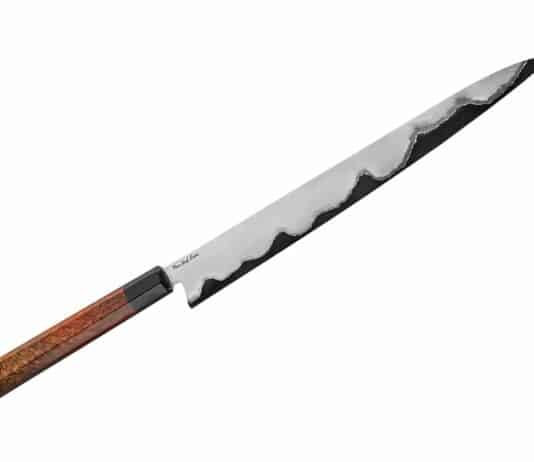
ABS Mastersmith Mike Williams demonstrates the techniques involved in grinding a forged blade from beginning to final grind. Mastersmiths JR Cook and Jerry F…

ABS Mastersmith Mike Williams demonstrates the techniques involved in grinding a forged blade from beginning to final grind. Mastersmiths JR Cook and Jerry F…
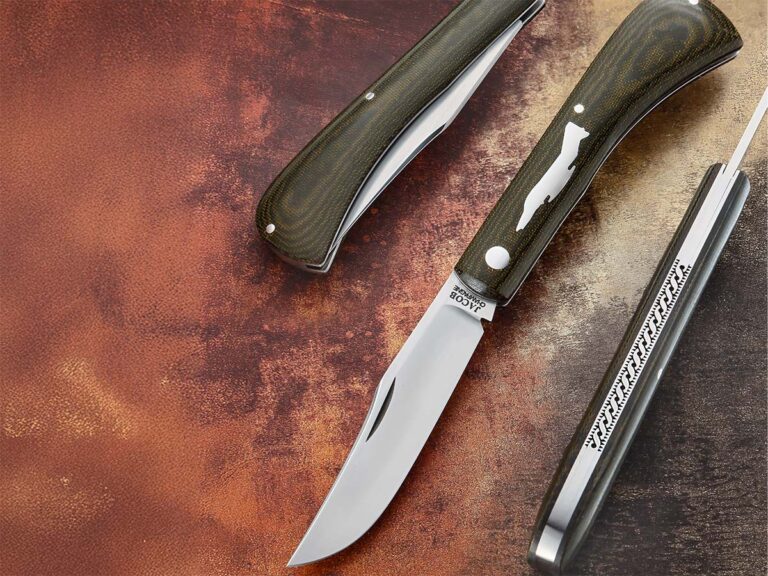
As a founding member of the South Texas Slipjoint Cartel, Rusty Preston made lots of traditional pocketknives over the years, but never did he have one made for him like the trapper recently built by fellow Cartel member Phil Jacob and Ben Champagne.
It all started when a friend sent Ben some green Micarta® bearing some unusual part and serial numbers. They traced it back to a Vietnam-era F4 Phantom fighter jet. The Micarta was part of a chafing block used on F4s as a support to keep hydraulic-activated metal rods used throughout the plane from rubbing or chafing against each other. Ben and Phil knew Rusty was an Air Force pilot during the Vietnam War and when they learned he flew an F4, they decided to use the Micarta in making a surprise knife for him.
The knife had to be a slipjoint, of course, and the two decided on a one-blade trapper pattern. Phil made the blade and springs and Ben made the handle. For a shield they figured a silhouette of an F4 would be appropriate. They got a photograph of an F4 to use as a guide and made the shield of 416 stainless steel to inlay into the Micarta. However, the shield was an inch-and-a-half long.
“It was so long it wouldn’t fit from the center pin to the pivot pin,” Phil said.
The solution? The knife would have to be a shadow pattern, which has no bolsters and provides a bigger canvas for a shield. Phil added some Roman knot filework—which Rusty taught him how to do—to the backspring, and the result is a really cool pocketknife.
Once the trapper was done, they had to settle on a place where they could all meet, including many members of the Cartel, and Rusty would be there, too. BLADE Show Texas would be the place and Rusty was about to get a surprise for the ages.
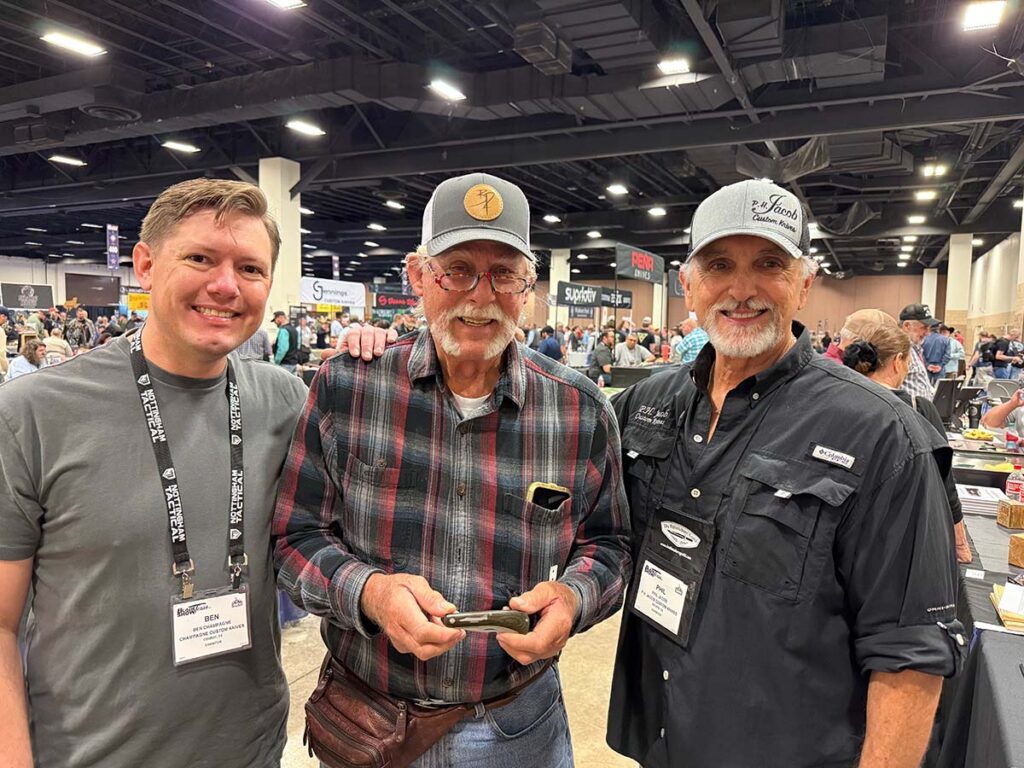
Rusty and his wife Sally had visited with BLADE Magazine Cutlery Hall-of-Fame® member Bill Ruple and the rest of the Cartel members during the show at the Fort Worth Convention Center and were preparing to leave on show Saturday.
“We were just saying our goodbyes and somebody hollered at me—Bill, I think—‘Hey Rusty, come over here,’ and I realized he was at the end of the aisle and he had a group of guys there,” Rusty recalled “Everybody there was a friend of mine, and I thought, ‘Oh, what’s gonna happen here?,’ and sure enough Sally and I walked up—Sally knew about it but I had not a clue—and they started in on me.”
It was all Rusty could do to keep from breaking down—which is about what he did.
“I’ve had this birth defect I’ve had all my life,” he said. “I can squall like a baby at an ice-skating contest at something like that, so it was pretty hard on me but in a good way—you know how that is. So they told me they wanted to present me with something and I saw what it was and I couldn’t believe it. It came as a total, absolute surprise to me. I was dumfounded at what they had done, and why they saw fit to honor me in that fashion is a marvel to me.
“It was just an honor to look around and see the approval on every one of those guys’ faces for what was happening.”
Rusty called the work on the knife “stunning.”
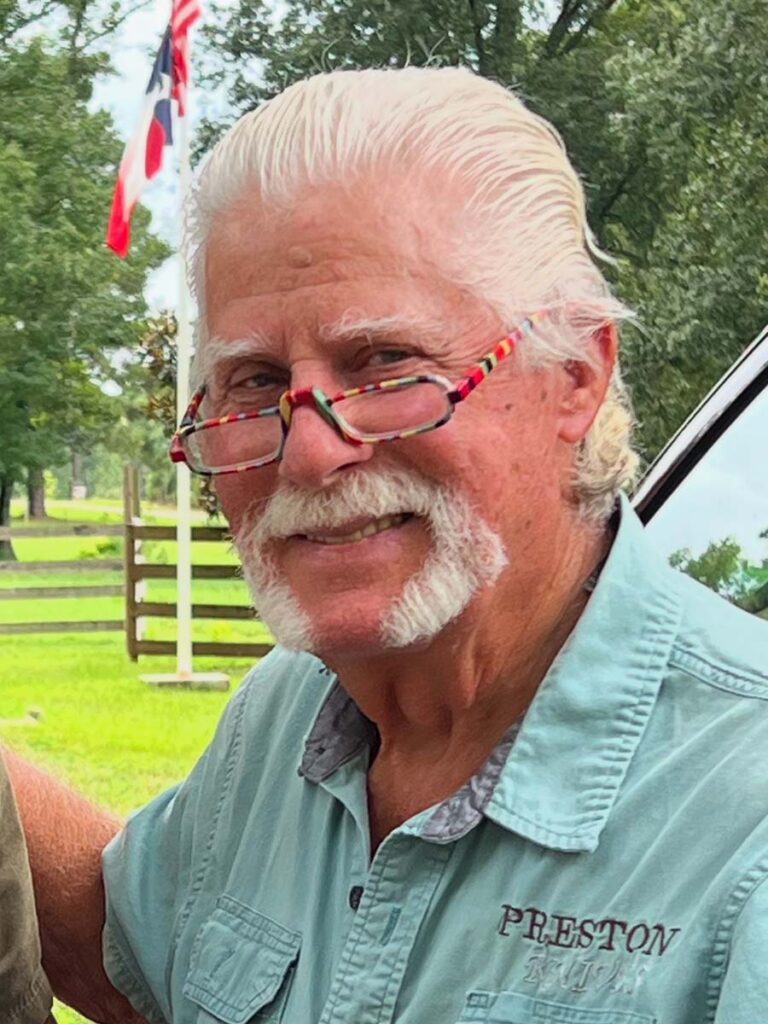
“It’s got both Ben and Phil’s names on the blade and it’s just absolutely outstanding detail work on the inlay and the silhouette of the F4,” he observed. “That took a lot of effort. I don’t know how they managed to get ahold of all that but they did. It’s beautiful, it’s perfect.”
But what about that Micarta? How in the heck was Ben able to obtain material meant for an F4 Phantom jet fighter? Some things are just better left unsaid.
“The fact that the handle material is what it is and where it came from, how in the world Ben ever got ahold of F4 parts I don’t know. And I’m scared to ask him,” Rusty grinned, “because he’d probably tell me.”
Location:
William F. “Bill” Moran, Jr School of Bladesmithing
Texarkana College
Washington, Arkansas
Information:
Contact B.R. Hughes at (903) 824-6588 or Email [email protected]
Registration:
Pre-Register and pay the $55 Registration fee online in the Store
or contact Cindy Sheely, ABS Office Manager at [email protected]or (419) 832-0400
Demonstrators:
Ron Newton, MS………………..Advanced Damascus and Folding Knives
Mike Williams, MS………………Handles and Guards and ABS Judging Standards
J.R. Cook, MS……………………..Basic Forging and Sound Hunter Design
BR Hughes, Founder……………ABS Judging Standards and Auction
Dr. Jim Batson, MS………………Bowie Basics and Basic Heat Treating
Schedule: on ABS Website www.americanbladesmith.com
Accomodations:
Holiday Inn Express, 2600 North Hervey Street, Hope, AR 71801, (870) 722-6262
Best Western, 1800 Holiday Drive, Hope, Arkansas 71801-2510, (870) 777-9222
Super 8 Motel, I-30 and Hwy 278, Hope, AR (870) 777-8601
Relax Inn, 2504 N. Hazel, Hope, AR (870) 777-0777
Days Inn, 16600 N. Hervey, Hope, AR (870) 777-0777
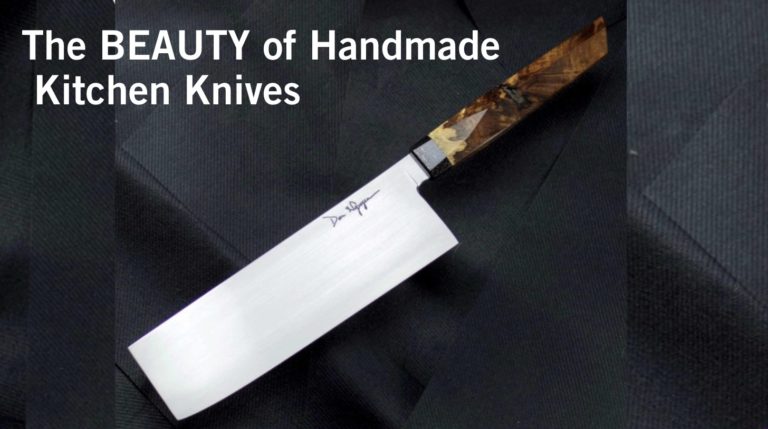
Don Nguyen didn’t know what he wanted from life when he was in college. An evening cooking at a friend’s apartment changed him forever. He was frustrated using his friend’s subpar, dull knives and wanted something better.
“It was that weird moment sharpening at a friend’s place where I said ‘I’m tired of this,’” Nguyen recalled. “I watched a bunch of YouTube videos, and those videos led me from sharpening to seeing Japanese makers make knives. I didn’t know what I wanted to do in life at that point so I was like OK, I want to do this. I dove in from there.”
Dive in he did, and now Nguyen has been making handmade kitchen knives, also commonly called custom kitchen knives, since 2017. He’s one of many makers entering the growing kitchen knife space and finding success.
Of course, the biggest difference between factory makers and custom makers is scale. A company like Wusthof can turn around hundreds of new knives every month. By contrast, Nguyen and his assistant complete a knife every one to two weeks. This allows for more delicate work when it comes to the actual knifemaking and makes getting different steels much easier.

“Right now we’re probably averaging one knife every two weeks depending on the complexity, but we’re working on multiple knives at once so it’s hard to dictate how long a single knife takes,” Nguyen said. “I have an assistant and he helps me work on a bunch of stuff. We’re juggling projects all the time.
“I don’t have a lot of steel that I need to go through, and the steel choices I tend to use aren’t exotic steels. I go with 52100 for the most part for carbon steel knives. When I go with stainless I go with AEB-L or RWL-34. Those are fairly accessible. They’re usually in stock.”
When you talk to him, Nguyen’s passion is clear, and even with that passion, a big question remains: why should someone spend money on handmade kitchen knives instead of buying from a well-known factory maker?
He spoke honestly about how handmade kitchen knives won’t be for everyone, but for those who want them, they want only the best.
“Custom knives are made for a specific type of person,” Nguyen said. “They need to have food as their hobby. If they don’t like cooking all that much, they aren’t the intended audience for that. But if you love food, you follow it, buy books, read up on chefs, then you get into custom knives. Then you get knives in the [top] percentile of performance that are unique, made by someone you admire.”
As more makers enter the market, finding out ways to make your knives that are little bit better than your competitors has become the key to knifemaking. So much so that, according to Nguyen, many makers are working on what the knife does after it cuts the food.
“There’s a lot of interesting trends in knifemaking and the pursuit of the last 1 percent in performance,” Nguyen said. “A lot of makers now are working on food release. Being able to cut the food and having it pop off the [blade] without any effort at all. That’s a huge difference between a knife you buy off the shelf and a custom-made knife.”
Nguyen is one of the highly-skilled makers producing handmade kitchen knives. The below makers are also making exciting knives.

A former executive chef, Mert Tansu has been making remarkable kitchen knives in his native Australia for several years, learning to forge san-mai and damascus, and officially hung up his chef’s coat in 2018 to focus solely on making knives.
His current knives are made in the Japanese tradition and fetch a tidy price, but the craftsmanship is clear from the moment you lay eyes on the blade.

Located in Washington state, Maumasi apprenticed under Bob Kramer, who we’ll talk about shortly, and makes multiple types of knives. He’s made many a wild damascus piece as well, and is a magician at working the steel to create exciting patterns.
“I think he’s one of the best makers out right now,” Nguyen said of Maumasi. “I talk with him all the time about business strategy, techniques, everything we’re going through.”

He worked as a professional chef for a decade before asking himself “why can’t I and other chefs keep our knives sharp?”
That question led him down the path to becoming one of the most accomplished makers of custom kitchen knives in the country. Kramer earned the title of ABS master smith in 1998, and since then he’s been “devoted … to the single-minded pursuit of crafting the perfect kitchen knife.”
His Kramer Knives not only turns out top-tier blades, but now features a small team to help keep the company strong and growing for decades to come. Additionally, his company has licensing agreements with a handful of major knife companies including Zwilling J.A. Henckels.

Andreas Kalani spent nearly a decade teaching himself the craft of knifemaking. He took his lumps and learned from his mistakes. Those years of trial and error have paid off as Kalani is now an accomplished knifemaker.
He makes beautiful Japanese-style knives as well as other kitchen utensils. Kalani even makes hunting knives and tools for skinning and processing your hunt. It all started with a dream for Kalani, and it has paid off handsomely thus far.

Knives from Will Brigham are just as much art as they are kitchen tools. He specializes in pattern-welded damascus and mokume-gane knives. His sells his knives through his company, The Artificery, and he’s pushing hard to make the most distinctive damascus designs and highest-quality blades.
“Will Brigham is making crazy stainless steel damascus,” Nguyen said. “I think he’s kind of the pioneer of modern stainless steel damascus.”
Read More
Editor’s note: Last time we outlined the questions you should ask the maker. This time, we cover some of the things that you either probably should not ask—or at least should think through thoroughly before doing so. You can read part 1 here.
Custom knifemakers are, for the most part, reasonable people. Actually, they’re a pretty likable lot. Engage one in conversation and it’s likely to be a pleasant experience.
Ask a maker about a knife and the discussion enters another dimension, particularly if it develops into one between a seller and potential buyer. Questions are part of the exchange of information, and just about any inquiry is fair. However, it pays to be courteous and respectful and to remember that courtesy and respect go both ways.
So, are there questions that are off limits when discussing the merits of a custom knifemaker’s work, their background, experience, or perspective? What are the potential hot buttons and how much is too much when it comes to probing a maker? Well, if you have to ask yourself whether a question is appropriate, then think twice about asking it. If it might not sit well with you on the receiving end, just remember those principles of kindness and respect.
“Asking a maker how long it took to make a knife is not polite etiquette,” offered veteran Vince Evans, “and it could also be misleading. An experienced maker may take 40 hours to make a really nice piece, whereas a beginner may spend 100-plus hours and come out with a poorly executed knife. On more complex knives and swords, the process may take months, or even years, to complete. So, a maker may not keep track of how many hours he has in a piece.”
David Broadwell has more than 40 years of experience making custom knives, and the time factor is always a bit contentious for him. “This is probably the most often asked question of me,” he said candidly. “I don’t know how long it takes! I don’t punch a time clock on each project. Most of my knives are fairly complex, and I do each step or operation until it’s right, regardless of the time. Simpler knives are easier to track with regard to the time involved.
“Another thing related to time,” David continued, “is that it’s easy for someone to start believing that because I, for example, with four decades of experience in grinding, can make a knife more quickly than another maker, so I should charge less per hour. But that’s not a fair comparison. I have all that experience, so some operations are quicker for me—but I should be paid for that experience.”

From a practical standpoint, BLADE Magazine Cutlery Hall-Of-Fame® member Dan Delavan of plazacutlery.com added, “It doesn’t hurt to ask, but most makers make knives in batches, so it’s hard to say.”
Even if the potential purchaser is bold enough to ask about the investment of time in a particular knife, the response may not be helpful. “It may not give you the answer you’re looking for,” commented longtime purveyor Les Robertson, “Why? Often the time to make a knife will depend on the maker’s experience level, the equipment in their shop, and the complexity of the knife. There is no set time for how long a particular knife should take to build.”
Beyond the time element, looking at a particular knife may prompt questions of a sensitive nature, particularly about the process itself. When credibility is on the line, what should the potential buyer do?
“Hmm, I’d say watch his eyes and study his body language,” Broadwell advised, “and, of course, a buyer needs to educate himself to be able to spot fakery.”

Most often the knifemaker’s work speaks for itself and to an educated buyer the quality or lack of quality in a handmade knife is readily apparent, but there are telltale signs when the presenter is blowing smoke. “If he or she does not look you in the eye, it’s a good indication,” Delavan related. “Hesitancy in the voice is a tip-off as well.”
Developing rapport is a big part of any relationship, and becoming friendly with custom knifemakers is often part of the enjoyment of buying and collecting their work. Still, personalities vary. The outgoing, talkative individual and the introverted, quiet one may accept inquiries on a different level, and of course, there are the pressing factors of time commitment—particularly during shows. Monopolizing a maker’s table time is bad etiquette when he or she has other customers or prospects to interact with. So keep it polite and to the point with an awareness of the clock.
One of the more interesting questions for a custom knifemaker might revolve around the knife the maker carries. You may be going out on a limb, putting the maker on the spot, or even offending him if you want to know what’s in his pocket. Ask at your own risk!
“I’ve always been surprised to find out a custom folder maker was carrying a factory knife,” Robertson observed. “This made no sense to me. Carrying a folder made by them would allow the makers to field test their knives regularly. For makers who build larger fixed blades, it can be difficult to carry these knives regularly. However, if they hunt, camp or fish, they should be using their knife, again to field test it. I feel it gives the maker more legitimacy when they tell what their knives can and cannot do.”
Broadwell added, “This is very important to me. Personally, I believe if a maker carries on his person a knife from another knifemaker or a factory, he is saying, especially to the newer and less educated buyers, that knife is better than the one he makes. That is not good salesmanship and marketing of your own brand.”

Possibly the biggest question of all relates to pricing. Is it OK, fair, chippy, or downright irritating to ask a custom knifemaker if a price for a certain piece is negotiable? Once more, depending on the depth of the existing relationship between maker and potential buyer, take stock of the possible outcome of the query before making it.
“In some cases, you will insult them,” Delavan said bluntly. “But on the last day of a show, some makers may give a better deal.”
Robertson sees a subjective exercise in the dollar dilemma. “Pricing is something each knifemaker must figure out for themselves,” he remarked. “As the buyer, you need to educate yourself as to what it takes to build a particular style of knife. This will help you determine what you feel the price of the knife should be. My advice to knifemakers is to price their knives according to their position in the marketplace they are competing in. By doing so, you are offering your work at a fair price, and you should not lower your price. As the buyer, you can ask the maker to lower their price, but don’t do so just because you think you should haggle on the price of a knife. You are not buying knives at a flea market.”
Tact and diplomacy work better than the “ready, fire, aim” approach. Knowing something about the knifemaker may indicate whether the door is open for negotiation. “This is a tricky question,” Broadwell said. “If the buyer is polite and respectful, it’s all right to ask. However, if the maker does not want to bargain, it should be dropped. What ticks makers off is a potential buyer who says he will just give such and such for a knife and that that’s all it’s worth. That’s arrogant and disrespectful!”
Concerning guarantees and 100-percent buybacks—the latter involving the maker buying the knife back from you if you buy it but then don’t want it—consider the accountability on both sides.
Like so many interactions between two people, the questions asked and answered relating to custom knives revolve around the delivery. Mutual understanding is essential. One individual is plowing his or her hard-earned money into the purchase of a knife, while the other is expected to accept payment for the time that is gone forever, and for the cost of materials, equipment, shop, and general overhead.
Choose words and ask questions wisely—always.
Editor’s note: In the final analysis, it’s your money that’s involved in a knife purchase, and the questions you ask a maker about their knife you are considering buying are up to you. One thing to remember: If it’s a knife you simply must have and you ask a question that is out of bounds and upsets the maker, the chances of you having that knife may be nil to none—not to mention the chances of you buying any knife directly from that maker in the future.
Read More
Mastersmith Hanford Miller demonstrates the use of his Leveling Table Jig in knife making. Hanford Miller has been a Mastersmith in the American Bladesmith S…
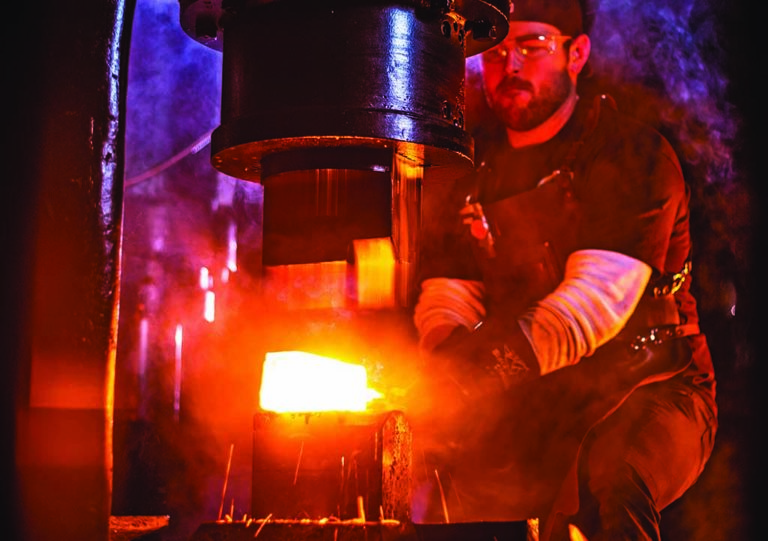
Alloy… in the knife world we hear the word often. Blade aficionados—many almost journeyman metallurgists in their own rights—pour over steel composition. Newbies to collecting and making, however, might be a bit perplexed over exactly what the material modification is all about.
With this in mind, we’ve boiled down what certain elements—when alloyed with iron—bring to the table for your knife. Now this isn’t a deep dive into the nitty-gritty of what each element does in a steel alloy, complete with phase diagrams and quenching charts. Honestly, if you need to cut to this quick, we recommend Larrin Thomas’ website KnifeSteelNerd.com. The son of BLADE Cutlery Hall of Fame member Devin Thomas and PhD metallurgist and material scientist, Thomas offers a much more in-depth look at steel from an engineer and knifemaker’s point of view.
What we have here is a quick and dirty guide to alloy elements and what they bring to a knife.
If your high school chemistry class is a bit foggy right now, perhaps we should take a moment to do a quick review of exactly what constitutes an alloy. Quite simply, an alloy is a mixture of two or more elements, where at least one of the elements is a metal. Note alloys are mixtures, not compounds—the former is a physical combination, the latter a chemical. For a mixture, think of something like oil emulsified in vinegar to create a tasty salad topping, while a compound is two gases like hydrogen and water bonding together to form water.
Alloying elements is done to enhance the properties of a material. In the case of knife steel elements are combined to improve toughness, wear resistance, corrosion resistance or other factors. While we won’t delve that deep in this article, we’ll point alloys can be classified into two main types:
Substitutional Alloys: In these alloys, the atoms of one element replace or substitute for the atoms of another in the metal lattice. An example is brass, which is an alloy of copper and zinc.
Interstitial Alloys: In these alloys, smaller atoms fit into the spaces (interstices) between the larger metal atoms in the lattice. Steel, which is an alloy of iron and carbon, is an example of an interstitial alloy.
Since we’ve dusted off some of those long-lost materials lessons you learned, let’s get into the down-and-dirty of what each common alloying element brings to knife steel.
Carbon: This ingredient makes the difference between iron and steel; all steel will have some amount of carbon. It is the most important hardening element, but it makes hardness by combining with other elements. As a simple generalization, the amount of carbon in the steel tells you a lot about the quality of the steel. Low-carbon steel has 0.3% carbon or less, medium has between 0.4-0.7% and high-carbon steel is 0.8% and above, maxing out at around 1.2% carbon for knife steels. Up to a point, the higher the carbon content within the range, the harder the steel will get.
Chromium: Chromium combines with carbon to make chromium carbides, which are resistant to corrosion. Stainless steel knives will have chromium as a major ingredient, typically at a minimum of 12-13%. Chromium also increases the strength of a knife to a degree, but adding chromium in large amounts decreases toughness.
Cobalt: In small amounts, cobalt increases toughness.
Manganese: This changes the rate of hardening. Manganese in carbon steels yields “deeper” hardening, which requires a slower speed quench and gives a wider range of acceptable heat before quench. If added in high quantities, it can increase brittleness. Manganese makes steel etch dark in damascus.
Molybdenum: Adding this maintains the steel’s strength at high temperatures.
Nickel: Nickel adds toughness to steel. It also makes steel etch bright in damascus.
Nitrogen: This element is sometimes used as a substitute for carbon in steel.
Silicon: Silicon increases strength and removes oxygen from the metal while it is being formed. It’s typically present in small quantities in most steels.
Sulfur: This increases machinability but decreases toughness.
Tungsten: Adding this increases wear resistance and forms tungsten carbides that are very hard.
Vanadium: Vanadium leads to smaller grains within the steel. Vanadium carbides are very small and hard, which increases wear resistance and edge retention.





