You haven’t experienced anti-knife reporting until you’ve been to Australia. Check out this sensational piece from the Geelong Advertiser:
KILLER knives are being sold around Geelong but police are powerless to stop their sale.
Police said, while the knives looked frightening, they were not illegal because they were classified as ornamental knives.
Geelong stabbing victim Paul Stuart, 37, was horrified the vicious-looking knives could be so readily purchased from local markets.
“It just makes it more of an issue and easier access for people who want to start trouble,” Mr Stuart said.
“To go to the market and say they are a toy is ridiculous. They are not a toy, they are still a weapon and can kill.
“It’s frustrating that (people) can go down and pick them up.”
The knives (pictured above), including some with sharp retractable blades, and martial arts-styled weapons were being sold at the Geelong Showground Sunday Market last week, from as little as $10.
Geelong police attended the market yesterday but the vendor selling the weapons was not present.
Shop Dump: Top makers reveal the key equipment that helps them get the job done
“Shop Dump” is a new BLADE® feature showcasing the special knifemaking equipment of some of today’s leading knifemakers and bladesmiths. The new feature kicks off with ABS master smith Rick Dunkerley and knifemaker Jason Fry.
Rick Dunkerley
Rick Dunkerley
“I’ve been making knives for almost 40 years,” Rick Dunkerley observed, “and in that time I think I’ve developed a style that is recognizable as my own.” It’s specific equipment that plays a crucial role in him making knives in that style. There are many more tools that help along the way, but he uses seven in particular on every knife.
1. Propane Forge
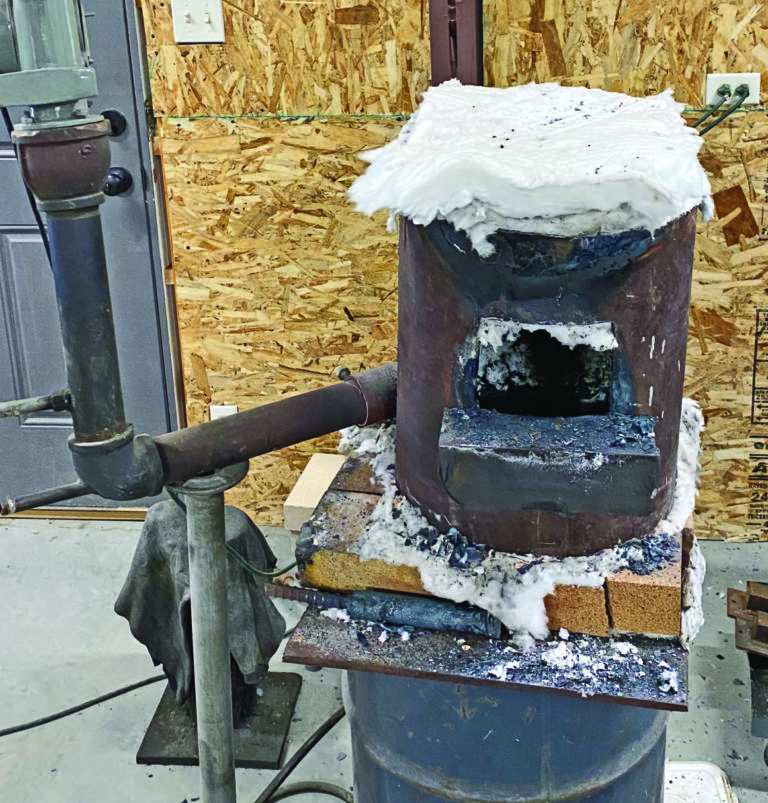
Dunkerley’s propane forge
His propane forge is homemade and the burner is over 20 years old. “It’s a vertical Don Fogg design,”he commented, “lined with ceramic wool lining. Since 99 percent of my knives are damascus steel, they begin in this forge.” Dunkerley began using his hydraulic press built by Billy Bob Sowell to forge damascus in the early 1990s. It’s Rick’s third hydraulic press, incorporating a larger cylinder, motor and hydraulic pump than his earlier models. The press helps him finish the damascus he forges.
2. eBay Bargain Surface Grinder
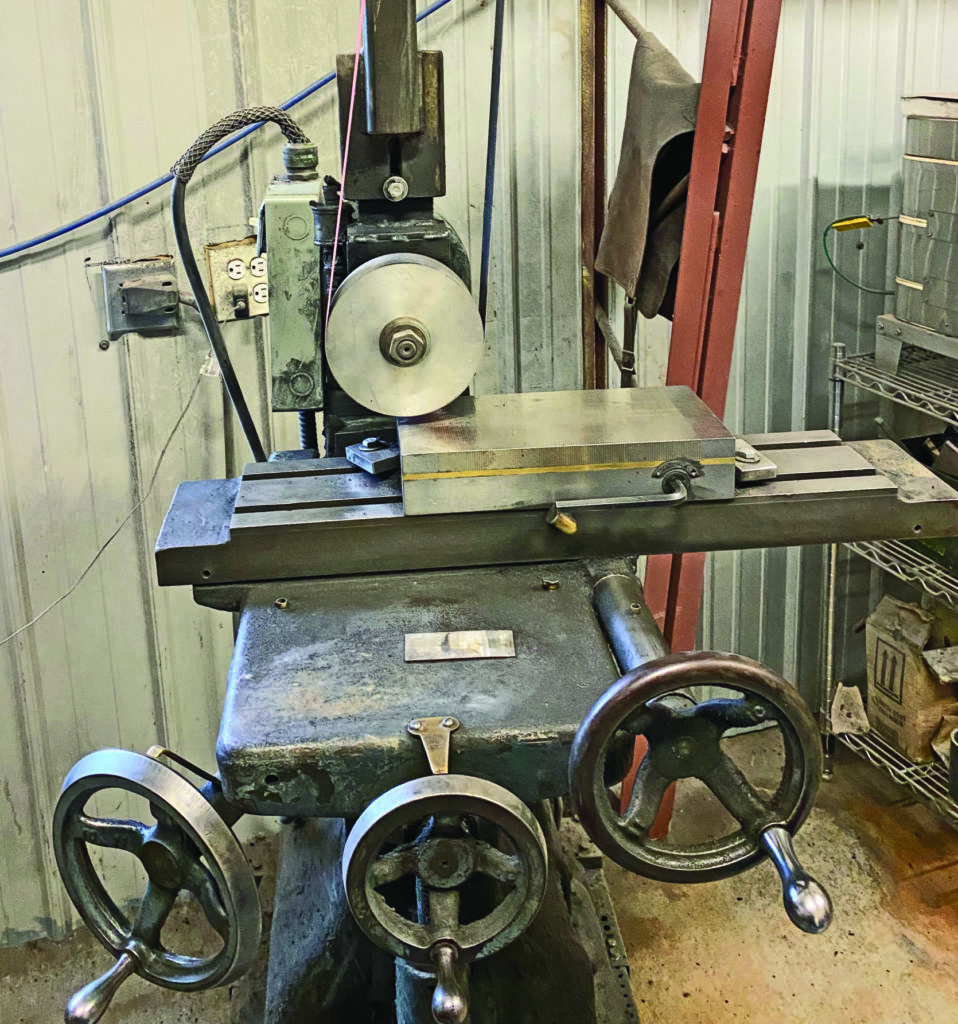
Surface grinder
An eBay-bargain ($300) surface grinder has served Rick well for 20 years. “I don’t know the make or the model,” he said, “and I changed it to a single-phase motor and converted it to run 2×72 belts with an aluminum contact wheel. It works on the damascus as it’s being made, and then precision grinds the blade and back bar material for my folders.”
3. Craftsman Drill Press
Dunkerley’s small Craftsman drill press “has drilled the holes on almost every folder to come from my shop,” he declared. “It’s very accurate and small, which is convenient as I can place it on my bench right next to my disc sanders. I added a keyless chuck to speed up the bit changes.”
4. Tru-Grit Disc Sander
Tru-Grit Disc Sander
Rick’s 9-inch Tru-Grit disc sander is another machine he’s had for 20 years. “The disc is great for flattening material, dovetailing bolsters, shaping handles and grinding blades. It’s reversible and set up with a foot switch to allow me to place the material against the disc and then turn it on,” he explained. “I wouldn’t want to make knives without a disc sander. I actually have three in my shop and would like one more.”
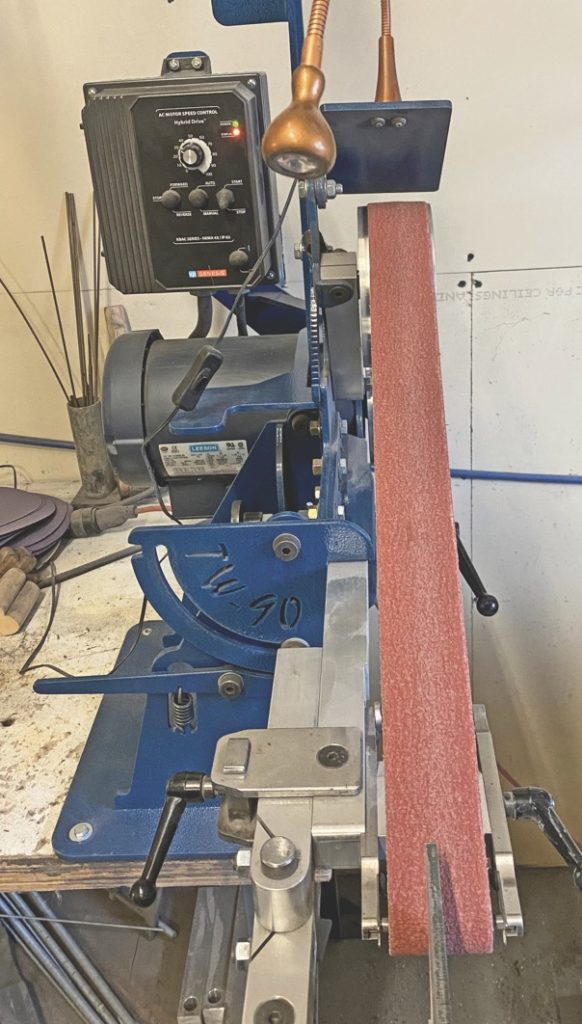
5. TW-90 Belt Sander
TW-90 Belt Sander
Dunkerley follows up with a TW-90 belt sander. “The versatility of this machine makes it one of the most used in my shop,” he remarked. “From rough grinding all types of material to fine finish work, this thing saves me huge amounts of time. The small wheel attachment and the fact that it turns into a horizontal grinder help me eliminate other machines that I would only use for specific jobs. The first time I saw one of these machines work, I knew it would make me a better knifemaker.
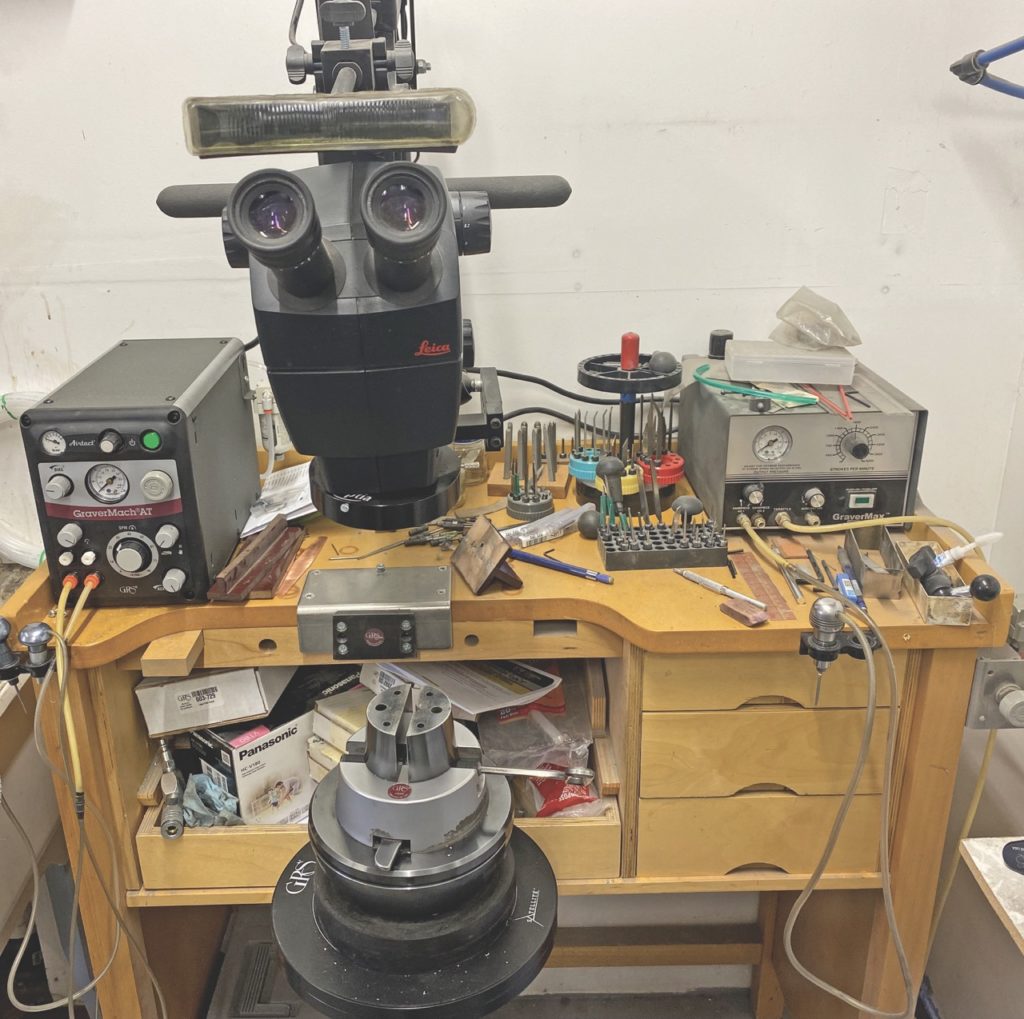
6. GRS Engraving Equipment
GRS Engraving Equipment
Rick uses his engraving equipment to give his knives an unmistakable quality and aesthetic. “Nearly every folder I make has engraving and some gold inlay,” he noted. “That happens here. My equipment was made by GRS and has served me very well. I continually think of new ways to use this equipment to add details to my knives.”
Jason Fry
Jason’s shop-proven equipment serves as a milestone along the way
Jason Fry
Jason Fry follows a direct route to excellence and each of his shop-proven pieces of equipment serve as a milestone along the way.
1. Wilmont Grinder
“My number one machine is my 2×72 Wilmont grinder,” he explained. “After 13 years on a homemade machine, I recently upgraded to the Wilmont Quattro.
Most of the recent high-end grinders will have variable speed, horizontal tilt, adjustable tool rests and specialty fixtures. This is the only ‘brand new’ machine I have ever purchased.”
Jason’s Wilmont Grinder
Fry adds a comparison of his heat-treat oven choice, relating, “You can argue Ford vs. Chevy or Evenheat vs. Paragon, but all the modern production ovens have digital temperature control. This gives the maker the ability to precisely dial in the heat treat of their chosen steels, and to heat treat stainless steels that require longer soaks at high temperatures.” Jason acknowledges that he bought a used Evenheat oven but he’s friends with all the folks at Paragon. “I got a good deal on the oven,” he smiled. “I had an old dental oven that I sold for three-fourths the price of my Evenheat, and it was a good upgrade.
2. File Guide
A file guide, such as this one by ABS master smith Bruce Bump, has carbide inserts that allow the maker to grind up against the guide and create a square shoulder on the blade.
“Another important tool is the file guide. I use a Bruce Bump file guide with carbide inserts. Bruce was an inspiration to me with his epic WIP threads in the forum days before Instagram, so I wanted one of his file guides when it came available.
3. Power Hammer
Jason’s power hammer
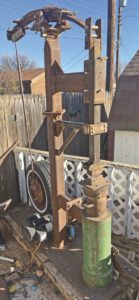
“My power hammer is a homemade ‘junkyard’ hammer in the ‘Appalachian’ or ‘Rusty’ basic design. It has a 40-pound head and hits at around 200 beats per minute. It makes the forging process faster and also allows me to efficiently make my own damascus. I chose the design because it was simpler to build from scrap than the tire hammer design.
“I competed on Forged in Fire back in May 2018 and my episode aired in September,” Jason added. “As I was preparing for the show, practicing forge welding and such, it came to mind to build a hammer. I prepared for Forged in Fire by building a hammer because even if I lost in the first round, I’d still have a hammer I could use for the rest of my career. This hammer took me about two months of intense weekends to build, and other than the initial test run, the first time I ran it was when I filmed the final [FIF episode] at my house. I still use it every forging session almost three years later, and having the hammer has made forging much more enjoyable and greatly expanded my capacity.”
Capitalizing on the right shop tools and equipment has made an enormous contribution in knifemaking, and listening to those who have been down the road gives others the opportunity to test, refine and choose what works best in their own shops. Meanwhile, the knife buyer can have an enriched ownership experience knowing more about the process and the pride that goes into each finished knife.
Cutting Through the Costs: How Tariffs Are Reshaping the Global Knife Industry.
Tariffs. The simple mention of the word makes some folks tear their hair out. That’s not a problem for me because the word doesn’t upset me that much. Besides, most of my hair has already fallen out anyway.
As you know, a significant portion of American knife companies depend on China to manufacture some, most or all of their knives. As you also no doubt know, President Trump is addressing America’s tariff imbalance with other countries—including China—in no small part to help erase some of America’s $36 trillion debt. And, at press time, he was threatening to impose higher tariffs on China than any other country.
How will the President’s tariffs affect the knife industry? I asked one industry insider and he told me of a recent trip he made to China to talk business with those who make many of the knives for the company he represents.
He said the last time he went there was 2018 and he was amazed at all the changes in the interim. There wasn’t a bridge from Hong Kong to China seven years ago. Now there is one and they drove on it to the Chinese mainland. There are new superhighways all over with no cars on them.
“It’s crazy the money they’re spending on infrastructure,” he wrote. When he went to one city in 2018 there wasn’t a traffic light in sight. Now it’s a city of 2.6 million people with high rises everywhere.
“Maybe it was my imagination but the vibe wasn’t great,” he observed of the reception he received earlier this year. “A couple of factories seemed to blow me off. I used to get the golden carpet treatment. One of our guys who speaks Chinese said he was having a hard time getting answers from some of them. I think the tariffs have them scared.”
I wondered out loud if the Chinese manufacturers thought they’d gotten most all they could out of the company my friend works for and are looking at other revenue avenues.
“I don’t think so,” he wrote. “The other markets are small in comparison to the USA. The Chinese knife factories are so specialized that making knives is really all they know.”
He added that the big Chinese manufacturers are building factories in Vietnam to avoid the tariffs, though he predicted the President would close the Vietnam loophole soon if he hadn’t already by the time this story hits print. I asked if that would make it more economically feasible for those American companies who have knives made in China to have them made domestically, and he hit me with the cold, hard facts.
“Rough numbers: cost to make a folder in the USA, $100; cost to make the comparable folder in China, $25. Double the cost with tariffs and Chinese-made knives are still half priced,” he emphasized. “Knives are such a niche market and relatively low volume that even with automation it would be tough to match the price of knives made in China. Marketing, design and innovation can overcome that cost gap. Look at Benchmade. They are killing it.”
Concerning my earlier question of whether the Chinese manufacturers might be looking at other sources of revenue, he returned with a qualifier.
“I did see two factories that are now making manicure stuff like nail clippers. Ten years ago you would not have seen that. A knife factory was a knife factory. One factory was making Nite Ize® products, so I guess they are diversifying,” he wrote.
“One more thing,” he added. “I went to a big-name [Chinese] factory and the owner did not appear to be worried about tariffs. He is focused on making the best knife he can, so I think you could say the higher-end manufacturers aren’t as worried about tariffs.”
My insider friend, however, disagrees with that rationale.
“I think when the market goes bad even the billionaires slow down on impulse buys,” he opined.
On the domestic side, at least one U.S. company official says costs are increasing for steel and other knife materials even though the steel and materials are U.S. made. Meanwhile, by the time you read this, here’s hoping the President has been able to work out, or is well on his way to working out, deals with most if not all of the countries on which he imposed tariffs. Either way, as my insider friend summarized,
“The tariffs are going to have a big impact on our little industry!”
Top masters in the world of bladesmithing have donated the most exciting set of auction knives ever seen for the American Bladesmith Society Annual fund raiser at the 2012 Blade Show and International Cutlery Fair in Atlanta, GA on June 9th in Saturday, June 9th at 10am in Room #103 of the Cobb Galleria.
There is currently an Online Auction being conducted through June 1, 2012 and information is posted on the ABS Forum at this link, Click: Online Auction. For more information you can contact the ABS Office at 419-832-0400 or send an email to the ABS Knife Auction Coordinator Dr. Dan L. Petersen at [email protected] .
BLADE Show’s home sharpens up for the event’s 45th Anniversary.
Longtime BLADE Show patrons, get ready for a brand-new venue. Calm your heart palpitations. The world’s largest knife show isn’t picking up stakes from Atlanta when it unsheathes its 45th iteration June 5-7. Simply put, the longtime home of our favorite edgy shindig is undergoing a massive $190 million facelift.
The Cobb Galleria Centre—now officially the Cobb Convention Center—is in the midst of a multi-year renovation to upgrade its facilities and amenities. While the project stretches into early 2027, it will be at its midway point when the BLADE Show doors open this June.
Diehard knifeaholics needn’t worry, the upgrade project won’t derail the aspects of the show you love. Factory knife debuts, the educational instruction of BLADE University (see sidebar) and action-packed demos still await show patrons. The BLADE Magazine 2025 Knife-Of-The-Year® Awards and the custom knife judging competition remain center stage. Furthermore, the American Bladesmith Society (ABS) will still name its latest master and journeyman smiths, and some of the best knives from the ABS, The Knifemakers’ Guild and unaffiliated makers will be on display in all their sharpest glory.
John Horrigan’s majestic fixed blade turned more than a few heads during the 2025 show. (Jocelyn Frasier image)
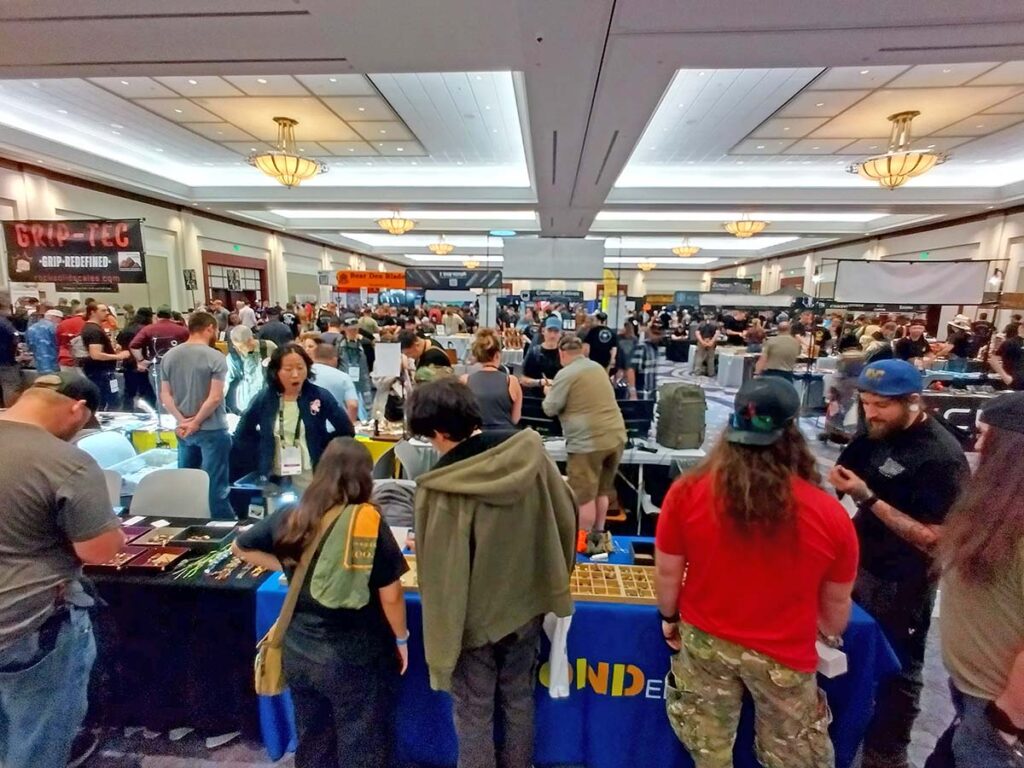
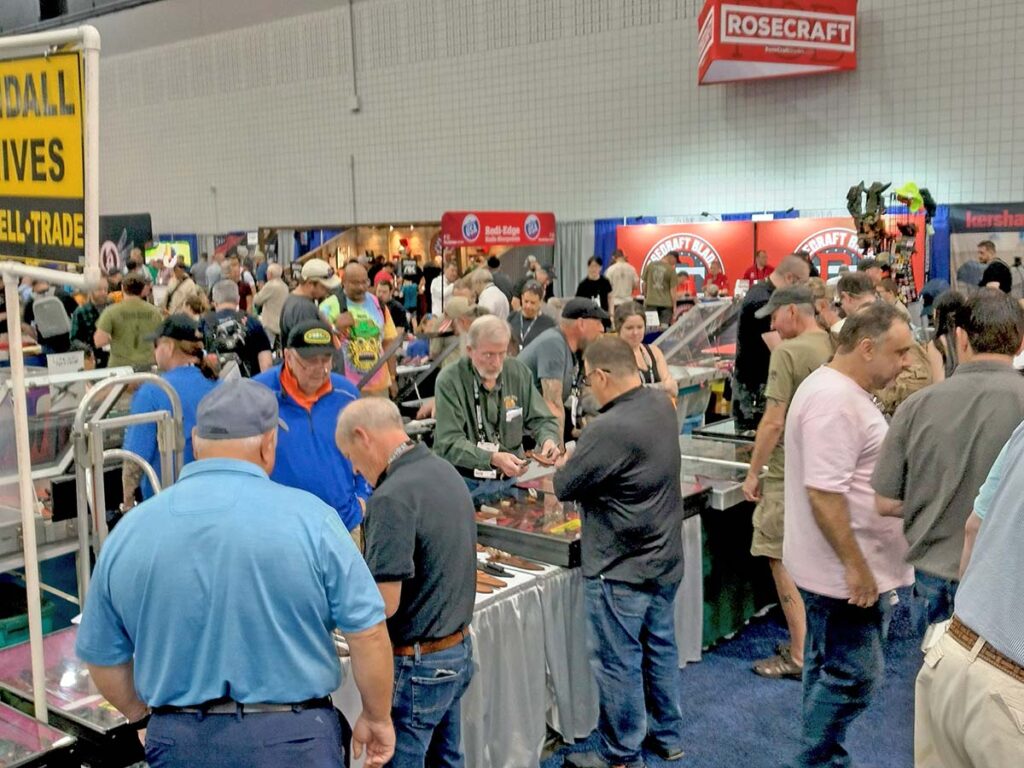
Additionally, the show floor welcomes more than 900 exhibitors from 35 countries, offering a global masterclass in modern cutlery. From the latest production folders and custom fixed blades to rare handle materials and high-tech shop equipment, the sheer volume of gear is staggering. All of this comes in the brand-new wrapper of the convention center, honing the BLADE Show to a razor’s edge.
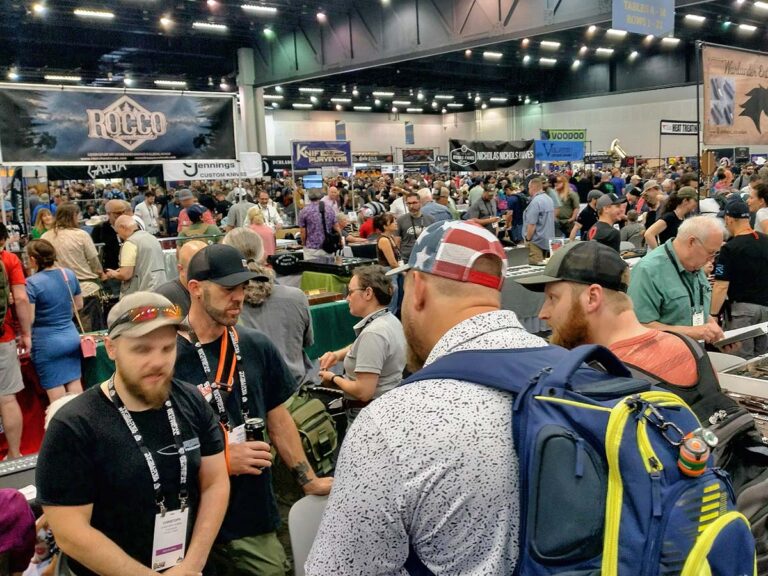
The main exhibit hall and the ballroom—better known to the faithful as the Baller Room—are already complete. These renovations will immediately improve the show with new LED lighting, fixed concession outlets, renovated restrooms and an improved PA system. The Baller Room and lobby area also sport new wall coverings, chandeliers and carpet, while the rotunda has an entirely new look. While the show floor is unaffected, attendees will feel some impact. The renovation of the specialty shops and meeting rooms below and across from the main hall will run congruent to the show. This means BLADE University has a new campus. Look for classes in the newly constructed ballrooms just off the Renaissance Atlanta Waverly.
And for those who love the food, libation (lots of that), knife boasting and lie swapping of “The Pit”, that is slated to proceed unchecked. The sunken bar of the Waverly is untouched by hammers, saws or fresh sheetrock. Get your sleep so you can haunt it until cock’s crow.
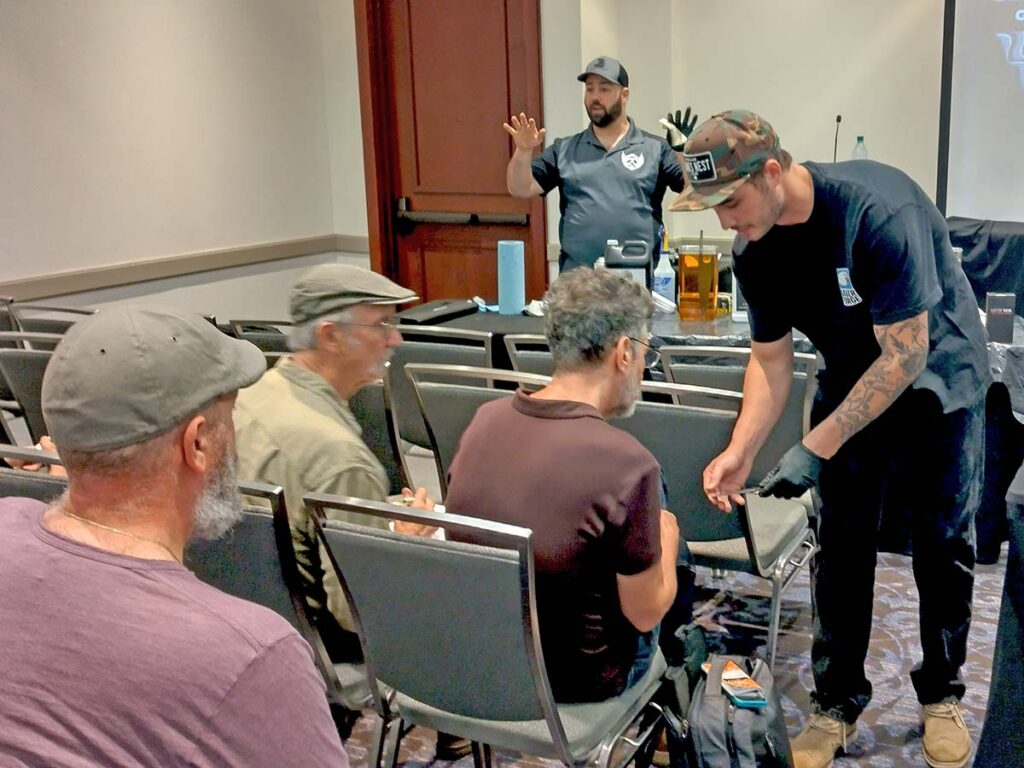
Jordan Berthelot discusses next-level damascus etching while Greyson Weltyk shows a student a result of the process during one of many BLADE University classes.
When the dust finally settles, the Cobb Convention Center will be a major boon. By 2027, showgoers can look forward to more than 50,000 square feet of new meeting rooms, event courtyards and indoor space. As the BLADE Show grows in global reach, its longtime home has the room to grow along with its marquee event.
Edge Of The World
Perhaps the most intriguing aspect of the BLADE Show in recent years is the global reach of the brothers and sisters of sharps. No one knife-specific event gathers more makers and companies from around the world—including the good ol’ U.S. of A—into one venue.
The outstanding international makers include: the CAS Brothers, Mauricio Daletzky and Javier Vogt (Argentina); Bertie Rietveld, Theuns Prinsloo, Henning Wilkinson and Neels van den Berg (South Africa); Franco de Souza, Rodrigo Sfreddo, Fabio Barros and Gus Cecchini (Brazil); Bruce Barnett (Australia); Kizer Cutlery, Reate and Ketuo (China); Koji Hara (Japan); Lionsteel, Alfredo Faccipieri, Fox Cutlery, Maniago Knife Makers (MKM) and Maserin (Italy); Damasteel (Sweden); Jens Anso (Denmark); Helle Knives (Norway); Jean-Louis Regel and Veronique Laurent (Belgium); Carlos Queiros (Portugal); Sergey Shirogorov (Russia); and Grace Horne (United Kingdom).
The Baller Room buzzed all three days of the show. The room comes with some notable improvements this year, including new carpet and wall coverings.
Some of the leading American exhibiting makers will be BLADE Magazine Cutlery Hall-Of-Fame® members Bill Ruple, Steve Schwarzer and Harvey Dean; ABS master smiths Mike Quesenberry, Shane Taylor, David Lisch, Jordan LaMothe, Josh and Karis Fisher, and Andrew Meers; slipjoint makers Stanley Buzek, Tom Ploppert, Luke Swenson and Tim Robertson; Allen Elishewitz; Les George; Walter Brend; Strider Knives; Hawk Knives; Vince Evans; factory companies Spyderco, Case, TOPS Knives, Chris Reeve Knives, Spartan Blades, Pro-Tech, Microtech, Kershaw, Squid Industries, KA-BAR and Heretic Knives; and many more.
Knives Of The Year
BLADE Magazine Knife-Of-The-Year® Awards is the factory knife industry’s highest honors, pitting the companies’ sharpest designs again each other. In an effort to keep the awards’ distinguished position and recognize the changing landscape of the industry, BLADE Show added a new category for this year.
New for the 2026 competition is the Best Slip Joint category, breaking off the traditional design from the Best Imported Folder and Best American Made Folder categories. This is the third new category added in as many years, with Best Of The Rest created in 2025 and the Automatic Knife Of The Year sponsored by PVK.com that debuted in 2024.
New knives aren’t the only draw in Atlanta. Antique Randall knives and their collectors were in abundance at the show.
As in the past, the entries are limited to BLADE Show factory booth exhibitors, all of whom received the rules well before the show outlining the new changes. Like last year, the winners will be announced and presented during the BLADE Magazine Awards Reception on Saturday at 8 p.m. in the room on the floor above The Pit. The winners will be listed on BLADE’s blademag.com website after the awards reception, and a list will be posted outside the show entrance Sunday morning.
BLADE University
Get current on the latest knifemaking techniques and other trending sharp subjects during the 13th Annual BLADE University on Thursday, Friday and Saturday. See the sidebar for a complete rundown of classes, days, times and instructors.
Sponsored by Work Sharp, BLADE University has the most extensive schedule of knife, knifemaking and other instruction held at any knife show. For enrollment and other information, visit https://bladeshow.com/show-info/classes.
Custom Knife Awards
Among the most testing custom knife competitions in the nation, the BLADE Show Custom Knife Awards is one of the most coveted honors in knifemaking. In a continuing effort to keep it the premier award in the handmade knives, the competition’s categories have been expanded. Best Slip Joint has been split into Best Single-Blade Slip Joint and Best Multi-Blade Slip Joint categories, allowing more subtlety in judging the nuanced class of knives.
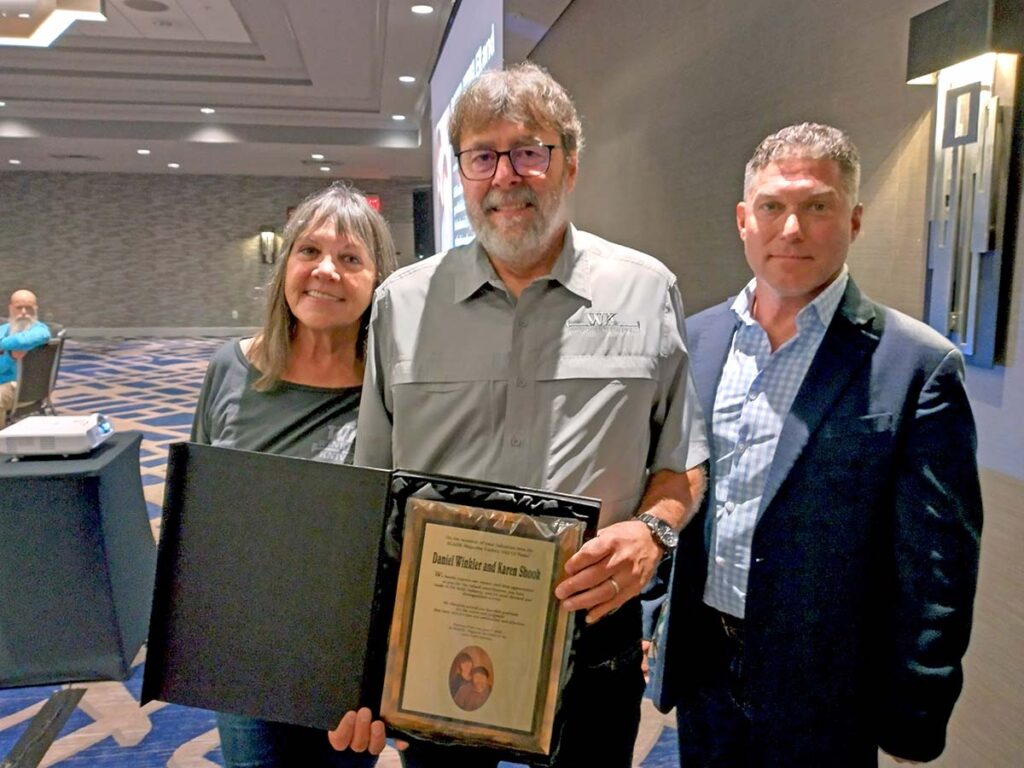
From left, Karen Shook and Daniel Winkler accept their Hall of Fame plaque after Kevin Holland (right) delivered their induction speech.
Leading industry authorities will pick the best custom knives by BLADE Show exhibitors in the annual knife judging competition, with the winners announced during the BLADE Magazine Awards Reception Saturday at 8 p.m.
The categories are: Best of Show; Best Art Knife; Best Bowie; Best Collaboration; Best Collaboration; Best Damascus; Best Fighter; Best Fixed Blade; Best Folder; Best Handle Design; Most Innovative Design; Best Kitchen Knife; Best M.A.C.K.; Best Miniature; Best New Maker; Best Single-Blade Slip Joint; Best Multi-Blade Slip Joint; Best Sword; Best Tactical Folder; Best Utility Hunter; Best of the Rest.
The competition is open to the show’s custom knife exhibitors only. The winners will be announced on BLADE’s blademag.com website after the awards ceremony, and a list will be posted outside the show entrance Sunday morning.
World Championship
The BLADE Show World Championship Cutting Competition will be conducted by BladeSports International (BSI) and held in The Courtyard, the parking lot of the host hotel, the Renaissance Atlanta Waverly, Saturday at 4:30 p.m. Attendance is free to BLADE Show ticketholders.
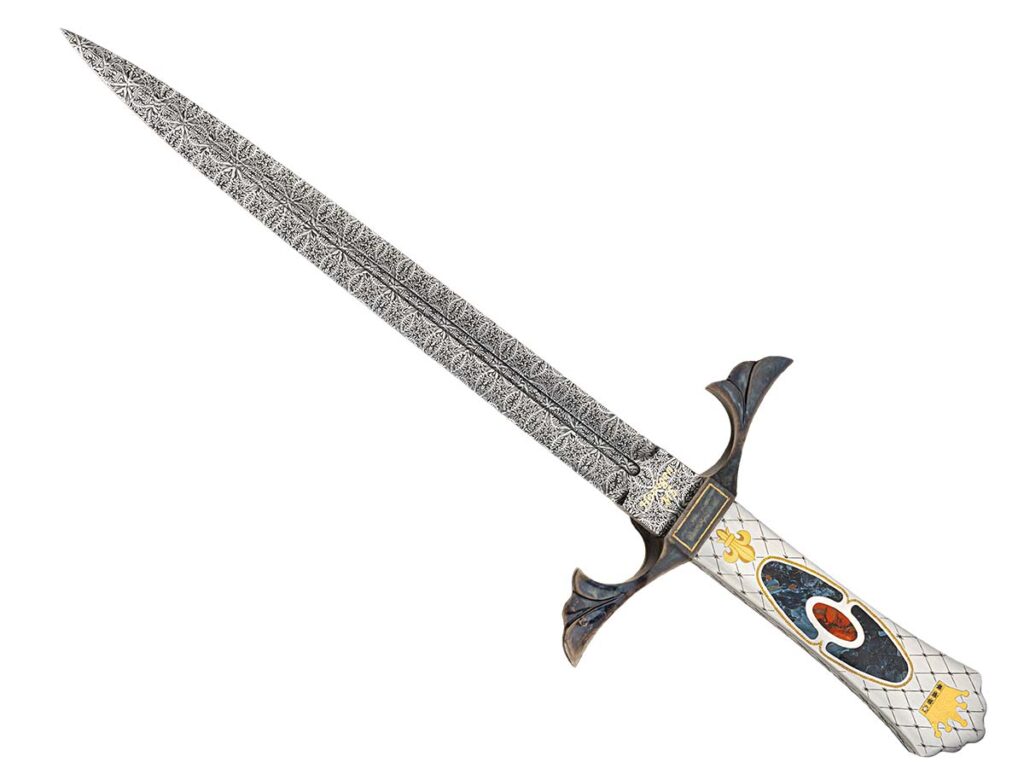
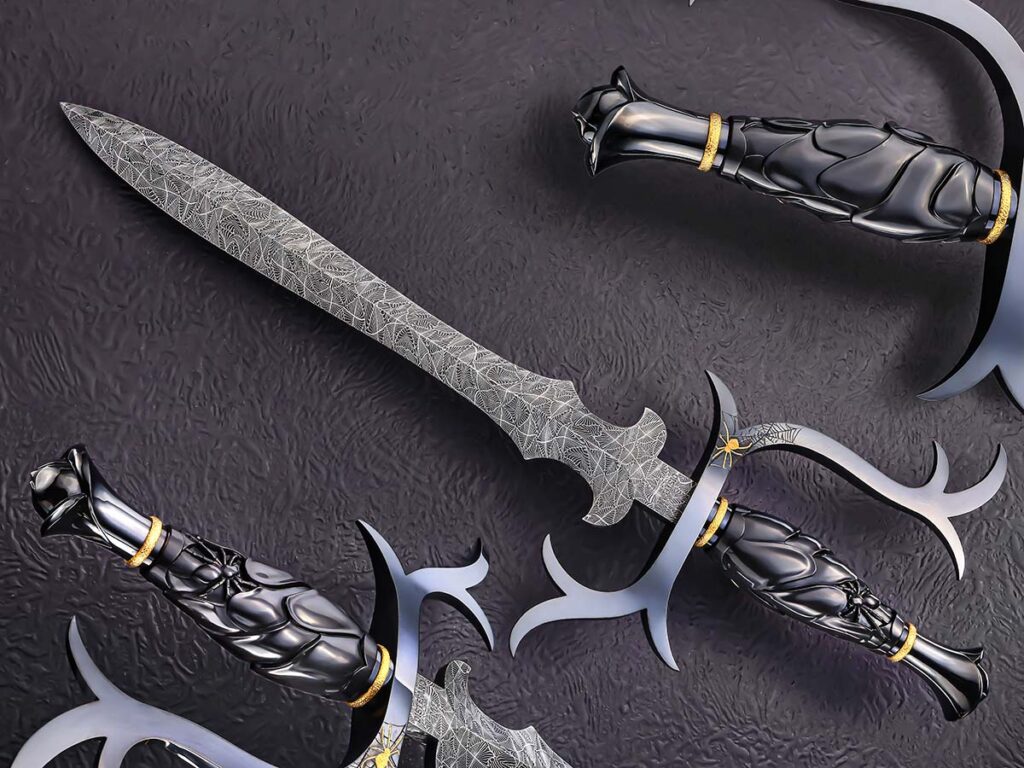
Paul DiStefano always produces stunning work, which certainly goes for his 14-inch spiderweb mosaic damascus-bladed dagger, which he brought to the BLADE Show. That’s a carved buffalo horn handle, by the way. (SharpByCoop image)
For a second year in a row the men’s and women’s divisions were won by a husband and wife: Mr. and Mrs. Ben and Sue Ann Propst. The championship results were as follows: Men’s Division: Ben Propst (Niagara Specialty Metals), world champion; 2nd: Donavon Phillips (Spyderco); 3rd: David Moore (Pops Knife Supplies); and 4th: James Clifton (Spyderco). Women’s Division: Sue Ann Propst (Niagara Specialty Metals), world champion; 2nd: Lauren Kalns; 3rd: Sara Maly (Pops Knife Supplies); and 4th: Jo Carothers (Carothers Performance Knives).
Bali Grand Master
Top balisong flippers will vie for the title of “Grand Master” in the 10th Annual Battle for Bali Champion sponsored and conducted by Blade HQ.
BLADE Show ticketholders are invited to watch the competition on the second floor above The Pit of the Renaissance Atlanta Waverly Hotel on show Saturday from 12:45 p.m. to 2 p.m. Competitors will start flipping knives at 1 p.m.
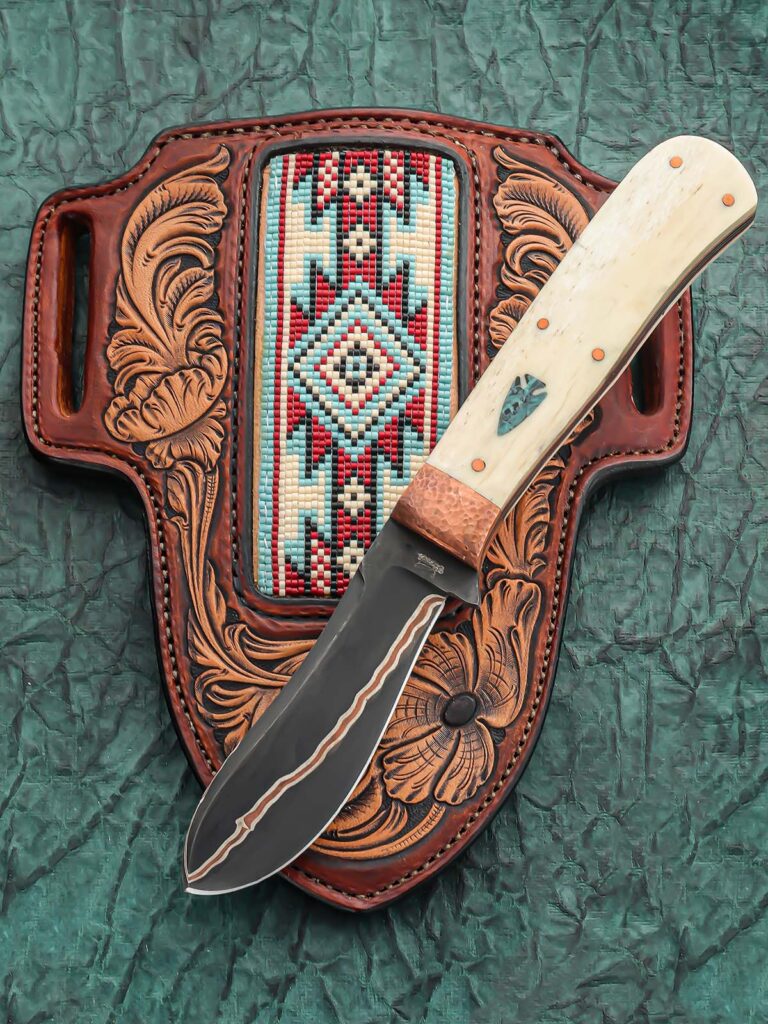
When it comes to slip joints, Bubba Crouch is a must-stop at BLADE Show. His skinner, with a 3 1/2-inch copper san mai blade, came complete with a sheath by Will Anderson, with beadwork done by Kelly Faulcorer. (SharpByCoop image)
The top three finishers will receive prizes and all participants will get swag bags. Brycen Nelson flipped his way to the top of the podium in the competition, Steve Ash placed second and Landon Morrison third.
Cutlery Hall Of Fame
The BLADE Magazine Cutlery Hall Of Fame® will formally induct its new members at 8 a.m. show Saturday in the Kennesaw Room of the Renaissance Atlanta Waverly Hotel. (At press time, the new members had not been determined. For updates, visit blademag.com.) Tickets are required ahead of time for the ceremony, which includes breakfast. Seating is limited. For ticket information, email [email protected].
What’s Next
The final BLADE Show-sponsored event for 2026 will be BLADE Show West, Oct. 9-10 at the Salt Palace Convention Center in Salt Lake City, Utah. For details, visit bladeshowwest.com. BLADE Show Texas 2027 will be March 12-13 at the Fort Worth Convention Center. Visit bladeshowtexas.com for more on it. And, of course, it’s never too late to start thinking about BLADE Show 2027 June 4-6 at the Cobb Convention Center in Atlanta. For details, visit bladeshow.com.
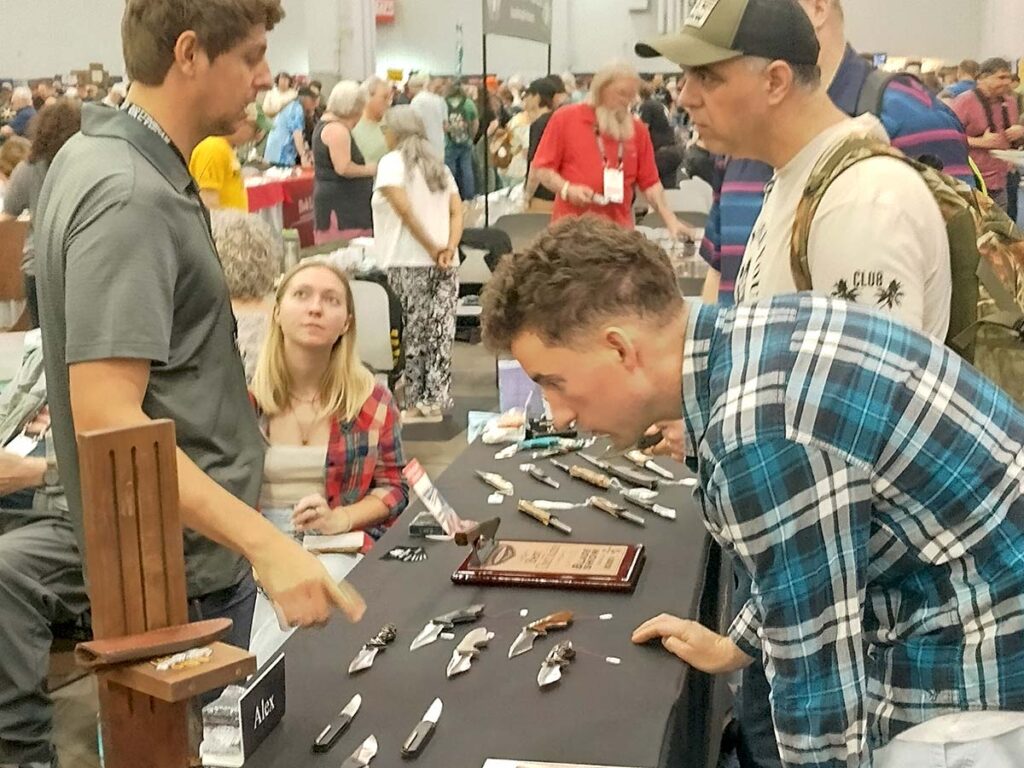
It’s easy to get mesmerized by knives at the BLADE Show, here at the table of Alex Hossom (left).
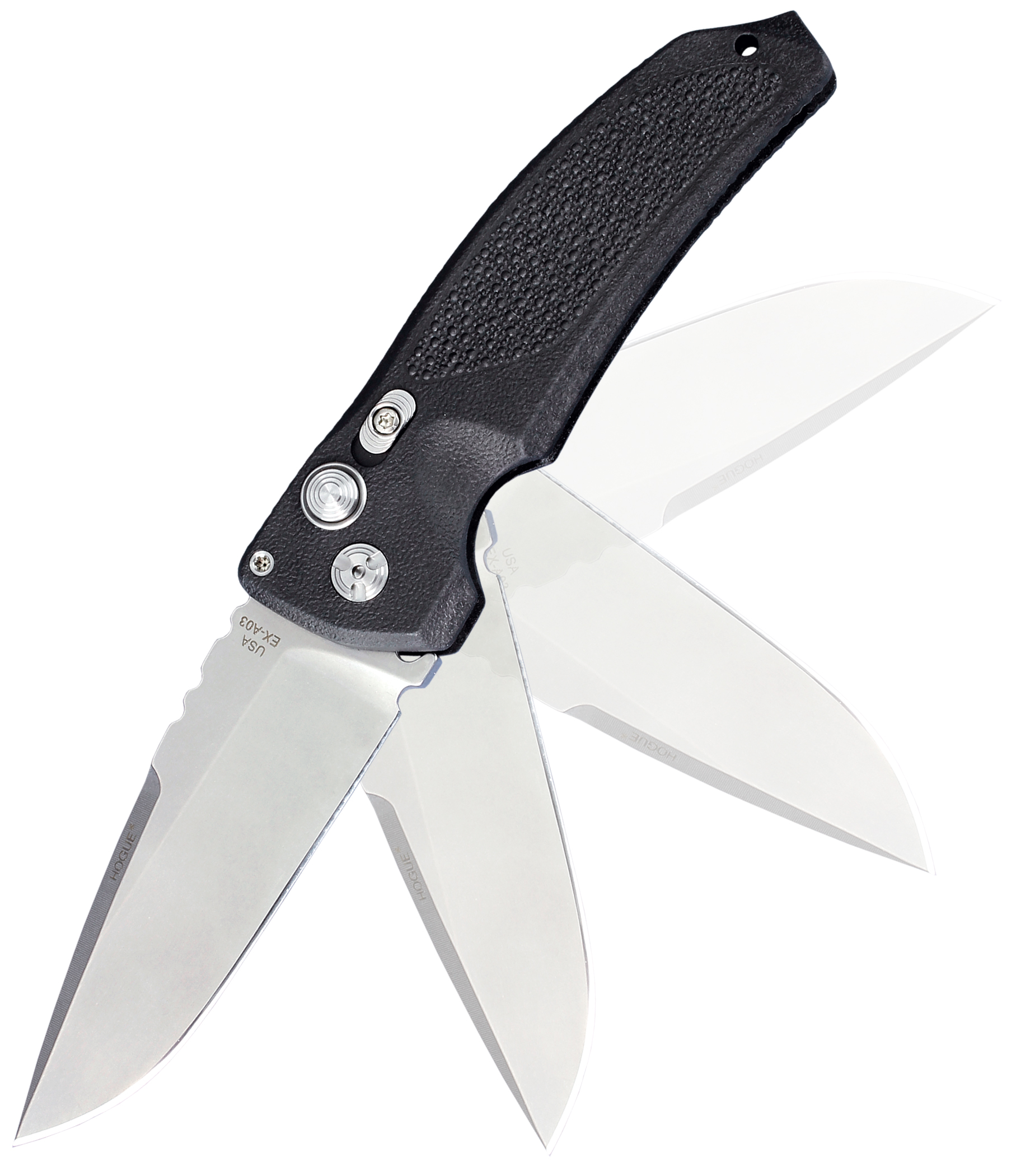
Editor’s note: Kizer Cutlery is The Pit sponsor. Work Sharp sponsors BLADE University. Nottingham Tactical is the lanyard sponsor. Hogue Knives is the housing sponsor. EKnives is the concessions sponsor. Vosteed is the Wi-Fi sponsor. The other sponsors are Heretic Knives, Reate Knives, Poikilo Blade, McNees Knives, Ketuo/Rike Knife, Artisan Cutlery/CJRB, Reate Knives and HORL Corporation.
Many Top Knifemakers Are Keeping Historic Styles And Methods Of Making Knives Alive Today.
Historical perspective is a relevant component in just about any undertaking. In the realm of cut, incorporating an appreciation of the past into the work of today brings another dimension to the custom knifemaker’s statement.
Interest in the knifemaking of a bygone era offers a window into the true artistry required to reproduce the knives of yesteryear, particularly with the absence of modern conveniences in the shop. Along with the interest in the historical knife, several custom makers bring famous designs, styles and patterns to life once again in tribute to those who have gone before.
The idea of the period piece blends old and new. “I’ve been making knives seriously since about 2002 when I took a class with the American Bladesmith Society in Washington, Arkansas,” related ABS master smith Lin Rhea. “Joe Keeslar and Greg Neely lit a fire under me and got me on my way. Since then the town of Washington has been like a second home, and I’ve even added to the personal connection between me and the area by interest in one of the town’s historical residents who was also a knifemaker. His name was James Black.”
A resident of Prattsville, Arkansas, Lin gained an appreciation for Black’s distinctive body of work*, using contrasting materials and techniques to create a bold, attractive look. “I’m grateful to get to know Mr. Black by studying his work,” Lin continued. “This intense study
Lin Rhea’s reproduction of the Carrigan Knife is based on a dress bowie James Black is thought to have made in the early 1830s in Washington, Arkansas. The original Carrigan includes a black walnut handle with coin silver pins and trim. The blade is about 6 inches long and the overall length is approximately 10.25 inches. (Whetstone Studio image)
led me to try to recreate one of his knives, the Carrigan Knife. The original knife, a guardless coffin-handled bowie, was made by Mr. Black in the early 1830s in Washington, Arkansas. I chose the Carrigan as my first attempt because of its less intimidating size; however, as is often the case I found it to be just as intimidating once I started into the project.”
The original Carrigan includes a black walnut handle providing a nice contrasting background to the coin silver pins and trim. The blade is about six inches long, and the overall length is approximately 10.25 inches. The full tang is virtually covered entirely by the walnut scales and the silver wrap.
When Rhea undertook his homage to Black and the Carrigan, he chose stabilized walnut, which he harvested himself several years ago, and trim in sterling silver. He forged the blade from 80CrV2 carbon steel and included at least 30 separate parts while attempting the same techniques used by Black nearly two centuries ago in fastening and assembling the finished knife.
“There is so much to be said about not only this knife but also Black’s work,” Lin concluded. “He was able to create a knife design utilizing only three materials yet impacting the knife world as few others could. His ability to arrange these materials into a functional, long-lasting, beautiful tool is only enhanced by the knowledge that he also built in other qualities like moisture resistance, logical assemblage and ergonomics. All of this was done in a historic setting without modern equipment and epoxies. In my opinion, his design is ingenious.”
Gold Rush Knives
Recently inducted into the BLADE Magazine Cutlery Hall of Fame® knifemaker Jim Sornberger has assimilated his gold and silversmith skill sets into custom knifemaking while helping introduce the modern world to the classic design, luster, and embellishment of the Gold Rush era and boomtown San Francisco of the mid-19th century.
Jim Sornberger’s interpretations of the Michael Price San Francisco/small dress bowie have won awards at various venues, including Best of Show at the 2019 International Custom Cutlery Exhibition in Fort Worth, Texas. Jim’s price for a similar knife: $3,500. (SharpByCoop image)
“I’ve been making knives since 1975 with the help of the late Les Berryman, an early Guild member, and with some guidance from Bob Loveless, Herman Schneider and Barry Wood,” Jim recalled. “The last three signed for me to join The Knifemakers’ Guild.”
For Sornberger, the style, embellishment and decoration of the canes, jewelry and knives of the Gold Rush era are most appealing. “San Francisco from 1850 to 1904, the Gold Rush period, was one of the wealthiest cities in the world, attracting some of the greatest artists, jewelers, carvers, and engravers to ply their trade to a wealthy clientele. The work done in that period,” he opined, “rivals the best ever done.”
In the knifemaking genre, Michael Price and Will & Finck were among the most successful and prolific of the Gold Rush. Their work remains emblematic of the great migration to settle the American West, and the riches and ruin that were found with the experience.
“Price was Irish, and both cutlery firms hired workers who were English, German and possibly Scottish,” Sornberger explained. “Their dress knives are probably the most embellished American knives made in the 1800s-1900s. The dress knives had two common handles: an interesting, modified coffin shape and a more rounded, subtle taper shape. The blade shapes are spear-point dagger and San Francisco clip spear point.”
Sornberger is recognized as an authority on original San Francisco knives, as well as the magnificent gold quartz that was used so well by Gold Rush artisans. His modern interpretations of the Michael Price San Francisco/small dress bowie have won awards at various venues, including Best of Show at the 2019 International Custom Cutlery Exhibition in Fort Worth, Texas.
Jim’s dress fixed-blade bowie in the accompanying picture was made with Vegas Forge stainless barstock AEBL and 412 stainless steels, and san-mai damascus steel with a solid core. The guard and wrap handle are in Mike Sakmar mokumé barstock. Jim’s made such handles in gold and silver and nickel silver, also. The inlays are tortoise celluloid and California native gold/gold quartz.
According to Sornberger, the biggest challenge in his stunning creation was grinding the blade to show the distinctive pattern of the shell and the hardened core. The san-mai laminated blade was etched with ferric chloride, rinsed and color set with WD-40®.
The Frog Knife
“The style of Michael Price’s work is a really good canvas with flowing lines, and there is a lot you can do with it,” observed ABS master smith Jon Christensen, who is in his 22nd year of making knives. “I wouldn’t call my San Francisco-style knives replicas. I do like to keep to the original form and honor the style of the maker, though.”
The Frog Knife by Jon Christensen is a San Francisco-style dress bowie with a back story. “I had seen the Poppy Knife that Michael Price made and thought I would do my version,” he related. “I took the knife to the BLADE Show, and it didn’t find its owner. Then, the handle got ruined, and I just took the opportunity to rehandle it with the frogs and lily pads.” Overall length: 10 inches. (SharpByCoop image)
One of Christensen’s most evocative pieces to date is referred to simply as the Frog Knife. However, the piece is far from simple, and Jon manages to convey the spirit of the Michael Price style while also imprinting some of his own personality.
“I built the feathered damascus for the blade with 1080 and 15N20,” he advised. “It’s a canister damascus. I forged the bamboo leaves and placed them in the can, welded it up, reduced it, and feather cut it so it would produce feather-cutting smears and leaves, and form branches to look like a little grove of bamboo leaves.”
The 10-inch knife has a 5.5-inch blade and a frame and sheath incorporating 410 stainless steel. Christensen utilized the “canvas” of the handle to the fullest, carving the mammoth ivory into a pleasing vignette of frogs and lily pads.
“The handle has something of a back story,” he smiled. “I had seen the Poppy Knife that Michael Price made and thought I would do my version. I took the knife to the BLADE Show and it didn’t find its owner. Then, the handle got ruined, and I just took the opportunity to rehandle it with the frogs and lily pads.”
Christensen got his start making stock removal knives after a career as a horticulturist. He learned to forge while working with ABS master smith Ed Caffrey and visited with knifemaker Rick Eaton and ABS master smiths Shane Taylor and Wade Colter. Jon also makes San Francisco folding knives and enjoys swordmaking. Plans for the future include more period pieces.
Kimball Style
ABS master smith Josh Smith owes his little league baseball coach, ABS master smith Rick Dunkerley, credit with getting him started making knives about 30 years ago. From the beginning, Josh has appreciated the thought process and craftsmanship of custom makers from a bygone era.
“There’s something special about reproducing something that was built nearly 200 years ago,” he reasoned. “It’s easy to get lost in your thoughts while working on these knives, wondering what the makers were thinking about at the time. Was the knife going into battle? Was a rich man just wanting something unique? Was the maker just trying to be different and impress people? Were function and effectiveness of use the only factors that mattered? It’s really cool to think about.”
Josh Smith’s dog-bone-handle dagger is a reproduction of a knife owned by Loring Kimball of Vicksburg, Mississippi, in the mid-1800s. The grip gets its name from its shape. Overall length: 14.25 inches. (Eric Eggly/PointSeven image)
Josh has found the opportunity to consider historical context with a dagger in the distinctive dog-bone handle, recalling the mid-1800s when a gentleman named Loring Kimball of Vicksburg, Mississippi, owned several similar original pieces that were probably made by at least two different knifemakers in the New Orleans area. Knives in what many refer to as the Kimball style have been reproduced by a number of modern makers, mostly bladesmiths.
“The distinctive characteristic of the dog bone is clearly the shape of the handle,” Smith said, “but to me it’s more than that. The large domed pins and the flat facets on the handle provide such a neat look. One of the original Kimball daggers from the 1830s had silver wrapped around the butt of the handle and a small, thin silver guard. I never pretend to exactly reproduce these knives. I always put my own spin on the knife, trying to bring some of my style into it.”
Smith’s dog-bone dagger is fashioned from his own ladder pattern “W’s” damascus blade, African blackwood handle and 18k-gold pins and liners. The 9.5-inch blade is forged from 1080 carbon and 15N20 nickel-alloy steels, while a gold collar stretches over the back of the blade and bears the engraved name of the maker. Overall length: 14.25 inches.
“This particular knife was heavily influenced by Tim Hancock,” Josh said. “I feel Tim, Harvey Dean and James Batson are the three men who led the way in bringing these knives back to prominence, and Tim had the most influence on my construction of these knives. I love period pieces and definitely plan on doing more. There are so many incredible weapons from the past that would be fun to recreate.”
*While a number of top industry authorities attribute such original 19th-century pieces as the Carrigan Knife, Bowie No. 1 and others to Black, no knives with Black’s mark are known to exist.





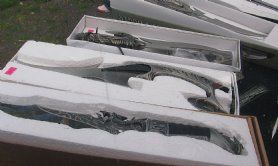 KILLER knives are being sold around Geelong but police are powerless to stop their sale.