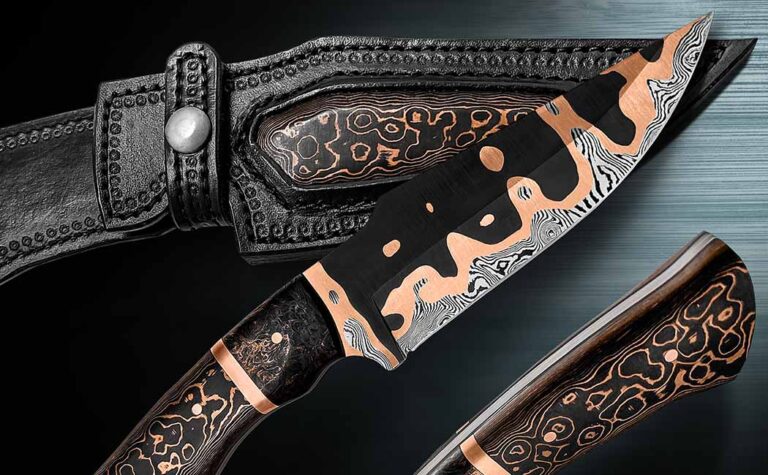
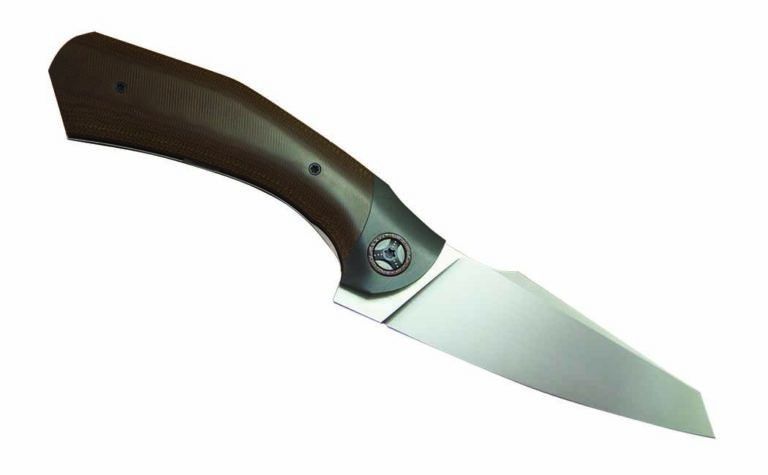
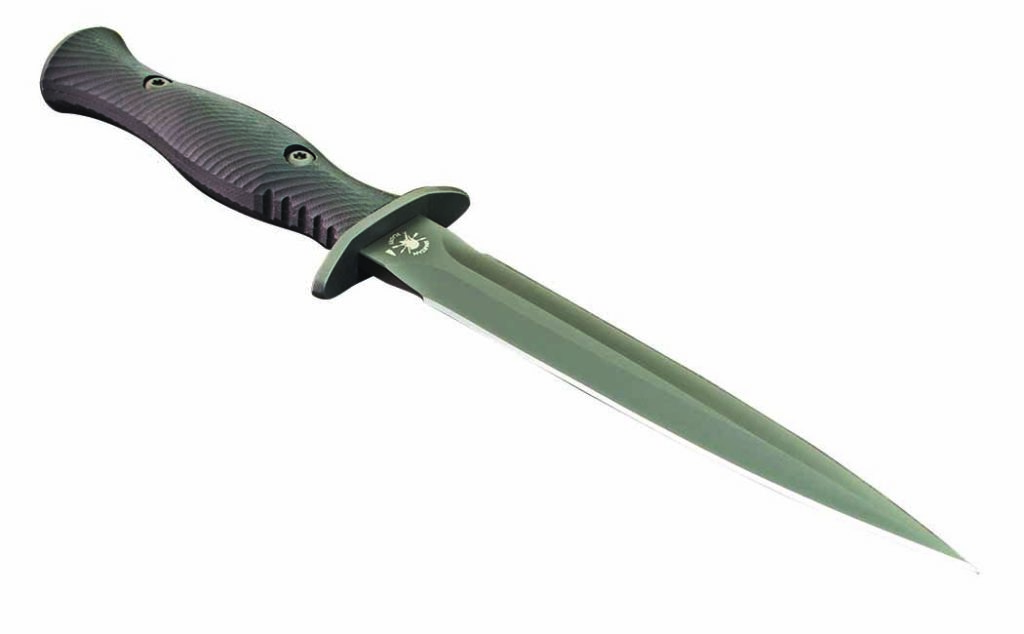
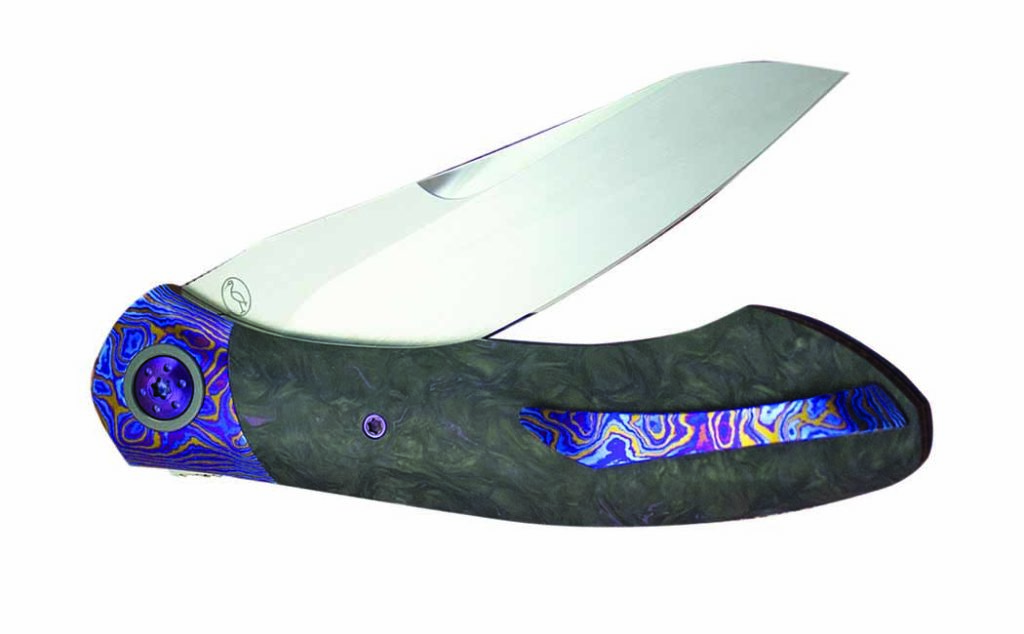
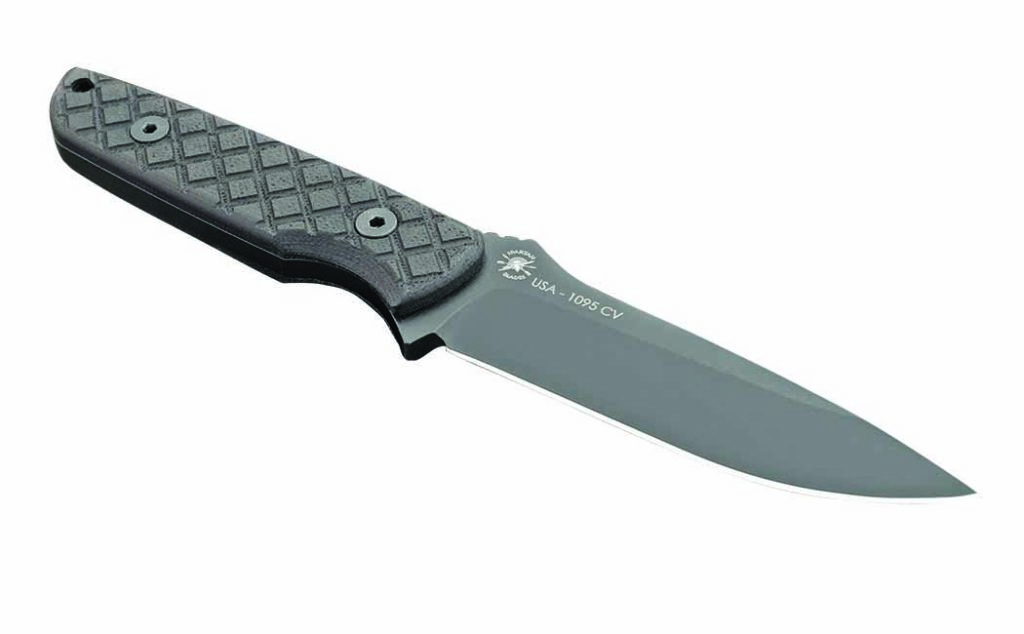
Top custom makers from around the world showcase rarefied knives at the annual ABS auction.
Each year when the BLADE Show rolls into Atlanta, the American Bladesmith Society (ABS) holds its auction of selected knives forged by ABS master and journeyman smiths. Here is a gander at the knives that crossed the block at the exclusive auction! ABS master smith and instructor Brion Tomberlin serves as a director and secretary of the society, and he handles the ABS auction from start to finish.
“I choose the smiths, mainly from the recent journeyman and master smiths who have gotten their stamps that year,” he explained, “and I also ask other master smiths and journeyman smiths, basically whoever I can get to say yes! The proceeds go to the general fund of the ABS.”
Support for the ongoing educational activities and programs of the ABS is vital to the health and future of the craft. Participants are honored to be involved and have their handiwork sold at auction by ABS director Robert Wilson. For years, Wilson has served as the event’s auctioneer, and Tomberlin said he likes to go with experience. For this year’s auction, several outstanding knives, both by American and international bladesmiths, will be available.
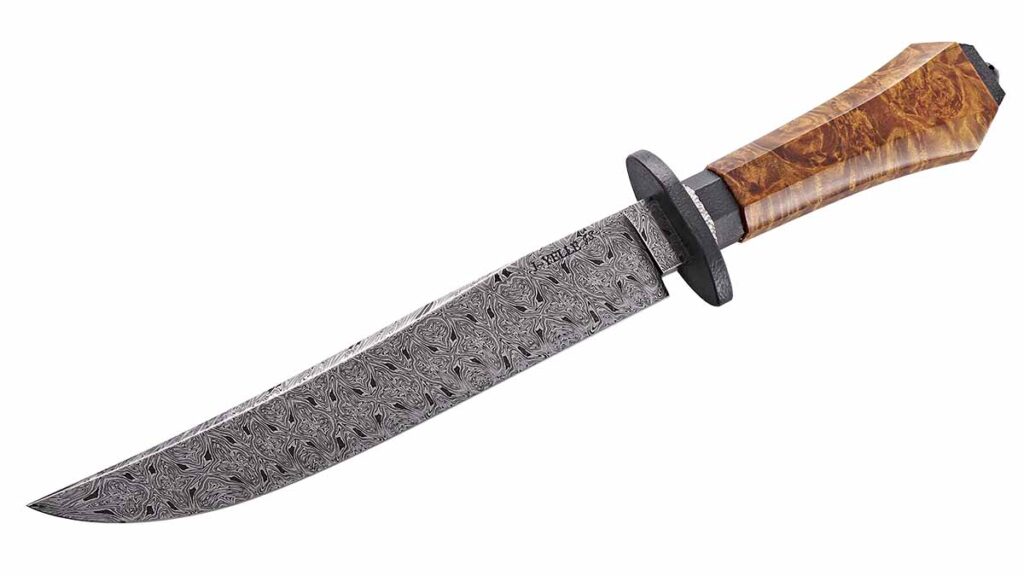
International ABS Journeyman Smith Knife—Jeremy Yelle: Gentleman’s Bowie
Jeremy Yelle, a 22-year-old bladesmith from Sherbrooke, Quebec, Canada, is excited to be involved and to offer one of two international journeyman smith knife entries. “I truly love the ABS and what it does,” he said, “and I felt like giving it my first-ever journeyman smith piece was the honorable thing to do.
“I personally love the antique and classic look of older knives, which is why I chose to make a coffin-handle bowie. The handle is a coffin shape, which happens to be a partial takedown. It has several lineup pins, my textured and fire etched 416 stainless steel fittings and a 416 textured spacer.”
Jeremy has been making knives for about five years, and his mosaic damascus blade was inspired by the process he learned from ABS master smith David Lisch. The handle of Jeremy’s gentleman’s bowie is particularly noteworthy with Canadian maple burl from Maritime Knife Supply that he stabilized and dyed. The knife is completed by a protective case.
International ABS Journeyman Smith Knife Maker: Jeremy Yelle Knife name: Gentleman’s Bowie Blade length: 8.625 inches Blade material: Mosaic damascus of 15N20 nickel alloy and 1084 carbon steels Handle material: Canadian maple burl Overall length: 13.5 inches
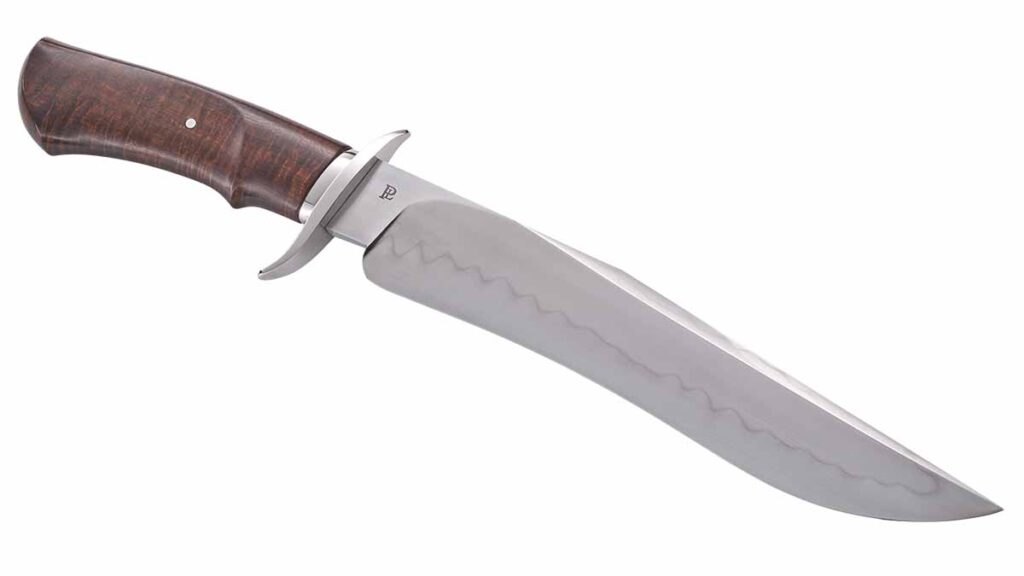
International ABS Journeyman Smith Knife—Pablo Lanaspa: Bisaurin
The second international journeyman smith knife entry is from Pablo Lanaspa Ubeira from the small town of Berdun in the north of Spain. “I am very grateful to the ABS for bringing me the opportunity to make this knife,” he said. “Special thanks to Brion for his kindness and ability to help in every circumstance.”
Ubeira has been making knives since 2008, and this piece, a bowie-inspired design, comes with a zippered case. “I was already a collector and then started to make my own blades from recycled steel when I made a rudimentary coal forge and a small belt grinder,” he said of his earlier days. His knife features a blade with a hamon that is clay differentiated and hardened. The blade is also slightly recurved with a full sharpened edge on the back, while the wood used for the handle, Australian ringed gidgee, is a gift from Belgian ABS master smith Sam Lurquin.
International ABS Journeyman Smith Knife Maker: Pablo Lanaspa Ubeira Knife name: Bisaurin Blade length: 12 inches Blade material: W2 steel with hamon Handle material: Australian ringed gidgee wood Overall length: 17 inches
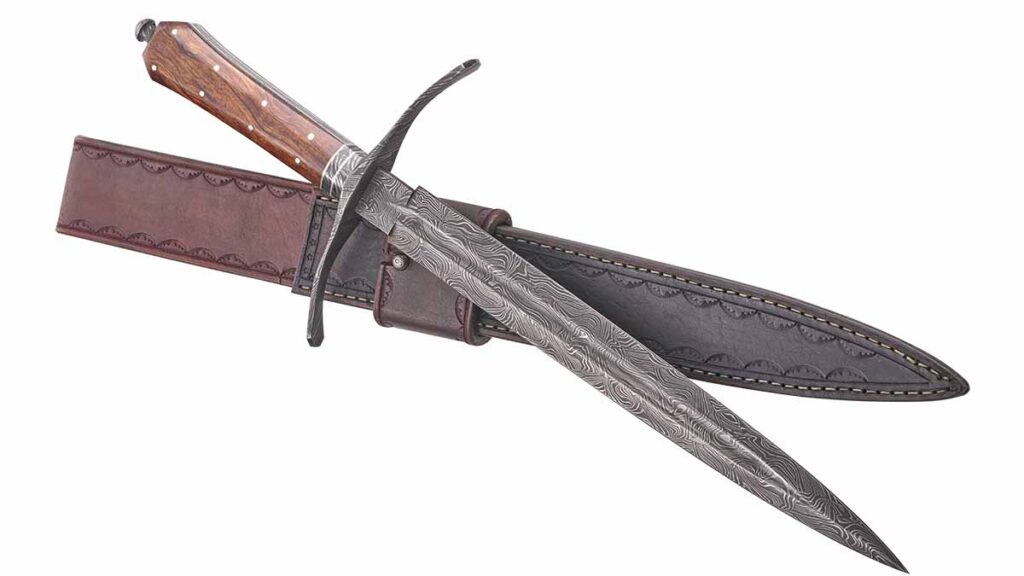
U.S. ABS Journeyman Smith Knife—Joshua States: Stylized Quillon Dagger
Can you think of a better name for a maker of a United States journeyman smith knife than Joshua States? Of New River, Arizona, Joshua fashioned his U.S. JS model as a stylized version of a quillon dagger. “The coffin-frame handle is a complex build, and the blade is flat ground on the bevels with a central fuller,” he explained. “I took my first class with Tim Hancock, and that was a game changer. Previous to that I had spent about a year trying to do things without any training or reference material.”
According to States, his JS knife was originally undertaken as a commission. “A customer had seen a similar dagger I had made in 2014 and wanted a copy of that knife,” he recalled. “Unfortunately, he passed away soon after I had made the blade, and I hadn’t started making any of the other parts. So, I was now free to redesign the handle/guard/finial.”
Joshua also made the leather sheath with minor decorative tooling and a multi-color dye job. The leather is 5/16-inch thick in a heavy oak tanned sole bend.
U.S. ABS Journeyman Smith Knife Maker: Joshua States Knife pattern: Stylized quillon dagger Blade length: 11 inches Blade material: Pattern-welded 1095 carbon and 15N20 nickel-alloy steels, and nickel Handle material: Pattern-welded frame/desert ironwood scales Overall length: 16.3 inches Sheath: Hand-tooled-and-stitched leather
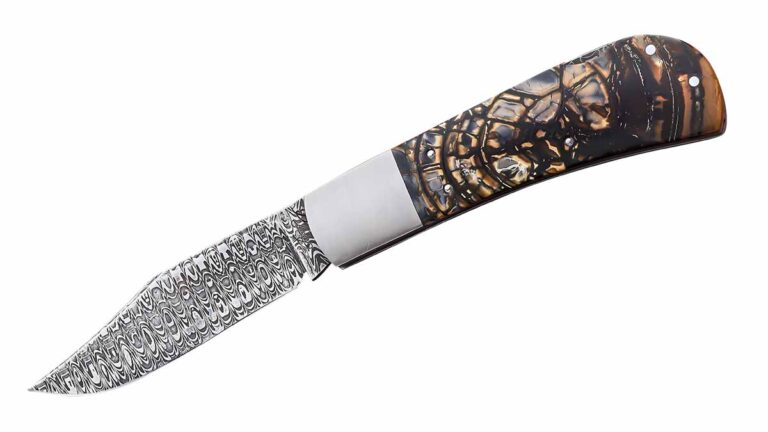
U.S. ABS Master Smith Folder—Bill Burke: Lanny’s Clip
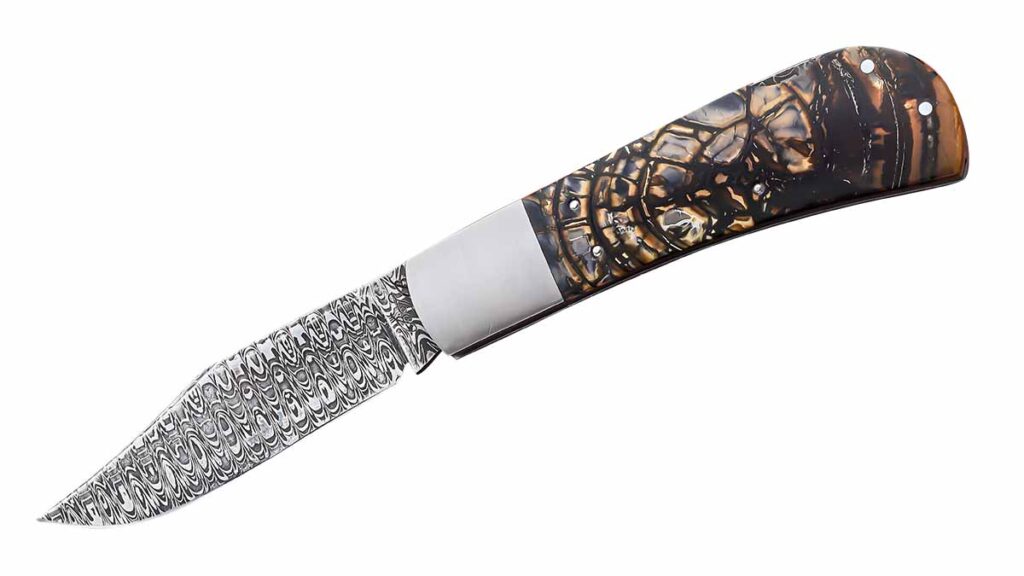
One of two U.S. master smith knives to be auctioned is a folder from Bill Burke of the Boise, Idaho, area. A custom knifemaker for 25 years, Bill pays homage to the late Tony Bose, BLADE Magazine Cutlery Hall-Of-Fame® slipjoint making wizard, with a Lanny’s Clip pocketknife in a shark’s tooth damascus blade and mammoth ivory scales. “A lockbar and spacer of damascus are included,” Bill said, “with integral liners and bolsters.” The liners are fileworked and the knife comes with a zippered case.
U.S. ABS Master Smith Folder Maker: Bill Burke Knife name: Lanny’s Clip Blade length: 3.25 inches Blade material: Shark’s tooth damascus of 15N20 nickel-alloy and 1080 carbon steels Handle material: Mammoth ivory Lock mechanism: Lockback Closed length: 4.1875 inches
U.S. Master Smith Knife—Nick Rossi: Hybrid European Chef
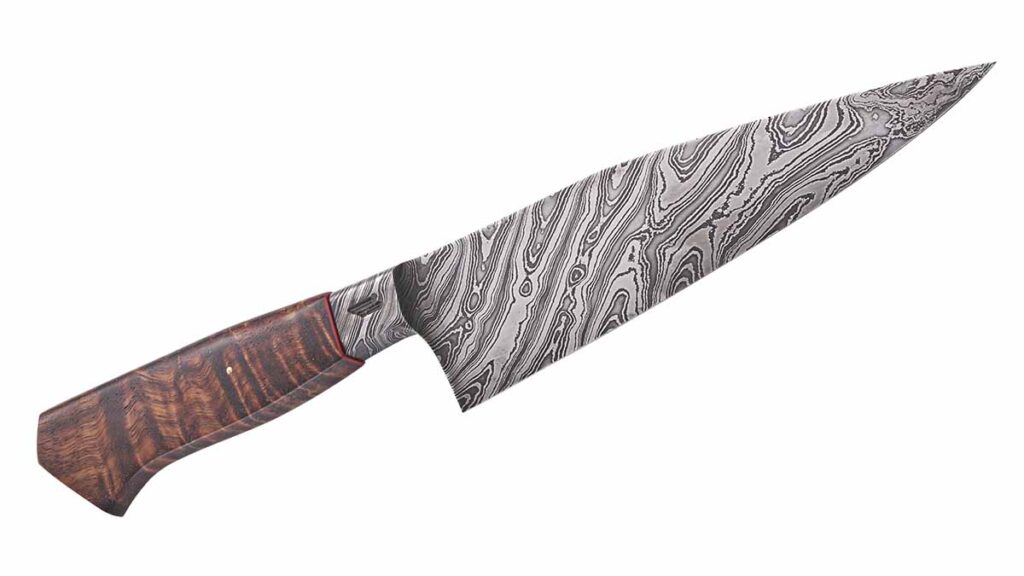
Nick Rossi of Vassalboro, Maine, contributed an integral European hybrid chef’s knife with a 50-layer twist damascus blade and curly koa handle as the second U.S. master smith knife. Both blade and handle are fashioned in the 25-year-veteran smith’s signature styles. The blade is flat ground with a subtle convex edge, and the handle features a bronze domed pin and a G-10 spacer. “This is my favorite type of knife to make,” he said. “It features an integral bolster, which makes it stronger and gives it better balance. It was inspired by European chef’s knives with a little Japanese flavor.” The knife comes complete with a padded case.
U.S. Master Smith Knife Maker: Nick Rossi Knife name: Hybrid European Chef Blade length: 7.5 inches Blade material: A twist damascus of 1084 carbon and 15N20 nickel-alloy steels Handle material: Curly koa Overall length: 12 inches
T.O.M.B. Knife—Steve Culver: Fighter
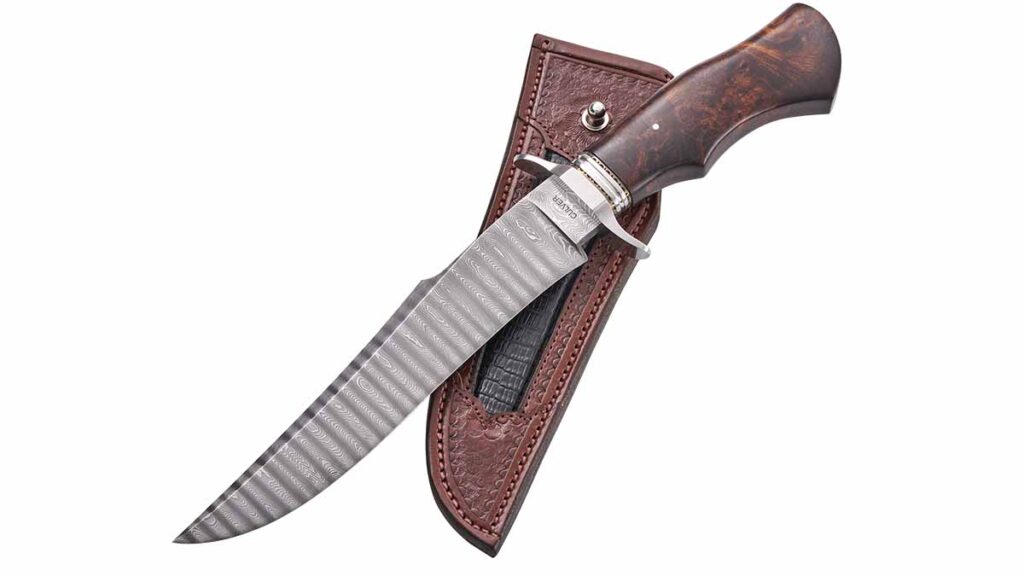
This year’s T.O.M.B. (The Order of the Mystic Brotherhood) Knife is by ABS master smith Steve Culver of Meriden, Kansas. Culver has been an active knifemaker for 36 years, and his fighter was inspired by “all the cool recurve bowies that I’ve seen others make.”
In fact, the knife is Steve’s first venture into the recurve blade style. The blade is 220-layer ladder-pattern damascus, while the handle is Arizona desert ironwood with guard and spacer materials of anodized titanium and stainless steel. Steve also made the lined sheath, which sports lizard skin inlay.
T.O.M.B. Knife Maker: Steve Culver Knife pattern: Fighter Blade length: 8 inches Blade material: Ladder-pattern damascus of 15N20 nickel-alloy and 1084 carbon steels Handle material: Desert ironwood Overall length: 13.125 inches Sheath: Lined and features lizard-skin inlay
Revel in a short list of knife industry milestones that transformed the knife world.
Editor’s Note: BLADE Magazine is celebrating its 50th anniversary of its founding this year. To recognize this milestone, we are running a series of articles looking at the changes to the knife world the publication has been privy to over its history.
Time marches on. And in the cutlery industry, the half century from the early 1970s to the present has been filled with both revolution and evolution.
From the corner of a massive hall at a gun show, the slight mention of a new style of field tool, and the basic everyday factory blade carried in the worker’s pocket, the knife industry, both custom and factory, has blazed its own trail over the past 50 or so years, emerging from a somewhat obscure existence to the mainstream. And along the way have been those moments of discovery, awareness and excitement that have marked the trail.
For reference, a few of those moments include the following.
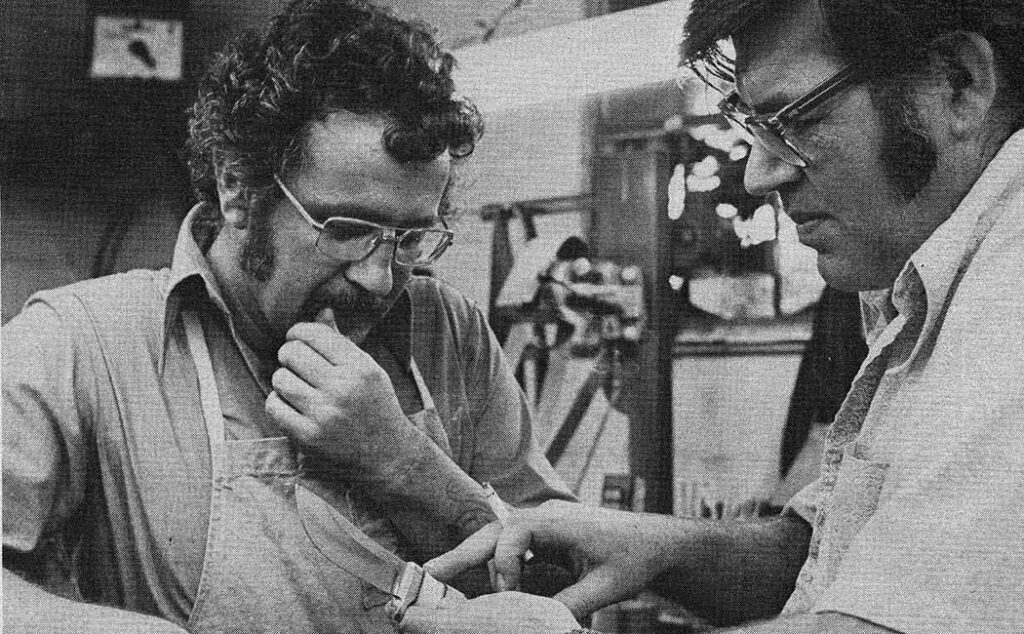
The first “meeting” of the Knifemakers’ Guild basically was the idea of A.G. Russell. What would become the Guild Show was the leading knife show for decades. A.G. (right) discusses a Harry Morseth knife with maker Lloyd Hale (left). (Sid Latham image)
1970s
Though what would become the Knifemakers’ Guild Show was first held in 1970, the show that occurred three years later is still talked about today. That was when Bill Moran reintroduced damascus steel for knife blades, kindling a revival of interest in damascus as the new “super steel” and generating a wave of collector fervor. Also in 1973, Blackie Collins founded The American Blade, a magazine for the knife industry like nothing that had been seen before. Known today as BLADE®, the publication remains a voice for the industry and a tangible contributor to the life and times of the knife enthusiast.
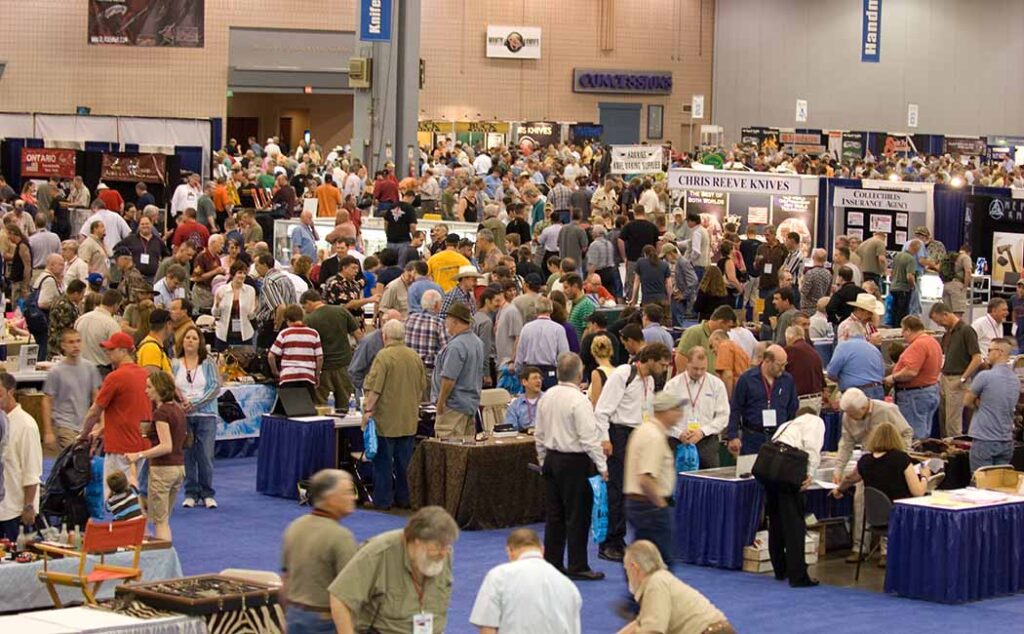
In the following decade, knife shows increased in number and attendance, including the BLADE Show, the New York Custom Knife Show, California Custom Knife Show and the Guild Show, the latter which led the pack for at least 20 years. At the same time, Guild members established industry trends, including the drop-point hunter and the popularization of super steels 154CM and ATS-34 by Bob Loveless, while A.G. Russell vigorously supported the knife industry through his advocacy, sharpeners, knives and growing catalog business.
Eric R Eggly, PointSeven Studios
In 1976, the American Bladesmith Society was formed, and those who forged their blades and worked in damascus at long last had their own organization to promote training and excellence with hammer-ins and other events that brought people together to learn the art of bladesmithing. By 1988, the ABS opened its own school, the Bill Moran School of Bladesmithing. For the first time, bladesmiths and knifemakers could take advantage of a year-round school that offered instruction in forging, bladesmithing and more.
1980s
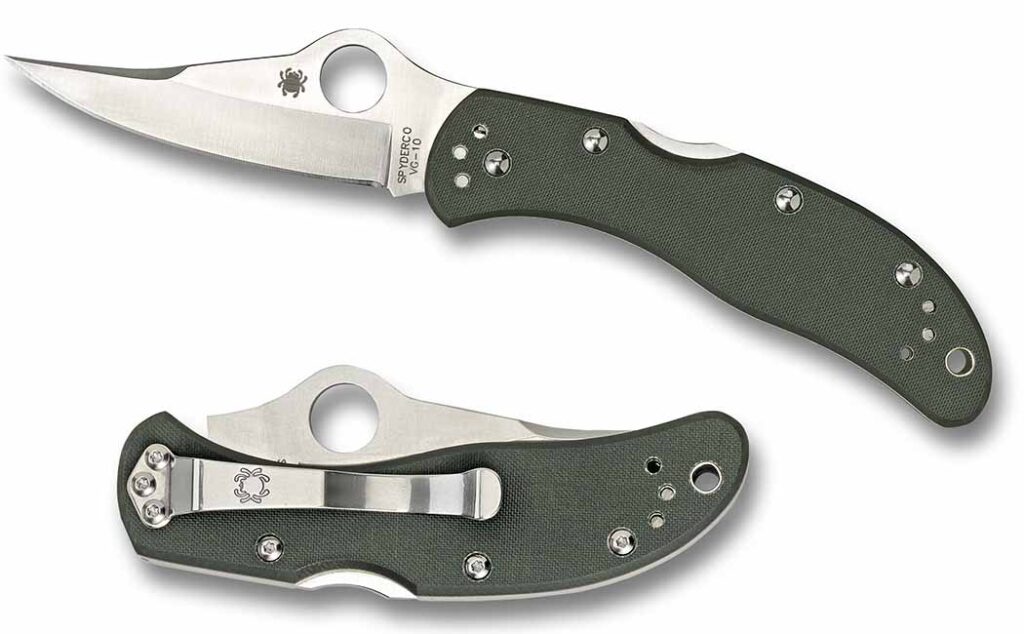
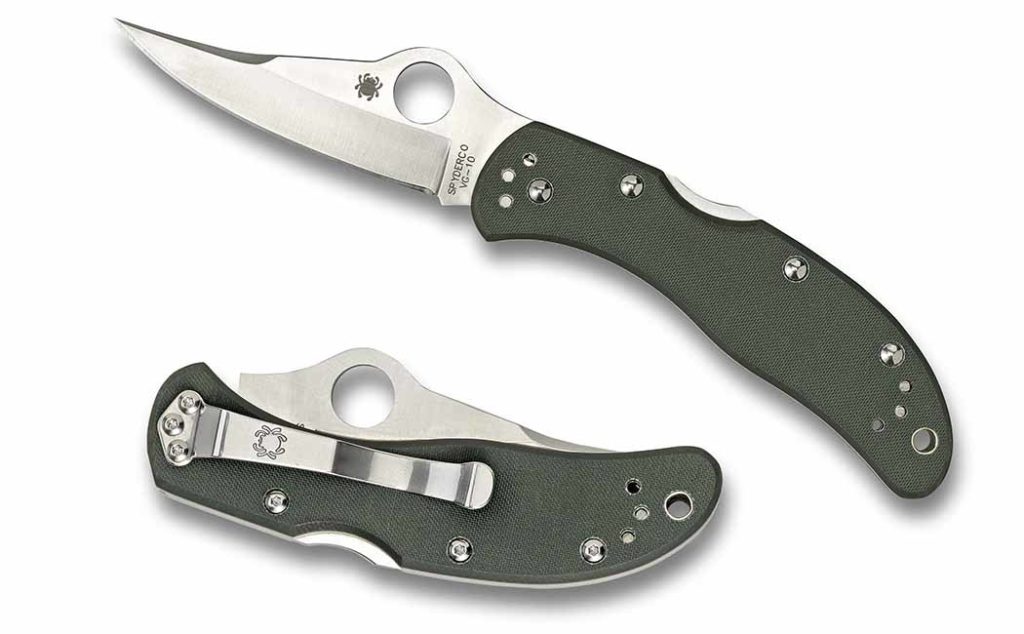
Nineteen-eighty-one saw the introduction of two watershed knife creations by Spyderco and Michael Walker. With the C01 Worker, Spyderco headman Sal Glesser introduced the first knife with both the famed hole in the blade for easier one-hand knife opening and a pocket clip for enhanced carry. Walker, meanwhile, debuted his groundbreaking linerlock folder. The innovations led to a concentration on ease of carry and deployment, focusing the industry on such elements that made the experience of knife ownership something even more special.
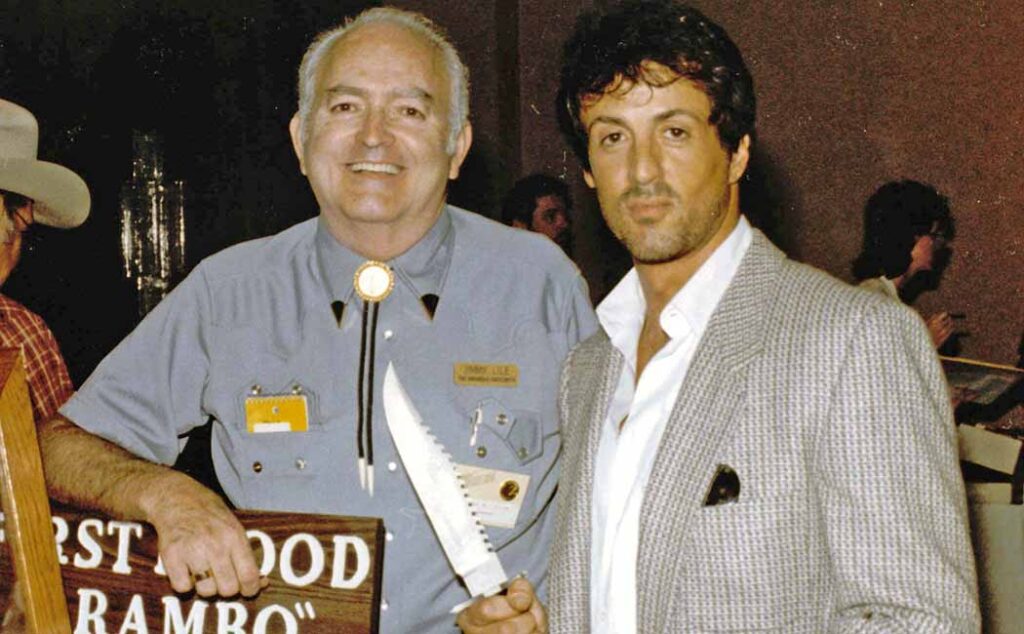
Jimmy Lile and Sylvester Stallone combined to use Lile’s survival knife in the 1982 movie First Blood, and knives were never the same again.
Hollywood took its turn in the early 1980s with the Rambo series of feature films and the knives that played starring roles. Cutlery Hall-Of-Famers Jimmy Lile and Gil Hibben became celebrities in their own right, and sure enough, other knife-and-sword-oriented films followed, including the Conan series, Commando, Predator and The Last of the Mohicans. These were just a few but the knives of custom makers profoundly influenced the marketplace. Soon enough, collaborations between custom knifemakers and factory knife companies began to flower.
1990s
By the 1990s, equipment such as CNC, laser cutters and CAD/CAM entered the knifemaking realm and brought about rapid change in the way custom and factory knives were made. The introduction of such hi-tech equipment into the maker’s shop gave rise to a debate over the very definition of handmade—a debate that continues to this day.
As early as the 1990s, the use of laser cutters—here cutting a hole in a Spyderco blade—CNC machines and other high-tech equipment began to take hold in the making of knives.
At the same time, the emergence of the internet brought the commercial knife market to the world, as custom makers, factories, dealers, collectors and others offered knives for sale on an unprecedented scale. The global reach of the internet led to a burst of information on every aspect of the knife industry, from websites, forums for the exchange of information, how-to videos, online auctions, and even a bit of the dark side—buyer beware! Know your customer and other maxims rang true.
Along with the information explosion, competition was more robust than ever, particularly with the onrush of China’s factory presence, not only in quantity but also, later, in quality. The Chinese influence has redefined notions of affordability, value, and how knives are produced and distributed, and the resulting market conditions continue to impact the buying habits of consumers worldwide.
2000s On
Of course, there are ongoing challenges. Two significant advocacy groups, the American Knife & Tool Institute (AKTI) and Knife Rights, assumed leading roles in responding to knife laws and particularly to the zeal of government regulation, which at times has threatened the livelihood and freedom of Americans to carry one of man’s oldest tools. Pro-knife legislation and the legalization of automatics in many states are evidence of the credible work that has been done, with much of the organized response from the knife industry resulting from the defeat of the 2009 effort led by U.S. Customs to reclassify one-hand knives as switchblades/automatics.
With the C01 Worker in 1981, Sal Glesser and Spyderco introduced the first knife with both the famed hole in the blade for easier one-hand knife opening and a pocket clip for enhanced carry. Released in 2014, the company’s C01GPGR Worker Sprint Run paid homage to the original C01.
Knife Innovation
The history of the modern knife industry is one of rapid change and continuing innovation. Long-time maker Tim Britton recalls the influence of Blackie Collins and Blackie’s foray into publishing. “Blackie could sell refrigerators to Eskimos,” he commented. “The American Blade magazine was one of his favorite projects, and his input and support facilitated the start of the Knifemakers’ Guild. We had one show, the Guild Show, where we could share fellowship and technology. Names like Buster [Warenski], Henry Frank, [W.W. “Bud”] Cronk, Jim Schmidt and Bob Loveless became famous at our annual shows.
“Virgil England took us to another planet and then along came the Chinese industrial monster,” he continued. “Tactical knives were their focus and they had no hesitation in copying American designs. The American Bladesmith Society developed a business model whereby rediscovered damascus steel could be taken to all new levels. There was never any question in this group about ‘what is a handmade knife’ or who is copying whose design. Knifesmiths flourished, and Forged in Fire has taken us all to a new level. Knifemaking caught on in other countries, and those makers continue to produce some of the finest work imaginable.”
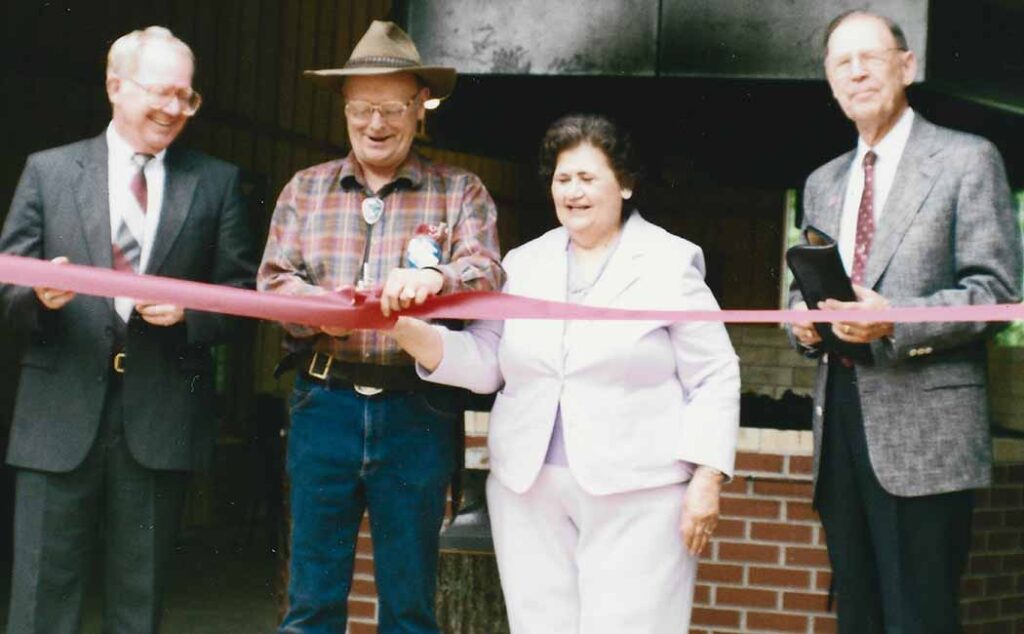
The ABS opened the Bill Moran School of Bladesmithing in 1988. The principals at the school’s ribbon cutting ceremony were, from left: Carl Nelson, president of Texarkana College, Bill Moran and Mrs. Margaret Moran, and Judge James Pilkington.
Custom knifemaker Jim Sornberger well remembers the early days of the Guild and its organization. “The Guild thing was first discussed in 1970, and that was Bob Loveless and A.G. Russell,” he said. “Actually, A.G. bought tables for a bunch of the guys and set that up. He said, ‘Let’s have a show and get a block of tables,’ and so he did that. The Guild was the best organization of knifemakers in the world, and it had the biggest knife show anywhere in the world for many years.”
As for technology, Sornberger says it is simply a fact of life. Evidence of progress and efficiency are seen in makers’ shops routinely today, including CNC equipment, mills, lathes, ingenious versions of versatile grinders and more. “You can’t reverse technology,” he reasoned. “There are always new methods of doing something.”
Ron Lake had a huge hand in the evolution of custom knives, introducing his clever tab-lock interframe folder and helping popularize 416 stainless. “It was a different world back when,” he remarked. “We had a small corner at a gun show, and Blackie Collins was sitting off by himself 30 feet away from me with a slipjoint knife, and I remember Loveless cut himself with that knife! A lot of people came and went from the knife world back in those days.”
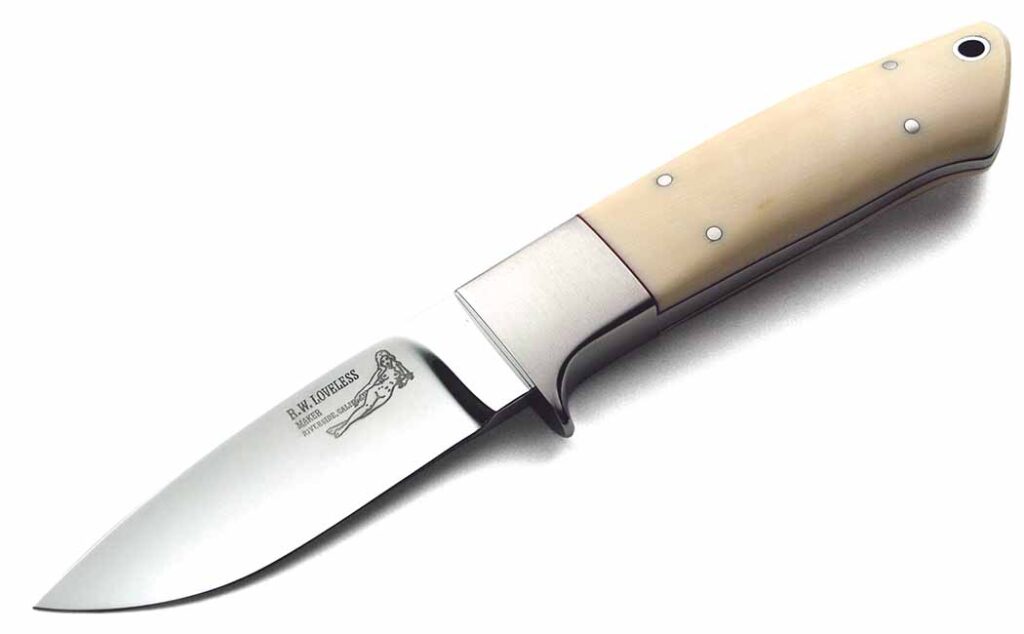
Contributions such as the dropped hunter by Bob Loveless were among the trends started by members of the Knifemakers’ Guild in the 1970s and beyond. (Exquisiteknives.com image)
As Moran brought damascus back into the spotlight in 1973 and other developments were coming along, Lake remembers the growing ranks of the virtuoso custom knifemakers, including Billy Mace Imel, Buster Warenski and others. He also recalls the sudden impact of Spyderco. “I think maybe it wasn’t so much the hole,” he said, “but the clip. That in itself was a mind-boggling event—maybe not so much at the time, but later as people started using it.”
Ron Lake, Bob Loveless, Bill Moran and A.G. Russell
The influential journalistic career of B. R. Hughes has made its own contribution to the modern knife world. Hughes was there in the beginning of the modern era. He planned the first Gun Digest Book of Knives along with Jack Lewis, and it hit the market in 1973.
“That was a meaningful year,” Hughes remembered. “Ron Lake, Bob Loveless, Bill Moran and A.G. Russell are the most influential individuals in the history of custom knifemaking, and A.G. played a bigger role than a lot of people give him credit for. He saw the need to organize and there was a meeting in Tulsa in 1970, and the first Guild Show was in 1971, and it grew unbelievably. They met in Houston and there were about 20 or so makers, and then the next year the show was in Kansas City, and there were 40 or 50, and it just kept growing.”
According to B. R., damascus was a catalyst for revival in American bladesmithing. “The inclusion of damascus saved bladesmithing,” he said, “and there were fewer than 15 bladesmiths in America in 1973. The number was going down. There was Bo Randall and then Rudy Ruana as well, but just a few younger bladesmiths.”
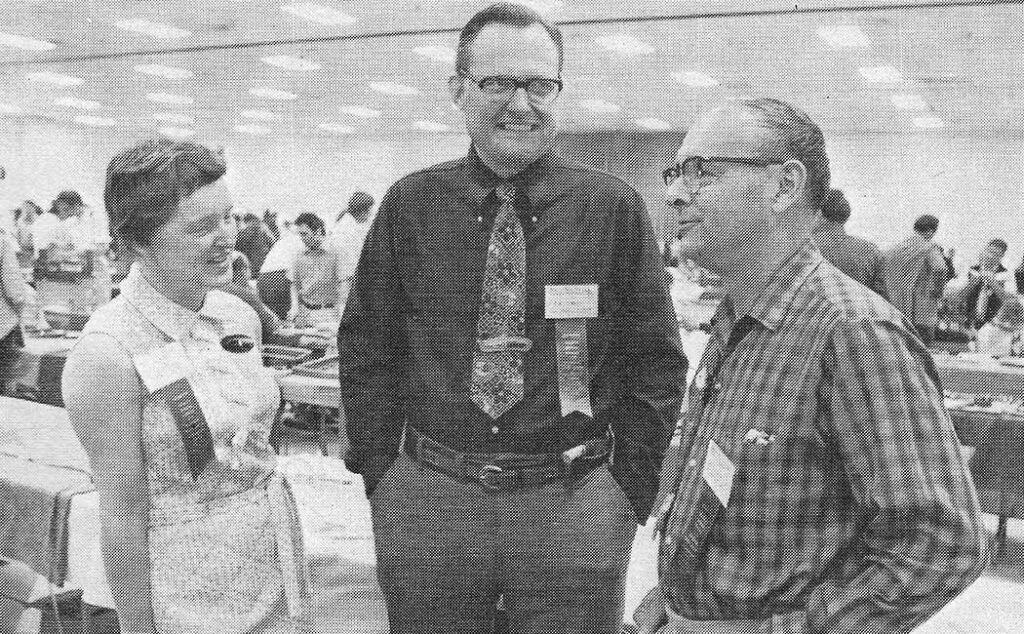
The use of a wide range of new materials in the making of knives exploded in the 1990s and continues to this day. One of the latest examples is Bill Moran reintroduced damascus for knives at the 1973 Guild Show and the rest is history. Moran (right) observes another successful Guild Show with Betty and Ted Dowell at the ’74 event in Kansas City. (Sid Latham image), employed here by Gerry Michael on the blade of his Fancy Harpoon model. (Jocelyn Frasier image edit)
Then, he says, the founding of The American Blade weighed in. “That was immense,” he offered. “I started writing about knives in the early 1960s, and there were primarily just gun magazines. I wrote for Gun Week, doing some knife articles for them, but there was no knife magazine, and the people I wrote about were people I met at gun shows. Without a knife magazine, it made it tough to write about knives.”
Hughes added, “I was fortunate to be around the first meeting of the Guild and things like that.” Indeed, B. R. saw and wrote about history as it was made.
Knife Industry Ups and Downs
These days, the world of knives continues to expand, to change, to elicit praise and criticism. Britton has watched much of this evolution. “Quality Chinese repros are available at flea markets and gun shows for $15 to $40,” he observed. “Many knifemakers are designing knives for knife companies, further blurring the differences between handmade and factory/manufactured. The internet is being used extensively for marketing—from very ornate websites to knife forums. The ‘Show Calendar’ page in BLADE is crammed full of announcements of shows from San Francisco to Paris. Several knife dealers have created a secondary market, and literally thousands of knives are available for sale 24/7.”
Concurrently, Britton is excited about what he notices these days. “We’re seeing abrasive materials, grinders, CNC equipment, new steels, and exotic types of handle materials from paua shells to hippos’ teeth,” he noted. “Creative craftsmen are exploring new horizons with acrylics and phenolics and stabilized wood burls. We see something new at every show.”
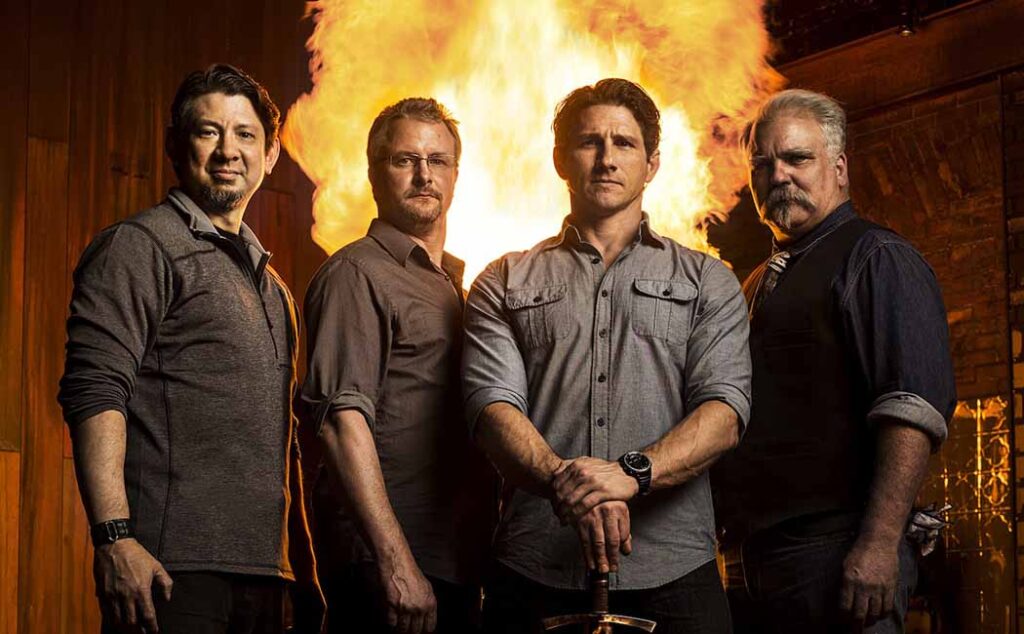
Forged in Fire debuted in 2015 and since then has exposed millions of television viewers to knifemaking and bladesmithing on a weekly basis.
That, succinctly, is a strong indication of an industry, a passion, a way of life that continues to flourish despite the strain and stress that are natural byproducts of absolutely anything and everything that is alive. A half century from now there will be more milestones, more discussions and even greater achievement.
Members of the BLADE Magazine Cutlery Hall Of Fame® mentioned in the story and sidebar are Blackie Collins, Sal Glesser, Gil Hibben, B. R. Hughes, Billy Mace Imel, Ron Lake, Jimmy Lile, Bob Loveless, Bill Moran, Bo Randall, Rudy Ruana, A.G. Russell, Jim Sornberger, Bruce Voyles, Michael Walker and Buster Warenski.
25 Knife Industry Milestones
1973 Bill Moran reintroduces damascus for knife blades at the Guild Show 1973 The American Blade debuts 1976 Bill Moran, B. R. Hughes, Don Hastings and Bill Bagwell found the American Bladesmith Society 1981 Spyderco debuts the C01 Worker, the first knife with both a blade opening hole and a pocket clip 1981 Michael Walker introduces a folder with the linerlock mechanism 1982 First Blood and Jimmy Lile’s Rambo knife appear in theaters 1983 Michael Walker first uses titanium in the construction of one of his linerlocks 1987 Buster Warenski completes the King Tut dagger reproduction 1988 The Bill Moran School of Bladesmithing opens in Old Washington, Arkansas 1992 Bruce Voyles moves the BLADE Show to the Renaissance Waverly Hotel in Atlanta, where it opens to rave reviews 1990s An explosion in Crucible Particle Metallurgy and the so-called “super steels,” and such materials as carbon fiber, mosaic damascus and more revolutionize knifemaking 1990s Computer numerically controlled equipment, laser cutters and more for knifemaking begin to appear 1990s Internet knife web pages, knife discussion forums, knife instruction videos and more start making their mark Mid-1990s Tactical folders begin to dominate the custom and factory knife industries 1997 The BLADE Show moves from the Renaissance Waverly Hotel to the adjoining Cobb Galleria Centre and completes its ascendancy as the world’s most important knife event 1990s Chinese companies begin entering the factory knife business 1998 The American Knife & Tool Institute (AKTI), the oldest surviving knife advocacy group, debuts 2001 Terrorists bring down the Twin Towers and the knife industry reacts with a slew of military inspired knives, tomahawks and more 2006 The Knife Rights advocacy group debuts 2009 The knife industry unites to defeat an attempt by U.S. Customs to declare all one-hand-opening knives switchblades/automatics 2010s Social media begins taking the internet knife business to the next level 2010s Knife Rights and AKTI work to overhaul anti-knife legislation, including overturning automatic/switchblade bans and establishing knife preemption laws at the state level 2010s European knife manufacturers such as LionSteel, Fox Cutlery, Maserin and others begin winning more than their share of BLADE Magazine Knife-Of-The-Year® Awards 2015 Forged in Fire debuts and exposes millions of television viewers to knifemaking and bladesmithing for the first time 2020 The pandemic ravages the world and also the knife world, closing knife shows everywhere—including the BLADE Show 2020s The knife industry survives the pandemic, and, thanks to internet sales, even thrives in some segments—and knife shows begin to return
Blackie Collins brought The American Blade to an audience thirsting for knife news.
Editor’s note: This year marks BLADE®’s 50th anniversary. In recognition of that milestone, we are presenting a series of stories celebrating our half-century birthday. This time, how Blackie Collins founded the magazine then known as The American Blade.
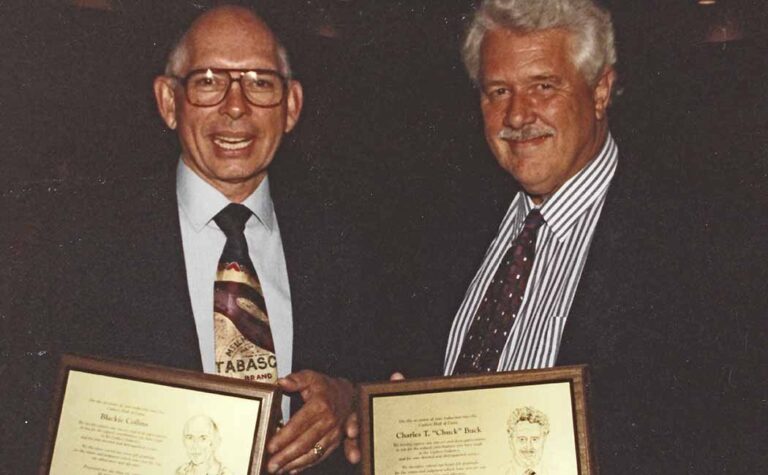
Whether designing a new knife, making a knife of his own creation, flying along on a motorcycle—or starting a magazine—BLADE Magazine Cutlery Hall-Of-Fame® member Walter Wells “Blackie” Collins was a risk taker.
Fifty years ago, Blackie spearheaded the first issue of The American Blade, the original name of today’s BLADE® Magazine. It’s unlikely he ever thought his creation would endure as it has, or that it would grow to become the World’s No. 1 Knife Publication. But back then, the time was right to give it a try.
“I was in business with a friend of mine buying and selling knives, and Blackie would supply us with cutlery. He was an excellent custom knifemaker,” remembered Roger Aiple of New Orleans. “He was a close friend and you might say he was thinking about producing a magazine. He asked me what I thought about it, and, knowing Blackie and his dedication to knives, I said it was a great idea but that producing a magazine was not the easiest thing in the world.”
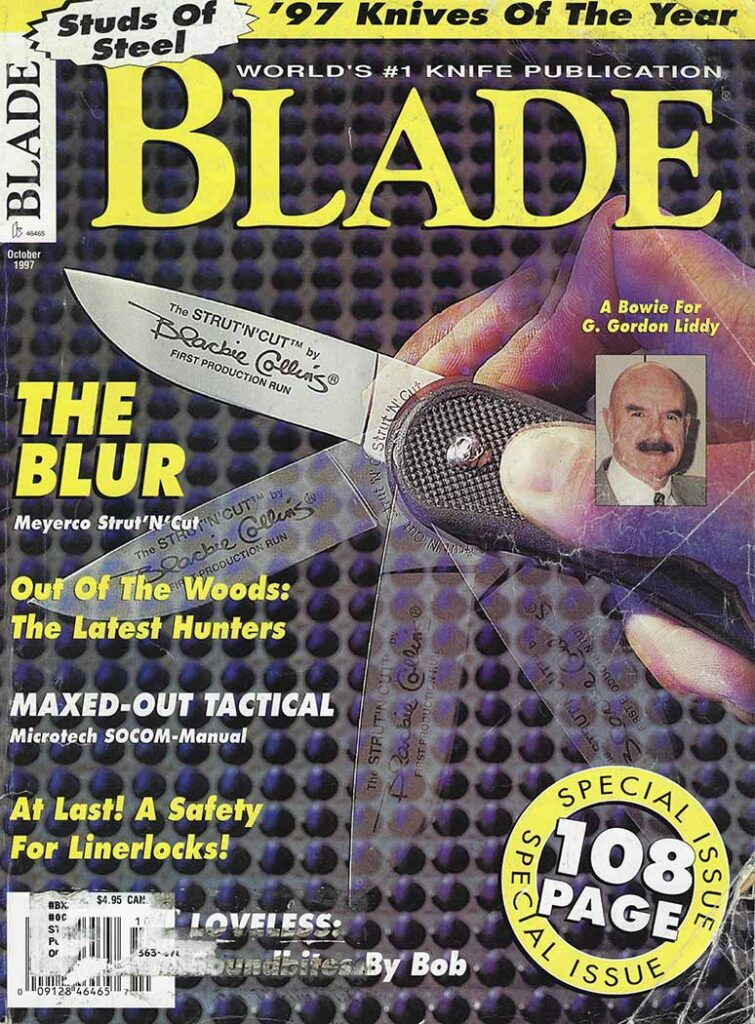
Blackie Collins loved motorcycles, including those by Ducati. In fact, he based the opening mechanism of his revolutionary Strut’N’Cut assisted-opening knife (inset gracing the cover of the October 1997 BLADE®) on the Ducati’s single-strut suspension system. He was killed in a motorcycle accident on July 20, 2011, at the age of 71.
Aiple introduced Blackie to Mal Mele and Sonny Molenaar, the owner of Molenaar Printing Company, in nearby Metairie, Louisiana, and the three men worked out a deal. Apparently, Mele and Molenaar were willing to share some of their insights on how magazine production worked, including printing, distribution, and other nuts and bolts items. Then, of course, there was editorial content to produce, copy to be written, and photos to be taken and reproduced for the new publication.
Blackie devoted energy and ideas to The American Blade, and there were two very good reasons for his drive to see the magazine concept become a reality. “Can you think of a better way, if you’ve got knives or knife designs, to get with other knife companies and everybody in the business?” reasoned Susan Collins, Blackie’s sister-in-law and wife of his brother, Michael. “The American Blade opened the door for him to walk into a shop or factory and say, ‘Let me do an article on you or on this or that subject.’ Blackie knew everybody, and it helped to make him very successful and Michael, too.”
While Blackie was putting The American Blade together, Michael was working away in the brothers’ shop. He knew Blackie was up to something but wasn’t sure exactly what was going on.
“I was working on knives and grinding blades, and he wouldn’t tell me what he was doing,” Michael smiled. “It was a surprise to me, but he got it done and it turned out well. Sometimes Blackie would do things and people would wonder why. He did a really good job of putting the magazine together and getting it published, and I sat back and watched it happen.”
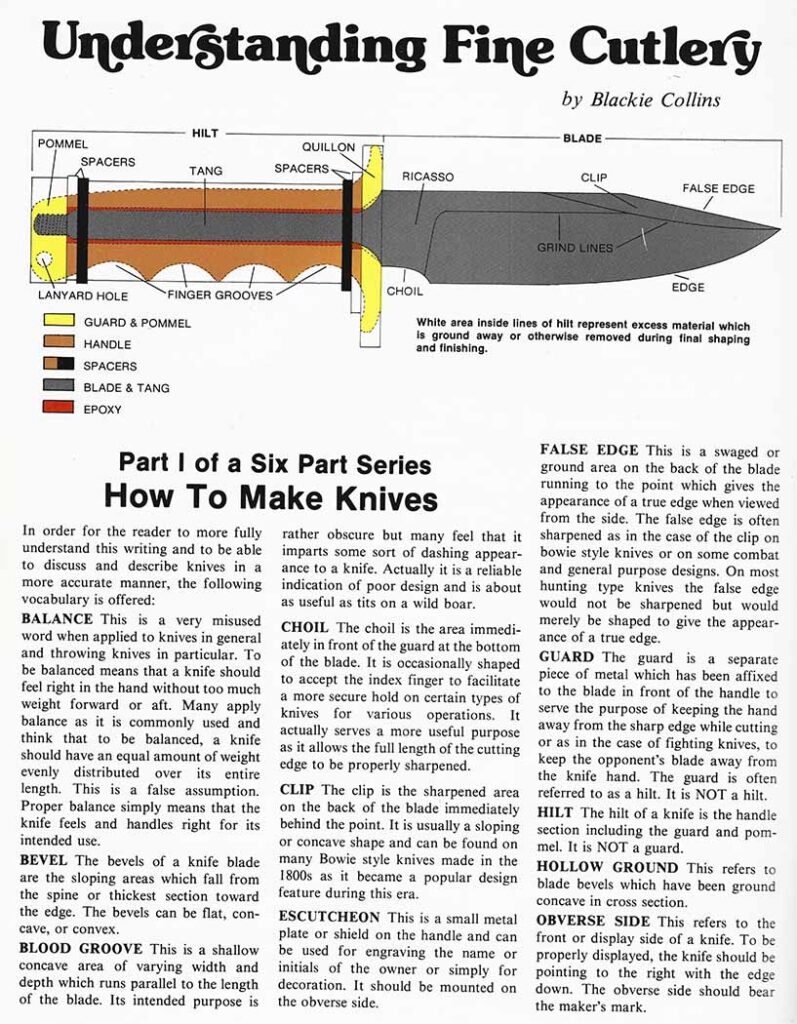
Blackie Collins wrote a series for the magazine titled, “Understanding Fine Cutlery,” and did his best to spread the good word of how to make knives, providing tips and pointers to up-and-coming makers.
Michael related that the two knives that graced the first cover of The American Blade were both his creations. After all, something had to go on that first cover, right? “He would set his mind to something, and that is what he was going to do,” Michael said of his industrious brother. “Sometimes, he would go a while before he would tell you what he was doing.”
Voice Of American Knifemaking
Cutlery Hall-Of-Famer Bill Adams, owner of long-time knife retailer Atlanta Cutlery for many years, was responsible in large part for the excitement that surrounded the knives of Sheffield, England, in the magazine in the early to mid-1970s. Sheffield was a center of knife production in Europe, and the quality of its cutlery was unsurpassed in the factory setting from the late 18th century until the early 20th century. After Bill put in long hours and travelled to Sheffield to search through the old local knife factories and make some key purchases, he had become an authority on Sheffield knives and co-wrote/wrote two articles on the topic in the first two issues of The American Blade. He later advertised Atlanta Cutlery in the magazine, too.
“There was something happening back at that time, and I thought The American Blade was an important development in the knife field,” Adams explained. “Up to that time, there was practically no news or information about custom knives, factory knives, sales outfits, or anything else if you were interested in collecting. Seems like I did write some articles for the magazine, and we probably swapped payment for advertising.”
Adams was right. There was something happening in the knife world in the 1970s, and The American Blade made information available to an ever-widening readership. Longtime knife-and-gun writer and one of the founders of the American Bladesmith Society, Cutlery Hall-Of-Famer B. R. Hughes, once said, “In the latter part of the 1960s, A.G. Russell supplied me with a list of all the custom knifemakers he knew at that time. There were 21 names on the list. The American Blade appeared in 1973, and there are literally thousands of known makers in America today. This is due primarily to BLADE’s features on knifemaking, prominent knifemakers, techniques, materials and the like, as well as information on knifemaking schools and expositions. This dramatic explosion of custom makers would never have occurred without BLADE.”
Jane Collins (right) said Blackie read and wrote constantly, and it was not unusual for him to stop his motorcycle on the side of the road or to get up in the middle of the night to write down an idea for a knife design or knife project.
And the big idea for The American Blade belonged to Blackie Collins. The magazine debuted with the May-June 1973 issue, and soon enough there was a buzz building up among knife people. Some of the most recognized custom makers in the industry were appearing with regularity in the pages of the magazine. D. E. Henry and Cutlery Hall-Of-Famer Bill Moran were members of its “Board of Editors,” while Bob Dozier made a knife that was given away in one issue to a lucky winner, a Mr. T. L. Cox of League City, Texas. Dozier, Moran, Lloyd Hale, Ted Dowell, Pat Crawford, Chubby Hueske, Herman Schneider, Cutlery Hall-Of-Famers Bob Loveless, Ron Lake, Buster Warenski, Wayne Goddard and Billy Mace Imel, and a host of other great custom makers were featured in one way or another in the succeeding issues. Dowell, Michael Collins, John Nelson Cooper, Jim Small, and Hueske also contributed giveaway knives that generated quite a swirl of excitement among early readers.
Bringing Knifemaking To The Masses
Blackie wrote a series for the magazine titled, “Understanding Fine Cutlery,” and did his best to spread the word on how to make knives, providing tips and pointers to up-and-coming makers. “There were a lot of people who wanted to learn how to make knives,” recalled Jane Collins, Blackie’s wife. “He had written a book about how knives are made, and he wanted to put the magazine out there to help new makers, too. It was so everybody could learn from it. He had learned from other people, and other people had learned from him.”
Jane remembers Blackie’s drive and commitment to various projects throughout his life, and The American Blade was an all-consuming endeavor for a while. “It caught on well. He was a writer, and he wrote and read constantly. He had the most interesting way of thinking about stuff,” she recalled. “He might be riding a motorcycle and have something come to mind and stop and write it down with a pencil and paper he carried. Sometimes, he woke up in the middle of the night and would run out to the workshop to make notes.”
Blackie always seemed to have a formula to make something go. His dedication to The American Blade in those early days was as intense as his new knife designs that always seemed to be in high demand.
“The magazine was such a good idea then because of our love of cutlery,” Roger Aiple observed. “We knew all of those first custom knifemakers, and the magazine was intended to promote knives. Blackie didn’t have any idea how to publish a magazine back then, but when I introduced him to Mal and to Sonny, they worked it out and helped him get it printed to start things.”
Soon after The American Blade got off the ground, Blackie must have felt that old familiar tug to move along to some new project. He had been listed on the magazine masthead as managing editor, editor and publisher, and of course, he had written articles as well. Some of the details from those days gone by have literally been lost to history, but it is safe to say that Blackie’s energy got things going, gave the publication the push that it needed, and set the stage for something that would have a far-reaching impact on the knife world.
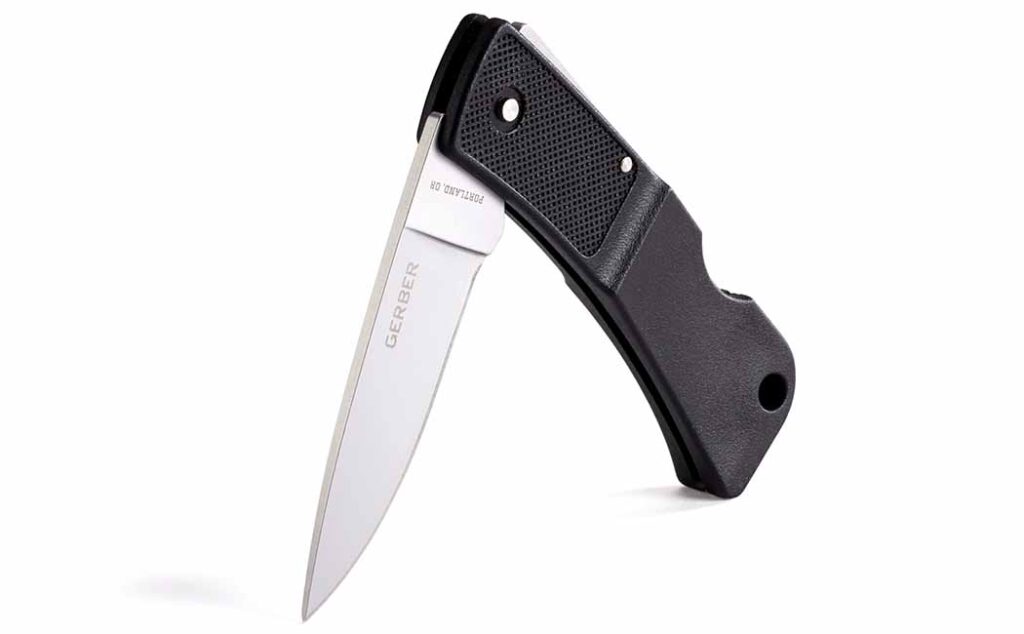
Blackie Collins designed the Gerber L.S.T. (1983), the first knife ever to have a handle of glass-filled nylon.
“Blackie was the kind of guy that would put things together, make some money and move on,” Aiple observed. “He was a great custom knifemaker, but his heart was in designing knives and having someone else make them. He did sell the magazine. I think he had gotten tired. It was taking up too much of his time, and it does take a lot of time to put a magazine together, writing articles, getting advertising, having photos prepared.”
Blackie resigned from The American Blade within months of the magazine’s launch, and an announcement ran in the November-December 1974 issue. The new editor, William L. Cassidy, noted that his predecessor was moving on and commented on Blackie’s important role in establishing a solid foundation and tapping into the knife community so well. “Blackie is, after all, the fellow who began this magazine—who lived with it through triumph and failure alike—and for this we all certainly owe him a debt of gratitude,” Cassidy wrote.
Blackie worked on the first seven issues of The American Blade in 1973-74. He saw his creation grow and prosper, becoming the icon in the knife publishing world that it is today. After half a century, BLADE’s staying power is proven. It still delivers on the desire of its founder to spread the good word about knives, and its message is as enduring as one of Blackie’s great knife designs that so many people have carried and used with pride through the years.
The Subhilt Provides An Additional Element To Make A Knife One Of A Kind. These Makers Show What A Subhilt Can Be.
The subhilt adds a little extra. Its form is expressive and its function is useful. It takes its share of the spotlight and provides another avenue of artistic approach for custom knifemakers who choose to build it.
A few of the makers who accept the challenge of the subhilt put their finest work forward. They use bold, sleek lines, and high-quality materials to bring the best of the subhilt to the market, and the combination of aesthetic and utility blends in a delightful presentation.
Subhilts In Italy
Daniele Ibba was already a goldsmith and “transferred” his skills in that pursuit to making knives. He describes himself as an “autodidact,” a self-taught subhilt maker.
Residing in a small town near Milan, Italy, Daniele Ibba has been making knives since 2004. He finds the subhilt a perfect approach to both usefulness and beauty as evidenced by his integral Medusa Gorgona.
“Although the knife has a clear artistic connotation, it was developed as a not-artistic knife,” he explained, “and the purpose of this subhilt is to have a stable grip, especially in the lunge, and consequently the possibility to hit the target/threat harder.”
Grip options are plentiful, and Daniele calls his subhilt pleasant to handle in any position, with the best control in the standard or reverse grips. The subhilt allows the user to always know where the blade and edge are located, and offers more protection to the hand.
In the Medusa Gorgona, Ibba collaborated with Lana Gorska and took home best in show from the September 2021 SICAC Knife Show in Paris.
“We are very proud of this,” he smiled, “because in every international show the competition is always very high and winning such a prize is never easy.”
The Medusa Gorgona is made from a single piece of 440C stainless steel hardened to a Rockwell hardness of 58-59 HRC, and is embellished with 13 mother-of-pearl inlays—four on the front of the handle, eight in the spine and one in the pommel. It also has 20 green diamonds, eight yellow diamonds, two blue diamonds, and three rubies—one round cut and two marquis cut. The fine engraving was done by Italian master Roberto Bruci.
“Lana and I had done many models in Plastiline® [a high-precision modeling clay] searching for the best ergonomic shape,” Daniele related. “Being a subhilt, it was not simple to reconcile design and easy handling. I do not have a [pantograph] or automated machinery, so it was very difficult to realize the handle and the slots for the mother-of-pearl inlays, but with time and patience I was able to achieve a beautiful result. Before designing the knife, Lana and I decided to engrave the mother-of-pearl with the mythological theme of Medusa.
“The story tells that she was one of the three sisters called the ‘Gorgoni,’ daughters of the Gods Forco and Ceto, and they had the power to petrify anyone with their gaze. So, we decided to make the name of the knife with the theme of the engraving, and Gorgona is like a nickname.”
An exquisite award-winning showpiece, the Medusa Gorgona stands out. Ibba’s price for a similar integral presentation without diamonds and extensive engraving would be roughly $13,000.
Marc Aldrich
Marc Aldrich mirror polished the undersides of the 416 stainless steel quillons of the subhilt on his bowie in a blade of 80CrV2 carbon steel and a handle of artificial ivory. Blade and overall lengths: 10 7/8 and 16 1 /8 inches. (Photo: SharpByCoop)
ABS apprentice smith Marc Aldrich has been making knives since 2013 after taking a couple of courses from ABS master smith/BLADE® field editor Joe Szilaski. Marc admires the work of Dave Loukides, Sam Lurquin, and Jan Hafinec which gave life to his ideas for a subhilt bowie with dazzling results.
His featured piece includes a blade of 80CrV2 carbon steel finished to a grit of 1500, a stainless subhilt with copper spacers, and a handle of artificial ivory accented with a copper pin. Marc made the sheath of hand-stitched leather with a quilted and copper-studded front panel, copper-studded frog and pigskin lining. A trace of a hamon is visible on the blade, and he explained that he chose not to etch the line but appreciates the discerning eye that catches sight of such detail.
“Of course, a subhilt adds retention and looks cool,” he offered, “but it helps if it is placed and shaped well. If we think of a knife as a sculptural object, the subhilt is another compositional, visual and tactile element we can use to add interest and function. I think my subhilt bowie is a mix between a bowie and fighter. Although not having a sharp swedge, the slender blade profile, added retention of the subhilt and excellent balance would make it formidable. The blade finish is actually bright and nearly mirror.”
Marc says his goal with every knife is to distill the lines down to their “pure essence.” His formula is “lines, flow, proportion and a tasteful balance of detail backed up with quality workmanship.”
The subhilt, he added, is an interesting subset of the bowie genre that is also seen in other knife styles. However, in all cases it must be properly spaced and integrated to avoid a clunky look and awkward handling. His price for a similar piece would run about $2,200.
Japanese Influence
Robert Appleby based his subhilt on a Tom Maringer-styled-and-designed fighter. Exhibiting a strong Japanese influence, the takedown model is comprised of 17 parts as a reflection of the 17 syllables in a Japanese haiku poem.
When Robert Appleby started making knives 27 years ago, he did so as a self-taught craftsman. He studied the work of other makers in similar styles prior to launching a piece of his own, and contacted other makers in person or by telephone to exchange information and gain understanding.
Appleby’s featured subhilt is a Tom Maringer-styled-and-designed Haiku fighter. Exhibiting a strong Japanese influence, the takedown model is composed of 17 parts as a reflection of the 17 syllables in a Japanese haiku poem.
A customer approached Robert a few years ago asking to make a 6-inch version of the original Maringer knife. After gaining permission, Robert borrowed an earlier version from a gracious customer and studied it closely. Robert has since made two knives in this fashion. The featured one sports a 9-inch blade of 154CM stainless steel mirror polished and double hollow ground.
Robert Appleby’s fighter (Photo: SharpByCoop)
The habaki is forged 416 stainless, while the tsuba (guard) consists of four layers of 410 stainless, and the handle sports 416 stainless fittings. The subhilt is formed of approximately 60 feet of twisted 304 stainless steel wire.
The handle and blade are joined by a toggle or link, and a pin attaches the tang to the threaded toggle. A 10-24 socket head cap screw is fed through the pommel and threaded into the toggle. For pricing on a similar piece, contact Robert directly.
“In my opinion, a subhilt provides increased retention, a more secure grip and increased control,” Appleby commented. “I don’t see the subhilt as impeding any grip style, as the blade is also double edged, and the subhilt also provides more positive extraction from the sheath. Each spacer is marked by a series of dots, one, two, three, etc., to hold the upper right of the tang hole. As I fit them, only the top and bottom of the tang hole contact the tang so they are self-aligning, as well as the front endcap of the handle. Indexing pins are set into the handle and align the last spacer, handle and pommel.”
Subhilts For Rugged Use
Knifemakers’ Guild voting member Gary Langley said his reproduction of a Bob Loveless Big Bear subhilt fighter is the only Big Bear he’s seen with a rear bolster. Blade and overall lengths: 8 3/8 and 15 inches.
Gary Langley built his reproduction of a Bob Loveless Big Bear subhilt for action.
“This was designed to be a fighter,” he said. “I have sold one that was going to be used to hunt wild hogs, though this particular piece resides in a collection in Florida. It’s pretty much a straight grip, but I suppose you could hold it however you’re comfortable with it.”
After building a new house, Gary started making custom knives in 1977. His new neighbor was Don Dollar, and it was Don who revealed fit and finish to Gary for the first time.
“Don showed me a few books and The American Blade Magazine [today’s BLADE®], and I was off,” Gary smiled. “I haven’t built a lot of knives compared to some, and this one is number 603. I’m 68 now and hope to get to 1,000 before I’m done.”
His Big Bear has a CPM 154 stainless blade and 416 stainless guard and subhilt with a mammoth ivory handle. Alice Carter did the engraving. Langley said this is the only Big Bear with a rear bolster he’s seen.
“I’m basically self-taught,” he commented, “and I’ve had a lot of inspiration, but have never taken a class or worked with anyone. [Steve] Johnson’s DVD on building a fighter was a big help—lots of trial and error! It’s not a simple knife to grind, and the things I learned trying to grind it have reshaped my process and equipment.
“The challenge on this blade with a rear bolster is to fit eight edges without a gap,” Langley concluded. “You just have to slow down. I would use my flat disc and rather than turn the motor on, I would turn it by hand so I didn’t go too far too fast.”
Depending on the engraving requested, Gary said his price for a similar knife would be around $3,000.
Known By Many Names, The Balisong Is A Flipper’s Favorite Knife. These Four New Balis Are On The Cutting Edge Of The Style.
The balisong presents knife manufacturers with an excellent opportunity to express their design creativity and material preferences in a style that promotes pure enjoyment among flipping enthusiasts.
Long popular amid the knife-buying public, the balisong—aka bali, butterfly knife or simply butterfly—is a favorite of those who appreciate its mechanics, good looks and the sheer fun of flipping. With safety in mind, the manufacturers whose stock in trade includes the balisong provide new and innovative models on a regular basis.
Along with these, training versions are often available, while seminars, videos, instructional courses, and online conversations are always at hand for those learning to use the balisong for the first time, as well as seasoned veterans who want to broaden their horizons.
Squid Industries Krake Raken Bowie V2.5
Lucas Cao, president of Squid Industries, is excited with the performance of the company’s Krake Raken Bowie V2.5.
“It’s wonderful that everything about it is highly optimized for the best flipping experience possible,” he said. “Some notable special features are the machined handle texture and its unique balance profile. The mechanism is a combination of stainless-steel bushings and phosphorus bronze washers. What makes the bushings special is we manufacture them in-house on our own Citizen Cincom L12 Type 7 Swiss lathe with extreme precision. Our expert assemblers use the bushings to then create the glassy smooth swing that the Krake Raken is known for.”
The Krake Raken is available in both live and training versions, allowing users to become familiar with its operations without the worry of an injury, according to Cao. And reliability is a watchword from the factory floor to the buyer’s hand.
“All of our balisongs go through rigorous testing across a long period of time and with many different users,” Lucas explained. “Balisong flipping is highly subjective, so we make sure that the feedback we gather is from both beginners and experts inside and outside of the organization. While Squid Industries has several top-tier flippers in our own ranks, we also work with top flippers around the world to hear their thoughts on our latest developments.”
An accomplished flipper in his own right, the Squid boss sees customers in the balisong universe always on the lookout for excellent ergonomics, grip, balance and durability. The ideals are addressed at Squid with continuing revisions and upgrades to its balisong line that are generated through robust customer feedback.
Finding Squid in the marketplace is easy, and its commitment to the education and popularization of the balisong is evident in its sponsorship of the West Coast Flipping Championship, a 32-person-event live competition held each year at BLADE Show West. In addition, YouTube is well stocked with flipping and maintenance tutorial videos.
Knife Specs
Blade Length: 4.5 inches
Blade Steel: AEB-L stainless
Blade Closure: Latchless design
Handle Material: 7075 T651 aluminum
Weight: 4.33 ounces
Closed Length: 5.625”
Country of Origin: USA
MSRP: $284.99
Premium Alpha Beast Kukri
The Premium Alpha Beast Kukri is the latest from Bladerunner Systems and is another example of the continuing outreach the company provides relating to balisongs.
“Spreading the word has been part of our primary focus,” commented Bladerunner’s Edward Anthonis. “We have been active in the community, hosted online tournaments, provided video content, and partnered with retailers to spread the word about balisongs and what a fulfilling and amazing hobby and sport it is and has become.”
With the Premium Alpha Beast Kukri, Bladerunner puts its best foot forward.
“What makes any knife transcend being just a knife will always be the attention to detail given from a maker or designer that truly understands what makes a purpose-driven knife the best in actual application,” Anthonis remarked. “Our balisongs are built not only to be great knives but also to be great for balisong manipulation.”
The bushings of the Premium Alpha Beast Kukri are something special, and Edward says they are an integral component of most Bladerunner folding knives.
“We use bushings in most of our knives, and we find the action of a balisong on bushings works best for the intended application,” he stated. “Having the critical dimensions of a balisong in place combined with a well-tuned bushing system makes for the best flipping experience.”
For Anthonis and company, testing is always a part of a quality manufacturing process, particularly since he and co-owner Lawrence Ho are flippers themselves.
“Since we both flip and have our feet firmly planted in the balisong community,” Edward related, “we can test the products and also get them into the hands of other flippers to solicit their feedback.”
KnifeSpecs
Blade Length: 4.5 inches
Blade Steel: 154CM stainless
Blade Closure: Latch
Handle Material: Titanium
Pocket Clip: Yes
Closed Length: 5.375 inches
Weight: 5.3 ounces
Country of Origin: USA
MSRP: $439.99
Kershaw Moonsault 5050
“Our butterfly knives utilize four KVT-ball bearing systems,” explained Dominic Aiello of Kershaw/Kai-USA. “On each side of the two pivots is a ring of ‘caged’ ball bearings that enable the blade and handles to move quickly and smoothly.”
So it is with the Kershaw Moonsault 5050. Customer appreciation and response to knife offerings help move the company forward, and with its latest balisong the reviews have been quite positive.
“When we develop our butterfly knives, our goal is simple,” Aiello related. “We want to offer a high-quality USA-made product that is affordable and fun for everyday knife users and flippers. With that said, smooth flipping, comfortable handles, and good weight balance are keys with butterfly knives.”
For beginners interested in learning more about the fun of flipping, Kershaw offers the Lucha trainer. It closely replicates the size, weight and design of the original Kershaw Lucha bali.
Knife Specs
Blade Length: 4.6 inches
Blade Steel: 14C28N stainless steel
Blade Closure: Latch
Handle Material: Stainless steel
Weight: 6.1 ounces
Closed Length: 5.65 inches
Country of Origin: USA
MSRP: $249.99
Benchmade 85 Billet Ti Balisong
The Benchmade 85 Billet Ti Balisong is the product of modern technologies, processes and materials applied to a very traditional knife, says Vance Collver, company director of product line management. The knife’s best attributes include smooth, consistent action, and those who experience it are the best judges of that slick performance.
“If a balisong has any drag or ‘sticky’ spots in the rotation, it can affect timing during flipping,” Collver reasoned. “Durable materials—think about how often these knives get dropped when flippers are learning or trying out new or complex tricks—and style since it must look good too, are important factors. A balisong must be ‘cool,’ solid and function flawlessly.”
Benchmade folks take pleasure in walking customers through basic, fundamental flipping techniques at shows and various customer interactions, and several balisong enthusiasts and experienced flippers on staff at Benchmade put the company’s new product offerings through their paces.
“This knife is not available in a trainer version and is intended for experienced flippers or collectors only,” Collver advised. “Balisongs are part of our DNA at Benchmade. Our company was founded in the pursuit of the balisong, and to this day our logo remains a butterfly harkening back to our origin.”
Are these the best American knives? Maybe, maybe not. One thing is for sure, these are some of the blades folk most associated most closely with the good ol’ USA.
If the knife isn’t man’s oldest tool, it’s probably a close second. It has been around in some form since time began. Styles, looks, form and function have steadily evolved, and even though the basics of a particular type may have originated somewhere else, there are those that are associated most closely with the good ol’ USA.
These are knife styles that the buying public, the collector, the factory, and the custom maker would probably associate with the United States more closely than any other country.
“You have to start with the time period when knives actually became ‘American,’” explained BLADE Magazine Cutlery Hall of Fame® member Bruce Voyles. “From the first settlers, the Spanish in Florida or the Vikings, every knife they brought to this country was made and came from somewhere else.”
American Designs Come Into Their Own
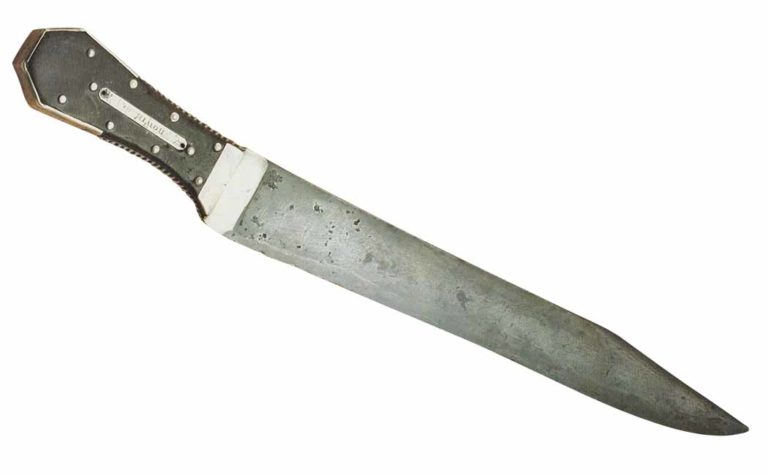
Voyles points to the truly American knife and says that the history of the country allows for a nod to the J. Russell Green River Works in the 1830s—the mountain man period when skinning knives were pretty much an enhanced version of the butcher knife—the epic sandbar fight that brought the bowie knife to the forefront, George Schrade and the introduction of the switchblade, and other examples of knives that are associated with America.
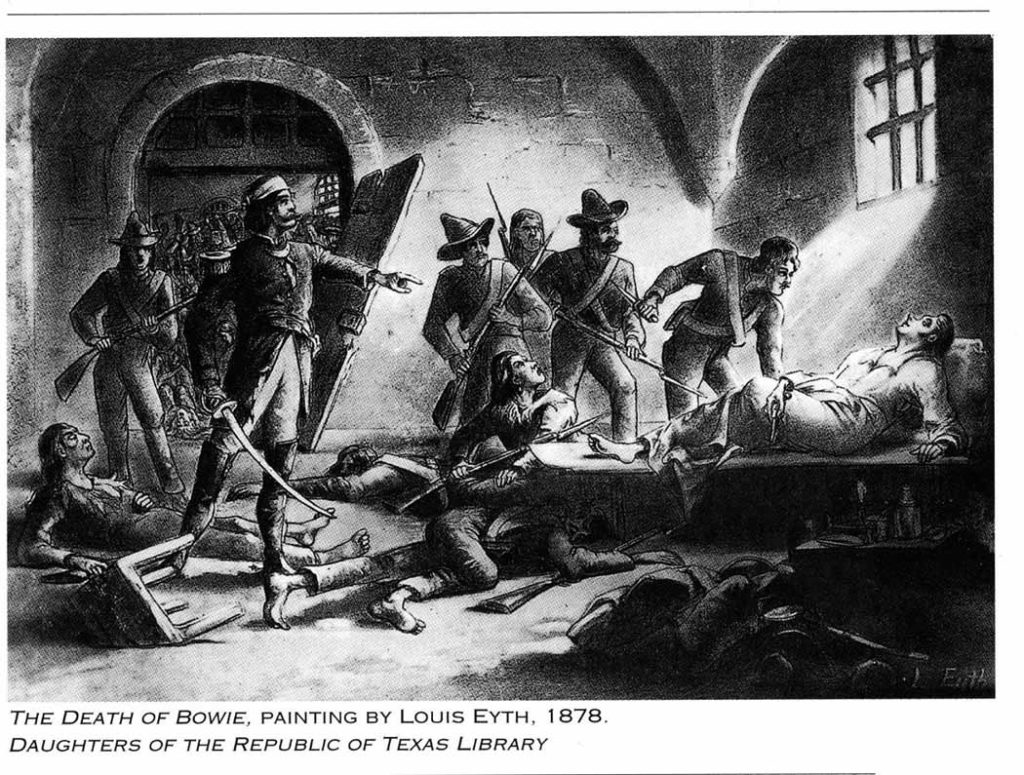
“Everything changed, and the cutlery world was turned on its ear when Jim Bowie got into a duel and that turned into a melee in 1827,” Voyles commented. “This happened across the river from Natchez, Mississippi, and you didn’t have good roads in those days. The rivers were the highways and when this happens, soon the story is heard in other river cities—New Orleans, Memphis, St. Louis and Cincinnati. Everybody hears this amazing story. Everybody wants a knife like Jim Bowie used, Bowie’s knife and then the bowie knife.”
Voyles related the story of George Schrade and the New York City patent office. “A guy comes in with something that looks like an automatic,” Bruce smiled. “George Schrade tinkers with it and invents the switchblade knife. He is the one that made it a production knife that people could afford. There were others around, but he got the patent on that style knife. Schrade kept tinkering with it, and he brought his brothers in and started Schrade Cutlery Company to produce George Schrade’s switchblades. So, now the modern American switchblade is truly an American knife, though the government banned it in 1958.”
In addition to his participating in the famous Sandbar Fight after which his knife became a sensation on both sides of the Atlantic, Jim Bowie also fought and died in the Battle of the Alamo.
There is, of course, with every innovation in cutlery or other endeavors, a ripple effect. And Schrade Cutlery is a great example as its knife production expanded and the brand became one of the most recognized in the world.
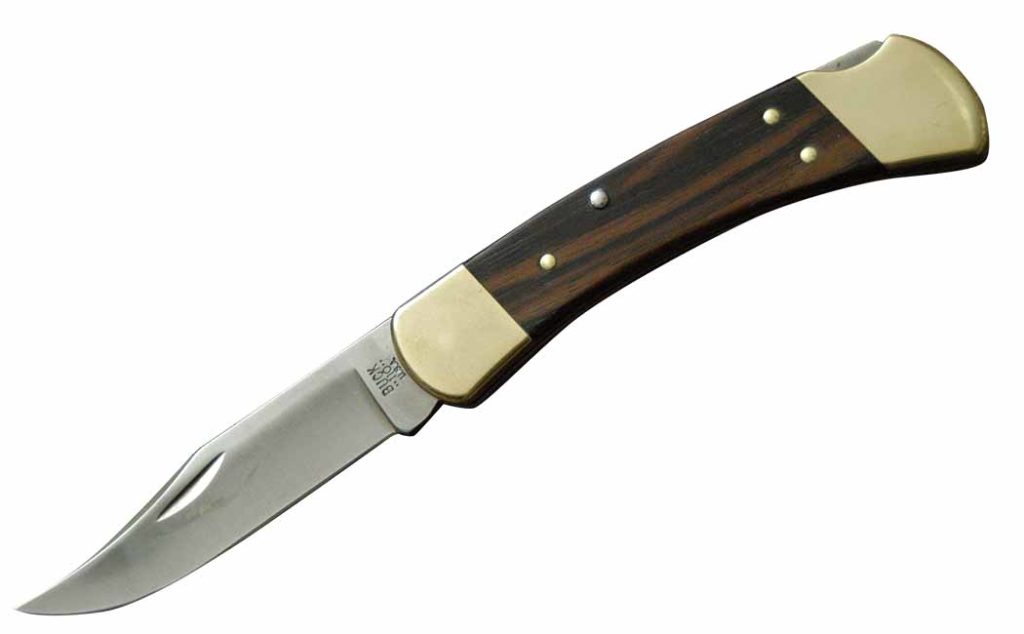
While folding hunters have been out there seemingly forever, Voyles categorically asserts that the Buck 110, which took the knife world by storm almost 60 years ago, is an American knife that deserves to be categorized all by itself.
“Nothing else looked like that knife when Al Buck made it,” Voyles reasoned. “The other lockback folding hunters looked like pocketknives, but I defy you to show me a look like the Buck 110 that existed any earlier. It’s an American style of its own because everybody copied it. The Buck 110 had different construction and sturdiness, and it was so distinctly different that everybody else copied it. The design was so different, and that is attested to by the number of people who copied it.”
According to Bruce Voyles, when Al Buck made the Buck 110 in the mid-1960s, nothing else looked quite like it.
Cutlery Hall-Of-Famer Dan Delavan of plazacutlery.com adds, “Americans have introduced a lot of different blades in the past, including the bowie, KA-BAR combat knife, the hollow-handle survival knife, as well as the basic Boy Scout knife. Each knife served a very basic function, from war to camp and basic scouting activities.
“I think the Spyderco hole is all American,” Delavan opined. “Sal and Gail Glesser came into my shop [the old Plaza Cutlery retail knife store in Costa Mesa, California] back at the very beginning with their folder with the pocket clip and the hole in the blade. They were doing county fairs at that time with their sharpener and introducing their knives. We bought on the spot and have been a lifelong dealer ever since. That has led to a lot of different openings for folders and remains a mainstay in the industry.”
While many may think serrations when they think Spyderco—and they would be correct—the most significant Spyderco innovations are the hole in the blade and the pocket clip. The Worker was the first Spyderco knife with those features, and it was reproduced in 2017 as seen here in one of the company’s sprint production runs.
Quintessential American Knives
Bowie
Historical or modern, vintage or recent, knives with that American flair are identifiable and recognized at home and abroad. Cutlery Hall-Of-Famer Goldie Russell of A.G. Russell Knives sees the bowie as iconic.
“The bowie knife is the quintessential American knife,” she noted. “It is believed that the first was made for Jim Bowie in the blacksmith shop of James Black* in south Arkansas. [Bowie knives] became so popular that they were manufactured by Sheffield cutlery factories for the American market.”
Fixed Blade Hunting Knives
Russell goes on to raise the work of Cutlery Hall-Of-Famer Bob Loveless and his fixed-blade hunting knives to the top as well. “Bob Loveless forever changed the style of the hunting knife with his drop-point, semi-skinner and utility blade shapes, with the drop-point hunter being the most popular,” she continued. “The influence these knives have had on the world knife market includes not just the blade shapes, but also the shaping of the handles to better fit the hand. These models have clearly influenced the shapes, look and feel of knives made by generations of knifemakers, and will continue to do so for decades to come.”
Bill Moran’s Mark
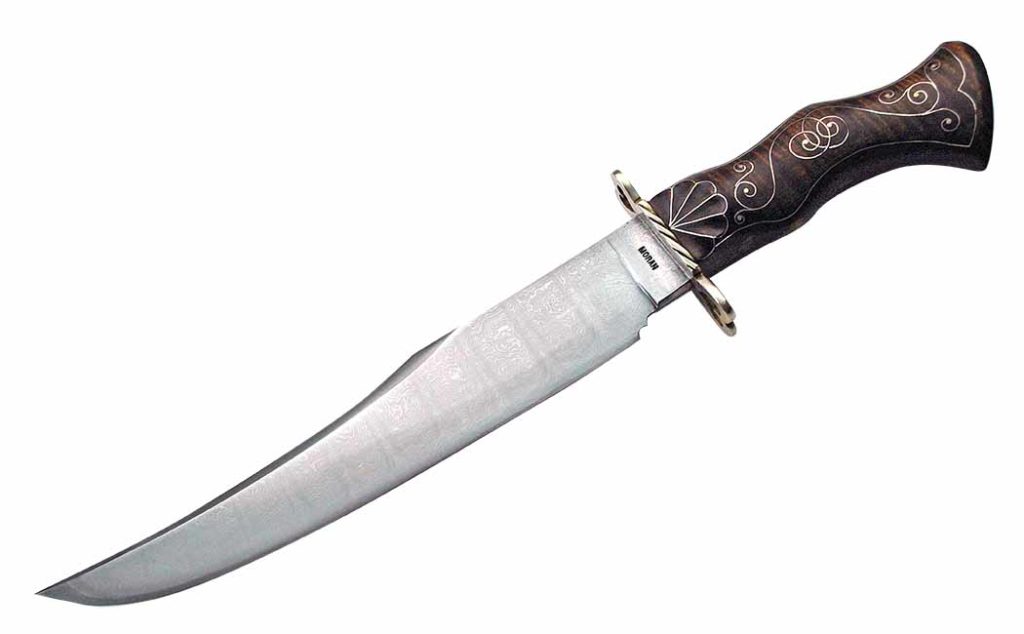
Bill Moran’s statuesque ST-24 not only paved the way for knives of carbon damascus in the 1970s and beyond, but subsequent models in mosaic and stainless damascus as well. (Dave Ellis image)
Also influencing generations of knifemakers were the many camp knives, bowies, fighters and other fixed blades forged from the damascus steel reintroduced by Cutlery Hall-Of-Famer Bill Moran in the early 1970s. Moran’s damascus knives set the stage not only for a plethora of standard carbon damascus knives but also later for stainless damascus and mosaic damascus knives.
Multi-Tool
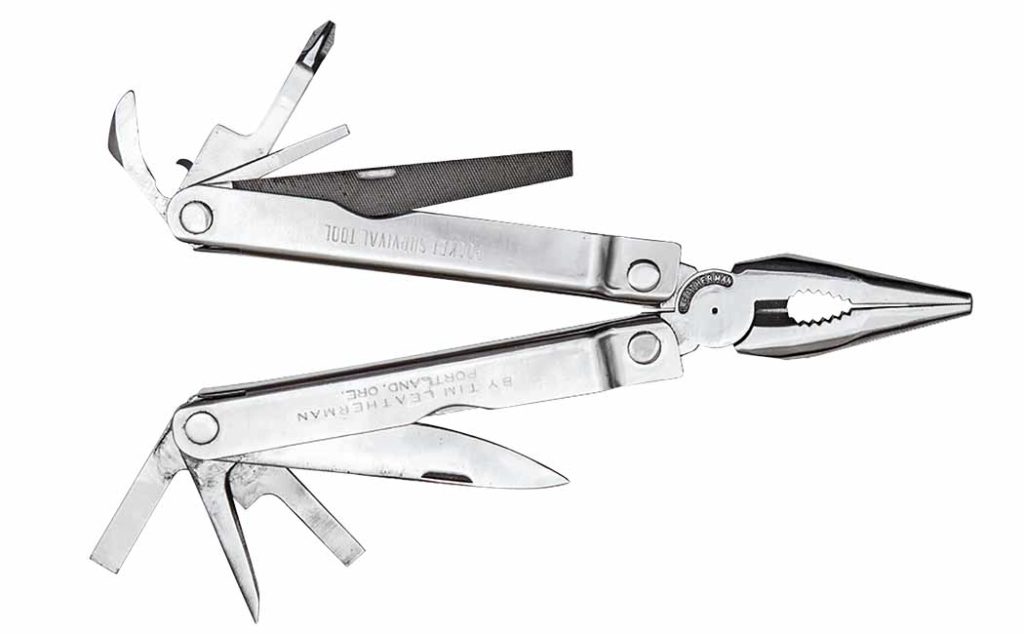
Tim Leatherman holds the multi-tool that started it all: the original Leatherman tool, the PST (Pocket Survival Tool).
Then, there are the variations on a theme. The multi-tool, for some a knife and for others something totally separate, has nonetheless influenced the cutlery market and is among those chiefly American styles.
“Tim Leatherman’s inspiration in the design of the first Leatherman tool created an entire category in the world of knives,” Goldie Russell explained, “but also in the tool industry. Most construction workers, farmers, carpenters, forestry workers and many other segments of our society carry a multi-tool every day. Those who are not carrying one will usually have one in their toolbox.”
American Knife Innovation
Linerlock
Inventiveness, in itself, is not uniquely American. However, at times the original has the potential for improvement, and just as Schrade improved the switchblade, Cutlery Hall-Of-Famer Michael Walker revolutionized what would become the linerlock.
Cattaraugus made a pocketknife with a brass spring/lever that helped prop the blade in the open position. “Walker changed the design so that when the lever locked it kept the long, clean lines of the knife,” Voyles observed. “The bottom side of the blade is blocked, and the big bump there has got something to hold onto. Walker’s lock does not block the bottom of the blade. It blocks the butt end of the tang. Michael didn’t patent it†, and every major manufacturer in the world has knocked it off. Nobody thought it would have such an impact. However, any knife with a locking liner is an American knife because it was an American innovation that did it.”
Russell echoes the sentiment that Walker’s linerlock was revolutionary and an American innovation. “Michael Walker’s genius of replacing the slip-joint spring with the ball detent spawned the entire generation of modern EDC knives,” she added. “His innovation allowed a portion of the liner to be utilized as a locking device. The idea caught on quickly with handmade knifemakers and has now become an integral part of the manufacturing process for almost every manufacturer of knives. This method of creating a locking folder has made knifemaking much simpler, with much less skill necessary to make an excellent functioning knife.”
Tactical Folder
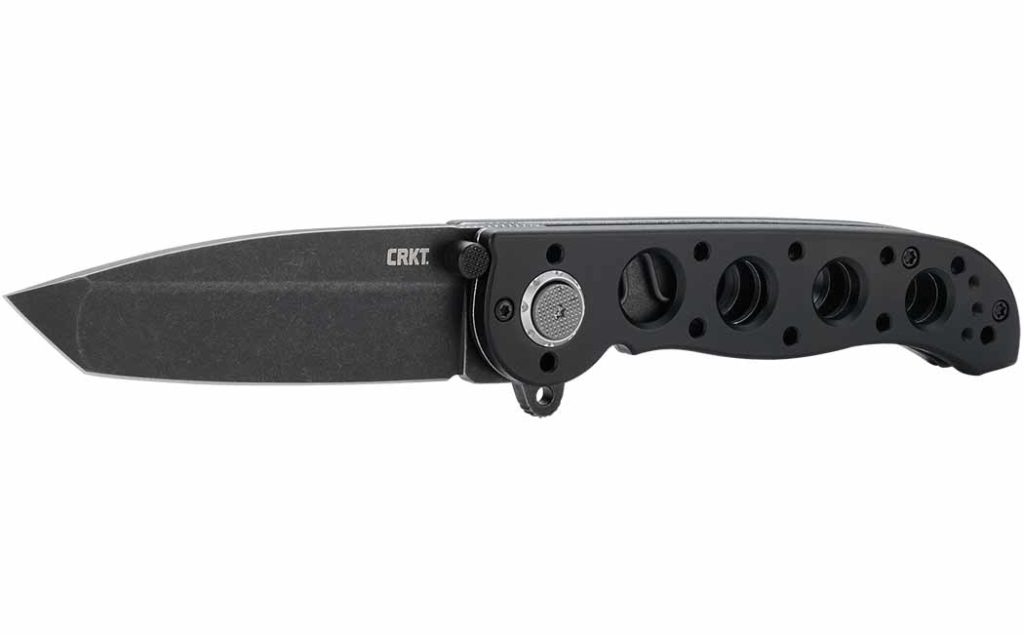
One result of Kit Carson’s popularization of the flipper folder is his long-running series of M16 flipper folders for CRKT. Among the latest iterations is the M16-02DB. In addition to being a flipper folder, the original M16 also was among the earlier top factory tactical folders.
The tactical folder took the world of knives by storm in the mid-to-late 1990s, offering a one-hand folder—usually black—with a non-glare stainless steel blade, a synthetic handle, a linerlock and a pocket clip. While some called it more a marketing approach than a knife, the fact that the folder dominated the market for at least a decade if not longer cannot be denied.
Flipper Folder
Searching her memory and experience, Goldie Russell also identifies the flipper folder popularized by Cutlery Hall-Of-Famer Kit Carson and the SpeedSafe assisted opener by Cutlery Hall-Of-Famer Ken Onion as innovative, influential styles that the world associates with the United States. “When combined with the Walker linerlock, the Carson flipper adds the ability to open the knife as fast, or faster, than a switchblade knife,” she remarked. “It’s a clear improvement over the stud or hole in the blade for the purpose of one-hand opening. The use of the flipper as an opening device has become prevalent throughout knifemaking across the world.
“Then, Ken Onion’s addition of a spring to launch the blade open** is another American innovation that has changed the landscape of the knife industry,” she concluded. “Nearly every American brand utilizes some variation of Ken’s way of using a spring to open a blade quickly. The genius was the bias toward closure that kept a folder from being deemed an automatic.”
Rambo’s Influence
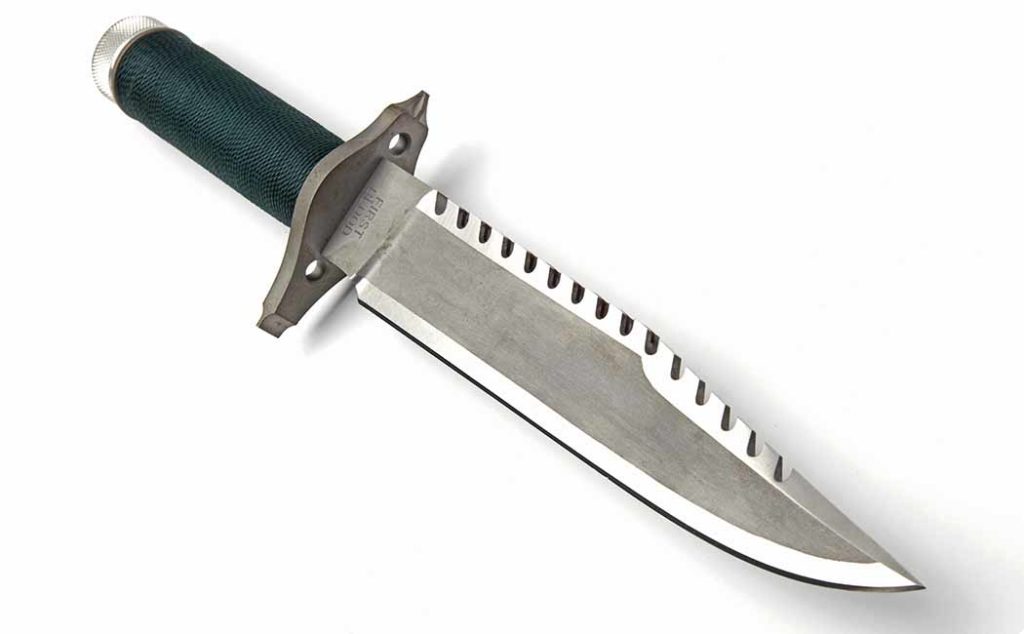
Jimmy Lile’s Rambo knives started the hollow-handle-survival-knife craze that dominated the 1980s and beyond. (from the Randy Rousseau collection)
As the Rambo film franchise grew in popularity during the 1980s, the work of Cutlery Hall-Of-Famers Jimmy Lile and later Gil Hibben made the knives in those motion pictures stars in themselves, rivaling Sylvester Stallone for worldwide acclaim. Voyles insists that the Rambo knife is an American phenomenon that still impacts the knife market today.
“The Rambo knife is uniquely American for two reasons,” Bruce said. “Jimmy Lile designed it and made the knives for the first two movies, and it ignited a boom in survival knives that exists today. Then, the other historical tie-in is that in the 1980s every boy who could walk had a survival knife with a big, round compass on the end and a hollow handle. Even today, those boys are adults and they love the nostalgia of that handmade Rambo knife. Indirectly, Jimmy Lile created all this, and the Rambo knife is uniquely American in that regard.”
Final Cut
Considering the knives closely associated with the United States, their impact is obvious. Those styles associated with the good ol’ USA still resonate across the market and in the inventive minds of those who brought them into being.
*Editor’s note: While many do indeed believe that James Black made a knife for Jim Bowie in Black’s shop, such a knife has never been definitively proved to be as such because Black did not mark his knives.
†Though unable to obtain a patent on the linerlock, Walker was able to obtain a trademark on the name linerlock, a trademark that has since elapsed.
**Cutlery Hall-Of-Famer Blackie Collins also made one of the first versions of an assisted opener.
A knifemaker and other knife pros take different approaches to the Ukraine-Russia conflict.
The ravages of war often have global impact—even when the fighting is half a world away and the devastation is seen through pictures and words rather than bullets and bombs. War, anywhere, tends to touch the lives and livelihoods of many.
The knife industry, both factory and custom, is no different. The war in Ukraine has brought devastation to the country, and its end was nowhere in sight as BLADE® was going to press. Ukrainian resistance is robust, probably in sharp contrast to the results anticipated when Russian President Vladimir Putin decided to invade his sovereign neighbor. While the resilient Ukrainians defend against such aggression, where and how does the knife industry feel the long reach of war?
Oleksii Nesterenko is a custom knifemaker. He is also Ukrainian.
“On February 24,” he commented, “Russia, with the support of Belarus, launched an open military attack on Ukraine. My city, Kyiv, was one of the main goals. After systematic rocket attacks on the city, my wife and children were forced to evacuate to Germany.”
At press time, Ukrainian knifemaker Oleksii Nesterenko had signed a contract as a territorial defense volunteer for Ukraine and had stopped making knives.
The war came home to Oleksii, and his life may very likely never be the same. He has responded to the call to defend his country. “I signed a contract for a territorial defense volunteer and stopped making knives,” he said. “As far as I know, the work of some knifemakers who work in the cities where there are no active hostilities has changed too. Many have abandoned the making of collectible knives and make simple, utilitarian knives and other devices for the military.”
Purveyor Dave Stark of Steel Addiction Custom Knives sells Oleksii’s work, and despite the fact there is a temporary suspension of custom pieces from the Ukrainian maker, Dave praises the quality of his knives.
“Oleksii’s fit and finish and his attention to detail are what set him apart from his peers,” Stark noted. “His choice of materials and the manner in which they are finished really make his work stand out. His hand-rubbed satin finish on his blades is some of the best I’ve seen. The knives feel great in the hand and mechanically are spot on. I would say his style is ‘dress tactical.’ He uses Damasteel’s pattern-welded steel, damascus, mother-of-pearl, mokuti, zircuti and zirconium.”
Perhaps current events will make Nesterenko’s knives even more highly sought after in the future. Meanwhile, he is consumed with the dirty business at hand.
“Now in the Kyiv region where I live, Russian troops are defeated and active hostilities have ceased,” Oleksii reported. “But I am still on duty at checkpoints and volunteer. We help the civilian population in the villages near the front. I think that in a few weeks I will have time to partially return to knifemaking.” While he is hopeful and actively involved in the defense of his country, Nesterenko has kept an eye on the conditions of the knife industry in Ukraine and anticipates some adaptations.
“Currently, there are no problems with the supply of materials for the production and shipment of knives abroad,” he advised, “so I look forward to returning to work. I am sure that a knifemaker can make a quality knife only if he uses it for its intended purpose. That’s why I used to make only EDC knives. Thanks to the war, I understand what requirements a tactical folding knife must meet. I have already drawn several designs and am waiting for the opportunity to get started.”
Changes in demand are not noticeable at this time, according to Oleksii, and orders are in the queue for delivery around the world into 2023. Still, he warned, “I think that the consequences of the war in Ukraine will affect the economies of many countries. And over time, that will affect collectors.”
Little Change
In much of the domestic knife industry, little in the way of change has occurred due to the war thus far. Custom knife purveyor Les Robertson said that by mid-April FedEx service to Ukraine had been suspended. Therefore, the volume of knives conventionally being sent to Ukraine has probably been curtailed, at least somewhat. Neighboring European Union countries are still moving mail into Ukraine.
Les Robertson
“No one is sending knives directly to anyone in Ukraine,” Les noted. He went on to comment that factory sales to “armchair warriors” may in fact tick upward as the war persists.
Purveyor Neil Ostroff of True North Knives agrees that the current custom knife market is maintaining its status quo. “In my opinion, as a dealer,” he commented, “we have no change from the customers concerning knives from either Ukraine—now on hold—or Russia. Several Ukrainian knifemakers have set up in Poland, and they do not want to be named.”
Still, Ostroff is somewhat insulated businesswise from the turmoil in Eastern Europe. “Going forward, I see no issues coming through, as there have been none so far,” he observed. “And most if not all of my clientele prefer to buy only USA-made items, which is what I prefer to supply as well.”
From the factory perspective, Joe Bradley, director of sales and marketing for KA-BAR, has noticed virtually no changes in activity. “The war in Ukraine hasn’t had any impact on us at all,” he remarked. “As far as production, and even consumption, the impact has been zero.”
Bradley added that supply and demand are in line. “We have not seen an increase. Currently, we are seeing the market being more impacted by inflation than anything else. I think most of the people, at least Westerners, in the Ukraine already had their supplies and as a result didn’t have a need to buy anything new. Production and logistics have been a problem since the start of COVID,” he observed, “and are just now starting to get back on track and return to a semblance of normalcy.”
KA-BAR has experienced no changes in product offerings or knife styles as a result of the war in Ukraine. However, Bradley offers one interesting point of view. “If anything, this war has shown the merits of what some might consider antiquated weaponry like the AK-47,” he pointed out. The AK-47 is perhaps the world’s most famous assault rifle, arising in the Soviet Union during the Cold War, experiencing authentic production models and knockoffs made in the millions, and arming military organizations around the world for well over half a century.
“Free The Oppressed”
Spartan Blades is located in Fayetteville, North Carolina, near the gates of Fort Bragg, home of the U.S. Army’s XVIII Airborne Corps and Special Operations Command. Spartan owners Curtis Iovito and Mark Carey, both Special Forces veterans, have seen a groundswell of support for Ukraine. Knife sales bear the unmistakable mark of the conflict.
According to Curtis Iovito of Spartan Blades, more military professionals and contractors buy the company’s Gold Line knives. An example is the Spartan-Harsey Dagger in a 6-inch blade of CPM S35VN stainless steel with a hollow grind. MSRP starts at $390. Bill Harsey is the designer.
“Most of the sales are to people here in the U.S. with notes that they are purchasing for folks in the Ukraine,” explained Curtis in acknowledging the market uptick. “Several orders have had short tags like ‘Free the Oppressed in the Ukraine’ or ‘Support the War against Russian Aggression.’ Because we are at Fort Bragg, we have several Special Mission units from friendly foreign countries drop by the shop to pick up knives for their use. While that isn’t uncommon, it’s happening more than usual. We’ve noticed during our discussions with them that things have a more serious tone.”
Others buying more knives from Spartan Blades include people from all walks of life and military involvement. Curtis said, “Our Gold Line knives are going to more of the military professionals and contractors, and our Silver- and Bronze-grade knives are selling to folks across the spectrum. Many of the knives bought are by civilians that later donate the knives to NGOs [non-governmental organizations] that ship in bulk to Ukraine.”
As far as production, it’s business as usual at Spartan Blades, a longtime producer of knives that go to war. There are a few new items on the horizon, and the owners expect business to be brisk in the days ahead.
Oleksii employs M390 stainless steel for the 3.75-inch blade and a handle of black and purple Fat carbon fiber for his Morph flipper folder. The bolster is Timascus™ and the pivot rings and back spacer are zirconium. Closed length: 8 5/8 inches. Retail price: $2,800. (Steel Addiction Custom Knives image)
“Honestly, the war in Ukraine hasn’t affected how we do things here at Spartan Blades,” Iovito asserted. “We’ve made knives through the last two decades for troops in both Afghanistan and Iraq, so things are kind of par for the course. “We have several new knives coming out around the end of this year,” he continued. “We had planned on releasing these later but have sped up because the price point and style match some of the requirements we have seen lately. They are being designed by William W. Harsey, Jr.—a fighter, a Nessmuk and a kukri blade. They will be in 1095 Cro-Van blade steel and made in conjunction with KA-BAR Knives. Pricing has not been determined yet, but we are shooting for a sub-$200 retail price. The first one produced will be a fighter later this year.”
Surveying the knife landscape today begs a few questions as Iovito and Carey plan for the future, uncertain as it may be.
“We have seen a slight increase in steel prices, but we haven’t raised our prices in over a decade,” Curtis stated. “We assume we will continue to see price increases soon in commercial, off-the–shelf parts but are keeping our fingers crossed. We believe we will see an increase in knife demand as it appears the conflict in Ukraine [will not end as soon as many thought it would].”
The war has had other effects, including dampening attendance at European trade shows.
“We were very surprised that most of the U.S. knife companies did not attend the IWA show* in Nuremberg, Germany, this year,” Curtis noted. “We even had people thanking us for attending, as you could tell they are counting on U.S. support even if it is just showing up to support them in spirit. There was definitely a new and urgent concern about military spending. The German government approached two companies that I know of and bought their whole inventory—cutting checks the same day!”
Curtis Iovito indicated Spartan’s affordable Silver- and Bronze-grade knives are selling well to people across the spectrum. One of the latest examples of a Silver-grade knife is the Alala in a 3.75-inch blade of Cro-Van carbon steel with a saber grind. MSRP: $159.
In wartime, uncertainty often reigns. However, awareness, preparation, and the desire to return to the shop are evidence that the ongoing conflict in Ukraine will influence the future of the entire knife industry for the foreseeable future.
*Held each spring, the IWA OutdoorClassics (iwa.info) is the European equivalent of the Shooting, Hunting, Outdoor, Trade (SHOT) Show stateside, and is a place where many new factory knives are debuted.