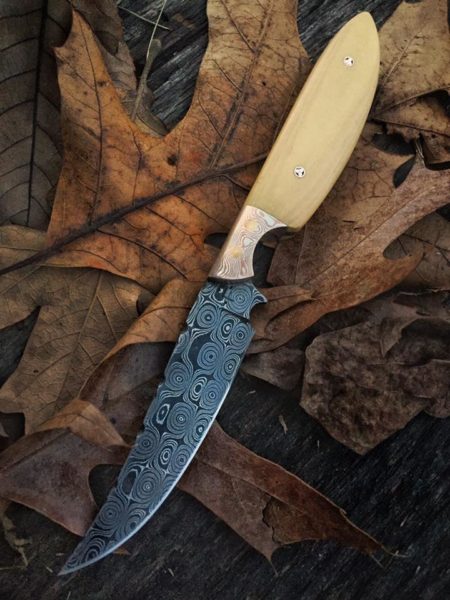
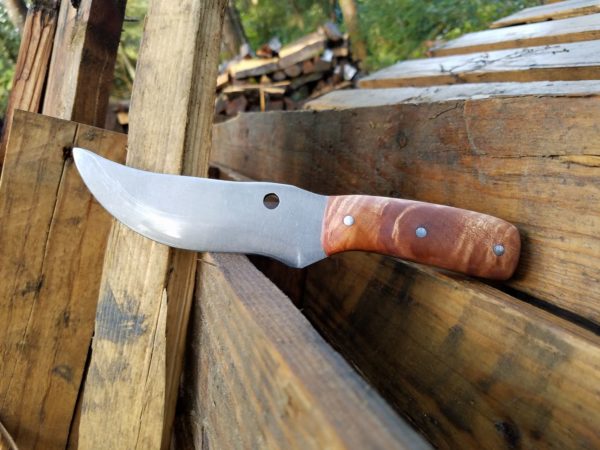
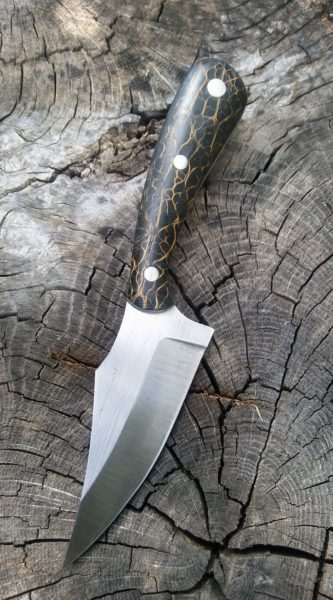
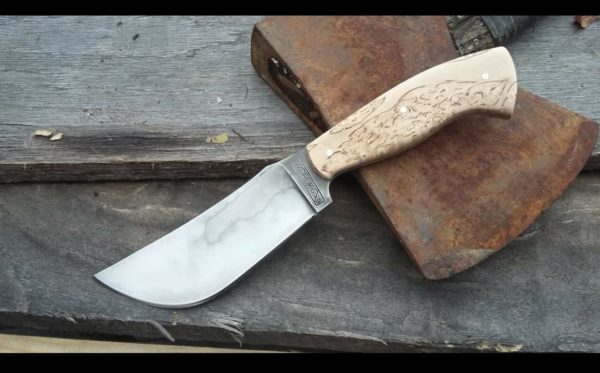
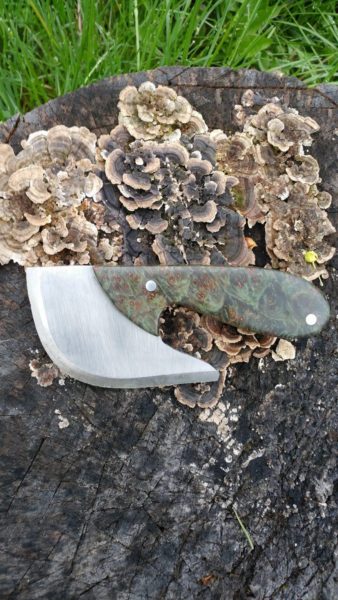
Jim Bowie is not amused with my lack of knowledge about steel mixes.
Knowing what you don’t know sometimes means knowing when to stop researching and just play with your knife. In the course of more fully educating myself about knives, I find that everything, and I mean every little thing, involves further study. It can be paralyzing. And sometimes it needs to just get silly so I can stop worrying about it.
I’m in charge of maintaining the style sheet at BLADE, which is an alphabetical list of knife industry-specific terms and instructions—or exceptions to instructions—regarding how we present certain things in BLADE. We want to be consistent.
The other day my boss and BLADE editor, Steve Shackleford, sent me something like, “Just so you know… the V in MoV is always capitalized. For example, 8Cr13MoV: Cr refers to chromium, Mo refers to molybdenum and V refers to vanadium—all elements in the steel mix.”
Cool, I thought.
And then I thought: The periodic table of elements? Seriously?
For an English major with a history minor—even one into guns and knives—this concerned me. Oh sure, there’s science in the acids and bases of a batch of cookies in the oven, but I honestly never imagined printing out that chart after I left high school. But there it lies, adding color to the growing pile, its information so obvious in hindsight. Jim Bowie perpetually scowls with what I imagine can only be his disappointment in my slow pickup.
So, when Steve explained how BLADE presents Rockwell hardness: “the Rockwell hardness is 58-59 HRC,” I figured I should try to fit more about that topic into my rock hard head.
After work I called a friend.
His response: “What is the Rockwell hardness scale and what does it mean to me?”
It all makes perfect sense. I think I can now move on to worrying about whether there’s a good mix of ATS-34, 440C, CPM S30V, CTS steels and 5160, O1, D2, 1095, L6 steels represented in our Knifemaker Showcase pieces.
Your Knifemaking Questions, Answered
Get all your knifemaking questions answered in this collection of expert advise from former BLADE columnist Wayne Goddard. The Wonder of Knifemaking makes a thoughtful gift for someone interested in starting or perfecting their knifemaking skills
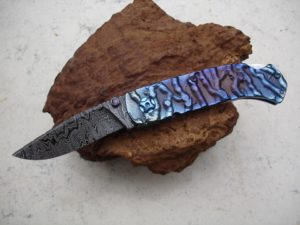
1. This everyday carry folding knife by Tim Lambkin is lightweight at 3.2 ounces. It measures 4 inches closed and is 3/8 inch thick. Tim welded the pattern, did the filework inside and out and flame-anodized the titanium scales to add the wow factor. The screws are the types used in hip replacements, anodized for color! The thumb stud is mother of pearl. Makers List Price: $900-$1000 Contact http://chopsknives.com, [email protected],903-926-7447. (Ericka Lambkin image)
Has a card, flowers and brunch become the routine for Mother’s Day? Maybe you’ve tried getting creative with gift-giving but it wasn’t well received, so you’re sticking with what works. Dull! Where’s your sense of adventure? What about giving the mothers in your life something sharp and pretty? Just like her! Let’s look at 20 custom knives moms want for Mother’s Day, or any day for that matter.
Isn’t that like giving a vacuum cleaner or an iron?
Yes and no. We’re not talking boxed sets of table cutlery or mass-produced blades, regardless of their quality and usefulness. We’re talking 100-percent hand-crafted custom knives. If you decide on a chef knife, for example, it could be construed as encouraging cooking, but the knife will be so beautiful, so smoothly made, so significant in her hand, she’ll overlook the “get cooking” aspect and start searching for things to julienne. You may find her looking for ways to display her knife not only as an easily accessible tool, but as a work of art. It’s not going to be tossed carelessly into a drawer, that’s for sure.
Hmmm. I’m not so sure.
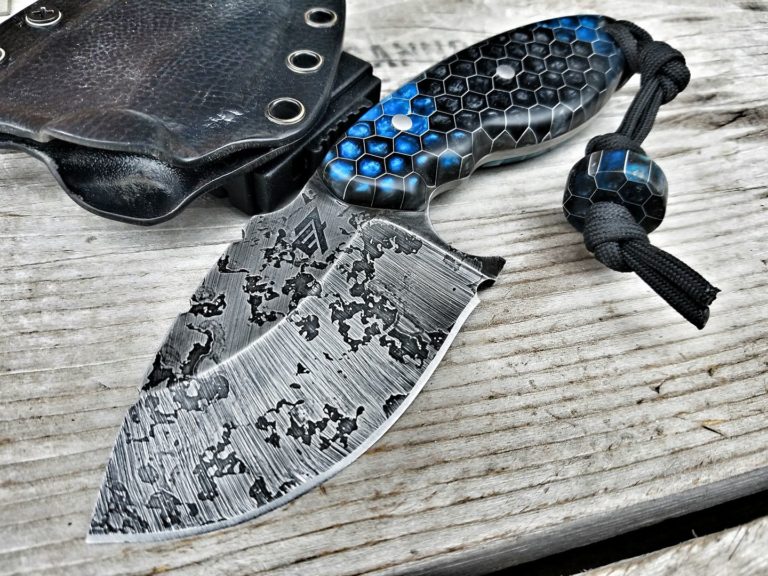
Ok. What about knives for self-defense? Or engraved knives in pearlesence or vivid colors that mom will want to hold, admire and show off? Knives for shaving? The cowgirl in your life could use a custom livestock castration knife.
Excuse me!
Just look. These 20 custom knives will be well received by all types of mothers. Trust me. Now these knives take time to make, so if you see something you like, contact the maker and if he or she doesn’t have one ready, put in an order for a birthday or the holidays. It’ll be worth the wait. I promise.
Neck Knives
Neck knives are compact blades that are drawn in a downward motion from a sheath on a necklace-length lanyard or looped onto a bra like a gun holster. Moms can use this for self-defense or as an everyday carry knife. Various blade styles are frequently offered.
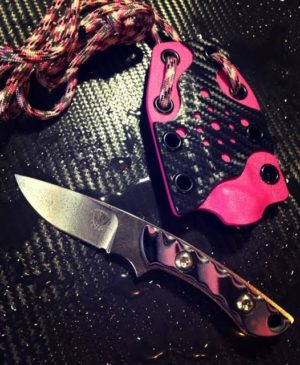
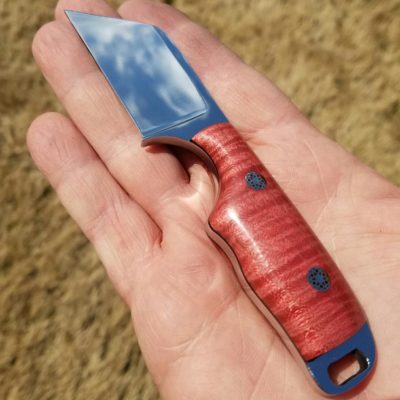
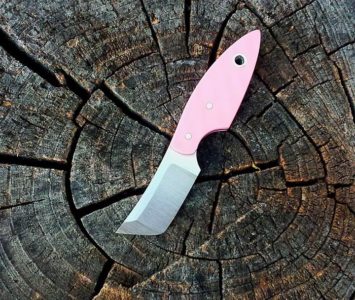
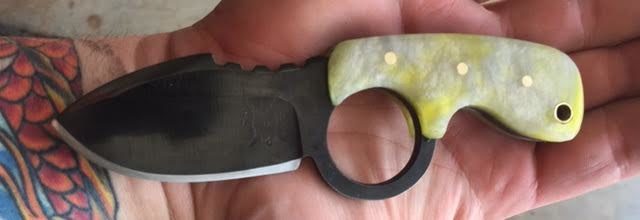
2. This necker by James Huse has a 2 1/8-inch drop-point-style blade made of A2 tool steel. Overall length is 5 1/8 inches. The handle is pink and black G10 with matching Kydex sheath. You release the knife with light thumb pressure and a downward draw. Maker’s List Price: $165. Contact www.huseknives.com, [email protected] or message to Huse Knives on Facebook, @huse_knives on Instagram.3. Pete Sloan’s neck knife is made from 440C stainless steel with a cleaver-Wharncliffe blade design. The handle was crafted using stabilized pink curly maple. Maker’s List Price: $150. Contact www.sloancustomknives.com, [email protected], 731-225-9209 or message on Facebook at Sloan Custom Knives.4. This neck knife by Travis Fleming has a trailing-point tanto blade design made from Nitro-V, an AEBL steel by New Jersey Steel Baron. A pink sheath completes the set. Makers List Price: $160. Contact [email protected] or message at Fleming’s Fabrications on Facebook.5. Denny Furey makes these three-finger Quick Defense Knives with an index finger ring for sure pistol-grip draw from under a top or from between buttons on a blouse. The 2.5-inch blade is made of high carbon 1095 with a blued and polished finish. The handle is made out of Voodoo Resins with brass pins and lanyard tube. Makers List Price: $160, includes sheath. Contact [email protected], 405-642-2198 or message on Facebook at Furey’s Urban Combat Knives.
Pretty Knives
Sometimes it’s all about the eye candy. Holding something pretty, showing it off, is a luxury mom is unlikely to allow herself either in time or cost. But, hey, beautiful knives can also cut a piece of string or open a box, and every time she studies the engraving, the jewel- and pearl-like finishes, the intricate designs in the pattern-welded steel, she’ll be reminded of how much she is treasured.
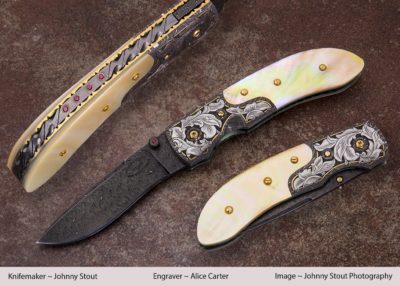
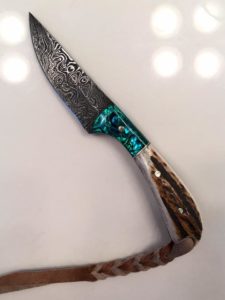
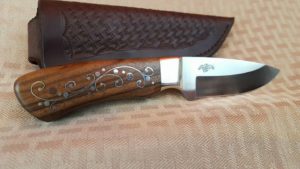
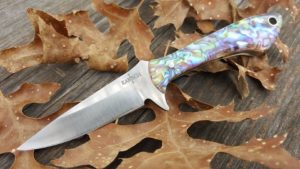
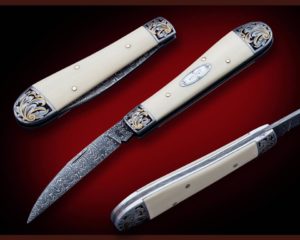
6. This Johnny Stout LeGrande Fine Folder has a 2 1/2-inch pattern-welded blade, gold lip mother of pearl handle scales, engraving by Alice Carter and a precious rubies inset in the backspacer and in the thumb stud. Closed, the knife measures 3 3/8 inches. Makers List Price: $3200. Contact http://stoutknives.com, [email protected] or 830-606-4067.7. Karen Jones made the 3-inch blade on this Work Pony out of raindrop-patterned steel. The bolsters are green abalone, the spacers are brass and the scales are elk antler. The 7-inch knife is “made to be used and abused in real life. Pretty is as pretty does,” Karen added. Makers List Price: $250-$275. Contact [email protected], 682-777-1193 or message at ThunderHorse Blades on Facebook.8. This Devin Bliss Bobcat has a 3.75-inch blade made of 1095 steel, walnut handle with mosaic pins and silver wire inlay and a nickel silver bolster. Its overall length is 8 inches. Makers List Price: $560. Contact [email protected], 903-736-3052 or message at DB Custom Knives on Facebook.9. Ben Kabisch made this for an emergency room nurse who works the night shift. She wanted something “cute, light and concealable.” The blade was made from 1084 carbon steel and the scales are an acrylic abalone. The blade is 3.5 inches and the overall length is 7.5 inches. Makers List Price: $175 Contact 940-733-6404 or message on Facebook at Ben Kabisch.10. This Raymon Earl Hunt Swayback Jack has a 2 3/4-inch Wharncliff-style blade, hand-finished and with a swedge. The handle scales are pre-ban elephant ivory with gold pins and stainless bolster. The inlaid engraving is by Bruce Christiansen. Maker’s list price: $1800 with sheath or purse pouch. Contact 214-507-0896, [email protected], or visit www.3hsknives.com.
Kitchen Knives
Whether the kitchen is in an urban apartment or at a campfire in the woods, chef knives that make food preparation more enjoyable, either by their ergonomics or their beauty, preferably both, are welcome gifts at Mother’s Day or on any holiday. This category also includes skinner/meat processing knives for the huntress in the family.
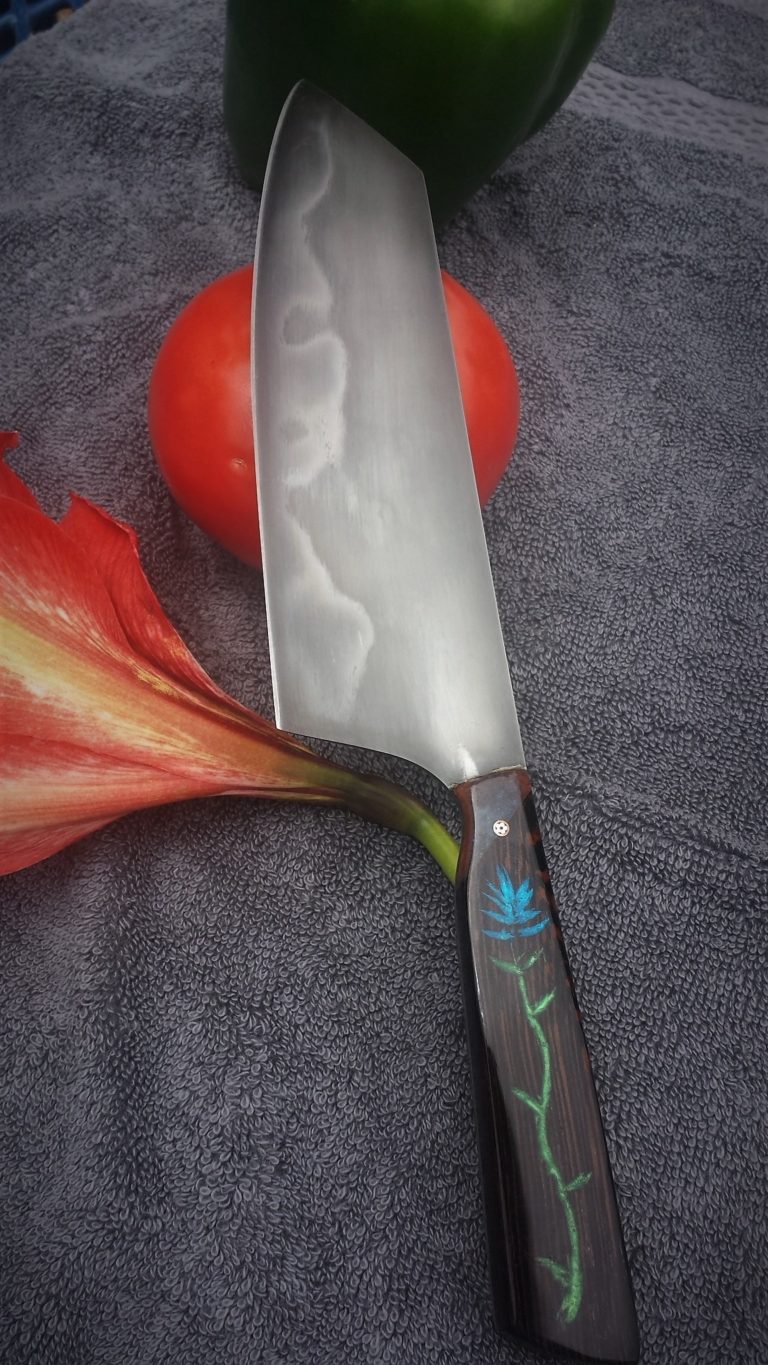
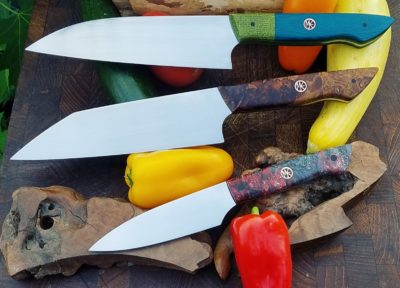
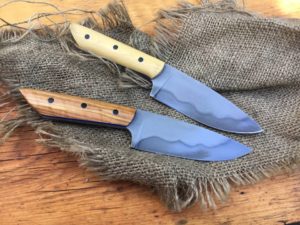
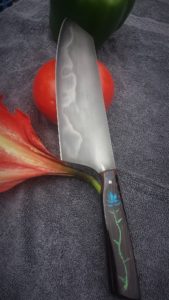
11. Mike Jeffries’ set of chefs knives includes two in AEB-L stainless steel, one in vintage Westinghouse Blue Micarta (rare stuff) with green Shadetree Burlap bolsters and the other in spalted maple burl. The paring knife is made of 52100 high carbon steel with dyed boxelder burl. Makers List Price: $900/set. Contact [email protected], 502-592-4240, on Facebook at 2Birds Metalworks and on Instagram @2birdsmetalworks.12. Nichole Lindstrand’s Modoc model knives are made from 15N20 steel with a drop-point blade, ideal for skinning and processing game. Overall they measure 7.25 inches with a cutting edge of just under 3.5 inches. The handles on these two are made of olivewood and Bone Micarta with blue G10 liners and carbon fiber pins. The makers list price is $165. Contact [email protected], 530-515-6082 or message on Facebook at Lindstrand Custom Knives.13. These 7 1/2-inch kitchen/camp knives by Carson Riley Marquis are made with 1095 steel with a differential heat treatment, acid etched/stonewashed finish and hammered-texture flats with flat grinds. The handles are dyed and stabilized zebra wood bolsters with Ivory Paper Micarta laid atop and divided by Natural Linen Micarta. Pins and lanyard tube are also Natural Linen Micarta. These are right-sized for meat processing and food prep. Makers List Price: $195 each with leather sheath. Contact http://crmarquisknives.bigcartel.com, 903-316-2824 or on Instagram @C.R.Marquis.Knives.14. This Thai-inspired kitchen knife by Todd Stracener is similar to a Japanese bunka. The 6 1/2-inch blade is made of 1095 steel and the handle is made of wenge wood with a resin inlay, The knife is 11 1/2 inches overall. $250. Contact on Instagram @thezeep or message on Facebook at Stracener Knives.
Everyday Carry Knives
Everyday carry, or EDC, knives are ones that you carry on your person or in your purse for both self-defense and general common use. They can be of the fixed-blade variety that you keep in a leather, Kydex or other molded-plastic sheath. Or they can be of the folding type and come with a clip that you can use on your pocket or inside a skirt or pant waistband. EDC makers strive for thin, small and light. They’re often tactical looking, but mom-friendly models come in everything from natural tones to bold and subtle colors.
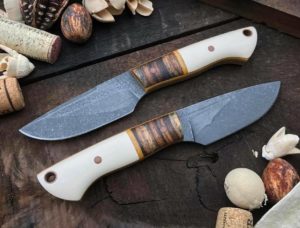
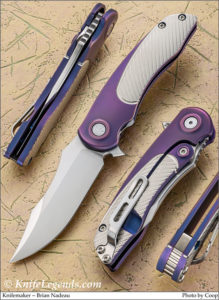
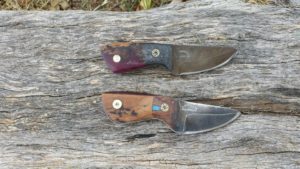
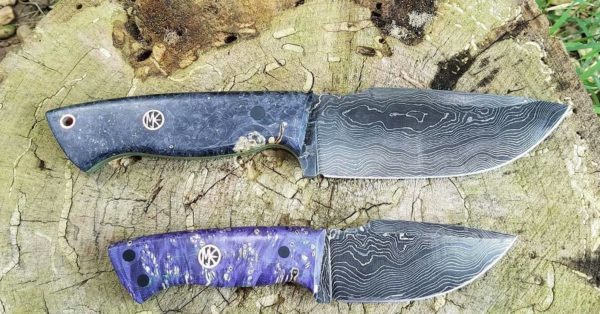
15. Brian Nadeau’s Cyclone Bowie Flipper has a 3.5-inch blade made of CPM S35VN steel. The pivot is constructed with a stainless ball thrust bearing with AEB-L lock. It has a textured, anodized-titanium frame and aggressive gimping for a secure grip in any weather. The pocket clip is 410 stainless steel. Makers list price: $995. Contact www.knifelegends.com, www.sharpbydesign.com or [email protected].16. Shane Hill made this knife for a woman who wanted to have a knife in her car with her. The 3-inch drop-point hollow-ground blade is 1095 steel; the handle is make of cocobolo wood. Overall length of just short of 8 inches. Makers list price: $165. Contact [email protected] or message Hill Knife Works on Facebook.17. These Mini Me knives by Charles Hawkins have 2-inch hollow-ground blades made of pattern-welded steel from Alabama Damascus Steel. The top one has an Alumilite resin and wood handle with carbon fiber bolsters. The bottom one has a terminate wood with box elder handle with Alumilite resin bolsters. Although these knives are technically skinners, at 4 1/2 inches overall and with a clip-on sheath, something tells me they’re more likely to be used as an everyday carry. Maker’s list price: $100-$125 each. Contact www.hawkcustomknives.com, 325-947-7875.
The Right Knife For The Job
To do the job right, you need the right tool. You wouldn’t use a router to mix cake batter, right? (I can tell you’ve thought about it though.) You wouldn’t use a flat brush to curl your bangs, right? OK, maybe. A girl’s gotta do what a girl’s gotta do. Well, it’s the same with knives. Aside from a survival situation, you wouldn’t bushcraft with a paring knife or filet a fish with a tomahawk. Here are just a few of many specialized knives that might be perfect for a mom in your life.
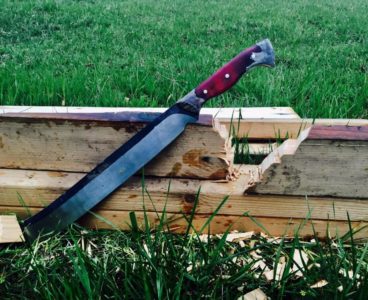
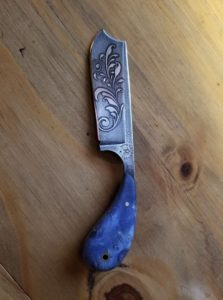
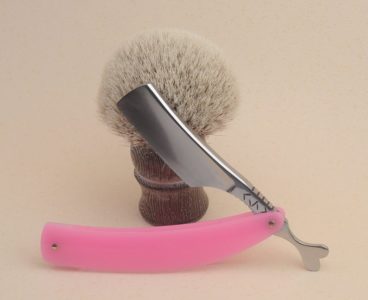
18. Eland Green made this GOLIATH chopper from 5160 tool steel and left the flats black after the heat treatment. The handle is a wood-resin combination. This is a worker for the gardening mom or for chores around a camp, farm or ranch. Makers list price: $600. Call [email protected], 940-736-8333 or message on Facebook at Lost Wood Knives.19. Becky McFall Rodriquez made this teardrop-handled livestock castration knife from a Travis Payne idea. Its 3-inch blade is acid-etched O1 tool steel. The handle is fashioned from blue-dyed box elder burl. The knife is 6-inches overall. When a lady’s doing dirty work, she should have a pretty tool. Makers list price $220-$250. Contact [email protected] or message on Facebook at Rafter M Custom Knives.20. Wet shaving is making a comeback, mainly for men, but also for women. Bruno van Dooren makes a 7/8-plus-inch wide round-point blade from O2 carbon steel with a half hollow grind. The length of the cutting edge is just under 2.5 inches. This shorter edge makes the razor more maneuverable for female shaving. The point is rounded to prevent accidentally poking through the skin. The scales are Kirinite Starlight Pink with Kirinite Glow in the Dark spacers. The pins and washer are brass. Makers list price is $325; pattern-welded or wootz steel versions are higher. Contact [email protected], www.snailforge.be or message on Facebook at Snailforge.
Bonus
Inside the heart of that special mom there lurks both a queen and a warrior princess, a diplomat and an avenger. She’s a lady with a hard edge and a soft inner core. She may be just the one to wield the Tactigal.
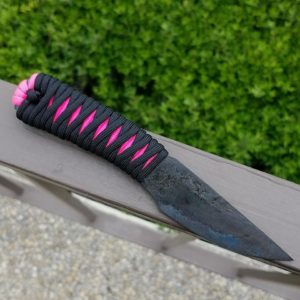
Bonus: Tobin Nieto forged his Tactigal out of 1084 steel to an overall length of 8.75 inches. The blade is a 3.25-inch drop-point style. The pink underlay is 550 paracord while the black cord has had the inner strands removed to allow for a flat Mongolian-style cross wrap. Maker’s list price: $175 with sheath. Contact Stonehaven Knife Works on Facebook or on Instagram @stonehavenknifeworks.
The CRKT Homefront is the Official Knife of the 2017 BLADE Show. This is a highly collectable item and the run is limited to 300. At $70 you can save $29.99 off the $99.99 price, if you order now. The field-strip technology allows you to disassemble without tools. The Ken Onion design won Most Innovative Imported Design award at the 2016 BLADE Show. Here’s where to order your Official 2017 BLADE Show CRKT Homefront Knife.
Taking great photographs of knives is no easy task—unless you’re a professional, in which case you can stop reading. Essentially, you’re taking a highly detailed shot of something that fills the entire frame, not something small like a bee in the center of a background of blurred petals, but a long, thin item that needs to be in focus from point to butt. But there’s so much more. Every line must be fully revealed and a depth established to convey thickness or thinness. I know close to zero about the mechanics of the art. There are plenty of videos and online courses out there that’ll give you the science of the “study of light.” They can speak to you of aperture, ISO and shutter speed in infinite combinations. All I know is a good photo when I see one, and how I have tried to improve my own photography. Here are the 6 things BLADE looks for in a knife photo. It’ll be up to you to make it happen. Why? Because there are “5 Ways To Get Your Knives Featured In BLADE” and you want to be ready.
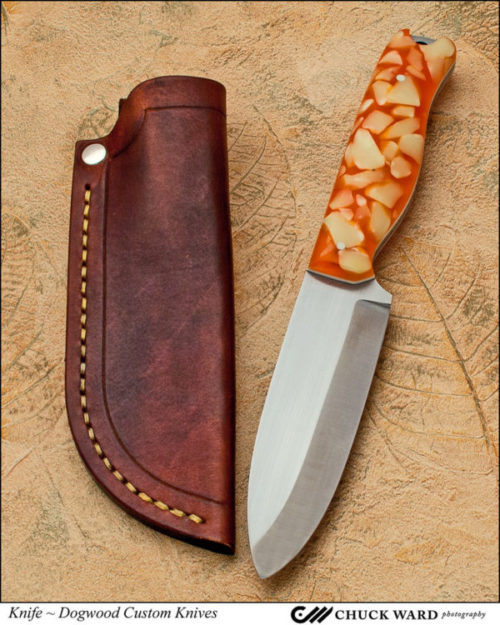
Dan Eastland of Dogwood Custom Knives used professional photographer Chuck Ward to take this exquisite image of his Hawkins knife. Chuck will be the official photographer at the 2017 BLADE Show. Contact www.dogwoodcustomknives.com for more about this outdoorsman’s knife.
Hire A Professional
Knife manufacturers, like good real estate agents, know that great photos will close a sale. They understand that the investment in a professional photographer pays off. When BLADE asks for a photo of their latest release, for example, some even allow high-resolution downloads right from the consumer website without having to go through a media relations person. That can be a time-saver at deadline. I’ve even experienced a large company resubmitting photos with even better ones. There’s nothing that says a one-man-show can’t learn from that level of perfectionism. It’s the same effort you put into crafting your knives.
Hiring a professional photographer will cost you some money, and it’s worth every penny. But like all professionals, some are more versed in what we’re trying to accomplish than others. A portraitist, wedding photographer or photojournalist may or may not be able to give you the results you’re looking for. You want to make sure you chose someone who can show you a portfolio of knives, guns, tools or similar items that looks…well…perfect.
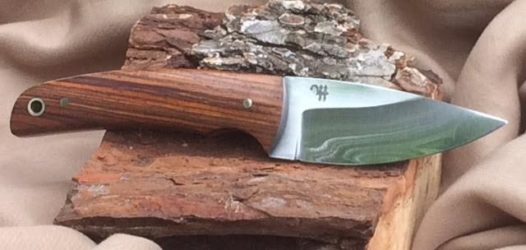
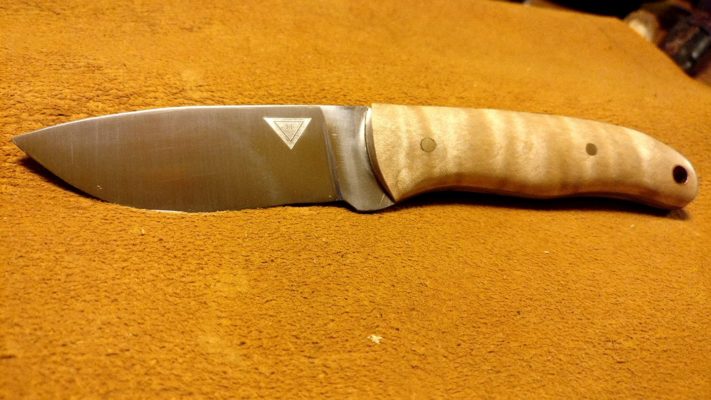
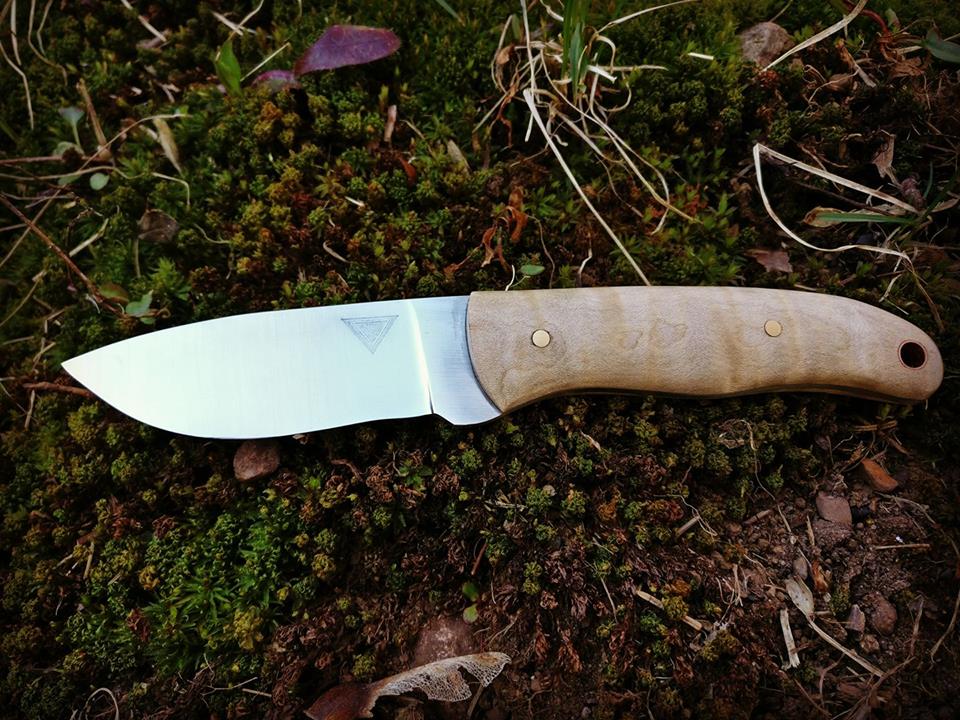
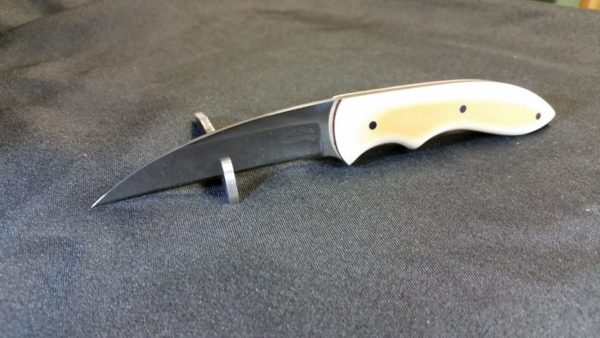
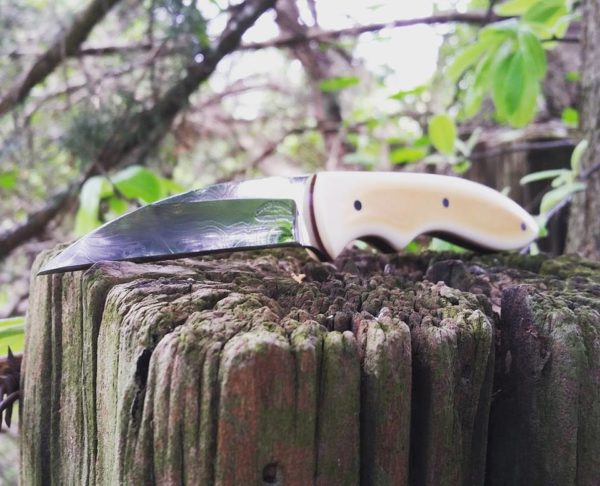
The handle on Tim Tracey’s everyday performer doesn’t stand out as much as it could against the similarly colored background. The caramel color ends up saturating everything in the photo. Also, although the focus on the blade is crisp, the topline on the handle is a touch soft.Tim Tracey took his knife outside and got not only a good image of the blade and handle, but good contrast and a better depiction of the piece’s fullness. The recurved blade is made of 1095 steel and sports exhibition grade curly maple scales. Makers list price: $220. Contact [email protected], Timtraceyknives.com on Facebook or @TimmTracey on Instagram.
You will want two kinds of photos. Photos for your website and social media will create an emotion, an atmosphere. Instagram is full of examples of survival, bushcrafting and hunting knives being photographed outdoors and tactical knives being shot in gritty workshops or light-painted in darkness. Makers create everyday carry still lifes with folders, wallets and watches. Typical? Sure, but each one tells a story that has been told a thousand times before in a slightly different way. Nobody reads just one novel, and nobody looks at just one knife photo. They are all beautiful in their own way. The other kind of photos you will need are those of just the knife itself on a simple background, what is often referred to as glamour or beauty shot.
The question you have to ask yourself is: Are you willing to put as much study and effort into your photography as you are your knifemaking? Answer honestly. There’s no shame in shelling out cash for stunning work. Fill your website with those choice images and have them on hand for BLADE, and then you can practice your own photography skills for social media. Even on social media, though, take the time to post only your best images. Plenty of knife-related Facebook Groups out there are looking for banner photography and have to reject knifes they’d like to showcase because the image is, say, out of focus.
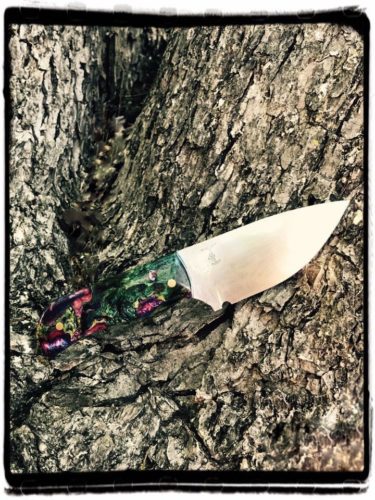
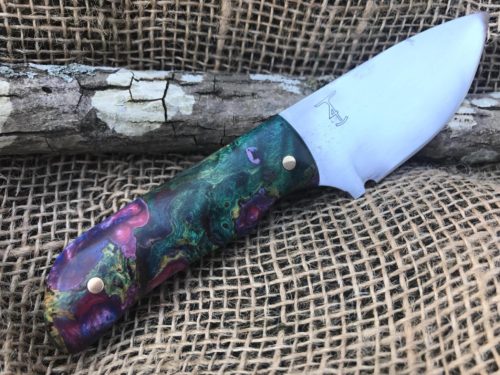
Although this image clearly shows the blade on this skinner by Bobby Toerck, the multicolored handle gets lost in the textured bark.In this image, the handle on Bobby Toerck’s drop-point skinner is nicely contrasted against the still-textured, but now single-colored burlap. And the 80CrV2 blade still looks terrific. The handle is triple-dyed box elder burl by Terry Dunn. Maker’s list price: $175 with Kydex sheath. Contact T4 Custom Knives on Facebook or call 903-812-1173.
Do-It-Yourself
Let’s say you can’t justify the expenditure at this point in your knifemaking journey. Or, more likely, by the very nature of your interest in crafting, you’re determined to take quality photos of your knives yourself. You think, How hard can it be? Very. It can be very challenging to produce the kind of photos needed for a glossy magazine.
“Real” Camera Vs. Camera Phone
You can take the cost of a few sessions with a photographer and buy yourself a decent camera, for starters. Keep in mind, however, that lenses that come with a camera are usually not very good. Be prepared to buy a decent mid-range lens at a minimum.
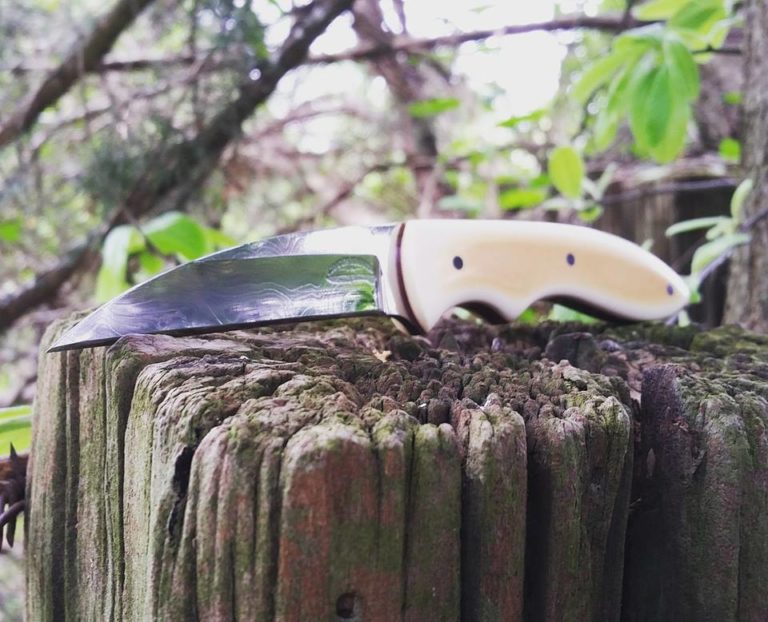
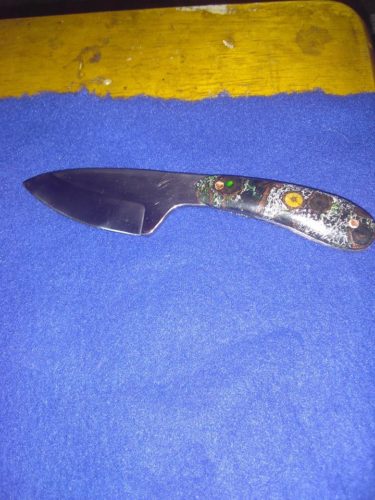
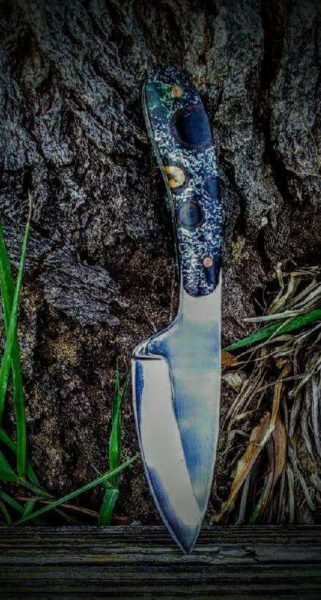
In this vertical image of a horizontal knife, the butt is cut off. There is also glare on the handle and the blade looks dull. Will Thompson decided to get some help for the reshoot.Even though Will Thompson’s handle has to work to stand out against the tree bark, it succeeds. The pattern is now discernible and the blade looks great. This drop-point finger skinner is made of 1095 steel and the Plantstone (stabilized pine branches with aluminum flakes) scales are from Robert Belcher. Maker’s list price: $75. Contact [email protected] or on Facebook at Dusty’s Cutlery.
Then again, there are some excellent photos being taken with newer camera phones. Do NOT attempt this with an older model. You will only frustrate us both because they do not allow for high enough resolution of the images. Be sure if you submit a photo from your phone that you email it at its largest size. If there are settings on your phone that need to be changed to allow for taking photos at higher resolution, then you’ll need to set those accordingly. Those settings will apply only to photos you take going forward; you cannot retroactively apply them to photos already taken. Whether you use your phone or a “real” camera, the same fundamentals of photography apply.
Tip: If you smoke or if you have your phone in your shop, there could be resin or dust on your lens. You’ll want to clean that—gently—before you begin.
Be sure to take great photos of all your work before they are sold, and to back them up, either in the cloud, through an online backup service or on a thumb-drive.
6 Things BLADE Looks For In A Knife Photo
Focus
The entire knife must be in focus, from point to butt. Are there some artsy shots of crystal clear blades and blurred handles or vice versa? Sure, but that’s not what we’re looking for in print. Online, we’re more open to considering some of those shots, provided we have some conventional full-focus shots to accompany the story as well.
If you are taking what we call a “using” shot where you’re photographing the knife in use for an online story or if we are working on a story together for print, be aware of where your camera is focusing. I have seen crystal clear shots of a leaves on the ground while the knife and the hand it’s in are both blurry. Focus is probably the single most important aspect of a good photo.
Contrast
Be aware of the color of your background. A grey knife on gray pavement, a black knife on a blackened tree stump, camouflage your knife. It’s like a silver or gray car against gray pavement on a gray winter day—you can’t see it. No contrast. This applies to multicolored handles against multicolored backgrounds as well.
In this image of Andrew Griggs’ knife, the blade looks dull and the focus on the handle is somewhat soft. Also, if this image were being used for a BLADE Magazine section that required a cutaway, the prop would be in the way of the blade.Andrew Griggs got outside to reshoot his knife. Now you can see the pattern-welded steel! The Southern Comfort gentleman’s fixed blade has a Vintage Paper Micarta handle. Maker’s list price: $300 with leather sheath. Contact Griggs Knives on Facebook.
Composition
For two of BLADE’s sections, “What’s New” and “Knifemaker Showcase,” only cutaway images of the knife are used. (See the “5 Ways To Get Your Knives Featured In BLADE.”) This means that you don’t need to worry about the background at all. In fact, white paper is fine, but watch for any shadows. It’s fine to have a slight shadow, provided the lines of the knife are clearly visible. If the edge or spine of your knife bleeds into the shadow to the point where you can’t tell where the knife starts and the shadow ends, that’ll need to be reshot. Our designers need to able to see those lines.
Mood images are fine for both a feature in print and for online stories. Feel free to get as creative as you want, but ensure that the knife is the main attraction. Photographing knives is one of those times when the rule of thirds really isn’t applicable. The knife is the main attraction and we’re not going for proportional sharing with a background. If the image you’re submitting for consideration is for a section of the magazine that uses cutaways and there’s moss or grass, fabric or fur encroaching on the blade itself, that’ll impede the designers in their work.
Make sure no part of the knife is cut off, and don’t crowd the point or butt. If you place the knife in a stand and that stand encroaches on the knife, it can’t be used for a cutaway, but it could possibly still be used for an online story or in print.
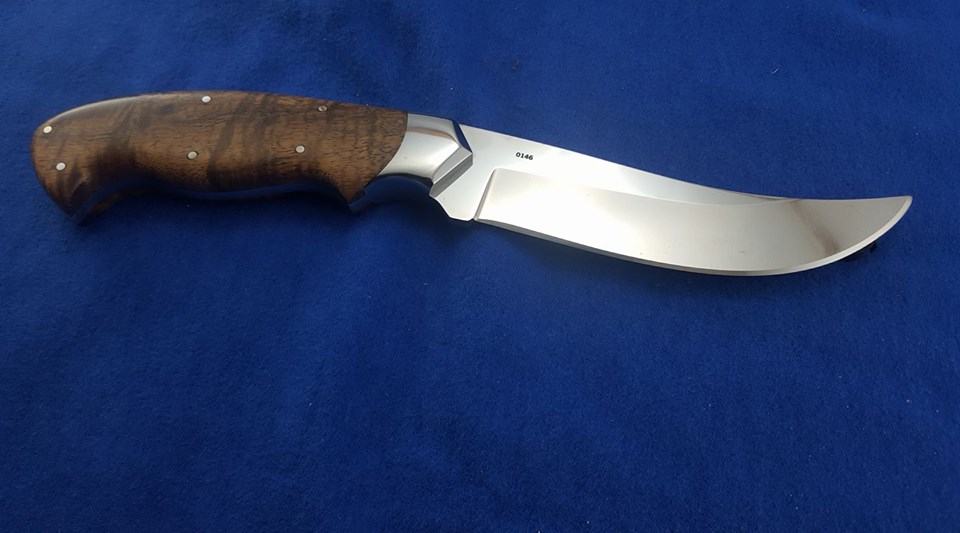
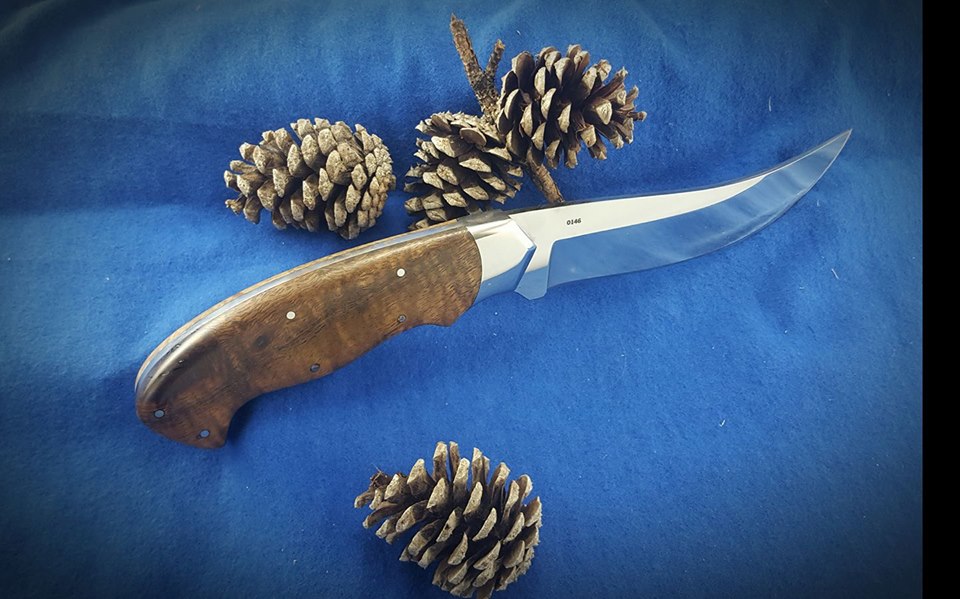
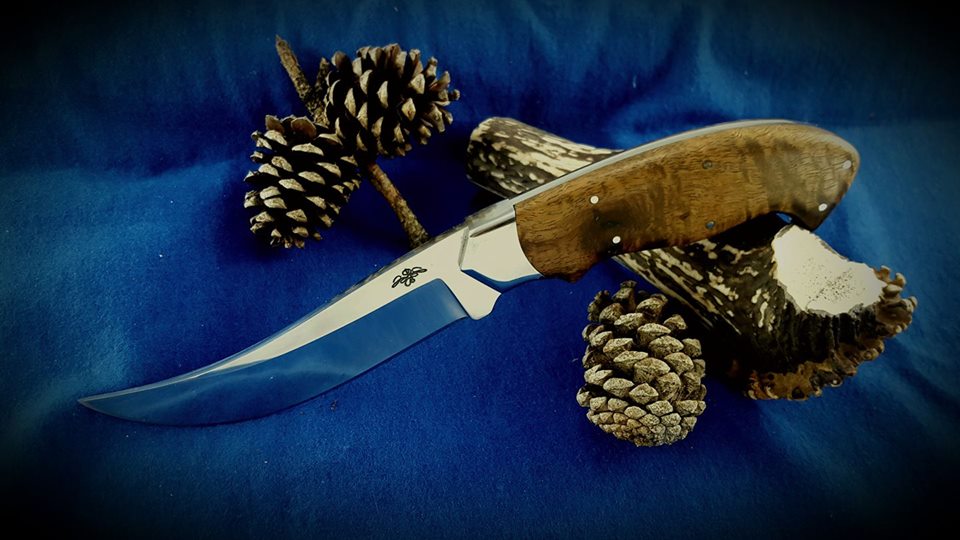
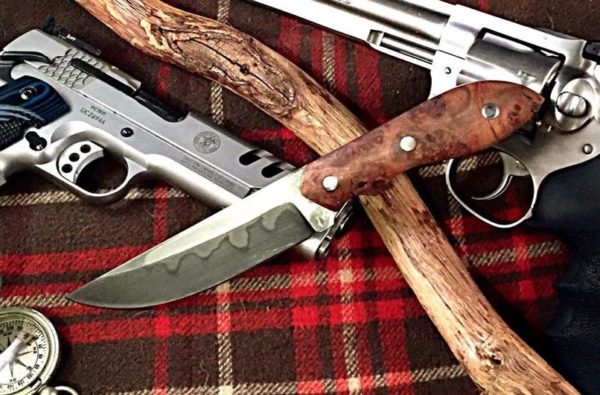
Devin Bliss has taken a very good photograph here. However, there is shadow at the handle, which would make it challenging for the designers to see where to make the cutaway image for inclusion in say, BLADE’s “What’s New” or “Knifemaker Showcase” sections.In Devin Bliss’s second attempt, the handle is more visible, but looks less rich in the harsher lighting. The inclusion of the pinecones makes a nice vignette without encroaching on any line of the knife, so it could still be used for a cutaway or as is. As a side note: Artists will tell you that the eye finds odd numbers more pleasing. I did not tell Devin that. I simply told him the truth: He had surpassed my level of being able to offer suggestions for improvement. He contacted another knifemaker for guidance.At this point, knifemaker Devin Bliss has reached a level of photography that serves his knives well. What did he do? “I changed the direction, propped up the handle onto the antler, moved the lighting around and used a foil reflector to get…a bit more light on the handle and a white reflector to mask off some glare on the blade and bolster.” This modified pronghorn is made of CTS-XHP steel with a curly koa handle. Maker’s list price $300 with stamped leather sheath. Contact [email protected], 903-736-3052 or on Facebook at DB Custom Knives.
Depth and Angles
In layman’s terms, you need to ensure your knives don’t look flat. You’re trying to capture something that’s three-dimensional in a two-dimensional medium. This is where some knives can look disproportionate because you’re focusing on the handle and the blade is in the fuzzy background, so to speak. A shallow depth of field is fine as long as your knife is standing out crisply from point to butt.
Finding the right angle will also help prevent your knife from looking flat. Prop up your knife somehow. Even just leaning it against a pebble allows you to move and capture the thickness or thinness of the piece. Laying it on your hand can work as long as your flesh doesn’t obstruct any of the knife’s lines.
Tip: Take dozens of photos from many different angles and distances and pick the best one of the bunch. If you don’t nail it, don’t compromise, don’t settle, get back there and take dozens more. Pros will take hundreds of impressions to deliver 30. Seriously. Take more shots. No, more. Get a ladder and shoot down, circle your quarry and shoot multiple shots from each hour of the clock, and get down and shoot at eye level. Shoot at morning, noon and night, but mostly late afternoon, to see how different types of sunlight affect your knife images. It’s what the pros did when they were starting out. Now, after years of experience, they can judge the sun’s angle and know how to get what they need.
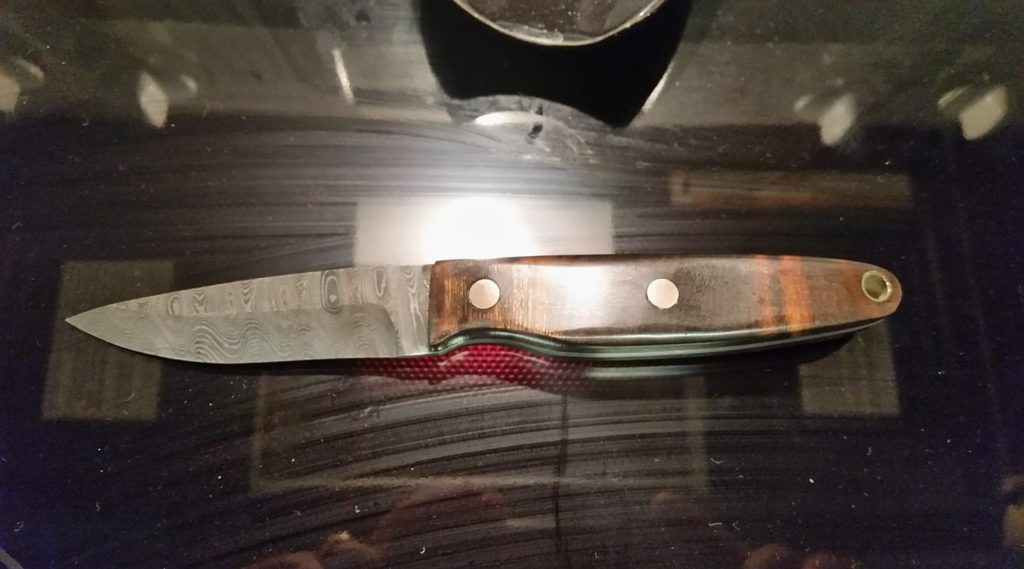
Charles Hawkins has a hard time taking a bad photo, but he pulled out all the stops on this one. That is a stovetop background, complete with streaks and a red glow. The glare on the handle deadens the handle and the pattern in the steel also appears dull. Note the photographer’s hands reflected on the cooktop. Analyze the entire photograph closely.Charles Hawkins took his knife outdoors, and now the focus is as sharp as can be. The background adds interest while still allowing for plenty of contrast. The 3.5-inch blade is made of pattern-welded steel from Alabama Damascus Steel. The handle is ironwood. Maker’s list price: $300. Contact www.hawkcustomknives.com.
Lighting
Natural light is easiest for the amateur to master. A cloudy day is good to reduce blade glare but sometimes it will dull colors. Try a sunny day, but shoot in the shade. Avoid glare on either the handle or the blade whether you’re shooting indoors or out. You also don’t want dappled light coming through the leaves of a tree to interfere with the hamon, for example, so try to find a solid overhang. You also don’t want reflection to make your blade look different than it is in reality.
Indoor lighting is infinitely more challenging. Low light, fluorescent light, light-painting in a dark room—they all have the potential to become “noisy,” grainy, soft. I will leave it to the articles and videos you’re going to pour over to explain why, but trust me, it’s not easy. Sometimes, in light-painting for example, the pins might absorb all the light and they take over the picture. Or the handle’s too dark, or the handle’s visible, but the blade looks dull. Changing the countless variables on this project will help you get the right shot out of your many attempts. It can help to take notes so you know what you’ve tried and whether or not it worked.
Avoid using the flash inside your camera. It will only give you an overlit image that makes your work look flat. An external flash, shot off a wall or ceiling or even a white T-shirt, or an extra light diffused with a white paper bag, may help, but now your knifemaking shop has turned into a spaceship and you’re behind in your orders.
Specs
Images need to be 300 dpi for print with the photo at least 8 inches on the longest side, preferably 10. The image size should be at the very least 600 KB. It’s not that we’ll run it that large, but we need to have the option to do so, especially if we’re doing a cutaway and the knife doesn’t fill the frame.
We prefer .jpg format, and that you attach the image file rather than dragging it into the email. Sometimes that can make a difference in resolution quality, though it admittedly shouldn’t. Also, for similar reasons, submit originals and not versions scraped from Facebook or other social media platform, even for online stories.
Remember, it’s all about the knife here at BLADE. Oh, and makers and manufacturers, too. But without a fantastic photo of a knife as a starting point, how are we ever going to get to know you better?
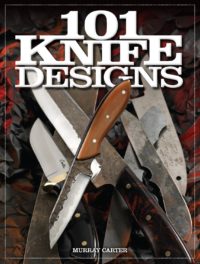
“101 Knife Designs” is not only filled with great comparisons of blade designs and design theory, but offers terrific examples of exceptional knife photography by Hiro Soga.
Knifemakers of all skill levels will enjoy comparing knife designs in this book by Murray Carter. The photographs by Hiro Soga are exquisite! There is even a discussion on the theory of knife design to help you better understand your craft. Save 35 percent off the cover cost of $29.99 for a total of $19.99.
Survival instructor, author and TV star Creek Stewart cross-carries a Whiskey Knives Corvid.
When Matthew Stewart was 5, his grandfather gave him a nickname that would chart the course of his life. “I was always playing in the creek,” said Creek Stewart, survival instructor, author and star of The Weather Channel’s now-cancelled “Fat Guys In The Woods.” No matter the time or weather, the boy was at the creek—happy. Not much has changed, except the budding outdoorsman of yore has now built an empire on his comfortable, family-friendly style of survival instruction. All things Creek also includes the soundly crafted, old-timey line of Whiskey Knives, which in addition to being ideally designed for bushcraft and easy on the wallet, also offers some scaled-down versions of classic styles that hands of all sizes can control. You can read all about Whiskey Knives and how they are made in an upcoming issue of BLADE magazine. If you’re not a subscriber, sign up so you don’t miss it.
Creek is “everywhere” and there are good reasons for that, not least being that he is genuinely warm and friendly. “I like working with people,” he said. Creek was a Boy Scout and an Eagle Scout. The first E in the CRE///K logo is representative of a scratch from an eagle’s talons. He continues to be a devotee of the Boy Scouts of America and a counselor for the Wilderness Survival merit badge. He lives the Be Prepared Boy Scout motto, and opted for Not If But When as his own tagline. Yes, scouts are being taught all kinds of skills, explained Creek, “but they’re also building character and learning life lessons.” He listed perseverance, teamwork, manners, camaraderie—all things the Boy Scouts instilled in him.
At Butler University in Indianapolis, Creek first perused a pharmacy major, but the misdirection, the urban setting and a campus crow that thought it was an alarm clock brought him to an awakening. You can read about his adventures trying to snare the bird on his website at The Crow, but in summary, the crow reawakened Creek’s inner woodsman. He decided he wanted to teach wilderness survival skills and set about making it happen.
He settled on a business major, a plan that would serve him well. During his sophomore year, he wrote and illustrated a wilderness survival field manual that collected his knowledge at the time. He had the book printed and spiral-bound, and offered free classes at Boy Scout troops to peddle it. He sold books, but he longed for a way to bring his customers to him rather than traveling to them. He asked his parents if he could teach a class in the woods on the family farm. Although still unnerved by his switch in major, they agreed. He sent out press releases and 15 people showed up. He’s been teaching ever since, part-time for many years but never quitting on his dream.
Creek’s business schooling helped him hone his marketing strategy. His many brands include, in addition to Whiskey Knives, Willow Haven Outdoor Survival School where he teaches one-day and weekend getaway survival courses on his 20-acre property, complete with lodge, in Anderson, Indiana. He also is lead instructor for the Escape The Woods challenge, which takes place at various locales around the country. The Not If But When Survival Store, which his parents now run, offers a collection of widely available survival items. And, Apocabox is a bimonthly subscription; six times a year members receive a box of survival tools and gear, hand-picked by Creek. It also includes a challenge that you can practice in the calm and comfort of a non-crisis. For instance, the December box included instructions on making snowshoes from your Christmas tree.
Creek’s overview of Whiskey Knives includes a revelation: his first knife.
Creek also saw that writing was going to be essential to reaching the right people—namely men and women of all ages and abilities. (While other survival instructors might emphasize immersing you in a survival scenario while you’re still learning, Creek feels that people absorb more and retain it longer, if they’re warm, dry and fed.)
His best-selling book is “Build the Perfect Bug Out Bag,” but he offers one on putting together a bug-out vehicle, two on survival skills and an intriguing one on the survival skills used in “The Hunger Games.” But Creek has also written two fiction books. “Stuck” is a short story about a Boy Scout dropout who through a series of bad decisions finds himself in a crisis situation—quicksand!—that he can only survive by using what he learned in scouting. “Rugosa” is a young-adult romance, due out this month. The novel has been in the works for six years. “I’m really sticking my neck out on this one.” Creek is anxious to see if his fans “get” it. “I’m a survivalist, but I’m also a person,” Creek said. (Check back for an upcoming review.)
Some people learn about Creek via completely different avenues. They may read some of his guest posts on The Art of Manliness blog and other websites. “I’ve known Brett (McKay, founder of AoM) a long time. I’m so proud to be a part of that,” Creek said. The Art of Manliness celebrates men stepping boldly into their roles as men, husbands and fathers, and includes articles on everything from health and style to relationships and how to survive in the wild. Creek has also been a guest on television shows such as TODAY, Inside Edition and Fox & Friends. He’s been featured in magazines like Men’s Fitness, Backpacker and Outdoor Life. And he was the star of The Weather Channel’s hit show, “Fat Guys in the Woods.”
When IBM purchased the digital portion of The Weather Channel in 2015, many programs were slashed, and “Fat Guys in the Woods” was just one of them. The show provided Creek with the ideal outlet for his wildlife survival instructing and was an inspiration to viewers who wanted to spend more time in the outdoors or jumpstart a healthier lifestyle. Three sedentary buddies would spend a week with Creek, learning survival basics. The last 24 hours would be spent alone, each man building his own shelter and fire. Creek would award one of them with a knife-sheath set. One would stand out as needing encouragement, or being there for the right reasons or excelling in a certain skill. “He gave it everything he got—a job well done,” as Creek put it.
That kit was an Ontario Knife Company’s Black Bird SK-5 wilderness survival knife with a sheath designed by Paul Scheiter of Hedgehog Leatherworks. It was the sheath that had Creek thinking about how to fine-tune the products he offered going forward. “I love my parents, and every day I get to spend with them (at Not If But When) is a blessing,” Creek said. He’s also happy to provide a place where people can find all the products he recommends in one place. But what he really likes is working with small American businesses that reflect simple, well-made, traditional craftsmanship. “I like things that have a story.”
That quest for mom-and-pop entrepreneurship and throwback workmanship with a story behind it, is what led to one of Creeks proudest collaborations: Whiskey Knives made by Reptile Toolworks in Kentucky. To read more about this partnership and exactly how Whiskey Knives are constructed, be sure to subscribe to subscribe to BLADE magazine.
BLADE Magazine is all about the blade: what it’s made out of, how its made, to what specifications and even who makes it. Be sure to keep your issues coming as the months tick down to BLADE Show, June 2-4 in Atlanta, Georgia. At $21.98 you’ll save 70 percent off the newsstand rate. Other options include digital, Canadian print and International print subscriptions.
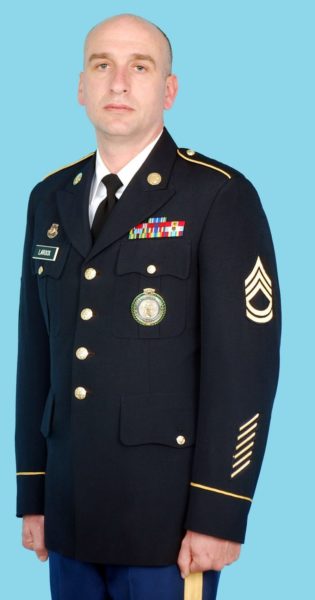
In BLADE®’s continuing series entitled Midweek Maker, we are in our third installment of Midweek Maker Military Style: Tracy LaRock of LaRock Knives.
Tracy LaRock grew up on a dairy farm and spent every spare moment hunting, trapping and fishing. He served as a mortarman in U.S. Marine Corps from 1990 to 1995, but he didn’t stay out for long. In 1997 he signed on with the Texas Army National Guard, in artillery and recruiting, and still serves today. “So knives have been a part of my daily life since the beginning,” he commented.
“In 2008 Atmar Lester was showing a knife he made to some folks at church. I asked him some questions and he pointed me in the direction I needed to go,” Tracy related. “To start off it was basic tools and head-scratching, then I discovered the forums and tutorials.” Thomas Rucker and Percy Richardson let Tracy visit their shops. In 2014 he started making slip joints. After completing a few he reached out for help and received helpful insights from knifemakers Luke Swenson, Jared Oser and Enrique Pena among others.
“I hope to become a full-time maker in a couple years when I hang this uniform up for the last time,” he noted. Tracy lives in Lufkin, Texas with his wife, Mia, and their three sons.
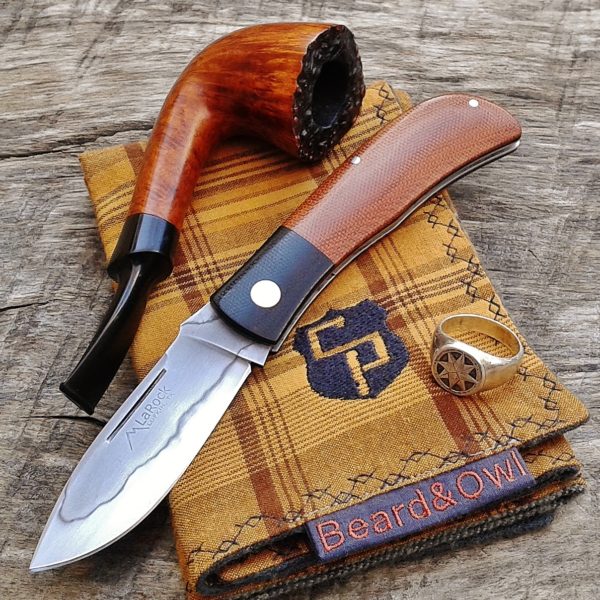
Best-selling knife patterns: TimberJack and TimberJack Jr., traditional slip joints
Favorite blade steels: W2, 1095, O1. “Most are W2 because I have long since fallen down the hamon hole,” Tracy quipped.
Blade grinds: flat
How he tests his knives: rope, cardboard
Favorite handle materials: green canvas Micarta and ironwood
Price range: $350-$850
Forums he participates in: Facebook Group like Making Slipjoints and Lockbacks
As Tracy LaRock retires from the military, he will be able to focus more time on making his TimberJack slip joints. His wife Mia LaRock does a terrific job running the Facebook Group at LaRock Knifes.
The above TimberJack has a 3-inch blade of W2 with hamon. The handle is fashioned from canvas Micarta scales. Overall length is 7.25 inches. Maker’s list price: $425.
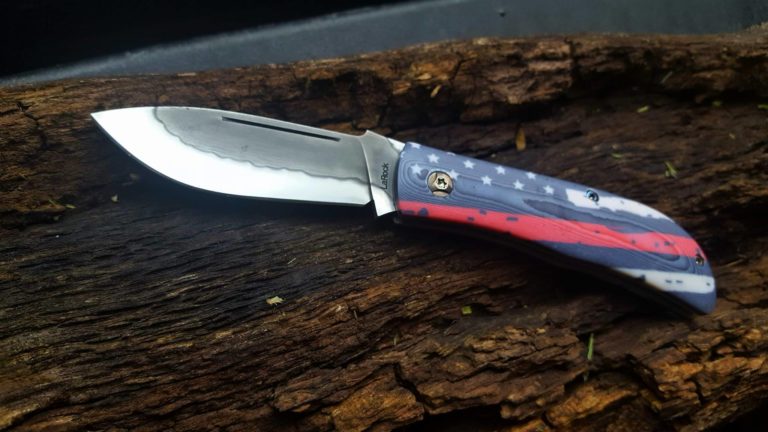
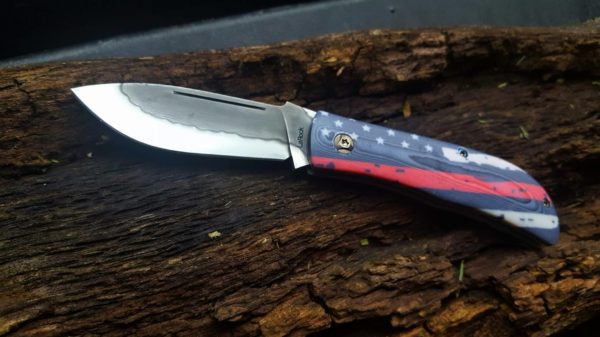
This Tracy LaRock creation is also a TimberJack with a 3-inch blade of W2 steel with hamon. The handle is American flag Carv-X. Overall length is 7 3/4 inches. The screw construction is done with titanium screws from TiConnector. Maker’s list price: $750.
Contact Tracy or Mia LaRock at 936-238-9077, [email protected], on Facebook at LaRock Knives or on Instagram @tracylarock.
Subscribe To BLADE For More Stories Like This
An annual U.S. subscription to BLADE is $21.98. You can get your 13 issues sent to Canada for $39.98 and internationally for $49.98. Or go green and get your issues sent digitally for $17.98.
A one year’s subscription to BLADE® will ensure you’re the first to read all six Knifemaker Showcase stories. You’ll also get the latest knife news, knifemaking how-tos, knife reviews, plus knife history and articles that tap into the knowledge of both the legends and the up-and-comers. Don’t miss out. Subscribe.
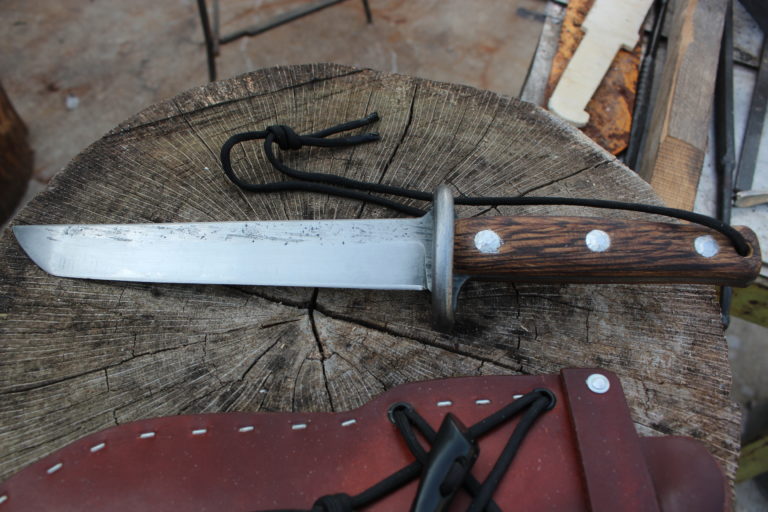
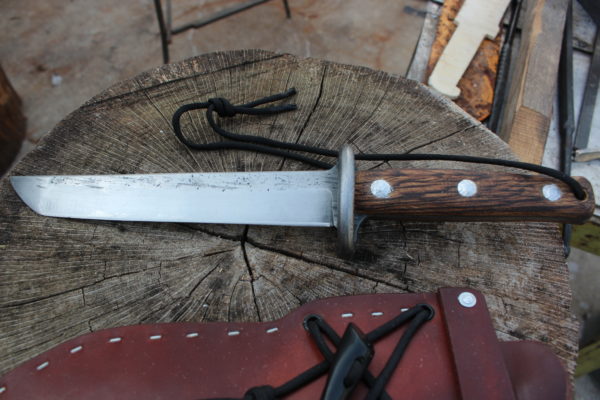
Survival instructor and host of The Weather Channel’s new series “SOS, How To Survive,” Creek Stewart is releasing a new addition to his line of Whiskey Knives. The 7.75-inch-bladed tanto in A36 carbon steel is designed by Hank Gevedon of Reptile Toolworks with continual input from Creek.
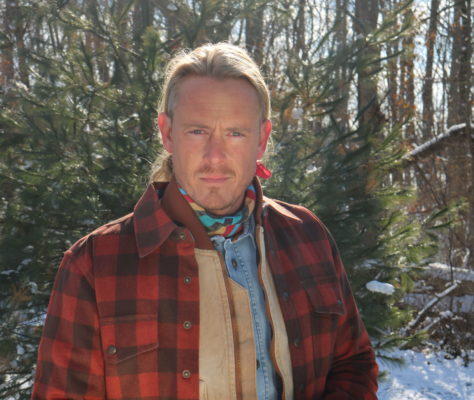
Creek Stewart of “Fat Guys In The Woods” fame is hosting a new Weather Channel series: SOS, How To Survive. He is also adding The Rising Sun to his line of Whiskey Knives.
Creek runs Willow Haven Outdoor in Anderson, Indiana, where he teaches survival skills, provides some survival supplies and especially enjoys partnering with American artisans to offer items of high quality craftsmanship at affordable prices. His Apocabox is a subscription-based collection of survival items that arrives at your door every two months. He also offers a monthly survival skill program. Creek was the star of “Fat Men In the Woods,” and is again working with The Weather Channel on the new series. He is the author of an young adult survivalist romance titled “Rugosa.” A follow-up to that is also in the works.
In “SOS, How To Survive,” Creek and other survival experts analyze a series of real-life survival situations. They discuss what happened, what was done correctly by the survivors or what went wrong. The show started Sunday, August 20 and is ongoing. Throughout Creek offers tips that can be used in survival situations.
Creek Stewart Hosts The Weather Channel’s New SOS Series
Meanwhile back in Mount Vernon, Kentucky, Hank and his crew are gearing up to roll small batches of The Rising Sun into production by early 2018. Like all Whiskey Knives, The Rising Sun marries the early American frontier spirit and looks with the precision of Asia’s strong cutlery tradition. All of the knives are asymmetrically ground (so remember to only sharpen one side and just strop the other). The A36 carbon steel allows for a hard outer edge that is sharp and holds an edge with a tough inner core that is flexible and stands up to the rigors of hard outdoor use.
The Rising Sun from Whiskey Knives has a “ghost” guard that rides up the sheath, creating a striking visual when carried.
The handles are made from upcycled white oak whiskey barrel staves, which have already gone through a processing and aging. Fitting rivets are aluminum, and Whiskey Knives come with a 9-ounce belly leather sheath, stapled and dipped in paraffin wax. The Rising Sun’s sheath slides up through the knife’s ghost guard for an attractive-looking carry. MSRP: $189.
Contact Creek Stewart, Willow Haven Outdoor, 2867 N. 200 E., Anderson, IN 46012, www.creekstewart.com/whiskey-knives, on Facebook at Creek Stewart and on Instagram at @creekstewart.
A Digital Subscription To BLADE Is The Answer
You can read your digital issues of BLADE Magazine anywhere you have your phone, tablet or computer, and there’s no need to find storage for all your old issues.
If piling-up issues of magazines seems like a waste to you… If you feel like you don’t have time to read a magazine… If you like the stories we offer in BLADE, but want a more economical option, then a digital subscription is the answer. An annual subscription to BLADE is $17.98, $4 off the print price.
Depending on where you live and by what method you hunt, deer season is underway. There are any number of blade patterns you could select for a skinning knife, but why are they shaped the way they are? What is the maker considering when he crafts a knife he calls a skinner? Let’s look at 20 examples of 5 types of skinners, plus an extra.
1. Bull-Nose Skinners
“The blunt tip in conjunction with the trailing point helps from punching through the hide,” noted Travis Fleming of Fleming Fabrications in North Texas about bull-nose skinners.
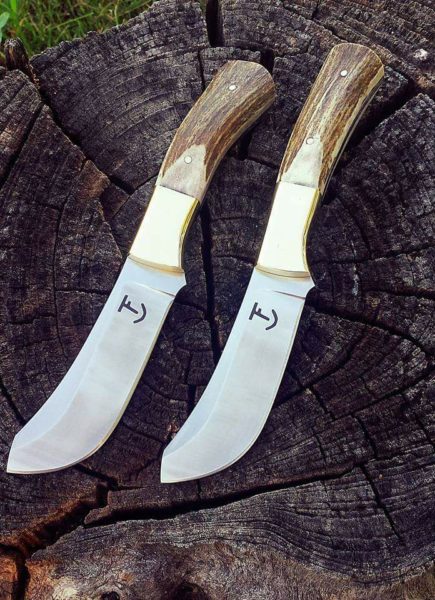
This set of bull-nose skinners were made for a father and son by Travis Fleming. The 4 1/2-inch blade is made out of CPM 154 stainless steel. The bolster is brass, and the antler handles were supplied by the son from the first buck he got with his dad. Overall length: 9 inches. Maker’s list price: $500/set. Contact Travis Flemming at [email protected] or on Facebook at Fleming’s Fabrications.
Josh Bryant of JB Custom Knives put it this way: “The bump and large drop at the tip are intended to go over guts without popping them.”
Josh Bryant’s Mini Green River Skinner is made with a 2 3/4-inch blade out of CPM 154 steel. The handle is made of dyed stabilized maple burl. Overall length is 6 inches. Maker’s list price: $180 with leather sheath made by the maker. Contact Josh Bryant at [email protected], on Facebook at JB Custom Knives and on Instagram @jb_custom_knives.
“I like a skinner made with a CPM steel,” Mike Cleveland of Half Life Knives commented. “(It) keeps its edge longer and that means more game prepared before sharpening.” Mike added: “I prefer the fuller belly for its ability to cape around tight areas. I value that over the ability to stab in a skinner. With this style of blade you’ll finish ahead of those with a sharper point.”
Michael J. Cleveland of Half Life Knives uses CPM S90V to make the 3.85-inch blade on this skinner. The overall length is 8.5 inches. The handle is made of mammoth bone with Voodoo Resin bolsters. Maker’s list price: $650 with leather sheath. Contact Mike Cleveland at Half Life Knives on Facebook or at 405-627-6097.
2. Drop-Point Skinners
The drop-point skinner is one of the most, if not the most, popular skinning knife blade design. Within the drop-point category, however, there is plenty of individual styling.
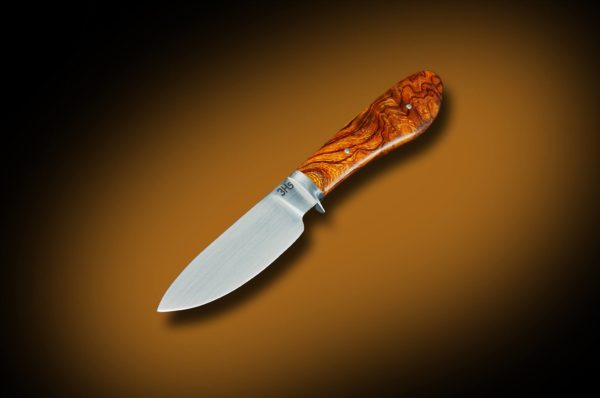
When Raymon Hunt of 3H’s Knives LLC makes a skinner, he strives for “enough belly for caping, but with enough point to make opening the cavity easy without piercing the organs.” A skinner should be balanced and lightweight, he notes. “It is amazing how carrying a heavy knife along with a rifle on a six-hour stalk through the bush can wear you out.” Raymon added that comfort is important. There should be no areas on the handle that could produce hot spots.
Raymon Earl Hunt’s Nessmuk-style drop-point hunter has a forged 4-inch flat-ground blade made out of 1075 steel. The convex cutting edge is 3 1/2 inches, and the knife is 8 1/2 inches overall. The mortised handle is made with exhibition-grade desert ironwood with sterling silver pins and 416 stainless steel guard. Maker’s list price: $600 (includes sheath). Contact Info: Ramon Hunt at www.3hsknives.com, raymon.hunt@3hsknives and on Facebook at 3H’s Knives, LLC.
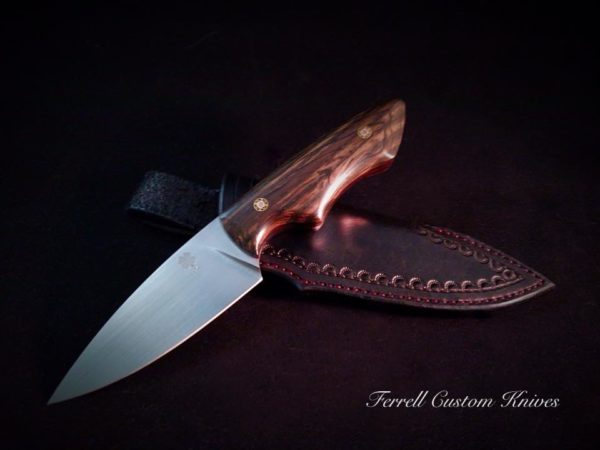
“I feel the most important parts of a good skinner are on edge-holding and the ability to be sharpened easily in the field,” Lane Ferrell of Farrell Custom Knives commented. He pointed out that comfort, not being too heavy and being balanced well, is essential “since some skinning jobs can take a while to finish.” He noted that a skinner “should also be small enough to be carried on a belt or in a pack, but large enough to get the job done effectively.”
Lane Ferrell’s Razorback model skinner has a 4.25-inch blade made with 1084 steel. The handle is Russian bog oak with red G10 liners and mosaic pins. Overall length is 8.75 inches. Price $275 with vegetable-tanned leather sheath with red stitching. Contact Lane Ferrell at [email protected] or Facebook at Ferrell Custom Knives.
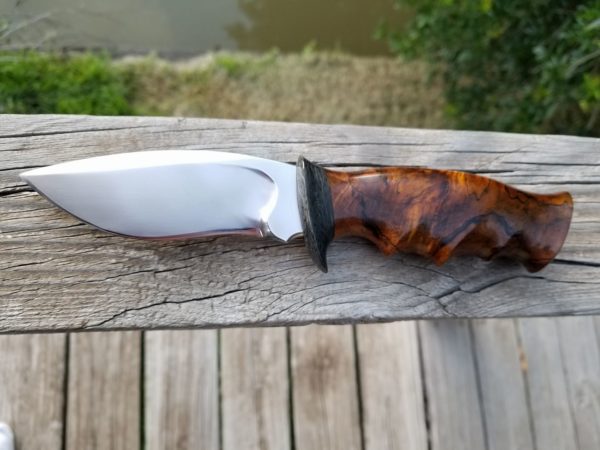
“I do such a wide variety of skinners that it all depends on what the customer wants,” Spencer Aplin of STA Custom Knives noted. “Most people want a 3- to 4-inch drop-point. Then the second most requested is a trailing-point 4- to 5-inch blade.” And in Spencer’s experience, a whopping 99 percent want finger grooves.
This Spencer Aplin skinner has a 4-inch blade made of ELMAX Steel. The handle is made with stabilized myrtle burl. Maker’s list price $550 with padded zippered pouch. Hand-tooled and carved sheathes are available upon request at an additional cost. Contact Spencer Aplin at [email protected], www.stacustomknives.com or on Facebook at STA Custom Knives.
Chris Rowley made this 3.25-inch blade from pattern-welded 1084 and 15N20 steels. The overall length is 7.5 inches. Scales are by Voodoo Resins. Maker’s list price: $350 with Kydex sheath. Contact Chris Rowley at [email protected] and at Nomad Custom Knives and Tools group on Facebook.
Mike Jeffries of 2 Birds Metalworks made the smaller skinner in this set as a companion to the camp knife. “The slight fighter profile and small size make it excellent for thumb, as well as index, purchase for those internal and fine skinning tasks,” Mike noted.
This drop-point set was made with pattern-welded steel from Alabama Damascus Steel. The scales are made from dyed box-elder burl. The blade on the bottom knife is 3 inches, contributing to an overall length of just over 7 inches. Maker’s list price: $320 with leather sheath. Contact Mike Jefferies at [email protected], on Facebook at 2Birds Metalworks and on Instagram @2birdsmetalworks.
The carbon content in the steel James McClendon used to make this skinner is approximately 1.27 percent. “Makes a most excellent knife,” James declared. “Those old files are getting harder to find.” James likes the “second-to-none on edge-holding–at least as simple-carbon steels go.” He added that the addition of a soft backdraw gives the blade toughness. “I just prefer a guard on a blade so sharp it could take a finger off with one slip. LOL. I also leave just a hint of the file teeth but not enough to hold contaminants.”
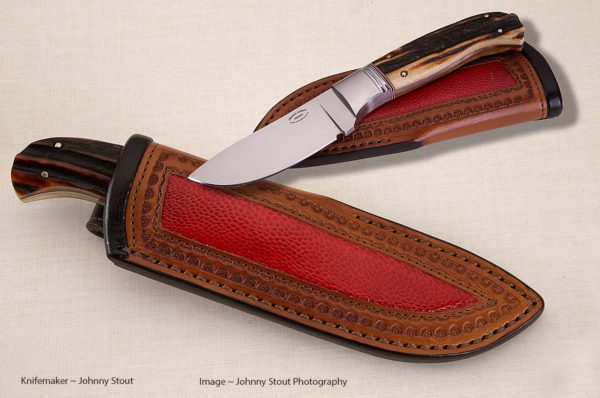
James McClendon made this 4-inch drop-point hunter/skinner out of a Black Diamond file. The bolt-through handle is made of stabilized stag. Overall length is 8 1/2 inches. Maker’s list price: $180 with sheath. Contact James McClendon at [email protected].Johnny Stout’s Rio Grande Skinner has a 3 3/4-inch blade made out of 154 CPM steel. Overall length is 8 inches. Handle is made from amber stag antler. Fluted bolsters are 416 stainless steel. Maker’s list price: $925 with custom Paul Long sheath with red full-quill ostrich inlay. Contact Johnny Stout at 830-606-4067 or [email protected].
Will Thompson put it this way: “The 3 1/4-inch blade is perfect to get around those places that you just can’t get to with a bigger blade. It’s ready to help you get those hams and backstraps to the ice.”
Will Thompson made this 3 1/4-inch drop-point blade out of 1095 carbon steel. The Plantstone handles are by Robert Belcher. Overall length is 6 7/8 inches. Maker’s list price: $120 with leather sheath. Contact Will Thompson at [email protected] or 910-385-6021.Phill Bilkey’s Sambar Skinner has a 3.5-inch blade made of 1085 carbon steel. The handle material is Australian sambar antler with red G10 liners. $200 AUD with leather sheath. Contact: Southern Cross Custom Knives on Facebook.Eric Pearson of Lake Effect Knifeworks made this 4.25-inch hollow-ground drop-point blade out of 1095 steel with hamon. Overall length 9 3/4 inches. The scales are big-leaf maple burl. Maker’s list price: $200-plus. Contact Eric Pearson at Lake Effect Knifeworks on Facebook.
3. Nessmuk-Style Skinners
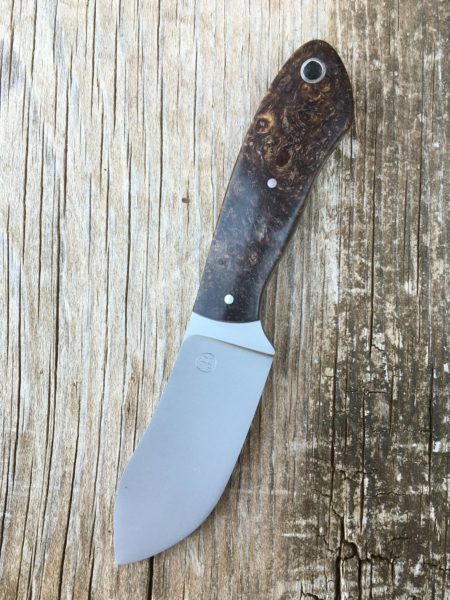
Joe Elinburg in northeast Florida likes the Nessmuk pattern for a skinner. “The rounded point makes skinning easier with less chance of putting a hole in the hide if you’re going to save it for tanning,” he commented. “Also the swoop in the back of the blade makes a great finger rest for more control of the blade.”
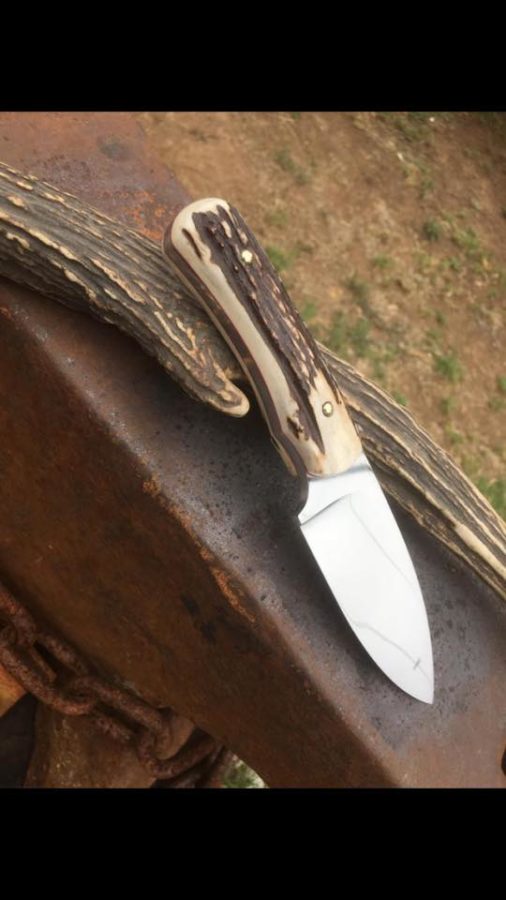
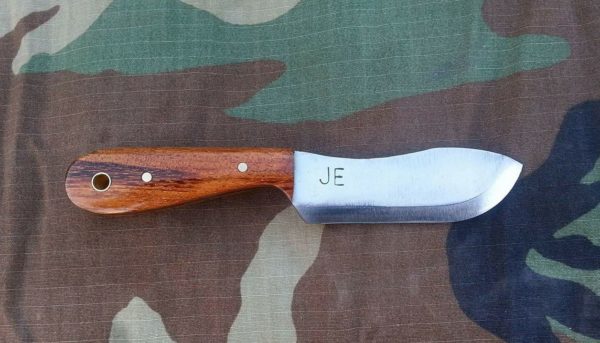
This Mini Nessmuk Skinner is made by Joe Elinburg in northeast Florida out of 1095 high carbon steel. The 3-inch blade is convex ground. Overall length is 6 inches. Handle material is camaru. Maker’s list price: $90 with Kydex sheath with mounted metal belt clip. Contact Joe Elinburg at [email protected], @jecustomknives on Instagram or call 904-962-0341.
4. Spear-Point Skinners
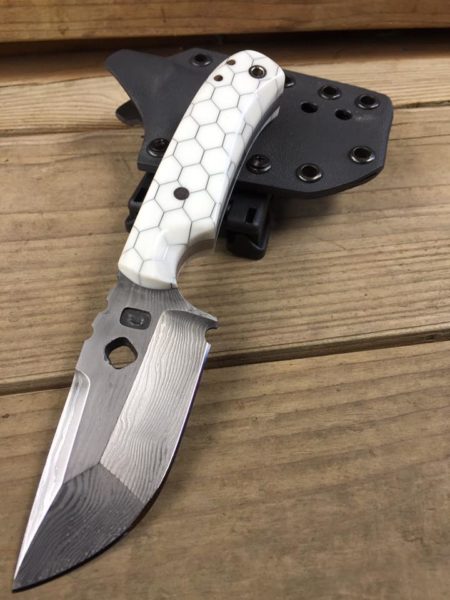
“I have always been a fan of spear-point skinners,” Jon Waltz commented. His son designed this model, and Jon made a few changes by adding the thumb ramp and expanding the belly. The deep finger guard and thumb ramp allow for full control of the blade. “The hollow grind makes for a extremely sharp cutting edge, and the large belly is great for slicing through flesh with precision,” Jon added.
Jon Waltz of Edge7 Custom Knives calls this model the 24/7 Skinner. The Hex resin scales are custom-made. Overall length is 7 inches. The 3-inch hollow-ground blade on this particular one is made of CPM D2 steel, but they are now made in PSF27 steel. Available finishes include acid etched, sandblasted and stonewashed. Makers list price: $275 and up with leather or Kydex sheath with combat loop. Contact Jon Waltz through www.edge7customknives.com.
Denny Furey of Furey’s Urban Combat Knives Unlimited uses NJ Steel Baron 1095 steel to make his Sukina, which is Japanese for skinner. Overall length is 7.75 inches with a 3.25-inch blade with a dark blued polished finish. The handle scales are Rob Carper Innovations (RCI) stabilized, dyed spalted maple. Maker’s list price: $175 with Kydex sheath with belt attachments. Contact Denny Furey at Furey’s Urban Combat Knives Unlimited on Facebook.
5. Trailing-Point Skinners
Trailing-point skinners excel for skinning small game, and are probably the second most popular skinning knife blade design behind drop-points.
“I believe that the finger groove and the thinned spot between it and the spine allows for easier indexing when trying to be precise while skinning raccoons or fox,” commented Tyler Freund of Freund’s Custom Knives. “One can simply pinch the knife between their thumb and finger. Much like you would a scalpel.” In addition, “the thin tip and thin steel lets the user make less intrusive cuts and more precise cuts around the wrists and ankles of the coon,” Tyler explained. He feels this would be more challenging with a bigger-bellied or thicker-bladed knife. “The knife has just enough belly in it that you can draw the knife and skin efficiently once you’ve gotten around the ribs,” he concluded.
Tyler Freund made this small-game skinner for a local trapper. The 3-inch trailing-point blade is made out of Vegas Forge’s raindrop-patterned steel, and the maker added file work along the spine. The handle is bone Micarta paired with Mike Sakmar mokume-gane. The knife is 7 1/4 inches overall. Maker’s list price: $350. Contact Tyler Freund at Freund’s Custom Knives on Facebook or on Instagram @tylerfreund08.Bryce Love’s trailing-point skinner has a 5-inch acid-etched stonewashed blade made out of 1095 steel. Overall length is 9 inches. The handle is made from curled cherry. Maker’s list price: $140. Contact Bryce Love on Facebook at 50Cal Forge or [email protected].
“This skinner has a short blade with pointed tip to reach into tight areas when skinning and caping,” Scooter Davis of Rough Run Forge explained about his Shrade-Sharpfinger-like knife. “The recess on the spine serves as a finger rest, allowing you to choke up forward on the knife for more control.”
Scooter Davis made this Shrade-Sharpfinger-style skinner with a 2 1/2-inch hollow-ground blade forged from 52100 steel. The scales are prickly pear cactus fastened with stainless steel corby pins. Maker’s list price: $175 with leather sheath. Contact Scooter Davis at Rough Run Forge on Facebook or call 540-560-1672.
Although not a traditional trailing-point blade shape, an upswept point is still evident. Richard Darby’s customer said you can make long sweeping cuts with this big-bellied blade design, as well as flesh with it. “Plus it gives a longer cutting edge for the length of the blade,” Richard noted.
Richard Darby’s big belly skinner has a 4.5-inch blade of 1095 steel with hamon. Overall length is 9 inches. The handle is made with flame masur birch from JHue Custom Sales. Maker’s list price: $150. Contact Richard Darby at [email protected].
Miscellaneous Skinners
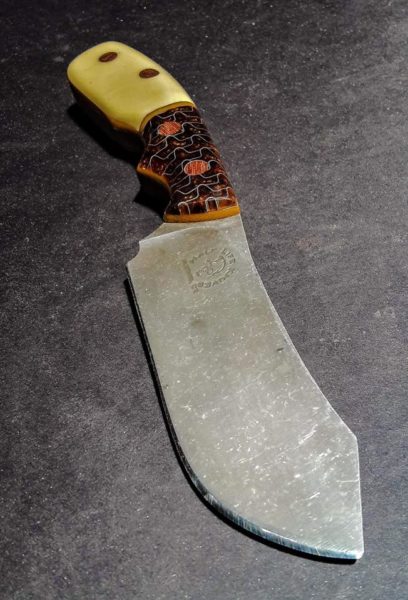
When you skin, the idea is to pull the skin back and make sweeping slices like you would when using an ulu, but it’s not an ulu, Matthew Nolan from Angry Beaver Knives explained. “The whole handle fits in your hand while grasping the blade with thumb and pointer finger…more blade…angles…equals more slicing…and it fits nice in the hand for sweeping strokes.”
Matthew Nolan’s Dear Beaver deer skinner is made out of 15N20 or 1095 steels. The overall length is 5 to 6 inches, depending on the hand size of the customer. The scales are Dustin Smith lace maple burl at Simply Scales. Maker’s list price: $225 with Kydex only sheath. Contact Matthew Nolan at Angry Beaver Knives at [email protected] or at 518-791-2551.
Learn Which Knife Designs Stand The Test Of Time
“101 Knife Designs” provides actual scaled patterns that you can use to spark your own designs. At $19.53, you’ll be saving 35 percent on a classic.
Compare and contrast different skinner designs as well as knife patterns of all types. Hiro Soga’s images will satisfy your knife eye-candy jones, you’ll be able to delve into the theory of blade design and you’ll get 101 scaled patterns that you can use to initiate you’re own design. “101 Knife Designs” by Murray Carter is a must-have in hard copy so you can work with the designs, mark with notes and refer to again and again.


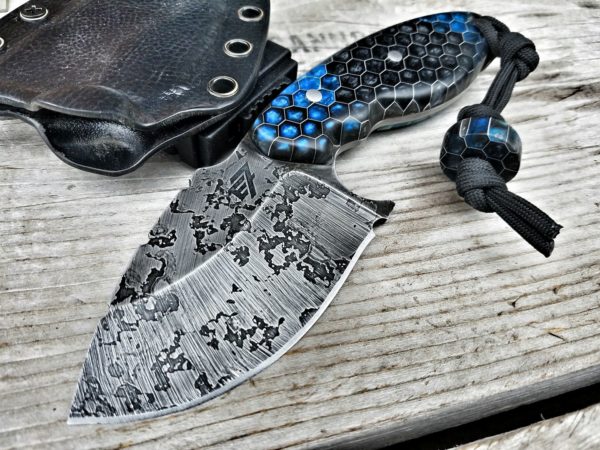
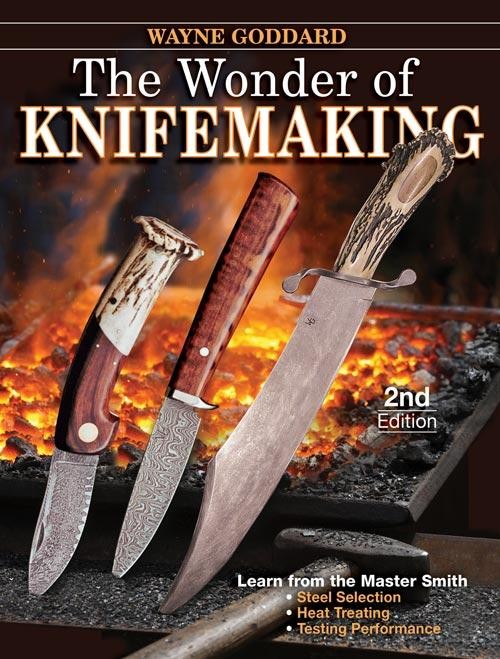

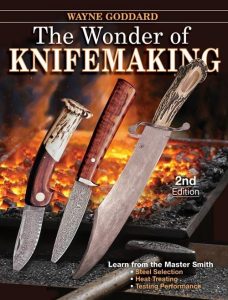 Get all your knifemaking questions answered in this collection of expert advise from former BLADE columnist Wayne Goddard. The Wonder of Knifemaking makes a thoughtful gift for someone interested in starting or perfecting their knifemaking skills