Medieval Diners Sang Grace From Notation Knives

The V&A Museum in London is in possession of a rare notation knife.
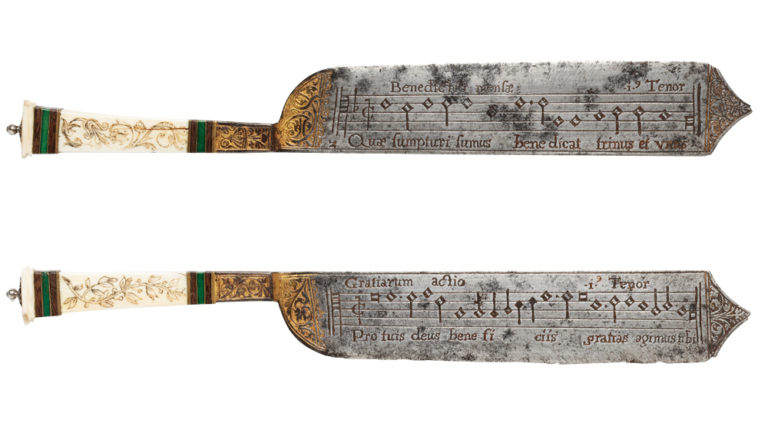
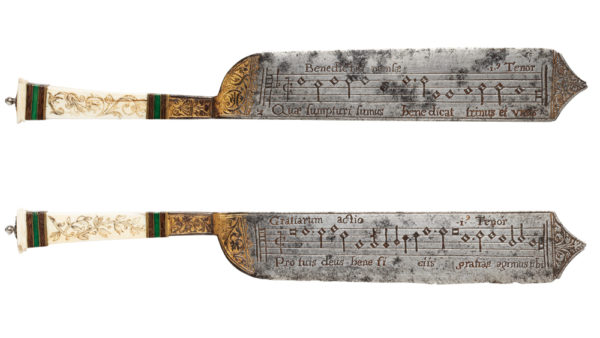
Notation knives dating from the mid-16th century were used to sing a pre-meal blessing and a post-meal grace. This example is on display at the Medieval and Renaissance Galleries at the Victoria & Albert Museum in London.

They’re called notation knives, and they’re engraved with what amounts to sheet music for multi-voiced song. They’re indicative of the formal role music played in medieval dining, according to Flora Dennis, an art historian and author of the book “Re-thinking Renaissance Objects: Design, Function and Meaning.” Holding the knife in the left hand, edge up, diners could see the notes and lyrics for the benediction, or blessing, sung before a meal. After the meal, again held in the left hand, edge down, the knife showed the music for the grace, thanking God for his generosity. Since cutting was done with the right hand, the knives may have been ritualistically transferred to the left hand, or they may have been solely used for singing purposes. Dating from the mid-1500s, one notation knife is on display at the Medieval and Renaissance Galleries at the V&A (Victoria & Albert) Museum in London, where Ms. Dennis works. There are others—seven in Paris, three in Philadelphia, two in The Hague, one in Austria, some in private collections—but as much as is known, much more remains unanswered about these rare items.

In addition to the 16 surviving notation knives, there are also written references to at least four others, according to Ms. Dennis. Essentially, though, the knives have been overlooked by historians because they don’t fit neatly into either “knives” or “music” and have been relegated to curiosity status. All the notation knives share a similar look. The steel blades are broad with straight spines and triangular points on center. According to V&A curator Kristen Kalber they may have been used to proffer a slice of meat to a diner, the point skewering the serving. Then again, squires normally carved meat and that was a highly skilled, status-imbued position. Carving rose to the level of entertainment with offerings carved from cooked fowls and beasts held aloft on forks. So, while some knives seem not to have been used other than to sing from, others show wear on the point and were definitely used.

Museum Curator And Historian Bring Notation Knife To Life

In this 2009 video V&A Museum curator Kristen Kalber shows the notation knife in the museum’s collection and demonstrates its use. Flora Dennis, an art historian at the museum, discusses the project that allowed the music on the knife to be recorded. Ms. Dennis holds a PhD in musicology, specializing in early music, and through an Arts and Humanities Research Council grant she was able to convert the music into modern notation, and then work with the Royal College of Music to bring it to life.

The points and the bolsters are engraved with leaf scrolls and strapwork, often gilded. The handles are made of ivory and green-dyed horn or bone with copper or brass spacers. The ivory is decorated with foliage, empty tablets of scrolls, Arabic or Moorish designs or winged cherub heads inlaid in black. The pommels are adorned with silver spherical knobs. The engravings are usually in Latin, though some are in the vernacular. The one from the V&A reads Benedictio mensae (The blessing of the table) on one side and Gratiarum actio (The saying of grace) on the other. The musical stave runs the length of the blade. In the upper right is the voice part, in this case “Tenor.” What this means is that there were different knives for different voices, in some cases as few as five or six or substantially more than 20.

Royal College Of Music Singers Record Two Versions Of The Meal Benediction


Knifemakers across Europe at the time would have been members of guilds and were specialized. Handles would have been made separately and assembled by the cutler who sold them. Ms. Dennis’ writings detail how challenging it can be to pinpoint where the notation knives were made or by whom. Knives were being made in Solingen and Nuremberg, Germany, and in Milan and Brescia, Italy. Possible guild marks show up in the form of arrows, fluers-de-lis or clovers, and etched Ns can be found on many of the blades, but those are more likely an engraver’s mark. One of Ms. Dennis’ knife consultants intimated that a Nuremberg mark would be on the tang, not the blade. The best guess is that they were made in France, with Italianate influence or for an Italian patron.

Were the knives collected after the gathering or did each singer keep his or her knife? In Ms. Dennis’ summation, judging by the scattering of surviving pieces, the latter might be more likely. It could also be that the knives were made for a group, such a monastery. In some instances, the strict, mass-like approach to such a shared meal could result in latecomers being fined for missing the benediction. What is clear is that the knives are not all from the same musical piece; there are two separate pieces of music represented by the known notation knives.

Royal College Of Music Singers Record Two Versions Of The Meal Grace


Interestingly, the notation knives are representative of both coming together and separating. It is the very nature of a knife to cut apart, but in this instance it is for the purpose of sharing, both repast and praise.

As Ms. Dennis writes:

“Benediction and Grace texts are inherently collective, expressing notions of conviviality and sharing. The knives reiterate this idea, needing to be brought together in a social context in order for their music to function. Simultaneously, however, they represent a contradictory action of dismembering and dividing. By slicing meat, the knives permit it to be shared between the gathered company in the same way that dismembering and scattering the musical text across the knives enabled a group to perform it collectively. The acts of uniting to say the Benediction and Grace, uniting to eat, and uniting to sing become inextricably intertwined with those of separating, dividing and sharing both meat and music.”

Bladecrafting Collection Includes 6 Classics

The 6-volume bladecrafting collection is available at less than half its normal cost.
The Bladecrafing Ultimate Collection includes two paperbacks and four ebooks for $34.99

Makers can’t go wrong with this collection. You’ll get two paperbacks: the third edition of “Blade’s Guide To Making Knives” and “How To Make Knives; and four e-books: “Greatest Loveless Knife Designs,” “Knife Grinding Secrets,” “Making Everyday Carry Knives” and “Fashioning A High-Tech Folding Knife.” Normally, this collection would cost over $70, but you can get it for half that.
 

Of Blue Mohawks, Butterfly Knives and Buddies

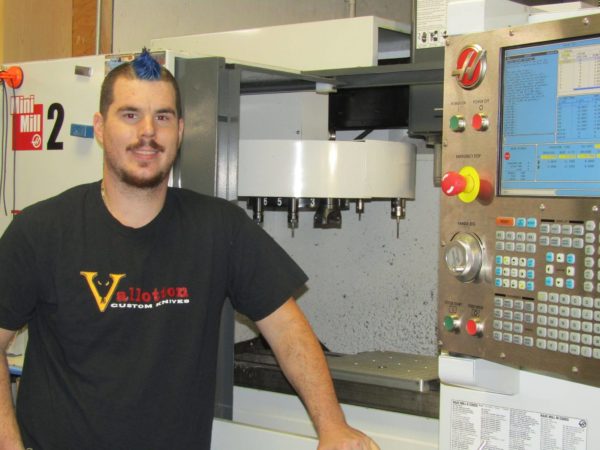
If you could apply a motto to VMX Knives it would be: Let’s have some fun. At least that’s the impression you get after talking with co-owners James Robert Buckley of Maverick Customs and Kyle Vallotton of three-generation-strong Vallotton Custom Knives. Rob and Kyle became friends online. For BLADE Show 2017, Kyle—sporting a new do—invited Rob, whom he calls Buckley, to share space at the Vallotton table. But due to a confluence of issues, Kyle, who is known for his butterfly art knives, had no balisongs at the table this year. Rob, a machinist and welder before getting into knifemaking, asked Kyle if he’d look at a design he’d come up with for a balisong. Kyle liked it. The men agreed to make the knife together, Kyle bringing his expertise in the art-balisong industry to the newcomer and Rob offering to show Kyle what he knew about machining steel. It wasn’t long before a work flow was ironed out and the VMX-1 was brought from paper to reality, a baby born of blue mohawks, butterfly knives and buddies.

Rob Buckley was a machinist and welder before he got into knifemaking full-time.
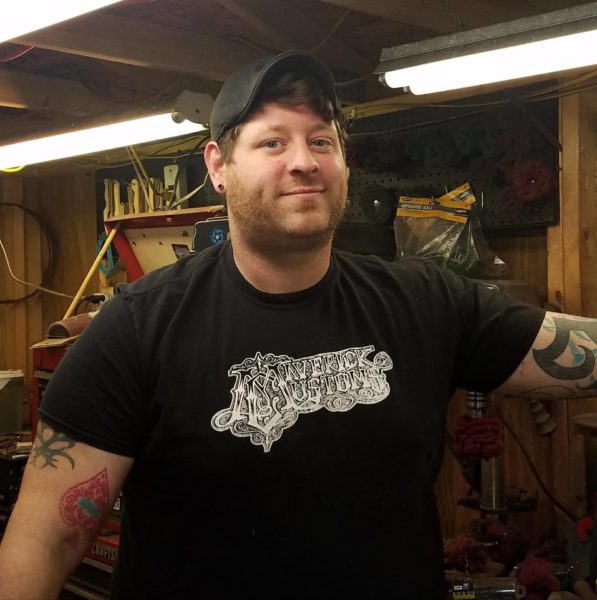
James Robert Buckley is the owner of Maverick Customs out of Horse Cave, Kentucky. He is also the co-owner with Kyle Vallotton of VMX Knives.

Rob Buckley grew up in Glasgow, Kentucky, about 45 minutes northeast of Bowling Green. While in high school and working at a family-owned cabinetry shop, he came to a realization: “I hated wood,” he said, laughing. But he took college-level courses in welding and machining. “It got me,” he said of metalwork. At 17 he entered the Army, wanting combat medic, but settling for infantry. He sustained injuries that would require surgery before continuing his training, so he accepted the proffered medical discharge. Returning home, he landed a machining job in Dickson, Tennessee, where his parents were living at the time. After those few months as a manual machinist and welder, he moved back to Glasgow to work as a certified welder. Six months later he took a position at a magazine printing plant, staying for 10 years. He left for a computer numeric controlled (CNC) machinist position, but he found operating the computer-programmed mills and lathes not as satisfying as hands-on metalworking. Three years ago he began making tools, then later knives, full time.

Kyle Vallotton specializes in art balisongs at Vallotton Custom Knives.
Kyle Vallotton hit BLADE Show 2017 with a blue mohawk. He is a third-generation knifemaker and the fifth person in his family to be making knives under Vallotton Custom Knives. He is also co-owner of VMX Knives with James Robert Buckley of Maverick Customs.

Kyle Valloton marks the third generation and fifth family member to be making knives under Vallotton Custom Knives. He began in the shop when he was 10 years old. He took some time off to test jobs away from the family business, such as telephone sales representative, but by the time he was 23, he knew he wanted to make knives for a living. He grew up in Umpqua, about an hour and a half south of Eugene. His grandfather Butch was an innovator in the tactical folder and automatic knifemaking world. The Vallottons hold 15 patentable developments with seven still-running royalty contracts. Vallotton innovations appear in numerous production knives, from Gerber to Spyderco.

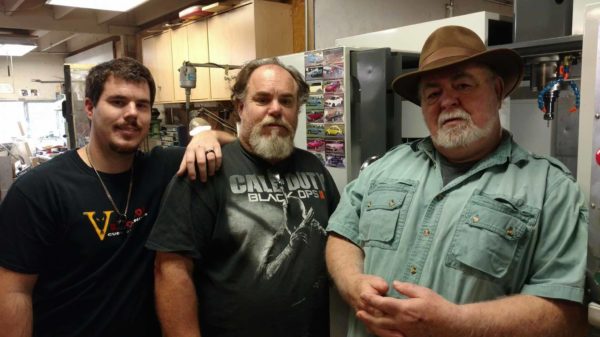
Kyle, Rainy and Butch Vallotton have been making knives for close to four decades.
Kyle Vallotton, left, specializes in high-end balisongs, tapping into both the artistry of his dad, Rainy, and the innovations of his grandpa, Butch, right.

Kyle’s dad, Rainy, made his mark in the high-end art-knife market, and Kyle’s specialty is the butterfly knife. He taps into both his grandfather’s exactitude in specifications and his father’s artistic flare. Kyle’s demeanor exudes good-natured enthusiasm and a sense of fun without being reckless. He contemplated attending BLADE Show 2017 sporting a blue mohawk, but wasn’t sure how it would go over. Finally, he decided to do it. “Let’s have some fun,” he said. “Everyone loved it.”

The first VMX-1s will ship mid-November, 2017.
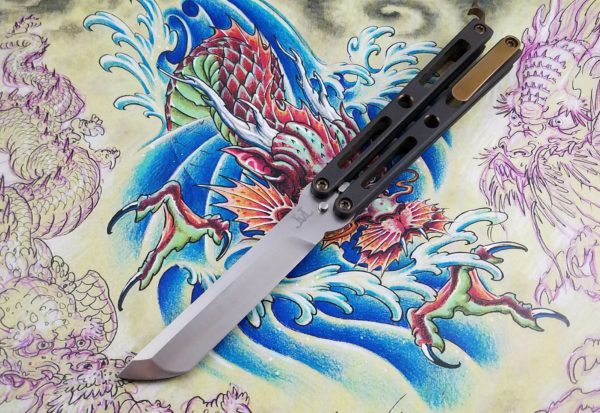
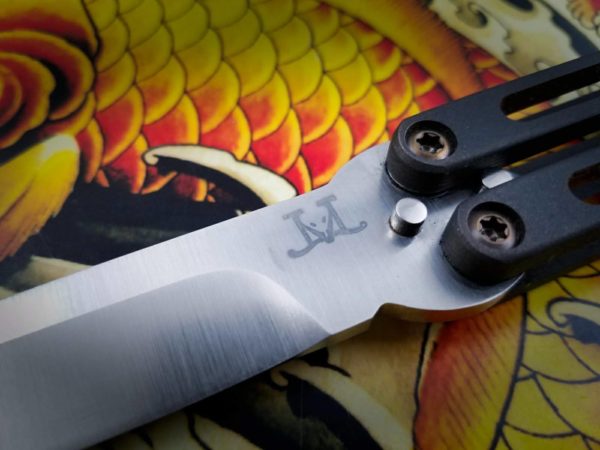
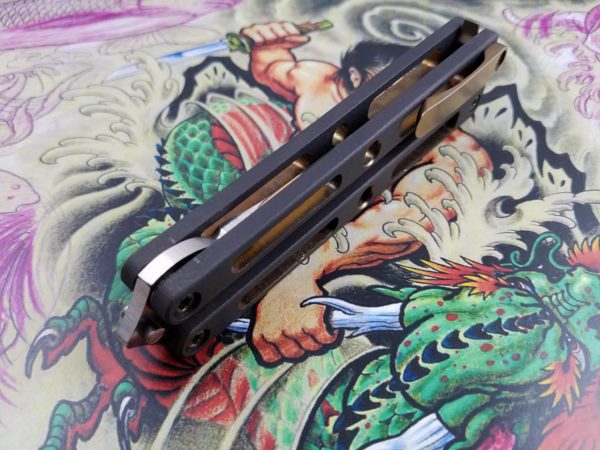
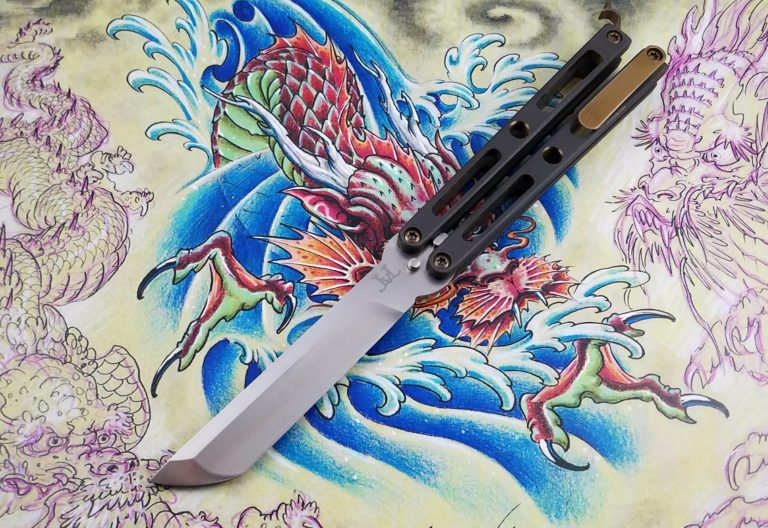
The VMX-1 prototype was made of BG42, but the production model has a 4-inch blade of CPM 154 steel. The prototype handle is black titanium, but custom-colored anodized titanium handles are available. Artwork by Zach Burcham of West Main St. Tattoos in Glasgow, Kentucky.

The balisong segment of the knife community is a microcosm of the knife industry itself. There are those who use the knives in the practice of Filipino-style martial arts; those who use the knives in a mesmerizing display of twirling and tricks, resplendent with the individual’s unique style; and those who collect the knives created as works of art. In addition, because many states have laws preventing the sale of balisongs—only trainers can be used by residents of those states. Kyle mentioned that he follows Knife Rights‘ work to overhaul outdated knife regulations in numerous states.

Rob jokes that he knows just enough about flipping balisongs to cut himself. In fact, VMX Knives will sell you its butterfly knife without an edge if you prefer. At any time, you are welcome to send it back if you decide you want to go with a live blade.

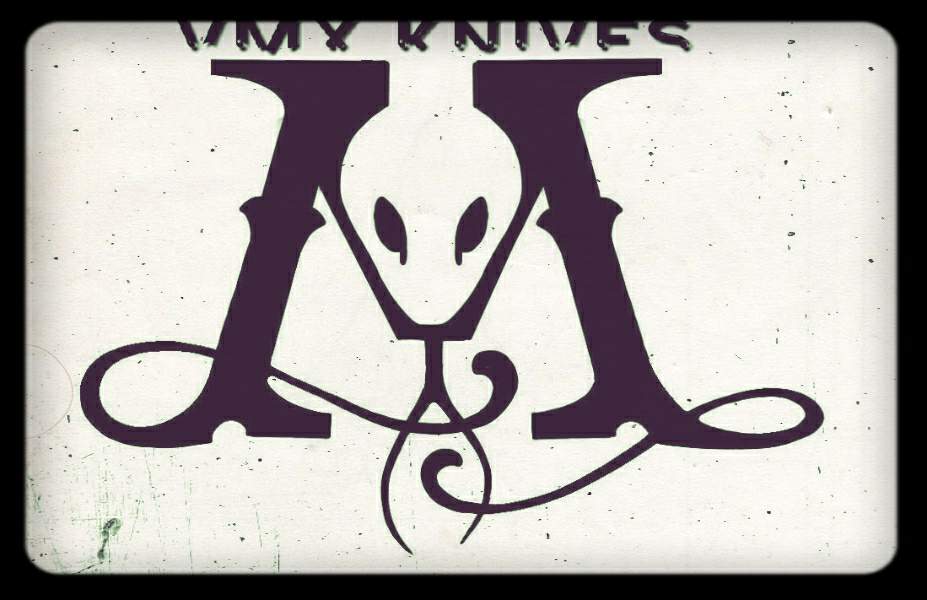
Zach Burcham of West St Tattoos in Glasgow, Kentucky, designed the VMX Knives logo.
Zach Burcham, owner of West Main St. Tattoos in Glasgow, Kentucky, designed the logo for Maverick Customs and was brought in again to combine the M from Maverick Custom’s logo as well as a V for Vallotton Custom Knives to create the VMX Knives logo. Like the VMX-1 balisong itself, the logo uses old-school lettering with a modern twist.

Rob got his tattoo artist, Zach Burcham of West Main St Tattoos, who designed the M logo for Maverick Customs—named after Rob’s son—to come up with a logo that incorporated a V for Vallotton with the M for Maverick, and the VMX Knives logo was born. It is representative of the gold-leafing in signs of yore in the style of David Smith, for example, but with a modern twist, which is exactly how this team approaches their design.

The VMX-1 utilizes a floating latch system designed by Kyle Vallotton.
The VMX-1 has phosphor bronze washers, titanium screws and standoffs, and a floating latch system designed by Kyle Vallotton. It measure 5.25 inches closed, 9.25 open. Artwork by Zach Burcham, West Main St. Tattoos in Glasgow, Kentucky.

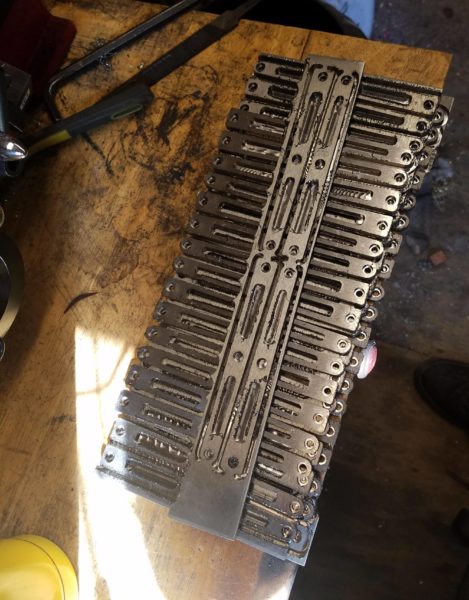
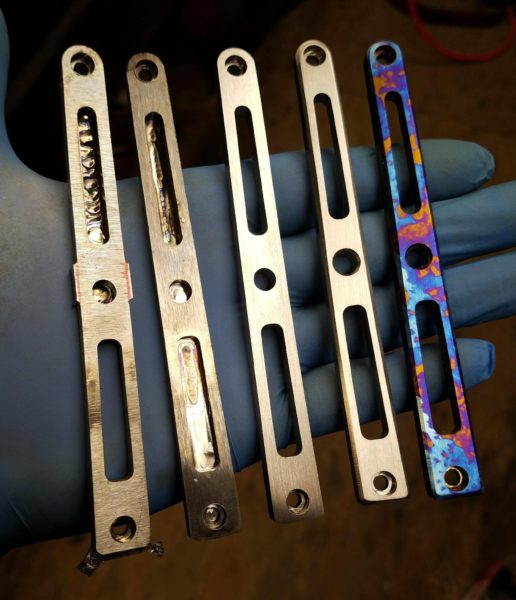
Right now, whichever of the two are ordering supplies in the course of their personal knifemaking businesses purchases whatever VMX needs. They split those expenses 50-50, watching the price of titanium as it fluctuates. At present, Kyle machines the profiles and handles then sends them to Rob, who likens what he receives to model car parts connected to their frames by plastic tabs. “From the sheet I surface everything flat, chamfer holes and shape the tops by hand,” he explained. He also applies any final finish, such as anodizing, and machines some internal parts. Currently, the blades go back to Kyle for hand-grinding, hollow on the belly and convex on the point. Soon unused equipment at the Vallottons’ will be heading Rob’s way so he can also do the grinding. Once all the components reach Rob’s shop, they’re ready for clean-up, assembly, packaging and shipping.


Blade HQ will have some VMX-1 balisongs or you can order directly from VMX Knives.
VMX Knives has built a high-end balisong that Kyle Vallotton hopes will change the way flippers think of flippers. You will find some offered for sale at Blade HQ or you can custom order yours by contacting Rob Buckley at Maverick Customs via methods listed at the bottom of this article. Tattoo art by Zach Burcham at West Main St. Tattoos in Glasgow, Kentucky.

“They are the strongest folding knives,” Rob said of balisongs. “There’s no locking failure; the pin stops it from closing.” No matter how tight tolerances are, owners will often loosen up butterfly knives for better flipping. “So it’s like a chain-link fence,” Rob said. He and Kyle are striving for a knife that is as tight as a bushings-and-washers construction can be while still allowing for smooth flipping action. In the future, they hope to offer a bearings model, as well as a limited-run high-end model.

Rob Buckley of Maverick Customs finishes the rough parts that come machined from Kyle Vallotton.
Even though Rob Buckley is in Kentucky and Kyle Vallotton is in Oregon, the men have worked out a division of labor that maximizes the strengths of each. Rob receives the parts on sheets. From there, they undergo numerous processes before they are ready to be finished, assembled and shipped.

The balisong community is an entity all to itself within the knife industry. Both Rob and Kyle acknowledge the achievements of others who started where they are now, while simultaneously carving out their own space in the market. Bladerunners Systems, which goes by BRS, started out as “flippers making flippers for flippers,” Kyle explained.

“I met the BRS boys before they became BRS,” he noted. “They are a bunch of balisong enthusiasts and great guys doing a great job.” In Kyle’s opinion BRS excels at using overlay materials that look cool and grab the attention of the crowd. “They are a big production company making a decent knife.”

“They make a great product,” Rob agreed, adding that butterfly knives made by Bali-Song Inc. (1979-1983), which became Pacific Cutlery Corp. (1983-1987), which became Benchmade (1988 to present) are well made as well. In fact, he owns a Benchmade Balisong 53 Mangus and a Spyderco Spyderfly.

VMX Knives is set to release its first round of VMX-1 balisongs in mid-November, 2017. They received 15 preorders, enough to get the project off the ground.

Kyle explained the partnership’s goals with the VMX-1. “What I have been doing and am now doing with VMX is simplifying and changing the norm,” he commented. “We are a small company making a very high-quality knife for the same price, and it’s custom-to-order.” Kyle wants to change the way flippers think about flippers. “I want to push boundaries and change things for the better. It’s what I wanted to do when I started making balis.”

It is obvious from their banter, that Rob and Kyle enjoy ribbing each other and genuinely respect what each brings to the project. The online acquaintances who developed a friendship and started a business together have also seemingly adopted each other’s families. Only Rob does not flip balisongs in front of his impressionable son, he admitted with a laugh.

Contact James Robert (Rob) Buckley, VMX Knives, 111 Corner Ave., Horse Cave, KY 42749; 270-576-4392. You can view the work of Rob on Facebook at Maverick Customs and Kyle’s work along with the work of other Vallottons at Vallotton Custom Knives.

A Digital Subscription To BLADE Is The Answer

Save $4 off the print price of a annual subscription to BLADE Magazine with a digital subscription.
You can read your digital issues of BLADE Magazine anywhere you have your phone, tablet or computer, and there’s no need to find storage for all your old issues.

If piling-up issues of magazines seems like a waste to you… If you feel like you don’t have time to read a magazine… If you like the stories we offer in BLADE, but want a more economical option, then a digital subscription is the answer. An annual subscription to BLADE is $17.98, $4 off the print price.


6 Knife Handles That Glow In The Dark

There are four categories of “glow.” Bioluminescence is, say, a firefly. There’s chemiluminescence, caused by a chemical reaction—think glow stick. Radioluminescence is most frequently used in clock or watch paints and on instrument panels. Then there’s phosphorescence, frequently used in toys, or toys for grown-ups: knives, or more specifically knife handles. The old-school invisible type of glow-in-the-dark scales show white-ish in daylight. The handle might have tinges of color, but it’s essentially white. If it has been exposed to enough sunlight, it will glow in blues, purples or greens in the dark. New-school daylight glow is visible day or night and comes in variety of colors. Here are six knife handles that glow in the dark, three of each variety, perfect options for Halloween or the everyday kid in all of us.

1. A son makes glow-in-the-dark-handled knife for his dad

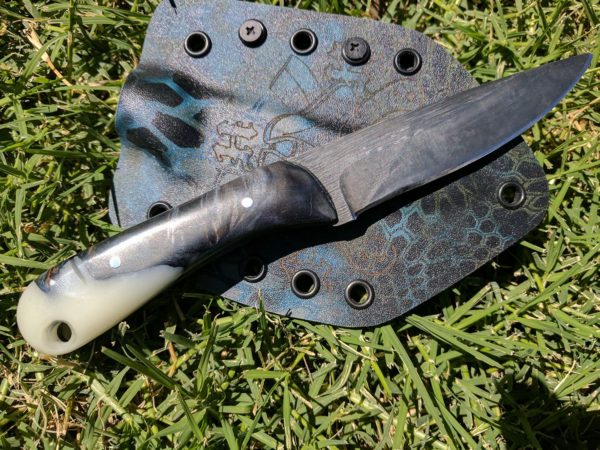
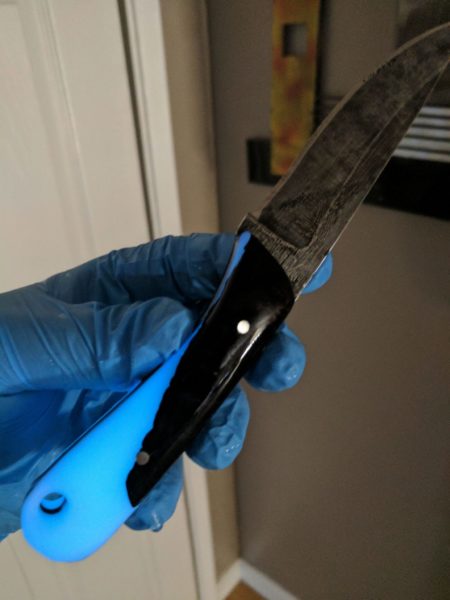
Randy Madan of Patriot Horde Knives made this Pig Poker for his dad, Randy, who uses it on his farm in Kentucky. This type of old-school glow will appear creamy or pasty by day and either blue-violet or green by night, provided it has absorbed some UV light, explained scalemaker, Rob Carper of Rob Carper Innovations (RCI).

This glow-in-the-dark knife handle is a hybrid by RC Innovations.
Randy Madan of Patriot Horde Knives made this 4.5-inch flat-ground blade out of 1095 steel from Aldo Bruno at New Jersey Steel Baron. The Pig Poker has an acid-washed finish and a hybrid glow-in-the-dark handle by Rob Carper of RC Innovations. The knife is 9 inches overall. Maker’s list price: $200. Contact Patriot Horde Knives, 760-885-9370, [email protected], on Facebook at Patriot Horde Knives or Jr Madan and on Instagram @the_patriot_horde.
Randy Madan made this glow-in-the-dark-handled knife for this father.
In low light this Pig Poker from The Patriot Horde Knives glows blue, provided it has absorbed enough light.

2. This GITD friction folder is pinned by a grenade pull

A rescue knife has a blunt point for two reasons, explained Denny Furey of Furey’s Urban Combat Knives – Unlimited. One, it can be used to pry with, and two, if you needed to cut someone’s seatbelt, for example, you don’t want to run the risk of sticking them with a sharp point.

The grenade pull locks the blade in the open position for secure cutting. The pin can then be stored in the attached slot on the sheath, similar to how a ferro rod might be stowed.

Denny Furey of Furey's Combat Knives - Unlimited made this blunt-tip rescue knife with grenade pull pin.
The “Resukyū” (Rescue) Friction Folder is a one-off by Denny Furey of Furey’s Urban Combat Knives – Unlimited. The 3-inch blunt-tip rescue blade is made out of O1 tool steel, as are the breacher/bottle opener and spacers. The blade and back spacer have an acid stonewashed finish. The knife measures 6.75 inches closed and 8 inches overall. The handle scales are Glow In The Dark by Voodoo Resins. The hardware, including the grenade pin lock, is stainless steel. Maker’s list price: $300 with Kydex/Holstex sheath. Contact Denny Furey, Furey’s Urban Combat Knives – Unlimited, 405-642-2198, [email protected], on Facebook at Furey’s Urban Combat Knives – Unlimited.
Furey Urban Combat Knives - Unlimited made this rescue friction folder as a one-off.
This Denny Furey friction folder handle was made by Voodoo Resins and appears green in the dark.

3. New-school daytime glow is visible day or night

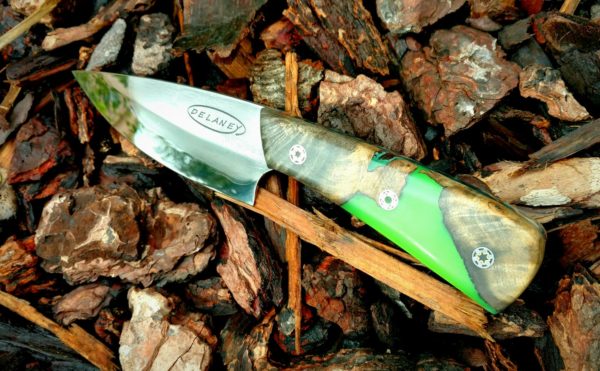
Jason Batdorf of Delaney Knives makes his own glow mix, using raw materials, but one would need to be a chemist with a laboratory to actually make the glow powder.

Jason Batdorf makes his own glow mix for his wood-glow hybrid knife scales.
Jason Batdorf made this 4-inch flat-ground Delaney drop-point blade out of 1095 steel with hamon. The handle is a buckeye burl and glow hybrid made by the maker with his own glow mix. Overall length is 8 inches. Maker’s list price: $250. Contact Jason Batdorf, at Delaney Knives on Facebook or call 419-583-8238.

4. Knife named for a customer’s departed sister

Brent Vacarro of Black Widow Knifeworks & Tactical Gear designed this blade for a customer as a custom order. When Brent began receiving interest in the knife, he wanted to introduce it into his lineup. But there were two problems. “First, I had to get permission from the customer, and second, I needed a name for it,” Brent explained. He contacted the customer and asked if it would be OK if he made more of this knife model. The customer was fine with that. “Then I asked him to name the blade,” Brent continued. “This is where it becomes very special very fast. He had told me about his sister passing away when they were younger, so he had asked if we can name the blade after her. My immediate response was ‘Of course!’ So that’s where H.E.R.L comes from, her initials.”
Brent Vacarro of Black Widow Knifeworks & Tactical Gear got permission from a customer to recreate his custom order. Brent let the customer name it after his deceased sister.
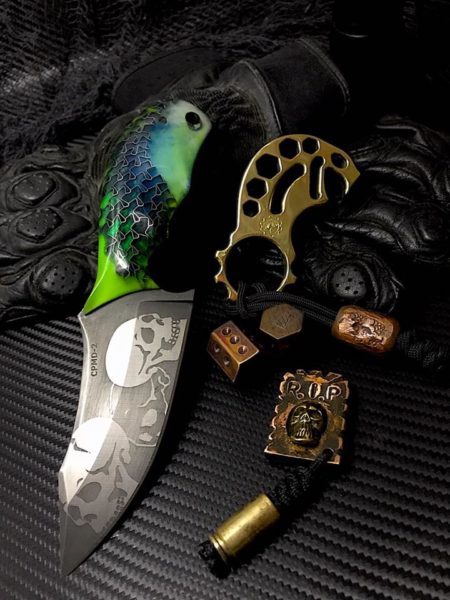
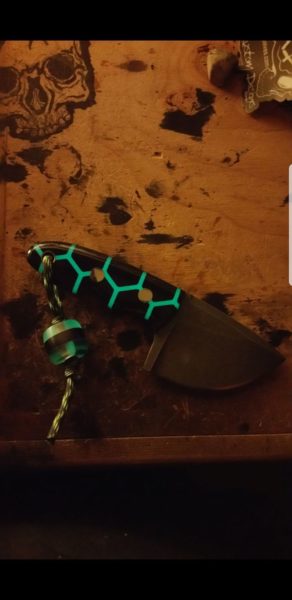
Brent Vaccaro’s H.E.R.L has a 4.5-inch flat-ground blade of CPM D2, acid-washed with etched skulls. The handle is Voodoo Resins’ Dr. Strangelove (green/blue glow) with green G-10 liners. Overall length is 7 inches. Maker’s list price: $280-$350. Contact Brent Vacarro at [email protected], 908-328-2049, on Facebook at Black Widow Knifeworks & Tactical Gear and on Instagram @blackwidowknifeworks.
Dr. Strangelove is a Voodoo Resins with blue and green glow in the dark.
Dr. Strangelove scales are made by Matt Peterson at Voodoo Resins. Dimensions are 5.9 inches long by 1.85 inches wide by .300-inch thick. Makers list price: $40/set.

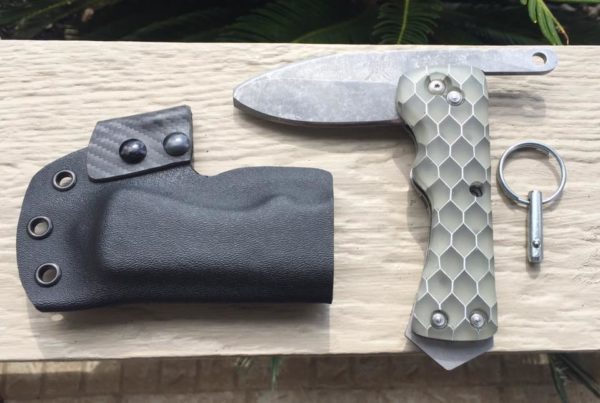
5. Glow-in-the-dark honeycomb pattern is echoed in leather sheath

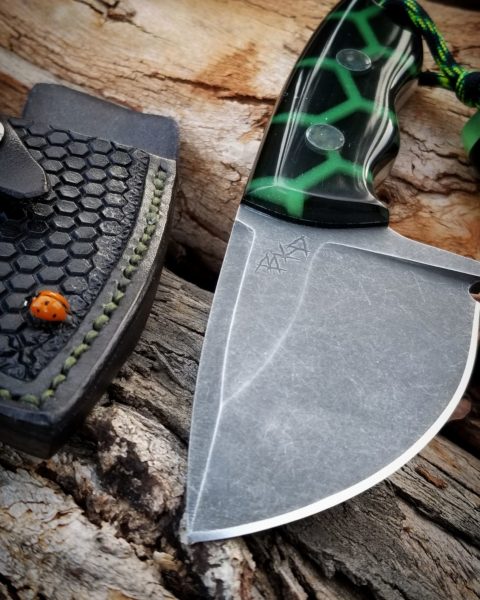
Namen Borras echoed the honeycomb glow-in-the-dark pattern in his accompanying leather sheath for the BKD Skinner.
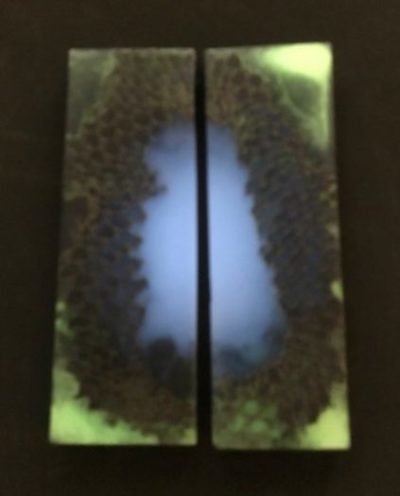
Namen Borras’ BKD Skinner has a flat-ground 2.5-inch blade with swedge made out of CPM S35VN with acid and stonewashed finish. The knife is 6 inches overall. The handle scales are glow-in-the-dark honeycomb with clear resin by DerangedDonkey with black G10 liners. Maker’s list price: $350 with black leather sheath with matching honeycomb pattern. Contact Namen Borras on Instagram @borraskustomdesigns, www.bkdknives.com or at [email protected].
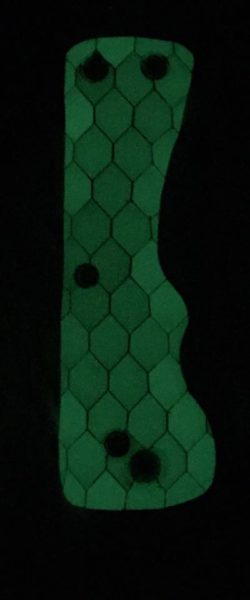
A knife handle can be a little or lot glow-in-the-dark, in random or purposeful design.
This is how the honeycomb pattern on the above knife appears in the dark.

6. Old-school Glow Hex emits violet shade in the dark

Tyler Freund's custom folder glows violet in the dark.
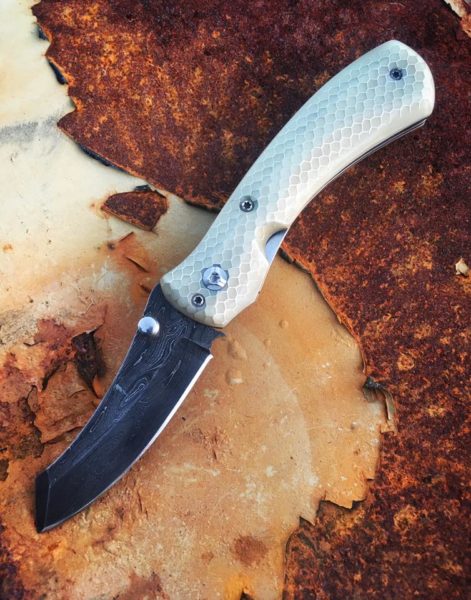
Tyler Freund made this one-off custom folder with a 1.3-inch flat-ground blade of pattern-welded steel from Alabama Damascus Steel. The Glow Hex scales are by Beyond Wood Products, and are paired with titanium liners. Screws, pivot pin, pivot screw, backspacers and clip are also titanium. Overall length is 9.7 inches. Maker’s list price: $400. Contact Tyler Freund, Freund Custom Knives, 1755 Madison 541, Ironton, MO 63650; 573-366-3906, [email protected] and on Instagram @freunds_customs.
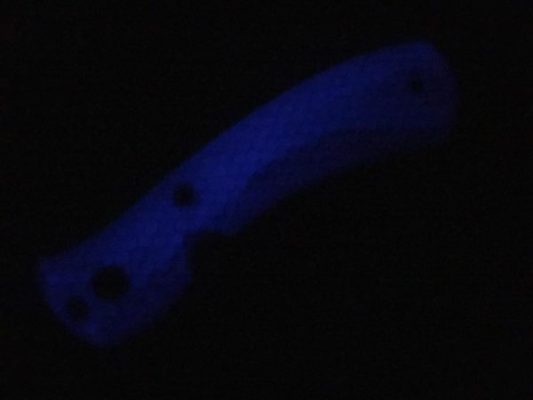
Old-school invisible scale material can glow blue, violet or green in the dark.
Tyler Freund’s one-off custom folder glows a blue-purple in the dark when it has absorbed sufficient UV light.

A Digital Subscription to BLADE Is The Answer

Save $4 off the print price of a annual subscription to BLADE Magazine with a digital subscription.
You can read your digital issues of BLADE Magazine anywhere you have your phone, tablet or computer, and there’s no need to find storage for all your old issues.

If piling-up issues of magazines seems like a waste to you… If you feel like you don’t have time to read a magazine… If you like the stories we offer in BLADE, but want a more economical option, then a digital subscription is the answer. An annual subscription to BLADE is $17.98, $4 off the print price.


Dropout Knifemaker Is A Master Of Marketing

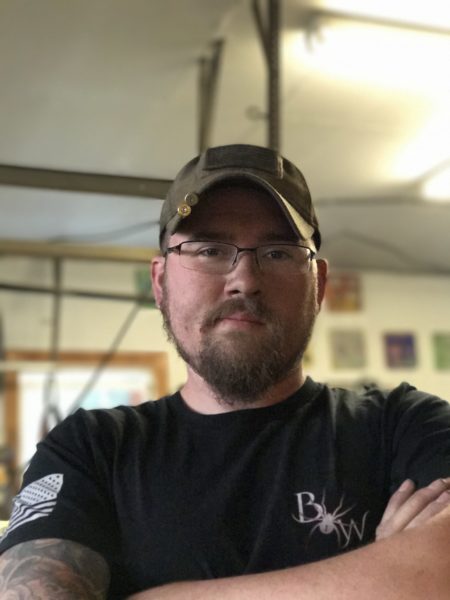
Brent Vaccaro owns Black Widow Knifeworks & Tactical Gear
Brent Vaccaro of Black Widow Knifeworks & Tactical Gear left high school in his junior year. He already knew carpentry inside and out. But it was when he turned to knifemaking that he found a way to identify himself that had eluded him during his other business attempts. This dropout knifemaker is a master at marketing.

Brent Vaccaro of Black Widow Knifeworks & Tactical Gear attended high school in New Jersey where he was born and raised. He excelled in woodworking, banging out projects that those two years ahead of him struggled through. His teacher helped him, Brent said, but perhaps most by giving him the freedom to do his own thing. Brent grew up building houses. His family lived in the middle of an open subdivision field and every day after school Brent would work on the other eight houses that needed to be constructed. In his junior year, bullying got too much. He left school and became a carpenter. Over the course of 15 years he worked in construction, running his own business and working for others. He also started a tactical gear company, and he dabbled in beard accessories during the height of facial hair resurgence. He never could quite establish an identity for himself in any of his three businesses, he admitted, but when he started making knives, everything came together. Now, no matter how different Brent’s knives are from each other, when you see a Black Widow knife, you recognize it immediately. The dropout knifemaker is a master of marketing.

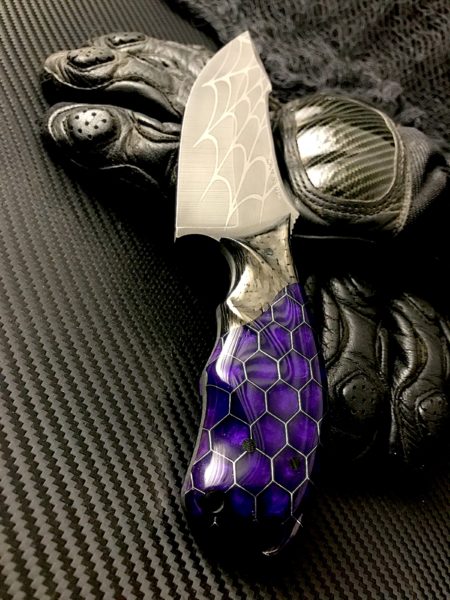
The H.E.R.L. is a knife designed by Brent Vaccaro of Black Widow Knifeworks & Tactical Gear.
Model: H.E.R.L
Blade Length: 4.25 inches
Blade Steel: CPM-S30V
Blade Finish: acid wash with spider web etch
Scales: Voodoo Resin’s Purple Haze with KS Carbon bolster
Overall Length: 8″ inches
Maker’s list price: $250-$350 shipped with Kydex sheath and Tec-Lok
Contact: Message Brent Vaccaro on Facebook at Black Widow Knifeworks & Tactical Gear. (Additional contacts at end of article.)

Around the time that Brent was struggling with being in school, when he was 16, his father gave him a pocketknife. It was a now-discontinued Kershaw model. “I still have it. I loved that knife,” Brent said. But he never had the money to collect knives, and some days he gets a mock scolding from his wife, Megan for forgetting to carry a blade on him. He was getting disillusioned with the diminishing level of artistry within carpentry, the lack of appreciation from the customers and the sense that the industry was solely focused on money. Although the skill sets are similar in woodworking and metalworking, it took some time to transition. Now Brent loves metalworking. It’s not months or years to finish a project with barely a handshake and never a thank you. It’s the instant gratification of seeing a knife come to completion over a course of days, sending it out and having the customer write him that they have no words for how impressed they are with his knife.

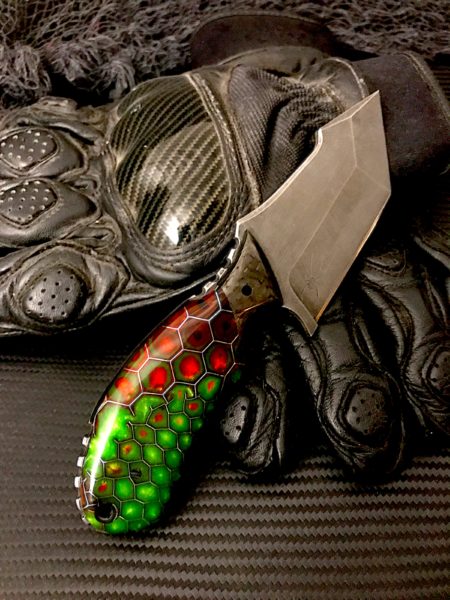
The BW Tac Tanto has a 3.5-inch blade of CPM S30V steel.
Model: BW Tac Tanto
Blade Steel: CPM S30V
Blade length: 3.5 inches
Blade Finish: dark acid wash and stonewash finish with aggressive gimping
Scales: Voodoo Resins’ Bloody Hulk with KS Carbon Fiber bolsters.
Overall length: 7 inches
Maker’s list price: $230-$330 shipped with Kydex sheath and Tec-Lok
Contact: Message Brent Vaccaro on Facebook at Black Widow Knifeworks & Tactical Gear. (Additional contacts at end of article.)

And therein lies his mastery. Brent is fulfilled by that appreciation for his craft, and he knows exactly how to represent his knives to the world in the best possible light—literally—without ever crossing into exaggeration. It means a lot to him that he has created an identity for himself that is true to him, celebratory of his knifemaking and honoring to the client. “It’s an extension of self,” Brent said, adding that he wants his knives to be passed on as a part of his and his client’s heritage. You only have to look at a photo of a Black Widow knife to get the “feel” for the candied richness of the colors, the smoothness of the handle and the badassery of the blade itself.

“I don’t keep them,” Brent said. So each night he takes the time to shoot exceptional photos of each piece, a running catalog of his work, for him to remember by and for the client to share. He takes 10 to 15 photos of every knife and picks the best ones. And that’s because he’s found a system that works for him. At first, you’ll need to shoot far more to find the right lighting and angles. “You have to take the time to do it. It’s part of marketing,” he said.

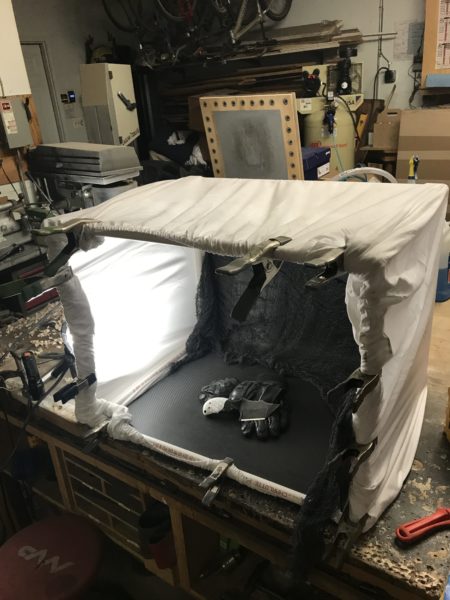
A lightbox is essential to taking great images of your knives.
If you want to take great photos of your knives, upgrade your cell phone, make yourself a lightbox, buy some handheld lights and take the time to learn how to make your knives look, not OK, but fantastic.

Building A Lightbox That Works

Brent invested $50 in his lightbox. At The Home Depot he bought 1-inch PVC and eight 90-degree T connections. With those he made his two squares for the box ends. He also got alligator clips. At Walmart he bought a king-sized white sheet and clipped it taught to the PVC frame. The whole thing is collapsible so that he can move it out of the way when he’s working. And, of course, the white sheet is no longer white.

The Backdrop

Normally, light boxes are made with white construction paper on the floor that bends up the back. Not Brent’s. He does a lot of Kydex. He was heating up a 2-by-4-foot sheet of carbon fiber one day and as it bent, it occurred to him to use it in the lightbox. He had to buy more Kydex, but he likes the look of it. That was probably anther $50, but wouldn’t be necessary for everyone since every knifemaker’s style is different. Brent strives to build tough knives that military and law enforcement can respect, while still appealing to the civilian population with his Candy-Crush-like handles. He mostly uses Matt Peterson’s Voodoo Resins scales, but he’s also using some of J Hue Customs’.

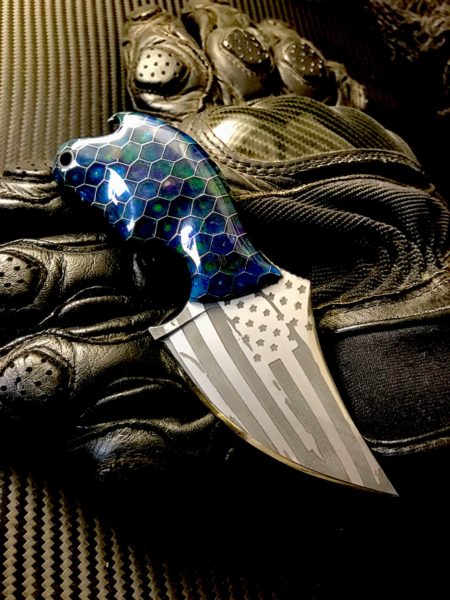
This Black Widow neck knife comes with American flag etching on both sides.
Model: Recluse Neck Knife
Blade Steel: CPM-D2
Blade Length: 3.25 inches
Blade Finish: acid wash with American flag etch on both sides
Scales: Voodoo Resins’ Chameleon
Overall length: 5.5 inches.
Maker’s list price: Price range: $165-$200 with Kydex neck sheath
Contact: Message Brent Vaccaro at Black Widow Knifeworks & Tactical Gear

Lights! Camera! Action—No Really, Move Around!

For lights he purchased round Utilitech LEDs that he can hold while he shoots. “The light is never stationary,” he explained. He waits until complete darkness because he has two windows in his shop and he wants total control of the lighting. Because the LEDs are very white lights, bluish even, he adds a 60-watt lightbulb to add a yellow hue to balance out the lighting. He moves around with his iPhone 7 Plus (“There is a difference with the Plus,” he notes.) and his light and gets exactly the angle and lighting he wants. Not only are the knives well lit, especially for mood-inducing vignettes, for which the majority of a knifemaker’s photos will be used, especially online, but they are in crystal clear focus. Brent does not use the focus feature on the phone. That will only cause the camera to focus on one point on the knife, when the objective is to show the entire knife in full focus, even if you have the point or butt stylistically in the background. He also does not use the flash, which only washes out colors and overexposes the image.


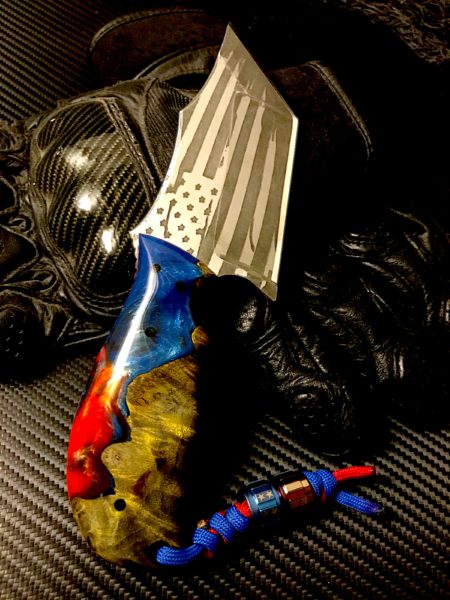
The Carnage by Black Widow Knifeworks & Tactical Gear sports patriotic resin with maple burl hybrid scales.
Model: The Carnage
Blade length: 4 inches
Blade Steel: CPM S30V
Blade Finish: acid/stonewashed with American flag etch on both sides
Scales: J Hue Customs’ hybrid red, white and blue resin with maple burl
Overall length: 8 inches
Maker’s list price: $320-$500 shipped with Kydex sheath and Tec-Lok
Contact: Message Brent Vaccaro on Facebook at Black Widow Knifeworks & Tactical Gear (Additional contacts at end of article.)

Props Never Steal The Scene

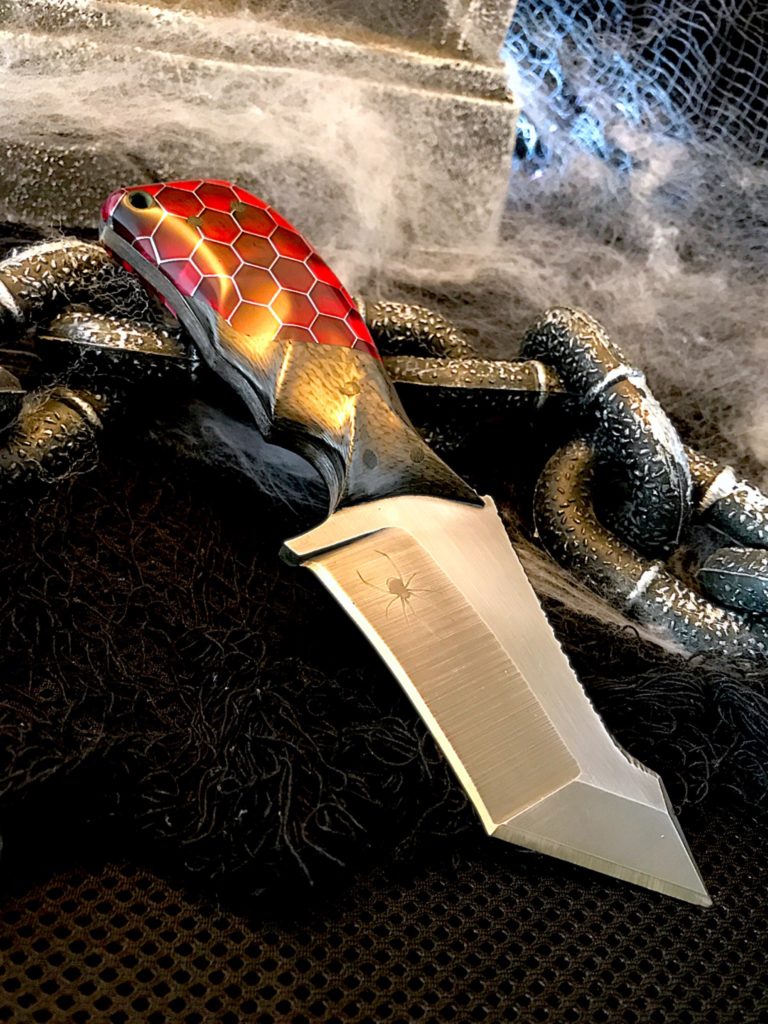
Brent uses all kinds of props in his still-lifes. Because he also produces tactical gear, like custom Kydex sheaths, you will often see pistols, ammunition and other gear as accessories in his pictures. Chain, motorcycle gloves, even Halloween webbing have been used in Black Widow images. His artistic eye is always at work, not only in the making of the knives, but in his ability to let the knives do the talking. They are always center stage. They are the first things you see in the picture and the props are there only to compliment the knives, never upstage them.

Editing

Brent uses two apps to edit his images: PicLab and Aviary. He bumps up the saturation until the image represents what you see in person. It’s important not to overdue saturation because then your customers will be disappointed that your knife doesn’t live up to how it was displayed online, all back-lit by the computer screen. It’s equally important, though, that the knife not appear duller than it is in real life.

Creating An Image

Brent is one of those men who is smart, learns quickly and follows directions. He is also a good man, turning away from an industry that couldn’t fulfill his creativity and abraded his integrity. He has been rewarded with great success. “I’m outgrowing my shop,” he said. Brent knows he’ll have to return to carpentry to build himself more space. He can’t believe it sometimes when he thinks how far he’s come in his year of knifemaking. Metal work comes easier to him. “I don’t get nearly as angry as I used to get doing carpentry,” he said. He’d be thinking artistically and make a little strip of wood for something and it would break. Sometimes he’ll find a scratch in a knife handle and he’ll have to go back and grind it out and re-sand—normally, he goes all the way from 150 to 2000 grit—but it’s not nearly as frustrating as woodworking had been.

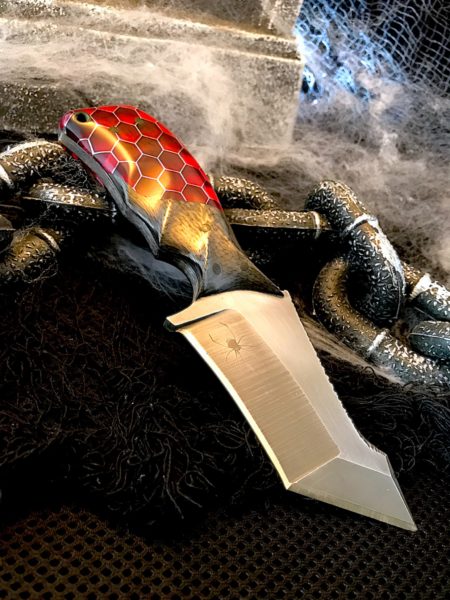
The Recurve Patella uses Voodoo Resin scales in Honeycomb Red.
Model: The Patella Recurve
Blade length: 4 inches
Blade Steel: CPM S30V
Blade Finish: acid wash
Scales: Voodoo Resins’ Red Honeycomb with KS Carbon bolsters
Overall length: 7.75 inches
Maker’s list price: $380-$500 with Kydex sheath and Tec-Lok
Contact: Message Brent Vaccaro on Facebook at Black Widow Knifeworks & Tactical Gear. (Additional contacts at bottom of article.)

Brent takes great pride when someone in the industry tells him they recognize his work right off. He has been an apt student of life. The years of entrepreneurship that didn’t work, prepared him for the one that would work. But no matter how much marketing you apply to your knifemaking, the knife must still cut. It must still hold up to wear and perform as expected upon arrival and for generations to come. Time will tell, but sometimes dues get paid behind the scenes and a meteoric rise is well-earned.

Meanwhile, Brent will have to break away for the birth of his first child, a son, Blake—due any day—and at some point, he’ll need to expand his shop, but he never closes his books for long. He doesn’t think it reflects well to just drop a knife. He refuses to do it. He respects reliability in the people he does business with, so he holds himself to that standard for his customers. Just get in touch, but be aware if you do, you’ll get caught up in the Black Widow web.

Contact: Brent E. Vaccaro by email at [email protected] or Message him on Facebook at Black Widow Knifeworks & Tactical Gear. He also has a website at www.blackwidowtac.com. If you need to call, Message first, otherwise he might not hear you over the machines, 908-328-2049.

It’s All In The Grind

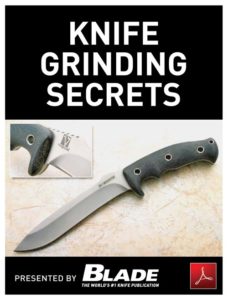
"Knife Grinding Secrets" is by maker and instructor R.J. Martin.
Mastering this one skill will improve your craft immensely. For less than $5, you can add an essential to your knifemaking library.

Author R.J. Martin instructs on flat and double hollow grinds. He discusses chisel grinds, tip shaping, the two-hand pass and lots more in “Knife Grinding Secrets.” Most importantly the finesse of grinding will be covered so that you can master the skill. Downloadable version availabe for $4.99.


Knife Ed 101: From the Periodic Table to the Rockwell Hardness Scale

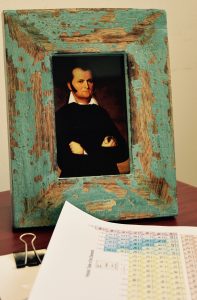
Jim Bowie scowls as I absorb the minutia of properly conveying knife specs.
Jim Bowie is not amused with my lack of knowledge about steel mixes.

Knowing what you don’t know sometimes means knowing when to stop researching and just play with your knife. In the course of more fully educating myself about knives, I find that everything, and I mean every little thing, involves further study. It can be paralyzing. And sometimes it needs to just get silly so I can stop worrying about it.

I’m in charge of maintaining the style sheet at BLADE, which is an alphabetical list of knife industry-specific terms and instructions—or exceptions to instructions—regarding how we present certain things in BLADE. We want to be consistent.

The other day my boss and BLADE editor, Steve Shackleford, sent me something like, “Just so you know… the V in MoV is always capitalized. For example, 8Cr13MoV: Cr refers to chromium, Mo refers to molybdenum and V refers to vanadium—all elements in the steel mix.”

Cool, I thought.

And then I thought: The periodic table of elements? Seriously?

For an English major with a history minor—even one into guns and knives—this concerned me. Oh sure, there’s science in the acids and bases of a batch of cookies in the oven, but I honestly never imagined printing out that chart after I left high school. But there it lies, adding color to the growing pile, its information so obvious in hindsight. Jim Bowie perpetually scowls with what I imagine can only be his disappointment in my slow pickup.

So, when Steve explained how BLADE presents Rockwell hardness: “the Rockwell hardness is 58-59 HRC,” I figured I should try to fit more about that topic into my rock hard head.

After work I called a friend.

His response: “What is the Rockwell hardness scale and what does it mean to me?”

Exactly, I replied.

And while we’re at it, I thought, aren’t “hard” and “tough” synonyms for the same thing, like soldiers or overcooked steak? (That’s a joke. You can read about the difference between hardness and toughness in Bernard Levine’s article, “Rockwell Hardness, What It Is And What It Means To Your Blades,” BLADE Magazine, Sept. 1997, Pages 74-76.)

And why can’t I close my Twitch II? Am I not pressing hard enough? Am I afraid of the release? (That’s not a joke, and no, the lock is not engaged.)

“I can envision both scenarios,” my friend said.

That’s how he talks.

We joke about cut-resistant gloves, only he’s not joking. I’m a klutz.

He explained something about measuring divots and my ears stopped up and my eyes glazed over. I have a hard time thinking in 3D.

But I had the power all along. In the archives of BLADE itself I found this helpful article: Bernard Levine’s article, “Rockwell Hardness, What It Is And What It Means To Your Blades,” BLADE Magazine, Sept. 1997, Pages 74-76

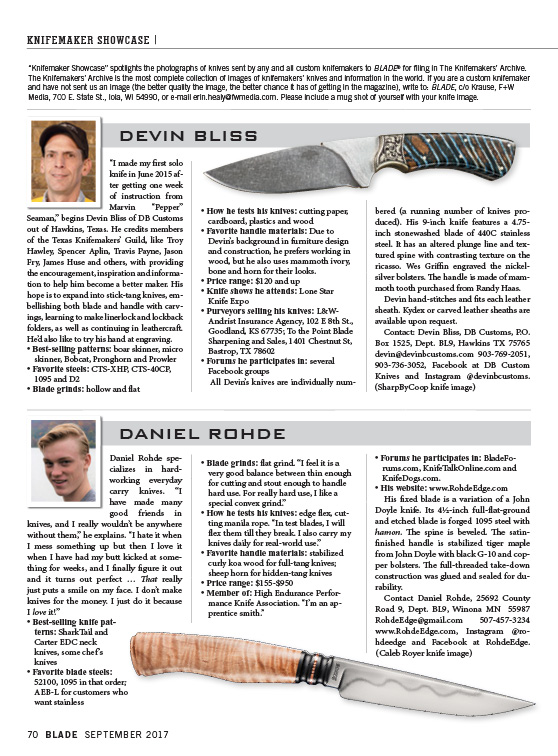
It all makes perfect sense. I think I can now move on to worrying about whether there’s a good mix of ATS-34, 440C, CPM S30V, CTS steels and 5160, O1, D2, 1095, L6 steels represented in our Knifemaker Showcase pieces.

Your Knifemaking Questions, Answered

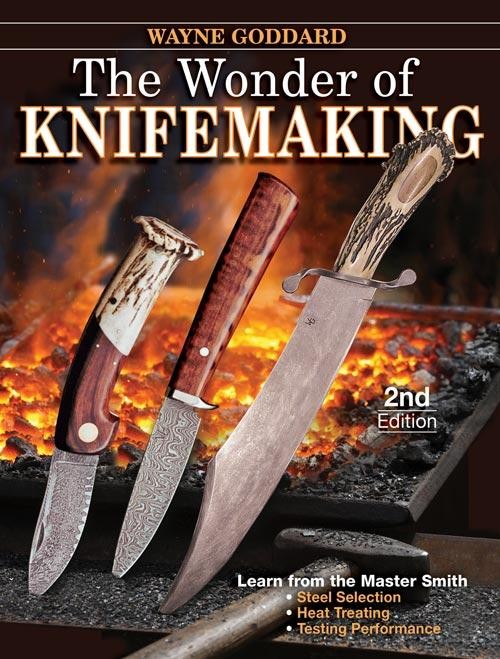
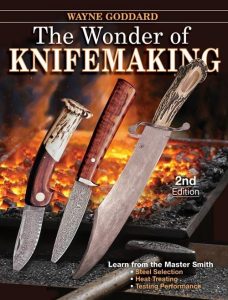
Knifemaking bookGet all your knifemaking questions answered in this collection of expert advise from former BLADE columnist Wayne Goddard. The Wonder of Knifemaking makes a thoughtful gift for someone interested in starting or perfecting their knifemaking skills


Midweek Maker Forged-Style: David McConnell

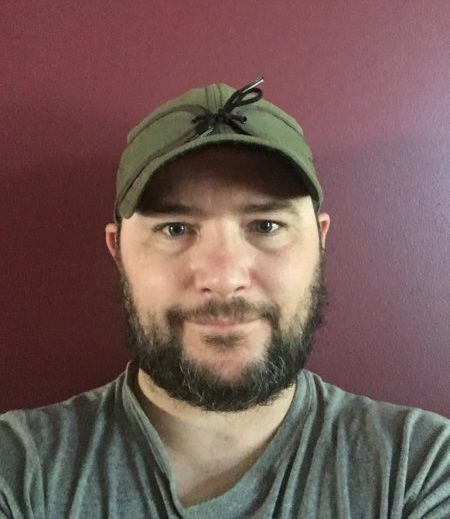
David McConnell is a stamping press repairman who hopes to convert to full-time bladesmithing soon. His first knife, was a cheap Wal-Mart special. Over the years he got frustrated with the lack of quality in such knives and began thinking about making his own. He knew he could make a better knife for himself, and he did. Only his buddy loved it so much that he bought it from him, David said, laughing.

North Woods Forge offers old-school styles of knives and tools.
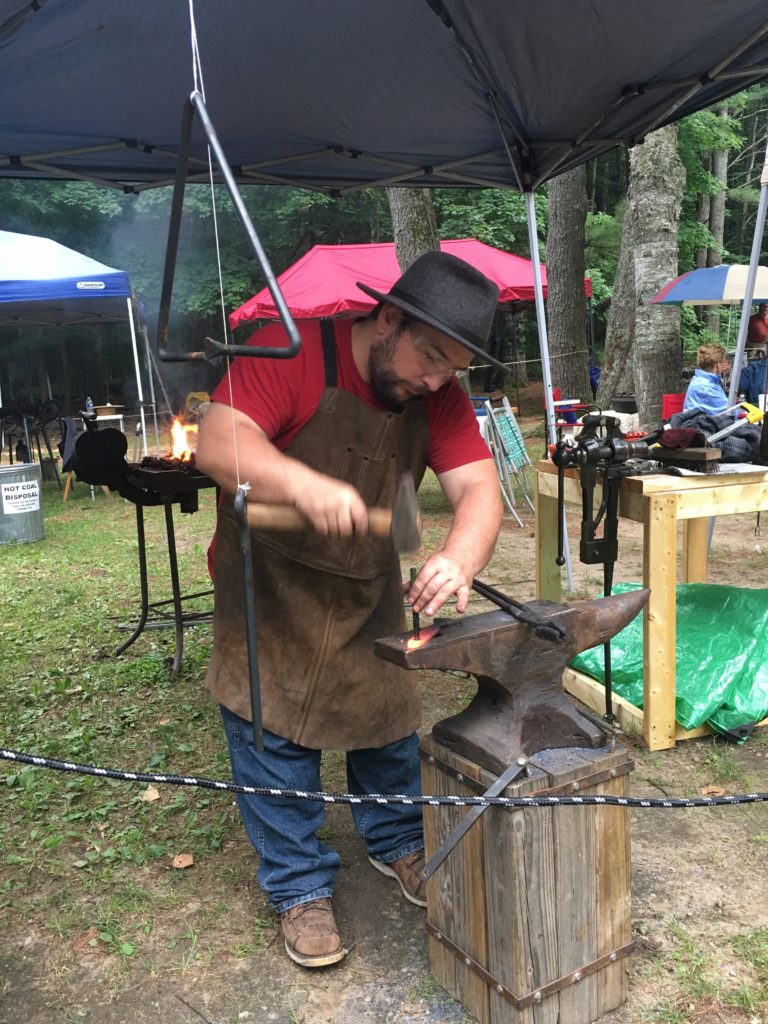
David McConnell of North Woods Forge in Michigan. He forges, preferring a primitive style, using natural materials..

The self-taught bladesmith has been making knives for 11 now, including tomahawks and axes. “I like to make hunting knives and more traditional stuff,” David noted.

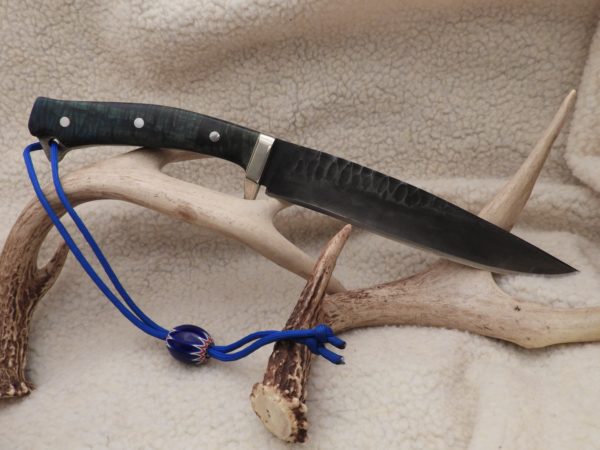
David McConnell of North Woods Forge used dyed and stabilize curly maple to make this bowie.
David McConnell made this bowie with an 8-inch blade of 1075 steel. The handle is blue-dyed and stabilized curly maple. Blue curly maple bowie. Guard is nickel silver. Overall length is 14 1/4 inches. Contacts listed at the bottom of this article.

He is an avid grouse and deer hunter, as well as and ice and fly fisherman. He lives in Kalkaska, Michigan, with his wife and 15-year-old son.

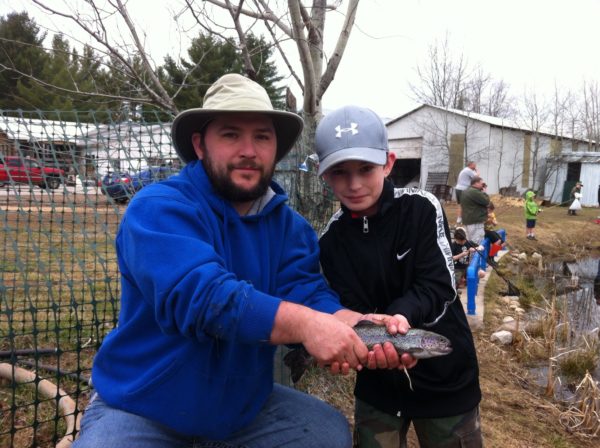
David McConnell of North Woods Forge helped his son Parker catch a trout at the National Trout Festival in Kalkaska, Michigan.
David McConnell started teaching his son Parker McConnell to fish early in life. The National Trout Festival, now in its 81st year, is held in April in Kalkaska, Michigan. Parker got this trout in the kid’s pond.
  • Best-selling knife patterns: 3 ½- to 4-inch-bladed bird-and-trout, 4- to 7-inch-bladed straight-back hunter, classic bowie
  • Favorite blade steels: W2 for hamon, toughness, ease of forging and grinding; 1075 for ease of forging and heat-treating
  • Blade grinds: flat ground, sometimes with appleseed edge
  • How he tests his knives: “If it can cut a nail and have no deformation or chipping and still stay shaving-sharp, I would have to say that’s a pretty good blade,” David commented.
  • Favorite handle materials: bone, wood, antler. “I just like the feel and warmth you get from natural materials.”
  • Price range: $85-$600
  • Knife shows he attends: local gun-and-knife shows and blacksmithing events
  • Member of: American Bladesmith Society
  • Forums he participates in: ABS
  • His website: www.northwoodsforge.com
David McConnell of North Woods Forge only forges his knives; he does not do stock-removal.
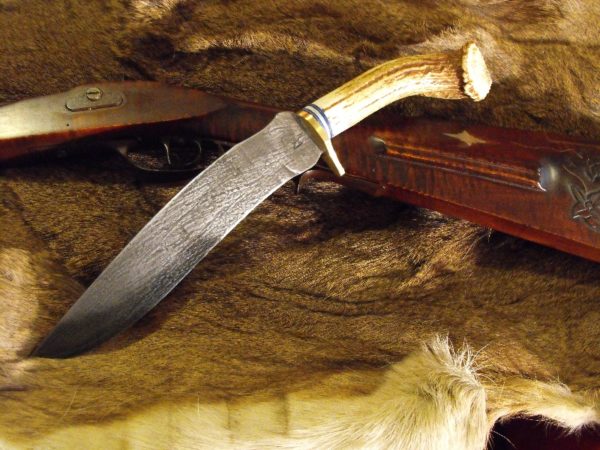
This 15-inch bowie has a 8 7/8-inch blade, flat-ground, appleseed-edged and forged from 1084 cable-patterned steel. The handle is made from axis deer crown antler with a brass guard and blue and white fiber spacers. Maker’s list price: $375.
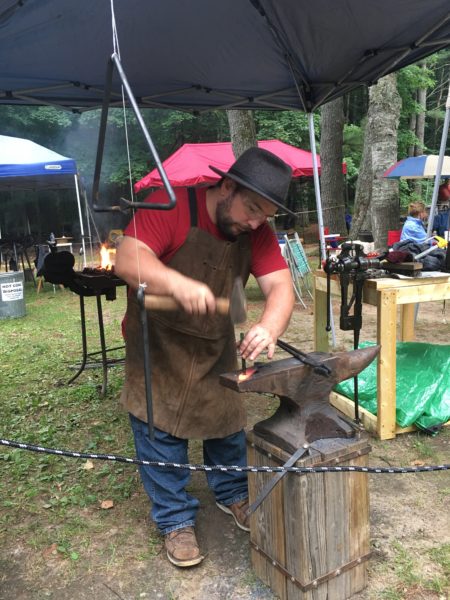
Black Iron Days takes place every August in Grayling, Michigan. David McConnell goes each year to help with bladesmithing demonstrations.
Bladesmith David McConnell puts on a forging demonstration at Black Iron Days at Hartwick Pines State Park in Grayling, Michigan. Every August blacksmiths from all over Michigan and a few from Ohio host demonstrations for the public for the whole weekend.
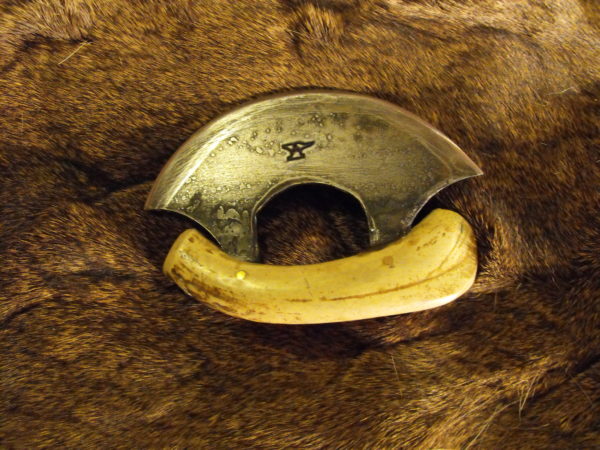
This ulu was forged by David McConnell of North Woods Forge.
North Woods Forge’s ulu has a 4 1/2-inch blade forged from 1095 steel. The handle is made from whitetail antler. David McConnell loves making primitive pieces and being an avid deer hunter, he often opts for antler material.

Contact David McConnell at 989-858-6344[email protected] or on Facebook at North Woods Forge.

A Digital Subscription To BLADE® Is The Answer

Save $4 off the print price of a annual subscription to BLADE Magazine with a digital subscription.
You can read your digital issues of BLADE Magazine anywhere you have your phone, tablet or computer, and there’s no need to find storage for all your old issues.

If piling-up issues of magazines seems like a waste to you… If you feel like you don’t have time to read a magazine… If you like the stories we offer in BLADE, but want a more economical option, then a digital subscription is the answer. An annual subscription to BLADE is $17.98, $4 off the print price.


Maker Continues Laplander Culture with Sami Knives

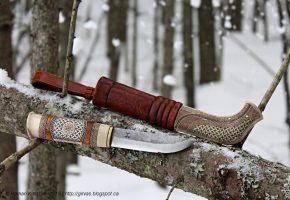
Roman Kislitsyn makes knives in Sami style. Sami people are native reindeer herders of northern Scandinavia.
This Roman Kislitsyn sheath is made in North Sami style with a pronounced hook, which interferes less when sitting. The 4-inch blade is made by Pasi Hurttila in 80CrV2 steel. The handle is reindeer antler and birch root burl.

Roman Kislitsyn grew up in Apatity in the Murmansk region of northwestern Russia. Close to Norway, parts of the area also include the lands of the Sami people (in the past referred to as Lapps or Laplanders) which traverse the Kola Peninsula of Russia, and the northern and coastal regions of Finland, Sweden and Norway. Roman and others in his family are geologists so he spent much of his childhood with outdoorsmen, hunters, fishermen and those expert at surviving in the Russian wilderness. Always an admirer of Finnish and Swedish knives, Roman was most drawn to the beauty of the knives made by the Sami, the native reindeer herders of Scandinavia.

Russian Roman Kislitsyn makes knives in the style of native Scandinavians.
Roman Kislitsyn makes Sami-style knives.

Roman’s exposure to knives and survival equipment, combined with a love of crafting things with his hands, led to his first attempt at knifemaking when he was 15 or 16. “It had a blade made of high-speed steel from a piece of mechanical saw, wooden handle made of birch burl, and simple leather sheath, but I was very proud of myself,” Roman related. He made a few more knives, left to attend university and life intervened. A few years ago, he returned to knifemaking and cannot stop.

The traditional Sami lifestyle depends on reindeer herding, hunting and fishing. Roman explained that the design of their knives developed over the course of hundreds of years. They also mastered their own style of decorating things made of reindeer antler. “I like to use Sami-style decoration on my knives too. Even though I’m not Sami, but this makes me feel my connection to the land where I grew up,” Roman stated.

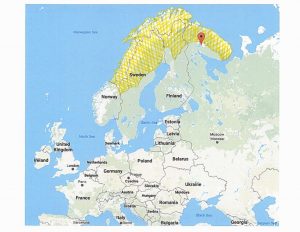
Native Scandinavians roamed the areas in yellow, approximated on this map.
Sami lands, in yellow, historically reached farther south, encompassing Roman’s home region, marked in orange.

Roman makes two types of knives, either Sami style or Finnish puukkos with Sami-style carvings. He does not make his own blades. Some Sami blacksmiths existed, but using blades made by other makers was, and still is, a common practice.

Roman works with high-carbon steel blades made by his friend Alessio Salsi in Belgium. Lately, he’s also being trying laminated and pattern-welded steels. Since Roman makes Scandinavian knives, the grinds are all Scandi. He used to employ blades made by Pasi Hurttila from Finland before Pasi stopped making knives. Roman also used blades made by Randal Graham in Nova Scotia. Randal took a hiatus from knifemaking but has now returned, and Roman hopes to resume collaborating with him.

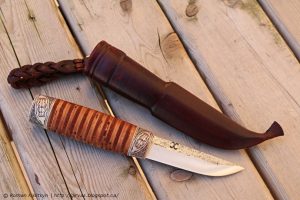
Roman Kislitsyn designed this knife with a stacked birch bard handle for feel and warmth..
Roman Kislitsyn put a stacked birch bark handle on this 3.2-inch Pasi-Hurttila-made 80CrV2 blade. Carvings on the antler are in Sami-style. Bark handles are popular for Finnish puukkos; they never get slippery or cold, even below freezing.

Roman is self-taught, learning everything about knifemaking and carving through the Internet, forums and social media. With the exception of light use of a hand-drill and a Dremel, Roman uses only hand tools. “No grinders, sanders, band saws, nothing. Only files and rasps, only hardcore!” he explains. Roman’s goal is to make “functional art,” as one of his customers put it, and not a knife that just sits on a shelf. His favorite handle materials are reindeer antler in combination with birch burl and-or bark, which are all traditional materials in Sami-style knives. Maker’s list price starts at $450 US.

Roman left Russia in 2002 and now lives in Nova Scotia, but you can converse with him through forums like British Blades, Canadianknifemaker.ca and the Russian forum zadi.ru. His website and blog are at Girvas. “Girvas is a name of a lake in same region where I’m from,” Roman added. It is the Russian pronounciation of the Sami word hirvas, meaning “reindeer stag.” You can visit Roman on Facebook at Roman Kislitsyn or on Instagram @roman.kislitsyn. You can e-mail him at [email protected].

 Get Your 2017 BLADE® Show Knife

Ken Onion and CRKT collaborated on the innovative Homefront knife.
The CRKT Homefront is the 2017 BLADE Show knife, and won last year’s Most Innovated Imported Design.

The CRKT Homefront is a Ken Onion-designed knife that won Most Innovative Imported Design at last year’s BLADE Show. The field-strip technology allows for easy cleaning anywhere, without tools. Get yours now for $70 and you’ll save 30% off this true collector’s item.


Advertisement

Must Read Articles

Read this before you make a knife

Knifemaking 101 – Read This Before You Make a Knife

  by Wayne Goddard My experience has taught me that there's nothing like digging in and getting started. I've often said the hardest part of the...
how to forge damascus steel

How to Forge Damascus

Advertisement
Advertisement