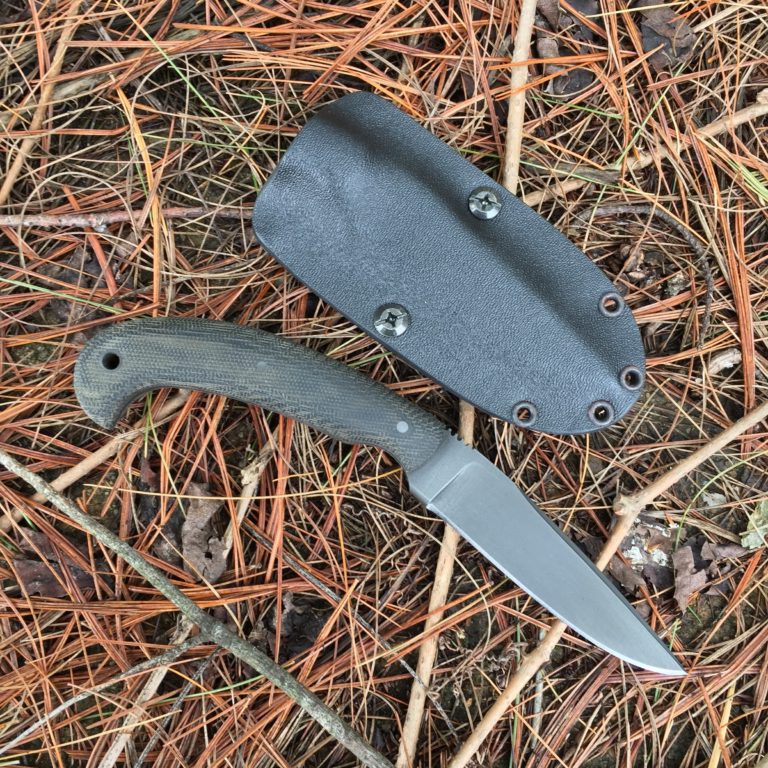
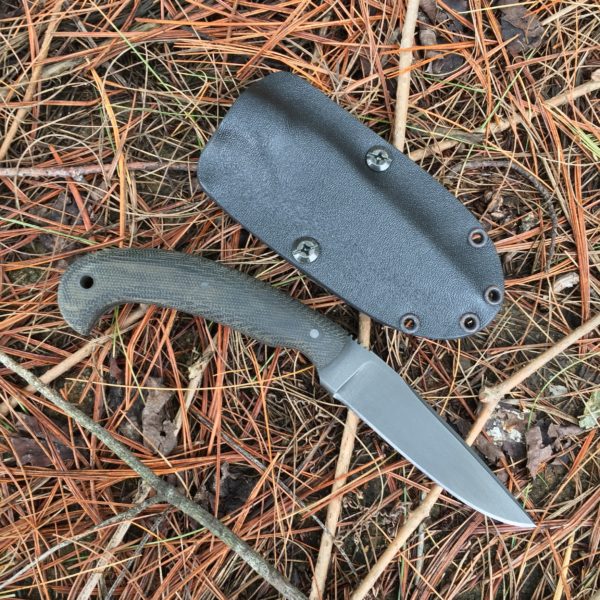
Contingency by Winkler II Knives is well designed for concealed carry. The sheath system offers a variety of carry options and the curved handle easily accommodates positive or 90-degree reverse grip. Contacts for Winkler II Knives are listed at the bottom of this article.
Contingency by Winkler Knives II is a concealable personal protection knife with a sheath system that allows for inside- or outside-the-waistband carry. (You’ll want to order a left-hand-draw sheath for right-hand IWB draw.) The 3 1/2-inch blade on Contingency is made of 80CrV2 steel and has thumb-grip gimping. The knife has a tapered, skeletonized tang and measures 7.625 inches overall.
The curved-handle design is well-suited for easy draw and positive grip or 90-degree reverse-grip positioning. It comes in your choice of walnut, maple or Black, Tan or Green Micarta. Rubber is available but is not recommended for concealed carry. The MSRP is $300. You can also order yours with sculpting, $15; sculpted WASP (air injection), $30; or sculpted multi-camo, $30.
Daniel Winkler’s Early Frontiersman Style
Daniel Winkler, along with wife and leather craftswoman, Karen Shook, started Winkler II Knives in 2016. Daniel’s ever-present love of early American history intensified when he started using black-powder weaponry to extend his hunting season. He added to his 18-century woodsman outfit by making powder horns and other accessories, and in 1975 he made his first knife. He was a member of The American Mountain Men and other historically strict reenactment groups, and began selling knives at gatherings, called rendezvous. The money he made allowed him to upgrade his car-wheel forge to a hand-cranked model. By 1988 he was making knives full time.
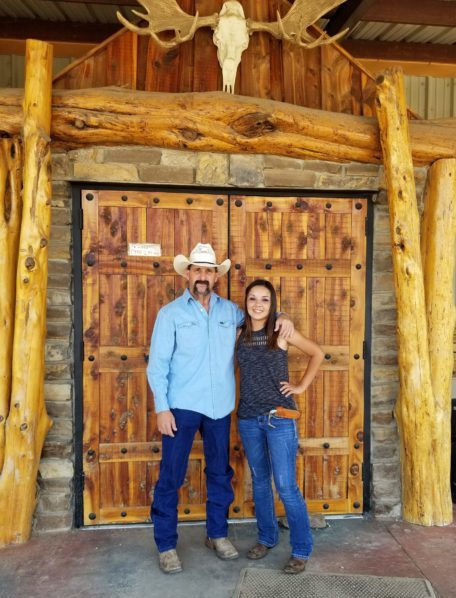
Daniel Winkler, co-owner of Winkler Knives II with his wife, Karen Shook, is based in Blowing Rock, North Carolina.
When he’d been at it for nearly two decades, he spent a few years entering cutting competitions. He says those experiences taught him more than he had learned in all the other years combined. Not only did he improve his knife-handling skills, he came to understand what made a knife perform in a wide variety of tests. Cutting competitions are timed events that involve a number of stations at which the maker and his knife must cut, say, a hanging rope, an upright straw, a row of water bottles, a cardboard tube, a pool noodle and then chop through a piece of lumber. The blade either cuts or it doesn’t.
Now he establishes the use of the knife before anything else, because no single knife can do all things well. He is honest about how knifemaking is always changing, sometimes advancing, sometimes failing.
In 1992 Daniel had the opportunity to make the knives and tomahawks used in the movie “The Last of the Mohicans.” His pieces also made appearances in 2012’s “Zero Dark Thirty.” It was his work on “Mohicans,” however, that would send him on the path to making knives and combat axes for today’s Special Operations personnel, while continuing to serve the hunter-outdoorsman community.
Contact Daniel Winkler, Winkler Knives II, P.O. Box 2166, Blowing Rock, NC 28605; 828-295-9156; [email protected]; www.winklerknives.com and on Facebook at Winkler Knives.
A Digital Subscription To BLADE Is The Answer
You can read your digital issues of BLADE Magazine anywhere you have your phone, tablet or computer, and there’s no need to find storage for all your old issues.
Save $4 off the print price of a annual subscription to BLADE Magazine with a digital subscription. If piling up issues of magazine seems like a waste for you… If you feel like you don’t have time to read a magazine… If you like the stories we offer in BLADE, but want a more economical option, then a digital subscription is the answer. An annual digital subscription to BLADE is $17.98.
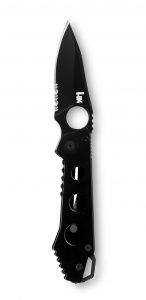
Photo courtesy of Benchmade Benchmade and H&K officially kicked off their collaboration 12 years ago with the 2004 release of the HK Pika.
Over a month ago Benchmade decision makers opted to immediately ramp down production of all Heckler & Koch (HK) knife lines, according to Benchmade Public Relations and Communications Manager Derrick Lau. Benchmade will concentrate efforts on its own brand of sports cutlery and edged tools.
The Oregon City designer and manufacturer notified knife dealers that although not official until Jan. 2, 2017, they would no longer make approximately 17 to 18 different models. Some supply remains, but is quickly dwindling. Dealers are encouraged to contact Benchmade if there are any HK knives they’d like to get before they are all gone.
The tactical design and affordability of HK knives attracted law enforcement officers. The knives include the Entourage, Patrol Axis, Ally, Turmoil, Dispatch, Plan D, Nitrous Blitz, MP5 and Epidemic families.
Benchmade designed and manufactured knives for other companies in the past, such as Harley-Davidson® and Bone Collector. Three years ago the company ended its collaboration with Lone Wolf to rededicate its efforts to Benchmade-branded knives. This is a continuation of that plan, Lau explained, adding it was a case of the company needing to “get our bearings back.”
The licensing agreement specified that Benchmade would design and manufacture the knives, and retain the use of any resulting innovations, while HK would lend its name and branding to the product. Such an arrangement can be a marketing boost for the manufacturer and provide a platform for creative innovation. Since automatics cannot be imported into the U.S., Lau explained, the German-based Heckler & Koch benefitted from the ability to get HK autos into the U.S. market through Benchmade.
“Our dealers are our most important asset,” Lau said. Dealer feedback indicated that the Benchmade brand is Benchmade’s most attractive selling point. After 30 years in the business, it was simply determined that Benchmade should refocus on its own brand.
Heckler & Koch does not have anything lined up in terms of continuing its knife brand, according to the company’s public relations spokesperson. “We’re a firearms company,” she reiterated, but “we like to offer our fans the accessories we know they want.” She added, “Benchmade did a great job of showing us there was a market for the knives.”
Benchmade would consult with HK officials on some designs they were considering, and HK would choose some for its web shop. Benchmade had the infrastructure in place for wider distribution.
In the future, Benchmade may be open to other collaborations, but for now the company is committed to growing its own line of knives. Some of the Benchmade knives in the works will have features inspired by the HK lines.
Benchmade did not issue an official press release because they wanted their dealers to know first, allow them time to ask questions, and provide any support they might need.
Steve Shackleford, BLADE® editor, contributed to this article
ShopBLADE is offering a not-to-be-missed package for “Knives” readers. You get the 2016 and 2017 paperback issues of “Knives,” a $67.98 value. Plus you get a digital download for the 2004-2015 editions, an $79.99 value. Your cost: $59.99, a savings of $87.98. Hurry!
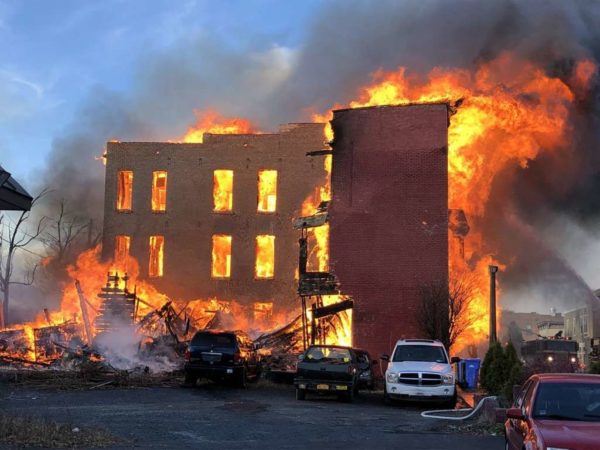
John Gomes, the 51-year-old Cohoes, New York, resident and alleged “amateur knifemaker” who started a fire that damaged 32 buildings and displaced approximately 20 people, will not appear in court today as scheduled. He was charged with felony reckless endangerment and misdemeanor arson on Friday, Dec. 1 while the 200 block of Remsen Street smoldered, threatening to reignite. Gomes’ case has been waived to Albany County Court to be presented to a grand jury. In a report by the Times Union of Albany, New York—which has followed the story closely—Gomes lawyer has stated that his client is a hard-working plumber, the father of two children and this was a tragic accident, not a crime. Reaction from knifemakers on social media was swift and nearly unanimous: Gomes’ did not do his research, about forges or metal working, and his claim of trying to replicate something he saw on “Forged In Fire” was a deflection from his own lack of forethought. One maker from Upstate New York theorized that it could have been simply a trash fire to avoid disposal charges, but that claiming to be working steel was a better story than a flagrant violation of the law. Was Forged In Fire a scapegoat for the Cohoes fire?
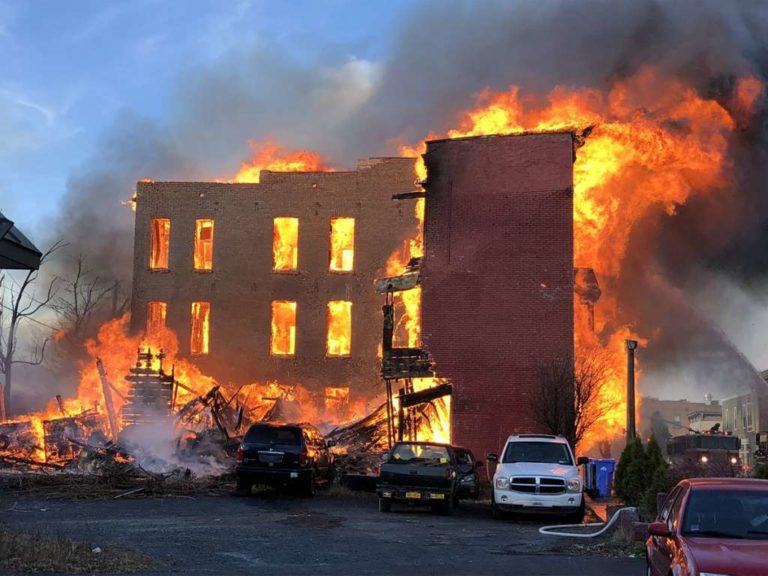
John Gomes, a resident of Cohoes, New York, started a fire in an open barrel in his back yard. Reports say he was attempting to bend a knife, as he had seen done on “Forged In Fire.” But was “Forged In Fire” a scapegoat? (Times Union photo)
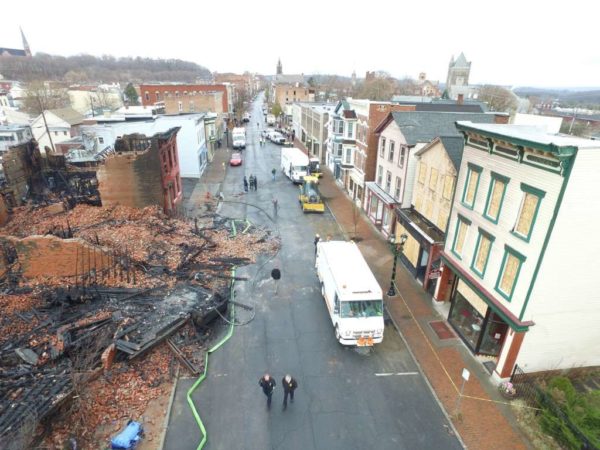
On Friday, December 1, knifemakers awoke to the cringeworthy news that Gomes had started an open barrel fire in his back yard to “bend” metal as he had seen done on “Forged In Fire.” It was a relief that nobody was killed in the fire. One fireman was treated for dehydration and heat-related issues and the fire chief received a burn from a flying ember, but other than that nobody was injured. By last count, 32 buildings were damaged by fire, smoke or water, resulting in millions of dollars’ worth of property damage. Approximately 20 to 25 people were displaced, but Red Cross representatives were on sight to meet the immediate needs of both emergency response personnel and to provide shelter, food and clothing to those whose houses had burned. Cohoes is a quiet commuter city about 18 miles north of Albany. The houses in the affected area are wooden and within inches of each other. The 30-mile-an-hour winds on November 30, made it challenging for the firefighters to stay ahead of the blaze.
Cohoes is an old mill town that is no stranger to fires. In 1978 a man and his seven children were killed in a fire suspected of being set by the sole survivor, the wife and mother. After new evidence surfaced in 2010 Virginia Grotto did sign a confession, but then claimed she was badgered to do so. Another Cohoes fire in 1988, destroyed nine buildings, including three businesses. That fire also affected Remsen Street. The cause remains a mystery with some neighbors claiming at the time it was a Hells Angels motorcycle gang act of revenge against someone living in the apartment building where the fire started and others claiming to have seen two boys playing with matches. All other causes were ruled out. In both cases, Cohoes rebuilt. One added note to the most recent fire was that this area of Cohoes was enjoying a resurgence. Both the current mayor and interviewed business owners commented on the city’s resilience and they would rebuild. A florist was able to resume work the next day despite building damage, and a pharmacy owner lost a storage garage that contained chair lifts that had been ordered for Christmas, backup inventory and old medical records, but his store was open for business.
The 30-mph winds made getting ahead of the fire a challenge. In the end 32 buildings were damaged and approximately 20 people displaced. (Times Union photo)
John Gomes’ son defended his father on social media, claiming that he never meant to burn down his own house or anyone else’s. Commenters offered words of encouragement for the boy and prayers for his family. On knifemaker Groups on Facebook like Forged In Fire TV Show Discussion Group!!!! and my own Erin at BLADE, it was unanimous that “Forged In Fire” was not to blame. There were jokes about the blade not making the cut, or the reverse, it being able to wipe out a city block. There was mention that “Forged In Fire” now does include a warning that forging is dangerous and not to be attempted without careful consideration of safety measures. Of course, one popular comment on Facebook was simply a picture of a fire extinguisher.
John Gomes, according to statements made by his lawyer to the media, never intended for his open barrel fire to cause damage to his own house or anyone else’s. He’s been charged with felony reckless endangerment and misdemeanor arson. (Times Union photo)
Concern was expressed, though, by more than one commenter on more than one thread that “Forged In Fire” seems to play up the fireball created during quenching. It is a television show and the quenching drama makes for good entertainment. However, the “Forged In Fire” set is actually fireproof. It is vented to prevent asphyxiation, but not in the way a home forger might vent his forge. This is why it is often unbearably hot on the set, causing heat exhaustion in some participants. And, of course, there are crewmembers standing by with extinguishers, ready to cut the electricity or provide medical attention as needed. There have been instances in the final round when participants are at their home forges of fireballs being too close to propane tanks and the like. Although show representatives expressed sadness over the fire in Cohoes, they reserved comment, according to Times Union reports.
One of the most intriguing comments was posted by a resident bladesmith of Upstate New York. “I think he was burning trash, which is illegal in most municipalities in New York State, so he would not have to pay for disposal,” theorized F. Page Steinhardt, of Sunshadow Design and “Forged In Fire” winner. He added, “In an open burn barrel, which is illegal in most municipalities in New York State in a 30-mile-per-hour wind, which is a dumb idea, and ‘Forged In Fire’ was a convenient scapegoat.” Page reiterated that he didn’t know for sure the exact motivation for the fire, and perhaps we will never know exactly what happened. “But that is just my opinion from reading the stories and living in Upstate New York,” he concluded.
Matthew Parkinson of Dragon’s Breath Forge in Connecticut and another “Forged In Fire” winner brought up another good point. “FIF isn’t responsible for someone who can’t think ahead. I mean, they show giant fireballs all the time, so it isn’t like you could even claim they make it look safe.” Matt also offered guidance to those just starting out. “As far as new smiths, take a class. Find a good school and take a class. It will be the best money you ever spend.”
A Digital Subscription To BLADE Is The Answer
You can read your digital issues of BLADE Magazine anywhere you have your phone, tablet or computer, and there’s no need to find storage for all your old issues.
If piling-up issues of magazines seems like a waste to you… If you feel like you don’t have time to read a magazine… If you like the stories we offer in BLADE, but want a more economical option, then a digital subscription is the answer. An annual subscription to BLADE is $17.98, $4 off the print price
Creek Stewart uses his survival knowledge, and a few good knifes, to tell a rockling adventure story, with a good romance interwoven throughout.
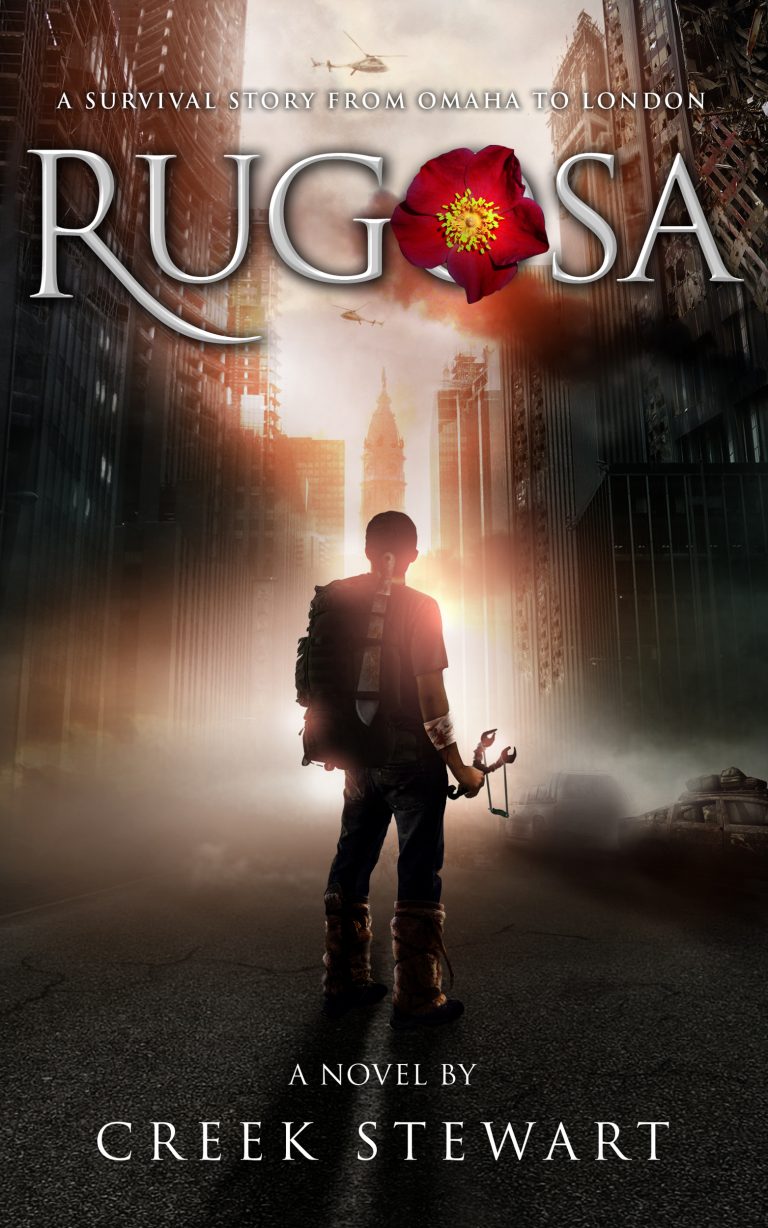
Valentine’s Day saw the release of survivalist and Whiskey Knives co-collaborator Creek Stewart’s young-adult romance novel, “Rugosa.” What knife enthusiasts will appreciate about this adventure is that by page 4 a machete crafted from a lawn-mower blade has made an appearance, and many others follow.
In the dystopian world of post-globalization America, 17-year-old Omaha Hoyt must leave the farm and woods were he is most at ease and travel to the city to rescue his love. The plan is to stay on back roads and subsist off his trapping and foraging skills. Very quickly plans change and the lifelong Boy Scout is forced to help someone he meets along the way.
Omaha’s pocketknife gets lots of use, and his sister makes a survival girl’s dream barrette that is shaped like a butterfly with cutting edges, a fishing line wrap with hooks for antennae, and is apparently weighted for easy throwing as a weapon. In what one might consider the equivalent of a gun getting reloaded in a movie, in the book there is actually a knife-sharpening scene.
This is not to say that “Rugosa” is knife heavy. It’s first and foremost a survival story about a 17-year-old who uses his scout training to survive physical and emotional challenges. But knives are more than an essential tool in this book. They each have a story behind them. Even the knife used against the protagonist is rich in lore.
“Rugosa” is also equal part love story. An author must possess the emotional intelligence to remember what it was like to be 17 and be able to convey what’s going on in the heart of a young man before that youth necessarily understands his own emotions, never mind knows how to convey them. It’s hard not to come across as a mature adult when writing from the perspective of a teen, but Creek creates a believable character. You can read more about the wilderness survival instructor and knife co-collaborator at “Survivalist Creek’s Life Led Naturally to Whiskey Knives.”
The book’s opening is slightly choppy, but only because editors now demand action begin in the fist paragraph. The beginning describes the farm and woods where Omaha lives with his mother and sister and the secret storage bunker he keeps hidden by “Rugosa.” It’s relaxed reading and idyllic, but once Omaha departs on his mission, the excitement is ramped up and the pace is non-stop. It’s easily read in a day or two.
You can get the paperback edition of “Rugosa” for $14.99 and the Kindle version for $3.99 through Amazon. Young-adult novels are one of the healthiest segments of publishing, probably because they’re fun for adults to read as well.
If you’d like to learn more about how Creek collaborated with Hank Gevedon of Reptile Toolworks to create Whiskey Knives, the bushcrafters that look like they stepped out of a 1700s mountain man’s kit, be sure to pick up the June 2017 edition of BLADE Magazine.
And yes, Creek is working on a follow-up novel to “Rugosa.” It takes place during the same timeframe but is told from the perspective of Omaha’s love interest, London, while she struggles to survive during the hostile takeover of Philadelphia.
Build a bug-out bag for your next adventure
Follow Creek’s instructions for putting together your emergency kit and you’ll have least a fighting chance of surviving.
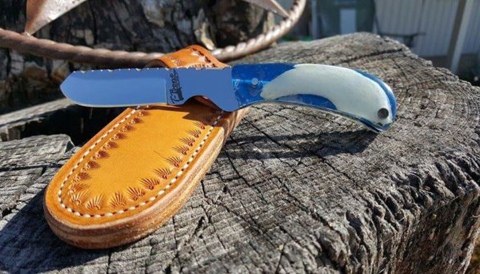
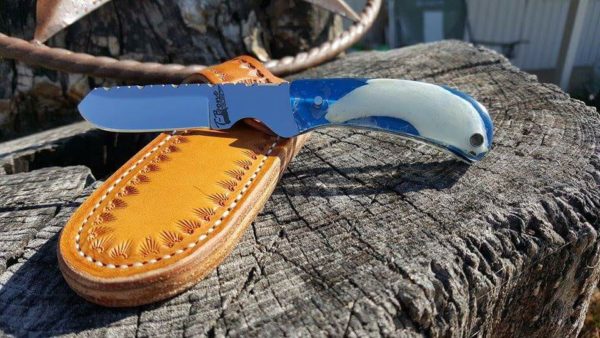
Travis Payne of T-Bone’s Custom Creations was hesitant at first, but when Kelly Pilcher asked, he made a knife with her rib. The overall length on this spey knife is 6.75 with a 2.5-inch cutting edge.
Kelly Pilcher of Collinsville, Texas, was 20 years old when doctors told her that hope of regaining feeling in her right side lay in having her first rib removed. She put the surgery off for as long as she could, but at 22 opted to go under the knife to alleviate her thoracic outlet syndrome. During surgery preparations Kelly asked, “‘What happens to body parts that come out of people?’” She was told that they were disposed of properly, but that if she wanted to take her rib home with her, she could. It was hers. She was adamant that she wanted to keep it. When she awoke from surgery, her dad was there and he had an idea of what to do with the bone. Shane Pilcher works at the New Gainesville Livestock Auction barn and when someone had mentioned making a knife with the rib, they knew just who to ask. Travis Payne, of T-Bones Custom Creations in Telephone, Texas, makes castration knives so all the cattlemen knew he could fashion a knife made from her rib. “Let’s do it!” Kelly remembers saying.
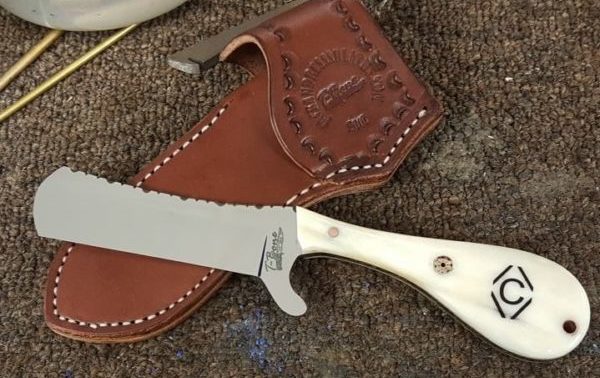
Travis Payne is renowned for his castration knife design. It is often copied by manufacturers using low-grade steel. Look for the T-Bone’s makers mark to ensure you’re getting the real thing.
TOS is a condition in which the surrounding soft tissue constricts nerves and blood vessels between the collar bone and first rib. Normally it is something diagnosed in people in their 40s to 60s, more commonly women, or perhaps mail carriers who consistently carry a heavy bag on their shoulder. Kelly was diagnosed when she was 14. It is believed in her case that years of catching slow-pitch softball as well as playing volleyball may have constituted the kind of overuse usually only seen in older patients.
By 17 Kelly had undergone a year of physical therapy. Although the therapy improved the symptoms of her TOS, it did not eliminate them. She went for an additional course of physical therapy a couple of years later, but the results were not as good. Her condition continued to worsen. “It’s different in each person,” she explained. She endured numbness that started in her arm, but then advanced to her whole side. Although she learned how to teach her body to move when numb, she was left with few options if she wanted to become fully functioning again. She decided to have her rib removed.
Shane Pilcher wasn’t sure about his daughter Kelly’s plan to keep her rib, but the cattlemen at the livestock sale barn convinced him that a knife might be the perfect solution. “I don’t leave home without it,” Kelly said of the knife Travis Payne fashioned from her first rib.
Shane had been at the livestock sale barn and was expressing some hesitation about Kelly’s decision to keep her rib. Someone pointed out that knives are made with animal bone and antler all the time, why not a human bone? “‘And doesn’t T-Bone make a knife?’” Travis said, recreating how the conversation may have gone at the barn. Since 1993 when Travis was still in high school he’d been making knives. His father and brother work the ranch where he lives in Telephone, Texas, but he makes knives full time. He is renowned for a style of castration knife that is frequently copied, most annoyingly by manufacturers using cheap steel. Since Travis’ father-in-law frequents the same sale barn where Shane works and the barn owner had purchased several of Travis’ knives and many of the cattlemen owned his knives, he was the first knifemaker that came to mind. Shane warmed to this idea and presented it to Kelly in the recovery room.
Travis Payne was nervous about slicing Kelly McGuire’s removed rib. What if it broke?
Like everyone involved in the project—except Kelly—Travis was hesitant, but he agreed to make the knife. He decided on his 3100T everyday carry model, a spey in cowboy parlance, usually the second blade on an old-school slipjoint trapper. Only this would be a fixed version. “It came to me in a hospital specimen jar,” Travis said, taking a drag on his cigarette and waiting for the laughter. “With the meat still on it.”
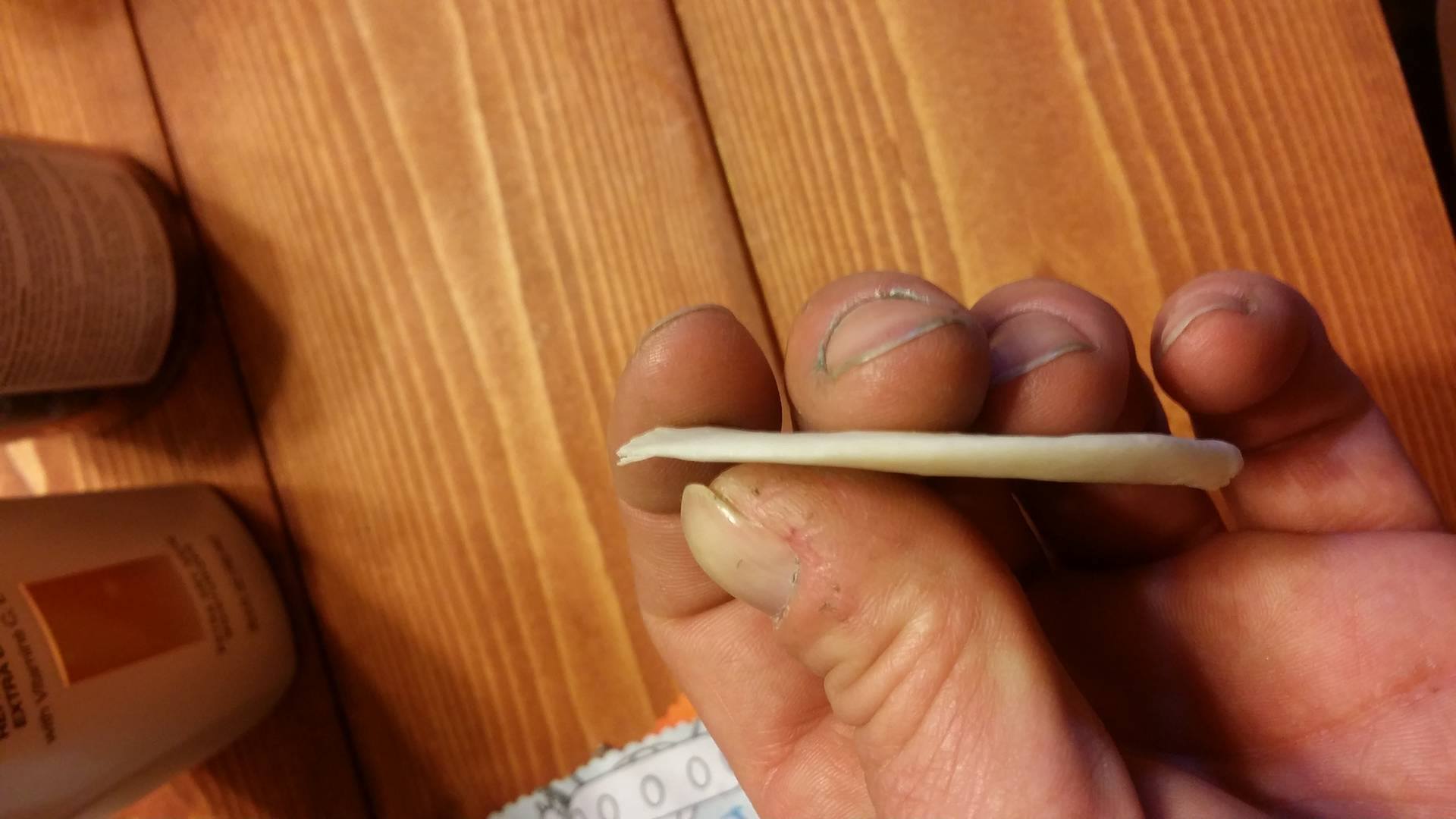
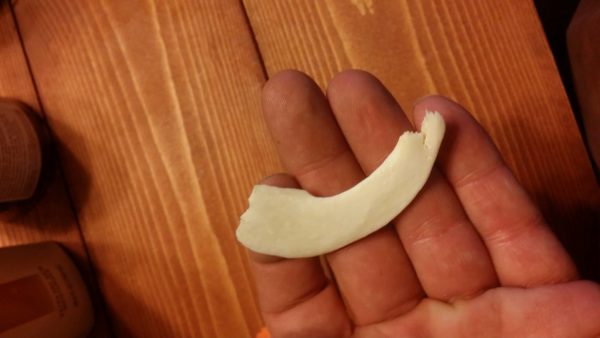
He approached the project like he would any deer skull. “Only I knew I wasn’t going to be using my wife’s cook pot,” Travis said, laughing. He bought a throw-away pot and boiled the bone to get off any connective tissue. Although bleaching a bone works, it also can break the bone down. Travis soaked the 3-inch bone in hydrogen peroxide for a week. The same whitening was achieved without compromising the strength of the bone. Then he let it dry for several months, providing a convenient delaying excuse. The bone was very thin, only an 1/8-inch at its widest point. Travis feared breaking it.
Once the rib was clean and dry, knifemaker Travis Payne was able to see its true size. It would need to be cast in resin if it was going to be used as a knife handle.
“I had to regroup and talk to Kelly,” he said. She remembers the call. He explained to her that the bone was too small and thin to make a handle out of, but that he could arrange for it to be cast in resin. Only he would need to slice it down the middle to have bone on each side of the handle. He could break it in the process. “I told him to go for it,” Kelly said.
“Anyone who knows me, will tell you that I procrastinate,” Travis said. He continued to analyze the problem. Meanwhile, he needed to find someone who would cast a human rib. Travis figured if anyone would do it, it would be Robert Belcher of Mental Co. Robert eschews phones and social contact, but his resins like Plantstone are innovative. “‘No, but hell no. I can’t be touching that,’” Travis recalled him saying. Travis moved on and got similar responses, but at least there was no point cutting the rib if he didn’t have someone lined up. Finally, he took the rib to a show and unwrapped it for Pat Ankrom, of Ankrom Exotics in Centerville, Iowa, specializing in natural and cast scale materials. “Pat was like, ‘I’m leery, but I also think it’s kind of cool,’” Travis said. The men discussed the casting, and Pat agreed to do the job. Pat did not want something to happen to the bone in the process of packing up from the show, so Travis said he would mail the rib to him.
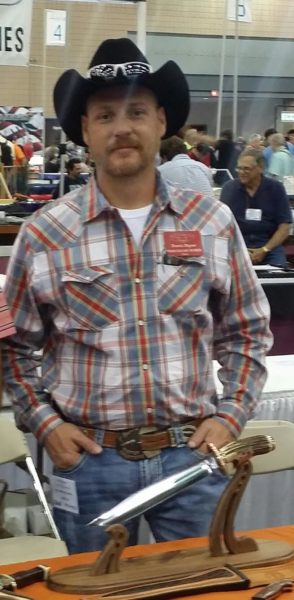
Travis Payne, 41, started making knives in high school before everyone had access to the Internet. He’s been a knifemaker for 20 years.
Now Travis had no choice but to cut the bone, but it was a nerve-wracking proposition. Travis wasn’t about to charge a young woman who didn’t have a lot of money and who had a debilitating condition more than the $200 he normally charged for such a knife, but in hindsight the cost to attempt something like this again would be closer to $500, Travis said. Kelly, of course, was excited to both see the knife and to have her rib back in her possession, so periodically she’d call for a status update. Finally, Travis got his courage up and sat down with a jeweler’s saw. “Even with a jeweler’s saw it was a tedious process,” he said. The whole project was “intense,” he said, laughing.
The two halves were packaged up and shipped to Pat, an exercise in trust in itself. Meanwhile, the blade awaited. It was made out of PSF27, a powered version of D2 that allowed for a true mirror finish. The lack of a point on a spey design means it’s ideal for active cattlemen, ensuring nobody stabs themselves or punctures a sheath. It has a hollow grind, and a finger groove for more controlled cutting. The file work on the spine increases a sure grip in what can be wet or messy work.
The bone was cast in clear resin so you could see it, but so that you couldn’t see the full tang Travis consulted with Kelly about colors. She was open to a turquoise or blue. Travis added a blue liner, which casts the clear with a blue tone. The knife was then sent to Jack Andress, who made a sheath in a yellow leather, complimenting the blue perfectly.
How’d it come out? “I love it,” Kelly declared. Shane and Kelly came together to pick up the knife from Travis. Kelly said that she’d had that rib her whole life and she saw no reason why she shouldn’t have it with her for the rest of her life. She carries it everywhere, either on her person or in her vehicle. Although she does use it, she tries not to. Her surgery was a success, and feeling has mostly returned. There is no cure for the many variations of TOS and symptoms can return, however, Kelly’s pluck and resolve are ever-present. “I can’t complain,” she said.
Which Knife Designs Work?
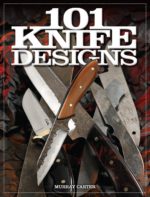
Do you want some fresh inspiration for your knife designs? The best inspiration is to look at the designs that have lasted and learn why.
“101 Knife Designs” gives you 101 scaled patterns that you can use to design your own knives. Learn how to compare patterns and understand how some designs survive the test of time. If you’ve enjoyed Murray Carter’s other writings, you will be sure to enjoy this one. On sale now for $19.53.