Home The BLADE Blogs Mightier than the Sword w/Erin Healy

Mightier than the Sword w/Erin Healy

Browning launches Wihongi line of Maori-inspired knives

Browning has launched the Jared Wihongi line for 2017.
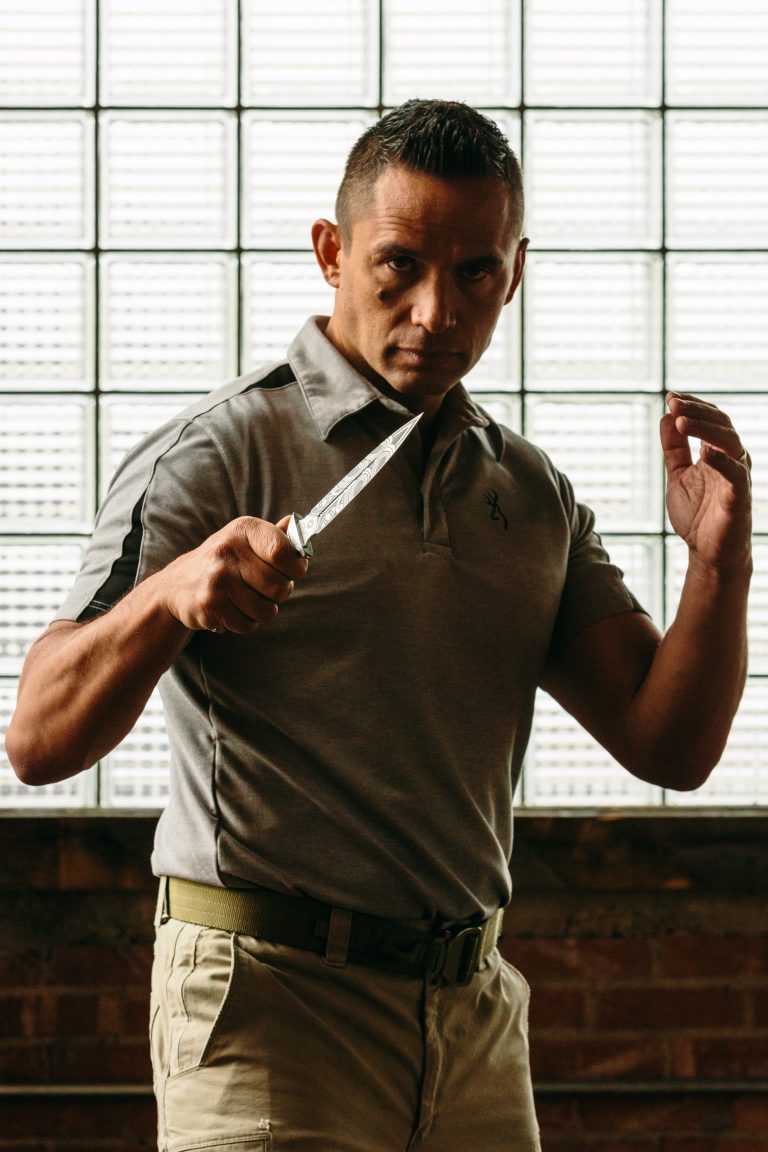
Together with Browning, tactical knife fighting instructor Jared Wihongi has released a signature knife line.

Jared Wihongi’s life and career is built on the warrior spirit of his Maori ancestors. He has practiced martial arts since he was a 10-year-old living in New Zealand, and the Filipino style of knife fighting, since he was 20, some 20-plus years ago. He also has his own signature line of edged weapons through Browning, knives that he hopes inspires “the warrior spirit that lives in each of us.”

Jared has reached the tuhon or master level of Pekiti Tirsia Kali and instructs police officers and elite military operatives in what he calls close quarter force integration tactics, or CQ-FIT. He applies the circular arm movements, the footwork, angling and distance control of Pekiti Tirsia Kali, using empty hands, sticks, knives and even guns, to reality-based training so that police officers are better able to subdue threats, or a special forces member is able to eliminate enemies in close-quarter combat.

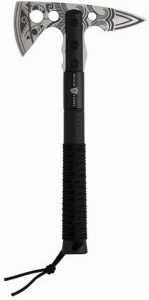
One of Jared’s most interesting-to-watch training sessions involves using a tomahawk in close-quarter fighting. Essentially, the circling motions, overhand and underhand, forward and backhand, are coordinated for attacking your opponent while simultaneously avoiding his advances. The tactical tomahawk in the Wihongi Signature Series is a true straight-handled tomahawk. The blade is made from ¼-inch 420 stainless steel, and the spike end includes a semi-sharpened blade. Three lightening holes are drilled into the blade, maintaining the integrity of the head while removing material to lighten the weapon, making it easier to wield in a fight—or to be fast as lightning.
Jared Wihongi uses tomahawks in his training, choking up on the handle for close-quarter combat.
The Jared Wihongi Signature Series Tomahawk includes acid-etched motifs from the Maori warrior culture.

The forked tang is secured with three flush-mounted screws but is also reinforced by a wide metal ring surrounding the handle. The Wihongi Signature Series Tomahawk carries Browning’s Black Label tactical line logo, along with the familiar Buckmark. The handle is wrapped in paracord, a lighter weight than 550 to eliminating bulkiness, Jared explained.

What is most notable about the weapon is the Maori tribal motif acid-etched into the steel. The warrior culture often carved facial features into wooden taiaha, or fighting staffs. These weapons would include eyes and ornate details that culminated in the familiar out-stuck tongue. Having these designs in a tattoo or engraved on a weapon meant that the warrior was carrying the strength and courage of his ancestors with him into battle.

Jared’s mother hailed from the Lone Star State, but being Mormon she decided to move to Utah. Jared’s father, living in New Zealand, attended a private school run by the Church of Jesus Christ of Latter-Day Saints. He excelled and was granted a scholarship to attend a university, also in Utah. The rest is history. By the time Jared was 1, the couple had returned to New Zealand, raising a brood of six.

Although native New Zealanders only make up 15 percent of the country’s population, the Wihongis lived in a small town that was predominantly Maori. Having grown up the late 1950s when there was little opportunity for Maori youths other than to become farmers, Jared’s father put great importance on education and became a school principal. Two of his sons followed in his footsteps, but Jared and another brother became police officers, with Jared going on to become a SWAT operator for 14 years and counting. He now teaches knife-fighting skills to SWAT teams and elite special forces in the U.S. and allied countries. “I’m an educator too,” Jared said, just in the warrior arts and lifestyle.

Jared Wihongi reviews his tomahawk fighting tactics.

Jared’s father died at a young age and when Jared was 17, the family moved back to the Salt Lake City area. Mormons are expected to go on a two-year mission before attending college. Jared served in the Philippines, which is where he began training in the Filipino knife-fighting arts. He attended college in Hawaii, where he worked as a bouncer, often having to apply his skills in a real-world application. He then returned to the Salt Lake City area and has advanced exponentially in his martial arts practice and his real-world curriculum, which  incorporates both the warrior spirit of his Maori ancestors and the premier knife-fighting skills of the Filipinos.

He recommends that anyone who wants to be able to defend themselves against a knife attack seek out a Pekiti Tirsia Kali instructor who offers real-world-scenario training. “Take a sample class,” Jared suggested. “You’ll be able to tell.” Learning to defend yourself against a knife attack is part of learning how to wield a knife in close proximity. Amazingly, this can be done with a tomahawk by choking up on your grip to right under the head. Don’t worry, practice is conducted with training knives. “But you have to make contact to understand knife fighting,” Jared explained

“When I presented this line to the sales force, I asked Jared to lead a haka dance,” said Diane Carver, knife and light product manager at Browning. The feedback she received was intense. Some had never seen the Maori warrior dance that has now been made popular by the New Zealand rugby team and others on social media. Some were inspired to see it live. “I’m so excited about this line,” Diane said.

Jared Wihongi introduces his signature knife line−and leads a haka.

If you’d like to read more about Jared and the four styles of knives in the Jared Wihongi Signature Series by Browning, be sure to pick up the July issue of BLADE® magazine or subscribe.

Secrets to making your own tomahawk
"Benchmade Tomahawk Secrets" is avaialbe in digital format for $4.99.
If you’ve ever wanted to try making your own tomahawk, this digital download will provide answers to your questions.

This digital download is an economical way to learn how to select and forge your tomahawk billet, how to drill and fill the eye hole, how to fit the haft to the head and grind it to rough shape. At only $4.99 this volume by BLADE field editor and ABS master smith Joe Szilaski is a fun and needed addition to your weapon-making library.
Save

Save

Midweek Maker Military-Style: Allan Reid

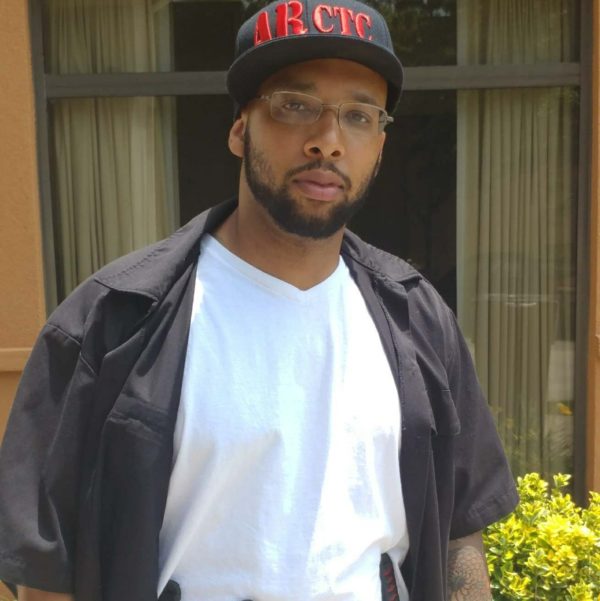
Allan Reid is the talent behind ARctc Knives.
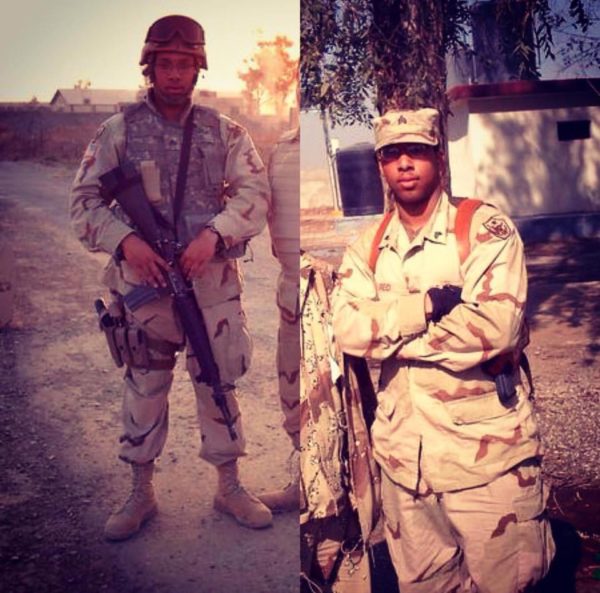
Allan Reid of Allan Reid Cut Throat Custom Knives is a part-time knifemaker who is a nurse by trade. He served in the U.S. Army. as a combat medic, obtaining the rank of sergeant.

Allan Reid of ARctc Knives, which stands for Allan Reid of Cut Throat Custom Knives, is a part-time maker who currently works as a nurse. He served for six years as a U.S. Army combat medic, achieving the rank of sergeant. In 2005-2006 he deployed on Operation Iraqi Freedom. Most recently, he earned his registered nursing credentials.

Allan Reid of ARctc Knives served in the U.S. Army as a combat medic.
Allan Reid of ARctc Knives parlayed his combat medic training into a nursing career. He has completed his schooling and is awaiting his state board certification.

Allan has been fascinated with blades and martial arts since childhood. “I was exposed to several custom knives while on deployment, which spurred my interest in knifemaking,” he noted. He learned about stock-removal methods by reading and asking questions on knife forums. He is now learning to forge blades under the mentorship of close friends James Helm and Tobin Nieto.

Allan is the father of four with another on the way. He and his family live in San Antonio, Texas.

  • Best-selling knife patterns: tactical, utility and bushcraft; Alpha-1, Nessmuk and Mini-muk models
  • Favorite blade steels: high-carbon and tool for edge retention; 1084 for ease of heat-treat and durability. “I also utilize 5160 spring steel for my larger blades, and often incorporate O1 and 1095.”
  • Blade grinds: full flat or saber
  • How he tests his knives: If Allan knows the intended use, those mediums will be cut, however, almost all of his blades are tested on 2-by-4s.
  • Favorite handle materials: G10 and Micarta for toughness, durability, color selection and low maintenance
  • Price range: $145-$400
  • Knife shows he attends: Texas shows, BLADE Show 2018
  • Forums he participates in: BladeForums.com when time allows
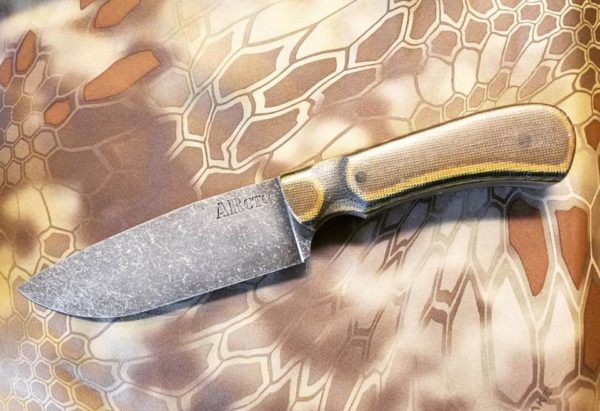
The Alpha-1 is just one of many knife designs offered by ARctc Knives.
As a former soldier, knifemaker Allan Reid of ARctc Knives is a fan of easy-to-maintain and cost-effective handle materials.

The Alpha-1 above has a 5-inch blade made out of 1084 steel with a full flat grind and acid stonewashed finish. The scales are Camo Micarta fitted with Black Micarta pins. Overall length is 9 ¼ inches. Maker’s list price: $165.

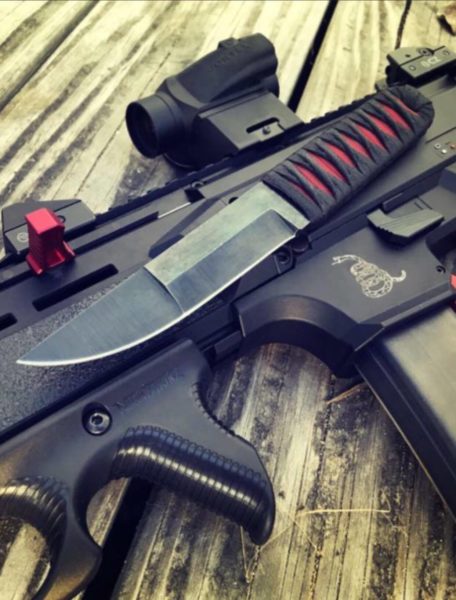
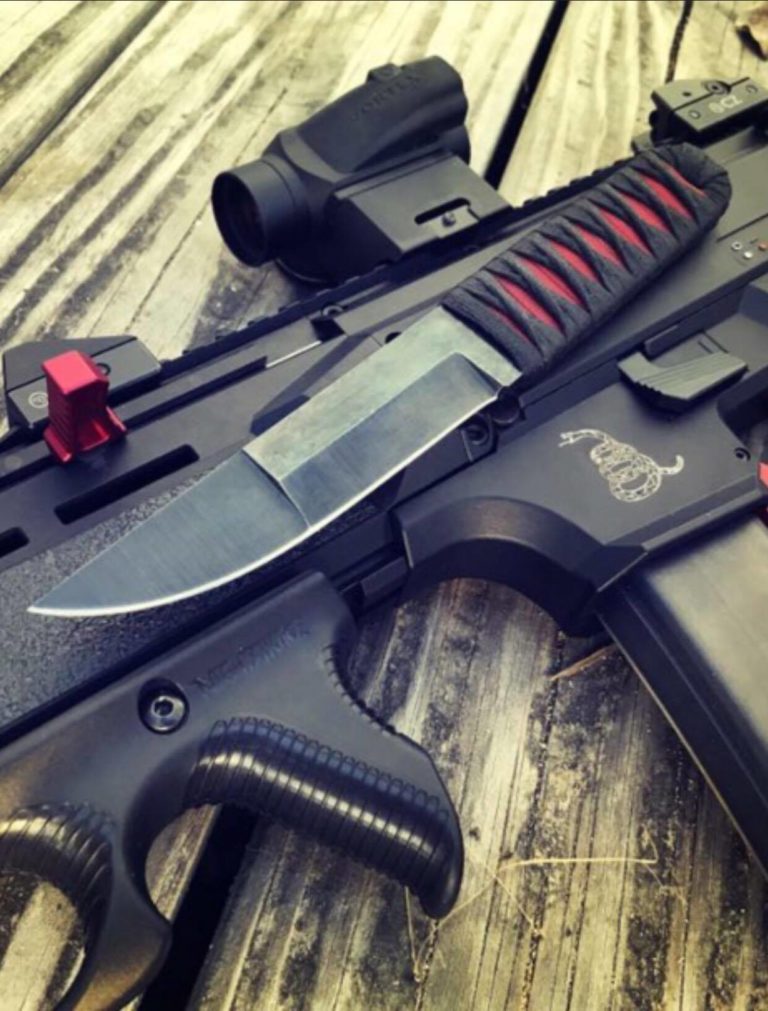
Allan Reid tried out a kwaiken design on his latest edged creation.
The ARctc Knives kwaiken-design knife has a 4.5-inch combination-ground blade made out of O1 tool steel. It’s 9 inches overall. The handle features an epoxy-sealed red paracord base under a black Japanese lace wrap. Maker’s list price: $180 with Kydex sheath and belt attachment.

Contact Allan Reid at [email protected], on Facebook at Allan Reid and on Instagram @arctc_knives.

5 Ways To Get Your Knives Featured In BLADE

Here are 5 ways to get your knives featured in BLADE, either in print or online. Our goal is to include as many different types of knives and as many different knifemakers and manufactures as we can in each issue and online. We try not to double up on any individual or company, though sometimes it’s unavoidable. That means that we’re always looking for makers who haven’t been featured before. There are some restrictions, but those will be covered under each category.

If you're a knifemaker wanting to get your work exposed through BLADE magazine, be sure to follow us on Facebook, Twitter and Instagram.
Be sure to Like and Follow BLADE Magazine on Facebook. If you’re on Twitter, look for BLADE Magazine. We’re @blade_magazine on Instagram.

First, please Like and Follow BLADE Magazine on Facebook and Follow BLADE Magazine on Twitter and @blade_magazine on Instagram. That way you can see online stories when they’re posted, which may prompt other story ideas.


3 essentials for all 5 publishing options

  1. Our Enthusiasm

We have to like your knife. But wait! We like ALL kinds of knives: cooking, everyday carry, bushcraft, hunting, tactical. We like fixed blades and folders of every deployment and locking mechanism. We like art knives that we’d be proud to put on our shelves. We like all shapes and sizes of knives, of every conceivable blade design and grind. We welcome smiths, stock-removal makers, manufacturers, collectors. Whether you’re just reaching your artistic stride or you’ve been involved in the knife industry for decades, you’re part of the BLADE community. So, don’t be shy. Chances are, we’ll thoroughly appreciate your knife or your perspective on the industry. The only way we’ll be able to see your knife, however, is if you show it to us in a well-done photograph.

  1. Your Enthusiasm

How hard are you willing to work to make your knife look its best in a photo? Or, are you willing and able to hire a professional to take photos so that you can concentrate on knifemaking? The answer to either of those questions will be the measure of your enthusiasm. Other pieces of information will be required, but those details seem easier to acquire than photographs that do justice to your knife.

  1. High-Quality Images

Poor-quality photos will definitely dampen our enthusiasm to publish them, no matter how beautiful your knife is. If the photo is out of focus, low resolution, poorly composed, lacking in contrast, flat or poorly lit, we’ll ask you to get better photos. As challenging as it will seem, it ensures that a poor image doesn’t run side by side with a stellar one, making your knife look lesser than it really is. You can read more about what we expect by reading “6 Things BLADE Looks For In a Knife Photo.”

Let’s say you have terrific photos, then what?

5 ways to get your knives featured in BLADE

  1. ‘What’s New’
A maker can be in “What’s New” only once every 12 months, and precedence is given to makers who have not been published before.
The “What’s New” section of BLADE magazine features knives from six manufacturers and six custom knifemakers. Occasionally a tomahawk, tool or knife accessory will be included, but the focus, as always, is on knives.

The “What’s New” section of BLADE magazine highlights 12 new knives each issue, six from manufacturers, six from custom knifemakers. And, guess what? If you’ve never been in “What’s New” before, everything you’ve made is “new” in that not all of our readers have seen your work before. If you’ve already been in “What’s New,” perhaps there is something new you’ve been trying out: a different design or grind, or you usually make fixed knives and now you’re moving into folders, or you’re using a different engraver. After being in “What’s New,” you must wait at least 12 months before you can be eligible again, and makers who haven’t been in before will take precedence. Just to reiterate, our goal is to get as many different knives into BLADE as possible. We will occasionally include a tomahawk, sharpener or other knife accessory, but mostly the section features factory and custom knives.

Requirements: High-Resolution Image, Short Description

All that’s needed for “What’s New” is a high-resolution, print-quality image of your knife. Bottom line: 300 dpi or higher, 8-10 inches on the longest side, be that vertical or horizontal, and .jpg format. Now, for “What’s New” we use “cutaways,” or just the knife devoid of its background. This means that you don’t need to worry about creating an artistic vignette or still life with your knife. You do have to worry about getting the best picture you can get. For more on what makes an acceptable photo, read “6 Things BLADE Looks For In A Knife Photo.”

You will also need to supply a list of specs and a few sentences describing the item’s usage. Be sure to note if there’s anything new-to-you about it. They say there are no new stories, just different ways of telling them, and that could also be said of knives. True innovation does happen, and of course, we’re eager to hear about that. However, a maker might be working on new things all the time in his or her shop and that counts!

  1. ‘Knifemaker Showcase’
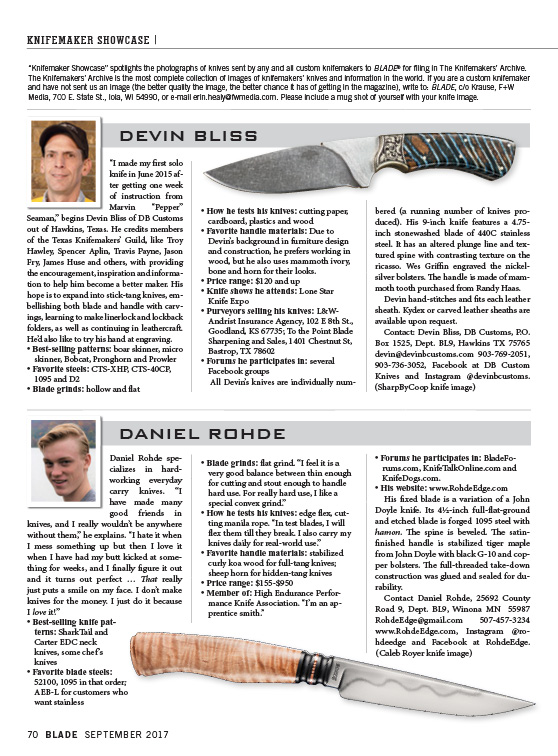
“Knifemaker Showcase” features six custom knifemakers in the pages of BLADE magazine every month.
In BLADE magazine’s “Knifemaker Showcase,” six custom knifemakers are featured every month. A well-done knife image, a mugshot and an interview are required for inclusion in this section.

“Knifemaker Showcase” features six custom knifemakers each month all with a half-page layout that includes a mugshot, cutaway knife image and bulleted interview. The goal here is find out more about you, your start in knifemaking, your influences and your preferred materials, designs and ways of connecting with your customers. You’ll need to answer a questionnaire, explaining why you make the choices you do when crafting a knife. You can type out your answers, or if you’re not into typing, we can interview you over the phone once you’ve had a chance to think about your answers. After you’ve been in “Knifemaker Showcase,” you must wait at least 12 months before you’re eligible to be in it again, and makers who’ve never been featured before will take precedence. That way we can shine the spotlight on as many different makers as possible.

Requirements: High-Resolution Knife Image, Mugshot, Completed Questionnaire

Again, our designers use cutaway images of knifes in this section, so a clean backdrop is best. You want to make sure your contrast is good and that nothing, including shadow, fabric, grass, encroaches on the edges of the knife. To learn more about the differences between a good photo and a bad one, read “6 Things BLADE Looks For In A Knife Photo.”

A mugshot is a portrait of you. It can be taken outside or in your shop, but the background will be mostly eliminated since we’ll be cropping in on your face. Don’t wear sunglasses. This is a chance for readers to meet you face-to-face, so to speak. If you’re wearing a hat, just make sure your face is not cast in shadow. Even though it will run small, your photo still needs to be print-quality. Keep in mind that if you submit a family portrait, for example, we will need to crop in on just you, so the size and resolution will need to be higher to account for that.

You’ll need to answer all the questions on the questionnaire unless something doesn’t apply to you. Too much information is better than too little.

  1. BLADEmag.com
Those within the knife industry who want to try their hand at writing can query the managing editor at BLADE magazine for guest blog opportunities.
“Mightier Than The Sword with Erin Healy” is one BLADEmag.com blog where knifemakers and manufacturers can suggest story ideas of interest to everyone within the industry.

The blogs on our website allow us to take as much or as little space as is required to tell a story. Here is where we have the freedom to explore all kinds of stories related to the industry. BLADEmag.com stories can be about manufacturers, distributors, collectors or knifemakers; they can cover everything from how you made a cast spruce cone handle to how you’ve used knives in your family or on the job, whether it’s skinning deer, cross-chopping herbs in a restaurant kitchen or employing various grips in edged-weapon martial arts. The story can be about one particular knife or a collection. The source can be a multinational corporation with operations on more than one continent or a lone individual in his or her shop. BLADEmag.com strives to be a resource for all things knife, so histories and how-tos are of particular interest.

We welcome guest bloggers, provided the topic you’re writing about is not self-promotional. What this means is that you cannot write about your own knives or services. Pay is non-existent, but bragging rights are impressive. You will need to be able to write well, or be open to guidance and editing. You will need to provide a paragraph-long biography and a mugshot to run with your story, as well as illustrative images.

Requirements: A Good Story, Good Images

The thing about a story, whether it’s a topic you suggest for us to explore or one you’d like to try your hand at writing, is that it needs to have a story—a beginning, middle and end, an angle, a hook. If you as someone in the knife industry find it interesting then, chances are, others will as well. Even though BLADEmag.com will always focus on the knife, we also know that it is the people behind the knife that makes the story compelling to read. The whys are always interesting to include, as well as trying to describe how a material or process contributes to the feel or wow-factor of a knife.

Images can be of web quality, but still need to be well composed. For more about how to take high-quality photos, read “6 Things BLADE looks For In A Knife Photo.”

  1. BLADE Magazine

Although knifemaker profiles are reserved for Knifemaker Showcase in print and BLADEmag.com stories online, other ideas for BLADE magazine are always welcome. The final decision for a feature article within the pages of BLADE rests with the editor. Oftentimes in the course of conducting an interview with a manufacturer or knifemaker for “What’s New,” “Knifemaker Showcase” or BLADEmag.com, we find other stories to write about in print.

Requirements: Exceptional Print-Quality Images, Extensive Interview

To get a story into print, images must be top-notch. Focus, contrast, lighting, composition, depth of field all matter. Resolution must be high; size must be large. To fully understand what this means, read “6 Things BLADE Looks For In A Knife Photo.”

  1. Social Media

Make sure to follow us on  tag us in your social media photos so we see them and use #BladeMagazine

Requirements: Images, Specifications, Intended Usage, Contact Information

Ready? Email Us

Email your photos with specs, information, and details to [email protected]. Remember that the photo must be  Did I mention photos? Before you get in touch, give “6 Things BLADE Looks For In A Knife Photo” a read.


Was “Forged In Fire” a Scapegoat For The Cohoes Fire?

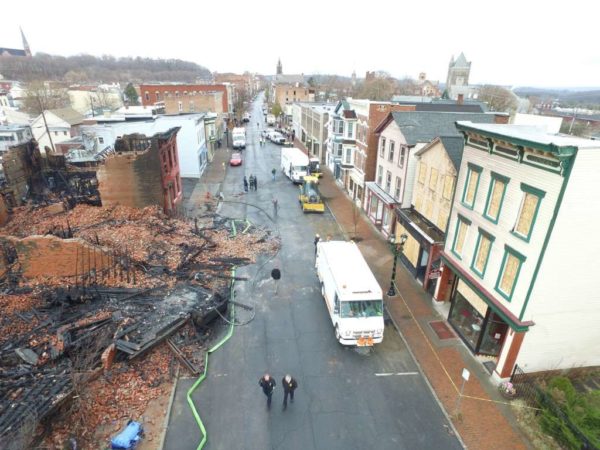
John Gomes, the 51-year-old Cohoes, New York, resident and alleged “amateur knifemaker” who started a fire that damaged 32 buildings and displaced approximately 20 people, will not appear in court today as scheduled. He was charged with felony reckless endangerment and misdemeanor arson on Friday, Dec. 1 while the 200 block of Remsen Street smoldered, threatening to reignite. Gomes’ case has been waived to Albany County Court to be presented to a grand jury. In a report by the Times Union of Albany, New York—which has followed the story closely—Gomes lawyer has stated that his client is a hard-working plumber, the father of two children and this was a tragic accident, not a crime. Reaction from knifemakers on social media was swift and nearly unanimous: Gomes’ did not do his research, about forges or metal working, and his claim of trying to replicate something he saw on “Forged In Fire” was a deflection from his own lack of forethought. One maker from Upstate New York theorized that it could have been simply a trash fire to avoid disposal charges, but that claiming to be working steel was a better story than a flagrant violation of the law. Was Forged In Fire a scapegoat for the Cohoes fire?

John Gomes claimed to be an amateur bladesmith. The fire he started in an open barrel behind his house started a fire that damaged 30 buildings.
John Gomes, a resident of Cohoes, New York, started a fire in an open barrel in his back yard. Reports say he was attempting to bend a knife, as he had seen done on “Forged In Fire.” But was “Forged In Fire” a scapegoat? (Times Union photo)

On Friday, December 1, knifemakers awoke to the cringeworthy news that Gomes had started an open barrel fire in his back yard to “bend” metal as he had seen done on “Forged In Fire.” It was a relief that nobody was killed in the fire. One fireman was treated for dehydration and heat-related issues and the fire chief received a burn from a flying ember, but other than that nobody was injured. By last count, 32 buildings were damaged by fire, smoke or water, resulting in millions of dollars’ worth of property damage. Approximately 20 to 25 people were displaced, but Red Cross representatives were on sight to meet the immediate needs of both emergency response personnel and to provide shelter, food and clothing to those whose houses had burned. Cohoes is a quiet commuter city about 18 miles north of Albany. The houses in the affected area are wooden and within inches of each other. The 30-mile-an-hour winds on November 30, made it challenging for the firefighters to stay ahead of the blaze.

Cohoes is an old mill town that is no stranger to fires. In 1978 a man and his seven children were killed in a fire suspected of being set by the sole survivor, the wife and mother. After new evidence surfaced in 2010 Virginia Grotto did sign a confession, but then claimed she was badgered to do so. Another Cohoes fire in 1988, destroyed nine buildings, including three businesses. That fire also affected Remsen Street. The cause remains a mystery with some neighbors claiming at the time it was a Hells Angels motorcycle gang act of revenge against someone living in the apartment building where the fire started and others claiming to have seen two boys playing with matches. All other causes were ruled out. In both cases, Cohoes rebuilt. One added note to the most recent fire was that this area of Cohoes was enjoying a resurgence. Both the current mayor and interviewed business owners commented on the city’s resilience and they would rebuild. A florist was able to resume work the next day despite building damage, and a pharmacy owner lost a storage garage that contained chair lifts that had been ordered for Christmas, backup inventory and old medical records, but his store was open for business.

Cohoes, N.Y. is no stranger to fires, but the one on Thursday, which was started in an open barrel, was the worst.
The 30-mph winds made getting ahead of the fire a challenge. In the end 32 buildings were damaged and approximately 20 people displaced. (Times Union photo)

John Gomes’ son defended his father on social media, claiming that he never meant to burn down his own house or anyone else’s. Commenters offered words of encouragement for the boy and prayers for his family. On knifemaker Groups on Facebook like Forged In Fire TV Show Discussion Group!!!! and my own Erin at BLADE, it was unanimous that “Forged In Fire” was not to blame. There were jokes about the blade not making the cut, or the reverse, it being able to wipe out a city block. There was mention that “Forged In Fire” now does include a warning that forging is dangerous and not to be attempted without careful consideration of safety measures. Of course, one popular comment on Facebook was simply a picture of a fire extinguisher.

John Gomes never meant for the barrel fire to engulf a city block, but it did.
John Gomes, according to statements made by his lawyer to the media, never intended for his open barrel fire to cause damage to his own house or anyone else’s. He’s been charged with felony reckless endangerment and misdemeanor arson. (Times Union photo)

Concern was expressed, though, by more than one commenter on more than one thread that “Forged In Fire” seems to play up the fireball created during quenching. It is a television show and the quenching drama makes for good entertainment. However, the “Forged In Fire” set is actually fireproof. It is vented to prevent asphyxiation, but not in the way a home forger might vent his forge. This is why it is often unbearably hot on the set, causing heat exhaustion in some participants. And, of course, there are crewmembers standing by with extinguishers, ready to cut the electricity or provide medical attention as needed. There have been instances in the final round when participants are at their home forges of fireballs being too close to propane tanks and the like. Although show representatives expressed sadness over the fire in Cohoes, they reserved comment, according to Times Union reports.

One of the most intriguing comments was posted by a resident bladesmith of Upstate New York. “I think he was burning trash, which is illegal in most municipalities in New York State, so he would not have to pay for disposal,” theorized F. Page Steinhardt, of Sunshadow Design and “Forged In Fire” winner. He added, “In an open burn barrel, which is illegal in most municipalities in New York State in a 30-mile-per-hour wind, which is a dumb idea, and ‘Forged In Fire’ was a convenient scapegoat.” Page reiterated that he didn’t know for sure the exact motivation for the fire, and perhaps we will never know exactly what happened. “But that is just my opinion from reading the stories and living in Upstate New York,” he concluded.

Matthew Parkinson of Dragon’s Breath Forge in Connecticut and another “Forged In Fire” winner brought up another good point. “FIF isn’t responsible for someone who can’t think ahead. I mean, they show giant fireballs all the time, so it isn’t like you could even claim they make it look safe.” Matt also offered guidance to those just starting out. “As far as new smiths, take a class. Find a good school and take a class. It will be the best money you ever spend.”

A Digital Subscription To BLADE Is The Answer

Save $4 off the print price of a annual subscription to BLADE Magazine with a digital subscription.
You can read your digital issues of BLADE Magazine anywhere you have your phone, tablet or computer, and there’s no need to find storage for all your old issues.

If piling-up issues of magazines seems like a waste to you… If you feel like you don’t have time to read a magazine… If you like the stories we offer in BLADE, but want a more economical option, then a digital subscription is the answer. An annual subscription to BLADE is $17.98, $4 off the print price


Maker Uses Daughter’s Hand To Perfect Mini Knife

Pete Sloan got a helping hand from his daughter Erin when he made neckers for Spencer Aplin's wife and son.
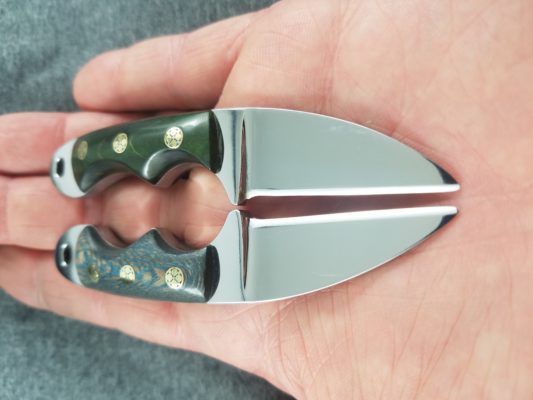
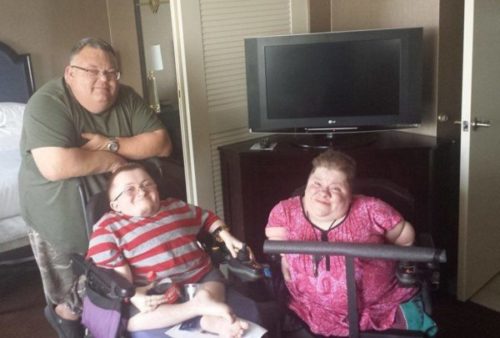
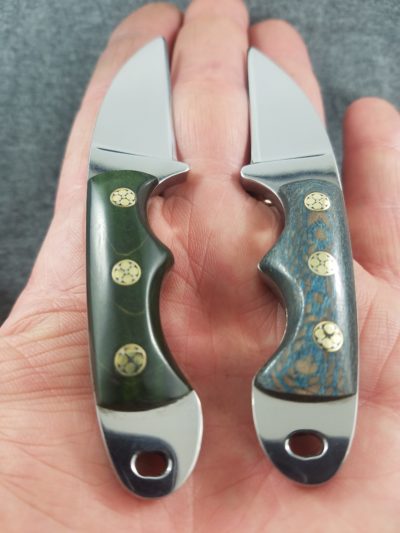
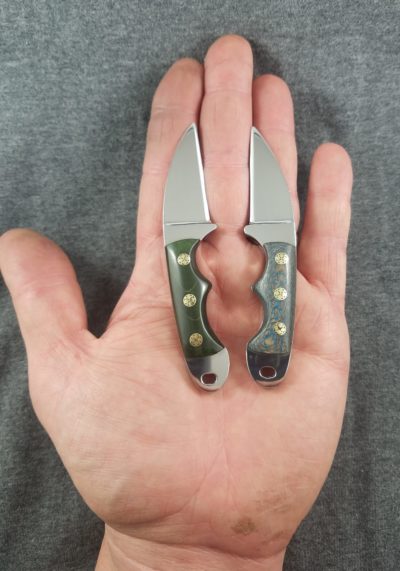
Pete Sloan made two neck knives for the wife and son of his friend and fellow maker Spencer Aplin. He used his daughter’s hand to perfect mini knife’s design, ensuring it fit the tiny hands of Lisa Johnson Aplin and son Alexx who suffer from brittle bone disease.

“One thing that Spencer is very good at is knowing what I’d like,” Lisa Johnson Aplin said. Lisa is the co-founder and chief operating officer of STA Custom Knives out of Brazoria, Texas. She and knifemaker Spencer Aplin were married in 1993, and together they have a son Alexx who will be 24 in a couple of months, a journalist and sometimes quality controller in his father’s shop. Lisa had no idea that a Sloan Custom Knives creation she admired had already been custom-ordered for her by her husband. Lisa suffers from osteogenesis imperfecta, or brittle bone disease, so although she does not have dwarfism and is therefore not a “little person,” she is a very little person. The one thing that Pete Sloan has plenty of access to is little people in the form of children, 9 to be exact. So, he used one daughter’s hand to perfect the mini knife fit and design.

Erin Sloan is one of 9 children that Pete and Holly Sloan have adopted.
Erin Sloan is 9 now, but she was 5 when her dad, Pete, asked her to help him custom-fit a tiny neck knife. Erin is one of 9 Sloan children.

Lisa’s favorite color is green and Spencer had been admiring a green knife he saw on Facebook that his friend Pete had made. “He asked me if I could make one for his wife,” Pete said. Pete was surprised and honored that Spencer, a maker he greatly admires for his knifemaking in general and blade-carving in particular, would ask him for a knife. Pete told Spencer that he was welcome to make the knife if he wanted, but Spencer said, no, that Pete had a good command of the Wharncliffe design and he wanted Pete to make it.

Pete Sloan is the owner of Sloan Custom Knives in Medina, Tennessee.
Pete Sloan started out with an old 4-by-36-inch belt grinder–generally considered underpowered and not ideally configured for knifemaking–and some hand files. “I liked it,” he said.

Humbled, Pete was determined to get it right. But he lived in Medina, Tennessee, and had never met Lisa. He only had Spencer’s description of her size to go on. Lisa is 2 feet, 10 inches tall. Pete’s daughter Erin was 5 at the time. So, he roughed out the 440C stainless steel blades and then with a Sharpie marked the first finger groove using Erin’s grip as a guide, grinding until it was just right for her petite hand. Spencer requested the stainless steel because the Aplins live next to salt water, and he wanted to minimize corrosion. Pete said he mostly gets requests for pattern-welded steel.

Specer Aplin and his wife, Lisa, co-founded STA Custom Knives, based in Texas.
Spencer Aplin of STA Custom Knives, standing, took his son, Alexx, and wife and business partner, Lisa, to the 2015 BLADE Show.

If you’ve ever seen the movie “Unbreakable” starring Bruce Willis, you know what osteogenesis imperfecta entails. Mr. Glass’ character, played by Samuel L. Jackson, has a form of the condition that allowed him to grow to full height, but his lifestyle is still hampered by debilitating bone breaks. Lisa and subsequently her son Alexx have Type III OI. A genetic mutation causing a lack of collagen, subsequently prompting connective tissue issues. The result is that bones fracture easily and those with the affliction will be short in stature with a curved spine and barrel-shaped chest. Type I is the most mild form of the condition, Type II and Type VIII the most severe and most often fatal. Types III through VI vary in symptoms and genetic causes. OI has been traced through mummies back to 1000 BC Egypt. Even though the condition has been around a long time, there is still no cure.

It was the green that first attracted Spencer Aplin's attention in these Pete Sloan knives. He knew his wife would love it.
Pete Sloan used green-dyed curly maple for the scales on Lisa Aplin’s knife and blue-dyed and natural sycamore for Alexx’s. You can contact Richard Beam on Facebook for such impregnated wood products.

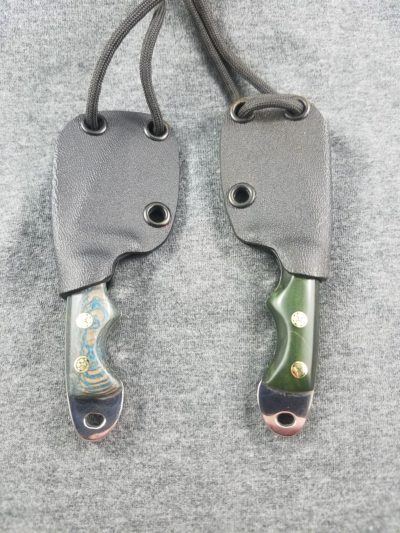
Pete used stabilized curly maple dyed green from Richard Beam at Nicholas Impregnated Woods to make the handle for Lisa’s knife and a combination blue-dyed and natural sycamore for Alexx’s. Each came with a Kydex sheath and cording to wear around the neck. At the 2015 BLADE Show, Lisa finally met Pete in person and he presented her with the knife. She loved it! “Green is my favorite color,” she said. She uses the knife all the time, opening boxes that come to the shop and for everyday uses around the house. Although it can be used for food preparation, Lisa doesn’t cook, she said laughing. Spencer does the cooking. She treasures the knife. “It’s one of my favorite’s in my collection.” She continues to be impressed with the fit and with how Pete obtained it.

These necker come with Kydex sheaths and lanyards for neck wear.
Push Kydex sheaths away with your thumb rather than struggling to pull the knife out. If they are too tight, contact the maker. He can heat and loosen the fit while still ensuring the knife does not fall out.

The only thing that Pete could not have accounted for was hand strength or lack thereof. Both Lisa and Alexx had a hard time drawing their knives. Spencer simply heated up the sheaths and worked the knives in them so that they released more easily without falling out. “It not something he could have known about,” Lisa said. “I think he did a great job.”

When asked how she adapts to daily activities in a full-size house at her stature and in a wheelchair, Lisa’s answer was immediate and delivered in as cheery a tone as everything else she talks about. “The great thing about being married to someone who works with his hands,” Lisa explained, “is that Spencer can make me anything I might need customized.” The Sloan Custom Knife was an unexpected surprise, but in hindsight typical of Spencer to have picked out exactly what she would have picked out for herself long beforehand.

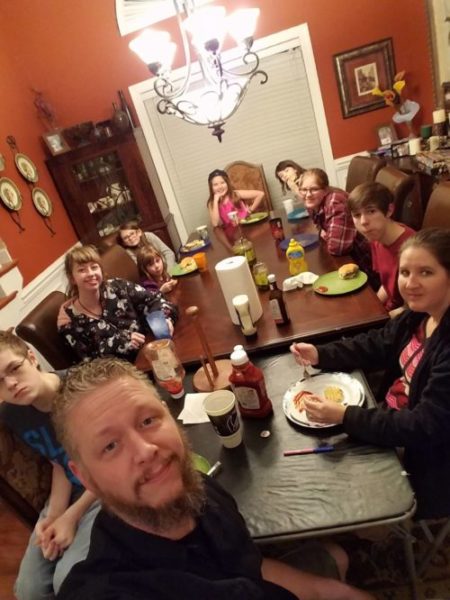
The Sloan family assembles for a meal together.
It’s a challenge to get all the Sloans in one place. This is the whole family minus oldest daughter, Becca, who is in the U.S. Air Force.

Pete visited Spencer before the 2017 BLADE Show and the two slept little working hard to finish up knives to sell. Spencer and Pete make knives with similar styles as Spencer shares his knowledge with Pete. And if Pete ever needs another hand model, he can turn to one of his and his wife, Holly’s, nine children, some biological, some adopted, some that came by other means: Becca, 19; Carson, 18; Gage, 15; Brant, 14; Makenzie, 13; Leigha, 10; Erin, 9; Madeline, 8; and Grace, 7. The couple used to be foster parents. “There a story to just about all of them,” Pete noted with a laugh.

Contact Pete Sloan at [email protected] or on Facebook at Sloan Custom Knives.

Mini neckers are just one style of knife made by Pete Sloan at Sloan Custom Knives.
These mini neckers are 4.25 inches overall. The 440C stainless steel blades are 2 inches. The full-tang construction allows for a lanyard through hole. These were designed for child-sized hands, but come in larger versions. Handle material is impregnated wood from Richard Beam. Maker’s list price: $200 shipped with Kydex sheath.

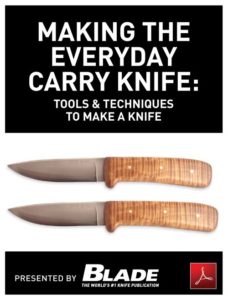
Are You Looking to Perfect Your Own Everyday Carry?

The digital version of "Making The Everyday Carry Knife" is available in digital format for a budget-friendly $4.99.
Another thing you’ll learn more about in Wayne Goddard’s “Making The Everyday Carry Knife” is selecting the right materials for a handle that lasts.

“Making the Everyday Carry Knife” by Wayne Goddard includes information on how to determine the best blade and handle length. You’ll also get tips on how to use your computer to assist you in designing your knife, plus lots more including grinding and tempering techniques and tool suggestions. At only $4.99 in digital format it’s a wealth of information at a steal.

Midweek Maker Military-Style: Randy Madan

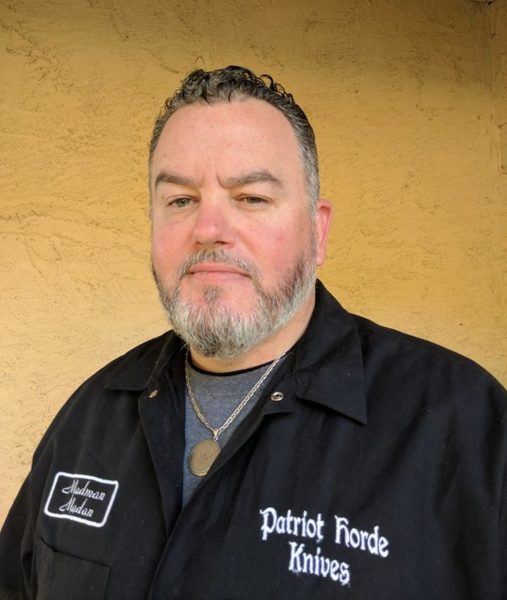
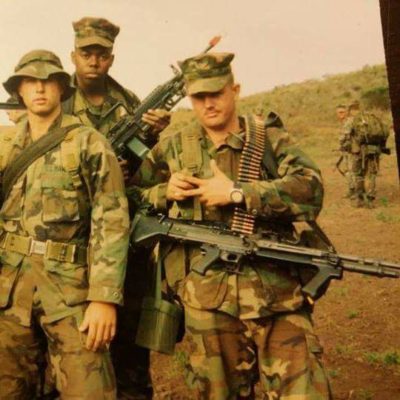
Randy Madan, known as JR on social media, served in the U.S. Marine Corps from 1992 to 1996 as a combat engineer. “I blew things up,” he said, laughing. Now, at 43, he has been a federal correctional worker for 20 years.

Randy Madan makes knives part-time under the Patriot Horde Knives name.
Randy Madan of Patriot Horde Knives hopes to be able to keep making knives when he retires from his job in the federal correctional system. Randy is supportive and encouraging of other veteran makers.

He always loved and carried knives, but he got his start in knifemaking in October 2016. “The knifemaker that I idolize, Michael Cleveland from Half Lives Knives, afforded me the opportunity to join a knife build-off for a veteran charity. Me being a vet myself, I jumped at the opportunity,” he explained. He has continued to make knives and to encourage other veteran makers.

Randy Madan continues to support his fellow veterans in their knifemaking pursuits.
Randy Madan of Patriot Horde Knives served in the U.S. Marine Corps from 1992 to 1996 as a combat engineer.

“I am just a small-time maker, wanting to perfect my knives so that when I retire in a couple of years I can make more,” he said. Other makers who have helped along the way include John Savage, Ryan Schreiber, Denny Furey and Mark Wagoner.

  • Best-selling knife patterns: DaCleva, PMAT, Flatliner
  • Favorite blade steels: 1095 with plans to start using O1 and 80CrV2
  • Blade grinds: flat with plans to add hollow
  • How he tests his knives: shave hair, skive 7- to 9-ounce leather, cut ¼-inch bolts, chop 2-by-4s
  • Favorite handle materials: Voodoo Resins, Rob Carper Innovations, 8th Dimension Concepts and J Hue Customs. “I am a big fan of the hybrid materials,” Randy noted.
  • Price range: $250 and up
  • Forums he participate in: The Real Knife Makers of America, Global EDC and other Groups on Facebook
DaCleva is one of Patriot Horde Knives' best-sellers.
DaCleva has a 4-inch flat-ground blade made of 1095 steel with an acid-washed finish for a battle-worn look. Overall length is 9 inches. Scales are by Norman Robbins at 8th Dimension Concepts. Maker’s list price: $250 with Kydex sheath; $325 with leather.
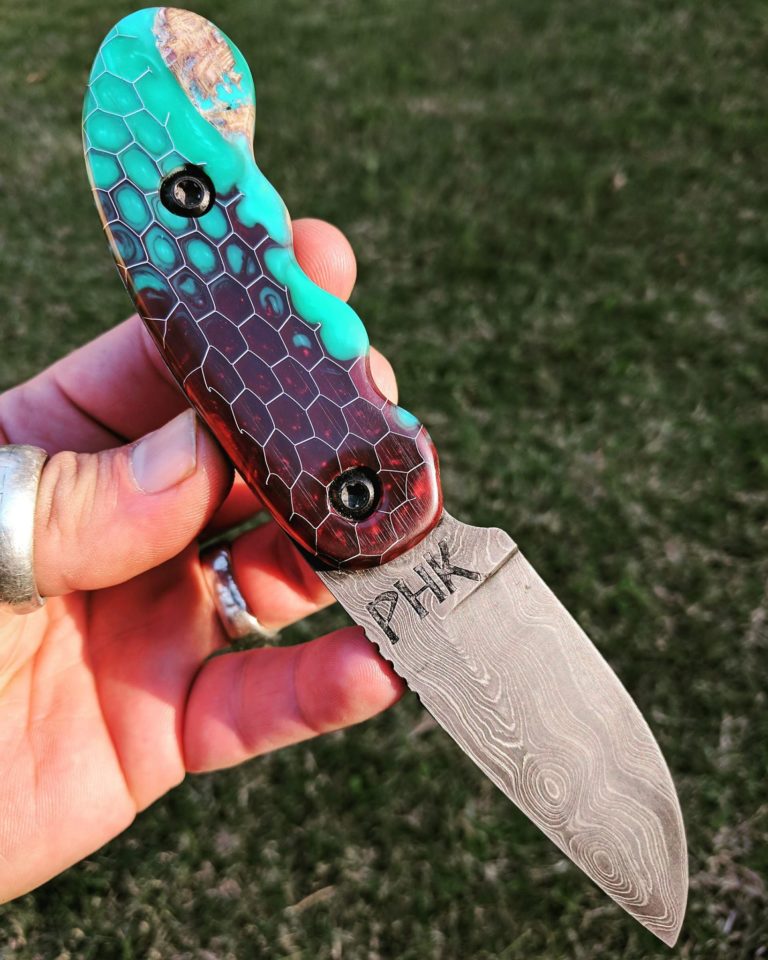
The Lil Chubby drop-point is made by Randy Madan of Patriot Horde Knives.
The Lil Chubby drop-point is 8 inches overall, with a 3.5-inch flat-ground blade made with random pattern Alabama Damascus Steel from Lacy Smith. The handle scales are from Norm Robbins from 8th Dimension Concepts. Maker’s list price: $300 with sheath. In 1095 steel at $200. Contacts listed at the bottom of this article.

Randy uses All Star Abrasives in Lawrenceburg, Tennessee, for his abrasive supplies, which is what he puts to his hybrid scales to bring out their color.

Contact Randy Madan at [email protected], 760-885-9370 on Facebook at Patriot Horde Knives and on Instagram @the_patriot_horde.

A Digital Subscription to BLADE Is The Anwswer

Save $4 off the print price of a annual subscription to BLADE Magazine with a digital subscription.
You can read your digital issues of BLADE Magazine anywhere you have your phone, tablet or computer, and there’s no need to find storage for all your old issues.

If piling-up issues of magazines seems like a waste to you… If you feel like you don’t have time to read a magazine… If you like the stories we offer in BLADE, but want a more economical option, then a digital subscription is the answer. An annual subscription to BLADE is $17.98, $4 off the print price.

Benchmade Drops HK Knife Line to Refocus on Own Brand


Benchmade ceased production of all HK knives. The initial offering of the Benchmade-HK partnership was the HK Pika.
Photo courtesy of Benchmade Benchmade and H&K officially kicked off their collaboration 12 years ago with the 2004 release of the HK Pika.

Over a month ago Benchmade decision makers opted to immediately ramp down production of all Heckler & Koch (HK) knife lines, according to Benchmade Public Relations and Communications Manager Derrick Lau. Benchmade will concentrate efforts on its own brand of sports cutlery and edged tools.

The Oregon City designer and manufacturer notified knife dealers that although not official until Jan. 2, 2017, they would no longer make approximately 17 to 18 different models. Some supply remains, but is quickly dwindling. Dealers are encouraged to contact Benchmade if there are any HK knives they’d like to get before they are all gone.

The tactical design and affordability of HK knives attracted law enforcement officers. The knives include the Entourage, Patrol Axis, Ally, Turmoil, Dispatch, Plan D, Nitrous Blitz, MP5 and Epidemic families.

Benchmade designed and manufactured knives for other companies in the past, such as Harley-Davidson® and Bone Collector. Three years ago the company ended its collaboration with Lone Wolf to rededicate its efforts to Benchmade-branded knives. This is a continuation of that plan, Lau explained, adding it was a case of the company needing to “get our bearings back.”

The licensing agreement specified that Benchmade would design and manufacture the knives, and retain the use of any resulting innovations, while HK would lend its name and branding to the product. Such an arrangement can be a marketing boost for the manufacturer and provide a platform for creative innovation. Since automatics cannot be imported into the U.S., Lau explained, the German-based Heckler & Koch benefitted from the ability to get HK autos into the U.S. market through Benchmade.

The Benchmade-HK arrangement was another in a series of firearms manufacturers working with knife manufacturers to create a mutually beneficial business endeavor. Other examples include Remington and Bear & Son Cutlery, Ruger and CRKT, Smith & Wesson and Schrade and others.

“Our dealers are our most important asset,” Lau said. Dealer feedback indicated that the Benchmade brand is Benchmade’s most attractive selling point. After 30 years in the business, it was simply determined that Benchmade should refocus on its own brand.

Heckler & Koch does not have anything lined up in terms of continuing its knife brand, according to the company’s public relations spokesperson. “We’re a firearms company,” she reiterated, but “we like to offer our fans the accessories we know they want.” She added, “Benchmade did a great job of showing us there was a market for the knives.”

Benchmade would consult with HK officials on some designs they were considering, and HK would choose some for its web shop. Benchmade had the infrastructure in place for wider distribution.

In the future, Benchmade may be open to other collaborations, but for now the company is committed to growing its own line of knives. Some of the Benchmade knives in the works will have features inspired by the HK lines.

Benchmade did not issue an official press release because they wanted their dealers to know first, allow them time to ask questions, and provide any support they might need.

Steve Shackleford, BLADE® editor, contributed to this article

Get ShopBLADES package deal on the two most recent issues of "Knives" along with a digital download of the last 12 years of "Knives," all for only $59.99, a savings of $87.98!

ShopBLADE is offering a not-to-be-missed package for “Knives” readers. You get the 2016 and 2017 paperback issues of “Knives,” a $67.98 value. Plus you get a digital download for the 2004-2015 editions, an $79.99 value. Your cost: $59.99, a savings of $87.98. Hurry!

Click here to check out the “Knives” bundle.


Save

Advertisement

Must Read Articles

Read this before you make a knife

Knifemaking 101 – Read This Before You Make a Knife

  by Wayne Goddard My experience has taught me that there's nothing like digging in and getting started. I've often said the hardest part of the...
how to forge damascus steel

How to Forge Damascus

Advertisement
Advertisement