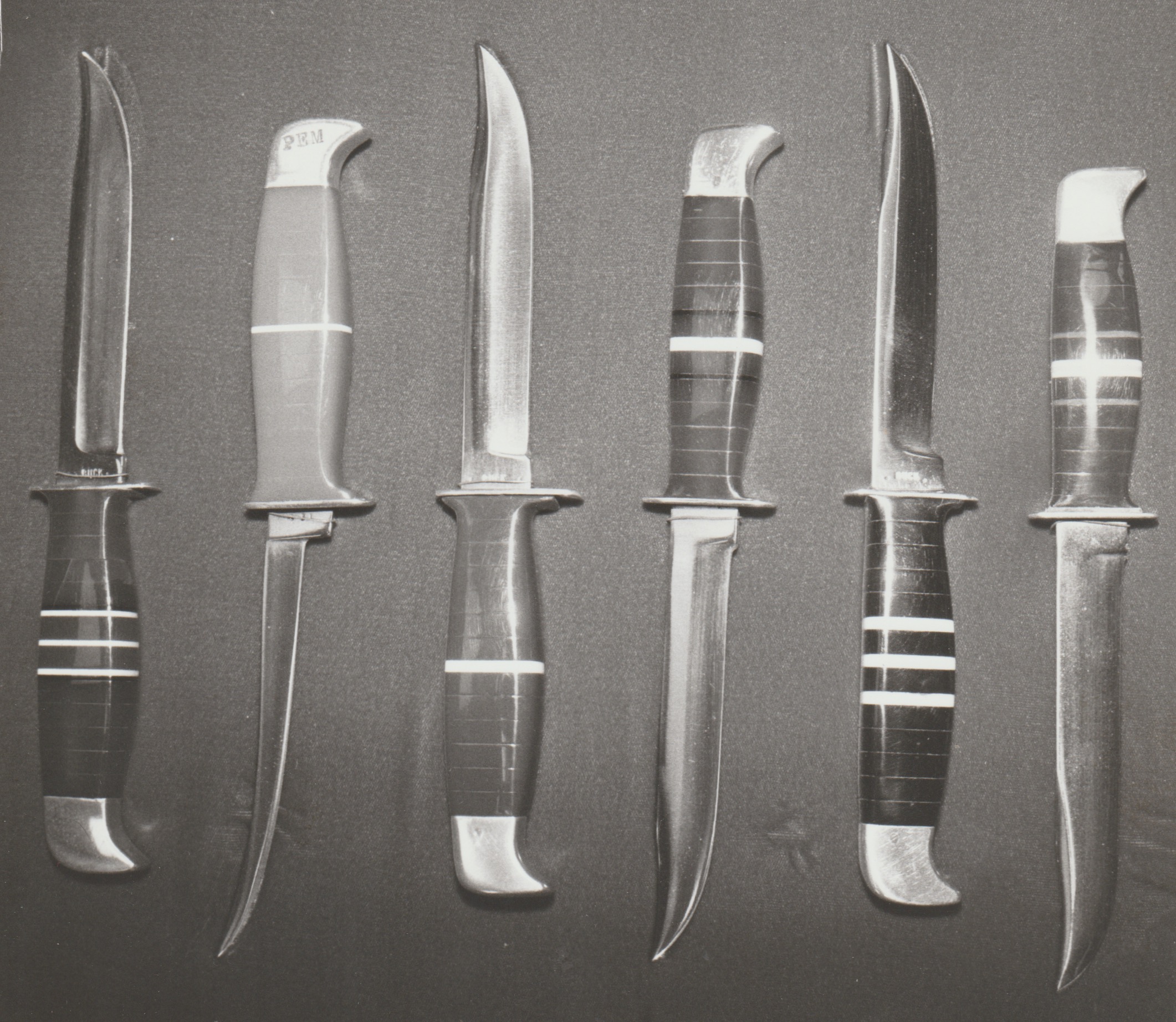
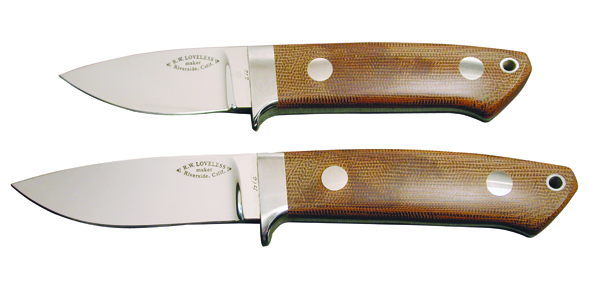
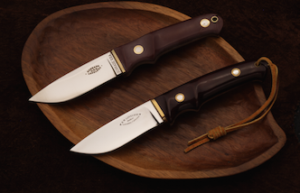
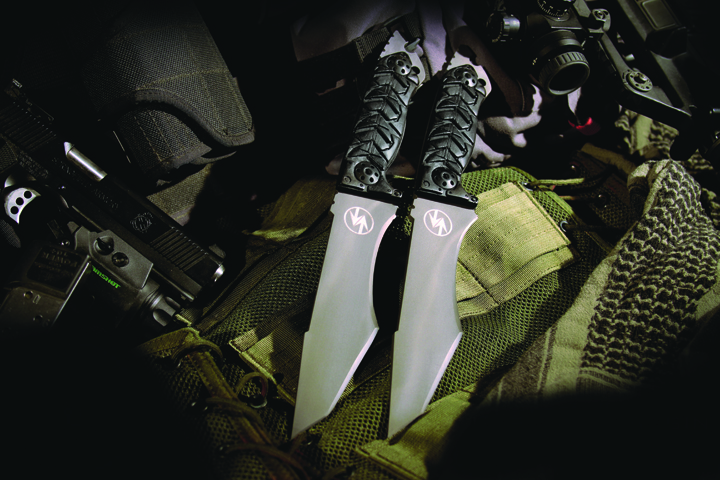
“The Loveless knife design is all about function,” Jim Merritt once noted. “A Loveless knife is made for the guy who wants to have the best knife possible for field work.” Merritt worked side-by-side with Loveless in his shop for 30 years, and toward the end was making Loveless’s knives on his own, with Bob pitching in and helping whenever he could.
This pair is a prime example of the combined efforts of Bob Loveless and Jim Merritt. Their skill as knifemakers is simply without peer.
Buck Knives has added survival instructor Ron Hood to their growing Pro Staff, bringing new focus on a key aspect of the knife market. This new agreement also will incorporate Hood’s skills as a knife designer, working with Buck in the development of new survival/tactical knives.
Hood has taught courses at UCLA, and has produced and published numerous award winning survival training videos. He has been featured on many TV shows and assisted with the training that goes on behind the Man vs. Wild TV show on Discovery Channel. He also has taught many military operatives the skills they need to survive in harsh outdoor conditions, based on first-hand knowledge and skills from his days in the Military Intelligence Community while in the Army Security Agency.
Hood says he bought his first Buck knife when he returned from Vietnam in 1967.
Once upon a time, two little boys were smashing their toy cars with hammers. An errant swing caused a brain injury that left one of them without his hearing. Thirty-four years later the deaf boy grew up to be a man who swings a hammer in the forge. He holds no grudges. They were just boys playing, neither knew any better. “I’m a forgiving person,” wrote Norman “Buddy” Thomas of Quapaw, Oklahoma, in a Messager note. Today Buddy is a graphic artist and runs a screen printing shop by day, making knives part-time by stock removal and forge. He also strives to set a positive example in the deaf community. So, in essence, the hammer that took a bladesmith’s hearing gave him his craft. Another loss would wound Buddy further, but he is grateful, always grateful, for the love of his family and the means to create beautiful knives.
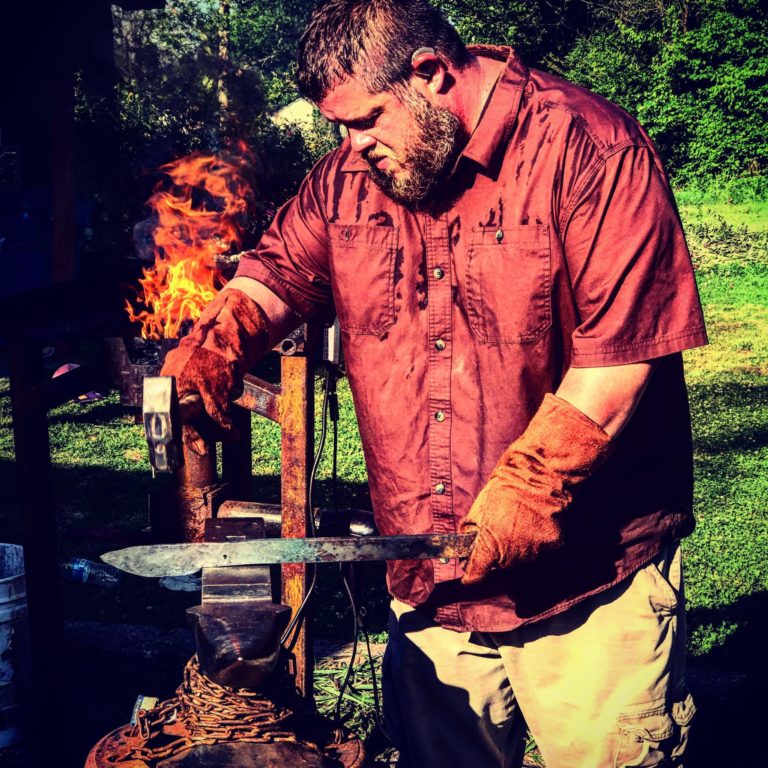
Norman “Buddy” Thomas of Tree of Liberty Bladecraft and Forge lost his hearing when he was accidentally hit in the head with a hammer. Today he’s the one wielding the hammer as he forges knives that run from frontier-style to post-apocalyptic.
Buddy was born in 1980. He and a neighbor boy were beating on their Hot Wheels with a hammer. Buddy was 3, the other boy, 5. The other boy’s swing went wild, hitting Buddy in the head. But a baby’s crown is not as forgiving as a die-cast model car. He irreparably lost his hearing. At first his parents tried the speech therapy route. Buddy began displaying social issues. It doesn’t seem like a bad idea to teach a non-hearing child to speak, but it confuses people who can hear and who do not realize the person is deaf. “No matter how well you can hone the speaking skills of a deaf individual, one thing is concrete certain, you can’t fix deaf,” Buddy explained.* He has one ear that is slightly better than the other and a hearing aid can maximize what remains, but it can’t cure the problem.
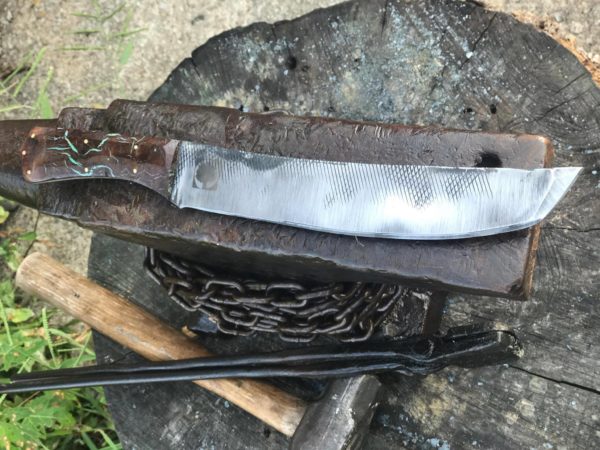
Buddy Thomas’ tanto chopper is made from a farrier rasp drawn out to 15 inches overall with a 9.75-inch blade length. The frontier-style coffin-shaped handle is stabilized maple burl with turquoise casting. Maker’s list price: $375. Contacts for Tree of Liberty Bladecrafting and Forge are listed at the end of this article.
Pre-kindergarten began for Buddy in an all-deaf environment. Throughout elementary and middle school Buddy was educated through a public-school system that focused on teaching deaf students to speak. His parents saw that he needed a change and enrolled him in Oklahoma School for the Deaf in Sulphur, which, funny enough, is one town over from where Jantz Supply is located in Davis. Jantz has been offering knifemaking supplies to craftsmen worldwide for 50 years. It was at OSD where Buddy flourished and his interest in metalwork began.
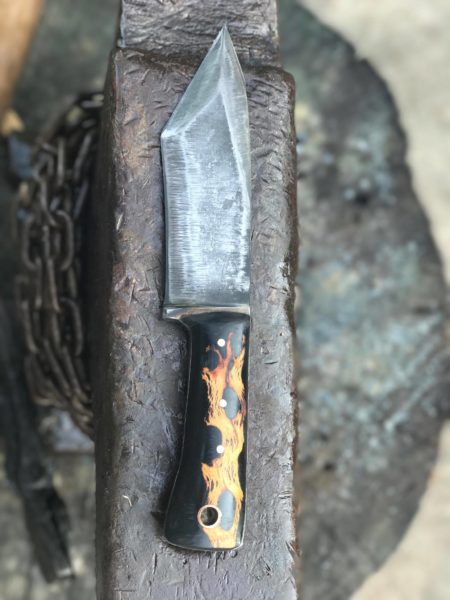
The American tanto hybrid from Tree of Liberty Bladecraft and Forge is made with 5160 spring steel. The blade length is 5.75 inches; overall length is 9.75 inches. The handle material is stabilized cholla cactus cast in black epoxy. Maker’s list price: $350. Contacts for Tree of Liberty are listed at the bottom of this article.
Meanwhile, at this time there were not a lot of American Sign Language courses for Buddy’s parents, but he taught them what he learned. His sister, Kalley, picked up on it quickly. Today, hearing parents are teaching sign language to their pre-verbal hearing children. Science is showing, in all mammals not just human babies, that possessing a non-verbal means of communication minimizes frustration and thereby aggression. Later these babies and, say, puppies who are taught means of communicating as early as three to four weeks of age, are more confident and better able to cope with the inevitable challenges of life. There are also positive physiological benefits. Buddy said that it was easiest to conduct a non-sign conversation with his parents, but even now he uses ASL frequently with his father. His mother passed away after an illness in 2014. Both of his parents encouraged Buddy tremendously, and his father, along with his fiance, June, remains one of his biggest supporters.
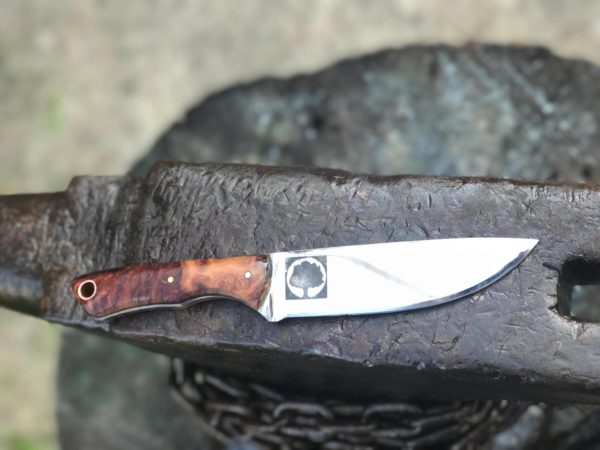
This small hunter has a 5.75-inch blade of 1095 high carbon steel. The overall length is 8.75 inches. The handle material is stabilized Australian red mallee burl cast in blur Alumilite by Lucas Free. Maker’s list price: $350. Contacts for Buddy Thomas at Tree of Liberty Bladecraft and Forge are listed at the bottom of this article.
Buddy didn’t realize how much his machine shop/metal working class would impact his life. He was focused on going to college. He graduated from OSD as a Salutatorian with a 4.0 grade point average, serving as president in the local National Honor Society. “The only mismatched puzzle was my machine shop/metal working class, which I loved because when I tried the first semester out in that class I got hooked to the welding and metal fabrication,” Buddy wrote. His instructor Dwayne Bryant spent hours of one-on-one time with him, helping him develop his welding skills. Each advancement in his metal fabrication skill fueled his creativity. “In fact, my very first nonfunctional knife was made in that class in 1997 when I was just 17 years old,” he recalled. “A piece of mild steel plating, ground into the shape of a knife roughly 8 inches overall. A DeWalt angle grinder was used to taper a bevel and create an edge. The handle was from a can of spray-on rubber. I wish I still had it. Well, after that it would be years before I attempted another knife build again.” Buddy sprinkled laughing emoticons throughout that description.
“It was pretty much just a plain little skinner, probably only an inch wide but at least a quarter-inch thick,” he noted with tears of laughter.
Buddy was also the co-editor of the school newspaper along with his good friend James Mitchell, who in his own right has had an impact on the deaf community supporting various organizations. Then it was off to major in visual communications art at the University of Oklahoma (UO) in Norman. “I was one of only three deaf students on campus: a football player recruited from Lee’s Summit, Missouri, a French major and myself, an art major,” Buddy wrote, revealing how isolating it can sometimes be for a deaf person in a hearing world.
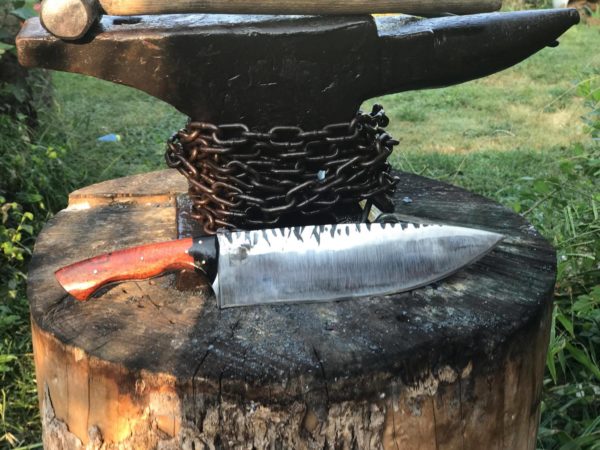
Buddy Thomas’ large bushcraft chopper is made from reclaimed early-1900s saw mill high-carbon steel. It is 16 inches overall with a 10.25-inch blade. It is 2.75 inches wide at its widest point. The handle material is figured cedarwood with a black epoxy bolster guard. Maker’s list price: $425. Contacts for Tree of Liberty Bladecraft and Forge are listed at the bottom of this article.
But Buddy got to work, putting his art and journalism experiences into play as a cartoonist and copy editor for The Oklahoma Daily, the school newspaper. “My childhood dream was to be a comic book artist. Of course, dreams change as we go through life,” Buddy noted. He grew up around several talented comic artists, including Steve Erwin, the original penciler for DC Comics’ Deathstroke the Terminator, a character portrayed on the television show “Arrow.” “I had originally wanted to attend the Joe Kubert School of Cartoon and Graphic Art in Dover, New Jersey, but I was persuaded to apply to UO and was accepted, so I went that route.” It was nice to have UO on his resume, but by the end of his first semester all the visual communications art slots were filled and he was assigned to a painting major. That was definitely not where he wanted to take his art, so he did not return, despite his good grade standing.
Buddy now manages a screen print shop and does graphic designs and color separations. “Part of my time I’m out running the automatic press and printing T-shirts, and the other part of my time I’m cooking up some wicked graphics, either for the storefront or a customer order,” he wrote. “At night and on weekends I work my forge and knife shop.” Care to guess what the name of the print shop is? Metal Fab Trophy and Screen Printing. You don’t have to hit Buddy over the head for him to get that he may be exactly where he was meant to be all along. The name he chose for his business: Tree of Liberty Bladecraft and Forge, invoking the freedom that he experiences through his creativity.
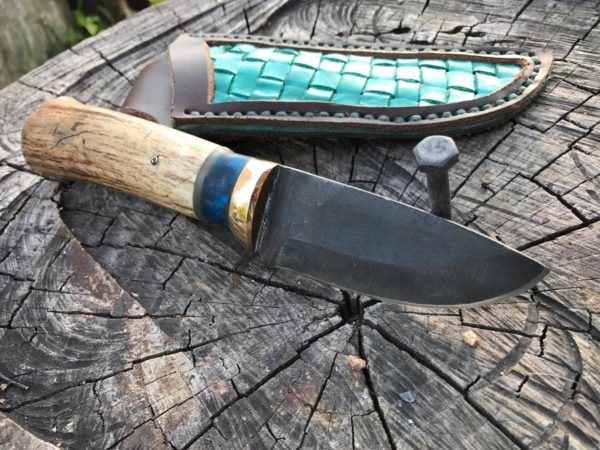
This Buddy Thomas creation comes with a turquoise leather weave sheath. It is made from CPM S90V steel, 9.5 inches overall with a 4.75-inch blade. The handle is elk antler with a rustic coffee stain and a blue Alumilite spacer and solid brass guard. Maker’s list price: $575. Contacts for Tree of Liberty Bladecraft and Forge are listed at the bottom of this article.
Buddy’s design skills do help him when he’s working up a pattern for a stock-removal knife on card stock, “but when forging, it’s all in the eye,” he wrote. Buddy started in stock removal and worked his way into forging by trial and error with lots of research and time spent learning from other forge artists. “A guy I ran into in a forum a few years back—his name was Ethan Paul Dobbins—he sent me tons of material to read up on. Another was a lifelong friend who did some blacksmith work as a tool maker, James Moore. I have actually learned most of my blacksmithing skills at the anvil from James, who was there to help me correct my hammering form and help guide me through and recognize heat requirements and steel reactions,” Buddy explained.
Buddy can read lips and his hearing aid, although not the best, helps him hear a little. “James is as hearing as they come! Maybe selectively deaf at times,” Buddy joked with a laughing emoticon. “I can read him pretty well, but sometimes have to have him repeat himself.”
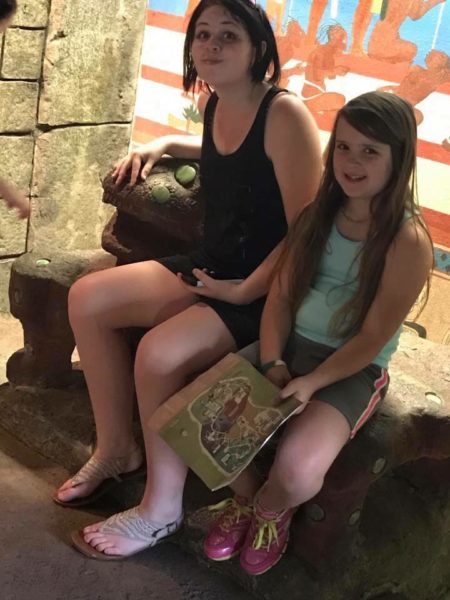
Deaf bladesmith Buddy Thomas and his hearing wife, Sundae, have two daughters, Anna, 12, and Kaity, 9.
Buddy’s wife, Sundae, is also hearing. They met at a football game in Picher, Oklahoma, and were married in 2001. She did not know sign language at the time, but she has learned from Buddy. They have two daughters, Annaleigh, 12, and Kaitlynne, 9, who also know sign language. Their first child, also a girl, Daisy Elizabeth, would be 15 now, but the couple lost her two weeks after she was born, to infection. “She passed in my arms,” Buddy wrote.
Buddy and Sundae Thomas lost their first child, a daughter, at 2 weeks of age, due to infection. Buddy lost his hearing at the age of 3; his wife is hearing.
“She was beautiful. I always wonder what she might have been like as their older sister. I’m so grateful and thankful for those two.”
If you converse with Buddy for any length of time, you will sense the sad undercurrent of the tragedies in his life, but you simultaneously get the feeling of a silent, gentle but unwavering determination to not just live, but thrive. He doesn’t minimize the impact of his losses—his hearing, his daughter, even his childhood aspiration to become a comic strip artist though he admits to outgrowing that aspiration—but the Tree of Liberty gives him more than solace; it restores his life-battered spirit.
He enjoys the stock-removal method of knifemaking, but whenever possible, he prefers to forge. He started on a coal forge and still loves it, but he often goes to the propane forge because it’s quicker and cleaner. “Most CPM steels are difficult to forge,” he observed. “Stock-removal methods work much easier for such jobs. Most of my stainless and powder steels I apply the stock-removal method to, but my high carbons benefit me better at the forge. Ultimately, they all go in the forge for heat treating.”
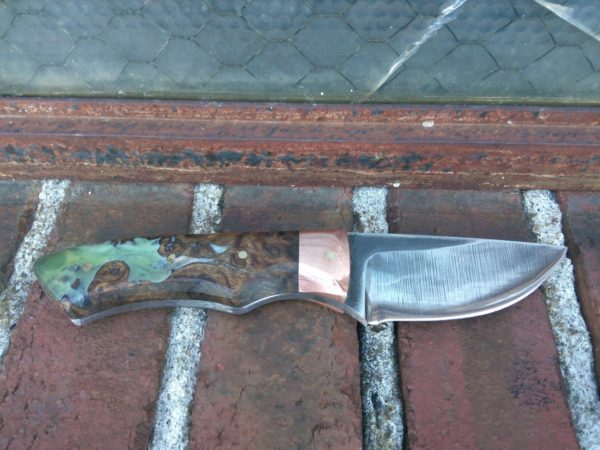
This Tree of Liberty Bladecraft and Forge creation has a 4-inch Elmax steel blade and an overall length of 8.75 inches. The handle material is rare black nargusta cast in a jade green Aluminite by Rob Carper of RC Innovations. The bolster is copper. Maker’s list price: $475. Contacts for Buddy Thomas listed at the bottom of this article.
Buddy’s knifemaking style swings from old frontier to post-apocalyptic utilizing reclaimed steel. He also makes everyday carry knives and has a preference for using copper bolstering. “One of my biggest goals as a maker is to get a prop knife made for ‘The Walking Dead’ show,” Buddy notes. His forging buddies, Aric Davis, Ryan Edwards and Louis Stark, often get together for Sunday forge-ins. In other words, the forge is the hearth of Buddy’s heart.
“I would not be where I am in this world if I did not have the deaf community behind me, specifically my best friend who has always had great words of encouragement,” Buddy said of a deaf woman who is like a sister to him. He recommends that deaf people who are interested in learning about knifemaking and forging do so through a deaf school or access vocational rehabilitation departments in their state for guidance and research. The next step is to seek out experienced bladesmiths who offer classes in their shops. “A deaf individual would acquire an interpreter to accompany them to the classes. It is actually my goal to establish a stronger bridge in that direction,” Buddy added. His plan is to work toward his American Bladesmith Society journeyman smith rating and eventually his master smith rating so he can offer classes to other deaf people. He knows they would be more comfortable learning from a deaf instructor. Three-way conversations with an interpreter can lead to a loss in focus.
Buddy lives out his favorite quote, attributed to Helen Keller: “Optimism is the faith that leads to achievement. Nothing can be done without hope or confidence.”
*Editor’s note: For this interview Buddy and I Messaged about using Facetime, but we felt it would be easier for him if we Messaged. It forced me to slow down and try to pick up on all of those nuanced things that happen even in phone conversations, like tone. In the end, Buddy and I both felt that he had told his story and I had heard his story in all its bittersweet humanness.
Buddy’s Links for Deaf-Related Services And Assistance
September is National Deaf Awareness month. Here are a few organizations that deaf bladesmith Buddy Thomas of Tree of Liberty Bladecraft and Forge in Quapaw, Oklahoma, recommends.
Empowers Oklahomans with disabilities to live healthy, active, smoking-free lives.
A Digital Subscription To BLADE Is The Answer
You can read your digital issues of BLADE Magazine anywhere you have your phone, tablet or computer, and there’s no need to find storage for all your old issues.
If piling up issues of magazine seems like a waste for you… If you feel like you don’t have time to read a magazine… If you like the stories we offer in BLADE, but want a more economical option, then a digital subscription is the answer. An annual subscription to BLADE is $17.98, $4 off the print price.
Great knives have face. I’m not talking about a face like on a Halloween mask, but a knife with a design or style that’s recognizable by a large number of knife enthusiasts as having been made first by one knifemaker and one knifemaker only.
The face, in this instance, is the unmistakable knife design or style of the maker in question.
There are at least two provisos: 1. To fully qualify as a knife with face the knife must be recognizable by a large number of knife enthusiasts. Now, there no doubt are great knives made by makers that one or a few enthusiasts may recognize as being the knives of specific makers, but the ones that really fill the bill are the ones many enthusiasts can look at and say, “Yep, that’s so-and-so’s knife.” It’s effective in terms of a conversation starter among knife enthusiasts who are friends, or as a conversation icebreaker among those who have just met. They don’t know each other but they do know great knives with face.
2. Some of the makers of knives with face have had their designs with face emulated by many others. Even so, if the knife has face those who recognize it will say that it’s in the style of the maker who originated it.
Following is a selection of great knives with face and why they qualify. Enjoy!
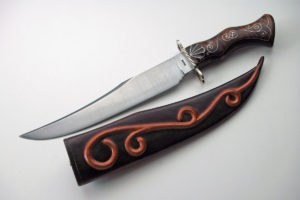
The Bob Loveless dropped or drop-point hunter. The Loveless drop-point hunter is one of the great knives with face on this list that meets Proviso 2 above. While it may not appear to be all that unusual, the drop-point style of the blade—where the blade tip falls below the plane of the spine—is something Loveless popularized in the 1970s and ’80s, and it remains his signature style to this day.
The Bill Moran style. Actually, as with Loveless, any number of Moran knives have face, though I’ve chosen one of my favorites: the ST-24. The flowing blade with a long clip point and ergonomically contoured dropped handle with silver wire inlay is unmistakably a Moran.
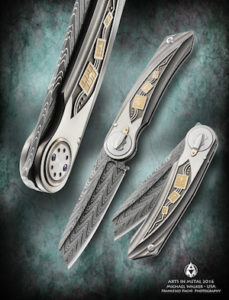
The Michael Walker style. Walker’s linerlock folder changed knives forever but he also makes models unlike anyone else. Outfitted with any number of his clever and innovative locks, each of which gives the handle a notably different look at the pivot, Walker’s knives use the latest and most exotic materials, are embellished in any number of creative and ornate ways, and usually have some of the most interesting blade shapes you’ll ever see.
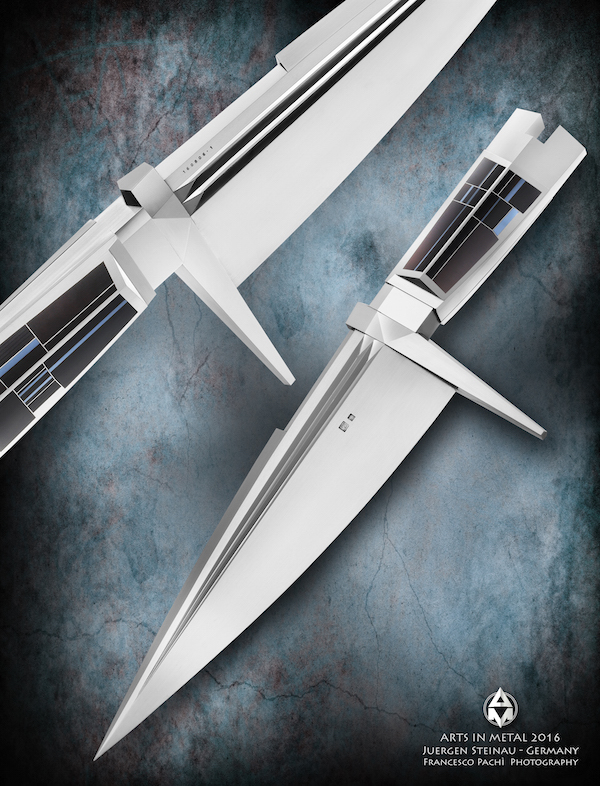
The Jurgen Steinau style. When I first saw one of Jurgen Steinau’s knives, at first I wasn’t even sure I was looking at a knife. The designs, angles and materials of his knives are like something from a book on intergalactic architecture. Suffice it to say, Steinau’s great knives have face—and then some!
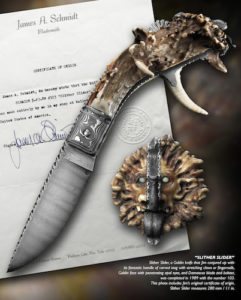
Jim Schmidt’s Goblin Folder. Schmidt’s Goblin Folders have face in more ways than one. Not only do they have the face of a goblin on the handle’s stag butt, but that face makes the knife unmistakable as the style originally made by Mr. Schmidt. A number of his other models have face as well.
There are others who make great knives with face. Which ones make your list?
1 The Loveless dropped or drop-point hunter has face in large part because of the drop-point blade with the tip that drops below the plane of the spine. An original is shown at bottom here, with a Schrade repro at top.4 Jurgen Steinau’s great knives have face for their design, angles and materials that look like something straight out of a book on intergalactic architecture.3 Michael Walker’s spectacular folders have face for any number of reasons, from their distinctive pivots to their exotic materials, creative embellishments and standout blade shapes.2 Bill Moran’s ST-24 has face thanks to the long, flowing blade and ergonomic dropped handle with silver wire inlay—not to mention his distinctive sheaths. Those who know great knives recognize the Moran style immediately.
5 Jim Schmidt’s Goblin Folder has face in more ways than one—it actually has the face of a goblin on the handle butt!
02.14.2011– Portland, OR – Gerber Legendary Blades, a leader in the knife and tool industry for over 70 years, is pleased support the Boy Scouts of America and the regional Cascade Pacific Council of the BSA.
With a promotion at the recent SHOT Show in Las Vegas, Nevada, Gerber was able to raise over twenty-two thousand dollars though the sale of Gerber’s new Bear Grylls Compact Scout knife over the course of the four-day show. Proceeds from the sale went directly to the Boy Scouts of America Cascade Pacific Council , which provides services and youth-development programs to families and community organizations in eighteen counties of northwest Oregon and southwest Washington states.
According to Michael Egan, Director of Development for the Cascade Pacific Council of the BSA, the funds will be used for Camperships for low-income youth. “Each year we invest over $100,000 for at risk kids to go to camp, yet do not have an ongoing revenue source to pay for them,” explains Egan. “So, when funds like Gerber’s generous gift come through, we put it right towards the kids who need it most.”
“At Gerber, we really pride ourselves on leadership, responsibility and action, all core tenants of the Boy Scouts, so we are very pleased to lend our support to the organization,” said Corey Maynard, Director of Marketing for Gerber. “Furthermore, by donating funds to the Cascade Pacific Council we are able to give back to our local community, a community that has greatly supported Gerber over the years,” concluded Maynard.
The launch of the Gerber Bear Grylls Survival Series, and Bear Grylls’ active role in the scouting movement, helped created a natural fit between Gerber and the Boys Scouts. In addition to the Bear Grylls Compact Scout knife, which helped raise funds from this sale, the 2011 Bear Grylls collection will feature a number of products including knives, tools and survival gear ideal for scouting.
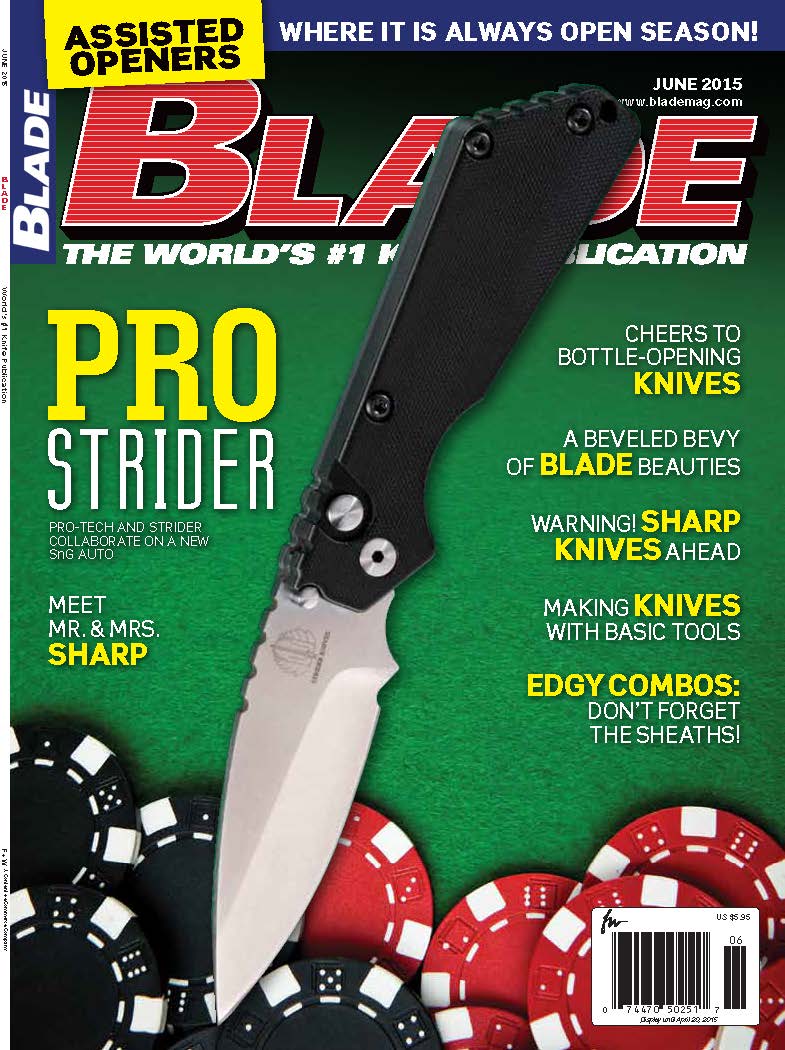
The Pro-Strider SnG, a collaboration between Pro-Tech and Strider Knives, is the cover knife for the latest issue of BLADE®.
The latest 2015 factory knives as seen at the SHOT Show—including the Pro-Strider SnG cover knife from Pro-Tech—how to make a knife with basic tools, hot bottle-opener knives, the edgiest custom knife-sheath combos going and much more highlight the new BLADE®, on newsstands NOW!
The Shooting, Hunting, Outdoor Trade (SHOT) Show is the annual coming-out party for the year’s brand new guns and related products for those in the applicable trades—including factory knives. BLADE was there to visit with factory knife and knife accessory companies from all corners of the globe to see what their latest and greatest knives are for the new year. Check out the results in “A Beveled Bevy of Blade Beauties” on page 12.
Many people seem to think you must have a complete shop setup to make a good knife, but BLADE field editor and ABS master smith Joe Szilaski knows better—and shows you how to make a knife from a file with a few basic tools on page 20.
Bottle-opener knives are nothing new—Swiss Army and boy scout knives with folding bottle-opener tools have been around for ages—but the recent crop of bottle-opener knives with the opener incorporated into the butt of the handle is going gangbusters. Check out this hot new trend on page 50.
Time was a sheath with a fixed blade was a given, kind of like milk with your cereal, bacon and eggs, and toast and jelly. However, it is not uncommon for some of today’s fixed blades to be absent a sheath. On the other hand are those custom makers who take pride not only in making world-class knives but pairing them with world-class sheaths as well. Meet some of these makers and their handiwork in “Edgy Combos” on page 72.
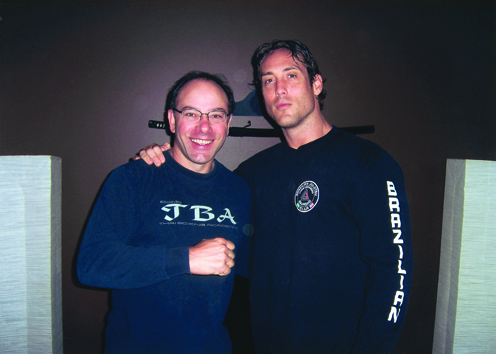
As with all Johnny Strong knives, the Urban Assassins (top photo) are flat ground from CPM-S35V stainless and heat treated by Paul Bos Heat Treating. Overall lengths: 11.5 inches. (Katie Summers photo) Johnny Strong’s latest movie Sinners and Saints (second photo from top) debuted in January. (Photo: Mark Rutledge; Poster: Dave Burton) The author [left] and Strong [right] (third photo from top) at the author’s house.
Star of Sinners and Saints also makes knives
By Wally Hayes
Through knives I have met some of the most amazing people, one of whom is actor Johnny Strong. Last summer I received an e-mail from Johnny. He was interested in my Dragon Waki he had found on Bladeart.com’s website. We exchanged e-mails about his new waki, music and his interest in knifemaking. I learned Johnny is an actor, musician, martial artist and artist. He has been collecting knives since he was 8.
“It was when I was on tour with my band, Operator, that I got serious about collecting custom knives. I would be on the tour bus searching the web for knife dealers,” he said.
After talking with Johnny and learning a little about him, I suggested he visit my shop and hang out for a weekend. He did—and he jumped in with both feet.
We started out forging two blades to shape. Then I taught him grinding and heat treating. The crash course was three long, fun-filled days. As Johnny told BLADE®, “It was a great experience coming to Wally’s and having him share all his knowledge with me. I learned how to manipulate steel and apply these skills to my edged art.”
As soon as Johnny returned home, he ordered a belt grinder, drill press and some steel. In the past year he has created some very original designs. His computer-drawing skills enabled him to develop a practical and aggressive-looking knife style. As he noted, “With my knives, I like to paint in tactical colors.” His blades are flat ground from CPM-S35V stainless steel and heat treated by Paul Bos Heat Treating.
Johnny has created some unusual blade finishes with a combination of bead blasting and etching. The blades are ground with a wide secondary bevel that makes his knives razor sharp, similar to those by Shiva Ki. Johnny hand carved a mold to make his handles. He casts them one at a time. The handle material is an impact/chemical-resistant resin. The cutouts in the handle butts are multi-purpose prying/shaping tools. He also designed and ordered custom-made black titanium handle fasteners.
Three of Johnny’s models are the Urban Assassin, Canine Assassin and Combat Assassin (this issue’s cover knife; see page 7). Respective blade lengths are 6.5, 8.5 and 11 inches. The blade of the Canine Assassin has a tiger-stripe finish, while the Combat Assassin blade features a sawback. Each blade has what Johnny calls his three-edge design, which was inspired by the knife-combat training he has received. All his knives come with custom leather sheaths.
Sinners and Saints
Johnny has starred in Black Hawk Down, The Fast and The Furious, Get Carter, The Glimmerman and his new action movie, Sinners and Saints. Johnny plays the lead role of Sean Riley, a New Orleans detective.
To prepare for one of the movie’s knife fight scenes, Johnny trained with Ron Balicki for three months. Balicki is well known as a practitioner and teacher of the martial arts, and is a student and son-in-law of Dan Inosanto, a legendary martial arts instructor who studied under Bruce Lee. Balicki is also a top Hollywood stuntman and plays the role of Rucker in Sinners and Saints.
Johnny learned both one-handed and two-handed combative drills. In a knife-fighting scene in the movie, Johnny uses an Allen Elishewitz “Phalanx” folder and a Cold Steel Tai Pan dagger. Balicki plays Rucker, a bad guy Johnny’s character must kill. The knife-fighting scene took two days to shoot. Balicki uses a Cold Steel Voyager folder in the scene.
“Ron has a ton of experience and was great to work with,” Johnny noted. “We wanted to make the knife fighting scene as realistic as possible.” Johnny has a strong background in martial arts with a black belt in Brazilian Ju-Jitsu and is training hard to get in shape for his next movie.
Movies, Music and Knives
This past fall I flew down to Johnny’s to help with his knifemaking and have some fun playing music as well. Music is a big part of Johnny’s life. When not acting, he works on music either for film scenes or his own CDs.
His new album is The War of Art on iTunes. It features two of his Urban Assassin models silhouetted on the cover. I was asked to bring my guitar so I could play lead on a couple of songs in his studio. What a blast—mixing knifemaking with recording music. We worked on edge geometry, sheaths and a new folder design coming out in 2012. Stay tuned for more movies, music and knives from a very talented guy.
For more on the latest knives, knife legislation, knifemaking instruction, knife trends, knifemakers, what knives to buy and where and much more, subscribe to BLADE Magazine, the World’s No. 1 Knife Publication. For subscription information click onhttp://www.shopblade.com/product/blade-magazine-one-year-subscripti…?r+ssfb030312#BL1SU