The BLADE Blogs

The blogs of the BLADE editors, Steve Shackleford and Erin Healy.

Elvis and the Gil Hibben Knife

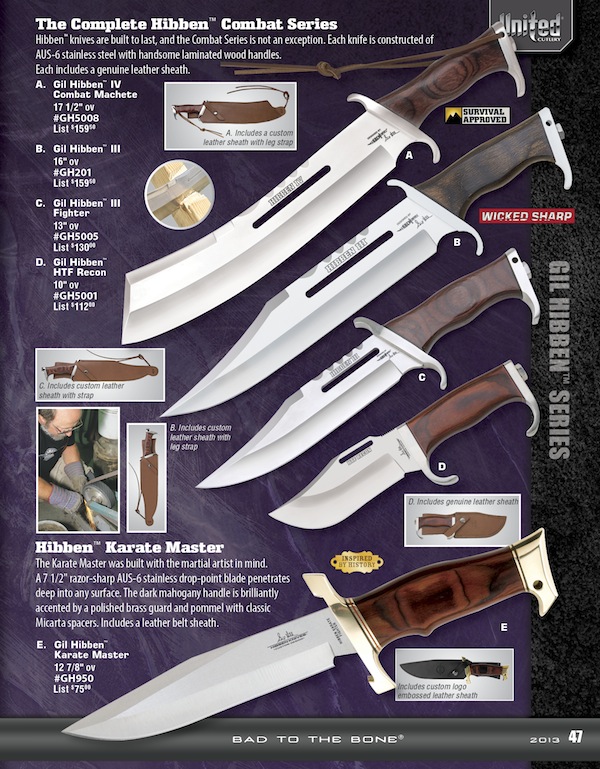
The Hibben Karate Master shown at bottom here is the updated version of the knife Gil Hibben made for Elvis Presley in 1974. (United photo)
The knife Gil Hibben made for Elvis Presley in 1974 lives on today in the “Hibben Karate Master” reproduction (shown at bottom above) from United Cutlery. (United photo)

What better day to celebrate the custom knife BLADE Magazine Cutlery Hall-Of-Fame© member Gil Hibben presented to Elvis Presley than on The King’s birthday?

Today is Presley’s birthday and a reminder of when Hibben and Phil Lobred, coordinator of the Art Knife Invitational, visited Presley 40 years ago.

It was also when Hibben presented Presley with a handmade Hibben knife.

Both Hibben and Presley were practitioners of Kenpo karate. In 1974, Gil and Phil attended a Kenpo tournament in Los Angeles. While there, they stayed with Ed Parker, founder of the Kenpo system. Parker had one of the early custom Hibben Kenpo knives which, at the time, Gil called the Ed Parker Knife. It occurred to Parker that Elvis, who had a second home in L.A. and was a karate student of Parker’s, might be interested in the Hibben knife. Plus, presenting the knife to Elvis could be a way to get Gil and Phil in to see the King.

Parker made the arrangements and Gil and Phil were at Presley’s L.A. home. When the knife was presented to Elvis, the King was extremely pleased. “He was like a kid with a new toy,” Lobred recalled. Presley went upstairs and returned with a gold Omega watch and presented it to Hibben in return. In all, Gil and Phil got to hang out with the King and Co. for about six hours.

As for whatever happened to the knife presented to Presley, Hibben said no one knows for sure. “It’s not at Graceland,” Gil noted. Maybe one day it will turn up. If it does, Hibben said he will know it on sight.

For the latest knives, knife news, trends, tips and more, stay honed at www.blademag.com.

High In The Necking Order

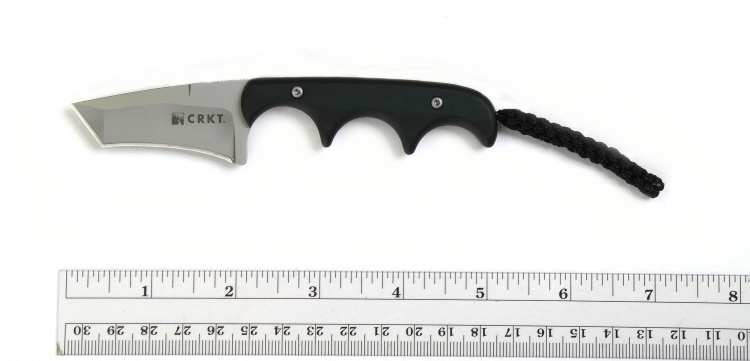
An Alan Folts design, the Columbia River Knife & Tool Minimalist Tanto features a 2.125-inch blade of 5Cr15MoV stainless with a Rockwell hardness of 55-57 HRC. Weight: 1.6 ounces. Overall length: 5.13 inches. MSRP: $34.99 (includes A glass-filled nylon sheath, neck paracord and braided fob). (CRKT photo)

The latest factory neck knives are a smorgasbord of designs and carry options

“When neck knives are designed and made properly, they will be minimal in size, yet easy and comfortable to use. They will be light enough around the neck to not be bothersome or noticeable [and] will be held safely and securely upside down in their sheath, but can be drawn and put into action with a minimum of effort.”

    The preceding words by ABS master smith Murray Carter accurately and succinctly capture the finer qualities of neck knives, a subject Carter knows a thing or two about since he forges nearly 40 varieties. Along with the growing popularity of knives specifically designed for this carry system, the offerings by knife manufacturers are also expanding to meet the demand, and like many factory-produced blades today, the quality of the finished product is increasingly excellent.

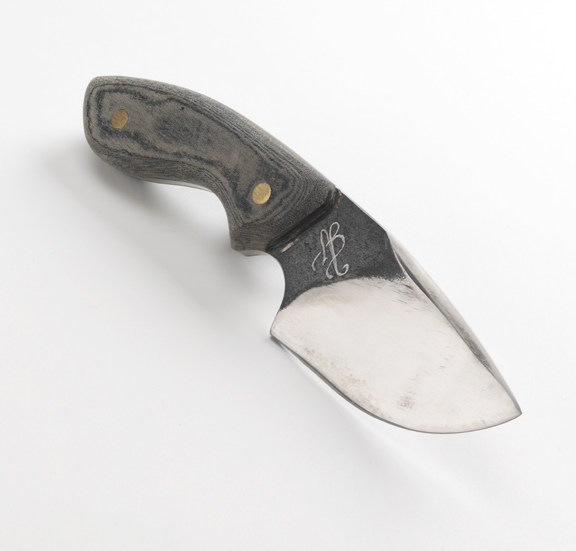
    If you happen to be in the market for a small, multi-use utility neck knife, then the Boker Plus Gnome fits the bill. The full-tang design is 4 inches overall, which is somewhat smaller than most neck knives, and the 2 1/8-inch blade of 12C27 stainless steel is relatively thin to enhance cutting ability. The Micarta® handle is equipped with a hole for a lanyard.

    “On a knife this small, weight is generally not an issue, and the lanyard hole does help the knife’s balance,” noted Terry Trahan, Boker USA product specialist. “The Micarta with the unique handle design’s deep choil-like area and lanyard all work together to provide a good grip.”

    The design is a collaboration between Boker Plus and Danish maker Jesper Voxnaes. The knife also is available in a stag handle, and comes with a leather belt sheath.

Female LEO Feedback

5.11 Tactical (see April 2011 BLADE®*) has introduced a new necker to its growing family of knives. Consistent with the company’s approach to knife designs, this one also grew out of feedback from customers.

    “We had a meeting of all female law enforcement officers, which was the first time we had women only at one of these meetings,” said Mike McCourt, business leader for 5.11’s knife program.  “The female officers requested a personal defense, last-ditch knife that could be worn around the neck or behind a belt.”

    The resulting effort is the “SidePick Spearpoint,” which has a 2-inch blade of AUS-8 stainless steel and choices of a plain or 50-50 plain/serrated edge. The textured FRN scales are removable. The back edge can be sharpened (though be sure to check the laws in your area for double-edged knives). MSRP: $59.99.

    “The composite sheath comes with an adjustable boot/belt clip and adapter that allow for a total of 12 carry angles,” McCourt noted. “There’s also an ankle strap for extra security during boot carry, and for neck carry it has a black beaded breakaway chain.” A breakaway chain prevents injury and even strangulation should it be grasped in a struggle or catch on something.

“A Pure Necker”

Nemesis Knives offers four different neck knives, including the new “Afterburner.”

    “The Afterburner’s 2.25-inch blade fills a gap between our 1 5/8- and 2-inch models and, unlike our other neck knives which can be carried numerous ways, the Afterburner is a pure necker in the sense that there are no other carry options,” noted Nemesis headman and the knife’s designer, Jeff Hall. “I’ve been thinking about the design for a long time, so it has been two or three years in the making.”

    The knife is 5.25 inches overall with a blade of 9Cr13 stainless in a satin or black finish. A bead chain and Kydex® sheath are included.

    “Our customers wanted a beefier small fixed blade, so unlike many other neck knives, which are only 1/8 inch thick, the Afterburner is 3/16 inch thick,” Hall said. “It’s also full machined inside and out, and all the holes and corners are CNC-machine countersunk and chamfered.” The knife features skeleton construction to reduce weight, and thumb ramp ridges for added traction in various grips. Tentative MSRP: $49.95. 

Church-Key Design

To hear Mike Manrose of Meyerco tell it, the company’s “Besh Wedge Bottle Rocket” designed by Brent Beshara seems to be a multi-collaboration of sorts.

    “It started off as Dirk Pinkerton’s Variable Broadhead neck knife and Brent added the BESH Wedge geometry, while also lengthening the knife out,” Manrose said. (Author’s note: The BESH Wedge is two diagonally opposed bevels converging to create a third edge [see October 2010 BLADE*]). In other words, what you have is a bottle opener and a handy box cutter. “The knife is a great utility piece as well as a very usable backup weapon,” Manrose said. “It is based on an age-old church key design.”

    The origin of church key is unknown to me, but the term brings to mind various bottle/can openers worn around the neck on youthful trips to the beach with a hoard of guys toting coolers full of beer. Apparently that memory is not far off the mark, as I discovered when I asked Beshara what the knife is designed to do.

    “It is a beer-drinking tool which opens bottles and cans,” he grinned. “The handle is the bottle opener, and the front has a BESH Wedge, which is unsharpened due to the nature of the tool, and the reinforced tip easily opens can tabs.”

    The Bottle Rocket’s 2.5-inch blade is 7Cr17 stainless (according to Manrose, an equivalent of 440A). Overall length: 5 inches. It comes with a sheath and neck chain. “The sheath is glass-filled nylon, which is tough as nails,” Manrose said. “We put a detent ball in it so you can spin it on a smooth surface for who buys the next round. It will serve you well for a long time as a utility piece, bottle opener, backup—and it’s just cool!”

    While nodding my head in mute admiration, I asked Manrose to expand on the “spin” feature.

    “Another age-old tool from the Roman era,” he chuckled.  “An old sailor’s game I picked up along the way,” added Beshara. The MSRP is $29.99 and the piece comes with the words “Cheers! Besh” aptly engraved on the reverse side.

Added Considerations

Given today’s available neck knife choices, opting to wear one involves making decisions that include purpose, size, materials, design, or just about anything else you would consider when choosing a fixed blade, with the provision that the overall length will be naturally limited.

    I have worn a necker regularly for some time in perhaps the most common form—handle down in a Kydex sheath. It is easy enough to access under a shirt with the button closest to the handle open, though I exercise great care returning the blade to the sheath for reasons equally divided between my intense dislike of pain and a deep fear of embarrassment were I to stab myself in the chest.  Along with using caution in re-sheathing, it is also important to remember a general rule of thumb: Any fixed blade may be considered “concealed” for legal purposes, so it is good to be familiar with pertinent state and local regulations.—by Stephen Garger

For information on how to get a wharncliffe-blade version of CRKT’s Alan Folts Minimalist, click on http://www.shopblade.com/folts-minimalist-2385?r+ssfb062112


For a profile of 5.11 Tactical, the BESH Wedge story and other articles, nearly 300 past issues of BLADE® are available in two separate DVDs. Visit http://www.shopblade.com/category/cds-dvds-videos?r+ssfb062112 or call 855-278-0406 and mention the First 25 Years Of BLADE DVD collection (1973-1997), or the BLADE 1997-2007 DVD.


For more on the latest knives, knife legislation, knifemaking instruction, knife trends, knifemakers, what knives to buy and where and much more, subscribe to BLADE® Magazine, the World’s No. 1 Knife Publication. Click on http://www.shopblade.com/blade-magazine-one-year-subscription-us/?r+ssfb062112 for more information.


Knife Test: Alan Blackwood’s D3 Skinner

The blade of Alan Blackwood’s field-grade skinner shows some of the smudges from the test administered to it by BLADE® field editor Kim Breed.

Alan Blackwood’s D3 Skinner Tackles Deer, Squirrel and More

By MSG Kim Breed, 5th Special Forces (retired)

    As hunting season was fast approaching, I told knifemaker Alan Blackwood I would like to test one of his new and improved skinners. I received a knife that looked good and felt even better. Now to the woods to see how the skinner performs.

Squirrels ‘n Such

As luck would have it on the whitetail side, I was striking out—not good for the knife or me. However, I did manage to remove some nuisance squirrels from Mrs. Elder’s house that were chewing holes in her log cabin home. The skinner’s blade easily parted the squirrel skin so I could finish the cleaning. The wide blade came in handy while removing the heads and tails, keeping my fingers away from the cleaning board while applying pressure to crunch through bones.

    While the squirrels soaked, I did some cutting tests. I stropped the edge to clean it up and started in on some dense foam. The knife has a sweet spot for cutting right at the blade belly. The dense foam parted easily with a nice, slick pull cut. Since I was at the cutting board already, I grabbed some 3/8-inch sisal rope. Crunch, crunch, crunch—man this steel really cuts rope aggressively! After 83 cuts I had a little sliding going on and noticed the edge had a wire burr. A few strops on the leather took care of it and the edged was back to hair-popping sharpness.

    As long as my list of honey-do’s was keeping me out of the woods, I had a new batch of pine to cut and whittle. I really like the way the skinner feels for whittling. The knife is very easy to control and, when I wanted to power cut, the wide blade bit even better. The rounded-off handle really form fit my hand as I applied pressure—and then I hit a hard knot. The blade still cut but the convex edge wanted to roll away from the knot. No problem. I opted to use a soft-blow hammer to drive the blade through the knot. It worked and there was no damage to the edge.

    As I was on a roll and not hunting, I decided to do the brass-rod edge-flex test. I did not know how the blade’s D3 tool steel would handle it as it was the first time I had tested a knife of D3. With gloves and safety glasses on, I pulled the edge across the brass rod. A little hump formed and followed the stroke of the knife to the tip, then returned to normal. The edge did not chip or stay bent—a perfect flex test result indicating spot-on heat treatment.

Skinning/Quartering Marathon

We had a little cold snap and that changed my luck. I harvested two does on a Monday and two more the following Wednesday. It was time to see what the skinner could do. I was in for a skinning-and-quartering marathon! The skinner was aggressive on the skin and meat. I was able to skin and quarter four good-sized deer in two hours, which is fast considering I could hang only one at a time and had to return to the backyard to fetch each deer carcass. After I washed the blade, it would still shave hair.

    The little skinner comes with a nicely tooled 8-ounce, vegetable-tanned leather snap sheath by Steve Stapleton of B&E Shoe Service. The sheath really makes the skinner pop.

Great Hunter Package

As far as skinners go, this is a great one. It stays sharp and is very comfortable in the hand. It is a great package for any hunter.

For more information contact Alan Blackwood, 32082 Sidehill Rd., Rutland, OH 45775 740-742-2431 e-mail [email protected].

KNIFE SPECS

Knife: Field-grade skinner

Maker: Alan Blackwood

Blade Length: 3.25”

Blade Material: D3 tool steel

Rockwell Hardness: 58 HRC

Handle: Micarta®

Overall Length: 7.25”

Sheath: 8-oz., vegetable-tanned leather snap model by Steve Stapleton

Maker’s List Price: $125

For more on the latest knives, knife legislation, knifemaking instruction, knife trends, knifemakers, what knives to buy and where and much more, subscribe to BLADE Magazine, the World’s No. 1 Knife Publication.

Veterans’ Knives for Veterans Day

Case V-42 dagger.
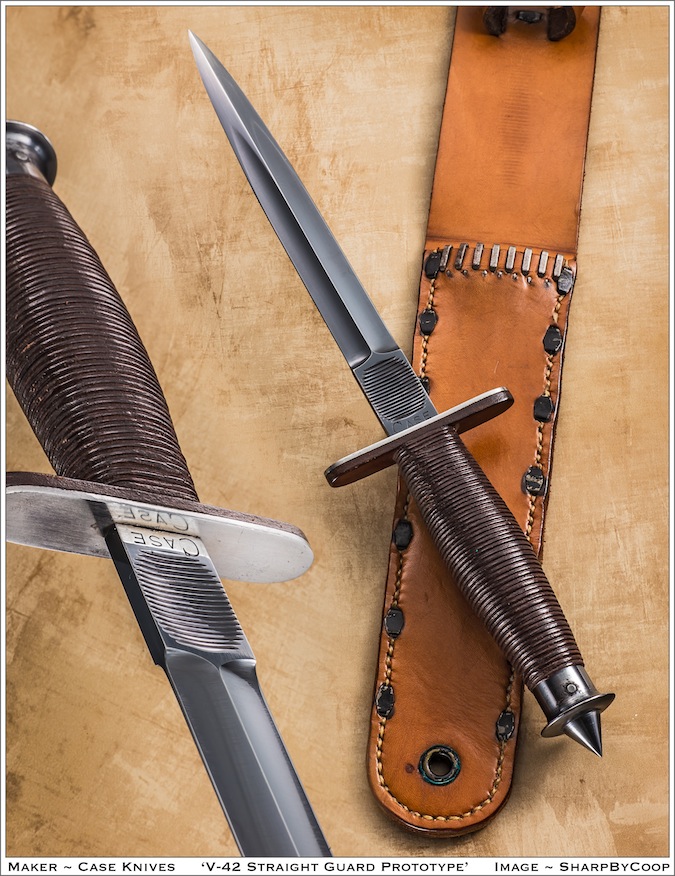
The classic Case V-42 with thumbprint ricasso. (SharpByCoop image)
World War II Mark 1's.
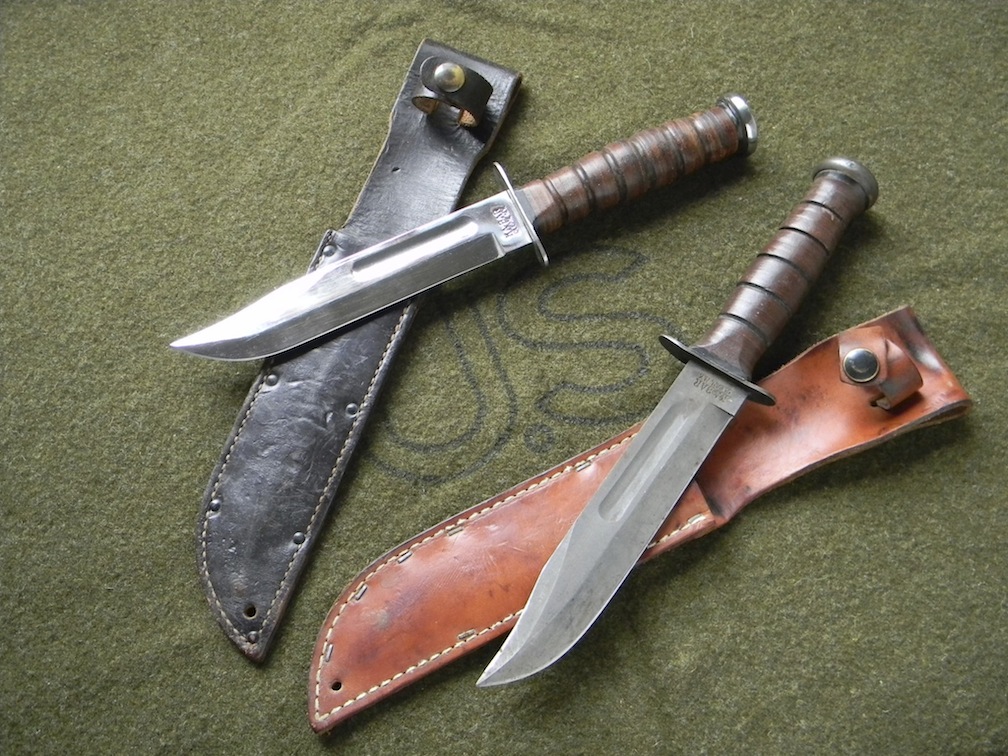
Two Mark 1’s, one by Pal (top) and Robeson (bottom).

In honor of Veterans Day, here are a few of the veterans’ knives that have seen action over the past century in the service of our country:

•U.S.N. Mark 2/U.S.M.C. fighting-utility knife: Known to many simply as a KA-BAR or kabar, it was made during World War II not only by Union Cutlery/KA-BAR but also, among others, Pal, Case, Camillus, Utica, Conetta and Robeson Shuredge. The iconic picture of it on the hips of U.S. Marines on the black sands of Iwo Jima tells it all—it was there and so were the Marines, who, by the way, are also celebrating their 240th anniversary. Semper Fidelis!;

•U.S. Mark I Trench Knife: It has all the trimmings: skull crusher, dagger blade, and the four finger holes in the knuckle guard. It reeks of Doughboys, Over There and Jimmy Cagney’s The Fighting 69th;

•Randall Model #1-8: WIth its stacked-leather grip and flowing blade, slightly dropped handle, double guard and narrow tang opening into a magnificently ground clip-point blade, the Model 1 has some of the most beautiful lines of any knife ever made;

KA-BAR Mark 2's.
Two Mark 2’s stamped “KA-BAR.”

•Case V-42: Classic skull crusher, cylindrical/swell-center handle, double guard, dagger blade and the clincher, the thumbprint indentation iwth grooved lines on the ricasso alone would guarantee the V-42 a place in any pantheon of military knives;

•Gerber Mark II: The one with the “cat-tongue” handle—so-called because of the feel of the grip created by spraying molten stainless steel onto the aluminum—and the wasp-waisted blade is a favorite from the Vietnam War;

•SOG Recon: The “twin-peak” blade spine readily identifies this military classic from the Vietnam War. “SOG” comprises the last three letters in the MACV-SOG acronym, the seven which stand for Military Assistance Command Vietnam-Studies and Observations Group;

•Ulster Mountain Pocketknife: These utlilitarian pocketknives reportedly were issued to the First Special Service Force during World War II and later to the troops of the 11th Mountain Division.

Marines at Iwo.
U.S. Marines land at Iwo Jima, their U.S.N. Mark 2’s/Ka-Bar fighting/utility knives at their sides.

A Revolution in Slip-Joint Construction

Unlike the traditional pocketknife in which the backspring rises and falls when the blade is opened and closed, the backbar of Tom Ferry’s model equipped with the Everflush Spring (top) remains flush when the blade is opened and closed. Ferry (above) works on a model with the mechanism in his shop.

The Everflush Spring takes the traditional pocketknife folding mechanism to the next level

By Lorien Arnold

As the traditional slip joint experiences a rebirth in favor among knife enthusiasts, there is increasing room for innovation in the knife’s classic, time-tested construction method.

    Enter Tom Ferry and Mike Vagnino.

    Innovators and educators, they have forged their paths in steel. Developing techniques and learning new skills, while at the same time teaching others, the two have collaborated on a concept that incorporates a generations-old method for assembling a slip joint, while bringing it into new worlds of materials and technology.

    “[An] idea evolved from the desire to engrave the backbar of slip-joint folders,” Ferry began. “The reason this was all but impossible before was that slip-joint backbars or [back]springs are heat treated, making them difficult to engrave, and, due to timing issues, [the engraving] was not easily done prior to heat treatment.

     “I had been bouncing the idea around trying to come up with a solution. One night while opening an automatic knife I noticed the internal kicker spring, which in many ways is similar in placement to a slip-joint spring. After doing some preliminary drawings, I contacted Mike for his input and assistance in developing the mechanism further. By sharing and combining forces, we cut the development time in half and have created a great working mechanism.

    “In total there have been at least five variations of the spring,” Ferry continued, “and Mike has taken the development further by creating the first multi-blade slip joint with the [new] mechanism. Mike coined the name the Everflush Spring because the backbar is always flush with the top of the handle.”

     You will notice the knives with the new spring in the accompanying photographs do not always correspond in form to the classic interpretation of the slip joint. Sporting titanium liners, bolsters and backbars, carbon fiber handles and high-alloy stainless blades, materials more common in the tactical category can be used to constitute the knives. To that end, the Everflush Spring allows for a completely solid handle configuration.

    The standard slip joint, whose backbar is a spring and must be free to move, can develop play on either side of the spring. The Everflush Spring design can incorporate pivot bearings for an action that is smooth with a crisp half stop. “The Everflush Spring is unlike common slip joints where the blade causes the spring to rise and drop as you rotate the blade from the open to closed position,” Ferry observed. “This innovation allows the opportunity for engraving of the backbar as well as eliminating the timing of the blade to the handle, as all the timing is internal.

    “[By] splitting the backbar in half, thus creating a lower spring upon which the blade rides and an upper tang stop which stays flush with the handle, the backbar does not need heat treatment. This allows a wider range of material choices and embellishing options.”

    Being intrinsic with the backbar, the lower spring diminishes the pressure exerted upon the pin, which traditionally would be used as the spring pivot. This allows the use of more exotic or fragile handle materials without fear of them cracking at the pin. In addition, the mechanism provides the potential for assembling a slip joint using threaded fasteners that allow for easy cleaning and pivot-tension adjustments.

    “The major disadvantage is that this design will not easily fit or adapt to many traditional designs,” such as folding patterns with three or more blades, Ferry noted. “The internal spring takes up more room and thereby creates issues with designing a knife for it.” Conversely, it challenges makers to devise new designs, which is always good for the knife industry.

Tango Foxtrot Knives

Ferry responded to the changing market with the creation of Tango Foxtrot Knives LLC, which he characterizes as his “new venture into the realm of semi-production knives” of his design.

    “The first knife from Tango Foxtrot is a tactical slip joint with the new mechanism, but I will also be introducing other models and types of knives in the future,” he said. “Tango Foxtrot Knives was conceived years ago but the timing never seemed to be right for me to proceed with the venture.

    “As with any new design or product, you can never be sure how it will be received by the buying public. Mike and I unveiled the Everflush Spring at the 2011 BLADE Show (www.bladeshow.com) and it was very apparent the design was a success, with both of us selling out of those knives prior to the end of the show’s first day. With the confidence of having innovated a great product, I decided to launch Tango Foxtrot Knives. The company’s first release was the prototype version of the T-1 folder at the 2011 USN Show, and again the design went over well.

“I am currently in production of the T-1 slip joint with the Everflush Spring,” Ferry maintained, “as well as designing other models of fixed blades and folders to develop a line of semi-production knives of my design. The components for the knives will be made out of shop, but all final assembly and fit and finish will be done in my shop. Most will be everyday user knives, but there will also be the occasional dressed-up model featuring my hand engraving.”

Another Level

The knife business tends to reward those who contribute to it. Moreover, there is always a connection to the past, as every maker builds upon the innovations, techniques and styles of those who came before. It is a rare cutler who introduces something completely new. It is an even rarer one who can take an innovation and bring it to the next level. There is always another level and, through Ferry and Vagnino’s innovation, the cutlery industry may be getting a peek at the next one.

    For more information on the Everflush mechanism, contact Tom Ferry at [email protected] or www.tomferryknives.com , or Mike Vagnino at [email protected] or www.mvknives.com.

For more on the latest knives, knife legislation, knifemaking instruction, knife trends, knifemakers, what knives to buy and where and much more, subscribe to BLADE Magazine, the World’s No. 1 Knife Publication. For subscription information click on http://www.shopblade.com/product/blade-magazine-one-year-subscripti…?r+ssfb031712#BL1SU.

Ask BLADE®: Japanese-Style Heat Treatment

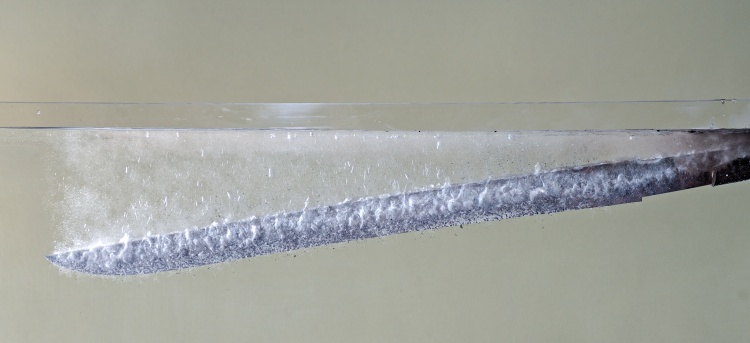
A tanto is plunged into the water during the hadaka-yaki process—yaki-ire, or heat treating, with no clay coating on the blade. (Yoshikazu Yoshihara photo)

Reader questions BLADE® story description of Japanese-style heat treatment

By BLADE staff


    Question: Regarding part three of the “HAMON!” series, page 46, in the November BLADE®: Bladesmithing articles written by observation sometimes lack accuracy. To heat treat tool steel you anneal first, then harden and then temper to change hardness into toughness. That temperature is usually 400°F to 435°F and it is called tempering for about 30 minutes.—Bob Rupert, Pittsburgh, Pennsylvania


    Answer: The author of the series, Leon Kapp, was kind enough to provide the following comments on Mr. Rupert’s letter:

    I described the process exactly as Yoshindo Yoshihara and other swordsmiths in Japan do it (and as I have done it myself). The process is at least 1,200 to 1,400 years old in Japan. It was developed and used for tamahagane—a raw steel made of Japanese iron-bearing sand that requires extensive refinement—and works beautifully for that steel. However, I think a main difference between tamahagane and modern steels is that tamahagane contains only small traces of anything except iron and carbon. Manganese or other elements in the steel might require changes in this process. If done right, the Japanese process hardens the blade all the way through the hamon, and not just near the surface.

    In fact, since all my experience is with Yoshindo and Japanese swords, I am very surprised and do not understand the technical reasons for the complex hardening methods I read about in BLADE or hear about from modern U.S. makers. It appears that Japanese-style yaki-ire (heat treatment) is a relatively simple process, but it does take years of experience to get it right.

    After yaki-ire, the blade is annealed by heating it in the forge, again as described in the story (that is, yaki-modoshi). If that is not done, the blade will be very brittle and even very difficult to polish.

    I think this is a reasonable answer to Mr. Rupert: The article is a detailed description of the process exactly as used in Japanese swords. The process and the steel are both very old and traditional in Japan, and it is done exactly as described—but the yaki-ire process was developed specifically for tamahagane steel.
Anthony Dicristofano (page 12, September BLADE®) has experimented with yaki-ire (Japanese style) for both tamahagane steels and for modern knife steels and told me he can see the differences. (Anthony works with Yoshindo in our backyard forge often during Yoshindo’s visits.) I think an important point to take from this is there are many ways to obtain great results with variations in materials and techniques.

    Oh, and one more point: There is another goal in Japanese and Western hardening. The Japanese method is designed to specifically harden only the edge region. As far as I know, the Western approach usually seems designed to harden or heat treat the entire blade. If yaki-ire were used to harden the entire blade, Yoshindo says the thin Japanese blades would crack or shatter immediately in use.

    Question: How much forging is enough? Is there a point of no return, or even a negative return? I typically start with 1-inch-diameter O1 drill rod for my knives, which I first must reduce to a flat piece of steel in the basic knife shape I want. This takes three-to-four heats to accomplish, and sometimes more depending on the size of the finished knife. Once the basic shape is attained, I then start working in the bevels.

    Is the reduction from 1-inch round to a quarter-inch flat going to give me all the benefits from forging that can be gained? Is the bevel forging simply gratuitous at that point? It occurs to me there must be a point in the process when additional heating and forging causes enough carbon loss to start degrading the steel rather than improving it. (Joshua States, a letter via e-mail)


    Answer (graciously provided by BLADE® field editor Ed Fowler): Starting with a 1-inch round bar should get you up into the 80-point rate of reduction range, depending on the size of the blade. This rate of reduction can definitely get you into the high-endurance performance realm, providing the steel you are using is of decent quality and you do not exceed a temperature of 1,725°F while forging. Forging at low temperatures equals fine grain and no measurable loss of carbon below the surface of the blade—about .002 inch, which is scale that comes off anyway. Forge the blades a little oversized and leave the edge of the blade about the thickness of a nickel for the heat treat (hardening and tempering).

    In our work at my Willow Bow Ranch, we have forged and tested to destruction many 5160 blades from 1-inch round bars (John Deere Load Control Shafts), and can get within 10 percent of the high performance of the blades forged from larger round bars.

    The more forging heats under 1,725°F, the better the performance potential of the steel. I take my bars to only 1,625°F to provide a margin of safety to prevent grain growth. Most of the benefits of forging will come from the round bar to quarter-inch flat bar. Merely forging the bevels only adds another two or three points if you are practicing reduction by forging. You are better off leaving the blades thick to protect the best edge, which will lay under the surface of the “as-forged blade.”

    When I start grinding, I take about the thickness of a dime off the edge of the hardened and tempered blade. The edge surface goes through a lot of thermal cycles and sometimes the best edge lies under the surface.

    As far as I know there is no “point of no return,” but the potential benefits between an 80-point rate of reduction and 99-point rate of reduction are not as significant as a difference between a 10-point rate of reduction and a 30-point rate of reduction. In other words, there is a decreasing rate of benefit, but always a benefit. Picture an ant crossing a table. The first trip he goes only halfway, second trip he goes half the remaining distance and the third trip he goes only half the remaining distance. How long will it take him to get to the end of the table?

    The answer is never. He will always be half the remaining distance to travel to the end, but the length of his trips becomes less each time.

     Send your question to “Ask BLADE,” c/o BLADE, 700 E. State St., Iola, WI 54990, or e-mail [email protected]. We will not print your name if you request it. If your question concerns the value of a knife, please understand it will be almost impossible for us to determine a value from a picture or e-mail image without being able to examine the knife from all angles in person.

    For more on the latest knives, knife legislation, knifemaking instruction, knife trends, knifemakers, what knives to buy and where and much more, subscribe to BLADE Magazine, the World’s No. 1 Knife Publication. For subscription information click on http://www.shopblade.com/product/blade-magazine-one-year-subscripti…?r+ssfb041912#BL1SU.


W.R. Case & Sons Acquires Timberline Knife Brand

GATCO stopped production over the summer. Bear & Son Cutlery purchased the sharpener division and W.R. Case has officially announced that they bought the Timberline knife brand of GATCO.
GATCO, following Spyderco's lead, was a sharpening company that expanded into knives with its Timberline brand.
GATCO, following Spyderco’s lead, was a sharpening company that expanded into knives with its Timberline brand.

W.R. Case & Sons Cutlery Co. in Bradford, Pennsylvania, has purchased the Timberline knife brand from The Great American Tool Company, or GATCO. The plan at Case is to launch a new line of Timberline knives and accessories “into the existing portfolio,” according to a press release issued by Case media contact FJ Feightner. GATCO stopped production over the summer and sold its sharpener division to Bear & Son Cutlery.

“Case is excited to have acquired the Timberline brand assets, and we are developing a comprehensive market strategy around it, which includes future new products and a cohesive integration with the Case brand,” said Mark Paup, president and CEO of Zippo Manufacturing Co. and W.R. Case & Sons.

GATCO acquired Timberline in the early-to-mid 1990s, including knives designed by Timberline’s Vaughn Neeley, such as his folders with the patented NeeleyLock locking system. This transaction followed Spyderco’s lead as a sharpener company that expanded into knives.

Timberline’s specialty was tactical, hunting, utility and kitchen knives, among others. The Timberline Stealth, a tactical folder designed by Neeley, was the BLADE Magazine 1997 American-Made Knife Of The Year®. Here knife designer Swiss Bianco gives a little history of Timberline’s NeeleyLock knives.

Timberline expanded its line to include factory-custom collaborations with knifemakers like Brian Fellhoelter, Tim Herman, Russ Kommer, Greg Lightfoot, Charles Ochs and Butch Vallotton, as well as with designers like Swiss Bianco, George Sessions, Kelly Worden and Dave Young.

Timberline offered a collection of ceramic kitchen knives under the Cape Cod Collection label. In recent years, the company debuted its Javelin and Gas Monkey Garage lines.

Case has been in business since 1889. Its knives have gone from the battlefields of World War II literally to the moon. The company’s expertise is in traditional folding pocketknives, as well as fixed blade sporting knives. In 1981, capitalizing on its unique tang stamp, the company initiated The Case Collectors Club, which now has over 18,000 active members, and is one of the largest known knife collecting associations, according to Feightner.

Steve Shackleford, BLADE editor, contributed to this article.

You Can’t Have Just One Case Knife In Your CollectionW.R. Case & Sons Cutlery Co. has been making pocketknives since 1889.

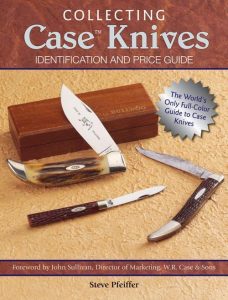
W.R. Case & Sons Cutlery Co. has 18,000 active members in The Case Collectors Club. Read more about the storied history of these traditional pocketknives in “Collecting Case Knives, Identification and Price Guide.”

Advertisement

Must Read Articles

Read this before you make a knife

Knifemaking 101 – Read This Before You Make a Knife

  by Wayne Goddard My experience has taught me that there's nothing like digging in and getting started. I've often said the hardest part of the...
how to forge damascus steel

How to Forge Damascus

Advertisement
Advertisement