
The BLADE Blogs

The blogs of the BLADE editors, Steve Shackleford and Erin Healy.

Irishman uses fossilized bog oak for knife handles

Paddy Smyth of Symth Knives uses a flat grind on this utility knife.
Smyth Knives’ Flat-Grind Utility Knife is made using O1 tool steel, black G10 scales, and blue liners. The blade is 3 inches, and the knife is 7.5 inches overall.

Irishman Paddy Smyth of Smyth Knives in County Roscommon, Ireland, sells 90 percent of his knives through his website to customers in the USA. The other 10 percent are purchased through The Quiet Cailin Studios in Cong, County Mayo, where “The Quiet Man,” starring John Wayne and Maureen O’Hara, was filmed. Some even incorporate ancient bog oak.

Irish Eyes Will Smile Over Smyth Knives

But it was another movie that sparked a love of knives in Paddy growing up. He watched wide-eyed as the work of Gil Hibben’s was deftly wielded in “Rambo III.” It is “my favorite knife of all time, so I have huge respect for [Hibben’s] work,” Paddy commented. He had a week-long visit last year from Jeff Knox,  who trained with Hibben in the US. “He has been a great help to me also with advice and sourcing materials as its hugely difficult to get materials in Ireland,” Paddy added.

Paddy Smyth of Smyth Knives feels at peace when working in his knifemaking workshop.
Paddy Smyth lives in County Roscommon in Ireland and undoubtedly with a name like Smyth has knifemaking in his blood.

He also mentioned that Walter Sorrells’ YouTube channel has been helpful and inspirational.

However, Paddy is a self-taught knifemaker and much of his learning has been by trial and error over the years. “I continue to learn,” he noted. He was trained as a chef and butcher and always had a keen interest in hunting, so he was intrigued by what made a high-quality knife. “So, I basically decided to have a go at knifemaking and caught the knifemaking bug,” he said.

Paddy concentrates on compact pocket and neck knives, bushcrafting and hunting/skinning knives. He makes specialty chef knives to order to client specifications. His favorite steels are O1 an Niolox stainless. He appreciates the consistent finish and heat treat he gets using these steels.

He likes three grinds: Scandi for his bushcrafting blades because it’s easy to maintain an edge; and flat and hollow, according to customer preference, because they both work well for his hunting and skinning blades. For bushcrafters, he chops and batons wood to test for toughness, and then fine-carves paper to verify sharpness. Cutting heavy cardboard with its abrasive quality helps him get a feel for how long his blades will stay sharp. He does ensure his flat- and hollow-ground blades can handle the detailed work of skinning and boning.
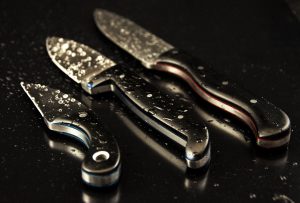
Everyone's Irish on St. Patrick's Day, so feast your eyes on these blades from Paddy Smyth on the Emerald Isle.
The Claw by Smyth Knives, left, is 5.25 inches long, with a 2.2-inch cutting blade. It’s perfect for close skinning/boning/gutting with complete one-finger control.

“My favorite handle material is ancient Irish bog oak, which can be up to 10,000 years old. It finishes really well and has beautiful character and history,” Paddy explained. “It’s very difficult to work with as it’s so hard it’s almost fossilized. And it’s becoming harder to find good pieces. It’s very hard on machinery and tools, but the work is worth the finished product.”

There are no knife shows currently in Ireland, so Paddy sells his work online at www.smythknives.com. Prices range from 90 to 500 Euros plus shipping with discounts for repeat customers. Also, check out the boutique artisan gallery in County Mayo where Smyth Knives are also sold on Facebook. Smyth Knives on Facebook and @smythknives on Instagram are chock full of additional photos and videos. You can call Paddy at 00353 87 6281252.

All Smyth Knives are completely handmade and heat-treated in house. Leatherwork is specific to each knife, so no two creations are the same. Paddy is a retail manager for an oil company based in the west of Ireland. He lives in Roscommontown with his wife, Edel, and their three boys, Shane, Darragh and Cian.
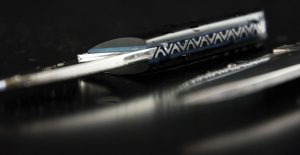
Patty Smyth uses detailed file work on the spine of some of his knives.
The ornate file work on the spine of this knife by Paddy Smyth in County Roscommon, Ireland, is reminiscent of a Celtic pattern.

“When I started making knives, I realized I had found something incredibly natural to me, as if I was meant to do this or was maybe in my blood, as my family name is Smyth,” Paddy noted. “I’m completely at peace when I’m in the workshop.”


Get Your 2017 BLADE® Show Knife Now!
Ken Onion and CRKT collaborated on the innovative Homefront knife.
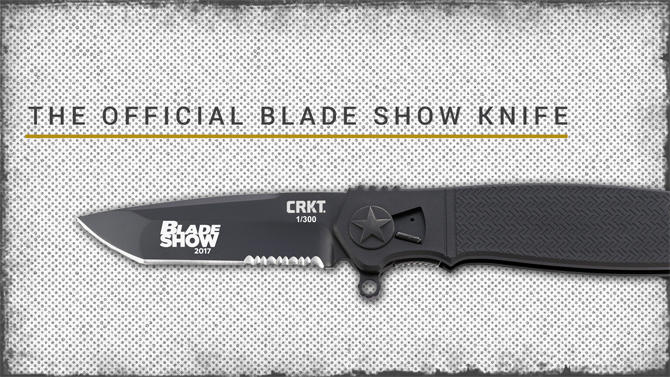
The CRKT Homefront is the 2017 BLADE Show knife. Be sure to get yours now.

CRKT and Ken Onion took home the Most Innovative Imported Design award at the 2016 BLADE Show for the groundbreaking Homefront. Now the Homefront is the official knife of the 2017 BLADE Show. This is a limited run of 300, so hurry! And at $70 you’ll be saving almost 30 percent.

Ball Bearing Lock Secures 2 Pieces Into 1

From left, the ball bearing slides into the channel formed by the blade and the handle as the Spyderco Polliwog is closed. The ball bearing self-adjusts when the knife is opened and/or closed. (David Jung photo)

     The idea of a ball bearing used as a knife lock may seem like a contradiction. Ball bearings are designed to keep things in motion, not freeze them in place. However, it is the shape of the ball bearing that gives the Spyderco Ball Bearing Lock some of its greatest strengths.

     Since variations on knife shapes and handle materials are harder to patent, that leaves lock designs. Borrowing such a design involves paying a royalty. Devising your own lock negates paying the royalty but involves many hours of research, design and testing.

     The Ball Bearing Lock began on paper, progressed to plastic models and then to the metal prototype stage. Throughout the process, the lock’s patentability was considered—though holding a patent does not mean the patent holder is free and clear. Competitors love to pore over a design to look for loopholes to exploit. Defending a patented design is crucial to its economic success. In the end, Spyderco CEO Sal Glesser, a Blade Magazine Cutlery Hall-Of-Fame© member, said he felt his Ball Bearing Lock was different enough to warrant a patent, and the design would be difficult to copy.

     The Ball Bearing Lock and the evolutionary caged Ball Bearing Lock comprise Spyderco’s attempt to develop a robust lock that meets martial blade craft (MBC) standards without being too bulky or hard to open or close. The hardened ball bearing, which is the main element, is allowed to rotate freely throughout its travel. Because it will always be in a different position, wear and tear is greatly reduced. Another benefit is the lock continually self-adjusts with each use. Because of its design, it can be operated on either side of the handle. An additional benefit is the lock is hard to accidentally disengage, which adds to its safety.

     One look at the Ball Bearing Lock reveals the creative thought process required in its creation. “The design objective,” Glesser noted, “was to have a fairly simple, very strong, very reliable folding knife lock.”

How It Works

When the knife is closed, the ball bearing sits in a slightly curved channel. The channel provides the track for the ball bearing, which is pushed toward the blade due to pressure from a small shaft surrounded by a coil spring. Opposite the slightly curved ramp is the other side of the channel, which is formed by the knife blade.

     As the blade pivots, the ball bearing pushes past the resistance of the closed position detent and follows a circular path until the knife approaches the open position. When the knife is nearly open, the blade channel drops away, allowing the ball bearing to push out into the channel formed at the top of the blade. Throughout the travel, the ball bearing rolls unobstructed with the outward spring pressure, providing the resistance to allow the blade to swing freely. In the open position, the pressure to close is surmounted by the ball bearing locking in place, on top by the liner and below by the blade. When the user removes the outward spring pressure by pulling back on the ball bearing, the blade can be pivoted to the closed position. The hardened ball bearing is unyielding under normal use. In the case of the newer models, a cage of a durable proprietary polymer blend surrounds and centers a smaller ball bearing. The lock action is the same.

The Knives

The Ball Bearing Lock debuted in 2002 on Spyderco’s World Trade Center (WTC) Knife, a non-profit fundraiser for victims of 9/11. On the WTC knife and the follow-up D’Allara knife, Spyderco used FRN (fiberglass-reinforced nylon) handles. The FRN made for a fairly thick, though comfortable, knife. Subsequent knives with the Ball Bearing Lock, including the Polliwog, Phoenix and Dodo, used such “flat” handle materials as stainless steel and G-10, which addressed the thickness concerns.

     The first-generation version had a large, hardened ball bearing. Some seemed concerned it took two fingers to easily slide the ball bearing back in its channel. Eric Glesser, Sal’s son, designed the newer version, which addressed the concern by making the ball bearing smaller and enclosing it in the cage that has more grip and a much thinner profile.

     The original Ball Bearing Lock was visibly different than any other lock, and some of the first models using it did not look traditional. Eric’s Polliwog design allows the ball-bearing channel to be open when the knife is closed, making it appear the ball bearing could slip out. Eric’s Dodo design features an ergonomic handle. It is scheduled to return in Spyderco’s carbon fiber and orange G-10 “Sprint Run” versions. The Phoenix, designed by knifemaker Howard Viele, also used the larger Ball Bearing Lock.

     The P’Kal has the caged Ball Bearing Lock, The knife is based on an edged martial arts technique from the Philippines, which involves an “ice-pick” grip with corresponding downward pulling thrusts. Lock strength is crucial in knives used in the martial arts, so the P’Kal needs the MBC-rated lock.

     The knife that has received the most attention of the caged series is the Manix 2. The original Manix knives featured a massive, heavy-duty design. By moving to the caged version of the Ball Bearing Lock, Spyderco changed the Manix in a positive way for everyday carry.

Use & Maintenance

The Ball Bearing Lock takes some getting used to if you are accustomed to LinerLocks™ or traditional lockbacks. Opening is the same as with other Spyderco knives via the blade hole. The difference is in closing. While it is possible to unlock the blade using one side of the lock, the best way is to pull the lock cage back with the thumb and index finger until it releases. Once the lock disengages, the blade can be pivoted closed. “People either like it or they don’t,” Sal observed. “They like the smooth action. They like the strong lock-up. We wanted it functional and easy to open, but I guess ‘not too easy’ would be one way of saying it.”

     Among the advantages of having an exposed lock is ease of cleaning. “We usually just rinse them out and add a drop of oil here and there,” Sal said. “We’ve never had an issue with the spring. These coil springs go a long time, so really there is not much maintenance, other than occasional oil.”

     The Ball Bearing Lock is one of many locks on the market. Others that share similar characteristics include the Bolt Action Lock designed by Cutlery Hall-Of-Famer Blackie Collins, and the Axis lock designed by Bill McHenry and Jason Williams and found on several Benchmade folders.

     “I think all locks compete and have advantages and disadvantages, so I don’t know that one would be better than another,” Sal opined. “Most locks will either slide or rotate; I guess [the Ball Bearing Lock] would be considered sliding, although it is more rolling than sliding that is the action of the lock.”

     Hence, the Ball Bearing Lock takes the contradictory rolling motion of a ball bearing and the sliding of a piston into a channel to lock two pieces of metal into one. It is a contradiction that works.—by David Jung


For more information on the Ball Bearing Lock and the Spyderco knives that have it, contact Spyderco, attn: J. Laituri, 820 Spyderco Way, Golden, CO 80403 800.525.7770 www.spyderco.com, [email protected].


To read similar stories and all about the latest knives, knife trends, knifemakers and much more, subscribe to BLADE®Magazine. For information on how to subscribe, click on http://www.shopblade.com/product/blade-magazine-one-year-subscription-us/?r+ssfb171211#BL1SU

Begg on Discovery Channel’s Blade Brothers Tonight

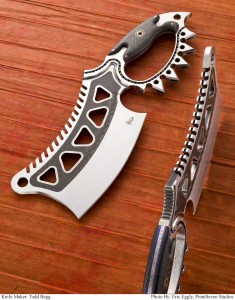
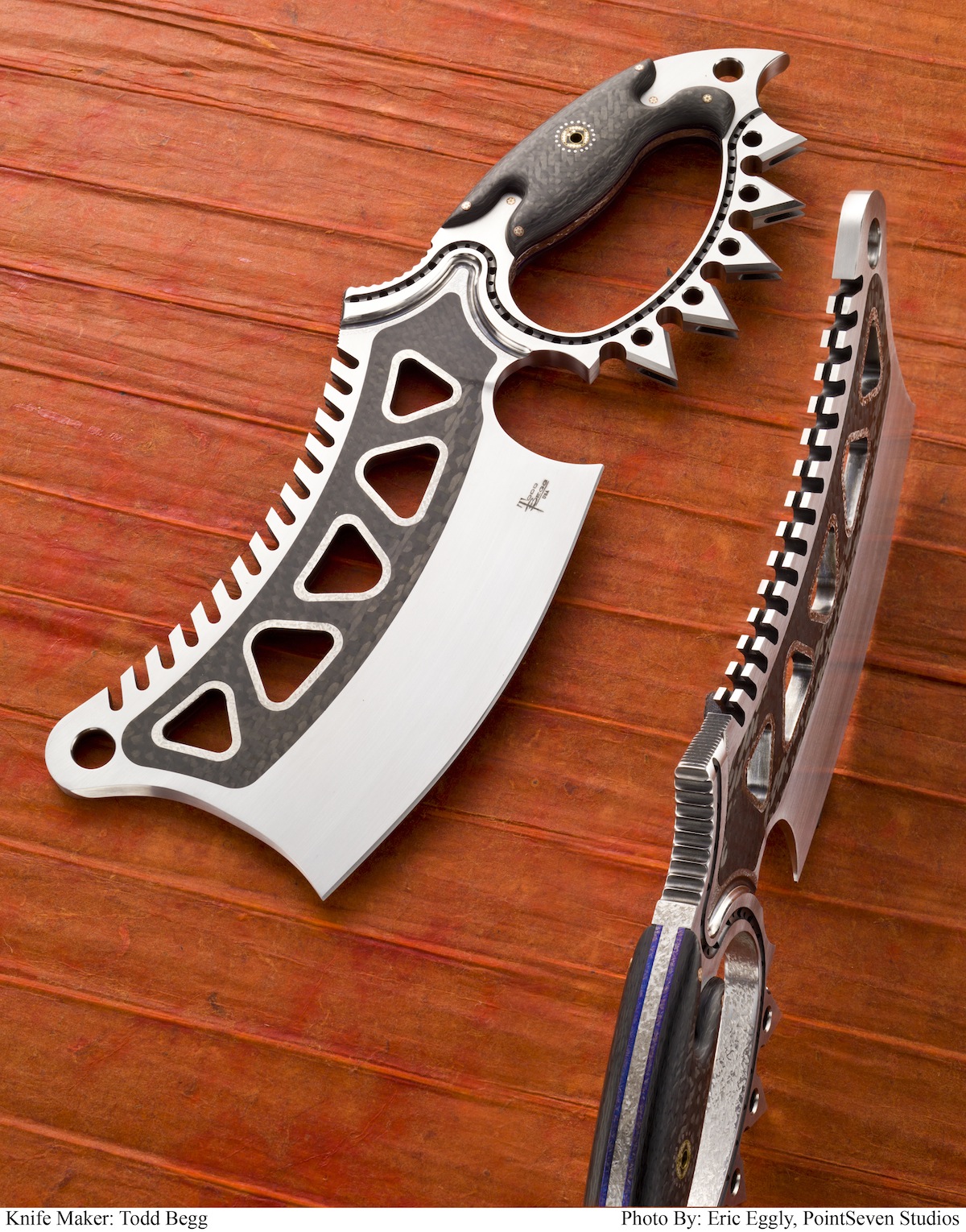
Todd Begg's Best Of The Rest fantasy cleaver from the 2010 BLADE Show. (Point Seven photo)
Todd Begg’s fantasy cleaver, winner of Best Of The Rest at the 2010 BLADE Show. (Point Seven photo)

Award-winning knifemaker Todd Begg will star in the premiere episodes of the Blade Brothers on Discovery Channel tonight at 10 p.m. and 10:30 p.m. EDT. (Check local listings for the times in your area.)

Todd becomes the latest knifemaker to join the ranks of television stars. Larry “The Hammer” Harley is the other, achieving newfound fame as one of the stars of National Geographic’s Lords of War. Both makers will exhibit knives at the 2013 BLADE Show (www.bladeshow.com) and Living Ready Expo May 31-June 2 at the Cobb Galleria Centre in Atlanta.

Winner of a number of awards for his custom knives—including Best Of The Rest at the 2010 BLADE Show for his fantasy cleaver—Begg will be joined by his brothers on the show as he tries to teach them how to help him run the knife business. Since none of Begg’s brothers have ever made a knife before, plenty of hijinks ensue as they learn the ropes in the always challenging business of custom knifemaking.

As he notes on his website, Todd’s interest in knives began at a young age while hunting and fishing with his brothers in the Great Northwest. He later used knives in the military as an NBC Recon team member, where he learned just how important and lifesaving they can be.

Based out of Petaluma, California, Todd specializes in high-grade tactical folders and fixed blades. His patterns include folders, integrals and fighters. He specialzies in flipper folders using the Ikoma Korth Bearing System (IKBS), and his list prices range from $400 to $15,000 per knife. He exhibits his knives at a wide range of knife shows, including the BLADE Show, and has appeared in BLADE Magazine (www.blademag.com) on any number of occasions.

For more information on Todd and makers like him, subscribe to BLADE at

www.shopblade.com/blade-magazine-one-year-subscription-us?icid=SHBLNCF2BL1SU-030613?lid=ssfbbl041913


Thanksgiving Cutters, Japanese Style

Thanksgiving cutters times four
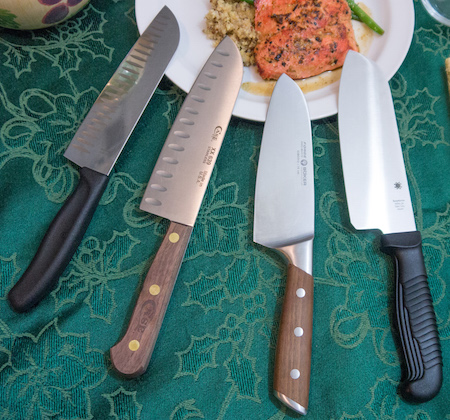
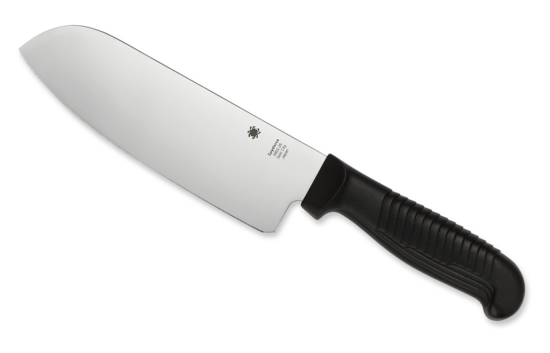
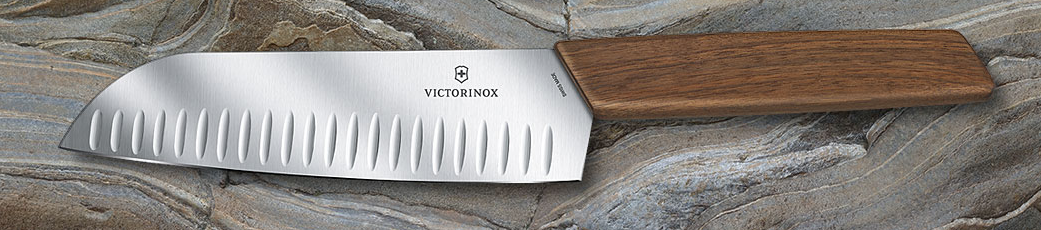
Thanksgiving cutters, Japanese style, from left: Victorinox SwissClassic Santoku, Case Santoku, Boker Forge Santoku Maple and Spyderco K08 Santoku.

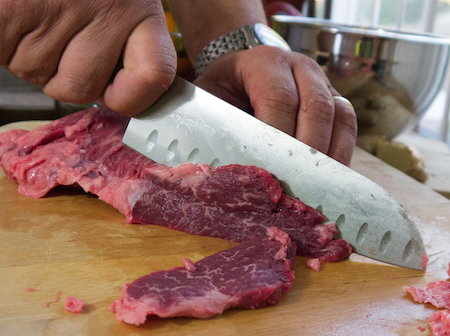
Santokus are Thanksgiving cutters, Japanese style. A design that originated in the Land of the Rising Sun, the santoku is a specialized tool well suited to preparing holiday meals. From cutting meat to dicing veggies and cutting fruit for creative holiday salads and such, santokus are perfect for Gobbler Day.

Santokus have a wide blade sometimes with scallops, which are supposed to create less friction than a solid blade, a sheepfoot tip, and are lighter and thinner than a French or German chef’s knife. Their length runs between 5 and 8 inches. The Thanksgiving cutters do not have a bolster. They have a straight edge with no curve.

San-to-ku is Japanese for the three cutting tasks for which the knife is designed: slicing, dicing and mincing. It is a specialized knife that, in the Japanese view, is optimized for the three aforementioned tasks. The straight edge of a santoku does not allow for the rocking motion commonly used with a French or German chef’s knife.

Cuts are made straight down with little or no forward movement, almost a guillotine action, which, again in the Japanese view, allows slicing very thin pieces of whatever’s being cut with precision. The Thanksgiving cutters are not meant to be all-around kitchen knives. An all-around knife used to cut many things is not a Japanese concept. The Japanese chef will typically have a vast array of knives, each one designed for a specific function.

Japanese kitchen knives typically have a chisel grind, which also contributes to cutting very thin slices with precision, as you may have seen sushi chefs do. The chisel grind is optimal for slicing, say, very thin slices of turkey, with the caveat that there are left and right grinds. If you are right handed you’ll need a blade ground on the right side. The chisel grind doesn’t work well for cutting through thick media, such as roasts and ribs because the chisel grind—since the edge is off center—will cause the blade to cut off center, and to wander. Also, the thin edge of a Santoku should not be used to cut through joints or bones, or to disjoint, say, a chicken.

HAPPY MARRIAGE

Thanksgiving cutters, Boker
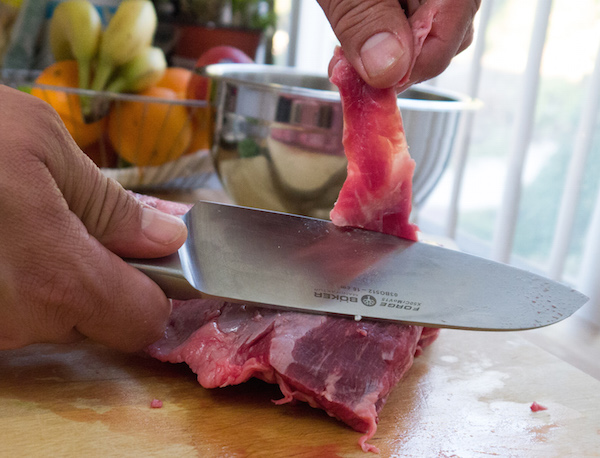
One reason santokus make such good Thanksgiving cutters is their ability to cut small meat slivers. The Boker Forge Santoku Maple is a classic example.

With its hefty blade, full tang, nicely sculpted bolsters and maple scales, the Boker Forge Santoku Maple is a happy marriage of a classic santoku and a German or French chef’s knife. While it lacks the acute point of a chef’s knife, the slight point is usable. The edge does have somewhat of a curve, which allows the rocking motion Western-trained chefs, and many domestic home cooks, are accustomed to using. It is the only one of the four knives reviewed that I would use to cut through pork rib joints, chicken backs, etc. The Boker is almost a mini cleaver as well as being an excellent slicer. It is a handsome knife and comfortable for long periods of work.

Thanksgiving cutters, Boker
Thanksgiving cutters must be adept at slicing veggies, and the Boker Forge Santoku Maple is that and more.

STURDY STUDY

With its walnut scales and full tang, the Case model is also a sturdy example of a Santoku. It has a barely perceptible curve to the edge and a scalloped blade. The Case looks more like a classic santoku than the Boker, but like the Boker has a thicker blade than a standard Japanese santoku. It felt solid in hand and while not as sculpted as the Boker, the traditional American handle was comfortable during extended use. The Case sliced, diced and minced as well as thin-bladed Santokus while giving the impression that it would be up for harder work if need be.

Thanksgiving cutters, Case
Thanksgiving cutters must be able to tackle meat slicing and the Case Santoku is a prime-cut cutter.

21st-CENTURY SHARP

spyderco chef's knife
Spyderco image

With its wide blade, classic Santoku profile, comfortable, molded grip and graceful overall appearance, the Spyderco K08 looks like a 21st-century interpretation of a classic—which is pretty much what it is. It is a very lightweight knife with an extremely thin blade, which is optimal for doing what a santoku is supposed to do. The Spyderco does have a slight curve toward the tip, which I think adds to its smooth lines. Since I am accustomed to using a French or German chef’s knife, the curve also made it easier for me to work my way through piles of squash and mushrooms, especially mushrooms, which I find hard to slice. The blade also made it easy to slice salmon smoothly and evenly.

ENTRY-LEVEL PRO

Victorinox chef's knife
Victorinox image

Victorinox makes the knives The American Culinary Institute gives to its students: chef’s knives, paring knives, bread knives and, yes, santokus. Pro chef Shawn Carlson’s first professional knife roll contained only Victorinox knives. So, he was familiar with the Victorinox characteristics: thin profile, very sharp, fairly soft steel that requires frequent steeling but which comes back to a fine edge quickly, and which does not chip if dropped on a kitchen floor. It has the standard santoku shape: flat edge and sheepfoot tip rather than a curved profile and pointy tip. I missed a curved edge and had trouble adjusting to the flat straight edge. Shawn did not—again, a pro is a pro. It is an entry-level professional knife.

FLAIR GAME

If you enjoy cooking and take pleasure in using specialized tools, you’ll find a santoku a welcome addition to your quiver of Thanksgiving cutters—keeping in mind that a santoku is a specialized tool. If you like to keep things simple, an 8-inch chef’s knife and a 4-inch paring knife will do most any kitchen job—if not with the flair of a santoku.

Midweek Maker Military-Style: Chris Rowley

Chris Rowley owns Nomad Customs in Rainier, Washington.
In the second of BLADE’s Midweek Makers series we continue with our armed forces active-duty members and veterans. This week: Midweek Makers Military-Style: Chris Rowley of Nomad Customs.

Chris Rowley was a farrier for 12 years or more before he joined the Army at age 34. During his seven years of service he deployed six times to Afghanistan with 2nd Battalion, 75 Ranger Regiment, winding up his service this year as a weapons squad leader with the rank of staff sergeant.

He always loved blacksmithing and found time after work and on weekends to keep his hand in it by making knives. “Pretty soon half of 2nd battalion had one of my knives,” he said.

When Chris entered blacksmithing competitions, his horseshoes were hammer-finished, essentially going from the forge to horse. He tries to carry those shaping skills over to his knives, completing as much work in the forge as possible. Although not applicable with all steels or designs, many of his knives maintain a richly textured hammered finish.

Chris lives with his wife in Rainier, Washington.

  • Best-selling knife patterns: small everyday carry knives and 4- to 10-inch bowie-fighters
  • Favorite blade steels: 1084, 1075 and 15N20 for ease in forge-welding and the contrast with 1084 and 15N20; also W2
  • Blade grinds: hollow and flat
  • How he tests his knives: cardboard and random materials for everyday carry knives; chopping kindling and prepping game for camp-oriented knives
  • Favorite handle materials: resin-and-burl-wood combinations by Voodoo Resins and J Hue Customs. “Both finish really well,” he added.
  • Price range: $275 and up
  • Forums he participate in: BladeForums.com
Chris Rowley of Nomad Customs was a farrier for 12 years before joining the U.S. Army.
The diamond hole you see in Nomad Custom knives is representative of the U.S. Army unit in which knifemaker Chris Rowley served, 2nd Battalion, 75th Ranger Regiment.

This knife has a 9-inch flat-ground forge-welded blade of 1084 and 15N20 steels. The handle is made of redwood burl with Voodoo Resins spacers and G10 liners. His maker’s mark is a diamond cutout to represent the Ranger Battalion emblem. Maker’s list price: $500 with sheath.

Watch Chris Rowley Cut Out His Maker’s Mark

The diamond-shaped insignia is used to represent the battalion within the Ranger Regiment. Often in comments, you will see it typed as < 2 > for 2nd Battalion, for example.

The Scroll Factory sells all kinds of U.S. Army Ranger apparel and accessories.
This sticker, offered by Scroll Factory, shows what the 2nd Battalion, 75th Ranger Regiment diamond looks like that bladesmith Chris Rowley of Nomad Custom Knives & Tools cuts out of his blades as his maker’s mark.


Contact Chris Rowley, [email protected], on Facebook at Nomad Customs and Nomad Custom Knives & Tools and on Instagram @nomadcustoms03.

Subscribe To BLADE For More Stories Like This

A U.S. subscription to BLADE magazine, 13 issues, is $21.98.
An annual U.S. subscription to BLADE is $21.98. You can get your 13 issues sent to Canada for $39.98 and internationally for $49.98. Or go green and get your issues sent digitally for $17.98.

A one year’s subscription to BLADE will ensure you’re the first to read all six Knifemaker Showcase stories. You’ll also get the latest knife news, knifemaking how-tos, knife reviews, plus knife history and articles that tap into the knowledge of both the legends and the up-and-comers. Don’t miss out. Subscribe.

Midweek Maker Forged-Style: Tyrell Johnson

Tyrell Johnson has always been interested in knives and firearms, and two-plus years ago he decided to take a knifemaking class at Montgomery Community College in North Carolina.  “As my wife can attest, I’ve had many hobbies in my life, but knifemaking immediately struck a chord with me,” he commented.  “I knew right away that this was what I was meant to do, and I’ve been making knives ever since. I eat, drink and sleep knives.” Travis Daniels, of TED Knives, has been a helpful mentor to him. Tyrell does both stock removal and forging, and especially enjoys forging brut de forges.

Tyrell Johnson of Tyrell Johnson Knives has enjoyed numerous hobbies, but none have captured his imagination like knifemaking.
Tyrell Johnson is a relative newcomer to knifemaking, but he loves both forging and stock removal. His 5-year plan is to retire and devote himself full-time to knifemaking.

Tyrell currently works full time as a waste treatment plant operator, but in five years he expect to retire and focus fully on knifemaking.

• Best-selling knife patterns: drop-point hunters, kitchen and filet knives

• Preferred blade steels: W2, 1084, 1095. “I love carbon steel. It has a great history and the keeness of the edge is hard to beat,” Tyrell noted.

• Blade grinds: hollow for slicing, flat for durability

• How he tests his knives: cutting paper, shaving hair, chopping wood

• Favorite handle materials: Micarta, exotic woods, burl wood, resins—“I love working with the scales produced by J Hue Customs by Tim Kipps,” Tyrell added.

• Price range: $150-$350

• Knife shows he attends: BLADE Show

• Member of: North Carolina Custom Knifemakers Guild, American Bladesmith Society

Tyrell hand-makes all his sheaths from premium 8-ounce leather or Kydex.

Tyrell Johnson is a newcomer to the art of knifemaking, but he's committed.
This brut de forge has a 4.25-inch hollow-ground blade forged out of 1084 carbon steel. The scales are fashioned from desert ironwood. The overall length is 8.5 inches. Maker’s list price: $275 with leather sheath.
Contacts listed at the bottom of this article.
Lisa Johnson has watched her husband, Tyrell Johnson, go through many hobbies, but he loves knifemaking and is sticking with it.
Tyrell Johnson and his wife, Lisa, sneak away for some trout fishing.
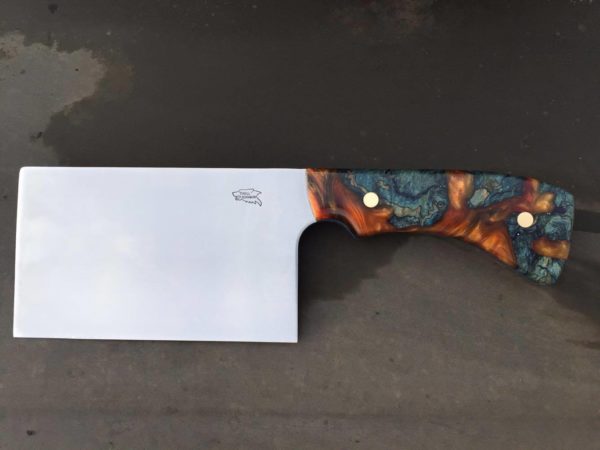
Tyrell Johnson Knives' cleaver has a 6-by-3-inch blade made out of 1095 steel.
Tyrell Johnson’s cleaver has a 6-inch edge on a 3-inch wide 1095 carbon steel blade. The resin-breech wood scales were made by J. Hue Customs. The cleaver is 10.5 inches overall. Maker’s list price: $225-$250. Contacts listed at the bottom of this article.
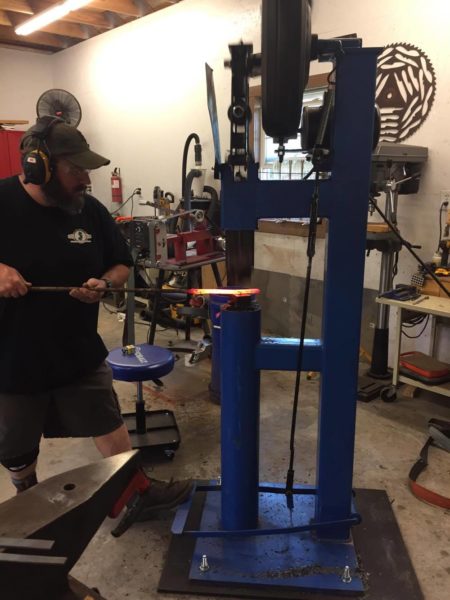
Tyrell Johnson of Tyrell Johnson knives makes his own san mai steel.
Tyrell made some san mai steel, sandwiching 1084 with mild steel. He wanted to try out his new tire hammer.
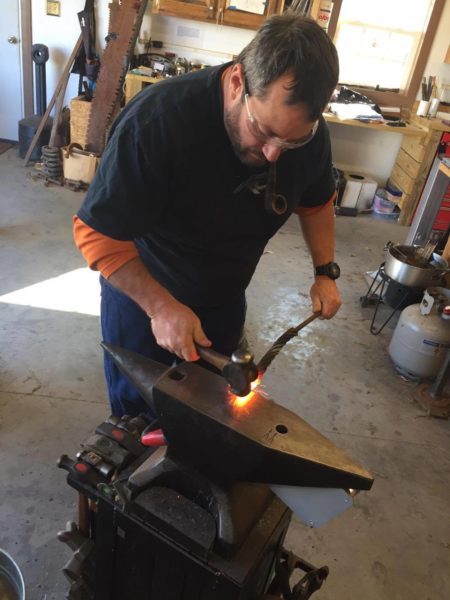
Tyrell Johnson makes his own pattern-welded steel.
Tyrell Johnson forge-welds some cable-pattern steel in his North Carolina shop.

Tyrell made a combat knife for the North Carolina Custom Knifemakers Guild’s cutting competition last spring. The knife could not be longer than 15.5 inches overall with a maximum blade length of 10 inches. At least one visible pin had to pass through the handle, a tang was required and the knife had to have a lanyard hole with wrist lanyard and be accompanied by a sheath and zippered pouch.

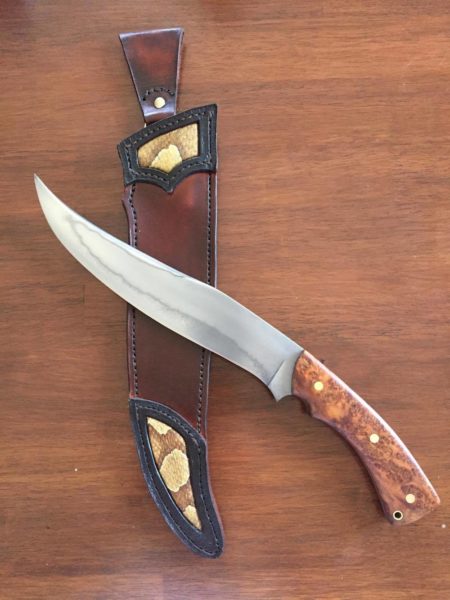
Tyrell Johnson made this knife for a cutting competition.
This Tyrell Johnson Knives’ Fighter was made using 1084 steel. The knife was 15 inches overall with a 9.75-inch blade. Tyrell used ambrosia maple burl for the handle. The sheath was 8-ounce premium leather with eastern North Carolina copperhead skin inset. “I personally harvested and processed” the snakeskin, Tyrell explained. Travis Daniels taught Tyrell how to make his own sheaths.

Contact Tyrell Johnson, 252-341-4791, [email protected], on Facebook at Tyrell Johnson and on Instagram @Tyrell_Johnson_Knives


A Digital Subscription to BLADE Is The Answer

Save $4 off the print price of a annual subscription to BLADE Magazine with a digital subscription.
You can read your digital issues of BLADE Magazine anywhere you have your phone, tablet or computer, and there’s no need to find storage for all your old issues.

If piling-up issues of magazines seems like a waste to you… If you feel like you don’t have time to read a magazine… If you like the stories we offer in BLADE, but want a more economical option, then a digital subscription is the answer. An annual subscription to BLADE is $17.98, $4 off the print price.

Medieval Diners Sang Grace From Notation Knives

The V&A Museum in London is in possession of a rare notation knife.
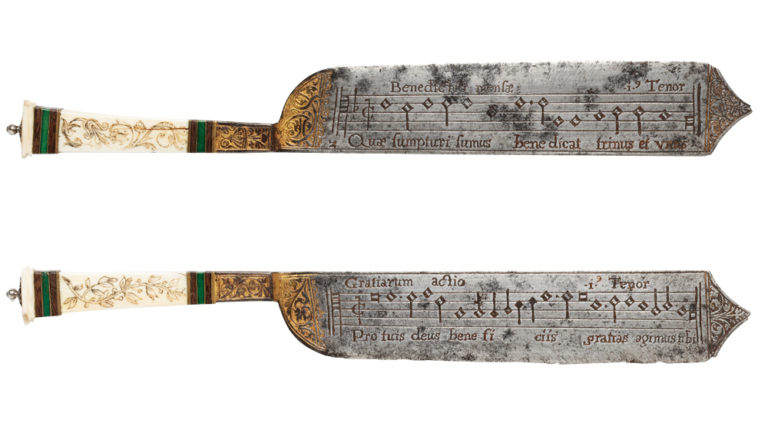
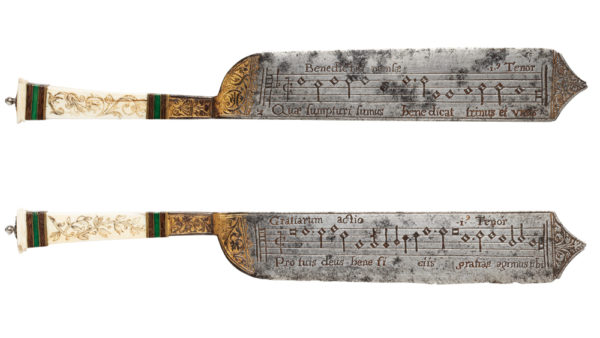
Notation knives dating from the mid-16th century were used to sing a pre-meal blessing and a post-meal grace. This example is on display at the Medieval and Renaissance Galleries at the Victoria & Albert Museum in London.

They’re called notation knives, and they’re engraved with what amounts to sheet music for multi-voiced song. They’re indicative of the formal role music played in medieval dining, according to Flora Dennis, an art historian and author of the book “Re-thinking Renaissance Objects: Design, Function and Meaning.” Holding the knife in the left hand, edge up, diners could see the notes and lyrics for the benediction, or blessing, sung before a meal. After the meal, again held in the left hand, edge down, the knife showed the music for the grace, thanking God for his generosity. Since cutting was done with the right hand, the knives may have been ritualistically transferred to the left hand, or they may have been solely used for singing purposes. Dating from the mid-1500s, one notation knife is on display at the Medieval and Renaissance Galleries at the V&A (Victoria & Albert) Museum in London, where Ms. Dennis works. There are others—seven in Paris, three in Philadelphia, two in The Hague, one in Austria, some in private collections—but as much as is known, much more remains unanswered about these rare items.

In addition to the 16 surviving notation knives, there are also written references to at least four others, according to Ms. Dennis. Essentially, though, the knives have been overlooked by historians because they don’t fit neatly into either “knives” or “music” and have been relegated to curiosity status. All the notation knives share a similar look. The steel blades are broad with straight spines and triangular points on center. According to V&A curator Kristen Kalber they may have been used to proffer a slice of meat to a diner, the point skewering the serving. Then again, squires normally carved meat and that was a highly skilled, status-imbued position. Carving rose to the level of entertainment with offerings carved from cooked fowls and beasts held aloft on forks. So, while some knives seem not to have been used other than to sing from, others show wear on the point and were definitely used.

Museum Curator And Historian Bring Notation Knife To Life

In this 2009 video V&A Museum curator Kristen Kalber shows the notation knife in the museum’s collection and demonstrates its use. Flora Dennis, an art historian at the museum, discusses the project that allowed the music on the knife to be recorded. Ms. Dennis holds a PhD in musicology, specializing in early music, and through an Arts and Humanities Research Council grant she was able to convert the music into modern notation, and then work with the Royal College of Music to bring it to life.

The points and the bolsters are engraved with leaf scrolls and strapwork, often gilded. The handles are made of ivory and green-dyed horn or bone with copper or brass spacers. The ivory is decorated with foliage, empty tablets of scrolls, Arabic or Moorish designs or winged cherub heads inlaid in black. The pommels are adorned with silver spherical knobs. The engravings are usually in Latin, though some are in the vernacular. The one from the V&A reads Benedictio mensae (The blessing of the table) on one side and Gratiarum actio (The saying of grace) on the other. The musical stave runs the length of the blade. In the upper right is the voice part, in this case “Tenor.” What this means is that there were different knives for different voices, in some cases as few as five or six or substantially more than 20.

Royal College Of Music Singers Record Two Versions Of The Meal Benediction


Knifemakers across Europe at the time would have been members of guilds and were specialized. Handles would have been made separately and assembled by the cutler who sold them. Ms. Dennis’ writings detail how challenging it can be to pinpoint where the notation knives were made or by whom. Knives were being made in Solingen and Nuremberg, Germany, and in Milan and Brescia, Italy. Possible guild marks show up in the form of arrows, fluers-de-lis or clovers, and etched Ns can be found on many of the blades, but those are more likely an engraver’s mark. One of Ms. Dennis’ knife consultants intimated that a Nuremberg mark would be on the tang, not the blade. The best guess is that they were made in France, with Italianate influence or for an Italian patron.

Were the knives collected after the gathering or did each singer keep his or her knife? In Ms. Dennis’ summation, judging by the scattering of surviving pieces, the latter might be more likely. It could also be that the knives were made for a group, such a monastery. In some instances, the strict, mass-like approach to such a shared meal could result in latecomers being fined for missing the benediction. What is clear is that the knives are not all from the same musical piece; there are two separate pieces of music represented by the known notation knives.

Royal College Of Music Singers Record Two Versions Of The Meal Grace


Interestingly, the notation knives are representative of both coming together and separating. It is the very nature of a knife to cut apart, but in this instance it is for the purpose of sharing, both repast and praise.

As Ms. Dennis writes:

“Benediction and Grace texts are inherently collective, expressing notions of conviviality and sharing. The knives reiterate this idea, needing to be brought together in a social context in order for their music to function. Simultaneously, however, they represent a contradictory action of dismembering and dividing. By slicing meat, the knives permit it to be shared between the gathered company in the same way that dismembering and scattering the musical text across the knives enabled a group to perform it collectively. The acts of uniting to say the Benediction and Grace, uniting to eat, and uniting to sing become inextricably intertwined with those of separating, dividing and sharing both meat and music.”

Bladecrafting Collection Includes 6 Classics

The 6-volume bladecrafting collection is available at less than half its normal cost.
The Bladecrafing Ultimate Collection includes two paperbacks and four ebooks for $34.99

Makers can’t go wrong with this collection. You’ll get two paperbacks: the third edition of “Blade’s Guide To Making Knives” and “How To Make Knives; and four e-books: “Greatest Loveless Knife Designs,” “Knife Grinding Secrets,” “Making Everyday Carry Knives” and “Fashioning A High-Tech Folding Knife.” Normally, this collection would cost over $70, but you can get it for half that.


Advertisement

Must Read Articles

Read this before you make a knife

Knifemaking 101 – Read This Before You Make a Knife

  by Wayne Goddard My experience has taught me that there's nothing like digging in and getting started. I've often said the hardest part of the...
how to forge damascus steel

How to Forge Damascus

Advertisement
Advertisement